The Underground University: How Two Imprisoned Priests Kept Catholic Theology Alive Without a Single Classroom
Church History • Czechoslovakia • Catholic Intellectual Resistance • A Documented Deep Dive
The Underground University: How Two Imprisoned Priests Kept Catholic Theology Alive Without a Single Classroom
One priest got a life sentence for writing an essay. The other spent nearly fourteen years in uranium labor camps. The regime that imprisoned them controlled every legal seminary, every publishing house, and every teaching license in the country — and still could not stop either man from teaching until the day Communism itself collapsed.
At a Glance
- Oto Mádr
- 1917–2011 • Arrested June 1, 1951 • Life sentence • Released 1966
- Josef Zvěřina
- 1913–1990 • Condemned 1952 • Jáchymov uranium camps • Released Nov. 1965
- Combined Prison Time
- Roughly 29 years between the two men
- Underground Journal
- Teologické texty — edited principally by Mádr
- Charter 77
- Zvěřina an early signatory, 1977
- Advised
- Cardinal František Tomášek, Archbishop of Prague
- Zvěřina's Final Public Act
- Addressed 500,000+ in Prague, Dec. 1989, at Václav Havel's invitation
- Zvěřina Died
- August 18, 1990 • posthumous Order of Masaryk, 1991
A University With No Building
The Communist assault on Catholic education in Czechoslovakia did not end with confiscated schools and restricted seminaries. It went a layer deeper: theology itself became a controlled activity, because a government capable of deciding which faculty could operate, which professor could teach, and which priest could obtain a license to minister possessed enormous power over the intellectual life of the visible Church. Two men understood that problem with unusual clarity, and neither accepted the state's terms for surviving it. Fr. Oto Mádr and Fr. Josef Zvěřina were both theologians, both endured long imprisonment for it, and both spent the rest of their lives helping build a clandestine theological culture that operated entirely outside the structures the regime controlled.
The War Within the Church: Communism, Infiltration, Persecution, Resistance, and the Spiritual Battle for Catholicism calls this network the underground university, and the name is not a metaphor. This article tells their full story, drawing on the book's research and building outward with the documented facts of how it all ended.

Part II
Oto Mádr Refuses the Faculty the Regime Would Permit
Oto Mádr was born on February 15, 1917, and ordained a priest during the Second World War, in 1942, after studies at the Archbishop's high school in Prague's Bubeneč district and the Charles University School of Theology. After the war he went to Rome to study moral theology at the Gregorian University, returning to a Czechoslovakia already transformed by Communist political control. When the new authorities reorganized Catholic theological education under direct state supervision, Mádr made a decision that would define the rest of his life: he refused to accept a teaching position within the government-approved structure, choosing prohibited pastoral and educational work among university students instead.
That refusal mattered for a reason that goes beyond personal conscience. A government-supervised theological faculty could maintain every outward appearance of legitimate Catholic education while quietly excluding exactly the theologians the state considered dangerous. By declining to participate, Mádr was not rejecting Catholic education itself — he was refusing to let an official classroom's continued existence conceal the actual loss of intellectual freedom happening inside it.
Part III
A Word About This Time: A Life Sentence for an Essay
In 1951, Mádr wrote a clandestine text titled Slovo o této době — "A Word About This Time" — attempting to help ordinary Catholics understand the historical moment they had entered and think theologically about Christian responsibility under a regime whose ideology grew more openly hostile to independent Catholic life by the month. He was arrested on June 1, 1951. The following year, a Communist court sentenced him to life imprisonment. He remained in prison until his conditional release in 1966, spending roughly fifteen years removed entirely from the intellectual and ecclesiastical work he had trained his whole life to do.
The severity of that sentence reveals exactly how threatening intellectual formation appeared to the regime. Mádr commanded no army and held no government office. His ability to teach young Catholics how to interpret the political and spiritual world around them was, on its own, judged serious enough to help justify a life sentence. The state could imprison the theologian. It could not erase the questions he had already raised — questions that, if anything, grew more urgent while he was gone, because an entire generation of Catholics had grown up inside the very system he had tried to help them understand before his arrest.
Part IV
Josef Zvěřina and the University Behind Bars
Josef Zvěřina followed a path just as difficult as Mádr's. He was condemned by the Communist regime in 1952 and passed through prisons and the uranium labor camps of the Jáchymov region — among the harshest forced-labor sites in the entire Communist bloc — before his eventual conditional release in November 1965. Imprisonment did not stop his theological work. The Czech Institute for the Study of Totalitarian Regimes identifies him as one of the central figures in what historians call the "prison university": an informal intellectual and religious culture in which imprisoned scholars, priests, and educated political prisoners taught one another directly, behind bars.
That phrase captures a genuinely unintended consequence of Communist repression. By concentrating priests, theologians, scholars, and other educated prisoners together inside the same camps, the state inadvertently created communities in which men stripped of books and classrooms could still exchange serious knowledge, person to person. Zvěřina participated fully in that hidden intellectual life and returned to writing and underground pastoral work the moment he was released, resuming exactly the vocation the state had spent thirteen years trying to interrupt.
Part V
A Brief Opening, Then Another Closing
The Prague Spring of 1968 gave both men a short window back into public intellectual life. Zvěřina organized theological lectures, taught at the theological faculty in Litoměřice, and worked alongside Mádr on a theological journal called Via. The opening did not last. After the Warsaw Pact invasion later that year and the political "normalization" that followed, independent Catholic intellectual activity came under intense renewed restriction, and in 1974 Zvěřina lost the state permission required to exercise public priestly ministry at all.
The government almost certainly expected that prohibition to silence him. Instead, the Institute for the Study of Totalitarian Regimes describes the years immediately following as the most productive phase of Zvěřina's entire life: he organized unofficial theological circles, lectured privately, wrote extensively, and taught Catholics entirely outside any structure the government could supervise. The same pattern that shaped his years in prison repeated itself in freedom. Legal exclusion did not eliminate his activity. It simply pushed that activity into a form the state found much harder to regulate.
Part VI
Theology Moves Into Apartments
Through the late 1970s and 1980s, Mádr became one of the leading organizers of unofficial Catholic theological education and samizdat publishing in the entire country, coordinating a network of domestic collaborators and foreign contacts to sustain an intellectual life the official religious system simply could not provide. Secret theological courses let lay Catholics, priests, religious, and future intellectual leaders study subjects that had no place in any government-controlled institution. Teachers traveled quietly between cities, manuscripts circulated hand to hand, foreign theological books were reproduced or summarized from memory, and private apartments became temporary classrooms in exactly the same way they had already become temporary chapels elsewhere in the underground Church.
Mádr became the chief editor of Teologické texty ("Theological Texts"), which developed into one of the most important underground theological periodicals in Czechoslovakia, circulating serious material entirely unavailable through official publishing channels. This underground intellectual life did more than preserve isolated devotional knowledge. It sustained real Catholic theology, philosophy, pastoral thought, ecclesiology, and ethics across decades when the regime had tried to control every legitimate venue where such education could occur — and, in an ironic twist, secrecy sometimes produced more genuine intellectual freedom than the official system ever offered, since a private seminar meeting without state approval could discuss questions an officially employed professor might avoid simply because his teaching license depended on the government's continued goodwill.
Part VII
Zvěřina Signs Charter 77
Zvěřina's resistance eventually reached beyond explicitly Church-focused activity altogether. In 1977, he became an early signatory of Charter 77, the Czechoslovak human-rights initiative that challenged the government to respect rights it had already publicly committed itself to uphold on paper. That decision placed him inside a genuinely broad dissident coalition, standing alongside secular intellectuals, former Communists, artists, and other critics of the regime around a shared commitment to truth, law, and human dignity.
The significance runs deeper than personal courage. Catholic opposition, through moves like this one, was becoming part of a wider moral challenge to the Communist state's control over public reality itself, and that shift deprived the government of an old and previously effective propaganda weapon: it became far harder to portray Catholic resistance as merely reactionary clergy trying to recover lost institutional privileges once priests were standing beside secular dissidents demanding basic civil and human rights for everyone.
Part VIII
The Hidden Advisers Around Cardinal Tomášek
By the 1970s and 1980s, Mádr and Zvěřina had become trusted advisers within the orbit of Cardinal František Tomášek, Archbishop of Prague. Tomášek had survived Communist persecution cautiously and maintained a restrained public posture for years, but during this later period he developed into one of the most important public opponents of the regime's religious policy in the entire country. Participants in the Czech underground later identified Mádr and Zvěřina among the priests who became his trusted advisers, connecting the visible Archbishop of Prague with an unofficial Catholic intellectual and dissident world operating entirely outside state-approved Church structures.
The symmetry with Communist strategy elsewhere in this history is genuinely striking. Security services had spent decades trying to surround bishops with acceptable clergy, informants, and intermediaries capable of shaping what a bishop knew and how he acted. The underground Church built its own countervailing network of faithful theologians capable of quietly advising a bishop from entirely outside the channels the state preferred him to rely on. A bishop who had once seemed manageable to the government eventually became a powerful public defender of religious liberty, and part of that transformation happened precisely because trustworthy people had finally succeeded in reaching him.
Part IX
Half a Million People, Then a Death Within the Year
The ending of Zvěřina's story is one of the most striking in this entire history. In October 1988, he was awarded an honorary doctorate in theology by the University of Tübingen — collected on his behalf by a friend, since he still could not travel freely. Then, in December 1989, during the massive popular demonstrations that were bringing down Communist rule in Czechoslovakia, Václav Havel personally invited Josef Zvěřina to address a crowd of more than half a million people gathered in Prague. A priest the state had imprisoned for nearly fourteen years and then stripped of his ministry license for the next fifteen stood before the largest audience of his life just weeks before the regime that had done both of those things to him ceased to exist.
He did not have long to enjoy the freedom he had helped make possible. In 1990, he returned briefly to the Theology Faculty of Charles University, the institution he had been barred from for nearly four decades. He died during a trip to Italy on August 18, 1990, and is buried in a common grave with a community of nuns in Prague's Vyšehrad cemetery. In 1991, the new democratic Czechoslovak state posthumously awarded him the Order of Masaryk.
Oto Mádr lived to see far more of the world his work had helped build. He returned to Charles University's Theology Faculty alongside Zvěřina in 1990, and after his friend's death that same year, continued the work largely alone for another two decades, still serving as editor of the theological project he had built underground. He died on February 27, 2011, at the age of 94 — nearly sixty years after a Communist court sentenced him to life in prison for writing a single essay about how Catholics should understand their own historical moment.
Part X
What's Inside The War Within the Church
Mádr and Zvěřina's story is chapter 8 of thirty-nine in The War Within the Church, positioned immediately after the account of Tomislav Kolaković and the Slovak Secret Church, because together the two chapters make the same underlying case from two different angles: Kolaković's network shows how ordinary Catholics preserved community and formation under persecution, while Mádr and Zvěřina show how the Church's actual intellectual and theological life survived the same conditions. The book closes with eight full evidence appendices and a complete chronology, so every date and claim summarized here can be checked against its original source.
Frequently Asked Questions
Oto Mádr, Josef Zvěřina & the Underground University — Q&A
A Life Sentence Could Not Stop One Man From Teaching. Fourteen Years in a Uranium Camp Could Not Stop the Other. Neither Ever Really Stopped.
Oto Mádr and Josef Zvěřina lost decades of their lives to a state that understood exactly how dangerous real theological education could be. Neither man ever agreed that the state's permission was required to keep teaching anyway. Their story is one of thirty-nine chapters in The War Within the Church.
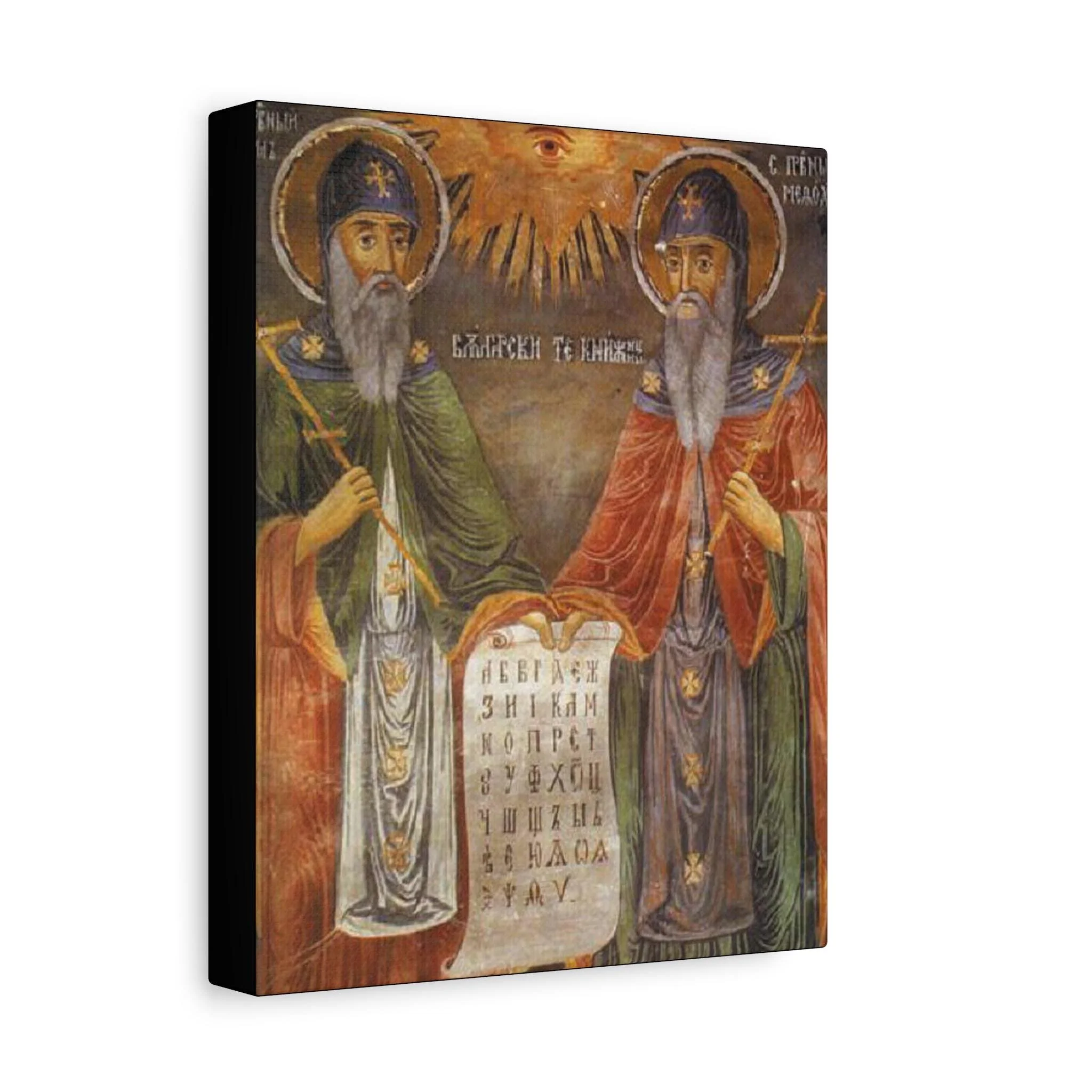
Read the full documented case. Then hang the icon of the saints who first brought learning to the Slavic peoples, and wear the shirt of the Doctor of the Church who proves that learning was always worth the fight.
Get The War Within the Church on Amazon →