 Image 1 of 1
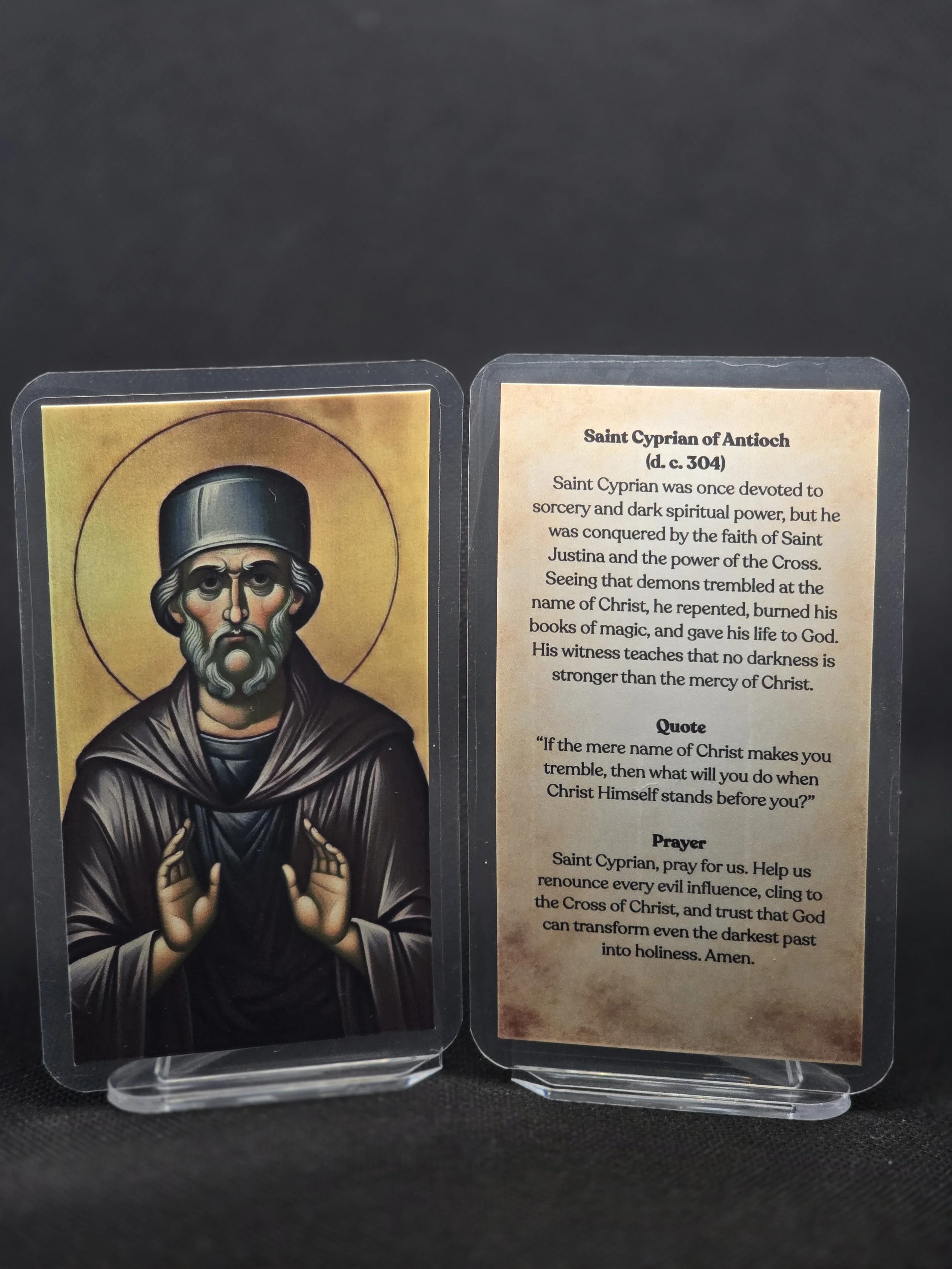
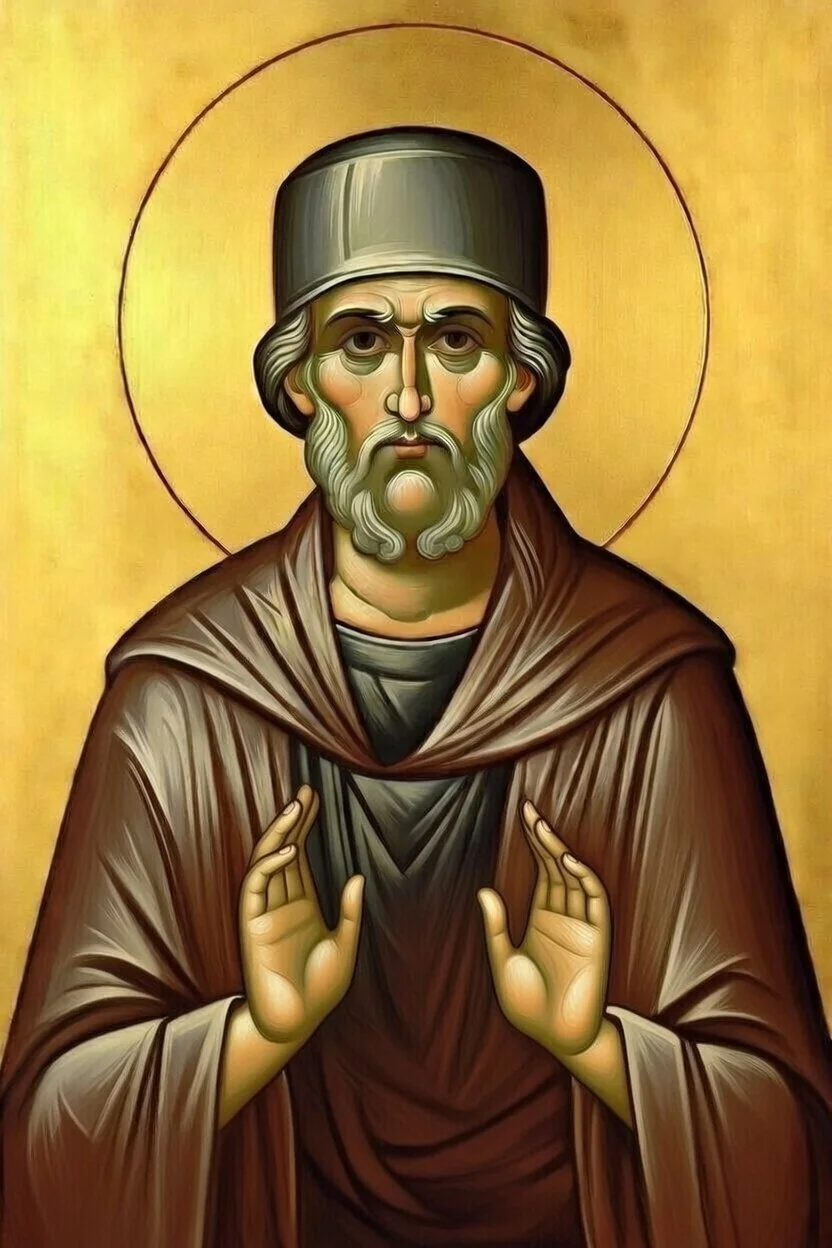
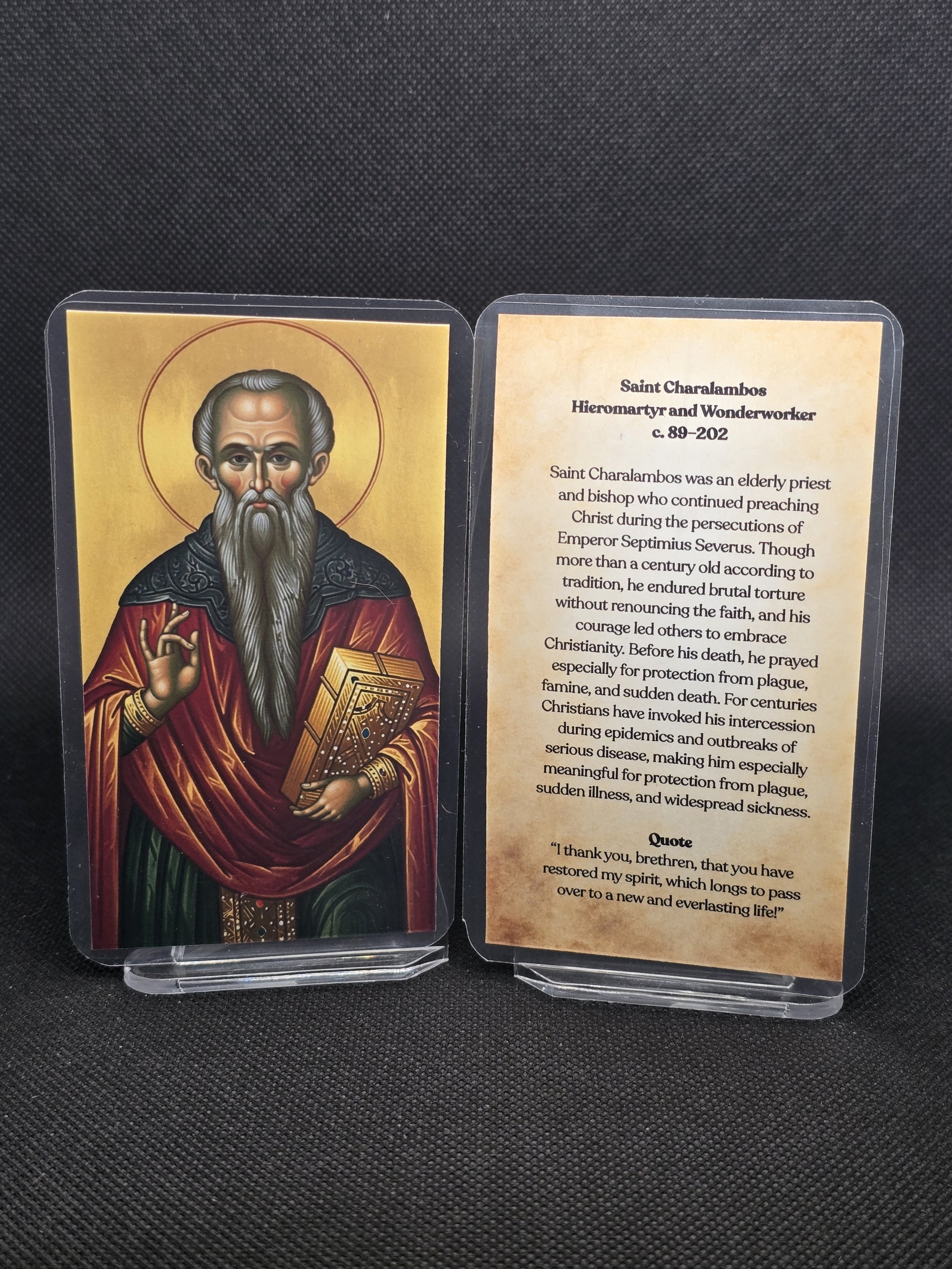
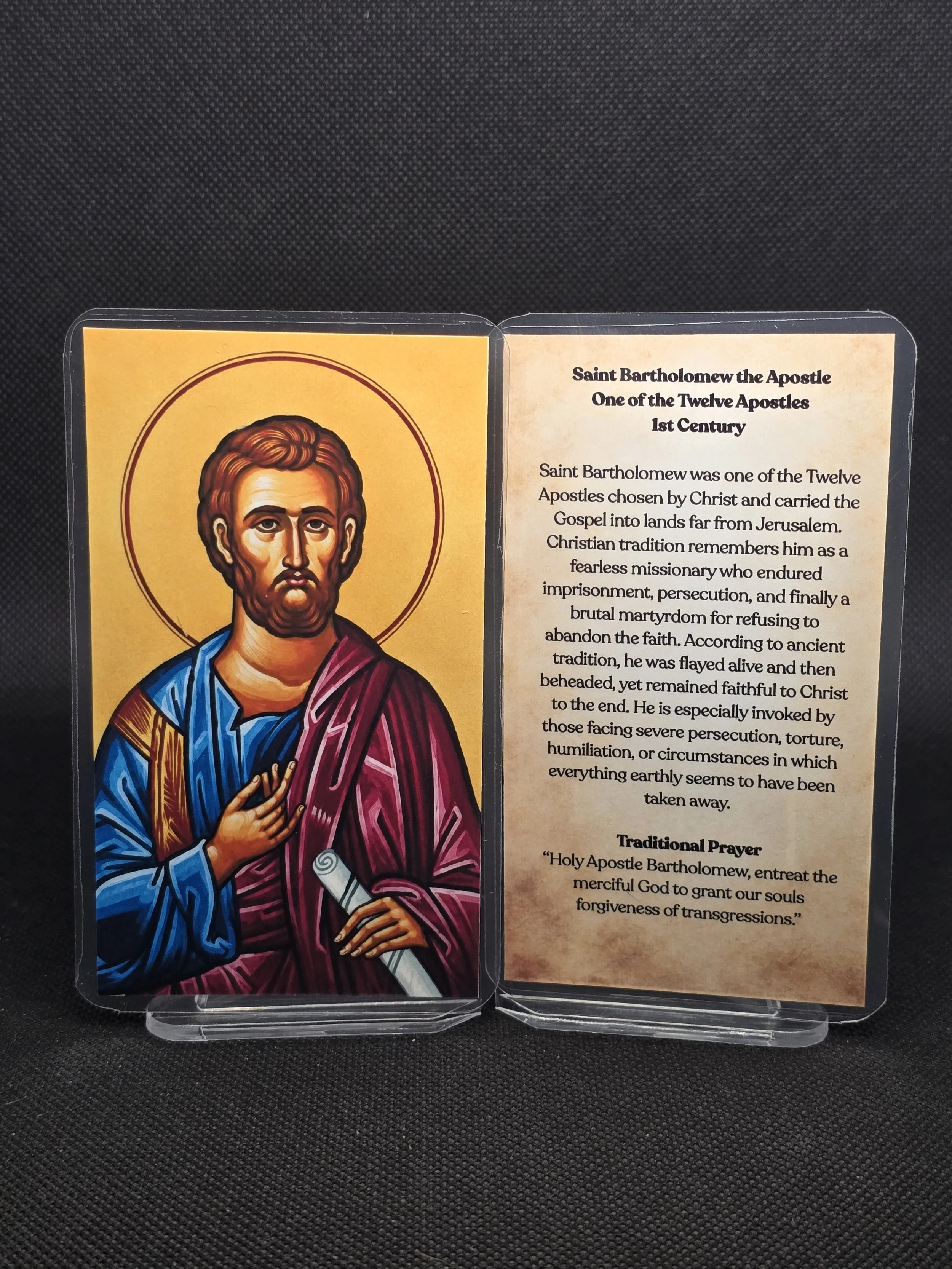
Saint Macarius the Great of Egypt Prayer Card - For Humility, Repentance, Spiritual Warfare & Prayer
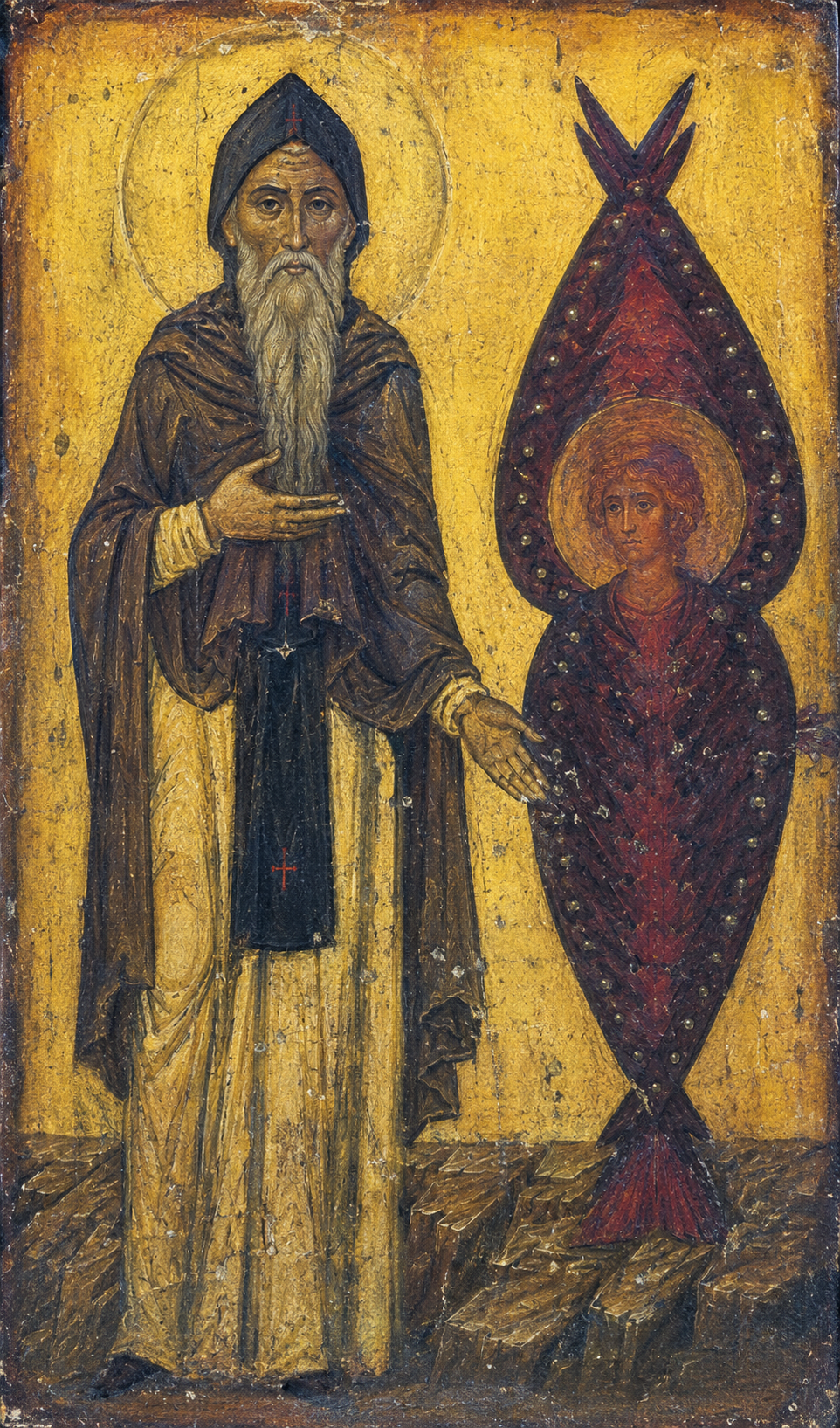
Saint Macarius the Great of Egypt, also known as Abba Macarius, Macarius the Egyptian, and Macarius the Great, was one of the foundational Desert Fathers and one of the most influential spiritual fathers of early Christian monasticism. Born around the beginning of the fourth century, he withdrew into the Egyptian desert, became associated with Saint Anthony the Great, helped establish the monastic life of Scetis in the present-day Wadi El-Natrun, guided generations of monks, endured persecution during the Arian controversy, and became renowned for extraordinary humility, discernment, prayer, mercy toward sinners, and spiritual warfare. The Orthodox Church's Kontakion fittingly calls him the “Father of Fathers,” while the Coptic Orthodox Church remembers him as one of the great founders of monastic life in the Western Desert.
Saint Macarius is especially meaningful for humility, repentance, spiritual warfare, discernment, persistent prayer, freedom from pride, mercy toward the faults of others, monastic vocation, and anyone trying to overcome the passions without becoming harsh toward other people. His traditional Life repeatedly presents humility as the virtue that most defeated the devil, while his sayings emphasize short, sincere prayer, repentance within one's cell, indifference to praise and insult, and the covering of another person's weaknesses rather than exposing them.
He is particularly valuable for Christians who find themselves becoming more judgmental as they become more religious. One of the most beautiful descriptions preserved about Abba Macarius says that he covered the weaknesses of his neighbor, behaving as though he had not seen what he had seen or heard what he had heard. His spirituality therefore joined rigorous asceticism with extraordinary mercy, showing that genuine spiritual growth should make a person more aware of personal sin and more compassionate toward the weakness of others, not more eager to condemn them.
Saint Macarius is also a powerful intercessor for spiritual warfare, although his stories give an important warning about what actually defeats temptation. In one famous episode from his traditional Life, a demon admits that fasting and vigil alone do not distinguish Macarius, because demons neither eat nor sleep, but confesses that Macarius possesses something the demon cannot imitate: humility. The lesson is deeply important because severe religious practices can coexist with pride, while humility places the entire struggle under dependence upon God.
His teaching on prayer is equally striking in its simplicity. When monks asked how they should pray, Macarius did not require complicated language but directed them toward brief cries for God's mercy and surrender to His will, making his spirituality particularly meaningful for people who feel they do not know how to pray or cannot sustain elaborate prayer during exhaustion, illness, fear, or temptation. The prayer tradition preserved under his name also became deeply embedded in Orthodox daily devotion, and the OCA notes that prayers attributed to Saint Macarius remain part of traditional Morning Prayers and Prayers Before Sleep.
Saint Macarius also provides an ancient foundation for Christians interested in hesychasm, watchfulness, inner prayer, the Desert Fathers, and the later Philokalic tradition. He lived centuries before Saint Gregory Palamas and before the Jesus Prayer reached the fixed forms familiar to later Byzantine spirituality, so he should not simply be called a teacher of the modern Jesus Prayer formula. His emphasis upon watchfulness, repentance, short prayer, stillness, struggle with thoughts, humility, and continual remembrance of God nevertheless belongs to the ancient Egyptian soil from which later Eastern contemplative spirituality grew.
He is equally meaningful for anyone who has been falsely accused or publicly humiliated. According to his received Life, Macarius was once falsely accused of fathering a woman's child and endured ridicule without retaliating, even using the income from his basket weaving to support the woman who had slandered him. When the truth eventually came out and people wanted to honor him and ask forgiveness, Macarius fled rather than exchange humiliation for public praise.
That story reveals the unusual depth of his humility because he did not simply tolerate being disliked while secretly waiting for vindication. When vindication finally came, he was just as suspicious of praise as he had been patient under accusation, showing that Christian humility seeks freedom from both humiliation and admiration becoming masters over the heart.
Saint Macarius is also firmly associated with healing. His Orthodox Troparion explicitly remembers him as a wonderworker who healed both bodily infirmities and souls, and his traditional Life says people traveled from many places seeking his prayers, advice, and healing. This provides a genuine liturgical basis for invoking him during illness, although his strongest spiritual identity remains that of Desert Father, teacher of repentance, and spiritual physician of the soul.
This prayer card is especially fitting for Christians studying the Desert Fathers, people beginning a serious life of repentance, monks and those discerning monastic vocation, priests and spiritual fathers, Christians fighting pride or recurring temptation, people struggling with judgment of others, those who have been falsely accused, and anyone who wants to learn how deep asceticism can coexist with mercy. It can also make a meaningful gift for someone named Macarius, Makarios, Makar, or Makary, or for anyone building a prayer corner centered upon the ancient Egyptian monastic tradition.
Each card is handmade in Austin, TX and created to order. We do not keep stock, because every prayer card is treated as a unique devotional offering. They are printed on museum-quality photo paper, not cardstock, and every card is made slowly during prayer with intentional reverence for the saint and for the person who will receive it. Names are lifted before Christ, intentions are held carefully, and each piece is handled multiple times in prayerful silence, asking God for mercy and asking Saint Macarius to intercede for the soul it is being made for. This is devotional craftsmanship shaped with patience, care, and spiritual responsibility because every soul and every prayer matters.
THE LIFE & STORY
Saint Macarius the Great was born in Egypt in the early fourth century, with the Orthodox Life identifying his birthplace as Ptinapor. The Coptic Orthodox Church places his life approximately between 300 and 390, dates that have become common in modern Coptic historical summaries of Egyptian monasticism.
According to the traditional Orthodox Life, Macarius's parents wanted him to marry, and he entered marriage in obedience to them. His wife died soon afterward, and the experience of death profoundly affected him, causing remembrance of mortality to become a permanent part of his spiritual life and drawing him increasingly toward prayer, repentance, Scripture, and asceticism.
Macarius did not immediately abandon his remaining family responsibilities. The Life remembers him caring for his elderly parents until their deaths, using his remaining resources for their support while praying that God would eventually send him someone capable of guiding him toward the ascetic life. This detail is important because his later radical renunciation was not presented as an excuse for abandoning the commandment to honor his parents.
Afterward, an experienced elder living in the desert became his first spiritual guide. The elder taught Macarius watchfulness, fasting, prayer, and the handicraft of basket weaving, and eventually gave him a separate cell in which he could begin living the solitary life more fully.
The local bishop later recognized Macarius's virtue and ordained him to the diaconate against his preference for solitude. Rather than allowing ecclesiastical recognition to become an ambition, Macarius withdrew to another place, continuing the pattern that would characterize his life: he desired hiddenness far more than position.
The desert quickly became a place of spiritual conflict rather than romantic peace. His traditional Life describes demonic attacks, frightening disturbances, and persistent sinful thoughts, while Macarius resisted through prayer and the Sign of the Cross. These stories helped make him one of the great ancient models of spiritual warfare, but the recurring lesson is that his deepest strength came not from fascination with demons but from humility and dependence upon God.
One of his greatest early trials came through false accusation. A pregnant woman from a nearby village accused the hermit of being the father of her child, and local people dragged Macarius from his cell, mocked him, and publicly disgraced him. Rather than fight for his reputation, he quietly worked harder at basket weaving and sent the money to provide for the woman and child.
The traditional Life says the truth emerged when the woman experienced a difficult labor and eventually confessed that Macarius had been falsely accused. Her family and neighbors then planned to go to the hermit and honor him, but Macarius fled during the night because he feared the spiritual danger of human praise as much as he had endured the pain of human contempt.
He eventually moved deeper into the Egyptian monastic world and sought Saint Anthony the Great, whose reputation as a father of desert monasticism had already spread widely. The OCA remembers Macarius becoming Anthony's devoted disciple and follower, while the Coptic Orthodox historical account records visits by Macarius to Saint Anthony during the middle decades of the fourth century.
After this formation, Macarius moved into Scetis, the great desert region now associated with Wadi El-Natrun in Egypt. The Coptic Orthodox Church places his movement into Scetis around 340 and credits him with establishing the monastic community that became one of the foundational centers of Egyptian Christianity.
Macarius's spiritual maturity became evident unusually early. The Orthodox Life says other monks called him a “young Elder” because, although not yet thirty, he already possessed the discernment and spiritual understanding normally associated with much older ascetics.
By approximately age forty, according to the traditional Life, Macarius was ordained to the priesthood and became a spiritual leader among the monks of Scetis. He continued maintaining contact with Saint Anthony and was traditionally remembered as being present near the end of Anthony's earthly life, receiving his staff as a sign of spiritual inheritance.
The Coptic historical tradition describes enormous growth in the Egyptian desert during this period. Macarius established monastic life in Scetis, monks gathered around him, and by the end of the fourth century the Wilderness of Sheheet had become home to thousands of ascetics and an international destination for Christians seeking to learn the Egyptian monastic way of life.
Visitors to the broader Egyptian monastic world included figures such as Rufinus, Melania the Elder, Evagrius Ponticus, Palladius, Jerome, and John Cassian, helping transmit Egyptian desert spirituality far beyond Egypt itself. The Coptic Orthodox Church explicitly describes Egyptian monasticism spreading from this environment throughout the Christian world.
THE FATHER OF SCETIS
Saint Macarius's importance cannot be understood without Scetis, known in Coptic tradition as the Wilderness of Sheheet and today associated with Wadi El-Natrun. This desert region became one of the great centers of Christian monastic history, and the official Coptic historical account specifically identifies Macarius the Great as the founder of the monastic movement there.
His model was neither the completely solitary hermit life in its strictest form nor the highly organized communal system associated especially with Saint Pachomius. Cells were scattered through the desert, monks lived significant periods in solitude, and yet spiritual fathers, worship, shared teaching, and developing community structures tied the ascetics together.
The modern Monastery of Saint Macarius the Great at Wadi El-Natrun traces its origins to this ancient community. The Coptic Orthodox Church says the monastery developed from Macarius's own cell as disciples gathered around him, eventually constructing cells, a church, stores, a well, and facilities for the sick and visitors.
The monastery remains active today and stands as one of the living continuations of the Egyptian desert tradition associated with Macarius. Its survival means that devotion to the saint is not merely archaeological memory, because monks still pray within a monastic landscape shaped by the movement he helped establish more than sixteen centuries ago.
HUMILITY: THE WEAPON THE DEVIL COULD NOT COPY
One of the most famous stories about Saint Macarius concerns a demon who complained that he could imitate almost every outward ascetic achievement. The demon did not eat, did not sleep, and therefore could claim an apparent superiority in fasting and vigil, but admitted that Macarius possessed one virtue the demon could not imitate: humility.
The spiritual lesson is unusually sharp because Christians can easily confuse difficult religious practices with holiness. Someone may fast strictly, pray long hours, study theology, memorize Scripture, or practice demanding devotions while still becoming proud, angry, judgmental, or convinced of spiritual superiority.
Macarius's life places humility at the center because humility changes the reason the ascetic struggles. The goal is no longer to prove strength but to discover dependence upon God, and that dependence makes even great spiritual accomplishments safer because they are received as grace rather than personal achievement.
This makes Saint Macarius particularly meaningful for people who have become discouraged because they cannot perform impressive ascetic disciplines. His stories suggest that the most important battle may not be performing more extraordinary acts but learning to become less defensive, less impressed with oneself, more repentant, and more merciful.
REPENTANCE WITHOUT DESPAIR
Saint Macarius's spirituality is deeply marked by repentance, but his understanding of repentance should not be confused with hopeless self-hatred. The traditional accounts repeatedly show him remembering death, weeping for sin, examining the heart, and urging monks toward continual repentance while simultaneously trusting deeply in the mercy and transforming grace of God.
When asked how someone too weak for extreme renunciation should live, Macarius's traditional answer was essentially to remain in the cell and repent. The point was not that physical isolation automatically saves someone, but that the Christian must eventually stop escaping the truth about the heart through endless activity and distraction.
Repentance in this tradition means seeing sin clearly enough to bring it continually before Christ. It does not mean concluding that transformation is impossible, because the whole ascetic life assumes that divine grace can heal what the person cannot heal alone.
For someone who repeatedly falls into the same sin, Saint Macarius can therefore become an especially meaningful intercessor. His life points away from both complacency and despair, asking the Christian to keep returning to repentance without pretending either that sin is harmless or that mercy has finally run out.
MERCY TOWARD THE SINS OF OTHER PEOPLE
Saint Macarius's reputation for mercy is one of the most beautiful aspects of his tradition. The OCA preserves the saying that he covered another person's weaknesses in a manner likened to seeing without seeing and hearing without hearing, meaning he refused to turn knowledge of another person's failures into an opportunity for condemnation.
This does not mean the Desert Fathers believed sin was unreal or that harmful behavior should never be addressed. Macarius himself lived an extremely serious life of repentance, but precisely because he knew the severity of the struggle within his own heart, he had little interest in gaining spiritual satisfaction from another person's weakness.
The lesson is extremely relevant to modern Christian life. Religious communities can become places where information about another person's sin travels quickly under the appearance of concern, discernment, or defending truth, while Macarius shows another way in which knowledge of weakness becomes an invitation to mercy rather than gossip.
Saint Macarius is therefore a particularly fitting saint for anyone struggling with judgment, resentment, gossip, or fixation upon the faults of others. His intercession can be sought for the grace to speak truth when necessary while refusing the pleasure that pride receives from discovering someone else is worse.
FALSE ACCUSATION & THE LOSS OF REPUTATION
The story of Macarius being accused of fathering a child gives him a particularly strong connection with false accusation, slander, humiliation, and damaged reputation. According to the traditional Life, he did not expose or attack the woman who accused him but quietly accepted the consequences and even worked to support her materially.
This is an extraordinary ascetic response and should not be converted into a universal command that every falsely accused person must remain silent. Serious accusations sometimes need to be answered for the protection of other people, family responsibilities, legal justice, safeguarding, or the good of the Church.
Macarius's example instead reveals the spiritual freedom of someone whose identity no longer depended entirely upon what other people thought. He could survive being regarded as guilty because God knew the truth, and he could later flee praise because vindication did not suddenly become the foundation of his worth.
Someone unfairly accused can therefore ask Saint Macarius not merely that the truth become known but also for protection from hatred, obsession, revenge, and the temptation to make restoration of reputation more important than salvation.
PRAISE & INSULT
Another famous teaching attributed to Macarius involved sending a young monk to a cemetery and instructing him first to insult the dead and then to praise them. The dead responded neither to criticism nor admiration, and Macarius used their silence to teach the monk not to become controlled by either insult or praise.
This does not mean a Christian should become emotionally numb or indifferent to legitimate correction. The deeper lesson concerns freedom from allowing other people's reactions to determine the state of the soul.
Praise can become as spiritually dangerous as criticism because admiration may quietly become addictive. A person can begin doing good things partly to preserve a reputation for holiness, generosity, intelligence, or righteousness, while criticism then feels unbearable because it threatens the identity that praise created.
Saint Macarius therefore offers a particularly relevant spiritual medicine for the age of constant public reaction. His teaching asks whether we can continue doing what is right when nobody praises us and continue repenting when somebody criticizes us.
HOW SAINT MACARIUS TAUGHT PEOPLE TO PRAY
The prayer teaching preserved in the Life of Saint Macarius is remarkably simple. When asked how to pray, he advised the monks that many words were unnecessary and taught them to surrender themselves to God's will while repeatedly asking for mercy.
A short traditional saying attributed to him is: “Lord, as Thou wilt and as Thou knowest, have mercy on me.”
This prayer captures several central themes of Desert spirituality at once. It admits that God knows what the person truly needs, relinquishes the demand that prayer control every outcome, and still asks boldly for mercy.
The teaching also gives Saint Macarius a special connection with people who cannot pray long offices because of illness, exhaustion, caregiving, fear, or another limitation. A brief prayer offered with genuine attention can become a complete act of dependence upon God.
Macarius also recommended the even shorter cry “Lord, have mercy” in spiritual battle. That prayer remains among the most fundamental petitions of Eastern Christian worship, repeated throughout the Divine Liturgy, offices, personal prayer, and moments of immediate need.
SAINT MACARIUS & THE ROOTS OF HESYCHASM
Saint Macarius lived many centuries before the medieval hesychast controversies associated with Saint Gregory Palamas, but his spiritual world contains many of the elements that later became characteristic of hesychasm. His tradition emphasizes solitude, watchfulness, prayer, struggle against thoughts, purification of the passions, humility, interior transformation, and communion with God.
Pope Saint John Paul II specifically included Macarius of Egypt when describing the eremitic stream of Eastern monastic spirituality in Orientale Lumen. He presented the monastic forms associated with Anthony and Macarius as part of the spiritual inheritance of the Christian East and encouraged Catholics to draw from the riches of the Eastern Fathers.
It is therefore appropriate to see Saint Macarius as an important ancestor of the later hesychastic tradition without anachronistically claiming that he practiced every later Athonite method. The continuity lies primarily in the interior goal: purification of the heart and a life increasingly gathered around God.
SPIRITUAL WARFARE WITHOUT OBSESSION WITH DEMONS
The Life of Saint Macarius contains numerous stories of demonic temptation and confrontation, which is unsurprising within early desert literature. The desert was understood not simply as empty geography but as a place where distraction was reduced and the hidden warfare of the heart became painfully visible.
Macarius's stories consistently refuse to make demons the center of spiritual attention. His strongest weapon is humility, while his responses involve prayer, the Sign of the Cross, repentance, and refusal to cooperate with tempting thoughts.
This distinction remains important because a Christian can become so interested in spiritual warfare that almost every difficulty is interpreted through fear of demonic activity. Macarius directs the attention instead toward the virtues that make the heart less vulnerable: humility, repentance, watchfulness, mercy, prayer, and freedom from self-importance.
Saint Macarius can therefore be invoked during temptation or spiritual oppression while keeping the prayer firmly centered upon Christ. The goal of spiritual warfare is not knowledge about demons but communion with God.
HEALING OF BODY & SOUL
The Church's Troparion explicitly remembers Saint Macarius as a wonderworker who healed both physical infirmities and souls. His traditional Life likewise describes people traveling long distances seeking healing, counsel, and his prayers.
This makes him a legitimate saint to invoke during physical illness, but the wording of the hymn is particularly beautiful because it does not separate bodily and spiritual healing. A person can be physically healthy while deeply wounded by pride, resentment, addiction, despair, or sin, while someone physically ill may possess profound holiness.
The spiritual physician of the desert therefore becomes an appropriate intercessor for the whole person. Christians can ask Saint Macarius to pray for medical healing while also asking Christ to heal whatever within the soul has become distorted.
THE THIEF WHO STOLE FROM HIM
One of the most memorable stories in his Life says Saint Macarius once discovered a thief taking possessions from his cell and loading them onto a donkey. Rather than confronting the man as the owner, Macarius helped him secure the load and allowed him to leave with the belongings.
The story is intentionally radical and should not be converted into a rule that Christians must assist criminals or refuse reasonable protection of family and property. Desert stories frequently use extreme actions to reveal the degree to which ascetics sought freedom from possessiveness.
Macarius's response demonstrates how completely he regarded material things as temporary. His traditional reflection emphasized that human beings enter the world with nothing and leave it unable to carry possessions away, so losing objects did not become an injury to his deepest identity.
For people struggling with material attachment, Saint Macarius therefore provides a demanding question about what we actually believe we own. His life does not teach irresponsibility but exposes how easily possessions become emotionally inseparable from security, status, and self.
THE TWO MARRIED WOMEN WHO SURPASSED THE DESERT FATHER
One of the most important traditional stories about Saint Macarius says he received a revelation that two married women living in a city had attained a virtue he had not yet reached. The great desert ascetic therefore left his solitude and went looking for them because he wanted to learn what they were doing.
The story is enormously significant because it prevents the monastic tradition from assuming that visible ascetic extremity automatically means greater holiness. Macarius, already renowned among monks, was willing to believe that ordinary women living within marriage might possess virtues from which he needed to learn.
Their holiness was found within ordinary Christian fidelity rather than spectacular desert feats. The story therefore becomes a powerful reminder that holiness is not restricted to monasteries, caves, clergy, theologians, or people whose religious life looks dramatic from the outside.
For lay Christians, this is one of the most encouraging parts of Saint Macarius's tradition. The Desert Father himself went into the city to learn that the grace of God was capable of producing extraordinary holiness inside ordinary household life.
A DESERT FATHER WHO REFUSED TO CONDEMN
Saint Macarius's spirituality repeatedly returns to the principle of refusing unnecessary condemnation. He was serious about sin but slow to expose another person's weakness, and the stories surrounding him portray mercy as one of the clearest signs that ascetic struggle had actually transformed the heart.
This balance is essential because two opposite distortions are possible. One can become so tolerant that sin is no longer taken seriously, or so zealous that the faults of other people become the primary subject of religious attention.
Macarius takes another path by becoming extremely severe toward his own passions and extraordinarily merciful toward the weakness of his neighbor. That asymmetry is one of the most recognizable patterns among the greatest Desert Fathers.
For Christians who instinctively reverse the pattern by excusing themselves while analyzing everyone else, Saint Macarius can become a particularly uncomfortable and useful intercessor.
PERSECUTION DURING THE ARIAN CONTROVERSY
Saint Macarius's life was not confined entirely to private ascetic struggle. During the reign of the Arian-supporting Emperor Valens, the traditional Life says Macarius the Great and Macarius of Alexandria were persecuted by followers of the Arian bishop Lucius and exiled together to an island inhabited by pagans.
The story says the saints' prayer delivered the daughter of a pagan priest from an evil spirit, after which the priest and the island's inhabitants embraced Christianity. The episode belongs to the received hagiographic Life and should be presented as such rather than as though every detail is preserved in independent imperial archives.
The persecution nevertheless places Macarius within the broader fourth-century struggle over the Nicene faith. The hermit who withdrew from worldly ambition was still affected by theological conflicts because desert monasticism was not detached from the Church's confession of Christ.
This makes him particularly meaningful for Christians trying to understand that contemplative spirituality and doctrine cannot ultimately be separated. Deep prayer did not make Macarius indifferent to what the Church taught about God.
SAINT MACARIUS & SAINT ANTHONY THE GREAT
Saint Anthony the Great is one of the most important figures in Macarius's traditional formation. The Orthodox Life remembers Macarius becoming Anthony's disciple, while the official Coptic chronology records Macarius visiting Anthony during the middle fourth century.
Their relationship places Macarius within the first generations of Egyptian monasticism. Saint Anthony represents the great anchoritic movement into the desert, while Macarius helped develop another major center in Scetis that would influence later monks throughout the Christian world.
The OCA tradition says Macarius received Anthony's staff after the elder's death, comparing the spiritual inheritance with the biblical relationship between Elijah and Elisha. Whatever the historical precision of every detail, the tradition clearly understands Macarius as a major heir to Anthony's spiritual way.
For someone devoted to the Desert Fathers, Saints Anthony and Macarius therefore belong naturally together. Anthony's flight into the desert helped establish the movement, while Macarius became one of the great fathers who transmitted and developed that life for subsequent generations.
SAINT MACARIUS & SAINT PACHOMIUS
Saint Pachomius represents another major stream of Egyptian monasticism, especially the organized cenobitic or communal monastic life. The official Coptic history places Anthony, Pachomius, Ammon, Macarius the Great, and Macarius of Alexandria among the foundational figures through whom Egyptian monasticism developed several complementary forms.
The traditional Life of Macarius even says Saints Anthony and Pachomius appeared to him shortly before his death to announce that his earthly departure was approaching. The story belongs to hagiographic tradition, but it beautifully places Macarius spiritually among the great founders whose different monastic forms shaped Christianity far beyond Egypt.
MACARIUS THE GREAT VS. MACARIUS OF ALEXANDRIA
Saint Macarius the Great of Egypt is frequently confused with Saint Macarius of Alexandria, another major fourth-century Egyptian monk. They were contemporaries, both were associated with the Egyptian desert, and the Orthodox Life even remembers them suffering exile together during the Arian persecution.
They are nevertheless different saints. Macarius the Great is especially associated with Scetis and Wadi El-Natrun, while Macarius of Alexandria became especially associated with the region of the Cells, or Kellia, and possesses his own separate hagiographic tradition.
The distinction is especially important for prayer cards, icons, relic labels, and online product listings because both saints may simply be called “Saint Macarius.” Including “the Great of Egypt” or “Macarius the Egyptian” in the title helps prevent customers from accidentally purchasing the wrong saint.
MACARIUS, MAKARIOS, MAKARY & ABBA MAQAR
The saint's name appears in several forms because of differences among Greek, Coptic, Arabic, Slavic, and English usage. Macarius is common in English, Makarios more directly reflects Greek usage, and Coptic and Arabic Christians commonly refer to him as Abba Maqar or Anba Makar.
These variations can be useful for search visibility because Christians from different traditions may know the same Desert Father by different names. The product title should remain clear with “Saint Macarius the Great of Egypt,” while alternate spellings can appear naturally in the description and FAQ.
THE FIFTY SPIRITUAL HOMILIES: AN IMPORTANT AUTHORSHIP CAUTION
Older ecclesiastical tradition commonly attributes the famous Fifty Spiritual Homilies to Saint Macarius the Great, and the OCA's Life continues to present the homilies and several ascetic treatises as part of his spiritual legacy. These writings became highly influential because of their teaching on the Holy Spirit, purification of the heart, spiritual transformation, and union with God.
Modern scholarship, however, generally distinguishes the historical Macarius of Egypt from the anonymous author commonly called Pseudo-Macarius, to whom the major Macarian homily collections are now usually attributed. Scholarly literature therefore refers to the Fifty Spiritual Homilies as Pseudo-Macarian rather than confidently treating every passage as a direct writing of Macarius the Great himself.
This distinction matters greatly when choosing quotations for a prayer card. A beautiful sentence from the Spiritual Homilies may belong authentically to the broader Macarian spiritual tradition while still not being secure enough to print beneath Saint Macarius's name as an unquestioned direct quotation.
For a devotional card, the safer choice is therefore one of the sayings specifically preserved in the early Desert Father tradition and repeated in the Church's received Life, or the official Troparion and Kontakion. That approach keeps the card both spiritually traditional and historically careful.
THE TRANSFORMATION OF THE HEART
The Macarian spiritual tradition places enormous emphasis upon the transformation of the inner person by the Holy Spirit. Even allowing for modern questions about the exact authorship of the homily collections, the tradition associated with Macarius deeply influenced Eastern Christian understandings of purification, grace, prayer, and the transformation of the human heart.
This helps explain why Saint Macarius is more than a saint for people who simply admire desert austerity. The external fasting, vigils, poverty, and solitude have meaning only insofar as they become instruments through which the heart is opened to divine grace.
A person can therefore imitate the spiritual direction of Macarius without reproducing fourth-century Egyptian living conditions. The essential questions concern whether the heart is becoming more prayerful, more humble, more merciful, more repentant, and more capable of loving God and neighbor.
A SAINT FOR MONKS & THOSE DISCERNING MONASTIC LIFE
Saint Macarius is one of the most natural saints for monks, hermits, monastic communities, and people discerning monastic vocation. The Coptic Orthodox Church identifies him as a founder of the monastic movement at Scetis, while the Orthodox Kontakion calls him the Father of Fathers.
His example is especially valuable because he demonstrates that monasticism is not simply escape from responsibility or dislike of ordinary people. Before entering full desert life, his traditional Life remembers him caring for his parents, learning obedience under an elder, and receiving spiritual formation rather than simply declaring himself ready for solitude.
Someone discerning monastic life can therefore ask Saint Macarius for more than courage to leave the world. His prayers can be sought for patience, obedience, discernment, humility, freedom from romantic ideas about solitude, and willingness to be formed by experienced spiritual authority.
WHAT LAY CHRISTIANS CAN LEARN FROM MACARIUS
The extreme form of Saint Macarius's desert life belongs to a particular monastic vocation and should not be copied mechanically by Christians responsible for spouses, children, jobs, health conditions, or other obligations. His own stories about holy married women provide an especially strong reason not to confuse the desert's outward form with the only path to holiness.
Lay Christians can nevertheless imitate the deeper principles of his life by creating moments of silence, practicing regular repentance, learning short prayer, fasting according to the Church and personal circumstances, guarding against judgment, refusing gossip, giving less importance to praise, and remembering death without falling into morbidity.
Someone raising children may discover that humility before family members is a more demanding asceticism than living alone. Someone caring for an elderly parent may practice self-denial every day, while a married couple who forgive one another repeatedly may be learning precisely the mercy the Desert Fathers considered central to salvation.
Saint Macarius's encounter with the holy women therefore prevents lay Christians from treating themselves as spiritually second-class. The desert may reveal holiness dramatically, but God can sanctify a kitchen, workplace, hospital room, marriage, or family home as surely as a cell in Scetis.
REMEMBRANCE OF DEATH
The early death of Macarius's wife made remembrance of death a major spiritual theme in his traditional Life. Rather than making him nihilistic, mortality reminded him that earthly possessions, reputation, comfort, and human praise eventually pass away and that the soul must be prepared for eternal life.
The Desert Fathers used remembrance of death not as morbid fascination but as a way of clarifying priorities. An argument that feels enormous today may look very different when viewed from the perspective of eternity, while a small act of love or repentance may possess far greater significance than it initially appears.
Saint Macarius can therefore be meaningful to someone grieving a death or reevaluating life after a serious illness. His response to mortality was not despair but conversion, deeper prayer, service to his parents, and eventually radical dedication to God.
HIS DEATH
The traditional Orthodox Life says Saint Macarius lived to approximately ninety years old and spent roughly sixty years in the wilderness. Shortly before his death, he gathered his disciples, instructed them to preserve the monastic traditions they had received, blessed them, and prepared consciously for his departure from earthly life.
The Coptic Orthodox Church likewise gives his lifespan approximately as 300 to 390, placing his repose at the end of the great formative century of Egyptian monasticism. By that time, the desert movement with which he had been associated had grown from scattered solitary cells into a major spiritual force attracting Christians from across the Mediterranean world.
His life therefore spans almost the entire rise of fourth-century Christian monasticism. He entered the desert when the movement was still developing around pioneers such as Anthony and lived long enough to become an elder whose own disciples would help transmit that tradition to generations he would never meet.
THE MONASTERY OF SAINT MACARIUS TODAY
The Monastery of Saint Macarius the Great in Wadi El-Natrun, Egypt, remains an active Coptic Orthodox monastery. The official Coptic Church identifies its origin with Saint Macarius's cell and describes how disciples gradually gathered around him, eventually building cells, a church, wells, facilities for visitors, and other structures required by the growing community.
The monastery became exceptionally important within Coptic history and eventually served as a spiritual and cultural center associated with numerous patriarchs. The Coptic Church notes that many patriarchs arose from the monastery and that important patriarchal relics came to be preserved there.
For Christians who wish to connect physically with Saint Macarius's tradition, Wadi El-Natrun therefore remains the most significant pilgrimage landscape. The desert he entered as a solitary became a Christian monastic region whose legacy continues into the present day.
THE RELICS OF SAINT MACARIUS
The relic tradition of Saint Macarius requires some care because authoritative Christian sources preserve more than one location. The OCA Life states that his holy relics are in Amalfi, Italy, while the official Coptic Orthodox Church states that relics of the three saints known as the Macarii, including Saint Macarius the Great, are preserved on the northern side of the Church of Saint Macarius at his monastery in Wadi El-Natrun.
The Coptic monastery's current official description is particularly specific, identifying relics of Saint Macarius the Great, Saint Macarius of Alexandria, and another Saint Macarius together within the church. Pope Tawadros II's 2025 historical account likewise refers to the shrine of the three Macarii within the monastery while discussing the relocation and preservation of nearby patriarchal relics.
Because these traditions coexist, it would be too strong to tell customers that the saint's complete body rests exclusively in one modern location. The safest wording is that relics attributed to Saint Macarius are venerated at his ancient monastery in Wadi El-Natrun, while the Orthodox Church in America also preserves a tradition locating relics in Amalfi, Italy.
COPTIC ORTHODOX, EASTERN ORTHODOX & CATHOLIC DEVOTION
Saint Macarius lived in the fourth century, long before the later divisions between the Chalcedonian Orthodox, Oriental Orthodox, and Catholic Churches. He therefore belongs to the ancient Christian inheritance shared across traditions, although his importance is especially profound within Coptic Christianity because his monastery and monastic descendants remain rooted in Egypt.
Eastern Orthodox Christians likewise venerate him as one of the great Desert Fathers and commemorate him on January 19. His Orthodox liturgical texts call him an angel in the body, wonderworker, and Father of Fathers, revealing how central his memory became outside Egypt as well.
Catholic Christianity also honors the Egyptian Desert Fathers as part of the common patristic inheritance. Pope John Paul II explicitly named Anthony, Pachomius, and Macarius among the illustrious founders of Christian monasticism and described figures of the Egyptian Church as part of the glory of the universal Church, while Orientale Lumen specifically names Macarius of Egypt when discussing the spiritual riches of Eastern monasticism.
Saint Macarius can therefore be accurately presented as an ancient pre-schism saint shared across the historic Christian traditions, with particularly strong devotion among Coptic Orthodox and Eastern Orthodox Christians. This is different from modern Orthodox saints whose formal glorification occurred long after the separation of the Churches.
FEAST DAY
The Eastern Orthodox Church commemorates Saint Macarius the Great of Egypt on January 19. The OCA's Life, Troparion, and Kontakion all give that date and distinguish him clearly from the other saints named Macarius who may also appear in Orthodox calendars.
Christians following the unrevised Julian calendar celebrate liturgical January 19 on a later civil Gregorian date, while the underlying church feast remains January 19. Different ancient Christian traditions may also preserve additional local commemorations connected with Macarius, his monastery, or church consecrations.
PRAYERS
A simple traditional invocation may be prayed throughout the day: Venerable Father Macarius the Great, pray to God for us. This is especially fitting during temptation, repentance, false accusation, struggles with pride, difficult fasting, monastic discernment, or periods when someone needs the grace to become more merciful toward the faults of others.
The Orthodox Troparion remembers Saint Macarius as a desert dweller, wonderworker, and God-bearing Father whose fasting, vigil, and prayer became instruments of healing. Its final petitions glorify Christ as the One who strengthened and crowned the saint and who grants healing through him, keeping the devotion firmly centered upon God rather than treating Macarius as an independent spiritual power.
The Kontakion calls him an unerring star and Father of Fathers, emphasizing both his ascetic life and his immense influence upon subsequent generations of monks. These liturgical titles provide an especially strong devotional foundation for giving his card to monks, priests, spiritual fathers, and anyone studying the Egyptian monastic tradition.
For personal prayer, the short saying traditionally attributed to him remains especially beautiful: “Lord, as Thou wilt and as Thou knowest, have mercy on me.” This prayer can be repeated when someone genuinely does not know what outcome to ask for, because it combines surrender to God's wisdom with confident appeal to His mercy.
Someone struggling against a recurring temptation can also use Saint Macarius's life as a reminder that humility may matter more than extraordinary ascetic performance. Instead of becoming fascinated by the temptation itself, the Christian can invoke Christ, ask Saint Macarius's intercession, confess personal weakness, and return repeatedly to the mercy of God.
This prayer card is especially fitting for a prayer corner, monastery cell, beside a collection of the Desert Fathers, near a prayer rope, within a Bible or prayer book, in a seminary room, or at a desk used for spiritual study. It can also make a meaningful gift for someone beginning serious study of early monasticism, visiting Egypt's ancient monasteries, discerning monastic life, or struggling to combine strong conviction with genuine humility.
FAQ
Who is Saint Macarius the Great of Egypt? Saint Macarius was a fourth-century Egyptian monk, priest, spiritual father, and one of the foundational figures of the Desert Father tradition. He became especially associated with Scetis in the Western Desert of Egypt and is remembered for humility, repentance, spiritual warfare, healing, mercy, and the formation of generations of monks.
Is Saint Macarius the Great one of the Desert Fathers? Yes, he is one of the most important Desert Fathers in Christian history. His sayings and stories form part of the ancient Egyptian monastic tradition that later influenced Eastern and Western monasticism throughout the Christian world.
When did Saint Macarius live? The Coptic Orthodox Church gives his approximate lifespan as 300 to 390 AD. He therefore lived during the same broad era as Saints Anthony the Great, Pachomius, Athanasius, and many of the figures who shaped fourth-century Egyptian Christianity.
Where was Saint Macarius born? The traditional Orthodox Life says he was born in the Egyptian village of Ptinapor. His precise early biography comes primarily through ecclesiastical hagiographic tradition rather than the kind of civil documentation available for modern saints.
Was Saint Macarius ever married? According to his traditional Life, yes, because his parents wished him to marry and he obeyed them. His wife died soon afterward, and her death became one of the events that turned his attention decisively toward repentance, remembrance of death, and the ascetic life.
Did Saint Macarius abandon his parents to become a hermit? No, his traditional Life specifically says he continued caring for his elderly parents until their deaths. Only afterward did his withdrawal into the ascetic life become more complete.
Was Saint Macarius a disciple of Saint Anthony the Great? The Orthodox tradition remembers him as a devoted disciple and follower of Saint Anthony, while the official Coptic historical chronology records Macarius visiting Anthony on multiple occasions. Their relationship places Macarius firmly within the earliest generations of Egyptian monasticism.
What is Saint Macarius known for? He is especially known for founding or establishing monastic life at Scetis, extraordinary humility, spiritual discernment, severe asceticism, short and powerful teachings on prayer, mercy toward sinners, healing, and resistance to demonic temptation. His Orthodox Kontakion calls him the Father of Fathers.
What is Saint Macarius the patron saint of? Ancient Orthodox practice does not reduce him to one fixed modern patronage. His strongest grounded devotional associations are humility, repentance, monastic life, prayer, spiritual warfare, discernment, healing, false accusation, and freedom from judging other people.
Is Saint Macarius a saint for humility? Yes, humility is perhaps the clearest single virtue associated with him. His traditional Life even preserves the famous story in which a demon admits that humility is the one thing in which Macarius surpasses him.
Can I pray to Saint Macarius when struggling with pride? Yes, his entire spiritual reputation makes this especially appropriate. His example also encourages practical repentance, such as accepting correction, resisting the need for praise, refusing to advertise one's virtues, and becoming more merciful toward other people's weakness.
Is Saint Macarius a saint for repentance? Yes, continual repentance is central to his sayings and traditional Life. He consistently directs attention away from other people's sins and back toward personal repentance and preparation for eternal life.
Can I pray to Saint Macarius when I keep falling into the same sin? Yes, especially because his spirituality emphasizes persistent repentance rather than despair. His teaching encourages the Christian to return repeatedly to God's mercy while continuing the struggle against the passions.
Is Saint Macarius associated with spiritual warfare? Yes, his Life contains many accounts of temptation and demonic opposition. The most important lesson of those accounts is that humility, prayer, repentance, and the Sign of the Cross matter more than fascination with demonic phenomena.
Can I ask Saint Macarius for protection during temptation? Yes, this is a very natural devotional application of his life. His example encourages someone under temptation to call upon God briefly, admit weakness, avoid arguing endlessly with thoughts, and return attention toward Christ.
What did Saint Macarius teach about prayer? He taught that prayer did not require a large number of words and recommended short appeals to God's mercy and will. His approach makes prayer accessible even in moments when a person feels weak, frightened, distracted, or spiritually dry.
What short prayer is attributed to Saint Macarius? A traditional prayer attributed to him asks God to have mercy according to His own will and knowledge. The saying is preserved in the OCA's received Life and reflects Macarius's characteristic combination of simplicity, humility, and trust.
Did Saint Macarius use the Jesus Prayer? It is better not to project the later standardized Jesus Prayer tradition backward onto him without qualification. His use of short prayer, especially repeated appeals for mercy, watchfulness, and interior recollection, nevertheless belongs to the ancient desert tradition that later contributed to Byzantine hesychastic spirituality.
Is Saint Macarius connected with hesychasm? Yes in a broad historical and spiritual sense, because his ascetic tradition emphasizes solitude, watchfulness, prayer, inner transformation, and communion with God. He lived centuries before Saint Gregory Palamas and should therefore be described as an important early ancestor of hesychastic spirituality rather than a medieval hesychast in the later technical sense.
Was Saint Macarius falsely accused of sexual sin? According to his traditional Life, a pregnant woman falsely accused him of being the father of her child. He endured public humiliation and even provided for her materially until she eventually confessed the truth.
Can someone who has been falsely accused pray to Saint Macarius? Yes, his traditional experience makes him especially meaningful for slander, false allegations, and damage to reputation. His example can accompany prayer both for truth to emerge and for protection from revenge, bitterness, and obsession with public vindication.
Did Saint Macarius really help a thief steal his belongings? His traditional Life contains a story in which he discovered a thief loading his possessions and quietly helped secure the load without revealing that he was the owner. The story is an ascetic lesson about detachment from possessions rather than a universal instruction to cooperate with theft.
What did Saint Macarius teach about praise and criticism? He taught a young monk through the example of the dead, who responded neither to insults nor praise. The spiritual goal was freedom from being inflated by admiration or controlled by contempt.
What did Saint Macarius teach about judging other people? His tradition remembers him as extraordinarily reluctant to expose another person's faults. The famous description of him says he covered his neighbor's weakness as though he had not seen or heard it, making mercy toward sinners one of his defining virtues.
Is Saint Macarius associated with healing? Yes, explicitly. His Orthodox Troparion remembers him healing bodily infirmities and souls, and his Life says people traveled to him seeking healing and prayer.
Can I pray to Saint Macarius for physical illness? Yes, because healing belongs firmly to his liturgical tradition. His intercession can be sought alongside appropriate medical care while also asking Christ for spiritual healing, peace, endurance, and repentance.
Was Saint Macarius a priest? Yes, his traditional Orthodox Life says he was ordained to the priesthood at approximately forty years old and became a spiritual leader among the monks of Scetis. He is nevertheless most commonly remembered by the monastic title Venerable Father or Abba rather than primarily through priestly office.
What does “Abba Macarius” mean? Abba means father and became a characteristic title for respected spiritual elders among the Desert Fathers. Calling him Abba Macarius therefore emphasizes his role as spiritual father rather than merely using “Father” as an honorific.
Why is Saint Macarius called “the Great”? The title distinguishes him from other saints named Macarius and reflects the exceptional importance of his holiness and monastic influence. It is especially useful because he lived at the same time as another famous Egyptian ascetic, Saint Macarius of Alexandria.
Is Saint Macarius the Great the same as Macarius of Alexandria? No, they are two different fourth-century Egyptian saints. Macarius the Great is particularly associated with Scetis, while Macarius of Alexandria is associated especially with the region known as the Cells or Kellia.
Did the two Saint Macariuses know each other? The Orthodox Life remembers them being persecuted and exiled together during the Arian controversy. Their similar names, overlapping lifetimes, and shared Egyptian monastic setting explain why they are sometimes confused.
Where is Scetis? Ancient Scetis corresponds to the monastic desert region now known as Wadi El-Natrun in Egypt, located between Cairo and Alexandria. It became one of the greatest centers of Christian monasticism and remains home to ancient Coptic monasteries.
Did Saint Macarius found a monastery? The Coptic Orthodox Church identifies Macarius as the founder of the monastic movement at Scetis and traces the Monastery of Saint Macarius to his cell and the disciples who gradually gathered around him. The monastery developed organizationally over time rather than appearing fully formed as a modern institutional monastery on one particular day.
Does the Monastery of Saint Macarius still exist? Yes, the Monastery of Saint Macarius the Great remains active in Wadi El-Natrun. It is one of the great surviving centers of the Coptic monastic tradition.
Can pilgrims visit the Monastery of Saint Macarius? The monastery remains a living Coptic Orthodox monastery and an important Christian site in Wadi El-Natrun. Because access rules for active monasteries can change, pilgrims should verify current visiting arrangements directly before traveling.
Did Saint Macarius know Saint Anthony? Yes according to both Orthodox and Coptic tradition. The OCA remembers him as Anthony's disciple, while official Coptic history records multiple visits between Macarius and Anthony.
Did Saint Macarius know Saint Pachomius? They belonged to the same formative era of Egyptian monasticism, although they represented different monastic streams. Macarius's traditional Life also says Pachomius and Anthony appeared to him shortly before his death, which belongs to the saint's received hagiographic tradition.
Did Saint Macarius suffer persecution? Yes, the traditional Orthodox Life says he and Macarius of Alexandria were persecuted during the reign of Emperor Valens because of the Arian controversy. They were exiled to an island before eventually returning.
Was Saint Macarius a defender of Nicene Christianity? His hagiographic tradition places him among monks persecuted by Arian church authorities during the reign of Valens. His life therefore belongs to the wider history of Egyptian resistance to Arian influence during the fourth century.
Did Saint Macarius perform miracles? His traditional Life records healings, deliverance from spiritual affliction, and even stories of the dead being raised through his prayers. These should be presented as received hagiographic traditions, while his official Orthodox hymnography clearly and independently preserves his longstanding title and reputation as a wonderworker.
Did Saint Macarius really speak with a skull? His traditional Life preserves a story in which a skull responds to him and describes receiving some relief when Macarius prays for the departed. This belongs to the spiritual and hagiographic literature of the Desert Fathers rather than something that should be treated as a modern historical observation.
What is the point of the story about the two married women? The story teaches that extraordinary holiness can exist outside the desert and outside monastic life. Macarius was humble enough to seek instruction from married women whom God had revealed as possessing great virtue.
Is Saint Macarius only for monks? No, although monasticism is central to his life. His teachings on humility, repentance, mercy, prayer, resisting praise, and refusing to judge others apply directly to Christians living in families and ordinary secular life.
Can married people be inspired by Saint Macarius? Yes, especially because his own tradition explicitly includes holy married women from whom he sought spiritual instruction. Their story prevents his monastic example from being interpreted as though God only produces profound holiness in monasteries.
Did Saint Macarius write the Fifty Spiritual Homilies? Traditional Church sources commonly attribute them to him, and the OCA still presents them within his spiritual legacy. Modern scholarship generally attributes the major Macarian homily collections to an anonymous author known as Pseudo-Macarius, so quotations from those homilies should not automatically be labeled secure direct sayings of Macarius the Great.
Why does that authorship distinction matter? It matters when creating a prayer card that promises an authentic quotation from the saint. A text can be ancient, Orthodox, spiritually valuable, and deeply connected with the Macarian tradition without being sufficiently secure to print as the saint's own exact words.
Are there prayers by Saint Macarius in Orthodox prayer books? Yes, the OCA notes that prayers attributed to Saint Macarius continue to appear in traditional Morning Prayers and Prayers Before Sleep. His name therefore remains part of the ordinary devotional life of Orthodox Christians far beyond his January feast.
Where are Saint Macarius's relics? Official sources preserve more than one tradition. The Coptic Orthodox Church states that relics of Saint Macarius the Great are preserved with the other Macarii at his monastery in Wadi El-Natrun, while the OCA Life also states that relics are in Amalfi, Italy.
Are Saint Macarius's relics really at Wadi El-Natrun? The official Coptic Orthodox Church specifically identifies relics of Saint Macarius the Great within the Church of Saint Macarius at the monastery. This is therefore a current ecclesiastical claim from the Church that actually maintains the ancient shrine.
Why does another source say his relics are in Amalfi? Relics of ancient saints were frequently divided or translated over many centuries, and different ecclesiastical traditions can preserve different histories. Because the OCA and Coptic Orthodox Church both preserve claims involving Saint Macarius, the safest product wording acknowledges both rather than pretending the question is simpler than the sources indicate.
When is Saint Macarius the Great's feast day? The Eastern Orthodox Church commemorates him on January 19. His OCA Life and proper Troparion and Kontakion are assigned to that date.
Is Saint Macarius an Eastern Orthodox saint? Yes, he is one of the great saints of the Eastern Orthodox monastic tradition. The Orthodox Church honors him liturgically as Venerable Macarius the Great of Egypt and Father of Fathers.
Is Saint Macarius a Coptic Orthodox saint? Yes, extremely strongly. His monastery remains one of the great historic Coptic monasteries of Wadi El-Natrun, and official Coptic history identifies him as a foundational father of monasticism in Scetis.
Is Saint Macarius also a Catholic saint? He belongs to the ancient Christian inheritance from centuries before the later separations of the Churches. Pope John Paul II explicitly honored Macarius among Egypt's great founders of Christian monasticism and discussed Macarius of Egypt positively within Catholic teaching on Eastern monastic spirituality.
Can Eastern Catholics venerate Saint Macarius? Yes, he is a pre-schism Desert Father belonging to the common early Christian inheritance. His spirituality is particularly natural for Eastern Catholics interested in Egyptian monasticism, the Desert Fathers, hesychasm, and the ancient roots of contemplative prayer.
Can I give this prayer card to someone discerning monastic life? Yes, Saint Macarius is among the strongest ancient saints for monastic discernment because he helped establish one of Christianity's foundational monastic centers. His life also teaches that solitude needs spiritual formation, obedience, humility, and freedom from romantic ideas about asceticism.
Can I give this card to someone fighting temptation? Yes, spiritual warfare forms a major part of his traditional Life. His most important lesson is that humility and dependence upon God matter more than trying to prove spiritual strength.
Can I give this card to someone who has been falsely accused? Yes, because Saint Macarius endured an especially painful false accusation and public humiliation. His life provides a powerful intercessory connection for people trying to defend truth without allowing resentment or revenge to consume them.
Can I give this card to someone struggling with judgment or gossip? Yes, because his refusal to expose another person's weaknesses is one of the defining characteristics preserved about him. Saint Macarius is particularly appropriate for anyone asking God to replace criticism and gossip with humility and mercy.
Can I give this card to someone beginning the Desert Fathers? Yes, Saint Macarius is one of the essential figures through whom the Desert Father tradition is understood. His sayings combine extreme ascetic seriousness with simplicity, mercy, humor, humility, and extraordinary insight into the human heart.
What does Saint Macarius teach about humility? He teaches that humility reaches deeper than outward religious achievement. His most famous spiritual warfare story says fasting and vigil could be imitated by demons, while humility could not.
What does Saint Macarius teach about repentance? He teaches that repentance should become a continuing movement of the heart rather than a temporary reaction after serious failure. His sayings continually draw Christians away from scrutiny of others and back toward honest attention to their own souls.
What does Saint Macarius teach about prayer? He teaches simplicity, trust, and perseverance. Prayer does not have to become complicated before it becomes real, because a brief cry for mercy offered from the heart can contain surrender, repentance, and faith.
What does Saint Macarius teach about other people's sins? His tradition teaches Christians to become much more interested in covering and healing another person's weakness than in publicizing it. He combined uncompromising repentance for himself with remarkable mercy toward his neighbor.
What does Saint Macarius teach about possessions? His traditional stories emphasize that material possessions are temporary and cannot accompany us beyond death. His extreme detachment from property was intended to free the heart from treating possessions as the source of security or identity.
What does Saint Macarius teach about praise? He teaches that praise can become spiritually dangerous when it controls behavior or creates dependence upon admiration. His flight after being vindicated from false accusation shows that he feared praise becoming spiritually harmful just as much as he had endured contempt.
What does Saint Macarius teach about lay holiness? The story of the two married women teaches that sanctity cannot be measured merely by how dramatic someone's ascetic life appears. The great Desert Father was willing to learn holiness from Christians living ordinary married lives in the city.
What is the main message of Saint Macarius the Great's life? Saint Macarius teaches that the deepest spiritual victory is not becoming impressive but becoming humble enough for God to transform the heart. The Egyptian monk who helped establish Scetis fasted, prayed, battled temptation, guided thousands, endured slander and persecution, healed the sick, and became one of Christianity's great Desert Fathers, yet the stories remembered most lovingly about him are stories in which he refused praise, covered another person's sin, learned from ordinary married women, helped a thief carry away his own possessions, and admitted his continuing need for repentance. His life shows that authentic asceticism should make a Christian less attached to reputation, possessions, judgment, and self-importance while becoming more dependent upon mercy, more compassionate toward sinners, and more completely centered upon God.
Saint Macarius the Great of Egypt, also known as Abba Macarius, Macarius the Egyptian, and Macarius the Great, was one of the foundational Desert Fathers and one of the most influential spiritual fathers of early Christian monasticism. Born around the beginning of the fourth century, he withdrew into the Egyptian desert, became associated with Saint Anthony the Great, helped establish the monastic life of Scetis in the present-day Wadi El-Natrun, guided generations of monks, endured persecution during the Arian controversy, and became renowned for extraordinary humility, discernment, prayer, mercy toward sinners, and spiritual warfare. The Orthodox Church's Kontakion fittingly calls him the “Father of Fathers,” while the Coptic Orthodox Church remembers him as one of the great founders of monastic life in the Western Desert.
Saint Macarius is especially meaningful for humility, repentance, spiritual warfare, discernment, persistent prayer, freedom from pride, mercy toward the faults of others, monastic vocation, and anyone trying to overcome the passions without becoming harsh toward other people. His traditional Life repeatedly presents humility as the virtue that most defeated the devil, while his sayings emphasize short, sincere prayer, repentance within one's cell, indifference to praise and insult, and the covering of another person's weaknesses rather than exposing them.
He is particularly valuable for Christians who find themselves becoming more judgmental as they become more religious. One of the most beautiful descriptions preserved about Abba Macarius says that he covered the weaknesses of his neighbor, behaving as though he had not seen what he had seen or heard what he had heard. His spirituality therefore joined rigorous asceticism with extraordinary mercy, showing that genuine spiritual growth should make a person more aware of personal sin and more compassionate toward the weakness of others, not more eager to condemn them.
Saint Macarius is also a powerful intercessor for spiritual warfare, although his stories give an important warning about what actually defeats temptation. In one famous episode from his traditional Life, a demon admits that fasting and vigil alone do not distinguish Macarius, because demons neither eat nor sleep, but confesses that Macarius possesses something the demon cannot imitate: humility. The lesson is deeply important because severe religious practices can coexist with pride, while humility places the entire struggle under dependence upon God.
His teaching on prayer is equally striking in its simplicity. When monks asked how they should pray, Macarius did not require complicated language but directed them toward brief cries for God's mercy and surrender to His will, making his spirituality particularly meaningful for people who feel they do not know how to pray or cannot sustain elaborate prayer during exhaustion, illness, fear, or temptation. The prayer tradition preserved under his name also became deeply embedded in Orthodox daily devotion, and the OCA notes that prayers attributed to Saint Macarius remain part of traditional Morning Prayers and Prayers Before Sleep.
Saint Macarius also provides an ancient foundation for Christians interested in hesychasm, watchfulness, inner prayer, the Desert Fathers, and the later Philokalic tradition. He lived centuries before Saint Gregory Palamas and before the Jesus Prayer reached the fixed forms familiar to later Byzantine spirituality, so he should not simply be called a teacher of the modern Jesus Prayer formula. His emphasis upon watchfulness, repentance, short prayer, stillness, struggle with thoughts, humility, and continual remembrance of God nevertheless belongs to the ancient Egyptian soil from which later Eastern contemplative spirituality grew.
He is equally meaningful for anyone who has been falsely accused or publicly humiliated. According to his received Life, Macarius was once falsely accused of fathering a woman's child and endured ridicule without retaliating, even using the income from his basket weaving to support the woman who had slandered him. When the truth eventually came out and people wanted to honor him and ask forgiveness, Macarius fled rather than exchange humiliation for public praise.
That story reveals the unusual depth of his humility because he did not simply tolerate being disliked while secretly waiting for vindication. When vindication finally came, he was just as suspicious of praise as he had been patient under accusation, showing that Christian humility seeks freedom from both humiliation and admiration becoming masters over the heart.
Saint Macarius is also firmly associated with healing. His Orthodox Troparion explicitly remembers him as a wonderworker who healed both bodily infirmities and souls, and his traditional Life says people traveled from many places seeking his prayers, advice, and healing. This provides a genuine liturgical basis for invoking him during illness, although his strongest spiritual identity remains that of Desert Father, teacher of repentance, and spiritual physician of the soul.
This prayer card is especially fitting for Christians studying the Desert Fathers, people beginning a serious life of repentance, monks and those discerning monastic vocation, priests and spiritual fathers, Christians fighting pride or recurring temptation, people struggling with judgment of others, those who have been falsely accused, and anyone who wants to learn how deep asceticism can coexist with mercy. It can also make a meaningful gift for someone named Macarius, Makarios, Makar, or Makary, or for anyone building a prayer corner centered upon the ancient Egyptian monastic tradition.
Each card is handmade in Austin, TX and created to order. We do not keep stock, because every prayer card is treated as a unique devotional offering. They are printed on museum-quality photo paper, not cardstock, and every card is made slowly during prayer with intentional reverence for the saint and for the person who will receive it. Names are lifted before Christ, intentions are held carefully, and each piece is handled multiple times in prayerful silence, asking God for mercy and asking Saint Macarius to intercede for the soul it is being made for. This is devotional craftsmanship shaped with patience, care, and spiritual responsibility because every soul and every prayer matters.
THE LIFE & STORY
Saint Macarius the Great was born in Egypt in the early fourth century, with the Orthodox Life identifying his birthplace as Ptinapor. The Coptic Orthodox Church places his life approximately between 300 and 390, dates that have become common in modern Coptic historical summaries of Egyptian monasticism.
According to the traditional Orthodox Life, Macarius's parents wanted him to marry, and he entered marriage in obedience to them. His wife died soon afterward, and the experience of death profoundly affected him, causing remembrance of mortality to become a permanent part of his spiritual life and drawing him increasingly toward prayer, repentance, Scripture, and asceticism.
Macarius did not immediately abandon his remaining family responsibilities. The Life remembers him caring for his elderly parents until their deaths, using his remaining resources for their support while praying that God would eventually send him someone capable of guiding him toward the ascetic life. This detail is important because his later radical renunciation was not presented as an excuse for abandoning the commandment to honor his parents.
Afterward, an experienced elder living in the desert became his first spiritual guide. The elder taught Macarius watchfulness, fasting, prayer, and the handicraft of basket weaving, and eventually gave him a separate cell in which he could begin living the solitary life more fully.
The local bishop later recognized Macarius's virtue and ordained him to the diaconate against his preference for solitude. Rather than allowing ecclesiastical recognition to become an ambition, Macarius withdrew to another place, continuing the pattern that would characterize his life: he desired hiddenness far more than position.
The desert quickly became a place of spiritual conflict rather than romantic peace. His traditional Life describes demonic attacks, frightening disturbances, and persistent sinful thoughts, while Macarius resisted through prayer and the Sign of the Cross. These stories helped make him one of the great ancient models of spiritual warfare, but the recurring lesson is that his deepest strength came not from fascination with demons but from humility and dependence upon God.
One of his greatest early trials came through false accusation. A pregnant woman from a nearby village accused the hermit of being the father of her child, and local people dragged Macarius from his cell, mocked him, and publicly disgraced him. Rather than fight for his reputation, he quietly worked harder at basket weaving and sent the money to provide for the woman and child.
The traditional Life says the truth emerged when the woman experienced a difficult labor and eventually confessed that Macarius had been falsely accused. Her family and neighbors then planned to go to the hermit and honor him, but Macarius fled during the night because he feared the spiritual danger of human praise as much as he had endured the pain of human contempt.
He eventually moved deeper into the Egyptian monastic world and sought Saint Anthony the Great, whose reputation as a father of desert monasticism had already spread widely. The OCA remembers Macarius becoming Anthony's devoted disciple and follower, while the Coptic Orthodox historical account records visits by Macarius to Saint Anthony during the middle decades of the fourth century.
After this formation, Macarius moved into Scetis, the great desert region now associated with Wadi El-Natrun in Egypt. The Coptic Orthodox Church places his movement into Scetis around 340 and credits him with establishing the monastic community that became one of the foundational centers of Egyptian Christianity.
Macarius's spiritual maturity became evident unusually early. The Orthodox Life says other monks called him a “young Elder” because, although not yet thirty, he already possessed the discernment and spiritual understanding normally associated with much older ascetics.
By approximately age forty, according to the traditional Life, Macarius was ordained to the priesthood and became a spiritual leader among the monks of Scetis. He continued maintaining contact with Saint Anthony and was traditionally remembered as being present near the end of Anthony's earthly life, receiving his staff as a sign of spiritual inheritance.
The Coptic historical tradition describes enormous growth in the Egyptian desert during this period. Macarius established monastic life in Scetis, monks gathered around him, and by the end of the fourth century the Wilderness of Sheheet had become home to thousands of ascetics and an international destination for Christians seeking to learn the Egyptian monastic way of life.
Visitors to the broader Egyptian monastic world included figures such as Rufinus, Melania the Elder, Evagrius Ponticus, Palladius, Jerome, and John Cassian, helping transmit Egyptian desert spirituality far beyond Egypt itself. The Coptic Orthodox Church explicitly describes Egyptian monasticism spreading from this environment throughout the Christian world.
THE FATHER OF SCETIS
Saint Macarius's importance cannot be understood without Scetis, known in Coptic tradition as the Wilderness of Sheheet and today associated with Wadi El-Natrun. This desert region became one of the great centers of Christian monastic history, and the official Coptic historical account specifically identifies Macarius the Great as the founder of the monastic movement there.
His model was neither the completely solitary hermit life in its strictest form nor the highly organized communal system associated especially with Saint Pachomius. Cells were scattered through the desert, monks lived significant periods in solitude, and yet spiritual fathers, worship, shared teaching, and developing community structures tied the ascetics together.
The modern Monastery of Saint Macarius the Great at Wadi El-Natrun traces its origins to this ancient community. The Coptic Orthodox Church says the monastery developed from Macarius's own cell as disciples gathered around him, eventually constructing cells, a church, stores, a well, and facilities for the sick and visitors.
The monastery remains active today and stands as one of the living continuations of the Egyptian desert tradition associated with Macarius. Its survival means that devotion to the saint is not merely archaeological memory, because monks still pray within a monastic landscape shaped by the movement he helped establish more than sixteen centuries ago.
HUMILITY: THE WEAPON THE DEVIL COULD NOT COPY
One of the most famous stories about Saint Macarius concerns a demon who complained that he could imitate almost every outward ascetic achievement. The demon did not eat, did not sleep, and therefore could claim an apparent superiority in fasting and vigil, but admitted that Macarius possessed one virtue the demon could not imitate: humility.
The spiritual lesson is unusually sharp because Christians can easily confuse difficult religious practices with holiness. Someone may fast strictly, pray long hours, study theology, memorize Scripture, or practice demanding devotions while still becoming proud, angry, judgmental, or convinced of spiritual superiority.
Macarius's life places humility at the center because humility changes the reason the ascetic struggles. The goal is no longer to prove strength but to discover dependence upon God, and that dependence makes even great spiritual accomplishments safer because they are received as grace rather than personal achievement.
This makes Saint Macarius particularly meaningful for people who have become discouraged because they cannot perform impressive ascetic disciplines. His stories suggest that the most important battle may not be performing more extraordinary acts but learning to become less defensive, less impressed with oneself, more repentant, and more merciful.
REPENTANCE WITHOUT DESPAIR
Saint Macarius's spirituality is deeply marked by repentance, but his understanding of repentance should not be confused with hopeless self-hatred. The traditional accounts repeatedly show him remembering death, weeping for sin, examining the heart, and urging monks toward continual repentance while simultaneously trusting deeply in the mercy and transforming grace of God.
When asked how someone too weak for extreme renunciation should live, Macarius's traditional answer was essentially to remain in the cell and repent. The point was not that physical isolation automatically saves someone, but that the Christian must eventually stop escaping the truth about the heart through endless activity and distraction.
Repentance in this tradition means seeing sin clearly enough to bring it continually before Christ. It does not mean concluding that transformation is impossible, because the whole ascetic life assumes that divine grace can heal what the person cannot heal alone.
For someone who repeatedly falls into the same sin, Saint Macarius can therefore become an especially meaningful intercessor. His life points away from both complacency and despair, asking the Christian to keep returning to repentance without pretending either that sin is harmless or that mercy has finally run out.
MERCY TOWARD THE SINS OF OTHER PEOPLE
Saint Macarius's reputation for mercy is one of the most beautiful aspects of his tradition. The OCA preserves the saying that he covered another person's weaknesses in a manner likened to seeing without seeing and hearing without hearing, meaning he refused to turn knowledge of another person's failures into an opportunity for condemnation.
This does not mean the Desert Fathers believed sin was unreal or that harmful behavior should never be addressed. Macarius himself lived an extremely serious life of repentance, but precisely because he knew the severity of the struggle within his own heart, he had little interest in gaining spiritual satisfaction from another person's weakness.
The lesson is extremely relevant to modern Christian life. Religious communities can become places where information about another person's sin travels quickly under the appearance of concern, discernment, or defending truth, while Macarius shows another way in which knowledge of weakness becomes an invitation to mercy rather than gossip.
Saint Macarius is therefore a particularly fitting saint for anyone struggling with judgment, resentment, gossip, or fixation upon the faults of others. His intercession can be sought for the grace to speak truth when necessary while refusing the pleasure that pride receives from discovering someone else is worse.
FALSE ACCUSATION & THE LOSS OF REPUTATION
The story of Macarius being accused of fathering a child gives him a particularly strong connection with false accusation, slander, humiliation, and damaged reputation. According to the traditional Life, he did not expose or attack the woman who accused him but quietly accepted the consequences and even worked to support her materially.
This is an extraordinary ascetic response and should not be converted into a universal command that every falsely accused person must remain silent. Serious accusations sometimes need to be answered for the protection of other people, family responsibilities, legal justice, safeguarding, or the good of the Church.
Macarius's example instead reveals the spiritual freedom of someone whose identity no longer depended entirely upon what other people thought. He could survive being regarded as guilty because God knew the truth, and he could later flee praise because vindication did not suddenly become the foundation of his worth.
Someone unfairly accused can therefore ask Saint Macarius not merely that the truth become known but also for protection from hatred, obsession, revenge, and the temptation to make restoration of reputation more important than salvation.
PRAISE & INSULT
Another famous teaching attributed to Macarius involved sending a young monk to a cemetery and instructing him first to insult the dead and then to praise them. The dead responded neither to criticism nor admiration, and Macarius used their silence to teach the monk not to become controlled by either insult or praise.
This does not mean a Christian should become emotionally numb or indifferent to legitimate correction. The deeper lesson concerns freedom from allowing other people's reactions to determine the state of the soul.
Praise can become as spiritually dangerous as criticism because admiration may quietly become addictive. A person can begin doing good things partly to preserve a reputation for holiness, generosity, intelligence, or righteousness, while criticism then feels unbearable because it threatens the identity that praise created.
Saint Macarius therefore offers a particularly relevant spiritual medicine for the age of constant public reaction. His teaching asks whether we can continue doing what is right when nobody praises us and continue repenting when somebody criticizes us.
HOW SAINT MACARIUS TAUGHT PEOPLE TO PRAY
The prayer teaching preserved in the Life of Saint Macarius is remarkably simple. When asked how to pray, he advised the monks that many words were unnecessary and taught them to surrender themselves to God's will while repeatedly asking for mercy.
A short traditional saying attributed to him is: “Lord, as Thou wilt and as Thou knowest, have mercy on me.”
This prayer captures several central themes of Desert spirituality at once. It admits that God knows what the person truly needs, relinquishes the demand that prayer control every outcome, and still asks boldly for mercy.
The teaching also gives Saint Macarius a special connection with people who cannot pray long offices because of illness, exhaustion, caregiving, fear, or another limitation. A brief prayer offered with genuine attention can become a complete act of dependence upon God.
Macarius also recommended the even shorter cry “Lord, have mercy” in spiritual battle. That prayer remains among the most fundamental petitions of Eastern Christian worship, repeated throughout the Divine Liturgy, offices, personal prayer, and moments of immediate need.
SAINT MACARIUS & THE ROOTS OF HESYCHASM
Saint Macarius lived many centuries before the medieval hesychast controversies associated with Saint Gregory Palamas, but his spiritual world contains many of the elements that later became characteristic of hesychasm. His tradition emphasizes solitude, watchfulness, prayer, struggle against thoughts, purification of the passions, humility, interior transformation, and communion with God.
Pope Saint John Paul II specifically included Macarius of Egypt when describing the eremitic stream of Eastern monastic spirituality in Orientale Lumen. He presented the monastic forms associated with Anthony and Macarius as part of the spiritual inheritance of the Christian East and encouraged Catholics to draw from the riches of the Eastern Fathers.
It is therefore appropriate to see Saint Macarius as an important ancestor of the later hesychastic tradition without anachronistically claiming that he practiced every later Athonite method. The continuity lies primarily in the interior goal: purification of the heart and a life increasingly gathered around God.
SPIRITUAL WARFARE WITHOUT OBSESSION WITH DEMONS
The Life of Saint Macarius contains numerous stories of demonic temptation and confrontation, which is unsurprising within early desert literature. The desert was understood not simply as empty geography but as a place where distraction was reduced and the hidden warfare of the heart became painfully visible.
Macarius's stories consistently refuse to make demons the center of spiritual attention. His strongest weapon is humility, while his responses involve prayer, the Sign of the Cross, repentance, and refusal to cooperate with tempting thoughts.
This distinction remains important because a Christian can become so interested in spiritual warfare that almost every difficulty is interpreted through fear of demonic activity. Macarius directs the attention instead toward the virtues that make the heart less vulnerable: humility, repentance, watchfulness, mercy, prayer, and freedom from self-importance.
Saint Macarius can therefore be invoked during temptation or spiritual oppression while keeping the prayer firmly centered upon Christ. The goal of spiritual warfare is not knowledge about demons but communion with God.
HEALING OF BODY & SOUL
The Church's Troparion explicitly remembers Saint Macarius as a wonderworker who healed both physical infirmities and souls. His traditional Life likewise describes people traveling long distances seeking healing, counsel, and his prayers.
This makes him a legitimate saint to invoke during physical illness, but the wording of the hymn is particularly beautiful because it does not separate bodily and spiritual healing. A person can be physically healthy while deeply wounded by pride, resentment, addiction, despair, or sin, while someone physically ill may possess profound holiness.
The spiritual physician of the desert therefore becomes an appropriate intercessor for the whole person. Christians can ask Saint Macarius to pray for medical healing while also asking Christ to heal whatever within the soul has become distorted.
THE THIEF WHO STOLE FROM HIM
One of the most memorable stories in his Life says Saint Macarius once discovered a thief taking possessions from his cell and loading them onto a donkey. Rather than confronting the man as the owner, Macarius helped him secure the load and allowed him to leave with the belongings.
The story is intentionally radical and should not be converted into a rule that Christians must assist criminals or refuse reasonable protection of family and property. Desert stories frequently use extreme actions to reveal the degree to which ascetics sought freedom from possessiveness.
Macarius's response demonstrates how completely he regarded material things as temporary. His traditional reflection emphasized that human beings enter the world with nothing and leave it unable to carry possessions away, so losing objects did not become an injury to his deepest identity.
For people struggling with material attachment, Saint Macarius therefore provides a demanding question about what we actually believe we own. His life does not teach irresponsibility but exposes how easily possessions become emotionally inseparable from security, status, and self.
THE TWO MARRIED WOMEN WHO SURPASSED THE DESERT FATHER
One of the most important traditional stories about Saint Macarius says he received a revelation that two married women living in a city had attained a virtue he had not yet reached. The great desert ascetic therefore left his solitude and went looking for them because he wanted to learn what they were doing.
The story is enormously significant because it prevents the monastic tradition from assuming that visible ascetic extremity automatically means greater holiness. Macarius, already renowned among monks, was willing to believe that ordinary women living within marriage might possess virtues from which he needed to learn.
Their holiness was found within ordinary Christian fidelity rather than spectacular desert feats. The story therefore becomes a powerful reminder that holiness is not restricted to monasteries, caves, clergy, theologians, or people whose religious life looks dramatic from the outside.
For lay Christians, this is one of the most encouraging parts of Saint Macarius's tradition. The Desert Father himself went into the city to learn that the grace of God was capable of producing extraordinary holiness inside ordinary household life.
A DESERT FATHER WHO REFUSED TO CONDEMN
Saint Macarius's spirituality repeatedly returns to the principle of refusing unnecessary condemnation. He was serious about sin but slow to expose another person's weakness, and the stories surrounding him portray mercy as one of the clearest signs that ascetic struggle had actually transformed the heart.
This balance is essential because two opposite distortions are possible. One can become so tolerant that sin is no longer taken seriously, or so zealous that the faults of other people become the primary subject of religious attention.
Macarius takes another path by becoming extremely severe toward his own passions and extraordinarily merciful toward the weakness of his neighbor. That asymmetry is one of the most recognizable patterns among the greatest Desert Fathers.
For Christians who instinctively reverse the pattern by excusing themselves while analyzing everyone else, Saint Macarius can become a particularly uncomfortable and useful intercessor.
PERSECUTION DURING THE ARIAN CONTROVERSY
Saint Macarius's life was not confined entirely to private ascetic struggle. During the reign of the Arian-supporting Emperor Valens, the traditional Life says Macarius the Great and Macarius of Alexandria were persecuted by followers of the Arian bishop Lucius and exiled together to an island inhabited by pagans.
The story says the saints' prayer delivered the daughter of a pagan priest from an evil spirit, after which the priest and the island's inhabitants embraced Christianity. The episode belongs to the received hagiographic Life and should be presented as such rather than as though every detail is preserved in independent imperial archives.
The persecution nevertheless places Macarius within the broader fourth-century struggle over the Nicene faith. The hermit who withdrew from worldly ambition was still affected by theological conflicts because desert monasticism was not detached from the Church's confession of Christ.
This makes him particularly meaningful for Christians trying to understand that contemplative spirituality and doctrine cannot ultimately be separated. Deep prayer did not make Macarius indifferent to what the Church taught about God.
SAINT MACARIUS & SAINT ANTHONY THE GREAT
Saint Anthony the Great is one of the most important figures in Macarius's traditional formation. The Orthodox Life remembers Macarius becoming Anthony's disciple, while the official Coptic chronology records Macarius visiting Anthony during the middle fourth century.
Their relationship places Macarius within the first generations of Egyptian monasticism. Saint Anthony represents the great anchoritic movement into the desert, while Macarius helped develop another major center in Scetis that would influence later monks throughout the Christian world.
The OCA tradition says Macarius received Anthony's staff after the elder's death, comparing the spiritual inheritance with the biblical relationship between Elijah and Elisha. Whatever the historical precision of every detail, the tradition clearly understands Macarius as a major heir to Anthony's spiritual way.
For someone devoted to the Desert Fathers, Saints Anthony and Macarius therefore belong naturally together. Anthony's flight into the desert helped establish the movement, while Macarius became one of the great fathers who transmitted and developed that life for subsequent generations.
SAINT MACARIUS & SAINT PACHOMIUS
Saint Pachomius represents another major stream of Egyptian monasticism, especially the organized cenobitic or communal monastic life. The official Coptic history places Anthony, Pachomius, Ammon, Macarius the Great, and Macarius of Alexandria among the foundational figures through whom Egyptian monasticism developed several complementary forms.
The traditional Life of Macarius even says Saints Anthony and Pachomius appeared to him shortly before his death to announce that his earthly departure was approaching. The story belongs to hagiographic tradition, but it beautifully places Macarius spiritually among the great founders whose different monastic forms shaped Christianity far beyond Egypt.
MACARIUS THE GREAT VS. MACARIUS OF ALEXANDRIA
Saint Macarius the Great of Egypt is frequently confused with Saint Macarius of Alexandria, another major fourth-century Egyptian monk. They were contemporaries, both were associated with the Egyptian desert, and the Orthodox Life even remembers them suffering exile together during the Arian persecution.
They are nevertheless different saints. Macarius the Great is especially associated with Scetis and Wadi El-Natrun, while Macarius of Alexandria became especially associated with the region of the Cells, or Kellia, and possesses his own separate hagiographic tradition.
The distinction is especially important for prayer cards, icons, relic labels, and online product listings because both saints may simply be called “Saint Macarius.” Including “the Great of Egypt” or “Macarius the Egyptian” in the title helps prevent customers from accidentally purchasing the wrong saint.
MACARIUS, MAKARIOS, MAKARY & ABBA MAQAR
The saint's name appears in several forms because of differences among Greek, Coptic, Arabic, Slavic, and English usage. Macarius is common in English, Makarios more directly reflects Greek usage, and Coptic and Arabic Christians commonly refer to him as Abba Maqar or Anba Makar.
These variations can be useful for search visibility because Christians from different traditions may know the same Desert Father by different names. The product title should remain clear with “Saint Macarius the Great of Egypt,” while alternate spellings can appear naturally in the description and FAQ.
THE FIFTY SPIRITUAL HOMILIES: AN IMPORTANT AUTHORSHIP CAUTION
Older ecclesiastical tradition commonly attributes the famous Fifty Spiritual Homilies to Saint Macarius the Great, and the OCA's Life continues to present the homilies and several ascetic treatises as part of his spiritual legacy. These writings became highly influential because of their teaching on the Holy Spirit, purification of the heart, spiritual transformation, and union with God.
Modern scholarship, however, generally distinguishes the historical Macarius of Egypt from the anonymous author commonly called Pseudo-Macarius, to whom the major Macarian homily collections are now usually attributed. Scholarly literature therefore refers to the Fifty Spiritual Homilies as Pseudo-Macarian rather than confidently treating every passage as a direct writing of Macarius the Great himself.
This distinction matters greatly when choosing quotations for a prayer card. A beautiful sentence from the Spiritual Homilies may belong authentically to the broader Macarian spiritual tradition while still not being secure enough to print beneath Saint Macarius's name as an unquestioned direct quotation.
For a devotional card, the safer choice is therefore one of the sayings specifically preserved in the early Desert Father tradition and repeated in the Church's received Life, or the official Troparion and Kontakion. That approach keeps the card both spiritually traditional and historically careful.
THE TRANSFORMATION OF THE HEART
The Macarian spiritual tradition places enormous emphasis upon the transformation of the inner person by the Holy Spirit. Even allowing for modern questions about the exact authorship of the homily collections, the tradition associated with Macarius deeply influenced Eastern Christian understandings of purification, grace, prayer, and the transformation of the human heart.
This helps explain why Saint Macarius is more than a saint for people who simply admire desert austerity. The external fasting, vigils, poverty, and solitude have meaning only insofar as they become instruments through which the heart is opened to divine grace.
A person can therefore imitate the spiritual direction of Macarius without reproducing fourth-century Egyptian living conditions. The essential questions concern whether the heart is becoming more prayerful, more humble, more merciful, more repentant, and more capable of loving God and neighbor.
A SAINT FOR MONKS & THOSE DISCERNING MONASTIC LIFE
Saint Macarius is one of the most natural saints for monks, hermits, monastic communities, and people discerning monastic vocation. The Coptic Orthodox Church identifies him as a founder of the monastic movement at Scetis, while the Orthodox Kontakion calls him the Father of Fathers.
His example is especially valuable because he demonstrates that monasticism is not simply escape from responsibility or dislike of ordinary people. Before entering full desert life, his traditional Life remembers him caring for his parents, learning obedience under an elder, and receiving spiritual formation rather than simply declaring himself ready for solitude.
Someone discerning monastic life can therefore ask Saint Macarius for more than courage to leave the world. His prayers can be sought for patience, obedience, discernment, humility, freedom from romantic ideas about solitude, and willingness to be formed by experienced spiritual authority.
WHAT LAY CHRISTIANS CAN LEARN FROM MACARIUS
The extreme form of Saint Macarius's desert life belongs to a particular monastic vocation and should not be copied mechanically by Christians responsible for spouses, children, jobs, health conditions, or other obligations. His own stories about holy married women provide an especially strong reason not to confuse the desert's outward form with the only path to holiness.
Lay Christians can nevertheless imitate the deeper principles of his life by creating moments of silence, practicing regular repentance, learning short prayer, fasting according to the Church and personal circumstances, guarding against judgment, refusing gossip, giving less importance to praise, and remembering death without falling into morbidity.
Someone raising children may discover that humility before family members is a more demanding asceticism than living alone. Someone caring for an elderly parent may practice self-denial every day, while a married couple who forgive one another repeatedly may be learning precisely the mercy the Desert Fathers considered central to salvation.
Saint Macarius's encounter with the holy women therefore prevents lay Christians from treating themselves as spiritually second-class. The desert may reveal holiness dramatically, but God can sanctify a kitchen, workplace, hospital room, marriage, or family home as surely as a cell in Scetis.
REMEMBRANCE OF DEATH
The early death of Macarius's wife made remembrance of death a major spiritual theme in his traditional Life. Rather than making him nihilistic, mortality reminded him that earthly possessions, reputation, comfort, and human praise eventually pass away and that the soul must be prepared for eternal life.
The Desert Fathers used remembrance of death not as morbid fascination but as a way of clarifying priorities. An argument that feels enormous today may look very different when viewed from the perspective of eternity, while a small act of love or repentance may possess far greater significance than it initially appears.
Saint Macarius can therefore be meaningful to someone grieving a death or reevaluating life after a serious illness. His response to mortality was not despair but conversion, deeper prayer, service to his parents, and eventually radical dedication to God.
HIS DEATH
The traditional Orthodox Life says Saint Macarius lived to approximately ninety years old and spent roughly sixty years in the wilderness. Shortly before his death, he gathered his disciples, instructed them to preserve the monastic traditions they had received, blessed them, and prepared consciously for his departure from earthly life.
The Coptic Orthodox Church likewise gives his lifespan approximately as 300 to 390, placing his repose at the end of the great formative century of Egyptian monasticism. By that time, the desert movement with which he had been associated had grown from scattered solitary cells into a major spiritual force attracting Christians from across the Mediterranean world.
His life therefore spans almost the entire rise of fourth-century Christian monasticism. He entered the desert when the movement was still developing around pioneers such as Anthony and lived long enough to become an elder whose own disciples would help transmit that tradition to generations he would never meet.
THE MONASTERY OF SAINT MACARIUS TODAY
The Monastery of Saint Macarius the Great in Wadi El-Natrun, Egypt, remains an active Coptic Orthodox monastery. The official Coptic Church identifies its origin with Saint Macarius's cell and describes how disciples gradually gathered around him, eventually building cells, a church, wells, facilities for visitors, and other structures required by the growing community.
The monastery became exceptionally important within Coptic history and eventually served as a spiritual and cultural center associated with numerous patriarchs. The Coptic Church notes that many patriarchs arose from the monastery and that important patriarchal relics came to be preserved there.
For Christians who wish to connect physically with Saint Macarius's tradition, Wadi El-Natrun therefore remains the most significant pilgrimage landscape. The desert he entered as a solitary became a Christian monastic region whose legacy continues into the present day.
THE RELICS OF SAINT MACARIUS
The relic tradition of Saint Macarius requires some care because authoritative Christian sources preserve more than one location. The OCA Life states that his holy relics are in Amalfi, Italy, while the official Coptic Orthodox Church states that relics of the three saints known as the Macarii, including Saint Macarius the Great, are preserved on the northern side of the Church of Saint Macarius at his monastery in Wadi El-Natrun.
The Coptic monastery's current official description is particularly specific, identifying relics of Saint Macarius the Great, Saint Macarius of Alexandria, and another Saint Macarius together within the church. Pope Tawadros II's 2025 historical account likewise refers to the shrine of the three Macarii within the monastery while discussing the relocation and preservation of nearby patriarchal relics.
Because these traditions coexist, it would be too strong to tell customers that the saint's complete body rests exclusively in one modern location. The safest wording is that relics attributed to Saint Macarius are venerated at his ancient monastery in Wadi El-Natrun, while the Orthodox Church in America also preserves a tradition locating relics in Amalfi, Italy.
COPTIC ORTHODOX, EASTERN ORTHODOX & CATHOLIC DEVOTION
Saint Macarius lived in the fourth century, long before the later divisions between the Chalcedonian Orthodox, Oriental Orthodox, and Catholic Churches. He therefore belongs to the ancient Christian inheritance shared across traditions, although his importance is especially profound within Coptic Christianity because his monastery and monastic descendants remain rooted in Egypt.
Eastern Orthodox Christians likewise venerate him as one of the great Desert Fathers and commemorate him on January 19. His Orthodox liturgical texts call him an angel in the body, wonderworker, and Father of Fathers, revealing how central his memory became outside Egypt as well.
Catholic Christianity also honors the Egyptian Desert Fathers as part of the common patristic inheritance. Pope John Paul II explicitly named Anthony, Pachomius, and Macarius among the illustrious founders of Christian monasticism and described figures of the Egyptian Church as part of the glory of the universal Church, while Orientale Lumen specifically names Macarius of Egypt when discussing the spiritual riches of Eastern monasticism.
Saint Macarius can therefore be accurately presented as an ancient pre-schism saint shared across the historic Christian traditions, with particularly strong devotion among Coptic Orthodox and Eastern Orthodox Christians. This is different from modern Orthodox saints whose formal glorification occurred long after the separation of the Churches.
FEAST DAY
The Eastern Orthodox Church commemorates Saint Macarius the Great of Egypt on January 19. The OCA's Life, Troparion, and Kontakion all give that date and distinguish him clearly from the other saints named Macarius who may also appear in Orthodox calendars.
Christians following the unrevised Julian calendar celebrate liturgical January 19 on a later civil Gregorian date, while the underlying church feast remains January 19. Different ancient Christian traditions may also preserve additional local commemorations connected with Macarius, his monastery, or church consecrations.
PRAYERS
A simple traditional invocation may be prayed throughout the day: Venerable Father Macarius the Great, pray to God for us. This is especially fitting during temptation, repentance, false accusation, struggles with pride, difficult fasting, monastic discernment, or periods when someone needs the grace to become more merciful toward the faults of others.
The Orthodox Troparion remembers Saint Macarius as a desert dweller, wonderworker, and God-bearing Father whose fasting, vigil, and prayer became instruments of healing. Its final petitions glorify Christ as the One who strengthened and crowned the saint and who grants healing through him, keeping the devotion firmly centered upon God rather than treating Macarius as an independent spiritual power.
The Kontakion calls him an unerring star and Father of Fathers, emphasizing both his ascetic life and his immense influence upon subsequent generations of monks. These liturgical titles provide an especially strong devotional foundation for giving his card to monks, priests, spiritual fathers, and anyone studying the Egyptian monastic tradition.
For personal prayer, the short saying traditionally attributed to him remains especially beautiful: “Lord, as Thou wilt and as Thou knowest, have mercy on me.” This prayer can be repeated when someone genuinely does not know what outcome to ask for, because it combines surrender to God's wisdom with confident appeal to His mercy.
Someone struggling against a recurring temptation can also use Saint Macarius's life as a reminder that humility may matter more than extraordinary ascetic performance. Instead of becoming fascinated by the temptation itself, the Christian can invoke Christ, ask Saint Macarius's intercession, confess personal weakness, and return repeatedly to the mercy of God.
This prayer card is especially fitting for a prayer corner, monastery cell, beside a collection of the Desert Fathers, near a prayer rope, within a Bible or prayer book, in a seminary room, or at a desk used for spiritual study. It can also make a meaningful gift for someone beginning serious study of early monasticism, visiting Egypt's ancient monasteries, discerning monastic life, or struggling to combine strong conviction with genuine humility.
FAQ
Who is Saint Macarius the Great of Egypt? Saint Macarius was a fourth-century Egyptian monk, priest, spiritual father, and one of the foundational figures of the Desert Father tradition. He became especially associated with Scetis in the Western Desert of Egypt and is remembered for humility, repentance, spiritual warfare, healing, mercy, and the formation of generations of monks.
Is Saint Macarius the Great one of the Desert Fathers? Yes, he is one of the most important Desert Fathers in Christian history. His sayings and stories form part of the ancient Egyptian monastic tradition that later influenced Eastern and Western monasticism throughout the Christian world.
When did Saint Macarius live? The Coptic Orthodox Church gives his approximate lifespan as 300 to 390 AD. He therefore lived during the same broad era as Saints Anthony the Great, Pachomius, Athanasius, and many of the figures who shaped fourth-century Egyptian Christianity.
Where was Saint Macarius born? The traditional Orthodox Life says he was born in the Egyptian village of Ptinapor. His precise early biography comes primarily through ecclesiastical hagiographic tradition rather than the kind of civil documentation available for modern saints.
Was Saint Macarius ever married? According to his traditional Life, yes, because his parents wished him to marry and he obeyed them. His wife died soon afterward, and her death became one of the events that turned his attention decisively toward repentance, remembrance of death, and the ascetic life.
Did Saint Macarius abandon his parents to become a hermit? No, his traditional Life specifically says he continued caring for his elderly parents until their deaths. Only afterward did his withdrawal into the ascetic life become more complete.
Was Saint Macarius a disciple of Saint Anthony the Great? The Orthodox tradition remembers him as a devoted disciple and follower of Saint Anthony, while the official Coptic historical chronology records Macarius visiting Anthony on multiple occasions. Their relationship places Macarius firmly within the earliest generations of Egyptian monasticism.
What is Saint Macarius known for? He is especially known for founding or establishing monastic life at Scetis, extraordinary humility, spiritual discernment, severe asceticism, short and powerful teachings on prayer, mercy toward sinners, healing, and resistance to demonic temptation. His Orthodox Kontakion calls him the Father of Fathers.
What is Saint Macarius the patron saint of? Ancient Orthodox practice does not reduce him to one fixed modern patronage. His strongest grounded devotional associations are humility, repentance, monastic life, prayer, spiritual warfare, discernment, healing, false accusation, and freedom from judging other people.
Is Saint Macarius a saint for humility? Yes, humility is perhaps the clearest single virtue associated with him. His traditional Life even preserves the famous story in which a demon admits that humility is the one thing in which Macarius surpasses him.
Can I pray to Saint Macarius when struggling with pride? Yes, his entire spiritual reputation makes this especially appropriate. His example also encourages practical repentance, such as accepting correction, resisting the need for praise, refusing to advertise one's virtues, and becoming more merciful toward other people's weakness.
Is Saint Macarius a saint for repentance? Yes, continual repentance is central to his sayings and traditional Life. He consistently directs attention away from other people's sins and back toward personal repentance and preparation for eternal life.
Can I pray to Saint Macarius when I keep falling into the same sin? Yes, especially because his spirituality emphasizes persistent repentance rather than despair. His teaching encourages the Christian to return repeatedly to God's mercy while continuing the struggle against the passions.
Is Saint Macarius associated with spiritual warfare? Yes, his Life contains many accounts of temptation and demonic opposition. The most important lesson of those accounts is that humility, prayer, repentance, and the Sign of the Cross matter more than fascination with demonic phenomena.
Can I ask Saint Macarius for protection during temptation? Yes, this is a very natural devotional application of his life. His example encourages someone under temptation to call upon God briefly, admit weakness, avoid arguing endlessly with thoughts, and return attention toward Christ.
What did Saint Macarius teach about prayer? He taught that prayer did not require a large number of words and recommended short appeals to God's mercy and will. His approach makes prayer accessible even in moments when a person feels weak, frightened, distracted, or spiritually dry.
What short prayer is attributed to Saint Macarius? A traditional prayer attributed to him asks God to have mercy according to His own will and knowledge. The saying is preserved in the OCA's received Life and reflects Macarius's characteristic combination of simplicity, humility, and trust.
Did Saint Macarius use the Jesus Prayer? It is better not to project the later standardized Jesus Prayer tradition backward onto him without qualification. His use of short prayer, especially repeated appeals for mercy, watchfulness, and interior recollection, nevertheless belongs to the ancient desert tradition that later contributed to Byzantine hesychastic spirituality.
Is Saint Macarius connected with hesychasm? Yes in a broad historical and spiritual sense, because his ascetic tradition emphasizes solitude, watchfulness, prayer, inner transformation, and communion with God. He lived centuries before Saint Gregory Palamas and should therefore be described as an important early ancestor of hesychastic spirituality rather than a medieval hesychast in the later technical sense.
Was Saint Macarius falsely accused of sexual sin? According to his traditional Life, a pregnant woman falsely accused him of being the father of her child. He endured public humiliation and even provided for her materially until she eventually confessed the truth.
Can someone who has been falsely accused pray to Saint Macarius? Yes, his traditional experience makes him especially meaningful for slander, false allegations, and damage to reputation. His example can accompany prayer both for truth to emerge and for protection from revenge, bitterness, and obsession with public vindication.
Did Saint Macarius really help a thief steal his belongings? His traditional Life contains a story in which he discovered a thief loading his possessions and quietly helped secure the load without revealing that he was the owner. The story is an ascetic lesson about detachment from possessions rather than a universal instruction to cooperate with theft.
What did Saint Macarius teach about praise and criticism? He taught a young monk through the example of the dead, who responded neither to insults nor praise. The spiritual goal was freedom from being inflated by admiration or controlled by contempt.
What did Saint Macarius teach about judging other people? His tradition remembers him as extraordinarily reluctant to expose another person's faults. The famous description of him says he covered his neighbor's weakness as though he had not seen or heard it, making mercy toward sinners one of his defining virtues.
Is Saint Macarius associated with healing? Yes, explicitly. His Orthodox Troparion remembers him healing bodily infirmities and souls, and his Life says people traveled to him seeking healing and prayer.
Can I pray to Saint Macarius for physical illness? Yes, because healing belongs firmly to his liturgical tradition. His intercession can be sought alongside appropriate medical care while also asking Christ for spiritual healing, peace, endurance, and repentance.
Was Saint Macarius a priest? Yes, his traditional Orthodox Life says he was ordained to the priesthood at approximately forty years old and became a spiritual leader among the monks of Scetis. He is nevertheless most commonly remembered by the monastic title Venerable Father or Abba rather than primarily through priestly office.
What does “Abba Macarius” mean? Abba means father and became a characteristic title for respected spiritual elders among the Desert Fathers. Calling him Abba Macarius therefore emphasizes his role as spiritual father rather than merely using “Father” as an honorific.
Why is Saint Macarius called “the Great”? The title distinguishes him from other saints named Macarius and reflects the exceptional importance of his holiness and monastic influence. It is especially useful because he lived at the same time as another famous Egyptian ascetic, Saint Macarius of Alexandria.
Is Saint Macarius the Great the same as Macarius of Alexandria? No, they are two different fourth-century Egyptian saints. Macarius the Great is particularly associated with Scetis, while Macarius of Alexandria is associated especially with the region known as the Cells or Kellia.
Did the two Saint Macariuses know each other? The Orthodox Life remembers them being persecuted and exiled together during the Arian controversy. Their similar names, overlapping lifetimes, and shared Egyptian monastic setting explain why they are sometimes confused.
Where is Scetis? Ancient Scetis corresponds to the monastic desert region now known as Wadi El-Natrun in Egypt, located between Cairo and Alexandria. It became one of the greatest centers of Christian monasticism and remains home to ancient Coptic monasteries.
Did Saint Macarius found a monastery? The Coptic Orthodox Church identifies Macarius as the founder of the monastic movement at Scetis and traces the Monastery of Saint Macarius to his cell and the disciples who gradually gathered around him. The monastery developed organizationally over time rather than appearing fully formed as a modern institutional monastery on one particular day.
Does the Monastery of Saint Macarius still exist? Yes, the Monastery of Saint Macarius the Great remains active in Wadi El-Natrun. It is one of the great surviving centers of the Coptic monastic tradition.
Can pilgrims visit the Monastery of Saint Macarius? The monastery remains a living Coptic Orthodox monastery and an important Christian site in Wadi El-Natrun. Because access rules for active monasteries can change, pilgrims should verify current visiting arrangements directly before traveling.
Did Saint Macarius know Saint Anthony? Yes according to both Orthodox and Coptic tradition. The OCA remembers him as Anthony's disciple, while official Coptic history records multiple visits between Macarius and Anthony.
Did Saint Macarius know Saint Pachomius? They belonged to the same formative era of Egyptian monasticism, although they represented different monastic streams. Macarius's traditional Life also says Pachomius and Anthony appeared to him shortly before his death, which belongs to the saint's received hagiographic tradition.
Did Saint Macarius suffer persecution? Yes, the traditional Orthodox Life says he and Macarius of Alexandria were persecuted during the reign of Emperor Valens because of the Arian controversy. They were exiled to an island before eventually returning.
Was Saint Macarius a defender of Nicene Christianity? His hagiographic tradition places him among monks persecuted by Arian church authorities during the reign of Valens. His life therefore belongs to the wider history of Egyptian resistance to Arian influence during the fourth century.
Did Saint Macarius perform miracles? His traditional Life records healings, deliverance from spiritual affliction, and even stories of the dead being raised through his prayers. These should be presented as received hagiographic traditions, while his official Orthodox hymnography clearly and independently preserves his longstanding title and reputation as a wonderworker.
Did Saint Macarius really speak with a skull? His traditional Life preserves a story in which a skull responds to him and describes receiving some relief when Macarius prays for the departed. This belongs to the spiritual and hagiographic literature of the Desert Fathers rather than something that should be treated as a modern historical observation.
What is the point of the story about the two married women? The story teaches that extraordinary holiness can exist outside the desert and outside monastic life. Macarius was humble enough to seek instruction from married women whom God had revealed as possessing great virtue.
Is Saint Macarius only for monks? No, although monasticism is central to his life. His teachings on humility, repentance, mercy, prayer, resisting praise, and refusing to judge others apply directly to Christians living in families and ordinary secular life.
Can married people be inspired by Saint Macarius? Yes, especially because his own tradition explicitly includes holy married women from whom he sought spiritual instruction. Their story prevents his monastic example from being interpreted as though God only produces profound holiness in monasteries.
Did Saint Macarius write the Fifty Spiritual Homilies? Traditional Church sources commonly attribute them to him, and the OCA still presents them within his spiritual legacy. Modern scholarship generally attributes the major Macarian homily collections to an anonymous author known as Pseudo-Macarius, so quotations from those homilies should not automatically be labeled secure direct sayings of Macarius the Great.
Why does that authorship distinction matter? It matters when creating a prayer card that promises an authentic quotation from the saint. A text can be ancient, Orthodox, spiritually valuable, and deeply connected with the Macarian tradition without being sufficiently secure to print as the saint's own exact words.
Are there prayers by Saint Macarius in Orthodox prayer books? Yes, the OCA notes that prayers attributed to Saint Macarius continue to appear in traditional Morning Prayers and Prayers Before Sleep. His name therefore remains part of the ordinary devotional life of Orthodox Christians far beyond his January feast.
Where are Saint Macarius's relics? Official sources preserve more than one tradition. The Coptic Orthodox Church states that relics of Saint Macarius the Great are preserved with the other Macarii at his monastery in Wadi El-Natrun, while the OCA Life also states that relics are in Amalfi, Italy.
Are Saint Macarius's relics really at Wadi El-Natrun? The official Coptic Orthodox Church specifically identifies relics of Saint Macarius the Great within the Church of Saint Macarius at the monastery. This is therefore a current ecclesiastical claim from the Church that actually maintains the ancient shrine.
Why does another source say his relics are in Amalfi? Relics of ancient saints were frequently divided or translated over many centuries, and different ecclesiastical traditions can preserve different histories. Because the OCA and Coptic Orthodox Church both preserve claims involving Saint Macarius, the safest product wording acknowledges both rather than pretending the question is simpler than the sources indicate.
When is Saint Macarius the Great's feast day? The Eastern Orthodox Church commemorates him on January 19. His OCA Life and proper Troparion and Kontakion are assigned to that date.
Is Saint Macarius an Eastern Orthodox saint? Yes, he is one of the great saints of the Eastern Orthodox monastic tradition. The Orthodox Church honors him liturgically as Venerable Macarius the Great of Egypt and Father of Fathers.
Is Saint Macarius a Coptic Orthodox saint? Yes, extremely strongly. His monastery remains one of the great historic Coptic monasteries of Wadi El-Natrun, and official Coptic history identifies him as a foundational father of monasticism in Scetis.
Is Saint Macarius also a Catholic saint? He belongs to the ancient Christian inheritance from centuries before the later separations of the Churches. Pope John Paul II explicitly honored Macarius among Egypt's great founders of Christian monasticism and discussed Macarius of Egypt positively within Catholic teaching on Eastern monastic spirituality.
Can Eastern Catholics venerate Saint Macarius? Yes, he is a pre-schism Desert Father belonging to the common early Christian inheritance. His spirituality is particularly natural for Eastern Catholics interested in Egyptian monasticism, the Desert Fathers, hesychasm, and the ancient roots of contemplative prayer.
Can I give this prayer card to someone discerning monastic life? Yes, Saint Macarius is among the strongest ancient saints for monastic discernment because he helped establish one of Christianity's foundational monastic centers. His life also teaches that solitude needs spiritual formation, obedience, humility, and freedom from romantic ideas about asceticism.
Can I give this card to someone fighting temptation? Yes, spiritual warfare forms a major part of his traditional Life. His most important lesson is that humility and dependence upon God matter more than trying to prove spiritual strength.
Can I give this card to someone who has been falsely accused? Yes, because Saint Macarius endured an especially painful false accusation and public humiliation. His life provides a powerful intercessory connection for people trying to defend truth without allowing resentment or revenge to consume them.
Can I give this card to someone struggling with judgment or gossip? Yes, because his refusal to expose another person's weaknesses is one of the defining characteristics preserved about him. Saint Macarius is particularly appropriate for anyone asking God to replace criticism and gossip with humility and mercy.
Can I give this card to someone beginning the Desert Fathers? Yes, Saint Macarius is one of the essential figures through whom the Desert Father tradition is understood. His sayings combine extreme ascetic seriousness with simplicity, mercy, humor, humility, and extraordinary insight into the human heart.
What does Saint Macarius teach about humility? He teaches that humility reaches deeper than outward religious achievement. His most famous spiritual warfare story says fasting and vigil could be imitated by demons, while humility could not.
What does Saint Macarius teach about repentance? He teaches that repentance should become a continuing movement of the heart rather than a temporary reaction after serious failure. His sayings continually draw Christians away from scrutiny of others and back toward honest attention to their own souls.
What does Saint Macarius teach about prayer? He teaches simplicity, trust, and perseverance. Prayer does not have to become complicated before it becomes real, because a brief cry for mercy offered from the heart can contain surrender, repentance, and faith.
What does Saint Macarius teach about other people's sins? His tradition teaches Christians to become much more interested in covering and healing another person's weakness than in publicizing it. He combined uncompromising repentance for himself with remarkable mercy toward his neighbor.
What does Saint Macarius teach about possessions? His traditional stories emphasize that material possessions are temporary and cannot accompany us beyond death. His extreme detachment from property was intended to free the heart from treating possessions as the source of security or identity.
What does Saint Macarius teach about praise? He teaches that praise can become spiritually dangerous when it controls behavior or creates dependence upon admiration. His flight after being vindicated from false accusation shows that he feared praise becoming spiritually harmful just as much as he had endured contempt.
What does Saint Macarius teach about lay holiness? The story of the two married women teaches that sanctity cannot be measured merely by how dramatic someone's ascetic life appears. The great Desert Father was willing to learn holiness from Christians living ordinary married lives in the city.
What is the main message of Saint Macarius the Great's life? Saint Macarius teaches that the deepest spiritual victory is not becoming impressive but becoming humble enough for God to transform the heart. The Egyptian monk who helped establish Scetis fasted, prayed, battled temptation, guided thousands, endured slander and persecution, healed the sick, and became one of Christianity's great Desert Fathers, yet the stories remembered most lovingly about him are stories in which he refused praise, covered another person's sin, learned from ordinary married women, helped a thief carry away his own possessions, and admitted his continuing need for repentance. His life shows that authentic asceticism should make a Christian less attached to reputation, possessions, judgment, and self-importance while becoming more dependent upon mercy, more compassionate toward sinners, and more completely centered upon God.