 Image 1 of 1
Saints Peter and Paul Prayer Card – For Conversion, Courage, Unity & Perseverance in Faith
Saints Peter and Paul, the Holy Glorious and All-Praised Leaders of the Apostles, stand together as two of the greatest witnesses to the transforming power of Jesus Christ. Peter was the Galilean fisherman who followed Christ from the beginning, confessed Him as the Messiah, failed Him through fear, was restored by the risen Lord, and became a shepherd of the early Church. Paul began as a persecutor of Christians, encountered the risen Christ on the road to Damascus, and became the great Apostle to the Gentiles. The Eastern Church commemorates them together on June 29 and honors them as the foremost leaders of the Apostles.
Saints Peter and Paul are especially meaningful for anyone who believes past failures have made holiness impossible. Peter denied Christ three times. Paul actively persecuted the Church. Neither man's worst moment became the final definition of his life. Christ restored Peter and commanded him to feed His sheep. Christ confronted Paul, transformed his entire direction, and sent him to proclaim the Gospel he had once tried to destroy.
Together, they are powerful intercessors for conversion, returning to God after serious failure, perseverance in Christian vocation, courage to proclaim the faith, Church leadership, missionary work, reconciliation, and unity despite differences. Their paired feast is especially striking because Peter and Paul were not identical personalities who agreed effortlessly about everything. Scripture records real disagreement between them concerning the treatment of Gentile Christians, yet the Church remembers them together as brothers in faith whose different gifts ultimately served the same Gospel. The Catholic Church likewise venerates them together as pillars of the Church and patrons of Rome.
For someone who has failed publicly, fallen into serious sin, abandoned prayer, hurt others, walked away from Christianity, or simply believes God could never use them again, Peter and Paul offer an unmistakable answer. Peter's cowardice did not prevent him from becoming a courageous preacher. Paul's persecution did not prevent him from becoming an Apostle. Grace did not pretend their pasts had never happened. Grace transformed what came next.
They are equally important for Christians who need courage to speak openly about Jesus Christ. Peter stood before crowds at Pentecost and proclaimed Christ publicly. Paul crossed cities, cultures, and political boundaries preaching the Gospel despite imprisonment, beatings, rejection, danger, and eventually martyrdom. The men who had once been ruled by fear or misdirected zeal became fearless witnesses because they had encountered the risen Lord.
This prayer card is created for converts, people returning to the Church, clergy, seminarians, missionaries, evangelists, catechists, church leaders, Christians struggling after failure, those discerning a vocation, people seeking reconciliation, and anyone who needs courage to begin again after making serious mistakes. It is also especially fitting for friends or family members named Peter or Paul and as a gift for ordinations, professions of faith, conversions, missionary work, or the feast of the Holy Apostles.
Saints Peter and Paul's strongest traditional associations include apostleship, evangelization, missionary work, leadership in the Church, preaching, conversion, courage under persecution, perseverance, and the city of Rome. Their lives also make them especially meaningful devotional intercessors for restoration after failure and for unity among Christians with different personalities, backgrounds, and gifts.
Each card is handmade in Austin, TX and created to order. We do not keep stock, because every prayer card is treated as a unique devotional offering. They are printed on museum-quality photo paper, not cardstock. Every card is made slowly, during prayer, with intentional reverence for the saint or holy image and for the person who will receive it. Names are lifted before Christ. Intentions are held carefully. Each piece is handled multiple times in prayerful silence, asking God for mercy and asking the saints to intercede for the soul it is being made for. This is not production work. It is devotional craftsmanship shaped with patience, care, and spiritual responsibility, because every soul and every prayer matters.
THE LIFE & STORY
Saint Peter was originally named Simon. He came from Bethsaida in Galilee, was the brother of Saint Andrew the First-Called, and worked as a fisherman. Scripture also tells us that Peter was married, because Christ healed his mother-in-law from a fever. Jesus gave Simon the name Cephas, or Peter, meaning rock.
Peter became one of the disciples closest to Christ. Together with James and John, he witnessed moments that not every Apostle saw. His personality emerges throughout the Gospels with unusual clarity. He is passionate, impulsive, loyal, confident, frightened, courageous, confused, and deeply human.
At Caesarea Philippi, Jesus asked His disciples who they believed Him to be. Peter answered with the great confession that Jesus was the Christ, the Son of the living God. Christ blessed Peter and spoke of the rock upon which His Church would be built. This confession became central to Peter's place in Christian history.
Yet Peter's faith was not a simple upward progression from strength to greater strength.
On the night Christ was arrested, Peter insisted that even if others abandoned Jesus, he would remain faithful. Within hours, fear overtook him.
Three times Peter denied knowing Christ.
Then the rooster crowed.
The disciple who had declared that he was ready to die with Jesus discovered that courage built on self-confidence could collapse almost instantly.
Peter's denial makes him one of the most important saints for Christians who have failed after sincerely believing they would never fail.
He knew what it was like to love Christ and still behave like a coward.
He knew what it was like to discover something about himself that he did not want to know.
He knew shame.
But Peter's story did not end beside the fire where he denied Jesus.
After the Resurrection, Christ encountered Peter again. Three times He asked Peter whether he loved Him, corresponding strikingly with Peter's three denials. Each time Peter professed his love, and Christ commanded him to care for His flock. The Eastern tradition explicitly sees this threefold restoration as Christ loosening Peter from the threefold denial into which fear had bound him.
This is one of the most powerful moments of restoration in Scripture.
Christ did not say that Peter's failure was irrelevant.
He transformed failure into humility and renewed vocation.
The man who had denied Jesus in fear later stood publicly at Pentecost and preached Christ before the crowds. The Book of Acts presents Peter as one of the principal leaders of the earliest Christian community, preaching, healing, enduring imprisonment, and guiding the growing Church. He also baptized Cornelius, an event of enormous importance in the mission to the Gentiles.
Peter eventually traveled beyond Palestine and Christian tradition places his final ministry and martyrdom in Rome under Emperor Nero. According to ancient tradition, he was crucified and requested to be crucified upside down because he did not consider himself worthy to die in precisely the same manner as Jesus Christ.
Saint Paul's road to apostleship could hardly have been more different.
Paul was originally called Saul. He came from Tarsus in Cilicia, belonged to the tribe of Benjamin, was a Pharisee, worked as a tentmaker, and had studied the Jewish Law under Gamaliel in Jerusalem.
Unlike Peter, Paul was not among the Twelve who followed Jesus during His earthly ministry.
Worse, Saul became an enemy of the early Christian movement.
He was present when Saint Stephen, the first Christian martyr, was stoned. He participated in the persecution of Christians and obtained authority to pursue believers.
Then everything changed.
While Saul was traveling toward Damascus to continue his persecution, the risen Christ appeared to him.
The question Saul heard was devastating:
“Saul, Saul, why are you persecuting Me?”
Saul discovered that the Christians he believed he was serving God by destroying belonged so completely to Christ that persecuting them was persecution of Christ Himself.
The encounter left Saul blind.
He entered Damascus no longer as the powerful persecutor arriving to arrest Christians, but as a helpless man who had to be led by the hand.
The Lord then sent a Christian named Ananias to him.
Ananias understandably knew Saul's reputation and feared him. Yet Christ revealed that Saul had been chosen for an entirely different purpose. He would carry the name of Jesus before Gentiles, rulers, and the people of Israel, and he would suffer greatly for Christ.
Ananias went.
Saul regained his sight and received Baptism.
The persecutor became the preacher.
The man who entered Damascus intending to imprison Christians eventually became one of Christianity's greatest missionaries.
Saint Paul traveled extensively throughout the Mediterranean world proclaiming Jesus Christ, establishing and strengthening Christian communities, enduring repeated persecution and imprisonment, and writing letters that became part of the New Testament. The Orthodox tradition remembers his preaching throughout Greece, Asia Minor, and Rome.
Paul's life demonstrates that conversion is more than becoming slightly better behaved.
Sometimes conversion means discovering that the entire direction of one's life has been wrong.
Paul was sincere before Damascus. He was zealous. He believed he was defending God.
He was also wrong.
His greatness began when encountering Christ became more important than defending his previous certainty.
This makes Saint Paul one of Christianity's strongest intercessors for converts and those undergoing radical changes in belief.
A person can spend years believing one thing, build an identity around it, defend it publicly, and still be called by Christ into something different.
Humility allows the soul to say:
I was wrong. Lord, what do You want me to do now?
Paul would eventually suffer enormously for the Gospel. His own writings recount beatings, imprisonments, dangers, hunger, sleeplessness, opposition, and shipwreck. Yet the former persecutor continued preaching the Christ whose followers he once tried to silence.
According to Christian tradition, Paul was eventually martyred in Rome during Nero's reign, traditionally by beheading. Peter and Paul therefore completed very different earthly journeys in the same city and through the same ultimate testimony: giving their lives for Jesus Christ.
The Church consequently refuses to separate them.
Their feast is celebrated together on June 29.
The Orthodox Church calls them the leaders, or koryphaioi, of the Apostles, a title expressing their foremost place in the apostolic witness.
In Rome they are honored together as the great apostolic patrons of the city. Their different personalities, backgrounds, and missions became united in the same confession of Christ and ultimately in martyrdom.
FAILURE, CONVERSION & BEGINNING AGAIN
Few pairings of saints speak as powerfully about failure as Peter and Paul.
Peter failed after becoming a disciple.
Paul failed before becoming one.
Peter teaches that a Christian can genuinely love Christ and still fall terribly through weakness.
Paul teaches that a person can sincerely believe he is doing good while actually fighting against God.
Together they destroy two forms of despair.
The first says:
“I knew Christ and still failed Him, so there is no way back.”
Peter answers that.
The second says:
“I have done too much harm for God ever to use my life.”
Paul answers that.
Neither Apostle was chosen because his history was spotless.
Their greatness came from what divine grace accomplished in human beings who finally surrendered themselves completely to Christ.
Peter's restoration is particularly important for Christians burdened by shame.
After denying Christ three times, Peter could have defined himself forever by those few terrible minutes.
Christ did not allow that.
He called Peter back into relationship and responsibility.
This is important because forgiveness is sometimes easier to believe abstractly than personally. A Christian may accept that God forgives sins while secretly believing that a particular failure permanently disqualifies him from doing meaningful work for Christ.
Peter's life contradicts that conclusion.
The wounds of failure may remain part of a person's story, but they do not have to remain the final chapter.
Paul's conversion takes the same truth even further.
Paul had harmed other people because of his beliefs. His past was not merely private weakness. Christians had suffered because of him.
Grace still reached him.
This does not make the damage insignificant. It demonstrates the magnitude of conversion.
Paul did not spend the rest of his life pretending he had never persecuted Christians. He spoke openly about his past and used the memory of it to magnify the grace of God rather than himself.
For someone recovering from a destructive former life, this offers a powerful pattern.
Repentance does not require rewriting history.
It requires allowing God to write what happens next.
UNITY DESPITE DIFFERENCES
Saints Peter and Paul are also extraordinary patrons for unity without sameness.
They were remarkably different men.
Peter was a Galilean fisherman.
Paul was a highly educated Pharisee from Tarsus.
Peter had followed Jesus throughout His public ministry.
Paul encountered Christ after the Resurrection.
Peter's early mission was closely tied to Jewish believers.
Paul became known above all as the Apostle to the Gentiles.
Their personalities were different, their backgrounds were different, and Scripture even records serious disagreement between them.
Saint Paul recounts confronting Peter at Antioch over Peter's behavior toward Gentile believers.
The Church did not erase this disagreement from Scripture.
It remembered both men together anyway.
That is profoundly important.
Christian unity does not require pretending that disagreement never exists.
It requires something greater than agreement to hold Christians together.
Peter and Paul belonged to the same Christ.
Their differences did not disappear. Their brotherhood became larger than those differences. A recent papal reflection on their feast described precisely this communion as a unity that does not erase differing backgrounds, personalities, ideas, or gifts.
This makes Saints Peter and Paul particularly meaningful for families, parishes, ministries, clergy, coworkers, and Christians trying to remain united while disagreeing about secondary matters.
It is also an important image for marriage and friendship.
Unity is not sameness.
Two people can approach problems differently, possess different personalities, disagree strongly, correct one another, and still remain joined by something deeper than preference.
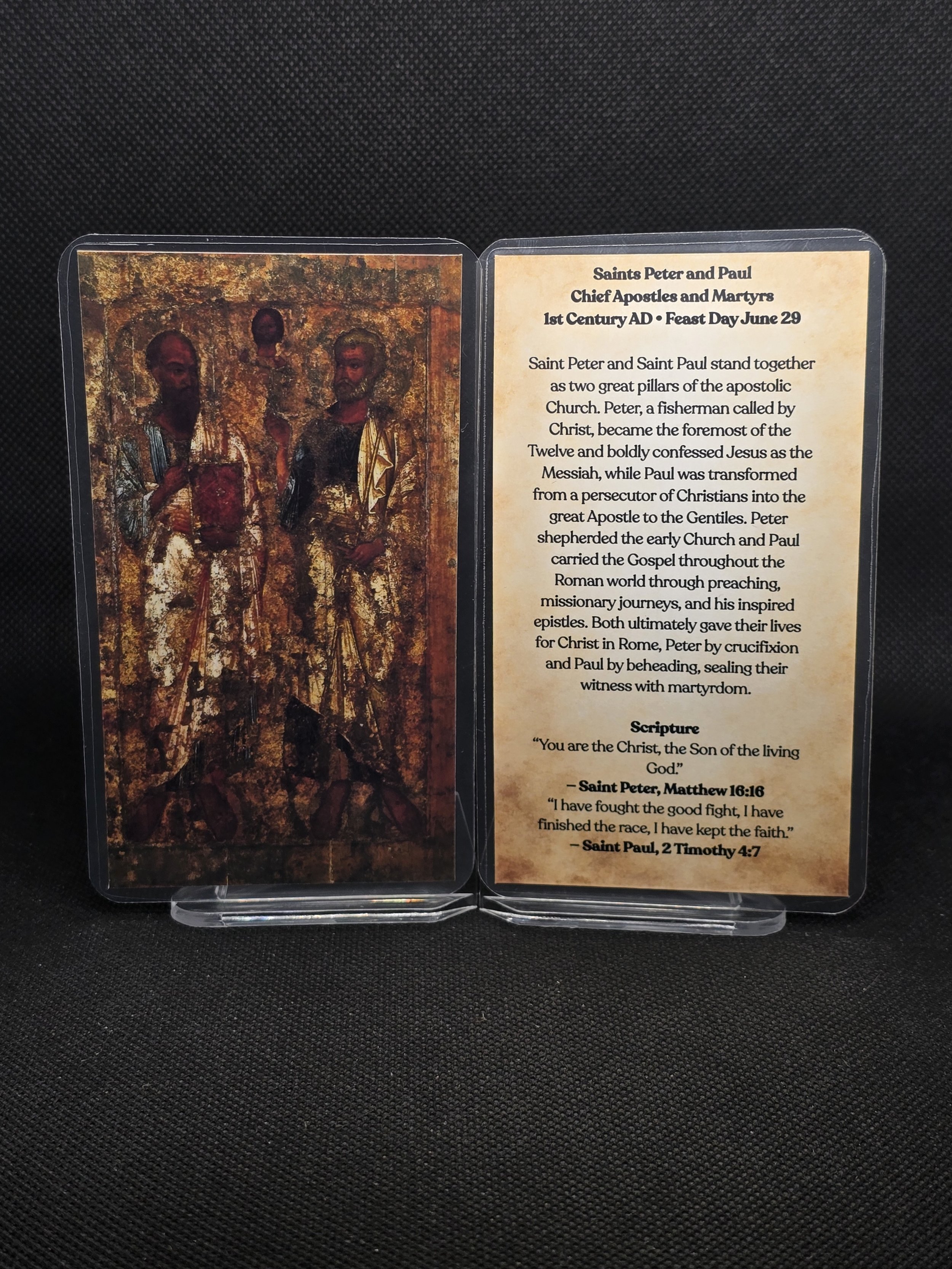
The paired icon of Peter and Paul often emphasizes precisely this communion. They may be shown together embracing or jointly holding an image of the Church, representing distinct apostolic ministries serving the one Body of Christ.
For Christians living in an age of constant division, the feast of Peter and Paul offers a needed correction.
Winning every argument is not the highest good.
Remaining faithful to Christ together is.
COURAGE TO PROCLAIM CHRIST
Both Peter and Paul eventually became fearless preachers, but neither began that way.
Peter's courage grew out of his experience of weakness.
The man who once denied Christ before people gathered around a fire later proclaimed Christ publicly before crowds and authorities.
That transformation matters.
Christian courage is not always a personality trait possessed from birth.
Sometimes it is produced through repentance.
Peter knew exactly what cowardice felt like. He therefore knew that his later courage was not something he could boast about as though it came entirely from himself.
Paul's courage developed through a different road.
He had once used power against Christians.
After conversion, he repeatedly became the powerless one: arrested, beaten, rejected, imprisoned, threatened, and eventually killed.
Yet he continued preaching.
Both men learned that the Gospel was worth suffering for.
This makes Saints Peter and Paul especially fitting intercessors for missionaries, evangelists, catechists, clergy, teachers, parents handing the faith to their children, Christians afraid to discuss religion publicly, and anyone who needs courage to say plainly:
Jesus Christ is Lord.
Their witness also guards evangelization from becoming self-promotion.
Peter and Paul were not spreading personal philosophies.
They were pointing away from themselves toward Christ.
The messenger mattered because of the message.
LEADERSHIP & VOCATION
Saints Peter and Paul are among Christianity's greatest models of spiritual leadership precisely because both men learned that leadership belonged to Christ before it belonged to them.
Peter was commanded:
“Feed My sheep.”
Not Peter's sheep.
Christ's sheep.
The distinction is essential.
The Orthodox reflection on Peter preserved for their joint feast emphasizes this point directly: the flock belongs to the Lord, and Christian shepherds receive responsibility for something that never becomes their personal possession.
For clergy, bishops, deacons, ministry leaders, catechists, parents, and anyone entrusted with other people, Peter teaches that authority is stewardship.
Paul teaches something complementary.
A vocation can arrive in a form a person never expected.
Saul did not spend his youth planning to become the Apostle to the Gentiles.
His entire life's direction changed through encounter with Christ.
This makes Paul especially meaningful for people discerning vocation later in life, converts who feel they have started too late, adults considering ministry, and people who discover that God's purpose for them does not resemble the future they had planned.
Both Apostles demonstrate that vocation requires movement.
Peter left his nets.
Paul abandoned the road he believed he was supposed to travel.
Following Christ often means leaving something behind.
MARTYRDOM IN ROME
Christian tradition remembers both Peter and Paul as martyrs in Rome during the persecution associated with Emperor Nero in the first century.
Peter was traditionally crucified, with the longstanding tradition that he requested crucifixion upside down because he considered himself unworthy to die in the same manner as Christ.
Paul, as a Roman citizen according to the New Testament tradition, is traditionally remembered as having been executed by beheading.
Their martyrdoms probably occurred during the Neronian period in the 60s AD. The Orthodox Church regards their martyrdom in Rome as historically well attested and celebrates their memory together even though their deaths were not necessarily on the exact same day.
Their association with Rome became so profound that both are honored as principal patrons of the city.
Two men who began thousands of miles away, with different educations, different personalities, and radically different relationships to the early Church eventually poured out their lives in the same imperial capital for the same Christ.
That is why their shared icon is so powerful.
The fisherman and the scholar stand together.
The denier and the persecutor stand together.
The restored sinner and the converted enemy stand together.
Both became saints.
THE APOSTLES' FAST
The importance of Saints Peter and Paul in Eastern Christianity is also visible in the liturgical calendar.
Their June 29 feast concludes the Apostles' Fast, one of the traditional fasting seasons of the Byzantine Christian year. The fast begins after the season of Pentecost and prepares the faithful for the feast of the great Apostles.
The existence of an entire fasting period connected with their feast demonstrates how seriously the Eastern Church receives the apostolic vocation.
The Apostles did not receive the Holy Spirit simply for private spiritual consolation.
Pentecost sent them outward.
Prayer became mission.
Grace became witness.
The Apostles' Fast therefore connects spiritual discipline with evangelization. Christians fast and pray not merely to become inwardly peaceful, but to become people capable of carrying Christ into the world.
Saints Peter and Paul embody that movement.
Both were changed by Christ.
Then both were sent.
PRAYERS
The traditional Orthodox Troparion for the feast addresses Peter and Paul together as the foremost of the Apostles and teachers of the inhabited earth and asks their intercession before Christ for peace and mercy.
A traditional short invocation may be prayed:
Holy Apostles Peter and Paul, pray to God for us.
Another traditional form using their Eastern titles is:
Holy, glorious and all-praised leaders of the Apostles, Peter and Paul, pray to God for us.
The Church's traditional Kontakion praises them as steadfast, divinely inspired heralds whose apostolic labors and deaths became offerings pleasing to God.
Those struggling after failure may keep this card nearby while praying for the repentance and renewed love shown in Saint Peter.
Those seeking radical conversion may invoke Saint Paul, remembering that Christ was able to transform a persecutor of Christians into one of Christianity's greatest Apostles.
Those struggling with division may invoke Peter and Paul together, asking through their intercession that differences not become hatred and that truth and communion remain joined.
Those discerning vocation, entering seminary, preparing for ordination, teaching the faith, evangelizing, or beginning missionary work may especially ask the prayers of the two great Apostles who gave everything to carry Christ to others.
This prayer card is especially fitting for a prayer corner, Bible, parish office, seminary room, ministry desk, missionary bag, catechism book, church office, or anywhere a person needs to remember that Christ can transform failure into vocation and very different people into fellow workers for the Gospel.
FAQ
Who are Saints Peter and Paul?
Saint Peter was one of the Twelve Apostles and a fisherman from Galilee who became a leading witness to Jesus Christ and a shepherd of the early Church. Saint Paul was originally a persecutor of Christians who encountered the risen Christ on the road to Damascus and became the great missionary Apostle to the Gentiles. Both were eventually martyred in Rome.
Why are Saints Peter and Paul celebrated together?
The Church celebrates them together because both hold a foremost place in the apostolic mission, both gave their lives proclaiming Jesus Christ, and Christian tradition associates both of their martyrdoms with Rome. Their shared feast also expresses unity between two very different apostles who served the same Gospel.
When is the feast of Saints Peter and Paul?
Their feast is celebrated on June 29 in both Eastern Orthodox and Catholic tradition.
What does the Orthodox Church call Saints Peter and Paul?
The Orthodox Church honors them as the Holy Glorious and All-Praised Leaders of the Apostles. They are also described as the foremost or chief Apostles.
Are Saints Peter and Paul Catholic saints?
Yes. Peter and Paul are foundational saints of Catholic Christianity and are particularly honored as patrons of the city and Diocese of Rome.
Are Saints Peter and Paul Orthodox saints?
Yes. They are among the most important saints in Eastern Orthodoxy and have a major joint feast on June 29, preceded by the Apostles' Fast.
Are Saints Peter and Paul Eastern Catholic saints?
Yes. Eastern Catholic Churches inherit the ancient Eastern devotion to the Apostles and celebrate Peter and Paul prominently within their liturgical traditions.
What are Saints Peter and Paul patron saints of?
Together they are especially associated with the apostolic mission, evangelization, preaching, Church leadership, missionary work, perseverance in faith, and Rome. Their biblical lives also make them particularly meaningful intercessors for conversion, restoration after failure, courage, and unity within the Church.
Are Saints Peter and Paul patron saints of Rome?
Yes. Catholic tradition venerates Saints Peter and Paul together as principal patrons of the city and Church of Rome.
Why is Saint Peter associated with fishermen?
Peter worked as a fisherman on the Sea of Galilee before becoming an Apostle of Christ.
Why is Saint Paul associated with missionaries?
Paul traveled extensively preaching the Gospel among Gentile populations throughout the ancient Mediterranean world. His missionary journeys and New Testament letters made him one of the foundational figures of Christian evangelization.
Why are Peter and Paul good saints for someone who has failed?
Peter denied knowing Jesus three times, while Paul had actively persecuted Christians. Both were transformed by grace and became great Apostles. Their lives show that serious past failure does not necessarily prevent a person from becoming holy or serving God faithfully.
Can I pray to Saints Peter and Paul after serious sin?
Yes. Their lives are especially meaningful for repentance and beginning again. Peter experienced restoration after denying Christ, while Paul's entire apostolic life began with radical repentance and conversion.
Can I give this card to a convert?
Yes. Saint Paul is one of Christianity's greatest models of radical conversion, while Saint Peter demonstrates the ongoing conversion required even after someone has already begun following Christ.
Can I give this card to someone returning to the Church?
Yes. Peter's restoration after denying Christ and Paul's complete change of direction make this an especially meaningful prayer card for someone returning to Christian life after a period of distance, sin, doubt, or spiritual failure.
Why did Peter deny Jesus?
During Christ's arrest and trial, Peter became afraid and three times denied knowing Him. After the Resurrection, Christ asked Peter three times whether he loved Him and entrusted him again with care of His flock.
Did Jesus forgive Saint Peter?
Yes. The encounter recorded in John 21 is traditionally understood as Peter's restoration after his threefold denial. Christ receives Peter's threefold profession of love and commands him to feed His sheep.
Was Saint Paul really a persecutor of Christians?
Yes. Before his conversion, Saul participated in persecution of the early Church and was present at the martyrdom of Saint Stephen.
What happened to Saint Paul on the road to Damascus?
The risen Jesus appeared to Saul while he was traveling toward Damascus. Saul was blinded, later received healing through Ananias, was baptized, and became a follower and Apostle of Christ.
Did Saints Peter and Paul ever disagree?
Yes. Saint Paul records confronting Peter at Antioch concerning Peter's conduct toward Gentile Christians. Their disagreement is important because the Church nevertheless remembers them together in apostolic communion.
Why are Peter and Paul a symbol of Christian unity?
They came from very different backgrounds, possessed different personalities, followed different paths to apostleship, and sometimes disagreed. Yet their differences were united in the same faith in Christ, the same Gospel mission, and ultimately the same witness of martyrdom.
Is Saints Peter and Paul a good prayer card for reconciliation?
Yes. Although reconciliation is best described as a devotional application rather than an official patronage title, their shared feast beautifully represents Christian communion strong enough to survive differences and disagreement.
Can I give this card to a priest, deacon, seminarian, or missionary?
Yes. Peter and Paul are among the most fitting saints for anyone serving or discerning ministry because their lives center on preaching, pastoral responsibility, missionary work, sacrifice, and complete dedication to Christ.
Is this a good ordination gift?
Yes. Their apostolic leadership and pastoral witness make a Saints Peter and Paul prayer card particularly meaningful for an ordination, seminary graduation, ministry anniversary, or vocational discernment.
What did Jesus mean when He told Peter to feed His sheep?
After the Resurrection, Christ entrusted Peter with pastoral responsibility for His people. The Eastern tradition emphasizes that the flock remains Christ's flock, making Christian leadership an act of stewardship rather than possession.
How did Saint Peter die?
Christian tradition holds that Peter was crucified in Rome during Nero's reign and requested crucifixion upside down because he felt unworthy to die exactly as Christ had died.
How did Saint Paul die?
Christian tradition holds that Paul was martyred in Rome during Nero's reign, traditionally by beheading. The Orthodox Church dates his martyrdom to approximately the late 60s AD.
Did Peter and Paul die on the same day?
The Church celebrates their martyrdom together on June 29, but ancient Christian tradition does not require that they were executed on the exact same calendar day. The significance of the joint feast lies in their united apostolic witness and martyrdom at Rome.
Where are Saints Peter and Paul buried?
Ancient Christian tradition associates Saint Peter's tomb with the site beneath Saint Peter's Basilica in Vatican City and Saint Paul's burial with the site of the Basilica of Saint Paul Outside the Walls in Rome.
What is the Apostles' Fast?
The Apostles' Fast is a traditional Eastern Christian fasting period following Pentecost that concludes with the June 29 feast of Saints Peter and Paul. Its length varies from year to year according to the date of Pascha.
Why are Saints Peter and Paul shown together in icons?
Their joint icon emphasizes that their distinct apostolic ministries belong to one Church and one Gospel. A common iconographic tradition depicts the two Apostles embracing, visually expressing communion despite their very different personalities and histories.
What is Saint Peter usually holding in icons?
Saint Peter is often depicted holding keys, referring to Christ's words concerning the keys of the Kingdom, or a scroll representing his apostolic teaching.
What is Saint Paul usually holding in icons?
Saint Paul is commonly depicted holding a book or scroll representing his teaching and his New Testament epistles. He may also be shown with a sword in Western iconography, connected both with the Word of God and with his traditional martyrdom by beheading.
Why is Saint Paul an Apostle if he was not one of the Twelve?
Paul was not one of the original Twelve disciples who accompanied Jesus during His earthly ministry. His apostleship came through his encounter and calling by the risen Christ, after which he was sent to proclaim the Gospel especially among the Gentiles.
What does Saint Peter teach about failure?
Peter teaches that genuine love for Christ does not mean a Christian will never fall. His life demonstrates the possibility of repentance, forgiveness, restoration, humility, and renewed vocation after serious failure.
What does Saint Paul teach about conversion?
Paul teaches that no identity, ideology, reputation, or past action is beyond the transforming call of Christ. Genuine conversion can require admitting that the road one has confidently traveled is the wrong road and allowing God to redirect an entire life.
What do Saints Peter and Paul teach about unity?
They show that Christian communion does not require identical backgrounds, personalities, opinions, or ministries. Their unity came from belonging to Christ, proclaiming the same Gospel, and ultimately laying down their lives for Him.
What is the main message of Saints Peter and Paul's lives?
Saints Peter and Paul teach that God can transform failure into mission. Peter denied Christ and became a fearless shepherd. Paul persecuted Christians and became the Apostle to the Gentiles. They differed, disagreed, suffered, persevered, preached, and ultimately gave their lives for the same Lord. Together they remind every Christian that the past need not dictate the future, differences need not destroy communion, and Christ can make extraordinary witnesses out of deeply imperfect people.
Saints Peter and Paul, the Holy Glorious and All-Praised Leaders of the Apostles, stand together as two of the greatest witnesses to the transforming power of Jesus Christ. Peter was the Galilean fisherman who followed Christ from the beginning, confessed Him as the Messiah, failed Him through fear, was restored by the risen Lord, and became a shepherd of the early Church. Paul began as a persecutor of Christians, encountered the risen Christ on the road to Damascus, and became the great Apostle to the Gentiles. The Eastern Church commemorates them together on June 29 and honors them as the foremost leaders of the Apostles.
Saints Peter and Paul are especially meaningful for anyone who believes past failures have made holiness impossible. Peter denied Christ three times. Paul actively persecuted the Church. Neither man's worst moment became the final definition of his life. Christ restored Peter and commanded him to feed His sheep. Christ confronted Paul, transformed his entire direction, and sent him to proclaim the Gospel he had once tried to destroy.
Together, they are powerful intercessors for conversion, returning to God after serious failure, perseverance in Christian vocation, courage to proclaim the faith, Church leadership, missionary work, reconciliation, and unity despite differences. Their paired feast is especially striking because Peter and Paul were not identical personalities who agreed effortlessly about everything. Scripture records real disagreement between them concerning the treatment of Gentile Christians, yet the Church remembers them together as brothers in faith whose different gifts ultimately served the same Gospel. The Catholic Church likewise venerates them together as pillars of the Church and patrons of Rome.
For someone who has failed publicly, fallen into serious sin, abandoned prayer, hurt others, walked away from Christianity, or simply believes God could never use them again, Peter and Paul offer an unmistakable answer. Peter's cowardice did not prevent him from becoming a courageous preacher. Paul's persecution did not prevent him from becoming an Apostle. Grace did not pretend their pasts had never happened. Grace transformed what came next.
They are equally important for Christians who need courage to speak openly about Jesus Christ. Peter stood before crowds at Pentecost and proclaimed Christ publicly. Paul crossed cities, cultures, and political boundaries preaching the Gospel despite imprisonment, beatings, rejection, danger, and eventually martyrdom. The men who had once been ruled by fear or misdirected zeal became fearless witnesses because they had encountered the risen Lord.
This prayer card is created for converts, people returning to the Church, clergy, seminarians, missionaries, evangelists, catechists, church leaders, Christians struggling after failure, those discerning a vocation, people seeking reconciliation, and anyone who needs courage to begin again after making serious mistakes. It is also especially fitting for friends or family members named Peter or Paul and as a gift for ordinations, professions of faith, conversions, missionary work, or the feast of the Holy Apostles.
Saints Peter and Paul's strongest traditional associations include apostleship, evangelization, missionary work, leadership in the Church, preaching, conversion, courage under persecution, perseverance, and the city of Rome. Their lives also make them especially meaningful devotional intercessors for restoration after failure and for unity among Christians with different personalities, backgrounds, and gifts.
Each card is handmade in Austin, TX and created to order. We do not keep stock, because every prayer card is treated as a unique devotional offering. They are printed on museum-quality photo paper, not cardstock. Every card is made slowly, during prayer, with intentional reverence for the saint or holy image and for the person who will receive it. Names are lifted before Christ. Intentions are held carefully. Each piece is handled multiple times in prayerful silence, asking God for mercy and asking the saints to intercede for the soul it is being made for. This is not production work. It is devotional craftsmanship shaped with patience, care, and spiritual responsibility, because every soul and every prayer matters.
THE LIFE & STORY
Saint Peter was originally named Simon. He came from Bethsaida in Galilee, was the brother of Saint Andrew the First-Called, and worked as a fisherman. Scripture also tells us that Peter was married, because Christ healed his mother-in-law from a fever. Jesus gave Simon the name Cephas, or Peter, meaning rock.
Peter became one of the disciples closest to Christ. Together with James and John, he witnessed moments that not every Apostle saw. His personality emerges throughout the Gospels with unusual clarity. He is passionate, impulsive, loyal, confident, frightened, courageous, confused, and deeply human.
At Caesarea Philippi, Jesus asked His disciples who they believed Him to be. Peter answered with the great confession that Jesus was the Christ, the Son of the living God. Christ blessed Peter and spoke of the rock upon which His Church would be built. This confession became central to Peter's place in Christian history.
Yet Peter's faith was not a simple upward progression from strength to greater strength.
On the night Christ was arrested, Peter insisted that even if others abandoned Jesus, he would remain faithful. Within hours, fear overtook him.
Three times Peter denied knowing Christ.
Then the rooster crowed.
The disciple who had declared that he was ready to die with Jesus discovered that courage built on self-confidence could collapse almost instantly.
Peter's denial makes him one of the most important saints for Christians who have failed after sincerely believing they would never fail.
He knew what it was like to love Christ and still behave like a coward.
He knew what it was like to discover something about himself that he did not want to know.
He knew shame.
But Peter's story did not end beside the fire where he denied Jesus.
After the Resurrection, Christ encountered Peter again. Three times He asked Peter whether he loved Him, corresponding strikingly with Peter's three denials. Each time Peter professed his love, and Christ commanded him to care for His flock. The Eastern tradition explicitly sees this threefold restoration as Christ loosening Peter from the threefold denial into which fear had bound him.
This is one of the most powerful moments of restoration in Scripture.
Christ did not say that Peter's failure was irrelevant.
He transformed failure into humility and renewed vocation.
The man who had denied Jesus in fear later stood publicly at Pentecost and preached Christ before the crowds. The Book of Acts presents Peter as one of the principal leaders of the earliest Christian community, preaching, healing, enduring imprisonment, and guiding the growing Church. He also baptized Cornelius, an event of enormous importance in the mission to the Gentiles.
Peter eventually traveled beyond Palestine and Christian tradition places his final ministry and martyrdom in Rome under Emperor Nero. According to ancient tradition, he was crucified and requested to be crucified upside down because he did not consider himself worthy to die in precisely the same manner as Jesus Christ.
Saint Paul's road to apostleship could hardly have been more different.
Paul was originally called Saul. He came from Tarsus in Cilicia, belonged to the tribe of Benjamin, was a Pharisee, worked as a tentmaker, and had studied the Jewish Law under Gamaliel in Jerusalem.
Unlike Peter, Paul was not among the Twelve who followed Jesus during His earthly ministry.
Worse, Saul became an enemy of the early Christian movement.
He was present when Saint Stephen, the first Christian martyr, was stoned. He participated in the persecution of Christians and obtained authority to pursue believers.
Then everything changed.
While Saul was traveling toward Damascus to continue his persecution, the risen Christ appeared to him.
The question Saul heard was devastating:
“Saul, Saul, why are you persecuting Me?”
Saul discovered that the Christians he believed he was serving God by destroying belonged so completely to Christ that persecuting them was persecution of Christ Himself.
The encounter left Saul blind.
He entered Damascus no longer as the powerful persecutor arriving to arrest Christians, but as a helpless man who had to be led by the hand.
The Lord then sent a Christian named Ananias to him.
Ananias understandably knew Saul's reputation and feared him. Yet Christ revealed that Saul had been chosen for an entirely different purpose. He would carry the name of Jesus before Gentiles, rulers, and the people of Israel, and he would suffer greatly for Christ.
Ananias went.
Saul regained his sight and received Baptism.
The persecutor became the preacher.
The man who entered Damascus intending to imprison Christians eventually became one of Christianity's greatest missionaries.
Saint Paul traveled extensively throughout the Mediterranean world proclaiming Jesus Christ, establishing and strengthening Christian communities, enduring repeated persecution and imprisonment, and writing letters that became part of the New Testament. The Orthodox tradition remembers his preaching throughout Greece, Asia Minor, and Rome.
Paul's life demonstrates that conversion is more than becoming slightly better behaved.
Sometimes conversion means discovering that the entire direction of one's life has been wrong.
Paul was sincere before Damascus. He was zealous. He believed he was defending God.
He was also wrong.
His greatness began when encountering Christ became more important than defending his previous certainty.
This makes Saint Paul one of Christianity's strongest intercessors for converts and those undergoing radical changes in belief.
A person can spend years believing one thing, build an identity around it, defend it publicly, and still be called by Christ into something different.
Humility allows the soul to say:
I was wrong. Lord, what do You want me to do now?
Paul would eventually suffer enormously for the Gospel. His own writings recount beatings, imprisonments, dangers, hunger, sleeplessness, opposition, and shipwreck. Yet the former persecutor continued preaching the Christ whose followers he once tried to silence.
According to Christian tradition, Paul was eventually martyred in Rome during Nero's reign, traditionally by beheading. Peter and Paul therefore completed very different earthly journeys in the same city and through the same ultimate testimony: giving their lives for Jesus Christ.
The Church consequently refuses to separate them.
Their feast is celebrated together on June 29.
The Orthodox Church calls them the leaders, or koryphaioi, of the Apostles, a title expressing their foremost place in the apostolic witness.
In Rome they are honored together as the great apostolic patrons of the city. Their different personalities, backgrounds, and missions became united in the same confession of Christ and ultimately in martyrdom.
FAILURE, CONVERSION & BEGINNING AGAIN
Few pairings of saints speak as powerfully about failure as Peter and Paul.
Peter failed after becoming a disciple.
Paul failed before becoming one.
Peter teaches that a Christian can genuinely love Christ and still fall terribly through weakness.
Paul teaches that a person can sincerely believe he is doing good while actually fighting against God.
Together they destroy two forms of despair.
The first says:
“I knew Christ and still failed Him, so there is no way back.”
Peter answers that.
The second says:
“I have done too much harm for God ever to use my life.”
Paul answers that.
Neither Apostle was chosen because his history was spotless.
Their greatness came from what divine grace accomplished in human beings who finally surrendered themselves completely to Christ.
Peter's restoration is particularly important for Christians burdened by shame.
After denying Christ three times, Peter could have defined himself forever by those few terrible minutes.
Christ did not allow that.
He called Peter back into relationship and responsibility.
This is important because forgiveness is sometimes easier to believe abstractly than personally. A Christian may accept that God forgives sins while secretly believing that a particular failure permanently disqualifies him from doing meaningful work for Christ.
Peter's life contradicts that conclusion.
The wounds of failure may remain part of a person's story, but they do not have to remain the final chapter.
Paul's conversion takes the same truth even further.
Paul had harmed other people because of his beliefs. His past was not merely private weakness. Christians had suffered because of him.
Grace still reached him.
This does not make the damage insignificant. It demonstrates the magnitude of conversion.
Paul did not spend the rest of his life pretending he had never persecuted Christians. He spoke openly about his past and used the memory of it to magnify the grace of God rather than himself.
For someone recovering from a destructive former life, this offers a powerful pattern.
Repentance does not require rewriting history.
It requires allowing God to write what happens next.
UNITY DESPITE DIFFERENCES
Saints Peter and Paul are also extraordinary patrons for unity without sameness.
They were remarkably different men.
Peter was a Galilean fisherman.
Paul was a highly educated Pharisee from Tarsus.
Peter had followed Jesus throughout His public ministry.
Paul encountered Christ after the Resurrection.
Peter's early mission was closely tied to Jewish believers.
Paul became known above all as the Apostle to the Gentiles.
Their personalities were different, their backgrounds were different, and Scripture even records serious disagreement between them.
Saint Paul recounts confronting Peter at Antioch over Peter's behavior toward Gentile believers.
The Church did not erase this disagreement from Scripture.
It remembered both men together anyway.
That is profoundly important.
Christian unity does not require pretending that disagreement never exists.
It requires something greater than agreement to hold Christians together.
Peter and Paul belonged to the same Christ.
Their differences did not disappear. Their brotherhood became larger than those differences. A recent papal reflection on their feast described precisely this communion as a unity that does not erase differing backgrounds, personalities, ideas, or gifts.
This makes Saints Peter and Paul particularly meaningful for families, parishes, ministries, clergy, coworkers, and Christians trying to remain united while disagreeing about secondary matters.
It is also an important image for marriage and friendship.
Unity is not sameness.
Two people can approach problems differently, possess different personalities, disagree strongly, correct one another, and still remain joined by something deeper than preference.
The paired icon of Peter and Paul often emphasizes precisely this communion. They may be shown together embracing or jointly holding an image of the Church, representing distinct apostolic ministries serving the one Body of Christ.
For Christians living in an age of constant division, the feast of Peter and Paul offers a needed correction.
Winning every argument is not the highest good.
Remaining faithful to Christ together is.
COURAGE TO PROCLAIM CHRIST
Both Peter and Paul eventually became fearless preachers, but neither began that way.
Peter's courage grew out of his experience of weakness.
The man who once denied Christ before people gathered around a fire later proclaimed Christ publicly before crowds and authorities.
That transformation matters.
Christian courage is not always a personality trait possessed from birth.
Sometimes it is produced through repentance.
Peter knew exactly what cowardice felt like. He therefore knew that his later courage was not something he could boast about as though it came entirely from himself.
Paul's courage developed through a different road.
He had once used power against Christians.
After conversion, he repeatedly became the powerless one: arrested, beaten, rejected, imprisoned, threatened, and eventually killed.
Yet he continued preaching.
Both men learned that the Gospel was worth suffering for.
This makes Saints Peter and Paul especially fitting intercessors for missionaries, evangelists, catechists, clergy, teachers, parents handing the faith to their children, Christians afraid to discuss religion publicly, and anyone who needs courage to say plainly:
Jesus Christ is Lord.
Their witness also guards evangelization from becoming self-promotion.
Peter and Paul were not spreading personal philosophies.
They were pointing away from themselves toward Christ.
The messenger mattered because of the message.
LEADERSHIP & VOCATION
Saints Peter and Paul are among Christianity's greatest models of spiritual leadership precisely because both men learned that leadership belonged to Christ before it belonged to them.
Peter was commanded:
“Feed My sheep.”
Not Peter's sheep.
Christ's sheep.
The distinction is essential.
The Orthodox reflection on Peter preserved for their joint feast emphasizes this point directly: the flock belongs to the Lord, and Christian shepherds receive responsibility for something that never becomes their personal possession.
For clergy, bishops, deacons, ministry leaders, catechists, parents, and anyone entrusted with other people, Peter teaches that authority is stewardship.
Paul teaches something complementary.
A vocation can arrive in a form a person never expected.
Saul did not spend his youth planning to become the Apostle to the Gentiles.
His entire life's direction changed through encounter with Christ.
This makes Paul especially meaningful for people discerning vocation later in life, converts who feel they have started too late, adults considering ministry, and people who discover that God's purpose for them does not resemble the future they had planned.
Both Apostles demonstrate that vocation requires movement.
Peter left his nets.
Paul abandoned the road he believed he was supposed to travel.
Following Christ often means leaving something behind.
MARTYRDOM IN ROME
Christian tradition remembers both Peter and Paul as martyrs in Rome during the persecution associated with Emperor Nero in the first century.
Peter was traditionally crucified, with the longstanding tradition that he requested crucifixion upside down because he considered himself unworthy to die in the same manner as Christ.
Paul, as a Roman citizen according to the New Testament tradition, is traditionally remembered as having been executed by beheading.
Their martyrdoms probably occurred during the Neronian period in the 60s AD. The Orthodox Church regards their martyrdom in Rome as historically well attested and celebrates their memory together even though their deaths were not necessarily on the exact same day.
Their association with Rome became so profound that both are honored as principal patrons of the city.
Two men who began thousands of miles away, with different educations, different personalities, and radically different relationships to the early Church eventually poured out their lives in the same imperial capital for the same Christ.
That is why their shared icon is so powerful.
The fisherman and the scholar stand together.
The denier and the persecutor stand together.
The restored sinner and the converted enemy stand together.
Both became saints.
THE APOSTLES' FAST
The importance of Saints Peter and Paul in Eastern Christianity is also visible in the liturgical calendar.
Their June 29 feast concludes the Apostles' Fast, one of the traditional fasting seasons of the Byzantine Christian year. The fast begins after the season of Pentecost and prepares the faithful for the feast of the great Apostles.
The existence of an entire fasting period connected with their feast demonstrates how seriously the Eastern Church receives the apostolic vocation.
The Apostles did not receive the Holy Spirit simply for private spiritual consolation.
Pentecost sent them outward.
Prayer became mission.
Grace became witness.
The Apostles' Fast therefore connects spiritual discipline with evangelization. Christians fast and pray not merely to become inwardly peaceful, but to become people capable of carrying Christ into the world.
Saints Peter and Paul embody that movement.
Both were changed by Christ.
Then both were sent.
PRAYERS
The traditional Orthodox Troparion for the feast addresses Peter and Paul together as the foremost of the Apostles and teachers of the inhabited earth and asks their intercession before Christ for peace and mercy.
A traditional short invocation may be prayed:
Holy Apostles Peter and Paul, pray to God for us.
Another traditional form using their Eastern titles is:
Holy, glorious and all-praised leaders of the Apostles, Peter and Paul, pray to God for us.
The Church's traditional Kontakion praises them as steadfast, divinely inspired heralds whose apostolic labors and deaths became offerings pleasing to God.
Those struggling after failure may keep this card nearby while praying for the repentance and renewed love shown in Saint Peter.
Those seeking radical conversion may invoke Saint Paul, remembering that Christ was able to transform a persecutor of Christians into one of Christianity's greatest Apostles.
Those struggling with division may invoke Peter and Paul together, asking through their intercession that differences not become hatred and that truth and communion remain joined.
Those discerning vocation, entering seminary, preparing for ordination, teaching the faith, evangelizing, or beginning missionary work may especially ask the prayers of the two great Apostles who gave everything to carry Christ to others.
This prayer card is especially fitting for a prayer corner, Bible, parish office, seminary room, ministry desk, missionary bag, catechism book, church office, or anywhere a person needs to remember that Christ can transform failure into vocation and very different people into fellow workers for the Gospel.
FAQ
Who are Saints Peter and Paul?
Saint Peter was one of the Twelve Apostles and a fisherman from Galilee who became a leading witness to Jesus Christ and a shepherd of the early Church. Saint Paul was originally a persecutor of Christians who encountered the risen Christ on the road to Damascus and became the great missionary Apostle to the Gentiles. Both were eventually martyred in Rome.
Why are Saints Peter and Paul celebrated together?
The Church celebrates them together because both hold a foremost place in the apostolic mission, both gave their lives proclaiming Jesus Christ, and Christian tradition associates both of their martyrdoms with Rome. Their shared feast also expresses unity between two very different apostles who served the same Gospel.
When is the feast of Saints Peter and Paul?
Their feast is celebrated on June 29 in both Eastern Orthodox and Catholic tradition.
What does the Orthodox Church call Saints Peter and Paul?
The Orthodox Church honors them as the Holy Glorious and All-Praised Leaders of the Apostles. They are also described as the foremost or chief Apostles.
Are Saints Peter and Paul Catholic saints?
Yes. Peter and Paul are foundational saints of Catholic Christianity and are particularly honored as patrons of the city and Diocese of Rome.
Are Saints Peter and Paul Orthodox saints?
Yes. They are among the most important saints in Eastern Orthodoxy and have a major joint feast on June 29, preceded by the Apostles' Fast.
Are Saints Peter and Paul Eastern Catholic saints?
Yes. Eastern Catholic Churches inherit the ancient Eastern devotion to the Apostles and celebrate Peter and Paul prominently within their liturgical traditions.
What are Saints Peter and Paul patron saints of?
Together they are especially associated with the apostolic mission, evangelization, preaching, Church leadership, missionary work, perseverance in faith, and Rome. Their biblical lives also make them particularly meaningful intercessors for conversion, restoration after failure, courage, and unity within the Church.
Are Saints Peter and Paul patron saints of Rome?
Yes. Catholic tradition venerates Saints Peter and Paul together as principal patrons of the city and Church of Rome.
Why is Saint Peter associated with fishermen?
Peter worked as a fisherman on the Sea of Galilee before becoming an Apostle of Christ.
Why is Saint Paul associated with missionaries?
Paul traveled extensively preaching the Gospel among Gentile populations throughout the ancient Mediterranean world. His missionary journeys and New Testament letters made him one of the foundational figures of Christian evangelization.
Why are Peter and Paul good saints for someone who has failed?
Peter denied knowing Jesus three times, while Paul had actively persecuted Christians. Both were transformed by grace and became great Apostles. Their lives show that serious past failure does not necessarily prevent a person from becoming holy or serving God faithfully.
Can I pray to Saints Peter and Paul after serious sin?
Yes. Their lives are especially meaningful for repentance and beginning again. Peter experienced restoration after denying Christ, while Paul's entire apostolic life began with radical repentance and conversion.
Can I give this card to a convert?
Yes. Saint Paul is one of Christianity's greatest models of radical conversion, while Saint Peter demonstrates the ongoing conversion required even after someone has already begun following Christ.
Can I give this card to someone returning to the Church?
Yes. Peter's restoration after denying Christ and Paul's complete change of direction make this an especially meaningful prayer card for someone returning to Christian life after a period of distance, sin, doubt, or spiritual failure.
Why did Peter deny Jesus?
During Christ's arrest and trial, Peter became afraid and three times denied knowing Him. After the Resurrection, Christ asked Peter three times whether he loved Him and entrusted him again with care of His flock.
Did Jesus forgive Saint Peter?
Yes. The encounter recorded in John 21 is traditionally understood as Peter's restoration after his threefold denial. Christ receives Peter's threefold profession of love and commands him to feed His sheep.
Was Saint Paul really a persecutor of Christians?
Yes. Before his conversion, Saul participated in persecution of the early Church and was present at the martyrdom of Saint Stephen.
What happened to Saint Paul on the road to Damascus?
The risen Jesus appeared to Saul while he was traveling toward Damascus. Saul was blinded, later received healing through Ananias, was baptized, and became a follower and Apostle of Christ.
Did Saints Peter and Paul ever disagree?
Yes. Saint Paul records confronting Peter at Antioch concerning Peter's conduct toward Gentile Christians. Their disagreement is important because the Church nevertheless remembers them together in apostolic communion.
Why are Peter and Paul a symbol of Christian unity?
They came from very different backgrounds, possessed different personalities, followed different paths to apostleship, and sometimes disagreed. Yet their differences were united in the same faith in Christ, the same Gospel mission, and ultimately the same witness of martyrdom.
Is Saints Peter and Paul a good prayer card for reconciliation?
Yes. Although reconciliation is best described as a devotional application rather than an official patronage title, their shared feast beautifully represents Christian communion strong enough to survive differences and disagreement.
Can I give this card to a priest, deacon, seminarian, or missionary?
Yes. Peter and Paul are among the most fitting saints for anyone serving or discerning ministry because their lives center on preaching, pastoral responsibility, missionary work, sacrifice, and complete dedication to Christ.
Is this a good ordination gift?
Yes. Their apostolic leadership and pastoral witness make a Saints Peter and Paul prayer card particularly meaningful for an ordination, seminary graduation, ministry anniversary, or vocational discernment.
What did Jesus mean when He told Peter to feed His sheep?
After the Resurrection, Christ entrusted Peter with pastoral responsibility for His people. The Eastern tradition emphasizes that the flock remains Christ's flock, making Christian leadership an act of stewardship rather than possession.
How did Saint Peter die?
Christian tradition holds that Peter was crucified in Rome during Nero's reign and requested crucifixion upside down because he felt unworthy to die exactly as Christ had died.
How did Saint Paul die?
Christian tradition holds that Paul was martyred in Rome during Nero's reign, traditionally by beheading. The Orthodox Church dates his martyrdom to approximately the late 60s AD.
Did Peter and Paul die on the same day?
The Church celebrates their martyrdom together on June 29, but ancient Christian tradition does not require that they were executed on the exact same calendar day. The significance of the joint feast lies in their united apostolic witness and martyrdom at Rome.
Where are Saints Peter and Paul buried?
Ancient Christian tradition associates Saint Peter's tomb with the site beneath Saint Peter's Basilica in Vatican City and Saint Paul's burial with the site of the Basilica of Saint Paul Outside the Walls in Rome.
What is the Apostles' Fast?
The Apostles' Fast is a traditional Eastern Christian fasting period following Pentecost that concludes with the June 29 feast of Saints Peter and Paul. Its length varies from year to year according to the date of Pascha.
Why are Saints Peter and Paul shown together in icons?
Their joint icon emphasizes that their distinct apostolic ministries belong to one Church and one Gospel. A common iconographic tradition depicts the two Apostles embracing, visually expressing communion despite their very different personalities and histories.
What is Saint Peter usually holding in icons?
Saint Peter is often depicted holding keys, referring to Christ's words concerning the keys of the Kingdom, or a scroll representing his apostolic teaching.
What is Saint Paul usually holding in icons?
Saint Paul is commonly depicted holding a book or scroll representing his teaching and his New Testament epistles. He may also be shown with a sword in Western iconography, connected both with the Word of God and with his traditional martyrdom by beheading.
Why is Saint Paul an Apostle if he was not one of the Twelve?
Paul was not one of the original Twelve disciples who accompanied Jesus during His earthly ministry. His apostleship came through his encounter and calling by the risen Christ, after which he was sent to proclaim the Gospel especially among the Gentiles.
What does Saint Peter teach about failure?
Peter teaches that genuine love for Christ does not mean a Christian will never fall. His life demonstrates the possibility of repentance, forgiveness, restoration, humility, and renewed vocation after serious failure.
What does Saint Paul teach about conversion?
Paul teaches that no identity, ideology, reputation, or past action is beyond the transforming call of Christ. Genuine conversion can require admitting that the road one has confidently traveled is the wrong road and allowing God to redirect an entire life.
What do Saints Peter and Paul teach about unity?
They show that Christian communion does not require identical backgrounds, personalities, opinions, or ministries. Their unity came from belonging to Christ, proclaiming the same Gospel, and ultimately laying down their lives for Him.
What is the main message of Saints Peter and Paul's lives?
Saints Peter and Paul teach that God can transform failure into mission. Peter denied Christ and became a fearless shepherd. Paul persecuted Christians and became the Apostle to the Gentiles. They differed, disagreed, suffered, persevered, preached, and ultimately gave their lives for the same Lord. Together they remind every Christian that the past need not dictate the future, differences need not destroy communion, and Christ can make extraordinary witnesses out of deeply imperfect people.