 Image 1 of 1
Blessed Estephan El Douaihy, also known as Stephen Douayhi, Estephan Douaihy, Istifan al-Duwayhi, Stephen al-Duwayhi, and Patriarch Estephan II Boutros El Douaihy, was one of the greatest scholars, shepherds, and defenders in the history of the Maronite Catholic Church. Revered as the Father of Maronite History, he preserved the memory, theology, Syriac liturgy, and spiritual inheritance of the Maronite people during an age of persecution and political instability.
Born in Ehden, Lebanon, on August 2, 1630, Estephan showed exceptional intelligence and spiritual seriousness from childhood. He was sent to the Maronite College in Rome while still young, where he studied philosophy, theology, history, languages, and the traditions of the Church. During his studies, he suffered from a serious problem with his eyesight and feared that he might become blind, but he attributed his healing to the intercession of the Blessed Virgin Mary.
While in Rome, he searched libraries and collected information concerning the ancient history of the Maronite Church. He understood that manuscripts, liturgical books, historical records, and the writings of earlier generations could easily be lost during war and persecution. His desire to preserve this inheritance became one of the defining missions of his life.
After returning to Lebanon, Estephan El Douaihy was ordained a priest on March 25, 1656. He became a preacher, teacher, missionary, and pastor, serving Maronite communities in Lebanon and Aleppo while giving particular attention to the religious education of children and the formation of adults. His intelligence never separated him from ordinary people, and he used his learning in service to families, villages, clergy, and the entire Maronite Church.
In 1668, he was consecrated Bishop of the Maronite Eparchy of Cyprus. Two years later, at only forty years of age, he was elected the 57th Maronite Patriarch of Antioch and All the East, beginning a patriarchate that would continue from 1670 until his death in 1704.
His years as patriarch unfolded during a dangerous period of Ottoman rule. Maronite villages faced crushing taxation, political oppression, violence, arrests, and repeated threats against clergy and faithful. Blessed Estephan himself was insulted, physically assaulted, forced to flee, and repeatedly driven from one residence to another, yet he refused to abandon his people or surrender his responsibilities as their shepherd.
He continued traveling among the faithful, visiting villages, consecrating churches, preaching, teaching, settling disputes, strengthening clergy, and defending those who were being treated unjustly. Even when he had to hide or move for his own safety, he continued writing and governing the Church. His life demonstrated that spiritual leadership does not depend upon comfort, security, or political power, but upon faithfulness to Christ and service to His people.
Blessed Estephan El Douaihy became one of the most important historians and theologians Lebanon ever produced. He wrote or compiled thirty-two manuscripts covering Maronite history, theology, philosophy, liturgy, canon law, poetry, Syriac hymnody, ecclesiastical tradition, and the relationship between the Maronite Church and the Apostolic See of Rome.
His historical writings preserved names, events, monasteries, patriarchs, persecutions, and traditions that might otherwise have disappeared. Because of this work, he is remembered as the Father of Maronite History, but his scholarship was never merely academic. He believed that preserving the Church’s memory helped its people understand who they were, what they had suffered, and why their faith must be handed faithfully to future generations.
Blessed Estephan also devoted himself to protecting the ancient Syriac and Antiochene heritage of Maronite worship. He studied liturgical manuscripts, corrected texts, documented hymns and prayers, and defended the authentic traditions of the Maronite Church. His work remains especially important for understanding how the Maronite liturgy developed and how its Syriac identity survived centuries of instability.
Education held a central place in his vision for the Church. He established schools, encouraged the religious education of children, promoted the formation of clergy, and supported the education of promising Maronite students. He knew that a persecuted people could lose more than their property and security. They could also lose their history, language, theology, and spiritual identity if future generations were not carefully taught.
He also supported the renewal and organization of Maronite monastic life. His leadership helped prepare the conditions from which renewed Maronite religious orders would emerge, strengthening monasteries as places of prayer, learning, hospitality, manuscript preservation, and service to the faithful.
Blessed Estephan’s scholarship was rooted in prayer. He possessed a profound devotion to the Eucharist, the Blessed Virgin Mary, the saints, and the sacred traditions entrusted to the Church. His patriarchal ministry joined the contemplative life of prayer with the demanding work of administration, scholarship, pastoral visitation, and defense of the oppressed.
He died on May 3, 1704, at Qannoubine in Lebanon’s Qadisha Valley. His reputation for holiness began among the Maronite faithful soon after his death, especially in Ehden and northern Lebanon, where his memory remained deeply cherished.
Pope Benedict XVI recognized his heroic virtues and declared him Venerable in 2008. After the approval of a miracle attributed to his intercession, Blessed Estephan El Douaihy was beatified in Bkerké, Lebanon, on August 2, 2024, becoming the first Maronite patriarch to be formally declared Blessed.
His feast is celebrated on May 3, the anniversary of his death. He remains an especially meaningful intercessor for Maronites, Church leaders, historians, theologians, teachers, writers, students, clergy, persecuted Christians, and everyone working to preserve the traditions of the Christian faith.
Blessed Estephan may also be sought by those facing injustice, political oppression, threats against their faith, or difficult responsibilities that must be carried without recognition or security. His life offers encouragement to anyone who feels exhausted by opposition but knows that abandoning the work entrusted to them would mean abandoning the people who depend upon them.
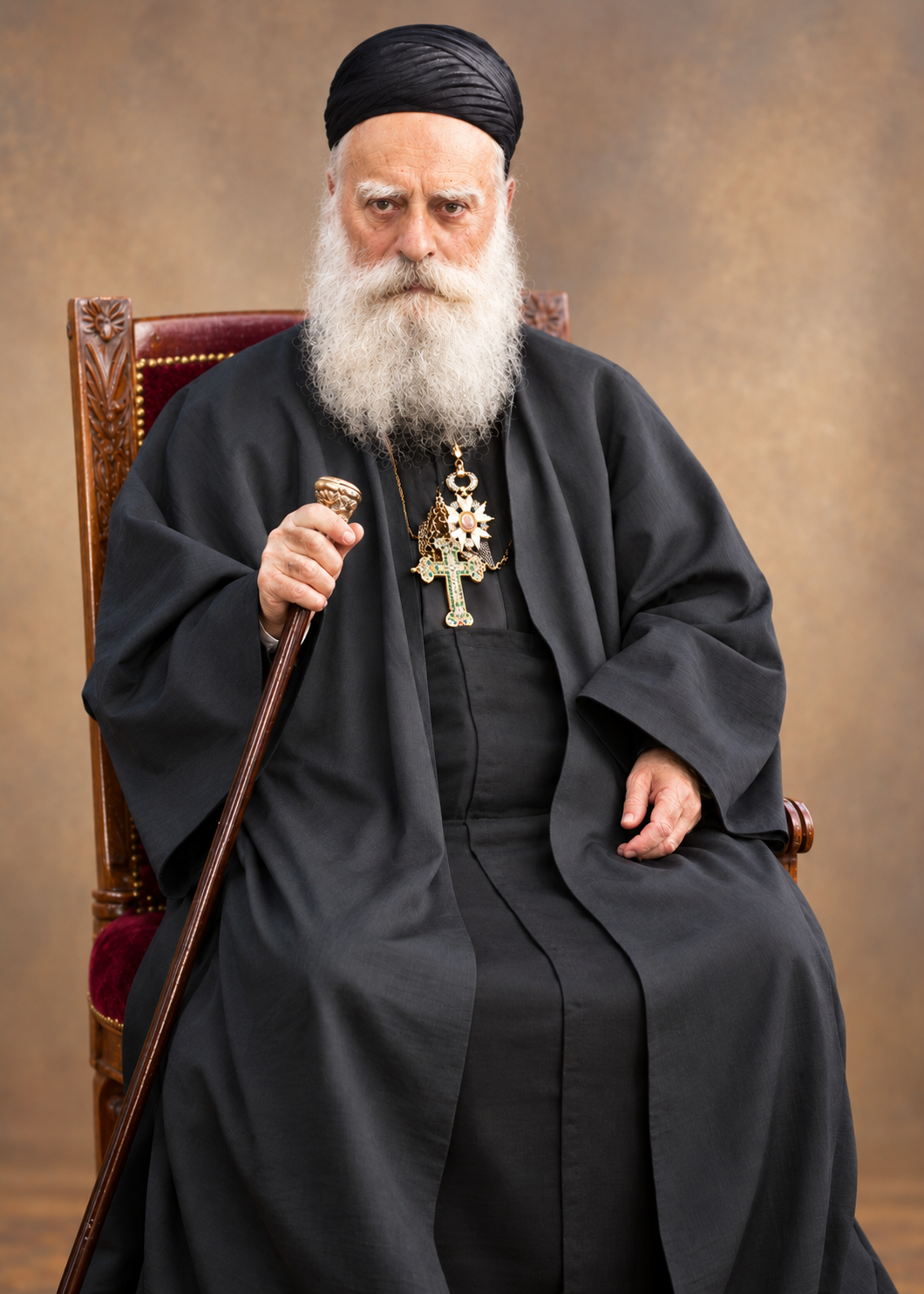
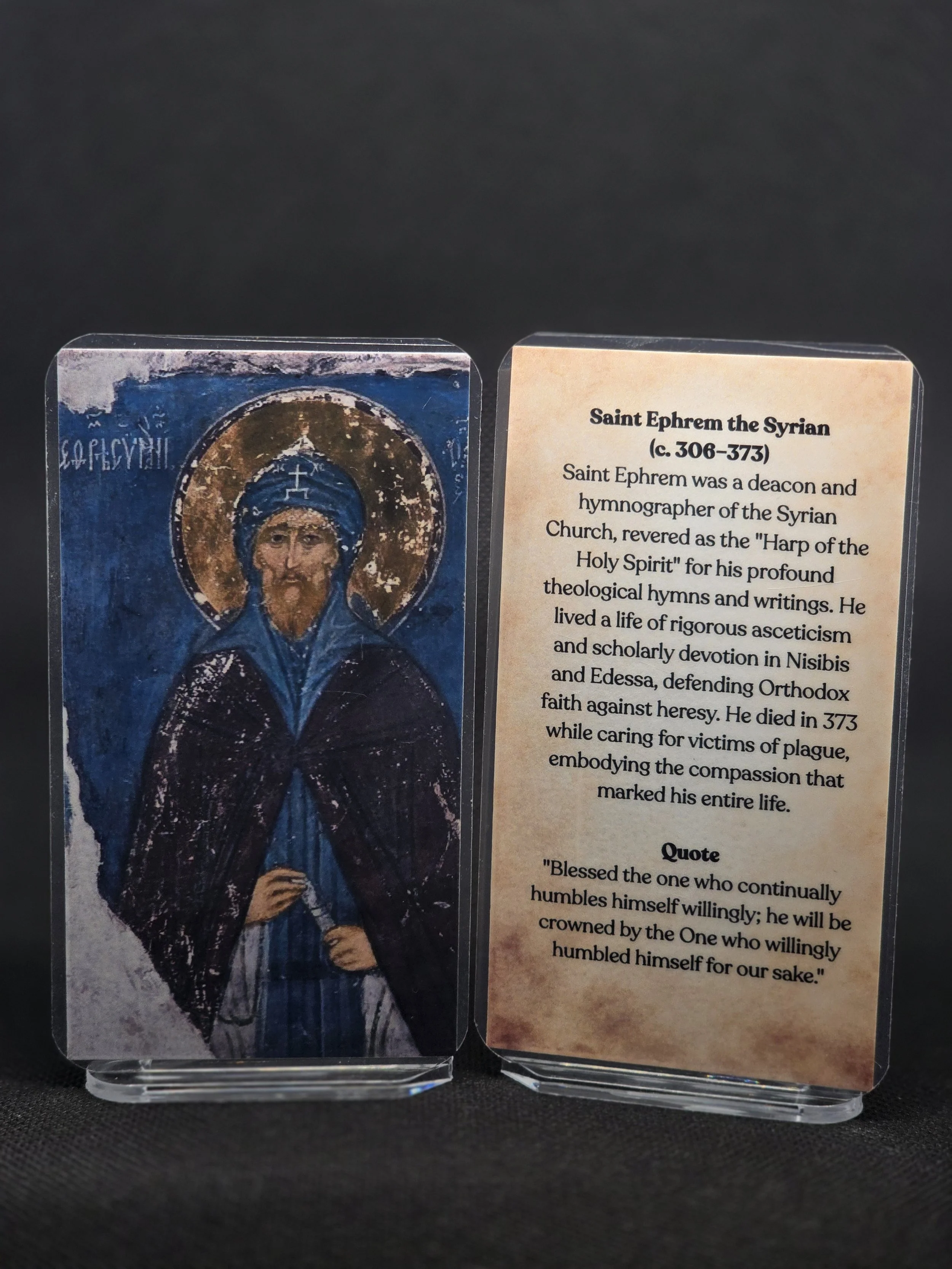
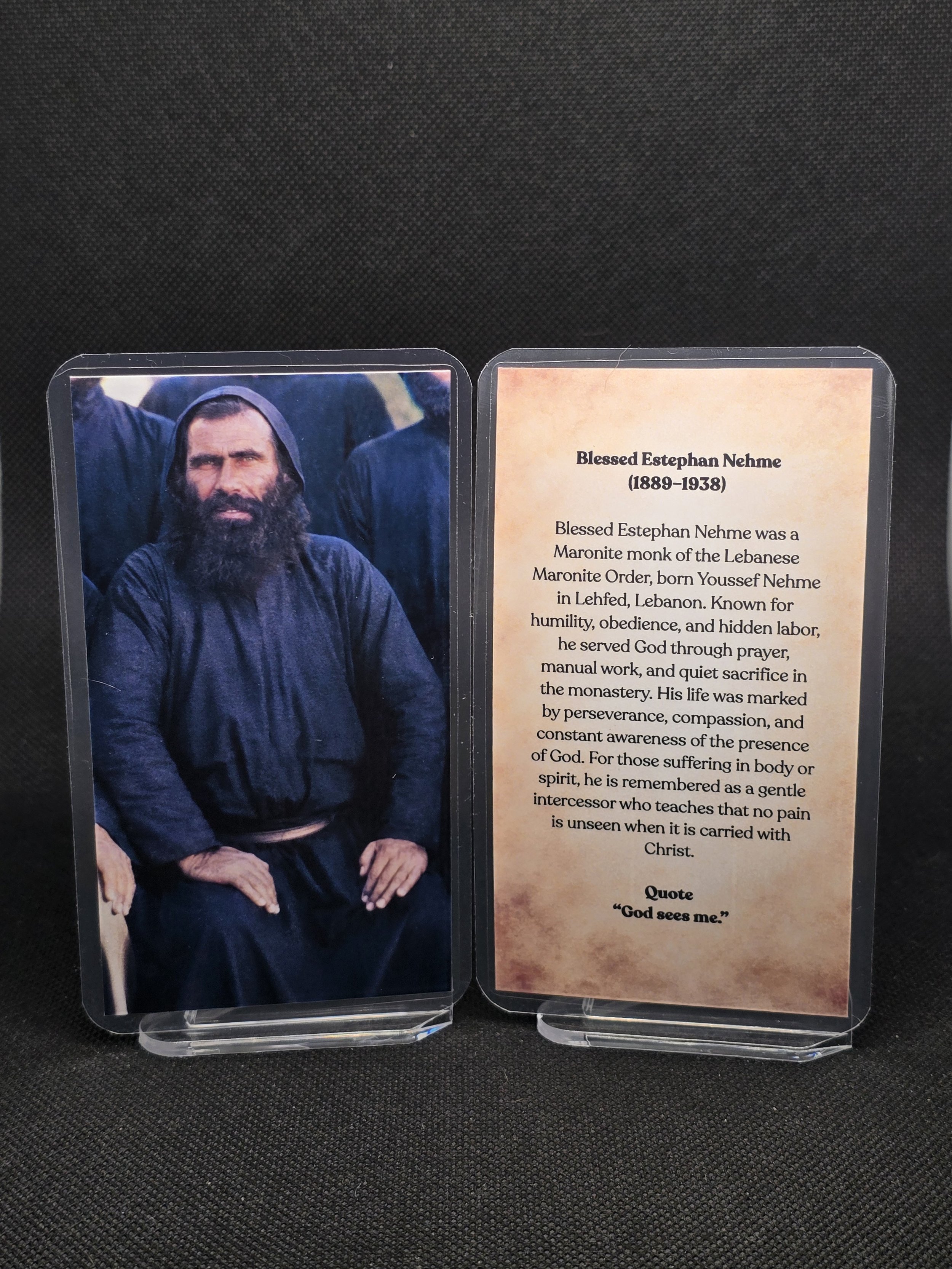
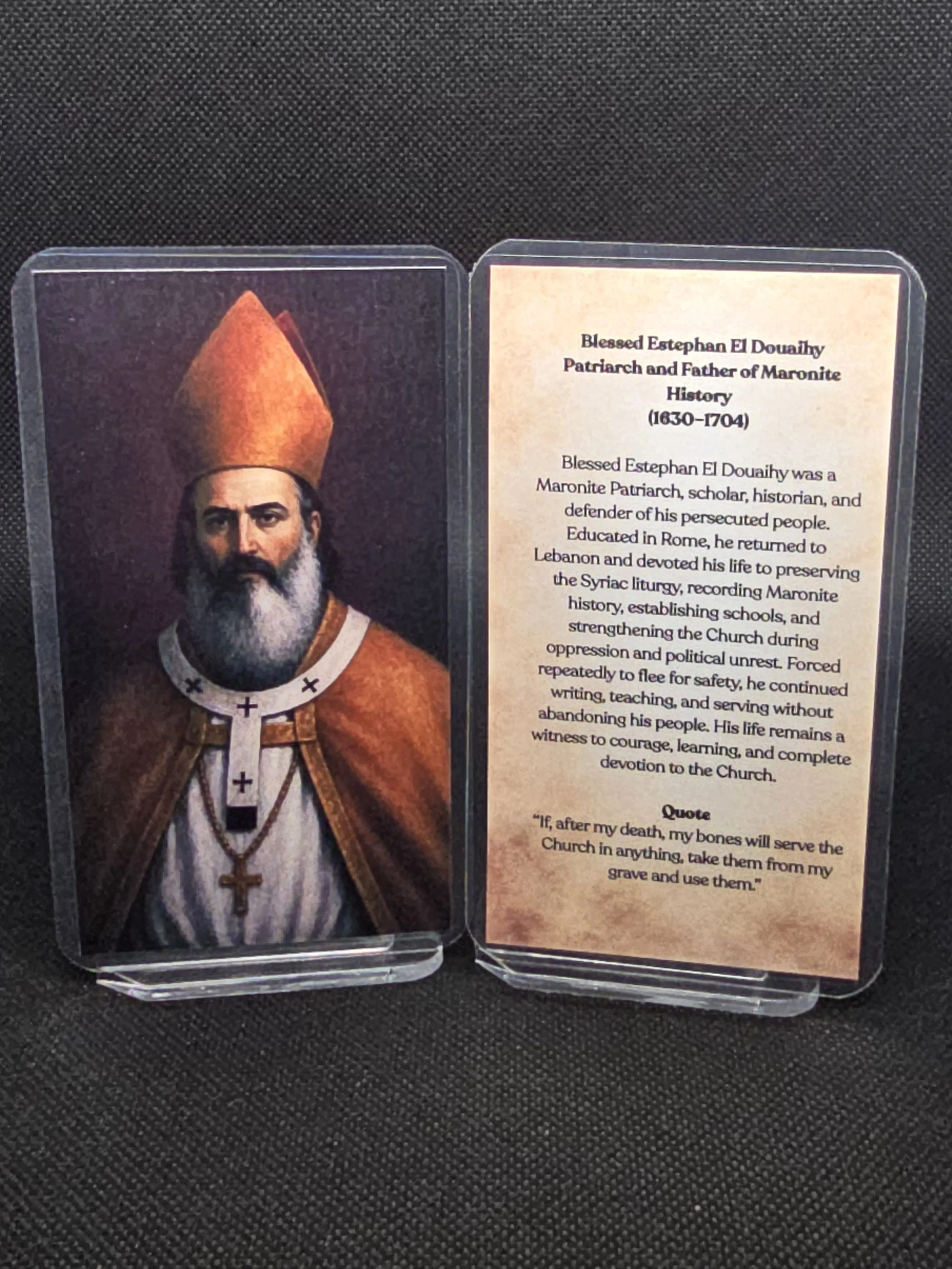
This prayer card honors Blessed Estephan El Douaihy as a holy patriarch, courageous shepherd, defender of his persecuted people, and Father of Maronite History. The front features a reverent portrait of the Maronite patriarch, while the reverse presents a concise account of his life and a quotation traditionally attributed to him:
“If, after my death, my bones will serve the Church in anything, take them from my grave and use them.”
Each prayer card is handmade to order in Austin, Texas. It is printed on museum-quality photo paper and double laminated for durability, creating a devotional card that can be carried, displayed, placed inside a Bible or prayer book, or given as a meaningful Catholic gift.
Throughout the creation process, Blessed Estephan El Douaihy is honored, his intercession is sought, and prayers are intentionally offered for the person who will receive the card. These cards are not commercially mass-produced devotional items. Each one is prepared slowly and reverently because every person, intention, and prayer matters.
Maronite Catholic Church
Blessed Estephan El Douaihy was a Maronite Catholic priest, Bishop of Cyprus, and Patriarch of Antioch and All the East. He is formally venerated as a Blessed within the Catholic Church and holds a particularly important place in Maronite history and spirituality.
May 3
Blessed Estephan El Douaihy, Blessed Estephan Douaihy, Stephen Douayhi, Stephen al-Duwayhi, Istifan al-Duwayhi, Estefan El Douaihy, Patriarch Douaihy, Estephan II Boutros El Douaihy, Father of Maronite History, Saint of the Word, and Blessed Patriarch of the Maronite Church
Blessed Estephan El Douaihy is a meaningful intercessor for:
Preservation of the Maronite Catholic faith
Protection of persecuted Christians
Courage during political or religious oppression
Maronite patriarchs, bishops, priests, and deacons
Historians, writers, scholars, and theologians
Teachers, students, schools, and seminaries
Preservation of Syriac language and liturgy
Wisdom in Church leadership
Strength when facing injustice
Fidelity to Catholic teaching
Protection of ancient Christian traditions
Healing from eye problems and fear of blindness
Perseverance in difficult responsibilities
Lebanon and the Lebanese people
These are devotional associations drawn from his life and witness rather than a declaration of formal patronage.
Blessed Estephan El Douaihy, also known as Stephen Douayhi, Estephan Douaihy, Istifan al-Duwayhi, Stephen al-Duwayhi, and Patriarch Estephan II Boutros El Douaihy, was one of the greatest scholars, shepherds, and defenders in the history of the Maronite Catholic Church. Revered as the Father of Maronite History, he preserved the memory, theology, Syriac liturgy, and spiritual inheritance of the Maronite people during an age of persecution and political instability.
Born in Ehden, Lebanon, on August 2, 1630, Estephan showed exceptional intelligence and spiritual seriousness from childhood. He was sent to the Maronite College in Rome while still young, where he studied philosophy, theology, history, languages, and the traditions of the Church. During his studies, he suffered from a serious problem with his eyesight and feared that he might become blind, but he attributed his healing to the intercession of the Blessed Virgin Mary.
While in Rome, he searched libraries and collected information concerning the ancient history of the Maronite Church. He understood that manuscripts, liturgical books, historical records, and the writings of earlier generations could easily be lost during war and persecution. His desire to preserve this inheritance became one of the defining missions of his life.
After returning to Lebanon, Estephan El Douaihy was ordained a priest on March 25, 1656. He became a preacher, teacher, missionary, and pastor, serving Maronite communities in Lebanon and Aleppo while giving particular attention to the religious education of children and the formation of adults. His intelligence never separated him from ordinary people, and he used his learning in service to families, villages, clergy, and the entire Maronite Church.
In 1668, he was consecrated Bishop of the Maronite Eparchy of Cyprus. Two years later, at only forty years of age, he was elected the 57th Maronite Patriarch of Antioch and All the East, beginning a patriarchate that would continue from 1670 until his death in 1704.
His years as patriarch unfolded during a dangerous period of Ottoman rule. Maronite villages faced crushing taxation, political oppression, violence, arrests, and repeated threats against clergy and faithful. Blessed Estephan himself was insulted, physically assaulted, forced to flee, and repeatedly driven from one residence to another, yet he refused to abandon his people or surrender his responsibilities as their shepherd.
He continued traveling among the faithful, visiting villages, consecrating churches, preaching, teaching, settling disputes, strengthening clergy, and defending those who were being treated unjustly. Even when he had to hide or move for his own safety, he continued writing and governing the Church. His life demonstrated that spiritual leadership does not depend upon comfort, security, or political power, but upon faithfulness to Christ and service to His people.
Blessed Estephan El Douaihy became one of the most important historians and theologians Lebanon ever produced. He wrote or compiled thirty-two manuscripts covering Maronite history, theology, philosophy, liturgy, canon law, poetry, Syriac hymnody, ecclesiastical tradition, and the relationship between the Maronite Church and the Apostolic See of Rome.
His historical writings preserved names, events, monasteries, patriarchs, persecutions, and traditions that might otherwise have disappeared. Because of this work, he is remembered as the Father of Maronite History, but his scholarship was never merely academic. He believed that preserving the Church’s memory helped its people understand who they were, what they had suffered, and why their faith must be handed faithfully to future generations.
Blessed Estephan also devoted himself to protecting the ancient Syriac and Antiochene heritage of Maronite worship. He studied liturgical manuscripts, corrected texts, documented hymns and prayers, and defended the authentic traditions of the Maronite Church. His work remains especially important for understanding how the Maronite liturgy developed and how its Syriac identity survived centuries of instability.
Education held a central place in his vision for the Church. He established schools, encouraged the religious education of children, promoted the formation of clergy, and supported the education of promising Maronite students. He knew that a persecuted people could lose more than their property and security. They could also lose their history, language, theology, and spiritual identity if future generations were not carefully taught.
He also supported the renewal and organization of Maronite monastic life. His leadership helped prepare the conditions from which renewed Maronite religious orders would emerge, strengthening monasteries as places of prayer, learning, hospitality, manuscript preservation, and service to the faithful.
Blessed Estephan’s scholarship was rooted in prayer. He possessed a profound devotion to the Eucharist, the Blessed Virgin Mary, the saints, and the sacred traditions entrusted to the Church. His patriarchal ministry joined the contemplative life of prayer with the demanding work of administration, scholarship, pastoral visitation, and defense of the oppressed.
He died on May 3, 1704, at Qannoubine in Lebanon’s Qadisha Valley. His reputation for holiness began among the Maronite faithful soon after his death, especially in Ehden and northern Lebanon, where his memory remained deeply cherished.
Pope Benedict XVI recognized his heroic virtues and declared him Venerable in 2008. After the approval of a miracle attributed to his intercession, Blessed Estephan El Douaihy was beatified in Bkerké, Lebanon, on August 2, 2024, becoming the first Maronite patriarch to be formally declared Blessed.
His feast is celebrated on May 3, the anniversary of his death. He remains an especially meaningful intercessor for Maronites, Church leaders, historians, theologians, teachers, writers, students, clergy, persecuted Christians, and everyone working to preserve the traditions of the Christian faith.
Blessed Estephan may also be sought by those facing injustice, political oppression, threats against their faith, or difficult responsibilities that must be carried without recognition or security. His life offers encouragement to anyone who feels exhausted by opposition but knows that abandoning the work entrusted to them would mean abandoning the people who depend upon them.
This prayer card honors Blessed Estephan El Douaihy as a holy patriarch, courageous shepherd, defender of his persecuted people, and Father of Maronite History. The front features a reverent portrait of the Maronite patriarch, while the reverse presents a concise account of his life and a quotation traditionally attributed to him:
“If, after my death, my bones will serve the Church in anything, take them from my grave and use them.”
Each prayer card is handmade to order in Austin, Texas. It is printed on museum-quality photo paper and double laminated for durability, creating a devotional card that can be carried, displayed, placed inside a Bible or prayer book, or given as a meaningful Catholic gift.
Throughout the creation process, Blessed Estephan El Douaihy is honored, his intercession is sought, and prayers are intentionally offered for the person who will receive the card. These cards are not commercially mass-produced devotional items. Each one is prepared slowly and reverently because every person, intention, and prayer matters.
Maronite Catholic Church
Blessed Estephan El Douaihy was a Maronite Catholic priest, Bishop of Cyprus, and Patriarch of Antioch and All the East. He is formally venerated as a Blessed within the Catholic Church and holds a particularly important place in Maronite history and spirituality.
May 3
Blessed Estephan El Douaihy, Blessed Estephan Douaihy, Stephen Douayhi, Stephen al-Duwayhi, Istifan al-Duwayhi, Estefan El Douaihy, Patriarch Douaihy, Estephan II Boutros El Douaihy, Father of Maronite History, Saint of the Word, and Blessed Patriarch of the Maronite Church
Blessed Estephan El Douaihy is a meaningful intercessor for:
Preservation of the Maronite Catholic faith
Protection of persecuted Christians
Courage during political or religious oppression
Maronite patriarchs, bishops, priests, and deacons
Historians, writers, scholars, and theologians
Teachers, students, schools, and seminaries
Preservation of Syriac language and liturgy
Wisdom in Church leadership
Strength when facing injustice
Fidelity to Catholic teaching
Protection of ancient Christian traditions
Healing from eye problems and fear of blindness
Perseverance in difficult responsibilities
Lebanon and the Lebanese people
These are devotional associations drawn from his life and witness rather than a declaration of formal patronage.