 Image 1 of 1
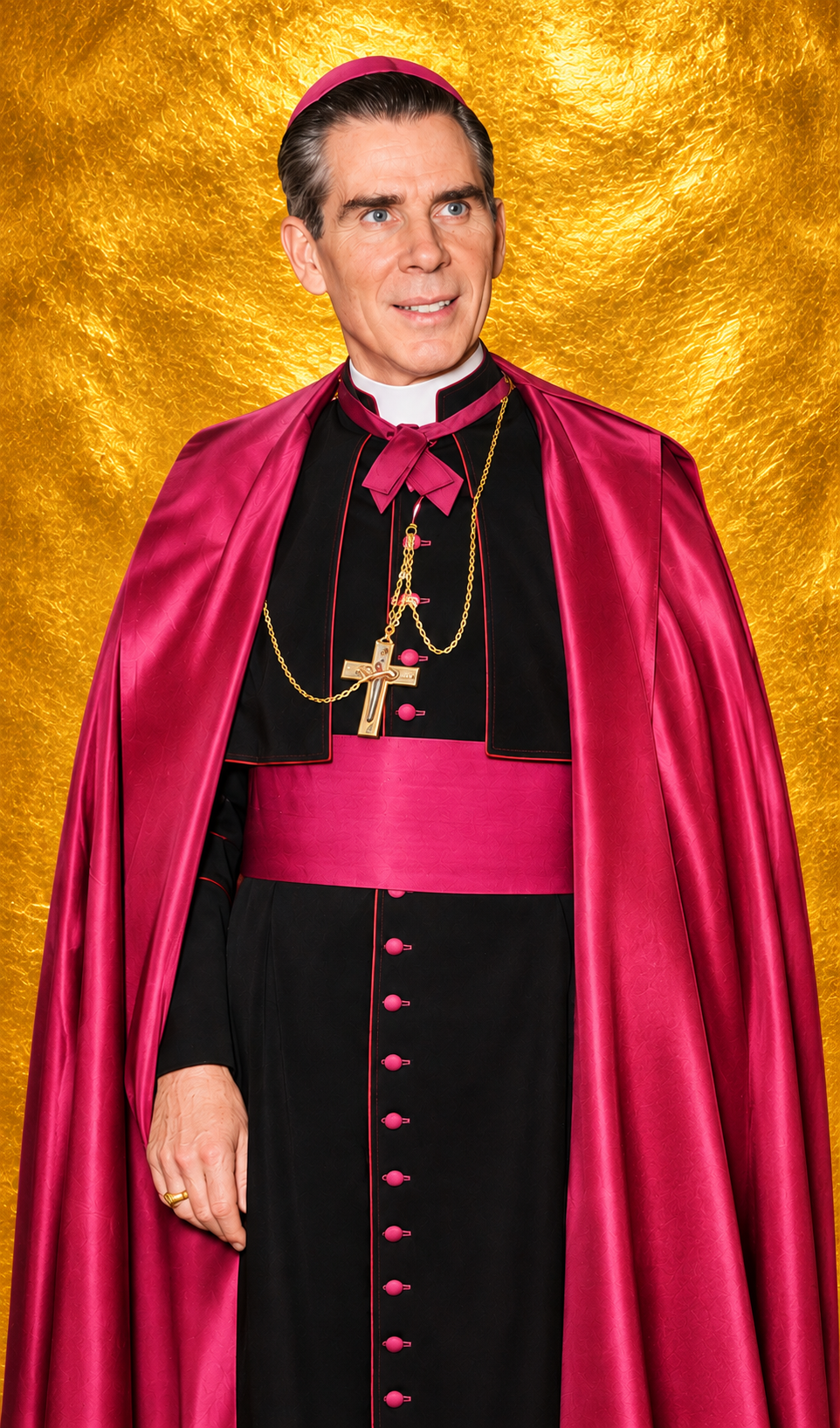
Blessed Fulton J. Sheen Prayer Card – For Eucharistic Adoration, Evangelization, Conversion & Courage to Speak the Faith
Blessed Fulton J. Sheen was an American Catholic priest, bishop, theologian, missionary leader, author, radio preacher, and pioneering television evangelist who became one of the most recognizable Catholic voices of the twentieth century. Long before religious teaching through modern media became commonplace, Sheen demonstrated that serious theology could be communicated to millions of ordinary people with clarity, humor, intelligence, and unmistakable confidence in Jesus Christ.
His television program Life Is Worth Living reached an enormous national audience and earned him one of television's highest honors, yet Sheen consistently insisted that the real source of his preaching was not celebrity, talent, or preparation alone. For six decades of priesthood, he maintained a daily Holy Hour before the Blessed Sacrament, believing that fruitful Christian work had to grow from sustained personal prayer with Christ.
Blessed Fulton Sheen is especially meaningful for priests, preachers, catechists, teachers, writers, Catholic content creators, converts, people seeking a deeper Eucharistic life, and anyone who needs courage to speak openly about the faith in a culture that may misunderstand it. His life offers a particularly powerful example for Christians trying to use television, radio, writing, social media, or other forms of communication without allowing the message of Christ to become secondary to the messenger.
Each prayer card measures 2.5" x 4.25", is handmade in Austin, Texas, printed on museum-quality photo paper rather than ordinary cardstock, and double laminated for durability. Every card is made to order and prepared prayerfully, with the recipient and their intentions brought before Christ while asking Blessed Fulton J. Sheen to intercede for their needs.
THE LIFE & STORY OF BLESSED FULTON J. SHEEN
Fulton John Sheen was born in El Paso, Illinois, in 1895 and grew up in the Diocese of Peoria. His family later moved to Peoria, where the young Fulton served Mass at the Cathedral of Saint Mary of the Immaculate Conception, the same cathedral in which he would eventually be ordained a priest and where his remains would later be interred.
From an early age, Sheen displayed unusual intellectual ability and a strong attraction toward the priesthood. His gifts would eventually take him into universities, lecture halls, radio studios, television sets, mission work, and episcopal leadership, but the identity underneath all of those roles remained fundamentally priestly.
He was ordained for the Diocese of Peoria in 1919. The priest who would eventually preach to millions began his ministry within the ordinary life of a Midwestern American diocese.
STUDY AND THE INTELLECTUAL LIFE
After ordination, Sheen pursued advanced studies in Europe and earned a doctorate in philosophy at the Catholic University of Leuven in Belgium. His academic work placed him deeply within Catholic philosophy and theology while also preparing him to engage modern intellectual questions.
He later joined the faculty of The Catholic University of America, where he taught for decades and became known for his ability to present complex ideas in language that remained understandable to ordinary listeners.
This combination of intellectual rigor and accessibility became one of Sheen's defining gifts. He did not believe serious theology needed to sound obscure in order to be profound, and he refused to assume that ordinary people were incapable of understanding difficult questions about God, morality, suffering, freedom, psychology, marriage, politics, and human purpose.
THE CATHOLIC HOUR
Sheen's national media apostolate began through radio. In 1930, he became a regular speaker on The Catholic Hour, a national radio program that brought Catholic teaching into homes across the United States.
His voice quickly became familiar to listeners far beyond the Catholic population. He addressed theological subjects but also spoke about culture, human psychology, international affairs, morality, communism, suffering, marriage, education, and the search for happiness.
The radio microphone allowed Sheen to accomplish something previously difficult for Catholic evangelists in America. He could enter the homes of millions of people who might never voluntarily attend a Catholic lecture or walk into a Catholic church.
His ability to speak to those outside the Church became one of the great strengths of his ministry.
LIFE IS WORTH LIVING
Sheen's most famous media work began with the television program Life Is Worth Living in the early 1950s. The format was remarkably simple by modern standards. Sheen generally stood before the camera in episcopal attire, spoke directly to the audience, and occasionally wrote on a blackboard.
There were no elaborate visual effects, fast editing, or large supporting cast. The program depended largely upon Sheen's ability to hold an audience through storytelling, humor, argument, personality, and conviction.
It worked.
Millions of people watched him every week, including enormous numbers of non-Catholics. At the height of its popularity, Life Is Worth Living became one of the most remarkable religious broadcasting successes in American history.
THE EMMY AWARD
Sheen's popularity became so great that the television industry itself recognized him. He received the Emmy Award for Outstanding Television Personality during an era dominated by some of the most famous entertainers in American television.
The achievement was extraordinary for a Catholic bishop presenting explicitly religious material.
Sheen famously accepted the award with humor, thanking his writers and naming Matthew, Mark, Luke, and John.
The joke captured his entire approach to television. He understood the conventions of entertainment and could participate in them naturally, but he never wanted the audience to forget that the Gospel remained the source of the message.
EVANGELIZING THROUGH MODERN MEDIA
Blessed Fulton Sheen was decades ahead of many church leaders in understanding that new communication technology could become missionary territory.
Radio and television were not merely entertainment devices to him. They were places where human beings gathered, listened, formed opinions, encountered ideas, and searched for meaning.
Sheen entered that world without watering down Catholic teaching. He spoke about sin, Confession, the Cross, the Eucharist, marriage, prayer, suffering, communism, freedom, psychology, and eternity to audiences measured in the millions.
His life remains especially relevant for Catholic writers, podcasters, YouTubers, teachers, artists, filmmakers, and others trying to communicate the faith through twenty-first-century media. The technology changes, but the missionary question remains the same: how can Christ be proclaimed clearly within the places where people actually spend their attention?
THE DAILY HOLY HOUR
The public Sheen was energetic, eloquent, and constantly visible. The private foundation beneath that activity was much quieter.
From the beginning of his priesthood, Sheen developed the practice of spending a daily Holy Hour in prayer before the Blessed Sacrament. He maintained this discipline throughout approximately sixty years of priestly life.
Sheen did not treat Eucharistic adoration as an optional devotion added around the edges of a busy ministry. He regarded the Holy Hour as the source from which the rest of his work received life.
He prepared sermons in the presence of the Blessed Sacrament, prayed through difficulties there, and encouraged priests and laypeople alike to discover what sustained attention to Christ could do within a soul.
“EVERY SINGLE DAY”
Sheen urged Christians to make deliberate time for God rather than expecting deep prayer to emerge automatically from a crowded schedule. He appealed especially strongly for a consistent hour of prayer before Christ.
His own discipline gives credibility to the recommendation. He did not teach the Holy Hour as something convenient. He maintained it while teaching, traveling, writing books, directing missionary work, appearing on radio and television, serving as a bishop, and carrying enormous administrative responsibilities.
The busier his life became, the more essential prayer became.
For someone overwhelmed by work, technology, notifications, obligations, and constant mental noise, Sheen's example offers a difficult but simple challenge: time with God must be protected deliberately.
THE EUCHARIST
The Eucharist stood at the heart of Sheen's spirituality. His preaching repeatedly returned to Christ's sacramental presence, the sacrifice of the Mass, and the transformation that occurs when a Christian learns to remain with Christ rather than merely speaking about Him.
This is why Sheen's media success cannot be understood simply as a triumph of natural charisma.
He deliberately connected effective preaching with contemplation.
For Catholics who struggle to maintain a consistent habit of Eucharistic adoration, Blessed Fulton Sheen provides an especially compelling spiritual companion. His life demonstrates what can happen when a person allows decades of public activity to remain rooted in private worship.
FOR EUCHARISTIC ADORATION
A Blessed Fulton J. Sheen prayer card can be particularly meaningful for someone beginning a Holy Hour, trying to return to Eucharistic adoration, or struggling with distraction in prayer.
Sheen knew that prayer does not always feel productive. A person may spend time before Christ without experiencing dramatic consolation or immediate answers.
The value of the Holy Hour was deeper than emotion. Sheen believed that remaining faithfully in Christ's presence gradually changed the person who prayed.
His example encourages perseverance rather than constant evaluation of whether prayer seems to be “working.”
CONVERSION
Sheen became famous for helping people approach the Catholic faith without first treating them as enemies. He understood that many objections to Catholicism came not from rejection of what the Church actually taught but from misunderstandings about what Catholics believed.
One of his most famous observations was that many people who appeared to hate Catholicism were actually rejecting a distorted idea of the Church rather than the Church itself.
That insight shaped his evangelization.
Sheen tried to remove misunderstandings, present Catholic teaching clearly, and allow listeners to encounter the claims of Christianity on their own terms. Numerous people eventually entered the Catholic Church after listening to his broadcasts or receiving personal instruction from him.
FOR SOMEONE CONSIDERING CATHOLICISM
Blessed Fulton Sheen can be especially meaningful for someone studying Catholicism, returning to the Church, or trying to understand teachings that initially seem difficult.
He respected the intelligence of his listeners while remaining convinced that Catholic doctrine could be explained coherently.
His approach did not begin by assuming that every objection came from bad faith. Sometimes a person simply had never heard the teaching presented accurately.
For converts and seekers, Sheen offers an example of faith that is simultaneously intellectually serious, unapologetic, joyful, and deeply centered upon Christ.
THE MISSIONS
Sheen's ministry reached far beyond American broadcasting. From 1950 until 1966, he served as national director of the Society for the Propagation of the Faith in the United States.
The position placed him at the center of Catholic missionary support throughout the world.
He used his public visibility to direct attention toward Christians and communities far beyond the United States, raising both awareness and financial support for missionary activity.
His concern for evangelization was therefore never merely about winning television audiences. Sheen understood the Church as missionary by nature and believed Catholics had responsibilities toward people throughout the world.
THE WORLD MISSION ROSARY
Sheen also promoted what became known as the World Mission Rosary, using different colors to represent regions of the world.
The devotion encouraged Catholics to pray beyond the boundaries of their own family, parish, nation, or immediate concerns.
For Sheen, missionary consciousness meant learning to see the entire human family as belonging within the prayer of the Church.
This wider vision remains part of the legacy preserved by the organizations that continue promoting his spirituality today.
CONSECRATED A BISHOP
Sheen was appointed auxiliary bishop of New York in 1951 and was consecrated to the episcopacy that same year.
The office increased his responsibilities while also making his distinctive episcopal appearance familiar to millions of television viewers.
His cape, pectoral cross, and unmistakable speaking style became recognizable across America.
Yet he continued understanding his public role primarily as a means of teaching Christ. The visibility belonged to the mission rather than to the man.
VATICAN II
Sheen participated in the Second Vatican Council, joining bishops from around the world during one of the most consequential periods of modern Catholic history.
His long career had already placed him at the intersection of traditional Catholic theology and emerging modern communications.
The Council's call for renewed evangelization and engagement with the modern world resonated with work Sheen had already been attempting for decades.
He understood that communicating ancient Christian truth in new circumstances requires both fidelity to the message and serious attention to how contemporary people hear it.
BISHOP OF ROCHESTER
In 1966, Sheen was appointed Bishop of Rochester, New York.
His time there was relatively brief and included both pastoral initiatives and difficulties. He eventually resigned from the diocese in 1969.
Pope Saint Paul VI subsequently appointed him titular Archbishop of Newport, allowing the title “Archbishop Sheen” by which he became widely known during the final decade of his life.
The change marked another transition in a career that had moved through teaching, radio, television, missionary administration, and episcopal leadership.
WRITER AND AUTHOR
Sheen's influence was never limited to broadcast media. He was also a prolific author whose books continue to be read long after the radio studios and television sets of his era disappeared.
Among his best-known works are Life of Christ, The World's First Love, Peace of Soul, Three to Get Married, The Priest Is Not His Own, Way to Happiness, and his autobiography Treasure in Clay.
His writing addressed theology while remaining intensely interested in the psychology of ordinary human life.
Marriage, anxiety, guilt, selfishness, suffering, love, freedom, temptation, prayer, and the search for happiness all became subjects through which Sheen attempted to lead readers toward Christ.
SUFFERING
Sheen spoke frequently about suffering because he believed Christianity offered something deeper than either pretending pain was meaningless or promising that faith would immediately remove it.
The Cross stood at the center of his theology.
He taught that suffering can become transformed when united with Christ, not because pain becomes pleasant but because love can give suffering a purpose it could not possess by itself.
His teachings remain especially meaningful for Christians trying to reconcile belief in a loving God with illness, grief, disappointment, loneliness, or circumstances that cannot simply be fixed.
FOR DISCOURAGEMENT
The title Life Is Worth Living itself reveals something fundamental about Sheen's message.
Modern people could experience emptiness even while surrounded by material comfort, entertainment, technological progress, and social activity. Sheen believed the human heart ultimately required a purpose larger than itself.
Christian hope did not depend upon circumstances always being pleasant.
Life remained worth living because human existence was created by God, redeemed by Christ, and ordered toward eternity.
For people experiencing spiritual discouragement or wondering whether their lives still possess meaning, Sheen's preaching continually returns attention toward that larger horizon.
COMMUNISM AND THE COLD WAR
Sheen became one of America's most prominent Catholic critics of communism during the twentieth century.
His opposition was philosophical and theological as well as political. He believed atheistic communism misunderstood the human person by reducing spiritual and moral reality to material and economic forces.
Sheen frequently addressed communism on radio and television while also warning Christians that simply opposing an ideology was not enough. The Church had to offer a positive understanding of human dignity, freedom, justice, sacrifice, and God.
His public commentary became part of the wider religious conversation of the Cold War era.
SPIRITUAL WARFARE
Sheen's writings also took seriously the Christian teaching that spiritual conflict exists within the human heart.
He repeatedly examined temptation, pride, selfishness, guilt, compromise, and the ways people gradually reshape their beliefs to justify how they have chosen to live.
His approach to spiritual warfare rarely centered on sensationalism. The battleground was frequently ordinary human behavior.
Prayer, Confession, the Eucharist, humility, examination of conscience, and fidelity to Christ became practical means of resisting the gradual surrender of the soul to sin.
CONFESSION AND GUILT
Sheen understood guilt very differently from a culture that often assumes guilt must always be psychologically unhealthy.
False guilt can certainly wound a person, but Sheen argued that genuine moral guilt can also serve as a spiritual warning that something needs healing.
The solution is not endless shame.
Christianity offers repentance, Confession, forgiveness, grace, and reconciliation.
This made Sheen particularly effective in speaking about the psychological dimensions of sin without reducing sin merely to psychology.
MEDIA AND CATHOLIC EVANGELIZATION
The world in which Sheen preached has changed dramatically, but his missionary strategy feels strikingly current.
He went where people's attention already was.
In his era that meant radio and television. Today it may mean podcasts, YouTube, social media, websites, streaming platforms, and other digital spaces.
Blessed Fulton Sheen offers a model for Christians working within those environments. Use the medium skillfully, understand the audience, communicate clearly, but never allow technique to replace prayer or popularity to become the purpose of evangelization.
HIS FINAL YEARS
Sheen continued writing, preaching, giving retreats, and encouraging Eucharistic devotion into the final years of his life.
His health eventually declined, and he underwent major heart surgery.
Yet the habit that had sustained his priesthood remained central.
He died in New York City on December 9, 1979, after a priestly life spanning sixty years.
The famous television personality died first and foremost as the priest he had always understood himself to be.
HIS REMAINS RETURN TO PEORIA
Sheen was originally buried in New York, but after years of legal and canonical complications connected with his cause, his remains were transferred to the Cathedral of Saint Mary of the Immaculate Conception in Peoria in 2019.
The return was deeply symbolic.
The priest who had traveled the world, preached through modern media, served in New York, and become internationally famous came back to the cathedral connected with his childhood and priestly ordination.
His tomb in Peoria subsequently became an important place of prayer for people asking his intercession.
THE MIRACLE OF JAMES FULTON ENGSTROM
The miracle recognized for Sheen's beatification involved the extraordinary recovery of a newborn boy named James Fulton Engstrom in central Illinois.
In 2010, James was born without signs of life. Despite intensive medical efforts, he remained without a heartbeat for sixty-one minutes while his family and others prayed for Fulton Sheen's intercession.
Just as medical personnel were preparing to declare the infant dead, his heart began beating.
The child survived without the catastrophic neurological damage that would ordinarily have been expected after such a prolonged period without a heartbeat.
The case underwent medical and theological investigation and was formally recognized by the Church as a miracle attributed to Sheen's intercession.
BEATIFICATION
Pope Benedict XVI recognized Sheen's heroic virtues in 2012, granting him the title Venerable. Pope Francis later approved the miracle connected with James Fulton Engstrom in 2019, opening the path toward beatification.
After a lengthy postponement, Fulton Sheen was finally beatified in Saint Louis, Missouri, on September 24, 2026.
He may therefore now properly be called Blessed Fulton J. Sheen.
His cause continues toward canonization, but his beatification allows the Church to honor publicly the holiness of a man whose preaching had already influenced generations.
THE QUOTE
One of Sheen's most powerful Eucharistic teachings beautifully summarizes the source of his enormous public ministry:
“I am asking you, every single day of your life without any exception, to make a continuous hour of adoration in the Presence of Our Lord in the Blessed Sacrament.”
The challenge is striking because Sheen practiced what he preached.
His recommendation did not come from someone living a quiet life without demands. It came from a professor, author, missionary director, bishop, radio preacher, television personality, traveler, and public figure with responsibilities that could easily have consumed every hour available.
For Sheen, prayer was not what remained after the important work was finished.
Prayer was what made the important work possible.
OFFICIAL PRAYER FOR HIS CANONIZATION
The Diocese of Peoria continues to promote prayer for the completion of Blessed Fulton Sheen's cause and his eventual canonization.
“Heavenly Father, source of all holiness, You raise up within the Church in every age men and women who serve with heroic love and dedication. You have blessed Your Church through the life and ministry of Your faithful servant, Archbishop Fulton J. Sheen. He has written and spoken well of Your Divine Son, Jesus Christ, and was a true instrument of the Holy Spirit in touching the hearts of countless people. If it be according to Your Will, for the honor and glory of the Most Holy Trinity and for the salvation of souls, we ask You to move the Church to proclaim him a saint. We ask this prayer through Jesus Christ, our Lord. Amen.”
The prayer is particularly appropriate for those seeking his intercession while also praying that the Church may one day complete the process of canonization.
WHO SHOULD RECEIVE A BLESSED FULTON J. SHEEN PRAYER CARD?
A Blessed Fulton J. Sheen prayer card can make a meaningful gift for priests, deacons, seminarians, catechists, teachers, Catholic writers, podcasters, broadcasters, filmmakers, apologists, content creators, converts, and anyone trying to communicate Christianity clearly within modern culture.
It is also especially fitting for someone beginning Eucharistic adoration or trying to establish a regular Holy Hour. Sheen's life offers an unusually concrete example of what sustained prayer can accomplish when joined with intellectual work and missionary action.
For anyone afraid to speak openly about faith, Sheen offers encouragement without demanding unnecessary aggression. He demonstrated that Catholic teaching could be communicated confidently, intelligently, humorously, and with genuine respect for the person listening.
FAQ
Who was Fulton J. Sheen? Blessed Fulton J. Sheen was an American Catholic priest, bishop, theologian, author, missionary leader, radio preacher, and television evangelist who lived from 1895 to 1979. He became one of the most famous Catholic communicators of the twentieth century.
Is Fulton Sheen a saint? Fulton Sheen has not yet been canonized a saint. He was beatified on September 24, 2026, and may now properly be called Blessed Fulton J. Sheen.
When was Fulton Sheen beatified? Blessed Fulton Sheen was beatified in Saint Louis, Missouri, on September 24, 2026, after the Catholic Church formally recognized the miracle attributed to his intercession.
Why is Fulton Sheen famous? He became famous through radio programs such as The Catholic Hour and especially through his television series Life Is Worth Living. He was also a prolific author, theologian, missionary leader, bishop, and advocate of Eucharistic adoration.
What was Life Is Worth Living? Life Is Worth Living was Sheen's enormously popular television program beginning in the 1950s. Sheen used the program to address theology, morality, psychology, culture, communism, suffering, love, family life, and the meaning of human existence.
Did Fulton Sheen win an Emmy? Yes. Sheen received an Emmy Award for Outstanding Television Personality during the early years of Life Is Worth Living, an extraordinary achievement for a Catholic bishop presenting explicitly religious programming.
Did Fulton Sheen really make a Holy Hour every day? Yes. The daily Holy Hour before the Blessed Sacrament became one of the defining spiritual disciplines of his priesthood. He maintained the practice for decades and strongly encouraged others to develop regular Eucharistic prayer.
What did Fulton Sheen teach about Eucharistic adoration? Sheen believed sustained prayer before Christ in the Eucharist transformed the person praying and gave spiritual power to apostolic work. His own preaching and writing were deliberately rooted in time spent before the Blessed Sacrament.
Was Fulton Sheen a bishop? Yes. He was consecrated an auxiliary bishop of New York in 1951 and later served as Bishop of Rochester. After resigning from Rochester, he received the personal title of archbishop.
Was Fulton Sheen involved in missionary work? Yes. He served for many years as national director of the Society for the Propagation of the Faith in the United States and worked extensively to support Catholic missionary activity around the world.
What is the World Mission Rosary? The World Mission Rosary uses different colors to symbolize regions of the world and encourages Catholics to pray for the Church's universal missionary work. Fulton Sheen strongly promoted this devotion.
What books did Fulton Sheen write? His major works include Life of Christ, The World's First Love, Peace of Soul, Three to Get Married, The Priest Is Not His Own, Way to Happiness, and his autobiography Treasure in Clay, among many others.
What did Fulton Sheen teach about suffering? Sheen repeatedly centered Christian suffering upon the Cross of Christ. He taught that pain does not automatically become good, but suffering can acquire meaning when it is united with love, sacrifice, and Christ's own Passion.
What did Fulton Sheen teach about the Catholic Church? Sheen believed many objections to Catholicism resulted from misunderstanding what the Church actually taught. His evangelization therefore emphasized explaining Catholic belief clearly before expecting people to accept or reject it.
What miracle led to Fulton Sheen's beatification? The recognized miracle involved newborn James Fulton Engstrom, who had no heartbeat for sixty-one minutes after birth in 2010. After prayers asking Sheen's intercession, the child's heart began beating, and he survived without the severe neurological injuries that had been expected.
Where is Fulton Sheen buried? Blessed Fulton Sheen's remains are interred at the Cathedral of Saint Mary of the Immaculate Conception in Peoria, Illinois, the cathedral connected with his childhood and priestly ordination.
Can I ask Blessed Fulton Sheen to pray for me? Yes. Following his beatification, Catholics may publicly invoke Blessed Fulton Sheen's intercession according to the Church's norms. The Diocese of Peoria also promotes prayers asking his intercession and praying for his eventual canonization.
Who would this Blessed Fulton J. Sheen prayer card make a meaningful gift for? It is especially fitting for priests, seminarians, Catholic teachers, catechists, converts, apologists, writers, podcasters, media professionals, missionaries, and people devoted to Eucharistic adoration. It can also be given to someone seeking courage to speak about the Catholic faith with greater clarity and confidence.
THE MAIN MESSAGE OF BLESSED FULTON J. SHEEN'S LIFE
Blessed Fulton Sheen became famous because he knew how to speak, but the deeper lesson of his life concerns where he learned to listen.
Millions saw the bishop beneath television lights. Far fewer saw the priest kneeling before the Blessed Sacrament during the Holy Hour he protected day after day.
The two realities cannot be separated.
Sheen's ability to enter modern media without allowing modern media to consume his spiritual identity came from a life anchored somewhere deeper than public attention. He could communicate confidently because he believed the message was not his own, and he could survive popularity because he returned continually to the presence of Christ.
For Christians today, that lesson may be even more important than it was during Sheen's lifetime. We possess communication tools capable of reaching audiences he could hardly have imagined, yet those same tools can tempt us to measure success through attention, followers, reactions, and visibility.
Blessed Fulton J. Sheen offers another order of priorities. Meet Christ first, remain with Him, learn the faith deeply, and then use every legitimate means available to proclaim what you have received. The microphone, television camera, book, website, or phone can become missionary instruments, but only if the person holding them remembers Who the message is actually about.