 Image 1 of 1
Blessed Jerzy Popiełuszko Prayer Card | For Truth, Freedom, Courage & Persecuted Christians
Blessed Jerzy Popiełuszko was a Polish Catholic priest and martyr whose fearless defense of truth, human dignity, religious freedom, workers, and the persecuted made him one of the most important Christian witnesses to communist oppression in twentieth-century Europe. As a young priest in Warsaw, he became closely associated with the workers of the Solidarity movement and celebrated his famous Masses for the Homeland, where thousands gathered to hear a Gospel message that rejected both the lies of totalitarianism and the temptation to answer hatred with hatred. Pope Benedict XVI later described his ministry as courageous service to those working for freedom, life, and human dignity.
Blessed Jerzy is especially meaningful for people seeking courage to tell the truth, Christians facing persecution, workers and laborers, priests, people confronting injustice, those afraid of retaliation, people struggling with fear, Polish Catholics, families living under oppressive circumstances, and anyone trying to resist evil without becoming consumed by hatred. These associations are deeply rooted in his life and in the Church's own devotional language. The official litany used at his Warsaw sanctuary calls him an advocate for human dignity, good shepherd of workers, teacher of conquering evil with good, promoter of courage and solidarity, and martyr for truth and freedom.
The central spiritual principle of Jerzy Popiełuszko's ministry came from Romans 12:21: “Do not be overcome by evil, but overcome evil with good.” He preached against communist repression and deliberate falsehood, but he repeatedly warned his listeners not to answer violence with violence or hatred with hatred. The Archdiocese of Warsaw emphasizes that even while openly criticizing abuses committed by the communist authorities, he warned people against hatred toward those who served the system.
His message was therefore much more demanding than political resistance. Jerzy insisted that a person could become inwardly enslaved even without prison bars if fear and falsehood were allowed to rule the conscience. Vatican News preserves his teaching: “To remain a spiritually free person, one must live in the truth.” He believed courageous witness to truth creates an interior freedom that no government, prison, threat, or law can completely take away.
This prayer card is especially fitting for someone facing pressure to remain silent, workplace retaliation, religious discrimination, government persecution, intimidation, moral compromise, fear of speaking openly about faith, or the temptation to respond to injustice with anger and revenge. It can also make a meaningful gift for priests and seminarians, workers and union members, Polish families, people advocating for human dignity, or anyone who needs the courage to remain truthful without surrendering Christian charity.
Each 2.5" x 4.25" prayer card is handmade in Austin, Texas and prepared prayerfully with each order. It is printed on museum-quality photo paper rather than cardstock and double-laminated for durability. During its preparation, the recipient and their intentions are lifted before Christ in prayer, with Blessed Jerzy Popiełuszko asked to intercede for them.
THE LIFE & STORY
Blessed Jerzy Popiełuszko was born on September 14, 1947, in the small Polish village of Okopy near Suchowola, into a deeply religious farming family. He was baptized two days later with the name Alfons Popiełuszko, and he formally changed his first name to Jerzy in 1971, shortly before completing his preparation for priesthood.
Faith was not something he discovered only as an adult. The official biography maintained by his Warsaw sanctuary describes a home in which prayer, Marian devotion, and the conviction that God must come before everything else formed him from childhood. After completing secondary school in 1965, he entered the Metropolitan Seminary of Warsaw.
THE SEMINARIAN SENT INTO THE COMMUNIST ARMY
Jerzy's first serious confrontation with the communist state came before he was even ordained. From 1966 to 1968, he was forced to perform military service in a special unit for seminarians at Bartoszyce. These units were used by the communist authorities as environments of ideological pressure intended to weaken religious commitment and discourage future priests.
Jerzy became known there for stubbornly maintaining his religious convictions despite repeated harassment and punishment by military superiors. His official sanctuary biography states that the experience seriously damaged his health, and after returning to seminary he endured hospitalization and major thyroid surgery.
This part of his life makes him particularly meaningful for Christians serving within institutions where religious conviction is mocked or pressured. Long before enormous crowds knew his name, Jerzy had already practiced the difficult discipline of remaining faithful when authority could punish him for it.
ORDAINED BY CARDINAL STEFAN WYSZYŃSKI
On May 28, 1972, Jerzy Popiełuszko was ordained a Catholic priest in Warsaw's Cathedral of Saint John by Cardinal Stefan Wyszyński, the great Polish primate who himself had suffered under communist repression and was later beatified by the Church.
Jerzy then served in several parishes in and around Warsaw. His health remained fragile, but his pastoral work increasingly placed him close to ordinary people dealing with sickness, demanding work, and the pressures of life under the communist system.
A PRIEST CLOSE TO THE SICK
Before becoming internationally known for his ministry to workers, Jerzy had a strong connection with healthcare workers and the sick. In 1979 he was appointed to pastoral ministry among medical personnel in Warsaw, while also teaching catechesis to medical students.
His official litany still remembers this dimension of his ministry, invoking him as one who was merciful toward the suffering and sensitive to victims. The same litany also invokes him as a defender of the unborn, making concern for vulnerable human life part of the devotional tradition surrounding him.
AUGUST 1980 AND THE WARSAW STEELWORKS
The direction of Jerzy's priesthood changed dramatically during the Polish labor strikes of August 1980. Workers at the Warsaw Steelworks wanted Mass celebrated inside the factory, and Jerzy was sent to them. On August 31, 1980, he celebrated Mass for the striking steelworkers, beginning a relationship with the world of labor that would define the final four years of his life.
The experience affected both the workers and the priest. Jerzy understood the industrial workforce as a missionary field that had been subjected for decades to deliberate communist atheization, and he began accompanying workers not merely politically but sacramentally and pastorally.
THE PRIEST OF SOLIDARITY
Jerzy soon became closely associated with the independent labor movement Solidarity, Solidarność, which emerged from the 1980 strikes. Vatican News describes him as a chaplain to Solidarity and emphasizes his care for workers, while the Polish bishops likewise remember him as the priest who gathered workers around prayer and the Church.
It is important, however, not to reduce Jerzy to a political organizer. His primary identity was priestly. The Mass, confession, preaching, works of mercy, Catholic social teaching, prayer, and formation of conscience were the means through which he responded to political oppression.
MARTIAL LAW
The communist government imposed martial law in Poland in December 1981, crushing independent organizations, arresting activists, restricting communications, and attempting to break Solidarity. Jerzy's ministry then expanded toward families of prisoners, people who had lost employment, those subjected to intimidation, and others suffering physically or materially because of repression.
His parish doors became a place where people could seek food, medicine, spiritual encouragement, and practical support. The official anniversary biography describes him as a priest who helped those who were persecuted and helped people overcome fear and hatred, two enemies he regarded as spiritually destructive regardless of which side produced them.
THE MASSES FOR THE HOMELAND
Beginning on February 28, 1982, Jerzy celebrated monthly Masses for the Homeland, Msze za Ojczyznę, at Saint Stanislaus Kostka Church in Warsaw's Żoliborz district. These Masses became one of the most remarkable religious gatherings in communist Poland.
Thousands, and eventually tens of thousands, came to pray. His homilies drew heavily upon Scripture, Catholic social teaching, Cardinal Wyszyński, and Pope John Paul II, addressing truth, conscience, human dignity, freedom, labor, fear, solidarity, and the Christian duty to resist evil without imitating it.
TRUTH AND FREEDOM
Truth was one of the central words in Jerzy's preaching. He believed totalitarian systems gain power not only through police and prisons, but when ordinary people become accustomed to repeating what they know is false or remaining silent because truth has become inconvenient.
Vatican News quotes his October 31, 1982 sermon: “To remain a spiritually free person, one must live in the truth.” He taught that truth could not be destroyed by legislation or administrative decisions and that courageous witness to truth leads toward genuine freedom even when external political freedom has not yet arrived.
A PRAYER CARD FOR TELLING THE TRUTH
Blessed Jerzy is therefore especially meaningful for someone who knows the truth but is frightened of the consequences of saying it. His example is useful for employees facing pressure to lie, students afraid to defend their faith, clergy confronting intimidation, families living beneath coercive authority, and anyone tempted to accept a falsehood simply because resistance has become exhausting.
His teaching also places a responsibility upon the person seeking his intercession. Truth cannot become an excuse for cruelty. Jerzy believed truth must remain joined to love, human dignity, forgiveness, and freedom from revenge.
“OVERCOME EVIL WITH GOOD”
The phrase inseparably associated with Blessed Jerzy is “Overcome evil with good,” taken from Romans 12:21. The Polish bishops and his Warsaw sanctuary repeatedly identify this principle as the foundation of his pastoral response to communist violence.
Jerzy was not advocating passive acceptance of injustice. He publicly named lies and abuses, defended imprisoned workers and their families, and refused to allow intimidation to silence him. What he rejected was the idea that Christians could defeat evil by becoming violent, deceitful, or hateful themselves.
COURAGE WITHOUT HATRED
This distinction is what makes him particularly valuable as a saintly model during social conflict. It is easy to become courageous by becoming angry. Jerzy demanded something harder: courage without hatred.
The official litany for Blessed Jerzy invokes him as one who taught people to conquer evil with good, promoted courage and solidarity, warned against revenge, and called people to remain hopeful.
A PRAYER CARD FOR ANGER & THE DESIRE FOR REVENGE
Jerzy knew what it meant to be angry at genuine injustice. He also knew that hatred can allow an oppressor to continue controlling a victim internally long after external control has weakened.
His final public prayer is therefore one of the most powerful parts of his life. Only hours before his abduction, he prayed that people might become free from fear and intimidation, “but above all from the desire for revenge and violence.”
THE GOVERNMENT BEGINS TARGETING HIM
As the Masses for the Homeland grew, the communist security apparatus increasingly regarded Jerzy as dangerous. He was watched, interrogated, publicly attacked by state-controlled media, and subjected to attempts to discredit and frighten him.
In December 1983, authorities searched his apartment and arrested him. Later accounts and Church sources describe fabricated evidence being used against him, while Soviet and Polish state media intensified the campaign portraying his pastoral activity as politically subversive.
THE STATE COULD NOT MAKE HIM QUIET
By 1984, Jerzy understood that his life was in danger. Friends and Church figures worried about him, and proposals were made that might have removed him from Poland or reduced his public exposure. Yet his determination to remain with the people entrusted to him remained extraordinarily strong.
His refusal to abandon his ministry should not be understood as simple recklessness. He had spent years telling frightened people that fear could not become the master of conscience, and eventually the same principle was demanded of him personally.
A FAILED ATTACK BEFORE HIS MURDER
The official chronology maintained by his sanctuary records an attempted attack on October 13, 1984, only six days before his abduction. A few weeks earlier, senior officials of Poland's Ministry of Internal Affairs had discussed how to silence priests considered hostile to the state, including Popiełuszko.
By this point, the threat was no longer theoretical. Yet Jerzy continued traveling, preaching, hearing confessions, and meeting workers.
OCTOBER 19, 1984
On October 19, 1984, Jerzy traveled to Bydgoszcz, where he led a rosary service at the Church of the Holy Polish Martyr Brothers. The theme of his final public reflections was remarkably consistent with everything he had preached before: courage, freedom from fear, and rejection of revenge.
He did not spend his final public appearance calling for retaliation against his persecutors. He prayed for the spiritual freedom to resist hatred.
ABDUCTED BY THE COMMUNIST SECURITY SERVICE
Later that evening, while returning from Bydgoszcz toward Warsaw, Jerzy was stopped and abducted by officers of the communist Security Service, Służba Bezpieczeństwa. The official chronology places the kidnapping at approximately 10 p.m. on October 19.
He was brutally beaten and tortured. His bound body, weighted down, was eventually thrown into water near Włocławek. It was recovered on October 30, 1984, after days in which Poland had been praying for the missing priest's safe return.
MARTYR, NOT MERELY A POLITICAL VICTIM
The Catholic Church's judgment concerning Jerzy's death is important. His beatification cause did not simply honor him as a political victim or national hero. The investigation concluded that his death constituted Christian martyrdom, accepted because of his faith and inflicted in hatred of that faith.
The official cause identified the communist system, with the circumstances it created and the men who acted within it, as the persecuting force. Pope Benedict XVI authorized the decree recognizing his martyrdom in December 2009.
HIS MOTHER'S EXTRAORDINARY RESPONSE
One of the most powerful aspects of Jerzy's legacy was the refusal of his family and spiritual community to turn his murder into permission for revenge. That attitude reflected exactly what he had preached while alive.
His funeral would become not an eruption of violence but an enormous manifestation of prayer, grief, solidarity, and peaceful resistance. The government had killed the priest who preached “overcome evil with good,” but his death magnified the message instead of destroying it.
THE FUNERAL
Blessed Jerzy's funeral was held on November 3, 1984, at Saint Stanislaus Kostka Church in Warsaw. His official sanctuary biography reports more than half a million people attending, while the anniversary project gives historical estimates ranging from roughly 450,000 to one million.
The communist authorities prepared for possible unrest, but the funeral became an extraordinary public witness to the very principle Jerzy had taught. An immense crowd grieving a priest murdered by agents of the state answered not with mass violence but with prayer and peaceful solidarity.
JOHN PAUL II & JERZY POPIEŁUSZKO
Pope Saint John Paul II followed Jerzy's abduction closely and publicly appealed for him while he was missing. Once the body was discovered, the Pope immediately interpreted the death through the Christian mystery of the Cross and Resurrection, praying that Jerzy's sacrifice would produce goodness rather than hatred.
John Paul II repeatedly returned to Jerzy's witness in later years. Vatican News records him presenting Popiełuszko as a symbol of the Polish struggle for human dignity and freedom and, in a European context, speaking of him as a patron of Poland's spiritual presence in Europe through the sacrifice of his life.
THE FALL OF COMMUNISM
Jerzy did not live to see political freedom return to Poland. Within five years of his death, however, Poland underwent the changes that ended communist domination and opened the way for democratic government.
Catholic teaching does not attribute such a vast historical change to one individual alone. Nevertheless, John Paul II and later Church sources repeatedly recognized Jerzy's martyrdom as an important spiritual witness within the wider Polish struggle for freedom.
BEATIFICATION
The formal beatification process opened in Warsaw in 1997. After examination of documents and witness testimony, the Church concluded that Jerzy had suffered authentic martyrdom for the faith. Pope Benedict XVI approved the decree of martyrdom in December 2009.
Blessed Jerzy Popiełuszko was beatified on June 6, 2010, in Warsaw before a vast gathering of the faithful. The Holy See officially described him in the beatification announcement simply and powerfully as “priest and martyr.”
BENEDICT XVI ON HIS MARTYRDOM
On the day of Jerzy's beatification, Pope Benedict XVI said his priestly service and martyrdom were a sign of the victory of good over evil. One week later, Benedict described him as a courageous priest who served people working for freedom and the defense of human life and dignity.
That papal interpretation captures the distinctive Christian character of Jerzy's story. He did not defeat his persecutors by possessing greater physical power. His victory consisted in refusing to allow their hatred to determine what kind of man he would become.
A MARTYR FOR TRUTH & FREEDOM
The official litany of Blessed Jerzy gives him the title “Martyr for truth and freedom.” It also calls him an advocate for human dignity, defender of Gospel values, courageous follower of Christ, and faithful priest until the end.
These titles provide especially strong guidance for prayer-card use. They are not invented product-marketing patronages but expressions already used in devotion at the sanctuary associated with his tomb.
“PATRON OF CONTEMPORARY FREEDOM”
In 2024, marking the fortieth anniversary of his martyrdom, the Polish Bishops' Conference issued a pastoral letter describing Blessed Jerzy as “the Patron of Contemporary Freedom.” The bishops called the faithful to seek truth and freedom in the heart, in Poland, and throughout the world.
This phrase is especially useful devotionally, although it is best understood as the language of the Polish bishops rather than as a claim that the universal Church has formally assigned him exclusive canonical patronage over every political or civil-freedom cause.
A PRAYER CARD FOR FREEDOM
The freedom Jerzy preached was deeper than freedom from one government. He believed a person could remain spiritually free even inside prison if the conscience refused cooperation with falsehood, while someone living outside prison could become inwardly enslaved through fear and dishonesty.
His card is therefore particularly meaningful for someone who feels controlled by fear. The prayer need not only ask God to remove the external problem. It can ask for the harder grace of becoming inwardly free enough to remain truthful while the problem remains.
A PRAYER CARD FOR WORKERS
Blessed Jerzy's connection with workers was central to his priesthood. The official litany calls him the Good Shepherd of workers, while his famous ministry developed directly out of celebrating Mass among striking steelworkers in 1980.
This makes his prayer card especially meaningful for laborers, union members, tradesmen, factory workers, people confronting unjust working conditions, and Catholics seeking to understand work through human dignity rather than seeing the worker merely as a unit of economic production.
A PRAYER CARD FOR PRIESTS
Jerzy is also a particularly strong figure for priests because his martyrdom was inseparable from his priestly work. Benedict XVI prayed that Jerzy's example and intercession would increase the zeal of priests, while his sanctuary prayer thanks God for sending him to preach the Word, administer the sacraments, act courageously in God's name, and remain close to people.
A Blessed Jerzy prayer card can therefore be given for ordination anniversaries, seminary formation, priests serving under hostility, chaplains working among laborers or persecuted communities, or clergy who need courage to remain truthful without becoming bitter.
A PRAYER CARD FOR SEMINARIANS
His experience in the military unit for seminarians makes Jerzy especially meaningful for men whose vocation is being tested before ordination. He discovered early that answering a call to priesthood could bring direct pressure from powerful institutions.
His example does not romanticize the difficulty of vocation. Jerzy's health was damaged, he experienced fear, and eventually his priesthood cost him his life, but he remained convinced that fidelity to Christ was worth more than safety.
A PRAYER CARD FOR PERSECUTED CHRISTIANS
Blessed Jerzy is a modern martyr whose persecutors, documents, surveillance methods, political context, and death all belong to recent recorded history. His story therefore gives contemporary Christians an unusually immediate picture of what religious persecution can look like within a modern bureaucratic state.
Persecution did not begin with execution. It began with ideological pressure, monitoring, propaganda, harassment, interrogation, threats, fabrication, and attempts to isolate or discredit the priest before eventually becoming physical violence.
A PRAYER CARD FOR PEOPLE BEING FALSELY ACCUSED
Communist authorities tried to portray Jerzy as dangerous, political, and subversive while using state-controlled institutions against him. His experience makes him particularly meaningful for people whose reputations are being attacked or who are being accused unjustly.
The devotional lesson is not that every accusation against a Christian must be false. It is that when an accusation truly is false, the believer still has to resist the temptation to defend truth through lies, cruelty, or revenge.
A PRAYER CARD FOR COURAGE
The official litany calls Jerzy a courageous follower of Christ and a promoter of courage and solidarity. Yet photographs and eyewitness accounts do not present him as physically imposing or naturally fearless. He was often described as physically fragile and sensitive.
That makes his courage even more useful devotionally. Christian courage does not require a person to feel no fear. It means that fear no longer possesses final authority over what the conscience will do.
A PRAYER CARD FOR HUMAN DIGNITY
Human dignity was one of Jerzy's great themes. He resisted a system that treated human beings as instruments of ideology and insisted that every person possesses a dignity that precedes the authority of the state.
The Church's official liturgical texts for his feast describe him as an unyielding witness to the Gospel of love and defender of human dignity. That language places his social teaching firmly inside his Christian vocation rather than outside it.
A PRAYER CARD FOR THE UNBORN
The official Litany of Blessed Jerzy Popiełuszko includes the invocation “Defender of the unborn, pray for us.” This makes prayer for the protection of unborn life a legitimate and already established dimension of his devotion.
It is better to ground this association in the Church's devotional text rather than inventing a broad patronage title. A card may therefore be meaningful for people engaged in pro-life ministry or praying for protection of vulnerable human life.
HIS GRAVE IN WARSAW
Blessed Jerzy was buried outside Saint Stanislaus Kostka Church in Warsaw's Żoliborz district, the parish from which his Masses for the Homeland had drawn enormous crowds. His grave quickly became a major place of pilgrimage.
The site is now the Sanctuary of Blessed Jerzy Popiełuszko, with a museum and documentation center devoted to preserving his life, ministry, martyrdom, and expanding devotion.
MILLIONS OF PILGRIMS
The official fortieth-anniversary project reports that roughly 23 million pilgrims have visited his grave since his death. Pilgrims have included ordinary believers as well as churchmen, national leaders, and people seeking spiritual help in situations involving fear, hatred, truth, and freedom.
Long before beatification, the constant stream of visitors to his grave demonstrated the spontaneous reputation for martyrdom and holiness that eventually contributed to the opening of his formal cause.
RELICS OF BLESSED JERZY POPIEŁUSZKO
Devotion to Blessed Jerzy has spread far beyond Warsaw. His official biography reports that his relics have been distributed to approximately 1,800 locations throughout the world, including more than 1,200 churches and chapels in Poland.
At his Warsaw sanctuary, pilgrims can also venerate relics and personal objects connected directly with his final hours, including pieces of the clothing he was wearing when he was murdered. The Polish Bishops' Conference specifically records the display of his cassock, shirt, and items he carried at the time of his death.
REPORTED GRACES & HEALINGS
The reputation of Blessed Jerzy's intercession has also generated numerous reports of extraordinary favors. Poland's Institute of National Remembrance notes that the Warsaw parish connected with him has collected hundreds of testimonies concerning alleged physical healings attributed to his intercession.
Individual reports of healing should not be treated automatically as formally recognized miracles. The Church investigates such claims carefully, and the official prayer for his canonization specifically asks that graces received through his intercession be reported to the postulation.
CANONIZATION CAUSE
Prayer for Blessed Jerzy's canonization continues. The Archdiocese of Warsaw regularly celebrates Masses asking for his canonization, and his official sanctuary provides a prayer asking God, through Jerzy's intercession, for particular graces and for his eventual enrollment among the saints.
Because he remains Blessed Jerzy Popiełuszko, product descriptions should retain his actual present title rather than prematurely calling him Saint Jerzy. His beatification already permits public liturgical veneration in the places authorized by the Church.
LITURGICAL COMMEMORATION
Blessed Jerzy's liturgical commemoration is associated with October 19, the anniversary of his abduction and martyrdom. The Warsaw Archdiocese and the Polish bishops observe that date annually with solemn Mass and prayer at his sanctuary.
October 19 is therefore the natural feast date to place on a devotional product. It recalls not simply his death but the final fulfillment of a priestly life spent teaching that evil must be conquered through goodness.
ICONOGRAPHY & DEVOTIONAL IMAGES
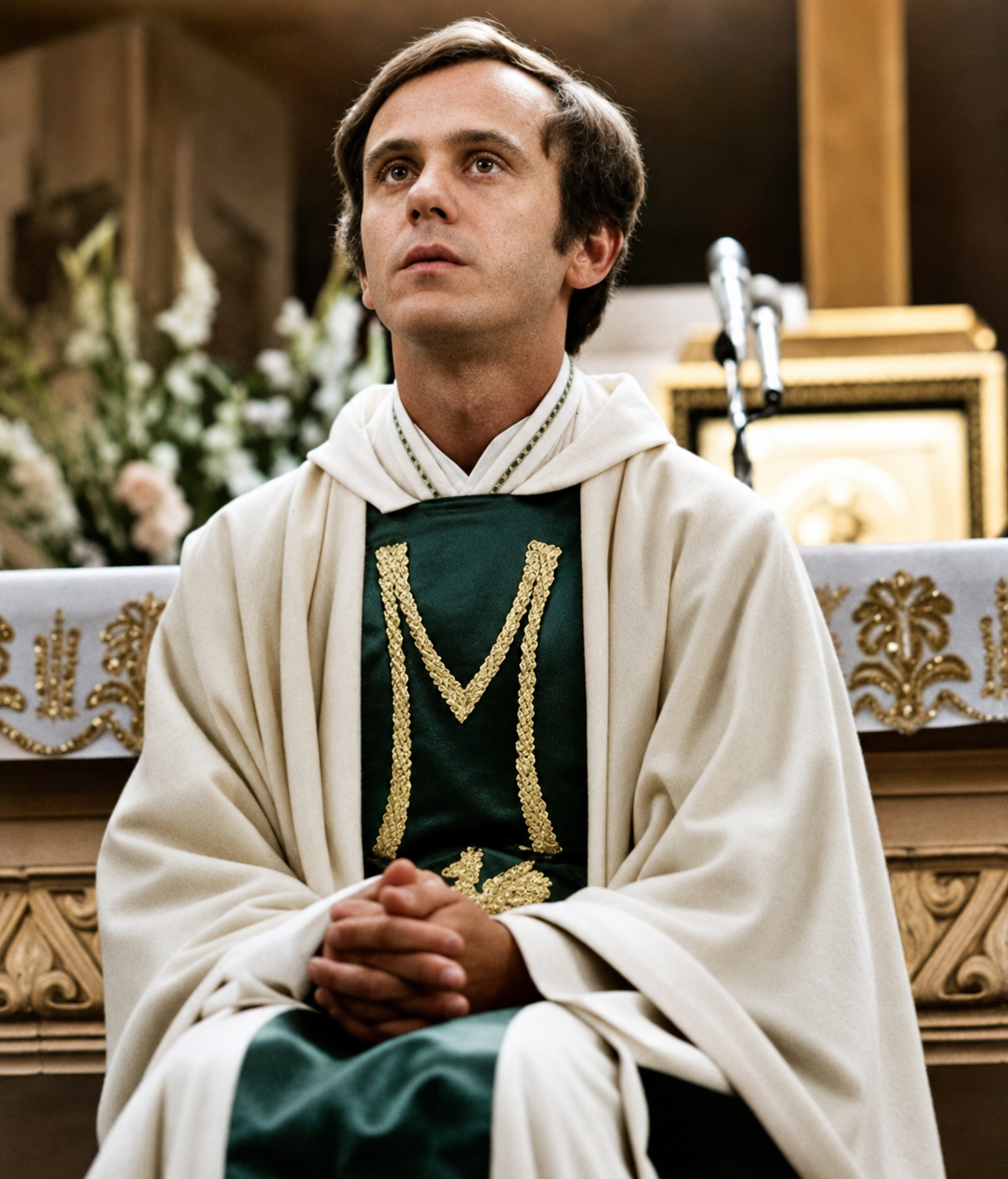
Because Blessed Jerzy lived in the age of photography, devotional images generally rely on actual photographs or realistic portraits rather than attempting to reconstruct an ancient appearance. He is most recognizable as a young Polish priest in a black cassock or clerical clothing, often wearing priestly vestments or holding a rosary.
Many devotional compositions incorporate the Cross, Polish national colors, the Solidarity connection, or the words “Overcome evil with good.” For a prayer card, however, his priestly identity should remain visually primary because the Church beatified him specifically as a priest and martyr.
PRAYERS
Blessed Jerzy already has established prayers maintained by his official sanctuary, including a Litany of Blessed Jerzy Popiełuszko, liturgical prayers for his Mass, and a Prayer of Thanksgiving asking his intercession. There is therefore no need to create an invented prayer for him.
A short established invocation suitable for a prayer card is:
“Blessed Jerzy, Martyr, pray for us.”
Another especially fitting invocation from the same official litany is:
“Martyr for truth and freedom, pray for us.”
The official prayer associated with his sanctuary asks God to look upon Jerzy's martyrdom in defense of faith and human dignity and, through his intercession, grant Christians the grace to live in true freedom and overcome evil with good.
A VERIFIED QUOTE FOR BLESSED JERZY
One of the strongest securely sourced quotations for his prayer card or product description comes from his October 31, 1982 preaching:
“To remain a spiritually free person, one must live in the truth.”
The statement captures his spirituality in one sentence. Political freedom mattered to Jerzy deeply, but he believed the struggle begins inside the human person, where fear, falsehood, hatred, and moral compromise can create forms of slavery even before an external oppressor succeeds.
FAQ
Who was Blessed Jerzy Popiełuszko? Blessed Jerzy Popiełuszko was a Polish Catholic priest who ministered to workers and people suffering under communist rule. He was abducted, tortured, and murdered by officers of the communist Security Service in October 1984 and was beatified as a martyr in 2010.
Is Jerzy Popiełuszko a saint? He is currently Blessed Jerzy Popiełuszko, not yet canonized as a saint. The Church formally recognized his martyrdom and beatified him on June 6, 2010.
When was Blessed Jerzy Popiełuszko born? He was born on September 14, 1947, in Okopy near Suchowola, Poland. He grew up in a deeply Catholic farming family before entering the Warsaw seminary in 1965.
Was Jerzy Popiełuszko originally named Alfons? Yes. He was baptized Alfons Popiełuszko and formally changed his first name to Jerzy in 1971.
When was Jerzy Popiełuszko ordained? He was ordained a Catholic priest on May 28, 1972, in Warsaw. Cardinal Stefan Wyszyński ordained him.
Did Blessed Jerzy serve in the military? Yes, as a seminarian he was forced into military service from 1966 to 1968 in a special unit for clerical students at Bartoszyce. His official biography says he endured harassment and punishment for maintaining his religious convictions there.
Why is Blessed Jerzy associated with workers? His close ministry to workers began when he celebrated Mass for striking employees at the Warsaw Steelworks in August 1980. He later became one of the priests most closely associated with Solidarity and is invoked in his official litany as the Good Shepherd of workers.
Was Jerzy Popiełuszko a member of Solidarity? He is usually described as the chaplain or priest of the Solidarity workers rather than simply as a political union leader. His ministry centered on Mass, preaching, pastoral care, Christian social teaching, and assistance to workers and persecuted families.
What were the Masses for the Homeland? Beginning in February 1982, Jerzy celebrated monthly Masses for Poland at Saint Stanislaus Kostka Church in Warsaw. They became enormous religious gatherings where he preached about truth, human dignity, freedom, solidarity, conscience, and overcoming evil with good.
Was Blessed Jerzy anti-communist? He openly criticized communist abuses, atheistic oppression, violations of human dignity, and the regime's use of lies and fear. His preaching remained explicitly Christian, and he repeatedly rejected hatred and revenge toward the people carrying out the oppression.
Why did the communist government consider him dangerous? His Masses drew huge crowds and created a space where people could hear openly about truth, freedom, conscience, and dignity outside state control. Authorities increasingly subjected him to surveillance, interrogations, propaganda attacks, arrest, and intimidation.
How did Blessed Jerzy Popiełuszko die? He was abducted on October 19, 1984, by officers of the Polish communist Security Service. He was brutally beaten and murdered, and his body was recovered from water near Włocławek on October 30.
How old was Blessed Jerzy when he died? He was only 37 years old. His brief priesthood nevertheless became one of the best-known examples of Catholic resistance to communist persecution in modern Europe.
Why is Jerzy Popiełuszko considered a martyr? The Catholic Church investigated his death and concluded that he was killed because of his Christian faith, in hatred of that faith, rather than treating the murder as merely a political killing. Pope Benedict XVI authorized the decree recognizing his martyrdom in 2009.
When was Blessed Jerzy beatified? His beatification took place in Warsaw on June 6, 2010. The Holy See officially announced the beatification of “Jerzy Popiełuszko, priest and martyr.”
What is Blessed Jerzy Popiełuszko's feast day? His liturgical commemoration is associated with October 19, the anniversary of his martyrdom. His Warsaw sanctuary holds major celebrations and prayers for his canonization on that date.
What is Blessed Jerzy's most famous saying? The biblical principle most strongly associated with him is “Overcome evil with good” from Romans 12:21. His ministry repeatedly developed this command into a Christian program of truth, courage, forgiveness, and resistance to hatred.
Did Jerzy Popiełuszko preach nonviolence? He repeatedly warned his listeners against revenge and violence even while openly opposing injustice. His final public prayer specifically asked that people be freed not only from fear but from the desire for retaliation.
Is Blessed Jerzy associated with truth? Yes, truth is one of the defining themes of his preaching. Vatican News preserves his teaching that spiritual freedom requires living in truth and bearing witness to it openly.
Is Blessed Jerzy associated with freedom? Yes. The official litany calls him a Martyr for truth and freedom, and the Polish bishops described him in 2024 as the Patron of Contemporary Freedom.
Can I pray to Blessed Jerzy for courage? Yes. His official litany invokes him as a courageous follower of Christ and promoter of courage and solidarity, making this a strongly established devotional association.
Can I pray to Blessed Jerzy when I am afraid to tell the truth? Yes, this is one of the most natural intentions connected with his life. He repeatedly taught that courageous witness to truth leads to inner freedom even when the external consequences are painful.
Can workers pray to Blessed Jerzy Popiełuszko? Yes. Workers stood at the center of his final years of ministry, and his official litany explicitly calls him the Good Shepherd of workers.
Can union members pray to Blessed Jerzy? Yes, especially through his historic pastoral relationship with Solidarity workers. His Christian message, however, extended beyond a particular union and focused more broadly on the dignity of work and the dignity of every human person.
Can persecuted Christians pray to Blessed Jerzy? Yes. He is a formally recognized martyr whose death followed years of surveillance, intimidation, arrest, false accusations, and state pressure against his priestly ministry.
Can priests and seminarians pray to Blessed Jerzy? Yes. His official prayer specifically thanks God for his priestly ministry, preaching, sacramental service, courage, and closeness to people, while Pope Benedict XVI explicitly prayed that his example would strengthen priestly zeal.
Is Blessed Jerzy associated with human dignity? Very strongly. Both his preaching and the Church's official liturgical texts describe defense of human dignity as central to his witness.
Is Blessed Jerzy associated with the unborn? His official sanctuary litany invokes him as Defender of the unborn. This makes prayer for vulnerable unborn life an established part of his devotional tradition.
Where is Blessed Jerzy Popiełuszko buried? His grave is outside Saint Stanislaus Kostka Church in Warsaw's Żoliborz district. The site has become the Sanctuary of Blessed Jerzy Popiełuszko and a major place of pilgrimage.
Is there a museum dedicated to Blessed Jerzy? Yes. A museum and documentation center operate at his Warsaw sanctuary and preserve extensive records of his life, persecution, martyrdom, beatification, and continuing devotion.
Are there relics of Blessed Jerzy Popiełuszko? Yes. His official biography reports relics distributed to around 1,800 locations around the world, and the Warsaw sanctuary preserves clothing and personal objects connected with his martyrdom.
Are miracles attributed to Blessed Jerzy? Numerous graces and alleged healings have been reported through his intercession, and the Warsaw parish has collected hundreds of testimonies. Reported healings are not automatically equivalent to miracles formally recognized by the Catholic Church.
Is there an official prayer to Blessed Jerzy Popiełuszko? Yes. His Warsaw sanctuary publishes a Litany of Blessed Jerzy, a Prayer of Thanksgiving through his intercession, and the official Mass prayers used for his liturgical commemoration.
What is a short traditional invocation to Blessed Jerzy? The official litany includes the simple invocation, “Blessed Jerzy, Martyr, pray for us.” It also invokes him as a martyr for truth and freedom.
What does Blessed Jerzy teach about freedom? He teaches that political freedom cannot survive permanently without interior freedom rooted in truth. A person who allows fear or falsehood to control the conscience is already experiencing a form of slavery.
What does Blessed Jerzy teach about fighting evil? He teaches that Christians must actively resist evil but cannot adopt evil's own methods. The Christian victory is to expose lies with truth, oppose hatred with love, resist fear with courage, and answer evil with good.
What does Blessed Jerzy teach about revenge? His final public words show how seriously he took this question. Even while living under real threat, he prayed that people would be free from the desire for revenge and violence.
Who would appreciate a Blessed Jerzy Popiełuszko prayer card? It is especially meaningful for priests, seminarians, workers, persecuted Christians, Polish Catholics, people facing intimidation, anyone fighting fear or hatred, people defending human dignity, and those who need courage to speak truth without surrendering Christian love.
What is the main message of Blessed Jerzy Popiełuszko's life? His life teaches that Christian freedom begins when fear and falsehood no longer determine what we are willing to say, do, or become. He endured communist military pressure as a seminarian, became a priest close to the sick and workers, stood beside Solidarity families during martial law, preached truth and human dignity to enormous crowds, and continued warning against hatred even as the state intensified its campaign against him. On the final night of his life, knowing the dangers surrounding him, his message was still freedom from fear, revenge, and violence. The communist security service could abduct and kill him, but it could not force him to become what he opposed. That is why the Church honors Blessed Jerzy not simply as a victim of communism, but as a priest and martyr whose life became a sign that good can overcome evil without becoming evil itself.
Blessed Jerzy Popiełuszko was a Polish Catholic priest and martyr whose fearless defense of truth, human dignity, religious freedom, workers, and the persecuted made him one of the most important Christian witnesses to communist oppression in twentieth-century Europe. As a young priest in Warsaw, he became closely associated with the workers of the Solidarity movement and celebrated his famous Masses for the Homeland, where thousands gathered to hear a Gospel message that rejected both the lies of totalitarianism and the temptation to answer hatred with hatred. Pope Benedict XVI later described his ministry as courageous service to those working for freedom, life, and human dignity.
Blessed Jerzy is especially meaningful for people seeking courage to tell the truth, Christians facing persecution, workers and laborers, priests, people confronting injustice, those afraid of retaliation, people struggling with fear, Polish Catholics, families living under oppressive circumstances, and anyone trying to resist evil without becoming consumed by hatred. These associations are deeply rooted in his life and in the Church's own devotional language. The official litany used at his Warsaw sanctuary calls him an advocate for human dignity, good shepherd of workers, teacher of conquering evil with good, promoter of courage and solidarity, and martyr for truth and freedom.
The central spiritual principle of Jerzy Popiełuszko's ministry came from Romans 12:21: “Do not be overcome by evil, but overcome evil with good.” He preached against communist repression and deliberate falsehood, but he repeatedly warned his listeners not to answer violence with violence or hatred with hatred. The Archdiocese of Warsaw emphasizes that even while openly criticizing abuses committed by the communist authorities, he warned people against hatred toward those who served the system.
His message was therefore much more demanding than political resistance. Jerzy insisted that a person could become inwardly enslaved even without prison bars if fear and falsehood were allowed to rule the conscience. Vatican News preserves his teaching: “To remain a spiritually free person, one must live in the truth.” He believed courageous witness to truth creates an interior freedom that no government, prison, threat, or law can completely take away.
This prayer card is especially fitting for someone facing pressure to remain silent, workplace retaliation, religious discrimination, government persecution, intimidation, moral compromise, fear of speaking openly about faith, or the temptation to respond to injustice with anger and revenge. It can also make a meaningful gift for priests and seminarians, workers and union members, Polish families, people advocating for human dignity, or anyone who needs the courage to remain truthful without surrendering Christian charity.
Each 2.5" x 4.25" prayer card is handmade in Austin, Texas and prepared prayerfully with each order. It is printed on museum-quality photo paper rather than cardstock and double-laminated for durability. During its preparation, the recipient and their intentions are lifted before Christ in prayer, with Blessed Jerzy Popiełuszko asked to intercede for them.
THE LIFE & STORY
Blessed Jerzy Popiełuszko was born on September 14, 1947, in the small Polish village of Okopy near Suchowola, into a deeply religious farming family. He was baptized two days later with the name Alfons Popiełuszko, and he formally changed his first name to Jerzy in 1971, shortly before completing his preparation for priesthood.
Faith was not something he discovered only as an adult. The official biography maintained by his Warsaw sanctuary describes a home in which prayer, Marian devotion, and the conviction that God must come before everything else formed him from childhood. After completing secondary school in 1965, he entered the Metropolitan Seminary of Warsaw.
THE SEMINARIAN SENT INTO THE COMMUNIST ARMY
Jerzy's first serious confrontation with the communist state came before he was even ordained. From 1966 to 1968, he was forced to perform military service in a special unit for seminarians at Bartoszyce. These units were used by the communist authorities as environments of ideological pressure intended to weaken religious commitment and discourage future priests.
Jerzy became known there for stubbornly maintaining his religious convictions despite repeated harassment and punishment by military superiors. His official sanctuary biography states that the experience seriously damaged his health, and after returning to seminary he endured hospitalization and major thyroid surgery.
This part of his life makes him particularly meaningful for Christians serving within institutions where religious conviction is mocked or pressured. Long before enormous crowds knew his name, Jerzy had already practiced the difficult discipline of remaining faithful when authority could punish him for it.
ORDAINED BY CARDINAL STEFAN WYSZYŃSKI
On May 28, 1972, Jerzy Popiełuszko was ordained a Catholic priest in Warsaw's Cathedral of Saint John by Cardinal Stefan Wyszyński, the great Polish primate who himself had suffered under communist repression and was later beatified by the Church.
Jerzy then served in several parishes in and around Warsaw. His health remained fragile, but his pastoral work increasingly placed him close to ordinary people dealing with sickness, demanding work, and the pressures of life under the communist system.
A PRIEST CLOSE TO THE SICK
Before becoming internationally known for his ministry to workers, Jerzy had a strong connection with healthcare workers and the sick. In 1979 he was appointed to pastoral ministry among medical personnel in Warsaw, while also teaching catechesis to medical students.
His official litany still remembers this dimension of his ministry, invoking him as one who was merciful toward the suffering and sensitive to victims. The same litany also invokes him as a defender of the unborn, making concern for vulnerable human life part of the devotional tradition surrounding him.
AUGUST 1980 AND THE WARSAW STEELWORKS
The direction of Jerzy's priesthood changed dramatically during the Polish labor strikes of August 1980. Workers at the Warsaw Steelworks wanted Mass celebrated inside the factory, and Jerzy was sent to them. On August 31, 1980, he celebrated Mass for the striking steelworkers, beginning a relationship with the world of labor that would define the final four years of his life.
The experience affected both the workers and the priest. Jerzy understood the industrial workforce as a missionary field that had been subjected for decades to deliberate communist atheization, and he began accompanying workers not merely politically but sacramentally and pastorally.
THE PRIEST OF SOLIDARITY
Jerzy soon became closely associated with the independent labor movement Solidarity, Solidarność, which emerged from the 1980 strikes. Vatican News describes him as a chaplain to Solidarity and emphasizes his care for workers, while the Polish bishops likewise remember him as the priest who gathered workers around prayer and the Church.
It is important, however, not to reduce Jerzy to a political organizer. His primary identity was priestly. The Mass, confession, preaching, works of mercy, Catholic social teaching, prayer, and formation of conscience were the means through which he responded to political oppression.
MARTIAL LAW
The communist government imposed martial law in Poland in December 1981, crushing independent organizations, arresting activists, restricting communications, and attempting to break Solidarity. Jerzy's ministry then expanded toward families of prisoners, people who had lost employment, those subjected to intimidation, and others suffering physically or materially because of repression.
His parish doors became a place where people could seek food, medicine, spiritual encouragement, and practical support. The official anniversary biography describes him as a priest who helped those who were persecuted and helped people overcome fear and hatred, two enemies he regarded as spiritually destructive regardless of which side produced them.
THE MASSES FOR THE HOMELAND
Beginning on February 28, 1982, Jerzy celebrated monthly Masses for the Homeland, Msze za Ojczyznę, at Saint Stanislaus Kostka Church in Warsaw's Żoliborz district. These Masses became one of the most remarkable religious gatherings in communist Poland.
Thousands, and eventually tens of thousands, came to pray. His homilies drew heavily upon Scripture, Catholic social teaching, Cardinal Wyszyński, and Pope John Paul II, addressing truth, conscience, human dignity, freedom, labor, fear, solidarity, and the Christian duty to resist evil without imitating it.
TRUTH AND FREEDOM
Truth was one of the central words in Jerzy's preaching. He believed totalitarian systems gain power not only through police and prisons, but when ordinary people become accustomed to repeating what they know is false or remaining silent because truth has become inconvenient.
Vatican News quotes his October 31, 1982 sermon: “To remain a spiritually free person, one must live in the truth.” He taught that truth could not be destroyed by legislation or administrative decisions and that courageous witness to truth leads toward genuine freedom even when external political freedom has not yet arrived.
A PRAYER CARD FOR TELLING THE TRUTH
Blessed Jerzy is therefore especially meaningful for someone who knows the truth but is frightened of the consequences of saying it. His example is useful for employees facing pressure to lie, students afraid to defend their faith, clergy confronting intimidation, families living beneath coercive authority, and anyone tempted to accept a falsehood simply because resistance has become exhausting.
His teaching also places a responsibility upon the person seeking his intercession. Truth cannot become an excuse for cruelty. Jerzy believed truth must remain joined to love, human dignity, forgiveness, and freedom from revenge.
“OVERCOME EVIL WITH GOOD”
The phrase inseparably associated with Blessed Jerzy is “Overcome evil with good,” taken from Romans 12:21. The Polish bishops and his Warsaw sanctuary repeatedly identify this principle as the foundation of his pastoral response to communist violence.
Jerzy was not advocating passive acceptance of injustice. He publicly named lies and abuses, defended imprisoned workers and their families, and refused to allow intimidation to silence him. What he rejected was the idea that Christians could defeat evil by becoming violent, deceitful, or hateful themselves.
COURAGE WITHOUT HATRED
This distinction is what makes him particularly valuable as a saintly model during social conflict. It is easy to become courageous by becoming angry. Jerzy demanded something harder: courage without hatred.
The official litany for Blessed Jerzy invokes him as one who taught people to conquer evil with good, promoted courage and solidarity, warned against revenge, and called people to remain hopeful.
A PRAYER CARD FOR ANGER & THE DESIRE FOR REVENGE
Jerzy knew what it meant to be angry at genuine injustice. He also knew that hatred can allow an oppressor to continue controlling a victim internally long after external control has weakened.
His final public prayer is therefore one of the most powerful parts of his life. Only hours before his abduction, he prayed that people might become free from fear and intimidation, “but above all from the desire for revenge and violence.”
THE GOVERNMENT BEGINS TARGETING HIM
As the Masses for the Homeland grew, the communist security apparatus increasingly regarded Jerzy as dangerous. He was watched, interrogated, publicly attacked by state-controlled media, and subjected to attempts to discredit and frighten him.
In December 1983, authorities searched his apartment and arrested him. Later accounts and Church sources describe fabricated evidence being used against him, while Soviet and Polish state media intensified the campaign portraying his pastoral activity as politically subversive.
THE STATE COULD NOT MAKE HIM QUIET
By 1984, Jerzy understood that his life was in danger. Friends and Church figures worried about him, and proposals were made that might have removed him from Poland or reduced his public exposure. Yet his determination to remain with the people entrusted to him remained extraordinarily strong.
His refusal to abandon his ministry should not be understood as simple recklessness. He had spent years telling frightened people that fear could not become the master of conscience, and eventually the same principle was demanded of him personally.
A FAILED ATTACK BEFORE HIS MURDER
The official chronology maintained by his sanctuary records an attempted attack on October 13, 1984, only six days before his abduction. A few weeks earlier, senior officials of Poland's Ministry of Internal Affairs had discussed how to silence priests considered hostile to the state, including Popiełuszko.
By this point, the threat was no longer theoretical. Yet Jerzy continued traveling, preaching, hearing confessions, and meeting workers.
OCTOBER 19, 1984
On October 19, 1984, Jerzy traveled to Bydgoszcz, where he led a rosary service at the Church of the Holy Polish Martyr Brothers. The theme of his final public reflections was remarkably consistent with everything he had preached before: courage, freedom from fear, and rejection of revenge.
He did not spend his final public appearance calling for retaliation against his persecutors. He prayed for the spiritual freedom to resist hatred.
ABDUCTED BY THE COMMUNIST SECURITY SERVICE
Later that evening, while returning from Bydgoszcz toward Warsaw, Jerzy was stopped and abducted by officers of the communist Security Service, Służba Bezpieczeństwa. The official chronology places the kidnapping at approximately 10 p.m. on October 19.
He was brutally beaten and tortured. His bound body, weighted down, was eventually thrown into water near Włocławek. It was recovered on October 30, 1984, after days in which Poland had been praying for the missing priest's safe return.
MARTYR, NOT MERELY A POLITICAL VICTIM
The Catholic Church's judgment concerning Jerzy's death is important. His beatification cause did not simply honor him as a political victim or national hero. The investigation concluded that his death constituted Christian martyrdom, accepted because of his faith and inflicted in hatred of that faith.
The official cause identified the communist system, with the circumstances it created and the men who acted within it, as the persecuting force. Pope Benedict XVI authorized the decree recognizing his martyrdom in December 2009.
HIS MOTHER'S EXTRAORDINARY RESPONSE
One of the most powerful aspects of Jerzy's legacy was the refusal of his family and spiritual community to turn his murder into permission for revenge. That attitude reflected exactly what he had preached while alive.
His funeral would become not an eruption of violence but an enormous manifestation of prayer, grief, solidarity, and peaceful resistance. The government had killed the priest who preached “overcome evil with good,” but his death magnified the message instead of destroying it.
THE FUNERAL
Blessed Jerzy's funeral was held on November 3, 1984, at Saint Stanislaus Kostka Church in Warsaw. His official sanctuary biography reports more than half a million people attending, while the anniversary project gives historical estimates ranging from roughly 450,000 to one million.
The communist authorities prepared for possible unrest, but the funeral became an extraordinary public witness to the very principle Jerzy had taught. An immense crowd grieving a priest murdered by agents of the state answered not with mass violence but with prayer and peaceful solidarity.
JOHN PAUL II & JERZY POPIEŁUSZKO
Pope Saint John Paul II followed Jerzy's abduction closely and publicly appealed for him while he was missing. Once the body was discovered, the Pope immediately interpreted the death through the Christian mystery of the Cross and Resurrection, praying that Jerzy's sacrifice would produce goodness rather than hatred.
John Paul II repeatedly returned to Jerzy's witness in later years. Vatican News records him presenting Popiełuszko as a symbol of the Polish struggle for human dignity and freedom and, in a European context, speaking of him as a patron of Poland's spiritual presence in Europe through the sacrifice of his life.
THE FALL OF COMMUNISM
Jerzy did not live to see political freedom return to Poland. Within five years of his death, however, Poland underwent the changes that ended communist domination and opened the way for democratic government.
Catholic teaching does not attribute such a vast historical change to one individual alone. Nevertheless, John Paul II and later Church sources repeatedly recognized Jerzy's martyrdom as an important spiritual witness within the wider Polish struggle for freedom.
BEATIFICATION
The formal beatification process opened in Warsaw in 1997. After examination of documents and witness testimony, the Church concluded that Jerzy had suffered authentic martyrdom for the faith. Pope Benedict XVI approved the decree of martyrdom in December 2009.
Blessed Jerzy Popiełuszko was beatified on June 6, 2010, in Warsaw before a vast gathering of the faithful. The Holy See officially described him in the beatification announcement simply and powerfully as “priest and martyr.”
BENEDICT XVI ON HIS MARTYRDOM
On the day of Jerzy's beatification, Pope Benedict XVI said his priestly service and martyrdom were a sign of the victory of good over evil. One week later, Benedict described him as a courageous priest who served people working for freedom and the defense of human life and dignity.
That papal interpretation captures the distinctive Christian character of Jerzy's story. He did not defeat his persecutors by possessing greater physical power. His victory consisted in refusing to allow their hatred to determine what kind of man he would become.
A MARTYR FOR TRUTH & FREEDOM
The official litany of Blessed Jerzy gives him the title “Martyr for truth and freedom.” It also calls him an advocate for human dignity, defender of Gospel values, courageous follower of Christ, and faithful priest until the end.
These titles provide especially strong guidance for prayer-card use. They are not invented product-marketing patronages but expressions already used in devotion at the sanctuary associated with his tomb.
“PATRON OF CONTEMPORARY FREEDOM”
In 2024, marking the fortieth anniversary of his martyrdom, the Polish Bishops' Conference issued a pastoral letter describing Blessed Jerzy as “the Patron of Contemporary Freedom.” The bishops called the faithful to seek truth and freedom in the heart, in Poland, and throughout the world.
This phrase is especially useful devotionally, although it is best understood as the language of the Polish bishops rather than as a claim that the universal Church has formally assigned him exclusive canonical patronage over every political or civil-freedom cause.
A PRAYER CARD FOR FREEDOM
The freedom Jerzy preached was deeper than freedom from one government. He believed a person could remain spiritually free even inside prison if the conscience refused cooperation with falsehood, while someone living outside prison could become inwardly enslaved through fear and dishonesty.
His card is therefore particularly meaningful for someone who feels controlled by fear. The prayer need not only ask God to remove the external problem. It can ask for the harder grace of becoming inwardly free enough to remain truthful while the problem remains.
A PRAYER CARD FOR WORKERS
Blessed Jerzy's connection with workers was central to his priesthood. The official litany calls him the Good Shepherd of workers, while his famous ministry developed directly out of celebrating Mass among striking steelworkers in 1980.
This makes his prayer card especially meaningful for laborers, union members, tradesmen, factory workers, people confronting unjust working conditions, and Catholics seeking to understand work through human dignity rather than seeing the worker merely as a unit of economic production.
A PRAYER CARD FOR PRIESTS
Jerzy is also a particularly strong figure for priests because his martyrdom was inseparable from his priestly work. Benedict XVI prayed that Jerzy's example and intercession would increase the zeal of priests, while his sanctuary prayer thanks God for sending him to preach the Word, administer the sacraments, act courageously in God's name, and remain close to people.
A Blessed Jerzy prayer card can therefore be given for ordination anniversaries, seminary formation, priests serving under hostility, chaplains working among laborers or persecuted communities, or clergy who need courage to remain truthful without becoming bitter.
A PRAYER CARD FOR SEMINARIANS
His experience in the military unit for seminarians makes Jerzy especially meaningful for men whose vocation is being tested before ordination. He discovered early that answering a call to priesthood could bring direct pressure from powerful institutions.
His example does not romanticize the difficulty of vocation. Jerzy's health was damaged, he experienced fear, and eventually his priesthood cost him his life, but he remained convinced that fidelity to Christ was worth more than safety.
A PRAYER CARD FOR PERSECUTED CHRISTIANS
Blessed Jerzy is a modern martyr whose persecutors, documents, surveillance methods, political context, and death all belong to recent recorded history. His story therefore gives contemporary Christians an unusually immediate picture of what religious persecution can look like within a modern bureaucratic state.
Persecution did not begin with execution. It began with ideological pressure, monitoring, propaganda, harassment, interrogation, threats, fabrication, and attempts to isolate or discredit the priest before eventually becoming physical violence.
A PRAYER CARD FOR PEOPLE BEING FALSELY ACCUSED
Communist authorities tried to portray Jerzy as dangerous, political, and subversive while using state-controlled institutions against him. His experience makes him particularly meaningful for people whose reputations are being attacked or who are being accused unjustly.
The devotional lesson is not that every accusation against a Christian must be false. It is that when an accusation truly is false, the believer still has to resist the temptation to defend truth through lies, cruelty, or revenge.
A PRAYER CARD FOR COURAGE
The official litany calls Jerzy a courageous follower of Christ and a promoter of courage and solidarity. Yet photographs and eyewitness accounts do not present him as physically imposing or naturally fearless. He was often described as physically fragile and sensitive.
That makes his courage even more useful devotionally. Christian courage does not require a person to feel no fear. It means that fear no longer possesses final authority over what the conscience will do.
A PRAYER CARD FOR HUMAN DIGNITY
Human dignity was one of Jerzy's great themes. He resisted a system that treated human beings as instruments of ideology and insisted that every person possesses a dignity that precedes the authority of the state.
The Church's official liturgical texts for his feast describe him as an unyielding witness to the Gospel of love and defender of human dignity. That language places his social teaching firmly inside his Christian vocation rather than outside it.
A PRAYER CARD FOR THE UNBORN
The official Litany of Blessed Jerzy Popiełuszko includes the invocation “Defender of the unborn, pray for us.” This makes prayer for the protection of unborn life a legitimate and already established dimension of his devotion.
It is better to ground this association in the Church's devotional text rather than inventing a broad patronage title. A card may therefore be meaningful for people engaged in pro-life ministry or praying for protection of vulnerable human life.
HIS GRAVE IN WARSAW
Blessed Jerzy was buried outside Saint Stanislaus Kostka Church in Warsaw's Żoliborz district, the parish from which his Masses for the Homeland had drawn enormous crowds. His grave quickly became a major place of pilgrimage.
The site is now the Sanctuary of Blessed Jerzy Popiełuszko, with a museum and documentation center devoted to preserving his life, ministry, martyrdom, and expanding devotion.
MILLIONS OF PILGRIMS
The official fortieth-anniversary project reports that roughly 23 million pilgrims have visited his grave since his death. Pilgrims have included ordinary believers as well as churchmen, national leaders, and people seeking spiritual help in situations involving fear, hatred, truth, and freedom.
Long before beatification, the constant stream of visitors to his grave demonstrated the spontaneous reputation for martyrdom and holiness that eventually contributed to the opening of his formal cause.
RELICS OF BLESSED JERZY POPIEŁUSZKO
Devotion to Blessed Jerzy has spread far beyond Warsaw. His official biography reports that his relics have been distributed to approximately 1,800 locations throughout the world, including more than 1,200 churches and chapels in Poland.
At his Warsaw sanctuary, pilgrims can also venerate relics and personal objects connected directly with his final hours, including pieces of the clothing he was wearing when he was murdered. The Polish Bishops' Conference specifically records the display of his cassock, shirt, and items he carried at the time of his death.
REPORTED GRACES & HEALINGS
The reputation of Blessed Jerzy's intercession has also generated numerous reports of extraordinary favors. Poland's Institute of National Remembrance notes that the Warsaw parish connected with him has collected hundreds of testimonies concerning alleged physical healings attributed to his intercession.
Individual reports of healing should not be treated automatically as formally recognized miracles. The Church investigates such claims carefully, and the official prayer for his canonization specifically asks that graces received through his intercession be reported to the postulation.
CANONIZATION CAUSE
Prayer for Blessed Jerzy's canonization continues. The Archdiocese of Warsaw regularly celebrates Masses asking for his canonization, and his official sanctuary provides a prayer asking God, through Jerzy's intercession, for particular graces and for his eventual enrollment among the saints.
Because he remains Blessed Jerzy Popiełuszko, product descriptions should retain his actual present title rather than prematurely calling him Saint Jerzy. His beatification already permits public liturgical veneration in the places authorized by the Church.
LITURGICAL COMMEMORATION
Blessed Jerzy's liturgical commemoration is associated with October 19, the anniversary of his abduction and martyrdom. The Warsaw Archdiocese and the Polish bishops observe that date annually with solemn Mass and prayer at his sanctuary.
October 19 is therefore the natural feast date to place on a devotional product. It recalls not simply his death but the final fulfillment of a priestly life spent teaching that evil must be conquered through goodness.
ICONOGRAPHY & DEVOTIONAL IMAGES
Because Blessed Jerzy lived in the age of photography, devotional images generally rely on actual photographs or realistic portraits rather than attempting to reconstruct an ancient appearance. He is most recognizable as a young Polish priest in a black cassock or clerical clothing, often wearing priestly vestments or holding a rosary.
Many devotional compositions incorporate the Cross, Polish national colors, the Solidarity connection, or the words “Overcome evil with good.” For a prayer card, however, his priestly identity should remain visually primary because the Church beatified him specifically as a priest and martyr.
PRAYERS
Blessed Jerzy already has established prayers maintained by his official sanctuary, including a Litany of Blessed Jerzy Popiełuszko, liturgical prayers for his Mass, and a Prayer of Thanksgiving asking his intercession. There is therefore no need to create an invented prayer for him.
A short established invocation suitable for a prayer card is:
“Blessed Jerzy, Martyr, pray for us.”
Another especially fitting invocation from the same official litany is:
“Martyr for truth and freedom, pray for us.”
The official prayer associated with his sanctuary asks God to look upon Jerzy's martyrdom in defense of faith and human dignity and, through his intercession, grant Christians the grace to live in true freedom and overcome evil with good.
A VERIFIED QUOTE FOR BLESSED JERZY
One of the strongest securely sourced quotations for his prayer card or product description comes from his October 31, 1982 preaching:
“To remain a spiritually free person, one must live in the truth.”
The statement captures his spirituality in one sentence. Political freedom mattered to Jerzy deeply, but he believed the struggle begins inside the human person, where fear, falsehood, hatred, and moral compromise can create forms of slavery even before an external oppressor succeeds.
FAQ
Who was Blessed Jerzy Popiełuszko? Blessed Jerzy Popiełuszko was a Polish Catholic priest who ministered to workers and people suffering under communist rule. He was abducted, tortured, and murdered by officers of the communist Security Service in October 1984 and was beatified as a martyr in 2010.
Is Jerzy Popiełuszko a saint? He is currently Blessed Jerzy Popiełuszko, not yet canonized as a saint. The Church formally recognized his martyrdom and beatified him on June 6, 2010.
When was Blessed Jerzy Popiełuszko born? He was born on September 14, 1947, in Okopy near Suchowola, Poland. He grew up in a deeply Catholic farming family before entering the Warsaw seminary in 1965.
Was Jerzy Popiełuszko originally named Alfons? Yes. He was baptized Alfons Popiełuszko and formally changed his first name to Jerzy in 1971.
When was Jerzy Popiełuszko ordained? He was ordained a Catholic priest on May 28, 1972, in Warsaw. Cardinal Stefan Wyszyński ordained him.
Did Blessed Jerzy serve in the military? Yes, as a seminarian he was forced into military service from 1966 to 1968 in a special unit for clerical students at Bartoszyce. His official biography says he endured harassment and punishment for maintaining his religious convictions there.
Why is Blessed Jerzy associated with workers? His close ministry to workers began when he celebrated Mass for striking employees at the Warsaw Steelworks in August 1980. He later became one of the priests most closely associated with Solidarity and is invoked in his official litany as the Good Shepherd of workers.
Was Jerzy Popiełuszko a member of Solidarity? He is usually described as the chaplain or priest of the Solidarity workers rather than simply as a political union leader. His ministry centered on Mass, preaching, pastoral care, Christian social teaching, and assistance to workers and persecuted families.
What were the Masses for the Homeland? Beginning in February 1982, Jerzy celebrated monthly Masses for Poland at Saint Stanislaus Kostka Church in Warsaw. They became enormous religious gatherings where he preached about truth, human dignity, freedom, solidarity, conscience, and overcoming evil with good.
Was Blessed Jerzy anti-communist? He openly criticized communist abuses, atheistic oppression, violations of human dignity, and the regime's use of lies and fear. His preaching remained explicitly Christian, and he repeatedly rejected hatred and revenge toward the people carrying out the oppression.
Why did the communist government consider him dangerous? His Masses drew huge crowds and created a space where people could hear openly about truth, freedom, conscience, and dignity outside state control. Authorities increasingly subjected him to surveillance, interrogations, propaganda attacks, arrest, and intimidation.
How did Blessed Jerzy Popiełuszko die? He was abducted on October 19, 1984, by officers of the Polish communist Security Service. He was brutally beaten and murdered, and his body was recovered from water near Włocławek on October 30.
How old was Blessed Jerzy when he died? He was only 37 years old. His brief priesthood nevertheless became one of the best-known examples of Catholic resistance to communist persecution in modern Europe.
Why is Jerzy Popiełuszko considered a martyr? The Catholic Church investigated his death and concluded that he was killed because of his Christian faith, in hatred of that faith, rather than treating the murder as merely a political killing. Pope Benedict XVI authorized the decree recognizing his martyrdom in 2009.
When was Blessed Jerzy beatified? His beatification took place in Warsaw on June 6, 2010. The Holy See officially announced the beatification of “Jerzy Popiełuszko, priest and martyr.”
What is Blessed Jerzy Popiełuszko's feast day? His liturgical commemoration is associated with October 19, the anniversary of his martyrdom. His Warsaw sanctuary holds major celebrations and prayers for his canonization on that date.
What is Blessed Jerzy's most famous saying? The biblical principle most strongly associated with him is “Overcome evil with good” from Romans 12:21. His ministry repeatedly developed this command into a Christian program of truth, courage, forgiveness, and resistance to hatred.
Did Jerzy Popiełuszko preach nonviolence? He repeatedly warned his listeners against revenge and violence even while openly opposing injustice. His final public prayer specifically asked that people be freed not only from fear but from the desire for retaliation.
Is Blessed Jerzy associated with truth? Yes, truth is one of the defining themes of his preaching. Vatican News preserves his teaching that spiritual freedom requires living in truth and bearing witness to it openly.
Is Blessed Jerzy associated with freedom? Yes. The official litany calls him a Martyr for truth and freedom, and the Polish bishops described him in 2024 as the Patron of Contemporary Freedom.
Can I pray to Blessed Jerzy for courage? Yes. His official litany invokes him as a courageous follower of Christ and promoter of courage and solidarity, making this a strongly established devotional association.
Can I pray to Blessed Jerzy when I am afraid to tell the truth? Yes, this is one of the most natural intentions connected with his life. He repeatedly taught that courageous witness to truth leads to inner freedom even when the external consequences are painful.
Can workers pray to Blessed Jerzy Popiełuszko? Yes. Workers stood at the center of his final years of ministry, and his official litany explicitly calls him the Good Shepherd of workers.
Can union members pray to Blessed Jerzy? Yes, especially through his historic pastoral relationship with Solidarity workers. His Christian message, however, extended beyond a particular union and focused more broadly on the dignity of work and the dignity of every human person.
Can persecuted Christians pray to Blessed Jerzy? Yes. He is a formally recognized martyr whose death followed years of surveillance, intimidation, arrest, false accusations, and state pressure against his priestly ministry.
Can priests and seminarians pray to Blessed Jerzy? Yes. His official prayer specifically thanks God for his priestly ministry, preaching, sacramental service, courage, and closeness to people, while Pope Benedict XVI explicitly prayed that his example would strengthen priestly zeal.
Is Blessed Jerzy associated with human dignity? Very strongly. Both his preaching and the Church's official liturgical texts describe defense of human dignity as central to his witness.
Is Blessed Jerzy associated with the unborn? His official sanctuary litany invokes him as Defender of the unborn. This makes prayer for vulnerable unborn life an established part of his devotional tradition.
Where is Blessed Jerzy Popiełuszko buried? His grave is outside Saint Stanislaus Kostka Church in Warsaw's Żoliborz district. The site has become the Sanctuary of Blessed Jerzy Popiełuszko and a major place of pilgrimage.
Is there a museum dedicated to Blessed Jerzy? Yes. A museum and documentation center operate at his Warsaw sanctuary and preserve extensive records of his life, persecution, martyrdom, beatification, and continuing devotion.
Are there relics of Blessed Jerzy Popiełuszko? Yes. His official biography reports relics distributed to around 1,800 locations around the world, and the Warsaw sanctuary preserves clothing and personal objects connected with his martyrdom.
Are miracles attributed to Blessed Jerzy? Numerous graces and alleged healings have been reported through his intercession, and the Warsaw parish has collected hundreds of testimonies. Reported healings are not automatically equivalent to miracles formally recognized by the Catholic Church.
Is there an official prayer to Blessed Jerzy Popiełuszko? Yes. His Warsaw sanctuary publishes a Litany of Blessed Jerzy, a Prayer of Thanksgiving through his intercession, and the official Mass prayers used for his liturgical commemoration.
What is a short traditional invocation to Blessed Jerzy? The official litany includes the simple invocation, “Blessed Jerzy, Martyr, pray for us.” It also invokes him as a martyr for truth and freedom.
What does Blessed Jerzy teach about freedom? He teaches that political freedom cannot survive permanently without interior freedom rooted in truth. A person who allows fear or falsehood to control the conscience is already experiencing a form of slavery.
What does Blessed Jerzy teach about fighting evil? He teaches that Christians must actively resist evil but cannot adopt evil's own methods. The Christian victory is to expose lies with truth, oppose hatred with love, resist fear with courage, and answer evil with good.
What does Blessed Jerzy teach about revenge? His final public words show how seriously he took this question. Even while living under real threat, he prayed that people would be free from the desire for revenge and violence.
Who would appreciate a Blessed Jerzy Popiełuszko prayer card? It is especially meaningful for priests, seminarians, workers, persecuted Christians, Polish Catholics, people facing intimidation, anyone fighting fear or hatred, people defending human dignity, and those who need courage to speak truth without surrendering Christian love.
What is the main message of Blessed Jerzy Popiełuszko's life? His life teaches that Christian freedom begins when fear and falsehood no longer determine what we are willing to say, do, or become. He endured communist military pressure as a seminarian, became a priest close to the sick and workers, stood beside Solidarity families during martial law, preached truth and human dignity to enormous crowds, and continued warning against hatred even as the state intensified its campaign against him. On the final night of his life, knowing the dangers surrounding him, his message was still freedom from fear, revenge, and violence. The communist security service could abduct and kill him, but it could not force him to become what he opposed. That is why the Church honors Blessed Jerzy not simply as a victim of communism, but as a priest and martyr whose life became a sign that good can overcome evil without becoming evil itself.