 Image 1 of 1
Blessed Justo Takayama Ukon Prayer Card | Samurai, Martial Artists, Courage & Persecuted Christians
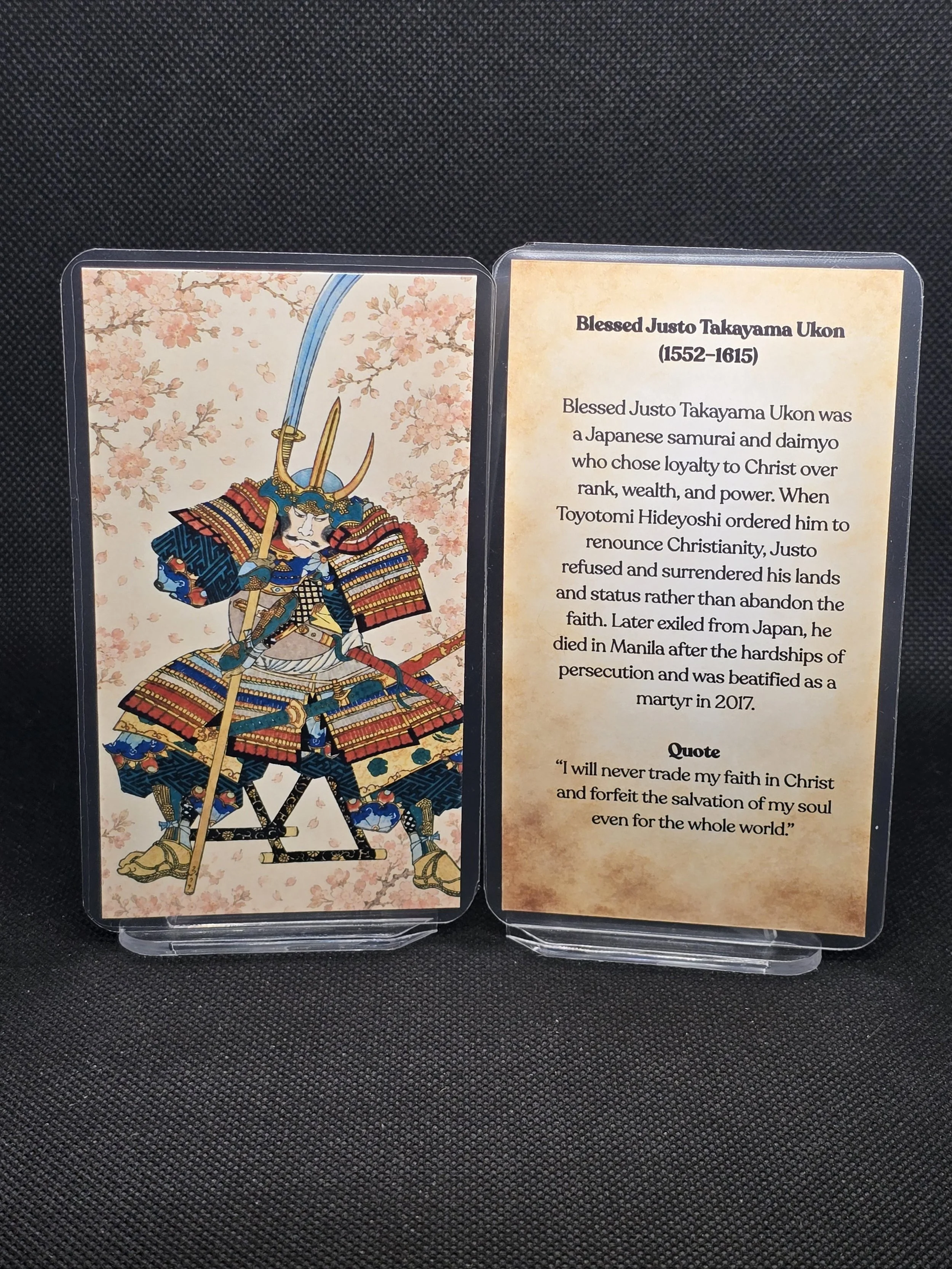
Blessed Justo Takayama Ukon, often called the “Samurai of Christ,” was a Japanese samurai warrior, daimyō, castle lord, Catholic evangelizer, and martyr by exile whose entire adult life became a contest between worldly honor and fidelity to Christ. Born in 1552, baptized at twelve, and raised within the violent Sengoku period of Japanese history, Justo became a highly skilled warrior and successful battlefield commander before willingly surrendering his rank, lands, wealth, and security rather than deny the Catholic faith. Pope Francis praised him after his 2017 beatification as a man who refused compromise, accepted humiliation and exile, and remained faithful to Christ and the Gospel.
Blessed Justo is especially meaningful for martial artists, samurai and Japanese martial-history enthusiasts, soldiers, veterans, law-enforcement officers, Christian men seeking disciplined strength, people facing pressure to compromise their beliefs, persecuted Christians, converts, fathers, leaders, and anyone trying to place courage and physical ability beneath obedience to Christ. These are not invented formal patronages, but they arise naturally from the life of a man whom Takatsuki's official history describes as a highly skilled samurai warrior who fought successfully in major campaigns yet ultimately proved willing to surrender everything his warrior status had won rather than abandon his faith.
For martial artists in particular, Justo offers something different from a saint merely associated with symbolic spiritual warfare. He actually belonged to the warrior class, commanded men, fought in battle, lived inside castles, served some of the most powerful warlords in Japanese history, and knew what physical courage and martial discipline demanded. Takatsuki's official historical account records him taking the vanguard in Hideyoshi's army at the Battle of Yamazaki in 1582 and later fighting for the Maeda forces during the campaign against the Hōjō in 1590.
Yet the greatest confrontation of Justo's life was one he chose not to solve with a sword. When Toyotomi Hideyoshi ordered Christian lords to abandon the faith in 1587, Justo could have preserved his position by conforming, but instead accepted the loss of his daimyō status, lands, and wealth. Decades later, when nationwide persecution forced the final choice between apostasy and exile, the aging warrior again refused to renounce Christ and was expelled from Japan, dying in Manila only forty-four days after his arrival.
That makes Blessed Justo an exceptionally powerful figure for Christian martial artists. The samurai's greatest victory was ultimately not defeating another warrior, but becoming free enough that no ruler could command his conscience. His military ability could win battles, but faith gave him the strength to surrender rank, castles, wealth, homeland, and finally life itself without surrendering Christ.
This prayer card is especially fitting for karate practitioners, judoka, jujutsu and Brazilian Jiu-Jitsu practitioners, kendō and kenjutsu students, MMA fighters, wrestlers, boxers, military members, veterans, law-enforcement officers, converts, Japanese Catholics, and men developing a serious Christian life alongside physical training. The connection is not that Justo practiced these modern systems, but that his real samurai life provides Christian martial artists with a historical example of courage, discipline, leadership, self-control, sacrifice, and strength finally placed beneath the authority of Christ.
Each prayer card measures 2.5" x 4.25", is handmade in Austin, Texas, printed on museum-quality photo paper rather than cardstock, and double laminated for durability. Each card is prepared prayerfully with the recipient and their intentions lifted before Christ while asking Blessed Justo Takayama Ukon to intercede for the person who will receive it.
THE LIFE & STORY
Blessed Justo Takayama Ukon was born in 1552 in Takayama, in present-day Toyono, Osaka Prefecture, during Japan's Sengoku period, an age of warfare among competing daimyō and rapidly shifting political alliances. His family belonged to the warrior nobility, and his father held Sawa Castle in what is now Nara Prefecture.
This was not a peaceful setting in which Christianity existed separately from political life. Justo grew into adulthood in a society where a samurai's reputation, loyalty, military ability, alliances, landholdings, and willingness to fight could determine not only his own future but the survival of his household.
BAPTIZED AT TWELVE YEARS OLD
In 1564, when Justo was about twelve, his father accepted Christianity and had his son baptized at Sawa Castle. The young Takayama received the Christian name Justo, or Justus, the name by which Catholics continue to know him.
His baptism took place only fifteen years after Saint Francis Xavier first arrived in Japan in 1549. Justo therefore belonged to the first generations of Japanese Christians and would live through the transformation of Christianity from a tolerated missionary religion into a faith whose public profession could cost a person everything.
A REAL SAMURAI WARRIOR
Takatsuki's official historical account describes Justo directly as a “highly skilled samurai warrior.” He was not simply a nobleman who carried the title of samurai while remaining removed from combat, because his surviving history places him personally in military campaigns during one of the most violent eras of Japanese political history.
For Christian martial artists, this distinction matters. Justo's connection with martial discipline does not depend upon dressing an unrelated Christian figure in samurai armor after the fact because warrior training, battlefield service, command responsibility, and the culture of the Japanese military elite genuinely belonged to his life.
LORD OF TAKATSUKI CASTLE
In 1573, at approximately twenty-one years old, Justo became lord of Takatsuki Castle. He governed the territory for about twelve years and participated actively in transforming Takatsuki into one of the important centers of early Japanese Catholicism.
Official Takatsuki history records that more than twenty churches were constructed in the area during his rule and that Christianity became extremely widespread among the approximately 25,000 inhabitants. A Christian cemetery and the remains of the Catholic church and theological school connected with Justo's period have also been found in the area.
THE WARRIOR WHO ALSO BUILT CHURCHES
Justo's life therefore combined two identities that modern people may initially find surprising: samurai commander and active Catholic evangelizer. The same man whose world required fortifications, weapons, military alliances, and battlefield courage also used his authority and resources to support churches, missionaries, religious education, and the spread of Christianity.
His life is valuable for Christian martial artists precisely because Christianity did not require pretending that strength, discipline, courage, leadership, and warrior formation were unreal. Instead, Justo's spiritual journey increasingly confronted him with the question of what all those abilities were ultimately supposed to serve.
SERVICE UNDER ODA NOBUNAGA
Justo lived during the rise of Oda Nobunaga, one of the great unifiers of sixteenth-century Japan. Takatsuki's official history records that Justo served Nobunaga before later serving Toyotomi Hideyoshi, placing him directly within the military and political upheavals that transformed Japan.
This environment demanded political intelligence as well as martial ability. Loyalty to a lord could determine survival, yet alliances shifted quickly enough that a samurai's position was rarely secure for long.
THE BATTLE OF YAMAZAKI
Justo's military credentials become particularly clear in 1582 at the Battle of Yamazaki, fought shortly after the death of Oda Nobunaga. According to the official history of Takatsuki, Justo fought successfully against Akechi Mitsuhide and took the vanguard in Toyotomi Hideyoshi's army.
Taking the vanguard was not symbolic ceremonial participation. It placed soldiers at the forward edge of battle, giving Justo's later willingness to surrender his warrior status an important context because the man who chose religious exile over political compromise had already demonstrated conventional battlefield courage.
THE DIFFERENCE BETWEEN PHYSICAL & MORAL COURAGE
Physical courage and moral courage are related, but they are not identical. A person can become fearless in physical confrontation while remaining terrified of losing reputation, income, rank, acceptance, or social standing.
Justo eventually faced both kinds of fear. His samurai training prepared him for dangerous men on a battlefield, while Christian discipleship prepared him for something different: the possibility that obedience to Christ might require voluntarily surrendering the very identity for which a samurai spent his life fighting.
A CHRISTIAN EXAMPLE FOR MARTIAL ARTISTS
This is where Blessed Justo becomes especially compelling for modern martial artists. Martial training can produce extraordinary confidence, endurance, control, decisiveness, and physical competence, but Christian formation asks an additional question: Who governs the person possessing those abilities?
Justo's life gradually answers that question. His skill remained real, but his identity could no longer finally depend upon rank, victories, possessions, or the approval of powerful men because each of those things would eventually be placed in conflict with his allegiance to Christ.
THE SAMURAI & SELF-MASTERY
A martial artist eventually discovers that defeating another person can be easier than defeating the passions within oneself. Anger, pride, fear, vanity, greed, resentment, lust for status, and the need to be respected can continue controlling someone long after physical technique becomes highly developed.
Blessed Justo's mature Christian life became an extraordinary exercise in this deeper form of self-mastery. The warrior capable of taking the vanguard eventually learned to surrender property and honor voluntarily rather than let fear of losing them dictate his conscience.
A DAIMYŌ WHO EVANGELIZED OTHER WARRIORS
Takatsuki's historical record also credits Justo with influencing other samurai toward Christianity, including Kuroda Kanbei and Gamō Ujisato. His witness therefore moved within the same warrior culture that had formed him.
This makes his story particularly meaningful for Christian men working within strongly masculine environments such as martial arts schools, military units, police departments, or competitive sports. Evangelization does not always happen by abandoning the culture surrounding us, because sometimes it begins by demonstrating within that culture that strength and faith are capable of belonging together.
A MASTER OF MORE THAN WAR
Justo was not defined only by combat. Takatsuki's official account remembers him as an accomplished man of culture, a talented castle builder, and one of the seven celebrated disciples of tea master Sen no Rikyū.
His mastery of the tea ceremony adds another dimension to his warrior identity. The same life contained battlefield decisiveness and highly disciplined attention to ritual, hospitality, simplicity, beauty, and controlled movement, showing a form of samurai culture much broader than violence alone.
MARTIAL DISCIPLINE WITHOUT WORSHIPING VIOLENCE
For modern Christian martial artists, Justo therefore offers a more complete image than romanticized samurai mythology. A warrior can value skill, discipline, courage, tradition, and physical training without making violence itself sacred.
Justo's beatification rests not upon how many battles he won but upon what happened when worldly power demanded a choice against Christ. The Catholic Church ultimately honors the warrior because he became willing to lose the things ordinary warriors were expected to defend at all costs.
TOYOTOMI HIDEYOSHI TURNS AGAINST CHRISTIANITY
The decisive crisis arrived in 1587, when Toyotomi Hideyoshi ordered Christian missionaries expelled. The edict placed Christian daimyō such as Justo in an impossible position because political survival depended increasingly upon cooperation with a ruler becoming hostile toward their religion.
For Justo, the choice was intensely personal. He possessed land, military status, political relationships, income, household responsibility, and a future within the ruling order, but all of those could be preserved only if he allowed political authority to determine the limits of his Christian faith.
THE MOST IMPORTANT BATTLE OF HIS LIFE
Justo's greatest battle contained no opposing army. Hideyoshi could offer him what warriors normally fought to preserve, but the cost was religious surrender.
Justo refused. He accepted the loss of his status as daimyō, relinquished wealth and position, and entered an uncertain life without the power and security that had defined him.
WHEN THE WARRIOR CHOSE TO LOSE EVERYTHING
From a purely political perspective, Justo's decision looked like defeat. He could no longer command the lands he had governed, and the rank that had placed him among Japan's warrior elite became something he willingly allowed to be taken.
The Church understands the same event very differently. The official prayer approved by the Catholic Bishops' Conference of Japan says that Justo rejected worldly rank and honors and received martyrdom through exile, while Pope Francis praised him for choosing humiliation and exile rather than compromise.
A SAINTLY MODEL FOR LOSING STATUS
This makes Blessed Justo especially meaningful for someone whose identity has become attached to rank, title, belt, promotion, military position, professional standing, wealth, or public reputation. Those things may be legitimately earned and genuinely valuable, but they cannot become the foundation upon which the person's worth before God depends.
Martial artists understand rank particularly well because a belt, title, record, or position represents years of real work. Justo's life asks the harder Christian question: if fidelity to Christ required surrendering even something honestly earned, would the possession still be held loosely enough to let go?
HIDING ON SHŌDOSHIMA
After losing his status, Justo spent time in hiding on Shōdoshima, assisted by another Christian daimyō, Konishi Yukinaga. His life had moved rapidly from castle lord and military commander to a man dependent upon other people for protection because he would not deny Christianity.
This reversal would have challenged far more than material comfort. Samurai society placed enormous importance upon honor, standing, loyalty, and household identity, making Justo's acceptance of dispossession a profound act of detachment.
THE MAEDA FAMILY GIVES HIM REFUGE
In 1588, Justo entered the protection of Maeda Toshiie in Kanazawa. He remained connected with the Maeda household for many years and continued contributing his military, architectural, and cultural abilities despite no longer possessing an independent daimyō domain.
Takatsuki's historical account records him later fighting for the Maeda forces against the Hōjō in 1590, demonstrating that the loss of his own lordship did not instantly end every element of his samurai life. His Christian conviction and warrior capability continued existing together.
A WARLORD WHO BECAME A RŌNIN-LIKE EXILE
Justo's later condition has often fascinated people interested in samurai history because the Christian daimyō who once controlled castles eventually lived without his former independent feudal status. His situation illustrates how completely religious conviction altered the trajectory that warrior society had prepared for him.
Yet he did not appear to spend the following decades trying to recover status at any cost. The trajectory of his life moved increasingly toward detachment from the structures of prestige that had once surrounded him.
CHRISTIANITY IS OUTLAWED AGAIN
The final stage of persecution arrived under the Tokugawa shogunate, which outlawed Christianity throughout Japan. Justo had already lived for decades knowing that his faith had cost him political advancement, but the later prohibition removed even the possibility of remaining quietly within his homeland.
By then he was no longer the young commander who had led men at Yamazaki. He was an older Christian who had already spent years learning that loyalty to Christ might repeatedly require the surrender of another layer of earthly security.
EXILED FROM JAPAN
Justo and members of his family were eventually expelled from Japan because he refused to renounce Catholicism. He sailed from Nagasaki to Manila, joining the Japanese Christian exiles forced to abandon their homeland under the persecution.
Pope Francis later singled out precisely this decision when describing Justo's witness. Rather than compromise, the former daimyō accepted exile and remained faithful to Christ and the Gospel.
THE SAMURAI WHO COULD NOT BE CONQUERED
The political rulers of Japan could remove Justo's lands, titles, income, social position, and eventually his homeland. What they could not obtain was the act they actually wanted: his denial of Christ.
This gives his samurai identity its deepest Christian meaning. A warrior traditionally seeks not to be conquered by another warrior, while Justo's final freedom consisted in refusing to let fear conquer his conscience.
ARRIVAL IN MANILA
Justo arrived in the Philippines as a Christian exile and was welcomed in Manila, then under Spanish rule. The Intramuros Administration identifies him as a pillar of the early Japanese Church and records that he died in Intramuros only forty-four days after his exile brought him to Manila.
The change must have been extraordinary. A Japanese warrior who had lived through the rise of Nobunaga, Hideyoshi, and Tokugawa authority ended his life far from the castles, battlefields, and communities that had shaped nearly every previous chapter.
MARTYRDOM THROUGH EXILE
Blessed Justo was not executed by sword, crucifixion, or firing squad. The Church nevertheless recognized him as a martyr because his death followed directly from the suffering imposed upon him for refusing to abandon Christianity.
The official prayer approved by the Catholic Bishops' Conference of Japan describes him as having “achieved martyrdom by exile from his homeland.” Pope Francis likewise referred to him as a Japanese layman martyred in Manila and emphasized the humiliation and exile he accepted rather than compromise.
HIS DEATH IN MANILA
Blessed Justo died in Intramuros, Manila, on February 3, 1615, only forty-four days after arriving in exile. The Philippine government's Intramuros Administration preserves that date and notes that the Archdiocese of Manila was already seeking his beatification as early as 1630.
The samurai's final suffering therefore came not in a glorious battlefield death but through displacement, exhaustion, illness, and exile. The Catholic understanding of his martyrdom recognizes that persecution killed him even though an executioner did not deliver the final blow.
THE FIRST SAINTHOOD CAUSE CONNECTED WITH MANILA
The Archdiocese of Manila presented a petition in 1630 seeking recognition of Justo's holiness, making devotion to him an old Philippine as well as Japanese tradition. The cause could not be completed at the time and was eventually revived centuries later with the Japanese bishops taking the leading role.
His story therefore connects two Asian Churches in an unusually intimate way. Japan was the homeland whose persecution expelled him, while Manila became the place where the exile completed his earthly life.
BEATIFIED IN OSAKA
Blessed Justo Takayama Ukon was solemnly beatified in Osaka on February 7, 2017. Pope Francis publicly marked the event the next day and described Justo as an admirable example of fortitude in faith and dedication in charity.
The location carried special significance because Osaka lies within the wider region associated with his birth and his years as lord of Takatsuki. More than four centuries after political power stripped the Christian warrior of honor, the Church gathered publicly in Japan to honor the very decision for which he had lost it.
HIS FEAST DAY
Blessed Justo's liturgical commemoration is associated with February 3, the anniversary of his death in Manila. His death on that date is securely documented by the Intramuros Administration, and Catholic communities devoted to him celebrate his memory in connection with that anniversary.
For martial-arts schools, men's groups, military communities, or Catholic families devoted to Blessed Justo, February 3 provides a natural opportunity to reflect upon courage, self-mastery, religious freedom, and the Christian understanding of true honor.
THE SAMURAI OF CHRIST
The popular description “Samurai of Christ” captures the striking combination at the center of Justo's life. He was genuinely formed within samurai culture, yet the allegiance that eventually governed every other loyalty was his allegiance to Jesus Christ.
The title becomes meaningful only when understood through sacrifice. Justo did not become Christ's samurai because he used Christianity to justify winning battles, but because he eventually allowed Christ to demand something more difficult than battlefield victory.
A BLESSED FOR MARTIAL ARTISTS
Blessed Justo is one of the most naturally compelling Catholic figures for martial artists because his biography already joins Christian discipleship to an authentic warrior life. Modern karate, judo, aikido, Brazilian Jiu-Jitsu, MMA, and modern kendō developed in forms different from the warfare of Justo's century, so it would be inaccurate to claim that he practiced those specific systems.
The connection lies at a deeper level. Training develops capability, while Christianity asks whether courage, discipline, aggression, confidence, loyalty, and physical strength are being governed by virtue rather than ego.
A BLESSED FOR SAMURAI & JAPANESE MARTIAL ARTS ENTHUSIASTS
For practitioners of traditional Japanese martial arts, Justo's life gives Christian history a genuinely Japanese warrior figure rather than requiring a symbolic connection to an unrelated European soldier. His samurai identity, battlefield record, castle leadership, tea practice, and political experience all belonged to the historical culture of sixteenth-century Japan.
A Justo Takayama prayer card can therefore fit naturally into the life of a Catholic martial artist who wants physical discipline to remain consciously subject to the Gospel. His example says that becoming capable of fighting is not the end of training because the harder discipline is becoming capable of surrendering pride, status, fear, and self-interest.
A BLESSED FOR SOLDIERS & VETERANS
Military members and veterans can also recognize the conflict that shaped Justo's life. He knew loyalty, command, hierarchy, combat, political authority, and the consequences of refusing powerful superiors.
His witness reminds Christians in military professions that obedience is never absolute when an earthly command requires betrayal of God. Justo served rulers faithfully in legitimate military responsibilities but reached a point where political obedience and Christian conscience could no longer be reconciled.
A BLESSED FOR PEOPLE FACING RELIGIOUS PRESSURE
The strongest universal application of Justo's story is the pressure to compromise quietly in order to keep everything else. Hideyoshi did not need Justo to stop being courageous, educated, skilled, or useful because he needed him to stop placing Christianity above political obedience.
Justo's refusal speaks powerfully to Christians facing workplace pressure, family hostility, cultural ridicule, persecution, or any situation in which belonging seems dependent upon hiding or denying one's faith.
A BLESSED FOR CHRISTIAN LEADERS
Justo was a ruler before he became an exile, which makes his example especially meaningful for people with authority. He used his position to build, organize, influence, and support Christian communities, yet he eventually proved that he did not need the position itself in order to remain Christian.
Leadership can easily become part of a person's identity until preserving authority begins to matter more than the purpose authority was supposed to serve. Justo's willingness to become powerless is one of the clearest signs that power had not become his god.
A BLESSED FOR CHRISTIAN MEN
Justo offers a strong model of Christian masculinity without requiring men to choose between strength and holiness. He fought, commanded, governed, built castles, practiced refined cultural arts, supported evangelization, endured political humiliation, lost wealth, protected his conscience, accepted exile, and died far from home rather than surrender Christ.
His example places masculine strength inside a much larger hierarchy of virtues. Courage becomes Christian when joined to humility, leadership when joined to service, discipline when joined to obedience to God, and strength when one becomes free enough to surrender it.
THE CROSS & THE SWORD
Modern representations of Blessed Justo frequently place the imagery of the samurai sword and Christian cross together because those objects summarize the tension that defined his life. The sword belonged to his social world and warrior vocation, while the Cross became the final measure by which every earthly loyalty was judged.
The important Christian message is not that the sword became holy simply because its owner was Christian. The deeper message is that even the warrior's sword, honor, rank, and life had to remain secondary to the Cross.
HIS RELICS IN OSAKA
The Osaka-Takamatsu Cathedral's Tamatsukuri Catholic Church maintains a prayer space containing relics of Blessed Justo Takayama Ukon. The shrine was established after his 2017 beatification and remains connected with ongoing prayer for his canonization.
The cathedral grounds also contain a prominent stone statue of Blessed Justo, while the cathedral itself preserves artistic representations connecting him with the history of Japanese Christianity.
TAKATSUKI & HIS JAPANESE LEGACY
Takatsuki remains one of the most important places for understanding Justo historically. The city preserves a statue of him, historical materials, the location associated with his castle, and the site of the Catholic church and theological school built during his rule.
For someone interested in combining Catholic pilgrimage with Japanese samurai history, Takatsuki provides an unusually direct connection between the two. Justo's religious and martial lives were not separate stories because both unfolded within the same castles, political relationships, and communities.
MANILA & HIS FINAL WITNESS
Manila holds the other half of Justo's geographical story. The Intramuros Administration continues commemorating him as the Japanese-born Catholic exile who died within the walled city after refusing to abjure Christianity.
His presence created lasting ties between Japan and the Philippines. Takatsuki and Manila later became sister cities specifically through their shared connection with Justo.
PRAYERS
Unlike many historical figures, Blessed Justo already has an official Church-approved prayer associated with his cause for canonization. The Catholic Bishops' Conference of Japan approved the prayer on September 26, 2017, and it explicitly asks God to hear petitions through Blessed Justo's intercession.
A short portion especially suitable for devotional use is:
“Merciful Father, through the intercession of Blessed Justo Ukon, please hear our fervent prayers.”
The official prayer remembers Justo's faithful following of the Gospel, his rejection of worldly rank and honor, the hardships he accepted, and his martyrdom through exile. This makes it particularly appropriate for Christians facing persecution, people making costly moral decisions, martial artists seeking freedom from ego, and anyone asking for courage to choose Christ when compromise would be easier.
A martial artist can seek Blessed Justo's intercession before training or competition for discipline without pride, courage without hatred, strength without cruelty, and the self-control to place physical ability beneath Christian virtue. A soldier or veteran can ask for courage of conscience, while someone facing religious pressure can ask for the same freedom that allowed Justo to surrender rank and homeland rather than surrender Christ.
FAQ
Who was Blessed Justo Takayama Ukon? Blessed Justo Takayama Ukon was a sixteenth-century Japanese samurai, daimyō, Catholic layman, and martyr by exile. He became lord of Takatsuki, fought in major campaigns, supported the growth of Christianity in Japan, and eventually surrendered his status and homeland rather than renounce Christ.
Was Justo Takayama really a samurai? Yes. Takatsuki's official historical account explicitly describes him as a highly skilled samurai warrior and records his participation in major military campaigns.
Was Justo Takayama a daimyō? Yes. He became lord of Takatsuki Castle around 1573 and governed the territory for approximately twelve years before later receiving Akashi as his fief.
Was Justo Takayama a martial artist? He was unquestionably a highly skilled samurai warrior, although the official sources used here do not assign him a specific modern martial-art system or named sword school. For modern martial artists, his strongest connection is therefore his authentic warrior formation, combat experience, discipline, and later Christian mastery over pride, fear, and attachment to status.
Did Justo Takayama actually fight in battles? Yes. Takatsuki's official history records that he took the vanguard at the Battle of Yamazaki in 1582 and later fought for the Maeda forces during the campaign against the Hōjō in 1590.
Is Blessed Justo good for martial artists? Yes, as a grounded devotional association rather than an invented formal patronage. His documented life as a skilled samurai warrior who eventually placed honor, rank, wealth, and even homeland beneath fidelity to Christ makes him particularly meaningful for Christian martial artists.
Is Blessed Justo a patron of karate, BJJ, MMA, or kendō? There is no need to claim a formal Church patronage over those modern martial arts. His samurai identity nevertheless gives practitioners of these disciplines a genuine historical Christian example of martial courage joined to humility, conscience, sacrifice, and faith.
When was Blessed Justo Takayama born? He was born in 1552 in Takayama, in the area of present-day Toyono, Osaka Prefecture. He entered a samurai family during the warfare of Japan's Sengoku period.
When was Justo baptized? He was baptized in 1564 at the age of twelve at Sawa Castle, where his father was lord. He received the Christian name Justo.
Why is he called Justo? Justo was the Christian name he received at baptism. The name is also rendered Justus in English and Latin contexts.
What castle did Justo Takayama rule? He became lord of Takatsuki Castle at approximately twenty-one years old. His rule made Takatsuki an important center of early Japanese Catholic life.
Did Justo build churches? Takatsuki's official history says that more than twenty churches were constructed in the area around his castle during his rule. Archaeological and historical sites connected with a Catholic church, theological school, cemetery, and Christian community remain part of Takatsuki's memory of him.
Did Justo Takayama serve Oda Nobunaga? Yes. Official Takatsuki history identifies both Oda Nobunaga and Toyotomi Hideyoshi among the rulers Justo served.
Why did Justo lose his lands? Toyotomi Hideyoshi ordered Christian missionaries expelled in 1587 and placed pressure upon Christian lords. Justo refused to abandon Christianity and consequently lost his daimyō status, possessions, and political security.
Why is surrendering his lands so important? Samurai society placed enormous importance upon rank, land, loyalty, household status, and honor, yet Justo chose Christ when those things came into conflict with his faith. Pope Francis later praised precisely this willingness to renounce honor and comfort instead of compromising the Gospel.
Did Justo stop being a warrior immediately after losing his domain? No. He later lived under the protection of the Maeda family, and official history records him participating in the 1590 campaign against the Hōjō. His eventual detachment from status therefore developed within a complicated life rather than through one instant rejection of every aspect of samurai identity.
Was Justo involved with the Japanese tea ceremony? Yes. Takatsuki's official history lists him among the seven celebrated disciples of Sen no Rikyū, one of the greatest masters in the history of Japanese tea.
Why was Justo exiled from Japan? Christianity was eventually outlawed nationally under the Tokugawa shogunate, and Justo still refused to renounce his Catholic faith. He and his family were expelled and sent from Japan to Manila.
Where did Blessed Justo die? He died in Intramuros, Manila, Philippines, on February 3, 1615. His death came only forty-four days after his arrival as a religious exile.
How did Blessed Justo die if he is considered a martyr? He was not executed directly, but the Catholic Church recognized his death as martyrdom because the suffering and exile that led to his death were imposed upon him for refusing to abandon Christianity. The Japanese bishops' official prayer specifically calls his suffering martyrdom by exile from his homeland.
When was Blessed Justo beatified? His beatification was celebrated in Osaka on February 7, 2017. Pope Francis publicly commemorated the event the following day and praised Justo's strength in faith and charity.
When is Blessed Justo Takayama Ukon's feast day? His commemoration is associated with February 3, the anniversary of his death in Manila. Catholic celebrations in Manila continue honoring him on that date.
Where can Blessed Justo's relics be venerated? Osaka-Takamatsu Cathedral's Tamatsukuri Catholic Church maintains a prayer space containing relics of Blessed Justo. The shrine was installed after his 2017 beatification and is used as a place of prayer connected with his continuing cause for canonization.
Is there an official prayer to Blessed Justo Takayama? Yes. The Catholic Bishops' Conference of Japan approved an official Prayer for the Canonization of Blessed Justo Takayama Ukon, Martyr in 2017, and the prayer explicitly seeks his intercession.
Can soldiers and veterans pray to Blessed Justo? Yes, particularly because his own life included authentic military service and battlefield leadership. His witness is especially meaningful for people trying to reconcile courage, duty, obedience, conscience, and fidelity to Christ.
Can police officers pray to Blessed Justo? Yes, although this is best understood as a devotional association rather than a formal exclusive patronage. His life speaks strongly to people who possess authority or physical capability and want those powers governed by conscience and Christian virtue.
Can I give this card to someone in karate or BJJ? Yes. The recipient does not have to practice the exact martial methods of sixteenth-century samurai warfare to appreciate a Christian warrior whose real life demonstrated courage, discipline, strength, surrender, and mastery over attachment to worldly honor.
Can I give this card to an MMA fighter? Yes, particularly if the fighter values the idea that physical power should remain subordinate to spiritual discipline. Blessed Justo complements Saint Nestor especially well because Nestor represents the Christian fighter entering combat, while Justo represents the experienced warrior eventually learning that the greatest battle concerns conscience and allegiance to Christ.
Can I give this card to someone afraid to stand up for their faith? Yes, because Justo repeatedly faced situations where a small compromise could have preserved enormous worldly advantages. His choice to accept poverty, humiliation, and exile rather than deny Christianity gives the devotion a strong connection with courage under pressure.
What does Blessed Justo teach about strength? His life teaches that strength reaches beyond physical capability. A samurai who could command troops ultimately demonstrated greater freedom when he became willing to lose command rather than let another man control his conscience.
What does Blessed Justo teach about martial arts? His example suggests that the purpose of discipline cannot end with becoming more dangerous or more capable. Christian martial formation must eventually ask whether increased physical ability is accompanied by humility, restraint, courage of conscience, and freedom from ego.
What does Blessed Justo teach about honor? His life radically reorders the samurai concept of honor because political disgrace could not make him spiritually dishonorable. He lost status before powerful rulers while remaining faithful to the One whose judgment ultimately mattered to him.
What does Blessed Justo teach about leadership? He shows that authority is something a Christian may use but must never worship. Justo could surrender his position because his Christian identity had become greater than the title through which other people knew him.
What does Blessed Justo teach about persecution? His life shows that persecution does not always begin with immediate execution. It can begin with demands for quiet compromise, loss of position, confiscation, displacement, and exile, making courage of conscience essential long before physical martyrdom appears.
What is the main message of Blessed Justo Takayama Ukon's life? Blessed Justo's life teaches that the greatest warrior is not necessarily the man who can defeat the most opponents, but the man who cannot be conquered by fear, ambition, status, or the threat of losing everything. The highly skilled samurai fought at the vanguard of armies, ruled a castle, influenced other warriors, built Christian communities, and lived among some of the most powerful men in Japanese history, yet his greatest act of courage came when those powers demanded that he choose between everything he had earned and Jesus Christ. Justo surrendered the lands, rank, wealth, security, and homeland that a samurai was expected to defend, endured exile rather than apostasy, and died in Manila still faithful to the Gospel. More than four centuries later, the Church honors precisely the apparent defeat that revealed the warrior's deepest victory.
Blessed Justo Takayama Ukon, often called the “Samurai of Christ,” was a Japanese samurai warrior, daimyō, castle lord, Catholic evangelizer, and martyr by exile whose entire adult life became a contest between worldly honor and fidelity to Christ. Born in 1552, baptized at twelve, and raised within the violent Sengoku period of Japanese history, Justo became a highly skilled warrior and successful battlefield commander before willingly surrendering his rank, lands, wealth, and security rather than deny the Catholic faith. Pope Francis praised him after his 2017 beatification as a man who refused compromise, accepted humiliation and exile, and remained faithful to Christ and the Gospel.
Blessed Justo is especially meaningful for martial artists, samurai and Japanese martial-history enthusiasts, soldiers, veterans, law-enforcement officers, Christian men seeking disciplined strength, people facing pressure to compromise their beliefs, persecuted Christians, converts, fathers, leaders, and anyone trying to place courage and physical ability beneath obedience to Christ. These are not invented formal patronages, but they arise naturally from the life of a man whom Takatsuki's official history describes as a highly skilled samurai warrior who fought successfully in major campaigns yet ultimately proved willing to surrender everything his warrior status had won rather than abandon his faith.
For martial artists in particular, Justo offers something different from a saint merely associated with symbolic spiritual warfare. He actually belonged to the warrior class, commanded men, fought in battle, lived inside castles, served some of the most powerful warlords in Japanese history, and knew what physical courage and martial discipline demanded. Takatsuki's official historical account records him taking the vanguard in Hideyoshi's army at the Battle of Yamazaki in 1582 and later fighting for the Maeda forces during the campaign against the Hōjō in 1590.
Yet the greatest confrontation of Justo's life was one he chose not to solve with a sword. When Toyotomi Hideyoshi ordered Christian lords to abandon the faith in 1587, Justo could have preserved his position by conforming, but instead accepted the loss of his daimyō status, lands, and wealth. Decades later, when nationwide persecution forced the final choice between apostasy and exile, the aging warrior again refused to renounce Christ and was expelled from Japan, dying in Manila only forty-four days after his arrival.
That makes Blessed Justo an exceptionally powerful figure for Christian martial artists. The samurai's greatest victory was ultimately not defeating another warrior, but becoming free enough that no ruler could command his conscience. His military ability could win battles, but faith gave him the strength to surrender rank, castles, wealth, homeland, and finally life itself without surrendering Christ.
This prayer card is especially fitting for karate practitioners, judoka, jujutsu and Brazilian Jiu-Jitsu practitioners, kendō and kenjutsu students, MMA fighters, wrestlers, boxers, military members, veterans, law-enforcement officers, converts, Japanese Catholics, and men developing a serious Christian life alongside physical training. The connection is not that Justo practiced these modern systems, but that his real samurai life provides Christian martial artists with a historical example of courage, discipline, leadership, self-control, sacrifice, and strength finally placed beneath the authority of Christ.
Each prayer card measures 2.5" x 4.25", is handmade in Austin, Texas, printed on museum-quality photo paper rather than cardstock, and double laminated for durability. Each card is prepared prayerfully with the recipient and their intentions lifted before Christ while asking Blessed Justo Takayama Ukon to intercede for the person who will receive it.
THE LIFE & STORY
Blessed Justo Takayama Ukon was born in 1552 in Takayama, in present-day Toyono, Osaka Prefecture, during Japan's Sengoku period, an age of warfare among competing daimyō and rapidly shifting political alliances. His family belonged to the warrior nobility, and his father held Sawa Castle in what is now Nara Prefecture.
This was not a peaceful setting in which Christianity existed separately from political life. Justo grew into adulthood in a society where a samurai's reputation, loyalty, military ability, alliances, landholdings, and willingness to fight could determine not only his own future but the survival of his household.
BAPTIZED AT TWELVE YEARS OLD
In 1564, when Justo was about twelve, his father accepted Christianity and had his son baptized at Sawa Castle. The young Takayama received the Christian name Justo, or Justus, the name by which Catholics continue to know him.
His baptism took place only fifteen years after Saint Francis Xavier first arrived in Japan in 1549. Justo therefore belonged to the first generations of Japanese Christians and would live through the transformation of Christianity from a tolerated missionary religion into a faith whose public profession could cost a person everything.
A REAL SAMURAI WARRIOR
Takatsuki's official historical account describes Justo directly as a “highly skilled samurai warrior.” He was not simply a nobleman who carried the title of samurai while remaining removed from combat, because his surviving history places him personally in military campaigns during one of the most violent eras of Japanese political history.
For Christian martial artists, this distinction matters. Justo's connection with martial discipline does not depend upon dressing an unrelated Christian figure in samurai armor after the fact because warrior training, battlefield service, command responsibility, and the culture of the Japanese military elite genuinely belonged to his life.
LORD OF TAKATSUKI CASTLE
In 1573, at approximately twenty-one years old, Justo became lord of Takatsuki Castle. He governed the territory for about twelve years and participated actively in transforming Takatsuki into one of the important centers of early Japanese Catholicism.
Official Takatsuki history records that more than twenty churches were constructed in the area during his rule and that Christianity became extremely widespread among the approximately 25,000 inhabitants. A Christian cemetery and the remains of the Catholic church and theological school connected with Justo's period have also been found in the area.
THE WARRIOR WHO ALSO BUILT CHURCHES
Justo's life therefore combined two identities that modern people may initially find surprising: samurai commander and active Catholic evangelizer. The same man whose world required fortifications, weapons, military alliances, and battlefield courage also used his authority and resources to support churches, missionaries, religious education, and the spread of Christianity.
His life is valuable for Christian martial artists precisely because Christianity did not require pretending that strength, discipline, courage, leadership, and warrior formation were unreal. Instead, Justo's spiritual journey increasingly confronted him with the question of what all those abilities were ultimately supposed to serve.
SERVICE UNDER ODA NOBUNAGA
Justo lived during the rise of Oda Nobunaga, one of the great unifiers of sixteenth-century Japan. Takatsuki's official history records that Justo served Nobunaga before later serving Toyotomi Hideyoshi, placing him directly within the military and political upheavals that transformed Japan.
This environment demanded political intelligence as well as martial ability. Loyalty to a lord could determine survival, yet alliances shifted quickly enough that a samurai's position was rarely secure for long.
THE BATTLE OF YAMAZAKI
Justo's military credentials become particularly clear in 1582 at the Battle of Yamazaki, fought shortly after the death of Oda Nobunaga. According to the official history of Takatsuki, Justo fought successfully against Akechi Mitsuhide and took the vanguard in Toyotomi Hideyoshi's army.
Taking the vanguard was not symbolic ceremonial participation. It placed soldiers at the forward edge of battle, giving Justo's later willingness to surrender his warrior status an important context because the man who chose religious exile over political compromise had already demonstrated conventional battlefield courage.
THE DIFFERENCE BETWEEN PHYSICAL & MORAL COURAGE
Physical courage and moral courage are related, but they are not identical. A person can become fearless in physical confrontation while remaining terrified of losing reputation, income, rank, acceptance, or social standing.
Justo eventually faced both kinds of fear. His samurai training prepared him for dangerous men on a battlefield, while Christian discipleship prepared him for something different: the possibility that obedience to Christ might require voluntarily surrendering the very identity for which a samurai spent his life fighting.
A CHRISTIAN EXAMPLE FOR MARTIAL ARTISTS
This is where Blessed Justo becomes especially compelling for modern martial artists. Martial training can produce extraordinary confidence, endurance, control, decisiveness, and physical competence, but Christian formation asks an additional question: Who governs the person possessing those abilities?
Justo's life gradually answers that question. His skill remained real, but his identity could no longer finally depend upon rank, victories, possessions, or the approval of powerful men because each of those things would eventually be placed in conflict with his allegiance to Christ.
THE SAMURAI & SELF-MASTERY
A martial artist eventually discovers that defeating another person can be easier than defeating the passions within oneself. Anger, pride, fear, vanity, greed, resentment, lust for status, and the need to be respected can continue controlling someone long after physical technique becomes highly developed.
Blessed Justo's mature Christian life became an extraordinary exercise in this deeper form of self-mastery. The warrior capable of taking the vanguard eventually learned to surrender property and honor voluntarily rather than let fear of losing them dictate his conscience.
A DAIMYŌ WHO EVANGELIZED OTHER WARRIORS
Takatsuki's historical record also credits Justo with influencing other samurai toward Christianity, including Kuroda Kanbei and Gamō Ujisato. His witness therefore moved within the same warrior culture that had formed him.
This makes his story particularly meaningful for Christian men working within strongly masculine environments such as martial arts schools, military units, police departments, or competitive sports. Evangelization does not always happen by abandoning the culture surrounding us, because sometimes it begins by demonstrating within that culture that strength and faith are capable of belonging together.
A MASTER OF MORE THAN WAR
Justo was not defined only by combat. Takatsuki's official account remembers him as an accomplished man of culture, a talented castle builder, and one of the seven celebrated disciples of tea master Sen no Rikyū.
His mastery of the tea ceremony adds another dimension to his warrior identity. The same life contained battlefield decisiveness and highly disciplined attention to ritual, hospitality, simplicity, beauty, and controlled movement, showing a form of samurai culture much broader than violence alone.
MARTIAL DISCIPLINE WITHOUT WORSHIPING VIOLENCE
For modern Christian martial artists, Justo therefore offers a more complete image than romanticized samurai mythology. A warrior can value skill, discipline, courage, tradition, and physical training without making violence itself sacred.
Justo's beatification rests not upon how many battles he won but upon what happened when worldly power demanded a choice against Christ. The Catholic Church ultimately honors the warrior because he became willing to lose the things ordinary warriors were expected to defend at all costs.
TOYOTOMI HIDEYOSHI TURNS AGAINST CHRISTIANITY
The decisive crisis arrived in 1587, when Toyotomi Hideyoshi ordered Christian missionaries expelled. The edict placed Christian daimyō such as Justo in an impossible position because political survival depended increasingly upon cooperation with a ruler becoming hostile toward their religion.
For Justo, the choice was intensely personal. He possessed land, military status, political relationships, income, household responsibility, and a future within the ruling order, but all of those could be preserved only if he allowed political authority to determine the limits of his Christian faith.
THE MOST IMPORTANT BATTLE OF HIS LIFE
Justo's greatest battle contained no opposing army. Hideyoshi could offer him what warriors normally fought to preserve, but the cost was religious surrender.
Justo refused. He accepted the loss of his status as daimyō, relinquished wealth and position, and entered an uncertain life without the power and security that had defined him.
WHEN THE WARRIOR CHOSE TO LOSE EVERYTHING
From a purely political perspective, Justo's decision looked like defeat. He could no longer command the lands he had governed, and the rank that had placed him among Japan's warrior elite became something he willingly allowed to be taken.
The Church understands the same event very differently. The official prayer approved by the Catholic Bishops' Conference of Japan says that Justo rejected worldly rank and honors and received martyrdom through exile, while Pope Francis praised him for choosing humiliation and exile rather than compromise.
A SAINTLY MODEL FOR LOSING STATUS
This makes Blessed Justo especially meaningful for someone whose identity has become attached to rank, title, belt, promotion, military position, professional standing, wealth, or public reputation. Those things may be legitimately earned and genuinely valuable, but they cannot become the foundation upon which the person's worth before God depends.
Martial artists understand rank particularly well because a belt, title, record, or position represents years of real work. Justo's life asks the harder Christian question: if fidelity to Christ required surrendering even something honestly earned, would the possession still be held loosely enough to let go?
HIDING ON SHŌDOSHIMA
After losing his status, Justo spent time in hiding on Shōdoshima, assisted by another Christian daimyō, Konishi Yukinaga. His life had moved rapidly from castle lord and military commander to a man dependent upon other people for protection because he would not deny Christianity.
This reversal would have challenged far more than material comfort. Samurai society placed enormous importance upon honor, standing, loyalty, and household identity, making Justo's acceptance of dispossession a profound act of detachment.
THE MAEDA FAMILY GIVES HIM REFUGE
In 1588, Justo entered the protection of Maeda Toshiie in Kanazawa. He remained connected with the Maeda household for many years and continued contributing his military, architectural, and cultural abilities despite no longer possessing an independent daimyō domain.
Takatsuki's historical account records him later fighting for the Maeda forces against the Hōjō in 1590, demonstrating that the loss of his own lordship did not instantly end every element of his samurai life. His Christian conviction and warrior capability continued existing together.
A WARLORD WHO BECAME A RŌNIN-LIKE EXILE
Justo's later condition has often fascinated people interested in samurai history because the Christian daimyō who once controlled castles eventually lived without his former independent feudal status. His situation illustrates how completely religious conviction altered the trajectory that warrior society had prepared for him.
Yet he did not appear to spend the following decades trying to recover status at any cost. The trajectory of his life moved increasingly toward detachment from the structures of prestige that had once surrounded him.
CHRISTIANITY IS OUTLAWED AGAIN
The final stage of persecution arrived under the Tokugawa shogunate, which outlawed Christianity throughout Japan. Justo had already lived for decades knowing that his faith had cost him political advancement, but the later prohibition removed even the possibility of remaining quietly within his homeland.
By then he was no longer the young commander who had led men at Yamazaki. He was an older Christian who had already spent years learning that loyalty to Christ might repeatedly require the surrender of another layer of earthly security.
EXILED FROM JAPAN
Justo and members of his family were eventually expelled from Japan because he refused to renounce Catholicism. He sailed from Nagasaki to Manila, joining the Japanese Christian exiles forced to abandon their homeland under the persecution.
Pope Francis later singled out precisely this decision when describing Justo's witness. Rather than compromise, the former daimyō accepted exile and remained faithful to Christ and the Gospel.
THE SAMURAI WHO COULD NOT BE CONQUERED
The political rulers of Japan could remove Justo's lands, titles, income, social position, and eventually his homeland. What they could not obtain was the act they actually wanted: his denial of Christ.
This gives his samurai identity its deepest Christian meaning. A warrior traditionally seeks not to be conquered by another warrior, while Justo's final freedom consisted in refusing to let fear conquer his conscience.
ARRIVAL IN MANILA
Justo arrived in the Philippines as a Christian exile and was welcomed in Manila, then under Spanish rule. The Intramuros Administration identifies him as a pillar of the early Japanese Church and records that he died in Intramuros only forty-four days after his exile brought him to Manila.
The change must have been extraordinary. A Japanese warrior who had lived through the rise of Nobunaga, Hideyoshi, and Tokugawa authority ended his life far from the castles, battlefields, and communities that had shaped nearly every previous chapter.
MARTYRDOM THROUGH EXILE
Blessed Justo was not executed by sword, crucifixion, or firing squad. The Church nevertheless recognized him as a martyr because his death followed directly from the suffering imposed upon him for refusing to abandon Christianity.
The official prayer approved by the Catholic Bishops' Conference of Japan describes him as having “achieved martyrdom by exile from his homeland.” Pope Francis likewise referred to him as a Japanese layman martyred in Manila and emphasized the humiliation and exile he accepted rather than compromise.
HIS DEATH IN MANILA
Blessed Justo died in Intramuros, Manila, on February 3, 1615, only forty-four days after arriving in exile. The Philippine government's Intramuros Administration preserves that date and notes that the Archdiocese of Manila was already seeking his beatification as early as 1630.
The samurai's final suffering therefore came not in a glorious battlefield death but through displacement, exhaustion, illness, and exile. The Catholic understanding of his martyrdom recognizes that persecution killed him even though an executioner did not deliver the final blow.
THE FIRST SAINTHOOD CAUSE CONNECTED WITH MANILA
The Archdiocese of Manila presented a petition in 1630 seeking recognition of Justo's holiness, making devotion to him an old Philippine as well as Japanese tradition. The cause could not be completed at the time and was eventually revived centuries later with the Japanese bishops taking the leading role.
His story therefore connects two Asian Churches in an unusually intimate way. Japan was the homeland whose persecution expelled him, while Manila became the place where the exile completed his earthly life.
BEATIFIED IN OSAKA
Blessed Justo Takayama Ukon was solemnly beatified in Osaka on February 7, 2017. Pope Francis publicly marked the event the next day and described Justo as an admirable example of fortitude in faith and dedication in charity.
The location carried special significance because Osaka lies within the wider region associated with his birth and his years as lord of Takatsuki. More than four centuries after political power stripped the Christian warrior of honor, the Church gathered publicly in Japan to honor the very decision for which he had lost it.
HIS FEAST DAY
Blessed Justo's liturgical commemoration is associated with February 3, the anniversary of his death in Manila. His death on that date is securely documented by the Intramuros Administration, and Catholic communities devoted to him celebrate his memory in connection with that anniversary.
For martial-arts schools, men's groups, military communities, or Catholic families devoted to Blessed Justo, February 3 provides a natural opportunity to reflect upon courage, self-mastery, religious freedom, and the Christian understanding of true honor.
THE SAMURAI OF CHRIST
The popular description “Samurai of Christ” captures the striking combination at the center of Justo's life. He was genuinely formed within samurai culture, yet the allegiance that eventually governed every other loyalty was his allegiance to Jesus Christ.
The title becomes meaningful only when understood through sacrifice. Justo did not become Christ's samurai because he used Christianity to justify winning battles, but because he eventually allowed Christ to demand something more difficult than battlefield victory.
A BLESSED FOR MARTIAL ARTISTS
Blessed Justo is one of the most naturally compelling Catholic figures for martial artists because his biography already joins Christian discipleship to an authentic warrior life. Modern karate, judo, aikido, Brazilian Jiu-Jitsu, MMA, and modern kendō developed in forms different from the warfare of Justo's century, so it would be inaccurate to claim that he practiced those specific systems.
The connection lies at a deeper level. Training develops capability, while Christianity asks whether courage, discipline, aggression, confidence, loyalty, and physical strength are being governed by virtue rather than ego.
A BLESSED FOR SAMURAI & JAPANESE MARTIAL ARTS ENTHUSIASTS
For practitioners of traditional Japanese martial arts, Justo's life gives Christian history a genuinely Japanese warrior figure rather than requiring a symbolic connection to an unrelated European soldier. His samurai identity, battlefield record, castle leadership, tea practice, and political experience all belonged to the historical culture of sixteenth-century Japan.
A Justo Takayama prayer card can therefore fit naturally into the life of a Catholic martial artist who wants physical discipline to remain consciously subject to the Gospel. His example says that becoming capable of fighting is not the end of training because the harder discipline is becoming capable of surrendering pride, status, fear, and self-interest.
A BLESSED FOR SOLDIERS & VETERANS
Military members and veterans can also recognize the conflict that shaped Justo's life. He knew loyalty, command, hierarchy, combat, political authority, and the consequences of refusing powerful superiors.
His witness reminds Christians in military professions that obedience is never absolute when an earthly command requires betrayal of God. Justo served rulers faithfully in legitimate military responsibilities but reached a point where political obedience and Christian conscience could no longer be reconciled.
A BLESSED FOR PEOPLE FACING RELIGIOUS PRESSURE
The strongest universal application of Justo's story is the pressure to compromise quietly in order to keep everything else. Hideyoshi did not need Justo to stop being courageous, educated, skilled, or useful because he needed him to stop placing Christianity above political obedience.
Justo's refusal speaks powerfully to Christians facing workplace pressure, family hostility, cultural ridicule, persecution, or any situation in which belonging seems dependent upon hiding or denying one's faith.
A BLESSED FOR CHRISTIAN LEADERS
Justo was a ruler before he became an exile, which makes his example especially meaningful for people with authority. He used his position to build, organize, influence, and support Christian communities, yet he eventually proved that he did not need the position itself in order to remain Christian.
Leadership can easily become part of a person's identity until preserving authority begins to matter more than the purpose authority was supposed to serve. Justo's willingness to become powerless is one of the clearest signs that power had not become his god.
A BLESSED FOR CHRISTIAN MEN
Justo offers a strong model of Christian masculinity without requiring men to choose between strength and holiness. He fought, commanded, governed, built castles, practiced refined cultural arts, supported evangelization, endured political humiliation, lost wealth, protected his conscience, accepted exile, and died far from home rather than surrender Christ.
His example places masculine strength inside a much larger hierarchy of virtues. Courage becomes Christian when joined to humility, leadership when joined to service, discipline when joined to obedience to God, and strength when one becomes free enough to surrender it.
THE CROSS & THE SWORD
Modern representations of Blessed Justo frequently place the imagery of the samurai sword and Christian cross together because those objects summarize the tension that defined his life. The sword belonged to his social world and warrior vocation, while the Cross became the final measure by which every earthly loyalty was judged.
The important Christian message is not that the sword became holy simply because its owner was Christian. The deeper message is that even the warrior's sword, honor, rank, and life had to remain secondary to the Cross.
HIS RELICS IN OSAKA
The Osaka-Takamatsu Cathedral's Tamatsukuri Catholic Church maintains a prayer space containing relics of Blessed Justo Takayama Ukon. The shrine was established after his 2017 beatification and remains connected with ongoing prayer for his canonization.
The cathedral grounds also contain a prominent stone statue of Blessed Justo, while the cathedral itself preserves artistic representations connecting him with the history of Japanese Christianity.
TAKATSUKI & HIS JAPANESE LEGACY
Takatsuki remains one of the most important places for understanding Justo historically. The city preserves a statue of him, historical materials, the location associated with his castle, and the site of the Catholic church and theological school built during his rule.
For someone interested in combining Catholic pilgrimage with Japanese samurai history, Takatsuki provides an unusually direct connection between the two. Justo's religious and martial lives were not separate stories because both unfolded within the same castles, political relationships, and communities.
MANILA & HIS FINAL WITNESS
Manila holds the other half of Justo's geographical story. The Intramuros Administration continues commemorating him as the Japanese-born Catholic exile who died within the walled city after refusing to abjure Christianity.
His presence created lasting ties between Japan and the Philippines. Takatsuki and Manila later became sister cities specifically through their shared connection with Justo.
PRAYERS
Unlike many historical figures, Blessed Justo already has an official Church-approved prayer associated with his cause for canonization. The Catholic Bishops' Conference of Japan approved the prayer on September 26, 2017, and it explicitly asks God to hear petitions through Blessed Justo's intercession.
A short portion especially suitable for devotional use is:
“Merciful Father, through the intercession of Blessed Justo Ukon, please hear our fervent prayers.”
The official prayer remembers Justo's faithful following of the Gospel, his rejection of worldly rank and honor, the hardships he accepted, and his martyrdom through exile. This makes it particularly appropriate for Christians facing persecution, people making costly moral decisions, martial artists seeking freedom from ego, and anyone asking for courage to choose Christ when compromise would be easier.
A martial artist can seek Blessed Justo's intercession before training or competition for discipline without pride, courage without hatred, strength without cruelty, and the self-control to place physical ability beneath Christian virtue. A soldier or veteran can ask for courage of conscience, while someone facing religious pressure can ask for the same freedom that allowed Justo to surrender rank and homeland rather than surrender Christ.
FAQ
Who was Blessed Justo Takayama Ukon? Blessed Justo Takayama Ukon was a sixteenth-century Japanese samurai, daimyō, Catholic layman, and martyr by exile. He became lord of Takatsuki, fought in major campaigns, supported the growth of Christianity in Japan, and eventually surrendered his status and homeland rather than renounce Christ.
Was Justo Takayama really a samurai? Yes. Takatsuki's official historical account explicitly describes him as a highly skilled samurai warrior and records his participation in major military campaigns.
Was Justo Takayama a daimyō? Yes. He became lord of Takatsuki Castle around 1573 and governed the territory for approximately twelve years before later receiving Akashi as his fief.
Was Justo Takayama a martial artist? He was unquestionably a highly skilled samurai warrior, although the official sources used here do not assign him a specific modern martial-art system or named sword school. For modern martial artists, his strongest connection is therefore his authentic warrior formation, combat experience, discipline, and later Christian mastery over pride, fear, and attachment to status.
Did Justo Takayama actually fight in battles? Yes. Takatsuki's official history records that he took the vanguard at the Battle of Yamazaki in 1582 and later fought for the Maeda forces during the campaign against the Hōjō in 1590.
Is Blessed Justo good for martial artists? Yes, as a grounded devotional association rather than an invented formal patronage. His documented life as a skilled samurai warrior who eventually placed honor, rank, wealth, and even homeland beneath fidelity to Christ makes him particularly meaningful for Christian martial artists.
Is Blessed Justo a patron of karate, BJJ, MMA, or kendō? There is no need to claim a formal Church patronage over those modern martial arts. His samurai identity nevertheless gives practitioners of these disciplines a genuine historical Christian example of martial courage joined to humility, conscience, sacrifice, and faith.
When was Blessed Justo Takayama born? He was born in 1552 in Takayama, in the area of present-day Toyono, Osaka Prefecture. He entered a samurai family during the warfare of Japan's Sengoku period.
When was Justo baptized? He was baptized in 1564 at the age of twelve at Sawa Castle, where his father was lord. He received the Christian name Justo.
Why is he called Justo? Justo was the Christian name he received at baptism. The name is also rendered Justus in English and Latin contexts.
What castle did Justo Takayama rule? He became lord of Takatsuki Castle at approximately twenty-one years old. His rule made Takatsuki an important center of early Japanese Catholic life.
Did Justo build churches? Takatsuki's official history says that more than twenty churches were constructed in the area around his castle during his rule. Archaeological and historical sites connected with a Catholic church, theological school, cemetery, and Christian community remain part of Takatsuki's memory of him.
Did Justo Takayama serve Oda Nobunaga? Yes. Official Takatsuki history identifies both Oda Nobunaga and Toyotomi Hideyoshi among the rulers Justo served.
Why did Justo lose his lands? Toyotomi Hideyoshi ordered Christian missionaries expelled in 1587 and placed pressure upon Christian lords. Justo refused to abandon Christianity and consequently lost his daimyō status, possessions, and political security.
Why is surrendering his lands so important? Samurai society placed enormous importance upon rank, land, loyalty, household status, and honor, yet Justo chose Christ when those things came into conflict with his faith. Pope Francis later praised precisely this willingness to renounce honor and comfort instead of compromising the Gospel.
Did Justo stop being a warrior immediately after losing his domain? No. He later lived under the protection of the Maeda family, and official history records him participating in the 1590 campaign against the Hōjō. His eventual detachment from status therefore developed within a complicated life rather than through one instant rejection of every aspect of samurai identity.
Was Justo involved with the Japanese tea ceremony? Yes. Takatsuki's official history lists him among the seven celebrated disciples of Sen no Rikyū, one of the greatest masters in the history of Japanese tea.
Why was Justo exiled from Japan? Christianity was eventually outlawed nationally under the Tokugawa shogunate, and Justo still refused to renounce his Catholic faith. He and his family were expelled and sent from Japan to Manila.
Where did Blessed Justo die? He died in Intramuros, Manila, Philippines, on February 3, 1615. His death came only forty-four days after his arrival as a religious exile.
How did Blessed Justo die if he is considered a martyr? He was not executed directly, but the Catholic Church recognized his death as martyrdom because the suffering and exile that led to his death were imposed upon him for refusing to abandon Christianity. The Japanese bishops' official prayer specifically calls his suffering martyrdom by exile from his homeland.
When was Blessed Justo beatified? His beatification was celebrated in Osaka on February 7, 2017. Pope Francis publicly commemorated the event the following day and praised Justo's strength in faith and charity.
When is Blessed Justo Takayama Ukon's feast day? His commemoration is associated with February 3, the anniversary of his death in Manila. Catholic celebrations in Manila continue honoring him on that date.
Where can Blessed Justo's relics be venerated? Osaka-Takamatsu Cathedral's Tamatsukuri Catholic Church maintains a prayer space containing relics of Blessed Justo. The shrine was installed after his 2017 beatification and is used as a place of prayer connected with his continuing cause for canonization.
Is there an official prayer to Blessed Justo Takayama? Yes. The Catholic Bishops' Conference of Japan approved an official Prayer for the Canonization of Blessed Justo Takayama Ukon, Martyr in 2017, and the prayer explicitly seeks his intercession.
Can soldiers and veterans pray to Blessed Justo? Yes, particularly because his own life included authentic military service and battlefield leadership. His witness is especially meaningful for people trying to reconcile courage, duty, obedience, conscience, and fidelity to Christ.
Can police officers pray to Blessed Justo? Yes, although this is best understood as a devotional association rather than a formal exclusive patronage. His life speaks strongly to people who possess authority or physical capability and want those powers governed by conscience and Christian virtue.
Can I give this card to someone in karate or BJJ? Yes. The recipient does not have to practice the exact martial methods of sixteenth-century samurai warfare to appreciate a Christian warrior whose real life demonstrated courage, discipline, strength, surrender, and mastery over attachment to worldly honor.
Can I give this card to an MMA fighter? Yes, particularly if the fighter values the idea that physical power should remain subordinate to spiritual discipline. Blessed Justo complements Saint Nestor especially well because Nestor represents the Christian fighter entering combat, while Justo represents the experienced warrior eventually learning that the greatest battle concerns conscience and allegiance to Christ.
Can I give this card to someone afraid to stand up for their faith? Yes, because Justo repeatedly faced situations where a small compromise could have preserved enormous worldly advantages. His choice to accept poverty, humiliation, and exile rather than deny Christianity gives the devotion a strong connection with courage under pressure.
What does Blessed Justo teach about strength? His life teaches that strength reaches beyond physical capability. A samurai who could command troops ultimately demonstrated greater freedom when he became willing to lose command rather than let another man control his conscience.
What does Blessed Justo teach about martial arts? His example suggests that the purpose of discipline cannot end with becoming more dangerous or more capable. Christian martial formation must eventually ask whether increased physical ability is accompanied by humility, restraint, courage of conscience, and freedom from ego.
What does Blessed Justo teach about honor? His life radically reorders the samurai concept of honor because political disgrace could not make him spiritually dishonorable. He lost status before powerful rulers while remaining faithful to the One whose judgment ultimately mattered to him.
What does Blessed Justo teach about leadership? He shows that authority is something a Christian may use but must never worship. Justo could surrender his position because his Christian identity had become greater than the title through which other people knew him.
What does Blessed Justo teach about persecution? His life shows that persecution does not always begin with immediate execution. It can begin with demands for quiet compromise, loss of position, confiscation, displacement, and exile, making courage of conscience essential long before physical martyrdom appears.
What is the main message of Blessed Justo Takayama Ukon's life? Blessed Justo's life teaches that the greatest warrior is not necessarily the man who can defeat the most opponents, but the man who cannot be conquered by fear, ambition, status, or the threat of losing everything. The highly skilled samurai fought at the vanguard of armies, ruled a castle, influenced other warriors, built Christian communities, and lived among some of the most powerful men in Japanese history, yet his greatest act of courage came when those powers demanded that he choose between everything he had earned and Jesus Christ. Justo surrendered the lands, rank, wealth, security, and homeland that a samurai was expected to defend, endured exile rather than apostasy, and died in Manila still faithful to the Gospel. More than four centuries later, the Church honors precisely the apparent defeat that revealed the warrior's deepest victory.