 Image 1 of 1
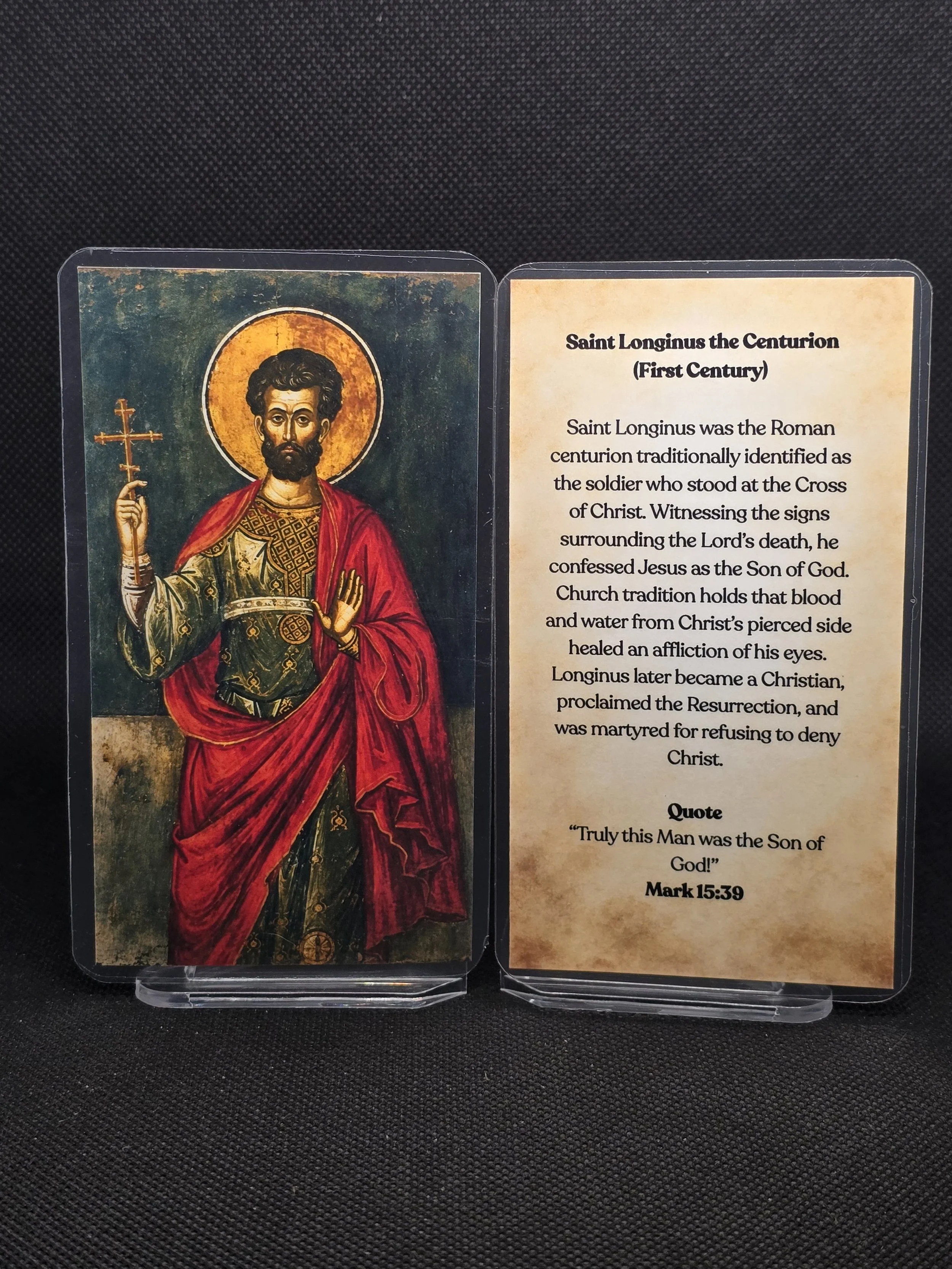
Blessed Theodore Romzha Prayer Card - For Courage, Persecuted Christians, Priests & Fidelity to the Faith
Blessed Theodore Romzha was a Ruthenian Byzantine Catholic bishop, priest-martyr, and Bishop of Mukachevo who gave his life rather than permit Soviet authorities to force his Church to break communion with Rome. Born in Veliky Bychkiv in Transcarpathia on April 14, 1911, he studied for the priesthood in Rome, served poor mountain parishes, became spiritual director and professor at the seminary in Uzhhorod, and was consecrated a bishop in September 1944 at only thirty-three years old. Within weeks, Soviet forces occupied his eparchy, beginning the struggle that would define the final three years of his life.
Blessed Theodore is especially meaningful for persecuted Christians, Byzantine Catholics, Ruthenian Catholics, bishops, priests, seminarians, pastors protecting their communities, Christians facing pressure to compromise their faith, people living under hostile governments, converts afraid of social consequences, and anyone asking for courage to remain faithful when obedience to Christ becomes costly. These associations arise directly from his life because Theodore resisted Soviet efforts to liquidate the Greek Catholic Church, continued visiting isolated parishes despite restrictions and danger, encouraged frightened clergy and faithful, rejected demands that his eparchy submit to the Moscow Patriarchate, and ultimately died as a martyr for his Catholic faith.
His connection with courage under religious persecution is particularly strong. Soviet authorities expelled priests, confiscated church property, intimidated clergy and laity, and demanded that Theodore abandon Catholic communion and submit his Church to Moscow. According to the Byzantine Catholic Archeparchy of Pittsburgh, his answer was uncompromising: “I will rather die than betray my Church!” His refusal was not rhetorical because he continued resisting until the state eventually arranged his murder.
Blessed Theodore is equally meaningful for priests and bishops who feel responsible for people they cannot completely protect. His episcopate unfolded during occupation, political annexation, church seizures, arrests, threats, and violence, yet he continued traveling through his mountainous eparchy after authorities confiscated his automobile, sometimes using a horse-drawn carriage simply to reach communities that needed their bishop. His ministry shows pastoral courage not as the ability to remove every danger, but as the refusal to abandon the flock when danger cannot be removed.
This prayer card is especially fitting for Byzantine Catholic clergy, seminarians, Ruthenian Catholic families, people preparing for ordination, Christians suffering religious discrimination, people praying for persecuted Churches, converts facing family or social pressure, and anyone seeking greater courage and fidelity. It can also make a meaningful ordination, seminary graduation, retreat, chrismation, baptism, name-day, parish anniversary, vocation, or clergy appreciation gift.
Each card is handmade in Austin, TX and created to order. We do not keep stock, because every prayer card is treated as a unique devotional offering. They are printed on museum-quality photo paper, not cardstock, and every card is made slowly during prayer with intentional reverence for the saint or blessed and for the person who will receive it. Names are lifted before Christ, intentions are held carefully, and each piece is handled multiple times in prayerful silence, asking God for mercy and asking Blessed Theodore Romzha to intercede for the soul it is being made for. This is devotional craftsmanship shaped with patience, care, and spiritual responsibility because every soul and every prayer matters.
THE LIFE & STORY
Blessed Theodore Romzha was born on April 14, 1911 in Veliky Bychkiv, a village in Transcarpathia within the complex borderlands historically known as Subcarpathian Ruthenia. The Byzantine Catholic Eparchy of Phoenix identifies him as the youngest of nine children in a modest family whose father worked for the railway and also maintained a small farm.
The political identity of his homeland changed repeatedly during his short life. The region passed from the Austro-Hungarian world into Czechoslovakia, returned to Hungarian control, and was eventually incorporated into Soviet Ukraine after the Second World War. Theodore's entire priesthood therefore unfolded amid changing borders, competing national identities, war, and political systems that increasingly placed pressure upon the Eastern Catholic Church.
Yet the deepest identity running through his life was not political. The sources consistently portray Theodore as a young man convinced that God was calling him to the priesthood and later as a bishop who interpreted his responsibility through fidelity to Christ and the Church entrusted to him.
A CARPATHO-RUSYN & RUTHENIAN CATHOLIC SAINTLY FIGURE
Blessed Theodore's ecclesial identity should be described carefully. He was bishop of the Greek Catholic Eparchy of Mukachevo, rooted in the Carpatho-Rusyn or Ruthenian Byzantine Catholic tradition of Subcarpathian Rus'. American Ruthenian Byzantine Catholic eparchies continue honoring him as one of their own principal modern martyrs, and their liturgical calendars commemorate him as the bishop-martyr of Mukachevo.
It is therefore more precise to call him a Ruthenian Byzantine Catholic bishop-martyr than simply to label him a Roman Catholic or Ukrainian Catholic saintly figure. He lived in territory that today belongs to Ukraine, and Ukrainian Greek Catholics also honor him, but his own episcopal see was Mukachevo and his spiritual heritage belongs especially to the Ruthenian Greek Catholic tradition.
For American Byzantine Catholics whose ancestors came from the Carpathian region, Theodore is particularly important because his story directly connects the Ruthenian Church in America with the persecuted mother Church of Transcarpathia.
HIS CHILDHOOD VOCATION
Theodore showed an early desire for the priesthood. The Eparchy of Passaic describes him as gifted, devout, friendly, academically successful, and even accomplished in athletics, particularly soccer, yet his announcement that he intended to become a priest surprised classmates at his graduation from the gymnasium in Chust.
This makes Blessed Theodore especially meaningful for young men discerning priesthood who do not fit a stereotypical image of a seminarian. Theodore was sociable, athletic, intelligent, and well liked, yet beneath those ordinary qualities was a vocation that would ultimately require extraordinary sacrifice.
His story reminds Christians that vocation is not necessarily recognizable because someone appears unusually solemn or separated from ordinary life. God can call someone directly through the middle of a completely recognizable youth.
SENT TO ROME
Theodore was sent to Rome for priestly formation, initially living at the German-Hungarian College before transferring in 1932 to the Pontifical Russian College, commonly called the Russicum. The Eparchy of Passaic explains that he made the move partly to prepare for possible missionary work among Christians living under Soviet rule.
At the Russicum he studied not only philosophy and theology but also the ideology of Communist atheism. What originally appeared to be preparation for missionary work somewhere inside the Soviet Union became unexpectedly relevant when the Soviet Union eventually came to him.
The Holy See's official biography confirms that Theodore completed philosophy and theology in Rome and earned a licentiate before returning to his homeland.
THE RUSSICUM
The Russicum had been established to prepare Catholic clergy for ministry connected with the Russian and Byzantine Christian world. Theodore's years there exposed him to Eastern Christian liturgy, Russian language and culture, and the ideological challenge posed by Soviet Communism.
This part of his formation later became providential. Theodore would eventually lead one of the few Greek Catholic communities still functioning openly inside Soviet-controlled territory, and the ideological system he once studied from afar became the government trying to destroy his Church.
His education therefore illustrates how formation that appears theoretical can suddenly become pastoral preparation for circumstances no seminarian could have predicted.
ORDAINED A PRIEST AT SANTA MARIA MAGGIORE
Theodore was ordained to the priesthood in Rome on December 25, 1936, and the Byzantine Catholic Eparchy of Phoenix identifies the Basilica of Santa Maria Maggiore as the place of his ordination.
He originally hoped to return to Rome and complete further academic work, but political events changed his plans. Military service and the approaching European crisis prevented the young priest from simply following the academic path he had anticipated.
This becomes another recurring theme in Theodore's life. He repeatedly accepted responsibilities he had not planned, yet the path he did not choose eventually became the path through which his holiness was revealed.
PRIEST AMONG THE POOR
After military service, Theodore was assigned to the remote parish of Berezovo, in the Maramorosh region. The Byzantine Catholic Archeparchy of Pittsburgh remembers him becoming a poor priest among poor parishioners, sometimes surviving on only one meal while giving his own money to those in greater need.
His pastoral success was not built on financial resources because he possessed very few. Instead, he taught people the faith through both instruction and example, helping a neglected rural community rediscover pride and seriousness in its Christian life.
This makes him especially meaningful for priests serving small, rural, financially struggling, or overlooked parishes. A parish's spiritual importance cannot be measured by budget, buildings, location, or public visibility.
A PRIEST WHO GAVE AWAY HIS MONEY
Theodore's generosity continued after leaving parish ministry for seminary work. The Pittsburgh Archeparchy records that money he earned through additional pastoral work was regularly distributed to the poor, leaving him personally with little.
This aspect of his life matters because later courage under persecution did not appear suddenly. The bishop who would eventually surrender his life had already spent years practicing smaller forms of surrender through poverty, service, obedience, and generosity.
Martyrdom was the final gift of a life that had already learned how not to hold tightly to itself.
SPIRITUAL DIRECTOR OF THE SEMINARY
In 1939, Theodore became spiritual director and professor of philosophy at the eparchial seminary in Uzhhorod. Former students remembered him as demanding in academic work while simultaneously fatherly, kind, deeply pious, and capable of inspiring seminarians toward serious priestly character.
His ministry there makes him particularly meaningful for seminarians, seminary professors, spiritual directors, and priests responsible for forming future clergy. Theodore understood that priestly formation required more than passing examinations because future priests needed habits of prayer, generosity, discipline, courage, and pastoral love.
The irony of his position would become visible only a few years later. He was forming men for priesthood at precisely the moment when their Church was approaching a persecution in which many priests would be imprisoned, pressured to defect, or forced underground.
FORMING PRIESTS FOR A PERSECUTION THEY DID NOT YET SEE
Neither Theodore nor his students could fully know what was coming. By the late 1940s the Greek Catholic Church in Soviet-controlled Transcarpathia would face liquidation, arrests, confiscation of churches, and pressure to enter the state-favored Orthodox structure.
The qualities Theodore emphasized in formation therefore became immediately practical. Fidelity, prayer, courage, generosity, and endurance were no longer abstract priestly ideals because they became qualities required for survival as Catholic clergy under an openly hostile regime.
His life can therefore encourage anyone responsible for Christian formation. We rarely know which future trials the people being formed today will eventually need the faith to endure.
A BISHOP AT THIRTY-THREE
After Bishop Alexander Stojka died in 1943 and the political situation rapidly deteriorated, Theodore was chosen to lead the Eparchy of Mukachevo. His episcopal consecration took place in Uzhhorod on September 24, 1944, when he was only thirty-three years old.
The Eparchy of Phoenix describes him at that time as the youngest Catholic bishop in the world. His youth made the responsibility extraordinary because he inherited an eparchy just as Soviet military power was moving permanently into the region.
Within approximately a month of his consecration, the Red Army controlled the entire territory of his eparchy. The young bishop therefore received almost no peaceful period in which to learn his office before entering a struggle for the survival of his Church.
HIS EPISCOPAL MOTTO
Theodore chose words from the Psalms as the guiding text for his episcopal ministry, beginning with the proclamation that the Lord was his strength, stronghold, and refuge. The Eparchy of Passaic and Archeparchy of Pittsburgh both preserve this Psalm as the motto by which he understood his episcopal vocation.
The choice became increasingly prophetic as ordinary institutional protections disappeared. Theodore could not depend upon political allies, military power, legal security, or even ownership of his Church's property because Soviet authorities gradually removed each of those protections.
His episcopal motto therefore became more than ceremonial language printed beneath a coat of arms. The circumstances of his final years forced him to decide whether the words were actually true.
THE SOVIET OCCUPATION
By 1945, Subcarpathian Ruthenia had been incorporated into Soviet Ukraine, bringing Theodore and the Mukachevo Eparchy under an explicitly atheistic Communist regime. Soviet policy regarded Catholic communion with Rome as politically dangerous and sought to eliminate Greek Catholic ecclesiastical structures.
Theodore initially tried to avoid unnecessary confrontation with Soviet authorities, but abuses against clergy, expulsions of priests, confiscation of church property, and attempts to dismantle the eparchy eventually made silence impossible.
His resistance was therefore not a political campaign for its own sake. It began as a bishop defending the right of his priests and faithful to remain the Church they already were.
PRESSURED TO BREAK WITH ROME
The central Soviet demand was clear: the Greek Catholic Church should cease its communion with the Pope and submit instead to the jurisdiction of the Moscow Patriarchate, which Soviet authorities were willing to recognize and control.
Theodore refused. The Byzantine Catholic source preserves his direct response that he would rather die than betray his Church, while later liturgical texts honor him specifically for preserving the ancient faith and his local Church's communion with the See of Peter.
This is the central reason Theodore is remembered as a Catholic martyr. His death was not merely the accidental result of political violence because the pressure directed against him concerned his refusal to renounce ecclesial communion and permit the liquidation of his Church.
A MARTYR FOR ECCLESIAL COMMUNION
Blessed Theodore's martyrdom is therefore unusually connected with the question of Church unity. Soviet authorities could have allowed him to remain a Christian bishop if he accepted the religious structure they prescribed, but he refused to separate his eparchy from Catholic communion.
Saint John Paul II later described Theodore as a zealous pastor who paid with his life for unwavering fidelity to the See of Peter. The Pope's language identifies the ecclesial meaning of Theodore's death with unusual clarity.
For Byzantine Catholics, his story is therefore particularly significant. Theodore died demonstrating that communion with Rome did not require abandoning the Byzantine tradition because the Church he defended was simultaneously Eastern, Byzantine, Ruthenian, and Catholic.
THE ATTEMPT TO DESTROY THE EPARCHY OF MUKACHEVO
Soviet authorities supported an Orthodox hierarchy in the region while increasing pressure upon Greek Catholic clergy and parishes. Priests were intimidated, removed, or imprisoned, and church property was progressively taken away.
The goal was not simply to reduce the political influence of one bishop. The Greek Catholic Eparchy itself was ultimately targeted for liquidation, with its clergy expected to enter the Orthodox structure recognized by the Soviet state.
Theodore understood that his own survival could not be separated from the fate of his people. Accepting the government's demand would have made the bishop personally safer while helping destroy the Church entrusted to him.
HIS CAR WAS CONFISCATED
Soviet authorities eventually confiscated Theodore's automobile, apparently hoping to limit his ability to travel through the mountainous eparchy and encourage frightened communities. The bishop responded by traveling by horse and carriage instead.
This small detail reveals his pastoral character particularly well. Persecution did not always arrive as dramatic arrest because sometimes it took the form of bureaucratic restrictions designed to make ministry progressively more difficult.
Theodore's answer was practical rather than theatrical. If one means of reaching the faithful disappeared, he found another.
A BISHOP WHO KEPT VISITING HIS PEOPLE
Theodore traveled throughout his eparchy encouraging priests and faithful not to surrender their faith. He knew that isolated communities could become easier to intimidate if they believed their bishop had disappeared or already compromised.
The Eparchy of Phoenix summarizes his episcopate as three years of traveling through the mountainous region and continually preaching fidelity. It preserves one of the sayings especially associated with him: “To die for Christ is to live forever!”
The words gained enormous force because Theodore eventually did exactly what he had encouraged others to be prepared to do.
A SAINTLY FIGURE FOR PRIESTS IN DANGEROUS PLACES
Blessed Theodore is especially fitting for priests serving amid war, political instability, persecution, anti-Christian hostility, or communities where the Church has little institutional protection. His pastoral method did not consist in waiting for safety before ministering because safety never returned during his episcopate.
He continued celebrating the mysteries, visiting parishes, instructing clergy, encouraging the frightened, and defending the Church even as the circle around him tightened.
His card can therefore make an especially meaningful ordination gift for a priest whose vocation requires courage and pastoral perseverance.
A SAINTLY FIGURE FOR BISHOPS
Theodore's life offers an unusually demanding image of episcopal ministry. A bishop is traditionally understood as shepherd, teacher, sanctifier, and guardian of ecclesial unity, and Theodore was forced to exercise all of those responsibilities under conditions in which failure could mean the destruction of the local Church.
The official Byzantine Catholic Moleben to Blessed Theodore specifically remembers him as the shepherd of Mukachevo, thanks God for his love of the poor, and praises his defense of both the Church and his people during war and persecution.
For bishops and church leaders, Theodore's intercession is especially appropriate when leadership requires choosing between institutional convenience and fidelity.
SECRET PREPARATION FOR AN UNDERGROUND CHURCH
The Eparchy of Phoenix reports that Theodore secretly consecrated two bishops in December 1944, preparing for the possibility that open episcopal leadership might become impossible. After the state formally suppressed the Eparchy in 1949, underground bishops and their successors helped maintain the Church until it emerged publicly again in 1989.
This detail reveals that Theodore's courage was strategic as well as personal. He did not simply prepare himself to die because he considered how sacramental and episcopal ministry might continue after his death.
Christian martyrdom therefore did not mean indifference toward earthly consequences. Theodore accepted death while simultaneously doing what he could to ensure that his people would still have shepherds.
THE UNDERGROUND CHURCH
After Theodore's death and the eventual suppression of the Eparchy, Greek Catholic life continued secretly. Priests, religious, and faithful faced arrests and persecution, but the Church survived underground until the collapse of Soviet restrictions permitted public life to re-emerge in 1989.
Theodore therefore became more than a remembered victim of Soviet violence. His actions before martyrdom helped prepare the structures through which the persecuted Church could continue.
His life is particularly meaningful for Christians in places where churches can be closed and organizations dissolved but faith itself cannot easily be confiscated.
THE GOOD SHEPHERD
The Gospel image of the Good Shepherd laying down his life for the sheep naturally became central to Theodore's later veneration. His official Moleben repeatedly presents his episcopal life through the image of Christ the Shepherd and describes Theodore's martyrdom as deeper identification with Christ.
This is especially fitting because Theodore had opportunities to increase his own safety. The pressure placed upon him was partly intended to induce cooperation, yet cooperation required abandoning the ecclesial identity of the flock entrusted to him.
His death therefore embodied the opposite choice: the shepherd remained with the sheep even when leaving them would have protected him.
A SAINTLY FIGURE FOR COURAGE WITHOUT RECKLESSNESS
Theodore's courage should not be confused with deliberately seeking death. His sources show that he initially attempted to avoid unnecessary confrontation, continued using ordinary pastoral means, and accepted practical ways of preserving ministry.
What changed was not a desire for martyrdom but the realization that the government demanded something he could not morally surrender. At that point, self-preservation became subordinate to fidelity.
His example can therefore help Christians distinguish courage from recklessness. Martyrdom is not looking for opportunities to suffer because it is refusing to purchase safety through betrayal when suffering cannot otherwise be avoided.
A SAINTLY FIGURE FOR PEOPLE PRESSURED TO COMPROMISE
Most Christians will never face a Communist official demanding formal apostasy. Smaller compromises can nevertheless carry similar spiritual logic when a person is asked to hide, deny, or contradict Christian convictions in exchange for acceptance, advancement, comfort, or security.
Blessed Theodore's life asks where the boundary lies beyond which compromise changes from prudence into betrayal. His own answer became unmistakable when Soviet authorities demanded abandonment of his Church.
His prayer card can therefore be especially meaningful during moral decisions in which fear makes the easier option appear increasingly attractive.
HIS LOVE FOR THE POOR
Long before persecution made Theodore famous, his priesthood was marked by generosity toward poor parishioners. He repeatedly gave away his own limited money and lived with very little while serving communities that themselves possessed little.
The official Moleben continues remembering this feature of his life, thanking God for giving Theodore a heart that loved the humble poor and made him a father to those entrusted to him.
This prevents Theodore's story from becoming only a political narrative. The bishop capable of resisting Soviet power was first a priest capable of noticing when an ordinary parishioner needed help.
A SAINTLY FIGURE FOR SEMINARIANS
Blessed Theodore is especially meaningful for seminarians because he personally served as both professor and spiritual director before becoming a bishop. Former students remembered intellectual seriousness joined with genuine pastoral fatherhood.
His life also gives seminarians a powerful perspective on what formation is ultimately preparing them for. Priesthood cannot be reduced to beautiful services, theological study, vestments, or parish administration because the priest may eventually be asked to remain faithful under circumstances no seminary curriculum can fully anticipate.
Theodore's card can therefore make a particularly meaningful seminary graduation or ordination gift.
A SAINTLY FIGURE FOR CATHOLICS UNDER COMMUNISM
Blessed Theodore belongs to the larger company of twentieth-century Catholic martyrs and confessors who suffered under Communist governments across Eastern and Central Europe. Saint John Paul II explicitly placed him among the heroic witnesses of the faith who endured persecution under the Communist regime.
His experience shares themes with other Eastern Catholic martyrs, including bishops and priests whose Churches were outlawed, properties confiscated, clergy imprisoned, and ecclesial structures forcibly absorbed into state-controlled religious institutions.
Theodore's distinctive place within that history comes from the Eparchy of Mukachevo and the Ruthenian Church he defended.
THE ATTEMPTED ASSASSINATION
On October 27, 1947, Theodore was returning from the rededication of a church near Mukachevo when a military truck deliberately rammed the horse-drawn carriage carrying him and his companions. The Holy See describes this as a Soviet attempt to kill him, while Byzantine Catholic sources provide additional details about the staged collision.
Theodore survived the crash despite being seriously injured. The Eparchy of Phoenix reports that attackers then beat the victims with iron rods until local people and another vehicle interrupted the assault.
The failed attack created a problem for those attempting to eliminate him because the bishop was still alive and recovering.
TAKEN TO THE HOSPITAL IN MUKACHEVO
The wounded bishop was brought to a hospital in Mukachevo, where his condition initially began to improve after the attack. Both the Holy See and Byzantine Catholic sources agree that Theodore survived the road assault and subsequently died after being poisoned while hospitalized.
The difference between the staged accident and the eventual poisoning is important because it demonstrates that his death was not simply the result of injuries suffered on the road. The assassination continued after the first attempt failed.
The hospital that should have represented safety became instead the setting of his martyrdom.
THE POISONING OF BLESSED THEODORE
Church sources preserve the account that a nurse connected with the Soviet security apparatus entered Theodore's room and administered poison after he began recovering. The Holy See's official biography states directly that he was poisoned in the hospital and died on November 1, 1947 according to the time then officially used under Soviet rule.
A later Vatican account identifies the poison as curare, while Ruthenian Byzantine Catholic sources likewise describe his death as deliberate poisoning following the failed road attack.
Theodore was only thirty-six years old. His episcopate had lasted just over three years.
OCTOBER 31 OR NOVEMBER 1?
Older biographies often give Theodore's death as November 1, 1947, and the Holy See's official beatification-era biography uses that date. The reason for the difference is unusually interesting because Soviet authorities had imposed Moscow time upon Transcarpathia, shifting official clocks away from the Central European time historically used in the region.
The Eparchy of Phoenix explains that Theodore was actually killed at approximately 10:30 p.m. Central European time on October 31, although Moscow time had already passed midnight into November 1. The Eparchy of Mukachevo later requested that his liturgical feast be moved to October 31 to correspond with the local historical time of his martyrdom.
Current 2026 calendars of both the Mukachevo Greek Catholic Eparchy and American Ruthenian Byzantine Catholics now commemorate Blessed Theodore on October 31.
HIS FINAL HOURS
The official historical biography of the Mukachevo Greek Catholic Eparchy records that Theodore received the Mysteries of Confession and the Eucharist on the morning of October 31, not knowing that they would be his final sacramental preparation. The same source remembers him enduring his injuries without complaint during the days between the attack and his death.
The bishop who had spent years feeding his people sacramentally therefore approached his own death through the sacramental life he had defended.
For Byzantine Catholics, this gives his martyrdom a particularly Eucharistic character. Theodore's final struggle was not simply about institutional allegiance because it concerned the continued sacramental and ecclesial life of an entire people.
“TO DIE FOR CHRIST IS TO LIVE FOREVER”
The saying “To die for Christ is to live forever” became closely associated with Theodore's episcopal preaching and is preserved by the Eparchy of Phoenix as a message he repeated while traveling throughout his endangered eparchy.
What makes the words extraordinary is their chronology. Theodore preached them before his murder, when he already understood that Soviet hostility made martyrdom a realistic possibility.
The saying therefore does not read like something created after his death to make his story more dramatic. It expresses the theology by which he was already preparing both himself and his people to understand whatever persecution might come.
MARTYRDOM, NOT POLITICAL ASSASSINATION ALONE
Theodore was certainly the victim of a political assassination, but Catholic recognition of his martyrdom goes beyond the political motive. He was targeted because the Soviet state could not persuade him to abandon the Catholic Church and assist the forced transformation of his eparchy.
His death therefore qualifies within Catholic devotion as martyrdom for the faith, not merely death because he happened to hold an inconvenient public office.
Saint John Paul II's beatification formally recognized that witness, allowing the Church publicly to venerate Theodore as a blessed bishop-martyr.
HIS FUNERAL
The Mukachevo Eparchy records that Theodore's funeral took place on November 4, 1947, with clergy and faithful paying final honor to the murdered bishop. His body was placed in the crypt of the Holy Cross Cathedral in Uzhhorod.
The funeral occurred before the Greek Catholic Church had been completely driven underground. Within only a few years, the public ecclesial world Theodore had led would effectively disappear under Soviet suppression.
His tomb therefore became connected not only with personal martyrdom but with the suffering of an entire local Church.
THE EPARCHY WAS SUPPRESSED
In 1949, Soviet authorities formally shut down the Eparchy of Mukachevo, and large numbers of priests, religious, and laypeople were arrested. The Church continued underground through clergy and secret bishops until religious freedom returned in the final years of the Soviet period.
From the Soviet perspective, Theodore's murder succeeded in removing the visible bishop. From the perspective of Church history, it failed to destroy what he had defended.
The underground survival of the eparchy became one of the strongest confirmations of his conviction that governments could take buildings and clergy away but could not simply confiscate faith from the human heart.
HIS BEATIFICATION
Saint John Paul II beatified Theodore Romzha in Lviv on June 27, 2001, during the Pope's historic visit to Ukraine. The Vatican records the beatification among the commemorations of Christians who suffered under twentieth-century totalitarian regimes.
The beatification transformed a devotion already deeply rooted among Ruthenian Catholics into formal universal Catholic recognition of Theodore's martyrdom and heavenly intercession.
The Pope later described Theodore as a zealous pastor who gave his life through unwavering fidelity to the See of Peter.
WHY HE IS CALLED “BLESSED” RATHER THAN “SAINT”
Theodore has been beatified but not canonized, so the correct formal Catholic title is Blessed Theodore Romzha, not Saint Theodore Romzha. His liturgical texts may also call him the holy priest-martyr or bishop-martyr according to Byzantine liturgical language, but product labeling should preserve his current canonical title as Blessed.
Beatification permits public ecclesial veneration according to the authorization given by the Church and formally recognizes the person's presence among the blessed in heaven.
For your product listing, Blessed Bishop-Martyr Theodore Romzha is therefore one of the strongest and most accurate forms of his name.
THE PRIEST-MARTYR TITLE
Byzantine liturgical sources frequently identify Theodore as the holy priest-martyr, while current Byzantine Catholic calendars commonly use Blessed Bishop-Martyr Theodore Romzha. Both expressions communicate that he was ordained and received martyrdom.
The term hieromartyr is also sometimes used in English-language Eastern Christian material for a bishop or priest who dies as a martyr.
For customers unfamiliar with Byzantine terminology, “Blessed Bishop-Martyr Theodore Romzha” communicates the meaning most clearly without losing the Eastern Christian identity of the feast.
HIS RELICS
Blessed Theodore's principal relics are enshrined today in Holy Cross Cathedral in Uzhhorod, Transcarpathia. The Byzantine Catholic Eparchy of Passaic explicitly identifies the cathedral as the current location of his relics.
The Mukachevo Eparchy's history of the cathedral records that Theodore's relics were returned there on June 28, 2003, after having spent several years elsewhere during the period surrounding his beatification and investigation.
This gives Blessed Theodore one of the clearest documented relic locations among modern Byzantine Catholic martyrs.
WHERE CAN HIS RELICS BE VENERATED?
The principal pilgrimage site is Holy Cross Cathedral in Uzhhorod, the cathedral connected directly with Theodore's episcopal ministry and burial. His relics are enshrined there for public veneration.
Smaller relics have also been distributed elsewhere. The Eparchy of Passaic documented relics of Blessed Theodore being placed inside the altar of Saint Nicholas Byzantine Catholic Church in Danbury, Connecticut during its dedication in 2015.
For American Byzantine Catholics, this means devotion to Theodore is not limited to historical interest in Transcarpathia because relics and icons of the bishop-martyr are present within Byzantine Catholic churches in the United States.
THE FEAST OF THE TRANSLATION OF HIS RELICS
The Mukachevo Eparchy also celebrates a feast connected with the translation or return of Blessed Theodore's relics on June 28. In 2024 the eparchy documented festal services associated with bringing the relics from Holy Cross Cathedral to the seminary that bears his name for the celebration.
This secondary observance is especially important locally because the return of his relics represented the restoration of the martyr to the Church that Soviet power had once attempted to erase.
For most prayer-card customers, October 31 should remain the principal feast date, while June 28 can be mentioned as the commemoration of the translation of his relics.
FEAST DAY
The current principal feast of Blessed Theodore Romzha is October 31 in the Ruthenian Byzantine Catholic calendar. The Metropolitan Cantor Institute, Eparchy of Phoenix, and current Mukachevo Eparchy calendar all place his liturgical commemoration on October 31.
Older publications may show November 1, and this is not necessarily an error because Soviet Moscow time placed his death after midnight. The Church's later decision to use October 31 reflects the local Central European time at which the murder actually occurred.
For this product page, the clearest listing is Feast Day: October 31.
AN OFFICIAL MOLEBEN TO BLESSED THEODORE
Blessed Theodore already has an established Byzantine Catholic Moleben, published by the Metropolitan Cantor Institute of the Byzantine Catholic Archeparchy of Pittsburgh. The service thanks God for Theodore's priesthood, love of the poor, episcopal ministry, defense of the Church during persecution, martyrdom, and continuing intercession.
This is particularly valuable for prayer-card devotion because there is no need to invent a modern prayer for him. His own Byzantine Catholic tradition already provides an ecclesial service centered specifically upon his life and martyrdom.
The Moleben also prays for bishops, clergy, faithful, and the continuing mission of the Byzantine Catholic Church, making it especially appropriate for parish groups, seminaries, clergy gatherings, and private devotion.
PRAYERS
A simple invocation consistent with the current prayer of the Mukachevo Greek Catholic Eparchy is: “Blessed Hieromartyr Theodore, pray to God for us.” The eparchy continues publicly invoking him in this form during celebrations connected with his relics and memory.
The official Byzantine Catholic Moleben may also be prayed for a fuller devotion. Its concluding prayer remembers Theodore's ministry to the Rusyn people, his love for the poor, his fidelity amid war and persecution, his defense of communion with Rome, and his martyrdom as a shepherd following Christ.
Someone facing pressure to compromise the faith can ask Blessed Theodore for courage, while a priest can seek his intercession for pastoral fidelity. Bishops and church leaders can ask for the strength to protect the people entrusted to them, and Byzantine Catholics can seek his prayers for their Churches to remain faithful to both their Eastern inheritance and Catholic communion.
A Christian who feels powerless before large political or cultural forces can also seek his intercession. Theodore possessed no army, police force, political party, or meaningful ability to prevent the Soviet government from taking church property, yet his faith ultimately survived the system that murdered him.
This prayer card is especially fitting beside a Byzantine prayer book, Psalter, Bible, chotki, seminary books, icon corner, clergy prayer book, vocation materials, or prayer list for persecuted Christians. It can also make a meaningful gift for a bishop, priest, seminarian, Byzantine Catholic convert, Ruthenian Catholic family, or person facing serious pressure because of Christian conviction.
FAQ
Who was Blessed Theodore Romzha? Blessed Theodore Romzha was a twentieth-century Ruthenian Byzantine Catholic bishop and martyr who led the Eparchy of Mukachevo during the Soviet occupation of Transcarpathia. He refused government demands that his Church break communion with Rome, survived a staged road attack, and was subsequently poisoned in a hospital in 1947.
When was Blessed Theodore Romzha born? Theodore was born on April 14, 1911 in Veliky Bychkiv in Transcarpathia. He was the youngest of nine children in a modest Christian family.
When did Blessed Theodore Romzha die? The Holy See records his death as November 1, 1947, according to the Soviet time then imposed upon the region. The Eparchy of Mukachevo now commemorates his martyrdom on October 31 because the murder occurred before midnight according to the local Central European time historically used there.
When is Blessed Theodore Romzha's feast day? His current feast day is October 31 in the Mukachevo and Ruthenian Byzantine Catholic calendars. Current 2026 calendars continue using that date.
Why do some sources say November 1? Soviet authorities had imposed Moscow time upon Transcarpathia, which placed the assassination after midnight even though local Central European time was still October 31. The Eparchy of Mukachevo later requested the October 31 feast to reflect the actual local time of his martyrdom.
Was Theodore Romzha Ukrainian Catholic? He lived in territory that today belongs to Ukraine and is honored by Ukrainian Greek Catholics, but his own ecclesial identity was specifically tied to the Greek Catholic Eparchy of Mukachevo and the Ruthenian or Carpatho-Rusyn Byzantine Catholic tradition. Calling him a Ruthenian Byzantine Catholic bishop-martyr is therefore more precise.
Was Theodore Romzha Ruthenian Catholic? Yes. American Ruthenian Byzantine Catholic eparchies honor him as a principal martyr of the Carpatho-Rusyn Greek Catholic tradition, and he served as bishop of Mukachevo.
Was Blessed Theodore Romzha a bishop? Yes, he was consecrated bishop for the Eparchy of Mukachevo on September 24, 1944 at only thirty-three years old. Within weeks his territory fell under Soviet military control.
Was Theodore Romzha really only thirty-three when he became bishop? Yes, and the Byzantine Catholic Eparchy of Phoenix describes him as the youngest Catholic bishop in the world at the time. His episcopate began under extraordinary wartime and political circumstances.
Was Blessed Theodore Romzha a priest before becoming bishop? Yes. He was ordained in Rome on December 25, 1936, served as a rural parish priest, and later became professor and spiritual director at the seminary in Uzhhorod.
Where did Theodore Romzha study for the priesthood? He studied in Rome, first at the German-Hungarian College and later at the Pontifical Russian College, or Russicum. His education there included preparation for ministry involving Soviet Russia and study of Communist ideology.
Why did he study at the Russicum? Theodore originally hoped to prepare for missionary service among Christians under Soviet rule. That preparation became unexpectedly relevant when Soviet rule later expanded into his own homeland.
Where was Theodore Romzha ordained a priest? The Byzantine Catholic Eparchy of Phoenix identifies the Basilica of Santa Maria Maggiore in Rome as the place where he was ordained on Christmas Day in 1936.
Was Theodore Romzha a poor parish priest? Yes. During his assignment in Berezovo he served an impoverished community and sometimes had only one meal a day while giving his own money to parishioners in need.
Was Theodore Romzha a seminary professor? Yes. Beginning in 1939 he taught philosophy and served as spiritual director at the Uzhhorod seminary. Former students remembered him as demanding academically while fatherly and kind in spiritual direction.
Why did the Soviet government oppose Theodore Romzha? The Soviet government sought to eliminate the Greek Catholic Church's communion with Rome and pressure its clergy into the Orthodox structure recognized by the state. Theodore refused to cooperate and continued publicly defending his clergy and faithful.
Was the Soviet government trying to force Byzantine Catholics to become Orthodox? In Theodore's region, Soviet authorities demanded that the Greek Catholic Church abandon communion with Rome and submit to the Moscow Patriarchate. Clergy and parishes faced intimidation, expulsions, confiscation, and imprisonment during the process.
Did Blessed Theodore Romzha oppose Orthodox Christianity itself? His martyrdom should be understood specifically within the context of a state-directed attempt to liquidate his Catholic eparchy, not as hatred of Orthodox Christians. His resistance concerned coercion, destruction of ecclesial freedom, and forced separation from Catholic communion.
What did Theodore Romzha say when ordered to leave the Catholic Church? The Byzantine Catholic Archeparchy of Pittsburgh preserves his reply that he would rather die than betray his Church. His later murder gave those words their full weight.
Why is Blessed Theodore associated with fidelity to Rome? Saint John Paul II specifically described him as a pastor who gave his life through unwavering fidelity to the See of Peter. His refusal to sever communion with Rome was a direct cause of Soviet hostility against him.
Did Theodore Romzha abandon the Byzantine tradition to remain Catholic? No. He remained fully Byzantine and Ruthenian while defending Catholic communion. His life demonstrates the Eastern Catholic conviction that fidelity to Rome and fidelity to an authentic Eastern Christian tradition need not oppose one another.
Did the Soviet authorities confiscate his car? Yes. After losing his automobile, Theodore continued traveling through the mountainous eparchy by horse and carriage so he could encourage isolated communities.
Did Blessed Theodore secretly consecrate bishops? The Byzantine Catholic Eparchy of Phoenix reports that he secretly consecrated two bishops in December 1944. Those hidden episcopal lines later helped sustain the underground Church after public structures were suppressed.
Did the Byzantine Catholic Church go underground after his death? Yes. The Eparchy of Mukachevo was suppressed by the Soviet state in 1949, while bishops, priests, religious, and faithful continued Catholic life secretly until the Church emerged publicly again in 1989.
How was Blessed Theodore Romzha attacked? On October 27, 1947, a military truck deliberately crashed into the horse-drawn carriage carrying Theodore and several companions. He survived despite serious injuries and was taken to the hospital in Mukachevo.
Was Blessed Theodore beaten after the crash? The Eparchy of Phoenix reports that soldiers attacked the survivors with iron rods after the staged collision, but local people and another vehicle interrupted them before they could finish the assassination.
Did Theodore Romzha die from the traffic accident? No. Although Soviet authorities initially claimed that his injuries caused his death, Church sources and later investigation identify poisoning in the hospital as the cause.
Was Blessed Theodore Romzha poisoned? Yes. The Holy See explicitly states that he was poisoned while hospitalized after surviving the assassination attempt.
What poison was used to kill Theodore Romzha? A later Vatican account identifies the poison as curare and describes a nurse administering it after Theodore began recovering from the road attack.
How old was Blessed Theodore when he was martyred? He was only thirty-six years old, having been born in April 1911 and killed in late October 1947.
Why is Theodore Romzha considered a martyr? He was killed after repeatedly refusing Soviet demands that he abandon Catholic communion and cooperate in the liquidation of his Church. The Catholic Church formally recognized his death as martyrdom when Saint John Paul II beatified him.
When was Theodore Romzha beatified? Saint John Paul II beatified him in Lviv on June 27, 2001 during the Pope's visit to Ukraine.
Why is he called Blessed rather than Saint Theodore Romzha? Theodore has been beatified but has not yet been canonized. The correct formal title for a product listing is therefore Blessed Theodore Romzha or Blessed Bishop-Martyr Theodore Romzha.
What is a bishop-martyr? In Byzantine Christian terminology, a bishop or priest who dies for Christ may be called a hieromartyr or priest-martyr. Current Byzantine Catholic liturgical material commonly identifies Theodore as the bishop-martyr or holy priest-martyr of Mukachevo.
What was Theodore Romzha's episcopal motto? He chose words from the Psalms proclaiming the Lord as his strength, stronghold, and refuge. The motto became particularly meaningful during the persecution that consumed his entire episcopate.
What is Blessed Theodore Romzha the patron of? The Church does not need an invented modern patronage list for him because his biography provides very strong associations with persecuted Christians, Byzantine Catholics, bishops, priests, seminarians, courage, fidelity to the Church, resistance to religious coercion, and pastoral perseverance. These themes arise directly from his ministry and martyrdom.
Is Blessed Theodore a good intercessor for persecuted Christians? Yes, this is one of the strongest applications of his devotion because persecution of the Church defined his episcopal ministry and ultimately caused his death.
Is Blessed Theodore a good intercessor for priests? Yes. He was a parish priest, seminary spiritual director, professor, bishop, and martyr, and his official Moleben specifically asks God's blessing upon bishops and clergy through his example and intercession.
Is Blessed Theodore a good intercessor for seminarians? Yes, especially because he spent years personally forming seminarians before becoming bishop. His life makes an especially meaningful example of priestly courage and pastoral responsibility.
Is Blessed Theodore a good intercessor for bishops? Yes. His martyrdom is fundamentally episcopal because he died protecting the people and ecclesial communion entrusted to him. His official Byzantine Catholic Moleben explicitly invokes his example for the Church's bishops and clergy.
Can someone facing pressure to hide their faith pray to Blessed Theodore? Yes, his entire martyrdom developed from refusing pressure to compromise or conceal his Catholic identity. His intercession is therefore especially fitting when fear of consequences makes fidelity difficult.
Can converts pray to Blessed Theodore Romzha? Yes, especially converts or Eastern Catholics whose commitment to the Church creates tension with family, friends, employers, or society. Theodore's story offers a particularly strong model of fidelity without pretending that fidelity is always socially comfortable.
Can I pray to Blessed Theodore for courage? Yes, courage is central to his life and official ecclesial memory. He repeatedly continued pastoral ministry despite explicit danger and eventually accepted death rather than cooperate with the destruction of his Church.
Is Blessed Theodore a good saintly figure for people suffering under anti-Christian governments? Yes. He lived under a government openly committed to atheistic control of religious life and died because he refused to surrender the freedom and communion of his Church.
Where is Blessed Theodore Romzha buried? His principal relics are enshrined at Holy Cross Cathedral in Uzhhorod, Transcarpathia. The cathedral was also the place associated with his original burial after his martyrdom.
Are Blessed Theodore's relics still in Uzhhorod? Yes. The Eparchy of Passaic identifies Holy Cross Cathedral as their current shrine, and the Mukachevo Eparchy records their return to the cathedral in 2003.
Are there relics of Blessed Theodore Romzha in the United States? Yes. The Eparchy of Passaic documented relics of Blessed Theodore being sealed into the altar of Saint Nicholas Byzantine Catholic Church in Danbury, Connecticut in 2015.
Does Blessed Theodore have an official prayer service? Yes. The Metropolitan Cantor Institute publishes a complete Moleben to Blessed Theodore Romzha for Byzantine Catholic devotional use.
Is there a traditional invocation to Blessed Theodore? The Mukachevo Eparchy publicly uses an invocation meaning “Blessed Hieromartyr Theodore, pray to God for us.” This provides established devotional wording rather than requiring an invented prayer.
Does Blessed Theodore have Byzantine liturgical hymns? Yes. The Metropolitan Cantor Institute publishes Vespers, Divine Liturgy propers, and other liturgical material for his October 31 commemoration.
Is Blessed Theodore especially important to Ruthenian Byzantine Catholics in America? Yes. The American Ruthenian Byzantine Catholic Church commemorates him liturgically, publishes his Moleben and feast texts, and preserves his relics and icons in American parishes.
Why is Blessed Theodore important to Eastern Catholics generally? His life embodies several themes central to Eastern Catholic identity: fidelity to an Eastern liturgical tradition, communion with Rome, resistance to forced ecclesial assimilation, pastoral courage, and survival under persecution.
Can I give this card to a Byzantine Catholic priest? Yes, it is particularly appropriate because Theodore lived every major stage of ordained ministry from rural pastor and seminary spiritual director to bishop and martyr. The card can make a meaningful ordination, anniversary, or clergy appreciation gift.
Can I give this card to a seminarian? Yes, especially to a Ruthenian or other Byzantine Catholic seminarian. Theodore's own work forming seminarians gives the gift a direct connection with his life.
Can I give this card to a bishop? Yes. Blessed Theodore is one of the strongest modern Eastern Catholic examples of episcopal courage because he remained with his flock when protecting himself would have required abandoning them.
Can I give this card to someone suffering religious discrimination? Yes, because Theodore endured escalating discrimination that eventually became outright persecution and murder. His intercession can accompany prayer for courage, wisdom, perseverance, and freedom from hatred.
What does Blessed Theodore teach about courage? His life teaches that courage is not the absence of danger or fear because he understood exactly what Soviet authorities were capable of doing. Courage meant refusing to let fear decide what he believed or whom he would abandon.
What does Blessed Theodore teach about being a priest? His ministry shows priesthood as spiritual fatherhood expressed through teaching, poverty, generosity, sacramental service, availability, and willingness to suffer with the people entrusted to the priest.
What does Blessed Theodore teach about being a bishop? His episcopate demonstrates that a bishop's authority is ultimately pastoral rather than merely administrative. When buildings, property, legal recognition, and transportation were stripped away, Theodore's essential work remained teaching, sanctifying, encouraging, defending, and remaining with his people.
What does Blessed Theodore teach about Church unity? He regarded communion with the Catholic Church as something worth dying to preserve. His martyrdom shows that ecclesial communion was not an abstract administrative arrangement to him because it belonged to his understanding of fidelity to Christ and his episcopal responsibility.
What does Blessed Theodore teach about persecution? His life demonstrates that persecution often develops gradually. Property confiscation, restrictions, intimidation, propaganda, and pressure to compromise can precede imprisonment or violence, making early fidelity especially important.
What does Blessed Theodore teach about political power? His story demonstrates how limited political power ultimately is before the human conscience. The Soviet state could seize churches, restrict clergy, kill the bishop, and suppress the eparchy publicly, but the faith survived underground and eventually returned to public life.
What does Blessed Theodore teach about martyrdom? His martyrdom shows that Christian willingness to die is not a rejection of life. Theodore's own preaching expressed the conviction that dying for Christ opens into eternal life, and his actions before death showed serious concern that his Church continue surviving after him.
What is the main message of Blessed Theodore Romzha's life? Blessed Theodore Romzha's life teaches that faithfulness becomes most visible when compromise would make life easier. A poor Carpatho-Rusyn boy followed a vocation to Rome, became a rural priest among the poor, formed seminarians, was made bishop at thirty-three, watched Soviet power descend upon his eparchy, resisted efforts to sever his Church from Catholic communion, continued traveling to frightened communities after losing even his automobile, prepared secret bishops for an underground future, survived a staged assassination, and was finally poisoned because authorities could not make him surrender. The state that murdered him eventually disappeared, while the Byzantine Catholic Church he defended emerged from underground, his relics returned to his cathedral, his liturgical feast is celebrated openly, and Christians throughout the world now invoke the bishop whom Soviet power could kill but could not convince to betray his faith.
Blessed Theodore Romzha was a Ruthenian Byzantine Catholic bishop, priest-martyr, and Bishop of Mukachevo who gave his life rather than permit Soviet authorities to force his Church to break communion with Rome. Born in Veliky Bychkiv in Transcarpathia on April 14, 1911, he studied for the priesthood in Rome, served poor mountain parishes, became spiritual director and professor at the seminary in Uzhhorod, and was consecrated a bishop in September 1944 at only thirty-three years old. Within weeks, Soviet forces occupied his eparchy, beginning the struggle that would define the final three years of his life.
Blessed Theodore is especially meaningful for persecuted Christians, Byzantine Catholics, Ruthenian Catholics, bishops, priests, seminarians, pastors protecting their communities, Christians facing pressure to compromise their faith, people living under hostile governments, converts afraid of social consequences, and anyone asking for courage to remain faithful when obedience to Christ becomes costly. These associations arise directly from his life because Theodore resisted Soviet efforts to liquidate the Greek Catholic Church, continued visiting isolated parishes despite restrictions and danger, encouraged frightened clergy and faithful, rejected demands that his eparchy submit to the Moscow Patriarchate, and ultimately died as a martyr for his Catholic faith.
His connection with courage under religious persecution is particularly strong. Soviet authorities expelled priests, confiscated church property, intimidated clergy and laity, and demanded that Theodore abandon Catholic communion and submit his Church to Moscow. According to the Byzantine Catholic Archeparchy of Pittsburgh, his answer was uncompromising: “I will rather die than betray my Church!” His refusal was not rhetorical because he continued resisting until the state eventually arranged his murder.
Blessed Theodore is equally meaningful for priests and bishops who feel responsible for people they cannot completely protect. His episcopate unfolded during occupation, political annexation, church seizures, arrests, threats, and violence, yet he continued traveling through his mountainous eparchy after authorities confiscated his automobile, sometimes using a horse-drawn carriage simply to reach communities that needed their bishop. His ministry shows pastoral courage not as the ability to remove every danger, but as the refusal to abandon the flock when danger cannot be removed.
This prayer card is especially fitting for Byzantine Catholic clergy, seminarians, Ruthenian Catholic families, people preparing for ordination, Christians suffering religious discrimination, people praying for persecuted Churches, converts facing family or social pressure, and anyone seeking greater courage and fidelity. It can also make a meaningful ordination, seminary graduation, retreat, chrismation, baptism, name-day, parish anniversary, vocation, or clergy appreciation gift.
Each card is handmade in Austin, TX and created to order. We do not keep stock, because every prayer card is treated as a unique devotional offering. They are printed on museum-quality photo paper, not cardstock, and every card is made slowly during prayer with intentional reverence for the saint or blessed and for the person who will receive it. Names are lifted before Christ, intentions are held carefully, and each piece is handled multiple times in prayerful silence, asking God for mercy and asking Blessed Theodore Romzha to intercede for the soul it is being made for. This is devotional craftsmanship shaped with patience, care, and spiritual responsibility because every soul and every prayer matters.
THE LIFE & STORY
Blessed Theodore Romzha was born on April 14, 1911 in Veliky Bychkiv, a village in Transcarpathia within the complex borderlands historically known as Subcarpathian Ruthenia. The Byzantine Catholic Eparchy of Phoenix identifies him as the youngest of nine children in a modest family whose father worked for the railway and also maintained a small farm.
The political identity of his homeland changed repeatedly during his short life. The region passed from the Austro-Hungarian world into Czechoslovakia, returned to Hungarian control, and was eventually incorporated into Soviet Ukraine after the Second World War. Theodore's entire priesthood therefore unfolded amid changing borders, competing national identities, war, and political systems that increasingly placed pressure upon the Eastern Catholic Church.
Yet the deepest identity running through his life was not political. The sources consistently portray Theodore as a young man convinced that God was calling him to the priesthood and later as a bishop who interpreted his responsibility through fidelity to Christ and the Church entrusted to him.
A CARPATHO-RUSYN & RUTHENIAN CATHOLIC SAINTLY FIGURE
Blessed Theodore's ecclesial identity should be described carefully. He was bishop of the Greek Catholic Eparchy of Mukachevo, rooted in the Carpatho-Rusyn or Ruthenian Byzantine Catholic tradition of Subcarpathian Rus'. American Ruthenian Byzantine Catholic eparchies continue honoring him as one of their own principal modern martyrs, and their liturgical calendars commemorate him as the bishop-martyr of Mukachevo.
It is therefore more precise to call him a Ruthenian Byzantine Catholic bishop-martyr than simply to label him a Roman Catholic or Ukrainian Catholic saintly figure. He lived in territory that today belongs to Ukraine, and Ukrainian Greek Catholics also honor him, but his own episcopal see was Mukachevo and his spiritual heritage belongs especially to the Ruthenian Greek Catholic tradition.
For American Byzantine Catholics whose ancestors came from the Carpathian region, Theodore is particularly important because his story directly connects the Ruthenian Church in America with the persecuted mother Church of Transcarpathia.
HIS CHILDHOOD VOCATION
Theodore showed an early desire for the priesthood. The Eparchy of Passaic describes him as gifted, devout, friendly, academically successful, and even accomplished in athletics, particularly soccer, yet his announcement that he intended to become a priest surprised classmates at his graduation from the gymnasium in Chust.
This makes Blessed Theodore especially meaningful for young men discerning priesthood who do not fit a stereotypical image of a seminarian. Theodore was sociable, athletic, intelligent, and well liked, yet beneath those ordinary qualities was a vocation that would ultimately require extraordinary sacrifice.
His story reminds Christians that vocation is not necessarily recognizable because someone appears unusually solemn or separated from ordinary life. God can call someone directly through the middle of a completely recognizable youth.
SENT TO ROME
Theodore was sent to Rome for priestly formation, initially living at the German-Hungarian College before transferring in 1932 to the Pontifical Russian College, commonly called the Russicum. The Eparchy of Passaic explains that he made the move partly to prepare for possible missionary work among Christians living under Soviet rule.
At the Russicum he studied not only philosophy and theology but also the ideology of Communist atheism. What originally appeared to be preparation for missionary work somewhere inside the Soviet Union became unexpectedly relevant when the Soviet Union eventually came to him.
The Holy See's official biography confirms that Theodore completed philosophy and theology in Rome and earned a licentiate before returning to his homeland.
THE RUSSICUM
The Russicum had been established to prepare Catholic clergy for ministry connected with the Russian and Byzantine Christian world. Theodore's years there exposed him to Eastern Christian liturgy, Russian language and culture, and the ideological challenge posed by Soviet Communism.
This part of his formation later became providential. Theodore would eventually lead one of the few Greek Catholic communities still functioning openly inside Soviet-controlled territory, and the ideological system he once studied from afar became the government trying to destroy his Church.
His education therefore illustrates how formation that appears theoretical can suddenly become pastoral preparation for circumstances no seminarian could have predicted.
ORDAINED A PRIEST AT SANTA MARIA MAGGIORE
Theodore was ordained to the priesthood in Rome on December 25, 1936, and the Byzantine Catholic Eparchy of Phoenix identifies the Basilica of Santa Maria Maggiore as the place of his ordination.
He originally hoped to return to Rome and complete further academic work, but political events changed his plans. Military service and the approaching European crisis prevented the young priest from simply following the academic path he had anticipated.
This becomes another recurring theme in Theodore's life. He repeatedly accepted responsibilities he had not planned, yet the path he did not choose eventually became the path through which his holiness was revealed.
PRIEST AMONG THE POOR
After military service, Theodore was assigned to the remote parish of Berezovo, in the Maramorosh region. The Byzantine Catholic Archeparchy of Pittsburgh remembers him becoming a poor priest among poor parishioners, sometimes surviving on only one meal while giving his own money to those in greater need.
His pastoral success was not built on financial resources because he possessed very few. Instead, he taught people the faith through both instruction and example, helping a neglected rural community rediscover pride and seriousness in its Christian life.
This makes him especially meaningful for priests serving small, rural, financially struggling, or overlooked parishes. A parish's spiritual importance cannot be measured by budget, buildings, location, or public visibility.
A PRIEST WHO GAVE AWAY HIS MONEY
Theodore's generosity continued after leaving parish ministry for seminary work. The Pittsburgh Archeparchy records that money he earned through additional pastoral work was regularly distributed to the poor, leaving him personally with little.
This aspect of his life matters because later courage under persecution did not appear suddenly. The bishop who would eventually surrender his life had already spent years practicing smaller forms of surrender through poverty, service, obedience, and generosity.
Martyrdom was the final gift of a life that had already learned how not to hold tightly to itself.
SPIRITUAL DIRECTOR OF THE SEMINARY
In 1939, Theodore became spiritual director and professor of philosophy at the eparchial seminary in Uzhhorod. Former students remembered him as demanding in academic work while simultaneously fatherly, kind, deeply pious, and capable of inspiring seminarians toward serious priestly character.
His ministry there makes him particularly meaningful for seminarians, seminary professors, spiritual directors, and priests responsible for forming future clergy. Theodore understood that priestly formation required more than passing examinations because future priests needed habits of prayer, generosity, discipline, courage, and pastoral love.
The irony of his position would become visible only a few years later. He was forming men for priesthood at precisely the moment when their Church was approaching a persecution in which many priests would be imprisoned, pressured to defect, or forced underground.
FORMING PRIESTS FOR A PERSECUTION THEY DID NOT YET SEE
Neither Theodore nor his students could fully know what was coming. By the late 1940s the Greek Catholic Church in Soviet-controlled Transcarpathia would face liquidation, arrests, confiscation of churches, and pressure to enter the state-favored Orthodox structure.
The qualities Theodore emphasized in formation therefore became immediately practical. Fidelity, prayer, courage, generosity, and endurance were no longer abstract priestly ideals because they became qualities required for survival as Catholic clergy under an openly hostile regime.
His life can therefore encourage anyone responsible for Christian formation. We rarely know which future trials the people being formed today will eventually need the faith to endure.
A BISHOP AT THIRTY-THREE
After Bishop Alexander Stojka died in 1943 and the political situation rapidly deteriorated, Theodore was chosen to lead the Eparchy of Mukachevo. His episcopal consecration took place in Uzhhorod on September 24, 1944, when he was only thirty-three years old.
The Eparchy of Phoenix describes him at that time as the youngest Catholic bishop in the world. His youth made the responsibility extraordinary because he inherited an eparchy just as Soviet military power was moving permanently into the region.
Within approximately a month of his consecration, the Red Army controlled the entire territory of his eparchy. The young bishop therefore received almost no peaceful period in which to learn his office before entering a struggle for the survival of his Church.
HIS EPISCOPAL MOTTO
Theodore chose words from the Psalms as the guiding text for his episcopal ministry, beginning with the proclamation that the Lord was his strength, stronghold, and refuge. The Eparchy of Passaic and Archeparchy of Pittsburgh both preserve this Psalm as the motto by which he understood his episcopal vocation.
The choice became increasingly prophetic as ordinary institutional protections disappeared. Theodore could not depend upon political allies, military power, legal security, or even ownership of his Church's property because Soviet authorities gradually removed each of those protections.
His episcopal motto therefore became more than ceremonial language printed beneath a coat of arms. The circumstances of his final years forced him to decide whether the words were actually true.
THE SOVIET OCCUPATION
By 1945, Subcarpathian Ruthenia had been incorporated into Soviet Ukraine, bringing Theodore and the Mukachevo Eparchy under an explicitly atheistic Communist regime. Soviet policy regarded Catholic communion with Rome as politically dangerous and sought to eliminate Greek Catholic ecclesiastical structures.
Theodore initially tried to avoid unnecessary confrontation with Soviet authorities, but abuses against clergy, expulsions of priests, confiscation of church property, and attempts to dismantle the eparchy eventually made silence impossible.
His resistance was therefore not a political campaign for its own sake. It began as a bishop defending the right of his priests and faithful to remain the Church they already were.
PRESSURED TO BREAK WITH ROME
The central Soviet demand was clear: the Greek Catholic Church should cease its communion with the Pope and submit instead to the jurisdiction of the Moscow Patriarchate, which Soviet authorities were willing to recognize and control.
Theodore refused. The Byzantine Catholic source preserves his direct response that he would rather die than betray his Church, while later liturgical texts honor him specifically for preserving the ancient faith and his local Church's communion with the See of Peter.
This is the central reason Theodore is remembered as a Catholic martyr. His death was not merely the accidental result of political violence because the pressure directed against him concerned his refusal to renounce ecclesial communion and permit the liquidation of his Church.
A MARTYR FOR ECCLESIAL COMMUNION
Blessed Theodore's martyrdom is therefore unusually connected with the question of Church unity. Soviet authorities could have allowed him to remain a Christian bishop if he accepted the religious structure they prescribed, but he refused to separate his eparchy from Catholic communion.
Saint John Paul II later described Theodore as a zealous pastor who paid with his life for unwavering fidelity to the See of Peter. The Pope's language identifies the ecclesial meaning of Theodore's death with unusual clarity.
For Byzantine Catholics, his story is therefore particularly significant. Theodore died demonstrating that communion with Rome did not require abandoning the Byzantine tradition because the Church he defended was simultaneously Eastern, Byzantine, Ruthenian, and Catholic.
THE ATTEMPT TO DESTROY THE EPARCHY OF MUKACHEVO
Soviet authorities supported an Orthodox hierarchy in the region while increasing pressure upon Greek Catholic clergy and parishes. Priests were intimidated, removed, or imprisoned, and church property was progressively taken away.
The goal was not simply to reduce the political influence of one bishop. The Greek Catholic Eparchy itself was ultimately targeted for liquidation, with its clergy expected to enter the Orthodox structure recognized by the Soviet state.
Theodore understood that his own survival could not be separated from the fate of his people. Accepting the government's demand would have made the bishop personally safer while helping destroy the Church entrusted to him.
HIS CAR WAS CONFISCATED
Soviet authorities eventually confiscated Theodore's automobile, apparently hoping to limit his ability to travel through the mountainous eparchy and encourage frightened communities. The bishop responded by traveling by horse and carriage instead.
This small detail reveals his pastoral character particularly well. Persecution did not always arrive as dramatic arrest because sometimes it took the form of bureaucratic restrictions designed to make ministry progressively more difficult.
Theodore's answer was practical rather than theatrical. If one means of reaching the faithful disappeared, he found another.
A BISHOP WHO KEPT VISITING HIS PEOPLE
Theodore traveled throughout his eparchy encouraging priests and faithful not to surrender their faith. He knew that isolated communities could become easier to intimidate if they believed their bishop had disappeared or already compromised.
The Eparchy of Phoenix summarizes his episcopate as three years of traveling through the mountainous region and continually preaching fidelity. It preserves one of the sayings especially associated with him: “To die for Christ is to live forever!”
The words gained enormous force because Theodore eventually did exactly what he had encouraged others to be prepared to do.
A SAINTLY FIGURE FOR PRIESTS IN DANGEROUS PLACES
Blessed Theodore is especially fitting for priests serving amid war, political instability, persecution, anti-Christian hostility, or communities where the Church has little institutional protection. His pastoral method did not consist in waiting for safety before ministering because safety never returned during his episcopate.
He continued celebrating the mysteries, visiting parishes, instructing clergy, encouraging the frightened, and defending the Church even as the circle around him tightened.
His card can therefore make an especially meaningful ordination gift for a priest whose vocation requires courage and pastoral perseverance.
A SAINTLY FIGURE FOR BISHOPS
Theodore's life offers an unusually demanding image of episcopal ministry. A bishop is traditionally understood as shepherd, teacher, sanctifier, and guardian of ecclesial unity, and Theodore was forced to exercise all of those responsibilities under conditions in which failure could mean the destruction of the local Church.
The official Byzantine Catholic Moleben to Blessed Theodore specifically remembers him as the shepherd of Mukachevo, thanks God for his love of the poor, and praises his defense of both the Church and his people during war and persecution.
For bishops and church leaders, Theodore's intercession is especially appropriate when leadership requires choosing between institutional convenience and fidelity.
SECRET PREPARATION FOR AN UNDERGROUND CHURCH
The Eparchy of Phoenix reports that Theodore secretly consecrated two bishops in December 1944, preparing for the possibility that open episcopal leadership might become impossible. After the state formally suppressed the Eparchy in 1949, underground bishops and their successors helped maintain the Church until it emerged publicly again in 1989.
This detail reveals that Theodore's courage was strategic as well as personal. He did not simply prepare himself to die because he considered how sacramental and episcopal ministry might continue after his death.
Christian martyrdom therefore did not mean indifference toward earthly consequences. Theodore accepted death while simultaneously doing what he could to ensure that his people would still have shepherds.
THE UNDERGROUND CHURCH
After Theodore's death and the eventual suppression of the Eparchy, Greek Catholic life continued secretly. Priests, religious, and faithful faced arrests and persecution, but the Church survived underground until the collapse of Soviet restrictions permitted public life to re-emerge in 1989.
Theodore therefore became more than a remembered victim of Soviet violence. His actions before martyrdom helped prepare the structures through which the persecuted Church could continue.
His life is particularly meaningful for Christians in places where churches can be closed and organizations dissolved but faith itself cannot easily be confiscated.
THE GOOD SHEPHERD
The Gospel image of the Good Shepherd laying down his life for the sheep naturally became central to Theodore's later veneration. His official Moleben repeatedly presents his episcopal life through the image of Christ the Shepherd and describes Theodore's martyrdom as deeper identification with Christ.
This is especially fitting because Theodore had opportunities to increase his own safety. The pressure placed upon him was partly intended to induce cooperation, yet cooperation required abandoning the ecclesial identity of the flock entrusted to him.
His death therefore embodied the opposite choice: the shepherd remained with the sheep even when leaving them would have protected him.
A SAINTLY FIGURE FOR COURAGE WITHOUT RECKLESSNESS
Theodore's courage should not be confused with deliberately seeking death. His sources show that he initially attempted to avoid unnecessary confrontation, continued using ordinary pastoral means, and accepted practical ways of preserving ministry.
What changed was not a desire for martyrdom but the realization that the government demanded something he could not morally surrender. At that point, self-preservation became subordinate to fidelity.
His example can therefore help Christians distinguish courage from recklessness. Martyrdom is not looking for opportunities to suffer because it is refusing to purchase safety through betrayal when suffering cannot otherwise be avoided.
A SAINTLY FIGURE FOR PEOPLE PRESSURED TO COMPROMISE
Most Christians will never face a Communist official demanding formal apostasy. Smaller compromises can nevertheless carry similar spiritual logic when a person is asked to hide, deny, or contradict Christian convictions in exchange for acceptance, advancement, comfort, or security.
Blessed Theodore's life asks where the boundary lies beyond which compromise changes from prudence into betrayal. His own answer became unmistakable when Soviet authorities demanded abandonment of his Church.
His prayer card can therefore be especially meaningful during moral decisions in which fear makes the easier option appear increasingly attractive.
HIS LOVE FOR THE POOR
Long before persecution made Theodore famous, his priesthood was marked by generosity toward poor parishioners. He repeatedly gave away his own limited money and lived with very little while serving communities that themselves possessed little.
The official Moleben continues remembering this feature of his life, thanking God for giving Theodore a heart that loved the humble poor and made him a father to those entrusted to him.
This prevents Theodore's story from becoming only a political narrative. The bishop capable of resisting Soviet power was first a priest capable of noticing when an ordinary parishioner needed help.
A SAINTLY FIGURE FOR SEMINARIANS
Blessed Theodore is especially meaningful for seminarians because he personally served as both professor and spiritual director before becoming a bishop. Former students remembered intellectual seriousness joined with genuine pastoral fatherhood.
His life also gives seminarians a powerful perspective on what formation is ultimately preparing them for. Priesthood cannot be reduced to beautiful services, theological study, vestments, or parish administration because the priest may eventually be asked to remain faithful under circumstances no seminary curriculum can fully anticipate.
Theodore's card can therefore make a particularly meaningful seminary graduation or ordination gift.
A SAINTLY FIGURE FOR CATHOLICS UNDER COMMUNISM
Blessed Theodore belongs to the larger company of twentieth-century Catholic martyrs and confessors who suffered under Communist governments across Eastern and Central Europe. Saint John Paul II explicitly placed him among the heroic witnesses of the faith who endured persecution under the Communist regime.
His experience shares themes with other Eastern Catholic martyrs, including bishops and priests whose Churches were outlawed, properties confiscated, clergy imprisoned, and ecclesial structures forcibly absorbed into state-controlled religious institutions.
Theodore's distinctive place within that history comes from the Eparchy of Mukachevo and the Ruthenian Church he defended.
THE ATTEMPTED ASSASSINATION
On October 27, 1947, Theodore was returning from the rededication of a church near Mukachevo when a military truck deliberately rammed the horse-drawn carriage carrying him and his companions. The Holy See describes this as a Soviet attempt to kill him, while Byzantine Catholic sources provide additional details about the staged collision.
Theodore survived the crash despite being seriously injured. The Eparchy of Phoenix reports that attackers then beat the victims with iron rods until local people and another vehicle interrupted the assault.
The failed attack created a problem for those attempting to eliminate him because the bishop was still alive and recovering.
TAKEN TO THE HOSPITAL IN MUKACHEVO
The wounded bishop was brought to a hospital in Mukachevo, where his condition initially began to improve after the attack. Both the Holy See and Byzantine Catholic sources agree that Theodore survived the road assault and subsequently died after being poisoned while hospitalized.
The difference between the staged accident and the eventual poisoning is important because it demonstrates that his death was not simply the result of injuries suffered on the road. The assassination continued after the first attempt failed.
The hospital that should have represented safety became instead the setting of his martyrdom.
THE POISONING OF BLESSED THEODORE
Church sources preserve the account that a nurse connected with the Soviet security apparatus entered Theodore's room and administered poison after he began recovering. The Holy See's official biography states directly that he was poisoned in the hospital and died on November 1, 1947 according to the time then officially used under Soviet rule.
A later Vatican account identifies the poison as curare, while Ruthenian Byzantine Catholic sources likewise describe his death as deliberate poisoning following the failed road attack.
Theodore was only thirty-six years old. His episcopate had lasted just over three years.
OCTOBER 31 OR NOVEMBER 1?
Older biographies often give Theodore's death as November 1, 1947, and the Holy See's official beatification-era biography uses that date. The reason for the difference is unusually interesting because Soviet authorities had imposed Moscow time upon Transcarpathia, shifting official clocks away from the Central European time historically used in the region.
The Eparchy of Phoenix explains that Theodore was actually killed at approximately 10:30 p.m. Central European time on October 31, although Moscow time had already passed midnight into November 1. The Eparchy of Mukachevo later requested that his liturgical feast be moved to October 31 to correspond with the local historical time of his martyrdom.
Current 2026 calendars of both the Mukachevo Greek Catholic Eparchy and American Ruthenian Byzantine Catholics now commemorate Blessed Theodore on October 31.
HIS FINAL HOURS
The official historical biography of the Mukachevo Greek Catholic Eparchy records that Theodore received the Mysteries of Confession and the Eucharist on the morning of October 31, not knowing that they would be his final sacramental preparation. The same source remembers him enduring his injuries without complaint during the days between the attack and his death.
The bishop who had spent years feeding his people sacramentally therefore approached his own death through the sacramental life he had defended.
For Byzantine Catholics, this gives his martyrdom a particularly Eucharistic character. Theodore's final struggle was not simply about institutional allegiance because it concerned the continued sacramental and ecclesial life of an entire people.
“TO DIE FOR CHRIST IS TO LIVE FOREVER”
The saying “To die for Christ is to live forever” became closely associated with Theodore's episcopal preaching and is preserved by the Eparchy of Phoenix as a message he repeated while traveling throughout his endangered eparchy.
What makes the words extraordinary is their chronology. Theodore preached them before his murder, when he already understood that Soviet hostility made martyrdom a realistic possibility.
The saying therefore does not read like something created after his death to make his story more dramatic. It expresses the theology by which he was already preparing both himself and his people to understand whatever persecution might come.
MARTYRDOM, NOT POLITICAL ASSASSINATION ALONE
Theodore was certainly the victim of a political assassination, but Catholic recognition of his martyrdom goes beyond the political motive. He was targeted because the Soviet state could not persuade him to abandon the Catholic Church and assist the forced transformation of his eparchy.
His death therefore qualifies within Catholic devotion as martyrdom for the faith, not merely death because he happened to hold an inconvenient public office.
Saint John Paul II's beatification formally recognized that witness, allowing the Church publicly to venerate Theodore as a blessed bishop-martyr.
HIS FUNERAL
The Mukachevo Eparchy records that Theodore's funeral took place on November 4, 1947, with clergy and faithful paying final honor to the murdered bishop. His body was placed in the crypt of the Holy Cross Cathedral in Uzhhorod.
The funeral occurred before the Greek Catholic Church had been completely driven underground. Within only a few years, the public ecclesial world Theodore had led would effectively disappear under Soviet suppression.
His tomb therefore became connected not only with personal martyrdom but with the suffering of an entire local Church.
THE EPARCHY WAS SUPPRESSED
In 1949, Soviet authorities formally shut down the Eparchy of Mukachevo, and large numbers of priests, religious, and laypeople were arrested. The Church continued underground through clergy and secret bishops until religious freedom returned in the final years of the Soviet period.
From the Soviet perspective, Theodore's murder succeeded in removing the visible bishop. From the perspective of Church history, it failed to destroy what he had defended.
The underground survival of the eparchy became one of the strongest confirmations of his conviction that governments could take buildings and clergy away but could not simply confiscate faith from the human heart.
HIS BEATIFICATION
Saint John Paul II beatified Theodore Romzha in Lviv on June 27, 2001, during the Pope's historic visit to Ukraine. The Vatican records the beatification among the commemorations of Christians who suffered under twentieth-century totalitarian regimes.
The beatification transformed a devotion already deeply rooted among Ruthenian Catholics into formal universal Catholic recognition of Theodore's martyrdom and heavenly intercession.
The Pope later described Theodore as a zealous pastor who gave his life through unwavering fidelity to the See of Peter.
WHY HE IS CALLED “BLESSED” RATHER THAN “SAINT”
Theodore has been beatified but not canonized, so the correct formal Catholic title is Blessed Theodore Romzha, not Saint Theodore Romzha. His liturgical texts may also call him the holy priest-martyr or bishop-martyr according to Byzantine liturgical language, but product labeling should preserve his current canonical title as Blessed.
Beatification permits public ecclesial veneration according to the authorization given by the Church and formally recognizes the person's presence among the blessed in heaven.
For your product listing, Blessed Bishop-Martyr Theodore Romzha is therefore one of the strongest and most accurate forms of his name.
THE PRIEST-MARTYR TITLE
Byzantine liturgical sources frequently identify Theodore as the holy priest-martyr, while current Byzantine Catholic calendars commonly use Blessed Bishop-Martyr Theodore Romzha. Both expressions communicate that he was ordained and received martyrdom.
The term hieromartyr is also sometimes used in English-language Eastern Christian material for a bishop or priest who dies as a martyr.
For customers unfamiliar with Byzantine terminology, “Blessed Bishop-Martyr Theodore Romzha” communicates the meaning most clearly without losing the Eastern Christian identity of the feast.
HIS RELICS
Blessed Theodore's principal relics are enshrined today in Holy Cross Cathedral in Uzhhorod, Transcarpathia. The Byzantine Catholic Eparchy of Passaic explicitly identifies the cathedral as the current location of his relics.
The Mukachevo Eparchy's history of the cathedral records that Theodore's relics were returned there on June 28, 2003, after having spent several years elsewhere during the period surrounding his beatification and investigation.
This gives Blessed Theodore one of the clearest documented relic locations among modern Byzantine Catholic martyrs.
WHERE CAN HIS RELICS BE VENERATED?
The principal pilgrimage site is Holy Cross Cathedral in Uzhhorod, the cathedral connected directly with Theodore's episcopal ministry and burial. His relics are enshrined there for public veneration.
Smaller relics have also been distributed elsewhere. The Eparchy of Passaic documented relics of Blessed Theodore being placed inside the altar of Saint Nicholas Byzantine Catholic Church in Danbury, Connecticut during its dedication in 2015.
For American Byzantine Catholics, this means devotion to Theodore is not limited to historical interest in Transcarpathia because relics and icons of the bishop-martyr are present within Byzantine Catholic churches in the United States.
THE FEAST OF THE TRANSLATION OF HIS RELICS
The Mukachevo Eparchy also celebrates a feast connected with the translation or return of Blessed Theodore's relics on June 28. In 2024 the eparchy documented festal services associated with bringing the relics from Holy Cross Cathedral to the seminary that bears his name for the celebration.
This secondary observance is especially important locally because the return of his relics represented the restoration of the martyr to the Church that Soviet power had once attempted to erase.
For most prayer-card customers, October 31 should remain the principal feast date, while June 28 can be mentioned as the commemoration of the translation of his relics.
FEAST DAY
The current principal feast of Blessed Theodore Romzha is October 31 in the Ruthenian Byzantine Catholic calendar. The Metropolitan Cantor Institute, Eparchy of Phoenix, and current Mukachevo Eparchy calendar all place his liturgical commemoration on October 31.
Older publications may show November 1, and this is not necessarily an error because Soviet Moscow time placed his death after midnight. The Church's later decision to use October 31 reflects the local Central European time at which the murder actually occurred.
For this product page, the clearest listing is Feast Day: October 31.
AN OFFICIAL MOLEBEN TO BLESSED THEODORE
Blessed Theodore already has an established Byzantine Catholic Moleben, published by the Metropolitan Cantor Institute of the Byzantine Catholic Archeparchy of Pittsburgh. The service thanks God for Theodore's priesthood, love of the poor, episcopal ministry, defense of the Church during persecution, martyrdom, and continuing intercession.
This is particularly valuable for prayer-card devotion because there is no need to invent a modern prayer for him. His own Byzantine Catholic tradition already provides an ecclesial service centered specifically upon his life and martyrdom.
The Moleben also prays for bishops, clergy, faithful, and the continuing mission of the Byzantine Catholic Church, making it especially appropriate for parish groups, seminaries, clergy gatherings, and private devotion.
PRAYERS
A simple invocation consistent with the current prayer of the Mukachevo Greek Catholic Eparchy is: “Blessed Hieromartyr Theodore, pray to God for us.” The eparchy continues publicly invoking him in this form during celebrations connected with his relics and memory.
The official Byzantine Catholic Moleben may also be prayed for a fuller devotion. Its concluding prayer remembers Theodore's ministry to the Rusyn people, his love for the poor, his fidelity amid war and persecution, his defense of communion with Rome, and his martyrdom as a shepherd following Christ.
Someone facing pressure to compromise the faith can ask Blessed Theodore for courage, while a priest can seek his intercession for pastoral fidelity. Bishops and church leaders can ask for the strength to protect the people entrusted to them, and Byzantine Catholics can seek his prayers for their Churches to remain faithful to both their Eastern inheritance and Catholic communion.
A Christian who feels powerless before large political or cultural forces can also seek his intercession. Theodore possessed no army, police force, political party, or meaningful ability to prevent the Soviet government from taking church property, yet his faith ultimately survived the system that murdered him.
This prayer card is especially fitting beside a Byzantine prayer book, Psalter, Bible, chotki, seminary books, icon corner, clergy prayer book, vocation materials, or prayer list for persecuted Christians. It can also make a meaningful gift for a bishop, priest, seminarian, Byzantine Catholic convert, Ruthenian Catholic family, or person facing serious pressure because of Christian conviction.
FAQ
Who was Blessed Theodore Romzha? Blessed Theodore Romzha was a twentieth-century Ruthenian Byzantine Catholic bishop and martyr who led the Eparchy of Mukachevo during the Soviet occupation of Transcarpathia. He refused government demands that his Church break communion with Rome, survived a staged road attack, and was subsequently poisoned in a hospital in 1947.
When was Blessed Theodore Romzha born? Theodore was born on April 14, 1911 in Veliky Bychkiv in Transcarpathia. He was the youngest of nine children in a modest Christian family.
When did Blessed Theodore Romzha die? The Holy See records his death as November 1, 1947, according to the Soviet time then imposed upon the region. The Eparchy of Mukachevo now commemorates his martyrdom on October 31 because the murder occurred before midnight according to the local Central European time historically used there.
When is Blessed Theodore Romzha's feast day? His current feast day is October 31 in the Mukachevo and Ruthenian Byzantine Catholic calendars. Current 2026 calendars continue using that date.
Why do some sources say November 1? Soviet authorities had imposed Moscow time upon Transcarpathia, which placed the assassination after midnight even though local Central European time was still October 31. The Eparchy of Mukachevo later requested the October 31 feast to reflect the actual local time of his martyrdom.
Was Theodore Romzha Ukrainian Catholic? He lived in territory that today belongs to Ukraine and is honored by Ukrainian Greek Catholics, but his own ecclesial identity was specifically tied to the Greek Catholic Eparchy of Mukachevo and the Ruthenian or Carpatho-Rusyn Byzantine Catholic tradition. Calling him a Ruthenian Byzantine Catholic bishop-martyr is therefore more precise.
Was Theodore Romzha Ruthenian Catholic? Yes. American Ruthenian Byzantine Catholic eparchies honor him as a principal martyr of the Carpatho-Rusyn Greek Catholic tradition, and he served as bishop of Mukachevo.
Was Blessed Theodore Romzha a bishop? Yes, he was consecrated bishop for the Eparchy of Mukachevo on September 24, 1944 at only thirty-three years old. Within weeks his territory fell under Soviet military control.
Was Theodore Romzha really only thirty-three when he became bishop? Yes, and the Byzantine Catholic Eparchy of Phoenix describes him as the youngest Catholic bishop in the world at the time. His episcopate began under extraordinary wartime and political circumstances.
Was Blessed Theodore Romzha a priest before becoming bishop? Yes. He was ordained in Rome on December 25, 1936, served as a rural parish priest, and later became professor and spiritual director at the seminary in Uzhhorod.
Where did Theodore Romzha study for the priesthood? He studied in Rome, first at the German-Hungarian College and later at the Pontifical Russian College, or Russicum. His education there included preparation for ministry involving Soviet Russia and study of Communist ideology.
Why did he study at the Russicum? Theodore originally hoped to prepare for missionary service among Christians under Soviet rule. That preparation became unexpectedly relevant when Soviet rule later expanded into his own homeland.
Where was Theodore Romzha ordained a priest? The Byzantine Catholic Eparchy of Phoenix identifies the Basilica of Santa Maria Maggiore in Rome as the place where he was ordained on Christmas Day in 1936.
Was Theodore Romzha a poor parish priest? Yes. During his assignment in Berezovo he served an impoverished community and sometimes had only one meal a day while giving his own money to parishioners in need.
Was Theodore Romzha a seminary professor? Yes. Beginning in 1939 he taught philosophy and served as spiritual director at the Uzhhorod seminary. Former students remembered him as demanding academically while fatherly and kind in spiritual direction.
Why did the Soviet government oppose Theodore Romzha? The Soviet government sought to eliminate the Greek Catholic Church's communion with Rome and pressure its clergy into the Orthodox structure recognized by the state. Theodore refused to cooperate and continued publicly defending his clergy and faithful.
Was the Soviet government trying to force Byzantine Catholics to become Orthodox? In Theodore's region, Soviet authorities demanded that the Greek Catholic Church abandon communion with Rome and submit to the Moscow Patriarchate. Clergy and parishes faced intimidation, expulsions, confiscation, and imprisonment during the process.
Did Blessed Theodore Romzha oppose Orthodox Christianity itself? His martyrdom should be understood specifically within the context of a state-directed attempt to liquidate his Catholic eparchy, not as hatred of Orthodox Christians. His resistance concerned coercion, destruction of ecclesial freedom, and forced separation from Catholic communion.
What did Theodore Romzha say when ordered to leave the Catholic Church? The Byzantine Catholic Archeparchy of Pittsburgh preserves his reply that he would rather die than betray his Church. His later murder gave those words their full weight.
Why is Blessed Theodore associated with fidelity to Rome? Saint John Paul II specifically described him as a pastor who gave his life through unwavering fidelity to the See of Peter. His refusal to sever communion with Rome was a direct cause of Soviet hostility against him.
Did Theodore Romzha abandon the Byzantine tradition to remain Catholic? No. He remained fully Byzantine and Ruthenian while defending Catholic communion. His life demonstrates the Eastern Catholic conviction that fidelity to Rome and fidelity to an authentic Eastern Christian tradition need not oppose one another.
Did the Soviet authorities confiscate his car? Yes. After losing his automobile, Theodore continued traveling through the mountainous eparchy by horse and carriage so he could encourage isolated communities.
Did Blessed Theodore secretly consecrate bishops? The Byzantine Catholic Eparchy of Phoenix reports that he secretly consecrated two bishops in December 1944. Those hidden episcopal lines later helped sustain the underground Church after public structures were suppressed.
Did the Byzantine Catholic Church go underground after his death? Yes. The Eparchy of Mukachevo was suppressed by the Soviet state in 1949, while bishops, priests, religious, and faithful continued Catholic life secretly until the Church emerged publicly again in 1989.
How was Blessed Theodore Romzha attacked? On October 27, 1947, a military truck deliberately crashed into the horse-drawn carriage carrying Theodore and several companions. He survived despite serious injuries and was taken to the hospital in Mukachevo.
Was Blessed Theodore beaten after the crash? The Eparchy of Phoenix reports that soldiers attacked the survivors with iron rods after the staged collision, but local people and another vehicle interrupted them before they could finish the assassination.
Did Theodore Romzha die from the traffic accident? No. Although Soviet authorities initially claimed that his injuries caused his death, Church sources and later investigation identify poisoning in the hospital as the cause.
Was Blessed Theodore Romzha poisoned? Yes. The Holy See explicitly states that he was poisoned while hospitalized after surviving the assassination attempt.
What poison was used to kill Theodore Romzha? A later Vatican account identifies the poison as curare and describes a nurse administering it after Theodore began recovering from the road attack.
How old was Blessed Theodore when he was martyred? He was only thirty-six years old, having been born in April 1911 and killed in late October 1947.
Why is Theodore Romzha considered a martyr? He was killed after repeatedly refusing Soviet demands that he abandon Catholic communion and cooperate in the liquidation of his Church. The Catholic Church formally recognized his death as martyrdom when Saint John Paul II beatified him.
When was Theodore Romzha beatified? Saint John Paul II beatified him in Lviv on June 27, 2001 during the Pope's visit to Ukraine.
Why is he called Blessed rather than Saint Theodore Romzha? Theodore has been beatified but has not yet been canonized. The correct formal title for a product listing is therefore Blessed Theodore Romzha or Blessed Bishop-Martyr Theodore Romzha.
What is a bishop-martyr? In Byzantine Christian terminology, a bishop or priest who dies for Christ may be called a hieromartyr or priest-martyr. Current Byzantine Catholic liturgical material commonly identifies Theodore as the bishop-martyr or holy priest-martyr of Mukachevo.
What was Theodore Romzha's episcopal motto? He chose words from the Psalms proclaiming the Lord as his strength, stronghold, and refuge. The motto became particularly meaningful during the persecution that consumed his entire episcopate.
What is Blessed Theodore Romzha the patron of? The Church does not need an invented modern patronage list for him because his biography provides very strong associations with persecuted Christians, Byzantine Catholics, bishops, priests, seminarians, courage, fidelity to the Church, resistance to religious coercion, and pastoral perseverance. These themes arise directly from his ministry and martyrdom.
Is Blessed Theodore a good intercessor for persecuted Christians? Yes, this is one of the strongest applications of his devotion because persecution of the Church defined his episcopal ministry and ultimately caused his death.
Is Blessed Theodore a good intercessor for priests? Yes. He was a parish priest, seminary spiritual director, professor, bishop, and martyr, and his official Moleben specifically asks God's blessing upon bishops and clergy through his example and intercession.
Is Blessed Theodore a good intercessor for seminarians? Yes, especially because he spent years personally forming seminarians before becoming bishop. His life makes an especially meaningful example of priestly courage and pastoral responsibility.
Is Blessed Theodore a good intercessor for bishops? Yes. His martyrdom is fundamentally episcopal because he died protecting the people and ecclesial communion entrusted to him. His official Byzantine Catholic Moleben explicitly invokes his example for the Church's bishops and clergy.
Can someone facing pressure to hide their faith pray to Blessed Theodore? Yes, his entire martyrdom developed from refusing pressure to compromise or conceal his Catholic identity. His intercession is therefore especially fitting when fear of consequences makes fidelity difficult.
Can converts pray to Blessed Theodore Romzha? Yes, especially converts or Eastern Catholics whose commitment to the Church creates tension with family, friends, employers, or society. Theodore's story offers a particularly strong model of fidelity without pretending that fidelity is always socially comfortable.
Can I pray to Blessed Theodore for courage? Yes, courage is central to his life and official ecclesial memory. He repeatedly continued pastoral ministry despite explicit danger and eventually accepted death rather than cooperate with the destruction of his Church.
Is Blessed Theodore a good saintly figure for people suffering under anti-Christian governments? Yes. He lived under a government openly committed to atheistic control of religious life and died because he refused to surrender the freedom and communion of his Church.
Where is Blessed Theodore Romzha buried? His principal relics are enshrined at Holy Cross Cathedral in Uzhhorod, Transcarpathia. The cathedral was also the place associated with his original burial after his martyrdom.
Are Blessed Theodore's relics still in Uzhhorod? Yes. The Eparchy of Passaic identifies Holy Cross Cathedral as their current shrine, and the Mukachevo Eparchy records their return to the cathedral in 2003.
Are there relics of Blessed Theodore Romzha in the United States? Yes. The Eparchy of Passaic documented relics of Blessed Theodore being sealed into the altar of Saint Nicholas Byzantine Catholic Church in Danbury, Connecticut in 2015.
Does Blessed Theodore have an official prayer service? Yes. The Metropolitan Cantor Institute publishes a complete Moleben to Blessed Theodore Romzha for Byzantine Catholic devotional use.
Is there a traditional invocation to Blessed Theodore? The Mukachevo Eparchy publicly uses an invocation meaning “Blessed Hieromartyr Theodore, pray to God for us.” This provides established devotional wording rather than requiring an invented prayer.
Does Blessed Theodore have Byzantine liturgical hymns? Yes. The Metropolitan Cantor Institute publishes Vespers, Divine Liturgy propers, and other liturgical material for his October 31 commemoration.
Is Blessed Theodore especially important to Ruthenian Byzantine Catholics in America? Yes. The American Ruthenian Byzantine Catholic Church commemorates him liturgically, publishes his Moleben and feast texts, and preserves his relics and icons in American parishes.
Why is Blessed Theodore important to Eastern Catholics generally? His life embodies several themes central to Eastern Catholic identity: fidelity to an Eastern liturgical tradition, communion with Rome, resistance to forced ecclesial assimilation, pastoral courage, and survival under persecution.
Can I give this card to a Byzantine Catholic priest? Yes, it is particularly appropriate because Theodore lived every major stage of ordained ministry from rural pastor and seminary spiritual director to bishop and martyr. The card can make a meaningful ordination, anniversary, or clergy appreciation gift.
Can I give this card to a seminarian? Yes, especially to a Ruthenian or other Byzantine Catholic seminarian. Theodore's own work forming seminarians gives the gift a direct connection with his life.
Can I give this card to a bishop? Yes. Blessed Theodore is one of the strongest modern Eastern Catholic examples of episcopal courage because he remained with his flock when protecting himself would have required abandoning them.
Can I give this card to someone suffering religious discrimination? Yes, because Theodore endured escalating discrimination that eventually became outright persecution and murder. His intercession can accompany prayer for courage, wisdom, perseverance, and freedom from hatred.
What does Blessed Theodore teach about courage? His life teaches that courage is not the absence of danger or fear because he understood exactly what Soviet authorities were capable of doing. Courage meant refusing to let fear decide what he believed or whom he would abandon.
What does Blessed Theodore teach about being a priest? His ministry shows priesthood as spiritual fatherhood expressed through teaching, poverty, generosity, sacramental service, availability, and willingness to suffer with the people entrusted to the priest.
What does Blessed Theodore teach about being a bishop? His episcopate demonstrates that a bishop's authority is ultimately pastoral rather than merely administrative. When buildings, property, legal recognition, and transportation were stripped away, Theodore's essential work remained teaching, sanctifying, encouraging, defending, and remaining with his people.
What does Blessed Theodore teach about Church unity? He regarded communion with the Catholic Church as something worth dying to preserve. His martyrdom shows that ecclesial communion was not an abstract administrative arrangement to him because it belonged to his understanding of fidelity to Christ and his episcopal responsibility.
What does Blessed Theodore teach about persecution? His life demonstrates that persecution often develops gradually. Property confiscation, restrictions, intimidation, propaganda, and pressure to compromise can precede imprisonment or violence, making early fidelity especially important.
What does Blessed Theodore teach about political power? His story demonstrates how limited political power ultimately is before the human conscience. The Soviet state could seize churches, restrict clergy, kill the bishop, and suppress the eparchy publicly, but the faith survived underground and eventually returned to public life.
What does Blessed Theodore teach about martyrdom? His martyrdom shows that Christian willingness to die is not a rejection of life. Theodore's own preaching expressed the conviction that dying for Christ opens into eternal life, and his actions before death showed serious concern that his Church continue surviving after him.
What is the main message of Blessed Theodore Romzha's life? Blessed Theodore Romzha's life teaches that faithfulness becomes most visible when compromise would make life easier. A poor Carpatho-Rusyn boy followed a vocation to Rome, became a rural priest among the poor, formed seminarians, was made bishop at thirty-three, watched Soviet power descend upon his eparchy, resisted efforts to sever his Church from Catholic communion, continued traveling to frightened communities after losing even his automobile, prepared secret bishops for an underground future, survived a staged assassination, and was finally poisoned because authorities could not make him surrender. The state that murdered him eventually disappeared, while the Byzantine Catholic Church he defended emerged from underground, his relics returned to his cathedral, his liturgical feast is celebrated openly, and Christians throughout the world now invoke the bishop whom Soviet power could kill but could not convince to betray his faith.