 Image 1 of 1
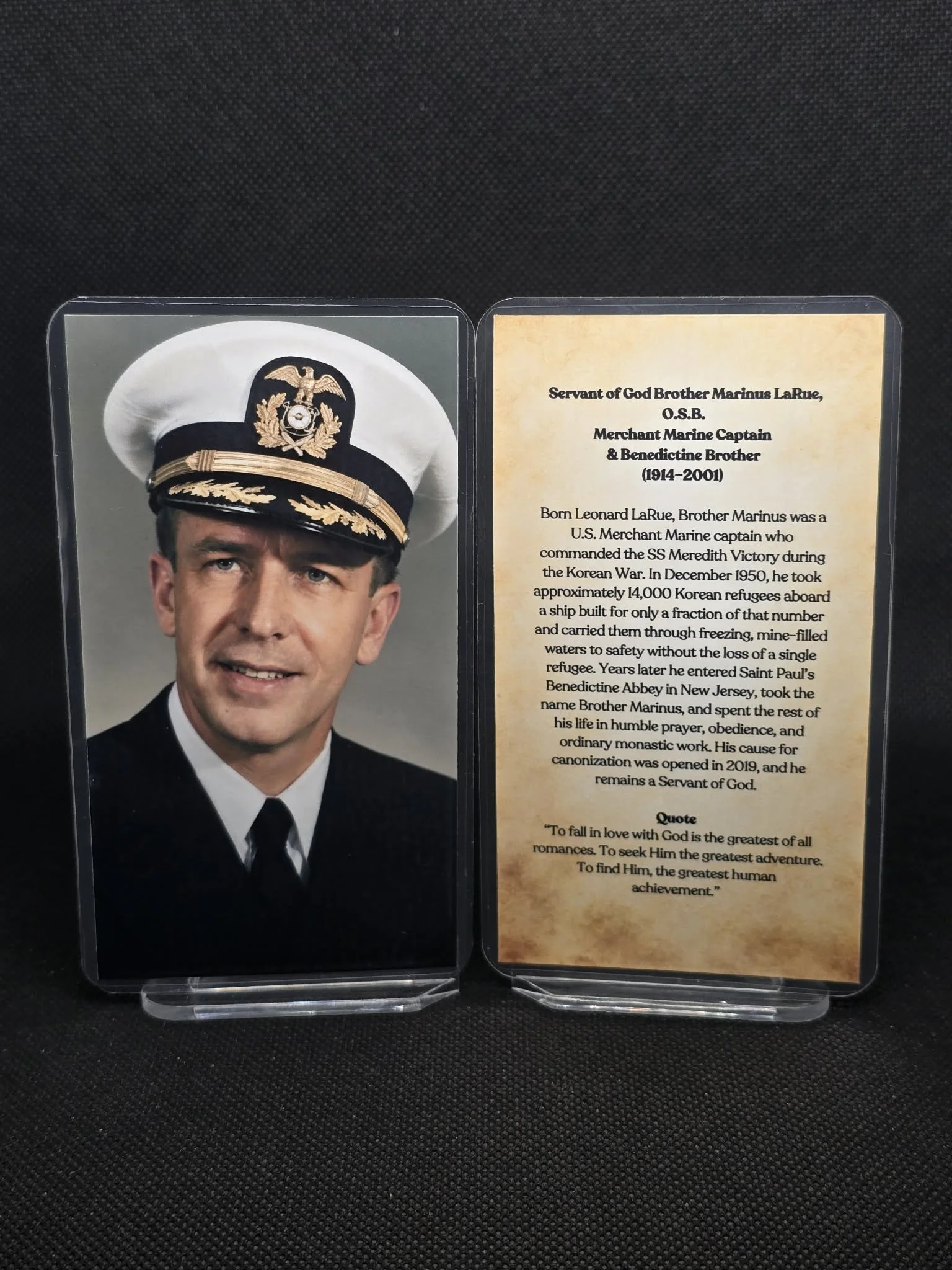
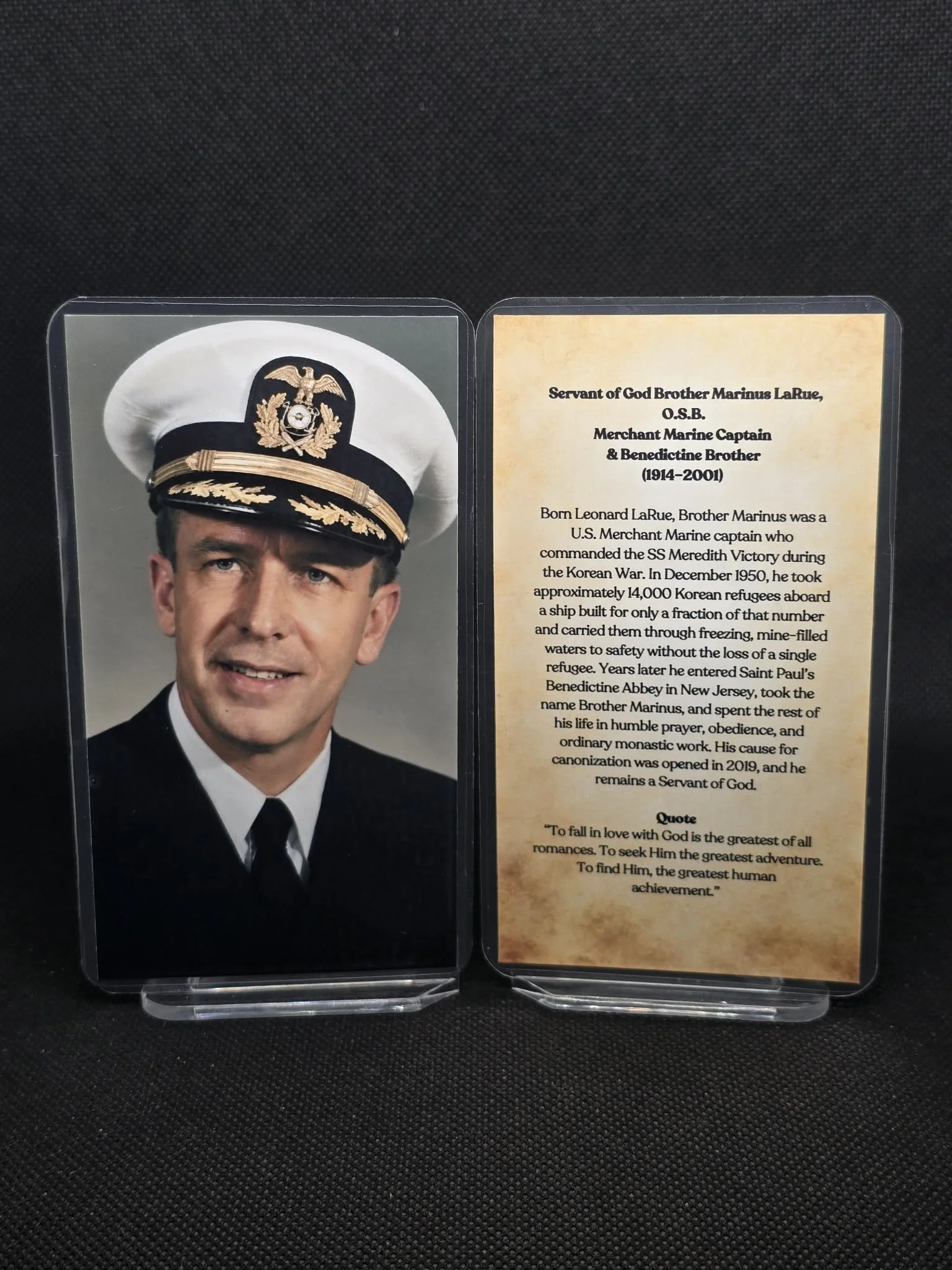
Servant of God Brother Marinus LaRue, O.S.B. Prayer Card | Merchant Marine Captain, Refugee Rescuer & Benedictine Monk
Servant of God Brother Marinus LaRue, O.S.B., born Leonard LaRue, was an American Merchant Marine captain, World War II mariner, Korean War humanitarian hero, and later a Benedictine religious brother whose life seems almost divided into two extraordinary chapters. As captain of the SS Meredith Victory during the Hungnam Evacuation of December 1950, he accepted thousands of desperate Korean civilians aboard a cargo ship designed to carry only twelve passengers, navigated them through dangerous waters, and brought them to freedom without the loss of a single refugee. Four years later, the celebrated sea captain left his maritime career behind and entered St. Paul’s Benedictine Abbey in Newton, New Jersey, where he spent the remainder of his life in prayer, obedience, manual work, Eucharistic devotion, and remarkable humility.
Brother Marinus is especially meaningful for Merchant Mariners, sailors, seafarers, ship captains and crews, refugees and displaced families, humanitarian workers, people responsible for others during emergencies, Benedictine monks and religious brothers, men discerning religious life later in adulthood, people changing vocations, and Christians trying to remain humble after professional success or public recognition. These are devotional associations grounded directly in his life rather than formal patronages assigned by the Church, because he has not yet been beatified or canonized.
His life is particularly powerful for anyone carrying responsibility for other people in a crisis. Captain LaRue did not know whether his ship could safely accommodate the enormous crowd at Hungnam, and he knew that enemy forces, mines, winter conditions, limited supplies, and the dangerous cargo aboard his vessel made the decision extraordinarily risky. Yet when confronted with civilians who had almost no other way to escape, he chose to take aboard as many people as the ship could possibly hold.
His story is equally meaningful for people who have achieved success yet sense that God may be calling them into something quieter, smaller, or less prestigious. Leonard LaRue had risen to command ocean-going ships and had become internationally associated with one of the great humanitarian rescues in maritime history, yet he eventually exchanged the captain’s bridge for Benedictine community life, where his duties included washing dishes, working in the monastery gift shop, and ringing the morning bell to awaken his brother monks for prayer.
The contrast between those two lives is one of the most remarkable parts of his cause. The same man who once commanded a ship carrying more than fourteen thousand human beings later willingly accepted jobs that attracted almost no attention at all, illustrating a distinctly Christian understanding of greatness in which saving lives and washing dishes can both become acts of obedience when they are performed according to the vocation God has given.
Brother Marinus was also intensely Eucharistic. In correspondence preserved and published by the United States bishops, he encouraged frequent Mass and Holy Communion and believed sacramental life transformed the Christian’s entire perspective. His later monastic life was therefore not an escape from the world but the fulfillment of a faith that had already accompanied him across oceans, through wartime danger, and onto the bridge of the Meredith Victory.
His cause for beatification and canonization was formally opened by Bishop Arthur Serratelli of the Diocese of Paterson on March 25, 2019, giving him the title Servant of God. In June 2021, the bishops of the United States overwhelmingly expressed support for advancement of his cause at the diocesan level, recognizing both the heroism of Captain LaRue and the simplicity and obedience of Brother Marinus as important elements of the life being investigated.
This prayer card is especially fitting for Merchant Mariners, active seafarers, Navy and Coast Guard families, maritime workers, refugees, people undertaking dangerous voyages, humanitarian volunteers, emergency leaders, Benedictines, religious brothers, men discerning monastic life, people beginning a second vocation later in life, and anyone asking God for courage to recognize Christ in a stranger who needs help. It can also make a meaningful gift before deployment or sailing, during vocational discernment, for someone working at sea, or for a person trying to understand how professional responsibility and Christian holiness can belong together.
Each card is handmade in Austin, TX and created to order. We do not keep stock, because every prayer card is treated as a unique devotional offering. They are printed on museum-quality photo paper, not cardstock, and every card is made slowly during prayer with intentional reverence for the Servant of God and for the person who will receive it. Names and intentions are brought before Christ throughout the process, asking God for mercy and asking for the intercession of Servant of God Brother Marinus for people at sea, displaced families, those facing dangerous decisions, and Christians seeking the courage to serve wherever God has placed them.
THE LIFE & STORY
Leonard LaRue was born on January 14, 1914, and was baptized at St. Joachim Church in Philadelphia, Pennsylvania. He later attended the Pennsylvania Nautical School, serving aboard the schoolship Annapolis, and graduated in 1934, beginning the professional maritime life that would occupy roughly two decades before his entrance into the monastery.
His formation as a professional mariner gave him something that would later prove essential during the Hungnam evacuation: the ability to make difficult decisions when hesitation could cost lives. By the time of the Korean War, LaRue was not simply an inexperienced sailor placed unexpectedly in command but an accomplished mariner who had spent years developing seamanship, leadership, judgment, and responsibility for ship and crew.
WORLD WAR II & THE MERCHANT MARINE
Long before the Korean War made his name famous, Leonard LaRue sailed with the American Merchant Marine during World War II. Accounts preserved by American Merchant Marine Veterans and contemporary Catholic reporting connect his wartime career with dangerous North Atlantic operations, including the Murmansk convoy routes that carried desperately needed supplies toward the Soviet Union through waters threatened by submarines, aircraft, severe storms, and Arctic conditions.
The United States Merchant Marine is sometimes misunderstood in stories about LaRue. He was not a U.S. Navy officer commanding a Navy warship; he was a professional American merchant mariner whose civilian maritime service supported national wartime operations, including the transport of military supplies. His story therefore occupies a distinctive place in American Catholic maritime history because his wartime and Korean War service belonged specifically to the Merchant Marine.
His wartime experience also helps explain the composure he demonstrated at Hungnam. By 1950 he had already spent years sailing in dangerous conditions and understood the realities of ship command, cargo, weather, enemy action, navigation, and the moral responsibility of a master for everyone entrusted to his vessel.
CAPTAIN OF THE SS MEREDITH VICTORY
During the Korean War, LaRue became master of the SS Meredith Victory, a Victory-class cargo vessel operated by Moore-McCormack Lines in support of the Military Sea Transportation Service. The ship had been built for cargo rather than mass passenger transportation and was designed to accommodate only twelve passengers in addition to its crew.
By late 1950 the military situation in northeastern Korea had become catastrophic. Chinese Communist forces had entered the war, United Nations forces were withdrawing toward the port of Hungnam, and huge numbers of Korean civilians who feared remaining behind gathered near the coast hoping to escape south.
The Meredith Victory arrived in the Hungnam area during this massive evacuation. What Captain LaRue saw was not an ordinary passenger-loading problem but thousands upon thousands of civilians, including families and children, caught between advancing enemy forces and the sea.
THE HUNGNAM EVACUATION
The Hungnam Evacuation was one of the enormous humanitarian undertakings of the Korean War. More than one hundred thousand military personnel and tens of thousands of civilians were being removed from northeastern Korea by sea while hostile forces closed around the port.
The Meredith Victory had come to Korea as a cargo ship carrying supplies. When the opportunity arose to help evacuate civilians, Captain LaRue agreed to take aboard as many people as his vessel could possibly hold.
Former shipboard staff officer Robert Lunney later remembered that when military officers asked whether the ship could participate, LaRue did not hold a lengthy conference before accepting. The surviving account describes a captain confronted with an urgent moral decision who answered that he would take the ship in and remove as many people as he could.
FOURTEEN THOUSAND PEOPLE ON A CARGO SHIP
The numbers remain astonishing. Approximately 14,000 Korean civilians boarded a vessel built with accommodations for only twelve passengers, filling cargo holds and virtually every available area of deck space. The U.S. Maritime Administration states that refugees were packed closely together in the holds and on deck, with some positioned even around the ship’s remaining cargo.
This is where two numbers commonly encountered in accounts of Brother Marinus can be reconciled. Approximately 14,000 refugees embarked at Hungnam, while five babies were born during the voyage, producing the traditional final figure of 14,005 people brought safely from the evacuation. The Diocese of Paterson regularly uses 14,005 when describing those ultimately rescued.
The ship did not suddenly become a properly equipped passenger liner simply because people were aboard. There was little food and water, no doctor, no interpreter when the voyage began, extremely limited sanitation, and no accommodations remotely appropriate for thousands of civilians in the middle of a freezing Korean winter.
A SHIP STILL CARRYING JET FUEL
The danger was greater than overcrowding alone. The Meredith Victory still carried hundreds of tons of aviation fuel, and refugees were packed into a ship traveling through a combat zone where enemy attack, fire, explosion, or collision with a mine could have produced unimaginable loss of life. Historical accounts describe some refugees positioned above drums of aviation fuel because every usable space had been taken.
Captain LaRue therefore faced an extraordinary tension between conventional maritime prudence and the desperate humanitarian necessity before him. What made the rescue heroic was not that danger had somehow disappeared but that the captain and crew accepted enormous responsibility while doing everything within their professional ability to bring the refugees to safety.
THROUGH MINE-INFESTED WATERS
The Meredith Victory departed Hungnam on December 23, 1950 and moved south through dangerous Korean waters without the kind of protection one would wish for a vessel carrying such an extraordinary human cargo. The Maritime Administration’s Gallant Ship citation specifically remembers the threat of artillery and air attack and the ship’s navigation through enemy minefields.
The refugees endured the voyage packed into dark cargo spaces and exposed decks during winter. Captain and crew simultaneously had to navigate the vessel, maintain order, protect the ship, and respond to thousands of people for whom the Meredith Victory had suddenly become their only home.
For seafarers and captains, this portion of LaRue’s life makes his story particularly powerful. Command sometimes requires a person to make a decision with incomplete information, accept responsibility for consequences, and then remain calm enough to lead everyone else through the danger that follows.
FIVE BABIES & NOT ONE REFUGEE LOST
Against extraordinary odds, not one refugee died during the voyage. Instead of arriving with fewer people than had boarded, the Meredith Victory arrived with more because five babies were born at sea.
The contrast is almost impossible to invent more dramatically: thousands of displaced people escaping a war zone aboard an overcrowded cargo ship, little food or water, freezing weather, mine-infested waters, no doctor at the beginning of the journey, and yet life was added rather than lost.
This extraordinary outcome became one reason the vessel acquired the enduring nickname “Ship of Miracles.” The U.S. Maritime Administration continues to describe the evacuation as a record-setting single-ship evacuation and one of the greatest marine rescues in history.
CHRISTMAS EVE AT PUSAN
The ship reached Pusan on Christmas Eve, but the port was already overwhelmed by the enormous number of military personnel and refugees arriving from the north. The Meredith Victory was not able simply to unload all fourteen thousand people there.
The vessel was permitted to transfer wounded people and obtain interpreters along with a limited amount of food and water. It was then redirected toward Koje-Do, now commonly rendered Geoje Island, where sufficient space could finally be found for the refugees.
LaRue later connected this moment with the first Christmas, remembering the painful similarity between arriving on Christmas Eve and discovering that there was effectively no room for the people aboard his ship. That Christian interpretation became part of the way he later understood the entire voyage.
CHRISTMAS DAY 1950
On Christmas Day, December 25, 1950, the refugees of the Meredith Victory finally disembarked on Geoje Island. Families who only days earlier had faced entrapment in northern Korea had reached safety in the south, while five newborn infants began life as part of a community of displaced people whose descendants would eventually number far beyond those who stood on the ship that Christmas morning.
Captain LaRue later reflected on the voyage in explicitly religious terms. After considering how so small a vessel could survive so many dangers without losing a single refugee, he concluded simply that “God’s own hand was at the helm of my ship.”
The words capture LaRue's own understanding of the rescue. Rather than treating the successful voyage as proof of his personal greatness, he interpreted the extraordinary outcome as an encounter between human responsibility and divine Providence.
THE FAMILY OF A FUTURE PRESIDENT
Among the refugees aboard the Meredith Victory were Moon Yong-hyung and Kang Han-ok, the parents of future South Korean president Moon Jae-in. President Moon publicly spoke about his family’s connection with the evacuation during an official visit to the United States, explaining that without the Hungnam evacuation his own life would not have unfolded as it did.
Moon was born on Geoje Island in 1953, the same island where the Meredith Victory refugees had been landed little more than two years earlier. His family’s story provides a remarkable example of how the captain’s decision continued affecting history decades after the refugees stepped ashore.
The point is larger than one future president. Every person aboard carried into freedom the possibility of marriages, children, grandchildren, careers, vocations, and generations that would never have existed in the same way had those lives been lost at Hungnam.
THE “SHIP OF MIRACLES”
The extraordinary success of the rescue caused the Meredith Victory to become widely known as the Ship of Miracles. The title did not originate merely as later devotional marketing because the remarkable absence of casualties became part of the ship’s official historical reputation.
The United States government subsequently recognized the vessel with the Gallant Ship Award, praising the courage, seamanship, resourcefulness, and teamwork of Captain LaRue, his officers, and crew. Its official citation describes their accomplishment as one of the great marine rescues in history.
For Brother Marinus himself, however, the most important explanation was not personal brilliance. His later reflection moved the glory away from the captain and toward Providence, interpreting the Christmas rescue through his conviction that God had guided them.
THE RESCUE CHANGED THE CAPTAIN
The Hungnam voyage did not create Leonard LaRue’s Catholic faith from nothing. He had been religious before 1950, prayed during his maritime career, and had encountered Benedictines during his travels, but the rescue became a profound turning point in the way he understood his life and vocation.
He had just experienced something few ship captains in history ever could: responsibility for more than fourteen thousand people crowded onto a vessel in wartime, followed by their safe arrival without a single death. Instead of interpreting this as proof of his own greatness, LaRue increasingly understood it as evidence that God had acted through circumstances far beyond his own power.
His response was eventually radical. He did not seek to build a public career around being the captain of the Ship of Miracles but began moving toward a hidden religious vocation.
FROM CAPTAIN TO BENEDICTINE
In 1954, Leonard LaRue left his maritime career and entered St. Paul’s Benedictine Abbey in Newton, New Jersey. The captain who had commanded ships and crews entered a monastery where authority would no longer belong primarily to him and where Benedictine obedience would require accepting the ordinary work assigned by his religious superiors.
He eventually received the name Brother Marinus. Although the name seems almost perfectly chosen for a man who had spent his life at sea, the sources connected with his cause emphasize that he chose it in honor of the Blessed Virgin Mary, not simply as a reference to his maritime career.
This distinction makes his religious name even more meaningful. The man associated with one of history’s most extraordinary voyages took a name that reminded him not principally of his own maritime accomplishments but of the Mother of Christ.
HE BECAME A BROTHER, NOT A PRIEST
Brother Marinus did not become a Catholic priest. He embraced the Benedictine vocation as a religious brother, living monastic vows and participating fully in Benedictine prayer and community without seeking priestly ordination.
This is particularly significant for Catholic men discerning religious life who may feel called to consecrated life but not to priesthood. Brother Marinus demonstrates that the vocation of a religious brother possesses its own integrity and can become the path through which an accomplished adult gives the remainder of his life completely to God.
He had already held extraordinary authority in the world. The monastery gave him the opportunity to discover another kind of greatness through obedience, silence, community, prayer, and service without rank.
HIS MONASTIC VOWS
Brother Marinus entered St. Paul’s in 1954 and advanced through Benedictine formation before making his first profession on Christmas Day 1956. Three years later he made his perpetual commitment at Christmas, completing the transformation from Captain Leonard LaRue into a man who would spend the rest of his earthly life within the monastery.
The repeated connection with Christmas is remarkable. Christmas 1950 had brought the extraordinary deliverance of the refugees aboard his ship; Christmas later became associated with his formal commitments to the Benedictine life.
These events form a beautiful historical pattern within his biography without requiring them to be interpreted as a separate supernatural sign. The season in which his maritime life reached its most famous moment also became the season in which his monastic vocation was solemnly established.
THE CAPTAIN WHO WASHED DISHES
Perhaps nothing explains Brother Marinus more clearly than what happened after he entered the monastery. The former captain performed ordinary community duties including washing dishes, working in the gift shop, and ringing the abbey bell each morning to wake the monks for prayer.
These were not temporary humiliations before he received a more prestigious position. They were ordinary expressions of Benedictine life, and he performed them for decades.
The image of Captain LaRue washing monastery dishes is therefore central to his spiritual appeal. Christian humility did not require pretending that his rescue had never happened; it required understanding that commanding a ship during an historic crisis did not make him too important to wash someone else’s plate.
RINGING THE MORNING BELL
Brother Marinus became particularly associated with the morning bell at St. Paul’s Abbey. He arose early and walked through the monastery ringing the bell that called his brothers from sleep toward the first prayers of the day.
There is something beautifully appropriate about that task. As a captain, LaRue had once been responsible for keeping a ship and its people on course; as Brother Marinus, he helped keep the monastery’s daily rhythm moving toward God.
The work was small enough to be overlooked and important enough that everyone depended upon someone doing it faithfully. That is precisely the kind of hidden obedience for which Benedictine spirituality has always made room.
HUMILITY AFTER HEROISM
Brother Marinus was famously reluctant to make himself the center of the Hungnam story. Some monks who lived with him for years knew surprisingly little about what the quiet brother washing dishes had accomplished before entering the abbey.
He did not deny the history when there was a good reason to speak about it, and later in life he accepted some publicity connected with the voyage. His correspondence indicates, however, that he saw such attention primarily as an opportunity to encourage religious vocations rather than as a way of promoting himself.
This gives Brother Marinus a powerful connection with anyone struggling with pride after success. Humility does not require denying genuine accomplishments; it means recognizing that gifts, opportunities, authority, and even heroic actions ultimately belong within a life directed toward God.
THE EUCHARIST
Brother Marinus spoke with unusual directness about the importance of Mass and Holy Communion. In correspondence with his former shipmate Robert Lunney, he urged Catholics toward frequent participation in the Eucharist and described sacramental life as necessary for growth in virtue and transformation in Christ.
This is important because the most spectacular element of his biography can easily overshadow the spiritual life that followed it. Brother Marinus did not spend nearly half a century searching for another Ship of Miracles; he spent it within the repetitive sacramental and liturgical rhythm of Benedictine life.
For someone attracted to extraordinary miracles, his biography therefore gives a useful Catholic correction. An exceptional rescue may happen once, but Mass, Holy Communion, prayer, obedience, and ordinary acts of charity are the places in which a Christian is asked to remain faithful day after day.
VOCATIONS & THE SECOND HALF OF LIFE
Leonard LaRue was approximately forty years old when he entered St. Paul’s Abbey. His story therefore gives particular encouragement to people who discover or seriously pursue a religious vocation later than the age usually imagined in vocation stories.
He had already possessed a career, professional identity, reputation, and decades of adult experience. Entering a monastery meant giving up not only future possibilities but a well-established identity as Captain LaRue.
His story provides a powerful reminder that discernment does not necessarily end when someone leaves school or reaches adulthood. God’s call can require a genuine second chapter, and sometimes the experience accumulated during the first chapter prepares a person for the surrender required in the next.
PRAYER & WORK
Brother Marinus lived within the Benedictine rhythm traditionally summarized as prayer and work. The heroic captain of 1950 became a monk whose holiness was investigated not merely because of what happened at sea but because his decades of monastic life were remembered for simplicity, prayer, obedience, and service.
That point matters greatly for his canonization cause. Saving thousands of lives is heroic in a human sense, but Catholic sainthood is not awarded as a military or humanitarian decoration; the Church investigates whether the person lived Christian holiness and virtue.
The cause therefore considers both sides of his life together. Captain LaRue reveals courage and charity in a moment of crisis, while Brother Marinus reveals whether the same man could live charity when there was no crisis, no worldwide attention, and no applause.
REFUGEES & RECOGNIZING CHRIST IN THE STRANGER
Brother Marinus has an especially strong connection with refugees and people displaced by war because his defining maritime action was the rescue of civilians fleeing an advancing army. The official prayer for his cause explicitly interprets Captain LaRue’s decision as recognizing Jesus Christ in the faces of Korean refugees.
That language gives his story a deeply Christian meaning beyond the history of the Korean War. The people standing at Hungnam did not belong to Captain LaRue’s family, nation, language, or ethnic community, yet their vulnerability created a moral claim upon his compassion.
His life can therefore accompany prayer for refugees today without turning devotion into a political argument. The central Christian question raised by his biography is much older and simpler: what does love require when a stranger’s life has suddenly been placed within our ability to help?
SEAFARERS & PEOPLE OF THE SEA
The cause of Brother Marinus has been strongly supported by the Apostleship of the Sea of the United States, reflecting the obvious connection between his life and Catholics who work upon the sea. The organization helped initiate and promote his cause and continues to publish the approved prayer asking for his intercession and advancement toward sainthood.
Merchant Mariners, commercial sailors, ship officers, port workers, maritime chaplains, fishermen, and families waiting for loved ones to return from sea can therefore find his story especially meaningful. He understood long absences, dangerous weather, wartime navigation, responsibility for a crew, and the strange mixture of beauty and danger belonging to life at sea.
His life also gives maritime Catholics an unusually direct example of a professional seafarer whose career itself became part of his path toward religious vocation.
LEADERSHIP IN A CRISIS
Captain LaRue’s decision at Hungnam provides an extraordinary study in Christian leadership. He possessed authority over the vessel and therefore could not simply follow emotion without considering the dangers to his existing crew, cargo, and ship, yet excessive caution could also have meant leaving thousands of civilians behind.
His response combined compassion with professional competence. The refugees were not saved merely because he wanted to help them; they were saved because a trained captain and experienced crew transformed that intention into an enormous and successful maritime operation.
This makes Brother Marinus especially fitting for people responsible for others: captains, supervisors, military leaders, emergency managers, physicians, parents, clergy, and anyone who must make consequential decisions while other people are afraid.
COURAGE WITHOUT SEEKING GLORY
The Meredith Victory rescue could have become the foundation for the remainder of LaRue’s public life. Instead, within a few years he surrendered the sea and entered a monastery.
That decision gives his heroism a distinctive spiritual character. The same man capable of acting decisively when thousands depended upon him was also capable of stepping away from recognition when he believed God wanted something else.
Brother Marinus therefore teaches that courage is not always movement toward public greatness. Sometimes courage means accepting obscurity after success.
HIS FINAL YEARS
Brother Marinus remained at St. Paul’s Abbey for the rest of his life. In his later years he experienced declining mobility and dementia, adding dependence and physical limitation to a life that had once been characterized by commanding a vessel across oceans.
This final period gives another dimension to his spirituality. The captain who once carried thousands had eventually to accept being cared for by others, while the monk who had spent years serving his community increasingly entered the vulnerability of old age.
Christian dignity did not disappear when professional ability, strength, or memory declined. His final years therefore offer a quieter witness for families caring for aging loved ones and religious communities accompanying elderly members through frailty.
DEATH
Brother Marinus died on October 14, 2001, at St. Paul’s Abbey at the age of eighty-seven. His funeral was celebrated at the abbey, and he was buried in Christ the King Cemetery at St. Paul’s Abbey.
Even his funeral reflected the humility with which he had lived. Contemporary reporting noted that his funeral holy card identified him simply as a monk of St. Paul’s Abbey rather than turning the dramatic Hungnam rescue into the centerpiece of his identity.
His grave now connects two worlds that seemed so different during his earthly life: the celebrated captain whose ship carried thousands to freedom and the quiet Benedictine brother who chose to die as a monk.
THE CAUSE FOR CANONIZATION
Bishop Arthur Serratelli of the Diocese of Paterson formally opened the cause for Brother Marinus on March 25, 2019, the Solemnity of the Annunciation. From that point he received the official ecclesiastical title Servant of God Brother Marinus LaRue, O.S.B.
The diocesan investigation was established to examine his life, heroic virtue, reputation for holiness, writings, and testimony from people who knew him. Importantly, his cause does not rest only upon the extraordinary rescue but also upon the nearly half century he spent as a Benedictine monk.
In June 2021, the bishops of the United States held the customary canonical consultation concerning the cause. The USCCB reported support for its advancement, while the Diocese of Paterson reported that approximately 99 percent of the bishops participating voted in favor.
As of September 2026, official organizations promoting his cause continue to identify him as Servant of God. He has not yet received the titles Venerable, Blessed, or Saint, and his proper current ecclesiastical title remains Servant of God Brother Marinus LaRue, O.S.B.
WHAT “SERVANT OF GOD” MEANS
The title Servant of God means that the Catholic Church has formally opened a person's cause for beatification and canonization. It does not itself constitute a declaration that every claim surrounding the person has been proven or that the candidate may already be publicly honored as a canonized saint.
Catholics may nevertheless privately ask God for favors through the intercession of a Servant of God and pray for advancement of the cause. In Brother Marinus’s case, the Diocese of Paterson and organizations promoting the cause explicitly encourage the faithful to use the approved prayer and report favors believed to have been received through his intercession.
At the present stage of his cause, his proper ecclesiastical title is Servant of God Brother Marinus LaRue, O.S.B.
DOES BROTHER MARINUS HAVE A FEAST DAY?
Brother Marinus does not currently have an official Catholic feast day because he has not yet been beatified or canonized. October 14, the anniversary of his death, can naturally serve as a date for private remembrance and prayer for his cause, but it is not presently an official liturgical feast.
December 25 also has an extraordinary historical connection with his life because the refugees disembarked safely on Christmas Day 1950 and important stages of his Benedictine profession were likewise associated with Christmas. These connections make Christmas especially meaningful when remembering his story, but they do not create an ecclesiastically assigned feast day.
VERIFIED QUOTE
Brother Marinus reflected upon the survival of the Meredith Victory and the thousands entrusted to him by giving the credit ultimately to God. His short conclusion captures his understanding of the extraordinary rescue:
“God’s own hand was at the helm of my ship.”
The quote is especially meaningful for sailors and for anyone confronting circumstances that exceed their own ability to control. It does not suggest abandoning competent leadership or responsibility, because Captain LaRue exercised both; rather, it expresses his conviction that human effort and divine Providence had met during that extraordinary Christmas voyage.
THE OFFICIAL PRAYER FOR HIS CAUSE
The Apostleship of the Sea of the United States publishes an official Prayer for the Cause of Captain LaRue/Brother Marinus, O.S.B. The prayer asks God, described as Creator of the seas and protector of refugees, that Brother Marinus’s life inspire care for seafarers, welcome for people displaced by war, deeper prayer, and service, while also asking that God glorify His servant according to the divine will.
The prayer received a Nihil Obstat and Imprimatur from the Diocese of Paterson on August 1, 2017, before the formal opening of the cause in 2019. A later approved version also provides a place for the faithful to present a particular favor through Brother Marinus’s intercession.
Because it comes directly from organizations promoting his cause and carries ecclesiastical approval, the prayer provides Catholics with an established way to pray for Brother Marinus’s cause and to seek his intercession.
FAQ
Who was Servant of God Brother Marinus LaRue? Brother Marinus was formerly Captain Leonard LaRue, an American Merchant Marine captain who commanded the SS Meredith Victory during the Korean War. After helping rescue approximately 14,000 Korean refugees in December 1950, he eventually left the sea and became a Benedictine religious brother at St. Paul’s Abbey in New Jersey.
Was Brother Marinus his birth name? No, he was born Leonard LaRue and received the religious name Marinus after entering Benedictine life. Sources connected with his cause emphasize that he chose the name in honor of the Blessed Virgin Mary.
Was Brother Marinus a priest? No, he was a professed Benedictine religious brother, not a priest. He deliberately lived the vocation of a monk and brother through prayer, community life, obedience, and ordinary service at St. Paul’s Abbey.
Was Leonard LaRue in the U.S. Navy? No, he was a professional member of the United States Merchant Marine. His ships supported American wartime operations, but the Meredith Victory was a Merchant Marine cargo vessel rather than a commissioned Navy warship.
Did Leonard LaRue serve during World War II? Yes, he sailed in the U.S. Merchant Marine during World War II and experienced dangerous wartime maritime service before the Korean War. Accounts of his career include North Atlantic and Murmansk convoy operations.
What was the SS Meredith Victory? The Meredith Victory was a Victory-type cargo ship built during World War II and later activated to transport military cargo during the Korean War. In December 1950, under Captain LaRue, it became the vessel associated with the extraordinary refugee rescue at Hungnam.
How many refugees did Captain LaRue rescue? Approximately 14,000 refugees boarded at Hungnam, and five babies were born during the voyage. This is why Catholic sources connected with his cause commonly refer to 14,005 people ultimately brought to safety.
Was the ship really designed for only twelve passengers? Yes, the U.S. Maritime Administration states that the ship's normal accommodations included only twelve passengers in addition to its crew. More than fourteen thousand civilians were nevertheless packed into its cargo holds and across available deck space during the emergency evacuation.
Did anyone die aboard the Meredith Victory during the evacuation? No refugee died during the journey. Even more remarkably, five babies were born, so the vessel finished the rescue with more refugee passengers than had originally boarded.
Why is the Meredith Victory called the Ship of Miracles? The nickname arose from the extraordinary outcome of the voyage: more than fourteen thousand civilians survived an overcrowded wartime escape through dangerous waters without a single casualty. Five children were also born during the voyage.
Was there a doctor aboard? The official Gallant Ship history states that the vessel undertook the voyage with little food and water and without a doctor or interpreter at the beginning of the journey. These conditions make the absence of fatalities even more extraordinary.
Did the ship travel through minefields? Yes, the official U.S. Maritime Administration citation specifically notes that the Meredith Victory navigated through enemy minefields while the danger of attack remained present.
Was there dangerous fuel aboard the ship? Yes, historical accounts record that aviation fuel remained aboard during the evacuation. This increased the potential consequences of enemy attack, fire, or another maritime disaster.
When did the Meredith Victory leave Hungnam? The ship departed with the refugees on December 23, 1950. It reached Pusan on Christmas Eve and continued to Geoje Island, where the refugees disembarked on Christmas Day.
Where did the refugees finally reach safety? They disembarked at Geoje Island in South Korea on December 25, 1950. The island became home to many displaced people who had escaped northern Korea during the Hungnam evacuation.
Were the parents of a South Korean president aboard? Yes, the parents of future South Korean President Moon Jae-in were among the refugees evacuated from Hungnam. President Moon later publicly acknowledged that his family's survival was connected directly with the evacuation.
Did Captain LaRue consider the rescue a miracle? His surviving reflections certainly show that he interpreted the successful voyage in strongly providential terms. His most memorable conclusion was, “God’s own hand was at the helm of my ship.”
When did Leonard LaRue become a monk? He entered St. Paul’s Benedictine Abbey in 1954, several years after the Hungnam rescue. He later made monastic profession and remained at the abbey for the rest of his life.
Why did he take the name Marinus? Although the name seems appropriate for a lifelong seafarer, Brother Marinus himself and sources connected with his cause identify the Blessed Virgin Mary as the reason for his religious name.
What work did Brother Marinus do in the monastery? His duties included washing dishes, working in the monastery gift shop, and ringing the morning bell to wake the monks for prayer. The striking simplicity of these jobs after his career as a celebrated captain is one of the strongest examples of his humility.
Was Brother Marinus devoted to the Eucharist? Yes, strongly. His correspondence encouraged frequent Mass and Holy Communion and emphasized the transforming effect of sacramental life upon Christian virtue.
Is Brother Marinus a saint? Not yet. His correct title as of September 2026 is Servant of God Brother Marinus LaRue, O.S.B., meaning his formal cause for beatification and canonization has been opened but he has not yet been declared Venerable, Blessed, or Saint.
When was Brother Marinus declared a Servant of God? His cause was formally opened by Bishop Arthur Serratelli on March 25, 2019. Opening the cause gave him the title Servant of God.
Did the U.S. bishops support his cause? Yes, the U.S. bishops held the required canonical consultation in June 2021 and expressed support for advancement of his cause at the diocesan level. The Diocese of Paterson reported approximately 99 percent support among the participating bishops.
Does Brother Marinus have an official feast day? No, because he has not yet been beatified or canonized. October 14 is the anniversary of his death and is appropriate for private remembrance, but it is not currently an official Catholic feast day.
Where did Brother Marinus die? He died at St. Paul’s Abbey in Newton, New Jersey, on October 14, 2001, at the age of eighty-seven. He had spent nearly half a century there as a Benedictine monk.
Where is Brother Marinus buried? He was buried in Christ the King Cemetery at St. Paul’s Abbey following his funeral Mass at the monastery. His grave remains closely associated with his life and cause.
Can Merchant Mariners pray through Brother Marinus’s intercession? Yes, private prayer asking for the intercession of a Servant of God is permitted, and his cause has a particularly strong connection with the Apostleship of the Sea. His professional life makes him an especially meaningful figure for Merchant Mariners, ship crews, captains, and other people of the sea.
Can refugees pray through Brother Marinus’s intercession? Yes, refugees are one of the most natural groups to find spiritual meaning in his life because the defining event of his career was his decision to rescue civilians fleeing war. The official cause prayer itself explicitly remembers refugees and asks Christians to continue caring for people displaced by conflict.
Can people pray through Brother Marinus’s intercession for safe travel at sea? Yes, that is a natural private intention given his maritime life, although he has not been formally declared a patron saint of safe sea travel. His experience makes his intercession particularly meaningful to seafarers.
Can someone discerning religious life pray through Brother Marinus’s intercession? Yes, especially someone discerning a vocation after already establishing an adult career. Leonard LaRue left a successful maritime profession around age forty and entered a Benedictine monastery, making his biography unusually encouraging for later vocations.
Can religious brothers pray through Brother Marinus’s intercession? Yes, because he was himself a religious brother rather than a priest. His life gives powerful witness to the dignity of the brother’s vocation through prayer, community, manual work, obedience, and Eucharistic devotion.
Is there an approved prayer for Brother Marinus’s cause? Yes. The Apostleship of the Sea publishes the official Prayer for the Cause of Captain LaRue/Brother Marinus, and the original prayer received a Nihil Obstat and Imprimatur from the Diocese of Paterson on August 1, 2017.
Can I report a favor received through Brother Marinus’s intercession? Yes, and those promoting his cause specifically encourage the faithful to report favors believed to have been received through his intercession. Such reports help establish an ongoing reputation for intercessory prayer as the cause develops.
Is Brother Marinus officially the patron saint of Merchant Mariners or refugees? No. Because he is still a Servant of God, the Church has not assigned him an official universal patronage. His life nevertheless has especially strong devotional connections with Merchant Mariners, seafarers, refugees, humanitarian rescue, Benedictine religious brothers, vocational discernment, and leadership in dangerous circumstances.
What makes Brother Marinus’s life unusual among Catholic sainthood causes? His biography joins two dramatically different forms of service. Captain Leonard LaRue became famous through an enormous humanitarian rescue, while Brother Marinus spent nearly fifty years becoming known for hidden prayer, obedience, and small acts of service inside a monastery.
What is the main message of Servant of God Brother Marinus LaRue’s life? His life shows that Christian holiness may require both extraordinary courage and extraordinary humility. Leonard LaRue was willing to accept responsibility for thousands of strangers when their lives depended upon his decision, yet after becoming famous he was also willing to surrender rank, career, and recognition to become a Benedictine brother who washed dishes and rang a bell for morning prayer. The captain who once guided the Ship of Miracles eventually wanted people to understand that the deepest explanation of his life was not his own heroism, but the God whom he believed had been guiding him all along.
Servant of God Brother Marinus LaRue, O.S.B., born Leonard LaRue, was an American Merchant Marine captain, World War II mariner, Korean War humanitarian hero, and later a Benedictine religious brother whose life seems almost divided into two extraordinary chapters. As captain of the SS Meredith Victory during the Hungnam Evacuation of December 1950, he accepted thousands of desperate Korean civilians aboard a cargo ship designed to carry only twelve passengers, navigated them through dangerous waters, and brought them to freedom without the loss of a single refugee. Four years later, the celebrated sea captain left his maritime career behind and entered St. Paul’s Benedictine Abbey in Newton, New Jersey, where he spent the remainder of his life in prayer, obedience, manual work, Eucharistic devotion, and remarkable humility.
Brother Marinus is especially meaningful for Merchant Mariners, sailors, seafarers, ship captains and crews, refugees and displaced families, humanitarian workers, people responsible for others during emergencies, Benedictine monks and religious brothers, men discerning religious life later in adulthood, people changing vocations, and Christians trying to remain humble after professional success or public recognition. These are devotional associations grounded directly in his life rather than formal patronages assigned by the Church, because he has not yet been beatified or canonized.
His life is particularly powerful for anyone carrying responsibility for other people in a crisis. Captain LaRue did not know whether his ship could safely accommodate the enormous crowd at Hungnam, and he knew that enemy forces, mines, winter conditions, limited supplies, and the dangerous cargo aboard his vessel made the decision extraordinarily risky. Yet when confronted with civilians who had almost no other way to escape, he chose to take aboard as many people as the ship could possibly hold.
His story is equally meaningful for people who have achieved success yet sense that God may be calling them into something quieter, smaller, or less prestigious. Leonard LaRue had risen to command ocean-going ships and had become internationally associated with one of the great humanitarian rescues in maritime history, yet he eventually exchanged the captain’s bridge for Benedictine community life, where his duties included washing dishes, working in the monastery gift shop, and ringing the morning bell to awaken his brother monks for prayer.
The contrast between those two lives is one of the most remarkable parts of his cause. The same man who once commanded a ship carrying more than fourteen thousand human beings later willingly accepted jobs that attracted almost no attention at all, illustrating a distinctly Christian understanding of greatness in which saving lives and washing dishes can both become acts of obedience when they are performed according to the vocation God has given.
Brother Marinus was also intensely Eucharistic. In correspondence preserved and published by the United States bishops, he encouraged frequent Mass and Holy Communion and believed sacramental life transformed the Christian’s entire perspective. His later monastic life was therefore not an escape from the world but the fulfillment of a faith that had already accompanied him across oceans, through wartime danger, and onto the bridge of the Meredith Victory.
His cause for beatification and canonization was formally opened by Bishop Arthur Serratelli of the Diocese of Paterson on March 25, 2019, giving him the title Servant of God. In June 2021, the bishops of the United States overwhelmingly expressed support for advancement of his cause at the diocesan level, recognizing both the heroism of Captain LaRue and the simplicity and obedience of Brother Marinus as important elements of the life being investigated.
This prayer card is especially fitting for Merchant Mariners, active seafarers, Navy and Coast Guard families, maritime workers, refugees, people undertaking dangerous voyages, humanitarian volunteers, emergency leaders, Benedictines, religious brothers, men discerning monastic life, people beginning a second vocation later in life, and anyone asking God for courage to recognize Christ in a stranger who needs help. It can also make a meaningful gift before deployment or sailing, during vocational discernment, for someone working at sea, or for a person trying to understand how professional responsibility and Christian holiness can belong together.
Each card is handmade in Austin, TX and created to order. We do not keep stock, because every prayer card is treated as a unique devotional offering. They are printed on museum-quality photo paper, not cardstock, and every card is made slowly during prayer with intentional reverence for the Servant of God and for the person who will receive it. Names and intentions are brought before Christ throughout the process, asking God for mercy and asking for the intercession of Servant of God Brother Marinus for people at sea, displaced families, those facing dangerous decisions, and Christians seeking the courage to serve wherever God has placed them.
THE LIFE & STORY
Leonard LaRue was born on January 14, 1914, and was baptized at St. Joachim Church in Philadelphia, Pennsylvania. He later attended the Pennsylvania Nautical School, serving aboard the schoolship Annapolis, and graduated in 1934, beginning the professional maritime life that would occupy roughly two decades before his entrance into the monastery.
His formation as a professional mariner gave him something that would later prove essential during the Hungnam evacuation: the ability to make difficult decisions when hesitation could cost lives. By the time of the Korean War, LaRue was not simply an inexperienced sailor placed unexpectedly in command but an accomplished mariner who had spent years developing seamanship, leadership, judgment, and responsibility for ship and crew.
WORLD WAR II & THE MERCHANT MARINE
Long before the Korean War made his name famous, Leonard LaRue sailed with the American Merchant Marine during World War II. Accounts preserved by American Merchant Marine Veterans and contemporary Catholic reporting connect his wartime career with dangerous North Atlantic operations, including the Murmansk convoy routes that carried desperately needed supplies toward the Soviet Union through waters threatened by submarines, aircraft, severe storms, and Arctic conditions.
The United States Merchant Marine is sometimes misunderstood in stories about LaRue. He was not a U.S. Navy officer commanding a Navy warship; he was a professional American merchant mariner whose civilian maritime service supported national wartime operations, including the transport of military supplies. His story therefore occupies a distinctive place in American Catholic maritime history because his wartime and Korean War service belonged specifically to the Merchant Marine.
His wartime experience also helps explain the composure he demonstrated at Hungnam. By 1950 he had already spent years sailing in dangerous conditions and understood the realities of ship command, cargo, weather, enemy action, navigation, and the moral responsibility of a master for everyone entrusted to his vessel.
CAPTAIN OF THE SS MEREDITH VICTORY
During the Korean War, LaRue became master of the SS Meredith Victory, a Victory-class cargo vessel operated by Moore-McCormack Lines in support of the Military Sea Transportation Service. The ship had been built for cargo rather than mass passenger transportation and was designed to accommodate only twelve passengers in addition to its crew.
By late 1950 the military situation in northeastern Korea had become catastrophic. Chinese Communist forces had entered the war, United Nations forces were withdrawing toward the port of Hungnam, and huge numbers of Korean civilians who feared remaining behind gathered near the coast hoping to escape south.
The Meredith Victory arrived in the Hungnam area during this massive evacuation. What Captain LaRue saw was not an ordinary passenger-loading problem but thousands upon thousands of civilians, including families and children, caught between advancing enemy forces and the sea.
THE HUNGNAM EVACUATION
The Hungnam Evacuation was one of the enormous humanitarian undertakings of the Korean War. More than one hundred thousand military personnel and tens of thousands of civilians were being removed from northeastern Korea by sea while hostile forces closed around the port.
The Meredith Victory had come to Korea as a cargo ship carrying supplies. When the opportunity arose to help evacuate civilians, Captain LaRue agreed to take aboard as many people as his vessel could possibly hold.
Former shipboard staff officer Robert Lunney later remembered that when military officers asked whether the ship could participate, LaRue did not hold a lengthy conference before accepting. The surviving account describes a captain confronted with an urgent moral decision who answered that he would take the ship in and remove as many people as he could.
FOURTEEN THOUSAND PEOPLE ON A CARGO SHIP
The numbers remain astonishing. Approximately 14,000 Korean civilians boarded a vessel built with accommodations for only twelve passengers, filling cargo holds and virtually every available area of deck space. The U.S. Maritime Administration states that refugees were packed closely together in the holds and on deck, with some positioned even around the ship’s remaining cargo.
This is where two numbers commonly encountered in accounts of Brother Marinus can be reconciled. Approximately 14,000 refugees embarked at Hungnam, while five babies were born during the voyage, producing the traditional final figure of 14,005 people brought safely from the evacuation. The Diocese of Paterson regularly uses 14,005 when describing those ultimately rescued.
The ship did not suddenly become a properly equipped passenger liner simply because people were aboard. There was little food and water, no doctor, no interpreter when the voyage began, extremely limited sanitation, and no accommodations remotely appropriate for thousands of civilians in the middle of a freezing Korean winter.
A SHIP STILL CARRYING JET FUEL
The danger was greater than overcrowding alone. The Meredith Victory still carried hundreds of tons of aviation fuel, and refugees were packed into a ship traveling through a combat zone where enemy attack, fire, explosion, or collision with a mine could have produced unimaginable loss of life. Historical accounts describe some refugees positioned above drums of aviation fuel because every usable space had been taken.
Captain LaRue therefore faced an extraordinary tension between conventional maritime prudence and the desperate humanitarian necessity before him. What made the rescue heroic was not that danger had somehow disappeared but that the captain and crew accepted enormous responsibility while doing everything within their professional ability to bring the refugees to safety.
THROUGH MINE-INFESTED WATERS
The Meredith Victory departed Hungnam on December 23, 1950 and moved south through dangerous Korean waters without the kind of protection one would wish for a vessel carrying such an extraordinary human cargo. The Maritime Administration’s Gallant Ship citation specifically remembers the threat of artillery and air attack and the ship’s navigation through enemy minefields.
The refugees endured the voyage packed into dark cargo spaces and exposed decks during winter. Captain and crew simultaneously had to navigate the vessel, maintain order, protect the ship, and respond to thousands of people for whom the Meredith Victory had suddenly become their only home.
For seafarers and captains, this portion of LaRue’s life makes his story particularly powerful. Command sometimes requires a person to make a decision with incomplete information, accept responsibility for consequences, and then remain calm enough to lead everyone else through the danger that follows.
FIVE BABIES & NOT ONE REFUGEE LOST
Against extraordinary odds, not one refugee died during the voyage. Instead of arriving with fewer people than had boarded, the Meredith Victory arrived with more because five babies were born at sea.
The contrast is almost impossible to invent more dramatically: thousands of displaced people escaping a war zone aboard an overcrowded cargo ship, little food or water, freezing weather, mine-infested waters, no doctor at the beginning of the journey, and yet life was added rather than lost.
This extraordinary outcome became one reason the vessel acquired the enduring nickname “Ship of Miracles.” The U.S. Maritime Administration continues to describe the evacuation as a record-setting single-ship evacuation and one of the greatest marine rescues in history.
CHRISTMAS EVE AT PUSAN
The ship reached Pusan on Christmas Eve, but the port was already overwhelmed by the enormous number of military personnel and refugees arriving from the north. The Meredith Victory was not able simply to unload all fourteen thousand people there.
The vessel was permitted to transfer wounded people and obtain interpreters along with a limited amount of food and water. It was then redirected toward Koje-Do, now commonly rendered Geoje Island, where sufficient space could finally be found for the refugees.
LaRue later connected this moment with the first Christmas, remembering the painful similarity between arriving on Christmas Eve and discovering that there was effectively no room for the people aboard his ship. That Christian interpretation became part of the way he later understood the entire voyage.
CHRISTMAS DAY 1950
On Christmas Day, December 25, 1950, the refugees of the Meredith Victory finally disembarked on Geoje Island. Families who only days earlier had faced entrapment in northern Korea had reached safety in the south, while five newborn infants began life as part of a community of displaced people whose descendants would eventually number far beyond those who stood on the ship that Christmas morning.
Captain LaRue later reflected on the voyage in explicitly religious terms. After considering how so small a vessel could survive so many dangers without losing a single refugee, he concluded simply that “God’s own hand was at the helm of my ship.”
The words capture LaRue's own understanding of the rescue. Rather than treating the successful voyage as proof of his personal greatness, he interpreted the extraordinary outcome as an encounter between human responsibility and divine Providence.
THE FAMILY OF A FUTURE PRESIDENT
Among the refugees aboard the Meredith Victory were Moon Yong-hyung and Kang Han-ok, the parents of future South Korean president Moon Jae-in. President Moon publicly spoke about his family’s connection with the evacuation during an official visit to the United States, explaining that without the Hungnam evacuation his own life would not have unfolded as it did.
Moon was born on Geoje Island in 1953, the same island where the Meredith Victory refugees had been landed little more than two years earlier. His family’s story provides a remarkable example of how the captain’s decision continued affecting history decades after the refugees stepped ashore.
The point is larger than one future president. Every person aboard carried into freedom the possibility of marriages, children, grandchildren, careers, vocations, and generations that would never have existed in the same way had those lives been lost at Hungnam.
THE “SHIP OF MIRACLES”
The extraordinary success of the rescue caused the Meredith Victory to become widely known as the Ship of Miracles. The title did not originate merely as later devotional marketing because the remarkable absence of casualties became part of the ship’s official historical reputation.
The United States government subsequently recognized the vessel with the Gallant Ship Award, praising the courage, seamanship, resourcefulness, and teamwork of Captain LaRue, his officers, and crew. Its official citation describes their accomplishment as one of the great marine rescues in history.
For Brother Marinus himself, however, the most important explanation was not personal brilliance. His later reflection moved the glory away from the captain and toward Providence, interpreting the Christmas rescue through his conviction that God had guided them.
THE RESCUE CHANGED THE CAPTAIN
The Hungnam voyage did not create Leonard LaRue’s Catholic faith from nothing. He had been religious before 1950, prayed during his maritime career, and had encountered Benedictines during his travels, but the rescue became a profound turning point in the way he understood his life and vocation.
He had just experienced something few ship captains in history ever could: responsibility for more than fourteen thousand people crowded onto a vessel in wartime, followed by their safe arrival without a single death. Instead of interpreting this as proof of his own greatness, LaRue increasingly understood it as evidence that God had acted through circumstances far beyond his own power.
His response was eventually radical. He did not seek to build a public career around being the captain of the Ship of Miracles but began moving toward a hidden religious vocation.
FROM CAPTAIN TO BENEDICTINE
In 1954, Leonard LaRue left his maritime career and entered St. Paul’s Benedictine Abbey in Newton, New Jersey. The captain who had commanded ships and crews entered a monastery where authority would no longer belong primarily to him and where Benedictine obedience would require accepting the ordinary work assigned by his religious superiors.
He eventually received the name Brother Marinus. Although the name seems almost perfectly chosen for a man who had spent his life at sea, the sources connected with his cause emphasize that he chose it in honor of the Blessed Virgin Mary, not simply as a reference to his maritime career.
This distinction makes his religious name even more meaningful. The man associated with one of history’s most extraordinary voyages took a name that reminded him not principally of his own maritime accomplishments but of the Mother of Christ.
HE BECAME A BROTHER, NOT A PRIEST
Brother Marinus did not become a Catholic priest. He embraced the Benedictine vocation as a religious brother, living monastic vows and participating fully in Benedictine prayer and community without seeking priestly ordination.
This is particularly significant for Catholic men discerning religious life who may feel called to consecrated life but not to priesthood. Brother Marinus demonstrates that the vocation of a religious brother possesses its own integrity and can become the path through which an accomplished adult gives the remainder of his life completely to God.
He had already held extraordinary authority in the world. The monastery gave him the opportunity to discover another kind of greatness through obedience, silence, community, prayer, and service without rank.
HIS MONASTIC VOWS
Brother Marinus entered St. Paul’s in 1954 and advanced through Benedictine formation before making his first profession on Christmas Day 1956. Three years later he made his perpetual commitment at Christmas, completing the transformation from Captain Leonard LaRue into a man who would spend the rest of his earthly life within the monastery.
The repeated connection with Christmas is remarkable. Christmas 1950 had brought the extraordinary deliverance of the refugees aboard his ship; Christmas later became associated with his formal commitments to the Benedictine life.
These events form a beautiful historical pattern within his biography without requiring them to be interpreted as a separate supernatural sign. The season in which his maritime life reached its most famous moment also became the season in which his monastic vocation was solemnly established.
THE CAPTAIN WHO WASHED DISHES
Perhaps nothing explains Brother Marinus more clearly than what happened after he entered the monastery. The former captain performed ordinary community duties including washing dishes, working in the gift shop, and ringing the abbey bell each morning to wake the monks for prayer.
These were not temporary humiliations before he received a more prestigious position. They were ordinary expressions of Benedictine life, and he performed them for decades.
The image of Captain LaRue washing monastery dishes is therefore central to his spiritual appeal. Christian humility did not require pretending that his rescue had never happened; it required understanding that commanding a ship during an historic crisis did not make him too important to wash someone else’s plate.
RINGING THE MORNING BELL
Brother Marinus became particularly associated with the morning bell at St. Paul’s Abbey. He arose early and walked through the monastery ringing the bell that called his brothers from sleep toward the first prayers of the day.
There is something beautifully appropriate about that task. As a captain, LaRue had once been responsible for keeping a ship and its people on course; as Brother Marinus, he helped keep the monastery’s daily rhythm moving toward God.
The work was small enough to be overlooked and important enough that everyone depended upon someone doing it faithfully. That is precisely the kind of hidden obedience for which Benedictine spirituality has always made room.
HUMILITY AFTER HEROISM
Brother Marinus was famously reluctant to make himself the center of the Hungnam story. Some monks who lived with him for years knew surprisingly little about what the quiet brother washing dishes had accomplished before entering the abbey.
He did not deny the history when there was a good reason to speak about it, and later in life he accepted some publicity connected with the voyage. His correspondence indicates, however, that he saw such attention primarily as an opportunity to encourage religious vocations rather than as a way of promoting himself.
This gives Brother Marinus a powerful connection with anyone struggling with pride after success. Humility does not require denying genuine accomplishments; it means recognizing that gifts, opportunities, authority, and even heroic actions ultimately belong within a life directed toward God.
THE EUCHARIST
Brother Marinus spoke with unusual directness about the importance of Mass and Holy Communion. In correspondence with his former shipmate Robert Lunney, he urged Catholics toward frequent participation in the Eucharist and described sacramental life as necessary for growth in virtue and transformation in Christ.
This is important because the most spectacular element of his biography can easily overshadow the spiritual life that followed it. Brother Marinus did not spend nearly half a century searching for another Ship of Miracles; he spent it within the repetitive sacramental and liturgical rhythm of Benedictine life.
For someone attracted to extraordinary miracles, his biography therefore gives a useful Catholic correction. An exceptional rescue may happen once, but Mass, Holy Communion, prayer, obedience, and ordinary acts of charity are the places in which a Christian is asked to remain faithful day after day.
VOCATIONS & THE SECOND HALF OF LIFE
Leonard LaRue was approximately forty years old when he entered St. Paul’s Abbey. His story therefore gives particular encouragement to people who discover or seriously pursue a religious vocation later than the age usually imagined in vocation stories.
He had already possessed a career, professional identity, reputation, and decades of adult experience. Entering a monastery meant giving up not only future possibilities but a well-established identity as Captain LaRue.
His story provides a powerful reminder that discernment does not necessarily end when someone leaves school or reaches adulthood. God’s call can require a genuine second chapter, and sometimes the experience accumulated during the first chapter prepares a person for the surrender required in the next.
PRAYER & WORK
Brother Marinus lived within the Benedictine rhythm traditionally summarized as prayer and work. The heroic captain of 1950 became a monk whose holiness was investigated not merely because of what happened at sea but because his decades of monastic life were remembered for simplicity, prayer, obedience, and service.
That point matters greatly for his canonization cause. Saving thousands of lives is heroic in a human sense, but Catholic sainthood is not awarded as a military or humanitarian decoration; the Church investigates whether the person lived Christian holiness and virtue.
The cause therefore considers both sides of his life together. Captain LaRue reveals courage and charity in a moment of crisis, while Brother Marinus reveals whether the same man could live charity when there was no crisis, no worldwide attention, and no applause.
REFUGEES & RECOGNIZING CHRIST IN THE STRANGER
Brother Marinus has an especially strong connection with refugees and people displaced by war because his defining maritime action was the rescue of civilians fleeing an advancing army. The official prayer for his cause explicitly interprets Captain LaRue’s decision as recognizing Jesus Christ in the faces of Korean refugees.
That language gives his story a deeply Christian meaning beyond the history of the Korean War. The people standing at Hungnam did not belong to Captain LaRue’s family, nation, language, or ethnic community, yet their vulnerability created a moral claim upon his compassion.
His life can therefore accompany prayer for refugees today without turning devotion into a political argument. The central Christian question raised by his biography is much older and simpler: what does love require when a stranger’s life has suddenly been placed within our ability to help?
SEAFARERS & PEOPLE OF THE SEA
The cause of Brother Marinus has been strongly supported by the Apostleship of the Sea of the United States, reflecting the obvious connection between his life and Catholics who work upon the sea. The organization helped initiate and promote his cause and continues to publish the approved prayer asking for his intercession and advancement toward sainthood.
Merchant Mariners, commercial sailors, ship officers, port workers, maritime chaplains, fishermen, and families waiting for loved ones to return from sea can therefore find his story especially meaningful. He understood long absences, dangerous weather, wartime navigation, responsibility for a crew, and the strange mixture of beauty and danger belonging to life at sea.
His life also gives maritime Catholics an unusually direct example of a professional seafarer whose career itself became part of his path toward religious vocation.
LEADERSHIP IN A CRISIS
Captain LaRue’s decision at Hungnam provides an extraordinary study in Christian leadership. He possessed authority over the vessel and therefore could not simply follow emotion without considering the dangers to his existing crew, cargo, and ship, yet excessive caution could also have meant leaving thousands of civilians behind.
His response combined compassion with professional competence. The refugees were not saved merely because he wanted to help them; they were saved because a trained captain and experienced crew transformed that intention into an enormous and successful maritime operation.
This makes Brother Marinus especially fitting for people responsible for others: captains, supervisors, military leaders, emergency managers, physicians, parents, clergy, and anyone who must make consequential decisions while other people are afraid.
COURAGE WITHOUT SEEKING GLORY
The Meredith Victory rescue could have become the foundation for the remainder of LaRue’s public life. Instead, within a few years he surrendered the sea and entered a monastery.
That decision gives his heroism a distinctive spiritual character. The same man capable of acting decisively when thousands depended upon him was also capable of stepping away from recognition when he believed God wanted something else.
Brother Marinus therefore teaches that courage is not always movement toward public greatness. Sometimes courage means accepting obscurity after success.
HIS FINAL YEARS
Brother Marinus remained at St. Paul’s Abbey for the rest of his life. In his later years he experienced declining mobility and dementia, adding dependence and physical limitation to a life that had once been characterized by commanding a vessel across oceans.
This final period gives another dimension to his spirituality. The captain who once carried thousands had eventually to accept being cared for by others, while the monk who had spent years serving his community increasingly entered the vulnerability of old age.
Christian dignity did not disappear when professional ability, strength, or memory declined. His final years therefore offer a quieter witness for families caring for aging loved ones and religious communities accompanying elderly members through frailty.
DEATH
Brother Marinus died on October 14, 2001, at St. Paul’s Abbey at the age of eighty-seven. His funeral was celebrated at the abbey, and he was buried in Christ the King Cemetery at St. Paul’s Abbey.
Even his funeral reflected the humility with which he had lived. Contemporary reporting noted that his funeral holy card identified him simply as a monk of St. Paul’s Abbey rather than turning the dramatic Hungnam rescue into the centerpiece of his identity.
His grave now connects two worlds that seemed so different during his earthly life: the celebrated captain whose ship carried thousands to freedom and the quiet Benedictine brother who chose to die as a monk.
THE CAUSE FOR CANONIZATION
Bishop Arthur Serratelli of the Diocese of Paterson formally opened the cause for Brother Marinus on March 25, 2019, the Solemnity of the Annunciation. From that point he received the official ecclesiastical title Servant of God Brother Marinus LaRue, O.S.B.
The diocesan investigation was established to examine his life, heroic virtue, reputation for holiness, writings, and testimony from people who knew him. Importantly, his cause does not rest only upon the extraordinary rescue but also upon the nearly half century he spent as a Benedictine monk.
In June 2021, the bishops of the United States held the customary canonical consultation concerning the cause. The USCCB reported support for its advancement, while the Diocese of Paterson reported that approximately 99 percent of the bishops participating voted in favor.
As of September 2026, official organizations promoting his cause continue to identify him as Servant of God. He has not yet received the titles Venerable, Blessed, or Saint, and his proper current ecclesiastical title remains Servant of God Brother Marinus LaRue, O.S.B.
WHAT “SERVANT OF GOD” MEANS
The title Servant of God means that the Catholic Church has formally opened a person's cause for beatification and canonization. It does not itself constitute a declaration that every claim surrounding the person has been proven or that the candidate may already be publicly honored as a canonized saint.
Catholics may nevertheless privately ask God for favors through the intercession of a Servant of God and pray for advancement of the cause. In Brother Marinus’s case, the Diocese of Paterson and organizations promoting the cause explicitly encourage the faithful to use the approved prayer and report favors believed to have been received through his intercession.
At the present stage of his cause, his proper ecclesiastical title is Servant of God Brother Marinus LaRue, O.S.B.
DOES BROTHER MARINUS HAVE A FEAST DAY?
Brother Marinus does not currently have an official Catholic feast day because he has not yet been beatified or canonized. October 14, the anniversary of his death, can naturally serve as a date for private remembrance and prayer for his cause, but it is not presently an official liturgical feast.
December 25 also has an extraordinary historical connection with his life because the refugees disembarked safely on Christmas Day 1950 and important stages of his Benedictine profession were likewise associated with Christmas. These connections make Christmas especially meaningful when remembering his story, but they do not create an ecclesiastically assigned feast day.
VERIFIED QUOTE
Brother Marinus reflected upon the survival of the Meredith Victory and the thousands entrusted to him by giving the credit ultimately to God. His short conclusion captures his understanding of the extraordinary rescue:
“God’s own hand was at the helm of my ship.”
The quote is especially meaningful for sailors and for anyone confronting circumstances that exceed their own ability to control. It does not suggest abandoning competent leadership or responsibility, because Captain LaRue exercised both; rather, it expresses his conviction that human effort and divine Providence had met during that extraordinary Christmas voyage.
THE OFFICIAL PRAYER FOR HIS CAUSE
The Apostleship of the Sea of the United States publishes an official Prayer for the Cause of Captain LaRue/Brother Marinus, O.S.B. The prayer asks God, described as Creator of the seas and protector of refugees, that Brother Marinus’s life inspire care for seafarers, welcome for people displaced by war, deeper prayer, and service, while also asking that God glorify His servant according to the divine will.
The prayer received a Nihil Obstat and Imprimatur from the Diocese of Paterson on August 1, 2017, before the formal opening of the cause in 2019. A later approved version also provides a place for the faithful to present a particular favor through Brother Marinus’s intercession.
Because it comes directly from organizations promoting his cause and carries ecclesiastical approval, the prayer provides Catholics with an established way to pray for Brother Marinus’s cause and to seek his intercession.
FAQ
Who was Servant of God Brother Marinus LaRue? Brother Marinus was formerly Captain Leonard LaRue, an American Merchant Marine captain who commanded the SS Meredith Victory during the Korean War. After helping rescue approximately 14,000 Korean refugees in December 1950, he eventually left the sea and became a Benedictine religious brother at St. Paul’s Abbey in New Jersey.
Was Brother Marinus his birth name? No, he was born Leonard LaRue and received the religious name Marinus after entering Benedictine life. Sources connected with his cause emphasize that he chose the name in honor of the Blessed Virgin Mary.
Was Brother Marinus a priest? No, he was a professed Benedictine religious brother, not a priest. He deliberately lived the vocation of a monk and brother through prayer, community life, obedience, and ordinary service at St. Paul’s Abbey.
Was Leonard LaRue in the U.S. Navy? No, he was a professional member of the United States Merchant Marine. His ships supported American wartime operations, but the Meredith Victory was a Merchant Marine cargo vessel rather than a commissioned Navy warship.
Did Leonard LaRue serve during World War II? Yes, he sailed in the U.S. Merchant Marine during World War II and experienced dangerous wartime maritime service before the Korean War. Accounts of his career include North Atlantic and Murmansk convoy operations.
What was the SS Meredith Victory? The Meredith Victory was a Victory-type cargo ship built during World War II and later activated to transport military cargo during the Korean War. In December 1950, under Captain LaRue, it became the vessel associated with the extraordinary refugee rescue at Hungnam.
How many refugees did Captain LaRue rescue? Approximately 14,000 refugees boarded at Hungnam, and five babies were born during the voyage. This is why Catholic sources connected with his cause commonly refer to 14,005 people ultimately brought to safety.
Was the ship really designed for only twelve passengers? Yes, the U.S. Maritime Administration states that the ship's normal accommodations included only twelve passengers in addition to its crew. More than fourteen thousand civilians were nevertheless packed into its cargo holds and across available deck space during the emergency evacuation.
Did anyone die aboard the Meredith Victory during the evacuation? No refugee died during the journey. Even more remarkably, five babies were born, so the vessel finished the rescue with more refugee passengers than had originally boarded.
Why is the Meredith Victory called the Ship of Miracles? The nickname arose from the extraordinary outcome of the voyage: more than fourteen thousand civilians survived an overcrowded wartime escape through dangerous waters without a single casualty. Five children were also born during the voyage.
Was there a doctor aboard? The official Gallant Ship history states that the vessel undertook the voyage with little food and water and without a doctor or interpreter at the beginning of the journey. These conditions make the absence of fatalities even more extraordinary.
Did the ship travel through minefields? Yes, the official U.S. Maritime Administration citation specifically notes that the Meredith Victory navigated through enemy minefields while the danger of attack remained present.
Was there dangerous fuel aboard the ship? Yes, historical accounts record that aviation fuel remained aboard during the evacuation. This increased the potential consequences of enemy attack, fire, or another maritime disaster.
When did the Meredith Victory leave Hungnam? The ship departed with the refugees on December 23, 1950. It reached Pusan on Christmas Eve and continued to Geoje Island, where the refugees disembarked on Christmas Day.
Where did the refugees finally reach safety? They disembarked at Geoje Island in South Korea on December 25, 1950. The island became home to many displaced people who had escaped northern Korea during the Hungnam evacuation.
Were the parents of a South Korean president aboard? Yes, the parents of future South Korean President Moon Jae-in were among the refugees evacuated from Hungnam. President Moon later publicly acknowledged that his family's survival was connected directly with the evacuation.
Did Captain LaRue consider the rescue a miracle? His surviving reflections certainly show that he interpreted the successful voyage in strongly providential terms. His most memorable conclusion was, “God’s own hand was at the helm of my ship.”
When did Leonard LaRue become a monk? He entered St. Paul’s Benedictine Abbey in 1954, several years after the Hungnam rescue. He later made monastic profession and remained at the abbey for the rest of his life.
Why did he take the name Marinus? Although the name seems appropriate for a lifelong seafarer, Brother Marinus himself and sources connected with his cause identify the Blessed Virgin Mary as the reason for his religious name.
What work did Brother Marinus do in the monastery? His duties included washing dishes, working in the monastery gift shop, and ringing the morning bell to wake the monks for prayer. The striking simplicity of these jobs after his career as a celebrated captain is one of the strongest examples of his humility.
Was Brother Marinus devoted to the Eucharist? Yes, strongly. His correspondence encouraged frequent Mass and Holy Communion and emphasized the transforming effect of sacramental life upon Christian virtue.
Is Brother Marinus a saint? Not yet. His correct title as of September 2026 is Servant of God Brother Marinus LaRue, O.S.B., meaning his formal cause for beatification and canonization has been opened but he has not yet been declared Venerable, Blessed, or Saint.
When was Brother Marinus declared a Servant of God? His cause was formally opened by Bishop Arthur Serratelli on March 25, 2019. Opening the cause gave him the title Servant of God.
Did the U.S. bishops support his cause? Yes, the U.S. bishops held the required canonical consultation in June 2021 and expressed support for advancement of his cause at the diocesan level. The Diocese of Paterson reported approximately 99 percent support among the participating bishops.
Does Brother Marinus have an official feast day? No, because he has not yet been beatified or canonized. October 14 is the anniversary of his death and is appropriate for private remembrance, but it is not currently an official Catholic feast day.
Where did Brother Marinus die? He died at St. Paul’s Abbey in Newton, New Jersey, on October 14, 2001, at the age of eighty-seven. He had spent nearly half a century there as a Benedictine monk.
Where is Brother Marinus buried? He was buried in Christ the King Cemetery at St. Paul’s Abbey following his funeral Mass at the monastery. His grave remains closely associated with his life and cause.
Can Merchant Mariners pray through Brother Marinus’s intercession? Yes, private prayer asking for the intercession of a Servant of God is permitted, and his cause has a particularly strong connection with the Apostleship of the Sea. His professional life makes him an especially meaningful figure for Merchant Mariners, ship crews, captains, and other people of the sea.
Can refugees pray through Brother Marinus’s intercession? Yes, refugees are one of the most natural groups to find spiritual meaning in his life because the defining event of his career was his decision to rescue civilians fleeing war. The official cause prayer itself explicitly remembers refugees and asks Christians to continue caring for people displaced by conflict.
Can people pray through Brother Marinus’s intercession for safe travel at sea? Yes, that is a natural private intention given his maritime life, although he has not been formally declared a patron saint of safe sea travel. His experience makes his intercession particularly meaningful to seafarers.
Can someone discerning religious life pray through Brother Marinus’s intercession? Yes, especially someone discerning a vocation after already establishing an adult career. Leonard LaRue left a successful maritime profession around age forty and entered a Benedictine monastery, making his biography unusually encouraging for later vocations.
Can religious brothers pray through Brother Marinus’s intercession? Yes, because he was himself a religious brother rather than a priest. His life gives powerful witness to the dignity of the brother’s vocation through prayer, community, manual work, obedience, and Eucharistic devotion.
Is there an approved prayer for Brother Marinus’s cause? Yes. The Apostleship of the Sea publishes the official Prayer for the Cause of Captain LaRue/Brother Marinus, and the original prayer received a Nihil Obstat and Imprimatur from the Diocese of Paterson on August 1, 2017.
Can I report a favor received through Brother Marinus’s intercession? Yes, and those promoting his cause specifically encourage the faithful to report favors believed to have been received through his intercession. Such reports help establish an ongoing reputation for intercessory prayer as the cause develops.
Is Brother Marinus officially the patron saint of Merchant Mariners or refugees? No. Because he is still a Servant of God, the Church has not assigned him an official universal patronage. His life nevertheless has especially strong devotional connections with Merchant Mariners, seafarers, refugees, humanitarian rescue, Benedictine religious brothers, vocational discernment, and leadership in dangerous circumstances.
What makes Brother Marinus’s life unusual among Catholic sainthood causes? His biography joins two dramatically different forms of service. Captain Leonard LaRue became famous through an enormous humanitarian rescue, while Brother Marinus spent nearly fifty years becoming known for hidden prayer, obedience, and small acts of service inside a monastery.
What is the main message of Servant of God Brother Marinus LaRue’s life? His life shows that Christian holiness may require both extraordinary courage and extraordinary humility. Leonard LaRue was willing to accept responsibility for thousands of strangers when their lives depended upon his decision, yet after becoming famous he was also willing to surrender rank, career, and recognition to become a Benedictine brother who washed dishes and rang a bell for morning prayer. The captain who once guided the Ship of Miracles eventually wanted people to understand that the deepest explanation of his life was not his own heroism, but the God whom he believed had been guiding him all along.