 Image 1 of 1
Saint Thomas the Apostle Prayer Card – Doubting Thomas, Faith Through Doubt & the Wounds of Christ
Saint Thomas the Apostle is a saint for anyone who has ever wanted to believe, but still felt the ache of doubt. He is a saint for the wounded heart, the questioning mind, the person who has prayed and still felt uncertain, and the soul that longs for proof that Christ is truly near. This prayer card is titled Doubting Thomas, not to shame Saint Thomas, but to honor the mercy of Jesus Christ, who did not reject him in his doubt, but invited him closer.
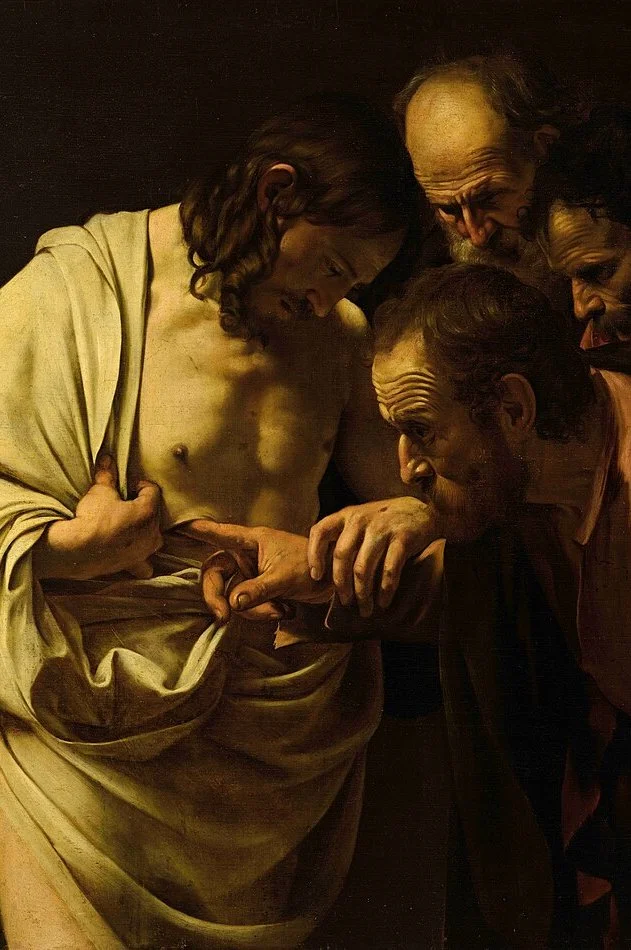
The image of Saint Thomas placing his finger into the wounds of the risen Christ is one of the most powerful scenes in Christian art and devotion. It shows the moment when doubt meets mercy, when fear meets the living Christ, and when a wounded apostle is invited to touch the wounds of God. Thomas had not been with the other disciples when Jesus first appeared after the Resurrection. When they told him, “We have seen the Lord,” Thomas struggled to believe. He wanted to see. He wanted to touch. He wanted to know that the Crucified One was truly alive.
Jesus answered him with mercy. He came to Thomas and invited him to place his finger in His wounds. Christ did not hide His scars. He revealed them. He did not crush Thomas for his weakness. He healed him by showing that the same wounds of the Cross had become signs of victory, love, and resurrection. From that encounter, Thomas cried out one of the greatest confessions of faith in the entire Gospel: “My Lord and my God.”
This Saint Thomas the Apostle prayer card is especially meaningful for those struggling with doubt, wounded faith, spiritual dryness, fear, uncertainty, grief, religious trauma, unanswered prayer, or the desire to return to Christ after a long season away. It is also a powerful devotional card for converts, catechumens, OCIA and RCIA candidates, Bible study groups, Easter devotion, Divine Mercy devotion, and anyone who finds comfort in the wounds of Christ.
Saint Thomas is often called “Doubting Thomas,” but his story is not the story of a failure. It is the story of a man who was honest about the gap between what he wanted to believe and what he could yet receive. His doubt became the doorway to one of the clearest declarations of Christ’s divinity. His hesitation became a witness. His weakness became a place where Jesus revealed His mercy.
This makes Saint Thomas a powerful intercessor for those who feel ashamed of their questions. Many people assume that doubt means they have no faith, but the Gospel shows something deeper. Thomas did not walk away forever. He stayed close enough to be found by Christ. He remained among the apostles. He was wounded, confused, and resistant, but he was still there. And because he was still there, the risen Jesus met him.
Saint Thomas is also beloved as the apostle connected with the ancient Christian tradition of India. The Saint Thomas Christians, especially in Kerala, have long honored him as the apostle who brought the Gospel to their land. For this reason, he is a deeply important saint for Indian Christians, Eastern Christians, Catholics, Orthodox Christians, Syro-Malabar Catholics, Malankara Christians, and all who honor the apostolic roots of Christianity in the East.
His patronage includes doubt, struggling faith, seekers, converts, wounded believers, those returning to Christ, India, architects, builders, stone masons, craftsmen, missionaries, and all who need the courage to move from uncertainty into confession. He is a saint for the person who says, “Lord, I want to believe. Help me come closer.”
Each card is handmade in Austin, TX and created to order. We do not keep stock, because every prayer card is treated as a unique devotional offering. They are printed on museum-quality photo paper, not cardstock. Every card is made slowly, during prayer, with intentional reverence for the saint or holy image and for the person who will receive it. Names are lifted before Christ. Intentions are held carefully. Each piece is handled multiple times in prayerful silence, asking God for mercy and asking the saint to intercede for the soul it is being made for. This is not production work. It is devotional craftsmanship shaped with patience, care, and spiritual responsibility, because every soul and every prayer matters.
THE LIFE & STORY
Saint Thomas the Apostle was one of the Twelve Apostles chosen by Jesus Christ. In the Gospel of John, he is also called Didymus, meaning “the Twin.” Though the Gospels do not give a long biography of his early life, they reveal enough to show a man of intensity, loyalty, realism, and deep feeling.
Saint Thomas appears at several important moments in the Gospel. When Jesus decided to return to Judea after the death of Lazarus, the disciples were afraid because danger awaited Him there. Thomas spoke with striking courage, saying to the other disciples that they should go with Jesus, even if it meant dying with Him. This is important because Thomas should not be remembered only for doubt. Before he was called “Doubting Thomas,” he was willing to walk toward danger with Christ.
At the Last Supper, Thomas also asked Jesus a question that opened the way for one of the most beloved sayings of the Lord. Jesus told His disciples that He was going to prepare a place for them, and that they knew the way. Thomas, honest and direct, said that they did not know where He was going, so how could they know the way? Jesus answered him: “I am the way, and the truth, and the life.” Thomas’s question gave the Church one of its clearest teachings on Christ as the way to the Father.
But Thomas is most remembered for what happened after the Resurrection. On the evening of Easter, Jesus appeared to the disciples, but Thomas was not with them. The others told him that they had seen the Lord, but Thomas could not receive their testimony. He said that unless he saw the mark of the nails, placed his finger in the wounds, and placed his hand in Christ’s side, he would not believe.
Eight days later, Jesus came again. This time, Thomas was there. The doors were locked, but Christ stood among them and said, “Peace be with you.” Then He turned to Thomas. Jesus did not ignore him. He did not shame him in front of the others. He answered the exact wound of Thomas’s doubt. He invited him to put his finger into the nail marks and place his hand into His side. Then He called him to believe.
Thomas responded with awe, repentance, and worship: “My Lord and my God.” These words are among the most direct confessions of Jesus Christ’s divinity in the New Testament. The man remembered for doubt became the man who spoke one of the Church’s greatest acts of faith.
After Pentecost, Christian tradition teaches that Saint Thomas carried the Gospel far beyond Jerusalem. He is especially associated with the evangelization of India, where the ancient Saint Thomas Christian communities trace their origins to his apostolic mission. Tradition holds that he preached, converted many, founded Christian communities, and was eventually martyred for Christ.
Saint Thomas is believed to have died as a martyr, traditionally associated with Mylapore, near present-day Chennai, India. Because of this, he is one of the great missionary apostles of the Church. His life moves from hidden doubt to bold confession, from the locked room to distant mission, from hesitation to martyrdom. The apostle who once needed to touch the wounds of Christ became a witness who gave his own life for the risen Lord.
MIRACLES & PATRONAGE
Saint Thomas the Apostle is not only remembered because he doubted. He is remembered because Christ met him in that doubt and transformed him into a missionary, confessor, and martyr. His life is a witness that Jesus can take a wounded, questioning heart and make it strong enough to carry the Gospel across the world.
His unofficial patronage of doubt and struggling faith comes directly from the Gospel account of his encounter with the risen Christ. Many Christians go through seasons when belief feels difficult. Some are grieving. Some have been hurt. Some are carrying intellectual questions. Some want to pray but feel nothing. Some believe in Christ, but still feel afraid to trust Him fully. Saint Thomas is a merciful companion for that kind of soul.
He is also a powerful saint for those who need to encounter the wounds of Christ. The scene of Doubting Thomas is not only about proof. It is about love. Jesus shows Thomas that the Resurrection does not erase the Cross as if suffering never happened. The risen Christ still bears His wounds. They are glorified, but they remain. For anyone carrying grief, trauma, betrayal, loss, illness, or spiritual pain, this is deeply consoling. Christ is not distant from wounds. He has wounds. And through His wounds, He heals.
Saint Thomas is especially meaningful for converts and catechumens because his journey reflects the movement from questioning to confession. Many people entering the Church do not arrive with every question answered. They come with longing, uncertainty, curiosity, fear, and hope. Thomas shows that honest questions can become part of the road to deeper faith, as long as the soul remains near Christ and open to His mercy.
He is also a traditional patron of India, because of the ancient Christian tradition that he preached the Gospel there. The Saint Thomas Christians of India have preserved a profound memory of his apostolic mission, making him a beloved saint not only in the West, but especially among Eastern Christians, Syro-Malabar Catholics, Malankara Christians, Indian Orthodox Christians, and many other Christians connected to India’s ancient apostolic heritage.
Saint Thomas is also known as a patron of architects, builders, stone masons, and craftsmen. This patronage is often connected to traditions about his missionary life and work. Because of this, he is a fitting saint for those who build with their hands, design homes, shape stone, create sacred spaces, or labor in practical trades.
People ask Saint Thomas’s intercession when they are struggling with doubt, trying to return to prayer, discerning conversion, preparing for Baptism or Confirmation, entering OCIA or RCIA, grieving, rebuilding faith after pain, or asking Jesus to reveal Himself more clearly. He is also a beautiful saint for anyone who wants to pray before a crucifix and meditate on the wounds of Christ.
Saint Thomas reminds the soul that doubt does not have to be the end of faith. Doubt can become the place where Christ comes near. The question is not whether the soul has ever struggled. The question is whether the soul will remain close enough to be found by Jesus.
PRAYERS
A simple invocation may be prayed often: Saint Thomas the Apostle, pray for us.
For those struggling with doubt, one may pray: Saint Thomas, you once longed to see and touch the wounds of the risen Christ. Pray for me, that my doubt may not drive me away from Jesus, but lead me closer to His mercy.
For wounded faith, one may pray: Lord Jesus Christ, You showed Your wounds to Saint Thomas with patience and love. Show mercy to my wounded heart, strengthen my faith, and help me confess with Thomas: My Lord and my God.
For those returning to Christ, one may pray: Saint Thomas the Apostle, pray for all who feel far from God, all who are afraid to believe again, and all who need to encounter the risen Christ in mercy.
For converts and catechumens, one may pray: Saint Thomas, guide those who are seeking the truth. Pray for those preparing to enter the Church, that their questions may be purified, their faith strengthened, and their hearts brought fully to Christ.
For those meditating on the wounds of Jesus, one may pray: Lord Jesus, by Your holy wounds, heal my unbelief. By Your pierced hands and side, draw me into deeper trust. Saint Thomas, pray that I may never be afraid to come near the wounded and risen Lord.
For courage in mission, one may pray: Saint Thomas the Apostle, missionary and martyr, pray that I may not keep my faith hidden in fear, but may confess Jesus Christ with courage, humility, and love.
This prayer card is especially fitting for a prayer corner, Bible, missal, catechism, chapel bag, Easter basket, OCIA or RCIA gift, Confirmation gift, or as a devotional card for anyone who is struggling to believe. It is also meaningful for those devoted to the wounds of Christ, the Resurrection, Divine Mercy, the apostles, and the ancient Christian heritage of India.
FAQ
Who is Saint Thomas the Apostle?
Saint Thomas the Apostle was one of the Twelve Apostles of Jesus Christ. He is also called Didymus, meaning “the Twin.” He is best known for his encounter with the risen Christ after the Resurrection, when Jesus invited him to see and touch His wounds.
Why is Saint Thomas called Doubting Thomas?
Saint Thomas is called Doubting Thomas because he struggled to believe the other apostles when they told him they had seen the risen Lord. He said he wanted to see the wounds of Christ for himself. Jesus later appeared to him and invited him to believe.
Is Doubting Thomas a negative title?
It can sound negative, but the story is much deeper than that. Saint Thomas’s doubt became the setting for one of the greatest confessions of faith in the Gospel: “My Lord and my God.” His story is not only about doubt, but about mercy, healing, and faith.
What did Jesus say to Doubting Thomas?
Jesus invited Thomas to place his finger in the nail marks and his hand in His side. He then called Thomas to believe. This moment shows the patience and mercy of Christ toward a soul struggling with doubt.
Did Saint Thomas actually touch the wounds of Jesus?
Christian art often shows Saint Thomas placing his finger in the wound of Christ. The Gospel records Jesus inviting Thomas to do this, followed by Thomas’s confession of faith. The scene has become one of the most powerful images of doubt being healed by the mercy of the risen Christ.
What did Saint Thomas say when he saw Jesus?
Saint Thomas responded to the risen Christ by saying, “My Lord and my God.” This is one of the clearest and most beautiful confessions of faith in the New Testament.
What is Saint Thomas the Apostle the patron saint of?
Saint Thomas is traditionally associated with India, architects, builders, stone masons, and craftsmen. He is also a powerful unofficial patron for those struggling with doubt, wounded faith, seekers, converts, catechumens, and anyone asking Jesus for deeper faith.
Is Saint Thomas connected to India?
Yes. Ancient Christian tradition strongly connects Saint Thomas the Apostle with the evangelization of India. The Saint Thomas Christians of India, especially in Kerala, trace their Christian heritage to his apostolic mission.
Is Saint Thomas venerated by Catholics and Orthodox Christians?
Yes. Saint Thomas the Apostle is venerated by Catholics, Orthodox Christians, Eastern Catholics, Oriental Orthodox Christians, and many other Christians. He is one of the Twelve Apostles and is honored throughout the Christian world.
When is Saint Thomas the Apostle’s feast day?
In the Roman Catholic Church, Saint Thomas the Apostle is celebrated on July 3. In the Orthodox Church, he is commemorated on October 6 and is also strongly associated with Thomas Sunday, the Sunday after Pascha, when the Gospel account of his encounter with the risen Christ is remembered.
Is Saint Thomas a good saint for someone struggling with doubt?
Yes. Saint Thomas is one of the most meaningful saints for someone struggling with doubt because he personally experienced the movement from uncertainty to faith. His story shows that Jesus is merciful toward those who honestly struggle and still remain open to Him.
Is this prayer card good for OCIA or RCIA candidates?
Yes. This Doubting Thomas prayer card is especially fitting for OCIA and RCIA candidates, converts, catechumens, Confirmation students, and anyone learning to confess Jesus Christ more fully.
Can this prayer card be used for Easter devotion?
Yes. The image of Saint Thomas with the risen Christ is deeply connected to Easter, the Resurrection, and the wounds of Jesus. It is especially fitting during the Easter season, Divine Mercy devotion, and Thomas Sunday.
Why are the wounds of Christ important in this image?
The wounds of Christ show that the risen Jesus is the same Jesus who was crucified. His wounds are signs of His love, sacrifice, mercy, and victory. For Saint Thomas, seeing the wounds became the path from doubt to worship.
What is the main message of Saint Thomas’s story?
The main message of Saint Thomas’s story is that Jesus does not abandon the doubting heart. He comes with mercy, reveals His wounds, and calls the soul into deeper faith. Doubt does not have to be the end. In Christ, it can become the beginning of a stronger confession: My Lord and my God.
Saint Thomas the Apostle is a saint for anyone who has ever wanted to believe, but still felt the ache of doubt. He is a saint for the wounded heart, the questioning mind, the person who has prayed and still felt uncertain, and the soul that longs for proof that Christ is truly near. This prayer card is titled Doubting Thomas, not to shame Saint Thomas, but to honor the mercy of Jesus Christ, who did not reject him in his doubt, but invited him closer.
The image of Saint Thomas placing his finger into the wounds of the risen Christ is one of the most powerful scenes in Christian art and devotion. It shows the moment when doubt meets mercy, when fear meets the living Christ, and when a wounded apostle is invited to touch the wounds of God. Thomas had not been with the other disciples when Jesus first appeared after the Resurrection. When they told him, “We have seen the Lord,” Thomas struggled to believe. He wanted to see. He wanted to touch. He wanted to know that the Crucified One was truly alive.
Jesus answered him with mercy. He came to Thomas and invited him to place his finger in His wounds. Christ did not hide His scars. He revealed them. He did not crush Thomas for his weakness. He healed him by showing that the same wounds of the Cross had become signs of victory, love, and resurrection. From that encounter, Thomas cried out one of the greatest confessions of faith in the entire Gospel: “My Lord and my God.”
This Saint Thomas the Apostle prayer card is especially meaningful for those struggling with doubt, wounded faith, spiritual dryness, fear, uncertainty, grief, religious trauma, unanswered prayer, or the desire to return to Christ after a long season away. It is also a powerful devotional card for converts, catechumens, OCIA and RCIA candidates, Bible study groups, Easter devotion, Divine Mercy devotion, and anyone who finds comfort in the wounds of Christ.
Saint Thomas is often called “Doubting Thomas,” but his story is not the story of a failure. It is the story of a man who was honest about the gap between what he wanted to believe and what he could yet receive. His doubt became the doorway to one of the clearest declarations of Christ’s divinity. His hesitation became a witness. His weakness became a place where Jesus revealed His mercy.
This makes Saint Thomas a powerful intercessor for those who feel ashamed of their questions. Many people assume that doubt means they have no faith, but the Gospel shows something deeper. Thomas did not walk away forever. He stayed close enough to be found by Christ. He remained among the apostles. He was wounded, confused, and resistant, but he was still there. And because he was still there, the risen Jesus met him.
Saint Thomas is also beloved as the apostle connected with the ancient Christian tradition of India. The Saint Thomas Christians, especially in Kerala, have long honored him as the apostle who brought the Gospel to their land. For this reason, he is a deeply important saint for Indian Christians, Eastern Christians, Catholics, Orthodox Christians, Syro-Malabar Catholics, Malankara Christians, and all who honor the apostolic roots of Christianity in the East.
His patronage includes doubt, struggling faith, seekers, converts, wounded believers, those returning to Christ, India, architects, builders, stone masons, craftsmen, missionaries, and all who need the courage to move from uncertainty into confession. He is a saint for the person who says, “Lord, I want to believe. Help me come closer.”
Each card is handmade in Austin, TX and created to order. We do not keep stock, because every prayer card is treated as a unique devotional offering. They are printed on museum-quality photo paper, not cardstock. Every card is made slowly, during prayer, with intentional reverence for the saint or holy image and for the person who will receive it. Names are lifted before Christ. Intentions are held carefully. Each piece is handled multiple times in prayerful silence, asking God for mercy and asking the saint to intercede for the soul it is being made for. This is not production work. It is devotional craftsmanship shaped with patience, care, and spiritual responsibility, because every soul and every prayer matters.
THE LIFE & STORY
Saint Thomas the Apostle was one of the Twelve Apostles chosen by Jesus Christ. In the Gospel of John, he is also called Didymus, meaning “the Twin.” Though the Gospels do not give a long biography of his early life, they reveal enough to show a man of intensity, loyalty, realism, and deep feeling.
Saint Thomas appears at several important moments in the Gospel. When Jesus decided to return to Judea after the death of Lazarus, the disciples were afraid because danger awaited Him there. Thomas spoke with striking courage, saying to the other disciples that they should go with Jesus, even if it meant dying with Him. This is important because Thomas should not be remembered only for doubt. Before he was called “Doubting Thomas,” he was willing to walk toward danger with Christ.
At the Last Supper, Thomas also asked Jesus a question that opened the way for one of the most beloved sayings of the Lord. Jesus told His disciples that He was going to prepare a place for them, and that they knew the way. Thomas, honest and direct, said that they did not know where He was going, so how could they know the way? Jesus answered him: “I am the way, and the truth, and the life.” Thomas’s question gave the Church one of its clearest teachings on Christ as the way to the Father.
But Thomas is most remembered for what happened after the Resurrection. On the evening of Easter, Jesus appeared to the disciples, but Thomas was not with them. The others told him that they had seen the Lord, but Thomas could not receive their testimony. He said that unless he saw the mark of the nails, placed his finger in the wounds, and placed his hand in Christ’s side, he would not believe.
Eight days later, Jesus came again. This time, Thomas was there. The doors were locked, but Christ stood among them and said, “Peace be with you.” Then He turned to Thomas. Jesus did not ignore him. He did not shame him in front of the others. He answered the exact wound of Thomas’s doubt. He invited him to put his finger into the nail marks and place his hand into His side. Then He called him to believe.
Thomas responded with awe, repentance, and worship: “My Lord and my God.” These words are among the most direct confessions of Jesus Christ’s divinity in the New Testament. The man remembered for doubt became the man who spoke one of the Church’s greatest acts of faith.
After Pentecost, Christian tradition teaches that Saint Thomas carried the Gospel far beyond Jerusalem. He is especially associated with the evangelization of India, where the ancient Saint Thomas Christian communities trace their origins to his apostolic mission. Tradition holds that he preached, converted many, founded Christian communities, and was eventually martyred for Christ.
Saint Thomas is believed to have died as a martyr, traditionally associated with Mylapore, near present-day Chennai, India. Because of this, he is one of the great missionary apostles of the Church. His life moves from hidden doubt to bold confession, from the locked room to distant mission, from hesitation to martyrdom. The apostle who once needed to touch the wounds of Christ became a witness who gave his own life for the risen Lord.
MIRACLES & PATRONAGE
Saint Thomas the Apostle is not only remembered because he doubted. He is remembered because Christ met him in that doubt and transformed him into a missionary, confessor, and martyr. His life is a witness that Jesus can take a wounded, questioning heart and make it strong enough to carry the Gospel across the world.
His unofficial patronage of doubt and struggling faith comes directly from the Gospel account of his encounter with the risen Christ. Many Christians go through seasons when belief feels difficult. Some are grieving. Some have been hurt. Some are carrying intellectual questions. Some want to pray but feel nothing. Some believe in Christ, but still feel afraid to trust Him fully. Saint Thomas is a merciful companion for that kind of soul.
He is also a powerful saint for those who need to encounter the wounds of Christ. The scene of Doubting Thomas is not only about proof. It is about love. Jesus shows Thomas that the Resurrection does not erase the Cross as if suffering never happened. The risen Christ still bears His wounds. They are glorified, but they remain. For anyone carrying grief, trauma, betrayal, loss, illness, or spiritual pain, this is deeply consoling. Christ is not distant from wounds. He has wounds. And through His wounds, He heals.
Saint Thomas is especially meaningful for converts and catechumens because his journey reflects the movement from questioning to confession. Many people entering the Church do not arrive with every question answered. They come with longing, uncertainty, curiosity, fear, and hope. Thomas shows that honest questions can become part of the road to deeper faith, as long as the soul remains near Christ and open to His mercy.
He is also a traditional patron of India, because of the ancient Christian tradition that he preached the Gospel there. The Saint Thomas Christians of India have preserved a profound memory of his apostolic mission, making him a beloved saint not only in the West, but especially among Eastern Christians, Syro-Malabar Catholics, Malankara Christians, Indian Orthodox Christians, and many other Christians connected to India’s ancient apostolic heritage.
Saint Thomas is also known as a patron of architects, builders, stone masons, and craftsmen. This patronage is often connected to traditions about his missionary life and work. Because of this, he is a fitting saint for those who build with their hands, design homes, shape stone, create sacred spaces, or labor in practical trades.
People ask Saint Thomas’s intercession when they are struggling with doubt, trying to return to prayer, discerning conversion, preparing for Baptism or Confirmation, entering OCIA or RCIA, grieving, rebuilding faith after pain, or asking Jesus to reveal Himself more clearly. He is also a beautiful saint for anyone who wants to pray before a crucifix and meditate on the wounds of Christ.
Saint Thomas reminds the soul that doubt does not have to be the end of faith. Doubt can become the place where Christ comes near. The question is not whether the soul has ever struggled. The question is whether the soul will remain close enough to be found by Jesus.
PRAYERS
A simple invocation may be prayed often: Saint Thomas the Apostle, pray for us.
For those struggling with doubt, one may pray: Saint Thomas, you once longed to see and touch the wounds of the risen Christ. Pray for me, that my doubt may not drive me away from Jesus, but lead me closer to His mercy.
For wounded faith, one may pray: Lord Jesus Christ, You showed Your wounds to Saint Thomas with patience and love. Show mercy to my wounded heart, strengthen my faith, and help me confess with Thomas: My Lord and my God.
For those returning to Christ, one may pray: Saint Thomas the Apostle, pray for all who feel far from God, all who are afraid to believe again, and all who need to encounter the risen Christ in mercy.
For converts and catechumens, one may pray: Saint Thomas, guide those who are seeking the truth. Pray for those preparing to enter the Church, that their questions may be purified, their faith strengthened, and their hearts brought fully to Christ.
For those meditating on the wounds of Jesus, one may pray: Lord Jesus, by Your holy wounds, heal my unbelief. By Your pierced hands and side, draw me into deeper trust. Saint Thomas, pray that I may never be afraid to come near the wounded and risen Lord.
For courage in mission, one may pray: Saint Thomas the Apostle, missionary and martyr, pray that I may not keep my faith hidden in fear, but may confess Jesus Christ with courage, humility, and love.
This prayer card is especially fitting for a prayer corner, Bible, missal, catechism, chapel bag, Easter basket, OCIA or RCIA gift, Confirmation gift, or as a devotional card for anyone who is struggling to believe. It is also meaningful for those devoted to the wounds of Christ, the Resurrection, Divine Mercy, the apostles, and the ancient Christian heritage of India.
FAQ
Who is Saint Thomas the Apostle?
Saint Thomas the Apostle was one of the Twelve Apostles of Jesus Christ. He is also called Didymus, meaning “the Twin.” He is best known for his encounter with the risen Christ after the Resurrection, when Jesus invited him to see and touch His wounds.
Why is Saint Thomas called Doubting Thomas?
Saint Thomas is called Doubting Thomas because he struggled to believe the other apostles when they told him they had seen the risen Lord. He said he wanted to see the wounds of Christ for himself. Jesus later appeared to him and invited him to believe.
Is Doubting Thomas a negative title?
It can sound negative, but the story is much deeper than that. Saint Thomas’s doubt became the setting for one of the greatest confessions of faith in the Gospel: “My Lord and my God.” His story is not only about doubt, but about mercy, healing, and faith.
What did Jesus say to Doubting Thomas?
Jesus invited Thomas to place his finger in the nail marks and his hand in His side. He then called Thomas to believe. This moment shows the patience and mercy of Christ toward a soul struggling with doubt.
Did Saint Thomas actually touch the wounds of Jesus?
Christian art often shows Saint Thomas placing his finger in the wound of Christ. The Gospel records Jesus inviting Thomas to do this, followed by Thomas’s confession of faith. The scene has become one of the most powerful images of doubt being healed by the mercy of the risen Christ.
What did Saint Thomas say when he saw Jesus?
Saint Thomas responded to the risen Christ by saying, “My Lord and my God.” This is one of the clearest and most beautiful confessions of faith in the New Testament.
What is Saint Thomas the Apostle the patron saint of?
Saint Thomas is traditionally associated with India, architects, builders, stone masons, and craftsmen. He is also a powerful unofficial patron for those struggling with doubt, wounded faith, seekers, converts, catechumens, and anyone asking Jesus for deeper faith.
Is Saint Thomas connected to India?
Yes. Ancient Christian tradition strongly connects Saint Thomas the Apostle with the evangelization of India. The Saint Thomas Christians of India, especially in Kerala, trace their Christian heritage to his apostolic mission.
Is Saint Thomas venerated by Catholics and Orthodox Christians?
Yes. Saint Thomas the Apostle is venerated by Catholics, Orthodox Christians, Eastern Catholics, Oriental Orthodox Christians, and many other Christians. He is one of the Twelve Apostles and is honored throughout the Christian world.
When is Saint Thomas the Apostle’s feast day?
In the Roman Catholic Church, Saint Thomas the Apostle is celebrated on July 3. In the Orthodox Church, he is commemorated on October 6 and is also strongly associated with Thomas Sunday, the Sunday after Pascha, when the Gospel account of his encounter with the risen Christ is remembered.
Is Saint Thomas a good saint for someone struggling with doubt?
Yes. Saint Thomas is one of the most meaningful saints for someone struggling with doubt because he personally experienced the movement from uncertainty to faith. His story shows that Jesus is merciful toward those who honestly struggle and still remain open to Him.
Is this prayer card good for OCIA or RCIA candidates?
Yes. This Doubting Thomas prayer card is especially fitting for OCIA and RCIA candidates, converts, catechumens, Confirmation students, and anyone learning to confess Jesus Christ more fully.
Can this prayer card be used for Easter devotion?
Yes. The image of Saint Thomas with the risen Christ is deeply connected to Easter, the Resurrection, and the wounds of Jesus. It is especially fitting during the Easter season, Divine Mercy devotion, and Thomas Sunday.
Why are the wounds of Christ important in this image?
The wounds of Christ show that the risen Jesus is the same Jesus who was crucified. His wounds are signs of His love, sacrifice, mercy, and victory. For Saint Thomas, seeing the wounds became the path from doubt to worship.
What is the main message of Saint Thomas’s story?
The main message of Saint Thomas’s story is that Jesus does not abandon the doubting heart. He comes with mercy, reveals His wounds, and calls the soul into deeper faith. Doubt does not have to be the end. In Christ, it can become the beginning of a stronger confession: My Lord and my God.