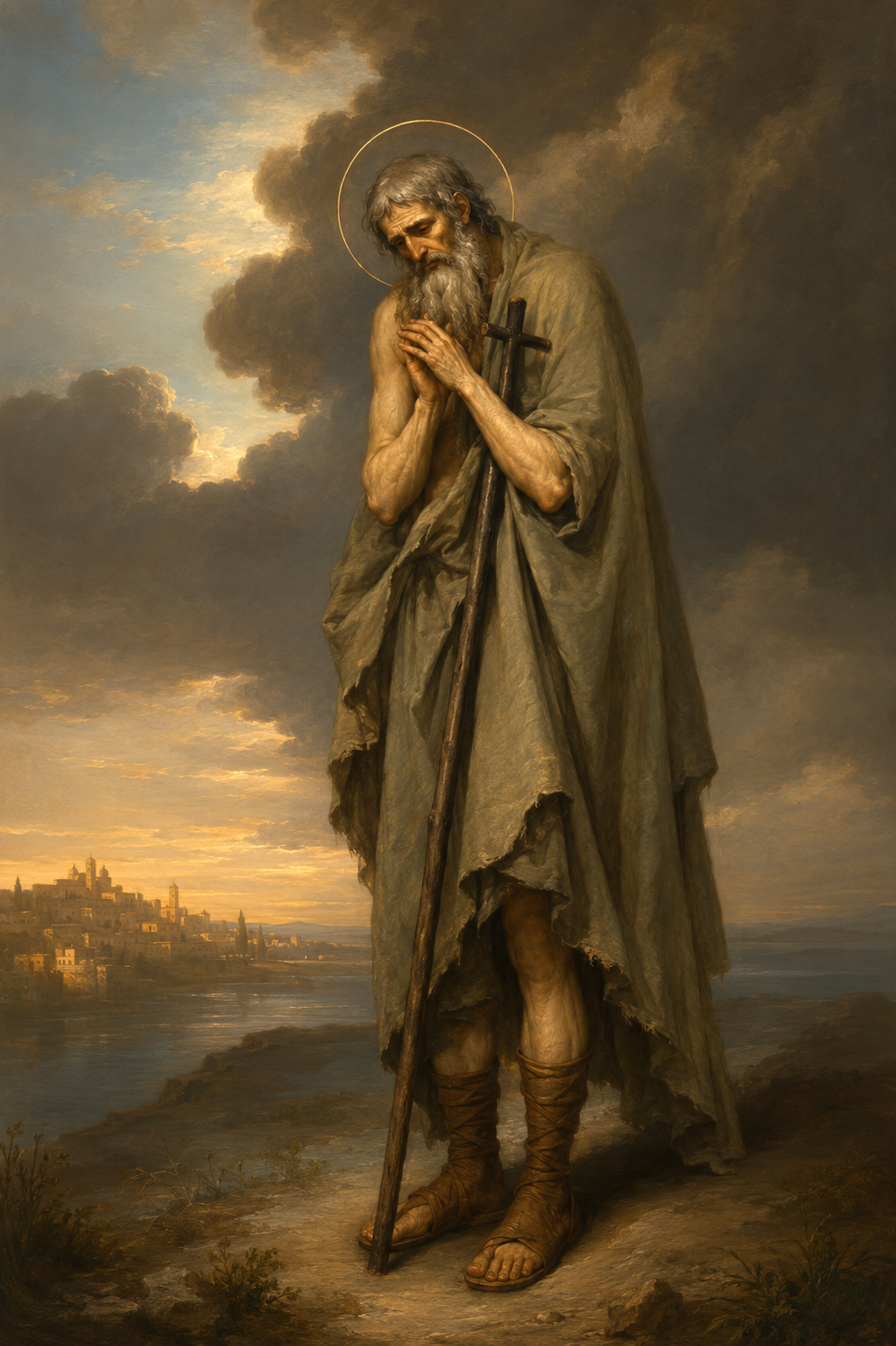
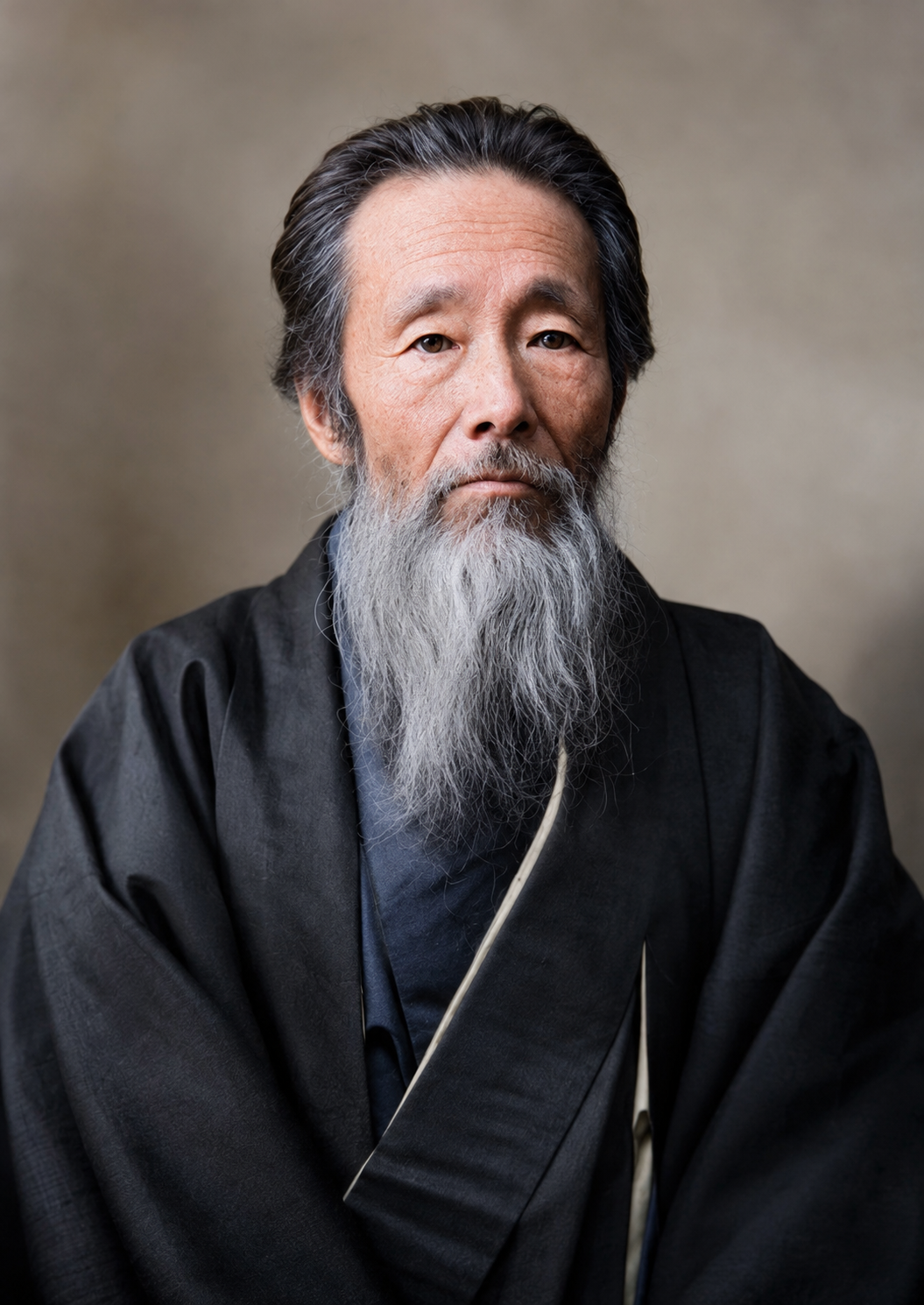
 Image 1 of 1
Father Paul Takuma Sawabe
Father Paul Takuma Sawabe Prayer Card - For Martial Artists, Converts, Courage & Christian Discipline
Father Paul Takuma Sawabe, also known as Pavel Sawabe Takuma, was a Japanese samurai, accomplished swordsman, martial arts instructor, convert to Orthodox Christianity, missionary, and the first native Japanese Orthodox priest. Born in Tosa Province on February 13, 1834, Sawabe belonged to the warrior culture of late Tokugawa Japan and trained seriously in swordsmanship before eventually teaching kenjutsu himself. His life took an extraordinary turn when the fiercely anti-Christian samurai approached the future Saint Nicholas of Japan with a sword at his side and the willingness to kill him, only to leave the encounter questioning everything he thought he knew about Christianity.
Sawabe is especially meaningful for martial artists, swordsmen, practitioners of traditional Japanese budō, military members, converts, catechumens, people struggling with anger or prejudice, men learning to redirect strength toward service, and Christians who understand that discipline of the body should ultimately be joined to discipline of the soul. These associations arise directly from his documented life. Sawabe was not merely descended from samurai or casually familiar with weapons because the Orthodox Church in Japan specifically remembers him teaching swordsmanship in Hakodate, while Hakodate's official historical account describes him operating a dōjō and being chosen to teach Japanese martial arts to children connected with the Russian consulate.
His story is particularly powerful for martial artists because Christianity did not simply erase the strength, courage, decisiveness, discipline, and intensity formed within Sawabe's earlier life. Those qualities were redirected. The swordsman who once believed defending Japan might require killing a Christian missionary eventually became a Christian missionary himself, accepted imprisonment for the faith, entered the priesthood, and helped establish native Orthodox communities throughout Japan. One Orthodox historical account even records that during the impoverished early mission, Sawabe sold his samurai clothing and sword to help support the Christian community.
This makes Sawabe especially compelling for someone practicing martial arts within a Christian life. Martial discipline can produce courage, endurance, attentiveness, control of movement, and perseverance, but Sawabe's conversion raises the deeper question of what those abilities are ultimately for. The sword that once represented his ability to impose his will gradually ceased to define him, while the discipline and courage of the swordsman remained visible in the priest and missionary he became.
This prayer card is especially fitting for martial artists, kenjutsu practitioners, kendō practitioners interested in Christian martial history, traditional Japanese martial arts students, military veterans, police officers, converts to Orthodoxy, catechumens, Japanese Christians, men entering serious spiritual formation, and anyone seeking to unite physical discipline with Christian self-mastery. It can also make a meaningful baptism, chrismation, conversion anniversary, martial arts promotion, dōjō gift, seminary, mission, or Christian men's ministry gift.
Each card is handmade in Austin, TX and created to order. We do not keep stock because every card is treated as an individual devotional offering. They are printed on museum-quality photo paper, not cardstock, and every card is made slowly during prayer with intentional care for the Christian history represented and for the person receiving it. In Sawabe's case, the devotional emphasis remains upon Christ, conversion, discipline, courage, repentance, and the extraordinary history of the first native Japanese Orthodox priest.
THE LIFE & STORY
Paul Takuma Sawabe was born February 13, 1834, in what is now Kochi Prefecture on the island of Shikoku. Japan's National Diet Library identifies him as the son of a samurai of the Kochi, or Tosa, domain and records that he studied at the school of the famous samurai Takechi Hanpeita alongside his relative Sakamoto Ryōma before going to Edo in 1851.
The Orthodox Church in Japan likewise identifies Sawabe as a genuine Tosa samurai and a relative of Sakamoto Ryōma, one of the most famous figures of the turbulent final years of the Tokugawa shogunate. Sawabe therefore emerged from precisely the warrior culture that shaped many of the men involved in Japan's transition from the feudal domain system into the modern Meiji state.
THE SAMURAI BEFORE THE PRIEST
Sawabe's samurai background was not simply a matter of family classification. Swordsmanship occupied a major place in his early life, and the official Orthodox Church in Japan specifically says that he taught kenjutsu in Hakodate. His martial ability consequently deserves a much more prominent place in his biography than it often receives in short accounts focused only upon his later conversion.
Japan's National Diet Library also records Sawabe studying in the school of Takechi Hanpeita, himself a prominent samurai and martial figure of Tosa. Sawabe later traveled to Edo, the center of some of the most prestigious sword schools in Japan, before the circumstances of his life eventually drove him north toward Hakodate.
Later Japanese historical accounts identify Sawabe with advanced training at the famous Momoi dōjō in Edo and describe him serving at an instructor level there. Because the most authoritative sources I found confirm his serious sword training and later work as a kenjutsu teacher but do not themselves specify his exact ryūha, the safest wording is that Sawabe was an accomplished kenjutsu practitioner and instructor without forcing a particular school designation where the evidence is less uniform.
KENJUTSU, NOT MODERN SPORT MARTIAL ARTS
When describing Sawabe as a martial artist, kenjutsu is the historically appropriate term. He lived before the modern development of many twentieth-century Japanese budō systems, and his martial background belonged to the sword traditions of the samurai rather than to modern karate, judo, aikido, or competitive combat sports.
This distinction actually makes his story more remarkable. Sawabe belonged to a culture in which sword training was not primarily recreational exercise because the sword remained connected with samurai identity, social status, personal defense, violence, and the real possibility of killing.
When Sawabe later approached Nicholas armed and prepared for a potentially lethal confrontation, the threat was therefore not theatrical. The man confronting the missionary actually knew how to use the weapon he carried.
A RELATIVE OF SAKAMOTO RYŌMA
Sawabe was closely related to Sakamoto Ryōma, the famous Tosa samurai remembered as an influential figure in the political transformations leading toward the Meiji Restoration. The Orthodox Church in Japan calls Sawabe Ryōma's cousin, while Japan's National Diet Library records that the two studied within the circle of Takechi Hanpeita.
The connection places Sawabe directly inside one of the most fascinating generations in Japanese history. Ryōma became associated with political transformation, while Sawabe eventually participated in a very different transformation by helping establish an indigenous Orthodox Christian Church in Japan.
Both men emerged from Tosa samurai culture, but Sawabe's road eventually carried him from the sword to the altar.
TRAINING UNDER TAKECHI HANPEITA
Japan's National Diet Library specifically states that Sawabe studied at the private school maintained by Takechi Hanpeita, together with Sakamoto Ryōma and others. Takechi became one of the important samurai activists of late Tokugawa Tosa, making Sawabe's early social world closely connected with the martial and political ferment of the period.
This context helps explain the intensity of Sawabe's early nationalism. He was not approaching questions about foreigners as a detached observer. His generation had been raised within a Japan increasingly confronted by foreign ships, diplomatic pressure, changing trade relationships, and arguments over whether foreigners should be expelled.
For Sawabe, martial discipline and defense of Japan could therefore appear inseparable.
THE ROAD TO HAKODATE
Sawabe eventually left the world he had known in Tosa and Edo and traveled north. Hakodate's official historical account says he reached the city in 1858, during the period when the port was becoming one of Japan's principal points of contact with foreigners.
The same local history preserves a particularly striking martial episode from his arrival. While staying at an inn, Sawabe drove away a robber, and the grateful innkeeper responded by providing him with a crude dōjō building on the grounds of Hakodate Shinmeisha Shrine.
Sawabe's swordsmanship therefore helped establish him socially in the very city where his Christian conversion would later occur.
THE SWORDSMAN OPENS A DŌJŌ
In Hakodate, Sawabe used the skill that had defined much of his earlier life and taught swordsmanship. The Orthodox Church in Japan directly describes him as teaching kenjutsu there, while Hakodate's official history connects his dōjō with the shrine environment in which he settled.
This means that before Paul Sawabe became one of Japan's first Orthodox evangelists, Takuma Sawabe was a martial arts teacher. Students came to him to learn a discipline built around posture, timing, distance, decisiveness, awareness, control, and the sword.
The future priest therefore already knew what it meant to train another person through repeated discipline long before he began teaching Christianity.
A SHINTO PRIEST & MARTIAL ARTS INSTRUCTOR
Sawabe married into the family of the Shinto priest associated with Hakodate Shinmeisha and adopted the Sawabe family name. Japan's National Diet Library records his marriage into the shrine family, while Orthodox sources remember his connection with the shrine and his religious position before conversion.
The combination of samurai, sword instructor, Shinto priest, and Japanese nationalist makes his later conversion unusually dramatic. Christianity did not simply enter the life of someone without previous religious or cultural commitments.
Sawabe had an identity, a religion, a social position, martial training, and strong convictions about what was good for Japan.
TEACHING MARTIAL ARTS TO THE RUSSIANS
Hakodate had recently opened as an international port, and the Russian consulate was located there. According to Hakodate's official history, people connected with the consulate wanted their children instructed in Japanese martial arts, and Sawabe became their teacher.
This provides an important bridge between his martial life and his conversion because the Russian consulate was also where the Orthodox missionary Father Nicholas Kasatkin, the future Saint Nicholas of Japan, was serving.
The sword therefore indirectly brought Sawabe into the environment where he encountered Christianity. The same skill that belonged to his samurai identity placed him in proximity to the missionary who would transform the direction of his life.
A MARTIAL ARTIST SUSPICIOUS OF FOREIGNERS
Sawabe nevertheless remained intensely suspicious of foreigners. The Orthodox Church in Japan remembers him regarding Nicholas as someone whose activities could poison or harm Japan, interpreting the missionary's interest in Japanese culture as potentially connected with foreign intrusion.
This attitude makes sense within the political atmosphere of the time. Sawabe had been formed during the years in which sonnō jōi, loyalty to the emperor and opposition to foreign intrusion, became a major rallying cry among sections of the samurai class.
He therefore did not initially encounter Nicholas as a curious religious seeker. He approached him as a warrior confronting a man he suspected of being dangerous.
HE WENT TO NICHOLAS WITH HIS SWORD
Hakodate's official history records that Sawabe went to confront Nicholas wearing his long sword and prepared to kill him if necessary. The account even notes that the sword associated with the event was later displayed at the Hokkaido Sakamoto Ryōma Memorial Museum.
The Orthodox Church in Japan similarly says Sawabe confronted Nicholas intending to dispute with him and, if the opportunity presented itself, cut him down.
This is the moment that makes Sawabe's life particularly extraordinary for martial artists. His first important encounter with Orthodoxy occurred with the possibility of physical violence hanging over the conversation.
NICHOLAS DID NOT DRAW A WEAPON
Nicholas answered the armed swordsman with a question. In the account preserved from Nicholas' own report, Sawabe attacked Christianity despite admitting that he did not actually understand what Nicholas taught. Nicholas challenged the fairness of condemning something before listening to it.
A short verified line from the exchange captures the principle:
“First listen in order to know, and then pass judgment.”
For a martial artist, there is something particularly striking in this confrontation. Nicholas did not overcome Sawabe through greater force because he gave the swordsman an opportunity to practice something equally demanding: restraint.
Sawabe listened.
THE FIRST BATTLE WAS WITH HIS OWN ASSUMPTIONS
Sawabe could have drawn the sword and ended the conversation. Instead, he allowed Nicholas to explain Christianity and discovered that the faith he had condemned was not the thing he had imagined it to be.
That decision required another form of courage. Physical courage can endure an opponent, but intellectual and spiritual courage requires allowing the possibility that the opponent may be right and we may be wrong.
Sawabe's transformation therefore gives martial discipline a Christian direction. Self-mastery is not complete merely because someone can control his body under pressure because pride, anger, prejudice, fear, and certainty can be more difficult opponents than another swordsman.
FROM ANGER TO CURIOSITY
Nicholas explained God, sin, the soul, and eternal life, and Sawabe left the conversation thinking rather than fighting. He returned repeatedly for further instruction and eventually began studying Christianity in earnest.
The Orthodox Church in Japan summarizes the change dramatically: the man who came prepared to attack Nicholas became deeply moved by the teaching he heard and ultimately embraced the Orthodox faith with great zeal.
Conversion did not happen because Sawabe became weak. It happened because his strength acquired a new direction.
THE SWORDSMAN READS THE GOSPEL IN SECRET
Nicholas eventually gave Sawabe a New Testament, but Christianity remained prohibited in Japan. Sawabe later recalled that he could not openly read the book, so he concealed his Gospel reading while outwardly appearing to perform duties associated with his previous religious environment.
The image is remarkable: a trained samurai and sword instructor secretly studying the words of Christ because possessing and embracing Christianity could bring severe punishment.
For martial artists, this part of his life demonstrates that courage gradually moved away from physical confrontation toward fidelity to what he had discovered to be true.
THE DISCIPLINE OF THE DŌJŌ & THE DISCIPLINE OF CONVERSION
Traditional martial training depends upon repetition. A movement is practiced again and again until the body no longer responds only through uncontrolled instinct.
Christian spiritual discipline works differently in its ultimate purpose, but Sawabe's life contains an interesting parallel. Conversion required him to retrain deeply established habits of thought, loyalty, anger, identity, and religion rather than merely agreeing intellectually with a new proposition.
The swordsman who had trained his hands now had to train the heart.
This is why his life can resonate so strongly with martial artists. The greatest victory in Sawabe's story was not over another fighter because it was over the man he had previously allowed himself to be.
BAPTISM UNDER THREAT OF PUNISHMENT
Sawabe eventually received Orthodox baptism from Nicholas together with John Sakai and James Urano. The detailed history of the Hakodate Orthodox Church places these secret baptisms in April 1868, while the OCA likewise identifies Sawabe as one of the first Japanese baptized by Nicholas in the spring of that year.
He received the Christian name Paul, an especially fitting name for a man whose story already resembled the basic pattern of an opponent of Christianity becoming one of its evangelists.
The Hakodate church regards these baptisms as the first fruits of the Japanese Orthodox mission, making Sawabe part of the foundational generation from which the Orthodox Church in Japan developed.
FROM TAKUMA TO PAUL
Baptism did not erase Takuma Sawabe's Japanese history because he remained Sawabe while receiving Paul as his Christian name. The transformation was therefore additive and redemptive rather than cultural annihilation.
This point mattered enormously to Saint Nicholas' missionary vision. The Orthodox Church in Japan emphasizes that Nicholas intended from the beginning to establish an Orthodox Church of Japanese people, for Japanese people, while respecting and seriously studying Japanese culture rather than attempting to make converts culturally Russian.
Paul Sawabe became living proof that Orthodox Christianity could take root in a Japanese life.
THE SAMURAI BECOMES AN EVANGELIST
After baptism, Sawabe immediately began drawing other Japanese people toward Christianity. Nicholas' reports describe him gathering educated young men and developing plans for spreading the faith despite the continued legal danger.
The forcefulness that had once made Sawabe dangerous to the missionary now made him useful to the mission.
This transformation resembles an important principle recognizable within martial training. Raw force without direction can become destructive, while disciplined force can serve a constructive purpose.
Sawabe's zeal did not disappear. Its target changed.
SELLING THE SWORD
One of the most powerful details in the Orthodox account of Sawabe's life comes during the poverty of the early Japanese mission. Christians who lost employment because of conversion needed support, catechists required resources, and the young community possessed very little money.
The ROCOR historical account states that Paul Sawabe sold his samurai clothing and his sword, while another early convert shared his medical income with the Christian community.
For a martial arts card, this deserves special prominence. The sword had represented Sawabe's former status, skill, livelihood, culture, and ability to use force.
Eventually even that could be surrendered for Christ.
FROM CARRYING A SWORD TO CARRYING THE GOSPEL
Sawabe's life therefore contains an almost perfect visible arc. He first came to Nicholas carrying a sword and prepared for violence; after conversion he eventually sold his sword to help sustain the Church.
The weapon itself was neither treated as magically evil nor made the center of his new identity. What mattered was the transformation of the man carrying it.
The martial skill remained part of his history, but it no longer determined the purpose of his life.
A CHRISTIAN LESSON FOR MARTIAL ARTISTS
Sawabe's biography gives Christian martial artists an especially useful distinction between ability and intention. Knowing how to fight does not determine whether someone is virtuous because the same skill can be directed by anger, fear, pride, protection, discipline, duty, or mercy.
Sawabe already possessed courage and skill before conversion. Christianity forced him to reconsider what deserved his loyalty and when strength should be used or restrained.
For someone practicing martial arts today, his story makes a powerful devotional question possible: Is my training making me more governed by anger and ego, or more capable of discipline and self-control?
THE HARDEST OPPONENT
A martial artist naturally learns to study an opponent's movement, balance, timing, and intention. Christianity asks for equally serious attention to the movements occurring within the self.
Pride can provoke when no physical opponent exists. Anger can attack long after danger has disappeared. Fear can dictate decisions without ever raising a weapon. Vanity can turn disciplined training into another means of proving superiority.
Sawabe's conversion gives martial artists an historical Christian example of someone whose external strength eventually required internal surrender.
The man capable of confronting others had to learn how to confront himself.
COURAGE WITHOUT VIOLENCE
Sawabe did not become cowardly when he became Christian. His later life demonstrates remarkable courage because practicing Christianity itself exposed him to legal danger.
ROCOR's history records that Sawabe was eventually imprisoned together with other Christians, while numerous people connected with the mission were interrogated during the persecution.
Physical violence had once seemed to Sawabe like a defense of Japan. After conversion he demonstrated a different form of courage by accepting suffering rather than surrendering the faith he had come to believe was true.
THE SWORDSMAN ACCEPTS IMPRISONMENT
Christianity remained illegal enough that baptism and evangelization could carry severe consequences. Sawabe nevertheless became a catechist and missionary, and his work eventually brought imprisonment.
His courage therefore did not disappear when he stopped defining himself through the sword. It became more demanding because he was now willing to endure punishment without simply destroying the person standing against him.
For Christian martial artists, this is an important distinction. Strength is not demonstrated only through the ability to inflict force because there are moments when greater strength is required to endure, restrain, forgive, or remain faithful.
THE FIRST JAPANESE ORTHODOX PRIEST
As Orthodox Christianity spread, native clergy became essential. At the Japanese Church council held in 1875, it was decided that Paul Sawabe should be ordained to the priesthood and John Sakai to the diaconate. Bishop Paul of Eastern Siberia subsequently performed the ordinations in Hakodate.
The Orthodox Church in Japan identifies this as the first ordination of a Japanese Orthodox priest.
The transformation was complete in outward form. The samurai who had approached an Orthodox priest with the possibility of killing him had become an Orthodox priest himself.
HE DID NOT INITIALLY WANT ORDINATION
The surviving Orthodox history preserves Sawabe's own words concerning the decision to ordain him. He considered the priesthood an extremely serious responsibility and initially resisted accepting it, but ultimately submitted to the judgment of the Church.
A verified portion of his statement reads:
“All of us have given ourselves completely to the service of the Church.”
That sentence provides a fitting summary of the second half of Sawabe's life. The man once willing to give himself to defense of his earlier convictions had become willing to give himself to the Church he once opposed.
MARTIAL DISCIPLINE & OBEDIENCE
The humility surrounding Sawabe's ordination also provides an interesting contrast with the self-assertion of his earlier life. He did not seize priesthood because he believed his missionary work entitled him to authority.
Instead, the historical account presents him as reluctant before the responsibility and ultimately obedient when the Church required him to accept it.
For martial artists, this again places self-mastery above domination. A person may become physically capable of imposing his will while still needing to learn when his own will should yield.
A PRIEST WHO REMAINED A MISSIONARY
Ordination did not end Sawabe's evangelistic work. Official histories of Japanese Orthodox parishes record him traveling and baptizing new Christians as Orthodoxy spread beyond Hakodate.
The Orthodox Church in Japan's history of Morioka records that Father Paul visited in 1875 and baptized seventy-three people, demonstrating how rapidly his ministry had moved beyond the tiny community in which his own baptism occurred.
The first Japanese Orthodox priest therefore became directly involved in transforming local groups of seekers into sacramental Christian communities.
FROM DŌJŌ TEACHER TO CHRISTIAN TEACHER
Sawabe's two great teaching roles create one of the most compelling parallels in his life. Before conversion he taught swordsmanship. After conversion he increasingly taught Christianity.
Both required discipline, repetition, trust between teacher and student, and transmission of something received from earlier masters. The content and purpose were profoundly different, but Sawabe already understood that knowledge becomes durable through formation rather than momentary enthusiasm.
The dōjō instructor eventually became a catechist and priest.
THE IMPORTANCE OF A JAPANESE PRIEST
Saint Nicholas understood that Japanese Christianity could not remain dependent entirely upon foreign clergy. Foreign missionaries were legally restricted in their movement, while Japanese catechists and clergy could speak to their own people from inside Japanese culture.
Sawabe therefore represented more than an individual ordination. His priesthood was evidence that Orthodoxy was becoming a Japanese Church rather than simply a Russian religious presence located in Japan.
The man once afraid that Christianity would destroy Japanese identity helped demonstrate that a Japanese man could become thoroughly Orthodox without ceasing to be Japanese.
THE MARTIAL ARTIST WHO HELPED INDIGENIZE ORTHODOXY
This may be one of the most important aspects of Sawabe's legacy. His very biography undermined the argument he himself once believed.
If Orthodoxy were only a foreign cultural weapon, then its first native Japanese priest would make little sense. Yet Sawabe became precisely that while remaining unmistakably shaped by Japanese language, history, social experience, and samurai culture.
His conversion did not turn a Japanese swordsman into a Russian. It turned a Japanese swordsman into a Japanese Orthodox Christian.
CHRISTIANITY & BUSHIDŌ SHOULD NOT BE OVERSIMPLIFIED
Modern writers sometimes try to draw easy parallels between Christianity and bushidō, but the historical situation is more complicated. Bushidō itself developed through multiple periods and interpretations, and Sawabe should not be made into a spokesman for a modern romantic synthesis he never articulated.
What his life genuinely provides is something stronger because it is historical rather than theoretical. A real nineteenth-century samurai and kenjutsu instructor encountered Christianity, accepted baptism, endured persecution, became a priest, and spent decades serving the Orthodox Church.
That does not make Christianity and every element of samurai ethics identical. It demonstrates that a man profoundly formed within samurai culture could allow Christ to judge, purify, preserve, and redirect elements of that formation.
DISCIPLINE WITHOUT IDOLIZING VIOLENCE
Sawabe's story gives martial artists room to value discipline without romanticizing violence. His swordsmanship was real and useful, but one of the pivotal moments of his life came when he chose not to use the sword.
This is particularly important for Christian martial arts spirituality. Skill can become dangerous when violence itself becomes fascinating or when martial identity becomes an excuse for pride.
The mature martial artist should possess greater control, not less.
Sawabe's conversion demonstrates that the ability to strike does not mean striking is always the courageous choice.
SELF-CONTROL
The encounter with Nicholas required Sawabe to interrupt a course of action that anger had already prepared. He arrived expecting confrontation and allowed a conversation to occur instead.
That moment can be read as a remarkable act of developing self-control. Sawabe had the weapon, training, physical ability, motive, and opportunity, yet something other than impulse ultimately governed what happened.
His later Christianity would deepen that transformation through catechesis, sacrifice, imprisonment, obedience, missionary work, and priesthood.
A CARD FOR KENJUTSU PRACTITIONERS
Father Paul Sawabe is particularly meaningful for practitioners of kenjutsu and classical Japanese sword arts because swordsmanship was genuinely part of his documented biography. This is not an artificial modern connection added only to sell a martial arts card.
A kenjutsu practitioner can look at Sawabe and see someone whose mastery of the sword belonged to an actual samurai world, yet whose spiritual transformation ultimately required more than technical skill.
The card can therefore serve as a reminder that training the weapon and training the soul are not the same thing.
A CARD FOR KENDŌ PRACTITIONERS
Sawabe predates modern kendō in its twentieth-century form, so it would be historically inaccurate to call him a kendōka. His background in historical Japanese swordsmanship nevertheless makes his life especially interesting for modern kendō practitioners who understand their art as descending from older sword traditions.
The appropriate devotional connection is therefore historical and spiritual rather than formal patronage. His life provides a Christian example of sword discipline redirected toward humility, restraint, courage, and service.
A CARD FOR OTHER MARTIAL ARTISTS
Sawabe's relevance is not limited to people holding a Japanese sword. Karateka, judoka, jujutsu practitioners, wrestlers, boxers, mixed martial artists, and practitioners of other systems can recognize the broader question his biography presents.
Training makes the body more capable. Christianity then asks what kind of person is being entrusted with that capability.
Strength without self-control can magnify character defects. Strength governed by humility and love can become useful in protecting and serving others.
A CARD FOR MILITARY MEMBERS & VETERANS
Sawabe's samurai background also gives his story a natural resonance for military members and veterans. His transformation demonstrates that martial identity and Christian faith need not be approached as though one automatically destroys the other.
What Christianity does demand is that loyalty, courage, force, discipline, and obedience be placed beneath a higher moral authority.
Sawabe had once interpreted hostility toward Nicholas as loyalty to Japan. Conversion forced him to recognize that sincere patriotism does not guarantee that every judgment made in the name of country is correct.
WHEN PATRIOTISM BECOMES PREJUDICE
Sawabe believed he was defending Japan when he condemned Nicholas. The problem was that he had already judged the missionary's religion without knowing what it taught.
Nicholas did not demand that Sawabe stop loving Japan. He challenged him to separate love of country from unjust judgment.
That distinction remains important for soldiers, martial artists, and citizens in any nation. Courageous loyalty is a virtue, but loyalty becomes dangerous when it makes listening impossible.
HIS CONVERSION DID NOT MAKE HIM LESS JAPANESE
The Orthodox Church in Japan emphasizes that Saint Nicholas worked according to a missionary principle of receiving and respecting the culture of the country rather than simply suppressing it. He learned Japanese, studied Japanese history and religion, and worked toward a Church led increasingly by Japanese Christians.
Sawabe's story therefore should not be told as a samurai abandoning Japan for Russia. That would reproduce the very misconception he originally held.
He became Christian while becoming one of the people responsible for making Orthodox Christianity indigenous to Japan.
FATHER PAUL & THE GROWTH OF JAPANESE ORTHODOXY
The small movement begun around Sawabe, Sakai, Urano, and Nicholas expanded dramatically. By the end of 1890, the OCA records 216 Orthodox communities and more than 18,000 faithful in Japan, followed by the consecration of the great Resurrection Cathedral in Tokyo in 1891.
Sawabe alone did not create this growth, but he belonged to the foundational native leadership without which it would have been extraordinarily difficult.
The swordsman who once feared Christianity's arrival became one of the people through whom Christianity genuinely entered Japanese society.
AN ARCHPRIEST OF THE JAPANESE CHURCH
Japan's National Diet Library records that Sawabe continued his Orthodox ministry and eventually became an archpriest. He remained connected with the Church for decades after the dramatic events surrounding his conversion and early missionary activity.
This long ministry matters because dramatic conversion stories can sometimes overshadow everything afterward. Sawabe did not simply experience one astonishing conversation with Nicholas and disappear from Church history.
He spent the remainder of his adult life serving the faith he had once opposed.
HIS REPOSE
Father Paul Takuma Sawabe died on June 25, 1913, according to Japan's National Diet Library. He was seventy-nine years old and had lived long enough to see Japanese Orthodoxy develop from a handful of secret converts into an established national Church with native clergy, churches, schools, and the great Resurrection Cathedral in Tokyo.
Saint Nicholas had reposed the previous year in 1912. The lives of missionary and convert therefore remained intertwined across roughly half a century of extraordinary transformation.
Sawabe began that relationship as the man considering whether Nicholas deserved to die. He ended his life as one of the foundational priests of the Church Nicholas established.
HIS LEGACY IN JAPANESE MARTIAL & CHRISTIAN HISTORY
Sawabe belongs simultaneously to several fascinating histories: the history of late samurai Japan, the history of traditional swordsmanship, the opening of Hakodate, the history of Japanese Christianity, and the establishment of the Orthodox Church in Japan.
His martial life should therefore not be reduced to colorful background before the “real” religious story begins. The martial story is part of the conversion story.
The swordsman's courage, intensity, willingness to act, loyalty, and discipline did not disappear. Christianity required them to be purified and redirected.
That transformation is precisely what makes his life so powerful for martial artists today.
VERIFIED QUOTES & DEVOTIONAL REFLECTION
One of the strongest historical quotes connected directly with Sawabe's conversion comes from Saint Nicholas' response when Sawabe condemned Christianity without understanding it:
“First listen in order to know, and then pass judgment.”
The statement is especially appropriate for a martial artist because it represents restraint before action. Sawabe had come prepared for confrontation, but listening created the possibility of conversion.
Years later, when the Church called Sawabe toward ordination, his own recorded words reveal how thoroughly the direction of his life had changed:
“All of us have given ourselves completely to the service of the Church.”
Together, these two statements form a remarkable summary of his journey. The first restrained the swordsman long enough to hear the Gospel, while the second came from the Christian leader who had eventually surrendered even his sword for the mission.
FAQ
Who was Paul Takuma Sawabe? Paul Takuma Sawabe was a nineteenth-century Japanese samurai, accomplished swordsman, kenjutsu instructor, Orthodox convert, missionary, and priest. He became one of the first Japanese Orthodox Christians and later the first native Japanese Orthodox priest.
Was Paul Sawabe really a samurai? Yes. Both Japan's National Diet Library and the Orthodox Church in Japan identify Sawabe with the Tosa samurai class. His martial background was therefore an actual social and professional part of his life rather than a later legend.
Was Paul Sawabe a martial artist? Yes. The Orthodox Church in Japan explicitly states that Sawabe taught kenjutsu in Hakodate, establishing a direct and historically documented connection with Japanese martial arts.
What martial art did Paul Sawabe practice? His securely documented martial discipline was kenjutsu, Japanese swordsmanship. Some later Japanese historical accounts identify particular dōjō and sword traditions connected with his training, but the most authoritative sources used here establish him as an accomplished swordsman and kenjutsu instructor without requiring us to force a particular ryūha designation.
Was Paul Sawabe a kendō practitioner? Not in the modern sense. Sawabe practiced nineteenth-century samurai swordsmanship before modern kendō developed into its later standardized form, so kenjutsu is historically the more accurate description.
Did Paul Sawabe teach martial arts? Yes. The Orthodox Church in Japan states that he taught swordsmanship in Hakodate, while Hakodate's official history says he operated a dōjō and served as a martial arts instructor for children connected with the Russian consulate.
Did Paul Sawabe have his own dōjō? Hakodate's official historical account says that after Sawabe drove away a robber at the inn where he was staying, the grateful owner provided him with a simple dōjō building on shrine grounds. He then used his swordsmanship as an important part of his livelihood and social position in Hakodate.
Did Paul Sawabe really fight off a robber? Hakodate's official tourism history preserves precisely that account and connects it with the establishment of his dōjō. The story is part of the local historical tradition concerning Sawabe's arrival in Hakodate.
Was Paul Sawabe good with a sword? The surviving sources clearly portray him as an accomplished swordsman rather than an ordinary samurai possessing only basic martial familiarity. He taught kenjutsu professionally and was trusted to instruct others in Japanese martial arts.
Did Paul Sawabe study with famous samurai? Japan's National Diet Library says Sawabe studied at the school of Takechi Hanpeita alongside his relative Sakamoto Ryōma and others. This places him within an important Tosa samurai network during the final decades of the Tokugawa period.
Was Paul Sawabe related to Sakamoto Ryōma? Yes. The Orthodox Church in Japan describes Sawabe as Ryōma's cousin, while the National Diet Library also connects them through their Tosa background and shared studies.
Did Paul Sawabe try to kill Saint Nicholas of Japan? The Orthodox Church in Japan says Sawabe approached Nicholas prepared to argue with him and, if necessary, cut him down. Hakodate's official history likewise records that he went armed with a long sword and was prepared to kill Nicholas if he concluded that the missionary threatened Japan.
Why did Sawabe want to kill Nicholas? Sawabe was strongly opposed to foreign influence and believed Christianity could harm Japan. He suspected Nicholas' study of Japanese culture might serve foreign interests and therefore approached him as a potential enemy rather than as a religious teacher.
Did Nicholas fight Sawabe? No. Nicholas challenged Sawabe intellectually by asking whether it was fair to condemn Christianity without first understanding what Christianity taught. Sawabe agreed to listen, and that conversation became the beginning of his conversion.
What did Saint Nicholas say to Sawabe? Nicholas challenged him to understand Christianity before condemning it. A short line preserved within the historical account is, “First listen in order to know, and then pass judgment.”
Why is Paul Sawabe's story meaningful for martial artists? His life presents an extraordinary movement from martial power toward Christian self-mastery. A skilled swordsman prepared to use violence eventually restrained himself, listened, converted, endured persecution, became a priest, and even surrendered his sword to help support the Church.
Did Paul Sawabe give up martial arts after becoming Christian? The sources emphasize his missionary and ecclesiastical work after conversion rather than documenting a continued martial teaching career. What is especially significant is that one Orthodox historical account says he eventually sold his samurai garments and sword to support the impoverished Christian mission.
Did Paul Sawabe sell his sword? Yes, according to the ROCOR history drawing upon early missionary sources. During the poverty and persecution experienced by the first Japanese Orthodox community, Sawabe sold his samurai clothing and sword while other converts likewise contributed what resources they possessed.
Why is Sawabe selling his sword important? The detail creates a remarkable contrast with the beginning of his relationship with Orthodoxy. He once approached Nicholas carrying a sword and prepared to use it, while later he surrendered the sword itself to help sustain the Christian community.
Was Paul Sawabe a Shinto priest? Sawabe married into the family of a Shinto shrine priest and became connected with the shrine's religious life before his conversion. Orthodox historical accounts explicitly remember him functioning within that religious environment before becoming Christian.
When did Paul Sawabe become Orthodox? The detailed Hakodate Orthodox history and the OCA place his baptism in spring 1868, together with John Sakai and James Urano. These men formed the foundational Japanese converts of the Orthodox mission.
What was Sawabe's baptismal name? He received the Christian name Paul, or Pavel, after baptism. The name creates a fitting parallel with the Apostle Paul because Sawabe also went from opposing Christianity to actively spreading it.
Did Sawabe read the Bible before converting? Yes. Saint Nicholas gave him a New Testament, which Sawabe later recalled reading secretly because Christianity remained prohibited. His conversion therefore included sustained study rather than one emotional encounter.
Was becoming Christian dangerous for Sawabe? Yes. Christianity remained prohibited in Japan during the early period of his conversion, and Orthodox Christians faced questioning and imprisonment. Sawabe himself was eventually imprisoned during persecution of the young mission.
Was Paul Sawabe imprisoned for Christianity? Yes. Orthodox historical material records his imprisonment along with other Christians during the period when authorities were suppressing the new community.
Did persecution make Sawabe abandon Christianity? No. He continued as a missionary and catechist and eventually became the first native Japanese Orthodox priest. His perseverance demonstrates that his conversion survived circumstances far more difficult than the original conversation that began it.
When did Paul Sawabe become a priest? The Orthodox Church in Japan records the decision to ordain him in 1875, with Bishop Paul of Eastern Siberia performing the ordination in Hakodate.
Was Paul Sawabe the first Japanese Orthodox priest? Yes. The Orthodox Church in Japan identifies his 1875 ordination as the first priestly ordination of a Japanese candidate in the history of the Japanese Church.
Did Sawabe want to become a priest? He initially hesitated because he considered the sacred ministry extremely serious. The historical account preserves him eventually accepting ordination through obedience to the Church and his spiritual father.
Did Paul Sawabe leave behind any quotes? One statement preserved from the period of his ordination says, “All of us have given ourselves completely to the service of the Church.” It provides a powerful summary of how far his life had moved from his earlier hostility toward Christianity.
Was Paul Sawabe a missionary after ordination? Yes. Japanese Orthodox parish histories record his continued travel, preaching, baptisms, and pastoral work after his priestly ordination.
Did Paul Sawabe baptize large numbers of Japanese converts? Yes. Official Japanese Orthodox parish history records Father Paul baptizing seventy-three people at Morioka in 1875 during one missionary visit. This demonstrates the scale his ministry could reach after the mission expanded.
Did Paul Sawabe help make Orthodoxy Japanese rather than Russian? Yes, this is one of his greatest historical contributions. Saint Nicholas wanted a Church rooted among Japanese Christians themselves, and Sawabe's emergence as native catechist, missionary, and priest represented the realization of that goal.
Can a Christian martial artist find meaning in Paul Sawabe's life? Very much so. His biography directly connects genuine sword training and martial instruction with a later Christian life centered upon restraint, conversion, sacrifice, courage, mission, and service.
Is Paul Sawabe a patron of martial artists? No formal patronage is needed to appreciate the connection. He is historically one of the most fascinating Orthodox Christian figures for martial artists because he was himself a documented samurai swordsman and kenjutsu instructor before becoming a priest.
Can I give this card to someone who practices kenjutsu? Yes, and that is probably one of the strongest uses of this card because Sawabe actually practiced and taught Japanese swordsmanship. His journey from the sword toward Christian service gives the card a direct historical connection with the recipient's discipline.
Can I give this card to someone who practices kendō? Yes, with the understanding that Sawabe himself practiced older kenjutsu rather than modern standardized kendō. The spiritual connection lies in Japanese sword discipline, self-control, courage, and the historical transformation of a swordsman into a Christian priest.
Can I give this card to someone who practices karate or another martial art? Yes, because the broader lesson of Sawabe's life concerns what happens when physical capability becomes governed by spiritual discipline. The card works especially well for a Christian martial artist concerned with humility, restraint, and self-mastery.
Can I give this card to a military member or veteran? Yes. Sawabe's samurai identity and transformation of martial courage into Christian courage make his story especially meaningful for people whose lives involve discipline, force, duty, and questions about when strength should be used or restrained.
Can I give this card to an Orthodox convert? Yes. Sawabe is one of the most dramatic converts in the history of the Orthodox Church in Japan because he moved from active hostility toward Orthodoxy into priesthood and missionary service.
Can I give this card to a catechumen? Yes, particularly someone who began with strong objections or skepticism toward Christianity. Sawabe's conversion involved listening, investigation, Scripture, catechesis, baptism, and years of continued formation rather than instant emotional acceptance.
What does Paul Sawabe teach martial artists about strength? His life demonstrates that strength is incomplete without control. He knew how to use a sword before becoming Christian, but one of the decisive moments of his life came when he possessed the ability to attack Nicholas and chose instead to listen.
What does Paul Sawabe teach about anger? Sawabe's conversion began when anger stopped controlling the encounter long enough for truth to be heard. His life demonstrates that an intense personality does not need to become passive because intensity can instead be redirected toward disciplined service.
What does Paul Sawabe teach about self-control? His biography shows that self-control can be harder than technical skill. A swordsman who can control a weapon must still learn to control pride, assumptions, fear, and anger.
What does Paul Sawabe teach about humility? He allowed a foreign missionary whom he despised to challenge his assumptions and eventually admitted through his actions that his judgment had been wrong. Later he accepted priesthood reluctantly and through obedience rather than demanding status for himself.
What does Paul Sawabe teach about prejudice? He judged Christianity and Nicholas before actually understanding them, then changed when he became willing to investigate honestly. His story shows how deeply held prejudice can collapse when someone values truth more than the comfort of remaining correct.
What does Paul Sawabe teach about conversion? Conversion does not necessarily erase someone's personality, talents, culture, or history. Sawabe's determination and courage remained, but Christianity redirected them from violent hostility toward missionary service.
What does Paul Sawabe teach about martial discipline? His life suggests that physical training reaches its highest purpose when joined with moral and spiritual discipline. The person capable of using force must become equally capable of restraint.
What does Paul Sawabe teach about the sword? Sawabe's sword symbolizes two very different moments of his life. He once carried it while prepared to confront Nicholas violently, while later Orthodox history remembers him selling his sword to support the Christian mission.
What is the main message of Paul Takuma Sawabe's life? Paul Takuma Sawabe's life shows that Christian conversion does not merely make a strong man weaker, but can teach him what his strength is actually for. A Tosa samurai trained in swordsmanship, studied among the martial circles of Takechi Hanpeita and Sakamoto Ryōma, taught kenjutsu in Hakodate, drove off a robber, operated a dōjō, and went armed to confront a Russian Orthodox missionary he believed threatened Japan. Instead of drawing the sword, he listened. He studied the Gospel, accepted baptism while Christianity was forbidden, endured persecution and imprisonment, sold his samurai clothing and sword to sustain the early mission, became Japan's first native Orthodox priest, and spent the remainder of his life preaching the Christianity he once intended to fight. His story makes him one of the most compelling figures in Christian martial history because the decisive victory of the swordsman's life was ultimately not over another man, but over the anger, assumptions, and loyalties that had once controlled the man holding the sword.
Father Paul Takuma Sawabe Prayer Card - For Martial Artists, Converts, Courage & Christian Discipline
Father Paul Takuma Sawabe, also known as Pavel Sawabe Takuma, was a Japanese samurai, accomplished swordsman, martial arts instructor, convert to Orthodox Christianity, missionary, and the first native Japanese Orthodox priest. Born in Tosa Province on February 13, 1834, Sawabe belonged to the warrior culture of late Tokugawa Japan and trained seriously in swordsmanship before eventually teaching kenjutsu himself. His life took an extraordinary turn when the fiercely anti-Christian samurai approached the future Saint Nicholas of Japan with a sword at his side and the willingness to kill him, only to leave the encounter questioning everything he thought he knew about Christianity.
Sawabe is especially meaningful for martial artists, swordsmen, practitioners of traditional Japanese budō, military members, converts, catechumens, people struggling with anger or prejudice, men learning to redirect strength toward service, and Christians who understand that discipline of the body should ultimately be joined to discipline of the soul. These associations arise directly from his documented life. Sawabe was not merely descended from samurai or casually familiar with weapons because the Orthodox Church in Japan specifically remembers him teaching swordsmanship in Hakodate, while Hakodate's official historical account describes him operating a dōjō and being chosen to teach Japanese martial arts to children connected with the Russian consulate.
His story is particularly powerful for martial artists because Christianity did not simply erase the strength, courage, decisiveness, discipline, and intensity formed within Sawabe's earlier life. Those qualities were redirected. The swordsman who once believed defending Japan might require killing a Christian missionary eventually became a Christian missionary himself, accepted imprisonment for the faith, entered the priesthood, and helped establish native Orthodox communities throughout Japan. One Orthodox historical account even records that during the impoverished early mission, Sawabe sold his samurai clothing and sword to help support the Christian community.
This makes Sawabe especially compelling for someone practicing martial arts within a Christian life. Martial discipline can produce courage, endurance, attentiveness, control of movement, and perseverance, but Sawabe's conversion raises the deeper question of what those abilities are ultimately for. The sword that once represented his ability to impose his will gradually ceased to define him, while the discipline and courage of the swordsman remained visible in the priest and missionary he became.
This prayer card is especially fitting for martial artists, kenjutsu practitioners, kendō practitioners interested in Christian martial history, traditional Japanese martial arts students, military veterans, police officers, converts to Orthodoxy, catechumens, Japanese Christians, men entering serious spiritual formation, and anyone seeking to unite physical discipline with Christian self-mastery. It can also make a meaningful baptism, chrismation, conversion anniversary, martial arts promotion, dōjō gift, seminary, mission, or Christian men's ministry gift.
Each card is handmade in Austin, TX and created to order. We do not keep stock because every card is treated as an individual devotional offering. They are printed on museum-quality photo paper, not cardstock, and every card is made slowly during prayer with intentional care for the Christian history represented and for the person receiving it. In Sawabe's case, the devotional emphasis remains upon Christ, conversion, discipline, courage, repentance, and the extraordinary history of the first native Japanese Orthodox priest.
THE LIFE & STORY
Paul Takuma Sawabe was born February 13, 1834, in what is now Kochi Prefecture on the island of Shikoku. Japan's National Diet Library identifies him as the son of a samurai of the Kochi, or Tosa, domain and records that he studied at the school of the famous samurai Takechi Hanpeita alongside his relative Sakamoto Ryōma before going to Edo in 1851.
The Orthodox Church in Japan likewise identifies Sawabe as a genuine Tosa samurai and a relative of Sakamoto Ryōma, one of the most famous figures of the turbulent final years of the Tokugawa shogunate. Sawabe therefore emerged from precisely the warrior culture that shaped many of the men involved in Japan's transition from the feudal domain system into the modern Meiji state.
THE SAMURAI BEFORE THE PRIEST
Sawabe's samurai background was not simply a matter of family classification. Swordsmanship occupied a major place in his early life, and the official Orthodox Church in Japan specifically says that he taught kenjutsu in Hakodate. His martial ability consequently deserves a much more prominent place in his biography than it often receives in short accounts focused only upon his later conversion.
Japan's National Diet Library also records Sawabe studying in the school of Takechi Hanpeita, himself a prominent samurai and martial figure of Tosa. Sawabe later traveled to Edo, the center of some of the most prestigious sword schools in Japan, before the circumstances of his life eventually drove him north toward Hakodate.
Later Japanese historical accounts identify Sawabe with advanced training at the famous Momoi dōjō in Edo and describe him serving at an instructor level there. Because the most authoritative sources I found confirm his serious sword training and later work as a kenjutsu teacher but do not themselves specify his exact ryūha, the safest wording is that Sawabe was an accomplished kenjutsu practitioner and instructor without forcing a particular school designation where the evidence is less uniform.
KENJUTSU, NOT MODERN SPORT MARTIAL ARTS
When describing Sawabe as a martial artist, kenjutsu is the historically appropriate term. He lived before the modern development of many twentieth-century Japanese budō systems, and his martial background belonged to the sword traditions of the samurai rather than to modern karate, judo, aikido, or competitive combat sports.
This distinction actually makes his story more remarkable. Sawabe belonged to a culture in which sword training was not primarily recreational exercise because the sword remained connected with samurai identity, social status, personal defense, violence, and the real possibility of killing.
When Sawabe later approached Nicholas armed and prepared for a potentially lethal confrontation, the threat was therefore not theatrical. The man confronting the missionary actually knew how to use the weapon he carried.
A RELATIVE OF SAKAMOTO RYŌMA
Sawabe was closely related to Sakamoto Ryōma, the famous Tosa samurai remembered as an influential figure in the political transformations leading toward the Meiji Restoration. The Orthodox Church in Japan calls Sawabe Ryōma's cousin, while Japan's National Diet Library records that the two studied within the circle of Takechi Hanpeita.
The connection places Sawabe directly inside one of the most fascinating generations in Japanese history. Ryōma became associated with political transformation, while Sawabe eventually participated in a very different transformation by helping establish an indigenous Orthodox Christian Church in Japan.
Both men emerged from Tosa samurai culture, but Sawabe's road eventually carried him from the sword to the altar.
TRAINING UNDER TAKECHI HANPEITA
Japan's National Diet Library specifically states that Sawabe studied at the private school maintained by Takechi Hanpeita, together with Sakamoto Ryōma and others. Takechi became one of the important samurai activists of late Tokugawa Tosa, making Sawabe's early social world closely connected with the martial and political ferment of the period.
This context helps explain the intensity of Sawabe's early nationalism. He was not approaching questions about foreigners as a detached observer. His generation had been raised within a Japan increasingly confronted by foreign ships, diplomatic pressure, changing trade relationships, and arguments over whether foreigners should be expelled.
For Sawabe, martial discipline and defense of Japan could therefore appear inseparable.
THE ROAD TO HAKODATE
Sawabe eventually left the world he had known in Tosa and Edo and traveled north. Hakodate's official historical account says he reached the city in 1858, during the period when the port was becoming one of Japan's principal points of contact with foreigners.
The same local history preserves a particularly striking martial episode from his arrival. While staying at an inn, Sawabe drove away a robber, and the grateful innkeeper responded by providing him with a crude dōjō building on the grounds of Hakodate Shinmeisha Shrine.
Sawabe's swordsmanship therefore helped establish him socially in the very city where his Christian conversion would later occur.
THE SWORDSMAN OPENS A DŌJŌ
In Hakodate, Sawabe used the skill that had defined much of his earlier life and taught swordsmanship. The Orthodox Church in Japan directly describes him as teaching kenjutsu there, while Hakodate's official history connects his dōjō with the shrine environment in which he settled.
This means that before Paul Sawabe became one of Japan's first Orthodox evangelists, Takuma Sawabe was a martial arts teacher. Students came to him to learn a discipline built around posture, timing, distance, decisiveness, awareness, control, and the sword.
The future priest therefore already knew what it meant to train another person through repeated discipline long before he began teaching Christianity.
A SHINTO PRIEST & MARTIAL ARTS INSTRUCTOR
Sawabe married into the family of the Shinto priest associated with Hakodate Shinmeisha and adopted the Sawabe family name. Japan's National Diet Library records his marriage into the shrine family, while Orthodox sources remember his connection with the shrine and his religious position before conversion.
The combination of samurai, sword instructor, Shinto priest, and Japanese nationalist makes his later conversion unusually dramatic. Christianity did not simply enter the life of someone without previous religious or cultural commitments.
Sawabe had an identity, a religion, a social position, martial training, and strong convictions about what was good for Japan.
TEACHING MARTIAL ARTS TO THE RUSSIANS
Hakodate had recently opened as an international port, and the Russian consulate was located there. According to Hakodate's official history, people connected with the consulate wanted their children instructed in Japanese martial arts, and Sawabe became their teacher.
This provides an important bridge between his martial life and his conversion because the Russian consulate was also where the Orthodox missionary Father Nicholas Kasatkin, the future Saint Nicholas of Japan, was serving.
The sword therefore indirectly brought Sawabe into the environment where he encountered Christianity. The same skill that belonged to his samurai identity placed him in proximity to the missionary who would transform the direction of his life.
A MARTIAL ARTIST SUSPICIOUS OF FOREIGNERS
Sawabe nevertheless remained intensely suspicious of foreigners. The Orthodox Church in Japan remembers him regarding Nicholas as someone whose activities could poison or harm Japan, interpreting the missionary's interest in Japanese culture as potentially connected with foreign intrusion.
This attitude makes sense within the political atmosphere of the time. Sawabe had been formed during the years in which sonnō jōi, loyalty to the emperor and opposition to foreign intrusion, became a major rallying cry among sections of the samurai class.
He therefore did not initially encounter Nicholas as a curious religious seeker. He approached him as a warrior confronting a man he suspected of being dangerous.
HE WENT TO NICHOLAS WITH HIS SWORD
Hakodate's official history records that Sawabe went to confront Nicholas wearing his long sword and prepared to kill him if necessary. The account even notes that the sword associated with the event was later displayed at the Hokkaido Sakamoto Ryōma Memorial Museum.
The Orthodox Church in Japan similarly says Sawabe confronted Nicholas intending to dispute with him and, if the opportunity presented itself, cut him down.
This is the moment that makes Sawabe's life particularly extraordinary for martial artists. His first important encounter with Orthodoxy occurred with the possibility of physical violence hanging over the conversation.
NICHOLAS DID NOT DRAW A WEAPON
Nicholas answered the armed swordsman with a question. In the account preserved from Nicholas' own report, Sawabe attacked Christianity despite admitting that he did not actually understand what Nicholas taught. Nicholas challenged the fairness of condemning something before listening to it.
A short verified line from the exchange captures the principle:
“First listen in order to know, and then pass judgment.”
For a martial artist, there is something particularly striking in this confrontation. Nicholas did not overcome Sawabe through greater force because he gave the swordsman an opportunity to practice something equally demanding: restraint.
Sawabe listened.
THE FIRST BATTLE WAS WITH HIS OWN ASSUMPTIONS
Sawabe could have drawn the sword and ended the conversation. Instead, he allowed Nicholas to explain Christianity and discovered that the faith he had condemned was not the thing he had imagined it to be.
That decision required another form of courage. Physical courage can endure an opponent, but intellectual and spiritual courage requires allowing the possibility that the opponent may be right and we may be wrong.
Sawabe's transformation therefore gives martial discipline a Christian direction. Self-mastery is not complete merely because someone can control his body under pressure because pride, anger, prejudice, fear, and certainty can be more difficult opponents than another swordsman.
FROM ANGER TO CURIOSITY
Nicholas explained God, sin, the soul, and eternal life, and Sawabe left the conversation thinking rather than fighting. He returned repeatedly for further instruction and eventually began studying Christianity in earnest.
The Orthodox Church in Japan summarizes the change dramatically: the man who came prepared to attack Nicholas became deeply moved by the teaching he heard and ultimately embraced the Orthodox faith with great zeal.
Conversion did not happen because Sawabe became weak. It happened because his strength acquired a new direction.
THE SWORDSMAN READS THE GOSPEL IN SECRET
Nicholas eventually gave Sawabe a New Testament, but Christianity remained prohibited in Japan. Sawabe later recalled that he could not openly read the book, so he concealed his Gospel reading while outwardly appearing to perform duties associated with his previous religious environment.
The image is remarkable: a trained samurai and sword instructor secretly studying the words of Christ because possessing and embracing Christianity could bring severe punishment.
For martial artists, this part of his life demonstrates that courage gradually moved away from physical confrontation toward fidelity to what he had discovered to be true.
THE DISCIPLINE OF THE DŌJŌ & THE DISCIPLINE OF CONVERSION
Traditional martial training depends upon repetition. A movement is practiced again and again until the body no longer responds only through uncontrolled instinct.
Christian spiritual discipline works differently in its ultimate purpose, but Sawabe's life contains an interesting parallel. Conversion required him to retrain deeply established habits of thought, loyalty, anger, identity, and religion rather than merely agreeing intellectually with a new proposition.
The swordsman who had trained his hands now had to train the heart.
This is why his life can resonate so strongly with martial artists. The greatest victory in Sawabe's story was not over another fighter because it was over the man he had previously allowed himself to be.
BAPTISM UNDER THREAT OF PUNISHMENT
Sawabe eventually received Orthodox baptism from Nicholas together with John Sakai and James Urano. The detailed history of the Hakodate Orthodox Church places these secret baptisms in April 1868, while the OCA likewise identifies Sawabe as one of the first Japanese baptized by Nicholas in the spring of that year.
He received the Christian name Paul, an especially fitting name for a man whose story already resembled the basic pattern of an opponent of Christianity becoming one of its evangelists.
The Hakodate church regards these baptisms as the first fruits of the Japanese Orthodox mission, making Sawabe part of the foundational generation from which the Orthodox Church in Japan developed.
FROM TAKUMA TO PAUL
Baptism did not erase Takuma Sawabe's Japanese history because he remained Sawabe while receiving Paul as his Christian name. The transformation was therefore additive and redemptive rather than cultural annihilation.
This point mattered enormously to Saint Nicholas' missionary vision. The Orthodox Church in Japan emphasizes that Nicholas intended from the beginning to establish an Orthodox Church of Japanese people, for Japanese people, while respecting and seriously studying Japanese culture rather than attempting to make converts culturally Russian.
Paul Sawabe became living proof that Orthodox Christianity could take root in a Japanese life.
THE SAMURAI BECOMES AN EVANGELIST
After baptism, Sawabe immediately began drawing other Japanese people toward Christianity. Nicholas' reports describe him gathering educated young men and developing plans for spreading the faith despite the continued legal danger.
The forcefulness that had once made Sawabe dangerous to the missionary now made him useful to the mission.
This transformation resembles an important principle recognizable within martial training. Raw force without direction can become destructive, while disciplined force can serve a constructive purpose.
Sawabe's zeal did not disappear. Its target changed.
SELLING THE SWORD
One of the most powerful details in the Orthodox account of Sawabe's life comes during the poverty of the early Japanese mission. Christians who lost employment because of conversion needed support, catechists required resources, and the young community possessed very little money.
The ROCOR historical account states that Paul Sawabe sold his samurai clothing and his sword, while another early convert shared his medical income with the Christian community.
For a martial arts card, this deserves special prominence. The sword had represented Sawabe's former status, skill, livelihood, culture, and ability to use force.
Eventually even that could be surrendered for Christ.
FROM CARRYING A SWORD TO CARRYING THE GOSPEL
Sawabe's life therefore contains an almost perfect visible arc. He first came to Nicholas carrying a sword and prepared for violence; after conversion he eventually sold his sword to help sustain the Church.
The weapon itself was neither treated as magically evil nor made the center of his new identity. What mattered was the transformation of the man carrying it.
The martial skill remained part of his history, but it no longer determined the purpose of his life.
A CHRISTIAN LESSON FOR MARTIAL ARTISTS
Sawabe's biography gives Christian martial artists an especially useful distinction between ability and intention. Knowing how to fight does not determine whether someone is virtuous because the same skill can be directed by anger, fear, pride, protection, discipline, duty, or mercy.
Sawabe already possessed courage and skill before conversion. Christianity forced him to reconsider what deserved his loyalty and when strength should be used or restrained.
For someone practicing martial arts today, his story makes a powerful devotional question possible: Is my training making me more governed by anger and ego, or more capable of discipline and self-control?
THE HARDEST OPPONENT
A martial artist naturally learns to study an opponent's movement, balance, timing, and intention. Christianity asks for equally serious attention to the movements occurring within the self.
Pride can provoke when no physical opponent exists. Anger can attack long after danger has disappeared. Fear can dictate decisions without ever raising a weapon. Vanity can turn disciplined training into another means of proving superiority.
Sawabe's conversion gives martial artists an historical Christian example of someone whose external strength eventually required internal surrender.
The man capable of confronting others had to learn how to confront himself.
COURAGE WITHOUT VIOLENCE
Sawabe did not become cowardly when he became Christian. His later life demonstrates remarkable courage because practicing Christianity itself exposed him to legal danger.
ROCOR's history records that Sawabe was eventually imprisoned together with other Christians, while numerous people connected with the mission were interrogated during the persecution.
Physical violence had once seemed to Sawabe like a defense of Japan. After conversion he demonstrated a different form of courage by accepting suffering rather than surrendering the faith he had come to believe was true.
THE SWORDSMAN ACCEPTS IMPRISONMENT
Christianity remained illegal enough that baptism and evangelization could carry severe consequences. Sawabe nevertheless became a catechist and missionary, and his work eventually brought imprisonment.
His courage therefore did not disappear when he stopped defining himself through the sword. It became more demanding because he was now willing to endure punishment without simply destroying the person standing against him.
For Christian martial artists, this is an important distinction. Strength is not demonstrated only through the ability to inflict force because there are moments when greater strength is required to endure, restrain, forgive, or remain faithful.
THE FIRST JAPANESE ORTHODOX PRIEST
As Orthodox Christianity spread, native clergy became essential. At the Japanese Church council held in 1875, it was decided that Paul Sawabe should be ordained to the priesthood and John Sakai to the diaconate. Bishop Paul of Eastern Siberia subsequently performed the ordinations in Hakodate.
The Orthodox Church in Japan identifies this as the first ordination of a Japanese Orthodox priest.
The transformation was complete in outward form. The samurai who had approached an Orthodox priest with the possibility of killing him had become an Orthodox priest himself.
HE DID NOT INITIALLY WANT ORDINATION
The surviving Orthodox history preserves Sawabe's own words concerning the decision to ordain him. He considered the priesthood an extremely serious responsibility and initially resisted accepting it, but ultimately submitted to the judgment of the Church.
A verified portion of his statement reads:
“All of us have given ourselves completely to the service of the Church.”
That sentence provides a fitting summary of the second half of Sawabe's life. The man once willing to give himself to defense of his earlier convictions had become willing to give himself to the Church he once opposed.
MARTIAL DISCIPLINE & OBEDIENCE
The humility surrounding Sawabe's ordination also provides an interesting contrast with the self-assertion of his earlier life. He did not seize priesthood because he believed his missionary work entitled him to authority.
Instead, the historical account presents him as reluctant before the responsibility and ultimately obedient when the Church required him to accept it.
For martial artists, this again places self-mastery above domination. A person may become physically capable of imposing his will while still needing to learn when his own will should yield.
A PRIEST WHO REMAINED A MISSIONARY
Ordination did not end Sawabe's evangelistic work. Official histories of Japanese Orthodox parishes record him traveling and baptizing new Christians as Orthodoxy spread beyond Hakodate.
The Orthodox Church in Japan's history of Morioka records that Father Paul visited in 1875 and baptized seventy-three people, demonstrating how rapidly his ministry had moved beyond the tiny community in which his own baptism occurred.
The first Japanese Orthodox priest therefore became directly involved in transforming local groups of seekers into sacramental Christian communities.
FROM DŌJŌ TEACHER TO CHRISTIAN TEACHER
Sawabe's two great teaching roles create one of the most compelling parallels in his life. Before conversion he taught swordsmanship. After conversion he increasingly taught Christianity.
Both required discipline, repetition, trust between teacher and student, and transmission of something received from earlier masters. The content and purpose were profoundly different, but Sawabe already understood that knowledge becomes durable through formation rather than momentary enthusiasm.
The dōjō instructor eventually became a catechist and priest.
THE IMPORTANCE OF A JAPANESE PRIEST
Saint Nicholas understood that Japanese Christianity could not remain dependent entirely upon foreign clergy. Foreign missionaries were legally restricted in their movement, while Japanese catechists and clergy could speak to their own people from inside Japanese culture.
Sawabe therefore represented more than an individual ordination. His priesthood was evidence that Orthodoxy was becoming a Japanese Church rather than simply a Russian religious presence located in Japan.
The man once afraid that Christianity would destroy Japanese identity helped demonstrate that a Japanese man could become thoroughly Orthodox without ceasing to be Japanese.
THE MARTIAL ARTIST WHO HELPED INDIGENIZE ORTHODOXY
This may be one of the most important aspects of Sawabe's legacy. His very biography undermined the argument he himself once believed.
If Orthodoxy were only a foreign cultural weapon, then its first native Japanese priest would make little sense. Yet Sawabe became precisely that while remaining unmistakably shaped by Japanese language, history, social experience, and samurai culture.
His conversion did not turn a Japanese swordsman into a Russian. It turned a Japanese swordsman into a Japanese Orthodox Christian.
CHRISTIANITY & BUSHIDŌ SHOULD NOT BE OVERSIMPLIFIED
Modern writers sometimes try to draw easy parallels between Christianity and bushidō, but the historical situation is more complicated. Bushidō itself developed through multiple periods and interpretations, and Sawabe should not be made into a spokesman for a modern romantic synthesis he never articulated.
What his life genuinely provides is something stronger because it is historical rather than theoretical. A real nineteenth-century samurai and kenjutsu instructor encountered Christianity, accepted baptism, endured persecution, became a priest, and spent decades serving the Orthodox Church.
That does not make Christianity and every element of samurai ethics identical. It demonstrates that a man profoundly formed within samurai culture could allow Christ to judge, purify, preserve, and redirect elements of that formation.
DISCIPLINE WITHOUT IDOLIZING VIOLENCE
Sawabe's story gives martial artists room to value discipline without romanticizing violence. His swordsmanship was real and useful, but one of the pivotal moments of his life came when he chose not to use the sword.
This is particularly important for Christian martial arts spirituality. Skill can become dangerous when violence itself becomes fascinating or when martial identity becomes an excuse for pride.
The mature martial artist should possess greater control, not less.
Sawabe's conversion demonstrates that the ability to strike does not mean striking is always the courageous choice.
SELF-CONTROL
The encounter with Nicholas required Sawabe to interrupt a course of action that anger had already prepared. He arrived expecting confrontation and allowed a conversation to occur instead.
That moment can be read as a remarkable act of developing self-control. Sawabe had the weapon, training, physical ability, motive, and opportunity, yet something other than impulse ultimately governed what happened.
His later Christianity would deepen that transformation through catechesis, sacrifice, imprisonment, obedience, missionary work, and priesthood.
A CARD FOR KENJUTSU PRACTITIONERS
Father Paul Sawabe is particularly meaningful for practitioners of kenjutsu and classical Japanese sword arts because swordsmanship was genuinely part of his documented biography. This is not an artificial modern connection added only to sell a martial arts card.
A kenjutsu practitioner can look at Sawabe and see someone whose mastery of the sword belonged to an actual samurai world, yet whose spiritual transformation ultimately required more than technical skill.
The card can therefore serve as a reminder that training the weapon and training the soul are not the same thing.
A CARD FOR KENDŌ PRACTITIONERS
Sawabe predates modern kendō in its twentieth-century form, so it would be historically inaccurate to call him a kendōka. His background in historical Japanese swordsmanship nevertheless makes his life especially interesting for modern kendō practitioners who understand their art as descending from older sword traditions.
The appropriate devotional connection is therefore historical and spiritual rather than formal patronage. His life provides a Christian example of sword discipline redirected toward humility, restraint, courage, and service.
A CARD FOR OTHER MARTIAL ARTISTS
Sawabe's relevance is not limited to people holding a Japanese sword. Karateka, judoka, jujutsu practitioners, wrestlers, boxers, mixed martial artists, and practitioners of other systems can recognize the broader question his biography presents.
Training makes the body more capable. Christianity then asks what kind of person is being entrusted with that capability.
Strength without self-control can magnify character defects. Strength governed by humility and love can become useful in protecting and serving others.
A CARD FOR MILITARY MEMBERS & VETERANS
Sawabe's samurai background also gives his story a natural resonance for military members and veterans. His transformation demonstrates that martial identity and Christian faith need not be approached as though one automatically destroys the other.
What Christianity does demand is that loyalty, courage, force, discipline, and obedience be placed beneath a higher moral authority.
Sawabe had once interpreted hostility toward Nicholas as loyalty to Japan. Conversion forced him to recognize that sincere patriotism does not guarantee that every judgment made in the name of country is correct.
WHEN PATRIOTISM BECOMES PREJUDICE
Sawabe believed he was defending Japan when he condemned Nicholas. The problem was that he had already judged the missionary's religion without knowing what it taught.
Nicholas did not demand that Sawabe stop loving Japan. He challenged him to separate love of country from unjust judgment.
That distinction remains important for soldiers, martial artists, and citizens in any nation. Courageous loyalty is a virtue, but loyalty becomes dangerous when it makes listening impossible.
HIS CONVERSION DID NOT MAKE HIM LESS JAPANESE
The Orthodox Church in Japan emphasizes that Saint Nicholas worked according to a missionary principle of receiving and respecting the culture of the country rather than simply suppressing it. He learned Japanese, studied Japanese history and religion, and worked toward a Church led increasingly by Japanese Christians.
Sawabe's story therefore should not be told as a samurai abandoning Japan for Russia. That would reproduce the very misconception he originally held.
He became Christian while becoming one of the people responsible for making Orthodox Christianity indigenous to Japan.
FATHER PAUL & THE GROWTH OF JAPANESE ORTHODOXY
The small movement begun around Sawabe, Sakai, Urano, and Nicholas expanded dramatically. By the end of 1890, the OCA records 216 Orthodox communities and more than 18,000 faithful in Japan, followed by the consecration of the great Resurrection Cathedral in Tokyo in 1891.
Sawabe alone did not create this growth, but he belonged to the foundational native leadership without which it would have been extraordinarily difficult.
The swordsman who once feared Christianity's arrival became one of the people through whom Christianity genuinely entered Japanese society.
AN ARCHPRIEST OF THE JAPANESE CHURCH
Japan's National Diet Library records that Sawabe continued his Orthodox ministry and eventually became an archpriest. He remained connected with the Church for decades after the dramatic events surrounding his conversion and early missionary activity.
This long ministry matters because dramatic conversion stories can sometimes overshadow everything afterward. Sawabe did not simply experience one astonishing conversation with Nicholas and disappear from Church history.
He spent the remainder of his adult life serving the faith he had once opposed.
HIS REPOSE
Father Paul Takuma Sawabe died on June 25, 1913, according to Japan's National Diet Library. He was seventy-nine years old and had lived long enough to see Japanese Orthodoxy develop from a handful of secret converts into an established national Church with native clergy, churches, schools, and the great Resurrection Cathedral in Tokyo.
Saint Nicholas had reposed the previous year in 1912. The lives of missionary and convert therefore remained intertwined across roughly half a century of extraordinary transformation.
Sawabe began that relationship as the man considering whether Nicholas deserved to die. He ended his life as one of the foundational priests of the Church Nicholas established.
HIS LEGACY IN JAPANESE MARTIAL & CHRISTIAN HISTORY
Sawabe belongs simultaneously to several fascinating histories: the history of late samurai Japan, the history of traditional swordsmanship, the opening of Hakodate, the history of Japanese Christianity, and the establishment of the Orthodox Church in Japan.
His martial life should therefore not be reduced to colorful background before the “real” religious story begins. The martial story is part of the conversion story.
The swordsman's courage, intensity, willingness to act, loyalty, and discipline did not disappear. Christianity required them to be purified and redirected.
That transformation is precisely what makes his life so powerful for martial artists today.
VERIFIED QUOTES & DEVOTIONAL REFLECTION
One of the strongest historical quotes connected directly with Sawabe's conversion comes from Saint Nicholas' response when Sawabe condemned Christianity without understanding it:
“First listen in order to know, and then pass judgment.”
The statement is especially appropriate for a martial artist because it represents restraint before action. Sawabe had come prepared for confrontation, but listening created the possibility of conversion.
Years later, when the Church called Sawabe toward ordination, his own recorded words reveal how thoroughly the direction of his life had changed:
“All of us have given ourselves completely to the service of the Church.”
Together, these two statements form a remarkable summary of his journey. The first restrained the swordsman long enough to hear the Gospel, while the second came from the Christian leader who had eventually surrendered even his sword for the mission.
FAQ
Who was Paul Takuma Sawabe? Paul Takuma Sawabe was a nineteenth-century Japanese samurai, accomplished swordsman, kenjutsu instructor, Orthodox convert, missionary, and priest. He became one of the first Japanese Orthodox Christians and later the first native Japanese Orthodox priest.
Was Paul Sawabe really a samurai? Yes. Both Japan's National Diet Library and the Orthodox Church in Japan identify Sawabe with the Tosa samurai class. His martial background was therefore an actual social and professional part of his life rather than a later legend.
Was Paul Sawabe a martial artist? Yes. The Orthodox Church in Japan explicitly states that Sawabe taught kenjutsu in Hakodate, establishing a direct and historically documented connection with Japanese martial arts.
What martial art did Paul Sawabe practice? His securely documented martial discipline was kenjutsu, Japanese swordsmanship. Some later Japanese historical accounts identify particular dōjō and sword traditions connected with his training, but the most authoritative sources used here establish him as an accomplished swordsman and kenjutsu instructor without requiring us to force a particular ryūha designation.
Was Paul Sawabe a kendō practitioner? Not in the modern sense. Sawabe practiced nineteenth-century samurai swordsmanship before modern kendō developed into its later standardized form, so kenjutsu is historically the more accurate description.
Did Paul Sawabe teach martial arts? Yes. The Orthodox Church in Japan states that he taught swordsmanship in Hakodate, while Hakodate's official history says he operated a dōjō and served as a martial arts instructor for children connected with the Russian consulate.
Did Paul Sawabe have his own dōjō? Hakodate's official historical account says that after Sawabe drove away a robber at the inn where he was staying, the grateful owner provided him with a simple dōjō building on shrine grounds. He then used his swordsmanship as an important part of his livelihood and social position in Hakodate.
Did Paul Sawabe really fight off a robber? Hakodate's official tourism history preserves precisely that account and connects it with the establishment of his dōjō. The story is part of the local historical tradition concerning Sawabe's arrival in Hakodate.
Was Paul Sawabe good with a sword? The surviving sources clearly portray him as an accomplished swordsman rather than an ordinary samurai possessing only basic martial familiarity. He taught kenjutsu professionally and was trusted to instruct others in Japanese martial arts.
Did Paul Sawabe study with famous samurai? Japan's National Diet Library says Sawabe studied at the school of Takechi Hanpeita alongside his relative Sakamoto Ryōma and others. This places him within an important Tosa samurai network during the final decades of the Tokugawa period.
Was Paul Sawabe related to Sakamoto Ryōma? Yes. The Orthodox Church in Japan describes Sawabe as Ryōma's cousin, while the National Diet Library also connects them through their Tosa background and shared studies.
Did Paul Sawabe try to kill Saint Nicholas of Japan? The Orthodox Church in Japan says Sawabe approached Nicholas prepared to argue with him and, if necessary, cut him down. Hakodate's official history likewise records that he went armed with a long sword and was prepared to kill Nicholas if he concluded that the missionary threatened Japan.
Why did Sawabe want to kill Nicholas? Sawabe was strongly opposed to foreign influence and believed Christianity could harm Japan. He suspected Nicholas' study of Japanese culture might serve foreign interests and therefore approached him as a potential enemy rather than as a religious teacher.
Did Nicholas fight Sawabe? No. Nicholas challenged Sawabe intellectually by asking whether it was fair to condemn Christianity without first understanding what Christianity taught. Sawabe agreed to listen, and that conversation became the beginning of his conversion.
What did Saint Nicholas say to Sawabe? Nicholas challenged him to understand Christianity before condemning it. A short line preserved within the historical account is, “First listen in order to know, and then pass judgment.”
Why is Paul Sawabe's story meaningful for martial artists? His life presents an extraordinary movement from martial power toward Christian self-mastery. A skilled swordsman prepared to use violence eventually restrained himself, listened, converted, endured persecution, became a priest, and even surrendered his sword to help support the Church.
Did Paul Sawabe give up martial arts after becoming Christian? The sources emphasize his missionary and ecclesiastical work after conversion rather than documenting a continued martial teaching career. What is especially significant is that one Orthodox historical account says he eventually sold his samurai garments and sword to support the impoverished Christian mission.
Did Paul Sawabe sell his sword? Yes, according to the ROCOR history drawing upon early missionary sources. During the poverty and persecution experienced by the first Japanese Orthodox community, Sawabe sold his samurai clothing and sword while other converts likewise contributed what resources they possessed.
Why is Sawabe selling his sword important? The detail creates a remarkable contrast with the beginning of his relationship with Orthodoxy. He once approached Nicholas carrying a sword and prepared to use it, while later he surrendered the sword itself to help sustain the Christian community.
Was Paul Sawabe a Shinto priest? Sawabe married into the family of a Shinto shrine priest and became connected with the shrine's religious life before his conversion. Orthodox historical accounts explicitly remember him functioning within that religious environment before becoming Christian.
When did Paul Sawabe become Orthodox? The detailed Hakodate Orthodox history and the OCA place his baptism in spring 1868, together with John Sakai and James Urano. These men formed the foundational Japanese converts of the Orthodox mission.
What was Sawabe's baptismal name? He received the Christian name Paul, or Pavel, after baptism. The name creates a fitting parallel with the Apostle Paul because Sawabe also went from opposing Christianity to actively spreading it.
Did Sawabe read the Bible before converting? Yes. Saint Nicholas gave him a New Testament, which Sawabe later recalled reading secretly because Christianity remained prohibited. His conversion therefore included sustained study rather than one emotional encounter.
Was becoming Christian dangerous for Sawabe? Yes. Christianity remained prohibited in Japan during the early period of his conversion, and Orthodox Christians faced questioning and imprisonment. Sawabe himself was eventually imprisoned during persecution of the young mission.
Was Paul Sawabe imprisoned for Christianity? Yes. Orthodox historical material records his imprisonment along with other Christians during the period when authorities were suppressing the new community.
Did persecution make Sawabe abandon Christianity? No. He continued as a missionary and catechist and eventually became the first native Japanese Orthodox priest. His perseverance demonstrates that his conversion survived circumstances far more difficult than the original conversation that began it.
When did Paul Sawabe become a priest? The Orthodox Church in Japan records the decision to ordain him in 1875, with Bishop Paul of Eastern Siberia performing the ordination in Hakodate.
Was Paul Sawabe the first Japanese Orthodox priest? Yes. The Orthodox Church in Japan identifies his 1875 ordination as the first priestly ordination of a Japanese candidate in the history of the Japanese Church.
Did Sawabe want to become a priest? He initially hesitated because he considered the sacred ministry extremely serious. The historical account preserves him eventually accepting ordination through obedience to the Church and his spiritual father.
Did Paul Sawabe leave behind any quotes? One statement preserved from the period of his ordination says, “All of us have given ourselves completely to the service of the Church.” It provides a powerful summary of how far his life had moved from his earlier hostility toward Christianity.
Was Paul Sawabe a missionary after ordination? Yes. Japanese Orthodox parish histories record his continued travel, preaching, baptisms, and pastoral work after his priestly ordination.
Did Paul Sawabe baptize large numbers of Japanese converts? Yes. Official Japanese Orthodox parish history records Father Paul baptizing seventy-three people at Morioka in 1875 during one missionary visit. This demonstrates the scale his ministry could reach after the mission expanded.
Did Paul Sawabe help make Orthodoxy Japanese rather than Russian? Yes, this is one of his greatest historical contributions. Saint Nicholas wanted a Church rooted among Japanese Christians themselves, and Sawabe's emergence as native catechist, missionary, and priest represented the realization of that goal.
Can a Christian martial artist find meaning in Paul Sawabe's life? Very much so. His biography directly connects genuine sword training and martial instruction with a later Christian life centered upon restraint, conversion, sacrifice, courage, mission, and service.
Is Paul Sawabe a patron of martial artists? No formal patronage is needed to appreciate the connection. He is historically one of the most fascinating Orthodox Christian figures for martial artists because he was himself a documented samurai swordsman and kenjutsu instructor before becoming a priest.
Can I give this card to someone who practices kenjutsu? Yes, and that is probably one of the strongest uses of this card because Sawabe actually practiced and taught Japanese swordsmanship. His journey from the sword toward Christian service gives the card a direct historical connection with the recipient's discipline.
Can I give this card to someone who practices kendō? Yes, with the understanding that Sawabe himself practiced older kenjutsu rather than modern standardized kendō. The spiritual connection lies in Japanese sword discipline, self-control, courage, and the historical transformation of a swordsman into a Christian priest.
Can I give this card to someone who practices karate or another martial art? Yes, because the broader lesson of Sawabe's life concerns what happens when physical capability becomes governed by spiritual discipline. The card works especially well for a Christian martial artist concerned with humility, restraint, and self-mastery.
Can I give this card to a military member or veteran? Yes. Sawabe's samurai identity and transformation of martial courage into Christian courage make his story especially meaningful for people whose lives involve discipline, force, duty, and questions about when strength should be used or restrained.
Can I give this card to an Orthodox convert? Yes. Sawabe is one of the most dramatic converts in the history of the Orthodox Church in Japan because he moved from active hostility toward Orthodoxy into priesthood and missionary service.
Can I give this card to a catechumen? Yes, particularly someone who began with strong objections or skepticism toward Christianity. Sawabe's conversion involved listening, investigation, Scripture, catechesis, baptism, and years of continued formation rather than instant emotional acceptance.
What does Paul Sawabe teach martial artists about strength? His life demonstrates that strength is incomplete without control. He knew how to use a sword before becoming Christian, but one of the decisive moments of his life came when he possessed the ability to attack Nicholas and chose instead to listen.
What does Paul Sawabe teach about anger? Sawabe's conversion began when anger stopped controlling the encounter long enough for truth to be heard. His life demonstrates that an intense personality does not need to become passive because intensity can instead be redirected toward disciplined service.
What does Paul Sawabe teach about self-control? His biography shows that self-control can be harder than technical skill. A swordsman who can control a weapon must still learn to control pride, assumptions, fear, and anger.
What does Paul Sawabe teach about humility? He allowed a foreign missionary whom he despised to challenge his assumptions and eventually admitted through his actions that his judgment had been wrong. Later he accepted priesthood reluctantly and through obedience rather than demanding status for himself.
What does Paul Sawabe teach about prejudice? He judged Christianity and Nicholas before actually understanding them, then changed when he became willing to investigate honestly. His story shows how deeply held prejudice can collapse when someone values truth more than the comfort of remaining correct.
What does Paul Sawabe teach about conversion? Conversion does not necessarily erase someone's personality, talents, culture, or history. Sawabe's determination and courage remained, but Christianity redirected them from violent hostility toward missionary service.
What does Paul Sawabe teach about martial discipline? His life suggests that physical training reaches its highest purpose when joined with moral and spiritual discipline. The person capable of using force must become equally capable of restraint.
What does Paul Sawabe teach about the sword? Sawabe's sword symbolizes two very different moments of his life. He once carried it while prepared to confront Nicholas violently, while later Orthodox history remembers him selling his sword to support the Christian mission.
What is the main message of Paul Takuma Sawabe's life? Paul Takuma Sawabe's life shows that Christian conversion does not merely make a strong man weaker, but can teach him what his strength is actually for. A Tosa samurai trained in swordsmanship, studied among the martial circles of Takechi Hanpeita and Sakamoto Ryōma, taught kenjutsu in Hakodate, drove off a robber, operated a dōjō, and went armed to confront a Russian Orthodox missionary he believed threatened Japan. Instead of drawing the sword, he listened. He studied the Gospel, accepted baptism while Christianity was forbidden, endured persecution and imprisonment, sold his samurai clothing and sword to sustain the early mission, became Japan's first native Orthodox priest, and spent the remainder of his life preaching the Christianity he once intended to fight. His story makes him one of the most compelling figures in Christian martial history because the decisive victory of the swordsman's life was ultimately not over another man, but over the anger, assumptions, and loyalties that had once controlled the man holding the sword.