 Image 1 of 1
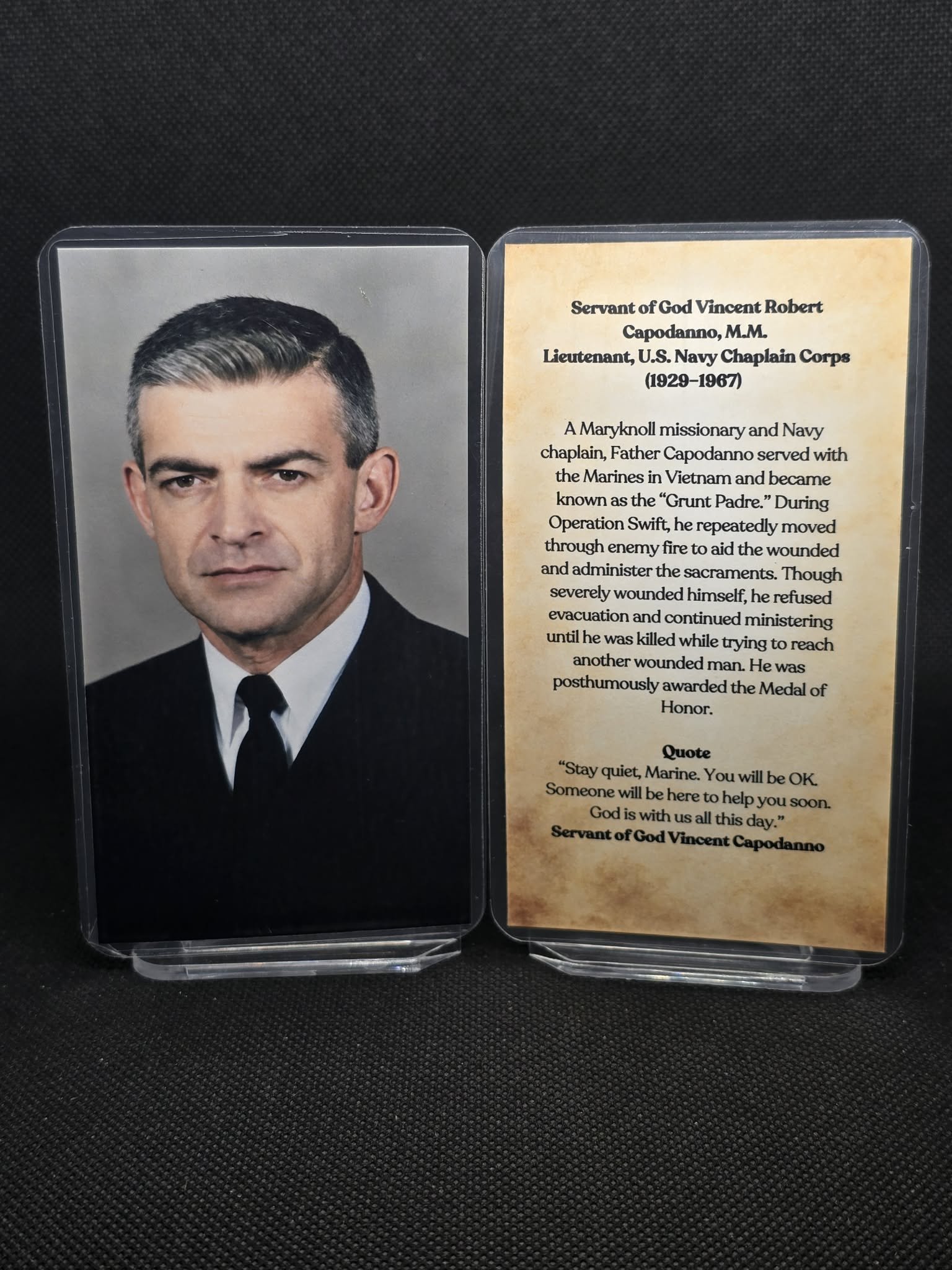
Servant of God Vincent Robert Capodanno, M.M. Prayer Card | “The Grunt Padre,” Navy Chaplain & Medal of Honor Recipient
Servant of God Father Vincent Robert Capodanno, M.M. was a Maryknoll missionary priest, United States Navy chaplain, Vietnam War hero, and posthumous recipient of the Medal of Honor whose priesthood reached its final expression on a battlefield. Known affectionately by the Marines as “The Grunt Padre,” Father Capodanno deliberately remained close to the enlisted men he served, sharing their hardships, accompanying them on dangerous operations, hearing Confessions, celebrating Mass, comforting the frightened, and carrying Christ into places where death could come without warning. On September 4, 1967, during Operation Swift in Vietnam’s Quế Sơn Valley, he repeatedly moved through intense enemy fire to reach wounded and dying Marines until he himself was killed while attempting to help a wounded Navy corpsman.
Father Capodanno is especially meaningful for members of the military, veterans, Marines, Sailors, military chaplains, priests, missionaries, combat medics and corpsmen, families with loved ones deployed, people facing fear or danger, and Christians trying to place the needs of others before their own comfort or safety. His official Guild emphasizes that his witness is not limited to military Catholics because his life presents a universal Christian pattern of humility, self-denial, courage, discernment, and sacrificial love.
His story is particularly powerful for someone asking how a Christian can remain faithful when fear is completely reasonable. Father Capodanno was not courageous because the battlefield was safe or because he did not understand the danger around him; he was courageous because wounded men needed their priest, and his love for them became stronger than the instinct to remain somewhere safer. His Medal of Honor citation records that he left relative safety, crossed ground swept by enemy fire, administered last rites, helped the wounded, continued after suffering serious wounds himself, and finally rushed toward a wounded corpsman under direct machine-gun fire.
He is also an exceptional Catholic witness for military chaplains and priests serving people in dangerous or difficult places. Father Capodanno did not minister from a distance, and the Marines recognized that he wanted to live where they lived, eat what they ate, endure what they endured, and be present when they were frightened or wounded. The nickname “Grunt Padre” grew from that closeness to the ordinary infantrymen entrusted to his spiritual care.
One of the words remembered from the battlefield captures the spirituality associated with Father Capodanno: “Do not be afraid this day, for God is with us.” The Father Vincent Capodanno Guild continues to place this message prominently at the center of his story, connecting his courage not simply with military bravery but with confidence in the presence of God when circumstances are terrifying.
Father Capodanno is currently recognized by the Catholic Church as Servant of God. His cause remains active before the Holy See’s Dicastery for the Causes of Saints, and the Archdiocese for the Military Services continued to identify him officially by that title in August 2026. He has not yet been declared Venerable, Blessed, or Saint, and his proper current ecclesiastical title remains Servant of God Father Vincent Robert Capodanno, M.M.
This prayer card is especially fitting for active-duty service members, veterans, military chaplains, priests, Marines, Sailors, corpsmen, missionaries, seminarians discerning military chaplaincy, families praying for deployed loved ones, and anyone asking God for courage in a dangerous or frightening situation. It can also make a meaningful Confirmation, ordination, commissioning, deployment, retirement, Veterans Day, Memorial Day, military graduation, or Catholic military ministry gift.
Each card is handmade in Austin, TX and created to order. We do not keep stock, because every prayer card is treated as a unique devotional offering. They are printed on museum-quality photo paper, not cardstock, and every card is made slowly during prayer with intentional reverence for the Servant of God and for the person who will receive it. Names and intentions are brought before Christ throughout the process, asking God for mercy and asking for the intercession of Servant of God Father Vincent Capodanno for those who serve, those who suffer, and those who need courage to remain faithful when their own field of battle becomes difficult.
THE LIFE & STORY
Vincent Robert Capodanno was born on February 13, 1929, on Staten Island, New York, into a large Italian-American Catholic family. After graduating from Curtis High School and spending time studying at Fordham University while also working, he entered the Maryknoll seminary in 1949 and began the long formation that would prepare him for missionary priesthood.
Maryknoll, formally the Catholic Foreign Mission Society of America, was founded specifically for missionary work beyond the United States. Vincent therefore entered the priesthood already expecting that his vocation might take him far from home and require sacrifice, cultural adaptation, perseverance, and service among people whose language and customs were different from his own.
He was ordained a priest on June 14, 1958. Rather than remaining in New York, Father Capodanno was assigned to missionary work in Asia, beginning the first major chapter of a priesthood that would eventually carry him from Taiwan and Hong Kong to the battlefields of Vietnam.
MARYKNOLL MISSIONARY IN TAIWAN
Father Capodanno's first missionary assignment brought him to Taiwan, where Maryknoll served communities that included indigenous people living in mountainous regions. His work demanded the ordinary sacrifices of missionary life: learning unfamiliar languages, entering another culture, traveling to scattered communities, teaching the Catholic faith, celebrating the sacraments, and remaining present to people far from the world in which he had grown up.
This period is important because Father Capodanno did not suddenly become self-sacrificing when bullets began flying in Vietnam. Years before becoming a military chaplain, he had already left his family and country to serve people on another side of the world, forming habits of availability and self-denial that would later become visible under far more dramatic circumstances.
His missionary vocation also makes him especially meaningful for missionaries, missionary priests, seminarians, catechists, and Christians serving cultures different from their own. The battlefield would eventually become the setting in which Father Capodanno was best remembered, but his identity remained fundamentally that of a missionary priest bringing Christ wherever he believed he was being sent.
HONG KONG & CONTINUING DISCERNMENT
Father Capodanno later served in Hong Kong, including work connected with a Maryknoll school. His years in Taiwan and Hong Kong together stretched from 1958 until 1965, giving him substantial missionary experience before military chaplaincy ever entered his life.
The official Guild describes Father Capodanno's life as one of constant discernment in following God's will. That description is especially useful because his vocation did not unfold as one simple decision made at ordination; again and again he had to discern whether God was asking him to remain where he was comfortable or move toward another need.
Eventually that discernment led him toward a form of missionary service unlike his previous assignments. American military personnel were fighting and dying in Vietnam, Catholic servicemen needed priests who could accompany them, and Father Capodanno became convinced that his priesthood was being called toward them.
BECOMING A UNITED STATES NAVY CHAPLAIN
Father Capodanno received his commission as a Lieutenant in the United States Navy Chaplain Corps on December 28, 1965. Because Navy chaplains provide religious ministry not only to Sailors but also to Marines, his commission would ultimately place him alongside Marine infantry units in Vietnam.
He underwent military and chaplain training before traveling to Vietnam during Holy Week of 1966. The timing has become particularly meaningful within devotion to him because his military mission began during the Church's annual contemplation of Christ's Passion and would end with Father Capodanno himself laying down his life while serving wounded men.
The transition from missionary priest to Navy chaplain did not replace his missionary identity. Father Capodanno simply found a new mission field, one filled with young Americans living far from home under extraordinary physical and psychological pressure.
THE “GRUNT PADRE”
Father Capodanno quickly became known among Marines as “The Grunt Padre.” In Marine vocabulary, a “grunt” is an infantryman, and the nickname reflected the way Father Capodanno chose to identify himself with the ordinary men in the field rather than remain primarily around headquarters or officer comforts.
Veterans who remembered him described a priest who focused intensely upon the person standing before him. One Marine later recalled the unusual calmness in Father Capodanno's eyes and the feeling that when he spoke with someone, that person had his complete attention.
That attentiveness is part of what made him effective as a chaplain. Combat creates fear, exhaustion, homesickness, grief, moral injury, loneliness, and the constant possibility of sudden death, and Father Capodanno's ministry was built upon being physically present rather than asking frightened men to seek him out somewhere safer.
HIS FIRST TOUR IN VIETNAM
From April 1966 through April 1967, Father Capodanno served with the 1st Battalion, 7th Marines, as well as with the 1st Medical Battalion. During this period he traveled with Marines in the field, celebrated Mass, heard Confessions, offered counsel, distributed religious items, and ministered to the wounded.
His time with medical personnel further exposed him to the terrible cost of combat. A military chaplain accompanying the wounded encounters not only fear before battle but also shattered bodies, dying young men, desperate requests for prayer, and families who will eventually receive news that changes their lives forever.
Rather than making Father Capodanno withdraw from front-line ministry, these experiences appear to have intensified his desire to remain where the Marines needed him most. His priesthood was becoming increasingly shaped by the conviction that the shepherd should be found close to the suffering flock.
HE ASKED TO RETURN
After completing his first Vietnam tour, Father Capodanno could have moved into a safer assignment. Instead, he requested an extension and returned to Vietnam, eventually serving with Marines of the 5th Marine Regiment during the final months of his life.
That decision is crucial for understanding his death because his presence on September 4, 1967 was not simply the result of being trapped in circumstances imposed upon him. Father Capodanno had already experienced Vietnam and understood its dangers when he asked to continue serving there.
His cause is now being pursued through the canonical path known as Oblatio vitae, or the Offer of Life, which concerns a Christian who lived virtuously and freely offered his or her life for others in imitation of Christ. The official Guild identifies this as the path currently being pursued for Father Capodanno.
OPERATION SWIFT
On September 4, 1967, American Marines were fighting North Vietnamese forces during Operation Swift in the Quế Sơn Valley. The fighting became extremely intense, and Marines were in danger of being overwhelmed as enemy small-arms fire, automatic weapons, and mortars struck their positions.
Father Capodanno learned that men were trapped and wounded. Instead of remaining at the relative safety of the command post, he crossed exposed ground under fire and went directly toward them.
This was the final and clearest expression of the ministry that had already defined his chaplaincy. The Marines needed a priest, and Father Capodanno went to them.
ADMINISTERING THE SACRAMENTS UNDER FIRE
The Medal of Honor citation records that Father Capodanno moved around the battlefield administering last rites to the dying and giving medical assistance to the wounded despite intense enemy fire. He was unarmed, carrying no weapon with which to protect himself, and his purpose for moving toward the fighting was pastoral and humanitarian.
For Catholics, the image of a priest administering the final sacraments in combat is especially powerful. A Marine who believed he might be only minutes from death could receive absolution, prayer, spiritual consolation, and the presence of a priest who refused to abandon him at the moment he most needed Christ.
Father Capodanno therefore became more than someone who spoke about courage from safety. His sacramental ministry required him physically to cross the battlefield and kneel beside wounded men while the same fire that had struck them continued around him.
WOUNDED BUT REFUSING TO LEAVE
During the battle, an exploding mortar round inflicted serious wounds upon Father Capodanno's arms and legs and severed part of his right hand. The Medal of Honor citation states that he nevertheless refused medical aid, directing corpsmen instead to care for other wounded men.
He then continued moving among the Marines, encouraging them and ministering to them despite his own injuries. His courage was therefore not confined to an initial rush into danger because he had a clear opportunity to stop after being seriously wounded and chose instead to remain with the men.
This makes him particularly meaningful for military medics, Navy corpsmen, emergency personnel, caregivers, and anyone whose vocation requires caring for others while personally exhausted or afraid. His example should never be used to discourage appropriate medical care, but it powerfully expresses the Christian instinct to ask first who else still needs help.
“GOD IS WITH US”
One testimony remembered from the battle recounts Father Capodanno calming a wounded Marine and assuring him of God's presence. The official Guild summarizes the spiritual message associated with him in the words “Do not be afraid this day, for God is with us.”
Those words are particularly striking because they were not spoken from a comfortable chapel. God was being proclaimed present amid gunfire, blood, terror, and death, precisely where a frightened person might be tempted to believe that God had disappeared.
For someone facing deployment, combat, emergency surgery, terminal illness, a dangerous occupation, or another frightening circumstance, Father Capodanno's witness therefore does not promise that nothing painful will happen. It offers something different: the Christian conviction that danger cannot make God absent.
HIS FINAL ACT
Father Capodanno eventually encountered a wounded Navy corpsman exposed near an enemy machine-gun position. Though already badly injured himself, he rushed toward the corpsman in an attempt to help him.
Only inches from reaching the wounded man, Father Capodanno was struck by a burst of machine-gun fire and killed. He was thirty-eight years old.
The final movement of his life was therefore toward another wounded person. His priesthood, missionary vocation, chaplaincy, and Christian faith all converged in an act that mirrors Christ's words about the greatest love being the willingness to lay down one's life for another.
THE MEDAL OF HONOR
Father Capodanno was posthumously awarded the Medal of Honor, the United States' highest military decoration for valor. The award was formally presented on January 7, 1969, recognizing his conspicuous gallantry and self-sacrifice during the battle in which he died.
His citation emphasizes that he acted above and beyond the call of duty, repeatedly exposing himself to enemy fire, caring for wounded Marines, refusing treatment for himself, and finally dying while attempting to reach a wounded corpsman.
Father Capodanno therefore occupies an unusual place in both Catholic and American military history. His Medal of Honor was awarded for actions inseparable from his priesthood because the courage being honored was exercised while bringing sacramental, spiritual, and medical assistance to others.
A PRIEST WITHOUT A WEAPON
Military chaplains accompany armed forces while serving in a noncombatant religious role. Father Capodanno's courage is especially striking because he entered lethal danger not to attack the enemy but to reach men who were frightened, wounded, or dying.
His battlefield ministry provides a powerful image of Catholic priesthood. Where others understandably sought cover, the priest moved toward those whose need for Confession, last rites, reassurance, and human companionship had suddenly become urgent.
For priests and seminarians, Father Capodanno therefore offers a demanding model of spiritual fatherhood. The shepherd's place is not always where he is safest; sometimes his people need him precisely where suffering is greatest.
FATHER CAPODANNO & MILITARY CHAPLAINS
Father Capodanno has become one of the most important modern Catholic witnesses associated with American military chaplaincy. The Archdiocese for the Military Services regularly presents his story to men discerning chaplaincy and continues to promote his cause for canonization.
His example illustrates that chaplaincy involves much more than celebrating Sunday Mass on a military installation. Military priests accompany Catholics through deployment, separation from family, moral decisions, traumatic injury, fear of death, bereavement, Confession, and the unique spiritual burdens carried by those who serve in war.
A seminarian or priest discerning military chaplaincy can therefore ask Father Capodanno's intercession for courage, discernment, generosity, and the ability to remain close to those entrusted to his pastoral care.
FATHER CAPODANNO & MARINES
Although he was commissioned as a United States Navy chaplain, Father Capodanno is inseparably associated with the United States Marine Corps because Navy chaplains provide pastoral care to Marines. The troops who called him “The Grunt Padre” were recognizing a priest who had made their hardships his own.
This makes his prayer card especially fitting for Marines and Marine families. His life expresses many of the virtues Marines themselves traditionally honor, including courage, loyalty, endurance, willingness to sacrifice for one's comrades, and refusal to abandon someone under fire.
For a Catholic Marine, however, Father Capodanno adds something specifically spiritual to those virtues. Courage is directed toward charity, loyalty becomes pastoral presence, and sacrifice becomes an imitation of Christ.
FATHER CAPODANNO & NAVY CORPSMEN
Father Capodanno's final attempt to help another person was directed toward a wounded Navy hospital corpsman. This gives his story an especially poignant relationship with corpsmen, who themselves enter danger in order to treat wounded Marines and Sailors.
The priest and corpsman represent two different forms of healing present on the battlefield. One attends primarily to the body while the other attends sacramentally to the soul, yet both move toward the wounded when instinct might tell everyone else to move away.
A prayer card of Father Capodanno can therefore make an especially meaningful gift for a Catholic Navy corpsman, combat medic, military nurse, physician, or emergency caregiver.
MISSIONARIES & THOSE CALLED FAR FROM HOME
Before Vietnam, Father Capodanno had already spent years far from Staten Island serving the Church in Taiwan and Hong Kong. His life therefore belongs as much to the missionary history of Maryknoll as it does to American military history.
Missionary life taught him to leave familiar surroundings in order to go where people needed a priest. Vietnam eventually demanded that same willingness in its most extreme form.
Missionaries, overseas workers, priests beginning foreign assignments, and families separated by mission or military service can therefore find in him an intercessor whose entire adult vocation was shaped by going where he believed God was calling him.
COURAGE WITHOUT HATRED
Father Capodanno's heroism should not be understood as enthusiasm for violence. He was a priest whose battlefield role was to console, absolve, pray, encourage, and care for the wounded, not to inflict injury.
That distinction makes his life particularly important when discussing Christian military service. His courage existed amid war while remaining directed toward mercy, human dignity, sacramental care, and love for those immediately entrusted to him.
The official Guild describes him as a priest who “radiated Christ” to those he served and interprets his death as an act of heroic love in imitation of Christ.
THE OFFER OF LIFE
The Father Vincent Capodanno Guild currently states that his cause is being pursued through the path known as Offer of Life, or Oblatio vitae. This canonical path concerns a person who lived Christian virtue and freely offered his or her life for others in imitation of Jesus Christ.
The category fits the central question raised by his final years: not simply whether Father Capodanno happened to die in combat, but whether the trajectory of his life shows a deliberate willingness to give himself for the people entrusted to him.
His return to Vietnam, his insistence upon remaining close to infantry Marines, his repeated movement toward the wounded, his refusal of treatment while others still needed help, and his final rush toward the corpsman form a coherent pattern of self-offering rather than an isolated moment of bravery.
THE CAUSE FOR CANONIZATION
The Church publicly recognized Father Vincent Capodanno as Servant of God in May 2006, formally placing his life within the canonization process. A diocesan tribunal later gathered testimony and documentation, and the archdiocesan phase of the cause closed in 2017 before the materials were sent to Rome.
His Positio, the extensive document presenting the case concerning his life and virtues, was printed and presented to the Dicastery for the Causes of Saints in March 2020. In 2022 theological consultants requested additional investigation, and the Guild subsequently assembled further historical material answering the questions that had been raised.
By 2025 the Guild reported continued work with its postulator in Rome, and by late 2025 Archbishop Timothy Broglio had met with the Prefect of the Dicastery, with a new group of theological consultants expected to consider the case.
The cause remains active in 2026. In March 2026 Archbishop Broglio encouraged the faithful to join an approved novena specifically for advancement of the cause, and the Archdiocese for the Military Services continued publicly identifying Father Capodanno as Servant of God in August 2026.
WHY HE IS STILL CALLED SERVANT OF GOD
Father Capodanno has not yet been declared Venerable, despite older articles discussing that as the hoped-for next stage of his cause. His proper current title in September 2026 remains Servant of God Father Vincent Robert Capodanno, M.M.
Catholics may support his cause, ask for his intercession, learn from his heroic life, and pray for his advancement while remaining faithful to the Church's present judgment concerning his canonical status.
If the Dicastery's review eventually leads to papal recognition under the applicable canonical path, his title could change. Until that occurs, Servant of God remains his ecclesiastical title.
REPORTED FAVORS & HEALINGS
Since Father Capodanno's death, people have reported favors after asking for his intercession. The Archdiocese for the Military Services has publicly noted such reports and has encouraged anyone who believes they have received a favor through Father Capodanno's intercession to contact the official Guild.
One widely discussed case involved the recovery of a Vietnamese religious sister suffering from advanced cancer. Accounts surrounding the cause have described the recovery as lacking an apparent medical explanation and as one of the cases connected with prayers for Father Capodanno's intercession.
These remain reported favors or alleged miraculous healings unless and until the Church formally recognizes a particular event as miraculous. The distinction reflects the rigorous medical and theological process through which the Catholic Church examines claims of miraculous healing.
HIS GRAVE
Father Capodanno was buried at Saint Peter's Cemetery on Staten Island, New York, following his Requiem Mass on September 19, 1967. His burial place remains an important location for people devoted to his memory and cause.
Pilgrims who visit can pray for the repose of his soul, for advancement of his cause, for military personnel and chaplains, and for favors through his intercession. Because he remains a Servant of God rather than a canonized saint, the Church's approved cause prayers provide an especially appropriate devotional framework.
SEPTEMBER 4 & HIS MEMORIAL MASS
Father Capodanno died on September 4, 1967, and the anniversary of his death has become the principal date on which his life is publicly remembered. The Archdiocese for the Military Services celebrates an annual Memorial Mass in his honor and for the repose of his soul at the Basilica of the National Shrine of the Immaculate Conception in Washington, D.C.
In 2026 that Mass was scheduled for September 3 because of the calendar, while the historical anniversary itself remains September 4. Father Capodanno does not currently have an official universal Catholic feast day because he has not yet been beatified or canonized.
For private devotion, September 4 is an especially fitting day to pray for his cause, for military chaplains, for those currently deployed, and for servicemen and women who have died.
PRAYERS
The Father Vincent Capodanno Guild, the official organization promoting his cause, publishes an approved Prayer to Obtain a Favor Through the Intercession of Servant of God Father Vincent R. Capodanno, M.M. written by Archbishop Timothy P. Broglio. The prayer asks Almighty God to hear those seeking help and, through Father Capodanno's intercession, to grant the favor being requested.
The printed prayer issued for the cause carries Archbishop Broglio's imprimatur and comes directly from the official organization promoting Father Capodanno's cause.
Father Daniel Mode, author of The Grunt Padre, has also written a prayer asking God for help through Father Capodanno's intercession and drawing a beautiful connection between the battlefields on which Father Capodanno served and the personal “field of battle” faced by the person praying.
In 2026 the Guild additionally published a novena approved and encouraged by Archbishop Broglio. Its themes include faith, hope, charity, prudence, justice, fortitude, temperance, humility, pastoral love, and willingness to make daily sacrifices for those entrusted to our care, all virtues the Guild sees reflected in Father Capodanno's life.
FAQ
Who was Servant of God Vincent Robert Capodanno? Father Vincent Capodanno was a Maryknoll missionary priest and U.S. Navy chaplain who served Marines during the Vietnam War. He was killed on September 4, 1967 while moving through intense enemy fire to minister to wounded and dying Marines, and he later received the Medal of Honor posthumously.
Why was Father Capodanno called “The Grunt Padre”? Marines called him the Grunt Padre because he deliberately stayed close to ordinary infantrymen, or “grunts,” sharing their hardships and accompanying them into the field. The nickname expresses the unusual closeness between the chaplain and the enlisted Marines he served.
Was Father Capodanno a Marine? No, Father Capodanno was a lieutenant in the United States Navy Chaplain Corps. Navy chaplains also provide religious ministry to Marines, which is why so much of his military service occurred with Marine units.
Was Father Capodanno a military chaplain? Yes, he was commissioned in the U.S. Navy Chaplain Corps in December 1965 and arrived in Vietnam during Holy Week of 1966. His chaplaincy placed him directly alongside Marines during combat operations.
Was Father Capodanno a missionary before joining the Navy? Yes, he was a member of the Maryknoll Fathers and Brothers and served as a missionary in Taiwan and Hong Kong from 1958 until 1965. His military chaplaincy was therefore a continuation of a priesthood already formed through missionary service far from home.
When was Father Vincent Capodanno ordained? He was ordained to the Catholic priesthood on June 14, 1958. Soon afterward he left the United States for missionary work in Asia.
When was Father Capodanno born? Vincent Robert Capodanno was born on February 13, 1929, on Staten Island, New York. He grew up in an Italian-American Catholic family before eventually entering Maryknoll formation.
When did Father Capodanno die? He was killed on September 4, 1967, during Operation Swift in Vietnam's Quế Sơn Valley. He was thirty-eight years old.
How did Father Capodanno die? After already being wounded by mortar fire, Father Capodanno continued ministering to wounded Marines. He was killed by machine-gun fire while rushing toward a wounded Navy corpsman who needed help.
Did Father Capodanno receive the Medal of Honor? Yes, he received the Medal of Honor posthumously for his actions on September 4, 1967. The award was formally presented in January 1969.
Why did Father Capodanno receive the Medal of Honor? His citation describes him repeatedly exposing himself to enemy fire in order to administer last rites, aid wounded Marines, encourage the men, and attempt to rescue a wounded corpsman. He continued serving others even after suffering serious wounds himself.
Did Father Capodanno carry a weapon? As a Navy chaplain, his battlefield ministry was religious rather than combatant. His actions during Operation Swift involved administering sacraments, comforting the wounded, providing assistance, and remaining with Marines under fire.
Can Marines pray through Father Capodanno's intercession? Yes, Catholics may privately ask for the intercession of a Servant of God, and Father Capodanno's life has an especially strong connection with Marines. The official cause itself distributes approved prayers asking for favors through his intercession.
Can Sailors and Navy personnel pray through Father Capodanno's intercession? Yes, Father Capodanno himself was a Navy lieutenant and chaplain. His story is particularly meaningful for Sailors, Navy chaplains, corpsmen, and families connected with naval service.
Is Father Capodanno a patron saint of military chaplains? No. Father Capodanno has not yet been canonized and has not received a formal patron-saint designation. He nevertheless has an especially strong devotional connection with military chaplains and those discerning chaplaincy because that vocation formed the final chapter of his life.
Is Father Capodanno a saint? Not yet. As of September 2026, the Catholic Church officially recognizes him as Servant of God, and his cause remains under consideration by the Dicastery for the Causes of Saints.
Is Father Capodanno Venerable? No, not as of September 2026. “Venerable” has been discussed as a hoped-for future stage of his cause, but the Archdiocese for the Military Services still officially identifies him as Servant of God.
Why did Father Capodanno's canonization cause encounter delays? Theological consultants reviewing his Positio requested additional information in 2022, leading to further historical research and supplemental material. The official Guild reports that this work was completed and sent toward Rome for continued consideration rather than the cause simply being abandoned.
Is Father Capodanno's cause still active? Yes. The Archdiocese for the Military Services and the official Father Vincent Capodanno Guild were actively promoting and praying for advancement of the cause throughout 2026.
What path to sainthood is being pursued for Father Capodanno? The official Guild says it is currently pursuing the Offer of Life, or Oblatio vitae path. This path concerns a virtuous Christian who freely offered his or her life for others in imitation of Christ.
Are there reported miracles connected with Father Capodanno? There have been reports of favors and extraordinary healings following prayers for his intercession. These remain reported or alleged miracles unless the Catholic Church formally recognizes a particular case after investigation.
Is there an official prayer to Father Capodanno? Yes, the official Guild publishes a Prayer to Obtain a Favor Through the Intercession of Servant of God Father Vincent R. Capodanno, M.M. written by Archbishop Timothy Broglio. The printed version carries his imprimatur.
Is there a Father Capodanno novena? Yes, the official Guild provides a novena for advancement of his cause. Archbishop Broglio publicly encouraged participation in that novena in 2026.
Where is Father Capodanno buried? He is buried at Saint Peter's Cemetery on Staten Island, New York. His burial followed a Requiem Mass held on September 19, 1967.
Does Father Capodanno have a feast day? He does not currently have an official universal Catholic feast day because he has not been beatified or canonized. September 4, the anniversary of his death, is nevertheless the principal date associated with memorial Masses and private devotion to his cause.
Is Father Capodanno good for a military prayer card? Yes, especially for Marines, Sailors, military chaplains, veterans, corpsmen, deployed service members, and military families. His life combines missionary priesthood, battlefield courage, sacramental ministry, loyalty to those entrusted to him, and a final act of self-sacrifice.
Can someone pray through Father Capodanno's intercession for courage? Yes, courage is one of the clearest virtues visible in his life and death. The official 2026 novena specifically reflects upon fortitude, faith, hope, charity, humility, and service to those entrusted to our care.
Can someone pray through Father Capodanno's intercession before deployment? Yes, that is a very natural private devotion given his military chaplaincy and battlefield ministry. A service member can ask God for courage, protection, fidelity, wise judgment, and the grace never to forget God's presence during deployment.
Can military families pray through Father Capodanno's intercession? Yes, especially when a loved one is deployed, serving in danger, struggling after combat, or discerning a military vocation. His life gives military families a Catholic figure who understood firsthand the spiritual and physical realities of service.
Can priests pray through Father Capodanno's intercession? Yes, and his example is particularly powerful for priests because his final actions were inseparable from his priesthood. He died while bringing sacramental and pastoral care to people who needed a priest immediately.
Can missionaries pray through Father Capodanno's intercession? Yes, because he spent years as a Maryknoll missionary in Taiwan and Hong Kong before entering military chaplaincy. Missionary identity remained central to who he was throughout his priesthood.
Why is Father Capodanno's story important today? His life demonstrates a form of Christianity centered upon going toward the person who needs help rather than protecting one's own comfort. His official Guild presents him as an example not only for military personnel but for every Christian called to humility, self-denial, discernment, courage, and generous love.
What is the central message of Father Vincent Capodanno's life? Father Capodanno's life shows what can happen when a Christian repeatedly chooses to be present wherever another person most needs Christ. He left home for missionary work, left safer assignments for Vietnam, remained close to ordinary Marines, moved toward wounded men under fire, continued serving after he was wounded himself, and finally died trying to reach one more man who needed help. His witness is therefore not merely a story of military heroism but a profoundly Catholic image of a priest and missionary who spent his life learning how to give himself away.
Servant of God Father Vincent Robert Capodanno, M.M. was a Maryknoll missionary priest, United States Navy chaplain, Vietnam War hero, and posthumous recipient of the Medal of Honor whose priesthood reached its final expression on a battlefield. Known affectionately by the Marines as “The Grunt Padre,” Father Capodanno deliberately remained close to the enlisted men he served, sharing their hardships, accompanying them on dangerous operations, hearing Confessions, celebrating Mass, comforting the frightened, and carrying Christ into places where death could come without warning. On September 4, 1967, during Operation Swift in Vietnam’s Quế Sơn Valley, he repeatedly moved through intense enemy fire to reach wounded and dying Marines until he himself was killed while attempting to help a wounded Navy corpsman.
Father Capodanno is especially meaningful for members of the military, veterans, Marines, Sailors, military chaplains, priests, missionaries, combat medics and corpsmen, families with loved ones deployed, people facing fear or danger, and Christians trying to place the needs of others before their own comfort or safety. His official Guild emphasizes that his witness is not limited to military Catholics because his life presents a universal Christian pattern of humility, self-denial, courage, discernment, and sacrificial love.
His story is particularly powerful for someone asking how a Christian can remain faithful when fear is completely reasonable. Father Capodanno was not courageous because the battlefield was safe or because he did not understand the danger around him; he was courageous because wounded men needed their priest, and his love for them became stronger than the instinct to remain somewhere safer. His Medal of Honor citation records that he left relative safety, crossed ground swept by enemy fire, administered last rites, helped the wounded, continued after suffering serious wounds himself, and finally rushed toward a wounded corpsman under direct machine-gun fire.
He is also an exceptional Catholic witness for military chaplains and priests serving people in dangerous or difficult places. Father Capodanno did not minister from a distance, and the Marines recognized that he wanted to live where they lived, eat what they ate, endure what they endured, and be present when they were frightened or wounded. The nickname “Grunt Padre” grew from that closeness to the ordinary infantrymen entrusted to his spiritual care.
One of the words remembered from the battlefield captures the spirituality associated with Father Capodanno: “Do not be afraid this day, for God is with us.” The Father Vincent Capodanno Guild continues to place this message prominently at the center of his story, connecting his courage not simply with military bravery but with confidence in the presence of God when circumstances are terrifying.
Father Capodanno is currently recognized by the Catholic Church as Servant of God. His cause remains active before the Holy See’s Dicastery for the Causes of Saints, and the Archdiocese for the Military Services continued to identify him officially by that title in August 2026. He has not yet been declared Venerable, Blessed, or Saint, and his proper current ecclesiastical title remains Servant of God Father Vincent Robert Capodanno, M.M.
This prayer card is especially fitting for active-duty service members, veterans, military chaplains, priests, Marines, Sailors, corpsmen, missionaries, seminarians discerning military chaplaincy, families praying for deployed loved ones, and anyone asking God for courage in a dangerous or frightening situation. It can also make a meaningful Confirmation, ordination, commissioning, deployment, retirement, Veterans Day, Memorial Day, military graduation, or Catholic military ministry gift.
Each card is handmade in Austin, TX and created to order. We do not keep stock, because every prayer card is treated as a unique devotional offering. They are printed on museum-quality photo paper, not cardstock, and every card is made slowly during prayer with intentional reverence for the Servant of God and for the person who will receive it. Names and intentions are brought before Christ throughout the process, asking God for mercy and asking for the intercession of Servant of God Father Vincent Capodanno for those who serve, those who suffer, and those who need courage to remain faithful when their own field of battle becomes difficult.
THE LIFE & STORY
Vincent Robert Capodanno was born on February 13, 1929, on Staten Island, New York, into a large Italian-American Catholic family. After graduating from Curtis High School and spending time studying at Fordham University while also working, he entered the Maryknoll seminary in 1949 and began the long formation that would prepare him for missionary priesthood.
Maryknoll, formally the Catholic Foreign Mission Society of America, was founded specifically for missionary work beyond the United States. Vincent therefore entered the priesthood already expecting that his vocation might take him far from home and require sacrifice, cultural adaptation, perseverance, and service among people whose language and customs were different from his own.
He was ordained a priest on June 14, 1958. Rather than remaining in New York, Father Capodanno was assigned to missionary work in Asia, beginning the first major chapter of a priesthood that would eventually carry him from Taiwan and Hong Kong to the battlefields of Vietnam.
MARYKNOLL MISSIONARY IN TAIWAN
Father Capodanno's first missionary assignment brought him to Taiwan, where Maryknoll served communities that included indigenous people living in mountainous regions. His work demanded the ordinary sacrifices of missionary life: learning unfamiliar languages, entering another culture, traveling to scattered communities, teaching the Catholic faith, celebrating the sacraments, and remaining present to people far from the world in which he had grown up.
This period is important because Father Capodanno did not suddenly become self-sacrificing when bullets began flying in Vietnam. Years before becoming a military chaplain, he had already left his family and country to serve people on another side of the world, forming habits of availability and self-denial that would later become visible under far more dramatic circumstances.
His missionary vocation also makes him especially meaningful for missionaries, missionary priests, seminarians, catechists, and Christians serving cultures different from their own. The battlefield would eventually become the setting in which Father Capodanno was best remembered, but his identity remained fundamentally that of a missionary priest bringing Christ wherever he believed he was being sent.
HONG KONG & CONTINUING DISCERNMENT
Father Capodanno later served in Hong Kong, including work connected with a Maryknoll school. His years in Taiwan and Hong Kong together stretched from 1958 until 1965, giving him substantial missionary experience before military chaplaincy ever entered his life.
The official Guild describes Father Capodanno's life as one of constant discernment in following God's will. That description is especially useful because his vocation did not unfold as one simple decision made at ordination; again and again he had to discern whether God was asking him to remain where he was comfortable or move toward another need.
Eventually that discernment led him toward a form of missionary service unlike his previous assignments. American military personnel were fighting and dying in Vietnam, Catholic servicemen needed priests who could accompany them, and Father Capodanno became convinced that his priesthood was being called toward them.
BECOMING A UNITED STATES NAVY CHAPLAIN
Father Capodanno received his commission as a Lieutenant in the United States Navy Chaplain Corps on December 28, 1965. Because Navy chaplains provide religious ministry not only to Sailors but also to Marines, his commission would ultimately place him alongside Marine infantry units in Vietnam.
He underwent military and chaplain training before traveling to Vietnam during Holy Week of 1966. The timing has become particularly meaningful within devotion to him because his military mission began during the Church's annual contemplation of Christ's Passion and would end with Father Capodanno himself laying down his life while serving wounded men.
The transition from missionary priest to Navy chaplain did not replace his missionary identity. Father Capodanno simply found a new mission field, one filled with young Americans living far from home under extraordinary physical and psychological pressure.
THE “GRUNT PADRE”
Father Capodanno quickly became known among Marines as “The Grunt Padre.” In Marine vocabulary, a “grunt” is an infantryman, and the nickname reflected the way Father Capodanno chose to identify himself with the ordinary men in the field rather than remain primarily around headquarters or officer comforts.
Veterans who remembered him described a priest who focused intensely upon the person standing before him. One Marine later recalled the unusual calmness in Father Capodanno's eyes and the feeling that when he spoke with someone, that person had his complete attention.
That attentiveness is part of what made him effective as a chaplain. Combat creates fear, exhaustion, homesickness, grief, moral injury, loneliness, and the constant possibility of sudden death, and Father Capodanno's ministry was built upon being physically present rather than asking frightened men to seek him out somewhere safer.
HIS FIRST TOUR IN VIETNAM
From April 1966 through April 1967, Father Capodanno served with the 1st Battalion, 7th Marines, as well as with the 1st Medical Battalion. During this period he traveled with Marines in the field, celebrated Mass, heard Confessions, offered counsel, distributed religious items, and ministered to the wounded.
His time with medical personnel further exposed him to the terrible cost of combat. A military chaplain accompanying the wounded encounters not only fear before battle but also shattered bodies, dying young men, desperate requests for prayer, and families who will eventually receive news that changes their lives forever.
Rather than making Father Capodanno withdraw from front-line ministry, these experiences appear to have intensified his desire to remain where the Marines needed him most. His priesthood was becoming increasingly shaped by the conviction that the shepherd should be found close to the suffering flock.
HE ASKED TO RETURN
After completing his first Vietnam tour, Father Capodanno could have moved into a safer assignment. Instead, he requested an extension and returned to Vietnam, eventually serving with Marines of the 5th Marine Regiment during the final months of his life.
That decision is crucial for understanding his death because his presence on September 4, 1967 was not simply the result of being trapped in circumstances imposed upon him. Father Capodanno had already experienced Vietnam and understood its dangers when he asked to continue serving there.
His cause is now being pursued through the canonical path known as Oblatio vitae, or the Offer of Life, which concerns a Christian who lived virtuously and freely offered his or her life for others in imitation of Christ. The official Guild identifies this as the path currently being pursued for Father Capodanno.
OPERATION SWIFT
On September 4, 1967, American Marines were fighting North Vietnamese forces during Operation Swift in the Quế Sơn Valley. The fighting became extremely intense, and Marines were in danger of being overwhelmed as enemy small-arms fire, automatic weapons, and mortars struck their positions.
Father Capodanno learned that men were trapped and wounded. Instead of remaining at the relative safety of the command post, he crossed exposed ground under fire and went directly toward them.
This was the final and clearest expression of the ministry that had already defined his chaplaincy. The Marines needed a priest, and Father Capodanno went to them.
ADMINISTERING THE SACRAMENTS UNDER FIRE
The Medal of Honor citation records that Father Capodanno moved around the battlefield administering last rites to the dying and giving medical assistance to the wounded despite intense enemy fire. He was unarmed, carrying no weapon with which to protect himself, and his purpose for moving toward the fighting was pastoral and humanitarian.
For Catholics, the image of a priest administering the final sacraments in combat is especially powerful. A Marine who believed he might be only minutes from death could receive absolution, prayer, spiritual consolation, and the presence of a priest who refused to abandon him at the moment he most needed Christ.
Father Capodanno therefore became more than someone who spoke about courage from safety. His sacramental ministry required him physically to cross the battlefield and kneel beside wounded men while the same fire that had struck them continued around him.
WOUNDED BUT REFUSING TO LEAVE
During the battle, an exploding mortar round inflicted serious wounds upon Father Capodanno's arms and legs and severed part of his right hand. The Medal of Honor citation states that he nevertheless refused medical aid, directing corpsmen instead to care for other wounded men.
He then continued moving among the Marines, encouraging them and ministering to them despite his own injuries. His courage was therefore not confined to an initial rush into danger because he had a clear opportunity to stop after being seriously wounded and chose instead to remain with the men.
This makes him particularly meaningful for military medics, Navy corpsmen, emergency personnel, caregivers, and anyone whose vocation requires caring for others while personally exhausted or afraid. His example should never be used to discourage appropriate medical care, but it powerfully expresses the Christian instinct to ask first who else still needs help.
“GOD IS WITH US”
One testimony remembered from the battle recounts Father Capodanno calming a wounded Marine and assuring him of God's presence. The official Guild summarizes the spiritual message associated with him in the words “Do not be afraid this day, for God is with us.”
Those words are particularly striking because they were not spoken from a comfortable chapel. God was being proclaimed present amid gunfire, blood, terror, and death, precisely where a frightened person might be tempted to believe that God had disappeared.
For someone facing deployment, combat, emergency surgery, terminal illness, a dangerous occupation, or another frightening circumstance, Father Capodanno's witness therefore does not promise that nothing painful will happen. It offers something different: the Christian conviction that danger cannot make God absent.
HIS FINAL ACT
Father Capodanno eventually encountered a wounded Navy corpsman exposed near an enemy machine-gun position. Though already badly injured himself, he rushed toward the corpsman in an attempt to help him.
Only inches from reaching the wounded man, Father Capodanno was struck by a burst of machine-gun fire and killed. He was thirty-eight years old.
The final movement of his life was therefore toward another wounded person. His priesthood, missionary vocation, chaplaincy, and Christian faith all converged in an act that mirrors Christ's words about the greatest love being the willingness to lay down one's life for another.
THE MEDAL OF HONOR
Father Capodanno was posthumously awarded the Medal of Honor, the United States' highest military decoration for valor. The award was formally presented on January 7, 1969, recognizing his conspicuous gallantry and self-sacrifice during the battle in which he died.
His citation emphasizes that he acted above and beyond the call of duty, repeatedly exposing himself to enemy fire, caring for wounded Marines, refusing treatment for himself, and finally dying while attempting to reach a wounded corpsman.
Father Capodanno therefore occupies an unusual place in both Catholic and American military history. His Medal of Honor was awarded for actions inseparable from his priesthood because the courage being honored was exercised while bringing sacramental, spiritual, and medical assistance to others.
A PRIEST WITHOUT A WEAPON
Military chaplains accompany armed forces while serving in a noncombatant religious role. Father Capodanno's courage is especially striking because he entered lethal danger not to attack the enemy but to reach men who were frightened, wounded, or dying.
His battlefield ministry provides a powerful image of Catholic priesthood. Where others understandably sought cover, the priest moved toward those whose need for Confession, last rites, reassurance, and human companionship had suddenly become urgent.
For priests and seminarians, Father Capodanno therefore offers a demanding model of spiritual fatherhood. The shepherd's place is not always where he is safest; sometimes his people need him precisely where suffering is greatest.
FATHER CAPODANNO & MILITARY CHAPLAINS
Father Capodanno has become one of the most important modern Catholic witnesses associated with American military chaplaincy. The Archdiocese for the Military Services regularly presents his story to men discerning chaplaincy and continues to promote his cause for canonization.
His example illustrates that chaplaincy involves much more than celebrating Sunday Mass on a military installation. Military priests accompany Catholics through deployment, separation from family, moral decisions, traumatic injury, fear of death, bereavement, Confession, and the unique spiritual burdens carried by those who serve in war.
A seminarian or priest discerning military chaplaincy can therefore ask Father Capodanno's intercession for courage, discernment, generosity, and the ability to remain close to those entrusted to his pastoral care.
FATHER CAPODANNO & MARINES
Although he was commissioned as a United States Navy chaplain, Father Capodanno is inseparably associated with the United States Marine Corps because Navy chaplains provide pastoral care to Marines. The troops who called him “The Grunt Padre” were recognizing a priest who had made their hardships his own.
This makes his prayer card especially fitting for Marines and Marine families. His life expresses many of the virtues Marines themselves traditionally honor, including courage, loyalty, endurance, willingness to sacrifice for one's comrades, and refusal to abandon someone under fire.
For a Catholic Marine, however, Father Capodanno adds something specifically spiritual to those virtues. Courage is directed toward charity, loyalty becomes pastoral presence, and sacrifice becomes an imitation of Christ.
FATHER CAPODANNO & NAVY CORPSMEN
Father Capodanno's final attempt to help another person was directed toward a wounded Navy hospital corpsman. This gives his story an especially poignant relationship with corpsmen, who themselves enter danger in order to treat wounded Marines and Sailors.
The priest and corpsman represent two different forms of healing present on the battlefield. One attends primarily to the body while the other attends sacramentally to the soul, yet both move toward the wounded when instinct might tell everyone else to move away.
A prayer card of Father Capodanno can therefore make an especially meaningful gift for a Catholic Navy corpsman, combat medic, military nurse, physician, or emergency caregiver.
MISSIONARIES & THOSE CALLED FAR FROM HOME
Before Vietnam, Father Capodanno had already spent years far from Staten Island serving the Church in Taiwan and Hong Kong. His life therefore belongs as much to the missionary history of Maryknoll as it does to American military history.
Missionary life taught him to leave familiar surroundings in order to go where people needed a priest. Vietnam eventually demanded that same willingness in its most extreme form.
Missionaries, overseas workers, priests beginning foreign assignments, and families separated by mission or military service can therefore find in him an intercessor whose entire adult vocation was shaped by going where he believed God was calling him.
COURAGE WITHOUT HATRED
Father Capodanno's heroism should not be understood as enthusiasm for violence. He was a priest whose battlefield role was to console, absolve, pray, encourage, and care for the wounded, not to inflict injury.
That distinction makes his life particularly important when discussing Christian military service. His courage existed amid war while remaining directed toward mercy, human dignity, sacramental care, and love for those immediately entrusted to him.
The official Guild describes him as a priest who “radiated Christ” to those he served and interprets his death as an act of heroic love in imitation of Christ.
THE OFFER OF LIFE
The Father Vincent Capodanno Guild currently states that his cause is being pursued through the path known as Offer of Life, or Oblatio vitae. This canonical path concerns a person who lived Christian virtue and freely offered his or her life for others in imitation of Jesus Christ.
The category fits the central question raised by his final years: not simply whether Father Capodanno happened to die in combat, but whether the trajectory of his life shows a deliberate willingness to give himself for the people entrusted to him.
His return to Vietnam, his insistence upon remaining close to infantry Marines, his repeated movement toward the wounded, his refusal of treatment while others still needed help, and his final rush toward the corpsman form a coherent pattern of self-offering rather than an isolated moment of bravery.
THE CAUSE FOR CANONIZATION
The Church publicly recognized Father Vincent Capodanno as Servant of God in May 2006, formally placing his life within the canonization process. A diocesan tribunal later gathered testimony and documentation, and the archdiocesan phase of the cause closed in 2017 before the materials were sent to Rome.
His Positio, the extensive document presenting the case concerning his life and virtues, was printed and presented to the Dicastery for the Causes of Saints in March 2020. In 2022 theological consultants requested additional investigation, and the Guild subsequently assembled further historical material answering the questions that had been raised.
By 2025 the Guild reported continued work with its postulator in Rome, and by late 2025 Archbishop Timothy Broglio had met with the Prefect of the Dicastery, with a new group of theological consultants expected to consider the case.
The cause remains active in 2026. In March 2026 Archbishop Broglio encouraged the faithful to join an approved novena specifically for advancement of the cause, and the Archdiocese for the Military Services continued publicly identifying Father Capodanno as Servant of God in August 2026.
WHY HE IS STILL CALLED SERVANT OF GOD
Father Capodanno has not yet been declared Venerable, despite older articles discussing that as the hoped-for next stage of his cause. His proper current title in September 2026 remains Servant of God Father Vincent Robert Capodanno, M.M.
Catholics may support his cause, ask for his intercession, learn from his heroic life, and pray for his advancement while remaining faithful to the Church's present judgment concerning his canonical status.
If the Dicastery's review eventually leads to papal recognition under the applicable canonical path, his title could change. Until that occurs, Servant of God remains his ecclesiastical title.
REPORTED FAVORS & HEALINGS
Since Father Capodanno's death, people have reported favors after asking for his intercession. The Archdiocese for the Military Services has publicly noted such reports and has encouraged anyone who believes they have received a favor through Father Capodanno's intercession to contact the official Guild.
One widely discussed case involved the recovery of a Vietnamese religious sister suffering from advanced cancer. Accounts surrounding the cause have described the recovery as lacking an apparent medical explanation and as one of the cases connected with prayers for Father Capodanno's intercession.
These remain reported favors or alleged miraculous healings unless and until the Church formally recognizes a particular event as miraculous. The distinction reflects the rigorous medical and theological process through which the Catholic Church examines claims of miraculous healing.
HIS GRAVE
Father Capodanno was buried at Saint Peter's Cemetery on Staten Island, New York, following his Requiem Mass on September 19, 1967. His burial place remains an important location for people devoted to his memory and cause.
Pilgrims who visit can pray for the repose of his soul, for advancement of his cause, for military personnel and chaplains, and for favors through his intercession. Because he remains a Servant of God rather than a canonized saint, the Church's approved cause prayers provide an especially appropriate devotional framework.
SEPTEMBER 4 & HIS MEMORIAL MASS
Father Capodanno died on September 4, 1967, and the anniversary of his death has become the principal date on which his life is publicly remembered. The Archdiocese for the Military Services celebrates an annual Memorial Mass in his honor and for the repose of his soul at the Basilica of the National Shrine of the Immaculate Conception in Washington, D.C.
In 2026 that Mass was scheduled for September 3 because of the calendar, while the historical anniversary itself remains September 4. Father Capodanno does not currently have an official universal Catholic feast day because he has not yet been beatified or canonized.
For private devotion, September 4 is an especially fitting day to pray for his cause, for military chaplains, for those currently deployed, and for servicemen and women who have died.
PRAYERS
The Father Vincent Capodanno Guild, the official organization promoting his cause, publishes an approved Prayer to Obtain a Favor Through the Intercession of Servant of God Father Vincent R. Capodanno, M.M. written by Archbishop Timothy P. Broglio. The prayer asks Almighty God to hear those seeking help and, through Father Capodanno's intercession, to grant the favor being requested.
The printed prayer issued for the cause carries Archbishop Broglio's imprimatur and comes directly from the official organization promoting Father Capodanno's cause.
Father Daniel Mode, author of The Grunt Padre, has also written a prayer asking God for help through Father Capodanno's intercession and drawing a beautiful connection between the battlefields on which Father Capodanno served and the personal “field of battle” faced by the person praying.
In 2026 the Guild additionally published a novena approved and encouraged by Archbishop Broglio. Its themes include faith, hope, charity, prudence, justice, fortitude, temperance, humility, pastoral love, and willingness to make daily sacrifices for those entrusted to our care, all virtues the Guild sees reflected in Father Capodanno's life.
FAQ
Who was Servant of God Vincent Robert Capodanno? Father Vincent Capodanno was a Maryknoll missionary priest and U.S. Navy chaplain who served Marines during the Vietnam War. He was killed on September 4, 1967 while moving through intense enemy fire to minister to wounded and dying Marines, and he later received the Medal of Honor posthumously.
Why was Father Capodanno called “The Grunt Padre”? Marines called him the Grunt Padre because he deliberately stayed close to ordinary infantrymen, or “grunts,” sharing their hardships and accompanying them into the field. The nickname expresses the unusual closeness between the chaplain and the enlisted Marines he served.
Was Father Capodanno a Marine? No, Father Capodanno was a lieutenant in the United States Navy Chaplain Corps. Navy chaplains also provide religious ministry to Marines, which is why so much of his military service occurred with Marine units.
Was Father Capodanno a military chaplain? Yes, he was commissioned in the U.S. Navy Chaplain Corps in December 1965 and arrived in Vietnam during Holy Week of 1966. His chaplaincy placed him directly alongside Marines during combat operations.
Was Father Capodanno a missionary before joining the Navy? Yes, he was a member of the Maryknoll Fathers and Brothers and served as a missionary in Taiwan and Hong Kong from 1958 until 1965. His military chaplaincy was therefore a continuation of a priesthood already formed through missionary service far from home.
When was Father Vincent Capodanno ordained? He was ordained to the Catholic priesthood on June 14, 1958. Soon afterward he left the United States for missionary work in Asia.
When was Father Capodanno born? Vincent Robert Capodanno was born on February 13, 1929, on Staten Island, New York. He grew up in an Italian-American Catholic family before eventually entering Maryknoll formation.
When did Father Capodanno die? He was killed on September 4, 1967, during Operation Swift in Vietnam's Quế Sơn Valley. He was thirty-eight years old.
How did Father Capodanno die? After already being wounded by mortar fire, Father Capodanno continued ministering to wounded Marines. He was killed by machine-gun fire while rushing toward a wounded Navy corpsman who needed help.
Did Father Capodanno receive the Medal of Honor? Yes, he received the Medal of Honor posthumously for his actions on September 4, 1967. The award was formally presented in January 1969.
Why did Father Capodanno receive the Medal of Honor? His citation describes him repeatedly exposing himself to enemy fire in order to administer last rites, aid wounded Marines, encourage the men, and attempt to rescue a wounded corpsman. He continued serving others even after suffering serious wounds himself.
Did Father Capodanno carry a weapon? As a Navy chaplain, his battlefield ministry was religious rather than combatant. His actions during Operation Swift involved administering sacraments, comforting the wounded, providing assistance, and remaining with Marines under fire.
Can Marines pray through Father Capodanno's intercession? Yes, Catholics may privately ask for the intercession of a Servant of God, and Father Capodanno's life has an especially strong connection with Marines. The official cause itself distributes approved prayers asking for favors through his intercession.
Can Sailors and Navy personnel pray through Father Capodanno's intercession? Yes, Father Capodanno himself was a Navy lieutenant and chaplain. His story is particularly meaningful for Sailors, Navy chaplains, corpsmen, and families connected with naval service.
Is Father Capodanno a patron saint of military chaplains? No. Father Capodanno has not yet been canonized and has not received a formal patron-saint designation. He nevertheless has an especially strong devotional connection with military chaplains and those discerning chaplaincy because that vocation formed the final chapter of his life.
Is Father Capodanno a saint? Not yet. As of September 2026, the Catholic Church officially recognizes him as Servant of God, and his cause remains under consideration by the Dicastery for the Causes of Saints.
Is Father Capodanno Venerable? No, not as of September 2026. “Venerable” has been discussed as a hoped-for future stage of his cause, but the Archdiocese for the Military Services still officially identifies him as Servant of God.
Why did Father Capodanno's canonization cause encounter delays? Theological consultants reviewing his Positio requested additional information in 2022, leading to further historical research and supplemental material. The official Guild reports that this work was completed and sent toward Rome for continued consideration rather than the cause simply being abandoned.
Is Father Capodanno's cause still active? Yes. The Archdiocese for the Military Services and the official Father Vincent Capodanno Guild were actively promoting and praying for advancement of the cause throughout 2026.
What path to sainthood is being pursued for Father Capodanno? The official Guild says it is currently pursuing the Offer of Life, or Oblatio vitae path. This path concerns a virtuous Christian who freely offered his or her life for others in imitation of Christ.
Are there reported miracles connected with Father Capodanno? There have been reports of favors and extraordinary healings following prayers for his intercession. These remain reported or alleged miracles unless the Catholic Church formally recognizes a particular case after investigation.
Is there an official prayer to Father Capodanno? Yes, the official Guild publishes a Prayer to Obtain a Favor Through the Intercession of Servant of God Father Vincent R. Capodanno, M.M. written by Archbishop Timothy Broglio. The printed version carries his imprimatur.
Is there a Father Capodanno novena? Yes, the official Guild provides a novena for advancement of his cause. Archbishop Broglio publicly encouraged participation in that novena in 2026.
Where is Father Capodanno buried? He is buried at Saint Peter's Cemetery on Staten Island, New York. His burial followed a Requiem Mass held on September 19, 1967.
Does Father Capodanno have a feast day? He does not currently have an official universal Catholic feast day because he has not been beatified or canonized. September 4, the anniversary of his death, is nevertheless the principal date associated with memorial Masses and private devotion to his cause.
Is Father Capodanno good for a military prayer card? Yes, especially for Marines, Sailors, military chaplains, veterans, corpsmen, deployed service members, and military families. His life combines missionary priesthood, battlefield courage, sacramental ministry, loyalty to those entrusted to him, and a final act of self-sacrifice.
Can someone pray through Father Capodanno's intercession for courage? Yes, courage is one of the clearest virtues visible in his life and death. The official 2026 novena specifically reflects upon fortitude, faith, hope, charity, humility, and service to those entrusted to our care.
Can someone pray through Father Capodanno's intercession before deployment? Yes, that is a very natural private devotion given his military chaplaincy and battlefield ministry. A service member can ask God for courage, protection, fidelity, wise judgment, and the grace never to forget God's presence during deployment.
Can military families pray through Father Capodanno's intercession? Yes, especially when a loved one is deployed, serving in danger, struggling after combat, or discerning a military vocation. His life gives military families a Catholic figure who understood firsthand the spiritual and physical realities of service.
Can priests pray through Father Capodanno's intercession? Yes, and his example is particularly powerful for priests because his final actions were inseparable from his priesthood. He died while bringing sacramental and pastoral care to people who needed a priest immediately.
Can missionaries pray through Father Capodanno's intercession? Yes, because he spent years as a Maryknoll missionary in Taiwan and Hong Kong before entering military chaplaincy. Missionary identity remained central to who he was throughout his priesthood.
Why is Father Capodanno's story important today? His life demonstrates a form of Christianity centered upon going toward the person who needs help rather than protecting one's own comfort. His official Guild presents him as an example not only for military personnel but for every Christian called to humility, self-denial, discernment, courage, and generous love.
What is the central message of Father Vincent Capodanno's life? Father Capodanno's life shows what can happen when a Christian repeatedly chooses to be present wherever another person most needs Christ. He left home for missionary work, left safer assignments for Vietnam, remained close to ordinary Marines, moved toward wounded men under fire, continued serving after he was wounded himself, and finally died trying to reach one more man who needed help. His witness is therefore not merely a story of military heroism but a profoundly Catholic image of a priest and missionary who spent his life learning how to give himself away.