 Image 1 of 1
Hodegetria Icon of the Mother of God Prayer Card | For Guidance, Discernment & Finding the Way to Christ
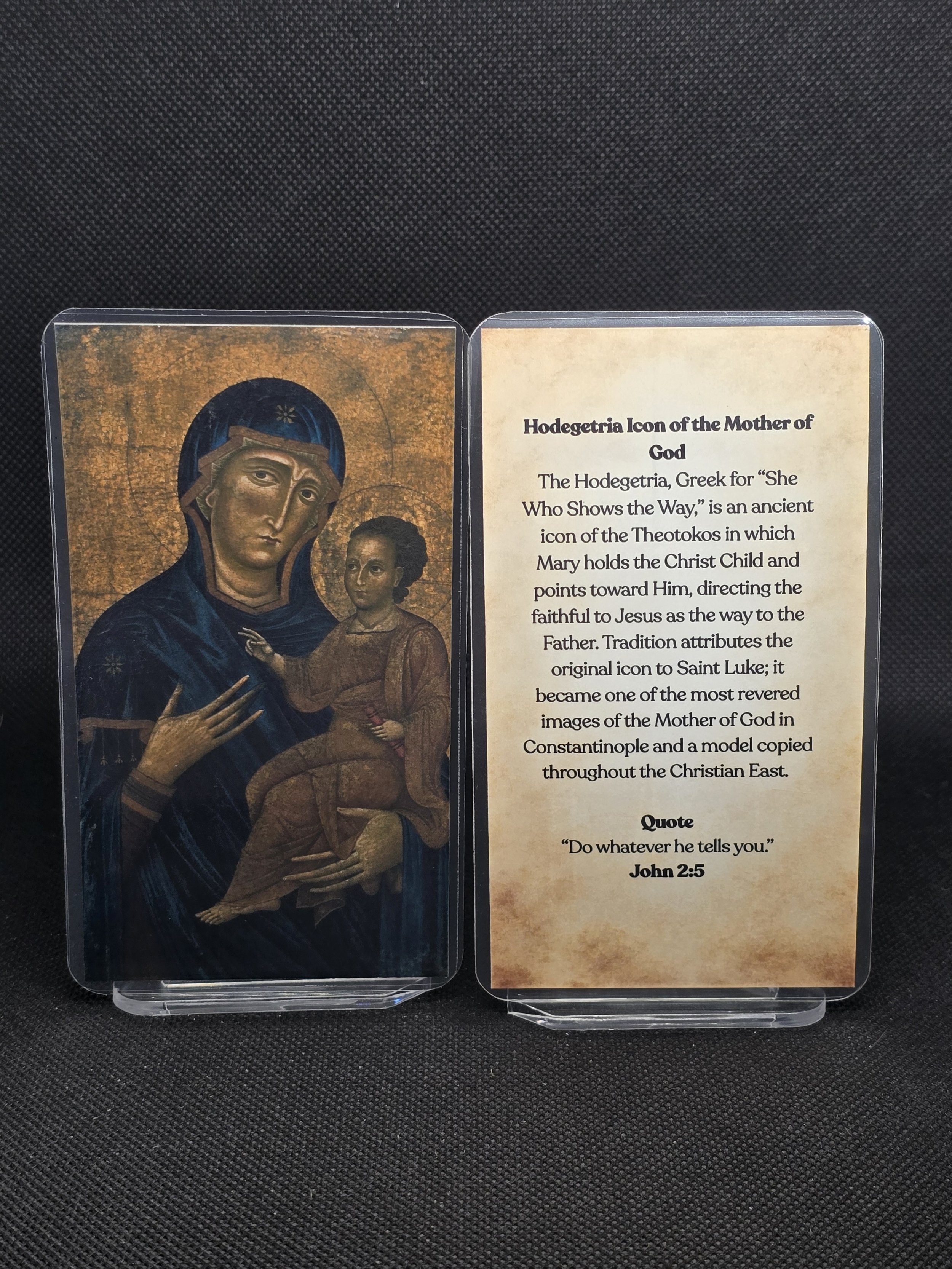
The Hodegetria Icon of the Mother of God, also called the Hodigitria, Odigitria, Directress, or “She Who Shows the Way,” is one of the oldest, most influential, and most widely copied images of the Theotokos in Christianity. Mary holds the Christ Child upon her arm while extending her free hand directly toward Him, visually proclaiming that Jesus Christ is the Way. The Orthodox Church explicitly interprets the gesture through Christ's words in John 14:6, “I am the way, and the truth, and the life,” while Saint John Paul II likewise described the Hodegetria as Mary who leads to Christ and manifests Him.
For that reason, the Hodegetria is especially meaningful for guidance, discernment, choosing the right path, vocational decisions, major life changes, conversion, spiritual direction, people who feel lost, parents praying for their children, and anyone asking the Mother of God to lead them more completely to Jesus Christ. These are not artificial modern patronages placed upon the icon. They arise from the icon's very composition and from the theological meaning that Eastern Christianity has given it for centuries: Mary does not draw attention finally to herself, but stretches out her hand and shows us where to look.
The Hodegetria is therefore a particularly powerful prayer card for someone standing at a crossroads. A person may be discerning marriage, priesthood, religious or monastic life, a career change, conversion, relocation, a difficult family decision, or simply asking what God wants next. The icon does not promise that Mary will reveal every answer immediately. Instead, it gives a more fundamental direction: before asking which road to take, fix your eyes upon Christ, because every truly Christian path must ultimately lead toward Him.
The icon also speaks strongly to parents and grandparents praying for children who seem to have lost their way. Mary's hand does not point toward an abstract idea, self-improvement program, or worldly success. She points to her Son. Saint John Paul II drew precisely this lesson from Hodegetria imagery, explaining that the Church sees in Mary a model of its own mission: to indicate Christ to the world as the path that leads to life.
This prayer card can make a meaningful gift for someone beginning RCIA or catechism, entering the Orthodox or Catholic Church, discerning a vocation, graduating, moving, beginning a new job, making a difficult decision, starting a pilgrimage, or trying to return to Christ after a period away from the faith. It is also especially appropriate for a prayer corner because the icon's central message remains useful regardless of the particular intention: “Look to Christ. Follow Him.”
Each 2.5" x 4.25" prayer card is handmade in Austin, Texas and prepared prayerfully with each order. It is printed on museum-quality photo paper rather than cardstock, double laminated for durability, and made while the recipient and their intentions are lifted before Christ in prayer, asking the Most Holy Theotokos to guide them toward her Son.
THE HISTORY & MEANING OF THE HODEGETRIA ICON
The Hodegetria is not merely the name of one painting. It became one of the foundational iconographic types of the Mother of God, copied throughout Byzantium and later throughout the Orthodox, Eastern Catholic, and Western Christian worlds. The Metropolitan Museum of Art describes it as a widespread Byzantine type in which the Virgin supports Christ with her left arm, while related Hodegetria images preserve the characteristic gesture of Mary indicating her Son as the path of salvation.
The famous prototype was associated with Constantinople, where an image of the Virgin and Child was venerated at the Hodegon Monastery. The Met notes that the very name Hodegetria comes from the Hodegon Monastery, while the Orthodox Church preserves a much older sacred tradition concerning the icon's origin and arrival in the imperial city.
“SHE WHO SHOWS THE WAY”
Hodegetria is commonly translated “She Who Shows the Way,” “Directress,” or “Guide.” Greek Orthodox teaching describes the image as the Theotokos showing the way to God, while Catholic teaching likewise identifies the Hodegetria as Mary pointing toward Christ, the one Mediator and true Way to the Father.
The title works on two levels. Historically, the name is connected with the Hodegon Monastery in Constantinople, which housed the celebrated icon. Theologically, Mary's gesture toward Jesus makes the title almost perfectly visual: she literally directs the viewer away from spiritual confusion and toward Christ.
That theological interpretation became so strong that Pope Saint John Paul II described Mary in the Byzantine tradition as “the way that leads to Christ and manifests him” when discussing the Hodegetria. In another address he summarized the image even more directly: Mary points toward the Son in her arms and reminds Christians that Christ is the path to follow.
WHY IS MARY POINTING TO JESUS?
Mary's extended hand is the defining theological gesture of the Hodegetria. She holds Christ securely, yet instead of enclosing Him within a private mother-and-child embrace, she opens the image outward toward the person praying before it and presents Christ to the world.
This distinguishes the Hodegetria from icons such as the Eleousa, or Virgin of Tenderness, where the faces of Mary and Christ press together in an intimate expression of maternal love. In the Hodegetria, the relationship remains loving, but the emphasis becomes proclamation: the Mother of God presents the incarnate Son and directs us toward Him.
For devotional use, this makes the Hodegetria particularly powerful whenever someone asks, “What am I supposed to do?” Mary's gesture gives the first answer before any specific decision is settled: choose nothing that pulls you away from Christ, and measure every road by whether it leads you toward greater communion with Him.
JOHN 14:6 & THE HODEGETRIA
The Gospel verse most directly associated with the icon is John 14:6:
“I am the way, and the truth, and the life.”
The Orthodox Church's own account of the Hodegetria explicitly uses this verse to explain Mary's gesture. Her hand indicates that the earthly pilgrimage of the Christian must lead toward Christ, who identifies Himself as the Way.
This is important because the icon does not present Mary as an alternative road competing with Christ. The entire composition says the opposite. Authentic Marian devotion is Christ-directed. The closer one comes to Mary as depicted in the Hodegetria, the more insistently she points toward her Son.
“DO WHATEVER HE TELLS YOU”
Another Gospel passage that beautifully expresses the spirituality of the Hodegetria is John 2:5, Mary's instruction to the servants at Cana: “Do whatever he tells you.” Saint John Paul II connected these words directly with the Hodegetria, describing Mary as pointing toward Jesus while continuing to give Christians the same direction she gave at Cana.
The icon can therefore be understood as a visual form of Mary's words at Cana. Her hand says what her voice said in the Gospel: listen to Him, trust Him, and follow what He tells you.
For someone using this prayer card for discernment, that is an especially useful distinction. Prayer for guidance is not primarily asking Mary to make our preferred plan succeed. It is asking for the grace to hear Christ clearly enough that we become willing to follow even when His road differs from the one we expected.
THE TRADITION OF SAINT LUKE
Orthodox tradition attributes the original Hodegetria to Saint Luke the Evangelist. The OCA preserves the Synaxarion tradition that Luke painted the Mother of God from life and that Mary blessed the image, asking that the grace of her Son remain with it.
The same tradition says the icon eventually came from Palestine to Constantinople during the reign of Emperor Theodosius II, when Empress Eudokia sent it to Saint Pulcheria. It was then associated with the Monastery of the Guides and became one of Constantinople's most revered Marian images.
For historical accuracy, it is best to describe this explicitly as the ancient Church tradition concerning the icon, rather than claiming that modern art history can independently prove Saint Luke painted the surviving Byzantine prototype. Art-historical sources securely confirm that the Hodegetria became an extremely important Byzantine image type and that its name was associated with the celebrated Constantinopolitan icon housed at Hodegon.
SAINT LUKE & THE TRADITION OF ICONOGRAPHY
The tradition that Saint Luke painted the Mother of God became enormously influential in Eastern Christianity. Icons connected with Luke were regarded not merely as artistic portraits but as witnesses to the Incarnation: the invisible God truly became visible in Jesus Christ, and His Mother and saints could therefore be represented in sacred images.
The Hodegetria became one of the most important expressions of that principle. Rather than depicting Mary independently, the icon always places the identity of the Mother of God in relationship with the incarnate Christ whom she carries and reveals.
THE HODEGON MONASTERY IN CONSTANTINOPLE
The original celebrated Hodegetria was housed at the Hodegon Monastery in Constantinople. Museum scholarship identifies the monastery directly as the source of the image type's name.
The monastery itself became associated with guidance, and later Byzantine tradition connected it with guides who assisted blind pilgrims. This historical association strengthened the image of the Theotokos as the one who directs, leads, and guides toward healing and ultimately toward Christ.
The combination is striking: an icon named for a place of guides became Christianity's great visual image of Mary guiding humanity toward Jesus.
THE HODEGETRIA & CONSTANTINOPLE
The icon became one of the most important sacred images of the Byzantine capital. The Met describes the Virgin as widely venerated in Byzantium not only as Mother of Christ but also as protectress of Constantinople, while the Hodegetria held a particularly prominent place among the city's sacred images.
The Orthodox tradition credits the Hodegetria with numerous miracles and specifically remembers its role in the deliverance of Constantinople from Arab attack in the early eighth century.
The icon therefore developed a secondary devotional connection with protection as well as guidance. Christians did not only look to the Mother of God for direction along the spiritual road, but also sought her intercession when the city itself faced danger.
A GREAT ICON OF BYZANTIUM
By the Middle Byzantine period, the Hodegetria had become one of the most recognizable representations of Mary anywhere in the Christian world. Surviving Byzantine ivories, mosaics, panels, manuscripts, and later paintings repeat the basic composition, demonstrating how extensively the type spread.
Its influence did not stop at the boundaries of the Byzantine Empire. The Met notes that Byzantine Marian images were adopted widely in Western Europe, and the Hodegetria provided a model for numerous medieval Madonna-and-Child compositions.
This makes the Hodegetria one of those rare sacred images whose visual language became familiar even to Christians who may never have heard its Greek name.
THE HODEGETRIA & THE SUNDAY OF ORTHODOXY
The Hodegetria occupies a place of honor in the famous icon of the Sunday of Orthodoxy, the feast commemorating the restoration of sacred icons after the Byzantine Iconoclast controversy. Greek Orthodox teaching identifies the Hodegetria as the central icon being carried within that composition.
Its presence is significant. When the Church celebrates the restoration of icons, the image at the center is itself an icon in which Mary points to the incarnate Christ.
The symbolism expresses the entire theology of Christian iconography: sacred images are possible because the Son of God truly became flesh, truly entered visible human history, and can therefore be depicted.
WHAT IS CHRIST HOLDING?
In many Hodegetria icons, the Christ Child holds a scroll in His left hand while raising His right hand in blessing. The scroll identifies Him not simply as an ordinary infant but as the eternal Word and divine Teacher, while His blessing hand presents Him with the authority of the Lord.
This is another reason the Hodegetria should not be read as a sentimental portrait of a mother and baby. The Child is often depicted with unusual maturity and solemnity because the icon is confessing that the infant Mary holds is Jesus Christ, the eternal Son and Word of God.
Mary points toward Him because He is not merely her child. He is the Savior.
WHY DOES THE CHRIST CHILD LOOK SO MATURE?
Byzantine iconography is not primarily trying to recreate a photographic snapshot of a particular afternoon in Jesus' infancy. The Christ Child is often shown with mature facial features, a blessing gesture, and the scroll of teaching precisely because the icon is revealing who this Child truly is.
He is simultaneously the infant born from Mary and the eternal Logos through whom all things were made. The icon therefore compresses theological truth into the visual image rather than limiting itself to naturalistic age.
WHY DOES MARY LOOK SO SERIOUS?
The Hodegetria is often solemn rather than smiling. Her expression invites contemplation instead of sentimental emotion, and many variants give her a grave or pensive gaze while she presents Christ to the viewer. The Met notes that Hodegetria imagery can carry awareness of the future suffering of the Son whom Mary presents as the path to salvation.
Her seriousness therefore should not be interpreted as coldness. The icon's purpose is larger than showing affectionate motherhood. Mary knows whom she carries and directs the entire attention of the viewer toward the mystery of Christ.
A PRAYER CARD FOR GUIDANCE
Guidance is probably the strongest devotional use for this particular icon. Someone uncertain about the future can place the difficult decision before Christ while asking His Mother to help remove fear, pride, impatience, and self-deception from the discernment process.
The Hodegetria does not offer a mystical shortcut around prudence, counsel, Scripture, prayer, or the sacramental life. Instead, it places every part of discernment into proper order by insisting that Christ must remain the destination.
For someone who keeps asking, “Which way should I go?” the icon quietly asks an even more important question: Which choice leads me closer to Him?
A PRAYER CARD FOR VOCATIONAL DISCERNMENT
The Hodegetria is especially meaningful for someone discerning priesthood, diaconate, monastic life, religious life, marriage, or another major Christian vocation. Mary's own life was marked by extraordinary willingness to accept God's direction even when she could not see the entire road ahead.
Yet the icon's primary message remains focused upon Jesus. A genuine vocation is never primarily about obtaining a title or finding the most personally impressive path. It is about following Christ in the particular way through which He calls the person to love God and neighbor.
A PRAYER CARD FOR SOMEONE WHO FEELS LOST
Some seasons of life do not present two obvious paths. They feel instead like there is no path at all.
Grief, divorce, unemployment, illness, family conflict, spiritual dryness, and major disappointment can leave someone unable to imagine what comes next. The Hodegetria is especially meaningful in those moments because Mary is not pointing toward a detailed map. She is pointing toward a Person.
Sometimes guidance begins not by understanding the next ten years, but by knowing whom to follow today.
A PRAYER CARD FOR CONVERSION & RETURNING TO CHRIST
The Hodegetria can also be especially meaningful for catechumens, converts, and people returning to Christian faith after many years away. Mary's gesture embodies the work of Christian evangelization itself: she introduces the person not to an ideology but to Jesus Christ.
This also makes the card an excellent gift for baptism, chrismation, reception into the Church, First Communion, confirmation, or completion of catechetical formation.
The message remains simple enough to last for the rest of a Christian life: however far you travel, keep returning to Christ.
A PRAYER CARD FOR PARENTS PRAYING FOR THEIR CHILDREN
Parents cannot control every road their children eventually choose. They can teach, protect, advise, correct, and pray, but eventually children begin making decisions beyond a parent's direct control.
The Hodegetria offers a particularly beautiful image for that pain. Mary points the child toward Christ.
A parent using this card can therefore pray not merely for a child's success, but for something greater: that the Mother of God continually direct that son or daughter toward Jesus, especially when the parent no longer knows how to reach them.
A PRAYER CARD FOR TRAVEL & PILGRIMAGE
Because the Hodegetria is fundamentally an icon of the way and the Christian journey, it also fits naturally with travel and pilgrimage. The OCA interpretation explicitly speaks of Mary's gesture as indicating the way Christians must follow on their earthly pilgrimage toward Christ.
This makes the card meaningful for someone leaving home, beginning a pilgrimage, traveling abroad, entering military service, relocating, or moving into a new stage of life.
The prayer need not be simply, “Make my journey easy.” It can become, “Wherever I go, do not let me lose the road that leads to Christ.”
THE HODEGETRIA & CHRISTIAN PROTECTION
The icon's ancient Constantinopolitan history also gives it a strong connection with protection. Byzantine Christians regarded the Mother of God as a protector of the imperial city, and the OCA tradition specifically associates the Hodegetria prototype with miraculous deliverance during military danger.
For modern devotion, this can make the Hodegetria meaningful for families asking protection over a home, travelers, military families, or someone beginning an uncertain journey.
The greater protection represented by the icon, however, is protection from losing the way spiritually.
THE ORIGINAL ICON & THE FALL OF CONSTANTINOPLE
According to the Orthodox Synaxarion tradition preserved by the OCA, the famed Constantinopolitan Hodegetria was lost or destroyed during the Fall of Constantinople in 1453. The prototype itself therefore does not survive for modern pilgrims to venerate in its original shrine.
Its image nevertheless survived through countless copies and related icon traditions across the Christian world. The Met emphasizes just how widespread the Hodegetria type became, while the OCA notes that a copy is preserved at Xenophontos Monastery on Mount Athos.
In this sense, the icon that disappeared from Constantinople continued living visually everywhere.
HODEGETRIA-TYPE ICONS THROUGHOUT CHRISTIANITY
Many famous Marian icons belong broadly to the Hodegetria family or developed from its visual pattern. The type became so influential that Byzantine models traveled into Eastern Europe and western European art, creating generations of sacred images in which Mary holds Christ and directs the believer toward Him.
One famous Western example of the broader Hodegetria tradition is the Black Madonna of Częstochowa, which Vatican sources identify as a Byzantine icon of the Hodegetria type.
This wide influence demonstrates something important about the icon's message. The visual language crosses later Catholic-Orthodox divisions because it is rooted in the fundamental Christian confession that salvation comes through Christ.
ORTHODOX & EASTERN CATHOLIC DEVOTION
The Hodegetria is one of the characteristic images of the Byzantine Christian tradition, and devotion to the type belongs naturally within both Orthodox and Eastern Catholic spirituality. Saint John Paul II repeatedly praised the Hodegetria specifically as part of the Marian heritage of the Christian East and interpreted its meaning in thoroughly Christ-centered terms.
For an Eastern Catholic prayer card, the Hodegetria therefore needs no adaptation into a Western devotional framework. Its theology already belongs deeply within Byzantine Christian prayer: Theotokos, point us toward Christ.
FEAST DAY
The Orthodox Church in America commemorates the Hodegetria Icon of the Mother of God on June 20. Its liturgical commemoration includes an established Troparion and Kontakion directed to the Theotokos.
Because Hodegetria is also a broad iconographic family, many specific wonderworking Hodegetria-type icons possess their own histories and feast days. For the Hodegetria itself, however, June 20 is the clearest feast date to use on this product page.
PRAYERS
There is an established Byzantine Troparion and Kontakion for the Hodegetria Icon, so there is no need to write a new prayer. The OCA's June 20 liturgical texts ask the Mother of God for compassion, help, protection, and intercession while placing Christian hope ultimately in God's mercy.
A short established portion especially suitable for devotional use is:
“O Sovereign Lady, have compassion on us, help us, and come quickly.”
Another traditional Hodegetria Kontakion invokes the Theotokos as the steadfast protectress of Christians and asks her to make supplication for those who honor her.
For someone using this card specifically for discernment, a simple personal intention can then be offered after the established prayer: ask the Mother of God to direct every desire, fear, plan, and decision toward Christ, and to close any road that would lead away from Him.
The Hodegetria is particularly suited to prayer before a major decision because its message does not depend upon knowing the future. Mary simply points toward the One who already knows it.
FAQ
What is the Hodegetria Icon of the Mother of God? The Hodegetria is one of the great Byzantine iconographic types of the Theotokos. Mary holds the Christ Child while directing her free hand toward Him as the way to salvation.
What does Hodegetria mean? It is commonly translated as “She Who Shows the Way,” “Directress,” or “Guide.” The name is historically associated with Constantinople's Hodegon Monastery and spiritually interpreted through Mary's gesture pointing toward Jesus.
Why does Mary point to Jesus in the Hodegetria? Her hand identifies Christ as the Way and directs the believer toward Him. Orthodox teaching explicitly links the gesture to John 14:6.
What Bible verse is most closely associated with the Hodegetria? John 14:6 is the clearest scriptural connection because Christ says, “I am the way, and the truth, and the life.” The OCA directly uses this verse when explaining the icon.
Is John 2:5 also connected with the Hodegetria? Yes, Saint John Paul II connected the icon's message with Mary's words at Cana, “Do whatever he tells you.” Both the Gospel verse and the icon direct attention away from Mary as an endpoint and toward obedience to Christ.
Who painted the original Hodegetria icon? Orthodox tradition attributes the prototype to Saint Luke the Evangelist, who is said to have painted the Theotokos from life. This is an ancient Church tradition rather than something modern art history can independently prove.
Did the Virgin Mary bless Saint Luke's icon? According to the Orthodox Synaxarion tradition, yes. The OCA preserves the account that Mary received the image with joy and blessed it with reference to the grace of her Son.
How did the Hodegetria reach Constantinople? Church tradition says Empress Eudokia sent the icon from Palestine to Saint Pulcheria in Constantinople during the reign of Theodosius II. It became associated with the Monastery of the Guides and later with the wider devotional life of Constantinople.
What was the Hodegon Monastery? It was a Byzantine monastery in Constantinople that housed the famous Hodegetria icon. Museum scholarship identifies the monastery as the historical source of the icon type's name.
Why is the Hodegetria called a guide? Mary's hand guides the viewer visually toward Christ, while the title's Constantinopolitan history is also associated with the Hodegon, the place of guides. The two meanings became beautifully intertwined in Christian devotion.
What is Christ holding in Hodegetria icons? He commonly holds a scroll while blessing with His other hand. The scroll visually identifies Him as divine Teacher and eternal Word rather than portraying Him simply as an ordinary infant.
Why does Jesus sometimes look like a small adult in the icon? Byzantine iconography emphasizes theological identity rather than photographic naturalism. The mature features, blessing hand, and scroll proclaim that the Child Mary carries is the eternal Son and divine Logos.
Why does Mary look serious in Hodegetria icons? The icon has a solemn theological purpose: Mary presents Christ as Savior rather than simply displaying maternal affection. Some Hodegetria variants also suggest awareness of the future suffering Christ will endure.
Is the Hodegetria the same as the Virgin of Tenderness? No. The Hodegetria emphasizes Mary pointing toward Christ, while the Eleousa or Virgin of Tenderness emphasizes the intimate affection between Mother and Child with their faces touching.
Is the Hodegetria Orthodox? It is fundamentally a Byzantine Christian icon type and remains especially prominent in Orthodox spirituality. Its influence, however, spread through Eastern Catholic and Western Catholic Christianity as well.
Can Eastern Catholics venerate the Hodegetria? Yes. Saint John Paul II repeatedly identified the Hodegetria with the Marian patrimony of the Churches of the East and praised its Christ-centered theology.
Do Roman Catholics also venerate Hodegetria icons? Yes. Hodegetria-type images spread widely into Western Christianity, and famous Catholic Marian images such as the Black Madonna of Częstochowa belong to the broader Hodegetria tradition.
When is the Hodegetria Icon commemorated? The Orthodox Church in America commemorates the Hodegetria Icon on June 20. An established Troparion and Kontakion are provided for the commemoration.
Is there a traditional prayer for the Hodegetria Icon? Yes. The June 20 Orthodox commemoration includes established liturgical hymns asking the Theotokos for help, protection, compassion, and intercession.
Is the Hodegetria good for discernment? Yes, this is perhaps its strongest devotional application because the icon literally presents Mary as the one who directs the believer toward Christ. It is especially meaningful when someone needs to choose a path without losing sight of the ultimate destination.
Is the Hodegetria good for vocational discernment? Yes. Someone discerning marriage, priesthood, diaconate, monastic life, religious life, or another vocation can use the icon as a reminder that the right vocation is ultimately the one through which Christ is faithfully followed.
Is the Hodegetria good for someone who feels lost? Yes, because its entire spiritual message concerns direction. Mary does not promise a complete map of the future but points to Christ as the Way through whatever uncertainty remains.
Can parents pray before the Hodegetria for their children? Yes. The icon offers a particularly beautiful image for parents who cannot control every choice their children make but can continue asking the Mother of God to direct them toward Jesus.
Is the Hodegetria associated with protection? Yes. The famous Constantinopolitan icon became deeply connected with the protection of the Byzantine capital, and Orthodox tradition attributes miraculous deliverance to it during periods of danger.
Is the Hodegetria suitable for travelers? Yes, especially because the OCA explicitly interprets it through the Christian's earthly pilgrimage toward Christ. It can be a meaningful devotional image for travel, relocation, pilgrimage, or beginning a new stage of life.
What happened to the original Hodegetria icon? The Orthodox tradition preserved by the OCA says the famous Constantinopolitan prototype was destroyed during the Fall of Constantinople in 1453. Its iconographic form survived through innumerable copies throughout the Christian world.
Are any old copies still venerated? Yes. The OCA specifically notes a Hodegetria copy at Xenophontos Monastery on Mount Athos, while countless Hodegetria-type icons survive across Orthodox and Catholic Christianity.
Why is the Hodegetria in the Sunday of Orthodoxy icon? Greek Orthodox teaching identifies the Hodegetria as the central sacred image carried within the icon celebrating the restoration of icons. Its presence emphasizes the Incarnation, the theological foundation that makes Christian sacred imagery possible.
Who would appreciate a Hodegetria prayer card? It is especially meaningful for someone discerning a vocation, making a major decision, converting, returning to faith, moving, graduating, traveling, beginning a new life stage, or praying for a child who seems spiritually lost.
What is the main message of the Hodegetria Icon? The Hodegetria says something remarkably simple and inexhaustible: Mary shows us Jesus. Her hand points toward the Son she carried in her womb and now presents to the world, reminding every Christian that guidance, vocation, discernment, protection, conversion, and the entire pilgrimage of life find their proper direction only when they lead toward Christ. The ancient icon of Constantinople may have disappeared, but its gesture survived across centuries precisely because the message never became obsolete: when you do not know the way, look where the Mother of God is pointing.
The Hodegetria Icon of the Mother of God, also called the Hodigitria, Odigitria, Directress, or “She Who Shows the Way,” is one of the oldest, most influential, and most widely copied images of the Theotokos in Christianity. Mary holds the Christ Child upon her arm while extending her free hand directly toward Him, visually proclaiming that Jesus Christ is the Way. The Orthodox Church explicitly interprets the gesture through Christ's words in John 14:6, “I am the way, and the truth, and the life,” while Saint John Paul II likewise described the Hodegetria as Mary who leads to Christ and manifests Him.
For that reason, the Hodegetria is especially meaningful for guidance, discernment, choosing the right path, vocational decisions, major life changes, conversion, spiritual direction, people who feel lost, parents praying for their children, and anyone asking the Mother of God to lead them more completely to Jesus Christ. These are not artificial modern patronages placed upon the icon. They arise from the icon's very composition and from the theological meaning that Eastern Christianity has given it for centuries: Mary does not draw attention finally to herself, but stretches out her hand and shows us where to look.
The Hodegetria is therefore a particularly powerful prayer card for someone standing at a crossroads. A person may be discerning marriage, priesthood, religious or monastic life, a career change, conversion, relocation, a difficult family decision, or simply asking what God wants next. The icon does not promise that Mary will reveal every answer immediately. Instead, it gives a more fundamental direction: before asking which road to take, fix your eyes upon Christ, because every truly Christian path must ultimately lead toward Him.
The icon also speaks strongly to parents and grandparents praying for children who seem to have lost their way. Mary's hand does not point toward an abstract idea, self-improvement program, or worldly success. She points to her Son. Saint John Paul II drew precisely this lesson from Hodegetria imagery, explaining that the Church sees in Mary a model of its own mission: to indicate Christ to the world as the path that leads to life.
This prayer card can make a meaningful gift for someone beginning RCIA or catechism, entering the Orthodox or Catholic Church, discerning a vocation, graduating, moving, beginning a new job, making a difficult decision, starting a pilgrimage, or trying to return to Christ after a period away from the faith. It is also especially appropriate for a prayer corner because the icon's central message remains useful regardless of the particular intention: “Look to Christ. Follow Him.”
Each 2.5" x 4.25" prayer card is handmade in Austin, Texas and prepared prayerfully with each order. It is printed on museum-quality photo paper rather than cardstock, double laminated for durability, and made while the recipient and their intentions are lifted before Christ in prayer, asking the Most Holy Theotokos to guide them toward her Son.
THE HISTORY & MEANING OF THE HODEGETRIA ICON
The Hodegetria is not merely the name of one painting. It became one of the foundational iconographic types of the Mother of God, copied throughout Byzantium and later throughout the Orthodox, Eastern Catholic, and Western Christian worlds. The Metropolitan Museum of Art describes it as a widespread Byzantine type in which the Virgin supports Christ with her left arm, while related Hodegetria images preserve the characteristic gesture of Mary indicating her Son as the path of salvation.
The famous prototype was associated with Constantinople, where an image of the Virgin and Child was venerated at the Hodegon Monastery. The Met notes that the very name Hodegetria comes from the Hodegon Monastery, while the Orthodox Church preserves a much older sacred tradition concerning the icon's origin and arrival in the imperial city.
“SHE WHO SHOWS THE WAY”
Hodegetria is commonly translated “She Who Shows the Way,” “Directress,” or “Guide.” Greek Orthodox teaching describes the image as the Theotokos showing the way to God, while Catholic teaching likewise identifies the Hodegetria as Mary pointing toward Christ, the one Mediator and true Way to the Father.
The title works on two levels. Historically, the name is connected with the Hodegon Monastery in Constantinople, which housed the celebrated icon. Theologically, Mary's gesture toward Jesus makes the title almost perfectly visual: she literally directs the viewer away from spiritual confusion and toward Christ.
That theological interpretation became so strong that Pope Saint John Paul II described Mary in the Byzantine tradition as “the way that leads to Christ and manifests him” when discussing the Hodegetria. In another address he summarized the image even more directly: Mary points toward the Son in her arms and reminds Christians that Christ is the path to follow.
WHY IS MARY POINTING TO JESUS?
Mary's extended hand is the defining theological gesture of the Hodegetria. She holds Christ securely, yet instead of enclosing Him within a private mother-and-child embrace, she opens the image outward toward the person praying before it and presents Christ to the world.
This distinguishes the Hodegetria from icons such as the Eleousa, or Virgin of Tenderness, where the faces of Mary and Christ press together in an intimate expression of maternal love. In the Hodegetria, the relationship remains loving, but the emphasis becomes proclamation: the Mother of God presents the incarnate Son and directs us toward Him.
For devotional use, this makes the Hodegetria particularly powerful whenever someone asks, “What am I supposed to do?” Mary's gesture gives the first answer before any specific decision is settled: choose nothing that pulls you away from Christ, and measure every road by whether it leads you toward greater communion with Him.
JOHN 14:6 & THE HODEGETRIA
The Gospel verse most directly associated with the icon is John 14:6:
“I am the way, and the truth, and the life.”
The Orthodox Church's own account of the Hodegetria explicitly uses this verse to explain Mary's gesture. Her hand indicates that the earthly pilgrimage of the Christian must lead toward Christ, who identifies Himself as the Way.
This is important because the icon does not present Mary as an alternative road competing with Christ. The entire composition says the opposite. Authentic Marian devotion is Christ-directed. The closer one comes to Mary as depicted in the Hodegetria, the more insistently she points toward her Son.
“DO WHATEVER HE TELLS YOU”
Another Gospel passage that beautifully expresses the spirituality of the Hodegetria is John 2:5, Mary's instruction to the servants at Cana: “Do whatever he tells you.” Saint John Paul II connected these words directly with the Hodegetria, describing Mary as pointing toward Jesus while continuing to give Christians the same direction she gave at Cana.
The icon can therefore be understood as a visual form of Mary's words at Cana. Her hand says what her voice said in the Gospel: listen to Him, trust Him, and follow what He tells you.
For someone using this prayer card for discernment, that is an especially useful distinction. Prayer for guidance is not primarily asking Mary to make our preferred plan succeed. It is asking for the grace to hear Christ clearly enough that we become willing to follow even when His road differs from the one we expected.
THE TRADITION OF SAINT LUKE
Orthodox tradition attributes the original Hodegetria to Saint Luke the Evangelist. The OCA preserves the Synaxarion tradition that Luke painted the Mother of God from life and that Mary blessed the image, asking that the grace of her Son remain with it.
The same tradition says the icon eventually came from Palestine to Constantinople during the reign of Emperor Theodosius II, when Empress Eudokia sent it to Saint Pulcheria. It was then associated with the Monastery of the Guides and became one of Constantinople's most revered Marian images.
For historical accuracy, it is best to describe this explicitly as the ancient Church tradition concerning the icon, rather than claiming that modern art history can independently prove Saint Luke painted the surviving Byzantine prototype. Art-historical sources securely confirm that the Hodegetria became an extremely important Byzantine image type and that its name was associated with the celebrated Constantinopolitan icon housed at Hodegon.
SAINT LUKE & THE TRADITION OF ICONOGRAPHY
The tradition that Saint Luke painted the Mother of God became enormously influential in Eastern Christianity. Icons connected with Luke were regarded not merely as artistic portraits but as witnesses to the Incarnation: the invisible God truly became visible in Jesus Christ, and His Mother and saints could therefore be represented in sacred images.
The Hodegetria became one of the most important expressions of that principle. Rather than depicting Mary independently, the icon always places the identity of the Mother of God in relationship with the incarnate Christ whom she carries and reveals.
THE HODEGON MONASTERY IN CONSTANTINOPLE
The original celebrated Hodegetria was housed at the Hodegon Monastery in Constantinople. Museum scholarship identifies the monastery directly as the source of the image type's name.
The monastery itself became associated with guidance, and later Byzantine tradition connected it with guides who assisted blind pilgrims. This historical association strengthened the image of the Theotokos as the one who directs, leads, and guides toward healing and ultimately toward Christ.
The combination is striking: an icon named for a place of guides became Christianity's great visual image of Mary guiding humanity toward Jesus.
THE HODEGETRIA & CONSTANTINOPLE
The icon became one of the most important sacred images of the Byzantine capital. The Met describes the Virgin as widely venerated in Byzantium not only as Mother of Christ but also as protectress of Constantinople, while the Hodegetria held a particularly prominent place among the city's sacred images.
The Orthodox tradition credits the Hodegetria with numerous miracles and specifically remembers its role in the deliverance of Constantinople from Arab attack in the early eighth century.
The icon therefore developed a secondary devotional connection with protection as well as guidance. Christians did not only look to the Mother of God for direction along the spiritual road, but also sought her intercession when the city itself faced danger.
A GREAT ICON OF BYZANTIUM
By the Middle Byzantine period, the Hodegetria had become one of the most recognizable representations of Mary anywhere in the Christian world. Surviving Byzantine ivories, mosaics, panels, manuscripts, and later paintings repeat the basic composition, demonstrating how extensively the type spread.
Its influence did not stop at the boundaries of the Byzantine Empire. The Met notes that Byzantine Marian images were adopted widely in Western Europe, and the Hodegetria provided a model for numerous medieval Madonna-and-Child compositions.
This makes the Hodegetria one of those rare sacred images whose visual language became familiar even to Christians who may never have heard its Greek name.
THE HODEGETRIA & THE SUNDAY OF ORTHODOXY
The Hodegetria occupies a place of honor in the famous icon of the Sunday of Orthodoxy, the feast commemorating the restoration of sacred icons after the Byzantine Iconoclast controversy. Greek Orthodox teaching identifies the Hodegetria as the central icon being carried within that composition.
Its presence is significant. When the Church celebrates the restoration of icons, the image at the center is itself an icon in which Mary points to the incarnate Christ.
The symbolism expresses the entire theology of Christian iconography: sacred images are possible because the Son of God truly became flesh, truly entered visible human history, and can therefore be depicted.
WHAT IS CHRIST HOLDING?
In many Hodegetria icons, the Christ Child holds a scroll in His left hand while raising His right hand in blessing. The scroll identifies Him not simply as an ordinary infant but as the eternal Word and divine Teacher, while His blessing hand presents Him with the authority of the Lord.
This is another reason the Hodegetria should not be read as a sentimental portrait of a mother and baby. The Child is often depicted with unusual maturity and solemnity because the icon is confessing that the infant Mary holds is Jesus Christ, the eternal Son and Word of God.
Mary points toward Him because He is not merely her child. He is the Savior.
WHY DOES THE CHRIST CHILD LOOK SO MATURE?
Byzantine iconography is not primarily trying to recreate a photographic snapshot of a particular afternoon in Jesus' infancy. The Christ Child is often shown with mature facial features, a blessing gesture, and the scroll of teaching precisely because the icon is revealing who this Child truly is.
He is simultaneously the infant born from Mary and the eternal Logos through whom all things were made. The icon therefore compresses theological truth into the visual image rather than limiting itself to naturalistic age.
WHY DOES MARY LOOK SO SERIOUS?
The Hodegetria is often solemn rather than smiling. Her expression invites contemplation instead of sentimental emotion, and many variants give her a grave or pensive gaze while she presents Christ to the viewer. The Met notes that Hodegetria imagery can carry awareness of the future suffering of the Son whom Mary presents as the path to salvation.
Her seriousness therefore should not be interpreted as coldness. The icon's purpose is larger than showing affectionate motherhood. Mary knows whom she carries and directs the entire attention of the viewer toward the mystery of Christ.
A PRAYER CARD FOR GUIDANCE
Guidance is probably the strongest devotional use for this particular icon. Someone uncertain about the future can place the difficult decision before Christ while asking His Mother to help remove fear, pride, impatience, and self-deception from the discernment process.
The Hodegetria does not offer a mystical shortcut around prudence, counsel, Scripture, prayer, or the sacramental life. Instead, it places every part of discernment into proper order by insisting that Christ must remain the destination.
For someone who keeps asking, “Which way should I go?” the icon quietly asks an even more important question: Which choice leads me closer to Him?
A PRAYER CARD FOR VOCATIONAL DISCERNMENT
The Hodegetria is especially meaningful for someone discerning priesthood, diaconate, monastic life, religious life, marriage, or another major Christian vocation. Mary's own life was marked by extraordinary willingness to accept God's direction even when she could not see the entire road ahead.
Yet the icon's primary message remains focused upon Jesus. A genuine vocation is never primarily about obtaining a title or finding the most personally impressive path. It is about following Christ in the particular way through which He calls the person to love God and neighbor.
A PRAYER CARD FOR SOMEONE WHO FEELS LOST
Some seasons of life do not present two obvious paths. They feel instead like there is no path at all.
Grief, divorce, unemployment, illness, family conflict, spiritual dryness, and major disappointment can leave someone unable to imagine what comes next. The Hodegetria is especially meaningful in those moments because Mary is not pointing toward a detailed map. She is pointing toward a Person.
Sometimes guidance begins not by understanding the next ten years, but by knowing whom to follow today.
A PRAYER CARD FOR CONVERSION & RETURNING TO CHRIST
The Hodegetria can also be especially meaningful for catechumens, converts, and people returning to Christian faith after many years away. Mary's gesture embodies the work of Christian evangelization itself: she introduces the person not to an ideology but to Jesus Christ.
This also makes the card an excellent gift for baptism, chrismation, reception into the Church, First Communion, confirmation, or completion of catechetical formation.
The message remains simple enough to last for the rest of a Christian life: however far you travel, keep returning to Christ.
A PRAYER CARD FOR PARENTS PRAYING FOR THEIR CHILDREN
Parents cannot control every road their children eventually choose. They can teach, protect, advise, correct, and pray, but eventually children begin making decisions beyond a parent's direct control.
The Hodegetria offers a particularly beautiful image for that pain. Mary points the child toward Christ.
A parent using this card can therefore pray not merely for a child's success, but for something greater: that the Mother of God continually direct that son or daughter toward Jesus, especially when the parent no longer knows how to reach them.
A PRAYER CARD FOR TRAVEL & PILGRIMAGE
Because the Hodegetria is fundamentally an icon of the way and the Christian journey, it also fits naturally with travel and pilgrimage. The OCA interpretation explicitly speaks of Mary's gesture as indicating the way Christians must follow on their earthly pilgrimage toward Christ.
This makes the card meaningful for someone leaving home, beginning a pilgrimage, traveling abroad, entering military service, relocating, or moving into a new stage of life.
The prayer need not be simply, “Make my journey easy.” It can become, “Wherever I go, do not let me lose the road that leads to Christ.”
THE HODEGETRIA & CHRISTIAN PROTECTION
The icon's ancient Constantinopolitan history also gives it a strong connection with protection. Byzantine Christians regarded the Mother of God as a protector of the imperial city, and the OCA tradition specifically associates the Hodegetria prototype with miraculous deliverance during military danger.
For modern devotion, this can make the Hodegetria meaningful for families asking protection over a home, travelers, military families, or someone beginning an uncertain journey.
The greater protection represented by the icon, however, is protection from losing the way spiritually.
THE ORIGINAL ICON & THE FALL OF CONSTANTINOPLE
According to the Orthodox Synaxarion tradition preserved by the OCA, the famed Constantinopolitan Hodegetria was lost or destroyed during the Fall of Constantinople in 1453. The prototype itself therefore does not survive for modern pilgrims to venerate in its original shrine.
Its image nevertheless survived through countless copies and related icon traditions across the Christian world. The Met emphasizes just how widespread the Hodegetria type became, while the OCA notes that a copy is preserved at Xenophontos Monastery on Mount Athos.
In this sense, the icon that disappeared from Constantinople continued living visually everywhere.
HODEGETRIA-TYPE ICONS THROUGHOUT CHRISTIANITY
Many famous Marian icons belong broadly to the Hodegetria family or developed from its visual pattern. The type became so influential that Byzantine models traveled into Eastern Europe and western European art, creating generations of sacred images in which Mary holds Christ and directs the believer toward Him.
One famous Western example of the broader Hodegetria tradition is the Black Madonna of Częstochowa, which Vatican sources identify as a Byzantine icon of the Hodegetria type.
This wide influence demonstrates something important about the icon's message. The visual language crosses later Catholic-Orthodox divisions because it is rooted in the fundamental Christian confession that salvation comes through Christ.
ORTHODOX & EASTERN CATHOLIC DEVOTION
The Hodegetria is one of the characteristic images of the Byzantine Christian tradition, and devotion to the type belongs naturally within both Orthodox and Eastern Catholic spirituality. Saint John Paul II repeatedly praised the Hodegetria specifically as part of the Marian heritage of the Christian East and interpreted its meaning in thoroughly Christ-centered terms.
For an Eastern Catholic prayer card, the Hodegetria therefore needs no adaptation into a Western devotional framework. Its theology already belongs deeply within Byzantine Christian prayer: Theotokos, point us toward Christ.
FEAST DAY
The Orthodox Church in America commemorates the Hodegetria Icon of the Mother of God on June 20. Its liturgical commemoration includes an established Troparion and Kontakion directed to the Theotokos.
Because Hodegetria is also a broad iconographic family, many specific wonderworking Hodegetria-type icons possess their own histories and feast days. For the Hodegetria itself, however, June 20 is the clearest feast date to use on this product page.
PRAYERS
There is an established Byzantine Troparion and Kontakion for the Hodegetria Icon, so there is no need to write a new prayer. The OCA's June 20 liturgical texts ask the Mother of God for compassion, help, protection, and intercession while placing Christian hope ultimately in God's mercy.
A short established portion especially suitable for devotional use is:
“O Sovereign Lady, have compassion on us, help us, and come quickly.”
Another traditional Hodegetria Kontakion invokes the Theotokos as the steadfast protectress of Christians and asks her to make supplication for those who honor her.
For someone using this card specifically for discernment, a simple personal intention can then be offered after the established prayer: ask the Mother of God to direct every desire, fear, plan, and decision toward Christ, and to close any road that would lead away from Him.
The Hodegetria is particularly suited to prayer before a major decision because its message does not depend upon knowing the future. Mary simply points toward the One who already knows it.
FAQ
What is the Hodegetria Icon of the Mother of God? The Hodegetria is one of the great Byzantine iconographic types of the Theotokos. Mary holds the Christ Child while directing her free hand toward Him as the way to salvation.
What does Hodegetria mean? It is commonly translated as “She Who Shows the Way,” “Directress,” or “Guide.” The name is historically associated with Constantinople's Hodegon Monastery and spiritually interpreted through Mary's gesture pointing toward Jesus.
Why does Mary point to Jesus in the Hodegetria? Her hand identifies Christ as the Way and directs the believer toward Him. Orthodox teaching explicitly links the gesture to John 14:6.
What Bible verse is most closely associated with the Hodegetria? John 14:6 is the clearest scriptural connection because Christ says, “I am the way, and the truth, and the life.” The OCA directly uses this verse when explaining the icon.
Is John 2:5 also connected with the Hodegetria? Yes, Saint John Paul II connected the icon's message with Mary's words at Cana, “Do whatever he tells you.” Both the Gospel verse and the icon direct attention away from Mary as an endpoint and toward obedience to Christ.
Who painted the original Hodegetria icon? Orthodox tradition attributes the prototype to Saint Luke the Evangelist, who is said to have painted the Theotokos from life. This is an ancient Church tradition rather than something modern art history can independently prove.
Did the Virgin Mary bless Saint Luke's icon? According to the Orthodox Synaxarion tradition, yes. The OCA preserves the account that Mary received the image with joy and blessed it with reference to the grace of her Son.
How did the Hodegetria reach Constantinople? Church tradition says Empress Eudokia sent the icon from Palestine to Saint Pulcheria in Constantinople during the reign of Theodosius II. It became associated with the Monastery of the Guides and later with the wider devotional life of Constantinople.
What was the Hodegon Monastery? It was a Byzantine monastery in Constantinople that housed the famous Hodegetria icon. Museum scholarship identifies the monastery as the historical source of the icon type's name.
Why is the Hodegetria called a guide? Mary's hand guides the viewer visually toward Christ, while the title's Constantinopolitan history is also associated with the Hodegon, the place of guides. The two meanings became beautifully intertwined in Christian devotion.
What is Christ holding in Hodegetria icons? He commonly holds a scroll while blessing with His other hand. The scroll visually identifies Him as divine Teacher and eternal Word rather than portraying Him simply as an ordinary infant.
Why does Jesus sometimes look like a small adult in the icon? Byzantine iconography emphasizes theological identity rather than photographic naturalism. The mature features, blessing hand, and scroll proclaim that the Child Mary carries is the eternal Son and divine Logos.
Why does Mary look serious in Hodegetria icons? The icon has a solemn theological purpose: Mary presents Christ as Savior rather than simply displaying maternal affection. Some Hodegetria variants also suggest awareness of the future suffering Christ will endure.
Is the Hodegetria the same as the Virgin of Tenderness? No. The Hodegetria emphasizes Mary pointing toward Christ, while the Eleousa or Virgin of Tenderness emphasizes the intimate affection between Mother and Child with their faces touching.
Is the Hodegetria Orthodox? It is fundamentally a Byzantine Christian icon type and remains especially prominent in Orthodox spirituality. Its influence, however, spread through Eastern Catholic and Western Catholic Christianity as well.
Can Eastern Catholics venerate the Hodegetria? Yes. Saint John Paul II repeatedly identified the Hodegetria with the Marian patrimony of the Churches of the East and praised its Christ-centered theology.
Do Roman Catholics also venerate Hodegetria icons? Yes. Hodegetria-type images spread widely into Western Christianity, and famous Catholic Marian images such as the Black Madonna of Częstochowa belong to the broader Hodegetria tradition.
When is the Hodegetria Icon commemorated? The Orthodox Church in America commemorates the Hodegetria Icon on June 20. An established Troparion and Kontakion are provided for the commemoration.
Is there a traditional prayer for the Hodegetria Icon? Yes. The June 20 Orthodox commemoration includes established liturgical hymns asking the Theotokos for help, protection, compassion, and intercession.
Is the Hodegetria good for discernment? Yes, this is perhaps its strongest devotional application because the icon literally presents Mary as the one who directs the believer toward Christ. It is especially meaningful when someone needs to choose a path without losing sight of the ultimate destination.
Is the Hodegetria good for vocational discernment? Yes. Someone discerning marriage, priesthood, diaconate, monastic life, religious life, or another vocation can use the icon as a reminder that the right vocation is ultimately the one through which Christ is faithfully followed.
Is the Hodegetria good for someone who feels lost? Yes, because its entire spiritual message concerns direction. Mary does not promise a complete map of the future but points to Christ as the Way through whatever uncertainty remains.
Can parents pray before the Hodegetria for their children? Yes. The icon offers a particularly beautiful image for parents who cannot control every choice their children make but can continue asking the Mother of God to direct them toward Jesus.
Is the Hodegetria associated with protection? Yes. The famous Constantinopolitan icon became deeply connected with the protection of the Byzantine capital, and Orthodox tradition attributes miraculous deliverance to it during periods of danger.
Is the Hodegetria suitable for travelers? Yes, especially because the OCA explicitly interprets it through the Christian's earthly pilgrimage toward Christ. It can be a meaningful devotional image for travel, relocation, pilgrimage, or beginning a new stage of life.
What happened to the original Hodegetria icon? The Orthodox tradition preserved by the OCA says the famous Constantinopolitan prototype was destroyed during the Fall of Constantinople in 1453. Its iconographic form survived through innumerable copies throughout the Christian world.
Are any old copies still venerated? Yes. The OCA specifically notes a Hodegetria copy at Xenophontos Monastery on Mount Athos, while countless Hodegetria-type icons survive across Orthodox and Catholic Christianity.
Why is the Hodegetria in the Sunday of Orthodoxy icon? Greek Orthodox teaching identifies the Hodegetria as the central sacred image carried within the icon celebrating the restoration of icons. Its presence emphasizes the Incarnation, the theological foundation that makes Christian sacred imagery possible.
Who would appreciate a Hodegetria prayer card? It is especially meaningful for someone discerning a vocation, making a major decision, converting, returning to faith, moving, graduating, traveling, beginning a new life stage, or praying for a child who seems spiritually lost.
What is the main message of the Hodegetria Icon? The Hodegetria says something remarkably simple and inexhaustible: Mary shows us Jesus. Her hand points toward the Son she carried in her womb and now presents to the world, reminding every Christian that guidance, vocation, discernment, protection, conversion, and the entire pilgrimage of life find their proper direction only when they lead toward Christ. The ancient icon of Constantinople may have disappeared, but its gesture survived across centuries precisely because the message never became obsolete: when you do not know the way, look where the Mother of God is pointing.