 Image 1 of 1
Miracle of Mokattam Mountain Prayer Card | Faith That Moves Mountains
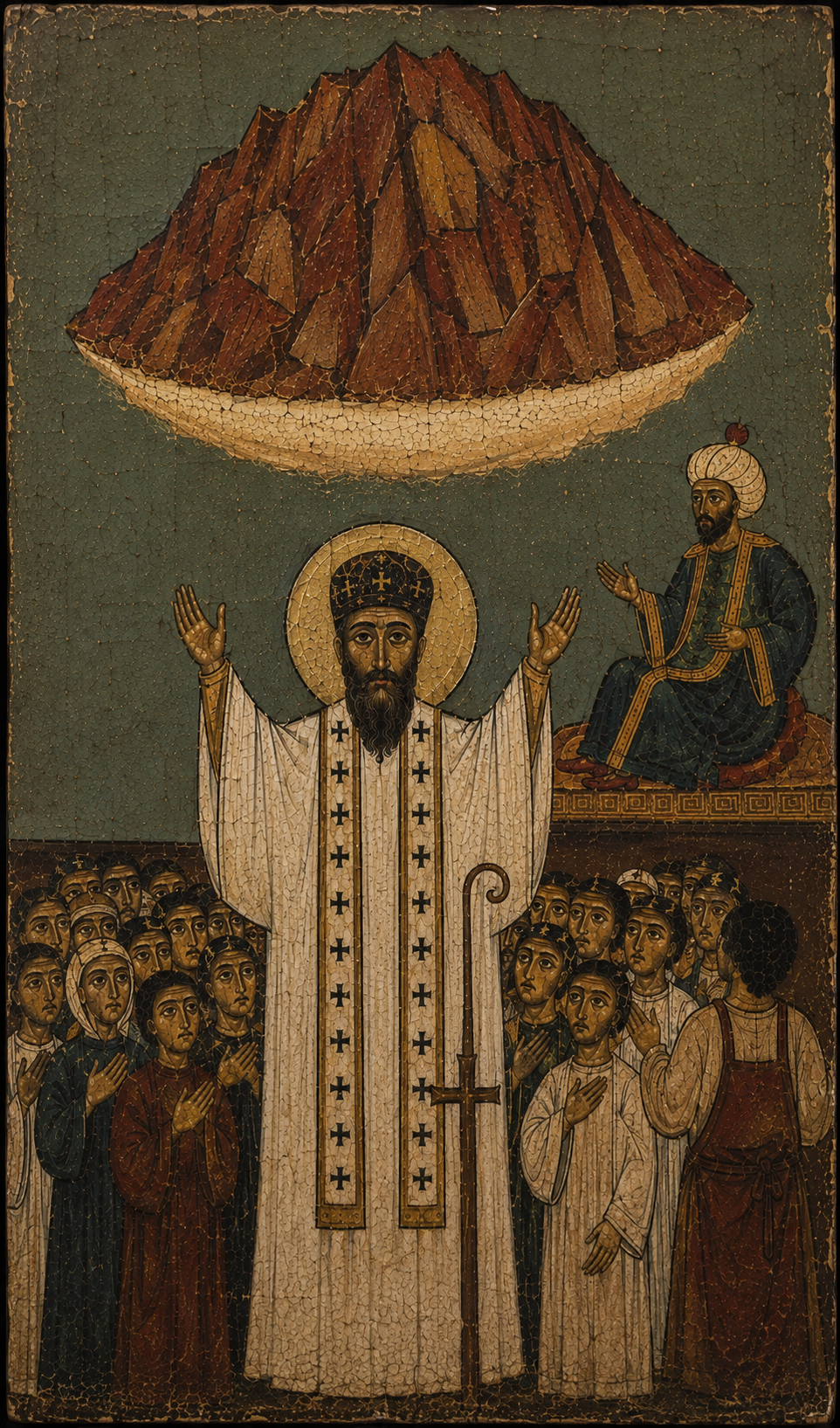
This prayer card depicts one of the most extraordinary events preserved in Coptic Orthodox history and tradition, the miraculous moving of Mokattam Mountain in Cairo through the faith and prayer of the Coptic Christian community. During the late tenth century, in the patriarchate of Pope Abraam the Syrian, the 62nd Pope of Alexandria, the Copts were challenged by the Fatimid ruler Caliph al-Mu'izz li-Din Allah to demonstrate the truth of Christ's words in Matthew 17:20: that faith as small as a mustard seed could move a mountain. According to the Coptic account, failure would leave the Christian community subject to the sword.
Faced with something completely beyond human power, Pope Abraam asked for three days. The bishops, priests, monks, and faithful gathered at the Hanging Church in Old Cairo, fasting, praying, and pleading with God for mercy. Before dawn on the third day, the exhausted Patriarch fell asleep and received a vision of the Virgin Mary, who told him to go into the marketplace and find an unknown one-eyed man carrying water. That man was Saint Simon the Tanner, a humble leatherworker whose hidden life of prayer, repentance, and charity was known to God even though almost no one else knew his name.
Simon regularly carried water to the elderly and sick before going to work at the tannery. When Pope Abraam explained the vision, Simon initially resisted being placed at the center of such an extraordinary event, but eventually agreed and instructed the Patriarch how the people should pray. The Coptic account says the Christians assembled before Mokattam Mountain with the Caliph and his court watching, repeatedly crying Kyrie eleison, “Lord, have mercy,” while kneeling and rising as Pope Abraam made the sign of the Cross.
Then, according to the received Coptic tradition, the mountain shook and lifted from the earth. As the congregation rose from prayer the mountain rose, and as they bowed it descended again. The account says this occurred three times, with sunlight becoming visible beneath the mountain before the astonished crowd. The Caliph finally told Pope Abraam that what he had witnessed was sufficient proof of the Christians' faith. The official Coptic Orthodox Church continues to include the moving of Mokattam Mountain in its historical chronology of Pope Abraam's patriarchate.
THE HIDDEN MAN AT THE EDGE OF THIS ICON
There is an important detail in this particular prayer card that was chosen deliberately. Saint Simon is shown at the edge of the crowd, turned partly away and unnoticed by the others, rather than standing prominently at the center of the miracle.
That composition reflects the final part of his traditional story. After the mountain moved and Pope Abraam turned to find the man whose faith had played such an important role, Simon had disappeared. One Coptic tradition says that God removed him miraculously, while another says Simon deliberately slipped away because he feared human praise and the temptation of vainglory. Either version preserves the same spiritual point: Simon did not want the miracle to become about Simon.
Many traditional representations therefore concentrate upon Pope Abraam, the praying Coptic people, and the mountain itself rather than making Simon the visual hero of the scene. This card intentionally does something slightly different. Simon is present because his role belongs to the story, but he has been placed where his own humility would have placed him: at the edge, turned away, largely unnoticed, while God receives the glory.
That small artistic choice captures one of the deepest lessons of the entire miracle. The man through whom God chose to answer an apparently impossible crisis was not a ruler, famous theologian, wealthy patron, or celebrated monk. He was an ordinary working man who carried water to people who could not carry it themselves, prayed through the night, lived simply, and apparently preferred to disappear rather than be praised. The Coptic doxology itself remembers Simon as a man of prayer who served the elderly, sick, and needy while living in humility.
WHY IS SAINT SIMON SHOWN WITH ONE EYE CLOSED?
Saint Simon's closed or missing eye is also intentional and comes directly from his Coptic tradition. While working as a shoemaker, Simon once looked lustfully at a woman who had come to have her shoe repaired. Horrified by the temptation, he took Christ's severe language in Matthew 5:29 literally and put out the offending eye. His traditional Coptic doxology explicitly remembers both the loss of the eye and the life of purity and humility that followed.
The Church does not present physical self-injury as ordinary Christian practice. The enduring spiritual lesson is the uncompromising seriousness with which Simon treated sin: whatever repeatedly leads a Christian away from God must be confronted rather than comfortably accommodated.
His one eye became so closely connected with his identity that the Virgin Mary's description to Pope Abraam specifically directed him to find the one-eyed man carrying water. In traditional iconography, therefore, showing both of Simon's eyes as completely normal would actually remove one of the principal visual signs identifying him.
THE THREE DAYS THAT CHANGED THE COPTIC NATIVITY FAST
The miracle left a permanent mark on Coptic Christian practice. The Coptic Orthodox tradition remembers the three days of fasting and prayer before the mountain moved by maintaining three additional fasting days immediately before the forty-day Nativity Fast. The Coptic Orthodox Metropolis of the Southern United States likewise explains that these days commemorate the three-day fast preceding the Mokattam miracle.
This makes the story far more than a medieval miracle preserved in a devotional book. Every year, the fasting life of Coptic Christians still carries a remembrance of the moment when an entire Christian community responded to an impossible threat not by trusting its political power, but through fasting, repentance, prayer, and the repeated cry, “Lord, have mercy.”
A PRAYER CARD FOR WHEN THE MOUNTAIN WILL NOT MOVE
This card is especially meaningful for someone facing a situation that appears impossible, immovable, or completely beyond human ability. It may be given during a frightening family crisis, prolonged financial difficulty, a seemingly hopeless legal or employment problem, a difficult conversion, a spiritual battle, persecution, illness, addiction, or any season when a person has reached the end of what ordinary human effort seems capable of accomplishing.
The message is not that sufficiently intense prayer obligates God to give us whatever outcome we request. The deeper lesson of Mokattam is that God remains greater than the obstacle, even when the obstacle appears as immovable as a mountain. The Christian continues doing what can responsibly be done while refusing to make hopelessness into an article of faith.
Saint Simon also makes the card especially meaningful for humility, hidden faith, repentance, purity, service to the elderly and sick, craftsmen, leatherworkers, shoemakers, and ordinary working people seeking holiness in everyday life. I found no reliable Coptic source establishing a narrow formal patronage such as “patron saint of tanners” or “patron saint of impossible causes,” so these are better presented as strong devotional associations arising directly from his Life rather than official titles.
Each 2.5" x 4.25" prayer card is handmade in Austin, Texas and prepared prayerfully with each order. It is printed on museum-quality photo paper rather than cardstock, double laminated for durability, and made while the recipient and their intentions are lifted before Christ in prayer.
HOW HISTORICAL IS THE MIRACLE OF MOKATTAM?
The best wording for the product page is “according to Coptic Orthodox history and tradition” rather than calling the account merely a legend or, at the opposite extreme, claiming that every detail possesses contemporary independent documentation. The official Coptic Orthodox Church places the moving of Mokattam directly in its historical chronology of Pope Abraam, and the story remains deeply embedded in Coptic worship, fasting, iconography, pilgrimage, and devotion.
Academic study shows that the textual tradition developed over time. Scholar Youhanna Nessim Youssef traces the earliest surviving written account to Michael of Tinnis in the eleventh century, roughly a century after the event; later sources added Simon's name and additional details that became part of the received tradition. Historian Jennifer Pruitt likewise treats the Miracle of Muqattam as a significant medieval Coptic foundational narrative that combines historical events, hagiography, and miraculous tradition within the religious world of Fatimid Egypt.
So the cleanest wording is exactly what this description uses: “The Coptic Orthodox Church preserves,” “according to Coptic tradition,” and “the Coptic account says.” That respects both the Church's actual belief and the limits of surviving tenth-century documentation.
SAINT SIMON'S FEAST & COPTIC COMMEMORATION
Modern Coptic liturgical sources place a commemoration of Saint Simon the Tanner on 17 Hathor, around late November, while the miracle of Mokattam is also commemorated in connection with the following days and the beginning of the special three-day fast. Coptic liturgical indexes include a Psali and Doxology for Simon, and modern Coptic Reader updates specifically include prayers for him.
Older English Synaxarium editions do not always give Simon a separate entry on that date. Instead, they preserve his story within the commemoration of Pope Abraam on 6 Kiahk, another reason different Coptic sources can appear to give somewhat different locations for his commemoration while telling the same received story.
TRADITIONAL COPTIC PRAYER
There is an existing Coptic Orthodox Doxology for Saint Simon the Tanner, so no newly invented prayer is necessary. The doxology specifically praises his great faith in connection with Mokattam, remembers his purity, simple ascetic life, prayer, service to the elderly and sick, and concludes with an established invocation.
A beautiful traditional prayer from that Doxology is:
“Ask the Lord on our behalf, great persevering one of Babylon, Saint Simon the Tanner, that He may forgive us our sins.”
That is the prayer I would use on the back of this card rather than writing a new one. It comes from an actual Coptic Vespers and Matins doxology and connects the card directly with Saint Simon's living liturgical tradition.
FAQ
What is the Miracle of Mokattam Mountain? According to Coptic Orthodox tradition, Caliph al-Mu'izz challenged Pope Abraam to demonstrate Christ's statement in Matthew 17:20 by moving Mokattam Mountain. After three days of fasting and prayer, the Coptic account says the mountain visibly lifted and shook as the Christians prayed.
Who was Pope Abraam? Pope Abraam the Syrian was the 62nd Pope of Alexandria and Patriarch of the See of Saint Mark. The official Coptic Orthodox Church places his patriarchate in the late 970s and specifically associates his papacy with the miracle of Mokattam.
Who was al-Mu'izz li-Din Allah? Al-Mu'izz was the Fatimid caliph under whom the Fatimid dynasty conquered Egypt and established its new political center at Cairo. Coptic tradition places the challenge to Pope Abraam during his rule.
What Bible verse caused the challenge? The principal verse was Matthew 17:20, in which Christ teaches that faith like a mustard seed can say to a mountain to move. The Coptic account says this verse was presented to the Caliph as a challenge to the Christian community.
Who was Saint Simon the Tanner? Simon was a tenth-century Coptic Christian leatherworker or tanner living in Old Cairo. Coptic tradition remembers him as a hidden ascetic who prayed deeply, lived simply, and carried water and food to elderly, sick, and poor people before going to work.
Why did the Virgin Mary tell Pope Abraam to find Simon? According to the Coptic story, the Virgin Mary appeared to the exhausted Pope during the three-day fast and told him that God would accomplish the sign through a one-eyed man carrying water. Pope Abraam followed her instructions and found Simon serving the needy.
Why did Saint Simon have only one eye? His traditional Life says he removed one eye after a lustful glance, interpreting Matthew 5:29 literally. His Coptic Doxology itself preserves this detail and praises the purity and humility that characterized his later life.
Why is Saint Simon shown at the edge of this prayer card? Simon's position is an intentional artistic reference to his humility and disappearance after the miracle. Rather than making him the obvious hero of the composition, the card shows him turned away and unnoticed while the people focus upon what God is doing.
Did Saint Simon disappear after the mountain moved? CopticChurch.net preserves two traditions: one says Simon was miraculously taken away, while another says he deliberately disappeared because he feared human praise and vainglory. Both versions emphasize the same defining virtue, his extraordinary humility.
Why did the Christians fast for three days? Pope Abraam requested three days before answering the Caliph's challenge, and the Christian community spent them fasting and praying. Coptic Christians continue remembering that fast in the three additional days associated with the beginning of the Nativity Fast.
What did the Christians pray at Mokattam? The Coptic account remembers them repeatedly chanting Kyrie eleison, meaning “Lord, have mercy,” while kneeling, rising, and making the sign of the Cross. Their prayer emphasizes that the miracle was attributed to God's mercy rather than human power.
Is there a traditional Coptic prayer to Saint Simon? Yes. A dedicated Doxology for Saint Simon the Tanner is preserved in Coptic Vespers and Matins material, and Coptic Reader also includes saint-specific prayers for him.
What is this prayer card especially meaningful for? It is especially fitting for impossible situations, deep faith, humility, repentance, purity, hidden service, and moments when a problem seems completely immovable. Simon's life also makes it meaningful for craftsmen, leatherworkers, caregivers, and people whose quiet service is largely unseen.
What is the main message of the Miracle of Mokattam? The story teaches that Christian faith is not confidence in one's own power, but trust in God's power when human strength has reached its limit. The mountain is the spectacular part of the story, but the hidden heart of it is a praying Church and an unknown working man whose humility was so complete that, once everyone wanted to find him, he was gone.
This prayer card depicts one of the most extraordinary events preserved in Coptic Orthodox history and tradition, the miraculous moving of Mokattam Mountain in Cairo through the faith and prayer of the Coptic Christian community. During the late tenth century, in the patriarchate of Pope Abraam the Syrian, the 62nd Pope of Alexandria, the Copts were challenged by the Fatimid ruler Caliph al-Mu'izz li-Din Allah to demonstrate the truth of Christ's words in Matthew 17:20: that faith as small as a mustard seed could move a mountain. According to the Coptic account, failure would leave the Christian community subject to the sword.
Faced with something completely beyond human power, Pope Abraam asked for three days. The bishops, priests, monks, and faithful gathered at the Hanging Church in Old Cairo, fasting, praying, and pleading with God for mercy. Before dawn on the third day, the exhausted Patriarch fell asleep and received a vision of the Virgin Mary, who told him to go into the marketplace and find an unknown one-eyed man carrying water. That man was Saint Simon the Tanner, a humble leatherworker whose hidden life of prayer, repentance, and charity was known to God even though almost no one else knew his name.
Simon regularly carried water to the elderly and sick before going to work at the tannery. When Pope Abraam explained the vision, Simon initially resisted being placed at the center of such an extraordinary event, but eventually agreed and instructed the Patriarch how the people should pray. The Coptic account says the Christians assembled before Mokattam Mountain with the Caliph and his court watching, repeatedly crying Kyrie eleison, “Lord, have mercy,” while kneeling and rising as Pope Abraam made the sign of the Cross.
Then, according to the received Coptic tradition, the mountain shook and lifted from the earth. As the congregation rose from prayer the mountain rose, and as they bowed it descended again. The account says this occurred three times, with sunlight becoming visible beneath the mountain before the astonished crowd. The Caliph finally told Pope Abraam that what he had witnessed was sufficient proof of the Christians' faith. The official Coptic Orthodox Church continues to include the moving of Mokattam Mountain in its historical chronology of Pope Abraam's patriarchate.
THE HIDDEN MAN AT THE EDGE OF THIS ICON
There is an important detail in this particular prayer card that was chosen deliberately. Saint Simon is shown at the edge of the crowd, turned partly away and unnoticed by the others, rather than standing prominently at the center of the miracle.
That composition reflects the final part of his traditional story. After the mountain moved and Pope Abraam turned to find the man whose faith had played such an important role, Simon had disappeared. One Coptic tradition says that God removed him miraculously, while another says Simon deliberately slipped away because he feared human praise and the temptation of vainglory. Either version preserves the same spiritual point: Simon did not want the miracle to become about Simon.
Many traditional representations therefore concentrate upon Pope Abraam, the praying Coptic people, and the mountain itself rather than making Simon the visual hero of the scene. This card intentionally does something slightly different. Simon is present because his role belongs to the story, but he has been placed where his own humility would have placed him: at the edge, turned away, largely unnoticed, while God receives the glory.
That small artistic choice captures one of the deepest lessons of the entire miracle. The man through whom God chose to answer an apparently impossible crisis was not a ruler, famous theologian, wealthy patron, or celebrated monk. He was an ordinary working man who carried water to people who could not carry it themselves, prayed through the night, lived simply, and apparently preferred to disappear rather than be praised. The Coptic doxology itself remembers Simon as a man of prayer who served the elderly, sick, and needy while living in humility.
WHY IS SAINT SIMON SHOWN WITH ONE EYE CLOSED?
Saint Simon's closed or missing eye is also intentional and comes directly from his Coptic tradition. While working as a shoemaker, Simon once looked lustfully at a woman who had come to have her shoe repaired. Horrified by the temptation, he took Christ's severe language in Matthew 5:29 literally and put out the offending eye. His traditional Coptic doxology explicitly remembers both the loss of the eye and the life of purity and humility that followed.
The Church does not present physical self-injury as ordinary Christian practice. The enduring spiritual lesson is the uncompromising seriousness with which Simon treated sin: whatever repeatedly leads a Christian away from God must be confronted rather than comfortably accommodated.
His one eye became so closely connected with his identity that the Virgin Mary's description to Pope Abraam specifically directed him to find the one-eyed man carrying water. In traditional iconography, therefore, showing both of Simon's eyes as completely normal would actually remove one of the principal visual signs identifying him.
THE THREE DAYS THAT CHANGED THE COPTIC NATIVITY FAST
The miracle left a permanent mark on Coptic Christian practice. The Coptic Orthodox tradition remembers the three days of fasting and prayer before the mountain moved by maintaining three additional fasting days immediately before the forty-day Nativity Fast. The Coptic Orthodox Metropolis of the Southern United States likewise explains that these days commemorate the three-day fast preceding the Mokattam miracle.
This makes the story far more than a medieval miracle preserved in a devotional book. Every year, the fasting life of Coptic Christians still carries a remembrance of the moment when an entire Christian community responded to an impossible threat not by trusting its political power, but through fasting, repentance, prayer, and the repeated cry, “Lord, have mercy.”
A PRAYER CARD FOR WHEN THE MOUNTAIN WILL NOT MOVE
This card is especially meaningful for someone facing a situation that appears impossible, immovable, or completely beyond human ability. It may be given during a frightening family crisis, prolonged financial difficulty, a seemingly hopeless legal or employment problem, a difficult conversion, a spiritual battle, persecution, illness, addiction, or any season when a person has reached the end of what ordinary human effort seems capable of accomplishing.
The message is not that sufficiently intense prayer obligates God to give us whatever outcome we request. The deeper lesson of Mokattam is that God remains greater than the obstacle, even when the obstacle appears as immovable as a mountain. The Christian continues doing what can responsibly be done while refusing to make hopelessness into an article of faith.
Saint Simon also makes the card especially meaningful for humility, hidden faith, repentance, purity, service to the elderly and sick, craftsmen, leatherworkers, shoemakers, and ordinary working people seeking holiness in everyday life. I found no reliable Coptic source establishing a narrow formal patronage such as “patron saint of tanners” or “patron saint of impossible causes,” so these are better presented as strong devotional associations arising directly from his Life rather than official titles.
Each 2.5" x 4.25" prayer card is handmade in Austin, Texas and prepared prayerfully with each order. It is printed on museum-quality photo paper rather than cardstock, double laminated for durability, and made while the recipient and their intentions are lifted before Christ in prayer.
HOW HISTORICAL IS THE MIRACLE OF MOKATTAM?
The best wording for the product page is “according to Coptic Orthodox history and tradition” rather than calling the account merely a legend or, at the opposite extreme, claiming that every detail possesses contemporary independent documentation. The official Coptic Orthodox Church places the moving of Mokattam directly in its historical chronology of Pope Abraam, and the story remains deeply embedded in Coptic worship, fasting, iconography, pilgrimage, and devotion.
Academic study shows that the textual tradition developed over time. Scholar Youhanna Nessim Youssef traces the earliest surviving written account to Michael of Tinnis in the eleventh century, roughly a century after the event; later sources added Simon's name and additional details that became part of the received tradition. Historian Jennifer Pruitt likewise treats the Miracle of Muqattam as a significant medieval Coptic foundational narrative that combines historical events, hagiography, and miraculous tradition within the religious world of Fatimid Egypt.
So the cleanest wording is exactly what this description uses: “The Coptic Orthodox Church preserves,” “according to Coptic tradition,” and “the Coptic account says.” That respects both the Church's actual belief and the limits of surviving tenth-century documentation.
SAINT SIMON'S FEAST & COPTIC COMMEMORATION
Modern Coptic liturgical sources place a commemoration of Saint Simon the Tanner on 17 Hathor, around late November, while the miracle of Mokattam is also commemorated in connection with the following days and the beginning of the special three-day fast. Coptic liturgical indexes include a Psali and Doxology for Simon, and modern Coptic Reader updates specifically include prayers for him.
Older English Synaxarium editions do not always give Simon a separate entry on that date. Instead, they preserve his story within the commemoration of Pope Abraam on 6 Kiahk, another reason different Coptic sources can appear to give somewhat different locations for his commemoration while telling the same received story.
TRADITIONAL COPTIC PRAYER
There is an existing Coptic Orthodox Doxology for Saint Simon the Tanner, so no newly invented prayer is necessary. The doxology specifically praises his great faith in connection with Mokattam, remembers his purity, simple ascetic life, prayer, service to the elderly and sick, and concludes with an established invocation.
A beautiful traditional prayer from that Doxology is:
“Ask the Lord on our behalf, great persevering one of Babylon, Saint Simon the Tanner, that He may forgive us our sins.”
That is the prayer I would use on the back of this card rather than writing a new one. It comes from an actual Coptic Vespers and Matins doxology and connects the card directly with Saint Simon's living liturgical tradition.
FAQ
What is the Miracle of Mokattam Mountain? According to Coptic Orthodox tradition, Caliph al-Mu'izz challenged Pope Abraam to demonstrate Christ's statement in Matthew 17:20 by moving Mokattam Mountain. After three days of fasting and prayer, the Coptic account says the mountain visibly lifted and shook as the Christians prayed.
Who was Pope Abraam? Pope Abraam the Syrian was the 62nd Pope of Alexandria and Patriarch of the See of Saint Mark. The official Coptic Orthodox Church places his patriarchate in the late 970s and specifically associates his papacy with the miracle of Mokattam.
Who was al-Mu'izz li-Din Allah? Al-Mu'izz was the Fatimid caliph under whom the Fatimid dynasty conquered Egypt and established its new political center at Cairo. Coptic tradition places the challenge to Pope Abraam during his rule.
What Bible verse caused the challenge? The principal verse was Matthew 17:20, in which Christ teaches that faith like a mustard seed can say to a mountain to move. The Coptic account says this verse was presented to the Caliph as a challenge to the Christian community.
Who was Saint Simon the Tanner? Simon was a tenth-century Coptic Christian leatherworker or tanner living in Old Cairo. Coptic tradition remembers him as a hidden ascetic who prayed deeply, lived simply, and carried water and food to elderly, sick, and poor people before going to work.
Why did the Virgin Mary tell Pope Abraam to find Simon? According to the Coptic story, the Virgin Mary appeared to the exhausted Pope during the three-day fast and told him that God would accomplish the sign through a one-eyed man carrying water. Pope Abraam followed her instructions and found Simon serving the needy.
Why did Saint Simon have only one eye? His traditional Life says he removed one eye after a lustful glance, interpreting Matthew 5:29 literally. His Coptic Doxology itself preserves this detail and praises the purity and humility that characterized his later life.
Why is Saint Simon shown at the edge of this prayer card? Simon's position is an intentional artistic reference to his humility and disappearance after the miracle. Rather than making him the obvious hero of the composition, the card shows him turned away and unnoticed while the people focus upon what God is doing.
Did Saint Simon disappear after the mountain moved? CopticChurch.net preserves two traditions: one says Simon was miraculously taken away, while another says he deliberately disappeared because he feared human praise and vainglory. Both versions emphasize the same defining virtue, his extraordinary humility.
Why did the Christians fast for three days? Pope Abraam requested three days before answering the Caliph's challenge, and the Christian community spent them fasting and praying. Coptic Christians continue remembering that fast in the three additional days associated with the beginning of the Nativity Fast.
What did the Christians pray at Mokattam? The Coptic account remembers them repeatedly chanting Kyrie eleison, meaning “Lord, have mercy,” while kneeling, rising, and making the sign of the Cross. Their prayer emphasizes that the miracle was attributed to God's mercy rather than human power.
Is there a traditional Coptic prayer to Saint Simon? Yes. A dedicated Doxology for Saint Simon the Tanner is preserved in Coptic Vespers and Matins material, and Coptic Reader also includes saint-specific prayers for him.
What is this prayer card especially meaningful for? It is especially fitting for impossible situations, deep faith, humility, repentance, purity, hidden service, and moments when a problem seems completely immovable. Simon's life also makes it meaningful for craftsmen, leatherworkers, caregivers, and people whose quiet service is largely unseen.
What is the main message of the Miracle of Mokattam? The story teaches that Christian faith is not confidence in one's own power, but trust in God's power when human strength has reached its limit. The mountain is the spectacular part of the story, but the hidden heart of it is a praying Church and an unknown working man whose humility was so complete that, once everyone wanted to find him, he was gone.