 Image 1 of 1
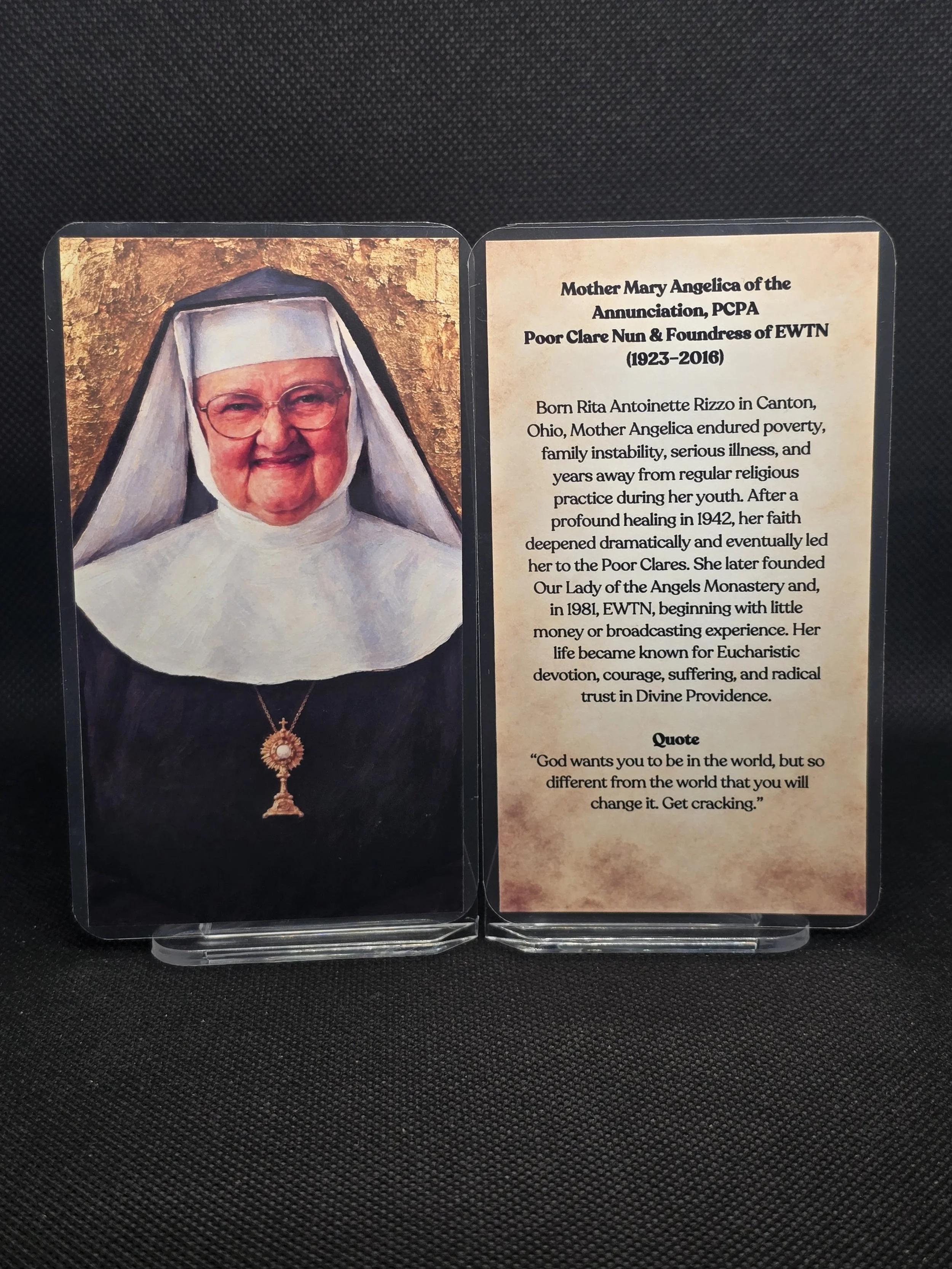
Mother Angelica Prayer Card – For Eucharistic Devotion, Divine Providence, Bold Faith & Prayer for Her Future Canonization Cause
Mother Mary Angelica of the Annunciation, P.C.P.A., known throughout the world simply as Mother Angelica, was a Poor Clare Nun of Perpetual Adoration, contemplative, spiritual teacher, foundress of Our Lady of the Angels Monastery, and founder of the Eternal Word Television Network, EWTN. From an impoverished and unstable childhood in Canton, Ohio, she entered contemplative religious life and eventually became one of the most recognizable Christian voices of the twentieth century, reaching millions through television while continually insisting that everything depended upon prayer and Divine Providence.
Her life is especially meaningful for people seeking greater Eucharistic devotion, courage to follow God when the path seems impossible, perseverance during chronic illness, confidence in Divine Providence, deeper prayer, evangelization, and boldness in carrying the faith into modern culture. Her story also speaks powerfully to entrepreneurs, Christian creators, religious communities, people beginning ministries with limited resources, and anyone who has ever felt that what God appears to be asking is far larger than their own abilities.
Mother Angelica died in 2016 and is not currently a canonized saint, Blessed, Venerable, or publicly recognized Servant of God. As of September 2026, no formal cause for her beatification and canonization has been publicly announced. This prayer card therefore honors her Christian witness and preserves her own words without assigning her a canonical title the Church has not yet given her.
Each prayer card measures 2.5" x 4.25", is handmade in Austin, Texas, printed on museum-quality photo paper rather than ordinary cardstock, and double laminated for durability. Every card is made to order and prepared prayerfully, with the recipient and their intentions brought before Christ while remembering Mother Angelica’s extraordinary confidence that God can accomplish great things through ordinary people who are willing to respond to Him.
THE LIFE & STORY
Rita Antoinette Rizzo was born on April 20, 1923, in Canton, Ohio, the only child of John Rizzo and Mae Gianfrancesco Rizzo. Her childhood was difficult, marked by poverty, the collapse of her parents’ marriage, her father’s absence, and the emotional and financial struggles endured by her mother.
Her family had Catholic roots, although religious practice was not especially strong during much of Rita’s childhood. Rita and her mother spent a significant period away from regular participation in Church life, making the profound religious awakening that followed in Rita’s young adulthood all the more striking.
A CHILDHOOD MARKED BY POVERTY & INSTABILITY
Mother Angelica rarely fit the image of someone whose childhood obviously prepared her to lead an international organization. Rita grew up watching her mother struggle to provide for them while carrying the stigma and emotional pain associated with divorce at a time when society could be particularly unforgiving toward a divorced woman.
The experience left Rita deeply aware of insecurity, humiliation, and dependence upon others. Years later, when EWTN repeatedly faced impossible financial circumstances, Mother Angelica’s willingness to proceed without conventional financial security would become one of the defining characteristics of her leadership.
THE HEALING THAT CHANGED RITA RIZZO
During adolescence and young adulthood, Rita suffered from severe stomach pain and digestive illness. Her condition became increasingly debilitating until she was introduced to Rhoda Wise, a woman in Canton known for deep prayer and reported mystical experiences.
Wise encouraged Rita to pray a novena seeking the intercession of Saint Thérèse of Lisieux. Rita later testified that the severe stomach condition disappeared after the novena, an experience she regarded as a profound healing and spiritual turning point.
The event did more than change her physical condition. Rita later described it as the moment when she truly began to understand that God loved her personally and when prayer ceased to be merely something external and became the center of her life.
RHODA WISE & MOTHER ANGELICA
Rhoda Wise would remain an important figure in Rita’s spiritual development. The connection is particularly remarkable today because Wise herself has a formally opened cause for canonization and is recognized as Servant of God Rhoda Wise.
Mother Angelica’s own cause has not yet begun, while the woman who helped lead young Rita toward deeper faith is already advancing through the formal Church process. Their relationship provides an extraordinary link between one of the twentieth century’s most recognizable religious broadcasters and the quieter spiritual influence that helped form her.
HER CALL TO RELIGIOUS LIFE
As Rita’s prayer life deepened, she became increasingly convinced that God was calling her to religious life. In 1944, she entered the Poor Clare community in Cleveland, Ohio, beginning the contemplative vocation that would eventually seem almost impossible to reconcile with international television.
She received the religious name Sister Mary Angelica of the Annunciation. The spirituality of the Poor Clares of Perpetual Adoration centered upon poverty, sacrifice, enclosure, and especially perpetual adoration of Jesus Christ in the Eucharist.
A CONTEMPLATIVE BEFORE SHE WAS A TELEVISION PERSONALITY
Mother Angelica’s television ministry can easily obscure the foundation beneath everything she later built. She was first and foremost a contemplative nun whose life was centered upon prayer before the Blessed Sacrament.
Her broadcasting work did not replace contemplation but grew out of it. Decisions that appeared reckless to outsiders were frequently preceded by long periods of prayer, and Mother Angelica continually returned to Eucharistic adoration when she needed to discern what direction the network or her religious community should take.
SERIOUS ILLNESS & A PROMISE TO GOD
Physical suffering remained part of Mother Angelica’s life from young adulthood onward. A severe spinal condition eventually required surgery, and doctors warned that the procedure carried the possibility that she might never walk again.
Mother Angelica promised God that if she were able to walk after the operation, she would work to establish a monastery in the American South. Although her recovery remained physically difficult, she did walk again and began pursuing the promise that eventually brought her to Alabama.
THE MOVE TO ALABAMA
After years of seeking permissions and overcoming practical obstacles, Mother Angelica and several sisters established Our Lady of the Angels Monastery in Irondale, Alabama. The foundation began in an area where Catholics formed a small minority and where the sisters possessed very limited financial resources.
The monastery survived through prayer, work, donations, and creative fundraising. The sisters produced and sold goods, while Mother Angelica increasingly became known for spiritual talks that combined direct Christian teaching with humor, practical wisdom, and a style unlike the formal religious broadcasting common at the time.
“LORD, I GOTTA HAVE ONE OF THESE”
During a visit to a television studio in Chicago in 1978, Mother Angelica recognized the extraordinary possibilities of television for evangelization. Looking at the equipment and seeing how television could carry religious teaching directly into people’s homes, she famously reacted with the conviction that she needed a television station of her own.
The idea was objectively enormous for a cloistered nun with no broadcasting background. Mother Angelica nevertheless returned to Alabama convinced that television could become a modern mission field and began moving toward what eventually became EWTN.
THE BEGINNING OF EWTN
The Eternal Word Television Network began broadcasting on August 15, 1981, from facilities at the monastery in Irondale. Mother Angelica began with approximately $200, a small community of nuns, very little broadcasting experience, and circumstances that offered almost no conventional reason to believe the project could become an international network.
EWTN gradually expanded from a few hours of programming into continuous broadcasting, international television, radio, publishing, news, digital media, and multiple language services. What began in a monastery garage eventually became one of the largest religious media organizations in the world.
BUILT ON DIVINE PROVIDENCE
Financial uncertainty accompanied EWTN from its earliest years. Unlike commercial television networks supported primarily through advertising, Mother Angelica relied heavily upon ordinary viewers who believed in the mission and contributed what they could.
She became famous for asking viewers to keep EWTN “between your gas and electric bill,” emphasizing small, regular gifts rather than treating support as something reserved for wealthy benefactors. That relationship between the network and ordinary viewers became one of the defining characteristics of EWTN.
THE $600,000 SATELLITE DISH STORY
One of the most remarkable stories associated with the early years of EWTN concerns a satellite dish that cost approximately $600,000. Mother Angelica had committed to acquiring the equipment even though the network did not possess the money necessary to pay for it.
When the delivery arrived and the money still had not appeared, Mother Angelica went to the chapel before the Blessed Sacrament. She admitted to God that perhaps she had misunderstood His will and asked whether there was anything He could do to help her out of the situation.
While she was praying, one of the sisters interrupted her because a man was calling and insisting upon speaking with her. The caller was a wealthy father whose son had struggled with drug addiction and had encountered one of Mother Angelica’s small spiritual books.
The booklet had profoundly affected the young man, who subsequently entered rehabilitation and began changing his life. His father was so grateful for what Mother Angelica’s ministry had done for his son that he wanted to make a substantial donation.
The amount he offered was $600,000, the same amount Mother Angelica needed for the satellite equipment. Mother Angelica immediately asked whether he could wire the money, and the satellite dish became part of the infrastructure that allowed EWTN’s signal to reach an enormous audience.
EWTN has continued to tell the story as one of the great examples of Divine Providence in its early history. It is important, however, to distinguish a providential event from a canonically investigated miracle; the Church has not formally examined or declared this financial event miraculous.
THE $650,000 DEBT CRISIS
The satellite story was not the only occasion when EWTN appeared financially close to collapse. In November 1984, a foundation called in a loan of approximately $650,000 plus interest, creating another major financial crisis for the still-young network.
Only two days later, a retired attorney and his wife agreed to advance approximately $700,000, allowing EWTN to pay the debt. Mother Angelica pointed to episodes like this as evidence of the Divine Providence upon which she believed the network depended.
“DO THE RIDICULOUS”
One of Mother Angelica’s best-known statements summarizes the unusual financial and spiritual philosophy behind many of these decisions: “Unless we are willing to do the ridiculous, God will not do the miraculous.”
She did not mean that every impulsive idea should automatically be treated as God’s will. Her approach combined prolonged prayer, discernment, bold action, and a willingness to accept the possibility that she herself had misunderstood something.
The repeated pattern of her life was to discern, act, encounter an apparently impossible obstacle, return to prayer, and continue trusting that the path would become clear. Whether the answer involved an unexpected benefactor, a change in plans, or simply the strength to continue, Mother Angelica interpreted these events through the lens of Divine Providence.
THE SHORTWAVE RADIO DREAM
Mother Angelica eventually became convinced that EWTN should expand beyond television into international shortwave radio. The project required another level of resources far beyond what most observers would have considered reasonable for the network.
A Dutch philanthropist, Piet Derksen, eventually provided substantial financial assistance toward the project. Other benefactors followed, allowing EWTN to establish international radio broadcasting that could reach countries where ordinary television distribution was difficult or impossible.
THE $1 MILLION GIFT
Another remarkable episode involved New Orleans businessman Joseph Canizaro. Mother Angelica asked what she could pray for that might persuade him to give EWTN one million dollars toward the shortwave project.
A planned hotel sale did not materialize as expected, but Canizaro later received a much larger than anticipated settlement involving another business matter. In February 1990, he and Archbishop Philip Hannan personally delivered a $1 million check to Mother Angelica, providing critical financing for the American shortwave operation.
THE DIVINE CHILD JESUS & THE SHRINE
In 1996, while visiting Colombia, Mother Angelica reported a mystical experience while praying before an image of the Divine Child Jesus. She said she heard the Child Jesus tell her, “Build Me a Temple and I will help those who help you.”
The experience dramatically changed her plans for property the sisters had acquired in Hanceville, Alabama. Instead of merely constructing a modest monastery chapel, Mother Angelica became convinced that the land should contain a magnificent shrine dedicated to Jesus in the Blessed Sacrament.
THE SHRINE OF THE MOST BLESSED SACRAMENT
The result was the Shrine of the Most Blessed Sacrament in Hanceville, Alabama, together with a new monastery for the Poor Clares of Perpetual Adoration. Five families provided major anonymous financial assistance toward the construction, allowing Mother Angelica’s vision to become reality.
The Shrine embodies the spiritual center underlying EWTN. Television might have made Mother Angelica famous, but the Eucharist remained the center of the contemplative vocation from which the network emerged.
HER DEVOTION TO THE EUCHARIST
Mother Angelica’s deepest spiritual identity cannot be understood without the Blessed Sacrament. Hours before cameras, microphones, business decisions, and fundraising stood hours of Eucharistic adoration and the life of a contemplative Poor Clare.
For those trying to establish a habit of Eucharistic adoration, Mother Angelica provides an especially powerful modern example. Her enormous public apostolate grew from a hidden life of prayer rather than prayer becoming merely an accessory to her public work.
“GET CRACKING”
Mother Angelica’s personality was unusually direct for a contemplative nun, and her humor made serious spiritual truths memorable. One of her most characteristic statements was: “God wants you to be in the world, but so different from the world that you will change it. Get cracking.”
The quotation captures the way she understood Christian life. Faith was not meant simply to make someone privately comfortable, but to make the person different enough from the surrounding culture that the Gospel became visible through the way they lived and worked.
FOR PEOPLE AFRAID TO BEGIN
Mother Angelica’s life speaks powerfully to people who believe they lack the qualifications, finances, education, connections, or experience necessary to begin something worthwhile. Nothing about a cloistered nun with two hundred dollars and no professional broadcasting background suggested the founder of a global media network.
Her example does not mean every ambitious project is automatically inspired by God. It does show that lack of resources alone should not automatically be treated as proof that God cannot be asking a person to move forward.
FOR ENTREPRENEURS & CHRISTIAN CREATORS
Entrepreneurs, writers, artists, filmmakers, publishers, broadcasters, podcasters, and Christian business owners can find unusual inspiration in Mother Angelica. She combined deep contemplative prayer with extraordinary practical initiative and was willing to enter technologies and industries that had little obvious connection with cloistered religious life.
Her approach also challenges the temptation to divide prayer from work. Mother Angelica believed major decisions required serious prayer, but she also believed discernment had to result in action when the direction became clear.
CHRONIC ILLNESS & SUFFERING
Mother Angelica’s life contained extensive physical suffering. She endured stomach disease, spinal damage, respiratory illness, severe asthma, painful braces, broken bones, repeated medical problems, and eventually debilitating strokes.
Her suffering never existed only as something to be overcome before her true vocation could begin. Weakness accompanied her ministry and gradually became more central as her ability to speak, travel, and lead publicly diminished.
THE 1998 HEALING OF HER LEGS
In 1998, Mother Angelica reported another extraordinary event while praying the Rosary with Italian mystic Paola Albertini. After years of relying upon braces because of painful leg and spinal problems, she removed the braces and began walking without them.
EWTN records that physicians examined her afterward and considered the improvement genuine. As with other reported extraordinary events in her life, this should be described accurately as a reported healing rather than as a miracle formally investigated and declared by the Church in a canonization process.
HER STROKE & THE LOSS OF HER VOICE
Mother Angelica suffered a severe stroke and cerebral hemorrhage in 2001. The woman whose voice had reached millions was left with drastically reduced speech and physical ability, bringing her public television ministry effectively to an end.
This period may be one of the most spiritually important chapters of her life. Mother Angelica had spent decades teaching people how to trust God, and her final years forced her to live that trust without the activity, public influence, or independence that had previously characterized her mission.
HIDDEN YEARS OF PRAYER
After the stroke, Mother Angelica lived largely within the enclosure of the monastery in Hanceville. The television personality gradually disappeared from public view, but the contemplative vocation with which she had begun remained.
Her life therefore came full circle. Before EWTN she had been a hidden Poor Clare, and after decades of worldwide broadcasting she returned to a hidden life of prayer, dependence, physical suffering, and preparation for death.
HER DEATH ON EASTER SUNDAY
Mother Angelica died on March 27, 2016, which that year was Easter Sunday. She was ninety-two years old and had spent more than seven decades in religious life.
She was buried at the Shrine of the Most Blessed Sacrament in Hanceville, Alabama, the place that embodied her Eucharistic spirituality and the contemplative community she had worked so hard to establish.
IS MOTHER ANGELICA A SAINT?
Mother Angelica is not currently a canonized saint. She has not been beatified, declared Venerable, or publicly designated a Servant of God through the opening of a formal cause.
Calling her simply Mother Angelica or Mother Mary Angelica of the Annunciation, P.C.P.A. respects both her religious vocation and the Church’s current judgment. Devotion to her life should never get ahead of the Church by assigning titles that have not formally been granted.
HAS HER CANONIZATION CAUSE BEEN OPENED?
As of September 2026, there has been no public announcement that the Diocese of Birmingham in Alabama has formally opened a cause for Mother Angelica’s beatification and canonization. The ordinary five-year waiting period following her death expired in 2021, so the canonical waiting period itself is no longer an obstacle.
The absence of an opened cause does not mean that a cause can never begin or that there is no interest in her holiness. It means only that the formal ecclesiastical process has not yet been publicly initiated.
HOW A CANONIZATION CAUSE REALLY BEGINS
A canonization cause does not begin in Rome simply because a famous person has admirers. Church law first looks for what is traditionally called a reputation for holiness, meaning a genuine belief among a significant portion of the faithful that the person lived an unusually holy Christian life.
The Church also considers a reputation for intercessory power, meaning that people naturally begin asking for the person’s prayers and report favors they believe they have received through that intercession. This reputation must be spontaneous, stable, continuing, and widespread rather than artificially manufactured.
That is where the grassroots element of a future Mother Angelica cause matters. Long before lawyers, historians, tribunals, and Vatican officials begin examining a candidate, ordinary Christians pray, preserve memories, share credible testimony, visit a grave, report favors, study the person’s writings, and keep alive a genuine conviction that the life deserves closer examination.
GRASSROOTS DOES NOT MEAN PRESSURING THE CHURCH
A grassroots movement for a canonization cause should never become a pressure campaign attempting to force a bishop to declare someone holy. The Church specifically requires that the reputation for holiness be genuine and spontaneous rather than artificially produced.
Support therefore means praying, preserving evidence, documenting favors, sharing authentic personal testimony, and respectfully making the existence of that devotion known to the proper Church authorities. A thousand copied form letters are less meaningful than sincere accounts showing how a person’s Christian witness actually led people toward Christ.
WHO CAN FORMALLY START A CAUSE?
Church law permits a cause to be promoted by an appropriate petitioner, which can include an individual member of the faithful or a legitimate group recognized by ecclesiastical authority. The petitioner then appoints a qualified postulator, someone trained in theology, canon law, history, and the procedures governing causes of saints.
The postulator conducts preliminary research and ultimately submits the formal written request, known as the libellus, to the competent diocesan bishop. The bishop does not automatically accept the request; he first determines whether a genuine reputation for holiness and intercessory power exists and whether opening the cause would serve the good of the Church.
WHY THE BISHOP OF BIRMINGHAM MATTERS
Under the ordinary canonical rule, the bishop competent to begin the investigation is the bishop of the diocese in which the candidate died. Mother Angelica died in Hanceville, Alabama, within the Diocese of Birmingham in Alabama.
The current diocesan bishop is Most Reverend Steven J. Raica. Unless canonical competence were transferred elsewhere for a legitimate reason, the Diocese of Birmingham would therefore play the central role in determining whether a formal diocesan inquiry into Mother Angelica’s life should begin.
HOW TO SUPPORT A FUTURE MOTHER ANGELICA CAUSE
People who believe Mother Angelica’s life deserves formal examination can begin by praying for God’s will concerning a future cause. They can learn her actual life rather than relying only upon popular stories, preserve her writings and recordings, and share testimony about ways her teaching brought them back to prayer, Confession, Eucharistic devotion, religious vocation, conversion, or a deeper Christian life.
Those who believe they have received an unusual favor after specifically asking for Mother Angelica’s intercession should write down exactly what occurred. Dates, medical records, names of physicians, witnesses, the specific prayer used, and evidence showing what happened before and after the alleged favor can become important if a cause is ever formally opened.
People who personally knew Mother Angelica should preserve correspondence, photographs, recordings, diaries, firsthand memories, and other historically useful documents. A future cause seeks truth rather than simply praise, so authentic documentary material can become extremely valuable.
WRITING TO BISHOP STEVEN J. RAICA
Supporters may also respectfully write to Most Reverend Steven J. Raica, Bishop of Birmingham in Alabama, expressing their desire that Mother Angelica’s reputation for holiness be considered. A proper letter should be personal, respectful, concise, and focused upon spiritual facts rather than demands.
The strongest letters explain how Mother Angelica affected the writer’s Christian life, whether through conversion, return to the sacraments, Eucharistic devotion, vocation, perseverance in suffering, or another concrete spiritual fruit. Someone who believes they received a favor through her intercession should describe that separately and accurately without declaring it miraculous on their own authority.
A letter can respectfully ask whether the bishop would consider discerning the possibility of a formal cause. It should not tell the bishop that he is obligated to open one, declare that Mother Angelica is already a saint, or imply that popular devotion can replace the Church’s investigation.
CONTACT INFORMATION FOR THE BISHOP OF BIRMINGHAM
Correspondence concerning interest in a future Mother Angelica cause may be addressed to Most Reverend Steven J. Raica, Bishop of Birmingham in Alabama, Office of the Bishop, Diocese of Birmingham in Alabama. The diocesan offices are located at 2121 Third Avenue North, Birmingham, Alabama 35203, while mailed correspondence may be sent to P.O. Box 12047, Birmingham, Alabama 35202-2047.
The main diocesan telephone number is (205) 838-8322, and the Office of the Bishop is extension 225. The Office of the Bishop has published dmealer@bhmdiocese.org for Donna Mealer, Executive Assistant to the Bishop, and ksessions@bhmdiocese.org for Kristin Sessions, Secretary to the Bishop.
The official diocesan website is the Diocese of Birmingham in Alabama website. Supporters using the site should look for the Office of the Bishop and current diocesan contact information rather than relying upon unofficial addresses posted elsewhere online.
A RESPECTFUL WAY TO WORD A LETTER
A supporter does not need to write a legal document. A simple letter can explain that the writer has developed a devotion to Mother Angelica’s Christian witness, briefly describe the specific spiritual effect her life or teaching has had, and respectfully ask Bishop Raica to consider whether the continuing reputation for holiness surrounding her merits formal discernment toward opening a cause.
The letter should remain focused on truth rather than enthusiasm alone. If the writer knows only Mother Angelica’s television work, that can be stated honestly; if the writer believes a particular favor occurred through her intercession, the circumstances should be described carefully and without exaggeration.
WHAT NOT TO DO
Supporters should not create fake miracle claims, embellish stories, manufacture signatures, or circulate inaccurate canonical titles in an attempt to make a cause appear more advanced than it actually is. Such behavior would undermine rather than strengthen the credibility of a future investigation.
Mother Angelica herself was known for bluntness and truthfulness, making factual honesty particularly appropriate in anything connected with her memory. Genuine devotion has nothing to fear from serious historical and ecclesiastical examination.
DOCUMENTING REPORTED FAVORS
A reported favor can be relatively simple, such as help with a spiritual problem, reconciliation, renewed faith, or assistance during a difficult situation. Those experiences can contribute to the broader reputation for intercessory power even when they are not miracles in the canonical sense.
A claimed miraculous healing requires much stronger evidence. Medical records before and after the event, test results, physician testimony, precise dates, proof of the diagnosis, the prognosis before the healing, and evidence identifying whose intercession was specifically invoked would all become important if the Church were eventually asked to investigate the case.
WHY STORIES OF DIVINE PROVIDENCE MATTER
The extraordinary financial stories surrounding EWTN help explain why Mother Angelica inspired such confidence in Divine Providence. The exact $600,000 donation arriving when the satellite equipment needed to be paid for became one of the clearest examples repeated within the EWTN family.
These stories should not be confused with the miracles eventually required during a canonization process. Their importance lies instead in understanding Mother Angelica’s spirituality and the extraordinary way she believed God repeatedly supplied what was necessary when she acted after prayerful discernment.
FOR PEOPLE PRAYING FOR HER FUTURE CAUSE
A Mother Angelica prayer card can serve as a reminder to pray both with gratitude for her Christian witness and for God’s will concerning any future cause. The goal should never be to tell the Church what verdict it must reach, but to ask that the truth about her life be carefully examined if and when the proper authorities judge the time appropriate.
Those who hope for a cause can also pray for Bishop Raica, for Mother Angelica’s Poor Clare community, for anyone who may eventually serve as petitioner or postulator, for historians who may preserve her records, and for the wisdom necessary to distinguish genuine holiness from admiration for a famous public personality.
HER WRITINGS & TEACHING
Mother Angelica left an enormous body of recorded teaching through television programs, talks, books, booklets, interviews, and spiritual reflections. Any future cause would have to take this material seriously because the Church examines a candidate’s writings and teaching to determine whether anything conflicts with faith or morals.
The tremendous volume of material is both a gift and a challenge. Unlike many historical candidates whose writings are scarce, Mother Angelica’s public teaching can be examined across decades, allowing investigators to see not only memorable quotations but the fuller development of her spirituality and public ministry.
HER LEGACY AT EWTN
EWTN continued after Mother Angelica’s retirement and death, making her legacy far larger than a single television personality. The network she began from a monastery garage now includes television, radio, online media, publishing, news, and international programming serving audiences across the world.
For Mother Angelica, however, success was never intended merely to build a large media company. Her stated purpose was evangelization, and the true measure of the work was whether it brought people toward Jesus Christ.
FAQ
Who was Mother Angelica? Mother Mary Angelica of the Annunciation was a Poor Clare Nun of Perpetual Adoration and founder of EWTN. Born Rita Antoinette Rizzo in 1923, she entered religious life in 1944 and eventually built an international media apostolate rooted in Eucharistic devotion and trust in Divine Providence.
Is Mother Angelica a saint? No, Mother Angelica has not been canonized or beatified. She should therefore not be identified as Saint Mother Angelica, Blessed Mother Angelica, or Venerable Mother Angelica.
Is Mother Angelica a Servant of God? Not according to the public ecclesiastical information available as of September 2026. That title ordinarily follows the formal initiation of a cause, and no such opening has been publicly announced for Mother Angelica.
Has Mother Angelica’s cause for canonization started? No formal cause has been publicly announced by the Diocese of Birmingham or the Holy See as of September 2026. The five-year waiting period following her death has already passed, so the possibility of a future cause remains open.
Can ordinary people help a cause begin? Yes, the authentic reputation for holiness that precedes a formal cause ordinarily grows among ordinary members of the faithful. Prayer, personal testimony, preservation of evidence, reports of favors, and respectful communication with Church authorities can all help demonstrate whether that reputation genuinely exists.
Does grassroots support automatically open a cause? No, popular support alone cannot open a canonical cause. A qualified petitioner and postulator must eventually approach the competent bishop, who must determine whether the legal and pastoral requirements for beginning the investigation have been met.
Why does the Bishop of Birmingham matter? Mother Angelica died within the Diocese of Birmingham in Alabama, making its diocesan bishop ordinarily competent for the initial investigation. The current bishop is Most Reverend Steven J. Raica.
Can someone write directly to Bishop Raica about Mother Angelica? Yes, respectful personal correspondence can make genuine devotion and spiritual fruits known to his office. A letter should explain why Mother Angelica’s Christian witness has been important and respectfully ask that the possibility of a future cause be considered rather than demanding that one be opened.
What address should be used? Correspondence can be addressed to Most Reverend Steven J. Raica, Office of the Bishop, Diocese of Birmingham in Alabama, P.O. Box 12047, Birmingham, Alabama 35202-2047. The chancery itself is located at 2121 Third Avenue North, Birmingham, Alabama 35203.
What is the diocesan phone number? The main number is (205) 838-8322, and the Office of the Bishop is extension 225. Callers can ask the office how correspondence concerning Mother Angelica should currently be directed.
What email addresses can be used? The Bishop’s Office has published dmealer@bhmdiocese.org and ksessions@bhmdiocese.org for members of the bishop’s staff. A respectful message asking where correspondence concerning interest in a possible Mother Angelica cause should be directed would be appropriate.
What should someone say when writing? The most useful letters describe concrete spiritual fruits rather than simply stating that Mother Angelica was popular. Conversion, return to Confession, renewed Eucharistic devotion, religious vocation, healing of family relationships, perseverance through suffering, or another genuine change inspired by her witness gives the bishop a clearer picture of her continuing reputation for holiness.
Should supporters send form letters? Personal testimony is preferable to artificial campaigns. Church norms specifically require a genuine and spontaneous reputation for holiness, so honest individual experiences are more consistent with the process than mass-produced claims designed to create the appearance of devotion.
What was the $600,000 EWTN story? Mother Angelica had committed to a satellite dish costing approximately $600,000 without having the money available when it arrived. After she prayed in the chapel, a grateful father called because Mother Angelica’s writings had helped his son overcome a destructive period involving drugs, and he offered exactly $600,000.
Was the $600,000 donation officially declared a miracle? No, it is a famous story of Divine Providence in EWTN history rather than a canonically recognized miracle. It should be presented as an extraordinary providential event without claiming that the Church has formally judged it supernatural.
Did Mother Angelica herself experience a healing? Yes, she attributed a dramatic healing from severe stomach illness in her youth to prayer following her encounter with Rhoda Wise. She also reported a later improvement in her ability to walk after years of serious orthopedic problems, although these events have not been examined as canonization miracles in a Mother Angelica cause.
Who was Rhoda Wise? Rhoda Wise was a Canton, Ohio, woman whose prayer and spiritual guidance profoundly influenced young Rita Rizzo. Wise now has an active canonization cause and is formally known as Servant of God Rhoda Wise.
Was Mother Angelica devoted to the Eucharist? Yes, Eucharistic adoration stood at the center of her religious vocation as a Poor Clare of Perpetual Adoration. Her Shrine of the Most Blessed Sacrament in Hanceville became a visible expression of that lifelong devotion.
Where is Mother Angelica buried? She is buried at the Shrine of the Most Blessed Sacrament in Hanceville, Alabama. The Shrine remains closely connected with the Poor Clare community and the Eucharistic spirituality that shaped her life.
When did Mother Angelica die? Mother Angelica died on Easter Sunday, March 27, 2016, at the age of ninety-two. Her death followed many years of severe physical limitation after the stroke that largely ended her public ministry.
Who would this Mother Angelica prayer card make a meaningful gift for? It is especially fitting for people devoted to Eucharistic adoration, Christian media, evangelization, Divine Providence, entrepreneurship, religious life, contemplative prayer, chronic illness, and bold trust in God. It is also particularly meaningful for people who hope the Church will someday formally examine Mother Angelica’s life through a cause for beatification and canonization.
THE MAIN MESSAGE OF MOTHER ANGELICA’S LIFE
Mother Angelica’s story repeatedly places an apparently inadequate person in front of an apparently impossible task. A girl raised amid poverty and family instability became a contemplative nun, the contemplative nun entered mass media, and a woman without broadcasting experience created a network capable of reaching people around the world.
The extraordinary financial stories surrounding EWTN became symbols of her dependence upon Divine Providence, but the deeper lesson was not simply that unexpected checks arrived. Mother Angelica believed that prayer had to come before action, that obedience to God could require taking risks, and that the Christian could not allow fear of inadequacy to become an excuse for refusing to act.
Her own words capture that urgency beautifully: “God wants you to be in the world, but so different from the world that you will change it. Get cracking.” Her life became an extended attempt to live those words through contemplation, broadcasting, Eucharistic devotion, suffering, and evangelization.
For those who hope the Church will someday open her canonization cause, the next chapter begins differently from the founding of EWTN. It begins quietly through prayer, honest testimony, careful preservation of evidence, reports of genuine favors, and the spontaneous reputation for holiness that Church law expects before a formal investigation begins.
Supporting a possible Mother Angelica cause therefore does not mean declaring the conclusion in advance. It means helping preserve the truth of her life, making genuine spiritual fruits known, praying for the Church’s discernment, and respectfully allowing the competent bishop and any future canonical process to determine whether the nun who repeatedly told Christians to trust Divine Providence should one day be formally proposed to the universal Church as a saint.
Mother Mary Angelica of the Annunciation, P.C.P.A., known throughout the world simply as Mother Angelica, was a Poor Clare Nun of Perpetual Adoration, contemplative, spiritual teacher, foundress of Our Lady of the Angels Monastery, and founder of the Eternal Word Television Network, EWTN. From an impoverished and unstable childhood in Canton, Ohio, she entered contemplative religious life and eventually became one of the most recognizable Christian voices of the twentieth century, reaching millions through television while continually insisting that everything depended upon prayer and Divine Providence.
Her life is especially meaningful for people seeking greater Eucharistic devotion, courage to follow God when the path seems impossible, perseverance during chronic illness, confidence in Divine Providence, deeper prayer, evangelization, and boldness in carrying the faith into modern culture. Her story also speaks powerfully to entrepreneurs, Christian creators, religious communities, people beginning ministries with limited resources, and anyone who has ever felt that what God appears to be asking is far larger than their own abilities.
Mother Angelica died in 2016 and is not currently a canonized saint, Blessed, Venerable, or publicly recognized Servant of God. As of September 2026, no formal cause for her beatification and canonization has been publicly announced. This prayer card therefore honors her Christian witness and preserves her own words without assigning her a canonical title the Church has not yet given her.
Each prayer card measures 2.5" x 4.25", is handmade in Austin, Texas, printed on museum-quality photo paper rather than ordinary cardstock, and double laminated for durability. Every card is made to order and prepared prayerfully, with the recipient and their intentions brought before Christ while remembering Mother Angelica’s extraordinary confidence that God can accomplish great things through ordinary people who are willing to respond to Him.
THE LIFE & STORY
Rita Antoinette Rizzo was born on April 20, 1923, in Canton, Ohio, the only child of John Rizzo and Mae Gianfrancesco Rizzo. Her childhood was difficult, marked by poverty, the collapse of her parents’ marriage, her father’s absence, and the emotional and financial struggles endured by her mother.
Her family had Catholic roots, although religious practice was not especially strong during much of Rita’s childhood. Rita and her mother spent a significant period away from regular participation in Church life, making the profound religious awakening that followed in Rita’s young adulthood all the more striking.
A CHILDHOOD MARKED BY POVERTY & INSTABILITY
Mother Angelica rarely fit the image of someone whose childhood obviously prepared her to lead an international organization. Rita grew up watching her mother struggle to provide for them while carrying the stigma and emotional pain associated with divorce at a time when society could be particularly unforgiving toward a divorced woman.
The experience left Rita deeply aware of insecurity, humiliation, and dependence upon others. Years later, when EWTN repeatedly faced impossible financial circumstances, Mother Angelica’s willingness to proceed without conventional financial security would become one of the defining characteristics of her leadership.
THE HEALING THAT CHANGED RITA RIZZO
During adolescence and young adulthood, Rita suffered from severe stomach pain and digestive illness. Her condition became increasingly debilitating until she was introduced to Rhoda Wise, a woman in Canton known for deep prayer and reported mystical experiences.
Wise encouraged Rita to pray a novena seeking the intercession of Saint Thérèse of Lisieux. Rita later testified that the severe stomach condition disappeared after the novena, an experience she regarded as a profound healing and spiritual turning point.
The event did more than change her physical condition. Rita later described it as the moment when she truly began to understand that God loved her personally and when prayer ceased to be merely something external and became the center of her life.
RHODA WISE & MOTHER ANGELICA
Rhoda Wise would remain an important figure in Rita’s spiritual development. The connection is particularly remarkable today because Wise herself has a formally opened cause for canonization and is recognized as Servant of God Rhoda Wise.
Mother Angelica’s own cause has not yet begun, while the woman who helped lead young Rita toward deeper faith is already advancing through the formal Church process. Their relationship provides an extraordinary link between one of the twentieth century’s most recognizable religious broadcasters and the quieter spiritual influence that helped form her.
HER CALL TO RELIGIOUS LIFE
As Rita’s prayer life deepened, she became increasingly convinced that God was calling her to religious life. In 1944, she entered the Poor Clare community in Cleveland, Ohio, beginning the contemplative vocation that would eventually seem almost impossible to reconcile with international television.
She received the religious name Sister Mary Angelica of the Annunciation. The spirituality of the Poor Clares of Perpetual Adoration centered upon poverty, sacrifice, enclosure, and especially perpetual adoration of Jesus Christ in the Eucharist.
A CONTEMPLATIVE BEFORE SHE WAS A TELEVISION PERSONALITY
Mother Angelica’s television ministry can easily obscure the foundation beneath everything she later built. She was first and foremost a contemplative nun whose life was centered upon prayer before the Blessed Sacrament.
Her broadcasting work did not replace contemplation but grew out of it. Decisions that appeared reckless to outsiders were frequently preceded by long periods of prayer, and Mother Angelica continually returned to Eucharistic adoration when she needed to discern what direction the network or her religious community should take.
SERIOUS ILLNESS & A PROMISE TO GOD
Physical suffering remained part of Mother Angelica’s life from young adulthood onward. A severe spinal condition eventually required surgery, and doctors warned that the procedure carried the possibility that she might never walk again.
Mother Angelica promised God that if she were able to walk after the operation, she would work to establish a monastery in the American South. Although her recovery remained physically difficult, she did walk again and began pursuing the promise that eventually brought her to Alabama.
THE MOVE TO ALABAMA
After years of seeking permissions and overcoming practical obstacles, Mother Angelica and several sisters established Our Lady of the Angels Monastery in Irondale, Alabama. The foundation began in an area where Catholics formed a small minority and where the sisters possessed very limited financial resources.
The monastery survived through prayer, work, donations, and creative fundraising. The sisters produced and sold goods, while Mother Angelica increasingly became known for spiritual talks that combined direct Christian teaching with humor, practical wisdom, and a style unlike the formal religious broadcasting common at the time.
“LORD, I GOTTA HAVE ONE OF THESE”
During a visit to a television studio in Chicago in 1978, Mother Angelica recognized the extraordinary possibilities of television for evangelization. Looking at the equipment and seeing how television could carry religious teaching directly into people’s homes, she famously reacted with the conviction that she needed a television station of her own.
The idea was objectively enormous for a cloistered nun with no broadcasting background. Mother Angelica nevertheless returned to Alabama convinced that television could become a modern mission field and began moving toward what eventually became EWTN.
THE BEGINNING OF EWTN
The Eternal Word Television Network began broadcasting on August 15, 1981, from facilities at the monastery in Irondale. Mother Angelica began with approximately $200, a small community of nuns, very little broadcasting experience, and circumstances that offered almost no conventional reason to believe the project could become an international network.
EWTN gradually expanded from a few hours of programming into continuous broadcasting, international television, radio, publishing, news, digital media, and multiple language services. What began in a monastery garage eventually became one of the largest religious media organizations in the world.
BUILT ON DIVINE PROVIDENCE
Financial uncertainty accompanied EWTN from its earliest years. Unlike commercial television networks supported primarily through advertising, Mother Angelica relied heavily upon ordinary viewers who believed in the mission and contributed what they could.
She became famous for asking viewers to keep EWTN “between your gas and electric bill,” emphasizing small, regular gifts rather than treating support as something reserved for wealthy benefactors. That relationship between the network and ordinary viewers became one of the defining characteristics of EWTN.
THE $600,000 SATELLITE DISH STORY
One of the most remarkable stories associated with the early years of EWTN concerns a satellite dish that cost approximately $600,000. Mother Angelica had committed to acquiring the equipment even though the network did not possess the money necessary to pay for it.
When the delivery arrived and the money still had not appeared, Mother Angelica went to the chapel before the Blessed Sacrament. She admitted to God that perhaps she had misunderstood His will and asked whether there was anything He could do to help her out of the situation.
While she was praying, one of the sisters interrupted her because a man was calling and insisting upon speaking with her. The caller was a wealthy father whose son had struggled with drug addiction and had encountered one of Mother Angelica’s small spiritual books.
The booklet had profoundly affected the young man, who subsequently entered rehabilitation and began changing his life. His father was so grateful for what Mother Angelica’s ministry had done for his son that he wanted to make a substantial donation.
The amount he offered was $600,000, the same amount Mother Angelica needed for the satellite equipment. Mother Angelica immediately asked whether he could wire the money, and the satellite dish became part of the infrastructure that allowed EWTN’s signal to reach an enormous audience.
EWTN has continued to tell the story as one of the great examples of Divine Providence in its early history. It is important, however, to distinguish a providential event from a canonically investigated miracle; the Church has not formally examined or declared this financial event miraculous.
THE $650,000 DEBT CRISIS
The satellite story was not the only occasion when EWTN appeared financially close to collapse. In November 1984, a foundation called in a loan of approximately $650,000 plus interest, creating another major financial crisis for the still-young network.
Only two days later, a retired attorney and his wife agreed to advance approximately $700,000, allowing EWTN to pay the debt. Mother Angelica pointed to episodes like this as evidence of the Divine Providence upon which she believed the network depended.
“DO THE RIDICULOUS”
One of Mother Angelica’s best-known statements summarizes the unusual financial and spiritual philosophy behind many of these decisions: “Unless we are willing to do the ridiculous, God will not do the miraculous.”
She did not mean that every impulsive idea should automatically be treated as God’s will. Her approach combined prolonged prayer, discernment, bold action, and a willingness to accept the possibility that she herself had misunderstood something.
The repeated pattern of her life was to discern, act, encounter an apparently impossible obstacle, return to prayer, and continue trusting that the path would become clear. Whether the answer involved an unexpected benefactor, a change in plans, or simply the strength to continue, Mother Angelica interpreted these events through the lens of Divine Providence.
THE SHORTWAVE RADIO DREAM
Mother Angelica eventually became convinced that EWTN should expand beyond television into international shortwave radio. The project required another level of resources far beyond what most observers would have considered reasonable for the network.
A Dutch philanthropist, Piet Derksen, eventually provided substantial financial assistance toward the project. Other benefactors followed, allowing EWTN to establish international radio broadcasting that could reach countries where ordinary television distribution was difficult or impossible.
THE $1 MILLION GIFT
Another remarkable episode involved New Orleans businessman Joseph Canizaro. Mother Angelica asked what she could pray for that might persuade him to give EWTN one million dollars toward the shortwave project.
A planned hotel sale did not materialize as expected, but Canizaro later received a much larger than anticipated settlement involving another business matter. In February 1990, he and Archbishop Philip Hannan personally delivered a $1 million check to Mother Angelica, providing critical financing for the American shortwave operation.
THE DIVINE CHILD JESUS & THE SHRINE
In 1996, while visiting Colombia, Mother Angelica reported a mystical experience while praying before an image of the Divine Child Jesus. She said she heard the Child Jesus tell her, “Build Me a Temple and I will help those who help you.”
The experience dramatically changed her plans for property the sisters had acquired in Hanceville, Alabama. Instead of merely constructing a modest monastery chapel, Mother Angelica became convinced that the land should contain a magnificent shrine dedicated to Jesus in the Blessed Sacrament.
THE SHRINE OF THE MOST BLESSED SACRAMENT
The result was the Shrine of the Most Blessed Sacrament in Hanceville, Alabama, together with a new monastery for the Poor Clares of Perpetual Adoration. Five families provided major anonymous financial assistance toward the construction, allowing Mother Angelica’s vision to become reality.
The Shrine embodies the spiritual center underlying EWTN. Television might have made Mother Angelica famous, but the Eucharist remained the center of the contemplative vocation from which the network emerged.
HER DEVOTION TO THE EUCHARIST
Mother Angelica’s deepest spiritual identity cannot be understood without the Blessed Sacrament. Hours before cameras, microphones, business decisions, and fundraising stood hours of Eucharistic adoration and the life of a contemplative Poor Clare.
For those trying to establish a habit of Eucharistic adoration, Mother Angelica provides an especially powerful modern example. Her enormous public apostolate grew from a hidden life of prayer rather than prayer becoming merely an accessory to her public work.
“GET CRACKING”
Mother Angelica’s personality was unusually direct for a contemplative nun, and her humor made serious spiritual truths memorable. One of her most characteristic statements was: “God wants you to be in the world, but so different from the world that you will change it. Get cracking.”
The quotation captures the way she understood Christian life. Faith was not meant simply to make someone privately comfortable, but to make the person different enough from the surrounding culture that the Gospel became visible through the way they lived and worked.
FOR PEOPLE AFRAID TO BEGIN
Mother Angelica’s life speaks powerfully to people who believe they lack the qualifications, finances, education, connections, or experience necessary to begin something worthwhile. Nothing about a cloistered nun with two hundred dollars and no professional broadcasting background suggested the founder of a global media network.
Her example does not mean every ambitious project is automatically inspired by God. It does show that lack of resources alone should not automatically be treated as proof that God cannot be asking a person to move forward.
FOR ENTREPRENEURS & CHRISTIAN CREATORS
Entrepreneurs, writers, artists, filmmakers, publishers, broadcasters, podcasters, and Christian business owners can find unusual inspiration in Mother Angelica. She combined deep contemplative prayer with extraordinary practical initiative and was willing to enter technologies and industries that had little obvious connection with cloistered religious life.
Her approach also challenges the temptation to divide prayer from work. Mother Angelica believed major decisions required serious prayer, but she also believed discernment had to result in action when the direction became clear.
CHRONIC ILLNESS & SUFFERING
Mother Angelica’s life contained extensive physical suffering. She endured stomach disease, spinal damage, respiratory illness, severe asthma, painful braces, broken bones, repeated medical problems, and eventually debilitating strokes.
Her suffering never existed only as something to be overcome before her true vocation could begin. Weakness accompanied her ministry and gradually became more central as her ability to speak, travel, and lead publicly diminished.
THE 1998 HEALING OF HER LEGS
In 1998, Mother Angelica reported another extraordinary event while praying the Rosary with Italian mystic Paola Albertini. After years of relying upon braces because of painful leg and spinal problems, she removed the braces and began walking without them.
EWTN records that physicians examined her afterward and considered the improvement genuine. As with other reported extraordinary events in her life, this should be described accurately as a reported healing rather than as a miracle formally investigated and declared by the Church in a canonization process.
HER STROKE & THE LOSS OF HER VOICE
Mother Angelica suffered a severe stroke and cerebral hemorrhage in 2001. The woman whose voice had reached millions was left with drastically reduced speech and physical ability, bringing her public television ministry effectively to an end.
This period may be one of the most spiritually important chapters of her life. Mother Angelica had spent decades teaching people how to trust God, and her final years forced her to live that trust without the activity, public influence, or independence that had previously characterized her mission.
HIDDEN YEARS OF PRAYER
After the stroke, Mother Angelica lived largely within the enclosure of the monastery in Hanceville. The television personality gradually disappeared from public view, but the contemplative vocation with which she had begun remained.
Her life therefore came full circle. Before EWTN she had been a hidden Poor Clare, and after decades of worldwide broadcasting she returned to a hidden life of prayer, dependence, physical suffering, and preparation for death.
HER DEATH ON EASTER SUNDAY
Mother Angelica died on March 27, 2016, which that year was Easter Sunday. She was ninety-two years old and had spent more than seven decades in religious life.
She was buried at the Shrine of the Most Blessed Sacrament in Hanceville, Alabama, the place that embodied her Eucharistic spirituality and the contemplative community she had worked so hard to establish.
IS MOTHER ANGELICA A SAINT?
Mother Angelica is not currently a canonized saint. She has not been beatified, declared Venerable, or publicly designated a Servant of God through the opening of a formal cause.
Calling her simply Mother Angelica or Mother Mary Angelica of the Annunciation, P.C.P.A. respects both her religious vocation and the Church’s current judgment. Devotion to her life should never get ahead of the Church by assigning titles that have not formally been granted.
HAS HER CANONIZATION CAUSE BEEN OPENED?
As of September 2026, there has been no public announcement that the Diocese of Birmingham in Alabama has formally opened a cause for Mother Angelica’s beatification and canonization. The ordinary five-year waiting period following her death expired in 2021, so the canonical waiting period itself is no longer an obstacle.
The absence of an opened cause does not mean that a cause can never begin or that there is no interest in her holiness. It means only that the formal ecclesiastical process has not yet been publicly initiated.
HOW A CANONIZATION CAUSE REALLY BEGINS
A canonization cause does not begin in Rome simply because a famous person has admirers. Church law first looks for what is traditionally called a reputation for holiness, meaning a genuine belief among a significant portion of the faithful that the person lived an unusually holy Christian life.
The Church also considers a reputation for intercessory power, meaning that people naturally begin asking for the person’s prayers and report favors they believe they have received through that intercession. This reputation must be spontaneous, stable, continuing, and widespread rather than artificially manufactured.
That is where the grassroots element of a future Mother Angelica cause matters. Long before lawyers, historians, tribunals, and Vatican officials begin examining a candidate, ordinary Christians pray, preserve memories, share credible testimony, visit a grave, report favors, study the person’s writings, and keep alive a genuine conviction that the life deserves closer examination.
GRASSROOTS DOES NOT MEAN PRESSURING THE CHURCH
A grassroots movement for a canonization cause should never become a pressure campaign attempting to force a bishop to declare someone holy. The Church specifically requires that the reputation for holiness be genuine and spontaneous rather than artificially produced.
Support therefore means praying, preserving evidence, documenting favors, sharing authentic personal testimony, and respectfully making the existence of that devotion known to the proper Church authorities. A thousand copied form letters are less meaningful than sincere accounts showing how a person’s Christian witness actually led people toward Christ.
WHO CAN FORMALLY START A CAUSE?
Church law permits a cause to be promoted by an appropriate petitioner, which can include an individual member of the faithful or a legitimate group recognized by ecclesiastical authority. The petitioner then appoints a qualified postulator, someone trained in theology, canon law, history, and the procedures governing causes of saints.
The postulator conducts preliminary research and ultimately submits the formal written request, known as the libellus, to the competent diocesan bishop. The bishop does not automatically accept the request; he first determines whether a genuine reputation for holiness and intercessory power exists and whether opening the cause would serve the good of the Church.
WHY THE BISHOP OF BIRMINGHAM MATTERS
Under the ordinary canonical rule, the bishop competent to begin the investigation is the bishop of the diocese in which the candidate died. Mother Angelica died in Hanceville, Alabama, within the Diocese of Birmingham in Alabama.
The current diocesan bishop is Most Reverend Steven J. Raica. Unless canonical competence were transferred elsewhere for a legitimate reason, the Diocese of Birmingham would therefore play the central role in determining whether a formal diocesan inquiry into Mother Angelica’s life should begin.
HOW TO SUPPORT A FUTURE MOTHER ANGELICA CAUSE
People who believe Mother Angelica’s life deserves formal examination can begin by praying for God’s will concerning a future cause. They can learn her actual life rather than relying only upon popular stories, preserve her writings and recordings, and share testimony about ways her teaching brought them back to prayer, Confession, Eucharistic devotion, religious vocation, conversion, or a deeper Christian life.
Those who believe they have received an unusual favor after specifically asking for Mother Angelica’s intercession should write down exactly what occurred. Dates, medical records, names of physicians, witnesses, the specific prayer used, and evidence showing what happened before and after the alleged favor can become important if a cause is ever formally opened.
People who personally knew Mother Angelica should preserve correspondence, photographs, recordings, diaries, firsthand memories, and other historically useful documents. A future cause seeks truth rather than simply praise, so authentic documentary material can become extremely valuable.
WRITING TO BISHOP STEVEN J. RAICA
Supporters may also respectfully write to Most Reverend Steven J. Raica, Bishop of Birmingham in Alabama, expressing their desire that Mother Angelica’s reputation for holiness be considered. A proper letter should be personal, respectful, concise, and focused upon spiritual facts rather than demands.
The strongest letters explain how Mother Angelica affected the writer’s Christian life, whether through conversion, return to the sacraments, Eucharistic devotion, vocation, perseverance in suffering, or another concrete spiritual fruit. Someone who believes they received a favor through her intercession should describe that separately and accurately without declaring it miraculous on their own authority.
A letter can respectfully ask whether the bishop would consider discerning the possibility of a formal cause. It should not tell the bishop that he is obligated to open one, declare that Mother Angelica is already a saint, or imply that popular devotion can replace the Church’s investigation.
CONTACT INFORMATION FOR THE BISHOP OF BIRMINGHAM
Correspondence concerning interest in a future Mother Angelica cause may be addressed to Most Reverend Steven J. Raica, Bishop of Birmingham in Alabama, Office of the Bishop, Diocese of Birmingham in Alabama. The diocesan offices are located at 2121 Third Avenue North, Birmingham, Alabama 35203, while mailed correspondence may be sent to P.O. Box 12047, Birmingham, Alabama 35202-2047.
The main diocesan telephone number is (205) 838-8322, and the Office of the Bishop is extension 225. The Office of the Bishop has published dmealer@bhmdiocese.org for Donna Mealer, Executive Assistant to the Bishop, and ksessions@bhmdiocese.org for Kristin Sessions, Secretary to the Bishop.
The official diocesan website is the Diocese of Birmingham in Alabama website. Supporters using the site should look for the Office of the Bishop and current diocesan contact information rather than relying upon unofficial addresses posted elsewhere online.
A RESPECTFUL WAY TO WORD A LETTER
A supporter does not need to write a legal document. A simple letter can explain that the writer has developed a devotion to Mother Angelica’s Christian witness, briefly describe the specific spiritual effect her life or teaching has had, and respectfully ask Bishop Raica to consider whether the continuing reputation for holiness surrounding her merits formal discernment toward opening a cause.
The letter should remain focused on truth rather than enthusiasm alone. If the writer knows only Mother Angelica’s television work, that can be stated honestly; if the writer believes a particular favor occurred through her intercession, the circumstances should be described carefully and without exaggeration.
WHAT NOT TO DO
Supporters should not create fake miracle claims, embellish stories, manufacture signatures, or circulate inaccurate canonical titles in an attempt to make a cause appear more advanced than it actually is. Such behavior would undermine rather than strengthen the credibility of a future investigation.
Mother Angelica herself was known for bluntness and truthfulness, making factual honesty particularly appropriate in anything connected with her memory. Genuine devotion has nothing to fear from serious historical and ecclesiastical examination.
DOCUMENTING REPORTED FAVORS
A reported favor can be relatively simple, such as help with a spiritual problem, reconciliation, renewed faith, or assistance during a difficult situation. Those experiences can contribute to the broader reputation for intercessory power even when they are not miracles in the canonical sense.
A claimed miraculous healing requires much stronger evidence. Medical records before and after the event, test results, physician testimony, precise dates, proof of the diagnosis, the prognosis before the healing, and evidence identifying whose intercession was specifically invoked would all become important if the Church were eventually asked to investigate the case.
WHY STORIES OF DIVINE PROVIDENCE MATTER
The extraordinary financial stories surrounding EWTN help explain why Mother Angelica inspired such confidence in Divine Providence. The exact $600,000 donation arriving when the satellite equipment needed to be paid for became one of the clearest examples repeated within the EWTN family.
These stories should not be confused with the miracles eventually required during a canonization process. Their importance lies instead in understanding Mother Angelica’s spirituality and the extraordinary way she believed God repeatedly supplied what was necessary when she acted after prayerful discernment.
FOR PEOPLE PRAYING FOR HER FUTURE CAUSE
A Mother Angelica prayer card can serve as a reminder to pray both with gratitude for her Christian witness and for God’s will concerning any future cause. The goal should never be to tell the Church what verdict it must reach, but to ask that the truth about her life be carefully examined if and when the proper authorities judge the time appropriate.
Those who hope for a cause can also pray for Bishop Raica, for Mother Angelica’s Poor Clare community, for anyone who may eventually serve as petitioner or postulator, for historians who may preserve her records, and for the wisdom necessary to distinguish genuine holiness from admiration for a famous public personality.
HER WRITINGS & TEACHING
Mother Angelica left an enormous body of recorded teaching through television programs, talks, books, booklets, interviews, and spiritual reflections. Any future cause would have to take this material seriously because the Church examines a candidate’s writings and teaching to determine whether anything conflicts with faith or morals.
The tremendous volume of material is both a gift and a challenge. Unlike many historical candidates whose writings are scarce, Mother Angelica’s public teaching can be examined across decades, allowing investigators to see not only memorable quotations but the fuller development of her spirituality and public ministry.
HER LEGACY AT EWTN
EWTN continued after Mother Angelica’s retirement and death, making her legacy far larger than a single television personality. The network she began from a monastery garage now includes television, radio, online media, publishing, news, and international programming serving audiences across the world.
For Mother Angelica, however, success was never intended merely to build a large media company. Her stated purpose was evangelization, and the true measure of the work was whether it brought people toward Jesus Christ.
FAQ
Who was Mother Angelica? Mother Mary Angelica of the Annunciation was a Poor Clare Nun of Perpetual Adoration and founder of EWTN. Born Rita Antoinette Rizzo in 1923, she entered religious life in 1944 and eventually built an international media apostolate rooted in Eucharistic devotion and trust in Divine Providence.
Is Mother Angelica a saint? No, Mother Angelica has not been canonized or beatified. She should therefore not be identified as Saint Mother Angelica, Blessed Mother Angelica, or Venerable Mother Angelica.
Is Mother Angelica a Servant of God? Not according to the public ecclesiastical information available as of September 2026. That title ordinarily follows the formal initiation of a cause, and no such opening has been publicly announced for Mother Angelica.
Has Mother Angelica’s cause for canonization started? No formal cause has been publicly announced by the Diocese of Birmingham or the Holy See as of September 2026. The five-year waiting period following her death has already passed, so the possibility of a future cause remains open.
Can ordinary people help a cause begin? Yes, the authentic reputation for holiness that precedes a formal cause ordinarily grows among ordinary members of the faithful. Prayer, personal testimony, preservation of evidence, reports of favors, and respectful communication with Church authorities can all help demonstrate whether that reputation genuinely exists.
Does grassroots support automatically open a cause? No, popular support alone cannot open a canonical cause. A qualified petitioner and postulator must eventually approach the competent bishop, who must determine whether the legal and pastoral requirements for beginning the investigation have been met.
Why does the Bishop of Birmingham matter? Mother Angelica died within the Diocese of Birmingham in Alabama, making its diocesan bishop ordinarily competent for the initial investigation. The current bishop is Most Reverend Steven J. Raica.
Can someone write directly to Bishop Raica about Mother Angelica? Yes, respectful personal correspondence can make genuine devotion and spiritual fruits known to his office. A letter should explain why Mother Angelica’s Christian witness has been important and respectfully ask that the possibility of a future cause be considered rather than demanding that one be opened.
What address should be used? Correspondence can be addressed to Most Reverend Steven J. Raica, Office of the Bishop, Diocese of Birmingham in Alabama, P.O. Box 12047, Birmingham, Alabama 35202-2047. The chancery itself is located at 2121 Third Avenue North, Birmingham, Alabama 35203.
What is the diocesan phone number? The main number is (205) 838-8322, and the Office of the Bishop is extension 225. Callers can ask the office how correspondence concerning Mother Angelica should currently be directed.
What email addresses can be used? The Bishop’s Office has published dmealer@bhmdiocese.org and ksessions@bhmdiocese.org for members of the bishop’s staff. A respectful message asking where correspondence concerning interest in a possible Mother Angelica cause should be directed would be appropriate.
What should someone say when writing? The most useful letters describe concrete spiritual fruits rather than simply stating that Mother Angelica was popular. Conversion, return to Confession, renewed Eucharistic devotion, religious vocation, healing of family relationships, perseverance through suffering, or another genuine change inspired by her witness gives the bishop a clearer picture of her continuing reputation for holiness.
Should supporters send form letters? Personal testimony is preferable to artificial campaigns. Church norms specifically require a genuine and spontaneous reputation for holiness, so honest individual experiences are more consistent with the process than mass-produced claims designed to create the appearance of devotion.
What was the $600,000 EWTN story? Mother Angelica had committed to a satellite dish costing approximately $600,000 without having the money available when it arrived. After she prayed in the chapel, a grateful father called because Mother Angelica’s writings had helped his son overcome a destructive period involving drugs, and he offered exactly $600,000.
Was the $600,000 donation officially declared a miracle? No, it is a famous story of Divine Providence in EWTN history rather than a canonically recognized miracle. It should be presented as an extraordinary providential event without claiming that the Church has formally judged it supernatural.
Did Mother Angelica herself experience a healing? Yes, she attributed a dramatic healing from severe stomach illness in her youth to prayer following her encounter with Rhoda Wise. She also reported a later improvement in her ability to walk after years of serious orthopedic problems, although these events have not been examined as canonization miracles in a Mother Angelica cause.
Who was Rhoda Wise? Rhoda Wise was a Canton, Ohio, woman whose prayer and spiritual guidance profoundly influenced young Rita Rizzo. Wise now has an active canonization cause and is formally known as Servant of God Rhoda Wise.
Was Mother Angelica devoted to the Eucharist? Yes, Eucharistic adoration stood at the center of her religious vocation as a Poor Clare of Perpetual Adoration. Her Shrine of the Most Blessed Sacrament in Hanceville became a visible expression of that lifelong devotion.
Where is Mother Angelica buried? She is buried at the Shrine of the Most Blessed Sacrament in Hanceville, Alabama. The Shrine remains closely connected with the Poor Clare community and the Eucharistic spirituality that shaped her life.
When did Mother Angelica die? Mother Angelica died on Easter Sunday, March 27, 2016, at the age of ninety-two. Her death followed many years of severe physical limitation after the stroke that largely ended her public ministry.
Who would this Mother Angelica prayer card make a meaningful gift for? It is especially fitting for people devoted to Eucharistic adoration, Christian media, evangelization, Divine Providence, entrepreneurship, religious life, contemplative prayer, chronic illness, and bold trust in God. It is also particularly meaningful for people who hope the Church will someday formally examine Mother Angelica’s life through a cause for beatification and canonization.
THE MAIN MESSAGE OF MOTHER ANGELICA’S LIFE
Mother Angelica’s story repeatedly places an apparently inadequate person in front of an apparently impossible task. A girl raised amid poverty and family instability became a contemplative nun, the contemplative nun entered mass media, and a woman without broadcasting experience created a network capable of reaching people around the world.
The extraordinary financial stories surrounding EWTN became symbols of her dependence upon Divine Providence, but the deeper lesson was not simply that unexpected checks arrived. Mother Angelica believed that prayer had to come before action, that obedience to God could require taking risks, and that the Christian could not allow fear of inadequacy to become an excuse for refusing to act.
Her own words capture that urgency beautifully: “God wants you to be in the world, but so different from the world that you will change it. Get cracking.” Her life became an extended attempt to live those words through contemplation, broadcasting, Eucharistic devotion, suffering, and evangelization.
For those who hope the Church will someday open her canonization cause, the next chapter begins differently from the founding of EWTN. It begins quietly through prayer, honest testimony, careful preservation of evidence, reports of genuine favors, and the spontaneous reputation for holiness that Church law expects before a formal investigation begins.
Supporting a possible Mother Angelica cause therefore does not mean declaring the conclusion in advance. It means helping preserve the truth of her life, making genuine spiritual fruits known, praying for the Church’s discernment, and respectfully allowing the competent bishop and any future canonical process to determine whether the nun who repeatedly told Christians to trust Divine Providence should one day be formally proposed to the universal Church as a saint.