 Image 1 of 1
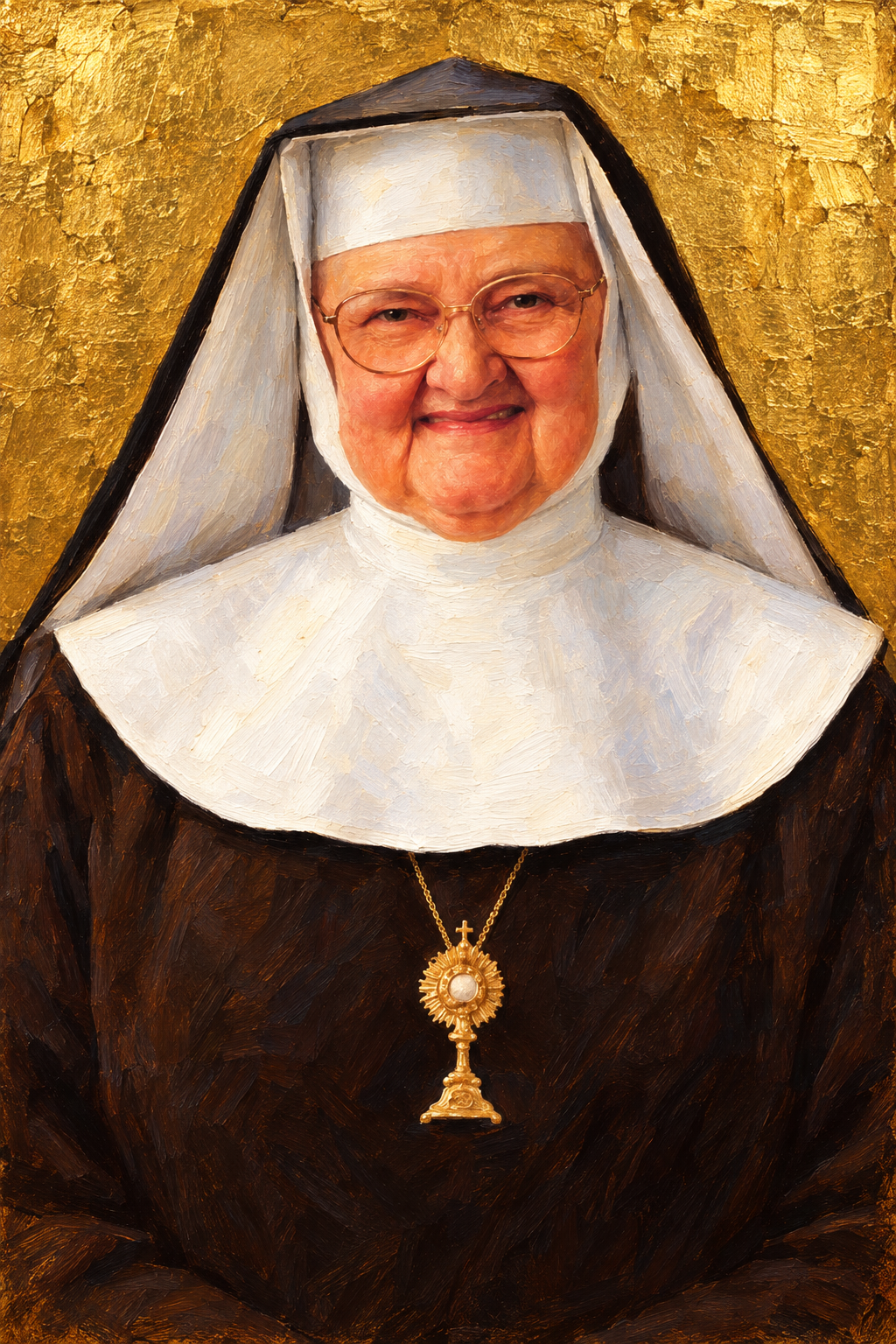
Mother Angelica Prayer Card – For Eucharistic Devotion, Bold Faith, Divine Providence & Prayer for Her Canonization
Mother Mary Angelica of the Annunciation, P.C.P.A., born Rita Antoinette Rizzo, was a Poor Clare Nun of Perpetual Adoration, contemplative, spiritual teacher, foundress of Our Lady of the Angels Monastery, and founder of the Eternal Word Television Network (EWTN). Beginning with little money and no professional television background, she helped build a worldwide media apostolate while repeatedly insisting that the work depended upon God’s Providence rather than her own abilities.
Her life is especially meaningful for people seeking greater love for the Eucharist, courage to follow God when the path seems unreasonable, perseverance through chronic illness, confidence in Divine Providence, deeper prayer, evangelization, and the grace to use modern media for Christ. Mother Angelica is not currently recognized with the canonical title “Servant of God,” so this card does not present her as a canonized saint or formally opened sainthood candidate.
Every card is made to order and prepared prayerfully, with the recipient and their intentions brought before Christ while remembering Mother Angelica’s extraordinary confidence that God can work through ordinary people who are willing to say yes to Him.
THE LIFE & STORY
Rita Antoinette Rizzo was born on April 20, 1923, in Canton, Ohio, into an Italian-American family. Her childhood was marked by poverty, her parents’ painful separation and divorce, instability at home, and her mother’s emotional suffering, leaving Rita with responsibilities and anxieties far beyond those normally carried by a child.
Although her family had Catholic roots, her parents were not particularly religious. After painful experiences involving her school and the treatment her divorced mother received, Rita and her mother withdrew from regular Church life for roughly a decade; she was not raised Jewish and did not pass through a Protestant conversion before becoming Catholic.
YEARS AWAY FROM THE CHURCH
Rita’s years away from regular religious practice make her later life particularly meaningful for people who have become distant from Christianity or whose experience of religious people has left wounds. Her later devotion did not grow from an uncomplicated childhood faith, but from discovering personally that God loved her despite the confusion and suffering surrounding her early life.
That experience would later shape the direct and sometimes startling way she spoke about God on television. Mother Angelica had little interest in making Christianity sound abstract or remote because her own spiritual life had changed when faith became personal rather than merely something associated with institutions or childhood customs.
THE HEALING THAT CHANGED HER LIFE
As a teenager and young woman, Rita suffered from a severe recurring stomach condition that caused considerable pain and difficulty eating. In 1942, she visited Rhoda Wise, the Canton woman whose own cause for canonization is now well advanced, and was instructed to pray a novena to Saint Thérèse of Lisieux. EWTN’s official chronology records that Rita experienced a sudden healing after this encounter and that the event changed the direction of her spiritual life.
The healing became a spiritual turning point because Rita came to understand that God loved her personally. She later grew close to Wise, and the experience helped prepare the young woman who had spent years away from active religious practice to consider giving her entire life to God.
DISCOVERING HER RELIGIOUS VOCATION
In the fall of 1943, while praying the Stations of the Cross at Saint Anthony’s Church, Rita became convinced that she was being called to religious life. After seeking guidance and investigating different communities, she entered a Franciscan contemplative convent in Cleveland on August 15, 1944, taking the name Sister Mary Angelica of the Annunciation.
The community eventually became known as the Poor Clares of Perpetual Adoration, whose spirituality centers intensely upon Jesus Christ present in the Eucharist. Sister Angelica made her solemn profession on January 2, 1953, committing herself permanently to contemplative religious life.
SUFFERING THAT SHAPED HER VOCATION
Physical suffering accompanied Mother Angelica through much of her life. She endured serious knee problems, spinal injury, respiratory problems, chronic pain, braces, crutches, repeated medical treatment, and eventually the disabling effects of strokes.
Her suffering did not remain separate from her spiritual life. She repeatedly spoke about accepting the present moment, trusting God when circumstances could not be controlled, and allowing weakness itself to become a place in which dependence upon Divine Providence could deepen.
THE PROMISE THAT BROUGHT HER TO ALABAMA
After a severe back injury, Sister Angelica faced an operation that carried the possibility that she might never walk again. She promised God that if she were able to walk afterward, she would establish a monastery in the American South; although the surgery itself was considered medically unsuccessful, she awoke able to move her legs.
After years of permissions, fundraising, construction, and setbacks, Rome granted approval for the Alabama foundation in 1961. Mother Angelica and her sisters established Our Lady of the Angels Monastery in the Birmingham area, beginning the Alabama chapter of her life that would eventually produce one of the world’s largest Christian media organizations.
FROM A CLOISTER TO TELEVISION
Mother Angelica initially reached people through recorded talks, printed booklets, teaching, and local media. After seeing the possibilities of television, she became convinced that modern broadcasting could place Christian teaching directly into homes on a scale previously impossible for her small community.
With approximately $200, a monastery garage, and a group of cloistered nuns who had no professional television background, she launched EWTN on August 15, 1981. What began as a small television operation eventually expanded into international television, radio, publishing, digital media, and global news services.
TRUST IN DIVINE PROVIDENCE
Mother Angelica’s story became inseparable from her willingness to begin projects before every practical question had been solved. She was not teaching that planning, competence, or financial responsibility were unimportant; rather, her life repeatedly expressed the conviction that fear should not prevent someone from acting when they have prayerfully become convinced that God is asking something of them.
Her famous statements about doing the ridiculous so that God could do the miraculous grew out of this spirituality. EWTN itself became the most visible example of a contemplative nun undertaking something for which her circumstances seemed almost comically inadequate and then watching that work grow far beyond anything she could have accomplished alone.
EUCHARISTIC DEVOTION
Behind the television personality was a cloistered contemplative nun devoted to Eucharistic adoration. In the 1990s Mother Angelica intensified the contemplative practices of her community and personally spent extended periods in adoration before the Blessed Sacrament, while the monastery and network continued to place the Eucharist at the center of their spiritual identity.
Her later foundation in Hanceville became home to the Shrine of the Most Blessed Sacrament, dedicated in 1999. The scale and beauty of the shrine reflected Mother Angelica’s conviction that television, radio, buildings, fundraising, and public evangelization ultimately mattered only insofar as they led people toward Jesus Christ.
“GET CRACKING”
Mother Angelica could speak about profound spiritual subjects with unusually direct language. One of the quotations EWTN continues to associate with her captures both her rejection of conformity and her insistence that Christian faith should change the way a person actually lives: “God wants you to be in the world, but so different from the world that you will change it. Get cracking.”
The words fit the unusual path of her own life because Mother Angelica did not withdraw from modern technology simply because she was a contemplative nun. She entered television, radio, satellite broadcasting, publishing, and eventually the internet precisely because she believed Christians were supposed to bring Christ into the places where contemporary people were already living.
FOR PEOPLE AFRAID TO BEGIN
Mother Angelica’s life is particularly meaningful for someone who believes they are too poor, too uneducated, too old, too sick, too inexperienced, or too insignificant to accomplish anything important. She did not begin EWTN with the financial resources, technical background, or institutional size that would normally be expected for an international broadcasting organization.
Her story therefore speaks naturally to entrepreneurs, missionaries, artists, writers, teachers, creators, small ministries, and anyone discerning a work that appears larger than their abilities. Her witness does not promise that every personal idea is God’s will, but it strongly challenges the temptation to use personal inadequacy as an excuse never to respond when God truly calls.
FOR CHRONIC ILLNESS & PHYSICAL SUFFERING
Illness was not merely an episode from Mother Angelica’s youth. Physical suffering continued throughout her religious life and eventually included serious spinal problems, respiratory illness, difficulty walking, strokes, and neurological damage that deprived a woman famous for speaking of much of her ability to speak publicly.
Her final years therefore form an essential part of her story rather than an epilogue to her television career. The woman whose voice had reached millions entered a quieter vocation of dependency, prayer, suffering, and hidden life within her monastery.
THE STROKE & HER FINAL YEARS
On Christmas Eve 2001, Mother Angelica suffered a severe stroke and cerebral hemorrhage that dramatically reduced her ability to speak and ended the public ministry by which most viewers knew her. She spent the remaining years of her life largely within the monastery, sharing the contemplative life of the sisters and carrying increasing physical limitations.
In 2009, Pope Benedict XVI awarded her the Pro Ecclesia et Pontifice Cross in recognition of her service to the Church and the papacy. Her final years remained markedly quieter than the decades of television that preceded them, creating a striking contrast between public evangelization and hidden suffering.
HER DEATH & BURIAL
Mother Angelica died on Easter Sunday, March 27, 2016, at the age of ninety-two. Her funeral was celebrated at the Shrine of the Most Blessed Sacrament in Hanceville, Alabama, and she was interred in the Shrine’s Crypt Church.
Her burial place remains closely connected with the contemplative monastery and Eucharistic shrine she established. Pilgrims continue to encounter there the two great themes that shaped her public life: confidence in Divine Providence and profound devotion to Jesus in the Blessed Sacrament.
IS THERE A CANONIZATION CAUSE FOR MOTHER ANGELICA?
As of September 2026, no formal cause for Mother Angelica’s beatification and canonization has been publicly announced by the Diocese of Birmingham, EWTN, or the Holy See, and she should therefore not be given the canonical title “Servant of God.” The five-year waiting period ordinarily required before a cause may begin expired in March 2021, and a publication associated with the Diocese of Birmingham noted at that time that opening a cause had become possible and that Birmingham would be the competent diocese.
HOW TO SUPPORT A FUTURE CAUSE FOR MOTHER ANGELICA
Those who believe Mother Angelica’s life deserves formal examination may respectfully make that desire known to the Bishop of Birmingham in Alabama, particularly by describing the enduring reputation for holiness, spiritual influence, conversions, or other fruits associated with her life. Such letters do not themselves open a cause, but the Church specifically considers a candidate’s genuine and widespread reputation for holiness and intercessory power when determining whether a formal investigation should proceed.
The formal canonical petition would ultimately need to come from a petitioner acting through an approved postulator, rather than simply from individual letters sent by devotees. Nevertheless, respectful correspondence from the faithful can demonstrate that devotion to Mother Angelica is living, spontaneous, and continuing rather than merely historical interest in a famous television personality.
CONTACT THE BISHOP OF BIRMINGHAM
The current bishop is The Most Reverend Steven J. Raica, Bishop of Birmingham in Alabama. The Diocese’s current records continue to identify Bishop Raica as the diocesan bishop, and the diocesan Office of the Bishop publishes its postal address, telephone number, and office email contacts.
Most Reverend Steven J. Raica, Bishop of Birmingham in Alabama. Correspondence may be addressed to the Office of the Bishop, Diocese of Birmingham in Alabama, 2121 Third Avenue North, Birmingham, AL 35203, or mailed to P.O. Box 12047, Birmingham, AL 35202-2047. The diocesan telephone number is (205) 838-8322, and the official diocesan website is available here: Diocese of Birmingham in Alabama.
WHAT TO SAY WHEN WRITING THE BISHOP
A letter supporting consideration of Mother Angelica’s cause is strongest when it is respectful and personal rather than simply demanding that she be canonized. A writer can explain how Mother Angelica’s teaching, Eucharistic devotion, witness during suffering, or media apostolate affected their own faith, and can respectfully ask Bishop Raica to consider whether the time has come for the canonical process examining her life and virtues to begin.
Those who have firsthand testimony about Mother Angelica, personal correspondence from her, historically significant documents, or accounts of particular spiritual favors should preserve that material carefully. If a formal cause is eventually opened, witness testimony, writings, documentary evidence, reputation for holiness, and reports of favors can all become important parts of the investigation contemplated by Church law.
IS THERE AN OFFICIAL PRAYER FOR HER CANONIZATION?
Because no formal cause has been publicly announced, there is currently no official cause prayer that should be represented as an approved prayer for Mother Angelica’s beatification or canonization. This prayer card therefore uses her own verified words rather than presenting a privately composed text as an ecclesiastically approved canonization prayer.
Private prayer for Mother Angelica and for God’s will concerning any future cause remains possible, but the distinction should be maintained on a devotional product. If the Diocese of Birmingham later opens a cause and publishes an approved prayer, the card and product description can then be updated to reflect her new canonical status and the official text.
MOTHER ANGELICA & RHODA WISE
Mother Angelica’s own story has an unusual connection with the canonization process because Rhoda Wise, the woman connected with Rita Rizzo’s pivotal healing and spiritual awakening, is herself a Servant of God. In 2026, Wise’s Positio was submitted to the Vatican’s Dicastery for the Causes of Saints for examination of her life and heroic virtues.
The connection creates a remarkable historical circle because the woman who profoundly influenced young Rita Rizzo now has an active cause of her own, while the nun Rita eventually became has inspired millions of people who hope that her life will someday receive the same formal examination. Mother Angelica’s future canonical status remains separate from Wise’s cause, but their spiritual relationship forms an important part of both women’s stories.
FOR EUCHARISTIC DEVOTION
Mother Angelica’s public broadcasting work can sometimes obscure the fact that she was first a contemplative nun whose religious life centered on the Eucharist. The monastery she founded, the Shrine of the Most Blessed Sacrament, the televised Mass, Eucharistic adoration, and the devotional culture surrounding EWTN all grew from that deeper contemplative identity.
This makes her prayer card especially meaningful for people trying to deepen their love for the Eucharist, begin Eucharistic adoration, return to Mass after years away, or learn to place prayer before activity. Mother Angelica’s enormous public apostolate grew from a woman whose vocation was originally hidden behind the enclosure of a monastery.
FOR EVANGELIZATION & CHRISTIAN MEDIA
Mother Angelica understood that television and emerging communications technology could become instruments for proclaiming Christ rather than merely sources of entertainment. EWTN expanded from a monastery garage into television, radio, publishing, online media, and international news while preserving evangelization as its central mission.
Her story is therefore particularly meaningful for Christian writers, filmmakers, broadcasters, podcasters, artists, publishers, teachers, and others using media to communicate the faith. She demonstrated that new technology does not have to belong exclusively to secular culture and can instead become a mission field.
FOR COURAGE & BOLDNESS
Mother Angelica was famous for a directness that sometimes surprised both supporters and critics. Her boldness was not simply a personality trait, because she repeatedly connected Christian courage with the willingness to act upon what one sincerely believes God is asking rather than waiting until every uncertainty disappears.
For people who struggle with fear of failure, criticism, financial insecurity, or appearing foolish, her life offers a particularly forceful example. Her confidence did not mean she avoided mistakes or difficulties, but it did mean fear rarely received the final word.
FOR THOSE RETURNING TO FAITH
The young Rita Rizzo knew what it was like to spend years outside regular religious practice. Her later life therefore gives particular hope to people who have been absent from church, disappointed by religious institutions, spiritually indifferent, or convinced that years of distance have made a return meaningless.
Her story demonstrates how dramatically the direction of a life can change after a renewed encounter with God. The woman who had once spent years away from active Church life eventually devoted herself to contemplative prayer and helped bring Christian teaching into hundreds of millions of homes.
FAQ
Who was Mother Angelica? Mother Mary Angelica of the Annunciation was a Poor Clare Nun of Perpetual Adoration and the founder of EWTN. Born Rita Antoinette Rizzo in Canton, Ohio, in 1923, she entered religious life in 1944 and died in Alabama on Easter Sunday in 2016.
Was Mother Angelica born Jewish? No, reliable biographical material does not support that claim. She was born into an Italian-American family with Catholic connections, although her parents were not strongly religious and she and her mother spent approximately a decade away from regular Church life.
Was Mother Angelica Protestant before becoming Catholic? No, the established biographies do not describe a Protestant conversion followed by reception into the Catholic Church. That story is more similar to the background of Rhoda Wise, Mother Angelica’s spiritual mentor, who was raised Protestant and later became Catholic.
Did Mother Angelica experience a healing? EWTN’s official chronology records that Rita Rizzo experienced a healing from her serious stomach condition in 1942 after visiting Rhoda Wise and praying a novena associated with Saint Thérèse of Lisieux. EWTN identifies this event as a major turning point in her relationship with God.
When did Mother Angelica become a nun? Rita entered her convent on August 15, 1944, and became Sister Mary Angelica of the Annunciation. She later made her solemn profession in 1953 and eventually became known as Mother Angelica.
When did Mother Angelica found EWTN? EWTN first went on the air on August 15, 1981, beginning from facilities at the monastery in Alabama. The network subsequently expanded into a worldwide multimedia apostolate.
Was Mother Angelica especially devoted to the Eucharist? Yes, Eucharistic adoration was central to her contemplative vocation and to the spirituality of the Poor Clares of Perpetual Adoration. She also founded the Shrine of the Most Blessed Sacrament in Hanceville, where she spent her final years and where she is buried.
Is Mother Angelica a saint? No, Mother Angelica has not been beatified or canonized. Devotion to her should therefore respect her current ecclesiastical status rather than placing “Saint,” “Blessed,” “Venerable,” or “Servant of God” before her name.
Is Mother Angelica a Servant of God? Not at present, based on the official public information available as of September 2026. I found no public announcement from the Diocese of Birmingham or the Holy See that a formal cause has been opened, so “Mother Angelica” remains the appropriate title rather than “Servant of God Mother Angelica.”
Can Mother Angelica’s canonization cause now be opened? Yes, the ordinary five-year waiting period following her 2016 death expired in March 2021. The Diocese of Birmingham has previously acknowledged that a cause became canonically possible after that date.
Which bishop would be responsible for a Mother Angelica cause? The competent diocese is ordinarily the diocese in which the candidate died, and Mother Angelica died in the Diocese of Birmingham in Alabama. The current diocesan bishop is Most Reverend Steven J. Raica.
Can ordinary people ask the bishop to consider opening her cause? Yes, members of the faithful can respectfully express their support and describe the spiritual influence Mother Angelica has had upon them. The formal canonical petition, however, is normally made by a petitioner through an approved postulator, so individual correspondence demonstrates support but does not itself establish the cause.
Where should someone write to support consideration of her cause? Correspondence can be sent to Most Reverend Steven J. Raica, Office of the Bishop, Diocese of Birmingham in Alabama, P.O. Box 12047, Birmingham, AL 35202-2047, and the main telephone number is (205) 838-8322. The bishop’s office currently publishes dmealer@bhmdiocese.org and ksessions@bhmdiocese.org as office email contacts.
Is there an official Mother Angelica canonization prayer? Not one connected with a formally opened cause that I could verify. Until an official cause exists and the competent ecclesiastical authority publishes or approves such a prayer, privately composed prayers should not be described as an “official prayer for the cause.”
Where is Mother Angelica buried? She is buried in the Crypt Church at the Shrine of the Most Blessed Sacrament in Hanceville, Alabama. Her funeral and interment took place there after her death on Easter Sunday in 2016.
Who would this Mother Angelica prayer card be meaningful for? It is especially fitting for people devoted to Eucharistic adoration, those returning to faith, people living with chronic illness, Christian broadcasters and creators, entrepreneurs undertaking difficult works, women in evangelization, contemplatives, and anyone trying to trust Divine Providence when the way forward appears impossible. It can also be kept by those praying that the Church will someday formally examine Mother Angelica’s life through a cause for beatification and canonization.
THE MAIN MESSAGE OF MOTHER ANGELICA’S LIFE
Mother Angelica’s story is remarkable not because everything came easily to her, but because so little about her beginnings suggested the life that followed. The child formed amid poverty and family instability became a contemplative nun, the young woman who spent years away from regular Church life became an evangelist, the chronically sick sister became a builder and foundress, and the woman with almost no television experience helped establish an international media network.
Her life repeatedly returned to the same spiritual pattern: pray, discern what God appears to be asking, act with courage, and leave room for Divine Providence to accomplish what human resources cannot. Her own words capture that sense of urgency particularly well: “God wants you to be in the world, but so different from the world that you will change it. Get cracking.”
For those hoping the Church will someday open a formal cause examining her life and virtues, Mother Angelica’s story is now in a different kind of waiting period. The appropriate response is neither to declare prematurely that the Church has already judged her sanctity nor to forget the extraordinary spiritual influence she continues to exercise, but to preserve her story, pray, share credible testimony, and respectfully make that enduring reputation for holiness known to the Church authorities responsible for discerning whether a cause should begin.
Mother Mary Angelica of the Annunciation, P.C.P.A., born Rita Antoinette Rizzo, was a Poor Clare Nun of Perpetual Adoration, contemplative, spiritual teacher, foundress of Our Lady of the Angels Monastery, and founder of the Eternal Word Television Network (EWTN). Beginning with little money and no professional television background, she helped build a worldwide media apostolate while repeatedly insisting that the work depended upon God’s Providence rather than her own abilities.
Her life is especially meaningful for people seeking greater love for the Eucharist, courage to follow God when the path seems unreasonable, perseverance through chronic illness, confidence in Divine Providence, deeper prayer, evangelization, and the grace to use modern media for Christ. Mother Angelica is not currently recognized with the canonical title “Servant of God,” so this card does not present her as a canonized saint or formally opened sainthood candidate.
Every card is made to order and prepared prayerfully, with the recipient and their intentions brought before Christ while remembering Mother Angelica’s extraordinary confidence that God can work through ordinary people who are willing to say yes to Him.
THE LIFE & STORY
Rita Antoinette Rizzo was born on April 20, 1923, in Canton, Ohio, into an Italian-American family. Her childhood was marked by poverty, her parents’ painful separation and divorce, instability at home, and her mother’s emotional suffering, leaving Rita with responsibilities and anxieties far beyond those normally carried by a child.
Although her family had Catholic roots, her parents were not particularly religious. After painful experiences involving her school and the treatment her divorced mother received, Rita and her mother withdrew from regular Church life for roughly a decade; she was not raised Jewish and did not pass through a Protestant conversion before becoming Catholic.
YEARS AWAY FROM THE CHURCH
Rita’s years away from regular religious practice make her later life particularly meaningful for people who have become distant from Christianity or whose experience of religious people has left wounds. Her later devotion did not grow from an uncomplicated childhood faith, but from discovering personally that God loved her despite the confusion and suffering surrounding her early life.
That experience would later shape the direct and sometimes startling way she spoke about God on television. Mother Angelica had little interest in making Christianity sound abstract or remote because her own spiritual life had changed when faith became personal rather than merely something associated with institutions or childhood customs.
THE HEALING THAT CHANGED HER LIFE
As a teenager and young woman, Rita suffered from a severe recurring stomach condition that caused considerable pain and difficulty eating. In 1942, she visited Rhoda Wise, the Canton woman whose own cause for canonization is now well advanced, and was instructed to pray a novena to Saint Thérèse of Lisieux. EWTN’s official chronology records that Rita experienced a sudden healing after this encounter and that the event changed the direction of her spiritual life.
The healing became a spiritual turning point because Rita came to understand that God loved her personally. She later grew close to Wise, and the experience helped prepare the young woman who had spent years away from active religious practice to consider giving her entire life to God.
DISCOVERING HER RELIGIOUS VOCATION
In the fall of 1943, while praying the Stations of the Cross at Saint Anthony’s Church, Rita became convinced that she was being called to religious life. After seeking guidance and investigating different communities, she entered a Franciscan contemplative convent in Cleveland on August 15, 1944, taking the name Sister Mary Angelica of the Annunciation.
The community eventually became known as the Poor Clares of Perpetual Adoration, whose spirituality centers intensely upon Jesus Christ present in the Eucharist. Sister Angelica made her solemn profession on January 2, 1953, committing herself permanently to contemplative religious life.
SUFFERING THAT SHAPED HER VOCATION
Physical suffering accompanied Mother Angelica through much of her life. She endured serious knee problems, spinal injury, respiratory problems, chronic pain, braces, crutches, repeated medical treatment, and eventually the disabling effects of strokes.
Her suffering did not remain separate from her spiritual life. She repeatedly spoke about accepting the present moment, trusting God when circumstances could not be controlled, and allowing weakness itself to become a place in which dependence upon Divine Providence could deepen.
THE PROMISE THAT BROUGHT HER TO ALABAMA
After a severe back injury, Sister Angelica faced an operation that carried the possibility that she might never walk again. She promised God that if she were able to walk afterward, she would establish a monastery in the American South; although the surgery itself was considered medically unsuccessful, she awoke able to move her legs.
After years of permissions, fundraising, construction, and setbacks, Rome granted approval for the Alabama foundation in 1961. Mother Angelica and her sisters established Our Lady of the Angels Monastery in the Birmingham area, beginning the Alabama chapter of her life that would eventually produce one of the world’s largest Christian media organizations.
FROM A CLOISTER TO TELEVISION
Mother Angelica initially reached people through recorded talks, printed booklets, teaching, and local media. After seeing the possibilities of television, she became convinced that modern broadcasting could place Christian teaching directly into homes on a scale previously impossible for her small community.
With approximately $200, a monastery garage, and a group of cloistered nuns who had no professional television background, she launched EWTN on August 15, 1981. What began as a small television operation eventually expanded into international television, radio, publishing, digital media, and global news services.
TRUST IN DIVINE PROVIDENCE
Mother Angelica’s story became inseparable from her willingness to begin projects before every practical question had been solved. She was not teaching that planning, competence, or financial responsibility were unimportant; rather, her life repeatedly expressed the conviction that fear should not prevent someone from acting when they have prayerfully become convinced that God is asking something of them.
Her famous statements about doing the ridiculous so that God could do the miraculous grew out of this spirituality. EWTN itself became the most visible example of a contemplative nun undertaking something for which her circumstances seemed almost comically inadequate and then watching that work grow far beyond anything she could have accomplished alone.
EUCHARISTIC DEVOTION
Behind the television personality was a cloistered contemplative nun devoted to Eucharistic adoration. In the 1990s Mother Angelica intensified the contemplative practices of her community and personally spent extended periods in adoration before the Blessed Sacrament, while the monastery and network continued to place the Eucharist at the center of their spiritual identity.
Her later foundation in Hanceville became home to the Shrine of the Most Blessed Sacrament, dedicated in 1999. The scale and beauty of the shrine reflected Mother Angelica’s conviction that television, radio, buildings, fundraising, and public evangelization ultimately mattered only insofar as they led people toward Jesus Christ.
“GET CRACKING”
Mother Angelica could speak about profound spiritual subjects with unusually direct language. One of the quotations EWTN continues to associate with her captures both her rejection of conformity and her insistence that Christian faith should change the way a person actually lives: “God wants you to be in the world, but so different from the world that you will change it. Get cracking.”
The words fit the unusual path of her own life because Mother Angelica did not withdraw from modern technology simply because she was a contemplative nun. She entered television, radio, satellite broadcasting, publishing, and eventually the internet precisely because she believed Christians were supposed to bring Christ into the places where contemporary people were already living.
FOR PEOPLE AFRAID TO BEGIN
Mother Angelica’s life is particularly meaningful for someone who believes they are too poor, too uneducated, too old, too sick, too inexperienced, or too insignificant to accomplish anything important. She did not begin EWTN with the financial resources, technical background, or institutional size that would normally be expected for an international broadcasting organization.
Her story therefore speaks naturally to entrepreneurs, missionaries, artists, writers, teachers, creators, small ministries, and anyone discerning a work that appears larger than their abilities. Her witness does not promise that every personal idea is God’s will, but it strongly challenges the temptation to use personal inadequacy as an excuse never to respond when God truly calls.
FOR CHRONIC ILLNESS & PHYSICAL SUFFERING
Illness was not merely an episode from Mother Angelica’s youth. Physical suffering continued throughout her religious life and eventually included serious spinal problems, respiratory illness, difficulty walking, strokes, and neurological damage that deprived a woman famous for speaking of much of her ability to speak publicly.
Her final years therefore form an essential part of her story rather than an epilogue to her television career. The woman whose voice had reached millions entered a quieter vocation of dependency, prayer, suffering, and hidden life within her monastery.
THE STROKE & HER FINAL YEARS
On Christmas Eve 2001, Mother Angelica suffered a severe stroke and cerebral hemorrhage that dramatically reduced her ability to speak and ended the public ministry by which most viewers knew her. She spent the remaining years of her life largely within the monastery, sharing the contemplative life of the sisters and carrying increasing physical limitations.
In 2009, Pope Benedict XVI awarded her the Pro Ecclesia et Pontifice Cross in recognition of her service to the Church and the papacy. Her final years remained markedly quieter than the decades of television that preceded them, creating a striking contrast between public evangelization and hidden suffering.
HER DEATH & BURIAL
Mother Angelica died on Easter Sunday, March 27, 2016, at the age of ninety-two. Her funeral was celebrated at the Shrine of the Most Blessed Sacrament in Hanceville, Alabama, and she was interred in the Shrine’s Crypt Church.
Her burial place remains closely connected with the contemplative monastery and Eucharistic shrine she established. Pilgrims continue to encounter there the two great themes that shaped her public life: confidence in Divine Providence and profound devotion to Jesus in the Blessed Sacrament.
IS THERE A CANONIZATION CAUSE FOR MOTHER ANGELICA?
As of September 2026, no formal cause for Mother Angelica’s beatification and canonization has been publicly announced by the Diocese of Birmingham, EWTN, or the Holy See, and she should therefore not be given the canonical title “Servant of God.” The five-year waiting period ordinarily required before a cause may begin expired in March 2021, and a publication associated with the Diocese of Birmingham noted at that time that opening a cause had become possible and that Birmingham would be the competent diocese.
HOW TO SUPPORT A FUTURE CAUSE FOR MOTHER ANGELICA
Those who believe Mother Angelica’s life deserves formal examination may respectfully make that desire known to the Bishop of Birmingham in Alabama, particularly by describing the enduring reputation for holiness, spiritual influence, conversions, or other fruits associated with her life. Such letters do not themselves open a cause, but the Church specifically considers a candidate’s genuine and widespread reputation for holiness and intercessory power when determining whether a formal investigation should proceed.
The formal canonical petition would ultimately need to come from a petitioner acting through an approved postulator, rather than simply from individual letters sent by devotees. Nevertheless, respectful correspondence from the faithful can demonstrate that devotion to Mother Angelica is living, spontaneous, and continuing rather than merely historical interest in a famous television personality.
CONTACT THE BISHOP OF BIRMINGHAM
The current bishop is The Most Reverend Steven J. Raica, Bishop of Birmingham in Alabama. The Diocese’s current records continue to identify Bishop Raica as the diocesan bishop, and the diocesan Office of the Bishop publishes its postal address, telephone number, and office email contacts.
Most Reverend Steven J. Raica, Bishop of Birmingham in Alabama. Correspondence may be addressed to the Office of the Bishop, Diocese of Birmingham in Alabama, 2121 Third Avenue North, Birmingham, AL 35203, or mailed to P.O. Box 12047, Birmingham, AL 35202-2047. The diocesan telephone number is (205) 838-8322, and the official diocesan website is available here: Diocese of Birmingham in Alabama.
WHAT TO SAY WHEN WRITING THE BISHOP
A letter supporting consideration of Mother Angelica’s cause is strongest when it is respectful and personal rather than simply demanding that she be canonized. A writer can explain how Mother Angelica’s teaching, Eucharistic devotion, witness during suffering, or media apostolate affected their own faith, and can respectfully ask Bishop Raica to consider whether the time has come for the canonical process examining her life and virtues to begin.
Those who have firsthand testimony about Mother Angelica, personal correspondence from her, historically significant documents, or accounts of particular spiritual favors should preserve that material carefully. If a formal cause is eventually opened, witness testimony, writings, documentary evidence, reputation for holiness, and reports of favors can all become important parts of the investigation contemplated by Church law.
IS THERE AN OFFICIAL PRAYER FOR HER CANONIZATION?
Because no formal cause has been publicly announced, there is currently no official cause prayer that should be represented as an approved prayer for Mother Angelica’s beatification or canonization. This prayer card therefore uses her own verified words rather than presenting a privately composed text as an ecclesiastically approved canonization prayer.
Private prayer for Mother Angelica and for God’s will concerning any future cause remains possible, but the distinction should be maintained on a devotional product. If the Diocese of Birmingham later opens a cause and publishes an approved prayer, the card and product description can then be updated to reflect her new canonical status and the official text.
MOTHER ANGELICA & RHODA WISE
Mother Angelica’s own story has an unusual connection with the canonization process because Rhoda Wise, the woman connected with Rita Rizzo’s pivotal healing and spiritual awakening, is herself a Servant of God. In 2026, Wise’s Positio was submitted to the Vatican’s Dicastery for the Causes of Saints for examination of her life and heroic virtues.
The connection creates a remarkable historical circle because the woman who profoundly influenced young Rita Rizzo now has an active cause of her own, while the nun Rita eventually became has inspired millions of people who hope that her life will someday receive the same formal examination. Mother Angelica’s future canonical status remains separate from Wise’s cause, but their spiritual relationship forms an important part of both women’s stories.
FOR EUCHARISTIC DEVOTION
Mother Angelica’s public broadcasting work can sometimes obscure the fact that she was first a contemplative nun whose religious life centered on the Eucharist. The monastery she founded, the Shrine of the Most Blessed Sacrament, the televised Mass, Eucharistic adoration, and the devotional culture surrounding EWTN all grew from that deeper contemplative identity.
This makes her prayer card especially meaningful for people trying to deepen their love for the Eucharist, begin Eucharistic adoration, return to Mass after years away, or learn to place prayer before activity. Mother Angelica’s enormous public apostolate grew from a woman whose vocation was originally hidden behind the enclosure of a monastery.
FOR EVANGELIZATION & CHRISTIAN MEDIA
Mother Angelica understood that television and emerging communications technology could become instruments for proclaiming Christ rather than merely sources of entertainment. EWTN expanded from a monastery garage into television, radio, publishing, online media, and international news while preserving evangelization as its central mission.
Her story is therefore particularly meaningful for Christian writers, filmmakers, broadcasters, podcasters, artists, publishers, teachers, and others using media to communicate the faith. She demonstrated that new technology does not have to belong exclusively to secular culture and can instead become a mission field.
FOR COURAGE & BOLDNESS
Mother Angelica was famous for a directness that sometimes surprised both supporters and critics. Her boldness was not simply a personality trait, because she repeatedly connected Christian courage with the willingness to act upon what one sincerely believes God is asking rather than waiting until every uncertainty disappears.
For people who struggle with fear of failure, criticism, financial insecurity, or appearing foolish, her life offers a particularly forceful example. Her confidence did not mean she avoided mistakes or difficulties, but it did mean fear rarely received the final word.
FOR THOSE RETURNING TO FAITH
The young Rita Rizzo knew what it was like to spend years outside regular religious practice. Her later life therefore gives particular hope to people who have been absent from church, disappointed by religious institutions, spiritually indifferent, or convinced that years of distance have made a return meaningless.
Her story demonstrates how dramatically the direction of a life can change after a renewed encounter with God. The woman who had once spent years away from active Church life eventually devoted herself to contemplative prayer and helped bring Christian teaching into hundreds of millions of homes.
FAQ
Who was Mother Angelica? Mother Mary Angelica of the Annunciation was a Poor Clare Nun of Perpetual Adoration and the founder of EWTN. Born Rita Antoinette Rizzo in Canton, Ohio, in 1923, she entered religious life in 1944 and died in Alabama on Easter Sunday in 2016.
Was Mother Angelica born Jewish? No, reliable biographical material does not support that claim. She was born into an Italian-American family with Catholic connections, although her parents were not strongly religious and she and her mother spent approximately a decade away from regular Church life.
Was Mother Angelica Protestant before becoming Catholic? No, the established biographies do not describe a Protestant conversion followed by reception into the Catholic Church. That story is more similar to the background of Rhoda Wise, Mother Angelica’s spiritual mentor, who was raised Protestant and later became Catholic.
Did Mother Angelica experience a healing? EWTN’s official chronology records that Rita Rizzo experienced a healing from her serious stomach condition in 1942 after visiting Rhoda Wise and praying a novena associated with Saint Thérèse of Lisieux. EWTN identifies this event as a major turning point in her relationship with God.
When did Mother Angelica become a nun? Rita entered her convent on August 15, 1944, and became Sister Mary Angelica of the Annunciation. She later made her solemn profession in 1953 and eventually became known as Mother Angelica.
When did Mother Angelica found EWTN? EWTN first went on the air on August 15, 1981, beginning from facilities at the monastery in Alabama. The network subsequently expanded into a worldwide multimedia apostolate.
Was Mother Angelica especially devoted to the Eucharist? Yes, Eucharistic adoration was central to her contemplative vocation and to the spirituality of the Poor Clares of Perpetual Adoration. She also founded the Shrine of the Most Blessed Sacrament in Hanceville, where she spent her final years and where she is buried.
Is Mother Angelica a saint? No, Mother Angelica has not been beatified or canonized. Devotion to her should therefore respect her current ecclesiastical status rather than placing “Saint,” “Blessed,” “Venerable,” or “Servant of God” before her name.
Is Mother Angelica a Servant of God? Not at present, based on the official public information available as of September 2026. I found no public announcement from the Diocese of Birmingham or the Holy See that a formal cause has been opened, so “Mother Angelica” remains the appropriate title rather than “Servant of God Mother Angelica.”
Can Mother Angelica’s canonization cause now be opened? Yes, the ordinary five-year waiting period following her 2016 death expired in March 2021. The Diocese of Birmingham has previously acknowledged that a cause became canonically possible after that date.
Which bishop would be responsible for a Mother Angelica cause? The competent diocese is ordinarily the diocese in which the candidate died, and Mother Angelica died in the Diocese of Birmingham in Alabama. The current diocesan bishop is Most Reverend Steven J. Raica.
Can ordinary people ask the bishop to consider opening her cause? Yes, members of the faithful can respectfully express their support and describe the spiritual influence Mother Angelica has had upon them. The formal canonical petition, however, is normally made by a petitioner through an approved postulator, so individual correspondence demonstrates support but does not itself establish the cause.
Where should someone write to support consideration of her cause? Correspondence can be sent to Most Reverend Steven J. Raica, Office of the Bishop, Diocese of Birmingham in Alabama, P.O. Box 12047, Birmingham, AL 35202-2047, and the main telephone number is (205) 838-8322. The bishop’s office currently publishes dmealer@bhmdiocese.org and ksessions@bhmdiocese.org as office email contacts.
Is there an official Mother Angelica canonization prayer? Not one connected with a formally opened cause that I could verify. Until an official cause exists and the competent ecclesiastical authority publishes or approves such a prayer, privately composed prayers should not be described as an “official prayer for the cause.”
Where is Mother Angelica buried? She is buried in the Crypt Church at the Shrine of the Most Blessed Sacrament in Hanceville, Alabama. Her funeral and interment took place there after her death on Easter Sunday in 2016.
Who would this Mother Angelica prayer card be meaningful for? It is especially fitting for people devoted to Eucharistic adoration, those returning to faith, people living with chronic illness, Christian broadcasters and creators, entrepreneurs undertaking difficult works, women in evangelization, contemplatives, and anyone trying to trust Divine Providence when the way forward appears impossible. It can also be kept by those praying that the Church will someday formally examine Mother Angelica’s life through a cause for beatification and canonization.
THE MAIN MESSAGE OF MOTHER ANGELICA’S LIFE
Mother Angelica’s story is remarkable not because everything came easily to her, but because so little about her beginnings suggested the life that followed. The child formed amid poverty and family instability became a contemplative nun, the young woman who spent years away from regular Church life became an evangelist, the chronically sick sister became a builder and foundress, and the woman with almost no television experience helped establish an international media network.
Her life repeatedly returned to the same spiritual pattern: pray, discern what God appears to be asking, act with courage, and leave room for Divine Providence to accomplish what human resources cannot. Her own words capture that sense of urgency particularly well: “God wants you to be in the world, but so different from the world that you will change it. Get cracking.”
For those hoping the Church will someday open a formal cause examining her life and virtues, Mother Angelica’s story is now in a different kind of waiting period. The appropriate response is neither to declare prematurely that the Church has already judged her sanctity nor to forget the extraordinary spiritual influence she continues to exercise, but to preserve her story, pray, share credible testimony, and respectfully make that enduring reputation for holiness known to the Church authorities responsible for discerning whether a cause should begin.