 Image 1 of 1
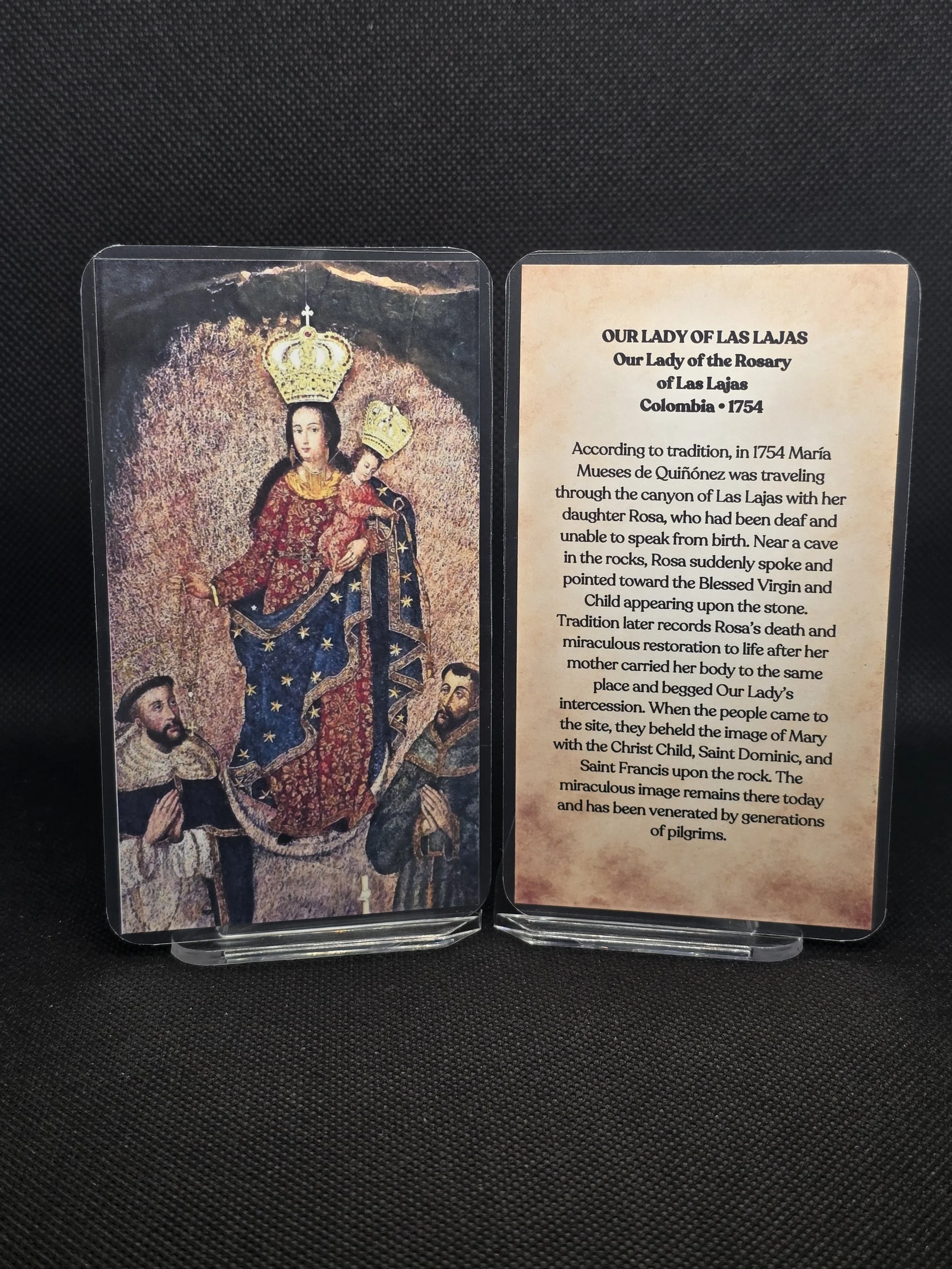
Our Lady of Las Lajas Prayer Card – Miraculous Image of the Virgin Mary in Colombia
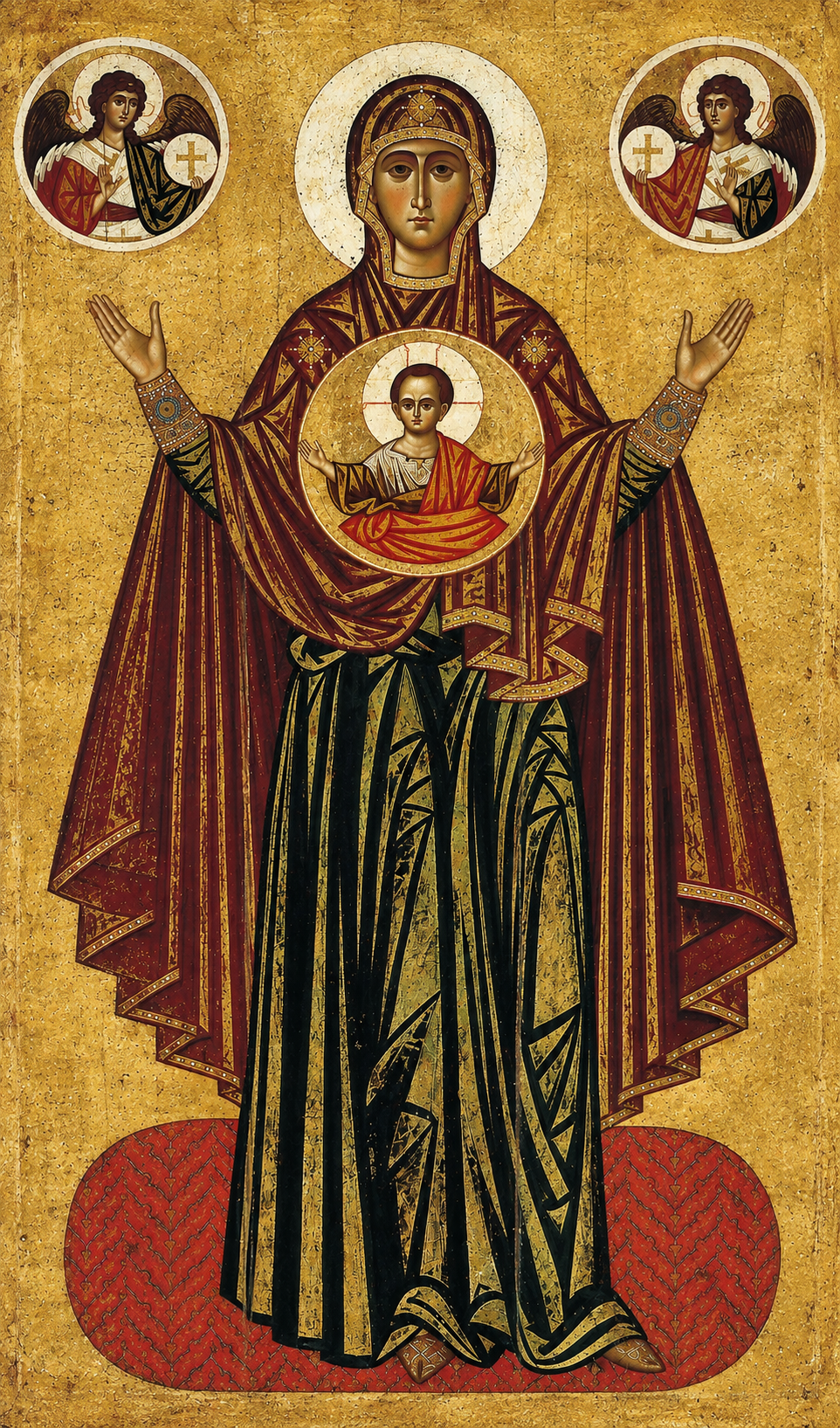
Our Lady of the Rosary of Las Lajas is venerated at one of the most extraordinary Marian shrines in the world, built into the walls of the Guáitara River canyon near Ipiales in southern Colombia. At the center of the sanctuary is not a statue or an image carried there for devotion, but the image around which the entire sanctuary was built: the Virgin Mary and the Christ Child appearing upon the natural rock itself.
The devotion traces its origin to 1754, when María Mueses de Quiñónez and her young daughter Rosa encountered the Blessed Virgin at Las Lajas. Rosa, who had been unable to hear or speak, suddenly spoke while pointing toward the Virgin and Child. The events that followed drew local families into the canyon and began a devotion that would grow from a tiny shelter beside the rock into an internationally known Marian sanctuary.
The image itself has made Las Lajas especially remarkable. It is situated directly upon the natural stone of the canyon, which today remains visible behind the sanctuary's high altar. Published Catholic accounts of geological examination report that the image was not found to consist of an ordinary surface layer of paint, pigment, or dye. They further report that samples taken from the image showed the coloration continuing into the rock itself, in some places to a depth exceeding one meter.
For Catholics devoted to the Blessed Virgin, Our Lady of Las Lajas is especially meaningful for healing, protection of children and families, desperate situations, physical disabilities, trust in Mary's intercession, and hope when circumstances appear impossible. The sanctuary has accumulated generations of testimonies and ex-votos from pilgrims who came to give thanks for favors received, while devotion to Our Lady of Las Lajas has endured for more than two and a half centuries.
Each prayer card measures 2.5" x 4.25", is handmade in Austin, Texas, printed on museum-quality photo paper rather than ordinary cardstock, and double laminated for durability. Every card is made to order and prepared prayerfully, with the recipient and their intentions remembered while making the card.
THE MIRACULOUS STORY OF OUR LADY OF LAS LAJAS
The story begins in the mountainous region surrounding Ipiales, near what is now the Colombian border with Ecuador. The Guáitara River cuts through a steep and dramatic canyon whose walls contain broad layers of flat stone known as lajas, the Spanish word from which the sanctuary eventually received its name.
Around 1754, María Mueses de Quiñónez, an Indigenous woman from nearby Potosí, was traveling through the canyon when severe weather forced her to seek shelter among the rocks. According to the traditional history preserved by the sanctuary, María invoked the protection of Our Lady of the Rosary while frightened in the isolated gorge.
She later passed through the area again accompanied by her young daughter, Rosa. The child had been unable to hear or speak from birth, yet while they rested near the rock, Rosa suddenly spoke and directed her mother's attention toward a beautiful woman with a child whom she perceived there.
For María, the shock was not merely what her daughter claimed to see. Her daughter had spoken. The child who had been unable to speak was suddenly calling her mother's attention toward the mysterious woman and child associated with the rock.
“THE MESTIZA CALLS ME”
The words traditionally associated with Rosa's first speech have been preserved in different forms, most commonly rendered in Spanish as “Mamita, la mestiza me llama”, meaning approximately, “Mama, the mestiza lady is calling me.” The language reflects the cultural world in which María and Rosa lived and became deeply associated with the Las Lajas tradition.
María initially could not see what Rosa was seeing. Yet Rosa continued to be drawn toward the place, and the strange events surrounding the rock did not end with the restoration of her speech.
According to the sanctuary's traditional history, Rosa at one point disappeared from home and María eventually found her again at Las Lajas, kneeling before the sacred image. The devotion that would eventually bring generations of pilgrims into the canyon was already beginning within the experience of this mother and child.
THE RESTORATION OF ROSA
The traditional account becomes still more extraordinary with the later death of Rosa. María returned to the sacred place with her daughter and implored the intercession of the Blessed Virgin.
The Las Lajas tradition preserves this event as another decisive miracle associated with the beginning of the shrine, with Rosa restored to life through the intercession of Our Lady. News spread through the surrounding communities, and increasing numbers of people made their way into the difficult canyon to see the place themselves.
The official sanctuary history dates the definitive manifestation of the image to September 15, 1754, a date that became central to the religious celebrations associated with Our Lady of Las Lajas.
THE IMAGE UPON THE ROCK
The image that pilgrims encounter at Las Lajas depicts the Blessed Virgin Mary with the Child Jesus. The Virgin is associated particularly with Our Lady of the Rosary, and the complete composition traditionally includes Saint Dominic and Saint Francis kneeling on either side.
Unlike a conventional church painting, the image was not installed after construction of the sanctuary. The opposite occurred: the sanctuary was constructed around the rock bearing the image.
The natural stone remains the location of the sacred image and forms the visual center behind the altar. The image upon the natural rock became the spiritual heart around which the present church was constructed.
This distinction is important. Las Lajas is not a church that later acquired a famous Marian painting. Every generation of construction at the site existed because pilgrims were already coming to the rock.
ONE OF THE EARLIEST WRITTEN RECORDS
Las Lajas is especially interesting historically because written testimony concerning the sanctuary appears surprisingly close to the traditional date of the apparition.
The Franciscan missionary Fray Juan de Santa Gertrudis, who traveled through the New Kingdom of Granada during the eighteenth century, included Las Lajas in his work Maravillas de la naturaleza. His journeys occurred between 1756 and 1767, placing his experience of the devotion within the same generation as the events of 1754.
Accounts connected with his journey record that by 1759, devotion at Las Lajas was already established. Pilgrims were visiting the place, an altar had been erected near the image, and lights were kept burning there because of the continuing flow of the faithful.
Fray Juan was sufficiently moved by the place to compose a short verse honoring the Virgin of Las Lajas. His testimony is important because it demonstrates that the devotion was not something first created centuries afterward; a Franciscan traveler was recording an established Marian shrine only a few years after the traditional events themselves.
THE FIRST SHRINE
The first structure at Las Lajas was extraordinarily simple. Local believers constructed a small shelter of wood and straw to protect the sacred location and provide a place where pilgrims could pray.
The earliest stage of construction is associated with 1754, when Fray Gabriel Villafuerte promoted the construction of a small thatched chapel at the apparition site.
As devotion increased, the primitive shelter could no longer accommodate the faithful. In 1769, Father Eusebio Mejía y Navarro began construction of a more permanent chapel built with brick and lime, which was completed approximately seven years later.
The progression from a primitive shelter to increasingly substantial churches tells its own story. Generations of local Catholics repeatedly invested enormous effort into preserving access to the rock because devotion to the image continued to grow.
THE GREAT BASILICA IN THE CANYON
The present sanctuary is among the most visually remarkable Catholic churches in the world. Instead of standing on an ordinary city street or open square, the Gothic Revival church rises dramatically within the Guáitara canyon, bridging the gorge while the original image remains incorporated into the sanctuary.
Its location required enormous engineering and construction work. The architecture effectively uses the mountain itself as part of the church, allowing the rock bearing the image of the Virgin to remain where pilgrims had venerated it for generations.
This explains the unusual appearance of Las Lajas. The builders were not choosing an impossibly difficult canyon simply for dramatic architecture. The church had to come to the image because the image could not be moved to the church.
THE SCIENTIFIC FINDINGS ASSOCIATED WITH THE IMAGE
The physical character of the image is one of the most fascinating aspects of Las Lajas.
Published Catholic reporting on examinations carried out during the twentieth century states that investigators found no conventional paint, pigment, or dye forming the image on the surface of the rock. In other words, the reported examination did not identify the kind of exterior painted layer expected if an artist had simply applied an image to the stone.
The account becomes even more remarkable when describing samples taken from the rock. During the period surrounding construction of the present basilica, German geologists are reported to have taken samples from several portions of the image. According to the published account, the coloration visible at the surface was also present within the rock.
The examination reportedly went substantially deeper than a microscopic surface test. The account states that investigators penetrated more than one meter, approximately three feet, into the stone and continued to encounter rock corresponding in color to the portion of the image from which it had been taken.
That reported observation is significant because ordinary painting places coloring material upon a surface or allows it to penetrate only a comparatively limited distance into porous material. What was described at Las Lajas was different: the visible coloration associated with the sacred image continued deep into the rock itself.
The same Catholic account also emphasizes another extraordinary characteristic of the image: its preservation. Las Lajas exists inside a wet mountain canyon, surrounded by flowing water, changing temperatures, and persistent environmental moisture, yet the image has remained visible through generations of exposure.
For the faithful, these physical findings deepen an already extraordinary story. The miraculous tradition did not begin with a modern laboratory examination; devotion had already existed for nearly two centuries before geologists examined the stone. The later observations simply added another remarkable dimension to an image Catholics had been venerating since the eighteenth century.
THE IMAGE WAS NOT CREATED TO ATTRACT PILGRIMS
The chronology is particularly important when considering Las Lajas. Pilgrims did not begin arriving after someone promoted a scientific investigation of an unusual rock formation.
The devotion was already flourishing in the eighteenth century. Fray Juan de Santa Gertrudis encountered the shrine during his travels only a few years after the events associated with María and Rosa, and successive generations then constructed churches at the location.
The scientific examination belongs to a much later chapter. By that time, Catholics had already been praying before the image for generations.
HEALINGS, FAVORS & THE WALLS OF EX-VOTOS
One of the most striking sights around Las Lajas is the enormous number of ex-votos and plaques of thanksgiving left by pilgrims. These memorials record gratitude for prayers answered, healings, protection, and other favors attributed to the intercession of the Blessed Virgin.
The rocks surrounding the sanctuary have become covered with thousands of plaques proclaiming the faith of pilgrims and their gratitude to the Mother of God.
These ex-votos transform the approach to the church into something more than an architectural walkway. They form a physical record of generations of people who came to Las Lajas carrying illnesses, fears, family difficulties, and seemingly impossible situations and later returned to give thanks.
CANONICAL CORONATION OF OUR LADY OF LAS LAJAS
The devotion eventually received some of the Church's highest forms of formal recognition for a Marian image and sanctuary.
In 1952, the image of Our Lady of Las Lajas received a canonical coronation authorized through the Church. The importance of the shrine continued to grow, and two years later, in 1954, the sanctuary was raised to the dignity of a Minor Basilica.
That same year, Pope Pius XII specifically mentioned Our Lady of Las Lajas when addressing Colombia and speaking about the country's many Marian sanctuaries. His remarks placed Las Lajas among the notable centers of Marian devotion in Colombian Catholic life.
PATRONESS OF THE DIOCESE OF IPIALES
The Church's recognition became still more explicit in 1965.
On April 26 of that year, Pope Saint Paul VI issued the Apostolic Letter Tutela Caelestis. In it, he formally declared and confirmed the Blessed Virgin Mary under the title Nuestra Señora del Rosario de las Lajas as the principal heavenly patroness of the Diocese of Ipiales.
Paul VI's document also recalled both the 1952 coronation of the image and the sanctuary's elevation to a Minor Basilica in 1954. It speaks directly of the long-established devotion of the people of Ipiales toward the Virgin of Las Lajas and refers to the Marian image upon the rock.
Las Lajas therefore is not simply a popular local legend surrounding an unusual site. The devotion has been incorporated deeply into the official Catholic life of the region, and Our Lady of Las Lajas is formally recognized as the principal patroness of the diocese that contains the sanctuary.
WHY OUR LADY OF THE ROSARY?
The title used by the Church is Our Lady of the Rosary of Las Lajas. The Rosary is therefore not incidental to the devotion but is part of the identity under which the Virgin is officially honored.
The image presents Mary with Christ, drawing the viewer immediately toward the mystery at the heart of authentic Marian devotion: Mary always leads the Christian toward her Son.
For families who pray the Rosary, people asking for healing, parents praying for children, and Christians facing circumstances in which human solutions appear exhausted, Las Lajas offers an especially powerful image of maternal intercession.
A MOTHER, A CHILD & AN IMPOSSIBLE SITUATION
At the center of the story are not kings, theologians, wealthy patrons, or powerful Church officials. The story begins with a mother and her disabled child walking through a dangerous canyon.
That simplicity is part of what gives Las Lajas such enduring spiritual power. María did not arrive expecting to establish a basilica, and Rosa did not arrive expecting generations of pilgrims to remember her name. Their encounter eventually transformed an isolated place in the mountains into one of the great Marian pilgrimage destinations of South America.
The enormous basilica came later. The crown came later. Papal recognition came later. What came first was a frightened mother, a child, prayer, and the Blessed Virgin.
WHY THE SANCTUARY STILL MATTERS
More than 270 years after the events of 1754, pilgrims continue descending into the Guáitara canyon to stand before the image.
The place unites several forms of evidence that rarely survive together over such a long period: a persistent local tradition, an eighteenth-century written record close to the period of the original events, generations of physical churches built upon the same location, thousands of devotional testimonies, an unusual image embedded within the natural rock, reported geological observations concerning the coloration of that rock, and formal recognition of the devotion by successive popes.
Las Lajas therefore belongs not only to the religious history of Colombia but to the wider history of Catholic Marian devotion.
FAQ
What is Our Lady of Las Lajas? Our Lady of Las Lajas is the Blessed Virgin Mary under the title Our Lady of the Rosary of Las Lajas, associated with a miraculous image upon the natural rock of the Guáitara canyon near Ipiales, Colombia. The devotion traces its traditional beginning to events involving María Mueses de Quiñónez and her daughter Rosa around 1754.
Was Rosa really unable to speak? The traditional history preserved by the sanctuary describes Rosa as deaf and unable to speak from birth. Her sudden speech while drawing her mother's attention to the Virgin is remembered as the first extraordinary healing associated with Las Lajas.
Is the image painted on a normal church wall? No. The image is located upon the natural rock of the canyon, and the sanctuary was constructed around that location. The rock bearing the image remains behind the altar.
Did scientists examine the Las Lajas image? Published Catholic accounts describe a geological examination during the twentieth century in which German geologists took samples from the image. Those reports state that no ordinary paint, pigment, or dye was found forming a surface image and that the coloration continued within the stone itself.
How deep does the coloration reportedly extend? The published account states that samples were taken to more than one meter, or approximately three feet, into the rock, with the relevant coloration continuing through the sampled stone.
How old is the devotion? The traditional date associated with the definitive manifestation of the image is September 15, 1754. An important early written record comes from the eighteenth-century travels of Franciscan missionary Fray Juan de Santa Gertrudis, placing written testimony to the devotion within the same generation.
Has the Catholic Church recognized Our Lady of Las Lajas? Yes. The image received canonical coronation in 1952, the sanctuary became a Minor Basilica in 1954, and Pope Saint Paul VI formally confirmed Our Lady of the Rosary of Las Lajas as principal patroness of the Diocese of Ipiales in 1965.
Where is Las Lajas? The sanctuary is located near Ipiales in the department of Nariño, Colombia, inside the Guáitara River canyon near the border with Ecuador.
Who would this Our Lady of Las Lajas prayer card make a meaningful gift for? It is especially meaningful for people praying for healing, parents interceding for their children, families experiencing an apparently impossible situation, those devoted to the Holy Rosary, Catholics with a devotion to miraculous Marian images, and anyone seeking the maternal protection and intercession of the Blessed Virgin Mary.
THE MESSAGE OF OUR LADY OF LAS LAJAS
The story of Las Lajas begins in an unlikely place. A dangerous canyon became a sanctuary, bare stone became the location of a sacred image, and the encounter of an ordinary mother and child eventually drew generations of pilgrims from throughout Colombia and beyond.
The magnificent basilica that now spans the canyon can almost distract from the simplicity of what stands at its center. Behind the architecture, towers, bridge, stained glass, and thousands of ex-votos remains the same rock toward which Rosa first directed her mother's attention.
For the Christian approaching Our Lady of Las Lajas in prayer, the message is one of hope when circumstances appear impossible, confidence in the maternal intercession of Mary, and trust that Christ is able to enter even the hardest places of human life with healing and grace.
Our Lady of the Rosary of Las Lajas is venerated at one of the most extraordinary Marian shrines in the world, built into the walls of the Guáitara River canyon near Ipiales in southern Colombia. At the center of the sanctuary is not a statue or an image carried there for devotion, but the image around which the entire sanctuary was built: the Virgin Mary and the Christ Child appearing upon the natural rock itself.
The devotion traces its origin to 1754, when María Mueses de Quiñónez and her young daughter Rosa encountered the Blessed Virgin at Las Lajas. Rosa, who had been unable to hear or speak, suddenly spoke while pointing toward the Virgin and Child. The events that followed drew local families into the canyon and began a devotion that would grow from a tiny shelter beside the rock into an internationally known Marian sanctuary.
The image itself has made Las Lajas especially remarkable. It is situated directly upon the natural stone of the canyon, which today remains visible behind the sanctuary's high altar. Published Catholic accounts of geological examination report that the image was not found to consist of an ordinary surface layer of paint, pigment, or dye. They further report that samples taken from the image showed the coloration continuing into the rock itself, in some places to a depth exceeding one meter.
For Catholics devoted to the Blessed Virgin, Our Lady of Las Lajas is especially meaningful for healing, protection of children and families, desperate situations, physical disabilities, trust in Mary's intercession, and hope when circumstances appear impossible. The sanctuary has accumulated generations of testimonies and ex-votos from pilgrims who came to give thanks for favors received, while devotion to Our Lady of Las Lajas has endured for more than two and a half centuries.
Each prayer card measures 2.5" x 4.25", is handmade in Austin, Texas, printed on museum-quality photo paper rather than ordinary cardstock, and double laminated for durability. Every card is made to order and prepared prayerfully, with the recipient and their intentions remembered while making the card.
THE MIRACULOUS STORY OF OUR LADY OF LAS LAJAS
The story begins in the mountainous region surrounding Ipiales, near what is now the Colombian border with Ecuador. The Guáitara River cuts through a steep and dramatic canyon whose walls contain broad layers of flat stone known as lajas, the Spanish word from which the sanctuary eventually received its name.
Around 1754, María Mueses de Quiñónez, an Indigenous woman from nearby Potosí, was traveling through the canyon when severe weather forced her to seek shelter among the rocks. According to the traditional history preserved by the sanctuary, María invoked the protection of Our Lady of the Rosary while frightened in the isolated gorge.
She later passed through the area again accompanied by her young daughter, Rosa. The child had been unable to hear or speak from birth, yet while they rested near the rock, Rosa suddenly spoke and directed her mother's attention toward a beautiful woman with a child whom she perceived there.
For María, the shock was not merely what her daughter claimed to see. Her daughter had spoken. The child who had been unable to speak was suddenly calling her mother's attention toward the mysterious woman and child associated with the rock.
“THE MESTIZA CALLS ME”
The words traditionally associated with Rosa's first speech have been preserved in different forms, most commonly rendered in Spanish as “Mamita, la mestiza me llama”, meaning approximately, “Mama, the mestiza lady is calling me.” The language reflects the cultural world in which María and Rosa lived and became deeply associated with the Las Lajas tradition.
María initially could not see what Rosa was seeing. Yet Rosa continued to be drawn toward the place, and the strange events surrounding the rock did not end with the restoration of her speech.
According to the sanctuary's traditional history, Rosa at one point disappeared from home and María eventually found her again at Las Lajas, kneeling before the sacred image. The devotion that would eventually bring generations of pilgrims into the canyon was already beginning within the experience of this mother and child.
THE RESTORATION OF ROSA
The traditional account becomes still more extraordinary with the later death of Rosa. María returned to the sacred place with her daughter and implored the intercession of the Blessed Virgin.
The Las Lajas tradition preserves this event as another decisive miracle associated with the beginning of the shrine, with Rosa restored to life through the intercession of Our Lady. News spread through the surrounding communities, and increasing numbers of people made their way into the difficult canyon to see the place themselves.
The official sanctuary history dates the definitive manifestation of the image to September 15, 1754, a date that became central to the religious celebrations associated with Our Lady of Las Lajas.
THE IMAGE UPON THE ROCK
The image that pilgrims encounter at Las Lajas depicts the Blessed Virgin Mary with the Child Jesus. The Virgin is associated particularly with Our Lady of the Rosary, and the complete composition traditionally includes Saint Dominic and Saint Francis kneeling on either side.
Unlike a conventional church painting, the image was not installed after construction of the sanctuary. The opposite occurred: the sanctuary was constructed around the rock bearing the image.
The natural stone remains the location of the sacred image and forms the visual center behind the altar. The image upon the natural rock became the spiritual heart around which the present church was constructed.
This distinction is important. Las Lajas is not a church that later acquired a famous Marian painting. Every generation of construction at the site existed because pilgrims were already coming to the rock.
ONE OF THE EARLIEST WRITTEN RECORDS
Las Lajas is especially interesting historically because written testimony concerning the sanctuary appears surprisingly close to the traditional date of the apparition.
The Franciscan missionary Fray Juan de Santa Gertrudis, who traveled through the New Kingdom of Granada during the eighteenth century, included Las Lajas in his work Maravillas de la naturaleza. His journeys occurred between 1756 and 1767, placing his experience of the devotion within the same generation as the events of 1754.
Accounts connected with his journey record that by 1759, devotion at Las Lajas was already established. Pilgrims were visiting the place, an altar had been erected near the image, and lights were kept burning there because of the continuing flow of the faithful.
Fray Juan was sufficiently moved by the place to compose a short verse honoring the Virgin of Las Lajas. His testimony is important because it demonstrates that the devotion was not something first created centuries afterward; a Franciscan traveler was recording an established Marian shrine only a few years after the traditional events themselves.
THE FIRST SHRINE
The first structure at Las Lajas was extraordinarily simple. Local believers constructed a small shelter of wood and straw to protect the sacred location and provide a place where pilgrims could pray.
The earliest stage of construction is associated with 1754, when Fray Gabriel Villafuerte promoted the construction of a small thatched chapel at the apparition site.
As devotion increased, the primitive shelter could no longer accommodate the faithful. In 1769, Father Eusebio Mejía y Navarro began construction of a more permanent chapel built with brick and lime, which was completed approximately seven years later.
The progression from a primitive shelter to increasingly substantial churches tells its own story. Generations of local Catholics repeatedly invested enormous effort into preserving access to the rock because devotion to the image continued to grow.
THE GREAT BASILICA IN THE CANYON
The present sanctuary is among the most visually remarkable Catholic churches in the world. Instead of standing on an ordinary city street or open square, the Gothic Revival church rises dramatically within the Guáitara canyon, bridging the gorge while the original image remains incorporated into the sanctuary.
Its location required enormous engineering and construction work. The architecture effectively uses the mountain itself as part of the church, allowing the rock bearing the image of the Virgin to remain where pilgrims had venerated it for generations.
This explains the unusual appearance of Las Lajas. The builders were not choosing an impossibly difficult canyon simply for dramatic architecture. The church had to come to the image because the image could not be moved to the church.
THE SCIENTIFIC FINDINGS ASSOCIATED WITH THE IMAGE
The physical character of the image is one of the most fascinating aspects of Las Lajas.
Published Catholic reporting on examinations carried out during the twentieth century states that investigators found no conventional paint, pigment, or dye forming the image on the surface of the rock. In other words, the reported examination did not identify the kind of exterior painted layer expected if an artist had simply applied an image to the stone.
The account becomes even more remarkable when describing samples taken from the rock. During the period surrounding construction of the present basilica, German geologists are reported to have taken samples from several portions of the image. According to the published account, the coloration visible at the surface was also present within the rock.
The examination reportedly went substantially deeper than a microscopic surface test. The account states that investigators penetrated more than one meter, approximately three feet, into the stone and continued to encounter rock corresponding in color to the portion of the image from which it had been taken.
That reported observation is significant because ordinary painting places coloring material upon a surface or allows it to penetrate only a comparatively limited distance into porous material. What was described at Las Lajas was different: the visible coloration associated with the sacred image continued deep into the rock itself.
The same Catholic account also emphasizes another extraordinary characteristic of the image: its preservation. Las Lajas exists inside a wet mountain canyon, surrounded by flowing water, changing temperatures, and persistent environmental moisture, yet the image has remained visible through generations of exposure.
For the faithful, these physical findings deepen an already extraordinary story. The miraculous tradition did not begin with a modern laboratory examination; devotion had already existed for nearly two centuries before geologists examined the stone. The later observations simply added another remarkable dimension to an image Catholics had been venerating since the eighteenth century.
THE IMAGE WAS NOT CREATED TO ATTRACT PILGRIMS
The chronology is particularly important when considering Las Lajas. Pilgrims did not begin arriving after someone promoted a scientific investigation of an unusual rock formation.
The devotion was already flourishing in the eighteenth century. Fray Juan de Santa Gertrudis encountered the shrine during his travels only a few years after the events associated with María and Rosa, and successive generations then constructed churches at the location.
The scientific examination belongs to a much later chapter. By that time, Catholics had already been praying before the image for generations.
HEALINGS, FAVORS & THE WALLS OF EX-VOTOS
One of the most striking sights around Las Lajas is the enormous number of ex-votos and plaques of thanksgiving left by pilgrims. These memorials record gratitude for prayers answered, healings, protection, and other favors attributed to the intercession of the Blessed Virgin.
The rocks surrounding the sanctuary have become covered with thousands of plaques proclaiming the faith of pilgrims and their gratitude to the Mother of God.
These ex-votos transform the approach to the church into something more than an architectural walkway. They form a physical record of generations of people who came to Las Lajas carrying illnesses, fears, family difficulties, and seemingly impossible situations and later returned to give thanks.
CANONICAL CORONATION OF OUR LADY OF LAS LAJAS
The devotion eventually received some of the Church's highest forms of formal recognition for a Marian image and sanctuary.
In 1952, the image of Our Lady of Las Lajas received a canonical coronation authorized through the Church. The importance of the shrine continued to grow, and two years later, in 1954, the sanctuary was raised to the dignity of a Minor Basilica.
That same year, Pope Pius XII specifically mentioned Our Lady of Las Lajas when addressing Colombia and speaking about the country's many Marian sanctuaries. His remarks placed Las Lajas among the notable centers of Marian devotion in Colombian Catholic life.
PATRONESS OF THE DIOCESE OF IPIALES
The Church's recognition became still more explicit in 1965.
On April 26 of that year, Pope Saint Paul VI issued the Apostolic Letter Tutela Caelestis. In it, he formally declared and confirmed the Blessed Virgin Mary under the title Nuestra Señora del Rosario de las Lajas as the principal heavenly patroness of the Diocese of Ipiales.
Paul VI's document also recalled both the 1952 coronation of the image and the sanctuary's elevation to a Minor Basilica in 1954. It speaks directly of the long-established devotion of the people of Ipiales toward the Virgin of Las Lajas and refers to the Marian image upon the rock.
Las Lajas therefore is not simply a popular local legend surrounding an unusual site. The devotion has been incorporated deeply into the official Catholic life of the region, and Our Lady of Las Lajas is formally recognized as the principal patroness of the diocese that contains the sanctuary.
WHY OUR LADY OF THE ROSARY?
The title used by the Church is Our Lady of the Rosary of Las Lajas. The Rosary is therefore not incidental to the devotion but is part of the identity under which the Virgin is officially honored.
The image presents Mary with Christ, drawing the viewer immediately toward the mystery at the heart of authentic Marian devotion: Mary always leads the Christian toward her Son.
For families who pray the Rosary, people asking for healing, parents praying for children, and Christians facing circumstances in which human solutions appear exhausted, Las Lajas offers an especially powerful image of maternal intercession.
A MOTHER, A CHILD & AN IMPOSSIBLE SITUATION
At the center of the story are not kings, theologians, wealthy patrons, or powerful Church officials. The story begins with a mother and her disabled child walking through a dangerous canyon.
That simplicity is part of what gives Las Lajas such enduring spiritual power. María did not arrive expecting to establish a basilica, and Rosa did not arrive expecting generations of pilgrims to remember her name. Their encounter eventually transformed an isolated place in the mountains into one of the great Marian pilgrimage destinations of South America.
The enormous basilica came later. The crown came later. Papal recognition came later. What came first was a frightened mother, a child, prayer, and the Blessed Virgin.
WHY THE SANCTUARY STILL MATTERS
More than 270 years after the events of 1754, pilgrims continue descending into the Guáitara canyon to stand before the image.
The place unites several forms of evidence that rarely survive together over such a long period: a persistent local tradition, an eighteenth-century written record close to the period of the original events, generations of physical churches built upon the same location, thousands of devotional testimonies, an unusual image embedded within the natural rock, reported geological observations concerning the coloration of that rock, and formal recognition of the devotion by successive popes.
Las Lajas therefore belongs not only to the religious history of Colombia but to the wider history of Catholic Marian devotion.
FAQ
What is Our Lady of Las Lajas? Our Lady of Las Lajas is the Blessed Virgin Mary under the title Our Lady of the Rosary of Las Lajas, associated with a miraculous image upon the natural rock of the Guáitara canyon near Ipiales, Colombia. The devotion traces its traditional beginning to events involving María Mueses de Quiñónez and her daughter Rosa around 1754.
Was Rosa really unable to speak? The traditional history preserved by the sanctuary describes Rosa as deaf and unable to speak from birth. Her sudden speech while drawing her mother's attention to the Virgin is remembered as the first extraordinary healing associated with Las Lajas.
Is the image painted on a normal church wall? No. The image is located upon the natural rock of the canyon, and the sanctuary was constructed around that location. The rock bearing the image remains behind the altar.
Did scientists examine the Las Lajas image? Published Catholic accounts describe a geological examination during the twentieth century in which German geologists took samples from the image. Those reports state that no ordinary paint, pigment, or dye was found forming a surface image and that the coloration continued within the stone itself.
How deep does the coloration reportedly extend? The published account states that samples were taken to more than one meter, or approximately three feet, into the rock, with the relevant coloration continuing through the sampled stone.
How old is the devotion? The traditional date associated with the definitive manifestation of the image is September 15, 1754. An important early written record comes from the eighteenth-century travels of Franciscan missionary Fray Juan de Santa Gertrudis, placing written testimony to the devotion within the same generation.
Has the Catholic Church recognized Our Lady of Las Lajas? Yes. The image received canonical coronation in 1952, the sanctuary became a Minor Basilica in 1954, and Pope Saint Paul VI formally confirmed Our Lady of the Rosary of Las Lajas as principal patroness of the Diocese of Ipiales in 1965.
Where is Las Lajas? The sanctuary is located near Ipiales in the department of Nariño, Colombia, inside the Guáitara River canyon near the border with Ecuador.
Who would this Our Lady of Las Lajas prayer card make a meaningful gift for? It is especially meaningful for people praying for healing, parents interceding for their children, families experiencing an apparently impossible situation, those devoted to the Holy Rosary, Catholics with a devotion to miraculous Marian images, and anyone seeking the maternal protection and intercession of the Blessed Virgin Mary.
THE MESSAGE OF OUR LADY OF LAS LAJAS
The story of Las Lajas begins in an unlikely place. A dangerous canyon became a sanctuary, bare stone became the location of a sacred image, and the encounter of an ordinary mother and child eventually drew generations of pilgrims from throughout Colombia and beyond.
The magnificent basilica that now spans the canyon can almost distract from the simplicity of what stands at its center. Behind the architecture, towers, bridge, stained glass, and thousands of ex-votos remains the same rock toward which Rosa first directed her mother's attention.
For the Christian approaching Our Lady of Las Lajas in prayer, the message is one of hope when circumstances appear impossible, confidence in the maternal intercession of Mary, and trust that Christ is able to enter even the hardest places of human life with healing and grace.