 Image 1 of 1
Saint Agatha of Sicily Icon Prayer Card | For Breast Cancer, Breast Disease, Courage & Protection from Fire
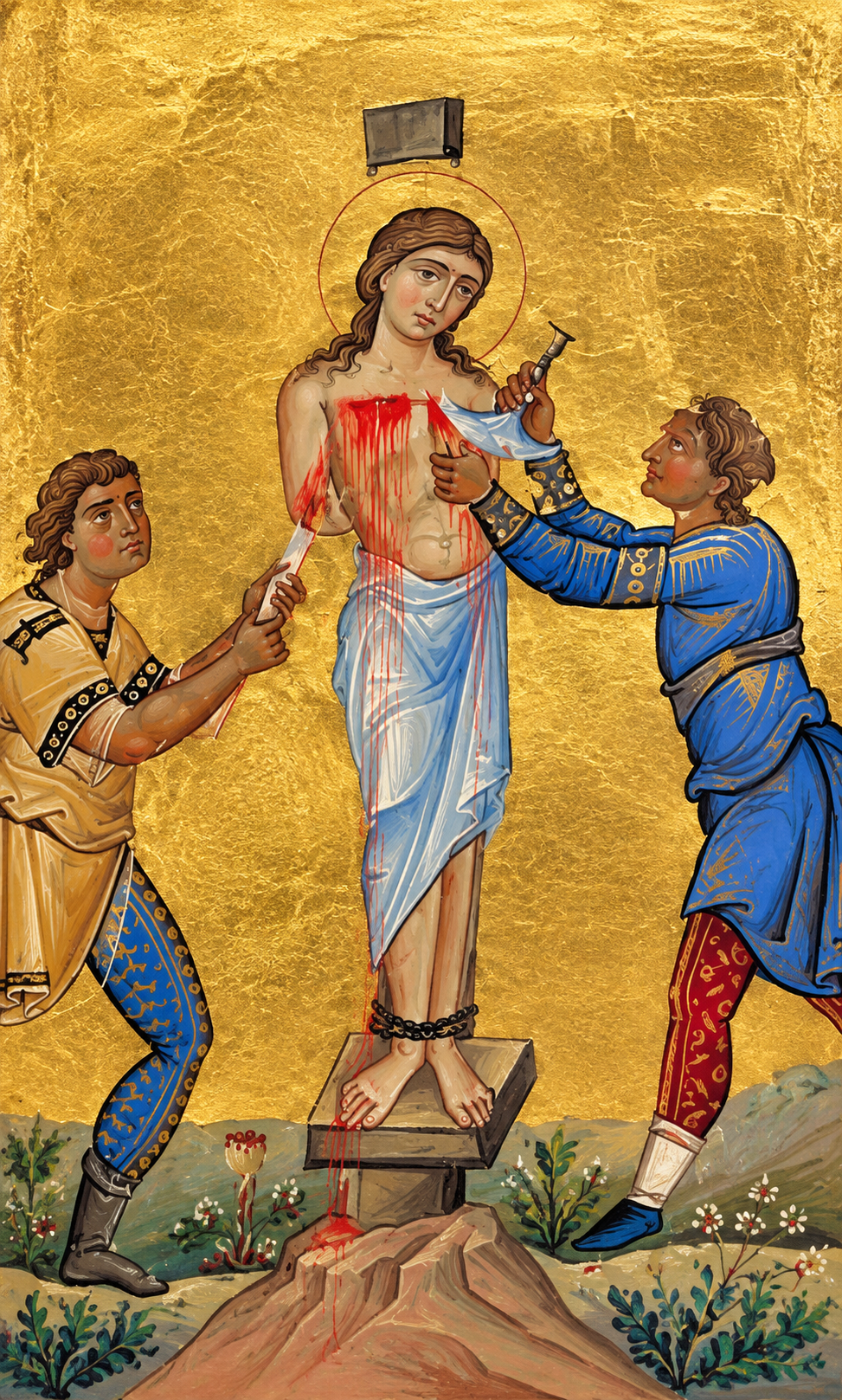
Saint Agatha of Sicily was one of the most revered virgin martyrs of the ancient Church, a young Christian woman whose refusal to abandon Christ subjected her to imprisonment, humiliation, torture, and ultimately death during the third-century persecution associated with Emperor Decius. Her martyrdom was remembered from very early Christian centuries, and devotion to her spread far beyond Sicily.
Saint Agatha is especially meaningful for women facing breast cancer, breast disease, mastectomy, breast surgery, painful treatment, serious illness, physical disfigurement, sexual humiliation, persecution, and situations requiring extraordinary courage. Her connection with diseases of the breast arises directly from the ancient account of her martyrdom, which recounts the brutal mutilation of her breasts after she refused to surrender either her Christian faith or her consecrated virginity.
She is also one of Christianity's great saints of protection against fire, volcanic eruptions, and destructive natural forces. Catanian tradition remembers that when Mount Etna erupted roughly a year after her martyrdom, the people carried Agatha's veil toward the advancing lava and invoked her intercession. The lava stopped, and devotion to Saint Agatha as the protector of Catania and an intercessor against volcanic fire became deeply rooted in Sicilian Christianity.
For someone undergoing cancer treatment, recovering from breast surgery, confronting frightening medical news, suffering because of their body, or simply needing courage when suffering cannot immediately be removed, Saint Agatha offers the witness of a young woman whose body could be wounded but whose faith could not be taken from her.
Each prayer card measures 2.5" x 4.25", is handmade in Austin, Texas, printed on museum-quality photo paper rather than ordinary cardstock, and double laminated for durability. Each card is prepared prayerfully with the recipient and their intentions lifted before Christ while asking Saint Agatha to intercede for the person who will receive it.
THE LIFE & STORY
Saint Agatha lived in third-century Sicily, with both Catania and Palermo appearing in traditions surrounding her origins. Her martyrdom at Catania during the persecution associated with Emperor Decius is the central historical fact around which her ancient Christian veneration developed.
The details of her surviving Passion were written down after her lifetime, so individual episodes must be distinguished from what can be established historically with certainty. What is beyond serious doubt is that Agatha was an early Sicilian Christian martyr, that devotion to her is extremely ancient, and that the Church was publicly venerating her long before many later medieval saints were even born.
A YOUNG WOMAN CONSECRATED TO CHRIST
The traditional account presents Agatha as coming from a wealthy and noble family and consecrating her virginity to Christ while still young. Vatican News recounts the tradition that she received the velatio, the veil associated with consecrated virgins, and dedicated herself to the Christian community.
Her social position could have offered a very different life. Instead, Agatha's identity became centered upon belonging to Christ, and that decision eventually brought her into direct conflict with political power.
THE PERSECUTION OF CHRISTIANS
In AD 250, Emperor Decius ordered inhabitants throughout the Roman Empire to participate in sacrifices connected with the traditional Roman gods and imperial religious order. Christians who refused could face imprisonment, confiscation, torture, or death.
The tradition of Saint Agatha places her ordeal within this persecution and identifies the local authority responsible for prosecuting her as Quintianus. The conflict that followed was not merely over private belief because Agatha was being required publicly to surrender the faith she had chosen.
“BECAUSE I AM A SERVANT OF CHRIST”
The ancient Passion preserves a remarkable exchange between Agatha and Quintianus. When challenged about her noble birth and her willingness to live as a servant of Christ, Agatha answers that Christian service is not degradation but genuine freedom.
The saying chosen for the back of this prayer card comes from that traditional account:
“The greatest freedom and nobility is here: to prove to be Christ's servants.”
For a Christian facing fear, illness, coercion, or pressure to compromise, the statement turns the ordinary meaning of freedom upside down. Agatha could be imprisoned physically while remaining inwardly free because the persecutor could not force her conscience to surrender Christ.
ATTACKED FOR HER FAITH AND HER BODY
The ancient account of Agatha's martyrdom contains a particularly brutal element that has shaped Christian devotion to her for centuries. Quintianus ordered that her breasts be mutilated as part of her torture.
This is why images of Saint Agatha sometimes depict her carrying her severed breasts upon a dish, imagery that can appear shocking until its meaning is understood. The image does not glorify what was done to her. It proclaims that what her persecutors attempted to use for humiliation became, in Christian memory, a sign that their violence did not have the final word.
SAINT AGATHA & BREAST CANCER
Saint Agatha's martyrdom created a particularly powerful devotional connection with women suffering from breast cancer and other diseases of the breast. Someone facing a biopsy, mastectomy, chemotherapy, radiation, reconstruction, chronic breast pain, or frightening medical uncertainty can recognize in Agatha a saint whose own suffering involved that part of the body in an intensely personal and traumatic way.
Asking Saint Agatha's intercession does not require pretending that serious illness is easy or painless. Her witness instead offers companionship in suffering and a model of faith that remains directed toward Christ even when the body becomes a place of fear, pain, medical intervention, or loss.
FOR WOMEN FACING MASTECTOMY OR BREAST SURGERY
A mastectomy or other major breast surgery can involve much more than physical recovery. Fear of cancer, changes to the body, scars, pain, questions about femininity, and uncertainty about the future can create emotional as well as physical suffering.
Saint Agatha's story gives Christian women an ancient intercessor whose veneration speaks directly to bodily injury without reducing a woman to the injury she has endured. Her dignity came from belonging to Christ, and the violence inflicted upon her body could not diminish that dignity.
FOR COURAGE DURING TREATMENT
Cancer treatment can require a quieter kind of courage than the dramatic courage shown in accounts of martyrdom. It can mean returning for another appointment, waiting for another test result, enduring another treatment cycle, accepting help, continuing prayer when exhausted, and resisting despair when the future remains uncertain.
Saint Agatha's courage was not the absence of suffering. Her Christian witness is powerful precisely because fidelity continued in the midst of suffering.
THE TRADITION OF SAINT PETER'S HEALING
The ancient Passion also recounts that while Agatha was imprisoned after the mutilation of her breasts, Saint Peter appeared to her and healed her wounds. The Catholic Encyclopedia correctly cautions that miraculous details of the later Passion cannot be treated with the same historical certainty as Agatha's martyrdom itself, but this episode has nevertheless belonged to her devotional tradition for centuries.
For someone seeking healing, the tradition adds another dimension to her intercession. Agatha is remembered not only as a woman who endured bodily suffering but also within a Christian story in which healing, martyrdom, resurrection, and eternal life ultimately belong to God.
HER FINAL PRAYER
According to the traditional Passion, Agatha finally extended her arms toward God and prayed before her death, thanking the Lord who had preserved her faith through everything inflicted upon her. The account places her death on February 5, 251, the date on which the Church continues to celebrate her feast.
Her death did not end devotion to her. Instead, the Christians who remembered her began a cult of veneration that would spread throughout both Eastern and Western Christianity.
THE MIRACLE OF MOUNT ETNA
One of the most famous traditions connected with Saint Agatha occurred after her death. Her Passion recounts that approximately a year after the martyrdom, Mount Etna erupted and lava threatened Catania. Christians went to Agatha's tomb, took the veil associated with her, and placed it before the advancing lava while seeking her intercession.
The lava stopped, and Saint Agatha became inseparably connected with Catania's prayers for protection from Etna. Her sacred veil is still preserved among her relics and continues to be venerated in connection with protection from the volcano.
FOR PROTECTION AGAINST FIRE
From the Etna tradition grew Saint Agatha's wider association with fire, volcanic eruptions, lightning, and destructive danger. The Catholic Encyclopedia notes that throughout the region surrounding Etna she has traditionally been invoked against volcanic eruptions and elsewhere against fire and lightning.
A Saint Agatha prayer card can therefore be meaningful not only to someone fighting illness but also to firefighters, families living in areas threatened by wildfire, people affected by house fires, and Christians asking God's protection during destructive natural events.
A SAINT OF THE ANCIENT CHURCH
Saint Agatha's importance cannot be measured merely by the popularity of modern devotion to her. Historical evidence shows that her martyrdom and public veneration were recognized in Christianity from very early centuries, with churches and liturgical devotion dedicated to her long before the medieval period.
Her feast on February 5 remains part of the Roman Catholic liturgical calendar, and her memory is also preserved throughout the wider ancient Christian tradition.
HER RELICS IN CATANIA
The principal relics of Saint Agatha are preserved in the Cathedral of Catania in Sicily, where devotion to the city's patroness remains extraordinarily strong. The cathedral preserves her relics in historic silver reliquaries, including the famous reliquary bust containing relics of her head.
Other reliquaries preserve portions traditionally identified with her hands, feet, femurs, a breast, and the sacred veil. These objects remain part of the living devotion of Catania rather than simply being museum artifacts from a vanished religious culture.
THE GREAT FESTIVAL OF SAINT AGATHA
Catania's devotion to Agatha remains one of the most visible examples of ancient saint veneration surviving into the modern world. Her relics and reliquary bust are carried with extraordinary public devotion during celebrations honoring the young martyr who became the city's heavenly patroness.
In 2026, the Church in Catania marked the 900th anniversary of the return of her relics to the city, demonstrating that Saint Agatha remains a living part of Catholic devotion more than seventeen centuries after her martyrdom.
THE QUOTE ON THIS PRAYER CARD
The back of this card includes one of the strongest sayings traditionally attributed to Saint Agatha in the ancient account of her trial:
“The greatest freedom and nobility is here: to prove to be Christ's servants.”
The wording is preserved in the traditional Acts of her martyrdom and is reproduced by Vatican News in its account of Saint Agatha's life.
The quotation is particularly fitting for someone enduring circumstances that seem to remove freedom. Agatha's persecutors controlled the prison, the courtroom, and what could be done to her body, but they never gained ownership of her conscience.
OFFICIAL LITURGICAL PRAYER
The card also includes the central petition from the Roman Catholic Collect for the Memorial of Saint Agatha:
“May the Virgin Martyr Saint Agatha implore your compassion for us, O Lord, we pray, for she found favor with you by the courage of her martyrdom and the merit of her chastity.”
This is not a modern prayer written for a devotional website or prayer card. It belongs to the Church's liturgical prayer for Saint Agatha's feast on February 5.
The complete liturgical Collect continues:
“Through our Lord Jesus Christ, your Son, who lives and reigns with you in the unity of the Holy Spirit, God, for ever and ever. Amen.”
A PRAYER CARD FOR SOMEONE WITH BREAST CANCER
This card is particularly appropriate as a devotional gift for someone who has recently received a breast cancer diagnosis, is awaiting biopsy results, is undergoing chemotherapy or radiation, is preparing for surgery, or is recovering from a mastectomy.
The intention is not to reduce Saint Agatha to a single medical patronage. Rather, the specific suffering recorded in her martyrdom allows someone confronting disease of the breast to pray alongside a saint whose Christian memory has been connected with that part of the body for centuries.
A PRAYER CARD FOR SOMEONE FACING FEAR
Saint Agatha is equally meaningful when the immediate problem is not illness but fear. Her traditional dialogue with Quintianus centers on the difference between outward power and inward freedom, showing a young Christian woman refusing to allow threats to determine whom she would worship.
A person facing persecution, intimidation, abuse of authority, workplace pressure, or another situation where compromise seems easier can ask Saint Agatha for the courage to remain faithful without allowing fear to rule the conscience.
FAQ
Who was Saint Agatha of Sicily? Saint Agatha was an early Christian virgin and martyr associated especially with Catania, Sicily. She was killed during the third-century persecution of Christians traditionally connected with Emperor Decius, and her veneration became widespread throughout the ancient Church.
When did Saint Agatha live? Saint Agatha lived during the third century. Traditional accounts place her martyrdom on February 5, 251, which remains the date of her liturgical feast.
Why is Saint Agatha associated with breast cancer? The traditional Passion recounts that her breasts were mutilated during the torture inflicted upon her for refusing to abandon Christ. Because of this suffering, devotion to Saint Agatha developed a particularly strong connection with breast disease and women undergoing serious illness involving the breasts.
Can someone with breast cancer pray to Saint Agatha? Yes. Catholics may ask any saint to intercede for them, and Saint Agatha has an especially longstanding devotional association with diseases of the breast because of the wounds she suffered during her martyrdom.
Is Saint Agatha appropriate for someone having a mastectomy? Yes. Her story makes her particularly meaningful for a woman preparing for or recovering from breast surgery, especially when that experience involves fear, pain, bodily changes, or uncertainty.
Why is Saint Agatha associated with fire? According to ancient tradition, Mount Etna erupted about a year after Agatha's death and threatened Catania. Her veil was carried toward the lava while the people invoked her intercession, and the lava stopped.
Is Saint Agatha invoked against volcanic eruptions? Yes. Her association with protection from Mount Etna became deeply rooted in the religious life of Catania, and the Catholic Encyclopedia specifically records her invocation against volcanic eruptions, fire, and lightning.
Where are Saint Agatha's relics? Her principal relics are preserved at the Basilica Cathedral of Saint Agatha in Catania, Sicily. They are kept in historic reliquaries and remain central to the city's devotion to its patron saint.
Does Saint Agatha have a relic of her veil? Yes. The Cathedral of Catania identifies the sacred veil among the relics preserved there, and devotion associates it particularly with protection from Mount Etna.
When is Saint Agatha's feast day? Her feast is celebrated on February 5, the traditional anniversary of her martyrdom.
Is the quote on this prayer card really attributed to Saint Agatha? Yes, with an important historical qualification. The words are preserved in the traditional Acts or Passion of Saint Agatha rather than in writings personally authored by her, and Vatican News reproduces the saying in its account of her trial.
Did Saint Agatha leave writings? No surviving writings authored by Saint Agatha are known. The sayings associated with her come principally through the ancient and medieval tradition surrounding her martyrdom.
Is the prayer on this card an official Catholic prayer? Yes. The prayer comes from the Roman Catholic liturgical Collect for the Memorial of Saint Agatha, rather than being a newly composed prayer created specifically for this card.
Can firefighters pray to Saint Agatha? Yes. Her ancient association with protection from fire and destructive natural forces makes her a meaningful intercessor for firefighters and for people threatened by fires, although specific formal patronage titles should be distinguished from broader devotional associations.
Can someone affected by wildfire pray to Saint Agatha? Yes. Christians have invoked Saint Agatha against destructive fire for centuries, making her a natural intercessor for families facing wildfire, evacuation, property loss, or fear of approaching flames.
Why is Saint Agatha shown carrying breasts on a plate in Christian art? This unusual iconographic attribute refers directly to the mutilation inflicted during her martyrdom. Christian art transformed the instrument of her humiliation into a recognizable sign of the martyr whose faith remained unconquered.
Why is Saint Agatha sometimes shown with fire or Mount Etna? Those images refer to her ancient association with the protection of Catania from volcanic eruption. The connection became one of the defining elements of devotion to her in Sicily.
Is Saint Agatha only a saint for women? No. Her specific connection with breast disease naturally makes her especially meaningful to many women, but her witness of courage, chastity, fidelity, endurance, and resistance to religious persecution belongs to the whole Church.
What can someone ask Saint Agatha to pray for? Someone may seek her intercession during breast cancer, breast disease, surgery, serious illness, fear, persecution, threats, fire, natural disaster, or any circumstance in which courage and fidelity to Christ are desperately needed.
THE MAIN MESSAGE OF SAINT AGATHA'S LIFE
Saint Agatha's life teaches that Christian freedom does not depend upon whether the world leaves us untouched. A persecutor could imprison her, wound her body, humiliate her, and ultimately kill her, but none of those things gave him the power to make her cease belonging to Christ.
That is why her traditional declaration about freedom is more than an ancient martyr's dramatic saying. “The greatest freedom and nobility is here: to prove to be Christ's servants.” The young woman whose body became the target of extraordinary cruelty understood freedom as something deeper than physical safety or political permission.
For someone confronting breast cancer, surgery, painful treatment, fear of death, persecution, fire, or another crisis that seems capable of taking control of life, Saint Agatha offers an ancient Christian witness that suffering does not possess the final word. More than seventeen centuries after her martyrdom, Christians continue to ask the intercession of the young woman from Sicily whose persecutors tried to destroy her dignity and instead helped make her courage remembered throughout the Church.
Saint Agatha of Sicily was one of the most revered virgin martyrs of the ancient Church, a young Christian woman whose refusal to abandon Christ subjected her to imprisonment, humiliation, torture, and ultimately death during the third-century persecution associated with Emperor Decius. Her martyrdom was remembered from very early Christian centuries, and devotion to her spread far beyond Sicily.
Saint Agatha is especially meaningful for women facing breast cancer, breast disease, mastectomy, breast surgery, painful treatment, serious illness, physical disfigurement, sexual humiliation, persecution, and situations requiring extraordinary courage. Her connection with diseases of the breast arises directly from the ancient account of her martyrdom, which recounts the brutal mutilation of her breasts after she refused to surrender either her Christian faith or her consecrated virginity.
She is also one of Christianity's great saints of protection against fire, volcanic eruptions, and destructive natural forces. Catanian tradition remembers that when Mount Etna erupted roughly a year after her martyrdom, the people carried Agatha's veil toward the advancing lava and invoked her intercession. The lava stopped, and devotion to Saint Agatha as the protector of Catania and an intercessor against volcanic fire became deeply rooted in Sicilian Christianity.
For someone undergoing cancer treatment, recovering from breast surgery, confronting frightening medical news, suffering because of their body, or simply needing courage when suffering cannot immediately be removed, Saint Agatha offers the witness of a young woman whose body could be wounded but whose faith could not be taken from her.
Each prayer card measures 2.5" x 4.25", is handmade in Austin, Texas, printed on museum-quality photo paper rather than ordinary cardstock, and double laminated for durability. Each card is prepared prayerfully with the recipient and their intentions lifted before Christ while asking Saint Agatha to intercede for the person who will receive it.
THE LIFE & STORY
Saint Agatha lived in third-century Sicily, with both Catania and Palermo appearing in traditions surrounding her origins. Her martyrdom at Catania during the persecution associated with Emperor Decius is the central historical fact around which her ancient Christian veneration developed.
The details of her surviving Passion were written down after her lifetime, so individual episodes must be distinguished from what can be established historically with certainty. What is beyond serious doubt is that Agatha was an early Sicilian Christian martyr, that devotion to her is extremely ancient, and that the Church was publicly venerating her long before many later medieval saints were even born.
A YOUNG WOMAN CONSECRATED TO CHRIST
The traditional account presents Agatha as coming from a wealthy and noble family and consecrating her virginity to Christ while still young. Vatican News recounts the tradition that she received the velatio, the veil associated with consecrated virgins, and dedicated herself to the Christian community.
Her social position could have offered a very different life. Instead, Agatha's identity became centered upon belonging to Christ, and that decision eventually brought her into direct conflict with political power.
THE PERSECUTION OF CHRISTIANS
In AD 250, Emperor Decius ordered inhabitants throughout the Roman Empire to participate in sacrifices connected with the traditional Roman gods and imperial religious order. Christians who refused could face imprisonment, confiscation, torture, or death.
The tradition of Saint Agatha places her ordeal within this persecution and identifies the local authority responsible for prosecuting her as Quintianus. The conflict that followed was not merely over private belief because Agatha was being required publicly to surrender the faith she had chosen.
“BECAUSE I AM A SERVANT OF CHRIST”
The ancient Passion preserves a remarkable exchange between Agatha and Quintianus. When challenged about her noble birth and her willingness to live as a servant of Christ, Agatha answers that Christian service is not degradation but genuine freedom.
The saying chosen for the back of this prayer card comes from that traditional account:
“The greatest freedom and nobility is here: to prove to be Christ's servants.”
For a Christian facing fear, illness, coercion, or pressure to compromise, the statement turns the ordinary meaning of freedom upside down. Agatha could be imprisoned physically while remaining inwardly free because the persecutor could not force her conscience to surrender Christ.
ATTACKED FOR HER FAITH AND HER BODY
The ancient account of Agatha's martyrdom contains a particularly brutal element that has shaped Christian devotion to her for centuries. Quintianus ordered that her breasts be mutilated as part of her torture.
This is why images of Saint Agatha sometimes depict her carrying her severed breasts upon a dish, imagery that can appear shocking until its meaning is understood. The image does not glorify what was done to her. It proclaims that what her persecutors attempted to use for humiliation became, in Christian memory, a sign that their violence did not have the final word.
SAINT AGATHA & BREAST CANCER
Saint Agatha's martyrdom created a particularly powerful devotional connection with women suffering from breast cancer and other diseases of the breast. Someone facing a biopsy, mastectomy, chemotherapy, radiation, reconstruction, chronic breast pain, or frightening medical uncertainty can recognize in Agatha a saint whose own suffering involved that part of the body in an intensely personal and traumatic way.
Asking Saint Agatha's intercession does not require pretending that serious illness is easy or painless. Her witness instead offers companionship in suffering and a model of faith that remains directed toward Christ even when the body becomes a place of fear, pain, medical intervention, or loss.
FOR WOMEN FACING MASTECTOMY OR BREAST SURGERY
A mastectomy or other major breast surgery can involve much more than physical recovery. Fear of cancer, changes to the body, scars, pain, questions about femininity, and uncertainty about the future can create emotional as well as physical suffering.
Saint Agatha's story gives Christian women an ancient intercessor whose veneration speaks directly to bodily injury without reducing a woman to the injury she has endured. Her dignity came from belonging to Christ, and the violence inflicted upon her body could not diminish that dignity.
FOR COURAGE DURING TREATMENT
Cancer treatment can require a quieter kind of courage than the dramatic courage shown in accounts of martyrdom. It can mean returning for another appointment, waiting for another test result, enduring another treatment cycle, accepting help, continuing prayer when exhausted, and resisting despair when the future remains uncertain.
Saint Agatha's courage was not the absence of suffering. Her Christian witness is powerful precisely because fidelity continued in the midst of suffering.
THE TRADITION OF SAINT PETER'S HEALING
The ancient Passion also recounts that while Agatha was imprisoned after the mutilation of her breasts, Saint Peter appeared to her and healed her wounds. The Catholic Encyclopedia correctly cautions that miraculous details of the later Passion cannot be treated with the same historical certainty as Agatha's martyrdom itself, but this episode has nevertheless belonged to her devotional tradition for centuries.
For someone seeking healing, the tradition adds another dimension to her intercession. Agatha is remembered not only as a woman who endured bodily suffering but also within a Christian story in which healing, martyrdom, resurrection, and eternal life ultimately belong to God.
HER FINAL PRAYER
According to the traditional Passion, Agatha finally extended her arms toward God and prayed before her death, thanking the Lord who had preserved her faith through everything inflicted upon her. The account places her death on February 5, 251, the date on which the Church continues to celebrate her feast.
Her death did not end devotion to her. Instead, the Christians who remembered her began a cult of veneration that would spread throughout both Eastern and Western Christianity.
THE MIRACLE OF MOUNT ETNA
One of the most famous traditions connected with Saint Agatha occurred after her death. Her Passion recounts that approximately a year after the martyrdom, Mount Etna erupted and lava threatened Catania. Christians went to Agatha's tomb, took the veil associated with her, and placed it before the advancing lava while seeking her intercession.
The lava stopped, and Saint Agatha became inseparably connected with Catania's prayers for protection from Etna. Her sacred veil is still preserved among her relics and continues to be venerated in connection with protection from the volcano.
FOR PROTECTION AGAINST FIRE
From the Etna tradition grew Saint Agatha's wider association with fire, volcanic eruptions, lightning, and destructive danger. The Catholic Encyclopedia notes that throughout the region surrounding Etna she has traditionally been invoked against volcanic eruptions and elsewhere against fire and lightning.
A Saint Agatha prayer card can therefore be meaningful not only to someone fighting illness but also to firefighters, families living in areas threatened by wildfire, people affected by house fires, and Christians asking God's protection during destructive natural events.
A SAINT OF THE ANCIENT CHURCH
Saint Agatha's importance cannot be measured merely by the popularity of modern devotion to her. Historical evidence shows that her martyrdom and public veneration were recognized in Christianity from very early centuries, with churches and liturgical devotion dedicated to her long before the medieval period.
Her feast on February 5 remains part of the Roman Catholic liturgical calendar, and her memory is also preserved throughout the wider ancient Christian tradition.
HER RELICS IN CATANIA
The principal relics of Saint Agatha are preserved in the Cathedral of Catania in Sicily, where devotion to the city's patroness remains extraordinarily strong. The cathedral preserves her relics in historic silver reliquaries, including the famous reliquary bust containing relics of her head.
Other reliquaries preserve portions traditionally identified with her hands, feet, femurs, a breast, and the sacred veil. These objects remain part of the living devotion of Catania rather than simply being museum artifacts from a vanished religious culture.
THE GREAT FESTIVAL OF SAINT AGATHA
Catania's devotion to Agatha remains one of the most visible examples of ancient saint veneration surviving into the modern world. Her relics and reliquary bust are carried with extraordinary public devotion during celebrations honoring the young martyr who became the city's heavenly patroness.
In 2026, the Church in Catania marked the 900th anniversary of the return of her relics to the city, demonstrating that Saint Agatha remains a living part of Catholic devotion more than seventeen centuries after her martyrdom.
THE QUOTE ON THIS PRAYER CARD
The back of this card includes one of the strongest sayings traditionally attributed to Saint Agatha in the ancient account of her trial:
“The greatest freedom and nobility is here: to prove to be Christ's servants.”
The wording is preserved in the traditional Acts of her martyrdom and is reproduced by Vatican News in its account of Saint Agatha's life.
The quotation is particularly fitting for someone enduring circumstances that seem to remove freedom. Agatha's persecutors controlled the prison, the courtroom, and what could be done to her body, but they never gained ownership of her conscience.
OFFICIAL LITURGICAL PRAYER
The card also includes the central petition from the Roman Catholic Collect for the Memorial of Saint Agatha:
“May the Virgin Martyr Saint Agatha implore your compassion for us, O Lord, we pray, for she found favor with you by the courage of her martyrdom and the merit of her chastity.”
This is not a modern prayer written for a devotional website or prayer card. It belongs to the Church's liturgical prayer for Saint Agatha's feast on February 5.
The complete liturgical Collect continues:
“Through our Lord Jesus Christ, your Son, who lives and reigns with you in the unity of the Holy Spirit, God, for ever and ever. Amen.”
A PRAYER CARD FOR SOMEONE WITH BREAST CANCER
This card is particularly appropriate as a devotional gift for someone who has recently received a breast cancer diagnosis, is awaiting biopsy results, is undergoing chemotherapy or radiation, is preparing for surgery, or is recovering from a mastectomy.
The intention is not to reduce Saint Agatha to a single medical patronage. Rather, the specific suffering recorded in her martyrdom allows someone confronting disease of the breast to pray alongside a saint whose Christian memory has been connected with that part of the body for centuries.
A PRAYER CARD FOR SOMEONE FACING FEAR
Saint Agatha is equally meaningful when the immediate problem is not illness but fear. Her traditional dialogue with Quintianus centers on the difference between outward power and inward freedom, showing a young Christian woman refusing to allow threats to determine whom she would worship.
A person facing persecution, intimidation, abuse of authority, workplace pressure, or another situation where compromise seems easier can ask Saint Agatha for the courage to remain faithful without allowing fear to rule the conscience.
FAQ
Who was Saint Agatha of Sicily? Saint Agatha was an early Christian virgin and martyr associated especially with Catania, Sicily. She was killed during the third-century persecution of Christians traditionally connected with Emperor Decius, and her veneration became widespread throughout the ancient Church.
When did Saint Agatha live? Saint Agatha lived during the third century. Traditional accounts place her martyrdom on February 5, 251, which remains the date of her liturgical feast.
Why is Saint Agatha associated with breast cancer? The traditional Passion recounts that her breasts were mutilated during the torture inflicted upon her for refusing to abandon Christ. Because of this suffering, devotion to Saint Agatha developed a particularly strong connection with breast disease and women undergoing serious illness involving the breasts.
Can someone with breast cancer pray to Saint Agatha? Yes. Catholics may ask any saint to intercede for them, and Saint Agatha has an especially longstanding devotional association with diseases of the breast because of the wounds she suffered during her martyrdom.
Is Saint Agatha appropriate for someone having a mastectomy? Yes. Her story makes her particularly meaningful for a woman preparing for or recovering from breast surgery, especially when that experience involves fear, pain, bodily changes, or uncertainty.
Why is Saint Agatha associated with fire? According to ancient tradition, Mount Etna erupted about a year after Agatha's death and threatened Catania. Her veil was carried toward the lava while the people invoked her intercession, and the lava stopped.
Is Saint Agatha invoked against volcanic eruptions? Yes. Her association with protection from Mount Etna became deeply rooted in the religious life of Catania, and the Catholic Encyclopedia specifically records her invocation against volcanic eruptions, fire, and lightning.
Where are Saint Agatha's relics? Her principal relics are preserved at the Basilica Cathedral of Saint Agatha in Catania, Sicily. They are kept in historic reliquaries and remain central to the city's devotion to its patron saint.
Does Saint Agatha have a relic of her veil? Yes. The Cathedral of Catania identifies the sacred veil among the relics preserved there, and devotion associates it particularly with protection from Mount Etna.
When is Saint Agatha's feast day? Her feast is celebrated on February 5, the traditional anniversary of her martyrdom.
Is the quote on this prayer card really attributed to Saint Agatha? Yes, with an important historical qualification. The words are preserved in the traditional Acts or Passion of Saint Agatha rather than in writings personally authored by her, and Vatican News reproduces the saying in its account of her trial.
Did Saint Agatha leave writings? No surviving writings authored by Saint Agatha are known. The sayings associated with her come principally through the ancient and medieval tradition surrounding her martyrdom.
Is the prayer on this card an official Catholic prayer? Yes. The prayer comes from the Roman Catholic liturgical Collect for the Memorial of Saint Agatha, rather than being a newly composed prayer created specifically for this card.
Can firefighters pray to Saint Agatha? Yes. Her ancient association with protection from fire and destructive natural forces makes her a meaningful intercessor for firefighters and for people threatened by fires, although specific formal patronage titles should be distinguished from broader devotional associations.
Can someone affected by wildfire pray to Saint Agatha? Yes. Christians have invoked Saint Agatha against destructive fire for centuries, making her a natural intercessor for families facing wildfire, evacuation, property loss, or fear of approaching flames.
Why is Saint Agatha shown carrying breasts on a plate in Christian art? This unusual iconographic attribute refers directly to the mutilation inflicted during her martyrdom. Christian art transformed the instrument of her humiliation into a recognizable sign of the martyr whose faith remained unconquered.
Why is Saint Agatha sometimes shown with fire or Mount Etna? Those images refer to her ancient association with the protection of Catania from volcanic eruption. The connection became one of the defining elements of devotion to her in Sicily.
Is Saint Agatha only a saint for women? No. Her specific connection with breast disease naturally makes her especially meaningful to many women, but her witness of courage, chastity, fidelity, endurance, and resistance to religious persecution belongs to the whole Church.
What can someone ask Saint Agatha to pray for? Someone may seek her intercession during breast cancer, breast disease, surgery, serious illness, fear, persecution, threats, fire, natural disaster, or any circumstance in which courage and fidelity to Christ are desperately needed.
THE MAIN MESSAGE OF SAINT AGATHA'S LIFE
Saint Agatha's life teaches that Christian freedom does not depend upon whether the world leaves us untouched. A persecutor could imprison her, wound her body, humiliate her, and ultimately kill her, but none of those things gave him the power to make her cease belonging to Christ.
That is why her traditional declaration about freedom is more than an ancient martyr's dramatic saying. “The greatest freedom and nobility is here: to prove to be Christ's servants.” The young woman whose body became the target of extraordinary cruelty understood freedom as something deeper than physical safety or political permission.
For someone confronting breast cancer, surgery, painful treatment, fear of death, persecution, fire, or another crisis that seems capable of taking control of life, Saint Agatha offers an ancient Christian witness that suffering does not possess the final word. More than seventeen centuries after her martyrdom, Christians continue to ask the intercession of the young woman from Sicily whose persecutors tried to destroy her dignity and instead helped make her courage remembered throughout the Church.