 Image 1 of 1
-
THE LIFE & STORY
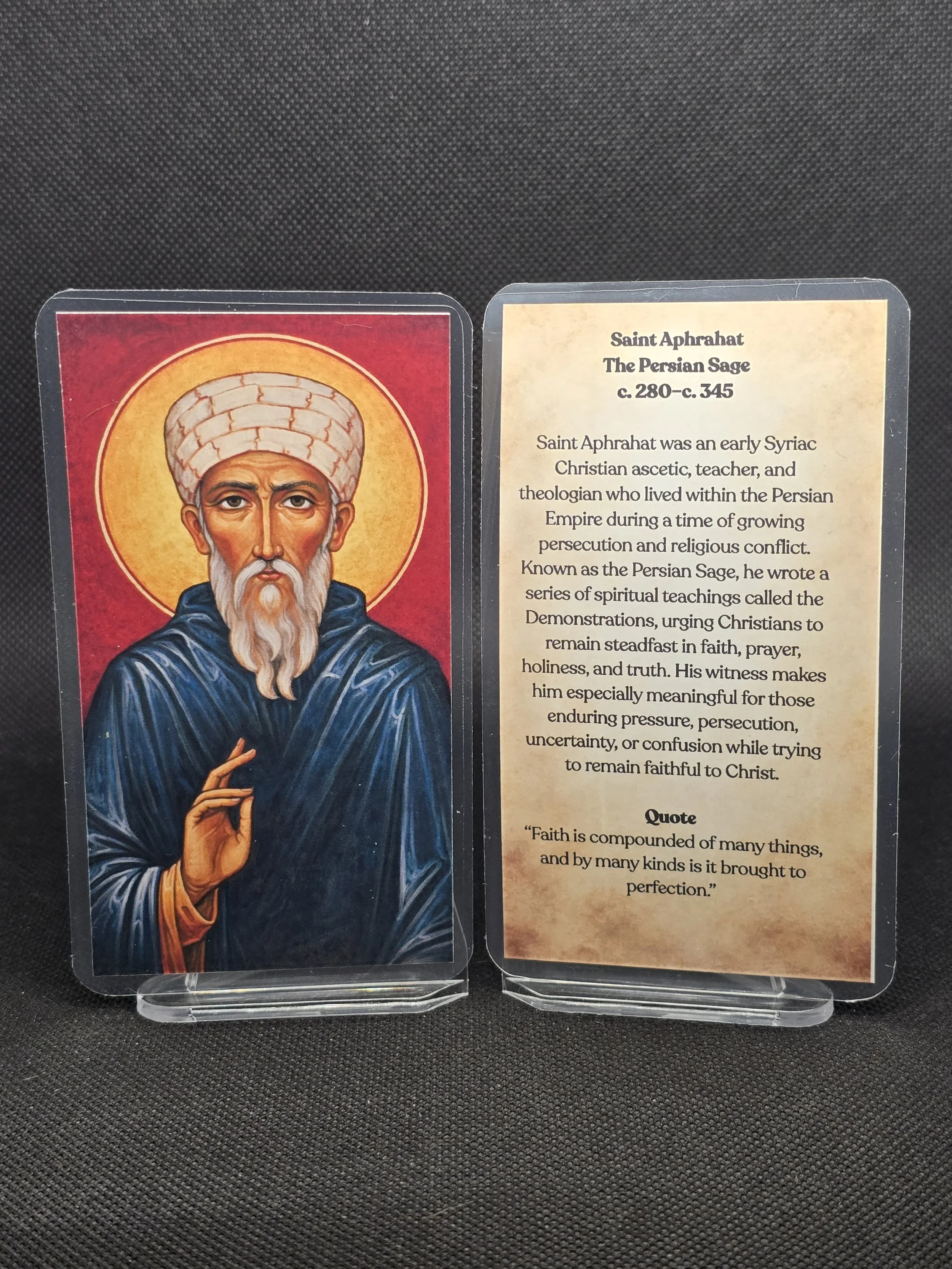
Aphrahat was born in the Persian Empire around the late third century. He likely embraced Christianity as a convert, taking on the name Jacob at baptism according to some early traditions, though historical certainty is limited. What is clear is that he lived as an ascetic and spiritual teacher within the Syriac Christian community.
He was not primarily a bishop known for councils.
He was a teacher of the interior life.
His most enduring work is a collection of twenty-three treatises known as the Demonstrations. These writings address faith, fasting, prayer, humility, persecution, and the relationship between Christians and Jews. They were composed during the persecution under Shapur II, when Persian Christians were suspected of political disloyalty due to Christianity’s growing association with the Roman Empire.
Aphrahat wrote to steady frightened believers.
He encouraged them not to retaliate.
He urged patience, obedience to Christ, and trust in God’s justice.
He emphasized simplicity of heart. He warned against pride. He taught that suffering for Christ purifies rather than destroys.
Unlike many later theologians, Aphrahat wrote in a poetic, symbolic Syriac style rooted deeply in Scripture. His thought is pastoral rather than speculative. He sought not to win arguments, but to preserve faith.
He likely died peacefully, though the exact details of his death are uncertain. His legacy endured through his writings, which remain foundational in Syriac spirituality.
He stands as a witness that theology can be medicine.
-
MIRACLES & PATRONAGE
Patron Saint Of:
Perseverance under persecution
Faithfulness in hostile environments
Spiritual clarity during cultural confusion
Endurance in quiet suffering
Teachers of Scripture
Aphrahat is not primarily associated with dramatic miracle stories. His influence comes through his writings and pastoral steadiness.
His miracle is preservation.
During persecution, communities remained grounded through his guidance. His Demonstrations strengthened Christians who feared imprisonment or social rejection. His words helped prevent panic from overtaking faith.
After his death, his writings continued to nourish Syriac monasticism and pastoral teaching. His spiritual legacy is considered a form of enduring intercession, shaping hearts across centuries.
Many today invoke him when navigating subtle persecution, cultural hostility, or intellectual confusion surrounding the faith.
His intercession is sought for courage without aggression.
-
PRAYERS
Short Traditional Invocation
Saint Aphrahat, wise teacher of perseverance, pray for us.
Traditional Syriac-Inspired Prayer
O holy Aphrahat,
faithful servant of Christ in times of trial,
intercede for us before the Lord.You who strengthened the persecuted,
strengthen us in our weakness.Guard our hearts from fear.
Protect our faith from compromise.
Teach us patience under pressure.Grant us courage without anger,
steadfastness without pride,
and clarity amid confusion.Through your prayers,
may we remain faithful to Christ
in every season.Amen.
-
FAQ
What is Saint Aphrahat known for?
He is known as the Persian Sage (modern day Iran), a fourth-century Syriac Christian author whose Demonstrations guided believers during persecution.When is his feast day?
January 29 in some Syriac and Eastern commemorations.Which Christian traditions venerate Saint Aphrahat?
He is venerated primarily within Syriac Christian traditions, especially the Syriac Orthodox Church.Why do people pray to Saint Aphrahat for perseverance?
Because he wrote pastoral guidance for Christians facing persecution and cultural hostility, teaching steady endurance and faithfulness.