 Image 1 of 1
Saint Arsenius the Great Prayer Card - For Silence, Prayer, Repentance, Discernment & Detachment
Saint Arsenius the Great, also known as Saint Arsenios the Great, Arsenius of Scetis, Arsenius the Roman, and Abba Arsenius, was one of the most revered Desert Fathers of early Christianity. Born in Rome around 354, he was exceptionally educated, served as a deacon of the Roman Church, and was chosen to educate the future emperors Arcadius and Honorius at the imperial court in Constantinople. Yet the honor, wealth, influence, and intellectual prestige surrounding him could not satisfy his longing for God, and he eventually abandoned the imperial palace for the Egyptian desert, where he became one of Christianity's greatest teachers of silence, repentance, humility, vigilance, and continual prayer.
Saint Arsenius is especially meaningful for monks, hermits, contemplatives, people seeking silence, Christians overwhelmed by constant noise or conversation, those establishing a serious prayer rule, people struggling with pride, teachers, professors, intellectuals seeking humility, people discerning whether they need greater solitude, Christians battling distraction, those learning to guard their speech, and anyone trying to move from knowing about God toward actually becoming quiet enough to remain before Him. These associations arise directly from his life because Arsenius deliberately moved from one of the most intellectually prestigious and socially powerful environments in the Roman Empire into obscurity, manual labor, silence, poverty, repentance, tears, Scripture, and prolonged prayer in the Egyptian desert.
His connection with silence is particularly strong. The Church remembers Arsenius hearing a divine call first to flee the distractions surrounding him and later to hide himself and live in silence, and the OCA describes silence as becoming one of the central struggles of his monastic life. Yet Arsenius did not understand silence as dislike of people because he continued giving short and penetrating counsel to monks who genuinely needed his help, demonstrating that Christian silence is meant to create deeper attention to God rather than contempt for other human beings.
Arsenius is also especially meaningful for highly educated Christians because he refused to confuse intellectual knowledge with holiness. Although he had studied philosophy and rhetoric, mastered Greek and Latin, taught imperial princes, and belonged to one of the most sophisticated intellectual environments of his age, the Desert Fathers preserve him asking spiritually experienced Egyptian monks for instruction because he understood that academic knowledge and purification of the heart are not the same achievement.
This prayer card is especially fitting for monks, seminarians, priests, professors, teachers, writers, scholars, retreatants, Christians practicing contemplative prayer, people undertaking a period of silence, anyone trying to reduce unnecessary speech or digital noise, and those asking for humility after professional or academic success. It can also make a meaningful monastery entrance, tonsure, ordination, seminary graduation, retreat, spiritual-direction, baptism, chrismation, name-day, or feast-day gift.
Each card is handmade in Austin, TX and created to order. We do not keep stock, because every prayer card is treated as a unique devotional offering. They are printed on museum-quality photo paper, not cardstock, and every card is made slowly during prayer with intentional reverence for the saint and for the person who will receive it. Names are lifted before Christ, intentions are held carefully, and each piece is handled multiple times in prayerful silence, asking God for mercy and asking Saint Arsenius the Great to intercede for the soul it is being made for. This is devotional craftsmanship shaped with patience, care, and spiritual responsibility because every soul and every prayer matters.
THE LIFE & STORY
Saint Arsenius was born in Rome during the fourth century, with the OCA dating his birth to 354. He came from a devout Christian family and received an unusually advanced education in rhetoric, philosophy, Greek, and Latin, placing him among the highly educated Christians of late Roman society.
Coptic tradition remembers him as coming from a wealthy and distinguished Roman family and emphasizes his early devotion to Scripture and Christian learning. Although some details differ between the surviving ecclesiastical traditions, they agree upon the central picture of a Roman Christian whose intelligence and education eventually brought him into direct contact with the imperial household.
The young Arsenius therefore possessed many of the qualities Roman society would have associated with success. Education, status, linguistic ability, ecclesiastical position, access to powerful people, and eventually imperial patronage all became available to him, yet his later life would become a sustained rejection of allowing any of those things to define his worth before God.
A DEACON OF THE CHURCH OF ROME
Before his move to Constantinople, Arsenius entered the clergy and served as a deacon in Rome. The OCA explicitly identifies him as a Roman deacon, while Vatican News likewise commemorates him as a Roman deacon who later became an anchorite in Egypt.
This makes Arsenius particularly interesting for deacons and men discerning ordained ministry because his vocation did not remain confined to one outward form. His diaconal service eventually led into a radically contemplative monastic life, demonstrating that God's direction can deepen or redirect a vocation in ways a person could not have predicted when first entering Church service.
His life should not be interpreted to mean that active ministry is spiritually inferior to solitude. Arsenius' story instead concerns the particular vocation God gave him, in which a man capable of functioning at the center of Christian imperial society was gradually drawn toward a hidden life in which almost everything that once made him publicly important would be surrendered.
THE IMPERIAL TUTOR
Emperor Theodosius I sought an exceptionally educated and trustworthy Christian to oversee the education of his sons Arcadius and Honorius, both of whom would later become Roman emperors. According to the OCA, Arsenius accepted the assignment reluctantly and in obedience to Pope Damasus, hoping that he could educate the imperial children not only academically but also in Christian piety.
The emperor took Arsenius' authority as teacher seriously. The traditional Life remembers Theodosius instructing his sons to obey their tutor rather than expecting special treatment merely because they were imperial princes, making Arsenius responsible for helping prepare two future rulers of the Roman world.
For teachers, professors, tutors, and parents, this part of Arsenius' life gives him an important association with education as moral formation. He was not asked merely to transfer information because the emperor wanted wisdom and character cultivated alongside knowledge.
TEACHING FUTURE EMPERORS
Arcadius would eventually become emperor in the East, while Honorius became emperor in the West. Their later reigns were politically difficult, but their connection with Arsenius placed the future Desert Father within one of the most consequential educational positions available anywhere in the late Roman Empire.
The contrast between this period and Arsenius' later life is extraordinary. One chapter of his life unfolded in imperial rooms among people whose decisions affected millions, while the next would unfold in a desert cell where he deliberately tried to avoid being noticed.
His transformation therefore gives him a powerful devotional connection with people whose careers have become prestigious but spiritually exhausting. Arsenius demonstrates that outward advancement and inward peace do not necessarily increase together, and there are moments when a Christian must ask whether success is helping or hindering the purpose for which life was given.
HONOR THAT TROUBLED HIM
The imperial court treated Arsenius with great respect, yet that respect increasingly disturbed him. The OCA says that the esteem surrounding him troubled a heart that had begun yearning for the quiet of monastic life, leading him to pray that God would show him the path toward salvation.
This is one of the most unusual dimensions of his vocation because many people pray for recognition, advancement, influence, or an opportunity to work with powerful people. Arsenius reached an extraordinary level of worldly importance and discovered that what others might have considered the fulfillment of ambition had become spiritually burdensome to him.
Saint Arsenius can therefore be meaningful for someone who has achieved the thing they thought they wanted and discovered that it did not bring peace. His life does not condemn success itself, but it asks whether every opportunity that increases status actually deserves to be held onto forever.
“ARSENIUS, FLEE”
The defining turning point of Arsenius' story came during prayer. The OCA preserves the tradition that he heard a divine voice directing him to flee from men in order to be saved, after which he secretly abandoned the palace, exchanged his expensive clothing for poor garments, traveled to Alexandria, and entered the Egyptian desert.
The command has sometimes been misunderstood when removed from its ascetical context. Arsenius was not being taught that other human beings are evil because Christianity cannot separate love of God from love of neighbor, but he personally had become surrounded by a world of honor, conversation, responsibility, luxury, and distraction that prevented the kind of prayer to which he believed God was calling him.
For modern Christians, the principle does not usually mean physically fleeing society. It may instead mean learning when to turn off the phone, close the computer, step away from constant conversation, stop consuming endless information, leave unnecessary argument behind, or create a protected place in which God is no longer competing with every other voice for attention.
FROM CONSTANTINOPLE TO EGYPT
Arsenius departed Constantinople secretly and traveled by sea to Alexandria, then moved into the famous monastic wilderness of Scetis, or Sketis, in Egypt. This region had become one of the principal centers of early Christian monasticism and was home to some of the greatest figures remembered among the Desert Fathers.
The change could hardly have been more extreme. Arsenius had gone from imperial rooms and servants to a desert culture in which monks lived by prayer, fasting, manual labor, obedience, and radical simplicity.
Importantly, his previous achievements did not automatically give him authority among the monks. Entering the desert meant becoming a beginner again.
ABBA JOHN THE DWARF
The monks brought Arsenius to Abba John the Dwarf, one of the great Egyptian elders, so that his humility could be tested. At the common meal, John did not give the distinguished former court tutor a place of honor but instead threw him a piece of dry bread, and Arsenius responded by humbling himself and eating without protest.
The point of the story is not that humiliating newcomers should become a model for ordinary Christian hospitality. Within the severe ascetic culture of the Desert Fathers, the episode revealed whether the former imperial teacher had merely changed clothing or had truly become willing to surrender the status he once possessed.
Arsenius passed the test because he did not demand that the monks acknowledge who he had been. The man who once instructed emperors accepted being treated as the least experienced member of a desert community.
BECOMING A BEGINNER AGAIN
One of the hardest forms of humility appears when an accomplished person enters a field in which other people know more. Arsenius knew languages, philosophy, rhetoric, theology, court culture, and education, yet Egyptian monks who possessed almost none of his formal learning knew forms of ascetic life he had never practiced.
Greek Orthodox tradition preserves an episode in which Arsenius sought advice from an Egyptian elder despite his superior formal education. When someone questioned why such a learned man would ask an apparently uneducated monk for guidance, Arsenius effectively distinguished secular learning from the spiritual knowledge acquired through years of purification and prayer.
This makes him an especially important saint for academics, theologians, professors, clergy, and people whose intelligence has become part of their identity. Arsenius demonstrates that being the smartest person in one room does not make someone spiritually advanced in every room.
THE SECOND CALL TO SILENCE
After entering the monastic life, Arsenius continued praying for guidance and received another call toward deeper silence. The OCA preserves the command for him to hide from people and dwell in silence, presenting silence as a root from which virtue could grow in his particular vocation.
He therefore withdrew into a more isolated cell and sharply reduced unnecessary conversation. He gathered with the Church for worship but otherwise protected the silence that had become central to his struggle.
Arsenius did not become spiritually important because he had discovered a clever technique. His silence mattered because it created the conditions in which pride, memories, desires, judgment, fear, and the constant need to respond to other people could be brought into sustained prayer before God.
WHAT CHRISTIAN SILENCE MEANS
Silence in the Desert Fathers does not simply mean refusing to speak. A person can be externally quiet while conducting endless arguments, fantasies, anxieties, resentments, and conversations internally, which means the deeper work concerns the silencing of compulsive interior noise.
Arsenius cultivated external silence because he was seeking a more profound interior attentiveness. Greek Orthodox spiritual teaching continues citing him as an example of concentrated prayer and disciplined silence rather than mere physical isolation.
His card can therefore be especially meaningful for someone who feels mentally exhausted by continuous information. The goal is not emptiness for its own sake, but enough interior space for Scripture, repentance, and the presence of God to become audible again.
“I HAVE NEVER REGRETTED MY SILENCE”
Among the best-known sayings attributed to Arsenius is his observation that he had regretted words he had spoken but never regretted his silence. The OCA preserves this teaching within its Life of the saint, connecting it directly with his reputation as one of the greatest practitioners of silence among the Desert Fathers.
The saying does not mean Christians should refuse to defend truth, comfort someone suffering, teach children, proclaim the Gospel, or speak when justice requires it. Arsenius was addressing the enormous amount of unnecessary speech through which judgment, gossip, anger, self-promotion, complaint, exaggeration, and regret enter human relationships.
His teaching is therefore remarkably modern. In an age in which almost every reaction can be instantly posted, sent, forwarded, or commented upon, Arsenius offers the discipline of asking whether everything we have the ability to say actually needs to be said.
A SAINT FOR GUARDING THE TONGUE
Saint Arsenius is therefore one of the strongest Desert Fathers for Christians struggling with gossip, oversharing, angry responses, constant commentary, arguments, and speaking impulsively. His life presents control of speech not merely as social politeness but as a serious spiritual discipline.
Silence creates a gap between emotion and response. Within that small space, a person can ask whether the words forming in the mind will heal, clarify, protect, teach, or simply satisfy the temporary desire to strike back.
A Saint Arsenius card beside a phone, computer, or work desk can therefore become a practical reminder. Before sending the message or posting the response, there is still time to decide whether silence might protect the soul better than another argument.
SILENCE WITHOUT CONTEMPT
Arsenius' desire for solitude was extremely strong, yet his Life explicitly says that he did not refuse spiritual counsel to monks who genuinely came seeking help. He answered their questions briefly and perceptively, demonstrating that the same man who guarded silence could speak when charity required it.
This distinction prevents his spirituality from becoming anti-social. Christian silence does not mean believing other people are beneath us, because avoiding people out of contempt is spiritually different from withdrawing in order to pray.
Arsenius loved the monks but recognized his own limits. His vocation required much greater solitude than most Christians need, and humility meant accepting that fact rather than forcing himself into a pattern simply because other people expected more availability.
A SAINT FOR INTROVERTS AND PEOPLE WHO NEED SOLITUDE
It would be too modern and psychologically simplistic to label Arsenius merely as an introvert. His withdrawal was fundamentally ascetical and theological rather than a personality preference, but his life can nevertheless be deeply reassuring to people who genuinely require more quiet than those around them understand.
Some Christians feel guilty because prolonged social interaction leaves them exhausted while prayer and solitude restore them. Arsenius demonstrates that a strong need for quiet can become fruitful when it produces prayer, patience, repentance, and greater love rather than avoidance of responsibility.
His card can therefore be especially meaningful for people trying to discern the difference between healthy solitude and unhealthy isolation. The fruit provides part of the answer because solitude that leads toward God should gradually make the heart more capable of charity rather than more hostile toward other people.
NIGHT-LONG PRAYER
Church tradition remembers Arsenius practicing extraordinary night vigils. Greek Orthodox and Coptic sources describe him beginning prayer as evening approached and continuing with his hands raised toward heaven until sunrise, demonstrating the intensity with which prayer became the organizing center of his life.
Ordinary Christians should not imitate such extreme physical vigils without discernment because monastic practices develop within particular spiritual and bodily conditions. The principle beneath his vigil, however, remains accessible: prayer deserves more than whatever exhausted minutes happen to remain after everything else receives the best part of the day.
Saint Arsenius can therefore be an especially meaningful saint for someone trying to establish consistent morning or evening prayer. His example asks whether time with God is being treated as foundational or merely optional.
PRAYING WITH THE BODY
Arsenius' practice of standing with his arms raised reminds Christians that prayer is not merely an activity of the intellect. Eastern Christianity has always prayed through the body as well as the mind, using standing, bowing, prostrations, the sign of the Cross, fasting, vigils, and physical attentiveness as part of worship.
The body can reinforce intention. Standing when tired, bowing in repentance, or deliberately putting aside comfort can sometimes reveal how much prayer had previously depended upon convenience.
Arsenius' bodily discipline should be interpreted through humility rather than competition. The purpose is never to prove that one's prayer rule is harder than another person's, because pride can survive very comfortably even inside impressive ascetic practices.
THE GIFT OF TEARS
The Orthodox liturgical tradition remembers Saint Arsenius particularly for tears of repentance, and his Troparion describes the barren desert becoming fruitful through the streams of his tears. The OCA Life likewise says that his eyes were continually filled with tears during his long ascetic life.
Within the spirituality of the Desert Fathers, tears are not valued simply because someone becomes emotional. They can represent compunction, awareness of sin, gratitude for mercy, sorrow over separation from God, compassion for human suffering, and the softening of a heart that has ceased defending itself.
This makes Saint Arsenius meaningful for someone whose spiritual life feels dry, intellectual, or emotionally hardened. His tears remind Christians that repentance is not merely agreeing intellectually that sin is wrong, but allowing the reality of God's mercy and our need for it to reach the heart.
REPENTANCE AFTER A LIFE OF RESPECTABILITY
Arsenius had not been notorious for scandal, violence, or public immorality before entering the desert. He had been a Christian cleric, scholar, and teacher, yet he still regarded repentance as central enough to spend decades weeping and examining the movements of his own heart.
This is significant because religious people can gradually assume that repentance belongs mainly to those whose sins are more visible. Arsenius presents another possibility: the closer a person moves toward God, the more clearly subtle pride, judgment, vanity, attachment, resentment, and self-will become visible.
His life therefore gives a strong answer to spiritual complacency. Respectability is not the same thing as holiness, and avoiding obvious scandal does not mean the work of conversion is complete.
ASCETICISM WITHOUT EXTERNAL SHOW
The OCA preserves a striking teaching from Arsenius warning that people may perform great works of fasting, vigil, and repentance while still failing to guard the soul from pride, greed, jealousy, hatred, resentment, and judgment. He compared impressive outward religious appearance with something that can conceal corruption within.
That teaching prevents his severe asceticism from being misunderstood. Arsenius did not believe that fasting longer, sleeping less, or speaking fewer words automatically made someone holy.
External discipline is valuable when it exposes and heals the passions of the heart. When outward religion becomes a source of comparison or superiority, the practice can begin feeding the very pride it was supposed to weaken.
A SAINT FOR PEOPLE WHO LOVE SPIRITUAL PRACTICES
Saint Arsenius is therefore especially useful for Christians attracted to fasting schedules, prayer rules, theological reading, ancient disciplines, or contemplative techniques. His own life validates serious spiritual practice while simultaneously warning that practices are not the final goal.
A person may keep every rule meticulously and still remain harsh toward a spouse, jealous of a coworker, resentful toward a priest, or contemptuous toward Christians who practice differently. Arsenius would direct attention back toward the interior transformation for which all those disciplines exist.
His card can therefore become a valuable companion during Great Lent or another intensive season of prayer. It can remind the person fasting that the deepest fast may also involve refusing judgment, bitterness, unnecessary speech, and pride.
SCRIPTURE EVEN WHEN YOU DO NOT FULLY UNDERSTAND IT
Arsenius strongly encouraged continual reading of the Holy Scriptures. When a monk asked what to do when biblical passages seemed difficult to understand, Arsenius encouraged him to continue learning and repeating Scripture rather than abandoning it simply because its full spiritual depth had not yet become clear.
This gives him a natural association with people who find Bible reading intimidating. Scripture is not mastered in one pass, and the fact that a passage remains difficult does not mean time spent with it has been wasted.
Saint Arsenius can therefore be meaningful for Bible students, catechumens, seminarians, and Christians beginning a disciplined Scripture-reading practice. His example combines serious study with humility before a text whose depths exceed the reader.
AN INTELLECTUAL WHO LEARNED HUMILITY
Few Desert Fathers provide such a dramatic contrast between formal education and spiritual simplicity. Arsenius had been trained in the intellectual culture of Rome and Constantinople, yet he deliberately sought instruction from Egyptian monks who lacked his literary education because he recognized forms of wisdom his books had not given him.
This does not make education an enemy of faith. Arsenius used his intelligence throughout life, but he refused to believe intellectual skill automatically purified desire, controlled anger, removed vanity, or taught someone how to pray.
His example is therefore especially valuable in theological study. The ability to explain hesychasm, repentance, or the passions is not identical to actually becoming silent, repentant, or free from them.
FROM LUXURY TO PALM LEAVES
In the imperial court, Arsenius had known an environment of refinement and privilege. In the desert, his ordinary work involved weaving baskets and mats from palm leaves, a common form of manual labor among Egyptian monks.
This change was spiritually important because manual work supported the monk while also creating a rhythm of humble labor. The man who once supervised imperial education now spent hours performing repetitive work with his hands.
For people whose identity has become tightly connected with professional status, Arsenius' transformation is striking. Human dignity does not rise and fall according to whether the day's work impresses other people.
THE FOUL WATER IN HIS CELL
One of the strangest details in Arsenius' Life concerns the water in which he soaked the palm leaves used for basket-making. He deliberately allowed the water to become foul-smelling and explained that he accepted the unpleasantness as a humbling contrast with the perfumes and comforts he had once enjoyed in worldly life.
The practice belongs to a severe ascetical culture and should not be copied literally simply because a saint practiced it. Its significance lies in Arsenius deliberately challenging the part of himself accustomed to refinement and insisting that previous luxury should not determine what he now considered necessary.
His spiritual question remains relevant even when the method does not. How much comfort has become so normal that losing it immediately produces anger, fear, or the feeling that life has become unbearable?
A SAINT FOR DETACHMENT FROM COMFORT
Arsenius did not teach that created comforts are evil. His own discipline aimed instead at discovering whether comfort had become an expectation powerful enough to control him.
This makes him especially meaningful for Christians attempting to simplify their lives or reduce unnecessary consumption. The goal is not misery, but freedom from the conviction that peace requires everything around us to remain pleasant.
A Saint Arsenius card can therefore be useful during fasting, decluttering, retreat, reduced technology use, or any deliberate practice of simplicity. His life challenges the assumption that discomfort automatically means something has gone wrong.
REFUSING AN INHERITANCE
Coptic tradition preserves an account in which Arsenius was informed that a wealthy relative had left him an inheritance. Arsenius refused the estate because, from his monastic perspective, the old worldly life capable of inheriting such wealth had already died when he entered the desert.
The episode does not create a universal Christian rule against receiving inheritances. Arsenius' refusal belonged to the radical poverty of his specific monastic vocation.
The spiritual principle concerns freedom from being pulled backward by things a person has already surrendered for God. Arsenius had chosen a life without wealth, and money powerful enough to reopen his former identity was therefore something he refused to reclaim.
A SAINT FOR PEOPLE LEAVING STATUS BEHIND
Career changes, retirement, illness, religious vocation, migration, or other major transitions can strip away titles that once explained who someone was. Arsenius offers a striking example of a man who voluntarily surrendered one of the most prestigious identities available in his society.
He did not spend the desert years insisting that everyone remember he had once educated emperors. His previous accomplishments became part of the story without becoming the foundation of his present identity.
Saint Arsenius can therefore be meaningful for retirees and people entering a less visible stage of life. The loss of a title does not mean the loss of vocation because hidden faithfulness can be more spiritually consequential than public prestige.
WORKING WHEN NO ONE WAS WATCHING
Arsenius repeatedly urged himself not to become idle. The OCA preserves the memory of him reminding himself that he had come to the desert to labor rather than to rest, demonstrating that solitude was not an excuse for passivity.
This is an important corrective to romantic pictures of contemplative life. Silence still requires discipline because a person can waste enormous amounts of time alone just as easily as in a crowd.
Arsenius' example makes him meaningful for people who work independently, writers, students, remote workers, monks, and anyone whose responsibilities require discipline without external supervision. His life demonstrates integrity when there is no audience available to reward the effort.
WHEN FAME FOLLOWED HIM INTO THE DESERT
The more Arsenius sought obscurity, the more his reputation for holiness spread. Monks and visitors continued searching for him, eventually disturbing the solitude he had gone to such lengths to protect.
This created a recurring tension between his desire to remain hidden and the legitimate spiritual needs of people who sought his counsel. Arsenius moved more than once while continuing to offer short guidance when appropriate.
His experience shows that withdrawing from public ambition does not guarantee obscurity. Sometimes genuine spiritual authority becomes visible precisely because the person possessing it has stopped trying to be seen.
THE VISITORS HE DID NOT WANT
Coptic tradition preserves a particularly memorable story involving visitors who asked Arsenius for spiritual instruction. He responded by asking that when they later learned where he was living, they allow him to remain undisturbed rather than continually pursuing him.
That response sounds severe when separated from context, but it reflects the radical nature of his personal vocation. Arsenius had not gone into the desert to become a celebrity elder receiving a constant stream of admirers.
His story provides an important warning for religious culture. Curiosity about a holy person can become another form of consumption when people pursue spiritual personalities for experiences instead of doing the difficult work already given to them in their own lives.
A SAINT FOR BOUNDARIES
Although modern psychological language would have been foreign to Arsenius, his life contains an ancient example of recognizing limits of availability. He loved the brethren and advised them when necessary, but he did not believe love required permanent access to his time and attention.
This is especially relevant for clergy, caregivers, teachers, counselors, business owners, and people whose responsibilities invite constant interruption. The Christian duty to serve others does not automatically mean every request deserves immediate access.
Arsenius' extreme example should be adapted carefully to ordinary vocations, but the principle remains useful. Protected prayer, rest, family responsibility, and silence can be legitimate boundaries rather than selfishness.
THE THREE DISCIPLES
Despite his reputation, Arsenius appears to have accepted only a very small number of close disciples. The OCA names Alexander, Zoilos, and Daniel as the principal disciples associated with him.
This is striking because spiritual fruitfulness is often measured today through size, reach, audience, followers, students, or institutional growth. Arsenius became one of the most influential Desert Fathers while personally forming only a tiny circle of disciples.
His life therefore challenges the assumption that a ministry must become large to become important. A few people formed deeply may transmit wisdom farther across history than thousands of superficial contacts.
ABBA DANIEL & THE MEMORY OF ARSENIUS
Abba Daniel became especially important in preserving memories and sayings associated with Arsenius. Through disciples and the later collections of sayings of the Desert Fathers, the hidden Roman monk eventually became one of the most recognizable voices of Egyptian monastic spirituality.
This creates another paradox in his story. Arsenius spent decades trying not to become famous, yet teachings about silence, prayer, humility, and repentance continued traveling long after his death.
Christian influence therefore does not always require self-promotion. Sometimes the words most worth preserving emerge from a life that was never organized around building an audience.
THE DESERT FATHERS
Saint Arsenius belongs to the extraordinary movement remembered as the Desert Fathers, the monks and hermits who populated the deserts of Egypt, Palestine, Syria, and surrounding regions during the formative centuries of Christian monasticism. Their sayings became a major source for later Eastern and Western ascetic spirituality.
Arsenius occupies a distinctive place among them because his path moved from Rome and Constantinople into the Egyptian desert. His intellectual and aristocratic background contrasted sharply with many Egyptian monks whose formal education was limited but whose ascetic wisdom he deeply respected.
For someone collecting prayer cards of the Desert Fathers, Arsenius naturally belongs beside Saint Anthony the Great, Saint Macarius the Great, Saint Moses the Black, Saint John the Dwarf, Saint Poemen, Saint Pachomius, and the other great fathers and mothers of Egyptian monasticism.
ARSENIUS & ABBA MOSES
The ancient sayings place Arsenius within the same monastic environment as other great fathers, including Abba Moses. The OCA preserves an exchange in which Moses questioned Arsenius about his extreme withdrawal, giving Arsenius an opportunity to explain that his silence arose from the intensity of his desire to remain with God.
Their different personalities illustrate something important about the Desert Fathers. Sanctity did not require every monk to become identical because different people could follow different ascetical patterns while remaining within one Christian tradition.
This is valuable for Christians who continually compare spiritual lives. Another person's prayer rule, ministry, personality, or degree of solitude may be genuinely holy without becoming the exact form God asks of everyone else.
THE BARBARIAN RAIDS & THE LOSS OF SCETIS
Arsenius spent approximately forty years at Scetis, but his long period there eventually ended amid violent raids upon the desert settlements. Coptic tradition places his departure around 434, while later summaries likewise connect his movement away from Scetis with attacks upon monastic communities.
This means that Arsenius' later movements were not simply caused by his preference for new hermitages. Political instability and violence disrupted the monastic landscape in which he had spent much of his life.
The saint of stability therefore also experienced forced displacement. His biography reminds Christians that faithfulness sometimes means remaining, while at other times circumstances outside our control require carrying the same vocation into a different place.
TROE NEAR MEMPHIS
After leaving Scetis, Arsenius eventually settled at Troe near Memphis, within the region of modern Tura south of Cairo. The OCA summarizes his later life as approximately ten years there, followed by time at Canopus and then a return to Troe for his final years.
The move placed him closer to more populated areas than the remote desert of Scetis, something the Coptic account says he found difficult because of his lifelong attachment to solitude. He nevertheless continued his ascetic life until extreme old age.
Arsenius' later years therefore show that even a deeply established spiritual routine may need to change. Holiness cannot depend entirely upon having perfect external conditions because eventually age, danger, illness, or circumstance changes the environment.
CANOPUS & RETURN TO TROE
The OCA states that Arsenius spent approximately three years at Canopus, near Alexandria, before returning again to Troe. His final earthly years therefore unfolded through several relocations rather than the stable desert cell that had characterized so much of his earlier monastic life.
This makes his story particularly meaningful for older Christians who find that their preferred spiritual routines become impossible because of health, family needs, relocation, or loss of independence. A vocation can remain fundamentally the same even when its practical expression changes.
Arsenius remained Arsenius whether he was at the imperial court, Scetis, Troe, or Canopus. The physical place mattered, but the deeper continuity was his movement toward God through repentance and prayer.
FEAR AT THE APPROACH OF DEATH
The Desert Fathers preserve a moving account of Arsenius weeping when he recognized that death was approaching. When disciples expressed surprise that such a great ascetic could still experience fear, Arsenius acknowledged that the seriousness of death and judgment had never become trivial to him.
This is an important corrective to sentimental portrayals of saints as people incapable of ordinary human fear. Arsenius' fear did not mean lack of faith because the same tradition describes him dying peacefully and trusting in God.
His final tears demonstrate Christian sobriety. Confidence in God's mercy does not require treating death, judgment, repentance, or the condition of the soul casually.
A SAINT FOR FEAR OF DEATH
Saint Arsenius can therefore be especially meaningful for Christians who feel ashamed because they are afraid of dying. One of the greatest ascetics of the ancient Church approached death with deep seriousness rather than pretending that decades of prayer had made mortality emotionally meaningless.
His example allows fear to be brought into faith rather than hidden. Christian courage does not always mean feeling nothing because sometimes it means entrusting oneself to Christ while still experiencing the natural trembling produced by the unknown.
A Saint Arsenius prayer card can therefore have a meaningful place beside the bed of someone facing serious illness or advanced age. His life joins repentance, humility, fear, faith, and final trust rather than pretending only one of those experiences can exist at a time.
HIS REPOSE
The exact year of Saint Arsenius' repose differs slightly among ecclesiastical traditions. The OCA places his death in 449 or 450 when he was nearly one hundred years old, while the Coptic source consulted here gives an earlier traditional date of approximately 445 and an age around ninety-five.
Because of this variation, a historically careful product page should avoid claiming an artificially precise lifespan. The safest presentation is c. 354 to c. 449/450, while noting that some Coptic sources preserve an earlier chronology.
What is secure is the extraordinary length of his monastic vocation. The OCA credits him with approximately fifty-five years of monastic labor, including forty years at Scetis before his later life near Memphis and Alexandria.
WHAT HAPPENED TO HIS RELICS?
The modern location of Saint Arsenius' principal relics is not securely documented in the major official Orthodox and Catholic sources consulted for this page. The OCA describes his repose at Troe but does not identify a current shrine containing his complete relics, while later historical traditions associate his burial with the monastic site at Tura in Egypt.
Medieval traditions concerning the movement of his relics are complicated and do not provide enough certainty to name one present location as the undisputed resting place of his complete body. Individual churches may possess relic fragments attributed to him, but those claims should be verified directly with the church or monastery before being presented as established pilgrimage information.
For this product page, the most historically responsible wording is therefore that Saint Arsenius reposed near Troe or Tura in Egypt, while the present location of his principal bodily relics cannot be securely identified from the authoritative sources consulted. This avoids giving customers a confident relic location where the surviving evidence is considerably more complicated.
THE ANCIENT MONASTIC SITE AT TURA
Historical tradition associates Arsenius' final years with Tura, south of present-day Cairo. A monastery later developed in the area connected with his memory, although centuries of destruction, rebuilding, political upheaval, and abandonment dramatically altered the site.
This provides an important geographic conclusion to his life. The Roman who had once lived within the imperial orbit of Constantinople finished his journey not in a palace or cathedral but in the Egyptian landscape to which he had fled decades earlier seeking salvation.
For pilgrims interested in Arsenius, the Egyptian desert tradition is therefore far more historically important than any modern attempt to associate him primarily with Rome. Rome was his birthplace, but Egypt became the landscape of his sanctity.
SAINT ARSENIUS IN THE ORTHODOX CHURCH
The Eastern Orthodox Church venerates Arsenius as Venerable Arsenius the Great and commemorates him on May 8. The OCA publishes both his Life and established Troparion, placing him firmly among the great monastic fathers of the Church.
His Orthodox liturgical memory emphasizes tears, ascetic labor, miracles, and intercession. The hymn does not celebrate the imperial career that once made him socially important because the Church remembers most strongly what happened after he surrendered that world for Christ.
This liturgical emphasis reveals something important about Christian memory. The accomplishments society might have placed at the beginning of his obituary became secondary to repentance, prayer, and transformation.
SAINT ARSENIUS IN THE COPTIC TRADITION
Saint Arsenius also belongs deeply to Coptic Christian memory because the decisive decades of his spiritual life unfolded in the Egyptian desert. Coptic sources preserve extensive traditions about his Roman background, imperial teaching, retreat to Scetis, ascetic disciplines, tears, and final years in Egypt.
This makes Arsenius one of the saints who naturally connects Byzantine and Coptic Christian history. The later doctrinal divisions between Chalcedonian and non-Chalcedonian Christians do not erase the fact that Arsenius belonged to the earlier Egyptian monastic world inherited and revered across these traditions.
For The Eastern Church, his product page can therefore accurately note that he is venerated within both Eastern Orthodox and Coptic Orthodox Christianity, as well as within Catholic tradition.
SAINT ARSENIUS IN THE CATHOLIC CHURCH
Saint Arsenius lived centuries before the later division between Catholic and Eastern Orthodox Christianity and belongs to the ancient Christian inheritance shared between East and West. Vatican News specifically commemorates Saint Arsenius the Great, Roman deacon and anchorite in Egypt, on May 8.
His recognition within Catholic tradition is therefore not merely historical interest in an Orthodox saint. Arsenius is a pre-schism saint belonging to the Catholic Church's own ancient monastic heritage, particularly through the influence the Egyptian Desert Fathers exercised upon later Western monasticism.
Eastern Catholics can likewise venerate him naturally within their own spiritual inheritance. His spirituality of silence, repentance, watchfulness, fasting, and continual prayer belongs directly to the broader ascetic world from which Eastern Christian spirituality developed.
FEAST DAY
The principal Byzantine and Roman Catholic commemoration of Saint Arsenius the Great is May 8. Both the Orthodox Church in America and Vatican News list him on that date.
Coptic Christianity commemorates Arsenius according to its own liturgical calendar, giving him an additional place within the Egyptian Church's annual remembrance of the Desert Fathers. The variation does not represent different saints because the Roman imperial tutor who became a Scetis hermit is the same Arsenius revered across these ancient Christian traditions.
For a customer-facing product page aimed at Orthodox, Catholic, and Eastern Catholic readers, May 8 is the most useful feast date to display prominently.
ICONOGRAPHY
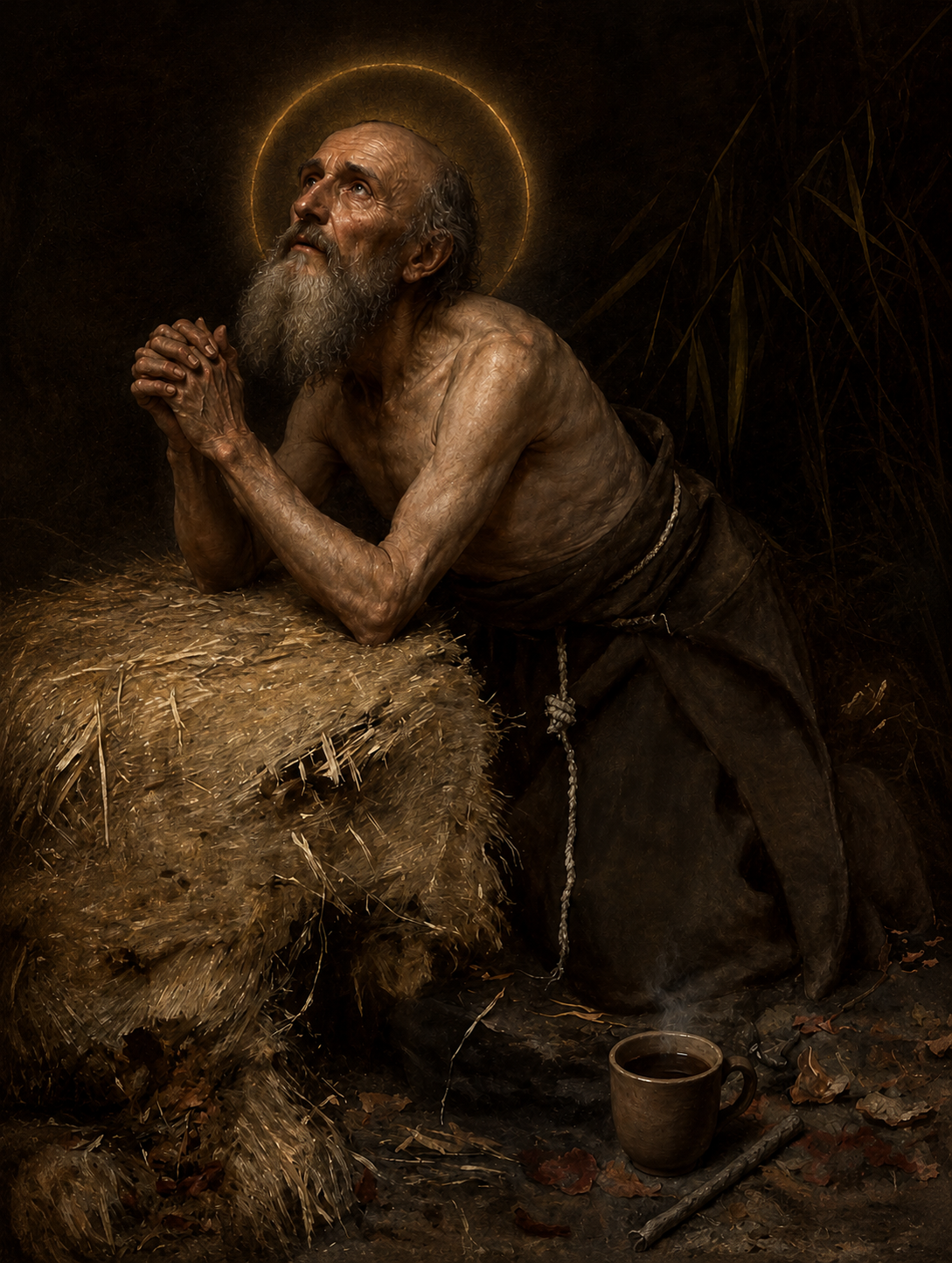
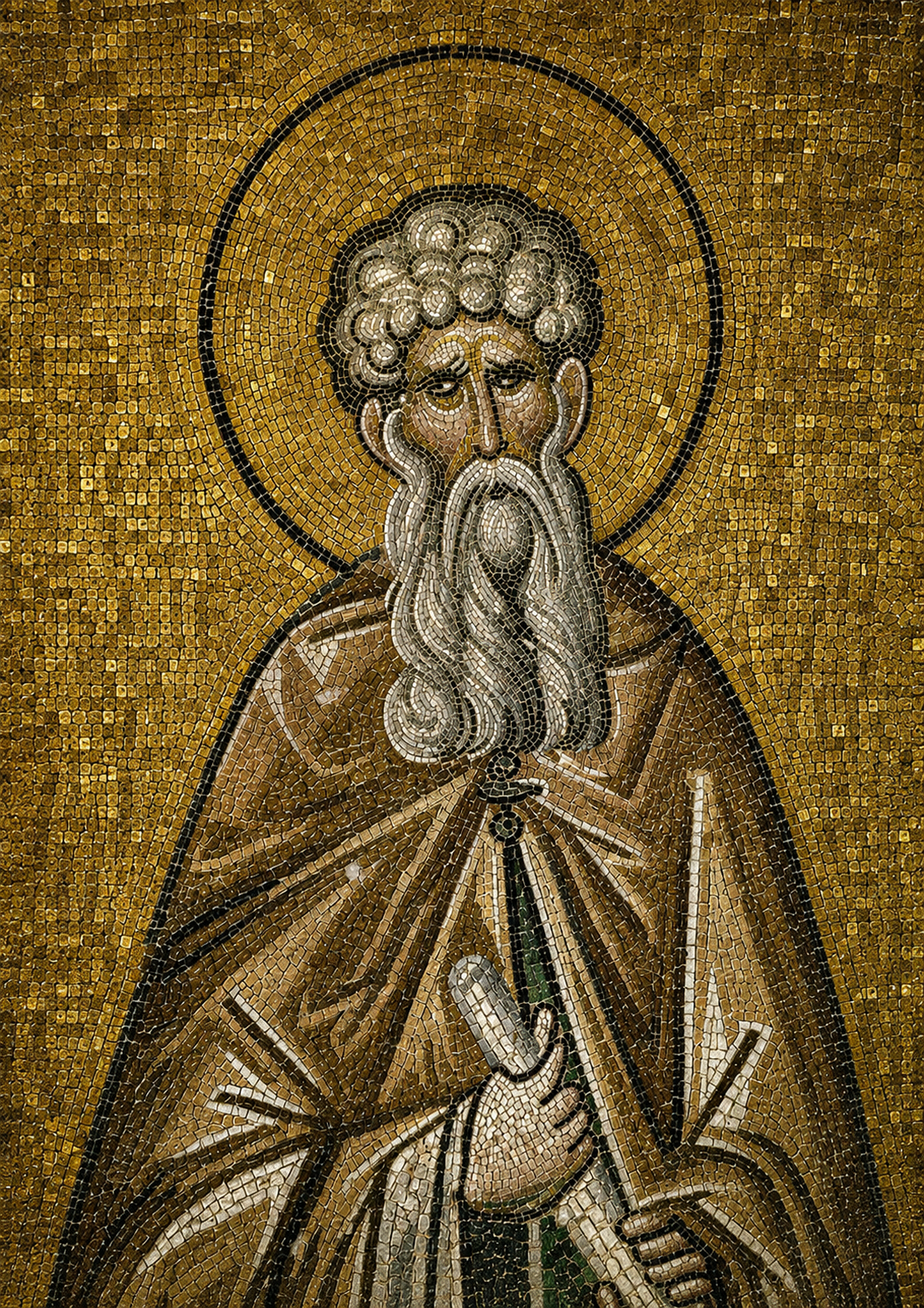
Traditional icons depict Saint Arsenius as an elderly Desert Father with a long beard and monastic garments, usually emphasizing the austerity and spiritual authority associated with his Egyptian life. Some icons place a scroll in his hand containing a teaching connected with silence or repentance, reflecting the sayings through which later generations came to know him.
His iconography should therefore remain recognizably monastic rather than presenting him in imperial clothing simply because he once lived at court. The central identity preserved by the Church is not Arsenius the imperial educator but Arsenius the repentant elder who exchanged public honor for silence.
For a prayer card, traditional Byzantine or Coptic-inspired monastic imagery is especially fitting. Earth tones, desert surroundings, a restrained expression, aged features, and the visual simplicity of a hermit's life all correspond more closely with his spiritual legacy than royal imagery would.
PRAYERS
A simple traditional invocation may be prayed throughout the day: Venerable Father Arsenius the Great, pray to God for us. It is particularly fitting before entering silence, beginning a retreat, reading Scripture, practicing the Jesus Prayer, trying to control angry speech, discerning whether to respond to an argument, or asking God for humility after success.
The Orthodox Church's established Troparion for Saint Arsenius praises the tears through which his desert became spiritually fruitful and concludes by asking his prayers before Christ. Because this text comes from the Church's liturgical worship, it provides a secure traditional devotional source rather than requiring a newly invented prayer specifically for the card.
Someone overwhelmed by noise can ask Saint Arsenius for the discipline to create genuine quiet rather than merely wishing circumstances would become quieter on their own. Someone who talks impulsively can seek his prayers for restraint, while an intellectual or theologian can ask for the humility to recognize forms of spiritual wisdom that cannot be acquired merely through reading.
A person approaching a retreat can also seek his intercession for courage to remain with the discomfort that silence sometimes exposes. When noise disappears, thoughts and wounds that had been hidden through busyness may become clearer, and Arsenius' life demonstrates why authentic silence needs repentance and prayer rather than simply absence of sound.
This prayer card is especially fitting beside a Bible, Psalter, prayer rope, Jesus Prayer book, retreat journal, monastery rule, theological textbook, study desk, nightstand, or home prayer corner. It can also make a meaningful gift for a monk, novice, professor, seminarian, priest, writer, teacher, scholar, retreatant, or someone intentionally creating a quieter and more prayerful life.
FAQ
Who was Saint Arsenius the Great? Saint Arsenius the Great was a Roman deacon, highly educated scholar, imperial tutor, and later Egyptian Desert Father who lived during the fourth and fifth centuries. He became one of the most famous early Christian teachers of silence, prayer, repentance, humility, and ascetic life.
Is Saint Arsenius also called Saint Arsenios? Yes, Arsenius and Arsenios are different English transliterations of the same name. He may also be called Arsenius of Scetis, Arsenius the Roman, or Abba Arsenius in writings about the Desert Fathers.
When was Saint Arsenius born? The OCA places his birth in 354 in Rome, while some Coptic traditions give a date around 350. Because ancient chronology is not always exact, approximately 350 to 354 is a reasonable historical range.
When did Saint Arsenius die? The OCA places his repose in 449 or 450, when he was nearly one hundred years old, while Coptic tradition consulted here gives approximately 445. The safest customer-facing date is therefore c. 449/450, with acknowledgment that early sources preserve slightly different chronologies.
When is Saint Arsenius the Great's feast day? His principal feast in the Eastern Orthodox and modern Roman Catholic calendars is May 8. Both the OCA and Vatican News commemorate him on that date.
Where was Saint Arsenius born? He was born in Rome into a Christian family and received an unusually sophisticated education. His later spiritual life, however, became permanently associated with Egypt and the Desert Fathers of Scetis.
Was Saint Arsenius a Roman? Yes, he was Roman by birth and is sometimes specifically called Arsenius the Roman. His movement from Rome and Constantinople into Egyptian monasticism is one of the defining features of his biography.
Was Saint Arsenius a deacon? Yes, both Orthodox and Catholic sources remember him as a deacon of the Roman Church before his service at the imperial court. Vatican News specifically identifies him as a Roman deacon who later became an Egyptian anchorite.
Was Saint Arsenius a priest? His secure ancient identity is as a Roman deacon and later monk and anchorite. Sources used for this page do not provide a comparably clear basis for describing him as a priest, so the safest product wording is deacon, monk, and Desert Father.
Was Saint Arsenius highly educated? Yes, the OCA states that he studied philosophy and rhetoric and knew both Greek and Latin. His education eventually made him suitable for the extraordinary responsibility of teaching the emperor's sons.
Who did Saint Arsenius teach? He became tutor to Arcadius and Honorius, sons of Emperor Theodosius I. Both boys later became Roman emperors, one ruling in the East and the other in the West.
Why did Saint Arsenius leave the imperial court? Despite his prestige and comfortable position, Arsenius increasingly longed for a life devoted more completely to God. His Life says that after praying for direction he received a divine call to flee the environment surrounding him and seek salvation through withdrawal.
Did Saint Arsenius leave Constantinople secretly? Yes, the traditional Life says that he exchanged his court clothing for poor garments and departed secretly for Alexandria before entering the Egyptian desert. The action marked a complete break with the public identity he had previously held.
Where did Saint Arsenius become a monk? He entered the monastic world of Scetis in Egypt, one of the great centers of early Christian desert spirituality. There he came under the guidance of experienced Egyptian elders, including Abba John the Dwarf.
Who was Abba John the Dwarf? Abba John the Dwarf was an important Egyptian Desert Father who tested Arsenius' humility when he first sought admission to monastic life. Arsenius' willingness to accept humiliating treatment without invoking his former status convinced the elder that he possessed the disposition required for monastic formation.
Did Saint Arsenius really eat bread from the floor? His traditional Life preserves an episode in which Abba John threw him bread rather than serving him as an honored guest. Arsenius accepted the humiliation, and the story became an important illustration of how completely he was willing to surrender his former courtly status.
What is Saint Arsenius the patron saint of? There is no need to invent one narrow modern patronage title because his life provides strong devotional associations with silence, contemplative prayer, monks, hermits, repentance, humility, guarding speech, spiritual detachment, Scripture, and intellectual humility. These associations arise directly from his teachings and ascetic life.
Is Saint Arsenius a patron saint of silence? Calling him a major patron or intercessor for silence is well grounded in his historical spiritual identity because few Desert Fathers are more consistently associated with deliberate silence. His Life repeatedly emphasizes his withdrawal from unnecessary speech and his teaching about the spiritual value of silence.
Is Saint Arsenius good for people who talk too much? Yes, his teaching is particularly appropriate for people struggling with unnecessary speech, gossip, oversharing, or impulsive reactions. His own discipline of silence demonstrates how restraint of speech can become part of repentance.
Can I pray to Saint Arsenius before responding to an argument? Yes, his spirituality makes this an especially fitting devotional use. Seeking his intercession can create a moment in which someone asks whether a response is actually necessary or whether silence would better preserve peace.
Is Saint Arsenius good for people overwhelmed by noise? Yes, his entire vocation centered upon withdrawing from excessive external activity so that attention could become more fully directed toward God. His example is especially meaningful for people trying to create periods without constant media, conversation, notifications, or information.
Can introverts pray to Saint Arsenius? Yes, although Arsenius should not simply be reduced to a modern personality type. His life can nevertheless encourage Christians who genuinely need solitude, provided that solitude produces prayer and charity rather than contempt or fear of other people.
Is Saint Arsenius a good saint for contemplative prayer? Yes, prolonged silence, vigils, continual prayer, repentance, and interior attentiveness were central to his spiritual life. He is one of the classic Desert Fathers for people studying or practicing Eastern Christian contemplative spirituality.
Did Saint Arsenius practice hesychasm? Arsenius lived centuries before the later theological controversies commonly associated with the term hesychasm, but hesychia, or spiritual stillness, was clearly central to his life. He therefore belongs to the ancient ascetical tradition from which later hesychastic spirituality developed.
Can someone practicing the Jesus Prayer ask Saint Arsenius for help? Yes, his life of watchfulness, silence, and concentrated prayer fits naturally with the spiritual environment in which the Jesus Prayer later flourished. It would be historically inaccurate, however, to attribute a later formal Jesus Prayer method directly to him without evidence.
Did Saint Arsenius pray all night? Church tradition remembers him practicing extraordinary night vigils, sometimes standing with his arms raised from evening until sunrise. Greek Orthodox and Coptic sources both preserve this aspect of his ascetic life.
Why is Saint Arsenius associated with tears? His Life and liturgical hymns repeatedly emphasize tears of repentance and compunction. His Troparion poetically describes the spiritually barren desert becoming fruitful through his tears.
Can I pray to Saint Arsenius for repentance? Yes, repentance is one of the strongest themes of his entire life. His decades of tears and self-examination demonstrate that conversion remains necessary even for someone already regarded publicly as devout and respectable.
Did Saint Arsenius teach that silence is always better than speaking? No, he himself gave spiritual advice when people genuinely needed it. His emphasis was upon guarding against unnecessary and harmful speech, not refusing every responsibility to teach, comfort, correct, or proclaim truth.
What did Saint Arsenius say about speaking? One of his most famous teachings contrasts regret over spoken words with the safety he found in silence. The saying became one of the classic Desert Father teachings on guarding the tongue.
Is Saint Arsenius a good saint for gossip? Yes, his disciplined silence and concern for guarding the interior life make him particularly meaningful for someone trying to stop gossiping. His example encourages pausing before speech becomes judgment or damages another person's reputation.
Is Saint Arsenius a good saint for anger? His teachings concerning silence and guarding the heart can be extremely useful when anger produces impulsive speech. He should not be presented as the exclusive patron of anger problems, but his spiritual method directly addresses one of the most common ways anger becomes destructive.
Is Saint Arsenius a good saint for social media use? This is obviously a modern application rather than an ancient patronage, but the connection is spiritually reasonable. His teaching on unnecessary speech provides a strong principle for Christians discerning whether every thought, reaction, or argument needs to be posted publicly.
Did Saint Arsenius read the Bible? Yes, Scripture was central to his formation and teaching. The OCA preserves his encouragement to continue studying Scripture even when its full meaning is not immediately understood.
Is Saint Arsenius good for someone who does not understand the Bible? Yes, his advice encourages persistence rather than giving up because some passages remain difficult. His example combines serious learning with humility about how slowly Scripture can reveal its depth.
Is Saint Arsenius a good saint for students? Yes, particularly for students who need both intellectual discipline and humility. His own extraordinary education demonstrates the value of learning, while his desert life demonstrates that knowledge should remain subordinate to holiness.
Is Saint Arsenius a good saint for professors and teachers? Yes, this is a strong association because he was once entrusted with educating future Roman emperors. His later decision to become a beginner among Egyptian monks also makes him a powerful saint for teachers who want to remain teachable themselves.
Is Saint Arsenius good for theologians? Yes, especially because he demonstrates the distinction between knowing theological concepts and possessing spiritual maturity. His willingness to receive guidance from monks with far less formal education makes him a particularly useful saint for theological scholars.
Why did Saint Arsenius ask uneducated monks for advice? He recognized that academic learning and experiential spiritual wisdom are different forms of knowledge. Greek Orthodox and Coptic traditions preserve his humility in learning from Egyptian elders whose ascetic experience exceeded his own.
Did Saint Arsenius reject education? No, his life does not suggest that learning is bad because he himself was extraordinarily educated and used his knowledge responsibly. His warning concerns intellectual pride and the assumption that education alone can transform the heart.
Did Saint Arsenius live in poverty? Yes, his desert life was marked by severe voluntary simplicity and manual labor. Coptic tradition even preserves his refusal of a later inheritance because he regarded his former worldly identity as already surrendered.
What kind of work did Saint Arsenius do in the desert? He supported himself through traditional monastic manual labor involving palm leaves, baskets, or mats. The work gave his life a rhythm of prayer and humble physical labor after years spent in intellectual and imperial settings.
Why did Saint Arsenius keep foul-smelling water? His Life says he allowed the water used for soaking palm leaves to remain unpleasant as a deliberate act of humility after the refined perfumes and comforts he had known in worldly life. The practice belongs to his severe personal asceticism and should not be treated as something ordinary Christians need to imitate literally.
Can Saint Arsenius help someone simplify their life? His movement from imperial luxury to desert poverty provides an exceptionally strong spiritual example of detachment. His life can accompany prayer for freedom from possessions, status, comfort, or constant stimulation.
Did Saint Arsenius have many disciples? Surprisingly, the OCA identifies only a few close disciples, particularly Alexander, Zoilos, and Daniel. His enormous historical influence therefore developed without a large personal following during his lifetime.
Is Saint Arsenius one of the Desert Fathers? Yes, he is one of the most famous Desert Fathers and is particularly associated with the monastic wilderness of Scetis in Egypt. His sayings remain among the classic texts of early Christian ascetic spirituality.
Did Saint Arsenius know Abba Moses? The OCA Life preserves an exchange involving Abba Moses and Arsenius concerning the latter's extreme solitude. Their presence within the same desert tradition demonstrates the interconnected world of the great Egyptian fathers.
How long did Saint Arsenius live at Scetis? The OCA says he spent approximately forty years there before later periods near Memphis and Alexandria. Coptic tradition likewise associates his departure from Scetis with raids upon the desert communities.
Why did Saint Arsenius leave Scetis? His later departure is connected in Coptic and historical tradition with destructive raids upon the monastic settlements. He eventually relocated toward Troe near Memphis and later spent time at Canopus.
Where did Saint Arsenius die? The OCA places his final repose at Troe near Memphis in Egypt, corresponding to the region of later Tura. His final years followed a long monastic life spent overwhelmingly in the Egyptian desert.
Where are Saint Arsenius' relics today? The present location of his complete principal relics is not securely established by the major official sources consulted for this page. Historical traditions connect his burial and later monastery with Tura in Egypt, but later movements of relics are complicated enough that one modern site should not be presented as unquestionably possessing his entire body.
Is there an ancient monastery associated with Saint Arsenius? Yes, later Christian tradition developed a monastic center at Tura connected with his burial and memory. The site's later history included destruction and abandonment, making the history of his tomb and relics more complicated than the surviving details of his early Life.
Was Saint Arsenius afraid to die? Desert Father tradition remembers Arsenius weeping as death approached and acknowledging real fear while still dying in faith. This makes his final moments especially meaningful because sainthood did not require pretending that death had become emotionally insignificant.
Can someone afraid of death pray to Saint Arsenius? Yes, his final experience gives this devotion a genuine biographical basis. He demonstrates that fear can coexist with faith, repentance, humility, and trust in God's mercy.
Is Saint Arsenius Orthodox? Yes, he is venerated throughout Eastern Orthodoxy as one of the great Desert Fathers. The Orthodox Church in America commemorates him on May 8 and provides his liturgical Troparion.
Is Saint Arsenius a Coptic Orthodox saint? Yes, Coptic Christianity preserves a detailed tradition surrounding his life in Egypt and venerates him as one of the great desert ascetics. His decades in Scetis make him deeply connected with the spiritual history of Egyptian Christianity.
Is Saint Arsenius a Catholic saint? Yes, he lived centuries before the East-West schism and is recognized within Catholic tradition. Vatican News commemorates Saint Arsenius the Great as a Roman deacon and Egyptian anchorite on May 8.
Can Eastern Catholics venerate Saint Arsenius? Yes, absolutely, because he belongs to the common pre-schism heritage of Christianity and to the ancient monastic tradition inherited by the Eastern Churches. His spirituality of repentance, silence, and watchfulness is especially compatible with Eastern Catholic ascetical tradition.
Can I give this card to a monk? Yes, Saint Arsenius is one of the most natural saints for a monk or hermit because silence, poverty, prayer, manual work, humility, and repentance defined his monastic life. The card can make a meaningful monastery entrance, tonsure, or profession gift.
Can I give this card to someone going on retreat? Yes, especially when the retreat includes silence or contemplative prayer. Arsenius' life can help the recipient understand that silence is not merely relaxation but an opportunity for deeper attention, repentance, and encounter with God.
Can I give this card to a teacher? Yes, because Arsenius was entrusted with teaching two future emperors before entering monastic life. His example is particularly meaningful for teachers who want knowledge to serve character and wisdom rather than prestige alone.
Can I give this card to a professor or scholar? Yes, perhaps especially so, because Arsenius was exceptionally educated yet remained willing to become a student again among the Desert Fathers. His life is a powerful model of intellectual ability joined with humility.
Can I give this card to someone who needs quiet? Yes, silence is the central devotional theme of his life. The card can serve as a reminder to protect periods of prayer and quiet without turning solitude into rejection of other people.
Can I give this card to someone trying to stop gossiping? Yes, his famous discipline of silence makes this a particularly fitting use. It can remind the recipient to pause before speech and consider whether the words being formed will actually serve love.
Can I give this card to someone trying to use their phone less? This is a modern application rather than an ancient patronage, but the spiritual connection is strong. Arsenius' deliberate withdrawal from constant stimulation can inspire practical limits on notifications, social media, and unnecessary digital noise.
What does Saint Arsenius teach about silence? His life teaches that silence can protect attention, restrain harmful speech, expose the movements of the heart, and create space for prayer. It becomes Christian silence when it leads toward God and greater love rather than isolation or contempt.
What does Saint Arsenius teach about knowledge? He demonstrates that formal education is valuable but incomplete. Intellectual knowledge can explain the spiritual life, while humility and ascetic practice are required to actually live it.
What does Saint Arsenius teach about prayer? His extraordinary vigils show prayer becoming the organizing center of life rather than a small activity attached to everything else. His example challenges Christians to give God deliberate time rather than only leftover attention.
What does Saint Arsenius teach about repentance? His tears show that repentance remains a lifelong movement rather than something completed once obvious sins have been abandoned. The closer the heart moves toward God, the more clearly subtler forms of pride, judgment, and self-will can become visible.
What does Saint Arsenius teach about humility? Arsenius moved from teaching emperors to receiving correction from monks with far less formal education. His willingness to become a beginner again demonstrates humility more powerfully than simply speaking about it.
What does Saint Arsenius teach about success? His life shows that prestige can become spiritually dangerous when it becomes the foundation of identity. He surrendered imperial honor because faithfulness to his vocation mattered more than preserving the admiration his position gave him.
What does Saint Arsenius teach about possessions? His movement from privilege into voluntary poverty shows that freedom sometimes requires deliberately reducing dependence upon comfort and wealth. He did not teach that material things are evil, but he refused to allow them to become necessary for peace.
What does Saint Arsenius teach about spiritual discipline? His life warns that severe fasting, vigils, and other religious practices are insufficient if pride, jealousy, judgment, resentment, and hatred remain untouched. External practices reach their purpose when they help transform the heart.
What does Saint Arsenius teach about boundaries? His extreme dedication to solitude demonstrates that not every request for access deserves an automatic yes. Christian service must be joined with discernment about the prayer, responsibilities, and limits God has genuinely given each person.
What does Saint Arsenius teach about death? His final tears demonstrate both the seriousness of judgment and the humility of a saint who never considered himself spiritually finished. His peaceful repose also shows that fear can be carried within trust rather than allowed to become despair.
What is the main message of Saint Arsenius the Great's life? Saint Arsenius' life teaches that the soul may need to become quiet before it can recognize what all its noise has been hiding. A brilliant Roman scholar became a deacon, taught future emperors, lived at the center of imperial power, and then abandoned prestige to become a beginner among Egyptian monks, where he spent more than half a century learning silence, prayer, manual labor, repentance, tears, Scripture, and humility. His greatness did not come from escaping people because he hated them, but from recognizing the particular silence he needed in order to belong more completely to God, and his life continues challenging Christians to ask how much speech, information, comfort, status, argument, and distraction they truly need before the heart can finally become still enough to pray.
Saint Arsenius the Great, also known as Saint Arsenios the Great, Arsenius of Scetis, Arsenius the Roman, and Abba Arsenius, was one of the most revered Desert Fathers of early Christianity. Born in Rome around 354, he was exceptionally educated, served as a deacon of the Roman Church, and was chosen to educate the future emperors Arcadius and Honorius at the imperial court in Constantinople. Yet the honor, wealth, influence, and intellectual prestige surrounding him could not satisfy his longing for God, and he eventually abandoned the imperial palace for the Egyptian desert, where he became one of Christianity's greatest teachers of silence, repentance, humility, vigilance, and continual prayer.
Saint Arsenius is especially meaningful for monks, hermits, contemplatives, people seeking silence, Christians overwhelmed by constant noise or conversation, those establishing a serious prayer rule, people struggling with pride, teachers, professors, intellectuals seeking humility, people discerning whether they need greater solitude, Christians battling distraction, those learning to guard their speech, and anyone trying to move from knowing about God toward actually becoming quiet enough to remain before Him. These associations arise directly from his life because Arsenius deliberately moved from one of the most intellectually prestigious and socially powerful environments in the Roman Empire into obscurity, manual labor, silence, poverty, repentance, tears, Scripture, and prolonged prayer in the Egyptian desert.
His connection with silence is particularly strong. The Church remembers Arsenius hearing a divine call first to flee the distractions surrounding him and later to hide himself and live in silence, and the OCA describes silence as becoming one of the central struggles of his monastic life. Yet Arsenius did not understand silence as dislike of people because he continued giving short and penetrating counsel to monks who genuinely needed his help, demonstrating that Christian silence is meant to create deeper attention to God rather than contempt for other human beings.
Arsenius is also especially meaningful for highly educated Christians because he refused to confuse intellectual knowledge with holiness. Although he had studied philosophy and rhetoric, mastered Greek and Latin, taught imperial princes, and belonged to one of the most sophisticated intellectual environments of his age, the Desert Fathers preserve him asking spiritually experienced Egyptian monks for instruction because he understood that academic knowledge and purification of the heart are not the same achievement.
This prayer card is especially fitting for monks, seminarians, priests, professors, teachers, writers, scholars, retreatants, Christians practicing contemplative prayer, people undertaking a period of silence, anyone trying to reduce unnecessary speech or digital noise, and those asking for humility after professional or academic success. It can also make a meaningful monastery entrance, tonsure, ordination, seminary graduation, retreat, spiritual-direction, baptism, chrismation, name-day, or feast-day gift.
Each card is handmade in Austin, TX and created to order. We do not keep stock, because every prayer card is treated as a unique devotional offering. They are printed on museum-quality photo paper, not cardstock, and every card is made slowly during prayer with intentional reverence for the saint and for the person who will receive it. Names are lifted before Christ, intentions are held carefully, and each piece is handled multiple times in prayerful silence, asking God for mercy and asking Saint Arsenius the Great to intercede for the soul it is being made for. This is devotional craftsmanship shaped with patience, care, and spiritual responsibility because every soul and every prayer matters.
THE LIFE & STORY
Saint Arsenius was born in Rome during the fourth century, with the OCA dating his birth to 354. He came from a devout Christian family and received an unusually advanced education in rhetoric, philosophy, Greek, and Latin, placing him among the highly educated Christians of late Roman society.
Coptic tradition remembers him as coming from a wealthy and distinguished Roman family and emphasizes his early devotion to Scripture and Christian learning. Although some details differ between the surviving ecclesiastical traditions, they agree upon the central picture of a Roman Christian whose intelligence and education eventually brought him into direct contact with the imperial household.
The young Arsenius therefore possessed many of the qualities Roman society would have associated with success. Education, status, linguistic ability, ecclesiastical position, access to powerful people, and eventually imperial patronage all became available to him, yet his later life would become a sustained rejection of allowing any of those things to define his worth before God.
A DEACON OF THE CHURCH OF ROME
Before his move to Constantinople, Arsenius entered the clergy and served as a deacon in Rome. The OCA explicitly identifies him as a Roman deacon, while Vatican News likewise commemorates him as a Roman deacon who later became an anchorite in Egypt.
This makes Arsenius particularly interesting for deacons and men discerning ordained ministry because his vocation did not remain confined to one outward form. His diaconal service eventually led into a radically contemplative monastic life, demonstrating that God's direction can deepen or redirect a vocation in ways a person could not have predicted when first entering Church service.
His life should not be interpreted to mean that active ministry is spiritually inferior to solitude. Arsenius' story instead concerns the particular vocation God gave him, in which a man capable of functioning at the center of Christian imperial society was gradually drawn toward a hidden life in which almost everything that once made him publicly important would be surrendered.
THE IMPERIAL TUTOR
Emperor Theodosius I sought an exceptionally educated and trustworthy Christian to oversee the education of his sons Arcadius and Honorius, both of whom would later become Roman emperors. According to the OCA, Arsenius accepted the assignment reluctantly and in obedience to Pope Damasus, hoping that he could educate the imperial children not only academically but also in Christian piety.
The emperor took Arsenius' authority as teacher seriously. The traditional Life remembers Theodosius instructing his sons to obey their tutor rather than expecting special treatment merely because they were imperial princes, making Arsenius responsible for helping prepare two future rulers of the Roman world.
For teachers, professors, tutors, and parents, this part of Arsenius' life gives him an important association with education as moral formation. He was not asked merely to transfer information because the emperor wanted wisdom and character cultivated alongside knowledge.
TEACHING FUTURE EMPERORS
Arcadius would eventually become emperor in the East, while Honorius became emperor in the West. Their later reigns were politically difficult, but their connection with Arsenius placed the future Desert Father within one of the most consequential educational positions available anywhere in the late Roman Empire.
The contrast between this period and Arsenius' later life is extraordinary. One chapter of his life unfolded in imperial rooms among people whose decisions affected millions, while the next would unfold in a desert cell where he deliberately tried to avoid being noticed.
His transformation therefore gives him a powerful devotional connection with people whose careers have become prestigious but spiritually exhausting. Arsenius demonstrates that outward advancement and inward peace do not necessarily increase together, and there are moments when a Christian must ask whether success is helping or hindering the purpose for which life was given.
HONOR THAT TROUBLED HIM
The imperial court treated Arsenius with great respect, yet that respect increasingly disturbed him. The OCA says that the esteem surrounding him troubled a heart that had begun yearning for the quiet of monastic life, leading him to pray that God would show him the path toward salvation.
This is one of the most unusual dimensions of his vocation because many people pray for recognition, advancement, influence, or an opportunity to work with powerful people. Arsenius reached an extraordinary level of worldly importance and discovered that what others might have considered the fulfillment of ambition had become spiritually burdensome to him.
Saint Arsenius can therefore be meaningful for someone who has achieved the thing they thought they wanted and discovered that it did not bring peace. His life does not condemn success itself, but it asks whether every opportunity that increases status actually deserves to be held onto forever.
“ARSENIUS, FLEE”
The defining turning point of Arsenius' story came during prayer. The OCA preserves the tradition that he heard a divine voice directing him to flee from men in order to be saved, after which he secretly abandoned the palace, exchanged his expensive clothing for poor garments, traveled to Alexandria, and entered the Egyptian desert.
The command has sometimes been misunderstood when removed from its ascetical context. Arsenius was not being taught that other human beings are evil because Christianity cannot separate love of God from love of neighbor, but he personally had become surrounded by a world of honor, conversation, responsibility, luxury, and distraction that prevented the kind of prayer to which he believed God was calling him.
For modern Christians, the principle does not usually mean physically fleeing society. It may instead mean learning when to turn off the phone, close the computer, step away from constant conversation, stop consuming endless information, leave unnecessary argument behind, or create a protected place in which God is no longer competing with every other voice for attention.
FROM CONSTANTINOPLE TO EGYPT
Arsenius departed Constantinople secretly and traveled by sea to Alexandria, then moved into the famous monastic wilderness of Scetis, or Sketis, in Egypt. This region had become one of the principal centers of early Christian monasticism and was home to some of the greatest figures remembered among the Desert Fathers.
The change could hardly have been more extreme. Arsenius had gone from imperial rooms and servants to a desert culture in which monks lived by prayer, fasting, manual labor, obedience, and radical simplicity.
Importantly, his previous achievements did not automatically give him authority among the monks. Entering the desert meant becoming a beginner again.
ABBA JOHN THE DWARF
The monks brought Arsenius to Abba John the Dwarf, one of the great Egyptian elders, so that his humility could be tested. At the common meal, John did not give the distinguished former court tutor a place of honor but instead threw him a piece of dry bread, and Arsenius responded by humbling himself and eating without protest.
The point of the story is not that humiliating newcomers should become a model for ordinary Christian hospitality. Within the severe ascetic culture of the Desert Fathers, the episode revealed whether the former imperial teacher had merely changed clothing or had truly become willing to surrender the status he once possessed.
Arsenius passed the test because he did not demand that the monks acknowledge who he had been. The man who once instructed emperors accepted being treated as the least experienced member of a desert community.
BECOMING A BEGINNER AGAIN
One of the hardest forms of humility appears when an accomplished person enters a field in which other people know more. Arsenius knew languages, philosophy, rhetoric, theology, court culture, and education, yet Egyptian monks who possessed almost none of his formal learning knew forms of ascetic life he had never practiced.
Greek Orthodox tradition preserves an episode in which Arsenius sought advice from an Egyptian elder despite his superior formal education. When someone questioned why such a learned man would ask an apparently uneducated monk for guidance, Arsenius effectively distinguished secular learning from the spiritual knowledge acquired through years of purification and prayer.
This makes him an especially important saint for academics, theologians, professors, clergy, and people whose intelligence has become part of their identity. Arsenius demonstrates that being the smartest person in one room does not make someone spiritually advanced in every room.
THE SECOND CALL TO SILENCE
After entering the monastic life, Arsenius continued praying for guidance and received another call toward deeper silence. The OCA preserves the command for him to hide from people and dwell in silence, presenting silence as a root from which virtue could grow in his particular vocation.
He therefore withdrew into a more isolated cell and sharply reduced unnecessary conversation. He gathered with the Church for worship but otherwise protected the silence that had become central to his struggle.
Arsenius did not become spiritually important because he had discovered a clever technique. His silence mattered because it created the conditions in which pride, memories, desires, judgment, fear, and the constant need to respond to other people could be brought into sustained prayer before God.
WHAT CHRISTIAN SILENCE MEANS
Silence in the Desert Fathers does not simply mean refusing to speak. A person can be externally quiet while conducting endless arguments, fantasies, anxieties, resentments, and conversations internally, which means the deeper work concerns the silencing of compulsive interior noise.
Arsenius cultivated external silence because he was seeking a more profound interior attentiveness. Greek Orthodox spiritual teaching continues citing him as an example of concentrated prayer and disciplined silence rather than mere physical isolation.
His card can therefore be especially meaningful for someone who feels mentally exhausted by continuous information. The goal is not emptiness for its own sake, but enough interior space for Scripture, repentance, and the presence of God to become audible again.
“I HAVE NEVER REGRETTED MY SILENCE”
Among the best-known sayings attributed to Arsenius is his observation that he had regretted words he had spoken but never regretted his silence. The OCA preserves this teaching within its Life of the saint, connecting it directly with his reputation as one of the greatest practitioners of silence among the Desert Fathers.
The saying does not mean Christians should refuse to defend truth, comfort someone suffering, teach children, proclaim the Gospel, or speak when justice requires it. Arsenius was addressing the enormous amount of unnecessary speech through which judgment, gossip, anger, self-promotion, complaint, exaggeration, and regret enter human relationships.
His teaching is therefore remarkably modern. In an age in which almost every reaction can be instantly posted, sent, forwarded, or commented upon, Arsenius offers the discipline of asking whether everything we have the ability to say actually needs to be said.
A SAINT FOR GUARDING THE TONGUE
Saint Arsenius is therefore one of the strongest Desert Fathers for Christians struggling with gossip, oversharing, angry responses, constant commentary, arguments, and speaking impulsively. His life presents control of speech not merely as social politeness but as a serious spiritual discipline.
Silence creates a gap between emotion and response. Within that small space, a person can ask whether the words forming in the mind will heal, clarify, protect, teach, or simply satisfy the temporary desire to strike back.
A Saint Arsenius card beside a phone, computer, or work desk can therefore become a practical reminder. Before sending the message or posting the response, there is still time to decide whether silence might protect the soul better than another argument.
SILENCE WITHOUT CONTEMPT
Arsenius' desire for solitude was extremely strong, yet his Life explicitly says that he did not refuse spiritual counsel to monks who genuinely came seeking help. He answered their questions briefly and perceptively, demonstrating that the same man who guarded silence could speak when charity required it.
This distinction prevents his spirituality from becoming anti-social. Christian silence does not mean believing other people are beneath us, because avoiding people out of contempt is spiritually different from withdrawing in order to pray.
Arsenius loved the monks but recognized his own limits. His vocation required much greater solitude than most Christians need, and humility meant accepting that fact rather than forcing himself into a pattern simply because other people expected more availability.
A SAINT FOR INTROVERTS AND PEOPLE WHO NEED SOLITUDE
It would be too modern and psychologically simplistic to label Arsenius merely as an introvert. His withdrawal was fundamentally ascetical and theological rather than a personality preference, but his life can nevertheless be deeply reassuring to people who genuinely require more quiet than those around them understand.
Some Christians feel guilty because prolonged social interaction leaves them exhausted while prayer and solitude restore them. Arsenius demonstrates that a strong need for quiet can become fruitful when it produces prayer, patience, repentance, and greater love rather than avoidance of responsibility.
His card can therefore be especially meaningful for people trying to discern the difference between healthy solitude and unhealthy isolation. The fruit provides part of the answer because solitude that leads toward God should gradually make the heart more capable of charity rather than more hostile toward other people.
NIGHT-LONG PRAYER
Church tradition remembers Arsenius practicing extraordinary night vigils. Greek Orthodox and Coptic sources describe him beginning prayer as evening approached and continuing with his hands raised toward heaven until sunrise, demonstrating the intensity with which prayer became the organizing center of his life.
Ordinary Christians should not imitate such extreme physical vigils without discernment because monastic practices develop within particular spiritual and bodily conditions. The principle beneath his vigil, however, remains accessible: prayer deserves more than whatever exhausted minutes happen to remain after everything else receives the best part of the day.
Saint Arsenius can therefore be an especially meaningful saint for someone trying to establish consistent morning or evening prayer. His example asks whether time with God is being treated as foundational or merely optional.
PRAYING WITH THE BODY
Arsenius' practice of standing with his arms raised reminds Christians that prayer is not merely an activity of the intellect. Eastern Christianity has always prayed through the body as well as the mind, using standing, bowing, prostrations, the sign of the Cross, fasting, vigils, and physical attentiveness as part of worship.
The body can reinforce intention. Standing when tired, bowing in repentance, or deliberately putting aside comfort can sometimes reveal how much prayer had previously depended upon convenience.
Arsenius' bodily discipline should be interpreted through humility rather than competition. The purpose is never to prove that one's prayer rule is harder than another person's, because pride can survive very comfortably even inside impressive ascetic practices.
THE GIFT OF TEARS
The Orthodox liturgical tradition remembers Saint Arsenius particularly for tears of repentance, and his Troparion describes the barren desert becoming fruitful through the streams of his tears. The OCA Life likewise says that his eyes were continually filled with tears during his long ascetic life.
Within the spirituality of the Desert Fathers, tears are not valued simply because someone becomes emotional. They can represent compunction, awareness of sin, gratitude for mercy, sorrow over separation from God, compassion for human suffering, and the softening of a heart that has ceased defending itself.
This makes Saint Arsenius meaningful for someone whose spiritual life feels dry, intellectual, or emotionally hardened. His tears remind Christians that repentance is not merely agreeing intellectually that sin is wrong, but allowing the reality of God's mercy and our need for it to reach the heart.
REPENTANCE AFTER A LIFE OF RESPECTABILITY
Arsenius had not been notorious for scandal, violence, or public immorality before entering the desert. He had been a Christian cleric, scholar, and teacher, yet he still regarded repentance as central enough to spend decades weeping and examining the movements of his own heart.
This is significant because religious people can gradually assume that repentance belongs mainly to those whose sins are more visible. Arsenius presents another possibility: the closer a person moves toward God, the more clearly subtle pride, judgment, vanity, attachment, resentment, and self-will become visible.
His life therefore gives a strong answer to spiritual complacency. Respectability is not the same thing as holiness, and avoiding obvious scandal does not mean the work of conversion is complete.
ASCETICISM WITHOUT EXTERNAL SHOW
The OCA preserves a striking teaching from Arsenius warning that people may perform great works of fasting, vigil, and repentance while still failing to guard the soul from pride, greed, jealousy, hatred, resentment, and judgment. He compared impressive outward religious appearance with something that can conceal corruption within.
That teaching prevents his severe asceticism from being misunderstood. Arsenius did not believe that fasting longer, sleeping less, or speaking fewer words automatically made someone holy.
External discipline is valuable when it exposes and heals the passions of the heart. When outward religion becomes a source of comparison or superiority, the practice can begin feeding the very pride it was supposed to weaken.
A SAINT FOR PEOPLE WHO LOVE SPIRITUAL PRACTICES
Saint Arsenius is therefore especially useful for Christians attracted to fasting schedules, prayer rules, theological reading, ancient disciplines, or contemplative techniques. His own life validates serious spiritual practice while simultaneously warning that practices are not the final goal.
A person may keep every rule meticulously and still remain harsh toward a spouse, jealous of a coworker, resentful toward a priest, or contemptuous toward Christians who practice differently. Arsenius would direct attention back toward the interior transformation for which all those disciplines exist.
His card can therefore become a valuable companion during Great Lent or another intensive season of prayer. It can remind the person fasting that the deepest fast may also involve refusing judgment, bitterness, unnecessary speech, and pride.
SCRIPTURE EVEN WHEN YOU DO NOT FULLY UNDERSTAND IT
Arsenius strongly encouraged continual reading of the Holy Scriptures. When a monk asked what to do when biblical passages seemed difficult to understand, Arsenius encouraged him to continue learning and repeating Scripture rather than abandoning it simply because its full spiritual depth had not yet become clear.
This gives him a natural association with people who find Bible reading intimidating. Scripture is not mastered in one pass, and the fact that a passage remains difficult does not mean time spent with it has been wasted.
Saint Arsenius can therefore be meaningful for Bible students, catechumens, seminarians, and Christians beginning a disciplined Scripture-reading practice. His example combines serious study with humility before a text whose depths exceed the reader.
AN INTELLECTUAL WHO LEARNED HUMILITY
Few Desert Fathers provide such a dramatic contrast between formal education and spiritual simplicity. Arsenius had been trained in the intellectual culture of Rome and Constantinople, yet he deliberately sought instruction from Egyptian monks who lacked his literary education because he recognized forms of wisdom his books had not given him.
This does not make education an enemy of faith. Arsenius used his intelligence throughout life, but he refused to believe intellectual skill automatically purified desire, controlled anger, removed vanity, or taught someone how to pray.
His example is therefore especially valuable in theological study. The ability to explain hesychasm, repentance, or the passions is not identical to actually becoming silent, repentant, or free from them.
FROM LUXURY TO PALM LEAVES
In the imperial court, Arsenius had known an environment of refinement and privilege. In the desert, his ordinary work involved weaving baskets and mats from palm leaves, a common form of manual labor among Egyptian monks.
This change was spiritually important because manual work supported the monk while also creating a rhythm of humble labor. The man who once supervised imperial education now spent hours performing repetitive work with his hands.
For people whose identity has become tightly connected with professional status, Arsenius' transformation is striking. Human dignity does not rise and fall according to whether the day's work impresses other people.
THE FOUL WATER IN HIS CELL
One of the strangest details in Arsenius' Life concerns the water in which he soaked the palm leaves used for basket-making. He deliberately allowed the water to become foul-smelling and explained that he accepted the unpleasantness as a humbling contrast with the perfumes and comforts he had once enjoyed in worldly life.
The practice belongs to a severe ascetical culture and should not be copied literally simply because a saint practiced it. Its significance lies in Arsenius deliberately challenging the part of himself accustomed to refinement and insisting that previous luxury should not determine what he now considered necessary.
His spiritual question remains relevant even when the method does not. How much comfort has become so normal that losing it immediately produces anger, fear, or the feeling that life has become unbearable?
A SAINT FOR DETACHMENT FROM COMFORT
Arsenius did not teach that created comforts are evil. His own discipline aimed instead at discovering whether comfort had become an expectation powerful enough to control him.
This makes him especially meaningful for Christians attempting to simplify their lives or reduce unnecessary consumption. The goal is not misery, but freedom from the conviction that peace requires everything around us to remain pleasant.
A Saint Arsenius card can therefore be useful during fasting, decluttering, retreat, reduced technology use, or any deliberate practice of simplicity. His life challenges the assumption that discomfort automatically means something has gone wrong.
REFUSING AN INHERITANCE
Coptic tradition preserves an account in which Arsenius was informed that a wealthy relative had left him an inheritance. Arsenius refused the estate because, from his monastic perspective, the old worldly life capable of inheriting such wealth had already died when he entered the desert.
The episode does not create a universal Christian rule against receiving inheritances. Arsenius' refusal belonged to the radical poverty of his specific monastic vocation.
The spiritual principle concerns freedom from being pulled backward by things a person has already surrendered for God. Arsenius had chosen a life without wealth, and money powerful enough to reopen his former identity was therefore something he refused to reclaim.
A SAINT FOR PEOPLE LEAVING STATUS BEHIND
Career changes, retirement, illness, religious vocation, migration, or other major transitions can strip away titles that once explained who someone was. Arsenius offers a striking example of a man who voluntarily surrendered one of the most prestigious identities available in his society.
He did not spend the desert years insisting that everyone remember he had once educated emperors. His previous accomplishments became part of the story without becoming the foundation of his present identity.
Saint Arsenius can therefore be meaningful for retirees and people entering a less visible stage of life. The loss of a title does not mean the loss of vocation because hidden faithfulness can be more spiritually consequential than public prestige.
WORKING WHEN NO ONE WAS WATCHING
Arsenius repeatedly urged himself not to become idle. The OCA preserves the memory of him reminding himself that he had come to the desert to labor rather than to rest, demonstrating that solitude was not an excuse for passivity.
This is an important corrective to romantic pictures of contemplative life. Silence still requires discipline because a person can waste enormous amounts of time alone just as easily as in a crowd.
Arsenius' example makes him meaningful for people who work independently, writers, students, remote workers, monks, and anyone whose responsibilities require discipline without external supervision. His life demonstrates integrity when there is no audience available to reward the effort.
WHEN FAME FOLLOWED HIM INTO THE DESERT
The more Arsenius sought obscurity, the more his reputation for holiness spread. Monks and visitors continued searching for him, eventually disturbing the solitude he had gone to such lengths to protect.
This created a recurring tension between his desire to remain hidden and the legitimate spiritual needs of people who sought his counsel. Arsenius moved more than once while continuing to offer short guidance when appropriate.
His experience shows that withdrawing from public ambition does not guarantee obscurity. Sometimes genuine spiritual authority becomes visible precisely because the person possessing it has stopped trying to be seen.
THE VISITORS HE DID NOT WANT
Coptic tradition preserves a particularly memorable story involving visitors who asked Arsenius for spiritual instruction. He responded by asking that when they later learned where he was living, they allow him to remain undisturbed rather than continually pursuing him.
That response sounds severe when separated from context, but it reflects the radical nature of his personal vocation. Arsenius had not gone into the desert to become a celebrity elder receiving a constant stream of admirers.
His story provides an important warning for religious culture. Curiosity about a holy person can become another form of consumption when people pursue spiritual personalities for experiences instead of doing the difficult work already given to them in their own lives.
A SAINT FOR BOUNDARIES
Although modern psychological language would have been foreign to Arsenius, his life contains an ancient example of recognizing limits of availability. He loved the brethren and advised them when necessary, but he did not believe love required permanent access to his time and attention.
This is especially relevant for clergy, caregivers, teachers, counselors, business owners, and people whose responsibilities invite constant interruption. The Christian duty to serve others does not automatically mean every request deserves immediate access.
Arsenius' extreme example should be adapted carefully to ordinary vocations, but the principle remains useful. Protected prayer, rest, family responsibility, and silence can be legitimate boundaries rather than selfishness.
THE THREE DISCIPLES
Despite his reputation, Arsenius appears to have accepted only a very small number of close disciples. The OCA names Alexander, Zoilos, and Daniel as the principal disciples associated with him.
This is striking because spiritual fruitfulness is often measured today through size, reach, audience, followers, students, or institutional growth. Arsenius became one of the most influential Desert Fathers while personally forming only a tiny circle of disciples.
His life therefore challenges the assumption that a ministry must become large to become important. A few people formed deeply may transmit wisdom farther across history than thousands of superficial contacts.
ABBA DANIEL & THE MEMORY OF ARSENIUS
Abba Daniel became especially important in preserving memories and sayings associated with Arsenius. Through disciples and the later collections of sayings of the Desert Fathers, the hidden Roman monk eventually became one of the most recognizable voices of Egyptian monastic spirituality.
This creates another paradox in his story. Arsenius spent decades trying not to become famous, yet teachings about silence, prayer, humility, and repentance continued traveling long after his death.
Christian influence therefore does not always require self-promotion. Sometimes the words most worth preserving emerge from a life that was never organized around building an audience.
THE DESERT FATHERS
Saint Arsenius belongs to the extraordinary movement remembered as the Desert Fathers, the monks and hermits who populated the deserts of Egypt, Palestine, Syria, and surrounding regions during the formative centuries of Christian monasticism. Their sayings became a major source for later Eastern and Western ascetic spirituality.
Arsenius occupies a distinctive place among them because his path moved from Rome and Constantinople into the Egyptian desert. His intellectual and aristocratic background contrasted sharply with many Egyptian monks whose formal education was limited but whose ascetic wisdom he deeply respected.
For someone collecting prayer cards of the Desert Fathers, Arsenius naturally belongs beside Saint Anthony the Great, Saint Macarius the Great, Saint Moses the Black, Saint John the Dwarf, Saint Poemen, Saint Pachomius, and the other great fathers and mothers of Egyptian monasticism.
ARSENIUS & ABBA MOSES
The ancient sayings place Arsenius within the same monastic environment as other great fathers, including Abba Moses. The OCA preserves an exchange in which Moses questioned Arsenius about his extreme withdrawal, giving Arsenius an opportunity to explain that his silence arose from the intensity of his desire to remain with God.
Their different personalities illustrate something important about the Desert Fathers. Sanctity did not require every monk to become identical because different people could follow different ascetical patterns while remaining within one Christian tradition.
This is valuable for Christians who continually compare spiritual lives. Another person's prayer rule, ministry, personality, or degree of solitude may be genuinely holy without becoming the exact form God asks of everyone else.
THE BARBARIAN RAIDS & THE LOSS OF SCETIS
Arsenius spent approximately forty years at Scetis, but his long period there eventually ended amid violent raids upon the desert settlements. Coptic tradition places his departure around 434, while later summaries likewise connect his movement away from Scetis with attacks upon monastic communities.
This means that Arsenius' later movements were not simply caused by his preference for new hermitages. Political instability and violence disrupted the monastic landscape in which he had spent much of his life.
The saint of stability therefore also experienced forced displacement. His biography reminds Christians that faithfulness sometimes means remaining, while at other times circumstances outside our control require carrying the same vocation into a different place.
TROE NEAR MEMPHIS
After leaving Scetis, Arsenius eventually settled at Troe near Memphis, within the region of modern Tura south of Cairo. The OCA summarizes his later life as approximately ten years there, followed by time at Canopus and then a return to Troe for his final years.
The move placed him closer to more populated areas than the remote desert of Scetis, something the Coptic account says he found difficult because of his lifelong attachment to solitude. He nevertheless continued his ascetic life until extreme old age.
Arsenius' later years therefore show that even a deeply established spiritual routine may need to change. Holiness cannot depend entirely upon having perfect external conditions because eventually age, danger, illness, or circumstance changes the environment.
CANOPUS & RETURN TO TROE
The OCA states that Arsenius spent approximately three years at Canopus, near Alexandria, before returning again to Troe. His final earthly years therefore unfolded through several relocations rather than the stable desert cell that had characterized so much of his earlier monastic life.
This makes his story particularly meaningful for older Christians who find that their preferred spiritual routines become impossible because of health, family needs, relocation, or loss of independence. A vocation can remain fundamentally the same even when its practical expression changes.
Arsenius remained Arsenius whether he was at the imperial court, Scetis, Troe, or Canopus. The physical place mattered, but the deeper continuity was his movement toward God through repentance and prayer.
FEAR AT THE APPROACH OF DEATH
The Desert Fathers preserve a moving account of Arsenius weeping when he recognized that death was approaching. When disciples expressed surprise that such a great ascetic could still experience fear, Arsenius acknowledged that the seriousness of death and judgment had never become trivial to him.
This is an important corrective to sentimental portrayals of saints as people incapable of ordinary human fear. Arsenius' fear did not mean lack of faith because the same tradition describes him dying peacefully and trusting in God.
His final tears demonstrate Christian sobriety. Confidence in God's mercy does not require treating death, judgment, repentance, or the condition of the soul casually.
A SAINT FOR FEAR OF DEATH
Saint Arsenius can therefore be especially meaningful for Christians who feel ashamed because they are afraid of dying. One of the greatest ascetics of the ancient Church approached death with deep seriousness rather than pretending that decades of prayer had made mortality emotionally meaningless.
His example allows fear to be brought into faith rather than hidden. Christian courage does not always mean feeling nothing because sometimes it means entrusting oneself to Christ while still experiencing the natural trembling produced by the unknown.
A Saint Arsenius prayer card can therefore have a meaningful place beside the bed of someone facing serious illness or advanced age. His life joins repentance, humility, fear, faith, and final trust rather than pretending only one of those experiences can exist at a time.
HIS REPOSE
The exact year of Saint Arsenius' repose differs slightly among ecclesiastical traditions. The OCA places his death in 449 or 450 when he was nearly one hundred years old, while the Coptic source consulted here gives an earlier traditional date of approximately 445 and an age around ninety-five.
Because of this variation, a historically careful product page should avoid claiming an artificially precise lifespan. The safest presentation is c. 354 to c. 449/450, while noting that some Coptic sources preserve an earlier chronology.
What is secure is the extraordinary length of his monastic vocation. The OCA credits him with approximately fifty-five years of monastic labor, including forty years at Scetis before his later life near Memphis and Alexandria.
WHAT HAPPENED TO HIS RELICS?
The modern location of Saint Arsenius' principal relics is not securely documented in the major official Orthodox and Catholic sources consulted for this page. The OCA describes his repose at Troe but does not identify a current shrine containing his complete relics, while later historical traditions associate his burial with the monastic site at Tura in Egypt.
Medieval traditions concerning the movement of his relics are complicated and do not provide enough certainty to name one present location as the undisputed resting place of his complete body. Individual churches may possess relic fragments attributed to him, but those claims should be verified directly with the church or monastery before being presented as established pilgrimage information.
For this product page, the most historically responsible wording is therefore that Saint Arsenius reposed near Troe or Tura in Egypt, while the present location of his principal bodily relics cannot be securely identified from the authoritative sources consulted. This avoids giving customers a confident relic location where the surviving evidence is considerably more complicated.
THE ANCIENT MONASTIC SITE AT TURA
Historical tradition associates Arsenius' final years with Tura, south of present-day Cairo. A monastery later developed in the area connected with his memory, although centuries of destruction, rebuilding, political upheaval, and abandonment dramatically altered the site.
This provides an important geographic conclusion to his life. The Roman who had once lived within the imperial orbit of Constantinople finished his journey not in a palace or cathedral but in the Egyptian landscape to which he had fled decades earlier seeking salvation.
For pilgrims interested in Arsenius, the Egyptian desert tradition is therefore far more historically important than any modern attempt to associate him primarily with Rome. Rome was his birthplace, but Egypt became the landscape of his sanctity.
SAINT ARSENIUS IN THE ORTHODOX CHURCH
The Eastern Orthodox Church venerates Arsenius as Venerable Arsenius the Great and commemorates him on May 8. The OCA publishes both his Life and established Troparion, placing him firmly among the great monastic fathers of the Church.
His Orthodox liturgical memory emphasizes tears, ascetic labor, miracles, and intercession. The hymn does not celebrate the imperial career that once made him socially important because the Church remembers most strongly what happened after he surrendered that world for Christ.
This liturgical emphasis reveals something important about Christian memory. The accomplishments society might have placed at the beginning of his obituary became secondary to repentance, prayer, and transformation.
SAINT ARSENIUS IN THE COPTIC TRADITION
Saint Arsenius also belongs deeply to Coptic Christian memory because the decisive decades of his spiritual life unfolded in the Egyptian desert. Coptic sources preserve extensive traditions about his Roman background, imperial teaching, retreat to Scetis, ascetic disciplines, tears, and final years in Egypt.
This makes Arsenius one of the saints who naturally connects Byzantine and Coptic Christian history. The later doctrinal divisions between Chalcedonian and non-Chalcedonian Christians do not erase the fact that Arsenius belonged to the earlier Egyptian monastic world inherited and revered across these traditions.
For The Eastern Church, his product page can therefore accurately note that he is venerated within both Eastern Orthodox and Coptic Orthodox Christianity, as well as within Catholic tradition.
SAINT ARSENIUS IN THE CATHOLIC CHURCH
Saint Arsenius lived centuries before the later division between Catholic and Eastern Orthodox Christianity and belongs to the ancient Christian inheritance shared between East and West. Vatican News specifically commemorates Saint Arsenius the Great, Roman deacon and anchorite in Egypt, on May 8.
His recognition within Catholic tradition is therefore not merely historical interest in an Orthodox saint. Arsenius is a pre-schism saint belonging to the Catholic Church's own ancient monastic heritage, particularly through the influence the Egyptian Desert Fathers exercised upon later Western monasticism.
Eastern Catholics can likewise venerate him naturally within their own spiritual inheritance. His spirituality of silence, repentance, watchfulness, fasting, and continual prayer belongs directly to the broader ascetic world from which Eastern Christian spirituality developed.
FEAST DAY
The principal Byzantine and Roman Catholic commemoration of Saint Arsenius the Great is May 8. Both the Orthodox Church in America and Vatican News list him on that date.
Coptic Christianity commemorates Arsenius according to its own liturgical calendar, giving him an additional place within the Egyptian Church's annual remembrance of the Desert Fathers. The variation does not represent different saints because the Roman imperial tutor who became a Scetis hermit is the same Arsenius revered across these ancient Christian traditions.
For a customer-facing product page aimed at Orthodox, Catholic, and Eastern Catholic readers, May 8 is the most useful feast date to display prominently.
ICONOGRAPHY
Traditional icons depict Saint Arsenius as an elderly Desert Father with a long beard and monastic garments, usually emphasizing the austerity and spiritual authority associated with his Egyptian life. Some icons place a scroll in his hand containing a teaching connected with silence or repentance, reflecting the sayings through which later generations came to know him.
His iconography should therefore remain recognizably monastic rather than presenting him in imperial clothing simply because he once lived at court. The central identity preserved by the Church is not Arsenius the imperial educator but Arsenius the repentant elder who exchanged public honor for silence.
For a prayer card, traditional Byzantine or Coptic-inspired monastic imagery is especially fitting. Earth tones, desert surroundings, a restrained expression, aged features, and the visual simplicity of a hermit's life all correspond more closely with his spiritual legacy than royal imagery would.
PRAYERS
A simple traditional invocation may be prayed throughout the day: Venerable Father Arsenius the Great, pray to God for us. It is particularly fitting before entering silence, beginning a retreat, reading Scripture, practicing the Jesus Prayer, trying to control angry speech, discerning whether to respond to an argument, or asking God for humility after success.
The Orthodox Church's established Troparion for Saint Arsenius praises the tears through which his desert became spiritually fruitful and concludes by asking his prayers before Christ. Because this text comes from the Church's liturgical worship, it provides a secure traditional devotional source rather than requiring a newly invented prayer specifically for the card.
Someone overwhelmed by noise can ask Saint Arsenius for the discipline to create genuine quiet rather than merely wishing circumstances would become quieter on their own. Someone who talks impulsively can seek his prayers for restraint, while an intellectual or theologian can ask for the humility to recognize forms of spiritual wisdom that cannot be acquired merely through reading.
A person approaching a retreat can also seek his intercession for courage to remain with the discomfort that silence sometimes exposes. When noise disappears, thoughts and wounds that had been hidden through busyness may become clearer, and Arsenius' life demonstrates why authentic silence needs repentance and prayer rather than simply absence of sound.
This prayer card is especially fitting beside a Bible, Psalter, prayer rope, Jesus Prayer book, retreat journal, monastery rule, theological textbook, study desk, nightstand, or home prayer corner. It can also make a meaningful gift for a monk, novice, professor, seminarian, priest, writer, teacher, scholar, retreatant, or someone intentionally creating a quieter and more prayerful life.
FAQ
Who was Saint Arsenius the Great? Saint Arsenius the Great was a Roman deacon, highly educated scholar, imperial tutor, and later Egyptian Desert Father who lived during the fourth and fifth centuries. He became one of the most famous early Christian teachers of silence, prayer, repentance, humility, and ascetic life.
Is Saint Arsenius also called Saint Arsenios? Yes, Arsenius and Arsenios are different English transliterations of the same name. He may also be called Arsenius of Scetis, Arsenius the Roman, or Abba Arsenius in writings about the Desert Fathers.
When was Saint Arsenius born? The OCA places his birth in 354 in Rome, while some Coptic traditions give a date around 350. Because ancient chronology is not always exact, approximately 350 to 354 is a reasonable historical range.
When did Saint Arsenius die? The OCA places his repose in 449 or 450, when he was nearly one hundred years old, while Coptic tradition consulted here gives approximately 445. The safest customer-facing date is therefore c. 449/450, with acknowledgment that early sources preserve slightly different chronologies.
When is Saint Arsenius the Great's feast day? His principal feast in the Eastern Orthodox and modern Roman Catholic calendars is May 8. Both the OCA and Vatican News commemorate him on that date.
Where was Saint Arsenius born? He was born in Rome into a Christian family and received an unusually sophisticated education. His later spiritual life, however, became permanently associated with Egypt and the Desert Fathers of Scetis.
Was Saint Arsenius a Roman? Yes, he was Roman by birth and is sometimes specifically called Arsenius the Roman. His movement from Rome and Constantinople into Egyptian monasticism is one of the defining features of his biography.
Was Saint Arsenius a deacon? Yes, both Orthodox and Catholic sources remember him as a deacon of the Roman Church before his service at the imperial court. Vatican News specifically identifies him as a Roman deacon who later became an Egyptian anchorite.
Was Saint Arsenius a priest? His secure ancient identity is as a Roman deacon and later monk and anchorite. Sources used for this page do not provide a comparably clear basis for describing him as a priest, so the safest product wording is deacon, monk, and Desert Father.
Was Saint Arsenius highly educated? Yes, the OCA states that he studied philosophy and rhetoric and knew both Greek and Latin. His education eventually made him suitable for the extraordinary responsibility of teaching the emperor's sons.
Who did Saint Arsenius teach? He became tutor to Arcadius and Honorius, sons of Emperor Theodosius I. Both boys later became Roman emperors, one ruling in the East and the other in the West.
Why did Saint Arsenius leave the imperial court? Despite his prestige and comfortable position, Arsenius increasingly longed for a life devoted more completely to God. His Life says that after praying for direction he received a divine call to flee the environment surrounding him and seek salvation through withdrawal.
Did Saint Arsenius leave Constantinople secretly? Yes, the traditional Life says that he exchanged his court clothing for poor garments and departed secretly for Alexandria before entering the Egyptian desert. The action marked a complete break with the public identity he had previously held.
Where did Saint Arsenius become a monk? He entered the monastic world of Scetis in Egypt, one of the great centers of early Christian desert spirituality. There he came under the guidance of experienced Egyptian elders, including Abba John the Dwarf.
Who was Abba John the Dwarf? Abba John the Dwarf was an important Egyptian Desert Father who tested Arsenius' humility when he first sought admission to monastic life. Arsenius' willingness to accept humiliating treatment without invoking his former status convinced the elder that he possessed the disposition required for monastic formation.
Did Saint Arsenius really eat bread from the floor? His traditional Life preserves an episode in which Abba John threw him bread rather than serving him as an honored guest. Arsenius accepted the humiliation, and the story became an important illustration of how completely he was willing to surrender his former courtly status.
What is Saint Arsenius the patron saint of? There is no need to invent one narrow modern patronage title because his life provides strong devotional associations with silence, contemplative prayer, monks, hermits, repentance, humility, guarding speech, spiritual detachment, Scripture, and intellectual humility. These associations arise directly from his teachings and ascetic life.
Is Saint Arsenius a patron saint of silence? Calling him a major patron or intercessor for silence is well grounded in his historical spiritual identity because few Desert Fathers are more consistently associated with deliberate silence. His Life repeatedly emphasizes his withdrawal from unnecessary speech and his teaching about the spiritual value of silence.
Is Saint Arsenius good for people who talk too much? Yes, his teaching is particularly appropriate for people struggling with unnecessary speech, gossip, oversharing, or impulsive reactions. His own discipline of silence demonstrates how restraint of speech can become part of repentance.
Can I pray to Saint Arsenius before responding to an argument? Yes, his spirituality makes this an especially fitting devotional use. Seeking his intercession can create a moment in which someone asks whether a response is actually necessary or whether silence would better preserve peace.
Is Saint Arsenius good for people overwhelmed by noise? Yes, his entire vocation centered upon withdrawing from excessive external activity so that attention could become more fully directed toward God. His example is especially meaningful for people trying to create periods without constant media, conversation, notifications, or information.
Can introverts pray to Saint Arsenius? Yes, although Arsenius should not simply be reduced to a modern personality type. His life can nevertheless encourage Christians who genuinely need solitude, provided that solitude produces prayer and charity rather than contempt or fear of other people.
Is Saint Arsenius a good saint for contemplative prayer? Yes, prolonged silence, vigils, continual prayer, repentance, and interior attentiveness were central to his spiritual life. He is one of the classic Desert Fathers for people studying or practicing Eastern Christian contemplative spirituality.
Did Saint Arsenius practice hesychasm? Arsenius lived centuries before the later theological controversies commonly associated with the term hesychasm, but hesychia, or spiritual stillness, was clearly central to his life. He therefore belongs to the ancient ascetical tradition from which later hesychastic spirituality developed.
Can someone practicing the Jesus Prayer ask Saint Arsenius for help? Yes, his life of watchfulness, silence, and concentrated prayer fits naturally with the spiritual environment in which the Jesus Prayer later flourished. It would be historically inaccurate, however, to attribute a later formal Jesus Prayer method directly to him without evidence.
Did Saint Arsenius pray all night? Church tradition remembers him practicing extraordinary night vigils, sometimes standing with his arms raised from evening until sunrise. Greek Orthodox and Coptic sources both preserve this aspect of his ascetic life.
Why is Saint Arsenius associated with tears? His Life and liturgical hymns repeatedly emphasize tears of repentance and compunction. His Troparion poetically describes the spiritually barren desert becoming fruitful through his tears.
Can I pray to Saint Arsenius for repentance? Yes, repentance is one of the strongest themes of his entire life. His decades of tears and self-examination demonstrate that conversion remains necessary even for someone already regarded publicly as devout and respectable.
Did Saint Arsenius teach that silence is always better than speaking? No, he himself gave spiritual advice when people genuinely needed it. His emphasis was upon guarding against unnecessary and harmful speech, not refusing every responsibility to teach, comfort, correct, or proclaim truth.
What did Saint Arsenius say about speaking? One of his most famous teachings contrasts regret over spoken words with the safety he found in silence. The saying became one of the classic Desert Father teachings on guarding the tongue.
Is Saint Arsenius a good saint for gossip? Yes, his disciplined silence and concern for guarding the interior life make him particularly meaningful for someone trying to stop gossiping. His example encourages pausing before speech becomes judgment or damages another person's reputation.
Is Saint Arsenius a good saint for anger? His teachings concerning silence and guarding the heart can be extremely useful when anger produces impulsive speech. He should not be presented as the exclusive patron of anger problems, but his spiritual method directly addresses one of the most common ways anger becomes destructive.
Is Saint Arsenius a good saint for social media use? This is obviously a modern application rather than an ancient patronage, but the connection is spiritually reasonable. His teaching on unnecessary speech provides a strong principle for Christians discerning whether every thought, reaction, or argument needs to be posted publicly.
Did Saint Arsenius read the Bible? Yes, Scripture was central to his formation and teaching. The OCA preserves his encouragement to continue studying Scripture even when its full meaning is not immediately understood.
Is Saint Arsenius good for someone who does not understand the Bible? Yes, his advice encourages persistence rather than giving up because some passages remain difficult. His example combines serious learning with humility about how slowly Scripture can reveal its depth.
Is Saint Arsenius a good saint for students? Yes, particularly for students who need both intellectual discipline and humility. His own extraordinary education demonstrates the value of learning, while his desert life demonstrates that knowledge should remain subordinate to holiness.
Is Saint Arsenius a good saint for professors and teachers? Yes, this is a strong association because he was once entrusted with educating future Roman emperors. His later decision to become a beginner among Egyptian monks also makes him a powerful saint for teachers who want to remain teachable themselves.
Is Saint Arsenius good for theologians? Yes, especially because he demonstrates the distinction between knowing theological concepts and possessing spiritual maturity. His willingness to receive guidance from monks with far less formal education makes him a particularly useful saint for theological scholars.
Why did Saint Arsenius ask uneducated monks for advice? He recognized that academic learning and experiential spiritual wisdom are different forms of knowledge. Greek Orthodox and Coptic traditions preserve his humility in learning from Egyptian elders whose ascetic experience exceeded his own.
Did Saint Arsenius reject education? No, his life does not suggest that learning is bad because he himself was extraordinarily educated and used his knowledge responsibly. His warning concerns intellectual pride and the assumption that education alone can transform the heart.
Did Saint Arsenius live in poverty? Yes, his desert life was marked by severe voluntary simplicity and manual labor. Coptic tradition even preserves his refusal of a later inheritance because he regarded his former worldly identity as already surrendered.
What kind of work did Saint Arsenius do in the desert? He supported himself through traditional monastic manual labor involving palm leaves, baskets, or mats. The work gave his life a rhythm of prayer and humble physical labor after years spent in intellectual and imperial settings.
Why did Saint Arsenius keep foul-smelling water? His Life says he allowed the water used for soaking palm leaves to remain unpleasant as a deliberate act of humility after the refined perfumes and comforts he had known in worldly life. The practice belongs to his severe personal asceticism and should not be treated as something ordinary Christians need to imitate literally.
Can Saint Arsenius help someone simplify their life? His movement from imperial luxury to desert poverty provides an exceptionally strong spiritual example of detachment. His life can accompany prayer for freedom from possessions, status, comfort, or constant stimulation.
Did Saint Arsenius have many disciples? Surprisingly, the OCA identifies only a few close disciples, particularly Alexander, Zoilos, and Daniel. His enormous historical influence therefore developed without a large personal following during his lifetime.
Is Saint Arsenius one of the Desert Fathers? Yes, he is one of the most famous Desert Fathers and is particularly associated with the monastic wilderness of Scetis in Egypt. His sayings remain among the classic texts of early Christian ascetic spirituality.
Did Saint Arsenius know Abba Moses? The OCA Life preserves an exchange involving Abba Moses and Arsenius concerning the latter's extreme solitude. Their presence within the same desert tradition demonstrates the interconnected world of the great Egyptian fathers.
How long did Saint Arsenius live at Scetis? The OCA says he spent approximately forty years there before later periods near Memphis and Alexandria. Coptic tradition likewise associates his departure from Scetis with raids upon the desert communities.
Why did Saint Arsenius leave Scetis? His later departure is connected in Coptic and historical tradition with destructive raids upon the monastic settlements. He eventually relocated toward Troe near Memphis and later spent time at Canopus.
Where did Saint Arsenius die? The OCA places his final repose at Troe near Memphis in Egypt, corresponding to the region of later Tura. His final years followed a long monastic life spent overwhelmingly in the Egyptian desert.
Where are Saint Arsenius' relics today? The present location of his complete principal relics is not securely established by the major official sources consulted for this page. Historical traditions connect his burial and later monastery with Tura in Egypt, but later movements of relics are complicated enough that one modern site should not be presented as unquestionably possessing his entire body.
Is there an ancient monastery associated with Saint Arsenius? Yes, later Christian tradition developed a monastic center at Tura connected with his burial and memory. The site's later history included destruction and abandonment, making the history of his tomb and relics more complicated than the surviving details of his early Life.
Was Saint Arsenius afraid to die? Desert Father tradition remembers Arsenius weeping as death approached and acknowledging real fear while still dying in faith. This makes his final moments especially meaningful because sainthood did not require pretending that death had become emotionally insignificant.
Can someone afraid of death pray to Saint Arsenius? Yes, his final experience gives this devotion a genuine biographical basis. He demonstrates that fear can coexist with faith, repentance, humility, and trust in God's mercy.
Is Saint Arsenius Orthodox? Yes, he is venerated throughout Eastern Orthodoxy as one of the great Desert Fathers. The Orthodox Church in America commemorates him on May 8 and provides his liturgical Troparion.
Is Saint Arsenius a Coptic Orthodox saint? Yes, Coptic Christianity preserves a detailed tradition surrounding his life in Egypt and venerates him as one of the great desert ascetics. His decades in Scetis make him deeply connected with the spiritual history of Egyptian Christianity.
Is Saint Arsenius a Catholic saint? Yes, he lived centuries before the East-West schism and is recognized within Catholic tradition. Vatican News commemorates Saint Arsenius the Great as a Roman deacon and Egyptian anchorite on May 8.
Can Eastern Catholics venerate Saint Arsenius? Yes, absolutely, because he belongs to the common pre-schism heritage of Christianity and to the ancient monastic tradition inherited by the Eastern Churches. His spirituality of repentance, silence, and watchfulness is especially compatible with Eastern Catholic ascetical tradition.
Can I give this card to a monk? Yes, Saint Arsenius is one of the most natural saints for a monk or hermit because silence, poverty, prayer, manual work, humility, and repentance defined his monastic life. The card can make a meaningful monastery entrance, tonsure, or profession gift.
Can I give this card to someone going on retreat? Yes, especially when the retreat includes silence or contemplative prayer. Arsenius' life can help the recipient understand that silence is not merely relaxation but an opportunity for deeper attention, repentance, and encounter with God.
Can I give this card to a teacher? Yes, because Arsenius was entrusted with teaching two future emperors before entering monastic life. His example is particularly meaningful for teachers who want knowledge to serve character and wisdom rather than prestige alone.
Can I give this card to a professor or scholar? Yes, perhaps especially so, because Arsenius was exceptionally educated yet remained willing to become a student again among the Desert Fathers. His life is a powerful model of intellectual ability joined with humility.
Can I give this card to someone who needs quiet? Yes, silence is the central devotional theme of his life. The card can serve as a reminder to protect periods of prayer and quiet without turning solitude into rejection of other people.
Can I give this card to someone trying to stop gossiping? Yes, his famous discipline of silence makes this a particularly fitting use. It can remind the recipient to pause before speech and consider whether the words being formed will actually serve love.
Can I give this card to someone trying to use their phone less? This is a modern application rather than an ancient patronage, but the spiritual connection is strong. Arsenius' deliberate withdrawal from constant stimulation can inspire practical limits on notifications, social media, and unnecessary digital noise.
What does Saint Arsenius teach about silence? His life teaches that silence can protect attention, restrain harmful speech, expose the movements of the heart, and create space for prayer. It becomes Christian silence when it leads toward God and greater love rather than isolation or contempt.
What does Saint Arsenius teach about knowledge? He demonstrates that formal education is valuable but incomplete. Intellectual knowledge can explain the spiritual life, while humility and ascetic practice are required to actually live it.
What does Saint Arsenius teach about prayer? His extraordinary vigils show prayer becoming the organizing center of life rather than a small activity attached to everything else. His example challenges Christians to give God deliberate time rather than only leftover attention.
What does Saint Arsenius teach about repentance? His tears show that repentance remains a lifelong movement rather than something completed once obvious sins have been abandoned. The closer the heart moves toward God, the more clearly subtler forms of pride, judgment, and self-will can become visible.
What does Saint Arsenius teach about humility? Arsenius moved from teaching emperors to receiving correction from monks with far less formal education. His willingness to become a beginner again demonstrates humility more powerfully than simply speaking about it.
What does Saint Arsenius teach about success? His life shows that prestige can become spiritually dangerous when it becomes the foundation of identity. He surrendered imperial honor because faithfulness to his vocation mattered more than preserving the admiration his position gave him.
What does Saint Arsenius teach about possessions? His movement from privilege into voluntary poverty shows that freedom sometimes requires deliberately reducing dependence upon comfort and wealth. He did not teach that material things are evil, but he refused to allow them to become necessary for peace.
What does Saint Arsenius teach about spiritual discipline? His life warns that severe fasting, vigils, and other religious practices are insufficient if pride, jealousy, judgment, resentment, and hatred remain untouched. External practices reach their purpose when they help transform the heart.
What does Saint Arsenius teach about boundaries? His extreme dedication to solitude demonstrates that not every request for access deserves an automatic yes. Christian service must be joined with discernment about the prayer, responsibilities, and limits God has genuinely given each person.
What does Saint Arsenius teach about death? His final tears demonstrate both the seriousness of judgment and the humility of a saint who never considered himself spiritually finished. His peaceful repose also shows that fear can be carried within trust rather than allowed to become despair.
What is the main message of Saint Arsenius the Great's life? Saint Arsenius' life teaches that the soul may need to become quiet before it can recognize what all its noise has been hiding. A brilliant Roman scholar became a deacon, taught future emperors, lived at the center of imperial power, and then abandoned prestige to become a beginner among Egyptian monks, where he spent more than half a century learning silence, prayer, manual labor, repentance, tears, Scripture, and humility. His greatness did not come from escaping people because he hated them, but from recognizing the particular silence he needed in order to belong more completely to God, and his life continues challenging Christians to ask how much speech, information, comfort, status, argument, and distraction they truly need before the heart can finally become still enough to pray.