 Image 1 of 1
Saint Artemios of Antioch Prayer Card | For Hernias, Healing, Soldiers & Courage
Saint Artemios of Antioch, also written Artemius, was a fourth-century Roman military commander, governor of Egypt, Great Martyr, and one of the most fascinating healing saints of the early Byzantine Church. He served at the highest levels of the Roman Empire under Constantius II, was entrusted with transporting precious apostolic relics to Constantinople, and was ultimately executed at Antioch during the reign of Julian the Apostate after refusing to abandon Christianity. The Orthodox Church commemorates him on October 20 and specifically preserves the ancient practice of invoking his intercession for people suffering from hernias.
Saint Artemios is especially meaningful for hernia patients, people awaiting surgery, those suffering from abdominal or groin disorders, soldiers, military officers, government officials, people facing persecution, Christians dealing with powerful opposition, and anyone needing courage to defend the faith publicly. These associations are not modern inventions. A remarkable seventh-century collection known as the Miracles of Saint Artemios records dozens of healings at his Constantinopolitan shrine, with an unusually large number involving hernias and ailments of the abdomen, groin, and male reproductive system.
His military story is equally striking. Artemios had already achieved significant authority within the Roman state, yet according to the received Byzantine tradition he publicly confronted Emperor Julian when Christians were being persecuted at Antioch. The confrontation cost Artemios his position, freedom, and eventually his life, making him an especially powerful saint for people who must choose between career security and fidelity to conscience.
Saint Artemios also has a fascinating connection with Saint Luke the Evangelist. The Greek Orthodox tradition records that Emperor Constantius entrusted Artemios with bringing Saint Luke's relics from Thebes to Constantinople, where they were placed in the great Church of the Holy Apostles. The Orthodox Life also credits him with transporting the relics of Saint Andrew from Patras, placing this military governor at the center of one of the great translations of apostolic relics in fourth-century Constantinople.
For someone facing surgery or a painful hernia, Saint Artemios provides an unusually specific ancient devotion. His Constantinopolitan shrine became a genuine healing center, where Christians prayed through the night near his relics and recorded cures generation after generation. The surviving miracle collection, assembled during the seventh century, gives modern readers an extraordinary window into how Christians more than thirteen centuries ago were already seeking Saint Artemios' intercession for precisely these physical conditions.
This prayer card is especially fitting for a person preparing for hernia surgery, abdominal surgery, treatment for a painful groin condition, military deployment, leadership responsibility, or a difficult confrontation in which Christian conviction may have consequences. It can also make a meaningful gift for soldiers, veterans, physicians, surgeons, men facing serious medical problems, Christians named Artemios or Artemius, and people devoted to the ancient military martyrs of the Church.
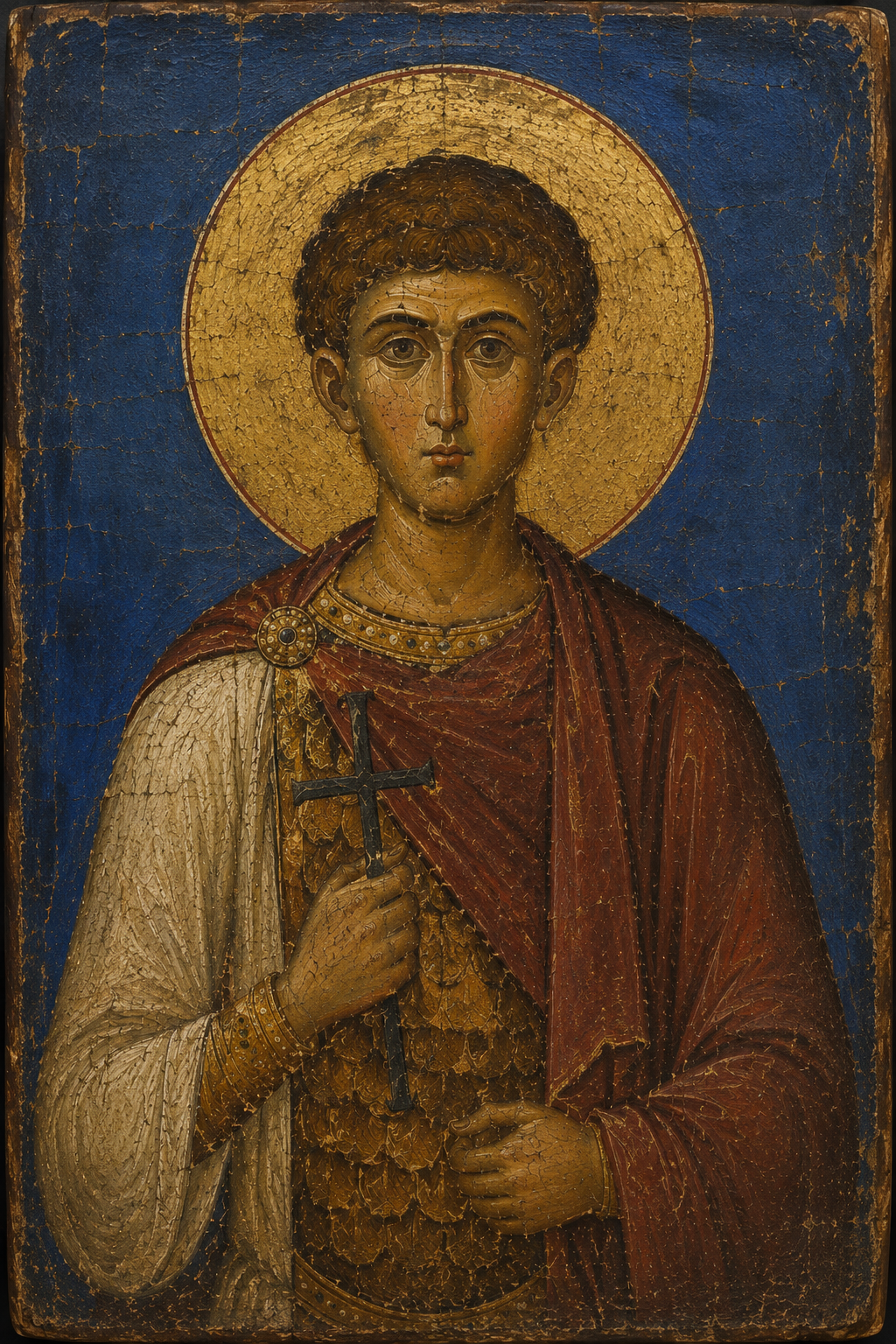
Each 2.5" x 4.25" prayer card is handmade in Austin, Texas and prepared prayerfully with each order. It is printed on museum-quality photo paper rather than cardstock, double-laminated for durability, and made while the recipient and their intentions are lifted before Christ in prayer, with Saint Artemios asked to intercede for them.
THE LIFE & STORY
Saint Artemios lived during one of Christianity's most dramatic historical transitions. He rose to prominence after the age of Constantine the Great, when Christianity had moved from persecution toward imperial recognition, yet he lived long enough to witness Emperor Julian's attempt to restore pagan religious dominance within the Roman Empire.
The historical Artemios was not merely a fictional soldier later created by hagiographers. Modern scholarship recognizes Flavius Artemius as a real fourth-century Roman official who served as dux Aegypti, the military commander or governor of Egypt, during the reign of Constantius II and was put to death during Julian's reign. The fuller Christian story of his confrontation with Julian, torture, visions, and martyrdom comes through later hagiographic tradition, so it is helpful to distinguish the historically documented official from details preserved within his received Church Life.
A HIGH-RANKING ROMAN MILITARY COMMANDER
The Orthodox tradition remembers Artemios as a distinguished soldier who received honors for courage and military service. He ultimately held authority over Egypt, one of the Roman Empire's wealthiest and strategically most important provinces.
His story is therefore quite different from that of a Christian martyr who possessed no public authority before persecution began. Artemios knew command, hierarchy, politics, military responsibility, and the expectations that accompany serving close to imperial power.
DUX AEGYPTI, GOVERNOR OF EGYPT
The Latin title dux Aegypti referred to a senior military command in Roman Egypt. The exact wording used in later Lives varies, with Artemios sometimes described as governor, commander, or viceroy, but his connection with high-level authority in Egypt is historically well established.
This makes Artemios especially meaningful for people carrying serious responsibility. Authority can provide prestige and influence, but it also creates situations in which conscience may eventually be tested by what superiors demand.
HE STRENGTHENED CHRISTIANITY IN EGYPT
The Orthodox Life remembers Artemios using his authority to support and strengthen Christianity in Egypt. Whatever historical complexities surrounded imperial Christianity during Constantius II's reign, later Byzantine memory clearly understood Artemios as a powerful official who placed his position at the service of Christian faith.
His life therefore offers a useful example for Christians working inside government, the military, business, or other institutions. Possessing influence is not necessarily contrary to holiness, but Christians eventually have to decide what their influence is serving.
THE RELICS OF SAINT LUKE
One of the most remarkable episodes associated with Artemios occurred when Emperor Constantius II ordered the translation of important apostolic relics to Constantinople. Greek Orthodox tradition specifically records Artemios bringing the relics of Saint Luke the Evangelist from Thebes to the imperial capital.
The relics were placed at the Church of the Holy Apostles, one of the most important churches of Constantinople. This gave Artemios a direct role in preserving and relocating some of the most precious physical links between the fourth-century Church and the apostolic generation.
THE RELICS OF SAINT ANDREW
The Orthodox Life further remembers Artemios bringing the relics of Saint Andrew the Apostle from Patras. These relics likewise entered the great apostolic shrine of Constantinople.
For someone interested in relics and early Christian history, this is an extraordinary detail. The man later invoked for healing had himself once been entrusted with carrying the bodies of men whose preaching had carried Christianity across the ancient world.
JULIAN THE APOSTATE
The political world changed radically when Julian became emperor in 361 AD. Raised within a Christian imperial family, Julian rejected Christianity and attempted to revive traditional Greco-Roman paganism while reducing Christian influence throughout the empire.
His policies did not simply return the empire to the religious situation existing before Constantine. Christianity had already become deeply embedded in society, so restoring pagan institutions inevitably created conflict with Christians who had spent decades living openly.
ARTEMIOS ARRIVES IN ANTIOCH
The Byzantine Life places Artemios in Antioch while Julian was persecuting Christian leaders who refused to cooperate with his religious program. Artemios saw bishops being tortured and publicly denounced the emperor's treatment of Christians.
This was an extraordinary confrontation because Artemios was not an anonymous private citizen yelling from a crowd. He was a man who understood imperial government from the inside and knew precisely what challenging an emperor could cost.
A SAINT FOR COURAGE OF CONSCIENCE
Saint Artemios therefore has a particularly strong connection with moral courage. Military courage is demonstrated when a person confronts physical danger, while moral courage appears when someone willingly risks career, status, reputation, or security because conscience will not allow silence.
That second kind of courage can sometimes be harder. Artemios could understand exactly how powerful Julian was and still refuse to treat imperial authority as something greater than God.
STRIPPED OF POWER
The emperor who had once benefited from Artemios' military service now regarded him as an opponent. According to the received Life, Julian ordered him tortured and imprisoned after Artemios openly condemned his actions.
The reversal is one of the strongest spiritual elements in the story. Titles can disappear, governments can change, powerful friends can become enemies, and years of public service cannot guarantee security when conscience collides with political power.
CHRIST APPEARS TO ARTEMIOS
The Orthodox Life preserves a vision during Artemios' imprisonment in which Christ appeared surrounded by angels and strengthened the suffering martyr. Christ assured Artemios that his confession had not gone unseen and that a heavenly crown awaited him.
The spiritual message is particularly important for someone enduring consequences for doing what they believe is right. Human institutions may remove honors, but Christianity measures success according to another tribunal entirely.
TORTURE DID NOT BREAK HIM
Julian again demanded that Artemios honor the pagan gods. Artemios refused, and the traditional account describes increasingly severe tortures intended to destroy his resistance.
The Church calls him Great Martyr, or Megalomartyr, because his witness was remembered not merely as a momentary execution but as an extended contest of suffering and steadfast confession.
MARTYRDOM AT ANTIOCH
Saint Artemios was finally executed by beheading at Antioch, probably around 362 AD. His feast on October 20 has preserved his memory in the Byzantine Church for centuries.
Antioch therefore became permanently attached to his name even though much of his public life had unfolded in Egypt. He is commonly called Saint Artemios of Antioch because the city became the setting of his final confession and martyrdom.
THE DEATH OF JULIAN
The traditional Life also connects Artemios with a prophecy that Julian's persecution would soon end. Julian died during his Persian campaign in 363 AD, only a short time after Artemios' execution.
Later Christian tradition surrounded Julian's death with dramatic stories, some of which are difficult to verify historically. The secure point is that Julian's reign ended unexpectedly after only about nineteen months as sole emperor, while devotion to the Christian martyr he had executed continued for centuries.
THE RELICS ARE TAKEN TO CONSTANTINOPLE
The Christian tradition says Artemios' relics were eventually transferred from Antioch to Constantinople. By the early Byzantine period they were venerated in the Church of Saint John the Forerunner in the Oxeia district, where an extraordinary healing cult developed around the martyr.
His relics rested in a crypt beneath the principal altar inside a lead sarcophagus. Sick people traveled to the church hoping for healing, especially from the illnesses for which Artemios became famous.
ONE OF BYZANTIUM'S GREAT HEALING SHRINES
During the sixth and seventh centuries, the shrine became a significant Christian healing center in Constantinople. Pilgrims attended vigils, prayed near Artemios' relics, used blessed oil, and sometimes slept within the church hoping to receive healing or guidance through a dream.
Forty-five miracle stories associated with the shrine were eventually gathered into the Miracles of Saint Artemios. Scholars date most of the collection to the seventh century, making it an exceptionally important source for understanding both Byzantine medicine and popular Christian devotion.
SAINT ARTEMIOS & HERNIAS
The connection between Saint Artemios and hernias is unusually strong and unusually well documented. The Orthodox Church in America explicitly states that he is invoked by those suffering from hernias, while the seventh-century miracle collection repeatedly describes people receiving healing for exactly this condition.
This is therefore not an internet-era assignment of an obscure medical patronage. Christians were traveling to Artemios' shrine seeking healing from hernias more than 1,300 years ago.
WHY HERNIAS?
The surviving miracle collection contains multiple stories of men and children suffering from different forms of hernia. Some accounts describe dramatic dream encounters with Artemios, while others involve prayer, vigils, blessed oil, or unexpected physical cures.
One scholarly survey of the collection notes that diseases of the male groin and reproductive organs form an unusually large percentage of Artemios' recorded miracles. His reputation therefore became highly specialized compared with many other healing saints.
A SAINT FOR HERNIA SURGERY
For someone awaiting inguinal, umbilical, femoral, incisional, or another type of hernia surgery, Saint Artemios has one of the strongest historically grounded Christian devotions available. A prayer card can be carried into the hospital, kept beside the bed during recovery, or given by a family member before surgery.
Seeking his intercession does not replace medical treatment. The ancient miracle stories themselves reveal Christians living within a world where physicians and healing shrines both existed, while modern devotion can similarly combine responsible medical care with prayer.
A SAINT FOR MEN'S HEALTH
Because so many of his ancient miracles involved ailments of the groin and male reproductive organs, Saint Artemios can also be particularly meaningful for men facing painful or embarrassing health problems they may be reluctant to discuss openly. The ancient Christian community clearly did not treat these conditions as subjects too undignified to bring before God.
That may itself be reassuring. Physical suffering remains worthy of prayer regardless of whether the illness is visible, easily discussed, or socially uncomfortable.
HEALING CHILDREN
The Miracles of Saint Artemios also includes children. One account concerns a boy suffering from a testicular hernia whose mother was directed toward Artemios' shrine and sought the martyr's intercession for her child.
Parents can therefore find a particularly ancient precedent for praying to Saint Artemios when a child faces surgery or a congenital hernia. His healing tradition was never limited only to adult soldiers or men.
HEALING BEYOND HERNIAS
Although hernias became his most distinctive medical association, Artemios' miracle tradition was not confined completely to them. The collection includes healing from other illnesses, including plague and different painful conditions.
His Kontakion consequently celebrates him more broadly as a martyr generous in performing miracles. The Church remembers the specialist patronage without restricting the saint's intercession to only one diagnosis.
SAINT ARTEMIOS & SAINT FEBRONIA
An especially interesting feature of the Constantinopolitan healing shrine is Saint Febronia of Nisibis, whose chapel stood beside Artemios' shrine. The seventh-century miracle accounts sometimes present Febronia as a kind of companion healer, particularly in stories involving women.
This gives the healing complex a fascinating place in Byzantine religious history. Men, women, and children came to a church dedicated to Saint John the Baptist and sought the intercession of Artemios and Febronia through vigils, prayer, relics, and sacred images.
WHEN A CHURCH FUNCTIONED LIKE A HEALING CENTER
The shrine of Artemios also tells us something important about early Christian attitudes toward sickness. Ill people were not hidden away as inconvenient because they entered the church, stayed for vigils, slept near the saint's relics, prayed, and expected the Christian community to take their suffering seriously.
The stories also preserve interaction with contemporary physicians. The result is an unusually vivid picture of Byzantine Christians seeking both ordinary medical help and divine mercy.
A SAINT FOR SOLDIERS
Before he became famous for healing, Artemios had been a professional military commander. His story therefore makes him a natural saint for soldiers, veterans, commanders, military families, and people carrying heavy responsibility within hierarchical organizations.
His life also adds a warning to military virtue. Discipline and obedience are valuable, but neither can become absolute when they require denial of Christ or cooperation with what conscience recognizes as evil.
A SAINT FOR MILITARY LEADERS
Artemios is especially interesting for senior officers because his life concerns more than battlefield courage. He governed territory, interacted with emperors, managed imperial responsibilities, transported treasured relics, and experienced the dangers of political power.
A Christian leader can therefore seek his intercession not merely for bravery but for wisdom, justice, integrity, and the courage to say no when authority crosses a moral boundary.
A SAINT FOR GOVERNMENT OFFICIALS
The same historical background makes Saint Artemios meaningful for people working in government. He understood how quickly political conditions can change and how an official can suddenly face a conflict between career and conscience.
It is best to describe this as a natural devotional association rather than inventing a universal formal title such as “patron saint of politicians.” His actual biography already provides a much stronger reason for public officials to appreciate him.
A SAINT FOR PERSECUTED CHRISTIANS
The heart of Artemios' martyrdom is his refusal to remain silent while other Christians were being harmed. According to his received Life, he intervened precisely because he saw Christian bishops suffering under imperial persecution.
His prayer card can therefore be especially meaningful for Christians facing government pressure, discrimination, public ridicule, workplace retaliation, or situations in which defending another believer may carry personal consequences.
DEFENDING OTHER CHRISTIANS COST HIM EVERYTHING
Artemios could have preserved himself by refusing to become involved. He instead spoke when the suffering belonged initially to other Christians.
That distinction gives his courage an important character. Christian solidarity sometimes means accepting risk because another member of the Church is being treated unjustly, rather than waiting until persecution reaches us personally.
SAINT ARTEMIOS AS MAR CHALLITA
Saint Artemios also has an important place in the Syriac and Lebanese Christian tradition, where he is known as Mar Challita, Mar Shalita, or Saint Challita. Lebanese Christian sources explicitly identify Challita with Artemios of Antioch, and numerous churches and old hermitages in Lebanon bear the name.
The connection is particularly visible in the Maronite world. Maronite church directories list multiple churches dedicated to Saint Challita in Lebanon, preserving a Syriac form of the martyr's name far from the Greek-speaking Byzantine tradition in which he is normally called Artemios.
AN EASTERN SAINT WITH AN UNUSUALLY WIDE LEGACY
This means the same martyr can appear under different names depending upon the Christian community. A Greek Orthodox Christian may know him as Artemios the Great Martyr, while a Lebanese Christian may recognize Mar Challita immediately.
That diversity makes him particularly interesting for an Eastern Christian prayer card. His story crosses Greek, Egyptian, Antiochian, Byzantine, and Syriac Christian worlds.
HOW HISTORICAL IS THE STORY OF SAINT ARTEMIOS?
Saint Artemios is unusual because there really was a powerful Roman official named Flavius Artemius serving as dux Aegypti under Constantius II, and ancient non-hagiographic sources confirm his execution during Julian's reign. The fuller martyrdom narrative developed later, and modern scholars note important differences between the historical evidence and the later Christian Passion.
For a devotional product page, the best wording is therefore to distinguish between what history securely confirms and what the Church's received hagiographic tradition preserves. His Roman office, service under Constantius, death under Julian, early cult, Constantinopolitan relic shrine, and seventh-century healing tradition have substantial historical evidence, while individual conversations, tortures, visions, and speeches belong to his later sacred Life.
THE MIRACLES ARE HISTORICALLY IMPORTANT DOCUMENTS
Whatever one concludes about individual supernatural cures, the Miracles of Saint Artemios themselves are real late-antique documents. The Oxford Cult of Saints database dates the healing accounts principally between the late sixth and seventh centuries and identifies the collection as assembled around 658 to 668 AD.
This is important because it proves something beyond doubt about his devotion. Byzantine Christians were genuinely traveling to Artemios' shrine, keeping vigils, invoking his name, and associating him particularly with hernia healing more than a millennium ago.
FEAST DAY
Saint Artemios the Great Martyr is commemorated on October 20 in the Byzantine Orthodox calendar. The Greek Orthodox liturgical readings for that day explicitly name the commemoration of the Holy Great Martyr Artemios.
The feast provides a natural annual day for someone devoted to Artemios to attend Divine Liturgy, ask his intercession for healing, and pray particularly for people facing surgery, military danger, or persecution.
ICONOGRAPHY
Saint Artemios is normally depicted as a military martyr, wearing armor or richly decorated military clothing and often holding a cross, spear, sword, or shield. These elements recall both his Roman command and the martyr's victory that the Church considers greater than any earthly military success.
Some icons show him as a mature bearded commander rather than a youthful soldier. That fits his traditional identity as an experienced imperial official who had already held substantial authority before his confrontation with Julian.
PRAYERS
Saint Artemios has established Byzantine liturgical hymns, so there is no need to invent a prayer for him. His Troparion praises the martyr for receiving an incorruptible crown through suffering and asks for salvation through his intercession, while his Kontakion calls him a victorious martyr and generous miracle-worker.
A short established line that works beautifully on the back of a prayer card is:
“Through his intercessions, save our souls!”
Another simple traditional form for personal devotion is “Holy Great Martyr Artemios, pray to God for us.” Someone facing hernia surgery can then ask specifically for a successful procedure, protection from complications, relief from pain, wisdom for the medical team, and patient recovery according to God's will.
FAQ
Who was Saint Artemios of Antioch? Saint Artemios was a fourth-century Roman military commander and governor of Egypt who was executed during the reign of Julian the Apostate. Byzantine Christian tradition venerates him as a Great Martyr who publicly defended Christianity and refused to renounce the faith.
Is Saint Artemios the same as Saint Artemius? Yes, Artemios and Artemius are different English transliterations of the same name. Greek-oriented sources usually prefer Artemios, while Latinized sources commonly use Artemius.
When did Saint Artemios live? He lived during the fourth century and served under Constantius II before dying during Julian's reign. His death is generally placed around 362 AD.
When is Saint Artemios' feast day? His feast day is October 20 in the Byzantine tradition. Greek Orthodox liturgical sources commemorate him that day as the Holy Great Martyr Artemios.
Was Saint Artemios really a Roman military commander? Yes, this part of his biography has unusually strong historical support. Modern scholarship identifies the historical Flavius Artemius as dux Aegypti under Constantius II.
What does dux Aegypti mean? It was a senior Roman military command associated with Egypt. Later Christian Lives describe Artemios in terms such as governor or ruler of Egypt, but dux Aegypti is the more historically precise title.
Why is he called Saint Artemios of Antioch if he governed Egypt? Antioch is associated with his martyrdom rather than the majority of his administrative career. According to Christian tradition, he confronted Julian there and was eventually executed in the city.
Did Saint Artemios transport Saint Luke's relics? Greek Orthodox tradition says Emperor Constantius sent Artemios to bring Saint Luke's relics from Thebes to Constantinople. They were placed in the Church of the Holy Apostles.
Did Saint Artemios also transport Saint Andrew's relics? The Orthodox Life says he brought Saint Andrew's relics from Patras as well. This mission became one of the most remarkable responsibilities attributed to Artemios before his governorship and martyrdom.
Why was Saint Artemios killed? The received Byzantine Life says he publicly condemned Julian's persecution of Christians and refused demands to honor pagan gods. Julian consequently ordered his torture and eventual execution.
How did Saint Artemios die? He was ultimately beheaded according to the Orthodox tradition. His death took place at Antioch during Julian's reign.
Is Saint Artemios a Great Martyr? Yes, Byzantine liturgical tradition explicitly calls him a Great Martyr, or Megalomartyr. The title reflects both the severity of his suffering and the importance of his witness within the Church.
Why is Saint Artemios associated with hernias? His ancient Constantinopolitan shrine became famous for healing hernias, and the surviving seventh-century Miracles of Saint Artemios contains numerous stories of such cures. The OCA explicitly states that people suffering from hernias invoke his intercession.
Is he actually a patron for hernia patients? It is historically accurate to say that Saint Artemios is traditionally invoked for hernias. That wording comes directly from an Orthodox Church source and is stronger than simply assigning him a modern patronage label.
Can I pray to Saint Artemios before hernia surgery? Yes, and this is one of the most historically grounded uses of devotion to him. Christians were already seeking his intercession for hernia healing at his Constantinopolitan shrine during the early Byzantine period.
Is Saint Artemios associated with men's health? Yes, particularly through the seventh-century healing accounts involving hernias and illnesses of the male groin and reproductive organs. Scholars studying the collection have noted how prominent these conditions are within his miracle tradition.
Did Saint Artemios heal children? His ancient miracle collection includes healings involving children, including a boy suffering from a testicular hernia. The account describes his mother seeking the saint's help for her son.
Was there a major shrine dedicated to Saint Artemios? His relics were venerated at the Church of Saint John the Forerunner in the Oxeia district of Constantinople. The shrine became an important healing center in the sixth and seventh centuries.
Where were Saint Artemios' relics kept? Historical sources describing the shrine place his relics in a lead sarcophagus in a crypt beneath the main altar of the Church of Saint John the Forerunner. The medieval church no longer survives.
What were the Miracles of Saint Artemios? They are a collection of approximately forty-five late-antique healing stories associated with his shrine in Constantinople. The collection was assembled principally in the seventh century and is important both for Church history and for the history of medicine.
Did people sleep inside his church hoping to be healed? Yes, some pilgrims participated in overnight vigils and a practice known as incubation, sleeping in the church while praying for healing or a dream encounter with the saint. The surviving miracle accounts provide unusually detailed descriptions of this devotional practice.
Is Saint Artemios good for soldiers? Yes, because he was himself a senior military commander and later became a military martyr in Byzantine tradition. His Life is especially meaningful for soldiers who want courage and obedience to remain subordinate to Christian conscience.
Can military officers pray to Saint Artemios? Yes, and his high rank makes him particularly relevant to people who carry command responsibility. His story raises the Christian question of what a leader should do when authority requires something conscience cannot accept.
Can government officials pray to Saint Artemios? Yes, because he personally held major governmental and military authority in Egypt. It is better to describe him as especially meaningful for public officials than to claim a universal formal patronage not clearly established by the Church.
Is Saint Artemios associated with courage? Courage is central to his Life because the Church remembers him confronting Emperor Julian publicly despite understanding the likely consequences. His courage involved both military experience and willingness to sacrifice political power for Christian conviction.
Is Saint Artemios associated with persecuted Christians? Yes, particularly because his received Life says he intervened when he saw other Christian leaders being tortured. His martyrdom consequently became a witness not only to personal faith but to solidarity with persecuted Christians.
Who was Julian the Apostate? Julian was Roman emperor from 361 to 363 and attempted to restore pagan religious institutions after decades of increasing imperial support for Christianity. Artemios' martyrdom tradition is set within this conflict.
Is Saint Artemios historically documented? Yes, the fourth-century official Artemius is historically attested independently of his later Christian Life. The detailed martyrdom narrative comes from later hagiographic texts, so the strongest product description distinguishes between those two layers of evidence.
Is Saint Artemios also called Mar Challita? Yes, he is known in Syriac and Lebanese Christian tradition as Mar Challita or Mar Shalita. Churches and old Christian sites in Lebanon continue bearing that name.
Is Saint Challita the same saint as Artemios of Antioch? In this Lebanese and Syriac usage, yes. Christian sources in Lebanon explicitly identify Saint Challita with Saint Artemios, and Maronite churches continue using the Challita form of the name.
Do Maronites know Saint Artemios? Lebanese Maronite tradition preserves him under the name Saint Challita or Mar Challita. Multiple Maronite churches in Lebanon are dedicated under that name, showing that his devotion extends beyond the Greek Byzantine tradition.
Is there a traditional prayer to Saint Artemios? Yes, he has established Byzantine Troparion and Kontakion hymns for October 20. The texts celebrate his martyrdom, victory over evil, miracles, and continuing intercession.
What does Saint Artemios teach about authority? His story teaches that authority can be used for good but can never replace God as the final standard of conscience. The same man who once exercised imperial power accepted death when obedience to earthly power became incompatible with Christian faith.
What does Saint Artemios teach about courage? He demonstrates that courage is not limited to surviving physical danger. The deeper test can be whether a successful person is willing to lose position and security rather than remain silent when faith requires speaking.
What does Saint Artemios teach about illness? His healing cult shows that Christians have long brought even painful and deeply personal physical problems before God. The ancient records surrounding his shrine make especially clear that there is nothing shameful about asking the Church's prayers for illnesses involving the abdomen, groin, or reproductive system.
What is the main message of Saint Artemios of Antioch's life? Saint Artemios' life brings together military courage, public responsibility, martyrdom, relics, and one of the most unusual healing traditions in Byzantine Christianity. The powerful Roman commander who governed Egypt and carried apostolic relics to Constantinople eventually stood against Emperor Julian when Christianity was again under pressure, surrendered the security his rank had once provided, and accepted martyrdom rather than compromise. Centuries later, Christians crowded around his relics in Constantinople asking for healing, especially from hernias and painful conditions of the groin, leaving behind dozens of written miracle accounts that still survive. His prayer card therefore speaks to two very different human battles at once: the struggle to remain faithful when worldly power becomes threatening, and the struggle to trust God while the body is suffering.
Saint Artemios of Antioch, also written Artemius, was a fourth-century Roman military commander, governor of Egypt, Great Martyr, and one of the most fascinating healing saints of the early Byzantine Church. He served at the highest levels of the Roman Empire under Constantius II, was entrusted with transporting precious apostolic relics to Constantinople, and was ultimately executed at Antioch during the reign of Julian the Apostate after refusing to abandon Christianity. The Orthodox Church commemorates him on October 20 and specifically preserves the ancient practice of invoking his intercession for people suffering from hernias.
Saint Artemios is especially meaningful for hernia patients, people awaiting surgery, those suffering from abdominal or groin disorders, soldiers, military officers, government officials, people facing persecution, Christians dealing with powerful opposition, and anyone needing courage to defend the faith publicly. These associations are not modern inventions. A remarkable seventh-century collection known as the Miracles of Saint Artemios records dozens of healings at his Constantinopolitan shrine, with an unusually large number involving hernias and ailments of the abdomen, groin, and male reproductive system.
His military story is equally striking. Artemios had already achieved significant authority within the Roman state, yet according to the received Byzantine tradition he publicly confronted Emperor Julian when Christians were being persecuted at Antioch. The confrontation cost Artemios his position, freedom, and eventually his life, making him an especially powerful saint for people who must choose between career security and fidelity to conscience.
Saint Artemios also has a fascinating connection with Saint Luke the Evangelist. The Greek Orthodox tradition records that Emperor Constantius entrusted Artemios with bringing Saint Luke's relics from Thebes to Constantinople, where they were placed in the great Church of the Holy Apostles. The Orthodox Life also credits him with transporting the relics of Saint Andrew from Patras, placing this military governor at the center of one of the great translations of apostolic relics in fourth-century Constantinople.
For someone facing surgery or a painful hernia, Saint Artemios provides an unusually specific ancient devotion. His Constantinopolitan shrine became a genuine healing center, where Christians prayed through the night near his relics and recorded cures generation after generation. The surviving miracle collection, assembled during the seventh century, gives modern readers an extraordinary window into how Christians more than thirteen centuries ago were already seeking Saint Artemios' intercession for precisely these physical conditions.
This prayer card is especially fitting for a person preparing for hernia surgery, abdominal surgery, treatment for a painful groin condition, military deployment, leadership responsibility, or a difficult confrontation in which Christian conviction may have consequences. It can also make a meaningful gift for soldiers, veterans, physicians, surgeons, men facing serious medical problems, Christians named Artemios or Artemius, and people devoted to the ancient military martyrs of the Church.
Each 2.5" x 4.25" prayer card is handmade in Austin, Texas and prepared prayerfully with each order. It is printed on museum-quality photo paper rather than cardstock, double-laminated for durability, and made while the recipient and their intentions are lifted before Christ in prayer, with Saint Artemios asked to intercede for them.
THE LIFE & STORY
Saint Artemios lived during one of Christianity's most dramatic historical transitions. He rose to prominence after the age of Constantine the Great, when Christianity had moved from persecution toward imperial recognition, yet he lived long enough to witness Emperor Julian's attempt to restore pagan religious dominance within the Roman Empire.
The historical Artemios was not merely a fictional soldier later created by hagiographers. Modern scholarship recognizes Flavius Artemius as a real fourth-century Roman official who served as dux Aegypti, the military commander or governor of Egypt, during the reign of Constantius II and was put to death during Julian's reign. The fuller Christian story of his confrontation with Julian, torture, visions, and martyrdom comes through later hagiographic tradition, so it is helpful to distinguish the historically documented official from details preserved within his received Church Life.
A HIGH-RANKING ROMAN MILITARY COMMANDER
The Orthodox tradition remembers Artemios as a distinguished soldier who received honors for courage and military service. He ultimately held authority over Egypt, one of the Roman Empire's wealthiest and strategically most important provinces.
His story is therefore quite different from that of a Christian martyr who possessed no public authority before persecution began. Artemios knew command, hierarchy, politics, military responsibility, and the expectations that accompany serving close to imperial power.
DUX AEGYPTI, GOVERNOR OF EGYPT
The Latin title dux Aegypti referred to a senior military command in Roman Egypt. The exact wording used in later Lives varies, with Artemios sometimes described as governor, commander, or viceroy, but his connection with high-level authority in Egypt is historically well established.
This makes Artemios especially meaningful for people carrying serious responsibility. Authority can provide prestige and influence, but it also creates situations in which conscience may eventually be tested by what superiors demand.
HE STRENGTHENED CHRISTIANITY IN EGYPT
The Orthodox Life remembers Artemios using his authority to support and strengthen Christianity in Egypt. Whatever historical complexities surrounded imperial Christianity during Constantius II's reign, later Byzantine memory clearly understood Artemios as a powerful official who placed his position at the service of Christian faith.
His life therefore offers a useful example for Christians working inside government, the military, business, or other institutions. Possessing influence is not necessarily contrary to holiness, but Christians eventually have to decide what their influence is serving.
THE RELICS OF SAINT LUKE
One of the most remarkable episodes associated with Artemios occurred when Emperor Constantius II ordered the translation of important apostolic relics to Constantinople. Greek Orthodox tradition specifically records Artemios bringing the relics of Saint Luke the Evangelist from Thebes to the imperial capital.
The relics were placed at the Church of the Holy Apostles, one of the most important churches of Constantinople. This gave Artemios a direct role in preserving and relocating some of the most precious physical links between the fourth-century Church and the apostolic generation.
THE RELICS OF SAINT ANDREW
The Orthodox Life further remembers Artemios bringing the relics of Saint Andrew the Apostle from Patras. These relics likewise entered the great apostolic shrine of Constantinople.
For someone interested in relics and early Christian history, this is an extraordinary detail. The man later invoked for healing had himself once been entrusted with carrying the bodies of men whose preaching had carried Christianity across the ancient world.
JULIAN THE APOSTATE
The political world changed radically when Julian became emperor in 361 AD. Raised within a Christian imperial family, Julian rejected Christianity and attempted to revive traditional Greco-Roman paganism while reducing Christian influence throughout the empire.
His policies did not simply return the empire to the religious situation existing before Constantine. Christianity had already become deeply embedded in society, so restoring pagan institutions inevitably created conflict with Christians who had spent decades living openly.
ARTEMIOS ARRIVES IN ANTIOCH
The Byzantine Life places Artemios in Antioch while Julian was persecuting Christian leaders who refused to cooperate with his religious program. Artemios saw bishops being tortured and publicly denounced the emperor's treatment of Christians.
This was an extraordinary confrontation because Artemios was not an anonymous private citizen yelling from a crowd. He was a man who understood imperial government from the inside and knew precisely what challenging an emperor could cost.
A SAINT FOR COURAGE OF CONSCIENCE
Saint Artemios therefore has a particularly strong connection with moral courage. Military courage is demonstrated when a person confronts physical danger, while moral courage appears when someone willingly risks career, status, reputation, or security because conscience will not allow silence.
That second kind of courage can sometimes be harder. Artemios could understand exactly how powerful Julian was and still refuse to treat imperial authority as something greater than God.
STRIPPED OF POWER
The emperor who had once benefited from Artemios' military service now regarded him as an opponent. According to the received Life, Julian ordered him tortured and imprisoned after Artemios openly condemned his actions.
The reversal is one of the strongest spiritual elements in the story. Titles can disappear, governments can change, powerful friends can become enemies, and years of public service cannot guarantee security when conscience collides with political power.
CHRIST APPEARS TO ARTEMIOS
The Orthodox Life preserves a vision during Artemios' imprisonment in which Christ appeared surrounded by angels and strengthened the suffering martyr. Christ assured Artemios that his confession had not gone unseen and that a heavenly crown awaited him.
The spiritual message is particularly important for someone enduring consequences for doing what they believe is right. Human institutions may remove honors, but Christianity measures success according to another tribunal entirely.
TORTURE DID NOT BREAK HIM
Julian again demanded that Artemios honor the pagan gods. Artemios refused, and the traditional account describes increasingly severe tortures intended to destroy his resistance.
The Church calls him Great Martyr, or Megalomartyr, because his witness was remembered not merely as a momentary execution but as an extended contest of suffering and steadfast confession.
MARTYRDOM AT ANTIOCH
Saint Artemios was finally executed by beheading at Antioch, probably around 362 AD. His feast on October 20 has preserved his memory in the Byzantine Church for centuries.
Antioch therefore became permanently attached to his name even though much of his public life had unfolded in Egypt. He is commonly called Saint Artemios of Antioch because the city became the setting of his final confession and martyrdom.
THE DEATH OF JULIAN
The traditional Life also connects Artemios with a prophecy that Julian's persecution would soon end. Julian died during his Persian campaign in 363 AD, only a short time after Artemios' execution.
Later Christian tradition surrounded Julian's death with dramatic stories, some of which are difficult to verify historically. The secure point is that Julian's reign ended unexpectedly after only about nineteen months as sole emperor, while devotion to the Christian martyr he had executed continued for centuries.
THE RELICS ARE TAKEN TO CONSTANTINOPLE
The Christian tradition says Artemios' relics were eventually transferred from Antioch to Constantinople. By the early Byzantine period they were venerated in the Church of Saint John the Forerunner in the Oxeia district, where an extraordinary healing cult developed around the martyr.
His relics rested in a crypt beneath the principal altar inside a lead sarcophagus. Sick people traveled to the church hoping for healing, especially from the illnesses for which Artemios became famous.
ONE OF BYZANTIUM'S GREAT HEALING SHRINES
During the sixth and seventh centuries, the shrine became a significant Christian healing center in Constantinople. Pilgrims attended vigils, prayed near Artemios' relics, used blessed oil, and sometimes slept within the church hoping to receive healing or guidance through a dream.
Forty-five miracle stories associated with the shrine were eventually gathered into the Miracles of Saint Artemios. Scholars date most of the collection to the seventh century, making it an exceptionally important source for understanding both Byzantine medicine and popular Christian devotion.
SAINT ARTEMIOS & HERNIAS
The connection between Saint Artemios and hernias is unusually strong and unusually well documented. The Orthodox Church in America explicitly states that he is invoked by those suffering from hernias, while the seventh-century miracle collection repeatedly describes people receiving healing for exactly this condition.
This is therefore not an internet-era assignment of an obscure medical patronage. Christians were traveling to Artemios' shrine seeking healing from hernias more than 1,300 years ago.
WHY HERNIAS?
The surviving miracle collection contains multiple stories of men and children suffering from different forms of hernia. Some accounts describe dramatic dream encounters with Artemios, while others involve prayer, vigils, blessed oil, or unexpected physical cures.
One scholarly survey of the collection notes that diseases of the male groin and reproductive organs form an unusually large percentage of Artemios' recorded miracles. His reputation therefore became highly specialized compared with many other healing saints.
A SAINT FOR HERNIA SURGERY
For someone awaiting inguinal, umbilical, femoral, incisional, or another type of hernia surgery, Saint Artemios has one of the strongest historically grounded Christian devotions available. A prayer card can be carried into the hospital, kept beside the bed during recovery, or given by a family member before surgery.
Seeking his intercession does not replace medical treatment. The ancient miracle stories themselves reveal Christians living within a world where physicians and healing shrines both existed, while modern devotion can similarly combine responsible medical care with prayer.
A SAINT FOR MEN'S HEALTH
Because so many of his ancient miracles involved ailments of the groin and male reproductive organs, Saint Artemios can also be particularly meaningful for men facing painful or embarrassing health problems they may be reluctant to discuss openly. The ancient Christian community clearly did not treat these conditions as subjects too undignified to bring before God.
That may itself be reassuring. Physical suffering remains worthy of prayer regardless of whether the illness is visible, easily discussed, or socially uncomfortable.
HEALING CHILDREN
The Miracles of Saint Artemios also includes children. One account concerns a boy suffering from a testicular hernia whose mother was directed toward Artemios' shrine and sought the martyr's intercession for her child.
Parents can therefore find a particularly ancient precedent for praying to Saint Artemios when a child faces surgery or a congenital hernia. His healing tradition was never limited only to adult soldiers or men.
HEALING BEYOND HERNIAS
Although hernias became his most distinctive medical association, Artemios' miracle tradition was not confined completely to them. The collection includes healing from other illnesses, including plague and different painful conditions.
His Kontakion consequently celebrates him more broadly as a martyr generous in performing miracles. The Church remembers the specialist patronage without restricting the saint's intercession to only one diagnosis.
SAINT ARTEMIOS & SAINT FEBRONIA
An especially interesting feature of the Constantinopolitan healing shrine is Saint Febronia of Nisibis, whose chapel stood beside Artemios' shrine. The seventh-century miracle accounts sometimes present Febronia as a kind of companion healer, particularly in stories involving women.
This gives the healing complex a fascinating place in Byzantine religious history. Men, women, and children came to a church dedicated to Saint John the Baptist and sought the intercession of Artemios and Febronia through vigils, prayer, relics, and sacred images.
WHEN A CHURCH FUNCTIONED LIKE A HEALING CENTER
The shrine of Artemios also tells us something important about early Christian attitudes toward sickness. Ill people were not hidden away as inconvenient because they entered the church, stayed for vigils, slept near the saint's relics, prayed, and expected the Christian community to take their suffering seriously.
The stories also preserve interaction with contemporary physicians. The result is an unusually vivid picture of Byzantine Christians seeking both ordinary medical help and divine mercy.
A SAINT FOR SOLDIERS
Before he became famous for healing, Artemios had been a professional military commander. His story therefore makes him a natural saint for soldiers, veterans, commanders, military families, and people carrying heavy responsibility within hierarchical organizations.
His life also adds a warning to military virtue. Discipline and obedience are valuable, but neither can become absolute when they require denial of Christ or cooperation with what conscience recognizes as evil.
A SAINT FOR MILITARY LEADERS
Artemios is especially interesting for senior officers because his life concerns more than battlefield courage. He governed territory, interacted with emperors, managed imperial responsibilities, transported treasured relics, and experienced the dangers of political power.
A Christian leader can therefore seek his intercession not merely for bravery but for wisdom, justice, integrity, and the courage to say no when authority crosses a moral boundary.
A SAINT FOR GOVERNMENT OFFICIALS
The same historical background makes Saint Artemios meaningful for people working in government. He understood how quickly political conditions can change and how an official can suddenly face a conflict between career and conscience.
It is best to describe this as a natural devotional association rather than inventing a universal formal title such as “patron saint of politicians.” His actual biography already provides a much stronger reason for public officials to appreciate him.
A SAINT FOR PERSECUTED CHRISTIANS
The heart of Artemios' martyrdom is his refusal to remain silent while other Christians were being harmed. According to his received Life, he intervened precisely because he saw Christian bishops suffering under imperial persecution.
His prayer card can therefore be especially meaningful for Christians facing government pressure, discrimination, public ridicule, workplace retaliation, or situations in which defending another believer may carry personal consequences.
DEFENDING OTHER CHRISTIANS COST HIM EVERYTHING
Artemios could have preserved himself by refusing to become involved. He instead spoke when the suffering belonged initially to other Christians.
That distinction gives his courage an important character. Christian solidarity sometimes means accepting risk because another member of the Church is being treated unjustly, rather than waiting until persecution reaches us personally.
SAINT ARTEMIOS AS MAR CHALLITA
Saint Artemios also has an important place in the Syriac and Lebanese Christian tradition, where he is known as Mar Challita, Mar Shalita, or Saint Challita. Lebanese Christian sources explicitly identify Challita with Artemios of Antioch, and numerous churches and old hermitages in Lebanon bear the name.
The connection is particularly visible in the Maronite world. Maronite church directories list multiple churches dedicated to Saint Challita in Lebanon, preserving a Syriac form of the martyr's name far from the Greek-speaking Byzantine tradition in which he is normally called Artemios.
AN EASTERN SAINT WITH AN UNUSUALLY WIDE LEGACY
This means the same martyr can appear under different names depending upon the Christian community. A Greek Orthodox Christian may know him as Artemios the Great Martyr, while a Lebanese Christian may recognize Mar Challita immediately.
That diversity makes him particularly interesting for an Eastern Christian prayer card. His story crosses Greek, Egyptian, Antiochian, Byzantine, and Syriac Christian worlds.
HOW HISTORICAL IS THE STORY OF SAINT ARTEMIOS?
Saint Artemios is unusual because there really was a powerful Roman official named Flavius Artemius serving as dux Aegypti under Constantius II, and ancient non-hagiographic sources confirm his execution during Julian's reign. The fuller martyrdom narrative developed later, and modern scholars note important differences between the historical evidence and the later Christian Passion.
For a devotional product page, the best wording is therefore to distinguish between what history securely confirms and what the Church's received hagiographic tradition preserves. His Roman office, service under Constantius, death under Julian, early cult, Constantinopolitan relic shrine, and seventh-century healing tradition have substantial historical evidence, while individual conversations, tortures, visions, and speeches belong to his later sacred Life.
THE MIRACLES ARE HISTORICALLY IMPORTANT DOCUMENTS
Whatever one concludes about individual supernatural cures, the Miracles of Saint Artemios themselves are real late-antique documents. The Oxford Cult of Saints database dates the healing accounts principally between the late sixth and seventh centuries and identifies the collection as assembled around 658 to 668 AD.
This is important because it proves something beyond doubt about his devotion. Byzantine Christians were genuinely traveling to Artemios' shrine, keeping vigils, invoking his name, and associating him particularly with hernia healing more than a millennium ago.
FEAST DAY
Saint Artemios the Great Martyr is commemorated on October 20 in the Byzantine Orthodox calendar. The Greek Orthodox liturgical readings for that day explicitly name the commemoration of the Holy Great Martyr Artemios.
The feast provides a natural annual day for someone devoted to Artemios to attend Divine Liturgy, ask his intercession for healing, and pray particularly for people facing surgery, military danger, or persecution.
ICONOGRAPHY
Saint Artemios is normally depicted as a military martyr, wearing armor or richly decorated military clothing and often holding a cross, spear, sword, or shield. These elements recall both his Roman command and the martyr's victory that the Church considers greater than any earthly military success.
Some icons show him as a mature bearded commander rather than a youthful soldier. That fits his traditional identity as an experienced imperial official who had already held substantial authority before his confrontation with Julian.
PRAYERS
Saint Artemios has established Byzantine liturgical hymns, so there is no need to invent a prayer for him. His Troparion praises the martyr for receiving an incorruptible crown through suffering and asks for salvation through his intercession, while his Kontakion calls him a victorious martyr and generous miracle-worker.
A short established line that works beautifully on the back of a prayer card is:
“Through his intercessions, save our souls!”
Another simple traditional form for personal devotion is “Holy Great Martyr Artemios, pray to God for us.” Someone facing hernia surgery can then ask specifically for a successful procedure, protection from complications, relief from pain, wisdom for the medical team, and patient recovery according to God's will.
FAQ
Who was Saint Artemios of Antioch? Saint Artemios was a fourth-century Roman military commander and governor of Egypt who was executed during the reign of Julian the Apostate. Byzantine Christian tradition venerates him as a Great Martyr who publicly defended Christianity and refused to renounce the faith.
Is Saint Artemios the same as Saint Artemius? Yes, Artemios and Artemius are different English transliterations of the same name. Greek-oriented sources usually prefer Artemios, while Latinized sources commonly use Artemius.
When did Saint Artemios live? He lived during the fourth century and served under Constantius II before dying during Julian's reign. His death is generally placed around 362 AD.
When is Saint Artemios' feast day? His feast day is October 20 in the Byzantine tradition. Greek Orthodox liturgical sources commemorate him that day as the Holy Great Martyr Artemios.
Was Saint Artemios really a Roman military commander? Yes, this part of his biography has unusually strong historical support. Modern scholarship identifies the historical Flavius Artemius as dux Aegypti under Constantius II.
What does dux Aegypti mean? It was a senior Roman military command associated with Egypt. Later Christian Lives describe Artemios in terms such as governor or ruler of Egypt, but dux Aegypti is the more historically precise title.
Why is he called Saint Artemios of Antioch if he governed Egypt? Antioch is associated with his martyrdom rather than the majority of his administrative career. According to Christian tradition, he confronted Julian there and was eventually executed in the city.
Did Saint Artemios transport Saint Luke's relics? Greek Orthodox tradition says Emperor Constantius sent Artemios to bring Saint Luke's relics from Thebes to Constantinople. They were placed in the Church of the Holy Apostles.
Did Saint Artemios also transport Saint Andrew's relics? The Orthodox Life says he brought Saint Andrew's relics from Patras as well. This mission became one of the most remarkable responsibilities attributed to Artemios before his governorship and martyrdom.
Why was Saint Artemios killed? The received Byzantine Life says he publicly condemned Julian's persecution of Christians and refused demands to honor pagan gods. Julian consequently ordered his torture and eventual execution.
How did Saint Artemios die? He was ultimately beheaded according to the Orthodox tradition. His death took place at Antioch during Julian's reign.
Is Saint Artemios a Great Martyr? Yes, Byzantine liturgical tradition explicitly calls him a Great Martyr, or Megalomartyr. The title reflects both the severity of his suffering and the importance of his witness within the Church.
Why is Saint Artemios associated with hernias? His ancient Constantinopolitan shrine became famous for healing hernias, and the surviving seventh-century Miracles of Saint Artemios contains numerous stories of such cures. The OCA explicitly states that people suffering from hernias invoke his intercession.
Is he actually a patron for hernia patients? It is historically accurate to say that Saint Artemios is traditionally invoked for hernias. That wording comes directly from an Orthodox Church source and is stronger than simply assigning him a modern patronage label.
Can I pray to Saint Artemios before hernia surgery? Yes, and this is one of the most historically grounded uses of devotion to him. Christians were already seeking his intercession for hernia healing at his Constantinopolitan shrine during the early Byzantine period.
Is Saint Artemios associated with men's health? Yes, particularly through the seventh-century healing accounts involving hernias and illnesses of the male groin and reproductive organs. Scholars studying the collection have noted how prominent these conditions are within his miracle tradition.
Did Saint Artemios heal children? His ancient miracle collection includes healings involving children, including a boy suffering from a testicular hernia. The account describes his mother seeking the saint's help for her son.
Was there a major shrine dedicated to Saint Artemios? His relics were venerated at the Church of Saint John the Forerunner in the Oxeia district of Constantinople. The shrine became an important healing center in the sixth and seventh centuries.
Where were Saint Artemios' relics kept? Historical sources describing the shrine place his relics in a lead sarcophagus in a crypt beneath the main altar of the Church of Saint John the Forerunner. The medieval church no longer survives.
What were the Miracles of Saint Artemios? They are a collection of approximately forty-five late-antique healing stories associated with his shrine in Constantinople. The collection was assembled principally in the seventh century and is important both for Church history and for the history of medicine.
Did people sleep inside his church hoping to be healed? Yes, some pilgrims participated in overnight vigils and a practice known as incubation, sleeping in the church while praying for healing or a dream encounter with the saint. The surviving miracle accounts provide unusually detailed descriptions of this devotional practice.
Is Saint Artemios good for soldiers? Yes, because he was himself a senior military commander and later became a military martyr in Byzantine tradition. His Life is especially meaningful for soldiers who want courage and obedience to remain subordinate to Christian conscience.
Can military officers pray to Saint Artemios? Yes, and his high rank makes him particularly relevant to people who carry command responsibility. His story raises the Christian question of what a leader should do when authority requires something conscience cannot accept.
Can government officials pray to Saint Artemios? Yes, because he personally held major governmental and military authority in Egypt. It is better to describe him as especially meaningful for public officials than to claim a universal formal patronage not clearly established by the Church.
Is Saint Artemios associated with courage? Courage is central to his Life because the Church remembers him confronting Emperor Julian publicly despite understanding the likely consequences. His courage involved both military experience and willingness to sacrifice political power for Christian conviction.
Is Saint Artemios associated with persecuted Christians? Yes, particularly because his received Life says he intervened when he saw other Christian leaders being tortured. His martyrdom consequently became a witness not only to personal faith but to solidarity with persecuted Christians.
Who was Julian the Apostate? Julian was Roman emperor from 361 to 363 and attempted to restore pagan religious institutions after decades of increasing imperial support for Christianity. Artemios' martyrdom tradition is set within this conflict.
Is Saint Artemios historically documented? Yes, the fourth-century official Artemius is historically attested independently of his later Christian Life. The detailed martyrdom narrative comes from later hagiographic texts, so the strongest product description distinguishes between those two layers of evidence.
Is Saint Artemios also called Mar Challita? Yes, he is known in Syriac and Lebanese Christian tradition as Mar Challita or Mar Shalita. Churches and old Christian sites in Lebanon continue bearing that name.
Is Saint Challita the same saint as Artemios of Antioch? In this Lebanese and Syriac usage, yes. Christian sources in Lebanon explicitly identify Saint Challita with Saint Artemios, and Maronite churches continue using the Challita form of the name.
Do Maronites know Saint Artemios? Lebanese Maronite tradition preserves him under the name Saint Challita or Mar Challita. Multiple Maronite churches in Lebanon are dedicated under that name, showing that his devotion extends beyond the Greek Byzantine tradition.
Is there a traditional prayer to Saint Artemios? Yes, he has established Byzantine Troparion and Kontakion hymns for October 20. The texts celebrate his martyrdom, victory over evil, miracles, and continuing intercession.
What does Saint Artemios teach about authority? His story teaches that authority can be used for good but can never replace God as the final standard of conscience. The same man who once exercised imperial power accepted death when obedience to earthly power became incompatible with Christian faith.
What does Saint Artemios teach about courage? He demonstrates that courage is not limited to surviving physical danger. The deeper test can be whether a successful person is willing to lose position and security rather than remain silent when faith requires speaking.
What does Saint Artemios teach about illness? His healing cult shows that Christians have long brought even painful and deeply personal physical problems before God. The ancient records surrounding his shrine make especially clear that there is nothing shameful about asking the Church's prayers for illnesses involving the abdomen, groin, or reproductive system.
What is the main message of Saint Artemios of Antioch's life? Saint Artemios' life brings together military courage, public responsibility, martyrdom, relics, and one of the most unusual healing traditions in Byzantine Christianity. The powerful Roman commander who governed Egypt and carried apostolic relics to Constantinople eventually stood against Emperor Julian when Christianity was again under pressure, surrendered the security his rank had once provided, and accepted martyrdom rather than compromise. Centuries later, Christians crowded around his relics in Constantinople asking for healing, especially from hernias and painful conditions of the groin, leaving behind dozens of written miracle accounts that still survive. His prayer card therefore speaks to two very different human battles at once: the struggle to remain faithful when worldly power becomes threatening, and the struggle to trust God while the body is suffering.