 Image 1 of 1
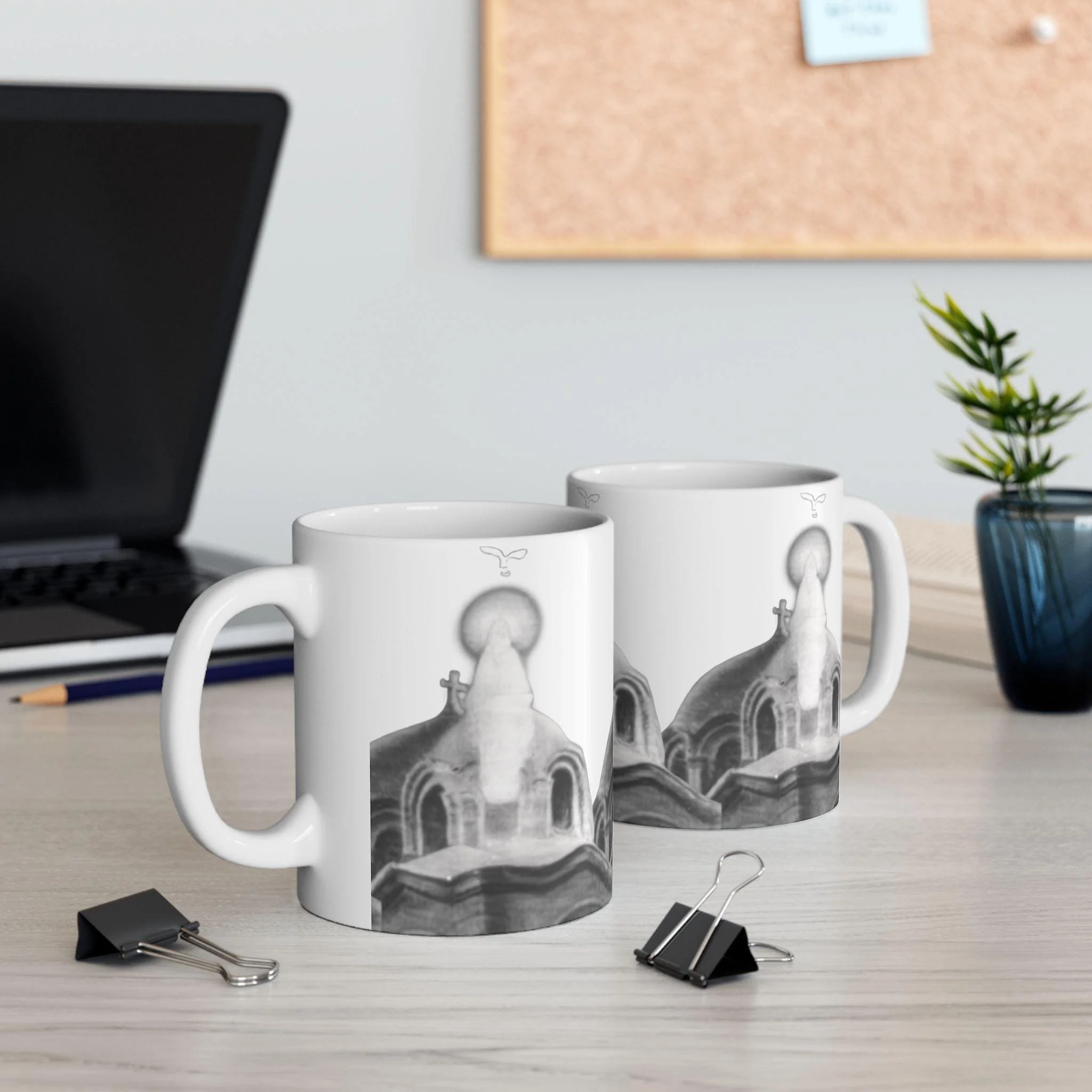
Saint Bishoy / Pishoy Prayer Card - For Humility, Monastic Prayer, Hospitality & Love of Christ
Saint Bishoy the Great, also written Saint Pishoy, Pishoi, Bishoi, or Anba Bishoy, was one of the great Desert Fathers of Egypt and remains among the most beloved saints of the Coptic Orthodox Church. Born in Egypt around 320 AD, he became a monk in the Wilderness of Scetis, or Shiheet, devoted himself to intense prayer and asceticism, defended the doctrine of the Holy Trinity, and became especially remembered for extraordinary traditions of encounters with Jesus Christ. The Coptic Orthodox Church calls him “the Perfect Man” and “the Beloved of Our Good Savior,” while another traditional title remembers him as the one who washed the feet of Christ. His monastery in Wadi El Natroun remains active today, and his body is still preserved and venerated there.
Saint Bishoy is especially meaningful for monks, men discerning monastic life, Christians seeking humility, people developing a deeper prayer life, those practicing fasting, people who feel physically weak or inadequate, Christians learning hospitality, people seeking greater compassion for strangers, those trying to see Christ in the poor or overlooked, and anyone who desires a more intimate love for Jesus Christ. These associations arise directly from his Coptic tradition because Bishoy was remembered as physically frail yet specifically chosen for God's service, became renowned for ascetic prayer, welcomed strangers generously, and stopped to carry a struggling elderly man whom the other monks had passed by, only to discover that the stranger was Christ Himself.
His association with seeing Christ in another person is one of the most beautiful elements of his story. According to the Coptic tradition, Bishoy told his fellow monks that Christ would appear to them on a mountain. When the day came, everyone hurried toward the place of the promised encounter, but they passed an elderly man struggling to make the journey. Bishoy alone stopped, lifted the man onto his shoulders, and continued carrying him until he realized that the person he had chosen to help was the very Christ everyone else was rushing to see.
That tradition makes Saint Bishoy particularly meaningful for Christians who want to understand Matthew 25 in practical life. It is possible to become so eager for an extraordinary religious experience that the ordinary person needing help becomes an inconvenience, yet Bishoy's story turns that instinct upside down because the stranger everyone ignored became the encounter they were seeking.
Saint Bishoy is also an especially powerful saint for anyone who feels too weak, physically unimpressive, or ordinary to be useful to God. His Synaxarium remembers his mother questioning why the angel had selected Bishoy from among her sons because he was thin and physically frail, only to be told that this was precisely the child God had chosen. The man considered the weakest became one of the greatest saints of Egyptian monasticism.
This prayer card is especially fitting for monks, novices, Coptic Orthodox Christians, men discerning monastery life, people beginning a serious prayer rule, Christians seeking humility, caregivers, people who serve the poor, people struggling with feelings of inadequacy, and anyone trying to grow in personal love for Jesus Christ. It can also make a meaningful baptism, chrismation, monastery entrance, tonsure, retreat, ordination, name-day, feast-day, spiritual-direction, or encouragement gift.
Each card is handmade in Austin, TX and created to order. We do not keep stock, because every prayer card is treated as a unique devotional offering. They are printed on museum-quality photo paper, not cardstock, and every card is made slowly during prayer with intentional reverence for the saint and for the person who will receive it. Names are lifted before Christ, intentions are held carefully, and each piece is handled multiple times in prayerful silence, asking God for mercy and asking Saint Bishoy to intercede for the soul it is being made for. This is devotional craftsmanship shaped with patience, care, and spiritual responsibility because every soul and every prayer matters.
THE LIFE & STORY
Saint Bishoy was born in the Egyptian village traditionally called Shansa or Shesna and grew up as one of seven brothers. The Coptic Synaxarium preserves a story in which his mother received a vision of an angel asking her to give one of her children to the service of God. She agreed to let God choose whichever child He desired, and the angel selected Bishoy.
His mother's first reaction was hesitation because Bishoy was physically frail. She suggested that one of her stronger sons might be better suited to serving God, but the angel insisted that Bishoy was the one who had been chosen.
That detail became spiritually important within the saint's later tradition. Bishoy's greatness was not built around extraordinary physical strength, impressive appearance, political position, or worldly achievement because the very characteristic his mother initially regarded as a disadvantage became part of the story through which Coptic Christians learned that God's calling does not depend upon human measurements of strength.
BORN AROUND 320 AD
The official history of the Coptic Orthodox Church gives Saint Bishoy's lifespan as approximately 320 to 417 AD and calls him the Beloved of Our Good Savior. It places him among the great saints of the Egyptian desert and records that he lived as a solitary in the Wilderness of Shiheet for approximately fifty-seven years.
The exact chronology of many fourth-century desert saints is not documented with the precision expected of modern civil records, so approximately 320 to 417 is best understood as the traditional Coptic chronology rather than a modern archival reconstruction. What is secure is Bishoy's place within the great flourishing of Egyptian monasticism that followed the pioneering generations of Saint Anthony the Great and the early Desert Fathers.
His life therefore belongs to the formative age in which the deserts of Egypt became one of the most influential schools of Christian spirituality in history.
THE WEAK CHILD GOD CHOSE
The story of Bishoy's childhood provides one of his most immediate devotional associations. His mother's concern was understandable because someone being dedicated to a demanding religious life might naturally seem to need physical strength, yet the angelic message insisted that God had chosen the weaker child.
This makes Saint Bishoy particularly meaningful for Christians who feel limited by physical weakness, chronic frailty, lack of confidence, age, small stature, or the belief that someone else is better equipped for the work God has given them. His life does not teach that limitations are imaginary because Bishoy's weakness was acknowledged rather than denied.
The deeper lesson is that weakness does not automatically disqualify a vocation. Christianity repeatedly presents divine grace operating through people whose limitations prevent them from imagining that every accomplishment came from themselves.
A SAINT FOR PEOPLE WHO FEEL INADEQUATE
Many Christians assume that serving God requires becoming a more impressive version of themselves before beginning. They wait to become stronger, smarter, more confident, wealthier, healthier, or more spiritually advanced, while Bishoy's story begins precisely with God choosing the child others regarded as less suited for the task.
His prayer card can therefore be especially meaningful for someone who constantly compares himself with people who appear stronger or more gifted. The point is not that preparation is unnecessary because Bishoy underwent decades of severe formation after his calling.
The point is that preparation begins after accepting that God can call the person who actually exists, rather than a hypothetical stronger person who may never exist.
THE WILDERNESS OF SHIHEET
Saint Bishoy eventually entered the famous Wilderness of Shiheet, also known as Scetis or Wadi El Natroun. The Coptic Synaxarium says he became a monk under Anba Bemwah, Bamouyah, or Pimwah, an elder who was also associated with the monastic formation of Saint John the Short.
Shiheet became one of the great centers of Egyptian monasticism. Generations of monks gathered there seeking prayer, fasting, repentance, spiritual fatherhood, Scripture, manual labor, and increasing freedom from the passions.
Bishoy's later monastery would become one of the enduring institutions of this desert landscape. The official Coptic Orthodox Church identifies the present Monastery of Saint Bishoy in Wadi El Natroun as a foundation dating to the end of the fourth century and established by Saint Bishoy himself.
SAINT JOHN THE SHORT
Bishoy's monastic story is closely connected with Saint John the Short, one of the other great fathers of Scetis. The Coptic Synaxarium identifies the same elder, Anba Bemwah, as a formative spiritual father for both Bishoy and John.
The Coptic Life of Saint John also remembers John and Bishoy living within the same monastic environment after their elder's departure, giving the two saints a genuine historical and devotional connection within the desert tradition.
For Christians building a collection of the Egyptian Desert Fathers, Saint Bishoy therefore belongs naturally beside Saint John the Short, Saint Macarius the Great, Saint Moses the Black, Saint Arsenius the Great, and Saint Anthony the Great. Their lives differ greatly, but together they reveal the variety of personalities and vocations contained within early Egyptian monasticism.
MONASTIC LIFE & ASCETICISM
The Coptic Synaxarium summarizes Bishoy's monastic life as one of intense ascetic struggle and worship. Another Coptic biography emphasizes his prayer, simplicity, modesty, courage, calmness, deep thought, wisdom, and generosity toward strangers.
Asceticism in this context means much more than performing difficult physical practices. Fasting, vigils, solitude, manual labor, restraint, and prayer were intended to expose and weaken the passions that prevent the human heart from loving God and neighbor freely.
Saint Bishoy's later reputation for extraordinary closeness to Christ is therefore inseparable from the ordinary years of monastic discipline that came first. The dramatic stories surrounding him emerged from a life already structured around repeated faithfulness.
A SAINT FOR FASTING
Fasting belongs naturally within devotion to Saint Bishoy because severe ascetical discipline formed part of the monastic life for which the Coptic Church remembers him. His identity as a fourth-century Egyptian monk places him firmly within a tradition in which fasting was joined with prayer, watchfulness, humility, Scripture, and repentance rather than practiced as an isolated health technique.
Modern Christians should not attempt to reproduce extreme ancient monastic fasts without pastoral and medical discernment. The value of Bishoy's example lies in the conviction that appetite does not have to govern every decision.
A Saint Bishoy card can therefore accompany Great Lent, the Nativity Fast, the Apostles' Fast, the Fast of the Virgin, or another period in which a Christian is trying to recover discipline over comfort while remaining attentive to humility and charity.
A SAINT FOR DEEP PRAYER
Prayer stands at the center of every major Coptic description of Bishoy. The official history of the Coptic Church remembers him as a solitary who spent decades in Shiheet, while his traditional Life connects his intense prayer with extraordinary experiences of Christ's presence.
This makes him especially meaningful for Christians who desire to move from occasional prayer toward a more stable daily life with God. Bishoy's example does not offer a quick method for producing spiritual experiences because his life demonstrates the opposite.
Decades of prayer, fasting, humility, manual discipline, and perseverance formed the context in which the Church later remembered his remarkable encounters with Christ.
THE BELOVED OF OUR GOOD SAVIOR
The modern Coptic Orthodox Church continues using the title “the Beloved of Our Good Savior” for Saint Bishoy. Pope Tawadros II explicitly taught on this title in 2022 and presented it as one of three descriptions that summarize the saint's spiritual life.
The title is especially intimate. Many saints are remembered primarily as martyrs, confessors, bishops, teachers, or miracle-workers, while Bishoy's Coptic identity emphasizes a personal relationship of love with Christ.
Pope Tawadros interpreted this title as a call for every Christian to ask whether his or her life actually brings joy to Christ through repentance, faithfulness, Scripture, and service to others. In that sense, devotion to Bishoy is not merely admiration for a saint who was loved by Jesus, because it becomes an invitation to live in a way that responds lovingly to Christ.
THE PERFECT MAN
Another title repeatedly used by the Coptic Orthodox Church for Saint Bishoy is “the Perfect Man.” Pope Tawadros II explained that this does not mean equality with God's absolute perfection but a life continually striving toward Christian maturity and growth.
The title therefore should not be misunderstood as claiming that Bishoy never needed repentance or growth. Its devotional meaning concerns the mature integration of prayer, humility, service, discipline, faith, and love that the Coptic Church sees manifested in his life.
Pope Tawadros specifically connected the title with the Christian call to continue progressing rather than becoming satisfied with spiritual stagnation. This makes Bishoy an especially meaningful saint for someone who feels that prayer has become routine or spiritually dry.
THE ONE WHO WASHED THE SAVIOR'S FEET
The Coptic Orthodox Church also calls Bishoy the one who washed the feet of the Savior. The official Coptic Church reported this title again when Pope Tawadros II anointed Saint Bishoy's body at his monastery in 2024, identifying it as language used by the Church in her prayers.
Pope Tawadros explained the title spiritually through humility and self-denial. Christ Himself washed His disciples' feet, and Bishoy's title therefore becomes a call to serve rather than to cultivate ego or seek position.
This makes Saint Bishoy particularly meaningful for Christians in ministry. The more responsibility someone receives, the more necessary it becomes to remember that Christian leadership is expressed through service rather than through insisting that others recognize status.
HIS PROMISED ENCOUNTER WITH CHRIST
One of the most famous Coptic stories about Saint Bishoy says that he received a promise that Jesus Christ would appear to him on the mountain of Shiheet. Bishoy told the other monks, and they became excited to participate in the promised encounter.
On the appointed day, the monks hurried toward the mountain because everyone wanted to see Christ. Their expectation was understandable because an extraordinary manifestation of the Savior would have seemed like the greatest possible spiritual experience.
The story then introduces an unexpected test. Along the road sat an elderly man who was struggling to make the same journey and asking the monks for help.
THE OLD MAN EVERYONE PASSED BY
The monks passed the elderly stranger because they were eager to reach Christ. Bishoy, however, stopped when the man asked for help and placed him upon his shoulders.
This is the central moral tension in the story. Every monk was pursuing something explicitly religious, yet religious eagerness became capable of making a suffering person invisible.
Bishoy was the one who allowed the interruption to become more important than the schedule. The tradition therefore teaches that compassion may be the very place where the encounter with Christ is already happening.
SAINT BISHOY CARRIES CHRIST
As Bishoy carried the old man, the burden changed, and he gradually realized that the stranger was Jesus Christ Himself. The Coptic Life identifies this directly as the fulfillment of the encounter the monks had been seeking.
This scene became one of the most recognizable subjects in Coptic iconography of Saint Bishoy. Icons often show the elderly monk carrying Christ upon his shoulders, visually preserving the lesson that the Savior may be encountered through service to someone other people consider inconvenient.
Few saint stories provide such a vivid illustration of Christ's teaching that service given to the least of His brethren is received as service offered to Him.
A SAINT FOR HOSPITALITY
The same Coptic biography that emphasizes Bishoy's prayer and asceticism also specifically remembers his generosity toward strangers. This makes hospitality one of his strongest grounded devotional associations rather than a modern invention.
Hospitality within desert monasticism is especially striking because visitors interrupt solitude. A monk may legitimately seek silence, but if the quest for private holiness becomes indifference toward another person's needs, the spiritual life has turned inward in the wrong way.
Bishoy's encounter with Christ in the elderly stranger makes the principle even stronger. Hospitality is not merely being polite to guests because the stranger can become an icon through whom Christ asks whether love is more important than convenience.
A SAINT FOR CAREGIVERS
Saint Bishoy can therefore be especially meaningful for caregivers, nurses, people caring for elderly parents, those assisting someone with limited mobility, and Christians whose plans are regularly interrupted by another person's needs. His famous story begins when everyone else is moving quickly toward something they believe to be important and Bishoy stops for the person who cannot keep up.
Caregiving often feels spiritually invisible because it consists of repetitive practical tasks rather than dramatic religious experiences. Bishoy's story offers a radically different interpretation because carrying the person who could not continue alone became his encounter with Christ.
His card can therefore serve as a reminder that hidden acts of physical care may have enormous spiritual significance even when no one else notices them.
A SAINT FOR THE ELDERLY & OVERLOOKED
The old man in Bishoy's story was not threatening, impressive, powerful, or visibly holy. He was simply someone who slowed everyone else down, which is precisely why the episode speaks so powerfully about the way vulnerable people can become socially invisible.
A society that values speed and independence can easily treat frailty as inconvenience. Bishoy's tradition reminds Christians that weakness does not make a person less worthy of attention because the face of Christ may be hidden precisely where society sees only burden.
A Saint Bishoy prayer card can therefore be meaningful for someone entering old age or struggling with dependence upon others. The saint who was chosen despite physical weakness later became the man who recognized Christ within another person's weakness.
CHRIST IN THE PERSON WE ARE TOO BUSY TO NOTICE
The spiritual lesson of Bishoy carrying Christ is especially relevant to busy Christians. It is possible to hurry toward church, ministry, prayer, a religious conference, or some other good activity while becoming impatient with the people encountered along the way.
Bishoy's story does not condemn organized religious activity because the monks were genuinely going to meet Christ. It warns that religious activity can become distorted when it trains the eyes to look beyond the neighbor rather than toward him.
The question his life raises is therefore simple but difficult: What if the interruption is not preventing us from meeting Christ, but is the form in which Christ has chosen to meet us?
A DEFENDER OF THE HOLY TRINITY
Saint Bishoy's life was not limited to contemplation and acts of charity. The Coptic Synaxarium also remembers him confronting a theological error involving denial of the Holy Spirit.
An influential ascetic in the region of Ansena had begun teaching that the Holy Spirit was not truly part of the divine Trinity, misleading a number of followers. Bishoy traveled to address the problem and deliberately carried a woven basket with three handles.
When people asked why the basket had been constructed in such an unusual way, Bishoy used it as an opportunity to teach about the Trinity and then explained from the Old and New Testaments that the Holy Spirit is one of the three Persons of the Holy Trinity. The Synaxarium says the people were convinced and returned to the faith.
THE THREE-HANDLED BASKET
The three-handled basket is one of the more memorable teaching methods in the saint's story. Bishoy used an ordinary handmade object as an opening into theological instruction, making the physical structure of his work point toward a doctrine his hearers had rejected.
The basket itself is not a complete theological explanation of the Trinity because no created analogy can fully describe God's inner life. Bishoy's teaching proceeded beyond the object into Scripture, using the visual image only to begin the conversation.
This makes him particularly meaningful for catechists, Sunday-school teachers, clergy, parents, and Christians who need to explain difficult theology in understandable ways. Good catechesis does not necessarily begin with technical vocabulary because an ordinary object can sometimes open a door through which deeper teaching can follow.
A SAINT FOR CATECHISTS
Bishoy's theological intervention shows that a contemplative monk still cared deeply about doctrine. His long hours of prayer did not lead him to conclude that questions about the Holy Spirit were irrelevant intellectual arguments because Christian worship depends upon the identity of the God being worshiped.
His approach also combined simplicity with Scripture. He did not answer the controversy merely by asserting personal spiritual authority but explained the faith from the biblical texts.
Saint Bishoy can therefore be especially meaningful for catechists who want to communicate doctrine without unnecessary complexity while remaining faithful to Scripture and the Church's confession.
CONTEMPLATION & THEOLOGY TOGETHER
Bishoy's life demonstrates an important Eastern Christian balance between mystical prayer and doctrinal truth. The same saint remembered for encounters with Christ was also remembered for correcting false teaching about the Holy Spirit.
This matters because spirituality can become vague when separated from doctrine, while doctrine can become sterile when separated from prayer. Bishoy's tradition refuses that division.
The monk seeking intimate communion with Christ also cared about the Trinity, Scripture, and the integrity of Christian teaching because the God encountered in prayer is the same God confessed by the Church.
THE VISION OF EMPEROR CONSTANTINE
The Coptic Synaxarium preserves another extraordinary vision in which Emperor Constantine appeared to Bishoy and spoke about the honor of the monastic vocation. Constantine told him that if he had understood the greatness of monastic honor, he would have abandoned his kingdom to become a monk.
Bishoy responded by reminding Constantine of the enormous Christian significance associated with his reign, including the end of pagan persecution and the public flourishing of Christianity. Constantine nevertheless answered that he had received many gifts but regarded the honor granted to monks as something extraordinary.
The story functions within Coptic monastic tradition as a dramatic comparison between earthly kingship and the hidden spiritual vocation of the monk.
THE HONOR OF MONASTIC LIFE
The Constantine vision does not mean every Christian should become a monk. Christianity has always recognized distinct vocations, including marriage, ordained ministry, consecrated life, and faithful Christian life within ordinary society.
The point of the tradition is that monasticism cannot be judged according to worldly measurements of productivity or prestige. Someone who leaves wealth, family life, public honor, and career advancement for prayer may appear to society as though something valuable has been abandoned.
Coptic monastic spirituality sees another kind of wealth. The monk's hidden life of prayer can become service to the entire Church even when that service cannot be measured economically.
A SAINT FOR MONASTIC VOCATIONS
Saint Bishoy is therefore one of the strongest saints for Coptic men discerning monastic life. His own monastery remains active in the desert where his spiritual tradition began, making the connection between saint and vocation unusually concrete.
A man considering a monastery can seek Bishoy's intercession for humility, perseverance, prayer, and clarity. The dramatic stories of Christ appearing to him should not create the expectation that monasticism consists primarily of visions because those stories emerge from decades of hidden ascetic labor.
The greater lesson is that love for Christ must eventually become faithfulness in prayer, work, fasting, obedience, hospitality, doctrine, and care for other people.
HIS MONASTERY IN WADI EL NATROUN
The Monastery of Saint Bishoy in Wadi El Natroun remains one of the major ancient monasteries of the Coptic Orthodox Church. The official Church describes it as one of the oldest monasteries in Egypt and in the world, dating its foundation to the end of the fourth century and identifying Saint Bishoy as its founder.
The monastery lies in the wilderness west of the Nile Delta, approximately between Cairo and Alexandria. Its ancient features include a fort, cells, mill, table, walls, churches, tombs, and a cathedral dedicated to Saint Bishoy.
Unlike many ancient monastic sites that survive only as ruins, Saint Bishoy's monastery remains part of the living Coptic Church.
ONE OF THE GREAT MONASTERIES OF SCETIS
Wadi El Natroun is historically associated with Scetis, one of the most famous landscapes in Christian monastic history. Several ancient Coptic monasteries continue preserving the spiritual inheritance of the monks who populated the region during late antiquity.
Saint Bishoy's monastery is therefore important not only because of devotion to one saint but because it remains part of the living continuation of the Egyptian desert tradition from which generations of monks, theologians, bishops, and patriarchs emerged.
The desert that once seemed remote from the centers of imperial power eventually became one of the great spiritual centers of Christianity.
SAINT BISHOY & MODERN COPTIC PATRIARCHS
The official Coptic Church records that several monks associated with Saint Bishoy's Monastery eventually became Patriarchs of Alexandria, including Pope Gabriel VIII, Pope Macarius III, and Pope Tawadros II.
Pope Tawadros II himself entered monastic life at Saint Bishoy's Monastery before later serving as bishop and ultimately becoming the 118th Pope of Alexandria and Patriarch of the See of Saint Mark.
This makes the monastery more than an ancient monument. It remains a place from which contemporary Coptic leadership has continued to emerge.
POPE SHENOUDA III & THE MONASTERY
Saint Bishoy's Monastery also contains the shrine of Pope Shenouda III, one of the most influential modern patriarchs of the Coptic Orthodox Church. The official monastery description lists his shrine among the significant features of the complex.
The monastery also became an important location for the preparation of the Holy Myron, the consecrated oil used within Coptic sacramental life. Pope Shenouda III and Pope Tawadros II both presided over multiple preparations of the Myron there.
Saint Bishoy's ancient foundation therefore remains directly connected with the sacramental and patriarchal life of the modern Coptic Church.
THE BARBARIAN INVASION OF SCETIS
The Coptic Synaxarium remembers Bishoy eventually leaving the wilderness of Shiheet because barbarian invaders entered the region. He relocated to Mount Ansena in Upper Egypt, where he lived during the final period of his earthly life.
This part of his story places him within a wider historical pattern affecting Egyptian monasticism. Desert monasteries could be spiritually isolated but were not immune to political instability, raids, violence, and the collapse of ordinary security.
Bishoy therefore knew not only chosen solitude but also displacement. The monk who had built his spiritual life around one desert eventually had to continue that life somewhere else.
A SAINT FOR PEOPLE FORCED TO LEAVE HOME
Although his relocation occurred within a monastic and historical context very different from modern displacement, Bishoy's final years can still speak to people who lose a familiar place because of danger, war, persecution, or circumstances outside their control.
A stable spiritual life cannot depend entirely upon remaining in one building or region because circumstances may change without permission. Bishoy carried his vocation from Shiheet to Ansena rather than concluding that holiness had been left behind with the place he loved.
His example therefore reminds Christians that sacred places matter enormously, but the God encountered there is not confined to them.
SAINT PAUL OF TAMOUH
During the later period of Bishoy's life, Coptic tradition connects him closely with Saint Paul of Tamouh. The Synaxarium of Saint Paul records that Bishoy joined him around Mount Ansena and that Christ promised the bodies of the two ascetics would eventually be buried together.
When Saint Paul died, his body was placed with Bishoy's according to this tradition. After the period of danger passed, both bodies were eventually transported back to Saint Bishoy's monastery in the Wilderness of Shiheet.
The connection gives Bishoy another important place within the network of Egyptian monastic saints whose lives and relic traditions became intertwined across generations.
HIS REPOSE
The official history of the Coptic Orthodox Church gives 417 AD as the traditional year of Saint Bishoy's repose. His Synaxarium says he died peacefully at Mount Ansena after leaving Scetis because of the invasion of the desert.
Unlike a martyr, Bishoy did not glorify Christ through execution. His witness consisted in an extraordinarily long monastic life of prayer, asceticism, doctrinal fidelity, humility, and service.
His death therefore completed a vocation whose holiness had been formed slowly. The saint celebrated for remarkable encounters with Christ spent most of his earthly life doing the repeated work of prayer that no chronicler could record day by day.
THE RETURN OF HIS BODY TO SCETIS
After the danger surrounding the desert had passed, the Coptic Synaxarium says Saint Bishoy's body and that of Saint Paul of Tamouh were returned to the monastery at Shiheet.
This return is important because it restored the saint physically to the monastic community with which his name had become permanently associated. His body, monastery, feast, and continuing monastic family remain linked within one devotional landscape.
The connection is unusually strong compared with saints whose relics became widely dispersed or whose original monasteries disappeared entirely.
WHERE ARE SAINT BISHOY'S RELICS TODAY?
Saint Bishoy's principal relics remain at Saint Bishoy's Monastery in Wadi El Natroun, Egypt. The official Coptic Orthodox Church continues referring to his preserved body there, and Pope Tawadros II personally performed the rite of anointing the saint's relics again in July 2026.
The 2026 report says the saint's body is preserved within its reliquary at the ancient monastery bearing his name. This provides exceptionally strong and current ecclesiastical documentation of the relic location.
For pilgrims who want to venerate Saint Bishoy, his monastery in Wadi El Natroun is therefore the principal destination associated with his life and body.
THE ANNUAL ANOINTING OF HIS RELICS
The official Coptic Church has documented Pope Tawadros II participating in the anointing of Saint Bishoy's relics around his feast on multiple occasions. In 2024, the pope anointed the container holding the saint's body, and in July 2026 the Church again reported the ritual anointing of his sacred relics.
These events demonstrate that veneration of Bishoy's relics is not simply an ancient custom preserved in books. It remains part of the living devotional practice of the Coptic Orthodox Church.
The continued presence of the saint's body at the monastery also creates a powerful continuity between fourth-century Egyptian monasticism and the contemporary Church.
HIS FEAST DAY
The Coptic Orthodox Church celebrates the departure of Saint Bishoy on 8 Abib, corresponding to July 15 in the current Gregorian calendar. The official Coptic Church confirmed this feast date again when announcing the anointing of his relics in 2024 and 2026.
The Synaxarium reading for 8 Abib specifically commemorates his departure and recounts his childhood calling, monastic vocation, defense of the Holy Spirit, departure from Shiheet, and eventual return of his body to the monastery.
For customer-facing product information, the clearest presentation is therefore Feast Day: July 15 / 8 Abib.
SAINT BISHOY IN THE COPTIC ORTHODOX CHURCH
Saint Bishoy belongs first and unmistakably to the Coptic Orthodox tradition. His monastery, Synaxarium, titles, relics, feast, iconography, and continuing liturgical devotion are all preserved within the Coptic Orthodox Church.
Because Bishoy lived in the fourth and early fifth centuries, his historical life predates the later permanent division between the Chalcedonian and Oriental Orthodox communions. His strongest living cult, however, remains Coptic, and a product page should identify that tradition clearly rather than simply labeling him generically as Eastern Orthodox.
For The Eastern Church, an accurate title is therefore Saint Bishoy the Great, Coptic Orthodox Desert Father, the Beloved of Our Good Savior.
IS SAINT BISHOY EASTERN ORTHODOX OR ORIENTAL ORTHODOX?
The Coptic Orthodox Church belongs to the Oriental Orthodox communion, not the Eastern Orthodox communion. Saint Bishoy is therefore most accurately described today as a major Coptic Orthodox and Oriental Orthodox saint, even though he lived before the later ecclesial division became permanent.
This distinction matters because customers frequently use “Orthodox” as though it referred to only one communion. Coptic Orthodox, Syriac Orthodox, Armenian Apostolic, Ethiopian Orthodox Tewahedo, Eritrean Orthodox Tewahedo, and Malankara Orthodox Christians belong to the Oriental Orthodox family.
Saint Bishoy's primary devotional identity should therefore remain Coptic Orthodox rather than being casually relabeled according to another Eastern tradition.
THE NAME BISHOY / PISHOY
The saint's name appears in English under several spellings, especially Bishoy and Pishoy, with additional forms such as Bishoi and Pishoi. These variations primarily arise from different ways of rendering Egyptian and Coptic pronunciation into Latin letters.
The Coptic biography published by CopticChurch.net says the name Bishoy means “elevated.”
For SEO purposes, using both Saint Bishoy and Saint Pishoy on the product page is valuable because customers may know the same saint by either spelling. The title should lead with Bishoy if that is how the artwork and product listing are labeled, while Pishoy should appear early enough that search engines and customers recognize the alternate form.
SAINT BISHOY IS NOT SAINT PAISIOS
Saint Bishoy should not be confused with Saint Paisios of Mount Athos, the twentieth-century Greek Orthodox elder. The English spellings can occasionally cause confusion, especially because several forms of Greek, Coptic, Arabic, and English transliteration look similar.
Saint Bishoy was an Egyptian Desert Father traditionally dated from approximately 320 to 417, while Saint Paisios the Athonite belonged to the twentieth century.
A product listing using both Bishoy and Pishoy therefore helps customers identify the ancient Coptic saint correctly.
ICONOGRAPHY
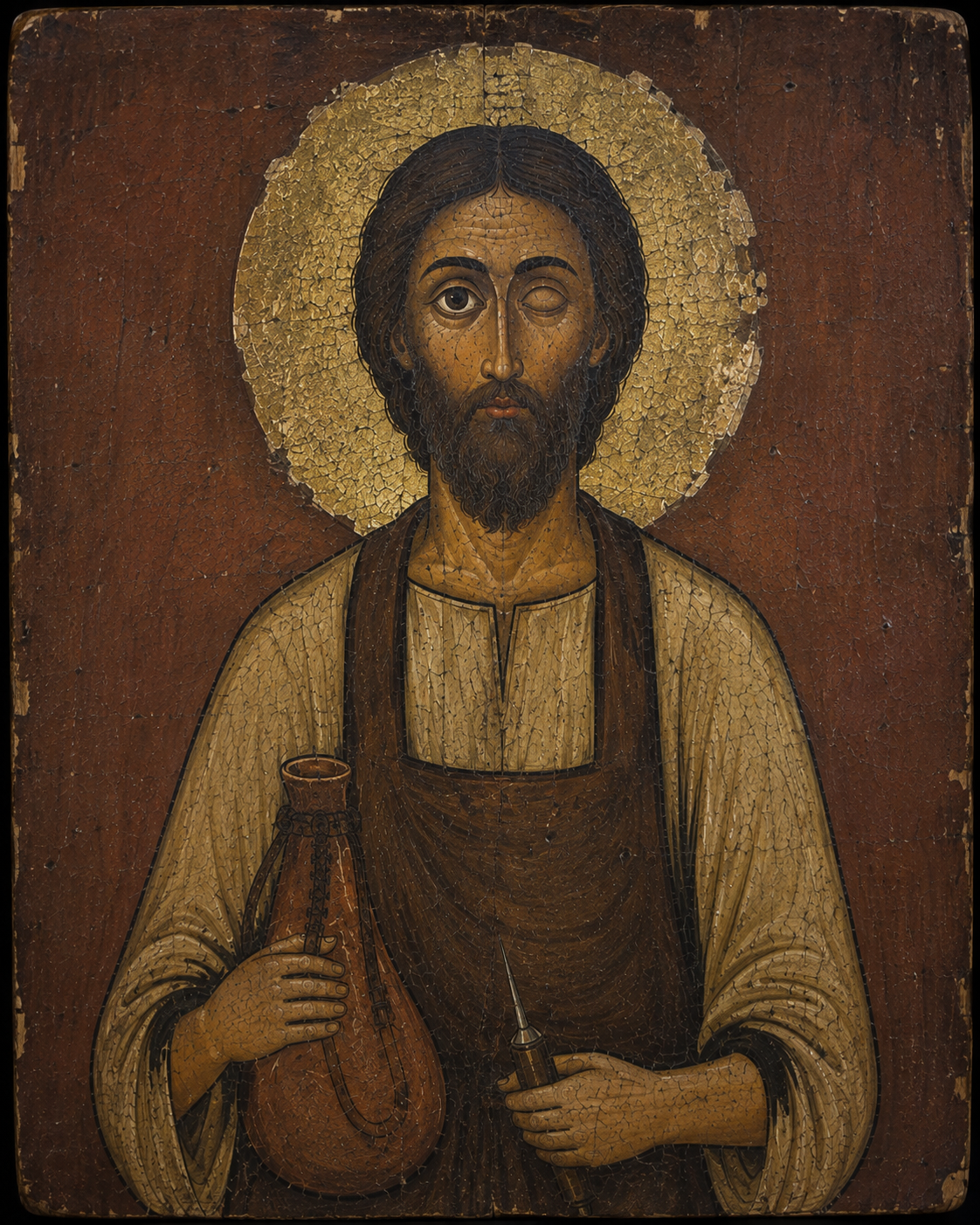
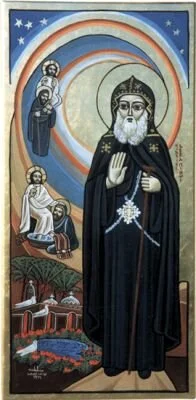
Traditional Coptic icons of Saint Bishoy generally depict him as an elderly monk with a long white beard and dark monastic garments. One of the most distinctive compositions shows him carrying Jesus Christ upon his shoulders, directly recalling the Coptic tradition in which Christ appeared as the struggling elderly stranger.
Another important iconographic subject depicts the intimacy between Christ and Bishoy connected with the saint's titles as the Beloved of the Savior and the one associated with washing the Savior's feet. These scenes distinguish him visually from more generic depictions of Egyptian Desert Fathers.
For a prayer card, traditional Coptic iconography is especially appropriate because the stories shown in these images come directly from the devotional tradition through which the Coptic Church remembers him.
THE MEANING OF CHRIST ON HIS SHOULDERS
The image of Bishoy carrying Christ is not simply a miracle scene. It provides an entire theology of Christian service because the Savior appears in the form of someone who needs help rather than someone visibly surrounded by glory.
The icon therefore asks the viewer to reconsider how Christ may be encountered. The person searching only for something supernatural may overlook Him, while the person willing to perform an ordinary act of mercy may discover the extraordinary hidden within it.
This makes the icon especially meaningful in homes, monasteries, ministries, hospitals, hospices, and places where Christians regularly serve vulnerable people.
HUMILITY AS THE GUARDIAN OF GRACE
When Pope Tawadros II reflected upon Saint Bishoy's titles, he emphasized humility and self-denial as central lessons of the saint's association with Christ washing feet. His teaching describes humility as guarding the gifts and graces a Christian receives.
This is especially appropriate for Bishoy because stories of visions and encounters with Christ could easily have become reasons for pride. The saint's tradition interprets them instead as the fruit of a life already shaped by humility.
A person receiving spiritual consolation, public recognition, ministry success, or unusual religious experiences can therefore seek Bishoy's prayers not merely for more gifts but for the humility necessary to carry gifts without becoming possessed by them.
A SAINT FOR CHRISTIANS SEEKING CHRIST HIMSELF
Many saints become especially associated with one practical need, but Bishoy's strongest devotional identity is unusually direct: love for Christ Himself. His titles, monastic vocation, visions, hospitality, prayer, and iconography continually return to the relationship between the saint and Jesus.
This makes him especially valuable for someone whose prayer life has become dominated entirely by requests. Asking saints for help is a normal Christian practice, but the ultimate purpose of every devotion is communion with God.
Bishoy's card can therefore serve as a reminder to pray not only for what Christ can give, but for the grace to love Christ because He is Christ.
A SAINT FOR SPIRITUAL DRYNESS
Pope Tawadros' reflection on Bishoy as the Perfect Man specifically connected Christian perfection with continued striving rather than allowing spiritual apathy or dryness to become permanent.
This makes Bishoy particularly meaningful when prayer no longer feels emotionally rewarding. The desert life assumes that there will be long periods in which faithfulness must continue without the consolation of dramatic experiences.
The same saint remembered for carrying Christ spent decades in ordinary monastic discipline. His life therefore teaches that intimacy with God is built not only through moments of spiritual sweetness but through continued fidelity when prayer feels dry.
A SAINT FOR SIMPLICITY
Coptic tradition specifically remembers Bishoy for simplicity in appearance, modesty, calmness, and deep thought. These qualities demonstrate that simplicity is not the opposite of intelligence because Bishoy was capable of profound theological instruction while remaining personally unpretentious.
Modern life often rewards complexity, presentation, self-promotion, and constant visibility. Bishoy's monastic identity represents a different measure of significance.
A simple life can still contain profound prayer, serious theology, wisdom, courage, and lasting influence. The fact that the Church still celebrates a desert monk roughly sixteen centuries later demonstrates how little public display is required for a life to become spiritually consequential.
A SAINT FOR CALMNESS
The Coptic biographical tradition also lists calmness among the characteristics associated with Bishoy.
Calmness in a Desert Father should not be confused with passive temperament alone. The same Bishoy who was remembered as quiet and calm also traveled to confront theological error and defended the doctrine of the Holy Spirit when necessary.
His example therefore demonstrates that calmness and courage can coexist. Christian peace does not mean never acting firmly because the deeper goal is to act without allowing fear, anger, or ego to become the controlling force.
A SAINT FOR WISDOM
The Coptic Life names wisdom and deep thought among Bishoy's defining characteristics. His handling of the Trinitarian controversy supports that description because he recognized both the theological error and an accessible way to begin correcting it.
Wisdom in his life was therefore practical as well as contemplative. It appeared in knowing when to remain silent in prayer, when to help a stranger, and when to speak publicly in defense of doctrine.
Saint Bishoy can therefore be sought as an intercessor when someone needs discernment about whether a situation requires silence, service, patience, or direct action.
A SAINT FOR PEOPLE SERVING STRANGERS
Bishoy's generosity to strangers and encounter with Christ in the elderly traveler make him especially appropriate for Christians involved in homeless ministry, refugee ministry, hospital visitation, food pantries, elder care, prison ministry, or other service involving people who may initially be unknown to them.
His story provides an antidote to serving people merely as abstract categories. The stranger is not simply a “case” because Christian hospitality begins by recognizing a human person.
The old man Bishoy carried had no visible credentials proving who he was. Mercy came before recognition, which is precisely what made the later recognition of Christ spiritually meaningful.
A SAINT FOR THOSE WHO SERVE QUIETLY
Bishoy also provides encouragement for people whose acts of service remain unnoticed. When he stopped for the old man, he was not doing something the other monks regarded as impressive because they were already ahead of him pursuing what seemed like the more important spiritual event.
Many forms of Christian service operate in exactly this hidden way. Cleaning, caring for someone who is sick, preparing a meal, helping an elderly person walk, making a phone call, visiting someone forgotten, or assisting a stranger rarely creates public recognition.
Bishoy's story suggests that hidden service may be precisely the place where divine recognition matters more than human recognition.
HIS LEGACY
Saint Bishoy's legacy extends far beyond the individual stories preserved in his Synaxarium. His monastery has survived for more than sixteen centuries as a center of Coptic monasticism, his body remains venerated there, Coptic patriarchs have emerged from the community, and the Church continues celebrating him liturgically as the Beloved of the Savior.
The endurance of his monastery is itself remarkable. Empires, rulers, languages, political systems, and borders have changed repeatedly since his lifetime, yet monks continue gathering in the same desert tradition to pray.
The frail child once considered an unlikely choice for God's service ultimately became the spiritual father of a monastery whose history has outlasted many of the powers that once governed Egypt.
PRAYERS
The most traditional prayer-card language for Saint Bishoy should draw from the actual Coptic Church's veneration of him rather than from a newly invented modern prayer. The Synaxarium itself concludes his commemoration by asking for his prayers, while contemporary Coptic worship continues invoking him as the Perfect Man and the Beloved of Our Good Savior.
A simple traditional invocation suitable for daily use is: “Saint Bishoy, the Beloved of Our Good Savior, pray for us.” This wording follows the saint's established Coptic title and the Church's traditional practice of seeking the prayers of the saints.
Someone seeking humility can ask Saint Bishoy for help serving without recognition, while someone who feels physically weak or inadequate can remember that his own frailty did not prevent God from choosing him. A caregiver can seek his prayers for patience, and someone trying to deepen prayer can ask for the perseverance to remain faithful even when no extraordinary consolation is present.
A Christian overwhelmed by busyness can also seek Saint Bishoy's intercession for the grace to notice the person immediately in front of them. His most famous encounter with Christ occurred not because he moved faster than everyone else toward a spiritual experience, but because he was willing to stop.
This prayer card is especially fitting beside a Coptic Agpeya, Bible, prayer rope, Psalter, monastery rule, icon corner, retreat journal, bedside table, caregiver's prayer space, or monastic vocation materials. It can also make a meaningful gift for a monk, novice, Coptic Christian, caregiver, catechist, theology student, servant, retreatant, or person seeking deeper personal love for Christ.
FAQ
Who was Saint Bishoy? Saint Bishoy was a fourth- and fifth-century Egyptian monk and Desert Father traditionally dated from approximately 320 to 417. He lived in the Wilderness of Shiheet, became renowned for prayer and asceticism, founded the monastery that bears his name, and is especially venerated within the Coptic Orthodox Church.
Is Saint Bishoy the same as Saint Pishoy? Yes, Bishoy and Pishoy are alternate English spellings of the same Coptic saint's name. Additional transliterations such as Bishoi and Pishoi may also appear in churches, books, and icon inscriptions.
What does the name Bishoy mean? A Coptic biography of the saint explains that Bishoy is a Coptic name meaning “elevated.”
When was Saint Bishoy born? The official history of the Coptic Orthodox Church gives approximately 320 AD as his birth year. Ancient monastic chronology is not always documented to modern standards, so the date is best understood as the traditional Coptic chronology.
When did Saint Bishoy die? The Coptic Orthodox Church's historical summary gives approximately 417 AD for his repose. The Synaxarium says he died peacefully at Mount Ansena after leaving Scetis because of invasion.
When is Saint Bishoy's feast day? His feast is July 15, corresponding to 8 Abib in the Coptic calendar. The official Coptic Church reaffirmed this date in its 2024 and 2026 reports on the annual veneration of his relics.
Where was Saint Bishoy born? The Coptic Synaxarium identifies his birthplace as a village called Shansa, while another Coptic biography renders the name as Shesna. Both refer to the Egyptian tradition surrounding his childhood.
How many brothers did Saint Bishoy have? His Synaxarium says he had six brothers, making him one of seven sons in the family.
Why was Saint Bishoy chosen by God? His mother received a vision in which an angel selected Bishoy for God's service. When she objected that he was physically weak and suggested a stronger brother, the angel insisted that Bishoy was the one God had chosen.
Was Saint Bishoy physically weak? Yes, the Coptic Synaxarium specifically remembers him as thin and physically frail during childhood. His later greatness therefore became a particularly strong example of divine calling working through human weakness.
Is Saint Bishoy a good saint for someone who feels weak or inadequate? Yes, this is one of the strongest devotional applications arising directly from his childhood story. God chose Bishoy even when his own mother believed a stronger brother might be better suited to service.
Where did Saint Bishoy become a monk? He entered monastic life in the Wilderness of Shiheet or Scetis, corresponding to the region now called Wadi El Natroun in Egypt.
Who was Saint Bishoy's spiritual father? The Synaxarium names Anba Bemwah, Bamouyah, or Pimwah as the elder under whom Bishoy became a monk. The same elder was also associated with Saint John the Short.
Did Saint Bishoy know Saint John the Short? Yes, the two saints belonged to the same monastic environment and were associated with the same elder. Saint John's Coptic Life also places him near Bishoy during their monastic development.
Was Saint Bishoy a hermit? Yes, the official Coptic history describes him as living as a solitary in the Wilderness of Shiheet for approximately fifty-seven years. His life nevertheless also involved disciples, monastery building, doctrinal teaching, and hospitality.
What is Saint Bishoy the patron saint of? The ancient Coptic tradition does not require one narrow Western-style patronage title. His strongest grounded devotional associations are monks, monastic vocations, humility, prayer, fasting, hospitality, physical weakness, service to strangers, love of Christ, and spiritual perseverance.
Is Saint Bishoy a patron saint of monks? He is certainly one of the major Coptic monastic saints and a natural intercessor for monks and monastic vocations. The ancient monastery he founded remains active in Wadi El Natroun today.
Can someone discerning monastic life pray to Saint Bishoy? Yes, his entire adult life was shaped by Egyptian monasticism, and his monastery remains a living Coptic monastic community. His example is particularly appropriate for prayer for humility, perseverance, discipline, and genuine love for Christ.
Why is Saint Bishoy called the Beloved of Our Good Savior? The Coptic Orthodox Church continues officially using this title for him. Pope Tawadros II has explained it as reflecting Bishoy's remarkable relationship of love with Christ and as an invitation for Christians to live in ways that bring joy to the Savior.
Why is Saint Bishoy called the Perfect Man? The Coptic Church uses this established title for him, and Pope Tawadros II has explained it as a call toward Christian maturity and continuous spiritual growth rather than a claim of absolute divine perfection.
Why is Saint Bishoy called the one who washed the Savior's feet? The Coptic Orthodox Church preserves this title in its devotional tradition and continues using it in connection with the saint's relics and feast. Pope Tawadros II interprets it as a call to humility, service, and self-denial.
Did Saint Bishoy see Jesus Christ? Coptic tradition strongly associates him with appearances of Christ. His Synaxarium says his ascetic life made him worthy to see Christ, while a fuller Coptic biography preserves the famous account of Christ appearing as an elderly traveler whom Bishoy carried.
Did Saint Bishoy carry Jesus on his shoulders? According to the Coptic tradition, yes. Christ appeared in the form of an elderly man struggling to reach the mountain, and Bishoy carried him when the other monks hurried past.
Why did Jesus appear as an old man to Saint Bishoy? The tradition emphasizes compassion and spiritual perception. Bishoy and the monks were seeking Christ, yet Christ appeared in the person of someone vulnerable whom most of them ignored.
What does the story of Saint Bishoy carrying Christ mean? It teaches that service to a vulnerable person can itself become an encounter with Christ. Bishoy recognized the spiritual importance of the person in need rather than allowing religious excitement to make him indifferent to another human being.
Is Saint Bishoy good for caregivers? Yes, this is a strong modern devotional application grounded in his famous act of physically carrying the struggling old man who was revealed as Christ. His story gives caregivers a powerful image of Christ present within hidden acts of service.
Is Saint Bishoy good for people caring for the elderly? Yes, especially because his most famous encounter with Christ occurred through assisting an elderly person whom others passed by. His life offers a genuine spiritual connection with honoring frailty rather than treating it as inconvenience.
Is Saint Bishoy a good saint for hospitality? Yes, the Coptic tradition specifically remembers him for generosity toward strangers, and his encounter with Christ as an unknown traveler gives hospitality a central place in his spiritual identity.
Did Saint Bishoy defend the doctrine of the Trinity? Yes. The Coptic Synaxarium remembers him confronting an ascetic teacher who denied the Holy Spirit and using Scripture to restore his followers to Trinitarian faith.
What was the three-handled basket of Saint Bishoy? Bishoy deliberately carried a basket with three handles when visiting people who had been taught to deny the Holy Spirit. He used the unusual object to begin a conversation about the Trinity before explaining the doctrine from Scripture.
Is Saint Bishoy a good saint for catechists or Sunday-school teachers? Yes, his three-handled basket story demonstrates creative catechesis joined with serious biblical teaching. He used an accessible physical image to open a discussion that he then grounded in Scripture.
Did Saint Bishoy have a vision of Emperor Constantine? The Coptic Synaxarium preserves a vision in which Constantine spoke with Bishoy about the extraordinary spiritual honor of monastic life.
What did Constantine tell Saint Bishoy? The Synaxarium says Constantine told him that if he had understood how great the honor of monks was, he would have preferred monastic life to kingship. Bishoy responded by reminding him of the gifts associated with his service to Christianity.
Where is Saint Bishoy's monastery? The monastery is in Wadi El Natroun, Egypt, in the desert west of the Nile Delta and roughly between Cairo and Alexandria.
Did Saint Bishoy actually found the monastery that bears his name? The official Coptic Orthodox Church identifies Saint Bishoy as the founder and dates the monastery to the end of the fourth century.
Is Saint Bishoy's monastery still active? Yes, it remains an active Coptic Orthodox monastery and is one of the major monastic centers of Wadi El Natroun. Contemporary popes and bishops continue visiting and celebrating there.
Is Saint Bishoy's monastery one of the oldest monasteries in the world? The official Coptic Orthodox Church describes it as one of the oldest monasteries in Egypt and in the world, with origins at the end of the fourth century.
Did Pope Tawadros II come from Saint Bishoy's Monastery? Yes, Pope Tawadros II entered monastic life at Saint Bishoy's Monastery before eventually becoming bishop and later the 118th Pope of Alexandria.
Is Pope Shenouda III buried at Saint Bishoy's Monastery? The monastery's official Coptic Orthodox Church page lists Pope Shenouda III's shrine among the important features of the monastery complex.
Was the Holy Myron made at Saint Bishoy's Monastery? Yes, the official monastery history records multiple preparations of the Holy Myron there under Pope Shenouda III and Pope Tawadros II.
Why did Saint Bishoy leave Scetis? The Synaxarium says barbarian invaders entered the wilderness, causing him to leave Shiheet and settle at Mount Ansena.
Where did Saint Bishoy die? He reposed at Mount Ansena after leaving Scetis because of the invasion. His body was later returned to his monastery in Shiheet.
Who was Saint Paul of Tamouh? Saint Paul of Tamouh was another Egyptian ascetic connected with Bishoy during his later life. Coptic tradition says their bodies were eventually placed together and returned to Bishoy's monastery.
Are Saint Bishoy and Saint Paul of Tamouh buried together? Coptic tradition links their bodies closely and says both were eventually brought back to the monastery in Shiheet.
Where are Saint Bishoy's relics today? His body is preserved at Saint Bishoy's Monastery in Wadi El Natroun. The official Coptic Orthodox Church documented Pope Tawadros II anointing the sacred relics there again in July 2026.
Is Saint Bishoy's body still preserved? Yes, the official Coptic Orthodox Church specifically refers to the saint's body being preserved within its reliquary at his monastery.
Did Pope Tawadros II recently venerate Saint Bishoy's relics? Yes. On July 7, 2026, Pope Tawadros II anointed the relics of Saint Bishoy at the Wadi El Natroun monastery in preparation for his feast.
Is Saint Bishoy Coptic Orthodox? Yes, his strongest and clearest living tradition is Coptic Orthodox. His Synaxarium, monastery, feast, relics, titles, and contemporary devotion are all actively maintained by the Coptic Orthodox Church.
Is Saint Bishoy Oriental Orthodox? Yes, because the Coptic Orthodox Church belongs to the Oriental Orthodox communion. His primary modern ecclesial identity should therefore be described as Coptic Orthodox or Oriental Orthodox rather than simply using the phrase Eastern Orthodox.
Did Saint Bishoy live before the division between Eastern and Oriental Orthodoxy? Yes. Bishoy's traditional life dates from approximately 320 to 417, before the Council of Chalcedon in 451 and the later permanent separation of the communions.
Can Eastern Catholics honor Saint Bishoy? Christians may certainly honor the holy men and women of the early Egyptian desert and learn from their witness. A product page should nevertheless preserve Bishoy's actual liturgical identity by identifying him first as a Coptic Orthodox Desert Father rather than presenting his modern cult as though it originated in a Byzantine Catholic calendar.
Is Saint Bishoy the same saint as Saint Paisios? No. Saint Bishoy or Pishoy is the ancient Egyptian Desert Father traditionally dated from about 320 to 417, while Saint Paisios the Athonite is a twentieth-century Greek Orthodox saint.
Why is Saint Bishoy shown carrying Jesus in icons? The image comes from his famous Coptic tradition in which Christ appeared as an elderly stranger. Bishoy stopped and carried Him after the other monks had hurried past.
Why does Saint Bishoy usually have a long white beard? Coptic iconography generally depicts him as the elderly Desert Father remembered by the Church after decades of monastic asceticism. His mature monastic appearance visually distinguishes his spiritual identity from his childhood calling.
Can I give this card to a monk? Yes, Saint Bishoy is one of the most appropriate Coptic saints for a monk. His monastery, asceticism, prayer, and enduring title as the Beloved of the Savior make the card particularly fitting for monastery entrance, tonsure, profession, or a monastic feast.
Can I give this card to someone considering becoming a monk? Yes, especially when the recipient is discerning Coptic monastic life. Bishoy's story emphasizes that monastic vocation is ultimately about love for Christ expressed through humility, prayer, fasting, service, and perseverance.
Can I give this card to someone who feels physically weak? Yes, his childhood story makes this especially meaningful because the angel chose Bishoy despite the concern that he was the physically weakest of his brothers.
Can I give this card to a caregiver? Yes, his story of carrying Christ in the form of an elderly stranger makes the card particularly appropriate for someone caring for another person's physical needs.
Can I give this card to someone who works with the homeless or poor? Yes, although Bishoy should not be assigned an invented formal patronage, his generosity toward strangers and recognition of Christ in a vulnerable traveler give the association a strong spiritual foundation.
Can I give this card to a Sunday-school teacher? Yes, especially because Bishoy's three-handled basket story shows him teaching the Trinity creatively while remaining grounded in Scripture.
Can I give this card to someone who wants to grow closer to Jesus? Yes, this may be the strongest devotional use of the card. Bishoy's established Coptic titles emphasize personal love for Christ, and the Church continues calling him the Beloved of Our Good Savior.
What does Saint Bishoy teach about weakness? His childhood story teaches that human weakness does not necessarily prevent divine calling. The brother considered physically least suited for demanding service became one of the great fathers of Egyptian monasticism.
What does Saint Bishoy teach about humility? His Coptic titles and traditions continually connect him with service and self-denial. Pope Tawadros II specifically presents the saint's association with washing Christ's feet as a call toward humility and freedom from ego.
What does Saint Bishoy teach about hospitality? His generosity toward strangers and encounter with Christ as an elderly traveler show that hospitality can become an encounter with the Savior Himself.
What does Saint Bishoy teach about prayer? His decades of desert asceticism show that extraordinary closeness to God develops through sustained prayer rather than constant pursuit of unusual religious experiences.
What does Saint Bishoy teach about theology? His defense of the Holy Spirit demonstrates that contemplative prayer and doctrinal truth belong together. He used both an accessible teaching image and the Scriptures to explain the Trinity.
What does Saint Bishoy teach about serving others? His famous encounter with the elderly stranger teaches that helping the person immediately in need may be more spiritually important than rushing toward the religious experience we imagine we need.
What does Saint Bishoy teach about seeing Christ in other people? His story provides one of Coptic Christianity's clearest illustrations of this principle. The Christ everyone was hurrying to meet was already present in the vulnerable person they were passing.
What is the main message of Saint Bishoy's life? Saint Bishoy's life teaches that love for Christ becomes visible through humility, prayer, faithfulness, and the way we treat the person placed directly in front of us. The frail child whom others considered an unlikely choice entered the Egyptian desert, spent decades seeking God, became known as the Beloved of the Savior, defended the Holy Trinity from Scripture, founded one of Christianity's ancient monasteries, and experienced his most famous encounter with Christ when he stopped to help the elderly stranger everyone else ignored. His body remains venerated at his monastery in Wadi El Natroun, where the Coptic Church still celebrates the monk whose life teaches that the person searching for Christ must never become so religiously busy that he passes Christ by.
Saint Bishoy the Great, also written Saint Pishoy, Pishoi, Bishoi, or Anba Bishoy, was one of the great Desert Fathers of Egypt and remains among the most beloved saints of the Coptic Orthodox Church. Born in Egypt around 320 AD, he became a monk in the Wilderness of Scetis, or Shiheet, devoted himself to intense prayer and asceticism, defended the doctrine of the Holy Trinity, and became especially remembered for extraordinary traditions of encounters with Jesus Christ. The Coptic Orthodox Church calls him “the Perfect Man” and “the Beloved of Our Good Savior,” while another traditional title remembers him as the one who washed the feet of Christ. His monastery in Wadi El Natroun remains active today, and his body is still preserved and venerated there.
Saint Bishoy is especially meaningful for monks, men discerning monastic life, Christians seeking humility, people developing a deeper prayer life, those practicing fasting, people who feel physically weak or inadequate, Christians learning hospitality, people seeking greater compassion for strangers, those trying to see Christ in the poor or overlooked, and anyone who desires a more intimate love for Jesus Christ. These associations arise directly from his Coptic tradition because Bishoy was remembered as physically frail yet specifically chosen for God's service, became renowned for ascetic prayer, welcomed strangers generously, and stopped to carry a struggling elderly man whom the other monks had passed by, only to discover that the stranger was Christ Himself.
His association with seeing Christ in another person is one of the most beautiful elements of his story. According to the Coptic tradition, Bishoy told his fellow monks that Christ would appear to them on a mountain. When the day came, everyone hurried toward the place of the promised encounter, but they passed an elderly man struggling to make the journey. Bishoy alone stopped, lifted the man onto his shoulders, and continued carrying him until he realized that the person he had chosen to help was the very Christ everyone else was rushing to see.
That tradition makes Saint Bishoy particularly meaningful for Christians who want to understand Matthew 25 in practical life. It is possible to become so eager for an extraordinary religious experience that the ordinary person needing help becomes an inconvenience, yet Bishoy's story turns that instinct upside down because the stranger everyone ignored became the encounter they were seeking.
Saint Bishoy is also an especially powerful saint for anyone who feels too weak, physically unimpressive, or ordinary to be useful to God. His Synaxarium remembers his mother questioning why the angel had selected Bishoy from among her sons because he was thin and physically frail, only to be told that this was precisely the child God had chosen. The man considered the weakest became one of the greatest saints of Egyptian monasticism.
This prayer card is especially fitting for monks, novices, Coptic Orthodox Christians, men discerning monastery life, people beginning a serious prayer rule, Christians seeking humility, caregivers, people who serve the poor, people struggling with feelings of inadequacy, and anyone trying to grow in personal love for Jesus Christ. It can also make a meaningful baptism, chrismation, monastery entrance, tonsure, retreat, ordination, name-day, feast-day, spiritual-direction, or encouragement gift.
Each card is handmade in Austin, TX and created to order. We do not keep stock, because every prayer card is treated as a unique devotional offering. They are printed on museum-quality photo paper, not cardstock, and every card is made slowly during prayer with intentional reverence for the saint and for the person who will receive it. Names are lifted before Christ, intentions are held carefully, and each piece is handled multiple times in prayerful silence, asking God for mercy and asking Saint Bishoy to intercede for the soul it is being made for. This is devotional craftsmanship shaped with patience, care, and spiritual responsibility because every soul and every prayer matters.
THE LIFE & STORY
Saint Bishoy was born in the Egyptian village traditionally called Shansa or Shesna and grew up as one of seven brothers. The Coptic Synaxarium preserves a story in which his mother received a vision of an angel asking her to give one of her children to the service of God. She agreed to let God choose whichever child He desired, and the angel selected Bishoy.
His mother's first reaction was hesitation because Bishoy was physically frail. She suggested that one of her stronger sons might be better suited to serving God, but the angel insisted that Bishoy was the one who had been chosen.
That detail became spiritually important within the saint's later tradition. Bishoy's greatness was not built around extraordinary physical strength, impressive appearance, political position, or worldly achievement because the very characteristic his mother initially regarded as a disadvantage became part of the story through which Coptic Christians learned that God's calling does not depend upon human measurements of strength.
BORN AROUND 320 AD
The official history of the Coptic Orthodox Church gives Saint Bishoy's lifespan as approximately 320 to 417 AD and calls him the Beloved of Our Good Savior. It places him among the great saints of the Egyptian desert and records that he lived as a solitary in the Wilderness of Shiheet for approximately fifty-seven years.
The exact chronology of many fourth-century desert saints is not documented with the precision expected of modern civil records, so approximately 320 to 417 is best understood as the traditional Coptic chronology rather than a modern archival reconstruction. What is secure is Bishoy's place within the great flourishing of Egyptian monasticism that followed the pioneering generations of Saint Anthony the Great and the early Desert Fathers.
His life therefore belongs to the formative age in which the deserts of Egypt became one of the most influential schools of Christian spirituality in history.
THE WEAK CHILD GOD CHOSE
The story of Bishoy's childhood provides one of his most immediate devotional associations. His mother's concern was understandable because someone being dedicated to a demanding religious life might naturally seem to need physical strength, yet the angelic message insisted that God had chosen the weaker child.
This makes Saint Bishoy particularly meaningful for Christians who feel limited by physical weakness, chronic frailty, lack of confidence, age, small stature, or the belief that someone else is better equipped for the work God has given them. His life does not teach that limitations are imaginary because Bishoy's weakness was acknowledged rather than denied.
The deeper lesson is that weakness does not automatically disqualify a vocation. Christianity repeatedly presents divine grace operating through people whose limitations prevent them from imagining that every accomplishment came from themselves.
A SAINT FOR PEOPLE WHO FEEL INADEQUATE
Many Christians assume that serving God requires becoming a more impressive version of themselves before beginning. They wait to become stronger, smarter, more confident, wealthier, healthier, or more spiritually advanced, while Bishoy's story begins precisely with God choosing the child others regarded as less suited for the task.
His prayer card can therefore be especially meaningful for someone who constantly compares himself with people who appear stronger or more gifted. The point is not that preparation is unnecessary because Bishoy underwent decades of severe formation after his calling.
The point is that preparation begins after accepting that God can call the person who actually exists, rather than a hypothetical stronger person who may never exist.
THE WILDERNESS OF SHIHEET
Saint Bishoy eventually entered the famous Wilderness of Shiheet, also known as Scetis or Wadi El Natroun. The Coptic Synaxarium says he became a monk under Anba Bemwah, Bamouyah, or Pimwah, an elder who was also associated with the monastic formation of Saint John the Short.
Shiheet became one of the great centers of Egyptian monasticism. Generations of monks gathered there seeking prayer, fasting, repentance, spiritual fatherhood, Scripture, manual labor, and increasing freedom from the passions.
Bishoy's later monastery would become one of the enduring institutions of this desert landscape. The official Coptic Orthodox Church identifies the present Monastery of Saint Bishoy in Wadi El Natroun as a foundation dating to the end of the fourth century and established by Saint Bishoy himself.
SAINT JOHN THE SHORT
Bishoy's monastic story is closely connected with Saint John the Short, one of the other great fathers of Scetis. The Coptic Synaxarium identifies the same elder, Anba Bemwah, as a formative spiritual father for both Bishoy and John.
The Coptic Life of Saint John also remembers John and Bishoy living within the same monastic environment after their elder's departure, giving the two saints a genuine historical and devotional connection within the desert tradition.
For Christians building a collection of the Egyptian Desert Fathers, Saint Bishoy therefore belongs naturally beside Saint John the Short, Saint Macarius the Great, Saint Moses the Black, Saint Arsenius the Great, and Saint Anthony the Great. Their lives differ greatly, but together they reveal the variety of personalities and vocations contained within early Egyptian monasticism.
MONASTIC LIFE & ASCETICISM
The Coptic Synaxarium summarizes Bishoy's monastic life as one of intense ascetic struggle and worship. Another Coptic biography emphasizes his prayer, simplicity, modesty, courage, calmness, deep thought, wisdom, and generosity toward strangers.
Asceticism in this context means much more than performing difficult physical practices. Fasting, vigils, solitude, manual labor, restraint, and prayer were intended to expose and weaken the passions that prevent the human heart from loving God and neighbor freely.
Saint Bishoy's later reputation for extraordinary closeness to Christ is therefore inseparable from the ordinary years of monastic discipline that came first. The dramatic stories surrounding him emerged from a life already structured around repeated faithfulness.
A SAINT FOR FASTING
Fasting belongs naturally within devotion to Saint Bishoy because severe ascetical discipline formed part of the monastic life for which the Coptic Church remembers him. His identity as a fourth-century Egyptian monk places him firmly within a tradition in which fasting was joined with prayer, watchfulness, humility, Scripture, and repentance rather than practiced as an isolated health technique.
Modern Christians should not attempt to reproduce extreme ancient monastic fasts without pastoral and medical discernment. The value of Bishoy's example lies in the conviction that appetite does not have to govern every decision.
A Saint Bishoy card can therefore accompany Great Lent, the Nativity Fast, the Apostles' Fast, the Fast of the Virgin, or another period in which a Christian is trying to recover discipline over comfort while remaining attentive to humility and charity.
A SAINT FOR DEEP PRAYER
Prayer stands at the center of every major Coptic description of Bishoy. The official history of the Coptic Church remembers him as a solitary who spent decades in Shiheet, while his traditional Life connects his intense prayer with extraordinary experiences of Christ's presence.
This makes him especially meaningful for Christians who desire to move from occasional prayer toward a more stable daily life with God. Bishoy's example does not offer a quick method for producing spiritual experiences because his life demonstrates the opposite.
Decades of prayer, fasting, humility, manual discipline, and perseverance formed the context in which the Church later remembered his remarkable encounters with Christ.
THE BELOVED OF OUR GOOD SAVIOR
The modern Coptic Orthodox Church continues using the title “the Beloved of Our Good Savior” for Saint Bishoy. Pope Tawadros II explicitly taught on this title in 2022 and presented it as one of three descriptions that summarize the saint's spiritual life.
The title is especially intimate. Many saints are remembered primarily as martyrs, confessors, bishops, teachers, or miracle-workers, while Bishoy's Coptic identity emphasizes a personal relationship of love with Christ.
Pope Tawadros interpreted this title as a call for every Christian to ask whether his or her life actually brings joy to Christ through repentance, faithfulness, Scripture, and service to others. In that sense, devotion to Bishoy is not merely admiration for a saint who was loved by Jesus, because it becomes an invitation to live in a way that responds lovingly to Christ.
THE PERFECT MAN
Another title repeatedly used by the Coptic Orthodox Church for Saint Bishoy is “the Perfect Man.” Pope Tawadros II explained that this does not mean equality with God's absolute perfection but a life continually striving toward Christian maturity and growth.
The title therefore should not be misunderstood as claiming that Bishoy never needed repentance or growth. Its devotional meaning concerns the mature integration of prayer, humility, service, discipline, faith, and love that the Coptic Church sees manifested in his life.
Pope Tawadros specifically connected the title with the Christian call to continue progressing rather than becoming satisfied with spiritual stagnation. This makes Bishoy an especially meaningful saint for someone who feels that prayer has become routine or spiritually dry.
THE ONE WHO WASHED THE SAVIOR'S FEET
The Coptic Orthodox Church also calls Bishoy the one who washed the feet of the Savior. The official Coptic Church reported this title again when Pope Tawadros II anointed Saint Bishoy's body at his monastery in 2024, identifying it as language used by the Church in her prayers.
Pope Tawadros explained the title spiritually through humility and self-denial. Christ Himself washed His disciples' feet, and Bishoy's title therefore becomes a call to serve rather than to cultivate ego or seek position.
This makes Saint Bishoy particularly meaningful for Christians in ministry. The more responsibility someone receives, the more necessary it becomes to remember that Christian leadership is expressed through service rather than through insisting that others recognize status.
HIS PROMISED ENCOUNTER WITH CHRIST
One of the most famous Coptic stories about Saint Bishoy says that he received a promise that Jesus Christ would appear to him on the mountain of Shiheet. Bishoy told the other monks, and they became excited to participate in the promised encounter.
On the appointed day, the monks hurried toward the mountain because everyone wanted to see Christ. Their expectation was understandable because an extraordinary manifestation of the Savior would have seemed like the greatest possible spiritual experience.
The story then introduces an unexpected test. Along the road sat an elderly man who was struggling to make the same journey and asking the monks for help.
THE OLD MAN EVERYONE PASSED BY
The monks passed the elderly stranger because they were eager to reach Christ. Bishoy, however, stopped when the man asked for help and placed him upon his shoulders.
This is the central moral tension in the story. Every monk was pursuing something explicitly religious, yet religious eagerness became capable of making a suffering person invisible.
Bishoy was the one who allowed the interruption to become more important than the schedule. The tradition therefore teaches that compassion may be the very place where the encounter with Christ is already happening.
SAINT BISHOY CARRIES CHRIST
As Bishoy carried the old man, the burden changed, and he gradually realized that the stranger was Jesus Christ Himself. The Coptic Life identifies this directly as the fulfillment of the encounter the monks had been seeking.
This scene became one of the most recognizable subjects in Coptic iconography of Saint Bishoy. Icons often show the elderly monk carrying Christ upon his shoulders, visually preserving the lesson that the Savior may be encountered through service to someone other people consider inconvenient.
Few saint stories provide such a vivid illustration of Christ's teaching that service given to the least of His brethren is received as service offered to Him.
A SAINT FOR HOSPITALITY
The same Coptic biography that emphasizes Bishoy's prayer and asceticism also specifically remembers his generosity toward strangers. This makes hospitality one of his strongest grounded devotional associations rather than a modern invention.
Hospitality within desert monasticism is especially striking because visitors interrupt solitude. A monk may legitimately seek silence, but if the quest for private holiness becomes indifference toward another person's needs, the spiritual life has turned inward in the wrong way.
Bishoy's encounter with Christ in the elderly stranger makes the principle even stronger. Hospitality is not merely being polite to guests because the stranger can become an icon through whom Christ asks whether love is more important than convenience.
A SAINT FOR CAREGIVERS
Saint Bishoy can therefore be especially meaningful for caregivers, nurses, people caring for elderly parents, those assisting someone with limited mobility, and Christians whose plans are regularly interrupted by another person's needs. His famous story begins when everyone else is moving quickly toward something they believe to be important and Bishoy stops for the person who cannot keep up.
Caregiving often feels spiritually invisible because it consists of repetitive practical tasks rather than dramatic religious experiences. Bishoy's story offers a radically different interpretation because carrying the person who could not continue alone became his encounter with Christ.
His card can therefore serve as a reminder that hidden acts of physical care may have enormous spiritual significance even when no one else notices them.
A SAINT FOR THE ELDERLY & OVERLOOKED
The old man in Bishoy's story was not threatening, impressive, powerful, or visibly holy. He was simply someone who slowed everyone else down, which is precisely why the episode speaks so powerfully about the way vulnerable people can become socially invisible.
A society that values speed and independence can easily treat frailty as inconvenience. Bishoy's tradition reminds Christians that weakness does not make a person less worthy of attention because the face of Christ may be hidden precisely where society sees only burden.
A Saint Bishoy prayer card can therefore be meaningful for someone entering old age or struggling with dependence upon others. The saint who was chosen despite physical weakness later became the man who recognized Christ within another person's weakness.
CHRIST IN THE PERSON WE ARE TOO BUSY TO NOTICE
The spiritual lesson of Bishoy carrying Christ is especially relevant to busy Christians. It is possible to hurry toward church, ministry, prayer, a religious conference, or some other good activity while becoming impatient with the people encountered along the way.
Bishoy's story does not condemn organized religious activity because the monks were genuinely going to meet Christ. It warns that religious activity can become distorted when it trains the eyes to look beyond the neighbor rather than toward him.
The question his life raises is therefore simple but difficult: What if the interruption is not preventing us from meeting Christ, but is the form in which Christ has chosen to meet us?
A DEFENDER OF THE HOLY TRINITY
Saint Bishoy's life was not limited to contemplation and acts of charity. The Coptic Synaxarium also remembers him confronting a theological error involving denial of the Holy Spirit.
An influential ascetic in the region of Ansena had begun teaching that the Holy Spirit was not truly part of the divine Trinity, misleading a number of followers. Bishoy traveled to address the problem and deliberately carried a woven basket with three handles.
When people asked why the basket had been constructed in such an unusual way, Bishoy used it as an opportunity to teach about the Trinity and then explained from the Old and New Testaments that the Holy Spirit is one of the three Persons of the Holy Trinity. The Synaxarium says the people were convinced and returned to the faith.
THE THREE-HANDLED BASKET
The three-handled basket is one of the more memorable teaching methods in the saint's story. Bishoy used an ordinary handmade object as an opening into theological instruction, making the physical structure of his work point toward a doctrine his hearers had rejected.
The basket itself is not a complete theological explanation of the Trinity because no created analogy can fully describe God's inner life. Bishoy's teaching proceeded beyond the object into Scripture, using the visual image only to begin the conversation.
This makes him particularly meaningful for catechists, Sunday-school teachers, clergy, parents, and Christians who need to explain difficult theology in understandable ways. Good catechesis does not necessarily begin with technical vocabulary because an ordinary object can sometimes open a door through which deeper teaching can follow.
A SAINT FOR CATECHISTS
Bishoy's theological intervention shows that a contemplative monk still cared deeply about doctrine. His long hours of prayer did not lead him to conclude that questions about the Holy Spirit were irrelevant intellectual arguments because Christian worship depends upon the identity of the God being worshiped.
His approach also combined simplicity with Scripture. He did not answer the controversy merely by asserting personal spiritual authority but explained the faith from the biblical texts.
Saint Bishoy can therefore be especially meaningful for catechists who want to communicate doctrine without unnecessary complexity while remaining faithful to Scripture and the Church's confession.
CONTEMPLATION & THEOLOGY TOGETHER
Bishoy's life demonstrates an important Eastern Christian balance between mystical prayer and doctrinal truth. The same saint remembered for encounters with Christ was also remembered for correcting false teaching about the Holy Spirit.
This matters because spirituality can become vague when separated from doctrine, while doctrine can become sterile when separated from prayer. Bishoy's tradition refuses that division.
The monk seeking intimate communion with Christ also cared about the Trinity, Scripture, and the integrity of Christian teaching because the God encountered in prayer is the same God confessed by the Church.
THE VISION OF EMPEROR CONSTANTINE
The Coptic Synaxarium preserves another extraordinary vision in which Emperor Constantine appeared to Bishoy and spoke about the honor of the monastic vocation. Constantine told him that if he had understood the greatness of monastic honor, he would have abandoned his kingdom to become a monk.
Bishoy responded by reminding Constantine of the enormous Christian significance associated with his reign, including the end of pagan persecution and the public flourishing of Christianity. Constantine nevertheless answered that he had received many gifts but regarded the honor granted to monks as something extraordinary.
The story functions within Coptic monastic tradition as a dramatic comparison between earthly kingship and the hidden spiritual vocation of the monk.
THE HONOR OF MONASTIC LIFE
The Constantine vision does not mean every Christian should become a monk. Christianity has always recognized distinct vocations, including marriage, ordained ministry, consecrated life, and faithful Christian life within ordinary society.
The point of the tradition is that monasticism cannot be judged according to worldly measurements of productivity or prestige. Someone who leaves wealth, family life, public honor, and career advancement for prayer may appear to society as though something valuable has been abandoned.
Coptic monastic spirituality sees another kind of wealth. The monk's hidden life of prayer can become service to the entire Church even when that service cannot be measured economically.
A SAINT FOR MONASTIC VOCATIONS
Saint Bishoy is therefore one of the strongest saints for Coptic men discerning monastic life. His own monastery remains active in the desert where his spiritual tradition began, making the connection between saint and vocation unusually concrete.
A man considering a monastery can seek Bishoy's intercession for humility, perseverance, prayer, and clarity. The dramatic stories of Christ appearing to him should not create the expectation that monasticism consists primarily of visions because those stories emerge from decades of hidden ascetic labor.
The greater lesson is that love for Christ must eventually become faithfulness in prayer, work, fasting, obedience, hospitality, doctrine, and care for other people.
HIS MONASTERY IN WADI EL NATROUN
The Monastery of Saint Bishoy in Wadi El Natroun remains one of the major ancient monasteries of the Coptic Orthodox Church. The official Church describes it as one of the oldest monasteries in Egypt and in the world, dating its foundation to the end of the fourth century and identifying Saint Bishoy as its founder.
The monastery lies in the wilderness west of the Nile Delta, approximately between Cairo and Alexandria. Its ancient features include a fort, cells, mill, table, walls, churches, tombs, and a cathedral dedicated to Saint Bishoy.
Unlike many ancient monastic sites that survive only as ruins, Saint Bishoy's monastery remains part of the living Coptic Church.
ONE OF THE GREAT MONASTERIES OF SCETIS
Wadi El Natroun is historically associated with Scetis, one of the most famous landscapes in Christian monastic history. Several ancient Coptic monasteries continue preserving the spiritual inheritance of the monks who populated the region during late antiquity.
Saint Bishoy's monastery is therefore important not only because of devotion to one saint but because it remains part of the living continuation of the Egyptian desert tradition from which generations of monks, theologians, bishops, and patriarchs emerged.
The desert that once seemed remote from the centers of imperial power eventually became one of the great spiritual centers of Christianity.
SAINT BISHOY & MODERN COPTIC PATRIARCHS
The official Coptic Church records that several monks associated with Saint Bishoy's Monastery eventually became Patriarchs of Alexandria, including Pope Gabriel VIII, Pope Macarius III, and Pope Tawadros II.
Pope Tawadros II himself entered monastic life at Saint Bishoy's Monastery before later serving as bishop and ultimately becoming the 118th Pope of Alexandria and Patriarch of the See of Saint Mark.
This makes the monastery more than an ancient monument. It remains a place from which contemporary Coptic leadership has continued to emerge.
POPE SHENOUDA III & THE MONASTERY
Saint Bishoy's Monastery also contains the shrine of Pope Shenouda III, one of the most influential modern patriarchs of the Coptic Orthodox Church. The official monastery description lists his shrine among the significant features of the complex.
The monastery also became an important location for the preparation of the Holy Myron, the consecrated oil used within Coptic sacramental life. Pope Shenouda III and Pope Tawadros II both presided over multiple preparations of the Myron there.
Saint Bishoy's ancient foundation therefore remains directly connected with the sacramental and patriarchal life of the modern Coptic Church.
THE BARBARIAN INVASION OF SCETIS
The Coptic Synaxarium remembers Bishoy eventually leaving the wilderness of Shiheet because barbarian invaders entered the region. He relocated to Mount Ansena in Upper Egypt, where he lived during the final period of his earthly life.
This part of his story places him within a wider historical pattern affecting Egyptian monasticism. Desert monasteries could be spiritually isolated but were not immune to political instability, raids, violence, and the collapse of ordinary security.
Bishoy therefore knew not only chosen solitude but also displacement. The monk who had built his spiritual life around one desert eventually had to continue that life somewhere else.
A SAINT FOR PEOPLE FORCED TO LEAVE HOME
Although his relocation occurred within a monastic and historical context very different from modern displacement, Bishoy's final years can still speak to people who lose a familiar place because of danger, war, persecution, or circumstances outside their control.
A stable spiritual life cannot depend entirely upon remaining in one building or region because circumstances may change without permission. Bishoy carried his vocation from Shiheet to Ansena rather than concluding that holiness had been left behind with the place he loved.
His example therefore reminds Christians that sacred places matter enormously, but the God encountered there is not confined to them.
SAINT PAUL OF TAMOUH
During the later period of Bishoy's life, Coptic tradition connects him closely with Saint Paul of Tamouh. The Synaxarium of Saint Paul records that Bishoy joined him around Mount Ansena and that Christ promised the bodies of the two ascetics would eventually be buried together.
When Saint Paul died, his body was placed with Bishoy's according to this tradition. After the period of danger passed, both bodies were eventually transported back to Saint Bishoy's monastery in the Wilderness of Shiheet.
The connection gives Bishoy another important place within the network of Egyptian monastic saints whose lives and relic traditions became intertwined across generations.
HIS REPOSE
The official history of the Coptic Orthodox Church gives 417 AD as the traditional year of Saint Bishoy's repose. His Synaxarium says he died peacefully at Mount Ansena after leaving Scetis because of the invasion of the desert.
Unlike a martyr, Bishoy did not glorify Christ through execution. His witness consisted in an extraordinarily long monastic life of prayer, asceticism, doctrinal fidelity, humility, and service.
His death therefore completed a vocation whose holiness had been formed slowly. The saint celebrated for remarkable encounters with Christ spent most of his earthly life doing the repeated work of prayer that no chronicler could record day by day.
THE RETURN OF HIS BODY TO SCETIS
After the danger surrounding the desert had passed, the Coptic Synaxarium says Saint Bishoy's body and that of Saint Paul of Tamouh were returned to the monastery at Shiheet.
This return is important because it restored the saint physically to the monastic community with which his name had become permanently associated. His body, monastery, feast, and continuing monastic family remain linked within one devotional landscape.
The connection is unusually strong compared with saints whose relics became widely dispersed or whose original monasteries disappeared entirely.
WHERE ARE SAINT BISHOY'S RELICS TODAY?
Saint Bishoy's principal relics remain at Saint Bishoy's Monastery in Wadi El Natroun, Egypt. The official Coptic Orthodox Church continues referring to his preserved body there, and Pope Tawadros II personally performed the rite of anointing the saint's relics again in July 2026.
The 2026 report says the saint's body is preserved within its reliquary at the ancient monastery bearing his name. This provides exceptionally strong and current ecclesiastical documentation of the relic location.
For pilgrims who want to venerate Saint Bishoy, his monastery in Wadi El Natroun is therefore the principal destination associated with his life and body.
THE ANNUAL ANOINTING OF HIS RELICS
The official Coptic Church has documented Pope Tawadros II participating in the anointing of Saint Bishoy's relics around his feast on multiple occasions. In 2024, the pope anointed the container holding the saint's body, and in July 2026 the Church again reported the ritual anointing of his sacred relics.
These events demonstrate that veneration of Bishoy's relics is not simply an ancient custom preserved in books. It remains part of the living devotional practice of the Coptic Orthodox Church.
The continued presence of the saint's body at the monastery also creates a powerful continuity between fourth-century Egyptian monasticism and the contemporary Church.
HIS FEAST DAY
The Coptic Orthodox Church celebrates the departure of Saint Bishoy on 8 Abib, corresponding to July 15 in the current Gregorian calendar. The official Coptic Church confirmed this feast date again when announcing the anointing of his relics in 2024 and 2026.
The Synaxarium reading for 8 Abib specifically commemorates his departure and recounts his childhood calling, monastic vocation, defense of the Holy Spirit, departure from Shiheet, and eventual return of his body to the monastery.
For customer-facing product information, the clearest presentation is therefore Feast Day: July 15 / 8 Abib.
SAINT BISHOY IN THE COPTIC ORTHODOX CHURCH
Saint Bishoy belongs first and unmistakably to the Coptic Orthodox tradition. His monastery, Synaxarium, titles, relics, feast, iconography, and continuing liturgical devotion are all preserved within the Coptic Orthodox Church.
Because Bishoy lived in the fourth and early fifth centuries, his historical life predates the later permanent division between the Chalcedonian and Oriental Orthodox communions. His strongest living cult, however, remains Coptic, and a product page should identify that tradition clearly rather than simply labeling him generically as Eastern Orthodox.
For The Eastern Church, an accurate title is therefore Saint Bishoy the Great, Coptic Orthodox Desert Father, the Beloved of Our Good Savior.
IS SAINT BISHOY EASTERN ORTHODOX OR ORIENTAL ORTHODOX?
The Coptic Orthodox Church belongs to the Oriental Orthodox communion, not the Eastern Orthodox communion. Saint Bishoy is therefore most accurately described today as a major Coptic Orthodox and Oriental Orthodox saint, even though he lived before the later ecclesial division became permanent.
This distinction matters because customers frequently use “Orthodox” as though it referred to only one communion. Coptic Orthodox, Syriac Orthodox, Armenian Apostolic, Ethiopian Orthodox Tewahedo, Eritrean Orthodox Tewahedo, and Malankara Orthodox Christians belong to the Oriental Orthodox family.
Saint Bishoy's primary devotional identity should therefore remain Coptic Orthodox rather than being casually relabeled according to another Eastern tradition.
THE NAME BISHOY / PISHOY
The saint's name appears in English under several spellings, especially Bishoy and Pishoy, with additional forms such as Bishoi and Pishoi. These variations primarily arise from different ways of rendering Egyptian and Coptic pronunciation into Latin letters.
The Coptic biography published by CopticChurch.net says the name Bishoy means “elevated.”
For SEO purposes, using both Saint Bishoy and Saint Pishoy on the product page is valuable because customers may know the same saint by either spelling. The title should lead with Bishoy if that is how the artwork and product listing are labeled, while Pishoy should appear early enough that search engines and customers recognize the alternate form.
SAINT BISHOY IS NOT SAINT PAISIOS
Saint Bishoy should not be confused with Saint Paisios of Mount Athos, the twentieth-century Greek Orthodox elder. The English spellings can occasionally cause confusion, especially because several forms of Greek, Coptic, Arabic, and English transliteration look similar.
Saint Bishoy was an Egyptian Desert Father traditionally dated from approximately 320 to 417, while Saint Paisios the Athonite belonged to the twentieth century.
A product listing using both Bishoy and Pishoy therefore helps customers identify the ancient Coptic saint correctly.
ICONOGRAPHY
Traditional Coptic icons of Saint Bishoy generally depict him as an elderly monk with a long white beard and dark monastic garments. One of the most distinctive compositions shows him carrying Jesus Christ upon his shoulders, directly recalling the Coptic tradition in which Christ appeared as the struggling elderly stranger.
Another important iconographic subject depicts the intimacy between Christ and Bishoy connected with the saint's titles as the Beloved of the Savior and the one associated with washing the Savior's feet. These scenes distinguish him visually from more generic depictions of Egyptian Desert Fathers.
For a prayer card, traditional Coptic iconography is especially appropriate because the stories shown in these images come directly from the devotional tradition through which the Coptic Church remembers him.
THE MEANING OF CHRIST ON HIS SHOULDERS
The image of Bishoy carrying Christ is not simply a miracle scene. It provides an entire theology of Christian service because the Savior appears in the form of someone who needs help rather than someone visibly surrounded by glory.
The icon therefore asks the viewer to reconsider how Christ may be encountered. The person searching only for something supernatural may overlook Him, while the person willing to perform an ordinary act of mercy may discover the extraordinary hidden within it.
This makes the icon especially meaningful in homes, monasteries, ministries, hospitals, hospices, and places where Christians regularly serve vulnerable people.
HUMILITY AS THE GUARDIAN OF GRACE
When Pope Tawadros II reflected upon Saint Bishoy's titles, he emphasized humility and self-denial as central lessons of the saint's association with Christ washing feet. His teaching describes humility as guarding the gifts and graces a Christian receives.
This is especially appropriate for Bishoy because stories of visions and encounters with Christ could easily have become reasons for pride. The saint's tradition interprets them instead as the fruit of a life already shaped by humility.
A person receiving spiritual consolation, public recognition, ministry success, or unusual religious experiences can therefore seek Bishoy's prayers not merely for more gifts but for the humility necessary to carry gifts without becoming possessed by them.
A SAINT FOR CHRISTIANS SEEKING CHRIST HIMSELF
Many saints become especially associated with one practical need, but Bishoy's strongest devotional identity is unusually direct: love for Christ Himself. His titles, monastic vocation, visions, hospitality, prayer, and iconography continually return to the relationship between the saint and Jesus.
This makes him especially valuable for someone whose prayer life has become dominated entirely by requests. Asking saints for help is a normal Christian practice, but the ultimate purpose of every devotion is communion with God.
Bishoy's card can therefore serve as a reminder to pray not only for what Christ can give, but for the grace to love Christ because He is Christ.
A SAINT FOR SPIRITUAL DRYNESS
Pope Tawadros' reflection on Bishoy as the Perfect Man specifically connected Christian perfection with continued striving rather than allowing spiritual apathy or dryness to become permanent.
This makes Bishoy particularly meaningful when prayer no longer feels emotionally rewarding. The desert life assumes that there will be long periods in which faithfulness must continue without the consolation of dramatic experiences.
The same saint remembered for carrying Christ spent decades in ordinary monastic discipline. His life therefore teaches that intimacy with God is built not only through moments of spiritual sweetness but through continued fidelity when prayer feels dry.
A SAINT FOR SIMPLICITY
Coptic tradition specifically remembers Bishoy for simplicity in appearance, modesty, calmness, and deep thought. These qualities demonstrate that simplicity is not the opposite of intelligence because Bishoy was capable of profound theological instruction while remaining personally unpretentious.
Modern life often rewards complexity, presentation, self-promotion, and constant visibility. Bishoy's monastic identity represents a different measure of significance.
A simple life can still contain profound prayer, serious theology, wisdom, courage, and lasting influence. The fact that the Church still celebrates a desert monk roughly sixteen centuries later demonstrates how little public display is required for a life to become spiritually consequential.
A SAINT FOR CALMNESS
The Coptic biographical tradition also lists calmness among the characteristics associated with Bishoy.
Calmness in a Desert Father should not be confused with passive temperament alone. The same Bishoy who was remembered as quiet and calm also traveled to confront theological error and defended the doctrine of the Holy Spirit when necessary.
His example therefore demonstrates that calmness and courage can coexist. Christian peace does not mean never acting firmly because the deeper goal is to act without allowing fear, anger, or ego to become the controlling force.
A SAINT FOR WISDOM
The Coptic Life names wisdom and deep thought among Bishoy's defining characteristics. His handling of the Trinitarian controversy supports that description because he recognized both the theological error and an accessible way to begin correcting it.
Wisdom in his life was therefore practical as well as contemplative. It appeared in knowing when to remain silent in prayer, when to help a stranger, and when to speak publicly in defense of doctrine.
Saint Bishoy can therefore be sought as an intercessor when someone needs discernment about whether a situation requires silence, service, patience, or direct action.
A SAINT FOR PEOPLE SERVING STRANGERS
Bishoy's generosity to strangers and encounter with Christ in the elderly traveler make him especially appropriate for Christians involved in homeless ministry, refugee ministry, hospital visitation, food pantries, elder care, prison ministry, or other service involving people who may initially be unknown to them.
His story provides an antidote to serving people merely as abstract categories. The stranger is not simply a “case” because Christian hospitality begins by recognizing a human person.
The old man Bishoy carried had no visible credentials proving who he was. Mercy came before recognition, which is precisely what made the later recognition of Christ spiritually meaningful.
A SAINT FOR THOSE WHO SERVE QUIETLY
Bishoy also provides encouragement for people whose acts of service remain unnoticed. When he stopped for the old man, he was not doing something the other monks regarded as impressive because they were already ahead of him pursuing what seemed like the more important spiritual event.
Many forms of Christian service operate in exactly this hidden way. Cleaning, caring for someone who is sick, preparing a meal, helping an elderly person walk, making a phone call, visiting someone forgotten, or assisting a stranger rarely creates public recognition.
Bishoy's story suggests that hidden service may be precisely the place where divine recognition matters more than human recognition.
HIS LEGACY
Saint Bishoy's legacy extends far beyond the individual stories preserved in his Synaxarium. His monastery has survived for more than sixteen centuries as a center of Coptic monasticism, his body remains venerated there, Coptic patriarchs have emerged from the community, and the Church continues celebrating him liturgically as the Beloved of the Savior.
The endurance of his monastery is itself remarkable. Empires, rulers, languages, political systems, and borders have changed repeatedly since his lifetime, yet monks continue gathering in the same desert tradition to pray.
The frail child once considered an unlikely choice for God's service ultimately became the spiritual father of a monastery whose history has outlasted many of the powers that once governed Egypt.
PRAYERS
The most traditional prayer-card language for Saint Bishoy should draw from the actual Coptic Church's veneration of him rather than from a newly invented modern prayer. The Synaxarium itself concludes his commemoration by asking for his prayers, while contemporary Coptic worship continues invoking him as the Perfect Man and the Beloved of Our Good Savior.
A simple traditional invocation suitable for daily use is: “Saint Bishoy, the Beloved of Our Good Savior, pray for us.” This wording follows the saint's established Coptic title and the Church's traditional practice of seeking the prayers of the saints.
Someone seeking humility can ask Saint Bishoy for help serving without recognition, while someone who feels physically weak or inadequate can remember that his own frailty did not prevent God from choosing him. A caregiver can seek his prayers for patience, and someone trying to deepen prayer can ask for the perseverance to remain faithful even when no extraordinary consolation is present.
A Christian overwhelmed by busyness can also seek Saint Bishoy's intercession for the grace to notice the person immediately in front of them. His most famous encounter with Christ occurred not because he moved faster than everyone else toward a spiritual experience, but because he was willing to stop.
This prayer card is especially fitting beside a Coptic Agpeya, Bible, prayer rope, Psalter, monastery rule, icon corner, retreat journal, bedside table, caregiver's prayer space, or monastic vocation materials. It can also make a meaningful gift for a monk, novice, Coptic Christian, caregiver, catechist, theology student, servant, retreatant, or person seeking deeper personal love for Christ.
FAQ
Who was Saint Bishoy? Saint Bishoy was a fourth- and fifth-century Egyptian monk and Desert Father traditionally dated from approximately 320 to 417. He lived in the Wilderness of Shiheet, became renowned for prayer and asceticism, founded the monastery that bears his name, and is especially venerated within the Coptic Orthodox Church.
Is Saint Bishoy the same as Saint Pishoy? Yes, Bishoy and Pishoy are alternate English spellings of the same Coptic saint's name. Additional transliterations such as Bishoi and Pishoi may also appear in churches, books, and icon inscriptions.
What does the name Bishoy mean? A Coptic biography of the saint explains that Bishoy is a Coptic name meaning “elevated.”
When was Saint Bishoy born? The official history of the Coptic Orthodox Church gives approximately 320 AD as his birth year. Ancient monastic chronology is not always documented to modern standards, so the date is best understood as the traditional Coptic chronology.
When did Saint Bishoy die? The Coptic Orthodox Church's historical summary gives approximately 417 AD for his repose. The Synaxarium says he died peacefully at Mount Ansena after leaving Scetis because of invasion.
When is Saint Bishoy's feast day? His feast is July 15, corresponding to 8 Abib in the Coptic calendar. The official Coptic Church reaffirmed this date in its 2024 and 2026 reports on the annual veneration of his relics.
Where was Saint Bishoy born? The Coptic Synaxarium identifies his birthplace as a village called Shansa, while another Coptic biography renders the name as Shesna. Both refer to the Egyptian tradition surrounding his childhood.
How many brothers did Saint Bishoy have? His Synaxarium says he had six brothers, making him one of seven sons in the family.
Why was Saint Bishoy chosen by God? His mother received a vision in which an angel selected Bishoy for God's service. When she objected that he was physically weak and suggested a stronger brother, the angel insisted that Bishoy was the one God had chosen.
Was Saint Bishoy physically weak? Yes, the Coptic Synaxarium specifically remembers him as thin and physically frail during childhood. His later greatness therefore became a particularly strong example of divine calling working through human weakness.
Is Saint Bishoy a good saint for someone who feels weak or inadequate? Yes, this is one of the strongest devotional applications arising directly from his childhood story. God chose Bishoy even when his own mother believed a stronger brother might be better suited to service.
Where did Saint Bishoy become a monk? He entered monastic life in the Wilderness of Shiheet or Scetis, corresponding to the region now called Wadi El Natroun in Egypt.
Who was Saint Bishoy's spiritual father? The Synaxarium names Anba Bemwah, Bamouyah, or Pimwah as the elder under whom Bishoy became a monk. The same elder was also associated with Saint John the Short.
Did Saint Bishoy know Saint John the Short? Yes, the two saints belonged to the same monastic environment and were associated with the same elder. Saint John's Coptic Life also places him near Bishoy during their monastic development.
Was Saint Bishoy a hermit? Yes, the official Coptic history describes him as living as a solitary in the Wilderness of Shiheet for approximately fifty-seven years. His life nevertheless also involved disciples, monastery building, doctrinal teaching, and hospitality.
What is Saint Bishoy the patron saint of? The ancient Coptic tradition does not require one narrow Western-style patronage title. His strongest grounded devotional associations are monks, monastic vocations, humility, prayer, fasting, hospitality, physical weakness, service to strangers, love of Christ, and spiritual perseverance.
Is Saint Bishoy a patron saint of monks? He is certainly one of the major Coptic monastic saints and a natural intercessor for monks and monastic vocations. The ancient monastery he founded remains active in Wadi El Natroun today.
Can someone discerning monastic life pray to Saint Bishoy? Yes, his entire adult life was shaped by Egyptian monasticism, and his monastery remains a living Coptic monastic community. His example is particularly appropriate for prayer for humility, perseverance, discipline, and genuine love for Christ.
Why is Saint Bishoy called the Beloved of Our Good Savior? The Coptic Orthodox Church continues officially using this title for him. Pope Tawadros II has explained it as reflecting Bishoy's remarkable relationship of love with Christ and as an invitation for Christians to live in ways that bring joy to the Savior.
Why is Saint Bishoy called the Perfect Man? The Coptic Church uses this established title for him, and Pope Tawadros II has explained it as a call toward Christian maturity and continuous spiritual growth rather than a claim of absolute divine perfection.
Why is Saint Bishoy called the one who washed the Savior's feet? The Coptic Orthodox Church preserves this title in its devotional tradition and continues using it in connection with the saint's relics and feast. Pope Tawadros II interprets it as a call to humility, service, and self-denial.
Did Saint Bishoy see Jesus Christ? Coptic tradition strongly associates him with appearances of Christ. His Synaxarium says his ascetic life made him worthy to see Christ, while a fuller Coptic biography preserves the famous account of Christ appearing as an elderly traveler whom Bishoy carried.
Did Saint Bishoy carry Jesus on his shoulders? According to the Coptic tradition, yes. Christ appeared in the form of an elderly man struggling to reach the mountain, and Bishoy carried him when the other monks hurried past.
Why did Jesus appear as an old man to Saint Bishoy? The tradition emphasizes compassion and spiritual perception. Bishoy and the monks were seeking Christ, yet Christ appeared in the person of someone vulnerable whom most of them ignored.
What does the story of Saint Bishoy carrying Christ mean? It teaches that service to a vulnerable person can itself become an encounter with Christ. Bishoy recognized the spiritual importance of the person in need rather than allowing religious excitement to make him indifferent to another human being.
Is Saint Bishoy good for caregivers? Yes, this is a strong modern devotional application grounded in his famous act of physically carrying the struggling old man who was revealed as Christ. His story gives caregivers a powerful image of Christ present within hidden acts of service.
Is Saint Bishoy good for people caring for the elderly? Yes, especially because his most famous encounter with Christ occurred through assisting an elderly person whom others passed by. His life offers a genuine spiritual connection with honoring frailty rather than treating it as inconvenience.
Is Saint Bishoy a good saint for hospitality? Yes, the Coptic tradition specifically remembers him for generosity toward strangers, and his encounter with Christ as an unknown traveler gives hospitality a central place in his spiritual identity.
Did Saint Bishoy defend the doctrine of the Trinity? Yes. The Coptic Synaxarium remembers him confronting an ascetic teacher who denied the Holy Spirit and using Scripture to restore his followers to Trinitarian faith.
What was the three-handled basket of Saint Bishoy? Bishoy deliberately carried a basket with three handles when visiting people who had been taught to deny the Holy Spirit. He used the unusual object to begin a conversation about the Trinity before explaining the doctrine from Scripture.
Is Saint Bishoy a good saint for catechists or Sunday-school teachers? Yes, his three-handled basket story demonstrates creative catechesis joined with serious biblical teaching. He used an accessible physical image to open a discussion that he then grounded in Scripture.
Did Saint Bishoy have a vision of Emperor Constantine? The Coptic Synaxarium preserves a vision in which Constantine spoke with Bishoy about the extraordinary spiritual honor of monastic life.
What did Constantine tell Saint Bishoy? The Synaxarium says Constantine told him that if he had understood how great the honor of monks was, he would have preferred monastic life to kingship. Bishoy responded by reminding him of the gifts associated with his service to Christianity.
Where is Saint Bishoy's monastery? The monastery is in Wadi El Natroun, Egypt, in the desert west of the Nile Delta and roughly between Cairo and Alexandria.
Did Saint Bishoy actually found the monastery that bears his name? The official Coptic Orthodox Church identifies Saint Bishoy as the founder and dates the monastery to the end of the fourth century.
Is Saint Bishoy's monastery still active? Yes, it remains an active Coptic Orthodox monastery and is one of the major monastic centers of Wadi El Natroun. Contemporary popes and bishops continue visiting and celebrating there.
Is Saint Bishoy's monastery one of the oldest monasteries in the world? The official Coptic Orthodox Church describes it as one of the oldest monasteries in Egypt and in the world, with origins at the end of the fourth century.
Did Pope Tawadros II come from Saint Bishoy's Monastery? Yes, Pope Tawadros II entered monastic life at Saint Bishoy's Monastery before eventually becoming bishop and later the 118th Pope of Alexandria.
Is Pope Shenouda III buried at Saint Bishoy's Monastery? The monastery's official Coptic Orthodox Church page lists Pope Shenouda III's shrine among the important features of the monastery complex.
Was the Holy Myron made at Saint Bishoy's Monastery? Yes, the official monastery history records multiple preparations of the Holy Myron there under Pope Shenouda III and Pope Tawadros II.
Why did Saint Bishoy leave Scetis? The Synaxarium says barbarian invaders entered the wilderness, causing him to leave Shiheet and settle at Mount Ansena.
Where did Saint Bishoy die? He reposed at Mount Ansena after leaving Scetis because of the invasion. His body was later returned to his monastery in Shiheet.
Who was Saint Paul of Tamouh? Saint Paul of Tamouh was another Egyptian ascetic connected with Bishoy during his later life. Coptic tradition says their bodies were eventually placed together and returned to Bishoy's monastery.
Are Saint Bishoy and Saint Paul of Tamouh buried together? Coptic tradition links their bodies closely and says both were eventually brought back to the monastery in Shiheet.
Where are Saint Bishoy's relics today? His body is preserved at Saint Bishoy's Monastery in Wadi El Natroun. The official Coptic Orthodox Church documented Pope Tawadros II anointing the sacred relics there again in July 2026.
Is Saint Bishoy's body still preserved? Yes, the official Coptic Orthodox Church specifically refers to the saint's body being preserved within its reliquary at his monastery.
Did Pope Tawadros II recently venerate Saint Bishoy's relics? Yes. On July 7, 2026, Pope Tawadros II anointed the relics of Saint Bishoy at the Wadi El Natroun monastery in preparation for his feast.
Is Saint Bishoy Coptic Orthodox? Yes, his strongest and clearest living tradition is Coptic Orthodox. His Synaxarium, monastery, feast, relics, titles, and contemporary devotion are all actively maintained by the Coptic Orthodox Church.
Is Saint Bishoy Oriental Orthodox? Yes, because the Coptic Orthodox Church belongs to the Oriental Orthodox communion. His primary modern ecclesial identity should therefore be described as Coptic Orthodox or Oriental Orthodox rather than simply using the phrase Eastern Orthodox.
Did Saint Bishoy live before the division between Eastern and Oriental Orthodoxy? Yes. Bishoy's traditional life dates from approximately 320 to 417, before the Council of Chalcedon in 451 and the later permanent separation of the communions.
Can Eastern Catholics honor Saint Bishoy? Christians may certainly honor the holy men and women of the early Egyptian desert and learn from their witness. A product page should nevertheless preserve Bishoy's actual liturgical identity by identifying him first as a Coptic Orthodox Desert Father rather than presenting his modern cult as though it originated in a Byzantine Catholic calendar.
Is Saint Bishoy the same saint as Saint Paisios? No. Saint Bishoy or Pishoy is the ancient Egyptian Desert Father traditionally dated from about 320 to 417, while Saint Paisios the Athonite is a twentieth-century Greek Orthodox saint.
Why is Saint Bishoy shown carrying Jesus in icons? The image comes from his famous Coptic tradition in which Christ appeared as an elderly stranger. Bishoy stopped and carried Him after the other monks had hurried past.
Why does Saint Bishoy usually have a long white beard? Coptic iconography generally depicts him as the elderly Desert Father remembered by the Church after decades of monastic asceticism. His mature monastic appearance visually distinguishes his spiritual identity from his childhood calling.
Can I give this card to a monk? Yes, Saint Bishoy is one of the most appropriate Coptic saints for a monk. His monastery, asceticism, prayer, and enduring title as the Beloved of the Savior make the card particularly fitting for monastery entrance, tonsure, profession, or a monastic feast.
Can I give this card to someone considering becoming a monk? Yes, especially when the recipient is discerning Coptic monastic life. Bishoy's story emphasizes that monastic vocation is ultimately about love for Christ expressed through humility, prayer, fasting, service, and perseverance.
Can I give this card to someone who feels physically weak? Yes, his childhood story makes this especially meaningful because the angel chose Bishoy despite the concern that he was the physically weakest of his brothers.
Can I give this card to a caregiver? Yes, his story of carrying Christ in the form of an elderly stranger makes the card particularly appropriate for someone caring for another person's physical needs.
Can I give this card to someone who works with the homeless or poor? Yes, although Bishoy should not be assigned an invented formal patronage, his generosity toward strangers and recognition of Christ in a vulnerable traveler give the association a strong spiritual foundation.
Can I give this card to a Sunday-school teacher? Yes, especially because Bishoy's three-handled basket story shows him teaching the Trinity creatively while remaining grounded in Scripture.
Can I give this card to someone who wants to grow closer to Jesus? Yes, this may be the strongest devotional use of the card. Bishoy's established Coptic titles emphasize personal love for Christ, and the Church continues calling him the Beloved of Our Good Savior.
What does Saint Bishoy teach about weakness? His childhood story teaches that human weakness does not necessarily prevent divine calling. The brother considered physically least suited for demanding service became one of the great fathers of Egyptian monasticism.
What does Saint Bishoy teach about humility? His Coptic titles and traditions continually connect him with service and self-denial. Pope Tawadros II specifically presents the saint's association with washing Christ's feet as a call toward humility and freedom from ego.
What does Saint Bishoy teach about hospitality? His generosity toward strangers and encounter with Christ as an elderly traveler show that hospitality can become an encounter with the Savior Himself.
What does Saint Bishoy teach about prayer? His decades of desert asceticism show that extraordinary closeness to God develops through sustained prayer rather than constant pursuit of unusual religious experiences.
What does Saint Bishoy teach about theology? His defense of the Holy Spirit demonstrates that contemplative prayer and doctrinal truth belong together. He used both an accessible teaching image and the Scriptures to explain the Trinity.
What does Saint Bishoy teach about serving others? His famous encounter with the elderly stranger teaches that helping the person immediately in need may be more spiritually important than rushing toward the religious experience we imagine we need.
What does Saint Bishoy teach about seeing Christ in other people? His story provides one of Coptic Christianity's clearest illustrations of this principle. The Christ everyone was hurrying to meet was already present in the vulnerable person they were passing.
What is the main message of Saint Bishoy's life? Saint Bishoy's life teaches that love for Christ becomes visible through humility, prayer, faithfulness, and the way we treat the person placed directly in front of us. The frail child whom others considered an unlikely choice entered the Egyptian desert, spent decades seeking God, became known as the Beloved of the Savior, defended the Holy Trinity from Scripture, founded one of Christianity's ancient monasteries, and experienced his most famous encounter with Christ when he stopped to help the elderly stranger everyone else ignored. His body remains venerated at his monastery in Wadi El Natroun, where the Coptic Church still celebrates the monk whose life teaches that the person searching for Christ must never become so religiously busy that he passes Christ by.