 Image 1 of 1
Saint Camillus de Lellis Prayer Card | For Nurses, Healthcare Workers, the Sick, Hospitals & Addiction Recovery
Saint Camillus de Lellis was a soldier, recovering compulsive gambler, priest, hospital reformer, and founder of the Order of Clerics Regular, Ministers to the Sick, commonly known as the Camillians. His transformation is one of the most dramatic conversion stories in Catholic history. The young Camillus lived an unstable military life, struggled seriously with gambling, lost money and possessions, and eventually became poor enough to beg for help. After a profound conversion in 1575, he devoted the rest of his life to serving Christ in the sick and dying.
Saint Camillus has formal Catholic patronage connected with healthcare. Pope Leo XIII proclaimed him patron of the sick and hospitals in 1886, Pope Pius XI extended his patronage to healthcare personnel in 1930, and Pope Paul VI named him patron of the Italian Military Health Service in 1974. His life therefore has particular meaning for nurses, physicians, hospital employees, emergency personnel, caregivers, chaplains, military medical personnel, the seriously ill, the dying, and families caring for someone who is sick.
His life also speaks powerfully to people struggling with gambling addiction, destructive habits, chronic illness, wounds that will not heal, relapse, and the need for radical conversion. Camillus personally knew what it meant to lose money and security through gambling, to make resolutions and fail, and to live with a painful wound that repeatedly disrupted his plans. Although the Church has not formally named him patron of gambling addiction, his own history gives those seeking freedom from destructive compulsions a deeply personal reason to ask his intercession.
Each prayer card measures 2.5" x 4.25", is handmade in Austin, Texas, printed on museum-quality photo paper rather than ordinary cardstock, and double laminated for durability. Each card is prepared prayerfully with the recipient and their intentions lifted before Christ while asking Saint Camillus de Lellis to intercede for the person who will receive it.
THE LIFE & STORY
Camillus de Lellis was born on May 25, 1550, in Bucchianico in Abruzzo, then part of the Kingdom of Naples. His father was a professional soldier, and Camillus eventually followed the military life himself. His youth developed very differently from the compassionate saint remembered today, and gambling became one of the destructive forces shaping his early adulthood.
He was physically imposing, hot-tempered, restless, and attracted to the instability of military life. His later sanctity is especially striking because he did not begin as an unusually gentle or obviously religious young man. His life had to be redirected almost completely before the wounded soldier and gambler became one of the Church’s great servants of the sick.
A SOLDIER BEFORE HE WAS A SAINT
Camillus served as a mercenary soldier during conflicts involving Christian European powers and the Ottoman Turks. Military life exposed him to violence, danger, illness, and instability, while his gambling repeatedly consumed the money he earned.
His military background remained significant long after his conversion. The religious order he later founded would send members to care for wounded soldiers during military campaigns, carrying organized medical and spiritual assistance into dangerous conditions where the wounded were often left with little care.
THE GAMBLER WHO LOST ALMOST EVERYTHING
Gambling was not a minor weakness in Camillus’ early life. Historical tradition describes it as a serious and compulsive habit that contributed to his poverty and instability. After military service, he found himself wandering without secure employment and eventually begging outside a church in Manfredonia.
His story gives particular hope to people whose lives have been damaged by gambling or another destructive compulsion. Camillus knew the cycle of money, risk, loss, shame, and instability personally, yet those failures did not become the final definition of his life. The man who once lost almost everything through gambling eventually became a saint whose life was spent giving himself completely for others.
FEBRUARY 2, 1575: THE CONVERSION OF CAMILLUS
The decisive turning point came on February 2, 1575. Camillus had been working as a laborer for the Capuchins when a friar named Father Angelo spoke seriously with him about God and the condition of his life. The following morning, while traveling back toward Manfredonia, Camillus was overwhelmed by repentance and recognized how far he had wandered from God.
From that day forward, February 2 became remembered within the Camillian family as the date of their founder’s conversion. Camillus was twenty-five years old, and his life shows that no amount of wasted time, money, health, or opportunity places a person beyond the possibility of beginning again with God.
THE WOUND THAT WOULD NOT HEAL
Camillus suffered for decades from a severe ulcerated wound on his leg. The condition repeatedly forced him to seek hospital treatment and twice prevented him from remaining with the Capuchins, despite his sincere desire after conversion to live religious life with them.
What first appeared to be an obstacle to his vocation eventually became one of the roads leading him toward it. Because Camillus was repeatedly a hospital patient himself, he experienced neglect, discomfort, and poor treatment from the patient’s side of the bed. His wound remained a source of suffering for many years, and his holiness developed without first receiving complete physical healing.
THE HOSPITAL THAT CHANGED HIS LIFE
Camillus received treatment at San Giacomo degli Incurabili in Rome. During an earlier period there, his gambling and behavior had become serious enough that he lost his position, but when he returned after conversion he was a markedly different man.
He became increasingly disturbed by the condition of hospital care. Many attendants lacked training or compassion, sanitation was poor, patients could be neglected, and the spiritual needs of the dying were sometimes overlooked. Camillus began improving food, hygiene, order, pastoral care, and the personal attention given to patients, eventually becoming a hospital supervisor and helping reform the very environment in which he had once failed.
“MORE HEART IN THOSE HANDS”
One of the sayings most closely associated with Saint Camillus summarizes his entire approach to healthcare: “More heart in those hands, brothers, more heart!” The Camillian tradition preserves these words as an expression of his belief that skilled medical care reaches its Christian fullness when it is joined to genuine love for the suffering person.
His teaching remains especially meaningful for nurses and other hands-on caregivers. Camillus did not oppose technical competence to compassion; he demanded both. The patient deserved trained and capable hands, but those hands also needed to belong to a heart that recognized Christ in the person being served.
CARE FOR THE SICK LIKE A MOTHER
Camillus gave an even more demanding instruction in his regulations for hospital service. He wanted caregivers to ask God for what he described as a motherly affection toward the sick, serving each suffering person with the tenderness a loving mother would give her only sick child.
That ideal became one of the defining characteristics of Camillian spirituality. A patient was never merely a diagnosis, a task, an occupied bed, or an inconvenience. The sick person was someone whose dignity demanded careful attention and someone in whom Christ Himself was to be encountered.
A REVOLUTION IN HOSPITAL CARE
Camillus lived in an era when hospital medicine was far removed from modern standards. He insisted upon better food, ventilation, sanitation, orderly beds, gentle handling of patients, attention to infectious disease, technical competence, and spiritual care for those approaching death.
Many of these principles now seem obvious because modern healthcare assumes that patients deserve cleanliness, training, and humane treatment. In the sixteenth century, however, Camillus’ insistence upon them represented an important reform, and he is often remembered as a significant precursor of modern professional nursing.
SAINT PHILIP NERI & CAMILLUS
During his spiritual development in Rome, Camillus came under the direction of Saint Philip Neri, one of the great saints of the Catholic Reformation. Philip helped guide him during the years when Camillus was discerning how his vocation of service to the sick should develop.
Camillus eventually concluded that priesthood would allow him to provide more complete spiritual care to patients, especially those approaching death. He studied in Rome and was ordained a Catholic priest in 1584, uniting sacramental ministry with the hospital reform already consuming his life.
FOUNDING THE MINISTERS OF THE SICK
Camillus began gathering men who would care for patients not simply because they were paid to perform unpleasant work, but because they believed they were serving Christ Himself. This community developed into the Ministers of the Sick, today commonly known as the Camillians.
Pope Sixtus V approved the congregation in 1586, and Pope Gregory XIV elevated it to the status of a religious order in 1591. In addition to the traditional vows of poverty, chastity, and obedience, the Camillians took a remarkable fourth vow to serve the sick even when doing so placed their own lives in danger.
THE RED CROSS OF SAINT CAMILLUS
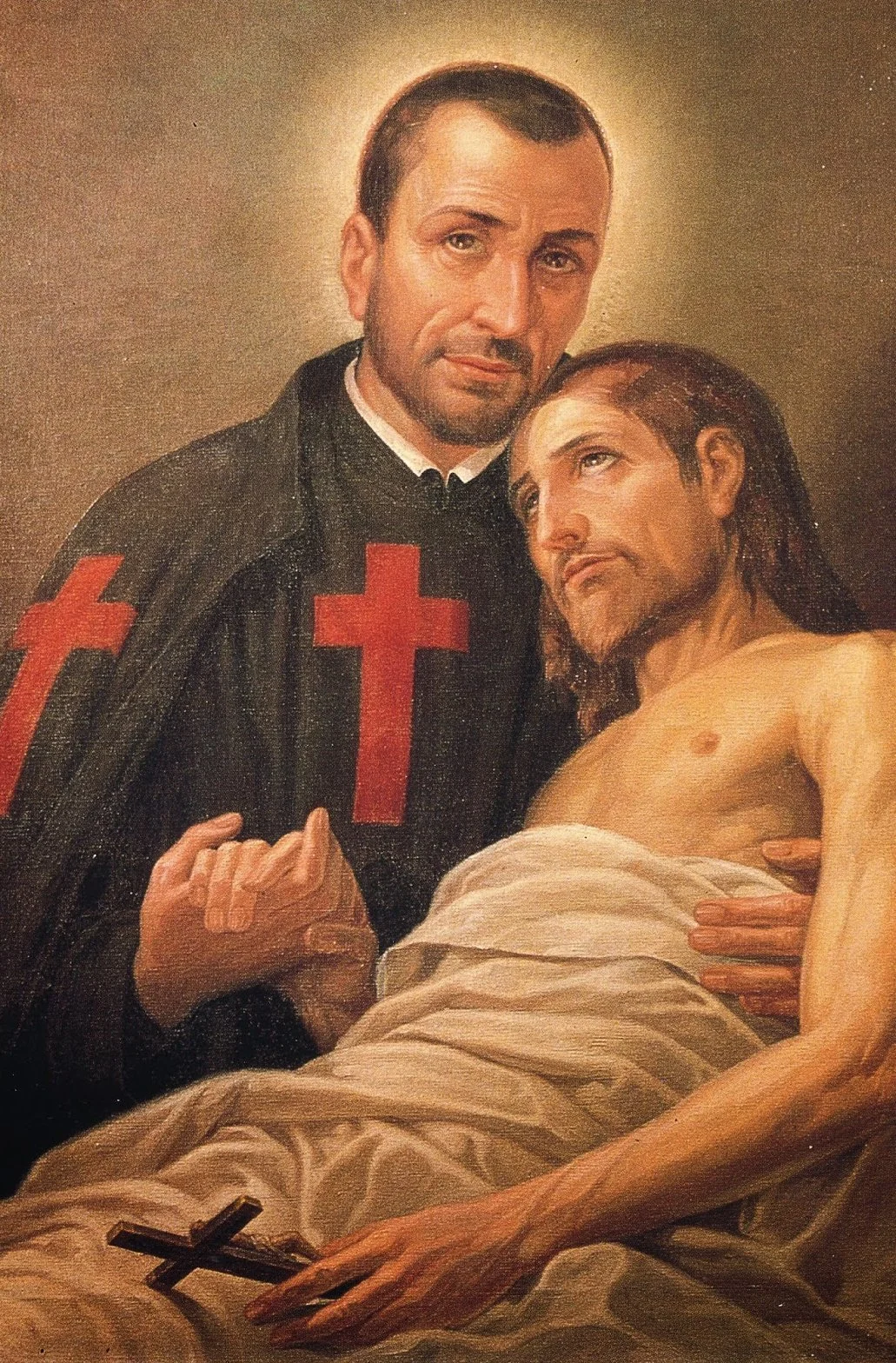
Camillus’ followers became recognizable by the large red cross worn on their dark religious habit. Pope Sixtus V granted permission for the community to wear this sign when he approved the congregation.
Long before the modern humanitarian organization known as the Red Cross existed, Camillian priests and brothers were serving plague victims, hospital patients, and wounded soldiers beneath a red cross associated with Christ’s sacrifice and their commitment to the sick. The red cross remains one of the distinctive signs of the Camillian Order today.
SERVING DURING THE PLAGUE
The Camillian fourth vow was not symbolic. When epidemic disease struck, Camillus and his companions deliberately entered places other people were desperate to escape.
During a catastrophic epidemic and famine in Rome beginning in 1590, Camillus organized relief, distributed food and clothing, searched homes for abandoned sick people, and rescued children whose parents had died or become incapacitated. Members of his young community died while serving plague victims, and Camillian tradition remembers these men as Martyrs of Charity.
FOR NURSES
Saint Camillus holds a special place in Catholic devotion for nurses. Pope Pius XI formally proclaimed Saint Camillus and Saint John of God patrons of nurses in 1930, connecting his centuries-old spirituality of compassionate bedside care directly with the modern nursing profession.
Nurses may ask his intercession for patience during exhausting shifts, skill in difficult procedures, compassion toward demanding patients, protection from burnout, courage around death, and the grace to remember the dignity of the person beneath the diagnosis. His words “More heart in those hands” remain a concise expression of Christian nursing.
FOR HEALTHCARE WORKERS
Saint Camillus’ patronage reaches beyond a single medical profession. Doctors, respiratory therapists, paramedics, nursing assistants, hospital chaplains, technicians, therapists, pharmacists, social workers, hospice employees, and many others who care for the sick can find in his life a genuine spiritual companion.
Medical science has changed enormously since the sixteenth century, but the central question Camillus asked remains unchanged: How should a suffering human being be treated? His answer joined competence, dignity, cleanliness, compassion, and spiritual care into a single Christian vision of healthcare.
FOR THE SICK
Pope Leo XIII formally proclaimed Saint Camillus a patron of the sick and hospitals in 1886. Those facing illness therefore stand within a longstanding Catholic tradition when they ask his intercession for healing, courage, peace, endurance, and trust in God.
Camillus also understood illness personally. He lived for decades with a painful wound that resisted treatment, limited his choices, disrupted his plans, and repeatedly returned him to the experience of being a patient. The sick can therefore approach him not only as the founder who cared for patients, but as someone who knew what it meant to suffer in his own body.
FOR CHRONIC WOUNDS & LONG-TERM ILLNESS
Camillus’ leg ulcer profoundly shaped his vocation. It prevented him from remaining with the Capuchins, repeatedly required medical treatment, and remained a source of physical pain long after his conversion.
For someone living with a wound that will not close, repeated infections, chronic pain, disability, or an illness that refuses to resolve, this part of his story carries particular meaning. Camillus became holy while continuing to suffer, and his life shows that sanctity does not depend upon first receiving the physical cure for which a person longs.
FOR GAMBLING ADDICTION
Although the Church has not formally named Saint Camillus patron of gambling addiction, his own struggle with compulsive gambling gives people seeking freedom from it a powerful spiritual connection with him. Gambling repeatedly consumed his money, damaged his stability, and contributed to the circumstances that left him in poverty.
Those trying to stop gambling may ask his intercession for freedom from compulsion, honesty about losses, courage to seek help, restoration of damaged relationships, responsibility with money, and perseverance after relapse. His life demonstrates that a destructive habit can belong to a person’s past without being allowed to determine that person’s future.
FOR ADDICTION & RADICAL REPENTANCE
The spiritual lesson of Camillus’ conversion extends beyond gambling. He knew what it meant to become trapped in behavior that contradicted the person God was calling him to become, and his repentance required far more than one emotional moment.
His conversion gradually reordered his habits, work, relationships, prayer, responsibilities, and use of his abilities. For those seeking recovery from addiction or another deeply rooted destructive behavior, Camillus offers an example of repentance that becomes visible through an entirely different way of living.
FOR CAREGIVER EXHAUSTION
Long-term caregiving can become physically and emotionally exhausting, especially when illness is chronic and the work is repetitive. Camillus understood that difficult patients still deserved tenderness, cleanliness, dignity, patience, and spiritual care.
His call to care for the sick with the affection of a mother toward her only sick child remains demanding precisely because compassion becomes hardest when a caregiver is tired. Family caregivers and healthcare professionals can ask his intercession not only for greater stamina, but for the grace to prevent exhaustion from hardening the heart.
FOR HOSPITAL CHAPLAINS & THE DYING
Camillus was deeply concerned with the soul as well as the body. One of the failures he observed in hospitals was that dying patients could be neglected spiritually and priests were not always summoned when they were needed.
His community therefore cared for physical suffering while also accompanying people spiritually toward death. Hospital chaplains, hospice workers, priests responding to emergency calls, and families sitting beside dying loved ones can find in Saint Camillus a particularly fitting intercessor for courage, mercy, and a peaceful Christian death.
HIS FINAL YEARS
Years of strenuous service and chronic illness gradually weakened Camillus. He resigned as Superior General in 1607, but leaving leadership did not mean withdrawing from the sick, and he continued serving them personally whenever his strength allowed.
Saint Camillus died in Rome on July 14, 1614, at sixty-four years old. His final testament entrusted his body, soul, sins, and entire life to the mercy of Jesus Christ Crucified, bringing to completion a life that had moved from gambling and military instability to priesthood and sacrificial service.
CANONIZATION & PATRONAGE
Pope Benedict XIV beatified Camillus in 1742 and canonized him on June 29, 1746. His formal patronage developed later, with Pope Leo XIII proclaiming him a universal patron of hospitals and the sick in 1886 and Pope Pius XI extending that patronage to healthcare personnel in 1930.
These declarations recognize what had already become unmistakable in his life and religious order. The former patient had become one of the Church’s great advocates for the sick, and the man whose own body remained wounded had spent the rest of his life teaching others how to care for wounded bodies with dignity and love.
HIS FEAST DAY
Saint Camillus died on July 14, which remains his general liturgical feast date. In the United States, however, his Optional Memorial is celebrated on July 18 because July 14 is occupied by the Memorial of Saint Kateri Tekakwitha.
Both dates therefore appear in Catholic sources for legitimate liturgical reasons. Catholics in the United States commonly encounter July 18, while the broader Roman calendar associates Saint Camillus with July 14, the anniversary of his death.
HIS RELICS IN ROME
Saint Camillus’ mortal remains are preserved in the Church of Santa Maria Maddalena in Campo Marzio in Rome, closely connected with the Camillian Generalate. The adjacent Camillian museum contains relics, manuscripts, and personal objects associated with his life and religious ministry.
Among the preserved objects are his crucifix, items associated with his religious life, and even bandages connected with the chronic ulcer that afflicted him. These relics preserve the memory of both his spiritual devotion and the physical suffering that accompanied much of his vocation.
THE RELIC OF HIS HEART
The Camillian Order also preserves Saint Camillus’ heart as a relic. The symbolism is especially striking for a saint whose most famous instruction centered upon putting more heart into the care of suffering people.
The relic has traveled to hospitals, churches, care homes, and other places of suffering as part of Camillian missions and pilgrimages. The preserved heart gives physical expression to the spirituality summarized in his words: “More heart in those hands.”
OFFICIAL LITURGICAL PRAYER
The Roman Missal preserves a Collect for Saint Camillus that asks God to give the faithful the same charity toward the sick that characterized his own life and ministry:
“O God, who adorned the Priest Saint Camillus with a singular grace of charity towards the sick, pour out upon us, by his merits, a spirit of love for you, so that, serving you in our neighbor, we may, at the hour of our death, pass safely over to you. Through our Lord Jesus Christ, your Son, who lives and reigns with you in the unity of the Holy Spirit, God, for ever and ever.”
Amen.
The prayer joins two themes that defined Camillus: love of God and service to the suffering neighbor. His spirituality never separated the care of bodies from preparation for eternal life, and the Collect reflects that union of charity, service, and hope.
FAQ
Who was Saint Camillus de Lellis? Saint Camillus de Lellis was a sixteenth-century Italian soldier who underwent a profound conversion, became a priest, reformed hospital care, and founded the Ministers of the Sick, commonly called the Camillians. He lived from 1550 to 1614 and became one of the Church’s most important patrons of healthcare.
Is Saint Camillus officially the patron saint of the sick? Yes. Pope Leo XIII proclaimed Saint Camillus and Saint John of God universal patrons of hospitals and the sick in 1886. This patronage formally connects his intercession with people facing illness and with the institutions that care for them.
Is Saint Camillus officially a patron of nurses and healthcare workers? Yes. Pope Pius XI proclaimed Saint Camillus and Saint John of God patrons of nurses in 1930, and Catholic sources also recognize his patronage of healthcare personnel more broadly.
Was Saint Camillus really addicted to gambling? Historical accounts describe gambling as a serious vice in his youth. He repeatedly lost money and possessions through gambling before the conversion that redirected his life toward God and the sick.
Can someone struggling with gambling ask Saint Camillus for intercession? Yes. Gambling addiction is not one of his formally proclaimed universal patronages, but his own documented history makes him especially meaningful for people seeking freedom from gambling and other destructive compulsions.
Was Saint Camillus a soldier? Yes. Before his conversion and religious vocation, Camillus served as a mercenary soldier, and his later religious order would also serve wounded soldiers during military campaigns.
Did Saint Camillus suffer from chronic illness? Yes. He suffered for decades from an ulcerated wound on his leg that repeatedly required medical treatment and prevented him from remaining with the Capuchins. The wound became one of the experiences through which he learned to understand the suffering of patients.
Was Saint Camillus miraculously healed of his leg wound? His conversion did not immediately remove his physical suffering. The chronic leg condition persisted for many years and became part of the life through which he learned to serve other patients with understanding and compassion.
Why did Saint Camillus found a religious order? His own experiences in hospitals convinced him that the sick needed caregivers motivated by charity and trained to care for both bodily and spiritual needs. He gathered men around this vision, and the community eventually became the Order of Clerics Regular, Ministers to the Sick.
What is the fourth Camillian vow? In addition to poverty, chastity, and obedience, Camillians traditionally vow to serve the sick even when doing so places their own lives at risk. This vow became especially visible during epidemics when members of the order died caring for contagious patients.
Why do Camillians wear a red cross? Pope Sixtus V permitted Camillus’ community to wear a red cross on its dark religious habit when the congregation received approval in 1586. The cross became the distinctive sign of the order’s service to Christ in the sick.
Did Saint Camillus care for plague victims? Yes. Camillus and his companions deliberately entered epidemic conditions to care for the sick, and members of his religious community died while carrying out that ministry.
Did Saint Camillus help reform nursing? Yes. He insisted upon greater cleanliness, competence, tenderness, nutrition, humane treatment, and attention to both bodily and spiritual needs. His approach is therefore often recognized as an important precursor of modern professional nursing.
What did Saint Camillus mean by “More heart in those hands”? His teaching was that competent physical care should be animated by genuine love for the suffering person. The Camillian Order continues to preserve the saying as a summary of his healthcare spirituality.
Where are Saint Camillus’ relics? His mortal remains are preserved at the Church of Santa Maria Maddalena in Rome, beside the General House of the Camillian Order. The site also preserves personal objects and other relics associated with his life.
Is Saint Camillus’ heart preserved as a relic? Yes. His heart is separately preserved and has traveled on devotional pilgrimages to hospitals, churches, and communities serving the sick.
When was Saint Camillus canonized? Pope Benedict XIV canonized Saint Camillus on June 29, 1746. His formal patronage of the sick, hospitals, nurses, and healthcare personnel developed through later papal declarations.
When is Saint Camillus’ feast day? His general feast is July 14, the anniversary of his death. In the United States his Optional Memorial is observed on July 18 because the Memorial of Saint Kateri Tekakwitha is celebrated on July 14.
Is the prayer associated with Saint Camillus an official Catholic prayer? Yes. The Roman Missal Collect for Saint Camillus asks God to give the faithful his spirit of charity toward the sick and to lead them safely toward eternal life.
Who would this Saint Camillus prayer card make a meaningful gift for? It is particularly appropriate for nurses, doctors, nursing students, hospital workers, hospice employees, caregivers, military medical personnel, people with chronic wounds or illnesses, recovering gamblers, those seeking conversion, and families caring for someone who is seriously ill or dying.
THE MAIN MESSAGE OF SAINT CAMILLUS DE LELLIS’ LIFE
Saint Camillus teaches that God can take precisely the parts of a life that appear ruined and transform them into places of mercy. His gambling taught him what slavery to a destructive habit felt like, his poverty taught him dependence, his chronic wound made him a patient, and his experiences in neglected hospitals showed him how badly suffering people could be treated. His conversion did not erase that history; it transformed that history into the foundation of his vocation.
The former gambler became a religious founder, the difficult hospital patient became a reformer of hospital care, and the wounded soldier became a patron of the sick and healthcare workers. The man who once squandered what he possessed eventually founded a community whose members promised to risk their own lives for strangers suffering from plague and other diseases.
His famous instruction therefore contains the direction of his entire transformed life: “More heart in those hands, brothers, more heart!” Skill matters, cleanliness matters, medicine matters, and discipline matters, but Saint Camillus insists that the suffering human being must never disappear behind the work being done to care for them.
Saint Camillus de Lellis was a soldier, recovering compulsive gambler, priest, hospital reformer, and founder of the Order of Clerics Regular, Ministers to the Sick, commonly known as the Camillians. His transformation is one of the most dramatic conversion stories in Catholic history. The young Camillus lived an unstable military life, struggled seriously with gambling, lost money and possessions, and eventually became poor enough to beg for help. After a profound conversion in 1575, he devoted the rest of his life to serving Christ in the sick and dying.
Saint Camillus has formal Catholic patronage connected with healthcare. Pope Leo XIII proclaimed him patron of the sick and hospitals in 1886, Pope Pius XI extended his patronage to healthcare personnel in 1930, and Pope Paul VI named him patron of the Italian Military Health Service in 1974. His life therefore has particular meaning for nurses, physicians, hospital employees, emergency personnel, caregivers, chaplains, military medical personnel, the seriously ill, the dying, and families caring for someone who is sick.
His life also speaks powerfully to people struggling with gambling addiction, destructive habits, chronic illness, wounds that will not heal, relapse, and the need for radical conversion. Camillus personally knew what it meant to lose money and security through gambling, to make resolutions and fail, and to live with a painful wound that repeatedly disrupted his plans. Although the Church has not formally named him patron of gambling addiction, his own history gives those seeking freedom from destructive compulsions a deeply personal reason to ask his intercession.
Each prayer card measures 2.5" x 4.25", is handmade in Austin, Texas, printed on museum-quality photo paper rather than ordinary cardstock, and double laminated for durability. Each card is prepared prayerfully with the recipient and their intentions lifted before Christ while asking Saint Camillus de Lellis to intercede for the person who will receive it.
THE LIFE & STORY
Camillus de Lellis was born on May 25, 1550, in Bucchianico in Abruzzo, then part of the Kingdom of Naples. His father was a professional soldier, and Camillus eventually followed the military life himself. His youth developed very differently from the compassionate saint remembered today, and gambling became one of the destructive forces shaping his early adulthood.
He was physically imposing, hot-tempered, restless, and attracted to the instability of military life. His later sanctity is especially striking because he did not begin as an unusually gentle or obviously religious young man. His life had to be redirected almost completely before the wounded soldier and gambler became one of the Church’s great servants of the sick.
A SOLDIER BEFORE HE WAS A SAINT
Camillus served as a mercenary soldier during conflicts involving Christian European powers and the Ottoman Turks. Military life exposed him to violence, danger, illness, and instability, while his gambling repeatedly consumed the money he earned.
His military background remained significant long after his conversion. The religious order he later founded would send members to care for wounded soldiers during military campaigns, carrying organized medical and spiritual assistance into dangerous conditions where the wounded were often left with little care.
THE GAMBLER WHO LOST ALMOST EVERYTHING
Gambling was not a minor weakness in Camillus’ early life. Historical tradition describes it as a serious and compulsive habit that contributed to his poverty and instability. After military service, he found himself wandering without secure employment and eventually begging outside a church in Manfredonia.
His story gives particular hope to people whose lives have been damaged by gambling or another destructive compulsion. Camillus knew the cycle of money, risk, loss, shame, and instability personally, yet those failures did not become the final definition of his life. The man who once lost almost everything through gambling eventually became a saint whose life was spent giving himself completely for others.
FEBRUARY 2, 1575: THE CONVERSION OF CAMILLUS
The decisive turning point came on February 2, 1575. Camillus had been working as a laborer for the Capuchins when a friar named Father Angelo spoke seriously with him about God and the condition of his life. The following morning, while traveling back toward Manfredonia, Camillus was overwhelmed by repentance and recognized how far he had wandered from God.
From that day forward, February 2 became remembered within the Camillian family as the date of their founder’s conversion. Camillus was twenty-five years old, and his life shows that no amount of wasted time, money, health, or opportunity places a person beyond the possibility of beginning again with God.
THE WOUND THAT WOULD NOT HEAL
Camillus suffered for decades from a severe ulcerated wound on his leg. The condition repeatedly forced him to seek hospital treatment and twice prevented him from remaining with the Capuchins, despite his sincere desire after conversion to live religious life with them.
What first appeared to be an obstacle to his vocation eventually became one of the roads leading him toward it. Because Camillus was repeatedly a hospital patient himself, he experienced neglect, discomfort, and poor treatment from the patient’s side of the bed. His wound remained a source of suffering for many years, and his holiness developed without first receiving complete physical healing.
THE HOSPITAL THAT CHANGED HIS LIFE
Camillus received treatment at San Giacomo degli Incurabili in Rome. During an earlier period there, his gambling and behavior had become serious enough that he lost his position, but when he returned after conversion he was a markedly different man.
He became increasingly disturbed by the condition of hospital care. Many attendants lacked training or compassion, sanitation was poor, patients could be neglected, and the spiritual needs of the dying were sometimes overlooked. Camillus began improving food, hygiene, order, pastoral care, and the personal attention given to patients, eventually becoming a hospital supervisor and helping reform the very environment in which he had once failed.
“MORE HEART IN THOSE HANDS”
One of the sayings most closely associated with Saint Camillus summarizes his entire approach to healthcare: “More heart in those hands, brothers, more heart!” The Camillian tradition preserves these words as an expression of his belief that skilled medical care reaches its Christian fullness when it is joined to genuine love for the suffering person.
His teaching remains especially meaningful for nurses and other hands-on caregivers. Camillus did not oppose technical competence to compassion; he demanded both. The patient deserved trained and capable hands, but those hands also needed to belong to a heart that recognized Christ in the person being served.
CARE FOR THE SICK LIKE A MOTHER
Camillus gave an even more demanding instruction in his regulations for hospital service. He wanted caregivers to ask God for what he described as a motherly affection toward the sick, serving each suffering person with the tenderness a loving mother would give her only sick child.
That ideal became one of the defining characteristics of Camillian spirituality. A patient was never merely a diagnosis, a task, an occupied bed, or an inconvenience. The sick person was someone whose dignity demanded careful attention and someone in whom Christ Himself was to be encountered.
A REVOLUTION IN HOSPITAL CARE
Camillus lived in an era when hospital medicine was far removed from modern standards. He insisted upon better food, ventilation, sanitation, orderly beds, gentle handling of patients, attention to infectious disease, technical competence, and spiritual care for those approaching death.
Many of these principles now seem obvious because modern healthcare assumes that patients deserve cleanliness, training, and humane treatment. In the sixteenth century, however, Camillus’ insistence upon them represented an important reform, and he is often remembered as a significant precursor of modern professional nursing.
SAINT PHILIP NERI & CAMILLUS
During his spiritual development in Rome, Camillus came under the direction of Saint Philip Neri, one of the great saints of the Catholic Reformation. Philip helped guide him during the years when Camillus was discerning how his vocation of service to the sick should develop.
Camillus eventually concluded that priesthood would allow him to provide more complete spiritual care to patients, especially those approaching death. He studied in Rome and was ordained a Catholic priest in 1584, uniting sacramental ministry with the hospital reform already consuming his life.
FOUNDING THE MINISTERS OF THE SICK
Camillus began gathering men who would care for patients not simply because they were paid to perform unpleasant work, but because they believed they were serving Christ Himself. This community developed into the Ministers of the Sick, today commonly known as the Camillians.
Pope Sixtus V approved the congregation in 1586, and Pope Gregory XIV elevated it to the status of a religious order in 1591. In addition to the traditional vows of poverty, chastity, and obedience, the Camillians took a remarkable fourth vow to serve the sick even when doing so placed their own lives in danger.
THE RED CROSS OF SAINT CAMILLUS
Camillus’ followers became recognizable by the large red cross worn on their dark religious habit. Pope Sixtus V granted permission for the community to wear this sign when he approved the congregation.
Long before the modern humanitarian organization known as the Red Cross existed, Camillian priests and brothers were serving plague victims, hospital patients, and wounded soldiers beneath a red cross associated with Christ’s sacrifice and their commitment to the sick. The red cross remains one of the distinctive signs of the Camillian Order today.
SERVING DURING THE PLAGUE
The Camillian fourth vow was not symbolic. When epidemic disease struck, Camillus and his companions deliberately entered places other people were desperate to escape.
During a catastrophic epidemic and famine in Rome beginning in 1590, Camillus organized relief, distributed food and clothing, searched homes for abandoned sick people, and rescued children whose parents had died or become incapacitated. Members of his young community died while serving plague victims, and Camillian tradition remembers these men as Martyrs of Charity.
FOR NURSES
Saint Camillus holds a special place in Catholic devotion for nurses. Pope Pius XI formally proclaimed Saint Camillus and Saint John of God patrons of nurses in 1930, connecting his centuries-old spirituality of compassionate bedside care directly with the modern nursing profession.
Nurses may ask his intercession for patience during exhausting shifts, skill in difficult procedures, compassion toward demanding patients, protection from burnout, courage around death, and the grace to remember the dignity of the person beneath the diagnosis. His words “More heart in those hands” remain a concise expression of Christian nursing.
FOR HEALTHCARE WORKERS
Saint Camillus’ patronage reaches beyond a single medical profession. Doctors, respiratory therapists, paramedics, nursing assistants, hospital chaplains, technicians, therapists, pharmacists, social workers, hospice employees, and many others who care for the sick can find in his life a genuine spiritual companion.
Medical science has changed enormously since the sixteenth century, but the central question Camillus asked remains unchanged: How should a suffering human being be treated? His answer joined competence, dignity, cleanliness, compassion, and spiritual care into a single Christian vision of healthcare.
FOR THE SICK
Pope Leo XIII formally proclaimed Saint Camillus a patron of the sick and hospitals in 1886. Those facing illness therefore stand within a longstanding Catholic tradition when they ask his intercession for healing, courage, peace, endurance, and trust in God.
Camillus also understood illness personally. He lived for decades with a painful wound that resisted treatment, limited his choices, disrupted his plans, and repeatedly returned him to the experience of being a patient. The sick can therefore approach him not only as the founder who cared for patients, but as someone who knew what it meant to suffer in his own body.
FOR CHRONIC WOUNDS & LONG-TERM ILLNESS
Camillus’ leg ulcer profoundly shaped his vocation. It prevented him from remaining with the Capuchins, repeatedly required medical treatment, and remained a source of physical pain long after his conversion.
For someone living with a wound that will not close, repeated infections, chronic pain, disability, or an illness that refuses to resolve, this part of his story carries particular meaning. Camillus became holy while continuing to suffer, and his life shows that sanctity does not depend upon first receiving the physical cure for which a person longs.
FOR GAMBLING ADDICTION
Although the Church has not formally named Saint Camillus patron of gambling addiction, his own struggle with compulsive gambling gives people seeking freedom from it a powerful spiritual connection with him. Gambling repeatedly consumed his money, damaged his stability, and contributed to the circumstances that left him in poverty.
Those trying to stop gambling may ask his intercession for freedom from compulsion, honesty about losses, courage to seek help, restoration of damaged relationships, responsibility with money, and perseverance after relapse. His life demonstrates that a destructive habit can belong to a person’s past without being allowed to determine that person’s future.
FOR ADDICTION & RADICAL REPENTANCE
The spiritual lesson of Camillus’ conversion extends beyond gambling. He knew what it meant to become trapped in behavior that contradicted the person God was calling him to become, and his repentance required far more than one emotional moment.
His conversion gradually reordered his habits, work, relationships, prayer, responsibilities, and use of his abilities. For those seeking recovery from addiction or another deeply rooted destructive behavior, Camillus offers an example of repentance that becomes visible through an entirely different way of living.
FOR CAREGIVER EXHAUSTION
Long-term caregiving can become physically and emotionally exhausting, especially when illness is chronic and the work is repetitive. Camillus understood that difficult patients still deserved tenderness, cleanliness, dignity, patience, and spiritual care.
His call to care for the sick with the affection of a mother toward her only sick child remains demanding precisely because compassion becomes hardest when a caregiver is tired. Family caregivers and healthcare professionals can ask his intercession not only for greater stamina, but for the grace to prevent exhaustion from hardening the heart.
FOR HOSPITAL CHAPLAINS & THE DYING
Camillus was deeply concerned with the soul as well as the body. One of the failures he observed in hospitals was that dying patients could be neglected spiritually and priests were not always summoned when they were needed.
His community therefore cared for physical suffering while also accompanying people spiritually toward death. Hospital chaplains, hospice workers, priests responding to emergency calls, and families sitting beside dying loved ones can find in Saint Camillus a particularly fitting intercessor for courage, mercy, and a peaceful Christian death.
HIS FINAL YEARS
Years of strenuous service and chronic illness gradually weakened Camillus. He resigned as Superior General in 1607, but leaving leadership did not mean withdrawing from the sick, and he continued serving them personally whenever his strength allowed.
Saint Camillus died in Rome on July 14, 1614, at sixty-four years old. His final testament entrusted his body, soul, sins, and entire life to the mercy of Jesus Christ Crucified, bringing to completion a life that had moved from gambling and military instability to priesthood and sacrificial service.
CANONIZATION & PATRONAGE
Pope Benedict XIV beatified Camillus in 1742 and canonized him on June 29, 1746. His formal patronage developed later, with Pope Leo XIII proclaiming him a universal patron of hospitals and the sick in 1886 and Pope Pius XI extending that patronage to healthcare personnel in 1930.
These declarations recognize what had already become unmistakable in his life and religious order. The former patient had become one of the Church’s great advocates for the sick, and the man whose own body remained wounded had spent the rest of his life teaching others how to care for wounded bodies with dignity and love.
HIS FEAST DAY
Saint Camillus died on July 14, which remains his general liturgical feast date. In the United States, however, his Optional Memorial is celebrated on July 18 because July 14 is occupied by the Memorial of Saint Kateri Tekakwitha.
Both dates therefore appear in Catholic sources for legitimate liturgical reasons. Catholics in the United States commonly encounter July 18, while the broader Roman calendar associates Saint Camillus with July 14, the anniversary of his death.
HIS RELICS IN ROME
Saint Camillus’ mortal remains are preserved in the Church of Santa Maria Maddalena in Campo Marzio in Rome, closely connected with the Camillian Generalate. The adjacent Camillian museum contains relics, manuscripts, and personal objects associated with his life and religious ministry.
Among the preserved objects are his crucifix, items associated with his religious life, and even bandages connected with the chronic ulcer that afflicted him. These relics preserve the memory of both his spiritual devotion and the physical suffering that accompanied much of his vocation.
THE RELIC OF HIS HEART
The Camillian Order also preserves Saint Camillus’ heart as a relic. The symbolism is especially striking for a saint whose most famous instruction centered upon putting more heart into the care of suffering people.
The relic has traveled to hospitals, churches, care homes, and other places of suffering as part of Camillian missions and pilgrimages. The preserved heart gives physical expression to the spirituality summarized in his words: “More heart in those hands.”
OFFICIAL LITURGICAL PRAYER
The Roman Missal preserves a Collect for Saint Camillus that asks God to give the faithful the same charity toward the sick that characterized his own life and ministry:
“O God, who adorned the Priest Saint Camillus with a singular grace of charity towards the sick, pour out upon us, by his merits, a spirit of love for you, so that, serving you in our neighbor, we may, at the hour of our death, pass safely over to you. Through our Lord Jesus Christ, your Son, who lives and reigns with you in the unity of the Holy Spirit, God, for ever and ever.”
Amen.
The prayer joins two themes that defined Camillus: love of God and service to the suffering neighbor. His spirituality never separated the care of bodies from preparation for eternal life, and the Collect reflects that union of charity, service, and hope.
FAQ
Who was Saint Camillus de Lellis? Saint Camillus de Lellis was a sixteenth-century Italian soldier who underwent a profound conversion, became a priest, reformed hospital care, and founded the Ministers of the Sick, commonly called the Camillians. He lived from 1550 to 1614 and became one of the Church’s most important patrons of healthcare.
Is Saint Camillus officially the patron saint of the sick? Yes. Pope Leo XIII proclaimed Saint Camillus and Saint John of God universal patrons of hospitals and the sick in 1886. This patronage formally connects his intercession with people facing illness and with the institutions that care for them.
Is Saint Camillus officially a patron of nurses and healthcare workers? Yes. Pope Pius XI proclaimed Saint Camillus and Saint John of God patrons of nurses in 1930, and Catholic sources also recognize his patronage of healthcare personnel more broadly.
Was Saint Camillus really addicted to gambling? Historical accounts describe gambling as a serious vice in his youth. He repeatedly lost money and possessions through gambling before the conversion that redirected his life toward God and the sick.
Can someone struggling with gambling ask Saint Camillus for intercession? Yes. Gambling addiction is not one of his formally proclaimed universal patronages, but his own documented history makes him especially meaningful for people seeking freedom from gambling and other destructive compulsions.
Was Saint Camillus a soldier? Yes. Before his conversion and religious vocation, Camillus served as a mercenary soldier, and his later religious order would also serve wounded soldiers during military campaigns.
Did Saint Camillus suffer from chronic illness? Yes. He suffered for decades from an ulcerated wound on his leg that repeatedly required medical treatment and prevented him from remaining with the Capuchins. The wound became one of the experiences through which he learned to understand the suffering of patients.
Was Saint Camillus miraculously healed of his leg wound? His conversion did not immediately remove his physical suffering. The chronic leg condition persisted for many years and became part of the life through which he learned to serve other patients with understanding and compassion.
Why did Saint Camillus found a religious order? His own experiences in hospitals convinced him that the sick needed caregivers motivated by charity and trained to care for both bodily and spiritual needs. He gathered men around this vision, and the community eventually became the Order of Clerics Regular, Ministers to the Sick.
What is the fourth Camillian vow? In addition to poverty, chastity, and obedience, Camillians traditionally vow to serve the sick even when doing so places their own lives at risk. This vow became especially visible during epidemics when members of the order died caring for contagious patients.
Why do Camillians wear a red cross? Pope Sixtus V permitted Camillus’ community to wear a red cross on its dark religious habit when the congregation received approval in 1586. The cross became the distinctive sign of the order’s service to Christ in the sick.
Did Saint Camillus care for plague victims? Yes. Camillus and his companions deliberately entered epidemic conditions to care for the sick, and members of his religious community died while carrying out that ministry.
Did Saint Camillus help reform nursing? Yes. He insisted upon greater cleanliness, competence, tenderness, nutrition, humane treatment, and attention to both bodily and spiritual needs. His approach is therefore often recognized as an important precursor of modern professional nursing.
What did Saint Camillus mean by “More heart in those hands”? His teaching was that competent physical care should be animated by genuine love for the suffering person. The Camillian Order continues to preserve the saying as a summary of his healthcare spirituality.
Where are Saint Camillus’ relics? His mortal remains are preserved at the Church of Santa Maria Maddalena in Rome, beside the General House of the Camillian Order. The site also preserves personal objects and other relics associated with his life.
Is Saint Camillus’ heart preserved as a relic? Yes. His heart is separately preserved and has traveled on devotional pilgrimages to hospitals, churches, and communities serving the sick.
When was Saint Camillus canonized? Pope Benedict XIV canonized Saint Camillus on June 29, 1746. His formal patronage of the sick, hospitals, nurses, and healthcare personnel developed through later papal declarations.
When is Saint Camillus’ feast day? His general feast is July 14, the anniversary of his death. In the United States his Optional Memorial is observed on July 18 because the Memorial of Saint Kateri Tekakwitha is celebrated on July 14.
Is the prayer associated with Saint Camillus an official Catholic prayer? Yes. The Roman Missal Collect for Saint Camillus asks God to give the faithful his spirit of charity toward the sick and to lead them safely toward eternal life.
Who would this Saint Camillus prayer card make a meaningful gift for? It is particularly appropriate for nurses, doctors, nursing students, hospital workers, hospice employees, caregivers, military medical personnel, people with chronic wounds or illnesses, recovering gamblers, those seeking conversion, and families caring for someone who is seriously ill or dying.
THE MAIN MESSAGE OF SAINT CAMILLUS DE LELLIS’ LIFE
Saint Camillus teaches that God can take precisely the parts of a life that appear ruined and transform them into places of mercy. His gambling taught him what slavery to a destructive habit felt like, his poverty taught him dependence, his chronic wound made him a patient, and his experiences in neglected hospitals showed him how badly suffering people could be treated. His conversion did not erase that history; it transformed that history into the foundation of his vocation.
The former gambler became a religious founder, the difficult hospital patient became a reformer of hospital care, and the wounded soldier became a patron of the sick and healthcare workers. The man who once squandered what he possessed eventually founded a community whose members promised to risk their own lives for strangers suffering from plague and other diseases.
His famous instruction therefore contains the direction of his entire transformed life: “More heart in those hands, brothers, more heart!” Skill matters, cleanliness matters, medicine matters, and discipline matters, but Saint Camillus insists that the suffering human being must never disappear behind the work being done to care for them.