 Image 1 of 1
-
THE LIFE & STORY
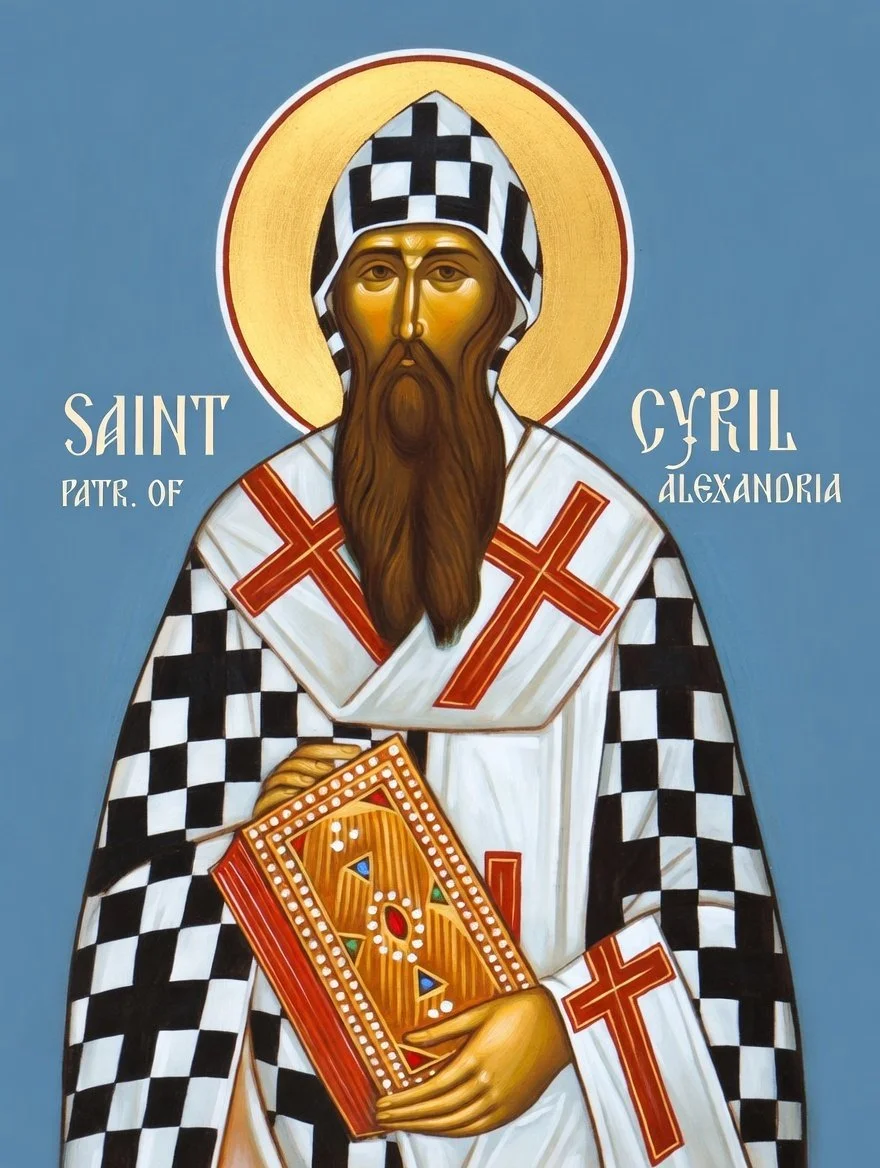
Cyril was born into a Christian family in Egypt and received a strong classical education alongside deep theological formation. He was closely connected to his uncle, Patriarch Theophilus of Alexandria, under whom he began his ecclesiastical service. From an early age, Cyril was immersed in Scripture, patristic teaching, and the spiritual traditions of Egyptian monasticism.
He did not grow into leadership gently.
He was formed by conflict.
When Cyril became Patriarch of Alexandria in AD 412, he inherited a divided city marked by religious tension, political unrest, and competing theological voices. Alexandria was one of the intellectual capitals of the ancient world, and its Christian community was under constant pressure from both imperial authority and rival doctrinal movements.
Cyril quickly found himself defending the Church on multiple fronts.
His greatest trial came during the Nestorian controversy. Nestorius, Patriarch of Constantinople, began teaching that Mary should not be called Theotokos (God-bearer), suggesting instead that Christ’s divine and human natures were separate in a way that fractured the unity of Jesus Himself.
To Cyril, this was not abstract theology.
This was salvation at stake.
If Christ were divided, humanity could not be redeemed.
Cyril wrote tirelessly, arguing that Jesus Christ is one divine Person with both fully divine and fully human natures united without separation. He defended the ancient confession that Mary is rightly called Theotokos because the One she bore is truly God incarnate.
The conflict escalated across the empire. Bishops took sides. Political forces intervened. Accusations flew. The Church stood on the edge of fragmentation.
In AD 431, the Council of Ephesus convened. Cyril presided over the council, which formally condemned Nestorianism and affirmed the orthodox teaching of Christ’s unity. The title Theotokos was upheld, securing a cornerstone of Christian belief.
But victory did not bring peace.
Cyril endured backlash, imprisonment, slander, and years of strained relationships among bishops. He carried the emotional weight of division even while preserving doctrinal truth. His writings from this period reveal a man burdened by responsibility yet anchored in prayer.
Throughout his life, Cyril remained deeply pastoral. He supported monks, encouraged clergy, wrote extensively on Scripture, and labored to protect ordinary believers from theological confusion. He understood that doctrine shapes souls, and that clarity about Christ safeguards the inner life of the faithful.
He died peacefully in AD 444 after more than three decades as patriarch.
His perseverance preserved the Church’s confession of who Jesus truly is.
-
MIRACLES & PATRONAGE
Patron Saint Of:
Spiritual protection during confusion or conflict
Inner strength when standing for truth
Perseverance through prolonged spiritual pressure
Emotional endurance during seasons of opposition
Clarity of faith amid doctrinal uncertainty
Saint Cyril’s miracle tradition is primarily rooted in his role as confessor and defender of orthodox belief. During his life, many sought his counsel for spiritual stability, clarity of faith, and courage under pressure.
After his death, devotion to him spread throughout Egypt and beyond. Believers reported renewed peace during moments of spiritual turmoil and strength during prolonged trials after invoking his intercession. His writings themselves became instruments of healing, guiding countless souls back to confidence in Christ.
He remains close to those who feel spiritually besieged, emotionally worn thin, or mentally exhausted from carrying responsibility.
Saint Cyril’s miracles often arrive quietly, as restored peace, strengthened resolve, or renewed trust in God when faith feels fragile.
-
PRAYERS
Short Traditional Invocation
Saint Cyril of Alexandria, defender of Christ, pray for us.
Personal Devotional Prayer
Saint Cyril, faithful shepherd and guardian of truth,
you who carried the weight of the Church when storms surrounded her,
I come to you with the burdens I do not know how to release.You understand spiritual pressure.
You understand the exhaustion of conflict.
You understand the loneliness of responsibility.Stand beside me now.
Intercede for me when my heart feels heavy and my thoughts feel scattered.
Intercede for me when peace feels distant and clarity feels clouded.
Intercede for me when standing for what is right feels overwhelming.Ask Christ to strengthen what is weak within me.
Ask Him to quiet the anxiety that rises in my soul.
Ask Him to grant me endurance rooted in trust.Teach me how to remain faithful without becoming hardened.
Teach me how to persevere without losing gentleness.
Teach me how to rest in God even when the road feels long.Saint Cyril, you defended the unity of Christ with courage and sacrifice.
Help me hold fast to truth in my own life.
Help me carry my crosses with humility and hope.Carry my intentions before the throne of mercy.
Hold my name in your prayer.
Guard my heart and protect my spirit.May your witness remind me that God remains present in every struggle,
that truth endures beyond every conflict,
and that peace is born from fidelity.Amen.
-
FAQ
What is Saint Cyril of Alexandria known for?
He is known as the great defender of Christ’s unity and the champion of the title Theotokos for the Virgin Mary. His leadership at the Council of Ephesus preserved essential Christian teaching about who Jesus truly is.When is his feast day?
June 27 in the Roman Catholic and Eastern Orthodox calendars, and Epip 3 in the Coptic calendar.Which Christian traditions venerate Saint Cyril of Alexandria?
He is venerated by Oriental Orthodox Christians (especially the Coptic Church), Eastern Orthodox Christians, and the Universal Catholic Church.Why do people pray to Saint Cyril for spiritual strength and protection?
Because he endured intense opposition, political pressure, and theological warfare while remaining faithful to Christ. His life offers hope to those experiencing spiritual confusion, emotional fatigue, or the quiet strain of standing for truth.