 Image 1 of 1
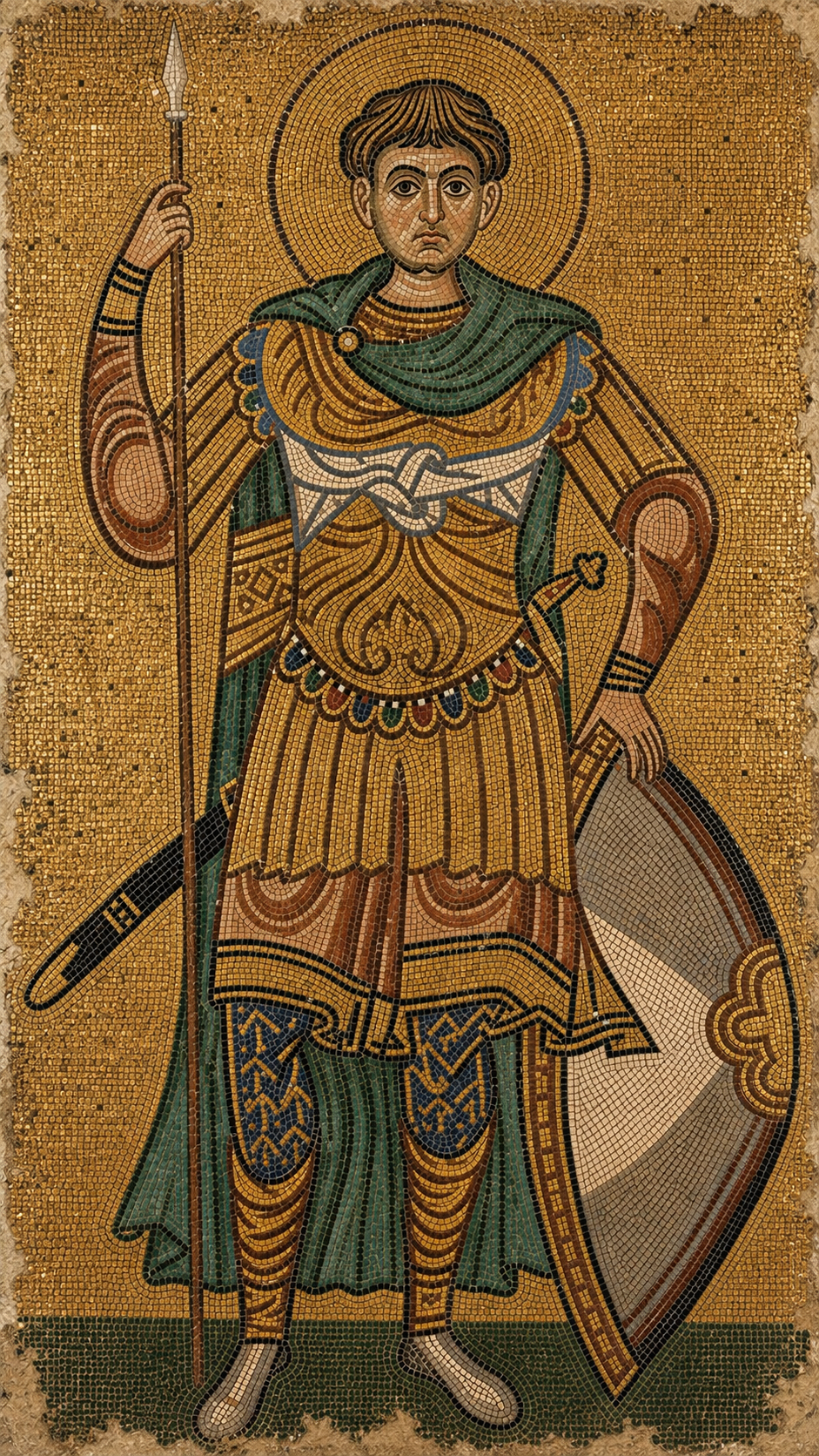
Saint Demetrios of Thessaloniki Prayer Card | For Soldiers, Protection, Courage & Healing
Saint Demetrios of Thessaloniki, also commonly written Saint Demetrius, is one of the great military martyrs of Eastern Christianity. Known as the Great Martyr, the Myrrh-Gusher, and the Protector of Thessaloniki, he is especially beloved by soldiers, people in dangerous professions, Christians seeking courage and protection, the sick seeking healing, young people, and those facing serious spiritual struggles. His feast is celebrated on October 26, with an especially solemn observance in the Byzantine tradition.
The received Byzantine tradition remembers Demetrios as a young man of education, military ability, and public authority in Roman Thessalonica during the persecution of Christians under Galerius Maximian. Although the emperor expected him to suppress Christianity, Demetrios openly confessed Christ and instead strengthened the Christians around him. He was imprisoned and ultimately killed with lances around 305 or 306 AD, giving up rank, security, and life rather than abandon the faith.
Saint Demetrios is particularly meaningful for soldiers, veterans, law-enforcement officers, first responders, protectors, people facing danger, men seeking courage and self-control, Christians under pressure to compromise, and anyone responsible for leading or protecting others. His association with military courage is ancient, and the Orthodox Church has long connected his veneration with soldiers and the defense of one's people. Byzantine liturgical texts likewise invoke him as a defender of those in peril and ask him for protection from visible and invisible enemies.
He also has an unusually strong connection with fighters, wrestlers, martial artists, coaches, and mentors through Saint Nestor of Thessaloniki. Nestor was a young Christian preparing to face the feared arena wrestler Lyaeus, and before entering the stadium he went to the imprisoned Demetrios for prayer and a blessing. Demetrios strengthened him, Nestor defeated the champion, and the Church's own Troparion still praises Demetrios for giving Nestor courage in the stadium.
This makes Demetrios and Nestor especially meaningful as a pair for combat athletes. Nestor represents the fighter who must enter the contest, while Demetrios represents the spiritual father, coach, or mentor who prepares him, gives courage, and reminds him that physical strength must remain subordinate to God. That relationship is not a modern invention because it is preserved directly in Byzantine liturgical worship.
Saint Demetrios is also deeply associated with healing. After his martyrdom, his servant Saint Lupus preserved Demetrios' blood-stained garment and ring, and the tradition remembers healings occurring through them. His shrine later became famous for fragrant myrrh associated with his relics, giving him the title Myrrh-Gusher or Myroblite, and Byzantine Catholic hymnography describes his church and relics as a source of miracles and medicine for illnesses.
This prayer card is especially fitting for a soldier leaving for deployment, a veteran, police officer, firefighter, young man entering military service, fighter preparing for competition, coach responsible for younger athletes, someone facing illness, or anyone who needs courage in a dangerous or uncertain season. It can also be given for baptism, chrismation, confirmation, a name day, military graduation, martial-arts promotion, first fight, wrestling season, or simply as a daily reminder that Christian strength must remain joined to humility, faith, sacrifice, and self-control.
Each 2.5" x 4.25" prayer card is handmade in Austin, Texas and prepared prayerfully with each order. It is printed on museum-quality photo paper rather than cardstock, double-laminated for durability, and made while the recipient and their intentions are lifted before Christ in prayer, with Saint Demetrios asked to intercede for them.
THE LIFE & STORY
Saint Demetrios lived in Thessalonica, modern Thessaloniki in Greece, during the final great era of Roman persecution before the legalization of Christianity. The Byzantine Life preserved by the Orthodox Church remembers him as the son of a Roman proconsul whose parents secretly practiced Christianity and raised their son in the faith. After his father's death, Demetrios himself received a position of considerable authority because of his education and military and administrative abilities.
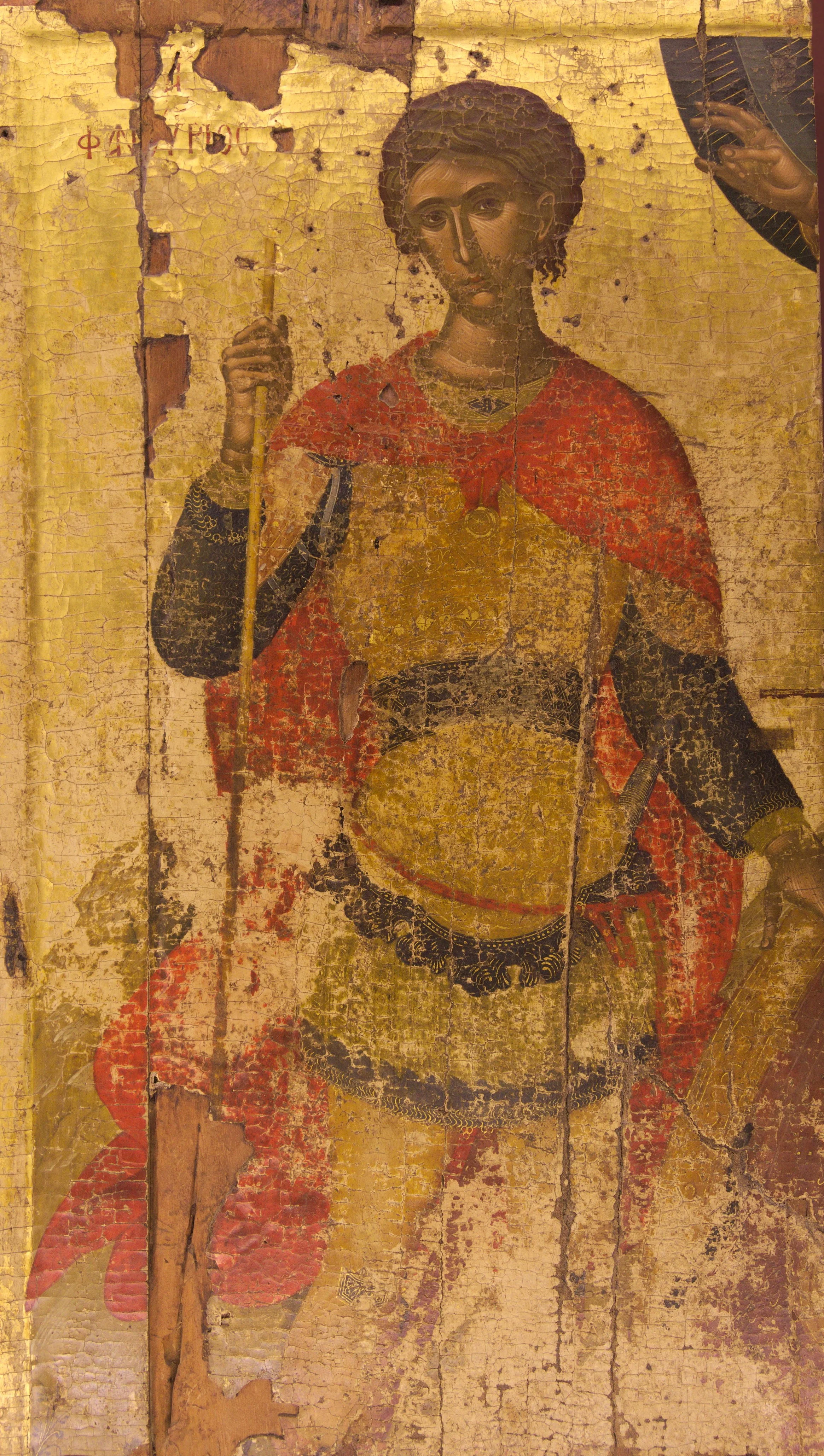
The exact administrative rank found in later hagiographic accounts should be understood as part of the received Church tradition, but Demetrios' identity as a military saint and public official became deeply rooted in Eastern Christian devotion. Icons normally portray him as a young warrior wearing armor and carrying a spear or sword, while Byzantine and Slavic traditions repeatedly connect his intercession with soldiers, defense, and protection in danger.
ORDERED TO DESTROY THE CHURCH, HE PREACHED CHRIST INSTEAD
According to the traditional Life, the Roman authorities expected Demetrios to defend Thessalonica while helping eradicate Christianity. Instead of obeying an order that contradicted his faith, he openly confessed himself a Christian and began teaching others about Christ.
This is one of the strongest reasons Saint Demetrios remains meaningful for military members and people in positions of authority. His story does not teach contempt for legitimate authority, but it makes clear that no earthly command can require a Christian to betray God.
A SAINT FOR SOLDIERS & VETERANS
Demetrios' military identity became one of the strongest themes of his later veneration. The OCA specifically notes that his memory became historically associated with the military, patriotism, and defense, while his traditional iconography presents him as an armed soldier.
For Christian soldiers, his example places military courage beneath a higher loyalty. Physical bravery, discipline, obedience, and ability to use force can be honorable, but Demetrios reminds the believer that every earthly authority remains answerable to God.
COURAGE OF CONSCIENCE
Demetrios possessed the kind of courage needed to confront physical danger, but the decisive courage of his life was moral courage. He knew that confessing Christianity could cost him his office and life, yet he refused to purchase safety through denial of Christ.
That makes him particularly meaningful for Christians facing pressure at work, in public life, within their families, or in cultures hostile to their beliefs. Courage is not always charging toward an enemy because sometimes it means calmly refusing to say what everyone else demands.
HE GAVE HIS WEALTH TO THE POOR
When Demetrios understood that arrest and martyrdom were approaching, the traditional Life says he instructed his servant Lupus to distribute his earthly possessions among the poor. He then turned himself more intensely toward prayer and fasting in preparation for death.
The detail reveals that the warrior saint's preparation for the final battle did not consist of gathering weapons. He emptied himself of possessions, prayed, fasted, and prepared to meet Christ.
IMPRISONED FOR HIS FAITH
Demetrios openly confessed Christianity when summoned by the emperor and was thrown into prison. The traditional Life says an angel appeared there to strengthen him, while events outside the prison prepared the episode that would forever join his name with Saint Nestor.
The imprisonment also places Demetrios among Christians who know what it means to lose freedom because of conscience. His courage was no longer theoretical once the doors of the prison closed.
LYAЕUS, THE FEARED ARENA CHAMPION
During Demetrios' imprisonment, the emperor held public games featuring a powerful wrestler named Lyaeus, also written Lyaeos or Lyaios. The Orthodox tradition describes him fighting opponents on a raised platform above sharpened spears and taking particular delight in overcoming Christians.
The spectacle represented physical power joined to arrogance and cruelty. Lyaeus possessed strength, but the Church's telling of the story emphasizes that strength becomes corrupted when it exists only to dominate, humiliate, or destroy.
SAINT NESTOR COMES TO DEMETRIOS
A young Christian named Nestor, whom Demetrios had instructed in the faith, decided to confront Lyaeus. Before entering the stadium, however, Nestor first went to Demetrios in prison and asked for his blessing.
Demetrios prayed for him and strengthened him for what was ahead. Nestor then entered the arena, defeated the feared champion, and turned what had been designed as a spectacle of Christian humiliation into the emperor's public embarrassment.
THE SAINT WHO BLESSED THE FIGHTER
For Christian martial artists, this scene makes Saint Demetrios especially compelling. Saint Nestor is the one who fought, but Saint Demetrios is the one the fighter went to before the fight.
The relationship is so important that Demetrios' ancient Troparion explicitly remembers him giving courage to Nestor in the stadium. His connection to fighters and coaches therefore does not depend upon stretching a vague warrior association because the Church itself has remembered him for centuries as the saint who strengthened a young Christian before combat.
A SAINT FOR MMA COACHES, MARTIAL-ARTS INSTRUCTORS & MENTORS
Saint Demetrios makes an especially meaningful devotional figure for coaches, cornermen, wrestling coaches, martial-arts instructors, fathers, military leaders, and mentors. Nestor came to him because Demetrios had already formed him spiritually, and when the younger man faced something terrifying, Demetrios did not compete in his place but gave him the courage to do what he had been called to do.
That is an excellent image of good mentorship. A coach can prepare, correct, encourage, and strengthen, but eventually the athlete must step into the cage, ring, or onto the mat and act upon what has been formed through training.
THE CHURCH STILL SINGS ABOUT THE FIGHT
The connection with Nestor is not buried in an obscure later legend. The Byzantine Troparion sung for Demetrios on October 26 explicitly recalls the defeat of Lyaeus and Demetrios giving courage to Nestor in the stadium.
That makes a Saint Demetrios and Saint Nestor prayer-card pair particularly meaningful for a fighter and coach, student and instructor, young wrestler and father, or athlete and spiritual mentor. Their feast days even follow one another, Demetrios on October 26 and Nestor on October 27.
MARTYRED WITH LANCES
The emperor's anger over Nestor's victory turned against Demetrios as well. According to the traditional Life, soldiers entered his underground prison at dawn and pierced him with lances, killing him for his confession of Christ.
His Byzantine Catholic Vespers texts intentionally compare the piercing of Demetrios' side with the pierced side of Christ on the Cross. His martyrdom therefore becomes not simply the death of a brave soldier, but an imitation of the suffering Savior whom he refused to deny.
SAINT LUPUS & THE FIRST HEALINGS
After Demetrios' martyrdom, his servant Saint Lupus preserved objects associated with his master's blood. The tradition remembers Lupus taking Demetrios' ring and blood-soaked garment and later using them in connection with healings.
Lupus himself was eventually arrested and killed. The saint's witness therefore continued through another Christian whose courage had been strengthened by knowing him.
WHY HE IS CALLED THE MYRRH-GUSHER
Saint Demetrios is widely called Myrrh-Gusher, Myrrh-Streamer, or Myroblite because his shrine and relics became associated with fragrant myrrh. The shrine in Thessaloniki preserves historic channels, vessels, and structures connected with the collection of myrrh, while the Metropolitanate of Thessaloniki continues to celebrate a formal service associated with the saint's myrrh today.
The tradition became one of the most recognizable features of his veneration. It also strengthened Demetrios' association with healing, because pilgrims sought both his intercession and the blessing associated with the fragrant myrrh at his shrine.
A SAINT FOR HEALING
Healing is not a secondary modern association added to Demetrios. Byzantine Catholic Vespers explicitly describe his relics as a treasure of miracles and medicine for illnesses, while the early tradition surrounding Lupus already connects Demetrios' martyrdom with miraculous healings.
This makes his prayer card especially meaningful during serious illness, hospitalization, surgery, chronic disease, or a frightening diagnosis. Christians seek his intercession while entrusting the actual outcome to the mercy and providence of Christ.
PROTECTOR OF THESSALONIKI
Saint Demetrios' connection with Thessaloniki became extraordinarily deep. The city's Metropolitanate still describes him as its patron and protector, and the great pilgrimage basilica containing his relics remains one of the spiritual centers of the city.
Byzantine hymnography likewise repeatedly praises him as the defender of Thessalonica from danger, enemies, and destruction. His Kontakion says that God has kept his city unharmed and calls Demetrios its support.
A SAINT FOR PROTECTION IN DANGER
This longstanding devotion makes Demetrios especially meaningful when someone needs protection during military deployment, dangerous work, travel, community crisis, or a threatening situation. His Troparion calls him a great champion in times of peril.
Christian protection should not be interpreted as a guarantee that nothing painful can happen. Demetrios himself died violently, so his Life teaches something deeper: God's protection includes the grace to remain faithful even when danger cannot simply be removed.
HIS RELICS IN THESSALONIKI
The principal relics of Saint Demetrios are venerated today in his great basilica in Thessaloniki, Greece. The Metropolitanate of Thessaloniki documents the silver reliquary within the church and identifies it as the central and most sacred point of the pilgrimage shrine.
The Metropolitanate also records the modern return of his relics from Italy. His sacred head returned to Thessaloniki in October 1978, with the rest of the relics returned on April 24, 1980, restoring them to the city that had honored him as its protector for centuries.
THE BASILICA OF SAINT DEMETRIOS
The basilica stands over the ancient setting connected with Demetrios' martyrdom and burial. The shrine contains the crypt, historic architectural remains, evidence connected with the tradition of the myrrh, and the reliquary in which his relics are now venerated.
For anyone making a pilgrimage specifically because of Saint Demetrios, Thessaloniki is the central destination. His city, martyrdom tradition, relics, basilica, myrrh devotion, and annual feast remain gathered together there.
A SAINT FOR PURITY & THE BATTLE AGAINST LUST
One of the less widely known traditions surrounding Saint Demetrios concerns purity and freedom from lust. Metropolitan Tikhon of the Orthodox Church in America specifically noted that Demetrios is traditionally invoked by those struggling with lustful temptations and recommended his intercession for Christians fighting pornography and related sins.
This gives his warrior identity another dimension. The strongest enemy a person faces is not always outside, and a man capable of physical strength still needs grace to govern the eyes, imagination, appetites, and passions.
A SAINT FOR YOUNG MEN
The OCA also notes a tradition regarding Demetrios as a protector of the young. Combined with his military identity, purity tradition, relationship with the younger Nestor, and example of courage under pressure, this makes him especially meaningful for boys and young men learning what Christian strength actually means.
Demetrios offers a model in which masculinity is not reduced to dominance. His life joins courage with faith, authority with service, strength with purity, mentorship with responsibility, and willingness to fight with willingness to suffer.
CHRISTIAN MASCULINITY & SAINT DEMETRIOS
Saint Demetrios possessed status and military ability, yet the Church ultimately honors him because he was willing to surrender them for Christ. He gave his possessions to the poor, prepared himself through prayer and fasting, strengthened a younger Christian, and accepted martyrdom instead of betrayal.
For men trying to build a serious Christian life, that combination matters. Strength is good when it protects, courage is good when it serves truth, and leadership is good when it forms others rather than feeding the ego of the leader.
SPIRITUAL WARFARE
Byzantine hymnography repeatedly interprets Demetrios' victory in spiritual terms. The Ruthenian Byzantine Catholic service praises him for defeating demonic attacks, asks his protection from visible and invisible enemies, and describes illnesses and demons being driven away through God's grace working in him.
For military members and martial artists, this gives physical imagery a deeper destination. Training can teach vigilance, discipline, endurance, and courage, but Christian spiritual warfare directs those habits toward the struggle against sin, temptation, fear, pride, and the passions.
EASTERN ORTHODOX & EASTERN CATHOLIC VENERATION
Saint Demetrios belongs fully to the shared Byzantine Christian tradition. The Orthodox Church celebrates him on October 26, while the Ruthenian Byzantine Catholic Menaion marks the same day as an All-Night Vigil feast of the holy and great martyr Demetrius.
The Melkite Greek Catholic Church likewise celebrates his October 26 feast and preserves the traditions of his martyrdom, healing, myrrh, relationship with Nestor, and protection of Thessaloniki. He is therefore not merely an Orthodox devotion observed from outside Eastern Catholic life, but one of the great ancient martyrs celebrated within the Byzantine Catholic inheritance as well.
FEAST DAY
The feast of Saint Demetrios the Great Martyr is October 26. The following day, October 27, commemorates Saint Nestor, preserving their relationship even within the arrangement of the Byzantine calendar.
In Thessaloniki, the celebration is particularly important because Demetrios is the city's patron. His relics are brought forward for veneration during the annual observances, drawing pilgrims from Greece and throughout the Orthodox world.
ICONOGRAPHY
Saint Demetrios is traditionally shown as a young military martyr, often wearing armor and holding a spear, sword, shield, or cross. The military imagery identifies his earthly vocation, while the weapon that appears in his icon can also recall the lances by which he received martyrdom.
Later icons sometimes show him mounted on horseback as a heavenly warrior and protector. The deeper meaning is not glorification of violence, because the decisive victory of Demetrios was remaining faithful to Christ when earthly power could no longer save him.
PRAYERS
Saint Demetrios possesses a rich and established Byzantine liturgical tradition, so there is no need to invent a prayer for him. His Troparion remembers him as a champion in danger, recalls Lyaeus and Nestor, and ends with this traditional invocation:
“O Holy Great Martyr Demetrios, entreat Christ God, that He grant us great mercy.”
That prayer is especially fitting for a soldier, veteran, fighter, coach, person facing danger, or someone asking for courage. A person seeking healing or purity can likewise ask Demetrios' intercession because both associations are firmly present in the Church's devotional tradition.
FAQ
Who was Saint Demetrios of Thessaloniki? Saint Demetrios was an early fourth-century Christian Great Martyr remembered as a Roman military and civic leader in Thessalonica. He openly confessed Christ during persecution, strengthened Saint Nestor before his arena combat, and was killed with lances for his faith.
Is Saint Demetrios the same as Saint Demetrius? Yes. Demetrios and Demetrius are English forms of the same Greek name, and both spellings are commonly used for the Great Martyr of Thessaloniki.
When did Saint Demetrios live? His martyrdom is traditionally placed around 305 or 306 AD during the persecution associated with Galerius Maximian. Byzantine sources agree on the early fourth-century setting even when they differ slightly in chronology.
When is Saint Demetrios' feast day? His feast is October 26 in the Byzantine tradition. Saint Nestor follows immediately on October 27.
Was Saint Demetrios really a soldier? The received Byzantine tradition remembers him as a man of military and administrative authority, and military imagery became a defining feature of his veneration. Orthodox sources explicitly connect him historically with soldiers and national defense.
Is Saint Demetrios a patron of soldiers? He is one of Eastern Christianity's most strongly established military saints and has long been associated with soldiers, defenders, and protection in danger. It is therefore entirely appropriate for soldiers and veterans to seek his intercession.
Is Saint Demetrios the patron saint of Thessaloniki? Yes. The contemporary Metropolitanate of Thessaloniki continues to honor him as the city's patron and protector, and his principal shrine stands there.
Why is Saint Demetrios called the Myrrh-Gusher? His shrine and relics became famous for fragrant myrrh, giving rise to titles such as Myrrh-Gusher, Myrrh-Streamer, and Myroblite. The myrrh tradition remains actively commemorated at his Thessaloniki basilica.
Where are Saint Demetrios' relics? His principal relics are venerated in the Basilica of Saint Demetrios in Thessaloniki, Greece. The Metropolitanate identifies the silver reliquary containing them as the central sacred point of the pilgrimage church.
Were Saint Demetrios' relics ever taken away from Thessaloniki? Yes, major relics were for a period held in Italy before being returned in the twentieth century. The Metropolitanate records the return of the sacred head in 1978 and the remaining relics in 1980.
Is Saint Demetrios associated with healing? Yes. Healings appear very early in his devotional tradition, beginning with objects connected to his blood after martyrdom, while Byzantine liturgical texts continue describing his relics as a source of healing.
Can I pray to Saint Demetrios for protection? Yes, protection is one of his strongest established devotional themes. His Troparion calls him a champion in times of peril, and Thessaloniki has honored him as its protector for centuries.
What is Saint Demetrios' connection with Saint Nestor? Nestor was a young Christian instructed by Demetrios who sought his blessing before fighting Lyaeus in the stadium. Nestor won the contest, and Demetrios' role in strengthening him remains part of the Church's liturgical memory.
Did Saint Demetrios bless Nestor before the fight? Yes. The traditional Life says Nestor went to Demetrios in prison and received his blessing and prayers before facing Lyaeus.
Does the Church actually mention Nestor's fight in Demetrios' prayers? Yes. Demetrios' Troparion explicitly remembers him giving courage to Nestor in the stadium and overcoming the boast of Lyaeus.
Is Saint Demetrios good for MMA fighters and wrestlers? Yes, especially through his direct connection with Saint Nestor. Nestor is the more direct fighter saint, while Demetrios naturally represents spiritual preparation, courage, mentorship, and the coach or spiritual father who strengthens the athlete before competition.
Is Saint Demetrios good for martial-arts coaches? Yes, and this is a particularly natural modern application of his established relationship with Nestor. Demetrios formed and strengthened the young Christian, but Nestor still had to enter the arena himself.
Should Saint Demetrios and Saint Nestor prayer cards be paired? They make an excellent pair because the two saints are inseparable in their traditional Lives and liturgical remembrance. Their consecutive October 26 and 27 feast days reinforce the relationship.
Is Saint Demetrios associated with purity? Yes. The OCA specifically records a tradition of invoking him by those struggling with lustful temptations.
Can Saint Demetrios be prayed to for help against pornography? Yes, as part of the broader struggle for chastity and freedom from lust. Metropolitan Tikhon specifically recommended seeking Saint Demetrios' prayers in this spiritual battle.
Is Saint Demetrios a protector of young people? The OCA notes that he is traditionally regarded as a protector of the young. His relationship with the younger Nestor makes that association especially meaningful.
How was Saint Demetrios killed? The traditional account says soldiers entered his prison and killed him with lances or spears. Byzantine hymnography compares his pierced side with the pierced side of Christ.
Who was Saint Lupus? Lupus was Demetrios' faithful servant, remembered for preserving his master's blood-stained garment and ring after the martyrdom. Healings became associated with these objects, and Lupus was later killed for his own Christian witness.
Can Byzantine Catholics venerate Saint Demetrios? Yes. The Ruthenian Byzantine Catholic Menaion celebrates him on October 26 with an All-Night Vigil, while Melkite Catholics also preserve his feast and devotion.
Is Saint Demetrios Catholic or Orthodox? He lived centuries before the later division between the Catholic and Orthodox Churches. He remains strongly venerated by Orthodox Christians and by Byzantine Catholics as part of their shared ancient Christian inheritance.
Why is Saint Demetrios shown in armor? His armor reflects the received tradition that he served in Roman military and civic authority. It also became symbolic of his identity as a protector and spiritual warrior.
Can I give this prayer card to a soldier or veteran? Yes. Demetrios' longstanding military association makes this an especially appropriate devotional gift for active-duty personnel, veterans, military families, and someone preparing for deployment.
Can I give this prayer card to a police officer or first responder? Yes. His connection with courage, protection, duty, and responsible authority gives the card a natural devotional meaning for people whose work involves protecting others.
Can I give this card to someone who is sick? Yes. Healing belongs firmly within Demetrios' ancient devotional tradition, and his liturgical texts describe his relics as a source of healing for illnesses.
What does Saint Demetrios teach about strength? His Life teaches that physical and political strength are good only when subordinated to God. Demetrios possessed authority but surrendered it rather than use it against Christ or the Church.
What does Saint Demetrios teach about leadership? He shows that good leadership strengthens other people rather than making them dependent upon the leader's ego. His relationship with Nestor gives a particularly vivid image of a mentor forming someone else to face a difficult contest.
What does Saint Demetrios teach about courage? Courage is more than refusing to fear physical danger. Demetrios demonstrates the deeper courage of remaining faithful when obedience to Christ costs security, reputation, wealth, freedom, and eventually life.
What is the main message of Saint Demetrios of Thessaloniki's life? Saint Demetrios teaches that true strength is strength placed beneath Christ. The Roman military leader who could have preserved his rank by persecuting Christians instead confessed the faith openly, gave his possessions to the poor, prepared for martyrdom through prayer and fasting, strengthened Saint Nestor before the arena fight, and accepted the spear rather than betray Christ. For centuries afterward, soldiers have looked to him for courage, Thessaloniki has called him its protector, the sick have sought healing through his intercession, Christians struggling with lust have asked for his prayers, and fighters can see in him the spiritual mentor who prepared another man for combat without allowing the contest to become greater than God.
Saint Demetrios of Thessaloniki, also commonly written Saint Demetrius, is one of the great military martyrs of Eastern Christianity. Known as the Great Martyr, the Myrrh-Gusher, and the Protector of Thessaloniki, he is especially beloved by soldiers, people in dangerous professions, Christians seeking courage and protection, the sick seeking healing, young people, and those facing serious spiritual struggles. His feast is celebrated on October 26, with an especially solemn observance in the Byzantine tradition.
The received Byzantine tradition remembers Demetrios as a young man of education, military ability, and public authority in Roman Thessalonica during the persecution of Christians under Galerius Maximian. Although the emperor expected him to suppress Christianity, Demetrios openly confessed Christ and instead strengthened the Christians around him. He was imprisoned and ultimately killed with lances around 305 or 306 AD, giving up rank, security, and life rather than abandon the faith.
Saint Demetrios is particularly meaningful for soldiers, veterans, law-enforcement officers, first responders, protectors, people facing danger, men seeking courage and self-control, Christians under pressure to compromise, and anyone responsible for leading or protecting others. His association with military courage is ancient, and the Orthodox Church has long connected his veneration with soldiers and the defense of one's people. Byzantine liturgical texts likewise invoke him as a defender of those in peril and ask him for protection from visible and invisible enemies.
He also has an unusually strong connection with fighters, wrestlers, martial artists, coaches, and mentors through Saint Nestor of Thessaloniki. Nestor was a young Christian preparing to face the feared arena wrestler Lyaeus, and before entering the stadium he went to the imprisoned Demetrios for prayer and a blessing. Demetrios strengthened him, Nestor defeated the champion, and the Church's own Troparion still praises Demetrios for giving Nestor courage in the stadium.
This makes Demetrios and Nestor especially meaningful as a pair for combat athletes. Nestor represents the fighter who must enter the contest, while Demetrios represents the spiritual father, coach, or mentor who prepares him, gives courage, and reminds him that physical strength must remain subordinate to God. That relationship is not a modern invention because it is preserved directly in Byzantine liturgical worship.
Saint Demetrios is also deeply associated with healing. After his martyrdom, his servant Saint Lupus preserved Demetrios' blood-stained garment and ring, and the tradition remembers healings occurring through them. His shrine later became famous for fragrant myrrh associated with his relics, giving him the title Myrrh-Gusher or Myroblite, and Byzantine Catholic hymnography describes his church and relics as a source of miracles and medicine for illnesses.
This prayer card is especially fitting for a soldier leaving for deployment, a veteran, police officer, firefighter, young man entering military service, fighter preparing for competition, coach responsible for younger athletes, someone facing illness, or anyone who needs courage in a dangerous or uncertain season. It can also be given for baptism, chrismation, confirmation, a name day, military graduation, martial-arts promotion, first fight, wrestling season, or simply as a daily reminder that Christian strength must remain joined to humility, faith, sacrifice, and self-control.
Each 2.5" x 4.25" prayer card is handmade in Austin, Texas and prepared prayerfully with each order. It is printed on museum-quality photo paper rather than cardstock, double-laminated for durability, and made while the recipient and their intentions are lifted before Christ in prayer, with Saint Demetrios asked to intercede for them.
THE LIFE & STORY
Saint Demetrios lived in Thessalonica, modern Thessaloniki in Greece, during the final great era of Roman persecution before the legalization of Christianity. The Byzantine Life preserved by the Orthodox Church remembers him as the son of a Roman proconsul whose parents secretly practiced Christianity and raised their son in the faith. After his father's death, Demetrios himself received a position of considerable authority because of his education and military and administrative abilities.
The exact administrative rank found in later hagiographic accounts should be understood as part of the received Church tradition, but Demetrios' identity as a military saint and public official became deeply rooted in Eastern Christian devotion. Icons normally portray him as a young warrior wearing armor and carrying a spear or sword, while Byzantine and Slavic traditions repeatedly connect his intercession with soldiers, defense, and protection in danger.
ORDERED TO DESTROY THE CHURCH, HE PREACHED CHRIST INSTEAD
According to the traditional Life, the Roman authorities expected Demetrios to defend Thessalonica while helping eradicate Christianity. Instead of obeying an order that contradicted his faith, he openly confessed himself a Christian and began teaching others about Christ.
This is one of the strongest reasons Saint Demetrios remains meaningful for military members and people in positions of authority. His story does not teach contempt for legitimate authority, but it makes clear that no earthly command can require a Christian to betray God.
A SAINT FOR SOLDIERS & VETERANS
Demetrios' military identity became one of the strongest themes of his later veneration. The OCA specifically notes that his memory became historically associated with the military, patriotism, and defense, while his traditional iconography presents him as an armed soldier.
For Christian soldiers, his example places military courage beneath a higher loyalty. Physical bravery, discipline, obedience, and ability to use force can be honorable, but Demetrios reminds the believer that every earthly authority remains answerable to God.
COURAGE OF CONSCIENCE
Demetrios possessed the kind of courage needed to confront physical danger, but the decisive courage of his life was moral courage. He knew that confessing Christianity could cost him his office and life, yet he refused to purchase safety through denial of Christ.
That makes him particularly meaningful for Christians facing pressure at work, in public life, within their families, or in cultures hostile to their beliefs. Courage is not always charging toward an enemy because sometimes it means calmly refusing to say what everyone else demands.
HE GAVE HIS WEALTH TO THE POOR
When Demetrios understood that arrest and martyrdom were approaching, the traditional Life says he instructed his servant Lupus to distribute his earthly possessions among the poor. He then turned himself more intensely toward prayer and fasting in preparation for death.
The detail reveals that the warrior saint's preparation for the final battle did not consist of gathering weapons. He emptied himself of possessions, prayed, fasted, and prepared to meet Christ.
IMPRISONED FOR HIS FAITH
Demetrios openly confessed Christianity when summoned by the emperor and was thrown into prison. The traditional Life says an angel appeared there to strengthen him, while events outside the prison prepared the episode that would forever join his name with Saint Nestor.
The imprisonment also places Demetrios among Christians who know what it means to lose freedom because of conscience. His courage was no longer theoretical once the doors of the prison closed.
LYAЕUS, THE FEARED ARENA CHAMPION
During Demetrios' imprisonment, the emperor held public games featuring a powerful wrestler named Lyaeus, also written Lyaeos or Lyaios. The Orthodox tradition describes him fighting opponents on a raised platform above sharpened spears and taking particular delight in overcoming Christians.
The spectacle represented physical power joined to arrogance and cruelty. Lyaeus possessed strength, but the Church's telling of the story emphasizes that strength becomes corrupted when it exists only to dominate, humiliate, or destroy.
SAINT NESTOR COMES TO DEMETRIOS
A young Christian named Nestor, whom Demetrios had instructed in the faith, decided to confront Lyaeus. Before entering the stadium, however, Nestor first went to Demetrios in prison and asked for his blessing.
Demetrios prayed for him and strengthened him for what was ahead. Nestor then entered the arena, defeated the feared champion, and turned what had been designed as a spectacle of Christian humiliation into the emperor's public embarrassment.
THE SAINT WHO BLESSED THE FIGHTER
For Christian martial artists, this scene makes Saint Demetrios especially compelling. Saint Nestor is the one who fought, but Saint Demetrios is the one the fighter went to before the fight.
The relationship is so important that Demetrios' ancient Troparion explicitly remembers him giving courage to Nestor in the stadium. His connection to fighters and coaches therefore does not depend upon stretching a vague warrior association because the Church itself has remembered him for centuries as the saint who strengthened a young Christian before combat.
A SAINT FOR MMA COACHES, MARTIAL-ARTS INSTRUCTORS & MENTORS
Saint Demetrios makes an especially meaningful devotional figure for coaches, cornermen, wrestling coaches, martial-arts instructors, fathers, military leaders, and mentors. Nestor came to him because Demetrios had already formed him spiritually, and when the younger man faced something terrifying, Demetrios did not compete in his place but gave him the courage to do what he had been called to do.
That is an excellent image of good mentorship. A coach can prepare, correct, encourage, and strengthen, but eventually the athlete must step into the cage, ring, or onto the mat and act upon what has been formed through training.
THE CHURCH STILL SINGS ABOUT THE FIGHT
The connection with Nestor is not buried in an obscure later legend. The Byzantine Troparion sung for Demetrios on October 26 explicitly recalls the defeat of Lyaeus and Demetrios giving courage to Nestor in the stadium.
That makes a Saint Demetrios and Saint Nestor prayer-card pair particularly meaningful for a fighter and coach, student and instructor, young wrestler and father, or athlete and spiritual mentor. Their feast days even follow one another, Demetrios on October 26 and Nestor on October 27.
MARTYRED WITH LANCES
The emperor's anger over Nestor's victory turned against Demetrios as well. According to the traditional Life, soldiers entered his underground prison at dawn and pierced him with lances, killing him for his confession of Christ.
His Byzantine Catholic Vespers texts intentionally compare the piercing of Demetrios' side with the pierced side of Christ on the Cross. His martyrdom therefore becomes not simply the death of a brave soldier, but an imitation of the suffering Savior whom he refused to deny.
SAINT LUPUS & THE FIRST HEALINGS
After Demetrios' martyrdom, his servant Saint Lupus preserved objects associated with his master's blood. The tradition remembers Lupus taking Demetrios' ring and blood-soaked garment and later using them in connection with healings.
Lupus himself was eventually arrested and killed. The saint's witness therefore continued through another Christian whose courage had been strengthened by knowing him.
WHY HE IS CALLED THE MYRRH-GUSHER
Saint Demetrios is widely called Myrrh-Gusher, Myrrh-Streamer, or Myroblite because his shrine and relics became associated with fragrant myrrh. The shrine in Thessaloniki preserves historic channels, vessels, and structures connected with the collection of myrrh, while the Metropolitanate of Thessaloniki continues to celebrate a formal service associated with the saint's myrrh today.
The tradition became one of the most recognizable features of his veneration. It also strengthened Demetrios' association with healing, because pilgrims sought both his intercession and the blessing associated with the fragrant myrrh at his shrine.
A SAINT FOR HEALING
Healing is not a secondary modern association added to Demetrios. Byzantine Catholic Vespers explicitly describe his relics as a treasure of miracles and medicine for illnesses, while the early tradition surrounding Lupus already connects Demetrios' martyrdom with miraculous healings.
This makes his prayer card especially meaningful during serious illness, hospitalization, surgery, chronic disease, or a frightening diagnosis. Christians seek his intercession while entrusting the actual outcome to the mercy and providence of Christ.
PROTECTOR OF THESSALONIKI
Saint Demetrios' connection with Thessaloniki became extraordinarily deep. The city's Metropolitanate still describes him as its patron and protector, and the great pilgrimage basilica containing his relics remains one of the spiritual centers of the city.
Byzantine hymnography likewise repeatedly praises him as the defender of Thessalonica from danger, enemies, and destruction. His Kontakion says that God has kept his city unharmed and calls Demetrios its support.
A SAINT FOR PROTECTION IN DANGER
This longstanding devotion makes Demetrios especially meaningful when someone needs protection during military deployment, dangerous work, travel, community crisis, or a threatening situation. His Troparion calls him a great champion in times of peril.
Christian protection should not be interpreted as a guarantee that nothing painful can happen. Demetrios himself died violently, so his Life teaches something deeper: God's protection includes the grace to remain faithful even when danger cannot simply be removed.
HIS RELICS IN THESSALONIKI
The principal relics of Saint Demetrios are venerated today in his great basilica in Thessaloniki, Greece. The Metropolitanate of Thessaloniki documents the silver reliquary within the church and identifies it as the central and most sacred point of the pilgrimage shrine.
The Metropolitanate also records the modern return of his relics from Italy. His sacred head returned to Thessaloniki in October 1978, with the rest of the relics returned on April 24, 1980, restoring them to the city that had honored him as its protector for centuries.
THE BASILICA OF SAINT DEMETRIOS
The basilica stands over the ancient setting connected with Demetrios' martyrdom and burial. The shrine contains the crypt, historic architectural remains, evidence connected with the tradition of the myrrh, and the reliquary in which his relics are now venerated.
For anyone making a pilgrimage specifically because of Saint Demetrios, Thessaloniki is the central destination. His city, martyrdom tradition, relics, basilica, myrrh devotion, and annual feast remain gathered together there.
A SAINT FOR PURITY & THE BATTLE AGAINST LUST
One of the less widely known traditions surrounding Saint Demetrios concerns purity and freedom from lust. Metropolitan Tikhon of the Orthodox Church in America specifically noted that Demetrios is traditionally invoked by those struggling with lustful temptations and recommended his intercession for Christians fighting pornography and related sins.
This gives his warrior identity another dimension. The strongest enemy a person faces is not always outside, and a man capable of physical strength still needs grace to govern the eyes, imagination, appetites, and passions.
A SAINT FOR YOUNG MEN
The OCA also notes a tradition regarding Demetrios as a protector of the young. Combined with his military identity, purity tradition, relationship with the younger Nestor, and example of courage under pressure, this makes him especially meaningful for boys and young men learning what Christian strength actually means.
Demetrios offers a model in which masculinity is not reduced to dominance. His life joins courage with faith, authority with service, strength with purity, mentorship with responsibility, and willingness to fight with willingness to suffer.
CHRISTIAN MASCULINITY & SAINT DEMETRIOS
Saint Demetrios possessed status and military ability, yet the Church ultimately honors him because he was willing to surrender them for Christ. He gave his possessions to the poor, prepared himself through prayer and fasting, strengthened a younger Christian, and accepted martyrdom instead of betrayal.
For men trying to build a serious Christian life, that combination matters. Strength is good when it protects, courage is good when it serves truth, and leadership is good when it forms others rather than feeding the ego of the leader.
SPIRITUAL WARFARE
Byzantine hymnography repeatedly interprets Demetrios' victory in spiritual terms. The Ruthenian Byzantine Catholic service praises him for defeating demonic attacks, asks his protection from visible and invisible enemies, and describes illnesses and demons being driven away through God's grace working in him.
For military members and martial artists, this gives physical imagery a deeper destination. Training can teach vigilance, discipline, endurance, and courage, but Christian spiritual warfare directs those habits toward the struggle against sin, temptation, fear, pride, and the passions.
EASTERN ORTHODOX & EASTERN CATHOLIC VENERATION
Saint Demetrios belongs fully to the shared Byzantine Christian tradition. The Orthodox Church celebrates him on October 26, while the Ruthenian Byzantine Catholic Menaion marks the same day as an All-Night Vigil feast of the holy and great martyr Demetrius.
The Melkite Greek Catholic Church likewise celebrates his October 26 feast and preserves the traditions of his martyrdom, healing, myrrh, relationship with Nestor, and protection of Thessaloniki. He is therefore not merely an Orthodox devotion observed from outside Eastern Catholic life, but one of the great ancient martyrs celebrated within the Byzantine Catholic inheritance as well.
FEAST DAY
The feast of Saint Demetrios the Great Martyr is October 26. The following day, October 27, commemorates Saint Nestor, preserving their relationship even within the arrangement of the Byzantine calendar.
In Thessaloniki, the celebration is particularly important because Demetrios is the city's patron. His relics are brought forward for veneration during the annual observances, drawing pilgrims from Greece and throughout the Orthodox world.
ICONOGRAPHY
Saint Demetrios is traditionally shown as a young military martyr, often wearing armor and holding a spear, sword, shield, or cross. The military imagery identifies his earthly vocation, while the weapon that appears in his icon can also recall the lances by which he received martyrdom.
Later icons sometimes show him mounted on horseback as a heavenly warrior and protector. The deeper meaning is not glorification of violence, because the decisive victory of Demetrios was remaining faithful to Christ when earthly power could no longer save him.
PRAYERS
Saint Demetrios possesses a rich and established Byzantine liturgical tradition, so there is no need to invent a prayer for him. His Troparion remembers him as a champion in danger, recalls Lyaeus and Nestor, and ends with this traditional invocation:
“O Holy Great Martyr Demetrios, entreat Christ God, that He grant us great mercy.”
That prayer is especially fitting for a soldier, veteran, fighter, coach, person facing danger, or someone asking for courage. A person seeking healing or purity can likewise ask Demetrios' intercession because both associations are firmly present in the Church's devotional tradition.
FAQ
Who was Saint Demetrios of Thessaloniki? Saint Demetrios was an early fourth-century Christian Great Martyr remembered as a Roman military and civic leader in Thessalonica. He openly confessed Christ during persecution, strengthened Saint Nestor before his arena combat, and was killed with lances for his faith.
Is Saint Demetrios the same as Saint Demetrius? Yes. Demetrios and Demetrius are English forms of the same Greek name, and both spellings are commonly used for the Great Martyr of Thessaloniki.
When did Saint Demetrios live? His martyrdom is traditionally placed around 305 or 306 AD during the persecution associated with Galerius Maximian. Byzantine sources agree on the early fourth-century setting even when they differ slightly in chronology.
When is Saint Demetrios' feast day? His feast is October 26 in the Byzantine tradition. Saint Nestor follows immediately on October 27.
Was Saint Demetrios really a soldier? The received Byzantine tradition remembers him as a man of military and administrative authority, and military imagery became a defining feature of his veneration. Orthodox sources explicitly connect him historically with soldiers and national defense.
Is Saint Demetrios a patron of soldiers? He is one of Eastern Christianity's most strongly established military saints and has long been associated with soldiers, defenders, and protection in danger. It is therefore entirely appropriate for soldiers and veterans to seek his intercession.
Is Saint Demetrios the patron saint of Thessaloniki? Yes. The contemporary Metropolitanate of Thessaloniki continues to honor him as the city's patron and protector, and his principal shrine stands there.
Why is Saint Demetrios called the Myrrh-Gusher? His shrine and relics became famous for fragrant myrrh, giving rise to titles such as Myrrh-Gusher, Myrrh-Streamer, and Myroblite. The myrrh tradition remains actively commemorated at his Thessaloniki basilica.
Where are Saint Demetrios' relics? His principal relics are venerated in the Basilica of Saint Demetrios in Thessaloniki, Greece. The Metropolitanate identifies the silver reliquary containing them as the central sacred point of the pilgrimage church.
Were Saint Demetrios' relics ever taken away from Thessaloniki? Yes, major relics were for a period held in Italy before being returned in the twentieth century. The Metropolitanate records the return of the sacred head in 1978 and the remaining relics in 1980.
Is Saint Demetrios associated with healing? Yes. Healings appear very early in his devotional tradition, beginning with objects connected to his blood after martyrdom, while Byzantine liturgical texts continue describing his relics as a source of healing.
Can I pray to Saint Demetrios for protection? Yes, protection is one of his strongest established devotional themes. His Troparion calls him a champion in times of peril, and Thessaloniki has honored him as its protector for centuries.
What is Saint Demetrios' connection with Saint Nestor? Nestor was a young Christian instructed by Demetrios who sought his blessing before fighting Lyaeus in the stadium. Nestor won the contest, and Demetrios' role in strengthening him remains part of the Church's liturgical memory.
Did Saint Demetrios bless Nestor before the fight? Yes. The traditional Life says Nestor went to Demetrios in prison and received his blessing and prayers before facing Lyaeus.
Does the Church actually mention Nestor's fight in Demetrios' prayers? Yes. Demetrios' Troparion explicitly remembers him giving courage to Nestor in the stadium and overcoming the boast of Lyaeus.
Is Saint Demetrios good for MMA fighters and wrestlers? Yes, especially through his direct connection with Saint Nestor. Nestor is the more direct fighter saint, while Demetrios naturally represents spiritual preparation, courage, mentorship, and the coach or spiritual father who strengthens the athlete before competition.
Is Saint Demetrios good for martial-arts coaches? Yes, and this is a particularly natural modern application of his established relationship with Nestor. Demetrios formed and strengthened the young Christian, but Nestor still had to enter the arena himself.
Should Saint Demetrios and Saint Nestor prayer cards be paired? They make an excellent pair because the two saints are inseparable in their traditional Lives and liturgical remembrance. Their consecutive October 26 and 27 feast days reinforce the relationship.
Is Saint Demetrios associated with purity? Yes. The OCA specifically records a tradition of invoking him by those struggling with lustful temptations.
Can Saint Demetrios be prayed to for help against pornography? Yes, as part of the broader struggle for chastity and freedom from lust. Metropolitan Tikhon specifically recommended seeking Saint Demetrios' prayers in this spiritual battle.
Is Saint Demetrios a protector of young people? The OCA notes that he is traditionally regarded as a protector of the young. His relationship with the younger Nestor makes that association especially meaningful.
How was Saint Demetrios killed? The traditional account says soldiers entered his prison and killed him with lances or spears. Byzantine hymnography compares his pierced side with the pierced side of Christ.
Who was Saint Lupus? Lupus was Demetrios' faithful servant, remembered for preserving his master's blood-stained garment and ring after the martyrdom. Healings became associated with these objects, and Lupus was later killed for his own Christian witness.
Can Byzantine Catholics venerate Saint Demetrios? Yes. The Ruthenian Byzantine Catholic Menaion celebrates him on October 26 with an All-Night Vigil, while Melkite Catholics also preserve his feast and devotion.
Is Saint Demetrios Catholic or Orthodox? He lived centuries before the later division between the Catholic and Orthodox Churches. He remains strongly venerated by Orthodox Christians and by Byzantine Catholics as part of their shared ancient Christian inheritance.
Why is Saint Demetrios shown in armor? His armor reflects the received tradition that he served in Roman military and civic authority. It also became symbolic of his identity as a protector and spiritual warrior.
Can I give this prayer card to a soldier or veteran? Yes. Demetrios' longstanding military association makes this an especially appropriate devotional gift for active-duty personnel, veterans, military families, and someone preparing for deployment.
Can I give this prayer card to a police officer or first responder? Yes. His connection with courage, protection, duty, and responsible authority gives the card a natural devotional meaning for people whose work involves protecting others.
Can I give this card to someone who is sick? Yes. Healing belongs firmly within Demetrios' ancient devotional tradition, and his liturgical texts describe his relics as a source of healing for illnesses.
What does Saint Demetrios teach about strength? His Life teaches that physical and political strength are good only when subordinated to God. Demetrios possessed authority but surrendered it rather than use it against Christ or the Church.
What does Saint Demetrios teach about leadership? He shows that good leadership strengthens other people rather than making them dependent upon the leader's ego. His relationship with Nestor gives a particularly vivid image of a mentor forming someone else to face a difficult contest.
What does Saint Demetrios teach about courage? Courage is more than refusing to fear physical danger. Demetrios demonstrates the deeper courage of remaining faithful when obedience to Christ costs security, reputation, wealth, freedom, and eventually life.
What is the main message of Saint Demetrios of Thessaloniki's life? Saint Demetrios teaches that true strength is strength placed beneath Christ. The Roman military leader who could have preserved his rank by persecuting Christians instead confessed the faith openly, gave his possessions to the poor, prepared for martyrdom through prayer and fasting, strengthened Saint Nestor before the arena fight, and accepted the spear rather than betray Christ. For centuries afterward, soldiers have looked to him for courage, Thessaloniki has called him its protector, the sick have sought healing through his intercession, Christians struggling with lust have asked for his prayers, and fighters can see in him the spiritual mentor who prepared another man for combat without allowing the contest to become greater than God.