 Image 1 of 1
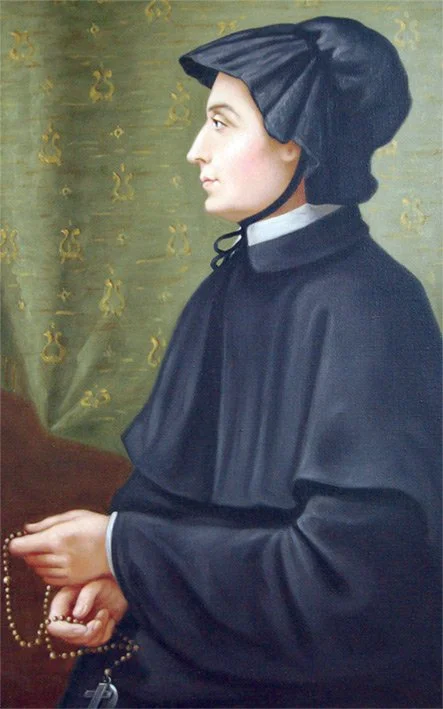
Saint Elizabeth Ann Seton Prayer Card – For Grief, Widowhood, Single Mothers, Conversion & Catholic Education
Saint Elizabeth Ann Seton was a wife, mother of five, young widow, convert to Catholicism, educator, religious founder, and the first native-born citizen of the United States to be canonized a saint. Her remarkable life was not built around escaping ordinary human suffering but around learning to follow God faithfully through bereavement, financial uncertainty, motherhood, religious conversion, illness, family conflict, and responsibilities she never expected to carry alone.
Elizabeth knew what it meant for life to change suddenly. Her husband's business collapsed, his health deteriorated, and she traveled with him to Italy hoping the climate might save his life. Instead, the family was placed in quarantine shortly after arriving, William died soon afterward, and Elizabeth found herself a widow in a foreign country with five children depending upon her.
Her encounter with Catholic friends in Italy awakened a deep attraction to the Eucharist and eventually led her into the Catholic Church despite the personal and financial consequences. She later moved to Maryland, founded the Sisters of Charity of Saint Joseph's, and established a school whose work helped plant the seeds of the Catholic parochial school system in the United States.
Saint Elizabeth Ann Seton is especially meaningful for widows, single mothers, grieving families, converts, people considering Catholicism, teachers, Catholic school families, parents carrying financial stress, and anyone trying to trust God's Providence after life has taken an unexpected direction. Her story demonstrates that a life can be profoundly changed by suffering without being destroyed by it.
Each prayer card measures 2.5" x 4.25", is handmade in Austin, Texas, printed on museum-quality photo paper rather than ordinary cardstock, and double laminated for durability. Every card is made to order and prepared prayerfully, with the recipient and their intentions brought before Christ while asking Saint Elizabeth Ann Seton to intercede for their needs.
THE LIFE & STORY OF SAINT ELIZABETH ANN SETON
Elizabeth Ann Bayley was born in New York City in 1774, only a few years before the American Revolution transformed the colonies into a new nation. She was raised within the Episcopal tradition and developed a strong Christian faith from childhood.
Loss entered her life early when her mother died before Elizabeth was three years old. Her childhood included periods of loneliness and separation, experiences that later helped her understand people carrying grief and emotional isolation.
Despite those early wounds, Elizabeth developed into an intelligent, energetic young woman with a deep love of Scripture, nature, friendship, and prayer.
MARRIAGE AND MOTHERHOOD
At nineteen, Elizabeth married William Magee Seton, a young merchant from a prominent New York family. Their marriage brought her great happiness, and together they had five children.
Elizabeth embraced motherhood intensely. She educated her children, formed them in Christian faith, cared for their physical and emotional needs, and remained closely involved in the ordinary life of her family.
This domestic period is important because Elizabeth did not become holy by leaving family life behind. Much of her spiritual formation occurred precisely through marriage, parenting, friendship, household responsibility, and concern for the people she loved.
CHARITY BEFORE RELIGIOUS LIFE
Long before founding a religious community, Elizabeth was already deeply concerned with people experiencing poverty. In New York she participated with other women in charitable work among poor families.
Her Christianity had a practical dimension from the beginning. Prayer and Scripture were meant to shape how a person responded to suffering neighbors.
This concern for vulnerable people later became central to the religious community she founded, but the roots were already present while she was a young wife and mother.
FINANCIAL COLLAPSE
The Seton family's circumstances changed dramatically as William's business encountered severe financial difficulties. International trade disruptions and accumulated debts eventually contributed to bankruptcy.
The comfortable social world Elizabeth had known began to disappear. Financial anxiety became part of ordinary family life, and she had to confront the uncertainty of how her children would be supported.
This aspect of her story makes Elizabeth especially meaningful for families carrying debt, business failure, employment uncertainty, or the fear that a previously stable life is beginning to unravel.
She knew that experience personally.
HER HUSBAND'S ILLNESS
William also suffered increasingly severe health problems, particularly tuberculosis. Doctors eventually recommended a warmer climate, leading Elizabeth to accompany him to Italy in hope that the journey might improve his condition.
Their daughter Anna Maria traveled with them.
The voyage was supposed to offer hope. Instead, it brought Elizabeth into one of the most painful periods of her life.
QUARANTINE IN ITALY
When the Setons arrived in Italy in 1803, health regulations required them to enter quarantine because of concerns about disease associated with their voyage.
They were confined for weeks in difficult conditions while William's already fragile health worsened.
Elizabeth prayed, read Scripture, cared for her husband and daughter, and tried to maintain hope within circumstances she could not control.
William survived the quarantine but died shortly after they were released.
Elizabeth was twenty-nine years old.
A YOUNG WIDOW
William's death left Elizabeth grieving in a foreign country while facing the reality that five children now depended upon her alone.
The saint who would later become a symbol of American Catholic education first had to figure out how to survive widowhood.
Her faith did not eliminate grief. Her writings reveal a woman capable of deep emotion who nevertheless increasingly learned to place sorrow within the hands of God.
This makes Elizabeth especially meaningful for widows and widowers who discover that bereavement creates not only emotional pain but also new financial, parental, practical, and spiritual responsibilities.
DISCOVERING CATHOLICISM
While Elizabeth remained in Italy after William's death, the Catholic Filicchi family cared for her and introduced her more deeply to Catholic belief and worship.
The Eucharist affected her profoundly.
Elizabeth had been a serious Christian before encountering Catholicism, but she became increasingly convinced that Christ was truly present in the Eucharist in a way that demanded a decision about the Church itself.
What began as curiosity gradually became a crisis of conscience.
HER LOVE FOR THE EUCHARIST
The Catholic doctrine of the Real Presence became one of the strongest forces drawing Elizabeth toward the Church.
She longed for Holy Communion even before she could receive it as a Catholic.
The Eucharist was not simply one doctrine among many in her conversion. It became a center around which much of her later spiritual life developed.
For Catholics struggling with Eucharistic faith or converts drawn toward Catholicism through the Mass, Elizabeth's story offers an especially compelling example of how belief in the Real Presence can change the direction of a life.
CONVERSION TO THE CATHOLIC CHURCH
After returning to New York, Elizabeth continued studying Catholicism while facing enormous pressure from family members and friends who strongly opposed the possibility of her conversion.
The decision carried serious consequences. Catholicism was socially suspect in much of the American culture surrounding her, and entering the Church threatened relationships and sources of support at a time when she was already financially vulnerable.
Elizabeth nevertheless became Catholic in 1805.
Her conversion did not come from rejection of everything she had previously believed. She continued to value the Christian formation she had received while becoming convinced that the Catholic Church contained the fullness she was seeking.
FOR CONVERTS
Saint Elizabeth Ann Seton is one of the most meaningful American saints for converts because she understood both the joy and cost of entering the Catholic Church.
Conversion affected friendships, family relationships, finances, education, and her place within society. She did not simply adopt a new set of beliefs while everything else remained unchanged.
Her example can therefore be especially encouraging for someone entering OCIA, discerning Catholicism, or dealing with opposition from relatives and friends.
Elizabeth demonstrates that following conscience may require real sacrifice while also opening an entirely new future.
SUPPORTING FIVE CHILDREN
After becoming Catholic, Elizabeth still faced the practical responsibility of supporting her children.
She attempted to earn income through education, but anti-Catholic prejudice complicated her efforts in New York. Families who might otherwise have sent their children to her school sometimes withdrew because of her conversion.
Elizabeth's life during these years involved constant tension between spiritual conviction and material necessity.
She trusted God while also working actively to find practical solutions for her family's future.
FROM NEW YORK TO MARYLAND
Eventually Elizabeth received an invitation that opened a new possibility in Baltimore, Maryland. The move allowed her to enter a Catholic environment where her talents as an educator could develop more freely.
Her path later led to Emmitsburg, Maryland, where the most important institutional work of her life began.
What looked initially like repeated displacement gradually became the route by which Elizabeth would leave an enormous mark upon Catholic life in the United States.
THE SISTERS OF CHARITY OF SAINT JOSEPH'S
In 1809, Elizabeth founded the Sisters of Charity of Saint Joseph's at Emmitsburg.
It became the first community of religious women founded in the United States.
Elizabeth, now known increasingly as Mother Seton, adapted the spiritual tradition of Saints Vincent de Paul and Louise de Marillac to the circumstances of the young American Church.
The community united prayer with active service, particularly education and care for people in need.
THE BEGINNINGS OF CATHOLIC EDUCATION IN AMERICA
Elizabeth established Saint Joseph's Academy and Free School for girls, one of the earliest Catholic schools in the United States and an important seed of the American Catholic parochial school system.
Her educational vision grew directly from her experience as a mother and teacher.
Education was not simply academic instruction. Children needed intellectual formation, moral guidance, religious faith, discipline, affection, and preparation for adult life.
The communities descending from Elizabeth's foundation would eventually establish schools, orphanages, hospitals, and charitable institutions throughout the United States.
A MOTHER WHO BECAME “MOTHER” TO MANY
Elizabeth entered religious life only after having lived as wife, mother, widow, and sole parent.
Her maternal identity therefore did not disappear when she became Mother Seton.
Instead, it expanded.
The woman who had raised five children became spiritual mother to a growing community of women and to generations of students whose education would be shaped by the institutions she founded.
This makes Elizabeth particularly meaningful for mothers whose vocation changes over time while the deeper call to nurture, teach, protect, and love remains.
FOR SINGLE MOTHERS AND SOLE PARENTS
Elizabeth understood the exhausting combination of grief, parenting, financial responsibility, and uncertainty that can fall upon one parent.
She did not raise her children within ideal circumstances. Widowhood required her to make difficult decisions while carrying responsibilities that had once been shared with her husband.
Her prayer card can therefore be especially meaningful for widowed mothers, single parents, grandparents raising children, and anyone suddenly carrying the primary responsibility for a family.
Elizabeth's life does not promise that this work becomes easy. It demonstrates that God can remain present inside the difficulty.
FOR GRIEF
Grief followed Elizabeth throughout much of her life.
She lost her mother as a child, her husband as a young wife, and later experienced the deaths of people she loved deeply, including children within her own family.
Her spirituality therefore developed in repeated contact with mortality rather than in a protected environment.
One of the great strengths of her writings is that she does not deny the pain of loss. She learns gradually to place grief within a larger confidence in eternity, Divine Providence, and the conviction that love is not destroyed by death.
“MY OWN TROUBLES WILL TEACH ME”
Elizabeth once wrote:
“My own troubles will teach me, I hope, how to comfort others.”
The sentence beautifully captures the way suffering changed her.
Pain did not automatically make her holy. She consciously allowed what she endured to enlarge her compassion for other people.
For anyone asking whether suffering can ever become meaningful without pretending that the suffering itself is good, Elizabeth offers a powerful answer. The wound can become a place from which we learn how to accompany another wounded person.
DIVINE PROVIDENCE
Trust in Divine Providence became one of the central themes of Elizabeth's spiritual life.
She lived through circumstances that repeatedly destroyed the future she had imagined: childhood loss, business failure, her husband's illness, widowhood, religious controversy, financial insecurity, and the deaths of people close to her.
Yet she gradually learned to rest in the conviction that God remained present even when she could not understand what He was doing.
Her letters contain some of her most beautiful language when she writes about remaining in God's hands.
“ALL IS IN GOD'S HANDS”
Elizabeth wrote:
“All is in God's hands. If I had a choice and my own will should decide in a moment, I would remain silent in God's hands. Oh, how sweet it is to rest there in perfect confidence.”
These words did not come from someone whose life unfolded according to plan.
They came from a woman repeatedly forced to surrender plans she deeply loved.
For someone facing an uncertain medical situation, family crisis, financial problem, grief, or life transition, this teaching can become a simple prayer of surrender.
THE WILL OF GOD
Elizabeth summarized her approach to daily life in one of her most famous teachings:
“The first end I propose in our daily work is to do the will of God; secondly, to do it in the manner He wills it; and thirdly to do it because it is His will.”
The teaching is simple but demanding.
Elizabeth did not believe holiness depended primarily upon accomplishing extraordinary projects. The first task was learning to receive the duty and circumstances of the present moment as the place where faithfulness could begin.
Her own extraordinary achievements grew from repeated obedience within ordinary responsibilities.
FOR FINANCIAL HARDSHIP
Elizabeth's association with schools and religious life can obscure how much of her adult life was shaped by money problems.
Her husband's business failed. Widowhood left her responsible for children. Her conversion damaged employment opportunities, and the community she later founded often lived with limited resources.
She therefore knew the emotional pressure created by financial insecurity.
A Saint Elizabeth Ann Seton prayer card can be particularly meaningful for families facing unemployment, debt, business problems, housing uncertainty, or the difficulty of providing for children when resources are limited.
CATHOLIC EDUCATION
Elizabeth's influence on Catholic education became one of the most important parts of her legacy.
The school founded at Emmitsburg helped demonstrate what a community of religious sisters could accomplish through organized Catholic education.
Over time, communities descended from her foundation spread throughout the United States, carrying the work of education into cities, immigrant neighborhoods, orphanages, hospitals, and other ministries.
For Catholic teachers and school families, Elizabeth stands near the beginning of a tradition that would eventually educate millions of American children.
FOR TEACHERS
Saint Elizabeth Ann Seton is especially meaningful for teachers because education was not merely an occupation she happened to perform.
Teaching became one of the ways she served God and supported her family before developing into an institutional mission of the Church.
She understood that education requires patience, discipline, knowledge, affection, and concern for the entire person.
Her intercession can therefore be sought by teachers, principals, homeschooling parents, catechists, tutors, school administrators, and anyone carrying responsibility for the formation of children.
SCRIPTURE
Elizabeth loved Sacred Scripture throughout her life.
The Bible had been central to her formation before becoming Catholic, and her conversion did not weaken that devotion. Instead, Scripture became integrated more deeply with the Eucharist, the sacraments, and the life of the Church.
Psalm 23 remained particularly precious to her.
During grief, uncertainty, illness, and the approach of death, biblical language repeatedly gave Elizabeth a way to place her circumstances within the faithfulness of God.
PRAYER
Elizabeth's surviving writings reveal a woman whose prayer could be intensely personal.
She spoke to God as Father, surrendered fears to Providence, meditated upon Christ's suffering, treasured the Eucharist, and repeatedly returned to the will of God.
Prayer did not remove her from practical responsibility. It gave her the interior strength required to return to those responsibilities.
Her life is therefore especially meaningful for people trying to build a deeper prayer life while simultaneously caring for children, working, grieving, teaching, or carrying other obligations.
FIRST NATIVE-BORN AMERICAN SAINT
Pope Paul VI canonized Elizabeth Ann Seton in 1975.
She became the first native-born citizen of the United States to be formally canonized by the Catholic Church.
Her canonization carried special significance for American Catholics because the Church was recognizing a saint whose life had unfolded within the earliest generations of the United States.
She was not a medieval European figure transplanted into American devotion. She was a New Yorker, wife, mother, widow, convert, educator, founder, and American citizen whose holiness grew within the social and religious circumstances of the young nation.
HER LEGACY
The communities descending from Mother Seton's Sisters of Charity eventually spread across North America and became deeply involved in education, healthcare, orphan care, social services, and ministry to the poor.
Her direct lifetime was relatively short. Elizabeth died in 1821 at only forty-six years old.
Yet the institutions and spiritual family that grew from her work continued expanding for generations.
Her life demonstrates that a person does not need decades of public prominence to leave an enduring mark upon the Church.
THE QUOTE
One of Elizabeth's strongest teachings for a prayer card is:
“Do what we can and God will do the rest. What seems so impossible to nature is quite easy to grace.”
The words express a spirituality that avoids both passivity and panic.
Elizabeth did not simply wait for God to solve every problem. She acted, worked, taught, raised children, founded institutions, sought financial support, traveled, studied, and made difficult decisions.
Yet she also knew there would always be a point beyond which human effort could not go.
At that point, grace had to carry what human strength could not.
OFFICIAL NOVENA PRAYER
The National Shrine of Saint Elizabeth Ann Seton publishes a novena prayer asking directly for her intercession:
“O God our Father, glorify here upon earth your servant, Saint Elizabeth Ann Seton, by manifesting the power of her intercession through the favor I now implore. We ask this through our Lord Jesus Christ, Your Son, who lives and reigns with You and the Holy Spirit, one God, forever and ever. Amen.”
This prayer can accompany intentions involving grief, family needs, widowhood, conversion, education, financial difficulty, or any situation in which someone seeks Saint Elizabeth Ann Seton's intercession.
WHO SHOULD RECEIVE A SAINT ELIZABETH ANN SETON PRAYER CARD?
A Saint Elizabeth Ann Seton prayer card can make a meaningful gift for widows, single mothers, grieving families, converts to Catholicism, OCIA candidates, teachers, Catholic school families, parents carrying financial stress, homeschooling families, and people facing major changes they did not choose.
Her life is especially powerful for someone whose identity has been disrupted by circumstances. Elizabeth had to become many different things during one short lifetime: daughter, wife, mother, widow, sole parent, convert, teacher, religious sister, founder, and spiritual mother.
Through every change, the deeper vocation remained the same. She continued trying to belong completely to God.
FAQ
Who was Saint Elizabeth Ann Seton? Saint Elizabeth Ann Seton was an American wife, mother, widow, Catholic convert, educator, religious founder, and saint who lived from 1774 to 1821. She founded the Sisters of Charity of Saint Joseph's and helped establish the foundations of Catholic education in the United States.
Was Elizabeth Ann Seton born Catholic? No. She was raised in the Episcopal Church and became Catholic as an adult after a long period of prayer, study, and attraction to the Eucharist.
Why did Elizabeth Ann Seton become Catholic? Her experiences in Italy after the death of her husband brought her into close contact with Catholic friends and Catholic worship. Belief in the Real Presence of Christ in the Eucharist became especially important in her conversion.
Was Elizabeth Ann Seton married? Yes. She married William Magee Seton when she was nineteen, and they had five children together.
Was Elizabeth Ann Seton a widow? Yes. William died in Italy in 1803 after suffering from tuberculosis, leaving Elizabeth a widow at twenty-nine with five children.
Was Saint Elizabeth Ann Seton a single mother? After her husband's death, Elizabeth became the sole surviving parent responsible for five children. Modern descriptions frequently highlight her significance for widows and sole parents because she personally carried those responsibilities.
Did Elizabeth Ann Seton experience financial problems? Yes. Her husband's business encountered serious financial difficulties and eventually failed, while widowhood and her later conversion created additional financial uncertainty for Elizabeth and her children.
Why is Saint Elizabeth Ann Seton associated with Catholic schools? She founded Saint Joseph's Academy and Free School for girls at Emmitsburg, one of the earliest Catholic schools in the United States. Her religious community helped inspire the development of the American Catholic school system.
What religious community did Elizabeth Ann Seton found? She founded the Sisters of Charity of Saint Joseph's in Emmitsburg, Maryland, in 1809. It became the first community of religious women founded in the United States.
Was Elizabeth Ann Seton the first American saint? She was the first native-born citizen of the United States to be canonized by the Catholic Church. Pope Paul VI canonized her in 1975.
Why is Saint Elizabeth Ann Seton meaningful for converts? Her conversion required her to follow conscience despite significant opposition from family and friends and despite the practical costs of becoming Catholic. Her life is therefore especially meaningful for people entering the Church or experiencing tension because of conversion.
Is Saint Elizabeth Ann Seton a good saint for grief? Her life was marked by repeated losses, including the death of her mother in childhood, her husband, and other people she loved deeply. Her writings contain extensive reflections on grief, eternity, Providence, and trusting Christ during suffering.
Can I ask Saint Elizabeth Ann Seton to pray for my family? Yes. Her experience as wife, mother, widow, and spiritual mother makes her a particularly meaningful intercessor for marriages, children, single parents, family difficulties, education, and financial concerns.
Is there an official prayer to Saint Elizabeth Ann Seton? The National Shrine of Saint Elizabeth Ann Seton publishes a novena prayer asking God to manifest the power of her intercession while presenting a specific intention.
Who would this Saint Elizabeth Ann Seton prayer card make a meaningful gift for? It is especially fitting for widows, grieving mothers, single parents, converts, OCIA candidates, teachers, students, Catholic school families, people facing financial difficulty, and anyone learning to trust God through an unexpected change in life.
THE MAIN MESSAGE OF SAINT ELIZABETH ANN SETON'S LIFE
Saint Elizabeth Ann Seton's life did not follow a single straight path. The young Episcopalian wife in New York could not have predicted that she would become a Catholic widow in her twenties, move to Maryland, establish a religious community, create a school, and eventually become the first native-born American citizen canonized by the Catholic Church.
Much of what made her a saint emerged through circumstances she never would have chosen. Grief taught her compassion, financial insecurity forced creativity, conversion demanded courage, motherhood taught self-giving, and repeated uncertainty drove her deeper into trust in Divine Providence.
Her life therefore offers powerful encouragement to anyone standing in the ruins of an old plan and wondering what comes next. Elizabeth does not promise that God will restore life to exactly what it was before. She shows that He can build something holy from circumstances that initially look only like loss.
Her own advice remains a fitting summary of that trust: do what we can, remain faithful to the duty in front of us, and allow grace to accomplish what human strength cannot.