 Image 1 of 1
Saint Ephraim of Nea Makri Prayer Card - For Healing, Urgent Help & Difficult Illness
Saint Ephraim of Nea Makri, also called Saint Ephraim the New, Saint Ephraim the New Martyr, and Saint Ephraim the Wonderworker, is one of the most beloved modernly revealed saints of Greek Orthodoxy. According to the tradition received by the Orthodox Church, he was a fifteenth-century hieromonk who spent decades in prayer and ascetic life on Mount Amomon near present-day Nea Makri, endured months of imprisonment and torture rather than deny Jesus Christ, and was finally martyred on May 5, 1426. His identity had been forgotten for centuries until relics believed to be his were uncovered at the ruined monastery in 1950, after which devotion to him spread rapidly because of numerous reported healings and answered prayers.
Saint Ephraim is especially meaningful for serious illness, chronic disease, painful medical conditions, frightening diagnoses, urgent needs, hospitalization, surgery, spiritual suffering, and situations in which a person feels that ordinary human help has reached its limits. This healing association is not merely a modern marketing label. The Orthodox Church's Troparion explicitly praises Christ for granting healing through Saint Ephraim, while the OCA's official Life states that people seeking his intercession have reported healing from many kinds of illnesses and describes him as quick to answer those who call upon him.
His devotion can be particularly powerful for someone praying while waiting for medical results or facing a condition for which no easy solution exists. Saint Ephraim's own earthly life ended in terrible physical suffering, so Christians do not approach him as someone unfamiliar with pain. His martyrdom presents a saint who remained faithful when his body had been wounded almost beyond endurance, and his later reputation as a wonderworker has made him a beloved intercessor precisely among people whose bodies are suffering.
Saint Ephraim is also an especially meaningful saint for urgent prayer. Orthodox sources do not assign him a formal title such as “patron saint of impossible cases,” so it would be inaccurate to manufacture such a patronage. However, the received Church tradition repeatedly emphasizes the speed with which people believe he responds to prayer, and the OCA itself says he is quick to answer those who call upon him. That provides a strong and honest devotional basis for invoking him when circumstances are frightening, rapidly developing, or seemingly beyond one's control.
His story is unusual because much of what the Church knows about his precise biography comes from the twentieth-century revelations associated with Abbess Makaria, rather than from a surviving fifteenth-century written Life. The relics were uncovered on January 3, 1950, after Makaria repeatedly felt directed toward a particular location within the ruins. Orthodox tradition then records appearances in which the saint identified himself as Ephraim and revealed details concerning his life and martyrdom. These events should be described as the received hagiographic tradition of the Church rather than presented as though every biographical detail survives independently in contemporary Ottoman or Byzantine archival documents.
That distinction does not diminish the importance of Saint Ephraim within Orthodoxy. His veneration became established within the Greek Church, the Ecumenical Patriarchate formally recognized him in 2011, and Orthodox liturgical calendars now commemorate both his martyrdom on May 5 and the discovery of his relics on January 3.
Saint Ephraim belongs specifically to the Eastern Orthodox tradition, with particularly deep devotion in Greek Orthodoxy. Because his formal recognition as a saint arose within the Orthodox Church many centuries after the medieval separation between East and West, he should not be casually labeled a universally recognized Catholic saint. For a devotional product, the clearest identification is Greek Orthodox New Martyr and Wonderworker.
This prayer card is especially fitting for someone facing cancer, chronic illness, surgery, hospitalization, severe pain, a frightening diagnosis, spiritual distress, or another urgent situation in which sustained prayer is needed. It can also be meaningful for caregivers and families who feel helpless while watching someone they love suffer, because seeking Saint Ephraim's intercession allows them to continue bringing that person before Christ even when they cannot personally fix what is happening.
Each card is handmade in Austin, TX and created to order. We do not keep stock, because every prayer card is treated as a unique devotional offering. They are printed on museum-quality photo paper, not cardstock, and every card is made slowly during prayer with intentional reverence for the saint and for the person who will receive it. Names are lifted before Christ, intentions are held carefully, and each piece is handled multiple times in prayerful silence, asking God for mercy and asking Saint Ephraim to intercede for the soul it is being made for. This is devotional craftsmanship shaped with patience, care, and spiritual responsibility because every soul and every prayer matters.
THE LIFE & STORY
According to the received Orthodox Life, Saint Ephraim was born in Greece on September 14, 1384. A later Greek tradition identifies his birthplace more specifically as Trikala in Thessaly and gives his secular name as Konstantinos Morfis, while the OCA's official Life limits itself to saying that he was born in Greece. His father died while he was young, leaving his mother responsible for a large family.
At approximately fourteen years old, Ephraim entered a monastery on Mount Amomon in Attica, near present-day Nea Makri. The OCA describes the monastery as dedicated to the Annunciation and Saint Paraskeva and remembers Ephraim embracing monastic discipline with unusual seriousness.
For almost twenty-seven years, according to that Life, he pursued the ascetic pattern of the monastic Fathers through prayer, fasting, obedience, purification from the passions, and withdrawal from worldly distractions. He was eventually ordained to the priesthood, making him not only a monk and martyr but a hieromartyr, a priest who suffers martyrdom.
This long hidden period matters because Saint Ephraim's spiritual life did not begin with miracles, visions, persecution, or public recognition. For decades, his holiness developed through ordinary monastic faithfulness that almost nobody outside the community would have noticed.
That pattern is deeply Christian. The final dramatic chapter of someone's life may receive most of the attention, but the ability to remain faithful during extraordinary suffering is usually formed through years of ordinary faithfulness beforehand.
According to the Church's received account, the monastery eventually came under violent attack during the Ottoman expansion into the region. The OCA places a devastating attack in September 1425 and states that monks were tortured and killed, while the fuller Greek tradition preserves an earlier attack in which much of the monastic community had already been massacred.
Saint Ephraim was captured rather than immediately killed. The traditional Life says his captors imprisoned him in a small cell and repeatedly attempted to force him to abandon Christianity and embrace Islam. He was denied adequate food and water, beaten, and tortured over a period of months, yet refused to renounce Christ.
This makes Saint Ephraim more than a healing saint.
He is fundamentally a martyr of perseverance.
His later miracles cannot be separated from the fact that his first witness was simply refusing to abandon Jesus when abandoning Him could have ended the suffering.
On May 5, 1426, according to the received Life, Ephraim's captors led him from imprisonment and bound him upside down to a mulberry tree. They beat, mocked, and tortured him while demanding to know why his God did not rescue him.
The OCA preserves a prayer attributed to Ephraim during the ordeal in which he surrendered himself to God's will rather than asking for vengeance upon his persecutors. His physical torture then intensified, culminating in the use of a burning wooden implement against his body before he finally died from his injuries at approximately nine in the morning.
The details are difficult, but the violence should not become the center of devotion.
The center is Christ.
Ephraim's persecutors tried to use pain to make apostasy appear preferable to faithfulness, yet the martyr refused to let physical suffering decide whom he would worship.
That is why the Church remembers his death as victory rather than merely tragedy.
A SAINT FOR SERIOUS ILLNESS & HEALING
Saint Ephraim has developed an extraordinary reputation within modern Orthodox devotion as an intercessor for healing. The Church's own Troparion ends by glorifying Christ who grants healing through the saint, giving this devotional association an explicit liturgical foundation rather than leaving it dependent solely upon later popular stories.
The OCA's Life is even more direct, stating that people venerating his relics have reported healing from many kinds of illnesses and infirmities. The official account therefore supports presenting Saint Ephraim as a wonderworking saint sought particularly during physical suffering.
It would nevertheless be inaccurate to turn him into the exclusive patron saint of cancer, neurological disease, heart disease, infertility, or another single diagnosis unless a particular Church tradition explicitly does so. His authentic healing devotion is broader.
That breadth can actually make the card more useful.
A person does not need to wonder whether their illness appears on an approved list.
Someone undergoing chemotherapy can seek his intercession.
Someone waiting for a biopsy can seek his intercession.
Someone preparing for surgery can seek his intercession.
Someone living with chronic pain can seek his intercession.
Someone whose doctors do not yet know what is wrong can seek his intercession.
The request remains directed ultimately toward Christ, because Orthodox devotion never treats a saint as an independent source of supernatural power.
Saint Ephraim intercedes.
Christ heals.
URGENT HELP & PRAYERS THAT CANNOT WAIT
Saint Ephraim's reputation for answering prayers quickly has made him especially beloved in frightening situations. The OCA describes him as quick to answer the prayers of those who invoke him, and that language provides one of the strongest foundations for presenting his card for urgent needs.
Urgency takes many forms. It may be a person being rushed to the hospital, a child whose condition suddenly worsens, a family waiting for emergency surgery, a loved one who has disappeared, a crisis that developed overnight, or simply a moment when fear becomes so intense that someone cannot form a long prayer.
In such moments, the traditional Christian response does not have to be complicated.
A person can simply pray:
Holy New Martyr Ephraim, pray to God for us.
That prayer does not tell God what He must do.
It asks another member of Christ's Body to stand with us before Him.
The urgency is real, but the prayer remains rooted in trust rather than panic.
Saint Ephraim is therefore especially appropriate for a wallet card, hospital bag, bedside table, or prayer corner where a person may reach for it during circumstances in which there is very little time to think.
THE DISCOVERY OF HIS RELICS
The story of Saint Ephraim's modern devotion begins almost five centuries after his martyrdom. By the twentieth century, the monastery where he was believed to have lived had long been ruined, and knowledge of the individual martyr had disappeared from ordinary historical memory.
In 1945, a nun named Makaria came to the ancient monastic ruins near Nea Makri and began restoring religious life there. She became deeply aware that monks had once lived and died on the site and prayed that God would reveal one of those holy ascetics to her.
According to her account, she repeatedly experienced an interior direction telling her to dig in a particular place. When a workman eventually dug where she indicated on January 3, 1950, human remains were uncovered beneath the ruins of what appeared to have been an old monastic cell. Makaria reported a powerful fragrance surrounding the discovery and believed immediately that the bones belonged to a holy person.
The Orthodox account says that remains of monastic clothing were also visible and that Makaria carefully gathered and cleaned the bones. She placed them near the altar and continued praying, still without knowing the identity of the person she believed had been revealed.
Then came the experiences that transformed an anonymous discovery into the modern devotion to Saint Ephraim.
Makaria reported hearing footsteps and seeing a tall monastic figure carrying a bright light and giving a blessing. She subsequently described a dream in which the saint identified himself by the name Ephraim and revealed the story of his life and martyrdom.
These details deserve precise language.
They are not reconstructed from a fifteenth-century manuscript unearthed beside the body.
They belong to the revelatory and hagiographic testimony of Abbess Makaria, which the Orthodox tradition subsequently received in connection with the relics and the growing miracle tradition surrounding the saint.
That distinction is important for an educational product page because faith and historical precision do not have to be enemies.
A reader can know exactly what kind of source a claim comes from.
THE MULBERRY TREE
The martyrdom tradition became physically connected with the monastery through the old mulberry tree identified as the tree from which Saint Ephraim was suspended during his final torture. Pemptousia's account of the monastery states that the tree remains preserved within the monastery grounds.
The tree appears frequently in icons of Saint Ephraim because it has become one of the recognizable symbols of his martyrdom.
Its meaning is similar to the Cross itself.
A tree intended by persecutors as an instrument of humiliation became, within Christian memory, a sign of fidelity.
The people torturing Ephraim expected suffering to break his allegiance to Christ.
Instead, the very location of the torture eventually became a pilgrimage destination where Christians pray.
The instrument of apparent defeat became part of the saint's witness.
WHY SAINT EPHRAIM IS OFTEN SHOWN HOLDING A FLAME
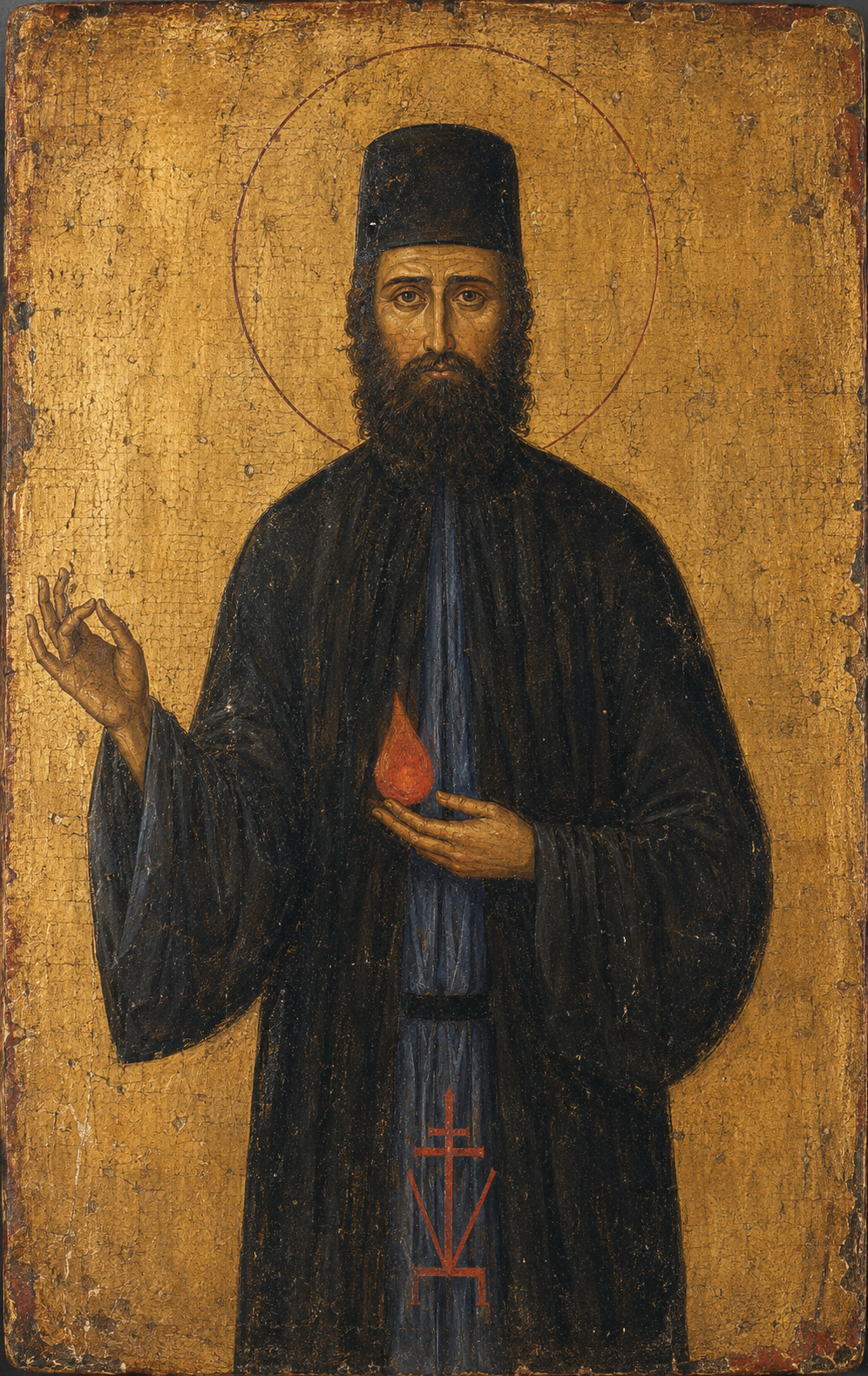
Icons of Saint Ephraim frequently show him as a thin, dark-haired monk wearing black monastic clothing and holding a flame or radiant light in one hand. That iconographic detail derives from Abbess Makaria's account of the saint's appearance following the discovery of his relics, when she described him carrying a bright light while blessing with his other hand.
The flame should therefore not be interpreted as though Saint Ephraim were historically known to carry a literal flame during his fifteenth-century monastic life. It belongs to the twentieth-century visionary tradition associated with his rediscovery.
Symbolically, however, it fits his story remarkably well.
A saint forgotten for nearly five centuries reappears carrying light.
The image expresses the Christian conviction that holiness hidden from human memory is not hidden from God.
A NEW MARTYR WHO WAS ACTUALLY AN OLD MARTYR
The title New Martyr can initially confuse people because Saint Ephraim lived in the fifteenth century. In Orthodox terminology, New Martyr does not normally mean someone who died in the last few years, but a martyr from later periods of Christian history, especially those suffering under Islamic or modern anti-Christian persecution after the ancient Roman martyr era.
Saint Ephraim therefore belongs to the broader company of Orthodox New Martyrs whose lives testify that persecution did not end with Constantine.
His martyrdom took place more than a thousand years after Saints George, Marina, Catherine, and Demetrios.
Yet the demand was essentially the same.
Deny Christ and survive.
Remain faithful and suffer.
Saint Ephraim chose faithfulness.
HIS PRIESTHOOD & THE TITLE HIEROMARTYR
Saint Ephraim was not only a monk. The received Orthodox Life states that he was ordained to the priesthood and served the Divine Liturgy with reverence during his years at the monastery.
For this reason, Orthodox hymnography also calls him a Hieromartyr, meaning a member of the ordained priesthood who suffers martyrdom. The Kontakion explicitly remembers the “double crown” associated with both his priestly service and his martyrdom.
This makes Saint Ephraim especially meaningful for priests and seminarians.
His priesthood did not protect him from suffering.
It prepared him to offer suffering to Christ.
The same hands that had served at the altar were eventually bound by persecutors, yet his final witness remained priestly in the deepest sense because his own life became an offering.
ENDURANCE WHEN SUFFERING DOES NOT END QUICKLY
Saint Ephraim's traditional martyrdom was not instantaneous. The OCA describes months of imprisonment, deprivation, beatings, and attempts to force conversion before the final day of torture.
This gives his story particular meaning for people enduring long-term suffering.
Some trials arrive suddenly and disappear quickly.
Others become a new way of living.
Chronic pain can last for years.
Cancer treatment can stretch across months.
Caregiving can become exhausting precisely because there is no clear ending.
A difficult marriage, family crisis, legal problem, or financial collapse can become something a person wakes up carrying every morning.
Saint Ephraim's life does not offer the shallow promise that faith will make prolonged suffering painless.
His witness says something more substantial.
A person can remain Christ's even inside suffering that has not yet ended.
That is a different kind of miracle.
SAINT EPHRAIM & FEAR
Fear is a natural response to serious illness and crisis.
A person may believe deeply in Christ and still be terrified of surgery.
A parent may pray fervently while fearing the death of a child.
A cancer patient may trust God and still dread the next scan.
Saint Ephraim's martyrdom helps separate fear from faithlessness.
Courage does not require the body to stop recognizing danger.
The martyr's courage consists in refusing to allow danger to determine ultimate allegiance.
A person asking Saint Ephraim's intercession does not need to pretend everything will definitely turn out according to the hoped-for earthly outcome.
The prayer can be more honest.
“Christ, have mercy on me. Saint Ephraim, pray for me. Give me healing if God grants it, and give me strength not to abandon Him whatever comes.”
REPORTED MIRACLES & MODERN DEVOTION
Saint Ephraim's modern reputation grew rapidly because of reports of miracles following the discovery of his relics. The OCA's official Life speaks broadly of healings from many illnesses and infirmities, while the January 3 commemoration repeats that people have experienced healing and prompt assistance through his intercession.
Because miracle literature surrounding modern saints can become filled with stories copied from one website to another without adequate sourcing, the safest product-page approach is not to present every dramatic internet story as established fact.
The Church's own testimony is sufficient.
Saint Ephraim is liturgically honored as a Wonderworker.
Healing is explicitly remembered in his hymnography.
His relics became a center of pilgrimage.
Reports of answered prayer helped spread his veneration.
Those claims can be made without embellishment.
Individual contemporary miracle accounts may be spiritually meaningful, but they should be identified as testimony rather than medical proof.
That distinction protects both faith and credibility.
THE MONASTERY AT NEA MAKRI
The modern center of devotion to Saint Ephraim is the monastery at Mount Amomon near Nea Makri in Attica, Greece, where his relics were uncovered in 1950. The same monastery preserves the location connected with his martyrdom tradition and became the primary pilgrimage destination associated with the saint.
His relics remain there for veneration, and the site attracts pilgrims seeking prayer, healing, and connection with the New Martyr. Pemptousia records that the relics continue to be kept at the monastery and that the mulberry tree associated with his martyrdom is preserved within the complex.
For someone traveling in Greece, Nea Makri therefore offers one of the most direct pilgrimages connected with a modernly revealed Orthodox saint.
The pilgrimage is unusual because the geographical distance between martyrdom and rediscovery is almost nonexistent.
The monastery is the place where he prayed.
It is the place where he suffered according to tradition.
It is the place where his relics were uncovered.
It is still the place where the faithful come to seek his prayers.
JANUARY 3: THE DISCOVERY OF HIS RELICS
Saint Ephraim has an additional feast on January 3, commemorating the uncovering of his relics in 1950. The OCA gives the discovery its own liturgical commemoration rather than treating it merely as a historical footnote.
This feast emphasizes a beautiful theme within Christian devotion: God remembers what human beings forget.
For centuries, there was apparently no living community preserving Ephraim's name.
No annual pilgrimage surrounded his grave.
No popular devotion kept his memory active.
Yet the Orthodox tradition understands his rediscovery as evidence that sainthood does not depend upon fame.
Human memory had lost him.
God had not.
That makes January 3 a particularly meaningful feast for people whose own lives feel hidden or unnoticed.
Holiness does not require an audience.
MAY 5: HIS MARTYRDOM
Saint Ephraim's principal feast is May 5, commemorating his martyrdom in 1426. The OCA lists him on that date as the New Martyr and Wonderworker Ephraim, while his Troparion and Kontakion focus especially upon his suffering, priesthood, victory, and healing intercession.
May 5 therefore emphasizes a different aspect of his life than January 3.
January celebrates revelation.
May celebrates faithfulness.
January remembers the saint being found.
May remembers why the saint mattered before anyone knew his name.
Both are necessary because miracles did not make Ephraim holy.
His life in Christ did.
RECOGNITION BY THE ORTHODOX CHURCH
Devotion to Saint Ephraim developed throughout the latter half of the twentieth century after the discovery of his relics. Pemptousia records that the Ecumenical Patriarchate formally recognized his sainthood in 2011, bringing the already widespread Greek devotion into broader official ecclesiastical recognition.
That date is important because it prevents a misunderstanding sometimes created by his story.
Abbess Makaria did not simply decide by herself that she had found a saint and thereby create a universally binding cult.
Devotion developed, reports of miracles accumulated, the ecclesiastical process continued, and Saint Ephraim eventually received formal recognition within the Orthodox Church.
Today, the OCA maintains both his May 5 Life and January 3 commemoration, complete with liturgical hymns, demonstrating that his veneration extends well beyond a local monastery in Greece.
PRAYERS
A simple traditional invocation can be prayed throughout the day: Holy New Martyr Ephraim, pray to God for us. Because he was a priest as well as a martyr, Holy Hieromartyr Ephraim, pray to God for us is also appropriate and corresponds with the language of his Orthodox hymnography.
The traditional Troparion praises his martyrdom and the grace associated with his intercession, ending with the powerful words: “Glory to Him Who, through you, grants healing to all.” This makes the established liturgical hymn especially appropriate when the prayer intention concerns sickness, hospitalization, surgery, or chronic suffering.
Someone facing an urgent medical situation may simply hold the card and repeat the traditional invocation while naming the sick person before Christ. Long prayers are not required for prayer to be sincere, and fear does not invalidate the prayer.
A caregiver may likewise ask Saint Ephraim's intercession for endurance, wisdom, patience, and compassion. Sometimes the person who is sick receives most of the attention while the spouse, parent, or child providing care becomes physically and emotionally depleted, and that hidden suffering also belongs before God.
The card is especially fitting for a hospital room, bedside table, Bible, prayer book, caregiver's bag, wallet, or home prayer corner. It can also make a meaningful gift for someone newly diagnosed with an illness, entering surgery, beginning cancer treatment, or enduring a condition for which doctors have not yet found an answer.
FAQ
Who is Saint Ephraim of Nea Makri? Saint Ephraim of Nea Makri is an Orthodox New Martyr and Wonderworker traditionally believed to have lived from 1384 to 1426. According to the received Orthodox Life, he was a monk and priest on Mount Amomon in Attica who was imprisoned and tortured for refusing to renounce Christianity and was finally martyred on May 5, 1426.
Is Saint Ephraim of Nea Makri the same as Saint Ephrem the Syrian? No, they are completely different saints. Saint Ephrem the Syrian was a fourth-century Syriac Christian theologian, hymnographer, and deacon, while Saint Ephraim of Nea Makri is the fifteenth-century Greek New Martyr whose relics were uncovered near Athens in 1950.
Why is Saint Ephraim called “of Nea Makri”? The title comes from the modern Greek area near the monastery where he is believed to have lived and suffered martyrdom and where his relics were uncovered. The ancient monastic site stood on Mount Amomon in Attica, near present-day Nea Makri.
Why is he called Saint Ephraim the New? “The New” distinguishes him from earlier saints named Ephraim or Ephrem, especially Saint Ephrem the Syrian. He is also commonly called the New Martyr Ephraim or Ephraim the Wonderworker within Orthodox devotion.
What is a New Martyr? Within Orthodox usage, the title generally refers to saints martyred during later periods of Christian history rather than the earliest Roman persecutions. Saint Ephraim's traditional martyrdom occurred in the fifteenth century during Ottoman expansion into the region.
Was Saint Ephraim a priest? Yes, according to his official Orthodox Life, he received priestly ordination during his years of monastic life and served at the altar. His Kontakion therefore calls him a Hieromartyr and speaks of the double crown of priesthood and martyrdom.
What is Saint Ephraim of Nea Makri known for? He is especially known for his martyrdom, the extraordinary 1950 discovery of his relics, and the large healing and miracle tradition that developed afterward. The Orthodox Church's own liturgical hymn explicitly connects him with healing.
What is Saint Ephraim the patron saint of? Orthodox tradition does not define him through one narrow universal patronage. His strongest established devotional associations are healing, serious illness, urgent prayer, perseverance through suffering, and faithfulness under persecution, all of which arise directly from his Life and liturgical texts.
Is Saint Ephraim a healing saint? Yes, very strongly. His Troparion explicitly praises Christ for granting healing through him, while the OCA's Life says people seeking his intercession have reported healing from many illnesses and infirmities.
Can I pray to Saint Ephraim for cancer? Yes. Although Saint Ephraim is not officially restricted to or universally titled the patron saint of cancer, his broad and well-established healing tradition makes his intercession appropriate for someone with cancer or another serious disease.
Can I pray to Saint Ephraim before surgery? Yes, because serious illness and healing belong firmly to his devotional tradition. A person may ask his intercession for the patient, surgeon, nurses, anesthesiologist, successful treatment, peace before the procedure, and a good recovery.
Can I pray to Saint Ephraim for chronic pain or chronic illness? Yes. The OCA describes healing from many kinds of illnesses rather than limiting devotion to one specific diagnosis, making his intercession particularly fitting for people enduring long-term conditions.
Is Saint Ephraim a saint for urgent help? “Urgent help” is best understood as a modern devotional description rather than an ancient formal patronage title. It is nevertheless strongly grounded in the OCA's statement that Saint Ephraim is quick to answer those who call upon him.
Is Saint Ephraim the patron saint of impossible cases? The Orthodox sources used here do not establish “patron saint of impossible cases” as a formal title for Saint Ephraim. It is safer and more accurate to describe him as a wonderworker invoked for healing, urgent prayer, and difficult situations.
Can I pray to Saint Ephraim when doctors do not know what is wrong? Yes, his broad healing devotion makes that entirely appropriate. Christian prayer can accompany continued medical evaluation rather than replacing it, while asking God through Saint Ephraim's intercession for clarity, healing, strength, and wise medical care.
Can caregivers pray to Saint Ephraim? Yes, especially when they are caring for someone facing severe or prolonged illness. His connection with suffering and healing makes his intercession meaningful for both the patient and the people carrying the physical and emotional burden of care.
When did Saint Ephraim live? The received Orthodox Life gives his birth as September 14, 1384 and his martyrdom as May 5, 1426. These exact biographical details belong to the saint's hagiographic tradition, much of which became known after the twentieth-century discovery of his relics.
What was Saint Ephraim's name before becoming a monk? Later Greek tradition identifies him as Konstantinos Morfis before monastic tonsure. Because these biographical details emerged within the later tradition surrounding his rediscovery, they should be presented as received ecclesiastical tradition rather than independently documented fifteenth-century civil biography.
Where was Saint Ephraim born? The OCA says he was born in Greece, while the fuller Greek tradition identifies his birthplace as Trikala in Thessaly.
How old was Saint Ephraim when he became a monk? His traditional Life says that he entered the monastery on Mount Amomon at approximately fourteen years old. He then spent nearly twenty-seven years in ascetic monastic life before his final persecution.
How was Saint Ephraim martyred? According to the Orthodox Life, he was imprisoned and tortured for months because he refused to abandon Christianity. On May 5, 1426, he was tied upside down to a mulberry tree, beaten and subjected to further torture until he died from his injuries.
Why is Saint Ephraim shown with a tree? The tree refers to the traditional account of his martyrdom, in which he was suspended upside down from a mulberry tree while being tortured. The monastery tradition states that the tree associated with his martyrdom remains preserved at the site.
Why does Saint Ephraim hold a flame in icons? The flame comes from Abbess Makaria's twentieth-century account of seeing the saint after his relics were uncovered. She described a tall monk holding a bright light in one hand while blessing with the other, and that description subsequently influenced his iconography.
How were Saint Ephraim's relics discovered? On January 3, 1950, Abbess Makaria directed a workman to dig at a specific location within the ruined monastery after repeatedly experiencing an interior prompting. Human remains and monastic clothing were uncovered, and Makaria believed she had discovered a holy monk and martyr.
How did Abbess Makaria know the saint's name? According to her account preserved by the Orthodox Church, the saint later appeared to her and identified himself as Ephraim. The detailed story of his life and martyrdom likewise became connected with subsequent revelatory experiences.
Was Saint Ephraim completely unknown before 1950? The OCA's commemoration says that his story had remained forgotten for nearly five centuries before the discovery of the relics. Modern devotion therefore regards him as a newly revealed saint whose identity returned to Church memory through the events surrounding Abbess Makaria.
Is there historical documentation proving every detail of Saint Ephraim's Life? No surviving contemporary fifteenth-century source has been presented in the official accounts used here as documenting every precise biographical detail. Much of the detailed Life belongs to the twentieth-century revelatory tradition associated with Abbess Makaria, so careful writing should identify it explicitly as Orthodox hagiographic tradition.
Does the Orthodox Church officially recognize Saint Ephraim? Yes. He is formally commemorated in Orthodox liturgical calendars, the OCA provides official Lives and hymns for him, and Pemptousia records his formal recognition by the Ecumenical Patriarchate in 2011.
When was Saint Ephraim formally recognized? Pemptousia records that the Ecumenical Patriarchate formally recognized Saint Ephraim in 2011. His popular veneration and local ecclesiastical recognition had already developed before that broader patriarchal recognition.
Is Saint Ephraim an Orthodox saint? Yes, Saint Ephraim of Nea Makri is specifically an Eastern Orthodox saint, particularly associated with the Greek Orthodox tradition. The OCA commemorates him as New Martyr and Wonderworker Ephraim.
Is Saint Ephraim of Nea Makri a Catholic saint? He is not best presented as a universally recognized Catholic saint. His formal glorification and liturgical cult developed within the Eastern Orthodox Church in modern times, so a product page should identify him clearly as an Orthodox saint rather than implying universal Catholic recognition.
When is Saint Ephraim of Nea Makri's feast day? His principal feast is May 5, commemorating his martyrdom. The Orthodox Church also commemorates the discovery of his relics on January 3.
Why does Saint Ephraim have two feast days? May 5 remembers his martyrdom in 1426, while January 3 remembers the discovery of his relics in 1950. The two feasts therefore commemorate two completely different moments separated by more than five centuries.
Where are Saint Ephraim's relics? His principal relics remain at the monastery near Nea Makri in Attica, Greece, where they were uncovered in 1950. The monastery continues to be the central pilgrimage shrine associated with Saint Ephraim.
Can pilgrims visit Saint Ephraim's relics? Yes, the monastery at Nea Makri remains a pilgrimage destination where the faithful venerate his relics and seek his intercession. Pemptousia identifies the relics as still being preserved there.
Are miracles associated with Saint Ephraim? Yes, his Orthodox title includes Wonderworker, his official Life records many reported healings and answered prayers, and his Troparion explicitly associates him with healing grace. Individual modern miracle stories should still be presented as testimonies rather than automatically as independently medically verified events.
Why is Saint Ephraim considered a wonderworker? His reputation developed after the discovery of his relics because numerous people reported healings and other answers to prayer through his intercession. The Church's hymnography subsequently incorporates healing into his liturgical remembrance.
What prayer can I say to Saint Ephraim? A safe traditional invocation is “Holy New Martyr Ephraim, pray to God for us.” His Orthodox Troparion may also be prayed, and its final petition specifically glorifies Christ for granting healing through the saint.
Can I give this prayer card to someone in the hospital? Yes, this is one of the strongest devotional uses for a Saint Ephraim prayer card because his liturgical tradition explicitly connects him with healing. It can accompany prayer for recovery, strength, doctors, nurses, treatment, and peace during hospitalization.
Can I give this card to someone beginning chemotherapy? Yes. Saint Ephraim does not need to be falsely labeled the exclusive patron of cancer for his card to be appropriate because his established devotion encompasses serious illness and healing broadly.
Can I give this card before surgery? Yes, particularly if the recipient is frightened or facing a difficult procedure. The traditional invocation can be used while asking Saint Ephraim to pray to Christ for healing, protection, wisdom for the medical team, and a peaceful recovery.
Can I give this card to someone suffering for a long time? Yes, because Saint Ephraim's traditional Life includes months of imprisonment and prolonged physical suffering before his martyrdom. His story therefore speaks not only to sudden emergencies but to people who must continue carrying a difficult cross day after day.
What does Saint Ephraim teach about suffering? His Life teaches that suffering does not possess the authority to determine whom a Christian will worship. Ephraim's persecutors attempted to use pain to force apostasy, but he remained faithful to Christ until death.
What does Saint Ephraim teach about unanswered prayer? His martyrdom shows that divine faithfulness cannot be reduced to immediate escape from suffering. The saint himself was not physically rescued from death, yet the Church understands his fidelity and later intercessory ministry as a victory that reaches beyond the preservation of earthly life.
What does Saint Ephraim teach about urgent prayer? His modern devotion encourages Christians to turn immediately toward Christ rather than allowing fear to become spiritually paralyzing. The OCA's description of him as quick to answer prayer helps explain why Orthodox Christians so often invoke him when a need feels urgent.
What is the main message of Saint Ephraim of Nea Makri's life? Saint Ephraim's life teaches that faithfulness hidden from the world is never hidden from God. According to the Orthodox tradition, a young monk spent decades quietly seeking Christ, endured months of persecution without renouncing Him, died violently in 1426, and disappeared from human memory for nearly five centuries before his relics were uncovered and his name returned to the life of the Church. His later reputation for healing and urgent intercession does not replace the meaning of his martyrdom but grows from it, reminding Christians that Christ can bring light out of forgotten suffering and that no prayer, illness, hidden sacrifice, or faithful life is truly invisible before God.
Saint Ephraim of Nea Makri, also called Saint Ephraim the New, Saint Ephraim the New Martyr, and Saint Ephraim the Wonderworker, is one of the most beloved modernly revealed saints of Greek Orthodoxy. According to the tradition received by the Orthodox Church, he was a fifteenth-century hieromonk who spent decades in prayer and ascetic life on Mount Amomon near present-day Nea Makri, endured months of imprisonment and torture rather than deny Jesus Christ, and was finally martyred on May 5, 1426. His identity had been forgotten for centuries until relics believed to be his were uncovered at the ruined monastery in 1950, after which devotion to him spread rapidly because of numerous reported healings and answered prayers.
Saint Ephraim is especially meaningful for serious illness, chronic disease, painful medical conditions, frightening diagnoses, urgent needs, hospitalization, surgery, spiritual suffering, and situations in which a person feels that ordinary human help has reached its limits. This healing association is not merely a modern marketing label. The Orthodox Church's Troparion explicitly praises Christ for granting healing through Saint Ephraim, while the OCA's official Life states that people seeking his intercession have reported healing from many kinds of illnesses and describes him as quick to answer those who call upon him.
His devotion can be particularly powerful for someone praying while waiting for medical results or facing a condition for which no easy solution exists. Saint Ephraim's own earthly life ended in terrible physical suffering, so Christians do not approach him as someone unfamiliar with pain. His martyrdom presents a saint who remained faithful when his body had been wounded almost beyond endurance, and his later reputation as a wonderworker has made him a beloved intercessor precisely among people whose bodies are suffering.
Saint Ephraim is also an especially meaningful saint for urgent prayer. Orthodox sources do not assign him a formal title such as “patron saint of impossible cases,” so it would be inaccurate to manufacture such a patronage. However, the received Church tradition repeatedly emphasizes the speed with which people believe he responds to prayer, and the OCA itself says he is quick to answer those who call upon him. That provides a strong and honest devotional basis for invoking him when circumstances are frightening, rapidly developing, or seemingly beyond one's control.
His story is unusual because much of what the Church knows about his precise biography comes from the twentieth-century revelations associated with Abbess Makaria, rather than from a surviving fifteenth-century written Life. The relics were uncovered on January 3, 1950, after Makaria repeatedly felt directed toward a particular location within the ruins. Orthodox tradition then records appearances in which the saint identified himself as Ephraim and revealed details concerning his life and martyrdom. These events should be described as the received hagiographic tradition of the Church rather than presented as though every biographical detail survives independently in contemporary Ottoman or Byzantine archival documents.
That distinction does not diminish the importance of Saint Ephraim within Orthodoxy. His veneration became established within the Greek Church, the Ecumenical Patriarchate formally recognized him in 2011, and Orthodox liturgical calendars now commemorate both his martyrdom on May 5 and the discovery of his relics on January 3.
Saint Ephraim belongs specifically to the Eastern Orthodox tradition, with particularly deep devotion in Greek Orthodoxy. Because his formal recognition as a saint arose within the Orthodox Church many centuries after the medieval separation between East and West, he should not be casually labeled a universally recognized Catholic saint. For a devotional product, the clearest identification is Greek Orthodox New Martyr and Wonderworker.
This prayer card is especially fitting for someone facing cancer, chronic illness, surgery, hospitalization, severe pain, a frightening diagnosis, spiritual distress, or another urgent situation in which sustained prayer is needed. It can also be meaningful for caregivers and families who feel helpless while watching someone they love suffer, because seeking Saint Ephraim's intercession allows them to continue bringing that person before Christ even when they cannot personally fix what is happening.
Each card is handmade in Austin, TX and created to order. We do not keep stock, because every prayer card is treated as a unique devotional offering. They are printed on museum-quality photo paper, not cardstock, and every card is made slowly during prayer with intentional reverence for the saint and for the person who will receive it. Names are lifted before Christ, intentions are held carefully, and each piece is handled multiple times in prayerful silence, asking God for mercy and asking Saint Ephraim to intercede for the soul it is being made for. This is devotional craftsmanship shaped with patience, care, and spiritual responsibility because every soul and every prayer matters.
THE LIFE & STORY
According to the received Orthodox Life, Saint Ephraim was born in Greece on September 14, 1384. A later Greek tradition identifies his birthplace more specifically as Trikala in Thessaly and gives his secular name as Konstantinos Morfis, while the OCA's official Life limits itself to saying that he was born in Greece. His father died while he was young, leaving his mother responsible for a large family.
At approximately fourteen years old, Ephraim entered a monastery on Mount Amomon in Attica, near present-day Nea Makri. The OCA describes the monastery as dedicated to the Annunciation and Saint Paraskeva and remembers Ephraim embracing monastic discipline with unusual seriousness.
For almost twenty-seven years, according to that Life, he pursued the ascetic pattern of the monastic Fathers through prayer, fasting, obedience, purification from the passions, and withdrawal from worldly distractions. He was eventually ordained to the priesthood, making him not only a monk and martyr but a hieromartyr, a priest who suffers martyrdom.
This long hidden period matters because Saint Ephraim's spiritual life did not begin with miracles, visions, persecution, or public recognition. For decades, his holiness developed through ordinary monastic faithfulness that almost nobody outside the community would have noticed.
That pattern is deeply Christian. The final dramatic chapter of someone's life may receive most of the attention, but the ability to remain faithful during extraordinary suffering is usually formed through years of ordinary faithfulness beforehand.
According to the Church's received account, the monastery eventually came under violent attack during the Ottoman expansion into the region. The OCA places a devastating attack in September 1425 and states that monks were tortured and killed, while the fuller Greek tradition preserves an earlier attack in which much of the monastic community had already been massacred.
Saint Ephraim was captured rather than immediately killed. The traditional Life says his captors imprisoned him in a small cell and repeatedly attempted to force him to abandon Christianity and embrace Islam. He was denied adequate food and water, beaten, and tortured over a period of months, yet refused to renounce Christ.
This makes Saint Ephraim more than a healing saint.
He is fundamentally a martyr of perseverance.
His later miracles cannot be separated from the fact that his first witness was simply refusing to abandon Jesus when abandoning Him could have ended the suffering.
On May 5, 1426, according to the received Life, Ephraim's captors led him from imprisonment and bound him upside down to a mulberry tree. They beat, mocked, and tortured him while demanding to know why his God did not rescue him.
The OCA preserves a prayer attributed to Ephraim during the ordeal in which he surrendered himself to God's will rather than asking for vengeance upon his persecutors. His physical torture then intensified, culminating in the use of a burning wooden implement against his body before he finally died from his injuries at approximately nine in the morning.
The details are difficult, but the violence should not become the center of devotion.
The center is Christ.
Ephraim's persecutors tried to use pain to make apostasy appear preferable to faithfulness, yet the martyr refused to let physical suffering decide whom he would worship.
That is why the Church remembers his death as victory rather than merely tragedy.
A SAINT FOR SERIOUS ILLNESS & HEALING
Saint Ephraim has developed an extraordinary reputation within modern Orthodox devotion as an intercessor for healing. The Church's own Troparion ends by glorifying Christ who grants healing through the saint, giving this devotional association an explicit liturgical foundation rather than leaving it dependent solely upon later popular stories.
The OCA's Life is even more direct, stating that people venerating his relics have reported healing from many kinds of illnesses and infirmities. The official account therefore supports presenting Saint Ephraim as a wonderworking saint sought particularly during physical suffering.
It would nevertheless be inaccurate to turn him into the exclusive patron saint of cancer, neurological disease, heart disease, infertility, or another single diagnosis unless a particular Church tradition explicitly does so. His authentic healing devotion is broader.
That breadth can actually make the card more useful.
A person does not need to wonder whether their illness appears on an approved list.
Someone undergoing chemotherapy can seek his intercession.
Someone waiting for a biopsy can seek his intercession.
Someone preparing for surgery can seek his intercession.
Someone living with chronic pain can seek his intercession.
Someone whose doctors do not yet know what is wrong can seek his intercession.
The request remains directed ultimately toward Christ, because Orthodox devotion never treats a saint as an independent source of supernatural power.
Saint Ephraim intercedes.
Christ heals.
URGENT HELP & PRAYERS THAT CANNOT WAIT
Saint Ephraim's reputation for answering prayers quickly has made him especially beloved in frightening situations. The OCA describes him as quick to answer the prayers of those who invoke him, and that language provides one of the strongest foundations for presenting his card for urgent needs.
Urgency takes many forms. It may be a person being rushed to the hospital, a child whose condition suddenly worsens, a family waiting for emergency surgery, a loved one who has disappeared, a crisis that developed overnight, or simply a moment when fear becomes so intense that someone cannot form a long prayer.
In such moments, the traditional Christian response does not have to be complicated.
A person can simply pray:
Holy New Martyr Ephraim, pray to God for us.
That prayer does not tell God what He must do.
It asks another member of Christ's Body to stand with us before Him.
The urgency is real, but the prayer remains rooted in trust rather than panic.
Saint Ephraim is therefore especially appropriate for a wallet card, hospital bag, bedside table, or prayer corner where a person may reach for it during circumstances in which there is very little time to think.
THE DISCOVERY OF HIS RELICS
The story of Saint Ephraim's modern devotion begins almost five centuries after his martyrdom. By the twentieth century, the monastery where he was believed to have lived had long been ruined, and knowledge of the individual martyr had disappeared from ordinary historical memory.
In 1945, a nun named Makaria came to the ancient monastic ruins near Nea Makri and began restoring religious life there. She became deeply aware that monks had once lived and died on the site and prayed that God would reveal one of those holy ascetics to her.
According to her account, she repeatedly experienced an interior direction telling her to dig in a particular place. When a workman eventually dug where she indicated on January 3, 1950, human remains were uncovered beneath the ruins of what appeared to have been an old monastic cell. Makaria reported a powerful fragrance surrounding the discovery and believed immediately that the bones belonged to a holy person.
The Orthodox account says that remains of monastic clothing were also visible and that Makaria carefully gathered and cleaned the bones. She placed them near the altar and continued praying, still without knowing the identity of the person she believed had been revealed.
Then came the experiences that transformed an anonymous discovery into the modern devotion to Saint Ephraim.
Makaria reported hearing footsteps and seeing a tall monastic figure carrying a bright light and giving a blessing. She subsequently described a dream in which the saint identified himself by the name Ephraim and revealed the story of his life and martyrdom.
These details deserve precise language.
They are not reconstructed from a fifteenth-century manuscript unearthed beside the body.
They belong to the revelatory and hagiographic testimony of Abbess Makaria, which the Orthodox tradition subsequently received in connection with the relics and the growing miracle tradition surrounding the saint.
That distinction is important for an educational product page because faith and historical precision do not have to be enemies.
A reader can know exactly what kind of source a claim comes from.
THE MULBERRY TREE
The martyrdom tradition became physically connected with the monastery through the old mulberry tree identified as the tree from which Saint Ephraim was suspended during his final torture. Pemptousia's account of the monastery states that the tree remains preserved within the monastery grounds.
The tree appears frequently in icons of Saint Ephraim because it has become one of the recognizable symbols of his martyrdom.
Its meaning is similar to the Cross itself.
A tree intended by persecutors as an instrument of humiliation became, within Christian memory, a sign of fidelity.
The people torturing Ephraim expected suffering to break his allegiance to Christ.
Instead, the very location of the torture eventually became a pilgrimage destination where Christians pray.
The instrument of apparent defeat became part of the saint's witness.
WHY SAINT EPHRAIM IS OFTEN SHOWN HOLDING A FLAME
Icons of Saint Ephraim frequently show him as a thin, dark-haired monk wearing black monastic clothing and holding a flame or radiant light in one hand. That iconographic detail derives from Abbess Makaria's account of the saint's appearance following the discovery of his relics, when she described him carrying a bright light while blessing with his other hand.
The flame should therefore not be interpreted as though Saint Ephraim were historically known to carry a literal flame during his fifteenth-century monastic life. It belongs to the twentieth-century visionary tradition associated with his rediscovery.
Symbolically, however, it fits his story remarkably well.
A saint forgotten for nearly five centuries reappears carrying light.
The image expresses the Christian conviction that holiness hidden from human memory is not hidden from God.
A NEW MARTYR WHO WAS ACTUALLY AN OLD MARTYR
The title New Martyr can initially confuse people because Saint Ephraim lived in the fifteenth century. In Orthodox terminology, New Martyr does not normally mean someone who died in the last few years, but a martyr from later periods of Christian history, especially those suffering under Islamic or modern anti-Christian persecution after the ancient Roman martyr era.
Saint Ephraim therefore belongs to the broader company of Orthodox New Martyrs whose lives testify that persecution did not end with Constantine.
His martyrdom took place more than a thousand years after Saints George, Marina, Catherine, and Demetrios.
Yet the demand was essentially the same.
Deny Christ and survive.
Remain faithful and suffer.
Saint Ephraim chose faithfulness.
HIS PRIESTHOOD & THE TITLE HIEROMARTYR
Saint Ephraim was not only a monk. The received Orthodox Life states that he was ordained to the priesthood and served the Divine Liturgy with reverence during his years at the monastery.
For this reason, Orthodox hymnography also calls him a Hieromartyr, meaning a member of the ordained priesthood who suffers martyrdom. The Kontakion explicitly remembers the “double crown” associated with both his priestly service and his martyrdom.
This makes Saint Ephraim especially meaningful for priests and seminarians.
His priesthood did not protect him from suffering.
It prepared him to offer suffering to Christ.
The same hands that had served at the altar were eventually bound by persecutors, yet his final witness remained priestly in the deepest sense because his own life became an offering.
ENDURANCE WHEN SUFFERING DOES NOT END QUICKLY
Saint Ephraim's traditional martyrdom was not instantaneous. The OCA describes months of imprisonment, deprivation, beatings, and attempts to force conversion before the final day of torture.
This gives his story particular meaning for people enduring long-term suffering.
Some trials arrive suddenly and disappear quickly.
Others become a new way of living.
Chronic pain can last for years.
Cancer treatment can stretch across months.
Caregiving can become exhausting precisely because there is no clear ending.
A difficult marriage, family crisis, legal problem, or financial collapse can become something a person wakes up carrying every morning.
Saint Ephraim's life does not offer the shallow promise that faith will make prolonged suffering painless.
His witness says something more substantial.
A person can remain Christ's even inside suffering that has not yet ended.
That is a different kind of miracle.
SAINT EPHRAIM & FEAR
Fear is a natural response to serious illness and crisis.
A person may believe deeply in Christ and still be terrified of surgery.
A parent may pray fervently while fearing the death of a child.
A cancer patient may trust God and still dread the next scan.
Saint Ephraim's martyrdom helps separate fear from faithlessness.
Courage does not require the body to stop recognizing danger.
The martyr's courage consists in refusing to allow danger to determine ultimate allegiance.
A person asking Saint Ephraim's intercession does not need to pretend everything will definitely turn out according to the hoped-for earthly outcome.
The prayer can be more honest.
“Christ, have mercy on me. Saint Ephraim, pray for me. Give me healing if God grants it, and give me strength not to abandon Him whatever comes.”
REPORTED MIRACLES & MODERN DEVOTION
Saint Ephraim's modern reputation grew rapidly because of reports of miracles following the discovery of his relics. The OCA's official Life speaks broadly of healings from many illnesses and infirmities, while the January 3 commemoration repeats that people have experienced healing and prompt assistance through his intercession.
Because miracle literature surrounding modern saints can become filled with stories copied from one website to another without adequate sourcing, the safest product-page approach is not to present every dramatic internet story as established fact.
The Church's own testimony is sufficient.
Saint Ephraim is liturgically honored as a Wonderworker.
Healing is explicitly remembered in his hymnography.
His relics became a center of pilgrimage.
Reports of answered prayer helped spread his veneration.
Those claims can be made without embellishment.
Individual contemporary miracle accounts may be spiritually meaningful, but they should be identified as testimony rather than medical proof.
That distinction protects both faith and credibility.
THE MONASTERY AT NEA MAKRI
The modern center of devotion to Saint Ephraim is the monastery at Mount Amomon near Nea Makri in Attica, Greece, where his relics were uncovered in 1950. The same monastery preserves the location connected with his martyrdom tradition and became the primary pilgrimage destination associated with the saint.
His relics remain there for veneration, and the site attracts pilgrims seeking prayer, healing, and connection with the New Martyr. Pemptousia records that the relics continue to be kept at the monastery and that the mulberry tree associated with his martyrdom is preserved within the complex.
For someone traveling in Greece, Nea Makri therefore offers one of the most direct pilgrimages connected with a modernly revealed Orthodox saint.
The pilgrimage is unusual because the geographical distance between martyrdom and rediscovery is almost nonexistent.
The monastery is the place where he prayed.
It is the place where he suffered according to tradition.
It is the place where his relics were uncovered.
It is still the place where the faithful come to seek his prayers.
JANUARY 3: THE DISCOVERY OF HIS RELICS
Saint Ephraim has an additional feast on January 3, commemorating the uncovering of his relics in 1950. The OCA gives the discovery its own liturgical commemoration rather than treating it merely as a historical footnote.
This feast emphasizes a beautiful theme within Christian devotion: God remembers what human beings forget.
For centuries, there was apparently no living community preserving Ephraim's name.
No annual pilgrimage surrounded his grave.
No popular devotion kept his memory active.
Yet the Orthodox tradition understands his rediscovery as evidence that sainthood does not depend upon fame.
Human memory had lost him.
God had not.
That makes January 3 a particularly meaningful feast for people whose own lives feel hidden or unnoticed.
Holiness does not require an audience.
MAY 5: HIS MARTYRDOM
Saint Ephraim's principal feast is May 5, commemorating his martyrdom in 1426. The OCA lists him on that date as the New Martyr and Wonderworker Ephraim, while his Troparion and Kontakion focus especially upon his suffering, priesthood, victory, and healing intercession.
May 5 therefore emphasizes a different aspect of his life than January 3.
January celebrates revelation.
May celebrates faithfulness.
January remembers the saint being found.
May remembers why the saint mattered before anyone knew his name.
Both are necessary because miracles did not make Ephraim holy.
His life in Christ did.
RECOGNITION BY THE ORTHODOX CHURCH
Devotion to Saint Ephraim developed throughout the latter half of the twentieth century after the discovery of his relics. Pemptousia records that the Ecumenical Patriarchate formally recognized his sainthood in 2011, bringing the already widespread Greek devotion into broader official ecclesiastical recognition.
That date is important because it prevents a misunderstanding sometimes created by his story.
Abbess Makaria did not simply decide by herself that she had found a saint and thereby create a universally binding cult.
Devotion developed, reports of miracles accumulated, the ecclesiastical process continued, and Saint Ephraim eventually received formal recognition within the Orthodox Church.
Today, the OCA maintains both his May 5 Life and January 3 commemoration, complete with liturgical hymns, demonstrating that his veneration extends well beyond a local monastery in Greece.
PRAYERS
A simple traditional invocation can be prayed throughout the day: Holy New Martyr Ephraim, pray to God for us. Because he was a priest as well as a martyr, Holy Hieromartyr Ephraim, pray to God for us is also appropriate and corresponds with the language of his Orthodox hymnography.
The traditional Troparion praises his martyrdom and the grace associated with his intercession, ending with the powerful words: “Glory to Him Who, through you, grants healing to all.” This makes the established liturgical hymn especially appropriate when the prayer intention concerns sickness, hospitalization, surgery, or chronic suffering.
Someone facing an urgent medical situation may simply hold the card and repeat the traditional invocation while naming the sick person before Christ. Long prayers are not required for prayer to be sincere, and fear does not invalidate the prayer.
A caregiver may likewise ask Saint Ephraim's intercession for endurance, wisdom, patience, and compassion. Sometimes the person who is sick receives most of the attention while the spouse, parent, or child providing care becomes physically and emotionally depleted, and that hidden suffering also belongs before God.
The card is especially fitting for a hospital room, bedside table, Bible, prayer book, caregiver's bag, wallet, or home prayer corner. It can also make a meaningful gift for someone newly diagnosed with an illness, entering surgery, beginning cancer treatment, or enduring a condition for which doctors have not yet found an answer.
FAQ
Who is Saint Ephraim of Nea Makri? Saint Ephraim of Nea Makri is an Orthodox New Martyr and Wonderworker traditionally believed to have lived from 1384 to 1426. According to the received Orthodox Life, he was a monk and priest on Mount Amomon in Attica who was imprisoned and tortured for refusing to renounce Christianity and was finally martyred on May 5, 1426.
Is Saint Ephraim of Nea Makri the same as Saint Ephrem the Syrian? No, they are completely different saints. Saint Ephrem the Syrian was a fourth-century Syriac Christian theologian, hymnographer, and deacon, while Saint Ephraim of Nea Makri is the fifteenth-century Greek New Martyr whose relics were uncovered near Athens in 1950.
Why is Saint Ephraim called “of Nea Makri”? The title comes from the modern Greek area near the monastery where he is believed to have lived and suffered martyrdom and where his relics were uncovered. The ancient monastic site stood on Mount Amomon in Attica, near present-day Nea Makri.
Why is he called Saint Ephraim the New? “The New” distinguishes him from earlier saints named Ephraim or Ephrem, especially Saint Ephrem the Syrian. He is also commonly called the New Martyr Ephraim or Ephraim the Wonderworker within Orthodox devotion.
What is a New Martyr? Within Orthodox usage, the title generally refers to saints martyred during later periods of Christian history rather than the earliest Roman persecutions. Saint Ephraim's traditional martyrdom occurred in the fifteenth century during Ottoman expansion into the region.
Was Saint Ephraim a priest? Yes, according to his official Orthodox Life, he received priestly ordination during his years of monastic life and served at the altar. His Kontakion therefore calls him a Hieromartyr and speaks of the double crown of priesthood and martyrdom.
What is Saint Ephraim of Nea Makri known for? He is especially known for his martyrdom, the extraordinary 1950 discovery of his relics, and the large healing and miracle tradition that developed afterward. The Orthodox Church's own liturgical hymn explicitly connects him with healing.
What is Saint Ephraim the patron saint of? Orthodox tradition does not define him through one narrow universal patronage. His strongest established devotional associations are healing, serious illness, urgent prayer, perseverance through suffering, and faithfulness under persecution, all of which arise directly from his Life and liturgical texts.
Is Saint Ephraim a healing saint? Yes, very strongly. His Troparion explicitly praises Christ for granting healing through him, while the OCA's Life says people seeking his intercession have reported healing from many illnesses and infirmities.
Can I pray to Saint Ephraim for cancer? Yes. Although Saint Ephraim is not officially restricted to or universally titled the patron saint of cancer, his broad and well-established healing tradition makes his intercession appropriate for someone with cancer or another serious disease.
Can I pray to Saint Ephraim before surgery? Yes, because serious illness and healing belong firmly to his devotional tradition. A person may ask his intercession for the patient, surgeon, nurses, anesthesiologist, successful treatment, peace before the procedure, and a good recovery.
Can I pray to Saint Ephraim for chronic pain or chronic illness? Yes. The OCA describes healing from many kinds of illnesses rather than limiting devotion to one specific diagnosis, making his intercession particularly fitting for people enduring long-term conditions.
Is Saint Ephraim a saint for urgent help? “Urgent help” is best understood as a modern devotional description rather than an ancient formal patronage title. It is nevertheless strongly grounded in the OCA's statement that Saint Ephraim is quick to answer those who call upon him.
Is Saint Ephraim the patron saint of impossible cases? The Orthodox sources used here do not establish “patron saint of impossible cases” as a formal title for Saint Ephraim. It is safer and more accurate to describe him as a wonderworker invoked for healing, urgent prayer, and difficult situations.
Can I pray to Saint Ephraim when doctors do not know what is wrong? Yes, his broad healing devotion makes that entirely appropriate. Christian prayer can accompany continued medical evaluation rather than replacing it, while asking God through Saint Ephraim's intercession for clarity, healing, strength, and wise medical care.
Can caregivers pray to Saint Ephraim? Yes, especially when they are caring for someone facing severe or prolonged illness. His connection with suffering and healing makes his intercession meaningful for both the patient and the people carrying the physical and emotional burden of care.
When did Saint Ephraim live? The received Orthodox Life gives his birth as September 14, 1384 and his martyrdom as May 5, 1426. These exact biographical details belong to the saint's hagiographic tradition, much of which became known after the twentieth-century discovery of his relics.
What was Saint Ephraim's name before becoming a monk? Later Greek tradition identifies him as Konstantinos Morfis before monastic tonsure. Because these biographical details emerged within the later tradition surrounding his rediscovery, they should be presented as received ecclesiastical tradition rather than independently documented fifteenth-century civil biography.
Where was Saint Ephraim born? The OCA says he was born in Greece, while the fuller Greek tradition identifies his birthplace as Trikala in Thessaly.
How old was Saint Ephraim when he became a monk? His traditional Life says that he entered the monastery on Mount Amomon at approximately fourteen years old. He then spent nearly twenty-seven years in ascetic monastic life before his final persecution.
How was Saint Ephraim martyred? According to the Orthodox Life, he was imprisoned and tortured for months because he refused to abandon Christianity. On May 5, 1426, he was tied upside down to a mulberry tree, beaten and subjected to further torture until he died from his injuries.
Why is Saint Ephraim shown with a tree? The tree refers to the traditional account of his martyrdom, in which he was suspended upside down from a mulberry tree while being tortured. The monastery tradition states that the tree associated with his martyrdom remains preserved at the site.
Why does Saint Ephraim hold a flame in icons? The flame comes from Abbess Makaria's twentieth-century account of seeing the saint after his relics were uncovered. She described a tall monk holding a bright light in one hand while blessing with the other, and that description subsequently influenced his iconography.
How were Saint Ephraim's relics discovered? On January 3, 1950, Abbess Makaria directed a workman to dig at a specific location within the ruined monastery after repeatedly experiencing an interior prompting. Human remains and monastic clothing were uncovered, and Makaria believed she had discovered a holy monk and martyr.
How did Abbess Makaria know the saint's name? According to her account preserved by the Orthodox Church, the saint later appeared to her and identified himself as Ephraim. The detailed story of his life and martyrdom likewise became connected with subsequent revelatory experiences.
Was Saint Ephraim completely unknown before 1950? The OCA's commemoration says that his story had remained forgotten for nearly five centuries before the discovery of the relics. Modern devotion therefore regards him as a newly revealed saint whose identity returned to Church memory through the events surrounding Abbess Makaria.
Is there historical documentation proving every detail of Saint Ephraim's Life? No surviving contemporary fifteenth-century source has been presented in the official accounts used here as documenting every precise biographical detail. Much of the detailed Life belongs to the twentieth-century revelatory tradition associated with Abbess Makaria, so careful writing should identify it explicitly as Orthodox hagiographic tradition.
Does the Orthodox Church officially recognize Saint Ephraim? Yes. He is formally commemorated in Orthodox liturgical calendars, the OCA provides official Lives and hymns for him, and Pemptousia records his formal recognition by the Ecumenical Patriarchate in 2011.
When was Saint Ephraim formally recognized? Pemptousia records that the Ecumenical Patriarchate formally recognized Saint Ephraim in 2011. His popular veneration and local ecclesiastical recognition had already developed before that broader patriarchal recognition.
Is Saint Ephraim an Orthodox saint? Yes, Saint Ephraim of Nea Makri is specifically an Eastern Orthodox saint, particularly associated with the Greek Orthodox tradition. The OCA commemorates him as New Martyr and Wonderworker Ephraim.
Is Saint Ephraim of Nea Makri a Catholic saint? He is not best presented as a universally recognized Catholic saint. His formal glorification and liturgical cult developed within the Eastern Orthodox Church in modern times, so a product page should identify him clearly as an Orthodox saint rather than implying universal Catholic recognition.
When is Saint Ephraim of Nea Makri's feast day? His principal feast is May 5, commemorating his martyrdom. The Orthodox Church also commemorates the discovery of his relics on January 3.
Why does Saint Ephraim have two feast days? May 5 remembers his martyrdom in 1426, while January 3 remembers the discovery of his relics in 1950. The two feasts therefore commemorate two completely different moments separated by more than five centuries.
Where are Saint Ephraim's relics? His principal relics remain at the monastery near Nea Makri in Attica, Greece, where they were uncovered in 1950. The monastery continues to be the central pilgrimage shrine associated with Saint Ephraim.
Can pilgrims visit Saint Ephraim's relics? Yes, the monastery at Nea Makri remains a pilgrimage destination where the faithful venerate his relics and seek his intercession. Pemptousia identifies the relics as still being preserved there.
Are miracles associated with Saint Ephraim? Yes, his Orthodox title includes Wonderworker, his official Life records many reported healings and answered prayers, and his Troparion explicitly associates him with healing grace. Individual modern miracle stories should still be presented as testimonies rather than automatically as independently medically verified events.
Why is Saint Ephraim considered a wonderworker? His reputation developed after the discovery of his relics because numerous people reported healings and other answers to prayer through his intercession. The Church's hymnography subsequently incorporates healing into his liturgical remembrance.
What prayer can I say to Saint Ephraim? A safe traditional invocation is “Holy New Martyr Ephraim, pray to God for us.” His Orthodox Troparion may also be prayed, and its final petition specifically glorifies Christ for granting healing through the saint.
Can I give this prayer card to someone in the hospital? Yes, this is one of the strongest devotional uses for a Saint Ephraim prayer card because his liturgical tradition explicitly connects him with healing. It can accompany prayer for recovery, strength, doctors, nurses, treatment, and peace during hospitalization.
Can I give this card to someone beginning chemotherapy? Yes. Saint Ephraim does not need to be falsely labeled the exclusive patron of cancer for his card to be appropriate because his established devotion encompasses serious illness and healing broadly.
Can I give this card before surgery? Yes, particularly if the recipient is frightened or facing a difficult procedure. The traditional invocation can be used while asking Saint Ephraim to pray to Christ for healing, protection, wisdom for the medical team, and a peaceful recovery.
Can I give this card to someone suffering for a long time? Yes, because Saint Ephraim's traditional Life includes months of imprisonment and prolonged physical suffering before his martyrdom. His story therefore speaks not only to sudden emergencies but to people who must continue carrying a difficult cross day after day.
What does Saint Ephraim teach about suffering? His Life teaches that suffering does not possess the authority to determine whom a Christian will worship. Ephraim's persecutors attempted to use pain to force apostasy, but he remained faithful to Christ until death.
What does Saint Ephraim teach about unanswered prayer? His martyrdom shows that divine faithfulness cannot be reduced to immediate escape from suffering. The saint himself was not physically rescued from death, yet the Church understands his fidelity and later intercessory ministry as a victory that reaches beyond the preservation of earthly life.
What does Saint Ephraim teach about urgent prayer? His modern devotion encourages Christians to turn immediately toward Christ rather than allowing fear to become spiritually paralyzing. The OCA's description of him as quick to answer prayer helps explain why Orthodox Christians so often invoke him when a need feels urgent.
What is the main message of Saint Ephraim of Nea Makri's life? Saint Ephraim's life teaches that faithfulness hidden from the world is never hidden from God. According to the Orthodox tradition, a young monk spent decades quietly seeking Christ, endured months of persecution without renouncing Him, died violently in 1426, and disappeared from human memory for nearly five centuries before his relics were uncovered and his name returned to the life of the Church. His later reputation for healing and urgent intercession does not replace the meaning of his martyrdom but grows from it, reminding Christians that Christ can bring light out of forgotten suffering and that no prayer, illness, hidden sacrifice, or faithful life is truly invisible before God.