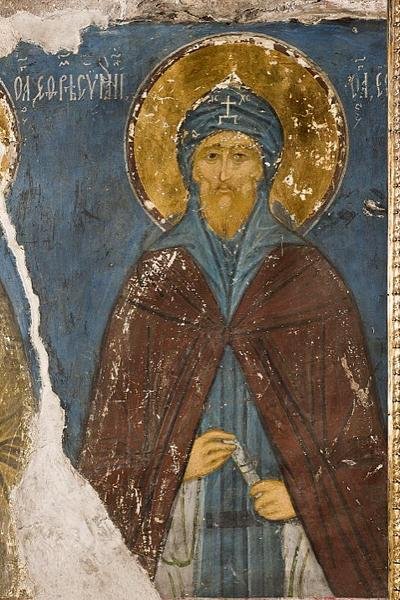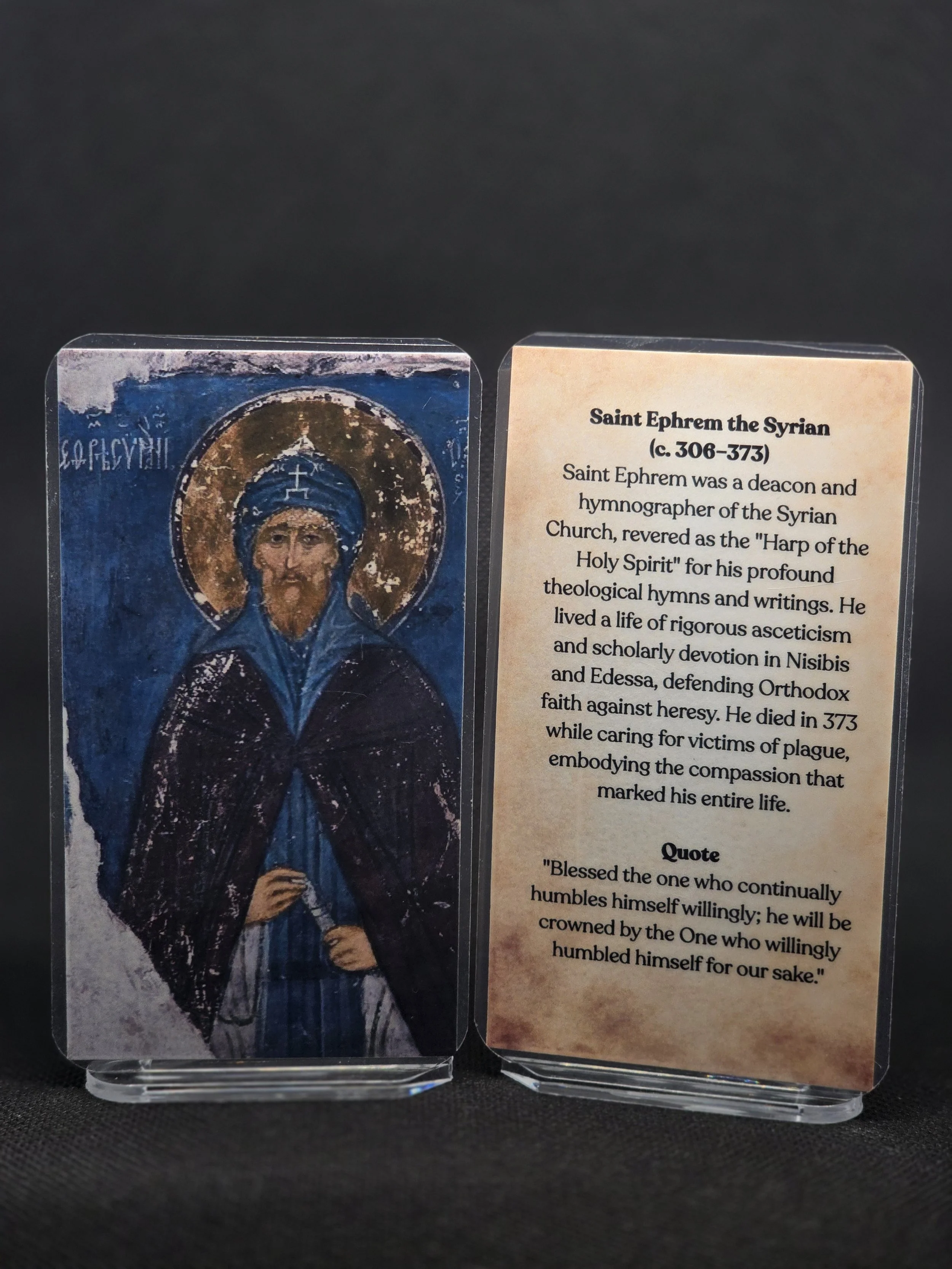
Saint Ephrem the Syrian Prayer Card – Patron for Inner Peace, Emotional Healing & Strength in Suffering

$3.00

Saint Ephrem the Syrian is one of Christianity’s most luminous poets, theologians, and spiritual healers. He was born around AD 306 in Nisibis, in what is now modern Turkey, and spent his life serving Christ through hymnography, Scripture, and quiet pastoral care. He lived before the great schisms of the Church and belongs to the undivided Christian world, venerated today by Syriac Christians, Oriental Orthodox, Eastern Orthodox, and the Universal Catholic Church.

His primary feast day is celebrated on June 9 in the Roman Catholic calendar and January 28 in the Eastern Orthodox calendar, with additional commemorations in Syriac and Oriental traditions.

Ephrem never sought power. He never became a bishop. He remained a deacon by choice.

Instead, he gave the Church something far rarer.

He gave language to suffering.

He lived during a time of war, exile, famine, and plague. His city was invaded. His people were displaced. Families were torn apart. Faith was tested by violence and loss. Ephrem walked among the wounded, the grieving, and the spiritually exhausted, offering not arguments, but hymns. Not speeches, but prayers. Not authority, but compassion.

People turn to Saint Ephrem today for inner peace, emotional healing, mental distress, grief, and spiritual protection because he understood the fragile interior world of the human heart. His writings speak directly to anxiety, despair, repentance, and the slow rebuilding of hope.

If you are carrying sorrow that feels too heavy to explain, if your thoughts feel scattered or overwhelmed, if your spirit feels tired from long seasons of endurance, Saint Ephrem knows that landscape.

He teaches that God meets us through tears.
He teaches that repentance is gentle.
He teaches that healing unfolds through humility.

This prayer card is created as a spiritual heirloom. It is meant to accompany quiet moments of reflection and prayer, reminding you that Christ draws near to broken hearts and listens carefully to whispered petitions.

Each card is handmade in Austin, TX and created to order. We do not keep stock, because every prayer card is treated as a unique devotional offering. They are printed on museum-quality photo paper, not cardstock. Every card is made slowly, during prayer, with intentional reverence for the saint or holy image and for the person who will receive it. Names are lifted before Christ. Intentions are held carefully. Each piece is handled multiple times in prayerful silence, asking God for mercy and asking the saint or Theotokos to intercede for the soul it is being made for. This is not production work. It is devotional craftsmanship shaped with patience, care, and spiritual responsibility, because every soul and every prayer matters.

Saint Ephrem the Syrian is one of Christianity’s most luminous poets, theologians, and spiritual healers. He was born around AD 306 in Nisibis, in what is now modern Turkey, and spent his life serving Christ through hymnography, Scripture, and quiet pastoral care. He lived before the great schisms of the Church and belongs to the undivided Christian world, venerated today by Syriac Christians, Oriental Orthodox, Eastern Orthodox, and the Universal Catholic Church.

His primary feast day is celebrated on June 9 in the Roman Catholic calendar and January 28 in the Eastern Orthodox calendar, with additional commemorations in Syriac and Oriental traditions.

Ephrem never sought power. He never became a bishop. He remained a deacon by choice.

Instead, he gave the Church something far rarer.

He gave language to suffering.

He lived during a time of war, exile, famine, and plague. His city was invaded. His people were displaced. Families were torn apart. Faith was tested by violence and loss. Ephrem walked among the wounded, the grieving, and the spiritually exhausted, offering not arguments, but hymns. Not speeches, but prayers. Not authority, but compassion.

People turn to Saint Ephrem today for inner peace, emotional healing, mental distress, grief, and spiritual protection because he understood the fragile interior world of the human heart. His writings speak directly to anxiety, despair, repentance, and the slow rebuilding of hope.

If you are carrying sorrow that feels too heavy to explain, if your thoughts feel scattered or overwhelmed, if your spirit feels tired from long seasons of endurance, Saint Ephrem knows that landscape.

He teaches that God meets us through tears.
He teaches that repentance is gentle.
He teaches that healing unfolds through humility.

This prayer card is created as a spiritual heirloom. It is meant to accompany quiet moments of reflection and prayer, reminding you that Christ draws near to broken hearts and listens carefully to whispered petitions.

Each card is handmade in Austin, TX and created to order. We do not keep stock, because every prayer card is treated as a unique devotional offering. They are printed on museum-quality photo paper, not cardstock. Every card is made slowly, during prayer, with intentional reverence for the saint or holy image and for the person who will receive it. Names are lifted before Christ. Intentions are held carefully. Each piece is handled multiple times in prayerful silence, asking God for mercy and asking the saint or Theotokos to intercede for the soul it is being made for. This is not production work. It is devotional craftsmanship shaped with patience, care, and spiritual responsibility, because every soul and every prayer matters.

  • THE LIFE & STORY

    Ephrem was born in Nisibis, a frontier city caught between the Roman and Persian empires. From his earliest years, he lived in a world shaped by instability, conflict, and displacement. He received Christian formation under Bishop Jacob of Nisibis and was ordained a deacon, a role he retained for the rest of his life.

    He never pursued ecclesiastical rank.

    He pursued holiness.

    Ephrem’s early ministry unfolded during repeated military sieges of Nisibis. He witnessed hunger, fear, and death firsthand. When the city was eventually ceded to Persia in AD 363, Ephrem and many Christians were forced into exile, settling in Edessa.

    This displacement marked him deeply.

    In Edessa, Ephrem devoted himself fully to teaching, writing, and caring for the poor. He composed hundreds of hymns and poetic sermons designed to teach Scripture, defend orthodox faith, and comfort wounded souls. His theology was not written for scholars alone. It was sung by ordinary believers. His words entered homes, churches, and hearts.

    Ephrem believed that poetry could carry divine truth where logic alone could not.

    He wrote about creation as a mirror of God.
    He wrote about repentance as a doorway back to light.
    He wrote about tears as sacred offerings.
    He wrote about Christ as the healer of both body and soul.

    He fought heresy not through aggression, but through beauty. His hymns reshaped popular devotion, gently guiding people back to orthodox belief through melody and metaphor.

    Yet Ephrem was also profoundly ascetic.

    He practiced fasting, silence, and humility. He avoided praise. He preferred solitude. He referred to himself as a sinner and continually emphasized repentance as the path to freedom.

    Near the end of his life, a devastating famine struck Edessa. Ephrem organized relief efforts, persuading the wealthy to give generously and personally overseeing distribution to the starving. Shortly afterward, while caring for plague victims, he contracted illness himself.

    He died in AD 373.

    His final request was simple.

    He asked to be buried with strangers, not honored publicly.

    After his death, devotion to Ephrem spread rapidly across Syriac Christianity and beyond. His hymns became foundational to Eastern liturgical life. His prayers continue to shape Lenten worship, especially his famous Prayer of Repentance, recited daily in Byzantine traditions.

    Saint Ephrem shows that holiness does not require loud authority. Sometimes it arrives quietly, through poetry, tears, and mercy.

  • MIRACLES & PATRONAGE

    Patron Saint Of:

    • Inner peace during emotional distress

    • Mental health struggles and spiritual heaviness

    • Grief, loss, and sorrow of heart

    • Emotional healing through repentance

    • Protection during seasons of suffering

    Saint Ephrem’s miracle tradition centers on spiritual healing rather than dramatic physical signs.

    During his life, many testified to receiving comfort, clarity, and renewed faith through his hymns and counsel. His poetic prayers brought peace to anxious minds and hope to grieving families.

    After his death, believers across Syriac, Byzantine, and Orthodox communities reported interior healing, relief from despair, and strengthened faith after praying through his intercession. His Lenten prayer became a cornerstone of spiritual renewal, helping generations confront pride, anxiety, and spiritual fatigue.

    He is especially close to those who feel emotionally fragile, spiritually worn down, or overwhelmed by life’s losses.

    Saint Ephrem’s intercession often arrives quietly, restoring calm, softening hardened hearts, and guiding souls back toward Christ.

  • PRAYERS

    Short Traditional Invocation

    Saint Ephrem the Syrian, harp of the Holy Spirit, pray for us.

    Personal Devotional Prayer

    Saint Ephrem, gentle teacher of repentance and healing,
    you who gave voice to sorrow and beauty to prayer,
    I come to you carrying what weighs on my heart.

    You understand grief that lingers.
    You understand thoughts that feel scattered.
    You understand how suffering can quietly reshape the soul.

    Stand beside me now.

    Intercede for me when anxiety rises without warning.
    Intercede for me when sadness feels heavy and persistent.
    Intercede for me when I feel spiritually tired or emotionally overwhelmed.

    Ask Christ to calm my inner storms.
    Ask Him to heal what feels broken within me.
    Ask Him to grant me peace that grows slowly and faithfully.

    Teach me how to repent gently.
    Teach me how to forgive myself.
    Teach me how to trust God in the middle of uncertainty.

    Saint Ephrem, you believed that tears can become prayers.
    Help me offer my own sorrows to Christ.
    Help me discover hope where I thought none remained.

    Carry my intentions before the throne of mercy.
    Hold my name in your prayer.
    Guard my mind and protect my heart.

    May your witness remind me that healing is holy,
    that humility opens doors,
    and that God never abandons those who seek Him with sincerity.

    Amen.

  • FAQ

    What is Saint Ephrem the Syrian known for?
    He is known as one of Christianity’s greatest hymnographers and theologians, celebrated for his poetic defense of orthodox faith and his deep compassion for human suffering.

    When is his feast day?
    June 9 in the Roman Catholic calendar and January 28 in the Eastern Orthodox calendar, with additional commemorations in Syriac traditions.

    Which Christian traditions venerate Saint Ephrem?
    He is venerated by Syriac Christians, Oriental Orthodox, Eastern Orthodox, and the Universal Catholic Church.

    Why do people pray to Saint Ephrem for emotional healing and inner peace?
    Because his life and writings address grief, repentance, anxiety, and spiritual exhaustion with profound tenderness. His intercession is sought by those seeking calm, healing, and renewed trust in God.