 Image 1 of 1
Saint Euthymius the Great Prayer Card - For Monastic Vocations, Spiritual Guidance, Obedience & Desert Prayer
Saint Euthymius the Great was one of the foundational fathers of Palestinian monasticism, a priest, hermit, spiritual father, miracle-worker, defender of the Council of Chalcedon, and teacher of saints whose influence spread throughout the Judean Desert. Born in Melitene in Armenia around 376, he was dedicated to God from childhood, became a monk and priest, left positions of authority in search of greater stillness, and eventually established one of the most influential lavras between Jerusalem and Jericho. Among those formed within his spiritual tradition was Saint Sabas the Sanctified, while Saint Gerasimus of the Jordan also turned to Euthymius for guidance during the theological conflicts following Chalcedon. Saint Euthymius reposed on January 20, 473, at approximately ninety-seven years of age.
Saint Euthymius is especially meaningful for monks, novices, men discerning monastic life, spiritual fathers, priests, people seeking reliable spiritual direction, Christians struggling with obedience, those trying to remain faithful to a prayer rule, people tempted to continually start over somewhere else, Christians seeking greater silence, people practicing fasting, those asking for perseverance, and anyone trying to distinguish genuine spiritual growth from restlessness. These associations arise directly from his life and teaching because Euthymius spent decades balancing solitude with responsibility, refusing fame, guiding monks, correcting discouragement, teaching obedience, practicing seasonal withdrawal into the wilderness, and forming men who would themselves become great spiritual fathers.
His connection with stability and perseverance is particularly powerful. When two monks became discouraged by the severity of life in his community and planned to leave, Euthymius warned them against imagining that merely changing places would solve an interior spiritual problem. His teaching compared a person who constantly changes places to a tree repeatedly transplanted before it can bear fruit. The principle is especially relevant to anyone who repeatedly believes that a new parish, monastery, job, spiritual practice, relationship, or environment will automatically resolve difficulties that may actually need to be faced within the heart.
Saint Euthymius is also one of the great saints for spiritual fathers and those seeking spiritual guidance. He did not simply attract disciples because of eloquence or position because he repeatedly tried to escape attention and return to silence. People continued finding him because they recognized wisdom, holiness, discernment, healing, and a capacity to guide souls. Eventually God had to redirect Euthymius himself, according to his Life, teaching him not to drive away people who genuinely came seeking salvation simply because their presence interrupted his solitude.
This prayer card is especially fitting for monks, monastery novices, seminarians, priests, men discerning monastic life, spiritual directors, retreatants, Christians establishing a prayer rule, people struggling with spiritual discouragement, and anyone trying to persevere faithfully where God has already placed them. It can also make a meaningful monastery entrance, tonsure, ordination, seminary graduation, retreat, spiritual-direction, baptism, chrismation, name-day, or feast-day gift.
Each card is handmade in Austin, TX and created to order. We do not keep stock, because every prayer card is treated as a unique devotional offering. They are printed on museum-quality photo paper, not cardstock, and every card is made slowly during prayer with intentional reverence for the saint and for the person who will receive it. Names are lifted before Christ, intentions are held carefully, and each piece is handled multiple times in prayerful silence, asking God for mercy and asking Saint Euthymius the Great to intercede for the soul it is being made for. This is devotional craftsmanship shaped with patience, care, and spiritual responsibility because every soul and every prayer matters.
THE LIFE & STORY
Saint Euthymius the Great was born around 376 in Melitene in Armenia, near the Euphrates. His parents, Paul and Dionysia, were devout Christians who had remained childless for many years and prayed earnestly for a son. According to the ecclesiastical tradition preserved by both the Orthodox Church in America and the Patriarchate of Jerusalem, they received a promise that God would grant them a child who would bring joy to the Church, and the name Euthymius was connected with the idea of good cheer or gladness.
His father died while Euthymius was still young, and his mother fulfilled the promise that her son would be dedicated to God. She entrusted him to her brother, the priest Eudoxius, who brought the child to the bishop of Melitene. Euthymius was educated in Scripture and ecclesiastical life, became a reader, and eventually entered monastic life and was ordained to the priesthood.
The future desert father therefore did not begin his Christian formation in isolation. Scripture, liturgy, clergy, family sacrifice, education, and Church discipline all shaped him long before he became famous for solitary prayer.
DEDICATED TO GOD FROM CHILDHOOD
Euthymius' childhood belongs to an ancient Christian pattern in which some children were dedicated very early to ecclesiastical or monastic service. The Byzantine Catholic Metropolitan Cantor Institute continues commemorating him as a saint who was consecrated to God from infancy, reflecting the traditional understanding of his early vocation.
Modern Christians do not need to imitate every historical circumstance literally to understand the spiritual principle. A vocation that appears early still requires formation, patience, discernment, education, and obedience rather than assuming that strong religious enthusiasm automatically produces maturity.
Euthymius' life therefore makes him meaningful for parents praying for a child's vocation, young men sensing an early attraction toward priesthood or monasticism, and people whose calling to religious life has remained persistent across many years. His story shows a vocation unfolding gradually through the Church rather than through one isolated spiritual experience.
PRIEST & OVERSEER OF MONASTERIES
As Euthymius matured, he was ordained a priest and eventually entrusted with the supervision of monasteries around Melitene. The position indicates that other church leaders already recognized his spiritual discipline and reliability, yet administrative responsibility created an unexpected conflict within him because Euthymius increasingly desired quiet and concentrated prayer.
During Great Lent he would leave ordinary responsibilities temporarily and withdraw into the wilderness. Over time, however, the tension between public responsibility and his longing for stillness became strong enough that he ultimately left his homeland for Jerusalem around 406.
This gives Euthymius a particularly interesting place among saints for people who are competent enough that others continually give them more responsibility. Being capable of leadership does not automatically mean every leadership role is one's permanent vocation, and Euthymius had to discern when responsibility was service and when it was preventing him from following a deeper call.
LEAVING ARMENIA FOR THE HOLY LAND
Euthymius traveled to Jerusalem, venerated the holy places, and then deliberately sought the desert fathers. He settled at the Pharan or Tharan Lavra, associated with the older monastic tradition of Saint Chariton, choosing a solitary cell and supporting himself through manual work such as basket weaving.
The move from Armenia to Palestine was not an attempt to build a public career because Euthymius was moving in the opposite direction. He left authority behind precisely because he wanted obscurity, prayer, manual labor, and stillness.
Yet this pattern would repeat throughout his life. The farther Euthymius moved into the wilderness to escape recognition, the more people eventually sought him out.
SAINT THEOCTISTUS
At Pharan, Euthymius developed an extraordinary spiritual friendship with Saint Theoctistus of Palestine. The OCA describes the two ascetics as sharing such unity of purpose and affection that they seemed to possess one soul and one will, while the Patriarchate of Jerusalem likewise remembers their spiritual friendship, cooperation, and common ascetic life.
Every year after the celebration of Theophany, Euthymius and Theoctistus withdrew deeper into the Judean wilderness and remained there in intense prayer and ascetic discipline until Palm Sunday. Their seasonal withdrawal became part of a wider Palestinian monastic pattern in which monks used Great Lent for especially concentrated prayer in the desert.
This friendship is important because desert spirituality is often imagined as radical individualism. Euthymius' life demonstrates something different because some of his deepest ascetic development occurred alongside another monk whose friendship strengthened his pursuit of God.
A SAINT FOR SPIRITUAL FRIENDSHIP
The relationship between Euthymius and Theoctistus provides a strong ancient model for holy friendship. They were not competing to become the most famous ascetic because each encouraged the other's spiritual growth and eventually accepted different responsibilities within the communities that formed around them.
When disciples gathered, Euthymius entrusted the practical supervision of the growing monastery to Theoctistus rather than attempting to control everything himself. Their complementary vocations allowed one spiritual movement to develop through more than one personality and form of service.
A Saint Euthymius prayer card can therefore be meaningful for someone praying for a faithful spiritual friend, accountability partner, monastic companion, or friendship centered upon growth in Christ. His life shows that friendship becomes especially fruitful when two people help one another seek God rather than simply reinforcing one another's preferences.
THE CAVE IN THE WILDERNESS
During one of their desert withdrawals, Euthymius and Theoctistus entered a steep gorge and discovered a cave where they could remain in solitude. Their hidden life did not remain hidden for long because shepherds discovered the monks and told others about the ascetics living in the wilderness.
People began visiting them for prayer, spiritual instruction, and blessing. Other monks arrived as well, and gradually a community formed around the cave. Euthymius entrusted its immediate leadership to Theoctistus while continuing to seek a more solitary vocation.
This became the first major example of a pattern that would define Euthymius' life: he sought solitude, holiness attracted people, a community formed, and then he attempted to withdraw again.
WHEN PEOPLE KEEP FINDING THE HERMIT
Euthymius did not become a famous spiritual father because he advertised himself. In fact, his Life repeatedly depicts him trying to avoid the reputation developing around him, particularly as stories of healing and spiritual discernment spread.
Eventually, however, Euthymius had to recognize that total withdrawal could itself become contrary to God's will if people were being sent to him for genuine spiritual help. According to the OCA Life, he received a vision instructing him not to drive away those who came seeking salvation.
This gives his life an important balance. Silence is holy, but so is love. A spiritual practice becomes distorted if protecting one's private peace becomes more important than responding to a person whom God genuinely places before us.
THE CONVERSION OF ARAB CHRISTIANS
One of the most historically important parts of Euthymius' ministry involved Arab and Saracen communities living near the Palestinian desert. The Jerusalem Patriarchate remembers him converting and baptizing many Arabs, including a leader named Aspebet and his son Terebon after the latter received healing through Euthymius' prayers.
Aspebet received the Christian name Peter and eventually became a bishop among his people. Other traditions surrounding Euthymius describe the resulting Christian community developing its own ecclesiastical leadership within the desert frontier.
This aspect of Euthymius' life makes him important not merely to the history of monks but to the history of Arab Christianity in the Holy Land. His ministry crossed ethnic and cultural boundaries, and his monastic communities became places where local desert peoples encountered Christianity.
A SAINT FOR MISSIONARY WITNESS
Euthymius did not approach missionary work primarily through large organized campaigns. People encountered the Christian faith because they encountered a life they believed reflected the presence of God, and spiritual questions followed from that encounter.
His example is useful for Christians who feel intimidated by evangelization. Witness can involve conversation and explanation, but credibility matters because people often evaluate a religious message partly through the character of the person carrying it.
Euthymius can therefore be a meaningful intercessor for missionaries, priests serving culturally different communities, Christians working among people unfamiliar with the Church, and anyone asking for the wisdom to speak about Christ without arrogance or pressure.
HEALING & MIRACLES
The ecclesiastical Lives of Saint Euthymius consistently remember numerous healings and miracles associated with his prayers. People traveled to him seeking relief from illness, and his reputation became so widespread that his desire for anonymity became increasingly difficult to maintain.
His Life also includes deliverance from demonic affliction, prophetic knowledge, miraculous provision of food, and unusual spiritual discernment. The Church therefore remembers Euthymius not only as a disciplined organizer of monks but as a holy man through whose prayers people believed they directly experienced God's mercy.
Christians may certainly ask Saint Euthymius to intercede for healing, spiritual oppression, serious illness, and difficult needs. It would nevertheless be inaccurate to manufacture a narrow modern claim that he is the exclusive patron saint of one particular disease because the strongest traditional themes surrounding him remain monastic life, spiritual fatherhood, healing, obedience, and defense of the faith.
RUNNING FROM FAME
As stories of Euthymius' miracles spread, increasing numbers of people sought him. The saint responded not by building his public reputation but by leaving secretly with his disciple Dometian and entering the Rouba wilderness near the Dead Sea.
He later traveled into the wilderness of Ziph and lived near the cave traditionally associated with David hiding from King Saul. Euthymius established another monastic foundation there and continued healing, teaching, and bringing people back from beliefs the Church regarded as heretical.
His repeated attempts to flee praise make him particularly meaningful for Christians whose work becomes unexpectedly successful. Recognition itself is not necessarily evil, but Euthymius understood how quickly spiritual service can become corrupted when admiration becomes something a person begins to need.
A SAINT FOR HUMILITY AFTER SUCCESS
People often ask saints for help before success but need spiritual protection just as much afterward. Euthymius' biography repeatedly shows him becoming uncomfortable when attention moved toward himself rather than toward God.
This makes him a useful saint for priests with growing ministries, writers whose work begins reaching large audiences, teachers receiving recognition, business owners experiencing success, or anyone whose influence increases quickly. The spiritual danger is not simply pride in obvious forms because even the desire to be constantly needed can become an attachment.
Euthymius reminds Christians that fruitfulness and self-importance are not the same thing. A person may receive a larger vocation while remaining inwardly detached from applause.
THE LAVRA OF SAINT EUTHYMIUS
Eventually Euthymius settled on a hill between Jerusalem and Jericho in the Judean Desert. He initially did not want to establish another formal community, but disciples continued gathering and his Life says that God instructed him to receive those coming for spiritual benefit.
A lavra developed there, modeled upon the Palestinian pattern of monks living in individual cells while gathering for common worship and remaining under spiritual authority. Archaeological and historical sources place the formal establishment and consecration of Euthymius' lavra in the late 420s, with Patriarch Juvenal of Jerusalem consecrating its church around 428 to 429.
The monastery became one of the most important centers of fifth-century Judean monasticism. Its remains still survive as an archaeological site between Jerusalem and Jericho.
WHAT IS A LAVRA?
The lavra form allowed monks to combine solitude with communion. Individual monks could spend much of the week in cells or hermitages devoted to prayer and work while gathering regularly for common Divine Liturgy, instruction, fellowship, and obedience to a spiritual father.
Euthymius' own life makes the logic of this arrangement understandable. He valued silence too deeply to build ordinary community life around constant interaction, yet he also learned that spiritual independence can become dangerous when it separates a monk from the Church, sacramental worship, correction, and experienced guidance.
His lavra therefore preserved both hesychia and accountability, allowing solitude without turning solitude into self-rule.
MIRACULOUS PROVISION FOR FOUR HUNDRED PILGRIMS
One of the most memorable miracles preserved in Euthymius' Life concerns approximately four hundred Armenian pilgrims who arrived at the lavra while traveling toward the Jordan. The monastery's steward warned that there was nowhere near enough food to feed such a crowd, but Euthymius instructed him to provide hospitality anyway.
When the storeroom was opened, the community found abundant bread as well as wine and oil sufficient for the pilgrims. The OCA account presents the event in deliberate comparison with the biblical miracle of the widow's flour and oil during the prophet Elijah's ministry.
This story gives Saint Euthymius a meaningful devotional connection with hospitality, monasteries struggling with limited resources, feeding visitors, and people afraid they do not have enough to share. The principle beneath the miracle is not reckless financial behavior, but trust that generosity toward genuine need can coexist with confidence in God's providence.
NEVER REFUSE HOSPITALITY
Near the end of his life, Euthymius explicitly instructed his monks not to neglect hospitality. His final guidance told them to receive strangers, provide a place for visitors to rest, and give what they could to people suffering poverty or misfortune.
That instruction matters because Euthymius was a man famous for wanting solitude. He did not conclude that the highest form of spirituality was keeping everyone else permanently outside the door.
His life instead teaches a more demanding balance: protect the silence necessary for prayer, but do not use silence as an excuse to become indifferent to a person in need.
OBEDIENCE IS GREATER THAN SACRIFICE
The OCA Life preserves a strong teaching from Euthymius concerning obedience. After a monk named Auxentius stubbornly refused an assigned responsibility, Euthymius emphasized that obedience is a great virtue and that God loves obedience more than sacrifice.
The principle comes from the biblical language of 1 Samuel 15:22 and became deeply important in monastic spirituality. It means that dramatic personal religious efforts can actually become forms of self-will when a person refuses the humble duties already placed before him.
Saint Euthymius is therefore especially meaningful for people tempted to pursue impressive spiritual practices while neglecting ordinary obligations. Sometimes the holier act is not adding another devotion but faithfully doing what has already been entrusted to us.
A SAINT FOR OBEDIENCE
Obedience can easily be misunderstood as passivity or the abandonment of moral responsibility. Christian monastic obedience is intended instead to expose the degree to which personal preference quietly controls behavior and to teach a person how to surrender self-will without surrendering conscience.
Euthymius' own life included both exercising authority and accepting the authority of the Church. His spiritual leadership therefore did not arise from someone who believed no one else could correct him.
His card can be particularly meaningful for novices, seminarians, clergy under obedience to a bishop, Christians struggling with spiritual direction, and people whose first reaction to correction is defensiveness. The goal is not obedience to every human demand, but formation in humility before God.
“A TREE OFTEN TRANSPLANTED DOES NOT BEAR FRUIT”
One of Saint Euthymius' most practical teachings came when two monks wanted to abandon their monastery because they had become discouraged. He warned them against believing that simply going elsewhere would solve the spiritual difficulty they were experiencing.
His image is memorable: a tree continually transplanted cannot easily bear fruit. Stability gives roots time to deepen, while constant movement can prevent a person from staying anywhere long enough for difficult but necessary transformation to occur.
This makes Euthymius particularly relevant for modern Christians because changing environments is easier than ever. A person can continually search for a new parish, new spiritual teacher, new devotion, new church tradition, new community, new job, or new method without ever remaining anywhere long enough to confront the same interior patterns that keep appearing.
A SAINT FOR PEOPLE WHO ALWAYS WANT TO START OVER
There are times when leaving is necessary. A harmful environment, abusive relationship, unsafe monastery, serious doctrinal problem, or destructive workplace should not be endured simply because stability is a virtue.
Euthymius' teaching addresses something different: restlessness disguised as discernment. When every difficulty causes the immediate conviction that God must be calling somewhere else, a person may never discover whether perseverance itself was the missing spiritual discipline.
His prayer card can therefore be particularly meaningful for people asking whether they genuinely need a new beginning or simply need grace to remain faithful through an uncomfortable stage of the beginning they have already been given.
SAINT SABAS THE SANCTIFIED
When Euthymius was already in his eighties, a young Cappadocian monk arrived who would later become Saint Sabas the Sanctified. Euthymius received him warmly but judged that Sabas was not yet ready for the severe life of advanced hermits and sent him to the monastery of Saint Theoctistus for more appropriate formation.
Euthymius nevertheless recognized something extraordinary in the young monk and foretold that Sabas would eventually surpass many of the other disciples in virtue. The Patriarchate of Jerusalem continues explicitly identifying Euthymius and Theoctistus as the teachers under whom Sabas received his early Palestinian monastic formation.
That prophecy proved remarkably fitting because Sabas later founded Mar Saba, organized monasteries throughout Palestine, and became one of the most important monastic fathers in Eastern Christian history.
WHY EUTHYMIUS SENT SABAS SOMEWHERE ELSE
The relationship between Euthymius and Sabas contains a valuable lesson in spiritual direction. Euthymius recognized Sabas' calling but did not confuse potential with readiness. The correct answer to a genuine vocation can sometimes be “yes, but not yet.”
Rather than giving the ambitious young monk the most dramatic ascetic life available, Euthymius sent him into a structured environment where obedience and common life could mature him.
This makes Saint Euthymius particularly meaningful for spiritual directors and vocation discerners. Good guidance does not simply tell people what they want to hear because genuine encouragement sometimes means protecting a vocation from being attempted before the person has developed the strength to carry it.
THE SPIRITUAL GRANDFATHER OF MAR SABA
Saint Sabas eventually became one of the greatest monastic organizers of the Holy Land, but his spiritual foundation had been laid within the world created by Euthymius and Theoctistus. The Patriarchate of Jerusalem continues describing Sabas as a disciple of those earlier fathers, making Euthymius one of the central links in the development of the later Savvaite tradition.
This gives Euthymius a remarkable place within the history of Eastern monasticism. His influence did not end with the monks he personally guided because those monks formed others, founded new monasteries, and transmitted an ascetic culture across generations.
For Christians devoted to Saint Sabas the Sanctified, a Saint Euthymius card naturally belongs beside his. Sabas' greatness becomes easier to understand when one encounters the elder who first recognized and carefully formed his vocation.
SAINT GERASIMUS OF THE JORDAN
Saint Euthymius also exercised important influence upon Saint Gerasimus of the Jordan. The Patriarchate of Jerusalem states that Gerasimus had initially been drawn into anti-Chalcedonian teaching but returned to the Orthodox confession through his relationship with Euthymius.
Gerasimus later founded his own renowned lavra near the Jordan and became another major father of Palestinian monasticism. His relationship with Euthymius therefore demonstrates that theological correction can become the beginning of profound spiritual fruit rather than simply the end of an argument.
For Christians collecting prayer cards connected with the Judean Desert, Saint Euthymius, Saint Gerasimus, Saint Sabas, Saint Theoctistus, and Saint Theodosius the Cenobiarch form an interconnected spiritual family rather than isolated biographies.
THE COUNCIL OF CHALCEDON
The Council of Chalcedon in 451 became one of the defining theological events of Euthymius' later life. The council confessed Jesus Christ as one and the same divine Person existing truly in both divinity and humanity, rejecting attempts either to divide Christ improperly or confuse His human and divine natures.
The council's reception was extremely controversial in Palestine. Large numbers of monks opposed Chalcedon, and ecclesiastical conflict became severe enough to divide monasteries, bishops, and entire regions.
Euthymius accepted the council as Orthodox and became an influential advocate for its teaching. His reputation was so great that the OCA tradition says many monks who had rejected Chalcedon reconsidered because Euthymius accepted it.
WHY HE IS CALLED “THE GREAT”
The title “the Great” was not simply attached to Euthymius because he founded an important monastery. Both the OCA and Jerusalem tradition connect the title particularly with his extraordinary ascetic life and his steadfast confession of the Orthodox faith.
His greatness therefore combined contemplation and doctrine. The saint who spent months in the wilderness did not conclude that theological controversy was beneath a spiritual person because truth about Christ directly affected the meaning of salvation.
This makes him particularly meaningful for Christians who want to avoid two opposite errors: theology without prayer and spirituality without theological truth.
EMPRESS EUDOCIA
The Patriarchate of Jerusalem also remembers Saint Euthymius as influential in the return of Empress Eudocia to the Chalcedonian position. Eudocia had become involved in the intense theological divisions affecting Palestine, and Euthymius' spiritual authority played an important role in convincing her to accept Chalcedon.
The episode demonstrates how far his influence eventually extended. A man who originally left administrative responsibility because he wanted to disappear into the wilderness became someone whose theological judgment could influence imperial figures.
Euthymius' authority did not come from proximity to power. Ironically, powerful people trusted him partly because he had already demonstrated for decades that worldly status was not what he wanted.
A SAINT FOR DEFENDING THE FAITH WITHOUT LOVING ARGUMENT
Saint Euthymius lived through fierce doctrinal controversy, yet his biography is not primarily the story of a professional polemicist. Prayer, fasting, monastic formation, hospitality, healing, and spiritual fatherhood remain at the center of his life.
This balance makes him a valuable saint for Christians who care deeply about doctrinal truth but fear becoming consumed by constant religious argument. Defending the faith should ultimately protect communion with Christ rather than transform controversy into an identity.
Euthymius' example suggests that theological conviction is strongest when it emerges from prayer, humility, Scripture, sacramental worship, and a life sufficiently detached from winning admiration.
DIVINE LITURGY & THE VISION OF FIRE
Euthymius' hagiographic tradition preserves extraordinary accounts surrounding his celebration of the Divine Liturgy. The OCA says some brethren saw heavenly fire surrounding him during the Eucharistic service and that Euthymius told trusted monks he sometimes perceived an angel celebrating alongside him.
The archaeological-historical database of the Hebrew University likewise preserves Cyril of Scythopolis' ancient account of a witness seeing fire descend around the altar while Euthymius celebrated the Eucharist.
For devotional purposes, the significance is not spectacle. These traditions communicate the reverence with which early Christians remembered Euthymius' priestly celebration of the Eucharist, treating earthly liturgy as participation in heavenly worship.
A SAINT FOR PRIESTS
Because Euthymius was both monk and priest, he is particularly meaningful for hieromonks, priests drawn to contemplative prayer, seminary students, and clergy trying to protect their interior life while carrying responsibility for other people.
His own biography demonstrates how difficult that balance can become. Euthymius repeatedly longed for silence while pastoral needs continually interrupted him, yet eventually learned to understand certain interruptions as part of obedience to God.
A priest can therefore seek Euthymius' prayers for the wisdom to know when to withdraw for prayer and when to open the door because another person genuinely needs a shepherd.
SPIRITUAL DISCERNMENT
The OCA tradition attributes to Euthymius an extraordinary gift of spiritual discernment, including an ability to perceive the inner condition of people approaching him. His Life describes him discerning thoughts and even recognizing the spiritual disposition with which monks received Holy Communion.
Such extraordinary gifts should not be imitated by ordinary Christians claiming supernatural knowledge about other people's souls. Their proper devotional meaning is that Euthymius became famous for discernment after decades of purification, humility, prayer, and pastoral responsibility.
His life therefore makes him a natural intercessor for people seeking discernment, particularly when they need wisdom rather than simply confirmation of what they already want.
A SAINT FOR SPIRITUAL DIRECTORS
Spiritual direction requires more than giving generic advice. A spiritual father must learn when to encourage, when to correct, when to delay someone's plans, when to receive a person gently, and when a difficult truth needs to be spoken clearly.
Euthymius demonstrated these different forms of guidance throughout his life. He could receive penitents, correct disobedience, redirect the young Sabas, reconcile monks to Orthodox doctrine, and still remind his community that love and humility secure every virtue.
For priests, elders, retreat leaders, and people responsible for guiding others, his card can serve as a reminder that discernment is not the ability to control another person's life. Its purpose is to help someone become increasingly responsive to God.
GREAT LENT & THE DESERT
Great Lent shaped the rhythm of Euthymius' spiritual life for decades. Even while he held ecclesiastical responsibility in Armenia, he withdrew during Lent, and after reaching Palestine he and Theoctistus developed the practice of leaving after Theophany and remaining in deeper desert asceticism until Palm Sunday.
The tradition later became characteristic of several Judean Desert communities. The point was not to make ordinary monastic life seem insufficient but to create a concentrated season of repentance, prayer, fasting, and spiritual attention leading toward Pascha.
Saint Euthymius is therefore especially meaningful during Great Lent. His card can accompany someone undertaking a more serious season of prayer, limiting unnecessary distractions, strengthening fasting, increasing Scripture reading, or seeking deeper repentance.
A SAINT FOR RETREATS
Most Christians cannot disappear into the Judean Desert for several months, nor would such an attempt ordinarily be wise. The spiritual principle can nevertheless be applied through periodic retreats, quieter days, reduced media use, fasting, confession, and deliberate time away from ordinary distractions.
Euthymius understood that human attention becomes scattered. Returning to silence gave him an opportunity to recollect the heart before God and then return to responsibilities with renewed clarity.
His card therefore makes a meaningful retreat gift, particularly for someone entering a monastery retreat, silent retreat, discernment weekend, or period of concentrated prayer.
FASTING WITHOUT PERFORMANCE
Euthymius belonged to an extraordinarily severe ascetic culture. Yet his final teachings place love, humility, hospitality, purity, worship, and care for struggling brothers at the center rather than presenting fasting as an achievement to display.
This is important because ascetic practices can easily become another arena for competition. Someone can technically fast while becoming more irritable, proud, judgmental, or obsessed with food.
Euthymius' broader life demonstrates that fasting belongs inside a system of spiritual medicine whose purpose is freedom and love. A discipline that increases self-importance is missing the point for which the discipline exists.
HIS LOVE OF STILLNESS
Euthymius repeatedly sought hesychia, or spiritual stillness. He left ecclesiastical administration, withdrew from populated monasteries, moved into desert caves, and even departed secretly when fame made solitude impossible.
Stillness in the Eastern Christian tradition is deeper than physical quiet. A silent room does not automatically produce a silent heart because memories, desires, fantasies, anger, anxieties, and internal arguments may become even more noticeable once external noise disappears.
The desert therefore served as a place where the heart's disorder could no longer hide as easily behind activity. Saint Euthymius can be particularly meaningful for Christians practicing the Jesus Prayer, beginning contemplative prayer, or seeking greater interior attentiveness.
WHEN SOLITUDE BECOMES SELFISH
Euthymius' biography also contains a corrective to romantic ideas about silence. According to his Life, he initially resisted the formation of another community around him because he wanted to preserve solitude, but God revealed that people were coming to him for their salvation and should not simply be driven away.
The lesson is particularly important for Christians attracted to contemplative spirituality. Prayer should increase love rather than become a sophisticated method of avoiding inconvenient human beings.
Euthymius eventually learned to protect necessary solitude while accepting spiritual fatherhood as part of his vocation. His life therefore presents contemplation and service as tensions to be discerned rather than enemies that must eliminate one another.
THE DEATH OF SAINT THEOCTISTUS
Saint Theoctistus remained one of Euthymius' closest spiritual companions into old age. When Theoctistus became gravely ill, Euthymius went to him, remained for several days, was present near the end of his life, and participated in his burial.
The death of such a long-term spiritual friend would have carried enormous emotional weight. These were men who had prayed together, fasted together, explored the desert together, founded communities together, and shared decades of spiritual struggle.
Euthymius' continued faithfulness after Theoctistus' death makes him meaningful for people who have lost a lifelong friend, spiritual brother, monastery companion, or someone with whom much of their Christian life was shared.
HIS FINAL INSTRUCTIONS
Euthymius knew his death was approaching. After the final vigil he would celebrate with the brethren, he gathered his priests and monks and prepared them for life without his visible presence.
His final instructions emphasized that love is the highest virtue, joined inseparably with humility. He instructed the monks to preserve purity, faithfully attend the services of the Church, maintain the community's traditions, help brothers struggling with temptation, welcome strangers, and provide what they could for the poor.
This is perhaps the clearest summary of what Euthymius ultimately believed monasticism was for. The desert disciplines mattered, but their mature fruit was love, humility, worship, purity, mercy, hospitality, and responsibility for another person's salvation.
LOVE & HUMILITY
The liturgical and ascetic severity surrounding Euthymius can make him appear intimidating until his final teaching is considered. He did not tell his disciples that the highest virtue was extreme fasting, long vigils, isolation, theological knowledge, or miraculous power.
Instead, he placed love and humility at the foundation. Every other spiritual achievement becomes unstable when separated from them.
This makes Saint Euthymius relevant far beyond monasteries. A married person, parent, worker, student, priest, monk, or retiree can test spiritual progress by asking whether prayer is actually producing more love and humility.
HIS REPOSE
After giving his final instructions, Euthymius withdrew with his disciple Dometian. He remained for three days in the altar area and then reposed on January 20, 473, at approximately ninety-seven years old.
Monks came from throughout the desert for his burial, along with Patriarch Anastasius of Jerusalem and other important churchmen. Saint Gerasimus of the Jordan was specifically remembered among those present, demonstrating the enormous respect Euthymius commanded within Palestinian monasticism.
His death closed almost a century of earthly life but opened an even longer period of influence because the monks and saints he formed continued carrying his spirituality into new communities.
SAINT DOMETIAN
Dometian had remained one of Euthymius' closest disciples and accompanied him during several of his attempts to withdraw into deeper solitude. After Euthymius' burial, Dometian stayed beside his elder's grave for several days.
The OCA tradition records that Dometian then experienced a vision of Euthymius calling him to join him in Christ. Shortly afterward Dometian died and was buried beside his elder.
The story reflects an ancient understanding of spiritual fatherhood as a relationship that does not simply vanish at death. The saints remain alive in Christ, and the Church continues seeking their prayers precisely because death does not destroy communion within the Body of Christ.
HIS MONASTERY AFTER HIS DEATH
The Lavra of Saint Euthymius continued developing after his repose. Within several years it was transformed into a more completely organized cenobitic monastery, and a new church and funeral chapel were built around the center where his memory and tomb were venerated.
The site experienced repeated destruction and rebuilding across centuries. Archaeological evidence records damage associated with the Persian conquest of 614, later restoration, additional destruction following a major seventh-century earthquake, and medieval rebuilding before eventual abandonment around the late twelfth or early thirteenth century.
Today the ruins remain an important archaeological witness to one of the foundational centers of Judean Desert monasticism.
THE TOMB OF SAINT EUTHYMIUS
Archaeological investigation has identified a burial crypt associated with Saint Euthymius within the ancient monastic complex. The Hebrew University database describes a vaulted burial area containing a tomb identified with Euthymius and surrounded by additional monastic burials.
The original reliquary arrangements described by ancient sources no longer survive intact, but the tomb structure remains identifiable within the archaeological remains. Historical records also show that Euthymius' relics were once publicly venerated at his monastery.
This distinction matters because the location of the tomb can be identified far more securely than the present location of the saint's complete bodily relics.
WHERE ARE SAINT EUTHYMIUS' RELICS TODAY?
The OCA records that Saint Euthymius' relics remained at his Palestinian monastery and were still seen there by the Russian pilgrim Igumen Daniel in the twelfth century.
The monastery was subsequently abandoned, and the ancient reliquary arrangements disappeared. Modern archaeological work has identified the tomb and funeral chapel, but the official Church sources consulted for this page do not provide a securely documented modern location for the saint's complete principal relics.
The safest product-page wording is therefore that Saint Euthymius' ancient tomb remains identifiable at the ruins of his monastery, while the current location of his principal bodily relics is not securely documented in the sources consulted. Smaller relic fragments may exist in individual churches or monasteries, but each should be independently verified before being presented as certain.
THE MONASTERY OF SAINT EUTHYMIUS TODAY
The ancient Lavra lies in the Judean Desert between Jerusalem and Jericho, and the Patriarchate of Jerusalem identifies its ruins as a visitable archaeological site. The complex is commonly associated today with Khan el-Ahmar, although that name has also been applied historically to other locations in the region and should be used with geographic care.
Archaeology preserves substantial portions of the later monastery, including church remains, water systems, burial areas, and the crypt associated with Euthymius.
For pilgrims studying Palestinian monasticism, the site offers a physical connection with the spiritual world that produced Saint Euthymius, Saint Sabas, Saint Theoctistus, Saint Gerasimus, and generations of Judean Desert monks.
THE MONASTERY OF SAINT EUTHYMIUS IN JERUSALEM
The Greek Orthodox Patriarchate of Jerusalem also maintains a Holy Monastery of Saint Euthymius the Great in the Christian Quarter of Jerusalem's Old City, near the Patriarchate. The Church of Jerusalem continues celebrating his January feast there.
This Jerusalem monastery should not be confused with the ruined ancient Lavra between Jerusalem and Jericho. The Old City monastery serves as a modern place of liturgical commemoration, while the Judean Desert archaeological site is the location directly associated with Euthymius' original lavra and tomb.
Both locations therefore carry his name, but they preserve different aspects of his legacy.
SAINT EUTHYMIUS IN THE BYZANTINE CATHOLIC TRADITION
Saint Euthymius lived centuries before the East-West schism and belongs to the common ancient Christian inheritance of East and West. His prominence is especially strong in the Byzantine liturgical tradition, where he is commemorated as a venerable and God-bearing father on January 20.
The Byzantine Catholic Metropolitan Cantor Institute of the Archeparchy of Pittsburgh lists Our Venerable and God-bearing Father Euthymius the Great on January 20 and provides proper Vespers and Divine Liturgy material for his feast.
This provides particularly clear evidence that Eastern Catholics may venerate Saint Euthymius as part of their own inherited liturgical tradition rather than treating devotion to him as something borrowed from modern Orthodoxy.
SAINT EUTHYMIUS IN ORTHODOX WORSHIP
Saint Euthymius has a significant liturgical commemoration on January 20. The Greek Orthodox Archdiocese's official Digital Chant Stand provides a complete festal service for his memory, including his proper apolytikion and appointed Scripture readings.
The hymn praises Euthymius as a man beloved by the Holy Spirit who made the spiritually barren desert fruitful by raising up disciples in godliness, self-control, and virtue. This is a remarkably accurate liturgical summary of his historical legacy because the Judean wilderness became populated with monastic communities partly through the movement he helped establish.
Using his established liturgical texts for prayer-card devotion therefore keeps the product rooted in actual Church worship rather than invented devotional language.
FEAST DAY
The principal feast of Saint Euthymius the Great is January 20. The Orthodox Church in America, Greek Orthodox Archdiocese, Patriarchate of Jerusalem, and Byzantine Catholic liturgical calendar all preserve this date.
Churches following the Julian calendar may celebrate the liturgical January 20 on a later Gregorian civil date, which explains why Jerusalem Patriarchate reports sometimes display the feast as January 20/February 2.
For a customer-facing prayer-card page, January 20 should be presented as the feast day, with the calendar distinction explained only when needed.
ICONOGRAPHY
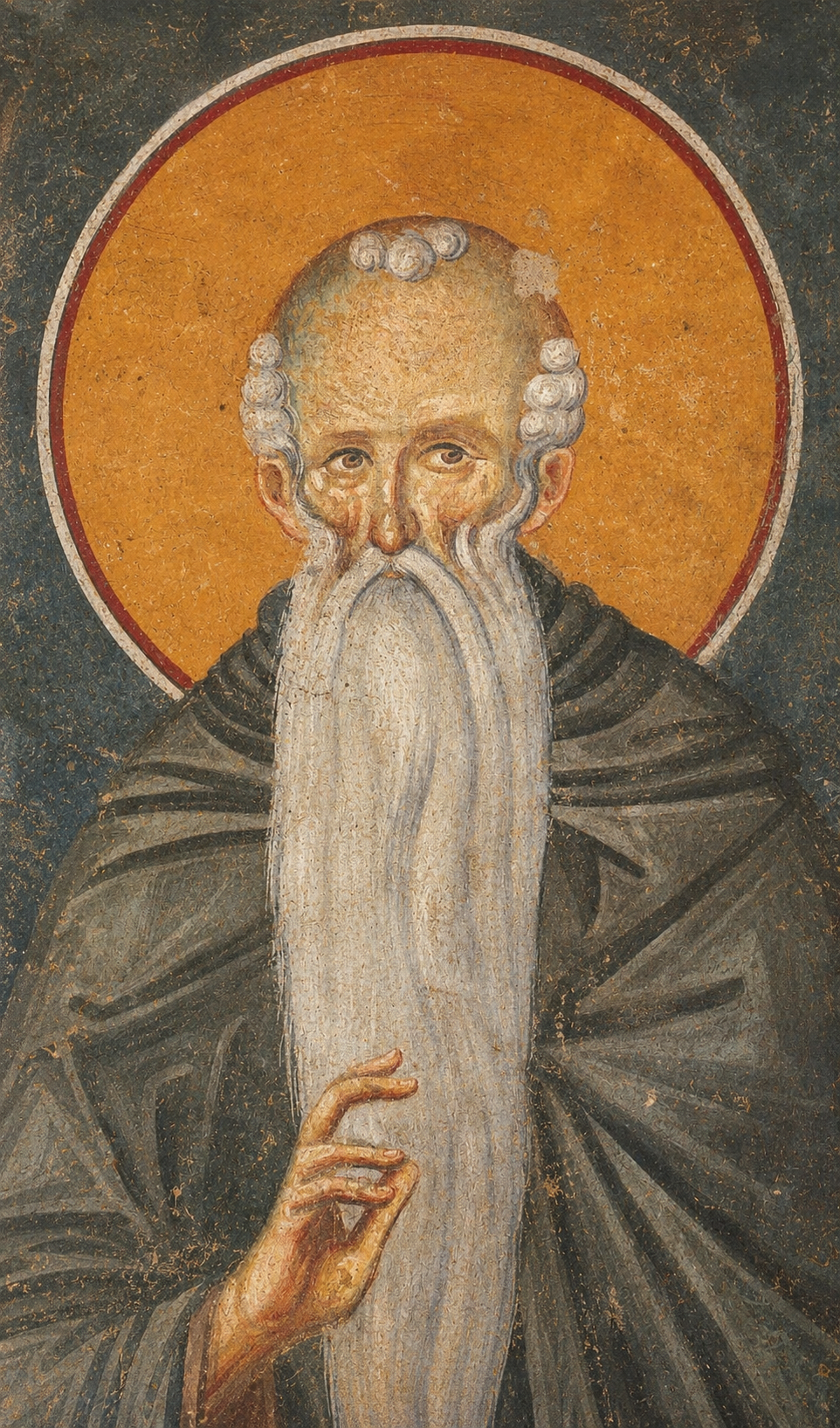
Traditional icons usually depict Saint Euthymius as an elderly monastic father with a long beard, wearing the garments of an Eastern monk rather than episcopal vestments. This reflects his identity as a priest-monk, desert elder, and founder rather than as a bishop.
His iconography frequently emphasizes the spiritual authority of age and asceticism. Because Euthymius lived nearly a century and became the elder of saints who themselves later became famous desert fathers, portraying him as an aged monastic teacher accurately reflects the Church's memory of him.
For a prayer card, the strongest visual approach is therefore traditional Palestinian or Byzantine monastic iconography rather than imagery suggesting a Western abbot, warrior, or diocesan bishop.
PRAYERS
A simple traditional invocation may be prayed throughout the day: Venerable Father Euthymius the Great, pray to God for us. It is especially fitting before beginning a retreat, discerning monastic life, meeting with a spiritual father, attempting to remain stable during discouragement, strengthening a prayer rule, entering Great Lent, or asking for greater humility and obedience.
The established Byzantine Apolytikion of Saint Euthymius remembers the barren land becoming fruitful because a man beloved by the Holy Spirit raised spiritual children in godliness, self-control, and virtue. The hymn concludes by asking Christ for peace through Euthymius' intercession, giving the Church a traditional prayer directly connected with the saint's monastic fatherhood.
Someone discerning monastic life can seek Saint Euthymius' prayers for patience and realistic preparation, remembering that he sent the young Saint Sabas into common monastic life rather than immediately permitting the severe solitude Sabas desired. Someone struggling with obedience can ask for humility, while someone continually tempted to abandon a difficult but healthy situation can seek discernment about whether the problem is truly the place or an interior restlessness that will follow them somewhere else.
A spiritual father can ask Euthymius for wisdom to recognize another person's actual needs rather than merely telling the person what he wants to hear. A Christian overwhelmed by activity can seek his intercession for stillness, while someone drawn so strongly toward solitude that other people become an annoyance can ask for the complementary grace of hospitality and love.
This prayer card is especially fitting beside a prayer rope, Psalter, Bible, monastic rule, fasting calendar, spiritual journal, seminary books, retreat materials, or home prayer corner. It can also make a meaningful gift for a monk, novice, priest, seminarian, spiritual director, retreatant, or someone trying to persevere faithfully through a difficult season of spiritual growth.
FAQ
Who was Saint Euthymius the Great? Saint Euthymius the Great was a fourth- and fifth-century Armenian-born priest, monk, hermit, monastery founder, miracle-worker, and spiritual father who became one of the foundational figures of Palestinian monasticism. He lived approximately from 376 to 473 and established an important lavra between Jerusalem and Jericho.
When was Saint Euthymius born? The Patriarchate of Jerusalem gives his birth as 376 AD in Melitene in Armenia. Some devotional chronologies round the date slightly differently, but the mid-370s is secure.
When did Saint Euthymius die? He reposed on January 20, 473, at approximately ninety-seven years old. The OCA preserves a detailed account of his preparation for death and final instructions to his monks.
When is Saint Euthymius the Great's feast day? His feast day is January 20. This date is preserved in Orthodox and Byzantine Catholic liturgical calendars.
Why is he called Euthymius the Great? His title reflects both the extraordinary ascetic reputation he acquired and his strong defense of Orthodox Christological teaching. The Church remembers him as one of the great fathers of the Judean Desert.
What does the name Euthymius mean? His traditional Life connects the name with good cheer, gladness, or encouragement, recalling the promise his parents received that their son would bring joy to the Church.
Where was Saint Euthymius from? He came from Melitene in Armenia, near the Euphrates. He later moved permanently to the Holy Land and became one of the major fathers of Palestinian desert monasticism.
Was Saint Euthymius Armenian? Yes, Byzantine Catholic and Orthodox sources explicitly remember him as Armenian in origin. His adult monastic legacy, however, developed primarily within Palestine.
Was Saint Euthymius a priest? Yes, he was ordained to the priesthood before leaving Armenia and had even been given responsibility for monasteries around Melitene. He remained both monk and priest throughout his later desert ministry.
Was Saint Euthymius a bishop? No, Euthymius was not a bishop. His enormous influence came through monastic spiritual fatherhood and priestly ministry rather than episcopal office.
Was Saint Euthymius a hermit? Yes, solitude was one of the defining desires of his life. He repeatedly moved deeper into the desert seeking prayer and stillness, although disciples repeatedly gathered around him and eventually required him to accept spiritual fatherhood.
What is Saint Euthymius the patron saint of? There is no need to invent a rigid modern patronage category because his historical associations are exceptionally strong. He is particularly meaningful for monks, monastic vocations, spiritual fathers, obedience, stability, prayer, fasting, discernment, desert spirituality, perseverance, and people seeking reliable spiritual guidance.
Is Saint Euthymius a good saint for monks? Yes, he is one of the major monastic fathers of the Judean Desert and spent almost his entire adult life forming monasteries, hermits, and future spiritual leaders. His liturgical hymn specifically celebrates the many spiritual children he raised in virtue.
Can someone discerning monastic life pray to Saint Euthymius? Yes, this is one of the most natural devotional uses of his card. Euthymius was both a monk and a discerning spiritual father who carefully guided younger men rather than immediately giving them the most severe form of ascetic life they desired.
Did Saint Euthymius train Saint Sabas the Sanctified? Yes, Saint Sabas came to Euthymius as a young monk. Euthymius received him but sent him to Saint Theoctistus for appropriate formation, later foretelling his extraordinary spiritual future.
Why did Saint Euthymius send Saint Sabas away? He did not reject Sabas' vocation. He judged that the young monk first needed structured common life and obedience before entering a more demanding eremitical form of monasticism.
Is Saint Euthymius connected with Mar Saba? He lived before Mar Saba was founded, but he was one of Saint Sabas' principal teachers. Euthymius therefore belongs directly to the spiritual lineage from which the Great Lavra of Saint Sabas emerged.
Did Saint Euthymius know Saint Gerasimus of the Jordan? Yes, and the Patriarchate of Jerusalem remembers Gerasimus returning to Chalcedonian Orthodoxy through Euthymius' guidance. Gerasimus later became another major founder of Palestinian monasticism.
Who was Saint Theoctistus? Saint Theoctistus was one of Euthymius' closest monastic companions and spiritual friends. They practiced asceticism together, and Euthymius entrusted Theoctistus with responsibility for one of the communities that formed around them.
Is Saint Euthymius a good saint for friendship? His deep spiritual friendship with Saint Theoctistus gives him a genuine devotional connection with friendships centered upon prayer and mutual growth in Christ. It is more accurate to describe this as a meaningful association than to invent a formal title such as patron saint of friendship.
What did Saint Euthymius teach about obedience? His Life specifically records him teaching that obedience is a great virtue and connecting it with the biblical principle that obedience is more pleasing to God than sacrifice.
Is Saint Euthymius a good saint for someone struggling with obedience? Yes, obedience was central to both his teaching and his approach to monastic formation. His life is especially helpful for someone tempted to substitute personally chosen spiritual practices for the responsibilities already entrusted to them.
What did Saint Euthymius teach about changing monasteries or communities? He warned discouraged monks that continually changing locations does not automatically solve spiritual problems. His memorable teaching compares instability to a tree that cannot bear fruit because it is repeatedly transplanted.
Is Saint Euthymius a good saint for someone who always wants to start over? Yes, this may be one of his strongest modern devotional applications. His teaching helps someone discern whether a new beginning is genuinely necessary or whether perseverance through the present difficulty is what will actually produce growth.
Does Saint Euthymius mean you should never leave a bad situation? No. His teaching about stability should not be used to justify remaining in abusive, unsafe, spiritually destructive, or seriously unhealthy environments. His warning concerns the mistaken belief that changing places alone can cure interior spiritual restlessness.
Did Saint Euthymius practice hesychasm? He lived centuries before the later theological controversies associated with the word hesychasm, but hesychia, or spiritual stillness, was central to his life. His repeated withdrawal into solitude, silence, prayer, and the desert places him firmly within the ascetic tradition from which later hesychastic spirituality developed.
Can someone practicing the Jesus Prayer seek Saint Euthymius' intercession? Yes, his lifelong pursuit of stillness and interior prayer makes him a meaningful saint for Christians seeking greater attentiveness and recollection. It would be historically inaccurate, however, to attribute later formal Jesus Prayer methods directly to him without evidence.
Did Saint Euthymius spend Great Lent in the desert? Yes, he and Saint Theoctistus regularly withdrew after Theophany and remained in deeper desert asceticism until Palm Sunday.
Is Saint Euthymius a good saint for Great Lent? Yes, his repeated Lenten withdrawals, fasting, prayer, and emphasis upon humility make him especially fitting for the Great Fast.
Can I pray to Saint Euthymius for help fasting? Yes, fasting was a major part of his ascetic life. His example is best invoked for disciplined fasting joined with prayer, humility, love, and obedience rather than fasting as an achievement in itself.
Did Saint Euthymius perform miracles? Yes, his traditional Life contains numerous miracles, including healing, deliverance from demonic affliction, prophetic knowledge, miraculous provision of food, and extraordinary signs associated with the Divine Liturgy.
Can I pray to Saint Euthymius for healing? Yes, healing is directly associated with his traditional ministry. People came from many places seeking his prayers for illness, and Church sources remember numerous healings.
Did Saint Euthymius feed hundreds of pilgrims miraculously? His Life records approximately four hundred Armenian pilgrims arriving when the monastery lacked sufficient food and describes the storeroom being miraculously supplied with bread, wine, and oil.
Is Saint Euthymius a good saint for hospitality? Yes, hospitality appears both in the miracle of feeding pilgrims and in his final instructions that monks should never refuse hospitality to strangers and should assist the poor.
Did Saint Euthymius convert Arabs to Christianity? The Patriarchate of Jerusalem remembers him baptizing numerous Arabs, including the leader Aspebet and his son Terebon. Aspebet became Peter in baptism and later served as a bishop among his people.
Is Saint Euthymius important to Arab Christian history? Yes, his work among Arab communities forms a genuine part of the history of Christianity in the Palestinian desert and demonstrates the multicultural character of early Holy Land monasticism.
Did Saint Euthymius defend the Council of Chalcedon? Yes, he accepted the Council of Chalcedon and became an important influence upon monks and other Christians who were deciding whether to accept its Christological teaching.
Did Saint Euthymius influence Empress Eudocia? The Patriarchate of Jerusalem remembers him helping bring Empress Eudocia back to acceptance of Chalcedonian Orthodoxy.
Is Saint Euthymius a good saint for theologians? His strongest identity is monastic rather than academic, but his importance in the reception of Chalcedon gives him a genuine connection with theology and doctrinal discernment. He is especially meaningful for people trying to unite theological fidelity with deep prayer.
What was the Lavra of Saint Euthymius? It was a major Palestinian monastic community established in the Judean Desert between Jerusalem and Jericho. Monks lived with substantial solitude while gathering within a common ecclesiastical structure under spiritual authority.
When was Saint Euthymius' Lavra founded? Its formal establishment occurred during the late 420s, and historical sources place the consecration of its church around 428 to 429.
Does Saint Euthymius' monastery still exist? The ancient monastery is no longer an active monastic community, but its substantial archaeological remains survive between Jerusalem and Jericho and can still be visited.
Where is Saint Euthymius' ancient monastery? Its ruins lie in the Judean Desert between Jerusalem and Jericho, at the site commonly associated with Khan el-Ahmar.
Is Saint Euthymius' tomb still there? Archaeological research has identified the ancient burial crypt and a tomb associated with Saint Euthymius within the monastery complex.
Where are Saint Euthymius' relics today? His relics were historically venerated at his Palestinian monastery and were still reported there by a twelfth-century Russian pilgrim. The current location of his complete principal relics is not securely documented in the official sources consulted, although his ancient tomb remains identifiable archaeologically.
Is there a Saint Euthymius monastery in Jerusalem today? Yes, the Greek Orthodox Patriarchate of Jerusalem maintains a monastery dedicated to Saint Euthymius in the Christian Quarter of the Old City and celebrates his feast there.
Is the Jerusalem monastery the same as his original Lavra? No. His original lavra lies in the Judean Desert between Jerusalem and Jericho, while the modern monastery bearing his name is within Jerusalem's Old City.
Is Saint Euthymius Orthodox? Yes, he is one of the major monastic fathers venerated throughout Eastern Orthodoxy. His January 20 feast has extensive liturgical propers in the Byzantine tradition.
Do Byzantine Catholics venerate Saint Euthymius? Yes. The Byzantine Catholic Metropolitan Cantor Institute and Archeparchy of Pittsburgh explicitly commemorate Our Venerable and God-bearing Father Euthymius the Great on January 20.
Is Saint Euthymius a Catholic saint? He lived centuries before the East-West schism and belongs to the common ancient Christian inheritance. His active liturgical commemoration in Byzantine Catholic calendars provides clear evidence of his place within Catholic Eastern tradition.
Can I give this card to a monk? Yes, Saint Euthymius is one of the most fitting saints for a monk because monastic formation, desert prayer, obedience, spiritual fatherhood, and stability defined almost his entire adult life.
Can I give this card to a novice? Yes, particularly because Euthymius was deeply concerned with gradual formation and did not assume that a novice should immediately undertake the severest ascetic practices.
Can I give this card to someone entering a monastery? Yes, it can make a meaningful monastery entrance or tonsure gift. Euthymius' life reminds the recipient that monastic vocation develops through obedience, patience, stability, prayer, and humility rather than through romantic ideas about solitude.
Can I give this card to a priest? Yes, Euthymius was himself a priest and spent decades balancing liturgical and spiritual fatherhood with his own need for deep prayer.
Can I give this card to a spiritual director? Yes, this is one of the strongest uses of the card because Euthymius became renowned for discernment and for guiding future saints according to what they actually needed rather than simply what they wanted.
Can I give this card to someone going on retreat? Yes, seasonal withdrawal into the desert was an important part of Euthymius' own spiritual rhythm. His example is especially appropriate for retreats intended to deepen prayer and discernment.
Can I give this card to someone struggling with restlessness? Yes, his teaching about the repeatedly transplanted tree makes him particularly meaningful for people continually tempted to believe that spiritual growth must always be somewhere else.
Can I give this card to someone who wants deeper prayer? Yes, Euthymius spent his life seeking greater stillness and concentrated prayer. His example also teaches that authentic contemplative life should eventually produce hospitality, humility, love, and service.
What does Saint Euthymius teach about stability? He teaches that spiritual fruit usually requires enough stability for roots to deepen. Constantly leaving whenever difficulty appears can prevent a person from discovering what perseverance might have accomplished.
What does Saint Euthymius teach about obedience? His teaching places obedience above self-selected religious sacrifice because surrendering self-will can be more spiritually demanding than choosing difficult practices for oneself.
What does Saint Euthymius teach about solitude? His life teaches that solitude is valuable when it opens the heart to God, but it should not become an excuse for refusing people whom God genuinely places in need of spiritual help.
What does Saint Euthymius teach about hospitality? His final instructions explicitly tell his monks to welcome strangers and assist people in need. The desert father who loved silence understood that love sometimes requires opening the door.
What does Saint Euthymius teach about spiritual direction? His relationship with Saint Sabas demonstrates that good spiritual guidance distinguishes between a genuine calling and immediate readiness. A wise spiritual father may affirm someone's vocation while still requiring patience and formation.
What does Saint Euthymius teach about discouragement? He warns against allowing discouragement to convince us that everything would automatically be better somewhere else. Spiritual growth often requires remaining long enough for difficulty to expose what needs healing within us.
What does Saint Euthymius teach about love? Near death, Euthymius taught that love is the highest virtue and that every virtue must be secured by love and humility. His final message therefore places charity above even the remarkable ascetic accomplishments for which he became famous.
What is the main message of Saint Euthymius the Great's life? Saint Euthymius' life teaches that spiritual maturity grows through stability, obedience, humility, prayer, and love rather than through constantly chasing a more impressive spiritual life. The Armenian child dedicated to God became a priest, left authority for the desert, formed an extraordinary spiritual friendship with Saint Theoctistus, tried repeatedly to escape fame, healed the sick, welcomed pilgrims, evangelized Arab communities, founded a great lavra, defended the faith of Chalcedon, guided Saint Gerasimus, recognized and formed the young Saint Sabas, and finally taught his monks that all their ascetic discipline had to culminate in love, humility, worship, hospitality, and care for struggling souls. His life remains a powerful answer to spiritual restlessness because the desert father who continually sought silence ultimately discovered that holiness means learning both how to remain before God and how to remain faithfully present to the people God entrusts to us.
Saint Euthymius the Great was one of the foundational fathers of Palestinian monasticism, a priest, hermit, spiritual father, miracle-worker, defender of the Council of Chalcedon, and teacher of saints whose influence spread throughout the Judean Desert. Born in Melitene in Armenia around 376, he was dedicated to God from childhood, became a monk and priest, left positions of authority in search of greater stillness, and eventually established one of the most influential lavras between Jerusalem and Jericho. Among those formed within his spiritual tradition was Saint Sabas the Sanctified, while Saint Gerasimus of the Jordan also turned to Euthymius for guidance during the theological conflicts following Chalcedon. Saint Euthymius reposed on January 20, 473, at approximately ninety-seven years of age.
Saint Euthymius is especially meaningful for monks, novices, men discerning monastic life, spiritual fathers, priests, people seeking reliable spiritual direction, Christians struggling with obedience, those trying to remain faithful to a prayer rule, people tempted to continually start over somewhere else, Christians seeking greater silence, people practicing fasting, those asking for perseverance, and anyone trying to distinguish genuine spiritual growth from restlessness. These associations arise directly from his life and teaching because Euthymius spent decades balancing solitude with responsibility, refusing fame, guiding monks, correcting discouragement, teaching obedience, practicing seasonal withdrawal into the wilderness, and forming men who would themselves become great spiritual fathers.
His connection with stability and perseverance is particularly powerful. When two monks became discouraged by the severity of life in his community and planned to leave, Euthymius warned them against imagining that merely changing places would solve an interior spiritual problem. His teaching compared a person who constantly changes places to a tree repeatedly transplanted before it can bear fruit. The principle is especially relevant to anyone who repeatedly believes that a new parish, monastery, job, spiritual practice, relationship, or environment will automatically resolve difficulties that may actually need to be faced within the heart.
Saint Euthymius is also one of the great saints for spiritual fathers and those seeking spiritual guidance. He did not simply attract disciples because of eloquence or position because he repeatedly tried to escape attention and return to silence. People continued finding him because they recognized wisdom, holiness, discernment, healing, and a capacity to guide souls. Eventually God had to redirect Euthymius himself, according to his Life, teaching him not to drive away people who genuinely came seeking salvation simply because their presence interrupted his solitude.
This prayer card is especially fitting for monks, monastery novices, seminarians, priests, men discerning monastic life, spiritual directors, retreatants, Christians establishing a prayer rule, people struggling with spiritual discouragement, and anyone trying to persevere faithfully where God has already placed them. It can also make a meaningful monastery entrance, tonsure, ordination, seminary graduation, retreat, spiritual-direction, baptism, chrismation, name-day, or feast-day gift.
Each card is handmade in Austin, TX and created to order. We do not keep stock, because every prayer card is treated as a unique devotional offering. They are printed on museum-quality photo paper, not cardstock, and every card is made slowly during prayer with intentional reverence for the saint and for the person who will receive it. Names are lifted before Christ, intentions are held carefully, and each piece is handled multiple times in prayerful silence, asking God for mercy and asking Saint Euthymius the Great to intercede for the soul it is being made for. This is devotional craftsmanship shaped with patience, care, and spiritual responsibility because every soul and every prayer matters.
THE LIFE & STORY
Saint Euthymius the Great was born around 376 in Melitene in Armenia, near the Euphrates. His parents, Paul and Dionysia, were devout Christians who had remained childless for many years and prayed earnestly for a son. According to the ecclesiastical tradition preserved by both the Orthodox Church in America and the Patriarchate of Jerusalem, they received a promise that God would grant them a child who would bring joy to the Church, and the name Euthymius was connected with the idea of good cheer or gladness.
His father died while Euthymius was still young, and his mother fulfilled the promise that her son would be dedicated to God. She entrusted him to her brother, the priest Eudoxius, who brought the child to the bishop of Melitene. Euthymius was educated in Scripture and ecclesiastical life, became a reader, and eventually entered monastic life and was ordained to the priesthood.
The future desert father therefore did not begin his Christian formation in isolation. Scripture, liturgy, clergy, family sacrifice, education, and Church discipline all shaped him long before he became famous for solitary prayer.
DEDICATED TO GOD FROM CHILDHOOD
Euthymius' childhood belongs to an ancient Christian pattern in which some children were dedicated very early to ecclesiastical or monastic service. The Byzantine Catholic Metropolitan Cantor Institute continues commemorating him as a saint who was consecrated to God from infancy, reflecting the traditional understanding of his early vocation.
Modern Christians do not need to imitate every historical circumstance literally to understand the spiritual principle. A vocation that appears early still requires formation, patience, discernment, education, and obedience rather than assuming that strong religious enthusiasm automatically produces maturity.
Euthymius' life therefore makes him meaningful for parents praying for a child's vocation, young men sensing an early attraction toward priesthood or monasticism, and people whose calling to religious life has remained persistent across many years. His story shows a vocation unfolding gradually through the Church rather than through one isolated spiritual experience.
PRIEST & OVERSEER OF MONASTERIES
As Euthymius matured, he was ordained a priest and eventually entrusted with the supervision of monasteries around Melitene. The position indicates that other church leaders already recognized his spiritual discipline and reliability, yet administrative responsibility created an unexpected conflict within him because Euthymius increasingly desired quiet and concentrated prayer.
During Great Lent he would leave ordinary responsibilities temporarily and withdraw into the wilderness. Over time, however, the tension between public responsibility and his longing for stillness became strong enough that he ultimately left his homeland for Jerusalem around 406.
This gives Euthymius a particularly interesting place among saints for people who are competent enough that others continually give them more responsibility. Being capable of leadership does not automatically mean every leadership role is one's permanent vocation, and Euthymius had to discern when responsibility was service and when it was preventing him from following a deeper call.
LEAVING ARMENIA FOR THE HOLY LAND
Euthymius traveled to Jerusalem, venerated the holy places, and then deliberately sought the desert fathers. He settled at the Pharan or Tharan Lavra, associated with the older monastic tradition of Saint Chariton, choosing a solitary cell and supporting himself through manual work such as basket weaving.
The move from Armenia to Palestine was not an attempt to build a public career because Euthymius was moving in the opposite direction. He left authority behind precisely because he wanted obscurity, prayer, manual labor, and stillness.
Yet this pattern would repeat throughout his life. The farther Euthymius moved into the wilderness to escape recognition, the more people eventually sought him out.
SAINT THEOCTISTUS
At Pharan, Euthymius developed an extraordinary spiritual friendship with Saint Theoctistus of Palestine. The OCA describes the two ascetics as sharing such unity of purpose and affection that they seemed to possess one soul and one will, while the Patriarchate of Jerusalem likewise remembers their spiritual friendship, cooperation, and common ascetic life.
Every year after the celebration of Theophany, Euthymius and Theoctistus withdrew deeper into the Judean wilderness and remained there in intense prayer and ascetic discipline until Palm Sunday. Their seasonal withdrawal became part of a wider Palestinian monastic pattern in which monks used Great Lent for especially concentrated prayer in the desert.
This friendship is important because desert spirituality is often imagined as radical individualism. Euthymius' life demonstrates something different because some of his deepest ascetic development occurred alongside another monk whose friendship strengthened his pursuit of God.
A SAINT FOR SPIRITUAL FRIENDSHIP
The relationship between Euthymius and Theoctistus provides a strong ancient model for holy friendship. They were not competing to become the most famous ascetic because each encouraged the other's spiritual growth and eventually accepted different responsibilities within the communities that formed around them.
When disciples gathered, Euthymius entrusted the practical supervision of the growing monastery to Theoctistus rather than attempting to control everything himself. Their complementary vocations allowed one spiritual movement to develop through more than one personality and form of service.
A Saint Euthymius prayer card can therefore be meaningful for someone praying for a faithful spiritual friend, accountability partner, monastic companion, or friendship centered upon growth in Christ. His life shows that friendship becomes especially fruitful when two people help one another seek God rather than simply reinforcing one another's preferences.
THE CAVE IN THE WILDERNESS
During one of their desert withdrawals, Euthymius and Theoctistus entered a steep gorge and discovered a cave where they could remain in solitude. Their hidden life did not remain hidden for long because shepherds discovered the monks and told others about the ascetics living in the wilderness.
People began visiting them for prayer, spiritual instruction, and blessing. Other monks arrived as well, and gradually a community formed around the cave. Euthymius entrusted its immediate leadership to Theoctistus while continuing to seek a more solitary vocation.
This became the first major example of a pattern that would define Euthymius' life: he sought solitude, holiness attracted people, a community formed, and then he attempted to withdraw again.
WHEN PEOPLE KEEP FINDING THE HERMIT
Euthymius did not become a famous spiritual father because he advertised himself. In fact, his Life repeatedly depicts him trying to avoid the reputation developing around him, particularly as stories of healing and spiritual discernment spread.
Eventually, however, Euthymius had to recognize that total withdrawal could itself become contrary to God's will if people were being sent to him for genuine spiritual help. According to the OCA Life, he received a vision instructing him not to drive away those who came seeking salvation.
This gives his life an important balance. Silence is holy, but so is love. A spiritual practice becomes distorted if protecting one's private peace becomes more important than responding to a person whom God genuinely places before us.
THE CONVERSION OF ARAB CHRISTIANS
One of the most historically important parts of Euthymius' ministry involved Arab and Saracen communities living near the Palestinian desert. The Jerusalem Patriarchate remembers him converting and baptizing many Arabs, including a leader named Aspebet and his son Terebon after the latter received healing through Euthymius' prayers.
Aspebet received the Christian name Peter and eventually became a bishop among his people. Other traditions surrounding Euthymius describe the resulting Christian community developing its own ecclesiastical leadership within the desert frontier.
This aspect of Euthymius' life makes him important not merely to the history of monks but to the history of Arab Christianity in the Holy Land. His ministry crossed ethnic and cultural boundaries, and his monastic communities became places where local desert peoples encountered Christianity.
A SAINT FOR MISSIONARY WITNESS
Euthymius did not approach missionary work primarily through large organized campaigns. People encountered the Christian faith because they encountered a life they believed reflected the presence of God, and spiritual questions followed from that encounter.
His example is useful for Christians who feel intimidated by evangelization. Witness can involve conversation and explanation, but credibility matters because people often evaluate a religious message partly through the character of the person carrying it.
Euthymius can therefore be a meaningful intercessor for missionaries, priests serving culturally different communities, Christians working among people unfamiliar with the Church, and anyone asking for the wisdom to speak about Christ without arrogance or pressure.
HEALING & MIRACLES
The ecclesiastical Lives of Saint Euthymius consistently remember numerous healings and miracles associated with his prayers. People traveled to him seeking relief from illness, and his reputation became so widespread that his desire for anonymity became increasingly difficult to maintain.
His Life also includes deliverance from demonic affliction, prophetic knowledge, miraculous provision of food, and unusual spiritual discernment. The Church therefore remembers Euthymius not only as a disciplined organizer of monks but as a holy man through whose prayers people believed they directly experienced God's mercy.
Christians may certainly ask Saint Euthymius to intercede for healing, spiritual oppression, serious illness, and difficult needs. It would nevertheless be inaccurate to manufacture a narrow modern claim that he is the exclusive patron saint of one particular disease because the strongest traditional themes surrounding him remain monastic life, spiritual fatherhood, healing, obedience, and defense of the faith.
RUNNING FROM FAME
As stories of Euthymius' miracles spread, increasing numbers of people sought him. The saint responded not by building his public reputation but by leaving secretly with his disciple Dometian and entering the Rouba wilderness near the Dead Sea.
He later traveled into the wilderness of Ziph and lived near the cave traditionally associated with David hiding from King Saul. Euthymius established another monastic foundation there and continued healing, teaching, and bringing people back from beliefs the Church regarded as heretical.
His repeated attempts to flee praise make him particularly meaningful for Christians whose work becomes unexpectedly successful. Recognition itself is not necessarily evil, but Euthymius understood how quickly spiritual service can become corrupted when admiration becomes something a person begins to need.
A SAINT FOR HUMILITY AFTER SUCCESS
People often ask saints for help before success but need spiritual protection just as much afterward. Euthymius' biography repeatedly shows him becoming uncomfortable when attention moved toward himself rather than toward God.
This makes him a useful saint for priests with growing ministries, writers whose work begins reaching large audiences, teachers receiving recognition, business owners experiencing success, or anyone whose influence increases quickly. The spiritual danger is not simply pride in obvious forms because even the desire to be constantly needed can become an attachment.
Euthymius reminds Christians that fruitfulness and self-importance are not the same thing. A person may receive a larger vocation while remaining inwardly detached from applause.
THE LAVRA OF SAINT EUTHYMIUS
Eventually Euthymius settled on a hill between Jerusalem and Jericho in the Judean Desert. He initially did not want to establish another formal community, but disciples continued gathering and his Life says that God instructed him to receive those coming for spiritual benefit.
A lavra developed there, modeled upon the Palestinian pattern of monks living in individual cells while gathering for common worship and remaining under spiritual authority. Archaeological and historical sources place the formal establishment and consecration of Euthymius' lavra in the late 420s, with Patriarch Juvenal of Jerusalem consecrating its church around 428 to 429.
The monastery became one of the most important centers of fifth-century Judean monasticism. Its remains still survive as an archaeological site between Jerusalem and Jericho.
WHAT IS A LAVRA?
The lavra form allowed monks to combine solitude with communion. Individual monks could spend much of the week in cells or hermitages devoted to prayer and work while gathering regularly for common Divine Liturgy, instruction, fellowship, and obedience to a spiritual father.
Euthymius' own life makes the logic of this arrangement understandable. He valued silence too deeply to build ordinary community life around constant interaction, yet he also learned that spiritual independence can become dangerous when it separates a monk from the Church, sacramental worship, correction, and experienced guidance.
His lavra therefore preserved both hesychia and accountability, allowing solitude without turning solitude into self-rule.
MIRACULOUS PROVISION FOR FOUR HUNDRED PILGRIMS
One of the most memorable miracles preserved in Euthymius' Life concerns approximately four hundred Armenian pilgrims who arrived at the lavra while traveling toward the Jordan. The monastery's steward warned that there was nowhere near enough food to feed such a crowd, but Euthymius instructed him to provide hospitality anyway.
When the storeroom was opened, the community found abundant bread as well as wine and oil sufficient for the pilgrims. The OCA account presents the event in deliberate comparison with the biblical miracle of the widow's flour and oil during the prophet Elijah's ministry.
This story gives Saint Euthymius a meaningful devotional connection with hospitality, monasteries struggling with limited resources, feeding visitors, and people afraid they do not have enough to share. The principle beneath the miracle is not reckless financial behavior, but trust that generosity toward genuine need can coexist with confidence in God's providence.
NEVER REFUSE HOSPITALITY
Near the end of his life, Euthymius explicitly instructed his monks not to neglect hospitality. His final guidance told them to receive strangers, provide a place for visitors to rest, and give what they could to people suffering poverty or misfortune.
That instruction matters because Euthymius was a man famous for wanting solitude. He did not conclude that the highest form of spirituality was keeping everyone else permanently outside the door.
His life instead teaches a more demanding balance: protect the silence necessary for prayer, but do not use silence as an excuse to become indifferent to a person in need.
OBEDIENCE IS GREATER THAN SACRIFICE
The OCA Life preserves a strong teaching from Euthymius concerning obedience. After a monk named Auxentius stubbornly refused an assigned responsibility, Euthymius emphasized that obedience is a great virtue and that God loves obedience more than sacrifice.
The principle comes from the biblical language of 1 Samuel 15:22 and became deeply important in monastic spirituality. It means that dramatic personal religious efforts can actually become forms of self-will when a person refuses the humble duties already placed before him.
Saint Euthymius is therefore especially meaningful for people tempted to pursue impressive spiritual practices while neglecting ordinary obligations. Sometimes the holier act is not adding another devotion but faithfully doing what has already been entrusted to us.
A SAINT FOR OBEDIENCE
Obedience can easily be misunderstood as passivity or the abandonment of moral responsibility. Christian monastic obedience is intended instead to expose the degree to which personal preference quietly controls behavior and to teach a person how to surrender self-will without surrendering conscience.
Euthymius' own life included both exercising authority and accepting the authority of the Church. His spiritual leadership therefore did not arise from someone who believed no one else could correct him.
His card can be particularly meaningful for novices, seminarians, clergy under obedience to a bishop, Christians struggling with spiritual direction, and people whose first reaction to correction is defensiveness. The goal is not obedience to every human demand, but formation in humility before God.
“A TREE OFTEN TRANSPLANTED DOES NOT BEAR FRUIT”
One of Saint Euthymius' most practical teachings came when two monks wanted to abandon their monastery because they had become discouraged. He warned them against believing that simply going elsewhere would solve the spiritual difficulty they were experiencing.
His image is memorable: a tree continually transplanted cannot easily bear fruit. Stability gives roots time to deepen, while constant movement can prevent a person from staying anywhere long enough for difficult but necessary transformation to occur.
This makes Euthymius particularly relevant for modern Christians because changing environments is easier than ever. A person can continually search for a new parish, new spiritual teacher, new devotion, new church tradition, new community, new job, or new method without ever remaining anywhere long enough to confront the same interior patterns that keep appearing.
A SAINT FOR PEOPLE WHO ALWAYS WANT TO START OVER
There are times when leaving is necessary. A harmful environment, abusive relationship, unsafe monastery, serious doctrinal problem, or destructive workplace should not be endured simply because stability is a virtue.
Euthymius' teaching addresses something different: restlessness disguised as discernment. When every difficulty causes the immediate conviction that God must be calling somewhere else, a person may never discover whether perseverance itself was the missing spiritual discipline.
His prayer card can therefore be particularly meaningful for people asking whether they genuinely need a new beginning or simply need grace to remain faithful through an uncomfortable stage of the beginning they have already been given.
SAINT SABAS THE SANCTIFIED
When Euthymius was already in his eighties, a young Cappadocian monk arrived who would later become Saint Sabas the Sanctified. Euthymius received him warmly but judged that Sabas was not yet ready for the severe life of advanced hermits and sent him to the monastery of Saint Theoctistus for more appropriate formation.
Euthymius nevertheless recognized something extraordinary in the young monk and foretold that Sabas would eventually surpass many of the other disciples in virtue. The Patriarchate of Jerusalem continues explicitly identifying Euthymius and Theoctistus as the teachers under whom Sabas received his early Palestinian monastic formation.
That prophecy proved remarkably fitting because Sabas later founded Mar Saba, organized monasteries throughout Palestine, and became one of the most important monastic fathers in Eastern Christian history.
WHY EUTHYMIUS SENT SABAS SOMEWHERE ELSE
The relationship between Euthymius and Sabas contains a valuable lesson in spiritual direction. Euthymius recognized Sabas' calling but did not confuse potential with readiness. The correct answer to a genuine vocation can sometimes be “yes, but not yet.”
Rather than giving the ambitious young monk the most dramatic ascetic life available, Euthymius sent him into a structured environment where obedience and common life could mature him.
This makes Saint Euthymius particularly meaningful for spiritual directors and vocation discerners. Good guidance does not simply tell people what they want to hear because genuine encouragement sometimes means protecting a vocation from being attempted before the person has developed the strength to carry it.
THE SPIRITUAL GRANDFATHER OF MAR SABA
Saint Sabas eventually became one of the greatest monastic organizers of the Holy Land, but his spiritual foundation had been laid within the world created by Euthymius and Theoctistus. The Patriarchate of Jerusalem continues describing Sabas as a disciple of those earlier fathers, making Euthymius one of the central links in the development of the later Savvaite tradition.
This gives Euthymius a remarkable place within the history of Eastern monasticism. His influence did not end with the monks he personally guided because those monks formed others, founded new monasteries, and transmitted an ascetic culture across generations.
For Christians devoted to Saint Sabas the Sanctified, a Saint Euthymius card naturally belongs beside his. Sabas' greatness becomes easier to understand when one encounters the elder who first recognized and carefully formed his vocation.
SAINT GERASIMUS OF THE JORDAN
Saint Euthymius also exercised important influence upon Saint Gerasimus of the Jordan. The Patriarchate of Jerusalem states that Gerasimus had initially been drawn into anti-Chalcedonian teaching but returned to the Orthodox confession through his relationship with Euthymius.
Gerasimus later founded his own renowned lavra near the Jordan and became another major father of Palestinian monasticism. His relationship with Euthymius therefore demonstrates that theological correction can become the beginning of profound spiritual fruit rather than simply the end of an argument.
For Christians collecting prayer cards connected with the Judean Desert, Saint Euthymius, Saint Gerasimus, Saint Sabas, Saint Theoctistus, and Saint Theodosius the Cenobiarch form an interconnected spiritual family rather than isolated biographies.
THE COUNCIL OF CHALCEDON
The Council of Chalcedon in 451 became one of the defining theological events of Euthymius' later life. The council confessed Jesus Christ as one and the same divine Person existing truly in both divinity and humanity, rejecting attempts either to divide Christ improperly or confuse His human and divine natures.
The council's reception was extremely controversial in Palestine. Large numbers of monks opposed Chalcedon, and ecclesiastical conflict became severe enough to divide monasteries, bishops, and entire regions.
Euthymius accepted the council as Orthodox and became an influential advocate for its teaching. His reputation was so great that the OCA tradition says many monks who had rejected Chalcedon reconsidered because Euthymius accepted it.
WHY HE IS CALLED “THE GREAT”
The title “the Great” was not simply attached to Euthymius because he founded an important monastery. Both the OCA and Jerusalem tradition connect the title particularly with his extraordinary ascetic life and his steadfast confession of the Orthodox faith.
His greatness therefore combined contemplation and doctrine. The saint who spent months in the wilderness did not conclude that theological controversy was beneath a spiritual person because truth about Christ directly affected the meaning of salvation.
This makes him particularly meaningful for Christians who want to avoid two opposite errors: theology without prayer and spirituality without theological truth.
EMPRESS EUDOCIA
The Patriarchate of Jerusalem also remembers Saint Euthymius as influential in the return of Empress Eudocia to the Chalcedonian position. Eudocia had become involved in the intense theological divisions affecting Palestine, and Euthymius' spiritual authority played an important role in convincing her to accept Chalcedon.
The episode demonstrates how far his influence eventually extended. A man who originally left administrative responsibility because he wanted to disappear into the wilderness became someone whose theological judgment could influence imperial figures.
Euthymius' authority did not come from proximity to power. Ironically, powerful people trusted him partly because he had already demonstrated for decades that worldly status was not what he wanted.
A SAINT FOR DEFENDING THE FAITH WITHOUT LOVING ARGUMENT
Saint Euthymius lived through fierce doctrinal controversy, yet his biography is not primarily the story of a professional polemicist. Prayer, fasting, monastic formation, hospitality, healing, and spiritual fatherhood remain at the center of his life.
This balance makes him a valuable saint for Christians who care deeply about doctrinal truth but fear becoming consumed by constant religious argument. Defending the faith should ultimately protect communion with Christ rather than transform controversy into an identity.
Euthymius' example suggests that theological conviction is strongest when it emerges from prayer, humility, Scripture, sacramental worship, and a life sufficiently detached from winning admiration.
DIVINE LITURGY & THE VISION OF FIRE
Euthymius' hagiographic tradition preserves extraordinary accounts surrounding his celebration of the Divine Liturgy. The OCA says some brethren saw heavenly fire surrounding him during the Eucharistic service and that Euthymius told trusted monks he sometimes perceived an angel celebrating alongside him.
The archaeological-historical database of the Hebrew University likewise preserves Cyril of Scythopolis' ancient account of a witness seeing fire descend around the altar while Euthymius celebrated the Eucharist.
For devotional purposes, the significance is not spectacle. These traditions communicate the reverence with which early Christians remembered Euthymius' priestly celebration of the Eucharist, treating earthly liturgy as participation in heavenly worship.
A SAINT FOR PRIESTS
Because Euthymius was both monk and priest, he is particularly meaningful for hieromonks, priests drawn to contemplative prayer, seminary students, and clergy trying to protect their interior life while carrying responsibility for other people.
His own biography demonstrates how difficult that balance can become. Euthymius repeatedly longed for silence while pastoral needs continually interrupted him, yet eventually learned to understand certain interruptions as part of obedience to God.
A priest can therefore seek Euthymius' prayers for the wisdom to know when to withdraw for prayer and when to open the door because another person genuinely needs a shepherd.
SPIRITUAL DISCERNMENT
The OCA tradition attributes to Euthymius an extraordinary gift of spiritual discernment, including an ability to perceive the inner condition of people approaching him. His Life describes him discerning thoughts and even recognizing the spiritual disposition with which monks received Holy Communion.
Such extraordinary gifts should not be imitated by ordinary Christians claiming supernatural knowledge about other people's souls. Their proper devotional meaning is that Euthymius became famous for discernment after decades of purification, humility, prayer, and pastoral responsibility.
His life therefore makes him a natural intercessor for people seeking discernment, particularly when they need wisdom rather than simply confirmation of what they already want.
A SAINT FOR SPIRITUAL DIRECTORS
Spiritual direction requires more than giving generic advice. A spiritual father must learn when to encourage, when to correct, when to delay someone's plans, when to receive a person gently, and when a difficult truth needs to be spoken clearly.
Euthymius demonstrated these different forms of guidance throughout his life. He could receive penitents, correct disobedience, redirect the young Sabas, reconcile monks to Orthodox doctrine, and still remind his community that love and humility secure every virtue.
For priests, elders, retreat leaders, and people responsible for guiding others, his card can serve as a reminder that discernment is not the ability to control another person's life. Its purpose is to help someone become increasingly responsive to God.
GREAT LENT & THE DESERT
Great Lent shaped the rhythm of Euthymius' spiritual life for decades. Even while he held ecclesiastical responsibility in Armenia, he withdrew during Lent, and after reaching Palestine he and Theoctistus developed the practice of leaving after Theophany and remaining in deeper desert asceticism until Palm Sunday.
The tradition later became characteristic of several Judean Desert communities. The point was not to make ordinary monastic life seem insufficient but to create a concentrated season of repentance, prayer, fasting, and spiritual attention leading toward Pascha.
Saint Euthymius is therefore especially meaningful during Great Lent. His card can accompany someone undertaking a more serious season of prayer, limiting unnecessary distractions, strengthening fasting, increasing Scripture reading, or seeking deeper repentance.
A SAINT FOR RETREATS
Most Christians cannot disappear into the Judean Desert for several months, nor would such an attempt ordinarily be wise. The spiritual principle can nevertheless be applied through periodic retreats, quieter days, reduced media use, fasting, confession, and deliberate time away from ordinary distractions.
Euthymius understood that human attention becomes scattered. Returning to silence gave him an opportunity to recollect the heart before God and then return to responsibilities with renewed clarity.
His card therefore makes a meaningful retreat gift, particularly for someone entering a monastery retreat, silent retreat, discernment weekend, or period of concentrated prayer.
FASTING WITHOUT PERFORMANCE
Euthymius belonged to an extraordinarily severe ascetic culture. Yet his final teachings place love, humility, hospitality, purity, worship, and care for struggling brothers at the center rather than presenting fasting as an achievement to display.
This is important because ascetic practices can easily become another arena for competition. Someone can technically fast while becoming more irritable, proud, judgmental, or obsessed with food.
Euthymius' broader life demonstrates that fasting belongs inside a system of spiritual medicine whose purpose is freedom and love. A discipline that increases self-importance is missing the point for which the discipline exists.
HIS LOVE OF STILLNESS
Euthymius repeatedly sought hesychia, or spiritual stillness. He left ecclesiastical administration, withdrew from populated monasteries, moved into desert caves, and even departed secretly when fame made solitude impossible.
Stillness in the Eastern Christian tradition is deeper than physical quiet. A silent room does not automatically produce a silent heart because memories, desires, fantasies, anger, anxieties, and internal arguments may become even more noticeable once external noise disappears.
The desert therefore served as a place where the heart's disorder could no longer hide as easily behind activity. Saint Euthymius can be particularly meaningful for Christians practicing the Jesus Prayer, beginning contemplative prayer, or seeking greater interior attentiveness.
WHEN SOLITUDE BECOMES SELFISH
Euthymius' biography also contains a corrective to romantic ideas about silence. According to his Life, he initially resisted the formation of another community around him because he wanted to preserve solitude, but God revealed that people were coming to him for their salvation and should not simply be driven away.
The lesson is particularly important for Christians attracted to contemplative spirituality. Prayer should increase love rather than become a sophisticated method of avoiding inconvenient human beings.
Euthymius eventually learned to protect necessary solitude while accepting spiritual fatherhood as part of his vocation. His life therefore presents contemplation and service as tensions to be discerned rather than enemies that must eliminate one another.
THE DEATH OF SAINT THEOCTISTUS
Saint Theoctistus remained one of Euthymius' closest spiritual companions into old age. When Theoctistus became gravely ill, Euthymius went to him, remained for several days, was present near the end of his life, and participated in his burial.
The death of such a long-term spiritual friend would have carried enormous emotional weight. These were men who had prayed together, fasted together, explored the desert together, founded communities together, and shared decades of spiritual struggle.
Euthymius' continued faithfulness after Theoctistus' death makes him meaningful for people who have lost a lifelong friend, spiritual brother, monastery companion, or someone with whom much of their Christian life was shared.
HIS FINAL INSTRUCTIONS
Euthymius knew his death was approaching. After the final vigil he would celebrate with the brethren, he gathered his priests and monks and prepared them for life without his visible presence.
His final instructions emphasized that love is the highest virtue, joined inseparably with humility. He instructed the monks to preserve purity, faithfully attend the services of the Church, maintain the community's traditions, help brothers struggling with temptation, welcome strangers, and provide what they could for the poor.
This is perhaps the clearest summary of what Euthymius ultimately believed monasticism was for. The desert disciplines mattered, but their mature fruit was love, humility, worship, purity, mercy, hospitality, and responsibility for another person's salvation.
LOVE & HUMILITY
The liturgical and ascetic severity surrounding Euthymius can make him appear intimidating until his final teaching is considered. He did not tell his disciples that the highest virtue was extreme fasting, long vigils, isolation, theological knowledge, or miraculous power.
Instead, he placed love and humility at the foundation. Every other spiritual achievement becomes unstable when separated from them.
This makes Saint Euthymius relevant far beyond monasteries. A married person, parent, worker, student, priest, monk, or retiree can test spiritual progress by asking whether prayer is actually producing more love and humility.
HIS REPOSE
After giving his final instructions, Euthymius withdrew with his disciple Dometian. He remained for three days in the altar area and then reposed on January 20, 473, at approximately ninety-seven years old.
Monks came from throughout the desert for his burial, along with Patriarch Anastasius of Jerusalem and other important churchmen. Saint Gerasimus of the Jordan was specifically remembered among those present, demonstrating the enormous respect Euthymius commanded within Palestinian monasticism.
His death closed almost a century of earthly life but opened an even longer period of influence because the monks and saints he formed continued carrying his spirituality into new communities.
SAINT DOMETIAN
Dometian had remained one of Euthymius' closest disciples and accompanied him during several of his attempts to withdraw into deeper solitude. After Euthymius' burial, Dometian stayed beside his elder's grave for several days.
The OCA tradition records that Dometian then experienced a vision of Euthymius calling him to join him in Christ. Shortly afterward Dometian died and was buried beside his elder.
The story reflects an ancient understanding of spiritual fatherhood as a relationship that does not simply vanish at death. The saints remain alive in Christ, and the Church continues seeking their prayers precisely because death does not destroy communion within the Body of Christ.
HIS MONASTERY AFTER HIS DEATH
The Lavra of Saint Euthymius continued developing after his repose. Within several years it was transformed into a more completely organized cenobitic monastery, and a new church and funeral chapel were built around the center where his memory and tomb were venerated.
The site experienced repeated destruction and rebuilding across centuries. Archaeological evidence records damage associated with the Persian conquest of 614, later restoration, additional destruction following a major seventh-century earthquake, and medieval rebuilding before eventual abandonment around the late twelfth or early thirteenth century.
Today the ruins remain an important archaeological witness to one of the foundational centers of Judean Desert monasticism.
THE TOMB OF SAINT EUTHYMIUS
Archaeological investigation has identified a burial crypt associated with Saint Euthymius within the ancient monastic complex. The Hebrew University database describes a vaulted burial area containing a tomb identified with Euthymius and surrounded by additional monastic burials.
The original reliquary arrangements described by ancient sources no longer survive intact, but the tomb structure remains identifiable within the archaeological remains. Historical records also show that Euthymius' relics were once publicly venerated at his monastery.
This distinction matters because the location of the tomb can be identified far more securely than the present location of the saint's complete bodily relics.
WHERE ARE SAINT EUTHYMIUS' RELICS TODAY?
The OCA records that Saint Euthymius' relics remained at his Palestinian monastery and were still seen there by the Russian pilgrim Igumen Daniel in the twelfth century.
The monastery was subsequently abandoned, and the ancient reliquary arrangements disappeared. Modern archaeological work has identified the tomb and funeral chapel, but the official Church sources consulted for this page do not provide a securely documented modern location for the saint's complete principal relics.
The safest product-page wording is therefore that Saint Euthymius' ancient tomb remains identifiable at the ruins of his monastery, while the current location of his principal bodily relics is not securely documented in the sources consulted. Smaller relic fragments may exist in individual churches or monasteries, but each should be independently verified before being presented as certain.
THE MONASTERY OF SAINT EUTHYMIUS TODAY
The ancient Lavra lies in the Judean Desert between Jerusalem and Jericho, and the Patriarchate of Jerusalem identifies its ruins as a visitable archaeological site. The complex is commonly associated today with Khan el-Ahmar, although that name has also been applied historically to other locations in the region and should be used with geographic care.
Archaeology preserves substantial portions of the later monastery, including church remains, water systems, burial areas, and the crypt associated with Euthymius.
For pilgrims studying Palestinian monasticism, the site offers a physical connection with the spiritual world that produced Saint Euthymius, Saint Sabas, Saint Theoctistus, Saint Gerasimus, and generations of Judean Desert monks.
THE MONASTERY OF SAINT EUTHYMIUS IN JERUSALEM
The Greek Orthodox Patriarchate of Jerusalem also maintains a Holy Monastery of Saint Euthymius the Great in the Christian Quarter of Jerusalem's Old City, near the Patriarchate. The Church of Jerusalem continues celebrating his January feast there.
This Jerusalem monastery should not be confused with the ruined ancient Lavra between Jerusalem and Jericho. The Old City monastery serves as a modern place of liturgical commemoration, while the Judean Desert archaeological site is the location directly associated with Euthymius' original lavra and tomb.
Both locations therefore carry his name, but they preserve different aspects of his legacy.
SAINT EUTHYMIUS IN THE BYZANTINE CATHOLIC TRADITION
Saint Euthymius lived centuries before the East-West schism and belongs to the common ancient Christian inheritance of East and West. His prominence is especially strong in the Byzantine liturgical tradition, where he is commemorated as a venerable and God-bearing father on January 20.
The Byzantine Catholic Metropolitan Cantor Institute of the Archeparchy of Pittsburgh lists Our Venerable and God-bearing Father Euthymius the Great on January 20 and provides proper Vespers and Divine Liturgy material for his feast.
This provides particularly clear evidence that Eastern Catholics may venerate Saint Euthymius as part of their own inherited liturgical tradition rather than treating devotion to him as something borrowed from modern Orthodoxy.
SAINT EUTHYMIUS IN ORTHODOX WORSHIP
Saint Euthymius has a significant liturgical commemoration on January 20. The Greek Orthodox Archdiocese's official Digital Chant Stand provides a complete festal service for his memory, including his proper apolytikion and appointed Scripture readings.
The hymn praises Euthymius as a man beloved by the Holy Spirit who made the spiritually barren desert fruitful by raising up disciples in godliness, self-control, and virtue. This is a remarkably accurate liturgical summary of his historical legacy because the Judean wilderness became populated with monastic communities partly through the movement he helped establish.
Using his established liturgical texts for prayer-card devotion therefore keeps the product rooted in actual Church worship rather than invented devotional language.
FEAST DAY
The principal feast of Saint Euthymius the Great is January 20. The Orthodox Church in America, Greek Orthodox Archdiocese, Patriarchate of Jerusalem, and Byzantine Catholic liturgical calendar all preserve this date.
Churches following the Julian calendar may celebrate the liturgical January 20 on a later Gregorian civil date, which explains why Jerusalem Patriarchate reports sometimes display the feast as January 20/February 2.
For a customer-facing prayer-card page, January 20 should be presented as the feast day, with the calendar distinction explained only when needed.
ICONOGRAPHY
Traditional icons usually depict Saint Euthymius as an elderly monastic father with a long beard, wearing the garments of an Eastern monk rather than episcopal vestments. This reflects his identity as a priest-monk, desert elder, and founder rather than as a bishop.
His iconography frequently emphasizes the spiritual authority of age and asceticism. Because Euthymius lived nearly a century and became the elder of saints who themselves later became famous desert fathers, portraying him as an aged monastic teacher accurately reflects the Church's memory of him.
For a prayer card, the strongest visual approach is therefore traditional Palestinian or Byzantine monastic iconography rather than imagery suggesting a Western abbot, warrior, or diocesan bishop.
PRAYERS
A simple traditional invocation may be prayed throughout the day: Venerable Father Euthymius the Great, pray to God for us. It is especially fitting before beginning a retreat, discerning monastic life, meeting with a spiritual father, attempting to remain stable during discouragement, strengthening a prayer rule, entering Great Lent, or asking for greater humility and obedience.
The established Byzantine Apolytikion of Saint Euthymius remembers the barren land becoming fruitful because a man beloved by the Holy Spirit raised spiritual children in godliness, self-control, and virtue. The hymn concludes by asking Christ for peace through Euthymius' intercession, giving the Church a traditional prayer directly connected with the saint's monastic fatherhood.
Someone discerning monastic life can seek Saint Euthymius' prayers for patience and realistic preparation, remembering that he sent the young Saint Sabas into common monastic life rather than immediately permitting the severe solitude Sabas desired. Someone struggling with obedience can ask for humility, while someone continually tempted to abandon a difficult but healthy situation can seek discernment about whether the problem is truly the place or an interior restlessness that will follow them somewhere else.
A spiritual father can ask Euthymius for wisdom to recognize another person's actual needs rather than merely telling the person what he wants to hear. A Christian overwhelmed by activity can seek his intercession for stillness, while someone drawn so strongly toward solitude that other people become an annoyance can ask for the complementary grace of hospitality and love.
This prayer card is especially fitting beside a prayer rope, Psalter, Bible, monastic rule, fasting calendar, spiritual journal, seminary books, retreat materials, or home prayer corner. It can also make a meaningful gift for a monk, novice, priest, seminarian, spiritual director, retreatant, or someone trying to persevere faithfully through a difficult season of spiritual growth.
FAQ
Who was Saint Euthymius the Great? Saint Euthymius the Great was a fourth- and fifth-century Armenian-born priest, monk, hermit, monastery founder, miracle-worker, and spiritual father who became one of the foundational figures of Palestinian monasticism. He lived approximately from 376 to 473 and established an important lavra between Jerusalem and Jericho.
When was Saint Euthymius born? The Patriarchate of Jerusalem gives his birth as 376 AD in Melitene in Armenia. Some devotional chronologies round the date slightly differently, but the mid-370s is secure.
When did Saint Euthymius die? He reposed on January 20, 473, at approximately ninety-seven years old. The OCA preserves a detailed account of his preparation for death and final instructions to his monks.
When is Saint Euthymius the Great's feast day? His feast day is January 20. This date is preserved in Orthodox and Byzantine Catholic liturgical calendars.
Why is he called Euthymius the Great? His title reflects both the extraordinary ascetic reputation he acquired and his strong defense of Orthodox Christological teaching. The Church remembers him as one of the great fathers of the Judean Desert.
What does the name Euthymius mean? His traditional Life connects the name with good cheer, gladness, or encouragement, recalling the promise his parents received that their son would bring joy to the Church.
Where was Saint Euthymius from? He came from Melitene in Armenia, near the Euphrates. He later moved permanently to the Holy Land and became one of the major fathers of Palestinian desert monasticism.
Was Saint Euthymius Armenian? Yes, Byzantine Catholic and Orthodox sources explicitly remember him as Armenian in origin. His adult monastic legacy, however, developed primarily within Palestine.
Was Saint Euthymius a priest? Yes, he was ordained to the priesthood before leaving Armenia and had even been given responsibility for monasteries around Melitene. He remained both monk and priest throughout his later desert ministry.
Was Saint Euthymius a bishop? No, Euthymius was not a bishop. His enormous influence came through monastic spiritual fatherhood and priestly ministry rather than episcopal office.
Was Saint Euthymius a hermit? Yes, solitude was one of the defining desires of his life. He repeatedly moved deeper into the desert seeking prayer and stillness, although disciples repeatedly gathered around him and eventually required him to accept spiritual fatherhood.
What is Saint Euthymius the patron saint of? There is no need to invent a rigid modern patronage category because his historical associations are exceptionally strong. He is particularly meaningful for monks, monastic vocations, spiritual fathers, obedience, stability, prayer, fasting, discernment, desert spirituality, perseverance, and people seeking reliable spiritual guidance.
Is Saint Euthymius a good saint for monks? Yes, he is one of the major monastic fathers of the Judean Desert and spent almost his entire adult life forming monasteries, hermits, and future spiritual leaders. His liturgical hymn specifically celebrates the many spiritual children he raised in virtue.
Can someone discerning monastic life pray to Saint Euthymius? Yes, this is one of the most natural devotional uses of his card. Euthymius was both a monk and a discerning spiritual father who carefully guided younger men rather than immediately giving them the most severe form of ascetic life they desired.
Did Saint Euthymius train Saint Sabas the Sanctified? Yes, Saint Sabas came to Euthymius as a young monk. Euthymius received him but sent him to Saint Theoctistus for appropriate formation, later foretelling his extraordinary spiritual future.
Why did Saint Euthymius send Saint Sabas away? He did not reject Sabas' vocation. He judged that the young monk first needed structured common life and obedience before entering a more demanding eremitical form of monasticism.
Is Saint Euthymius connected with Mar Saba? He lived before Mar Saba was founded, but he was one of Saint Sabas' principal teachers. Euthymius therefore belongs directly to the spiritual lineage from which the Great Lavra of Saint Sabas emerged.
Did Saint Euthymius know Saint Gerasimus of the Jordan? Yes, and the Patriarchate of Jerusalem remembers Gerasimus returning to Chalcedonian Orthodoxy through Euthymius' guidance. Gerasimus later became another major founder of Palestinian monasticism.
Who was Saint Theoctistus? Saint Theoctistus was one of Euthymius' closest monastic companions and spiritual friends. They practiced asceticism together, and Euthymius entrusted Theoctistus with responsibility for one of the communities that formed around them.
Is Saint Euthymius a good saint for friendship? His deep spiritual friendship with Saint Theoctistus gives him a genuine devotional connection with friendships centered upon prayer and mutual growth in Christ. It is more accurate to describe this as a meaningful association than to invent a formal title such as patron saint of friendship.
What did Saint Euthymius teach about obedience? His Life specifically records him teaching that obedience is a great virtue and connecting it with the biblical principle that obedience is more pleasing to God than sacrifice.
Is Saint Euthymius a good saint for someone struggling with obedience? Yes, obedience was central to both his teaching and his approach to monastic formation. His life is especially helpful for someone tempted to substitute personally chosen spiritual practices for the responsibilities already entrusted to them.
What did Saint Euthymius teach about changing monasteries or communities? He warned discouraged monks that continually changing locations does not automatically solve spiritual problems. His memorable teaching compares instability to a tree that cannot bear fruit because it is repeatedly transplanted.
Is Saint Euthymius a good saint for someone who always wants to start over? Yes, this may be one of his strongest modern devotional applications. His teaching helps someone discern whether a new beginning is genuinely necessary or whether perseverance through the present difficulty is what will actually produce growth.
Does Saint Euthymius mean you should never leave a bad situation? No. His teaching about stability should not be used to justify remaining in abusive, unsafe, spiritually destructive, or seriously unhealthy environments. His warning concerns the mistaken belief that changing places alone can cure interior spiritual restlessness.
Did Saint Euthymius practice hesychasm? He lived centuries before the later theological controversies associated with the word hesychasm, but hesychia, or spiritual stillness, was central to his life. His repeated withdrawal into solitude, silence, prayer, and the desert places him firmly within the ascetic tradition from which later hesychastic spirituality developed.
Can someone practicing the Jesus Prayer seek Saint Euthymius' intercession? Yes, his lifelong pursuit of stillness and interior prayer makes him a meaningful saint for Christians seeking greater attentiveness and recollection. It would be historically inaccurate, however, to attribute later formal Jesus Prayer methods directly to him without evidence.
Did Saint Euthymius spend Great Lent in the desert? Yes, he and Saint Theoctistus regularly withdrew after Theophany and remained in deeper desert asceticism until Palm Sunday.
Is Saint Euthymius a good saint for Great Lent? Yes, his repeated Lenten withdrawals, fasting, prayer, and emphasis upon humility make him especially fitting for the Great Fast.
Can I pray to Saint Euthymius for help fasting? Yes, fasting was a major part of his ascetic life. His example is best invoked for disciplined fasting joined with prayer, humility, love, and obedience rather than fasting as an achievement in itself.
Did Saint Euthymius perform miracles? Yes, his traditional Life contains numerous miracles, including healing, deliverance from demonic affliction, prophetic knowledge, miraculous provision of food, and extraordinary signs associated with the Divine Liturgy.
Can I pray to Saint Euthymius for healing? Yes, healing is directly associated with his traditional ministry. People came from many places seeking his prayers for illness, and Church sources remember numerous healings.
Did Saint Euthymius feed hundreds of pilgrims miraculously? His Life records approximately four hundred Armenian pilgrims arriving when the monastery lacked sufficient food and describes the storeroom being miraculously supplied with bread, wine, and oil.
Is Saint Euthymius a good saint for hospitality? Yes, hospitality appears both in the miracle of feeding pilgrims and in his final instructions that monks should never refuse hospitality to strangers and should assist the poor.
Did Saint Euthymius convert Arabs to Christianity? The Patriarchate of Jerusalem remembers him baptizing numerous Arabs, including the leader Aspebet and his son Terebon. Aspebet became Peter in baptism and later served as a bishop among his people.
Is Saint Euthymius important to Arab Christian history? Yes, his work among Arab communities forms a genuine part of the history of Christianity in the Palestinian desert and demonstrates the multicultural character of early Holy Land monasticism.
Did Saint Euthymius defend the Council of Chalcedon? Yes, he accepted the Council of Chalcedon and became an important influence upon monks and other Christians who were deciding whether to accept its Christological teaching.
Did Saint Euthymius influence Empress Eudocia? The Patriarchate of Jerusalem remembers him helping bring Empress Eudocia back to acceptance of Chalcedonian Orthodoxy.
Is Saint Euthymius a good saint for theologians? His strongest identity is monastic rather than academic, but his importance in the reception of Chalcedon gives him a genuine connection with theology and doctrinal discernment. He is especially meaningful for people trying to unite theological fidelity with deep prayer.
What was the Lavra of Saint Euthymius? It was a major Palestinian monastic community established in the Judean Desert between Jerusalem and Jericho. Monks lived with substantial solitude while gathering within a common ecclesiastical structure under spiritual authority.
When was Saint Euthymius' Lavra founded? Its formal establishment occurred during the late 420s, and historical sources place the consecration of its church around 428 to 429.
Does Saint Euthymius' monastery still exist? The ancient monastery is no longer an active monastic community, but its substantial archaeological remains survive between Jerusalem and Jericho and can still be visited.
Where is Saint Euthymius' ancient monastery? Its ruins lie in the Judean Desert between Jerusalem and Jericho, at the site commonly associated with Khan el-Ahmar.
Is Saint Euthymius' tomb still there? Archaeological research has identified the ancient burial crypt and a tomb associated with Saint Euthymius within the monastery complex.
Where are Saint Euthymius' relics today? His relics were historically venerated at his Palestinian monastery and were still reported there by a twelfth-century Russian pilgrim. The current location of his complete principal relics is not securely documented in the official sources consulted, although his ancient tomb remains identifiable archaeologically.
Is there a Saint Euthymius monastery in Jerusalem today? Yes, the Greek Orthodox Patriarchate of Jerusalem maintains a monastery dedicated to Saint Euthymius in the Christian Quarter of the Old City and celebrates his feast there.
Is the Jerusalem monastery the same as his original Lavra? No. His original lavra lies in the Judean Desert between Jerusalem and Jericho, while the modern monastery bearing his name is within Jerusalem's Old City.
Is Saint Euthymius Orthodox? Yes, he is one of the major monastic fathers venerated throughout Eastern Orthodoxy. His January 20 feast has extensive liturgical propers in the Byzantine tradition.
Do Byzantine Catholics venerate Saint Euthymius? Yes. The Byzantine Catholic Metropolitan Cantor Institute and Archeparchy of Pittsburgh explicitly commemorate Our Venerable and God-bearing Father Euthymius the Great on January 20.
Is Saint Euthymius a Catholic saint? He lived centuries before the East-West schism and belongs to the common ancient Christian inheritance. His active liturgical commemoration in Byzantine Catholic calendars provides clear evidence of his place within Catholic Eastern tradition.
Can I give this card to a monk? Yes, Saint Euthymius is one of the most fitting saints for a monk because monastic formation, desert prayer, obedience, spiritual fatherhood, and stability defined almost his entire adult life.
Can I give this card to a novice? Yes, particularly because Euthymius was deeply concerned with gradual formation and did not assume that a novice should immediately undertake the severest ascetic practices.
Can I give this card to someone entering a monastery? Yes, it can make a meaningful monastery entrance or tonsure gift. Euthymius' life reminds the recipient that monastic vocation develops through obedience, patience, stability, prayer, and humility rather than through romantic ideas about solitude.
Can I give this card to a priest? Yes, Euthymius was himself a priest and spent decades balancing liturgical and spiritual fatherhood with his own need for deep prayer.
Can I give this card to a spiritual director? Yes, this is one of the strongest uses of the card because Euthymius became renowned for discernment and for guiding future saints according to what they actually needed rather than simply what they wanted.
Can I give this card to someone going on retreat? Yes, seasonal withdrawal into the desert was an important part of Euthymius' own spiritual rhythm. His example is especially appropriate for retreats intended to deepen prayer and discernment.
Can I give this card to someone struggling with restlessness? Yes, his teaching about the repeatedly transplanted tree makes him particularly meaningful for people continually tempted to believe that spiritual growth must always be somewhere else.
Can I give this card to someone who wants deeper prayer? Yes, Euthymius spent his life seeking greater stillness and concentrated prayer. His example also teaches that authentic contemplative life should eventually produce hospitality, humility, love, and service.
What does Saint Euthymius teach about stability? He teaches that spiritual fruit usually requires enough stability for roots to deepen. Constantly leaving whenever difficulty appears can prevent a person from discovering what perseverance might have accomplished.
What does Saint Euthymius teach about obedience? His teaching places obedience above self-selected religious sacrifice because surrendering self-will can be more spiritually demanding than choosing difficult practices for oneself.
What does Saint Euthymius teach about solitude? His life teaches that solitude is valuable when it opens the heart to God, but it should not become an excuse for refusing people whom God genuinely places in need of spiritual help.
What does Saint Euthymius teach about hospitality? His final instructions explicitly tell his monks to welcome strangers and assist people in need. The desert father who loved silence understood that love sometimes requires opening the door.
What does Saint Euthymius teach about spiritual direction? His relationship with Saint Sabas demonstrates that good spiritual guidance distinguishes between a genuine calling and immediate readiness. A wise spiritual father may affirm someone's vocation while still requiring patience and formation.
What does Saint Euthymius teach about discouragement? He warns against allowing discouragement to convince us that everything would automatically be better somewhere else. Spiritual growth often requires remaining long enough for difficulty to expose what needs healing within us.
What does Saint Euthymius teach about love? Near death, Euthymius taught that love is the highest virtue and that every virtue must be secured by love and humility. His final message therefore places charity above even the remarkable ascetic accomplishments for which he became famous.
What is the main message of Saint Euthymius the Great's life? Saint Euthymius' life teaches that spiritual maturity grows through stability, obedience, humility, prayer, and love rather than through constantly chasing a more impressive spiritual life. The Armenian child dedicated to God became a priest, left authority for the desert, formed an extraordinary spiritual friendship with Saint Theoctistus, tried repeatedly to escape fame, healed the sick, welcomed pilgrims, evangelized Arab communities, founded a great lavra, defended the faith of Chalcedon, guided Saint Gerasimus, recognized and formed the young Saint Sabas, and finally taught his monks that all their ascetic discipline had to culminate in love, humility, worship, hospitality, and care for struggling souls. His life remains a powerful answer to spiritual restlessness because the desert father who continually sought silence ultimately discovered that holiness means learning both how to remain before God and how to remain faithfully present to the people God entrusts to us.