 Image 1 of 1
Saint Frances Xavier Cabrini Prayer Card – For Immigrants, Anxiety, Courage, Travel & Trust in God
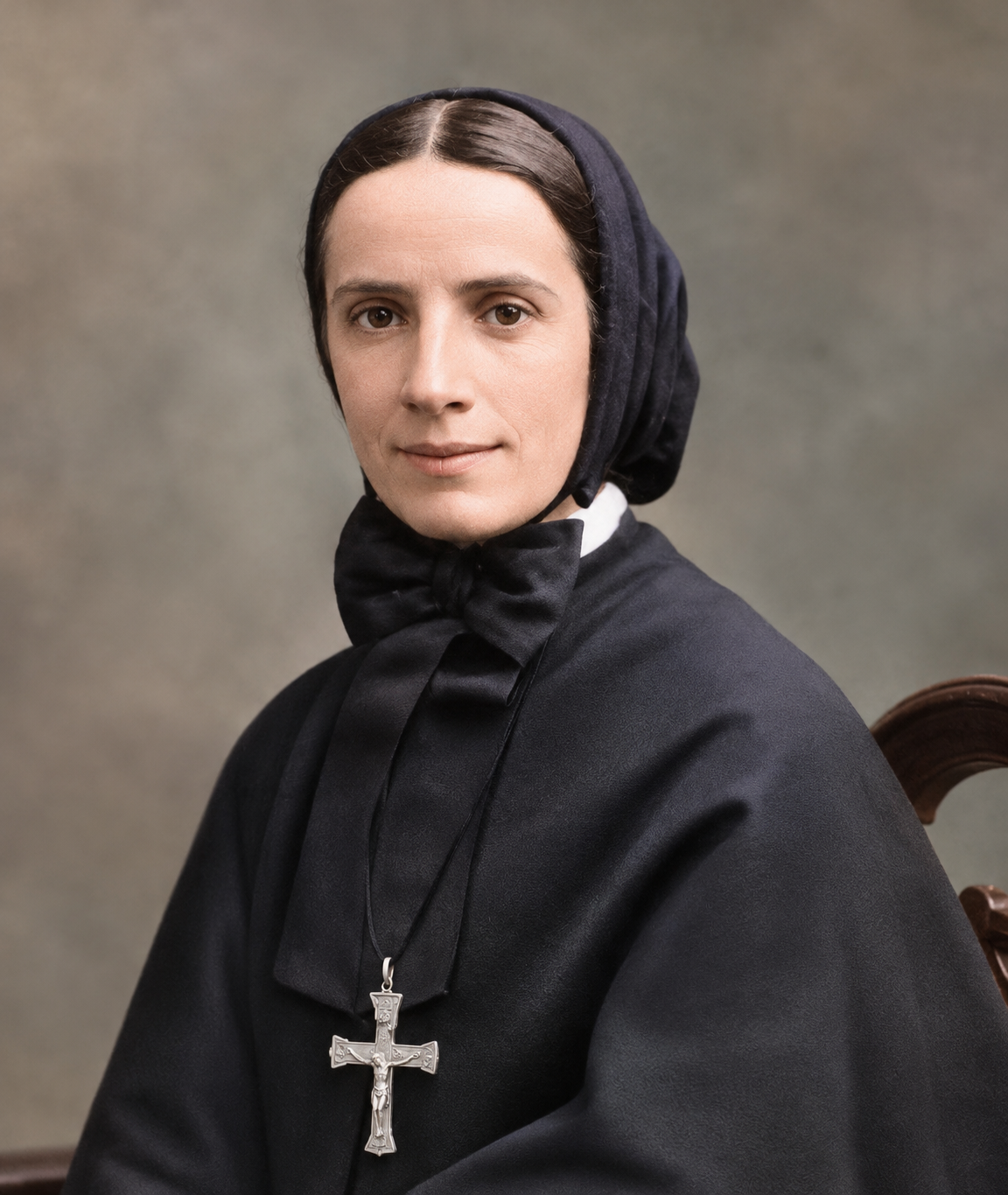
Saint Frances Xavier Cabrini, known throughout the world as Mother Cabrini, was an Italian-born Catholic religious sister, missionary, educator, hospital founder, defender of immigrants, and the first citizen of the United States to be canonized a saint. Though physically frail throughout much of her life and repeatedly told that her health made missionary life unrealistic, Cabrini eventually crossed oceans, mountains, nations, and cultural barriers to build an extraordinary network of schools, hospitals, orphanages, and charitable institutions.
Her original dream was to become a missionary in China. Pope Leo XIII redirected that dream with the famous instruction to go not to the East, but to the West, sending her instead toward the enormous population of struggling Italian immigrants in the Americas. Mother Cabrini responded by entering neighborhoods where poverty, discrimination, dangerous working conditions, language barriers, inadequate healthcare, and social isolation had left immigrant families vulnerable.
Saint Frances Xavier Cabrini is especially meaningful for immigrants and their families, travelers, missionaries, healthcare workers, educators, people facing anxiety or uncertainty, and anyone who feels that personal weakness makes God's calling impossible. Her life demonstrates that courage does not require perfect health, ideal circumstances, or freedom from fear. It requires trusting Christ enough to continue moving when He opens the next door.
Each prayer card measures 2.5" x 4.25", is handmade in Austin, Texas, printed on museum-quality photo paper rather than ordinary cardstock, and double laminated for durability. Every card is made to order and prepared prayerfully, with the recipient and their intentions brought before Christ while asking Saint Frances Xavier Cabrini to intercede for their needs.
THE LIFE & STORY OF SAINT FRANCES XAVIER CABRINI
Francesca Cabrini was born in Sant'Angelo Lodigiano in northern Italy in 1850. She grew up fascinated by stories of missionaries and dreamed from childhood of carrying the Gospel to distant lands.
Her ambitions seemed almost impossible because her health was fragile. When she sought admission to religious communities, her physical weakness became one of the reasons she was refused.
The woman who would eventually become one of history's most traveled missionary sisters therefore began her vocation by repeatedly hearing that she was not strong enough for the life she wanted.
REJECTED BECAUSE OF HER HEALTH
Mother Cabrini's early rejection is one of the most important parts of her story. She did not begin with the appearance of someone destined to establish an international missionary congregation.
She trained as a teacher and served where opportunities opened while continuing to discern religious life. Eventually, instead of entering an established missionary community, circumstances pushed her toward something far more demanding.
She would found one herself.
For people whose health, finances, background, education, or circumstances seem to have closed the obvious path forward, Cabrini offers an important spiritual lesson. Sometimes a closed door does not mean the vocation is over. It may mean God is leading toward a form of the vocation that could not yet have been imagined.
THE MISSIONARY SISTERS OF THE SACRED HEART OF JESUS
In 1880, Frances Cabrini founded the Missionary Sisters of the Sacred Heart of Jesus with a small group of companions. The Sacred Heart became the spiritual center of the congregation and of Cabrini's own missionary life.
Her community combined prayer with intense practical activity. The sisters would teach children, care for the sick, shelter orphans, assist immigrants, establish institutions, and go wherever human need required them.
Cabrini expected courage and sacrifice from her sisters, but she also insisted that missionary activity had to flow from union with Christ. Work by itself was not enough. Prayer, Eucharistic devotion, interior discipline, and confidence in the Sacred Heart were necessary if the work was truly to remain Christian.
HER DREAM OF CHINA
Mother Cabrini admired Saint Francis Xavier, the great Jesuit missionary, so deeply that she added Xavier to her own religious name. Like him, she dreamed of missionary work in Asia, particularly China.
She eventually traveled to Rome seeking approval for her missionary ambitions. Pope Leo XIII listened to her plans but redirected them toward a completely different mission.
Instead of China, the Pope urged her to look toward the West, where enormous numbers of Italian emigrants were struggling to establish lives in the Americas.
Cabrini surrendered her own plan and accepted the mission placed before her.
That moment became one of the great examples of Christian discernment in her life. She had not misunderstood her desire to become a missionary, but she had misunderstood where the mission would take her.
“NOT TO THE EAST, BUT TO THE WEST”
Pope Leo XIII's direction changed Mother Cabrini's life. Rather than sailing toward China, she prepared herself and her sisters for New York.
The Italian migration of the period had created communities facing severe poverty, overcrowded housing, dangerous labor, discrimination, language barriers, and limited access to education and healthcare. Families had crossed an ocean seeking opportunity but could easily find themselves socially isolated and vulnerable to exploitation.
Cabrini recognized that these immigrant communities did not need sympathy alone. They needed schools, hospitals, orphanages, religious formation, advocates, and institutions capable of helping them build stable lives.
She began building them.
ARRIVING IN NEW YORK
Mother Cabrini arrived in New York in 1889 with her missionary sisters. Their reception was far from easy, and the practical arrangements they expected were not waiting for them in the form they had imagined.
Cabrini nevertheless refused to turn back. She organized religious instruction, worked among immigrant families, found assistance for orphans, and gradually established institutions that could provide more permanent support.
New York became the first major American field of a mission that would eventually spread across the United States and far beyond it.
MOTHER OF IMMIGRANTS
Mother Cabrini became so closely associated with immigrant communities that Pope Pius XII later formally proclaimed her Patroness of Immigrants.
She understood migration as far more than transportation from one country to another. Immigrants could lose familiar language, social position, family networks, religious community, employment security, and a sense of belonging all at once.
Cabrini worked to help them preserve their human dignity while learning how to build new lives. Education, healthcare, spiritual support, and practical assistance became means of helping families integrate without simply abandoning their identity.
For immigrants today, her story remains strikingly contemporary. The details of migration change, but the experience of arriving somewhere unfamiliar and trying to build a secure life for one's family remains deeply human.
THE FIRST U.S. CITIZEN CANONIZED
Mother Cabrini became a naturalized citizen of the United States in 1909. When Pope Pius XII canonized her in 1946, she became the first citizen of the United States to be canonized a saint.
That distinction is especially remarkable because she had arrived in America as an immigrant herself. The Church's first canonized U.S. citizen was therefore someone who had crossed an ocean, learned to work within another culture, and devoted herself particularly to other immigrants trying to do the same.
Her story belongs simultaneously to Italian Catholic history, American Catholic history, and the broader story of migration.
SIXTY-SEVEN FOUNDATIONS
By the end of Mother Cabrini's life, she and her sisters had established 67 institutions, including schools, hospitals, and orphanages.
The scale is extraordinary considering her recurring health problems and the transportation limitations of the late nineteenth and early twentieth centuries. Cabrini traveled repeatedly through the United States, Europe, Central America, and South America while supervising projects separated by enormous distances.
The number itself, however, should not obscure the purpose. Every institution existed because particular people needed something concrete: a child needed education, an orphan needed a home, an immigrant needed medical care, or a family needed a community capable of helping them survive.
Cabrini transformed missionary zeal into infrastructure.
HOSPITALS
Healthcare became one of Mother Cabrini's most important areas of work. Immigrant families could struggle to obtain quality medical care, particularly when poverty, prejudice, or language barriers stood between them and existing institutions.
Cabrini responded by helping establish hospitals where vulnerable people could receive treatment with dignity. Her sisters entered healthcare as nurses, administrators, and religious caregivers, continuing the Catholic tradition of joining medicine with spiritual and personal care.
Her story therefore has particular resonance for nurses, physicians, hospital administrators, chaplains, and people trying to create healthcare systems that remain genuinely attentive to the human person.
SCHOOLS
Mother Cabrini had trained as a teacher before founding her congregation, and education remained fundamental to her missionary vision.
She recognized that immigrant children needed more than immediate relief. Education could help a new generation learn the language and skills necessary to participate fully in society while remaining rooted in their faith and family heritage.
Her schools therefore served both practical and spiritual purposes. Cabrini understood education as a way of expanding a child's possibilities while forming the whole person.
Her prayer card can be especially meaningful for teachers, Catholic school educators, students, immigrant families, and anyone whose vocation involves opening doors through education.
ORPHANS AND VULNERABLE CHILDREN
Mother Cabrini also devoted enormous energy to children who lacked stable family care. Orphanages and homes became an essential part of her network of institutions.
Her concern was not merely providing shelter. The children needed education, religious formation, security, community, and the possibility of a future.
Cabrini repeatedly turned buildings, donations, land, and networks of supporters into places where vulnerable children could receive those opportunities.
This aspect of her ministry makes her especially meaningful for foster families, adoptive families, orphan-care ministries, teachers, social workers, and anyone praying for children who lack stable support.
A WOMAN OF EXTRAORDINARY PRACTICAL ABILITY
Mother Cabrini's achievements required far more than religious enthusiasm. She negotiated property purchases, raised money, confronted bureaucratic obstacles, recruited supporters, supervised construction, traveled constantly, communicated across cultures, and managed an expanding international congregation.
Her life challenges the stereotype that holiness and practical competence belong to separate worlds.
Cabrini prayed intensely, but she also studied problems, found donors, purchased property, solved logistical difficulties, and acted decisively.
For someone running a ministry, school, nonprofit organization, hospital, business, or complicated family household, she offers a spirituality in which administration itself can become service.
COURAGE DESPITE PHYSICAL WEAKNESS
Mother Cabrini remained physically fragile throughout her life. Her health had once been considered a reason she should not become a missionary, yet she ultimately traveled farther and undertook more demanding responsibilities than many physically stronger people.
This does not mean illness should simply be ignored. Cabrini's body placed real limits upon her, and she experienced genuine suffering.
Her life instead demonstrates that weakness does not automatically determine the boundaries of a vocation.
For people with chronic illness, disability, fatigue, or health anxiety, Cabrini offers a particularly powerful witness. God's work does not depend upon possessing the body we wish we had.
TRAVEL AND FEAR
Mother Cabrini spent an extraordinary portion of her missionary life traveling. She crossed the Atlantic more than twenty times and journeyed through multiple countries as her congregation expanded.
Travel in her era involved dangers and discomforts difficult to imagine from modern commercial transportation. Ocean crossings were long, communication was slow, and reaching remote missions could involve trains, horses, ships, and exhausting overland journeys.
Yet she continued traveling because the communities she served were spread across continents.
This makes Mother Cabrini especially meaningful for travelers, missionaries, immigrants, people relocating far from home, and anyone who experiences anxiety about journeys or major transitions.
ACROSS THE ANDES
Cabrini's missionary travels were not limited to the United States. Her work expanded through Central and South America as requests for schools and charitable institutions multiplied.
She crossed difficult terrain and traveled through regions where ordinary transportation itself could become a major challenge.
The fragile young woman once rejected for missionary life had become an international founder moving across continents.
Her physical weakness remained real, but it no longer defined what she believed God could ask of her.
THE SACRED HEART OF JESUS
The name of Cabrini's congregation reveals the source of her missionary spirituality: the Sacred Heart of Jesus.
For Cabrini, devotion to the Sacred Heart meant entering the love of Christ deeply enough that His concern for souls became the missionary's own concern.
She wanted her sisters to bring that love into schools, hospitals, orphanages, immigrant neighborhoods, prisons, and every other place in which people experienced abandonment or suffering.
Mission was therefore not primarily expansion of an institution. It was an attempt to make the love of Christ visible.
“I WILL GO ANYWHERE”
One of the statements most closely associated with Mother Cabrini summarizes her missionary determination:
“I will go anywhere and do anything in order to communicate the love of Jesus to those who do not know Him or have forgotten Him.”
The line captures the remarkable flexibility of her vocation. She wanted China, but went to New York. She expected one mission and received another.
Her willingness to go anywhere did not mean lacking a plan. Cabrini was an extraordinary planner. It meant that every plan remained subordinate to God's will.
FOR ANXIETY AND PEACE OF MIND
Mother Cabrini understood both activity and interior surrender. Her surviving prayer for peace of mind asks the Holy Spirit to free the soul from needless anxiety and align the human will with God's will.
That prayer is especially important because Cabrini had countless practical reasons to worry. Her communities needed money, buildings had to be purchased, sisters became sick, institutions faced crises, travel was dangerous, and people continually asked her to solve new problems.
She learned to distinguish responsible concern from anxiety that consumes the soul.
For someone whose mind constantly returns to everything that could go wrong, Mother Cabrini offers both a prayer and an example.
HER PRAYER FOR PEACE OF MIND
The Mother Cabrini Shrine preserves this beautiful prayer attributed to her:
“Fortify me with the grace of Your Holy Spirit and give Your peace to my soul that I may be free from all needless anxiety and worry. Help me to desire always that which is pleasing and acceptable to You so that Your will may be my will. Amen.”
The prayer fits Cabrini's life perfectly. She was extraordinarily active without believing she could control everything.
Her goal was not simply to become more efficient at managing the future. It was to bring her own will into harmony with God's.
FOR PEOPLE FACING REJECTION
Mother Cabrini's early religious vocation was marked by rejection because of her health. The institutions that would later become eager to claim her as a great saint could not have predicted what the frail young woman would accomplish.
Rejection did not make every door magically open afterward. Her missionary life continued to involve opposition, disappointment, lack of resources, and circumstances that forced her repeatedly to begin again.
Her story can therefore be especially meaningful for someone who has been told they are not strong enough, qualified enough, healthy enough, wealthy enough, or connected enough to accomplish something important.
Cabrini does not promise that every rejected plan will eventually succeed. She demonstrates that rejection does not have the authority to define God's entire plan for a life.
FOR IMMIGRANT FAMILIES
Saint Frances Xavier Cabrini is one of the Church's most important intercessors for migrants and immigrant families.
Her ministry recognizes the particular fears carried by people beginning again in another country: finding employment, learning a language, navigating unfamiliar institutions, protecting children, preserving faith, facing discrimination, and wondering whether the family will ever truly belong.
Cabrini did not address those struggles only through preaching. She created institutions capable of helping families survive and thrive.
Her prayer card can therefore be kept in a family prayer space, carried during immigration proceedings or travel, or given to someone beginning life in a new country.
FOR TRAVELERS
Mother Cabrini's extraordinary travel also makes her a natural saint to invoke during long journeys, international moves, missionary work, and trips involving uncertainty.
She repeatedly left familiar places to enter situations where she did not know exactly what conditions she would find.
Travel became part of her surrender to Providence.
A prayer card carried in a wallet, suitcase, backpack, car, or travel bag can therefore serve as a simple reminder to ask her intercession for protection, courage, and peace while away from home.
FOR MISSIONARIES
Cabrini's missionary vocation was built upon flexibility. She had to learn that surrendering to God's mission sometimes meant surrendering her preferred version of the mission.
Her story therefore has particular value for priests, religious, lay missionaries, parish workers, nonprofit leaders, and anyone whose service has taken an unexpected direction.
Sometimes the mission God actually provides looks different from the mission we imagined.
Mother Cabrini teaches that fidelity consists not merely in holding tightly to the original dream but in recognizing when Providence is redirecting it.
FOR ENTREPRENEURS AND FOUNDERS
Although Mother Cabrini would never have described herself in modern entrepreneurial language, anyone who has founded an organization will recognize much of her life.
She began with limited resources, recruited a team, raised funds, opened facilities, acquired properties, navigated resistance, solved crises, expanded internationally, developed new leaders, and built institutions capable of continuing beyond her death.
What distinguishes her work is the reason behind it.
Growth was not the goal for its own sake. Expansion mattered because more people could be served.
For Christian founders and leaders, Cabrini offers a powerful example of ambition purified by mission.
AMERICAN CITIZENSHIP
Mother Cabrini became a United States citizen in Seattle in 1909.
Her citizenship gave a striking final dimension to a life devoted to immigrants. She had arrived as a foreign-born missionary serving people who themselves were trying to become part of American society, and she eventually became an American citizen alongside them.
When she was canonized decades later, that citizenship made her the first U.S. citizen officially declared a saint by the Catholic Church.
Her life therefore occupies a unique place in American Catholic history.
HER FINAL YEARS
Mother Cabrini continued traveling and directing her international congregation despite declining health.
By the time of her death, the missionary work she had begun with a handful of women had developed into a network stretching across multiple countries and continents.
She died in Chicago in 1917 at the age of sixty-seven.
Her death did not end the mission. The Missionary Sisters of the Sacred Heart continued the work she had begun and remain active internationally in education, healthcare, social service, and ministry to vulnerable communities.
CANONIZATION
Mother Cabrini was beatified in 1938 and canonized by Pope Pius XII in 1946.
Her canonization made her the first United States citizen to be formally numbered among the Catholic saints.
In 1950, Pope Pius XII gave her another distinction that captures the enduring meaning of her life's work when he proclaimed her Patroness of Immigrants.
The frail Italian girl who once dreamed of China had become a heavenly patron for people crossing borders throughout the world.
WHERE HER RELICS ARE VENERATED
Saint Frances Xavier Cabrini's major relics are venerated at the Saint Frances Cabrini Shrine in New York City.
The shrine stands on property connected directly with Cabrini's own work. It remains a place of pilgrimage where people come to pray for her intercession, learn about her mission, and encounter the legacy of the woman who spent so much of her life serving immigrants in the city.
Other important Cabrini shrines and places associated with her life can be found in Chicago, Colorado, Italy, and elsewhere throughout the world.
THE QUOTE
One of Mother Cabrini's own teachings, written only days before her death, offers a beautiful summary of the trust that sustained her extraordinary activity:
“Be peaceful in difficulties, fear nothing, that the good Jesus thinks of everything and will defend us in everything.”
These are powerful words precisely because Cabrini did not live an easy life.
Her peace did not depend upon having no difficulties. It came from believing that difficulties themselves remained within the Providence of Christ.
WHO SHOULD RECEIVE A SAINT FRANCES XAVIER CABRINI PRAYER CARD?
A Saint Frances Xavier Cabrini prayer card can make an especially meaningful gift for immigrants, people moving to another country, travelers, missionaries, nurses, doctors, teachers, hospital workers, social workers, nonprofit leaders, religious sisters, and families carrying anxiety about an uncertain future.
It can also be especially meaningful for someone struggling with rejection, chronic health problems, fear of travel, or the belief that personal weakness has disqualified them from an important calling.
Mother Cabrini's life answers that fear with an extraordinary record of what God can accomplish through a person who continues saying yes.
FAQ
Who was Saint Frances Xavier Cabrini? Saint Frances Xavier Cabrini, commonly called Mother Cabrini, was an Italian-born Catholic religious sister, missionary, educator, hospital founder, and defender of immigrants who lived from 1850 to 1917. She founded the Missionary Sisters of the Sacred Heart of Jesus and established schools, hospitals, orphanages, and other missions throughout the Americas and Europe.
Is Mother Cabrini the same person as Saint Frances Xavier Cabrini? Yes. Mother Cabrini, Frances Cabrini, and Saint Frances Xavier Cabrini all refer to the same saint. She added Xavier to her religious name in honor of Saint Francis Xavier, the great Jesuit missionary.
Why is Saint Frances Cabrini important to American Catholic history? She became a naturalized U.S. citizen and was the first citizen of the United States to be canonized a saint. Her missionary work also had an enormous influence on Catholic education, healthcare, and immigrant ministry in the United States.
Why is Mother Cabrini the patron saint of immigrants? Much of Cabrini's missionary life was devoted to Italian immigrants and other vulnerable people living far from their homeland. Pope Pius XII formally proclaimed her Patroness of Immigrants in 1950.
Why did Mother Cabrini come to the United States? Cabrini originally wanted to become a missionary in China, but Pope Leo XIII directed her toward the West and the enormous population of Italian immigrants living in the Americas. She arrived in New York in 1889.
What order did Mother Cabrini found? She founded the Missionary Sisters of the Sacred Heart of Jesus in 1880. The congregation continues her missionary work internationally.
How many institutions did Mother Cabrini establish? Mother Cabrini and her sisters established 67 institutions during her lifetime, including schools, hospitals, and orphanages.
Was Mother Cabrini in poor health? Yes. She experienced fragile health from childhood and was rejected by religious communities partly because of it. Her later missionary accomplishments are especially striking because physical weakness remained part of her life.
Did Mother Cabrini really want to go to China? Yes. She dreamed of missionary work in the East and admired Saint Francis Xavier. Pope Leo XIII redirected her toward Italian immigrants in the Americas instead.
What did Pope Leo XIII tell Mother Cabrini? The famous instruction associated with their meeting was that she should go not to the East but to the West. The phrase symbolizes the redirection of her missionary vocation from China toward the Americas.
What hospitals did Mother Cabrini establish? Cabrini and her sisters founded and developed hospitals as part of their ministry to immigrant communities, particularly where poor families had difficulty obtaining adequate medical care. Healthcare became one of the major expressions of Cabrinian missionary service.
Why is Mother Cabrini associated with the Sacred Heart? She founded the Missionary Sisters of the Sacred Heart of Jesus, and devotion to the Sacred Heart stood at the center of her spirituality. She understood missionary life as carrying the love of the Heart of Christ to people who felt forgotten or abandoned.
Is Saint Frances Cabrini a good saint for anxiety? Her surviving prayer for peace of mind specifically asks God for freedom from needless anxiety and worry. Her own life also demonstrates how intense responsibility can be united with deep trust in Divine Providence.
Can Saint Frances Cabrini be asked to pray for travelers? Yes. Christians may ask any saint for intercession, and Cabrini's extraordinary missionary travels make her particularly meaningful for people crossing borders, moving internationally, traveling for work, or beginning life far from home.
Can immigrants ask Mother Cabrini for intercession? Yes. She is formally honored as Patroness of Immigrants, making her one of the most fitting saints to invoke for migrants, refugees, immigrant families, immigration concerns, and people beginning life in a new country.
What did Mother Cabrini say about fear? One of her surviving writings says, “Be peaceful in difficulties, fear nothing, that the good Jesus thinks of everything and will defend us in everything.” Her writings repeatedly express confidence in Christ amid uncertainty.
Where is Mother Cabrini buried? Her major relics are enshrined at the Saint Frances Cabrini Shrine in New York City, where pilgrims continue to visit and ask for her intercession.
Who would this Saint Frances Xavier Cabrini prayer card make a meaningful gift for? It is especially fitting for immigrants, travelers, missionaries, people moving abroad, healthcare workers, teachers, religious sisters, nonprofit leaders, people facing anxiety, and anyone trying to follow God's call despite poor health or discouraging circumstances.
THE MAIN MESSAGE OF SAINT FRANCES XAVIER CABRINI'S LIFE
Saint Frances Xavier Cabrini's life repeatedly appeared to be moving toward impossibility. Her health was considered too poor for the missionary vocation she desired, the religious communities she hoped to enter rejected her, and the destination she dreamed of serving was ultimately not the destination God gave her.
Yet each apparent limitation became part of a larger vocation.
Instead of joining an existing missionary order, she founded one. Instead of going to China, she crossed the Atlantic and became a mother to immigrants throughout the Americas. Instead of allowing physical weakness to define what she could accomplish, she established institutions on multiple continents and built structures of charity capable of surviving long after her death.
For anyone afraid that weakness, rejection, anxiety, immigration, unfamiliar surroundings, or an unexpected change in plans has ruined the future, Mother Cabrini offers a different interpretation. God's Providence may redirect the road without abandoning the destination, and a life surrendered to Christ can become far larger than the plan we originally imagined.