 Image 1 of 1
Saint Gordius Prayer Card | For Soldiers, Courage & Standing Firm in Faith
Saint Gordius of Caesarea, also called Saint Gordios of Cappadocia, was an early fourth-century Christian soldier, Roman centurion, desert ascetic, and martyr remembered for one of the boldest public confessions of faith in the age of persecution. Born into a Christian family in Caesarea of Cappadocia, in present-day Turkey, Gordius became a successful military officer before anti-Christian measures forced a choice between his position and his faith. He left military life, withdrew into the wilderness for fasting and prayer, and then did something extraordinary: instead of remaining safely hidden, he deliberately returned to Caesarea during a packed public festival and openly proclaimed himself a Christian before the entire city.
Saint Gordius is especially meaningful for soldiers, veterans, military officers, Christians facing persecution, people under pressure to hide their faith, men seeking courage and discipline, those afraid of public ridicule, and anyone who needs the strength to remain faithful when compromise would be easier. These associations grow directly from his Life rather than from invented formal patronages. Gordius understood military courage, but Saint Basil the Great remembers his greatest act of bravery as walking voluntarily into a hostile crowd and publicly identifying himself with Christ when he already knew what the confession could cost.
What makes Saint Gordius particularly important historically is the source for his story. Saint Basil the Great, Bishop of Caesarea, preached a surviving homily honoring Gordius in the same city where the martyr had died, only several decades after the event. Modern scholarship identifies Basil's homily as the earliest surviving witness to the cult and story of Gordius, giving us a much earlier source than the medieval Lives through which many other ancient martyrs are primarily known.
His story also combines two forms of Christian discipline that are rarely brought together so dramatically: the soldier and the ascetic. Gordius had learned military discipline, command, courage, and endurance, but after leaving the army he entered the wilderness and trained through fasting, vigils, prayer, and meditation on Scripture. Saint Basil deliberately describes this preparation using athletic language, presenting Gordius as a spiritual athlete training himself for the final contest of martyrdom.
This makes Saint Gordius especially compelling for soldiers and martial-minded Christians who understand that courage is not merely the ability to confront physical danger. A person may be brave in combat and still be terrified of losing career, reputation, social approval, or status. Gordius ultimately demonstrated a deeper freedom because after surrendering his military rank and years of safety in the wilderness, he voluntarily walked back into danger simply because he believed Christ should be confessed openly.
This prayer card is especially fitting for active-duty military personnel, veterans, cadets, police officers, first responders, Christian men, people facing workplace pressure over their faith, converts afraid to speak openly about Christianity, and anyone who needs courage to refuse an immoral compromise. It can also make a meaningful gift before deployment, military graduation, a difficult assignment, baptism or chrismation, or any moment when someone needs the reminder that being faithful can require standing alone.
Each 2.5" x 4.25" prayer card is handmade in Austin, Texas and prepared prayerfully with each order. It is printed on museum-quality photo paper rather than cardstock, double-laminated for durability, and made while the recipient and their intentions are lifted before Christ in prayer, with Saint Gordius asked to intercede for them.
THE LIFE & STORY
Saint Gordius was born near the end of the third century in Caesarea of Cappadocia, the same great Christian city later associated with Saint Basil the Great. The Orthodox Church remembers him as coming from a Christian family and entering Roman military service as a young man, where his courage and ability eventually earned him the rank of centurion.
A Roman centurion was not merely an ordinary enlisted soldier. Centurions were professional officers responsible for discipline, leadership, training, and the lives of the men under their command, so the title tells us something significant about the kind of man Gordius had become before persecution forced him from military life.
A ROMAN CENTURION
Saint Basil's ancient tradition identifies Gordius as a military officer whose position was lost during the anti-Christian policies surrounding the reign of Licinius. Later Orthodox tradition similarly remembers him as a centurion renowned for military valor and skill before persecution drove him away from public life.
This background gives Gordius an unusually direct relationship with soldiers and veterans. He was not imagined as a warrior centuries later simply because iconographers wanted him to look heroic, because military service belongs to the oldest surviving tradition about him.
WHEN MILITARY SERVICE COLLIDED WITH FAITH
The early fourth century was a dangerous period for Christians serving in imperial institutions. The Roman state could demand participation in pagan religious rites closely tied to public office and military loyalty, placing Christians in situations where obedience to superiors could become incompatible with worship of Christ.
According to the tradition summarized in the ancient sources, Gordius relinquished or was deprived of his military position rather than participate in what his Christian conscience could not accept. He then withdrew completely from civic life, leaving behind the uniform, authority, salary, status, and social identity that came with being a Roman centurion.
THE SOLDIER GOES INTO THE WILDERNESS
Gordius retreated into the wilderness and became an anchorite, living in solitude, prayer, fasting, and severe ascetic discipline. Saint Basil describes him fleeing the noise and corruption of the city and seeking God in the desert, comparing his withdrawal with the prophet Elijah seeking God on Horeb.
The desert did not make Gordius passive. It became a second form of training in which the discipline once exercised through military life was redirected toward mastery of the passions, continual prayer, purification of the heart, and preparation for whatever God might ask of him.
A SOLDIER BECOMES A SPIRITUAL ATHLETE
Saint Basil specifically uses athletic imagery to describe Gordius' preparation. Through fasting, vigils, prayer, and constant meditation upon Scripture, Gordius trained himself like an athlete preparing for a contest, eventually believing that the time had come to make his confession publicly.
This makes Gordius especially meaningful for athletes, martial artists, and military personnel even without assigning him a formal patronage over those groups. His Life presents physical discipline as useful, but incomplete, unless the inner person is also trained to master fear, pride, comfort, and attachment to worldly status.
HE COULD HAVE STAYED SAFE
One of the most remarkable parts of Gordius' story is that nobody forced him to leave his hiding place. He had successfully escaped the persecution and could apparently have remained in the wilderness, living out his Christian life in relative isolation.
Instead, Gordius concluded that his faith required a public witness. The man who had withdrawn precisely because Christians were in danger voluntarily began walking back toward the city from which he had escaped.
CAESAREA GATHERS FOR THE GAMES
Saint Basil describes Caesarea crowded for a major public festival associated with Mars, the Roman god of war. Horse and chariot races filled the theater, citizens packed the seats, children were released from school, slaves were given an opportunity to attend, and even Christians were among those watching the spectacle.
The setting was almost perfectly chosen for the former soldier's return. A city gathered to celebrate a pagan god of war suddenly saw one of its former military officers emerge from the mountains to proclaim another allegiance.
THE WILD-LOOKING MAN FROM THE DESERT
Years of asceticism had transformed Gordius' appearance. Later summaries of Basil's homily describe the former officer entering the stadium with a long beard, worn clothing, a body hardened by fasting, and skin darkened by exposure to the wilderness.
The contrast would have been dramatic. The polished military centurion once recognizable through his insignia and rank now appeared as a desert ascetic stripped of every outward symbol of Roman status.
HE WALKED INTO THE MIDDLE OF THE STADIUM
Gordius did not remain at the edge of the crowd. Saint Basil says that he came down from the mountains, passed through the spectators without fear, and stood in the middle of the stadium while everyone turned away from the races to look at him.
Basil describes him as possessing the confidence of a lion. That detail captures the transformation his years of prayer had produced because the former military officer had become more fearless without his weapons and rank than he had ever needed to be while possessing them.
“I AM A CHRISTIAN”
Gordius openly revealed who he was and why he had returned. The received tradition remembers him identifying himself before the authorities, explaining his former military rank, his withdrawal during persecution, and his deliberate decision to come back so that he could publicly testify to his faith in Christ.
The spectacle therefore changed instantly. A crowd that had gathered to watch athletes and horses was now watching a man voluntarily place his life at risk for the Gospel.
A SAINT FOR PUBLIC COURAGE
Saint Gordius is particularly meaningful for Christians who are not being asked to deny Christ formally but who feel strong pressure to keep Christianity hidden. Fear of ridicule, professional consequences, hostile coworkers, family criticism, or social rejection can make silence seem safer.
Gordius' example does not mean Christians should seek confrontation merely for attention. His years in the wilderness show the opposite because his public confession came only after prolonged prayer and spiritual preparation, making his courage the fruit of discernment rather than ego.
COURAGE WITHOUT ANGER
Saint Basil's account does not portray Gordius entering the stadium in a rage. He appears remarkably composed, willingly offering himself for confession and apparently possessing a peace that confused those who expected threats to frighten him.
That distinction matters for Christians today. Courage does not require becoming combative, hostile, or consumed with hatred toward opponents, because Gordius' strength came from becoming less controlled by fear rather than more controlled by anger.
THE GOVERNOR TRIES TO FRIGHTEN HIM
Once Gordius had publicly confessed Christianity, the authorities responded with threats of increasingly terrible punishments. Saint Basil's tradition lists scourging, the rack, fire, beasts, the sword, and the cross among the torments invoked to terrify him into changing his mind.
Instead of retreating, Gordius answered with one of the most memorable sayings attributed to an early martyr. His response expressed regret not that he might die, but that one human life allowed him to die for Christ only once.
A VERIFIED SAYING OF SAINT GORDIUS
Saint Basil's account preserves the remarkable response:
“What a bad thing for me that I cannot die for Christ again and again!”
The line reveals the radical change in Gordius' understanding of death. The authorities regarded death as their ultimate weapon, while Gordius regarded faithful death as something capable of taking him into eternal life.
HIS FAMILY & FRIENDS BEG HIM TO RECONSIDER
The ancient tradition remembers people surrounding Gordius as his execution approached, pleading with him to preserve his life. Appeals to family, youth, future possibilities, and ordinary human happiness all represented powerful reasons to make some compromise and survive.
Gordius' response was not contempt for life. His position was that earthly life is temporary regardless of how successfully we protect it, so preserving a few additional years cannot justify losing the eternal life promised by Christ.
THE CHRISTIAN UNDERSTANDING OF DEATH
Saint Basil summarizes Gordius' final teaching as an exhortation to turn unavoidable mortality into a voluntary offering to God. Every human being eventually dies, Gordius reasoned, so the Christian should value eternal life more highly than temporary survival.
This makes his story particularly meaningful for someone terrified of death, aging, serious illness, or danger. Gordius does not trivialize death because he radically changes the question, asking whether death actually possesses the final victory for someone united to Christ.
HE MADE THE SIGN OF THE CROSS
As the moment of execution arrived, Saint Basil remembers Gordius making the sign of the Cross and approaching death without losing his composure. His demeanor was so peaceful that Basil compares him not to a condemned prisoner walking toward an executioner, but to someone placing himself into the hands of angels.
The final gesture is particularly fitting for a prayer card. The soldier who once carried Roman military insignia completed his life beneath a different sign, the Cross of Christ.
MARTYRDOM BY THE SWORD
Saint Gordius was killed by the sword, with the Orthodox tradition normally describing his martyrdom as beheading. Modern Orthodox calendars commonly place his death around 320 AD, although different older traditions give dates somewhat earlier within the persecution under Licinius.
Because the ancient evidence does not establish one exact year beyond all dispute, “around 320 AD” is the safest wording for a prayer card date line. His feast, however, is firmly preserved on January 3.
SAINT BASIL THE GREAT PRESERVED HIS STORY
Gordius has an unusually important connection with Saint Basil the Great, who became Bishop of the same Caesarea later in the fourth century. Basil's surviving Homily 18, On the Martyr Gordius, is the earliest known literary witness to the saint and provides the foundation for much of what later Christian tradition remembers about him.
This means Gordius' story did not first appear many centuries later in a medieval collection. Basil was preaching in the martyr's own city while memories of the period of persecution still belonged to the relatively recent past.
HOW HISTORICALLY SECURE IS SAINT GORDIUS' STORY?
Modern scholarship treats Basil's homily as the earliest attestation of Gordius and his cult, while also warning that later hagiography expanded the story with additional details. Scholar Aude Busine notes that relatively little independent information survives concerning Gordius' biography, but his local cult at Caesarea and Basil's fourth-century witness make him significantly better anchored than saints whose narratives first appear centuries later.
The strongest product-page wording is therefore to distinguish carefully between the core story preserved by Saint Basil and later elaborations. His identity as a Cappadocian martyr associated with military service, desert withdrawal, public confession, and execution is rooted in the earliest tradition, while some precise chronological details vary in later accounts.
A LOCAL MARTYR OF CAESAREA
Gordius was not originally a saint imported from a distant country into Cappadocian devotion. He belonged to Caesarea itself, and Basil's homily shows the local Christian population assembling for his commemoration.
That local character is important because Cappadocia would become one of the great centers of fourth-century Christianity. Saint Basil, Saint Gregory of Nyssa, Saint Gregory Nazianzen, and other Fathers emerged from the same broader Christian world in which Gordius' martyrdom was remembered.
FROM ROMAN SOLDIER TO SOLDIER OF CHRIST
The transformation of Gordius can be summarized through two uniforms. He began as a Roman centurion whose belt and insignia signified obedience to the empire, but he ended as a martyr marked by the Cross.
Eastern Christianity frequently uses the language of Christ's soldiers for martyrs, not because martyrdom glorifies warfare but because courage, endurance, loyalty, discipline, and willingness to sacrifice are redirected toward the Gospel.
A SAINT FOR SOLDIERS
Saint Gordius is an especially fitting saint for active-duty soldiers, veterans, officers, cadets, and military families because his actual biography contains military service rather than a purely symbolic association. His story also confronts the serious question of how obedience and conscience relate when a military system demands something contrary to faith.
For a Christian soldier, Gordius does not teach disloyalty or rejection of discipline. He teaches that earthly authority is real but never absolute, because no commander, government, or institution can rightfully occupy the place belonging to God.
A SAINT FOR VETERANS
Gordius can also be especially meaningful after military service ends. His identity changed dramatically when his rank disappeared, yet losing the role that had defined him did not mean losing his purpose.
Veterans who struggle with the transition from uniformed service into another stage of life may find something powerful in that transformation. Gordius' military discipline did not disappear when he entered the wilderness because it was redirected toward another kind of service.
A SAINT FOR CHRISTIAN MEN
Gordius presents a particularly strong model of Christian masculinity because his Life contains strength without domination, courage without rage, discipline without vanity, and sacrifice without self-pity. He had once held real authority and possessed real military skill, yet he became willing to surrender all of it when those things came into conflict with Christ.
His example asks whether strength is merely the ability to impose one's will or the ability to remain faithful when fear, reputation, and self-preservation are pulling in the opposite direction.
A SAINT FOR PEOPLE FACING WORKPLACE PRESSURE
Most Christians will never be ordered to sacrifice incense to a Roman god, but many experience subtler pressures to conceal, compromise, or contradict their beliefs for professional acceptance. Gordius' story speaks directly to the temptation to treat career preservation as though it were the highest possible good.
The proper application is not reckless confrontation. His long preparation in prayer suggests that Christian witness should be thoughtful and discerning, but once conscience becomes clear, fear of losing status cannot become the final authority.
A SAINT FOR PEOPLE AFRAID OF RIDICULE
The packed stadium makes Gordius particularly meaningful for anyone terrified of being embarrassed publicly. He chose the most visible setting imaginable for his confession, surrounded by people who could mock, condemn, or demand his death.
His freedom came not from believing everyone would approve but from accepting in advance that their approval could no longer determine his faithfulness.
A SAINT FOR CONVERTS
Converts sometimes experience intense pressure from family, friends, or a previous social community when they begin practicing Christianity seriously. Gordius can become a meaningful intercessor whenever following Christ creates the fear of losing relationships or an identity built over many years.
His story demonstrates that losing an old identity can sometimes reveal a deeper one. The centurion disappeared into the wilderness, but what emerged was a man whose identity in Christ no longer depended upon a Roman title.
A SAINT FOR SPIRITUAL DISCIPLINE
Gordius did not walk straight from the barracks into martyrdom. Between the army and the stadium came years of ascetic preparation through fasting, prayer, vigils, solitude, and Scripture.
That sequence matters because dramatic Christian courage is usually built through ordinary habits before a crisis arrives. The ability to stand firm publicly may depend upon thousands of smaller decisions made privately when nobody is watching.
A SAINT FOR MARTIAL ARTISTS & ATHLETES
There is no historical basis for calling Gordius the formal patron saint of a modern martial art, but Saint Basil's description makes him naturally meaningful for athletes and disciplined fighters. Basil explicitly portrays the desert years as training for a contest, with fasting and prayer functioning as the ascetic preparation of a spiritual athlete.
For a Christian martial artist, the lesson is clear. The body may be trained to endure pain and pressure, but the deeper question is whether the will has been trained to resist fear, temptation, ego, and compromise.
A SAINT FOR STANDING ALONE
One of the hardest forms of courage is acting rightly when the surrounding crowd has chosen something else. Gordius entered a stadium containing pagans, authorities, and even Christians who had simply come to enjoy the games, yet he made his confession without waiting for someone else to go first.
His card can therefore be especially meaningful for someone who feels isolated in defending a moral conviction. The crowd's size does not determine truth, and being outnumbered does not mean being abandoned by God.
FEAST DAY
Saint Gordius is commemorated on January 3 in the Byzantine tradition. Both the Orthodox Church in America and the Greek Orthodox Archdiocese's contemporary Menaion place the Holy Martyr Gordios on that date during the Forefeast of Theophany.
The January 3 feast offers a natural annual day to pray especially for soldiers, persecuted Christians, people struggling with fear, and anyone who needs courage to confess Christ without shame.
ICONOGRAPHY
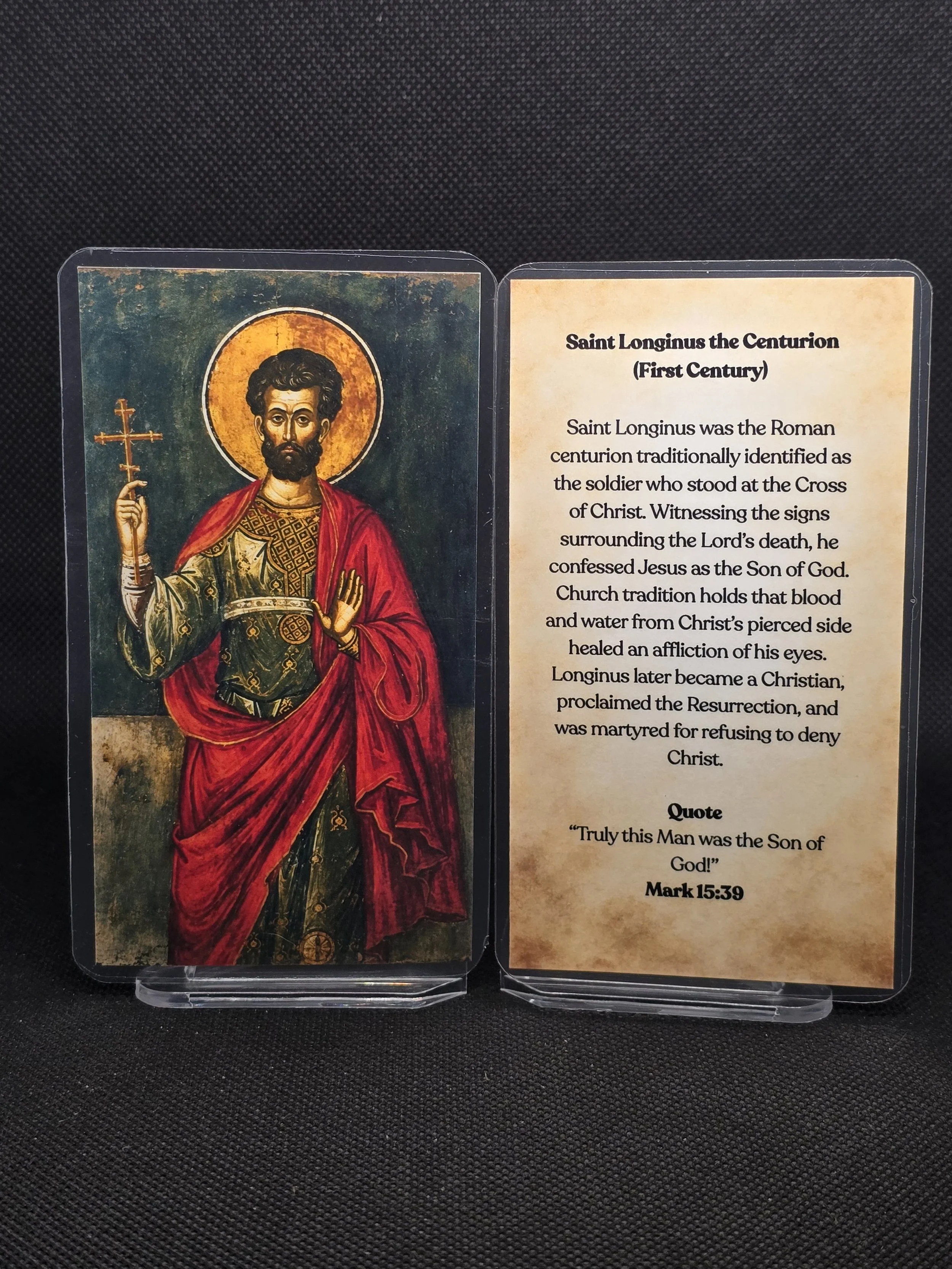
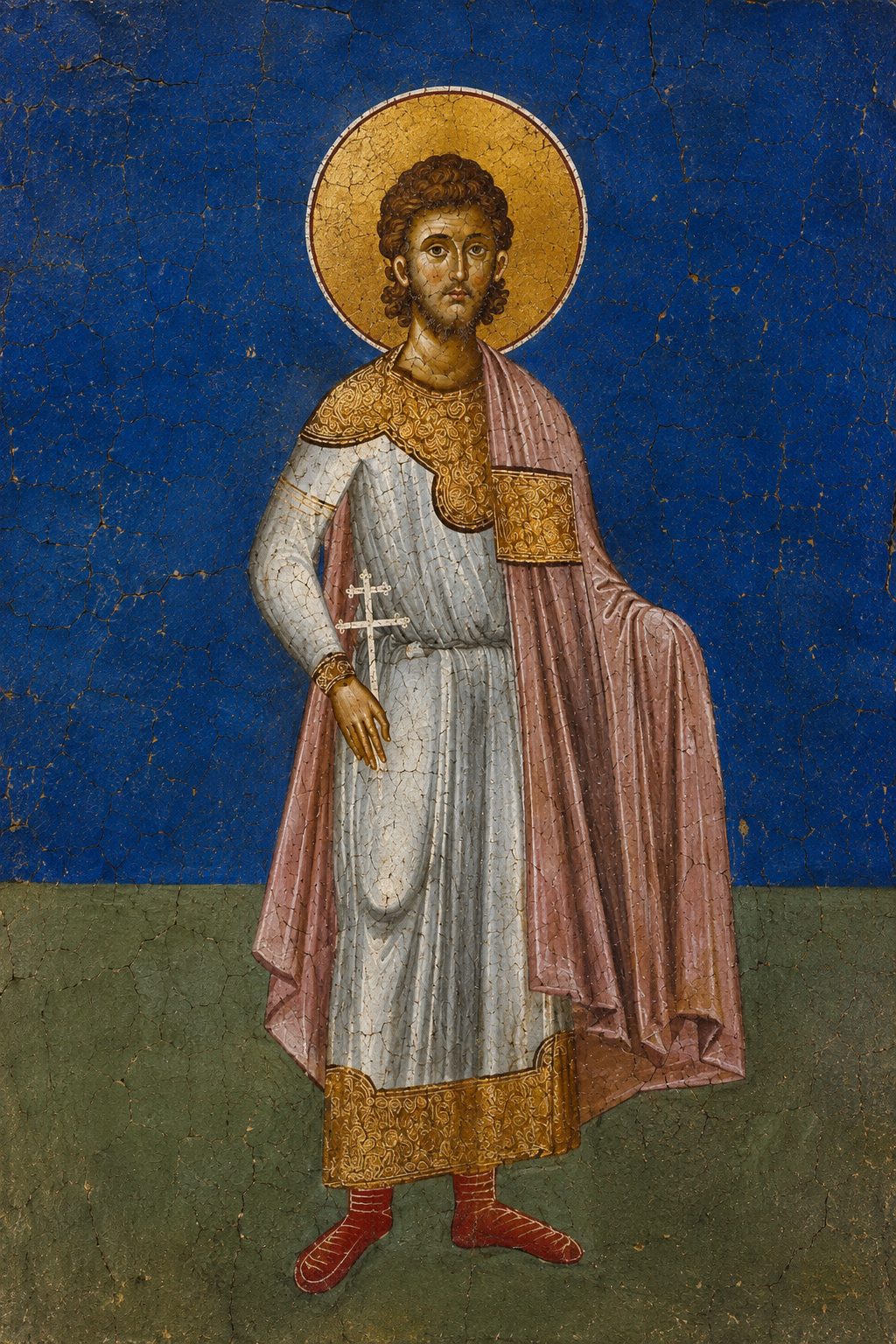
Traditional icons commonly portray Saint Gordius either as a Roman military martyr in armor or as a martyr holding the Cross. Both forms are appropriate because his story contains a genuine transition from military officer to ascetic and martyr.
Some icons emphasize the centurion through armor, spear, or military cloak, while others clothe him more simply and place the martyr's cross in his hand. The cross ultimately explains why the Church remembers him because his earthly military career became secondary to his final confession.
PRAYERS
Saint Gordius possesses established Byzantine liturgical hymns for his January 3 feast, so there is no need to invent a saint-specific prayer. The Orthodox Troparion praises the strength God gave His martyr, remembers his victory over spiritual enemies, and concludes by asking for his intercession.
A short traditional line especially suitable for the back of a prayer card is:
“Through his intercessions, save our souls!”
His Kontakion likewise remembers Gordius' ascetic labor and the blood he shed as a martyr, asking that those who honor him in faith be helped through his prayers. The Greek Orthodox Menaion also praises Gordius as a brilliant light arising from the East and an ornament of Christ's martyrs.
FAQ
Who was Saint Gordius? Saint Gordius was an early fourth-century Christian from Caesarea in Cappadocia who served as a Roman centurion before withdrawing into the wilderness during persecution. After years of ascetic preparation, he returned publicly to Caesarea, confessed Christ before a crowded stadium, and was executed as a martyr.
Is Saint Gordius the same as Saint Gordios? Yes, Gordius and Gordios are different English transliterations of the same name. Greek Orthodox sources frequently use Gordios, while English and Slavic Orthodox material often uses Gordius.
When did Saint Gordius live? He lived around the end of the third and beginning of the fourth century. Orthodox tradition commonly places his martyrdom around 320 AD, although some older sources give somewhat earlier dates under Licinius.
When is Saint Gordius' feast day? His feast is January 3 in the Byzantine calendar. The OCA and Greek Orthodox Archdiocese both commemorate the Holy Martyr Gordius or Gordios on that date.
Where was Saint Gordius from? Gordius was from Caesarea in Cappadocia, an important city in Asia Minor corresponding to the region around modern Kayseri, Turkey. The city later became famous as the episcopal see of Saint Basil the Great.
Was Saint Gordius really a soldier? Yes, his military identity appears in the earliest tradition surrounding him. Both Saint Basil's tradition and modern Orthodox sources remember him as a centurion who had achieved his position through courage and military ability.
What was a Roman centurion? A centurion was a professional Roman military officer responsible for leading and disciplining a body of soldiers. Gordius therefore had genuine command experience rather than simply being described generically as a soldier.
Why did Saint Gordius leave the army? Anti-Christian policies created a conflict between military service and his Christian faith. Gordius relinquished or lost his rank rather than submit to requirements incompatible with his allegiance to Christ.
Did Saint Gordius become a monk? The earliest tradition describes him more precisely as withdrawing into the wilderness and living as an anchorite or desert ascetic. He practiced fasting, prayer, vigils, and contemplation before returning to Caesarea.
Did Saint Gordius go to Mount Sinai? Later Orthodox tradition specifically places his retreat in the Sinai wilderness or near Horeb. Saint Basil's earlier homily clearly preserves his withdrawal into remote wilderness, while some of the more precise geographical details belong to later tradition.
Why did Saint Gordius leave the desert? According to Saint Basil, his ascetic preparation convinced him that the time had come to confess Christ openly. Rather than remaining safe, he deliberately returned to Caesarea during a major public gathering.
What happened at the stadium in Caesarea? Caesarea had gathered for games connected with a pagan festival when Gordius walked into the crowded stadium and publicly identified himself as a Christian. The spectators turned their attention away from the races toward the former centurion who had emerged from the desert.
Why is Saint Gordius associated with courage? His story contains both military courage and an even more striking form of moral courage. He voluntarily returned from safety to confess Christianity publicly despite knowing that torture and execution were likely.
Is Saint Gordius a patron saint of soldiers? It is safest not to claim a universal formal patronage unless a particular Church assigns it explicitly. He is nevertheless exceptionally meaningful for soldiers and veterans because he genuinely served as a Roman centurion and his martyrdom centers on the relationship between military obedience and Christian conscience.
Can soldiers pray to Saint Gordius? Yes, especially for courage, integrity, obedience to legitimate authority, and the wisdom to recognize when conscience must come before earthly commands. His military biography gives this devotion a strong historical foundation.
Can veterans pray to Saint Gordius? Yes, and his life after military service can be particularly meaningful for veterans. Gordius lost the rank that had helped define his public identity but discovered a deeper vocation through prayer and Christian witness.
Is Saint Gordius good for people afraid to speak about their faith? Yes, this is one of the clearest modern applications of his story. Gordius' defining act was publicly confessing Christ before a massive crowd when remaining silent would have been much safer.
Is Saint Gordius good for Christians facing workplace pressure? Yes, particularly when professional advancement or security appears to require compromising one's faith or conscience. His story reminds Christians that careers are important but cannot become more important than God.
Is Saint Gordius good for martial artists? He is not an established formal patron of modern martial arts, but the association can be meaningful. Saint Basil explicitly describes Gordius' fasting, vigils, and prayer as the training of a spiritual athlete preparing for a contest.
What did Saint Gordius say before his martyrdom? Saint Basil preserves several sayings attributed to him, including his striking wish that he could die for Christ more than once. The homily presents Gordius as facing execution with unusual calm and even joy.
How was Saint Gordius killed? The Byzantine tradition remembers him as dying by the sword, ordinarily described as beheading. Before the final blow, Saint Basil says Gordius made the sign of the Cross and approached death without losing his peaceful demeanor.
Did Saint Basil the Great know about Saint Gordius? Yes, and this is one of the most historically important things about Gordius' story. Basil preached a surviving homily devoted specifically to the martyr in Caesarea during the fourth century.
How early is Saint Basil's account? Basil served as bishop from 370 to 379, placing his homily only several decades after Gordius' traditional martyrdom. Modern scholarship identifies it as the earliest surviving literary witness to Gordius and the development of his cult at Caesarea.
How historically reliable is the story of Saint Gordius? His local veneration and Basil's fourth-century homily provide unusually early evidence for a martyr of this period, although scholars caution that later hagiographic traditions added details over time. The safest approach is to rely most heavily upon the core narrative already found in Basil.
Why is Saint Gordius sometimes shown in armor? Armor identifies his remembered earthly profession as a Roman centurion. Other icons emphasize his martyrdom by showing him holding the Cross instead, and both traditions express genuine parts of his story.
Does Saint Gordius have an established prayer? Yes, Byzantine liturgical tradition provides a Troparion and Kontakion for his January 3 commemoration. The Troparion ends by invoking his intercession, so there is no need to invent a new prayer for the saint.
What does Saint Gordius teach about courage? He teaches that courage is not simply absence of fear during physical danger. The deeper freedom is becoming willing to lose status, comfort, reputation, or even life rather than allow fear to dictate what one believes and confesses.
What does Saint Gordius teach about military service? His story respects military courage while placing all earthly authority beneath God. A Christian can serve faithfully and honorably, but no institution can demand the worship, conscience, or ultimate loyalty that belongs to Christ.
What does Saint Gordius teach about spiritual discipline? His years in the wilderness show that courageous moments are often prepared by long periods of hidden discipline. Prayer, fasting, Scripture, and mastery over the passions trained Gordius before the day when he had to stand publicly before the crowd.
Who would appreciate a Saint Gordius prayer card? It is especially meaningful for soldiers, veterans, military officers, cadets, police officers, converts, persecuted Christians, Christian men, athletes, and anyone facing a situation in which remaining faithful may have professional or social consequences. His story speaks particularly strongly to people who need courage without anger and conviction without fear.
What is the main message of Saint Gordius' life? Saint Gordius teaches that the greatest courage may begin after the weapons are put down. The accomplished Roman centurion surrendered his military rank when it conflicted with Christ, entered the wilderness and trained himself through years of fasting and prayer, then voluntarily returned to a crowded pagan festival and confessed his faith before the city that could condemn him. Threats could not frighten him, public opinion could not shame him, and death could not control him because he had already decided that Christ was worth more than rank, safety, reputation, and earthly life. Saint Basil the Great preserved that witness for the Christians of Caesarea, and the Church still commemorates Gordius every January 3 as a martyr whose strength was finally measured not by the men he commanded, but by the fear he overcame.
Saint Gordius of Caesarea, also called Saint Gordios of Cappadocia, was an early fourth-century Christian soldier, Roman centurion, desert ascetic, and martyr remembered for one of the boldest public confessions of faith in the age of persecution. Born into a Christian family in Caesarea of Cappadocia, in present-day Turkey, Gordius became a successful military officer before anti-Christian measures forced a choice between his position and his faith. He left military life, withdrew into the wilderness for fasting and prayer, and then did something extraordinary: instead of remaining safely hidden, he deliberately returned to Caesarea during a packed public festival and openly proclaimed himself a Christian before the entire city.
Saint Gordius is especially meaningful for soldiers, veterans, military officers, Christians facing persecution, people under pressure to hide their faith, men seeking courage and discipline, those afraid of public ridicule, and anyone who needs the strength to remain faithful when compromise would be easier. These associations grow directly from his Life rather than from invented formal patronages. Gordius understood military courage, but Saint Basil the Great remembers his greatest act of bravery as walking voluntarily into a hostile crowd and publicly identifying himself with Christ when he already knew what the confession could cost.
What makes Saint Gordius particularly important historically is the source for his story. Saint Basil the Great, Bishop of Caesarea, preached a surviving homily honoring Gordius in the same city where the martyr had died, only several decades after the event. Modern scholarship identifies Basil's homily as the earliest surviving witness to the cult and story of Gordius, giving us a much earlier source than the medieval Lives through which many other ancient martyrs are primarily known.
His story also combines two forms of Christian discipline that are rarely brought together so dramatically: the soldier and the ascetic. Gordius had learned military discipline, command, courage, and endurance, but after leaving the army he entered the wilderness and trained through fasting, vigils, prayer, and meditation on Scripture. Saint Basil deliberately describes this preparation using athletic language, presenting Gordius as a spiritual athlete training himself for the final contest of martyrdom.
This makes Saint Gordius especially compelling for soldiers and martial-minded Christians who understand that courage is not merely the ability to confront physical danger. A person may be brave in combat and still be terrified of losing career, reputation, social approval, or status. Gordius ultimately demonstrated a deeper freedom because after surrendering his military rank and years of safety in the wilderness, he voluntarily walked back into danger simply because he believed Christ should be confessed openly.
This prayer card is especially fitting for active-duty military personnel, veterans, cadets, police officers, first responders, Christian men, people facing workplace pressure over their faith, converts afraid to speak openly about Christianity, and anyone who needs courage to refuse an immoral compromise. It can also make a meaningful gift before deployment, military graduation, a difficult assignment, baptism or chrismation, or any moment when someone needs the reminder that being faithful can require standing alone.
Each 2.5" x 4.25" prayer card is handmade in Austin, Texas and prepared prayerfully with each order. It is printed on museum-quality photo paper rather than cardstock, double-laminated for durability, and made while the recipient and their intentions are lifted before Christ in prayer, with Saint Gordius asked to intercede for them.
THE LIFE & STORY
Saint Gordius was born near the end of the third century in Caesarea of Cappadocia, the same great Christian city later associated with Saint Basil the Great. The Orthodox Church remembers him as coming from a Christian family and entering Roman military service as a young man, where his courage and ability eventually earned him the rank of centurion.
A Roman centurion was not merely an ordinary enlisted soldier. Centurions were professional officers responsible for discipline, leadership, training, and the lives of the men under their command, so the title tells us something significant about the kind of man Gordius had become before persecution forced him from military life.
A ROMAN CENTURION
Saint Basil's ancient tradition identifies Gordius as a military officer whose position was lost during the anti-Christian policies surrounding the reign of Licinius. Later Orthodox tradition similarly remembers him as a centurion renowned for military valor and skill before persecution drove him away from public life.
This background gives Gordius an unusually direct relationship with soldiers and veterans. He was not imagined as a warrior centuries later simply because iconographers wanted him to look heroic, because military service belongs to the oldest surviving tradition about him.
WHEN MILITARY SERVICE COLLIDED WITH FAITH
The early fourth century was a dangerous period for Christians serving in imperial institutions. The Roman state could demand participation in pagan religious rites closely tied to public office and military loyalty, placing Christians in situations where obedience to superiors could become incompatible with worship of Christ.
According to the tradition summarized in the ancient sources, Gordius relinquished or was deprived of his military position rather than participate in what his Christian conscience could not accept. He then withdrew completely from civic life, leaving behind the uniform, authority, salary, status, and social identity that came with being a Roman centurion.
THE SOLDIER GOES INTO THE WILDERNESS
Gordius retreated into the wilderness and became an anchorite, living in solitude, prayer, fasting, and severe ascetic discipline. Saint Basil describes him fleeing the noise and corruption of the city and seeking God in the desert, comparing his withdrawal with the prophet Elijah seeking God on Horeb.
The desert did not make Gordius passive. It became a second form of training in which the discipline once exercised through military life was redirected toward mastery of the passions, continual prayer, purification of the heart, and preparation for whatever God might ask of him.
A SOLDIER BECOMES A SPIRITUAL ATHLETE
Saint Basil specifically uses athletic imagery to describe Gordius' preparation. Through fasting, vigils, prayer, and constant meditation upon Scripture, Gordius trained himself like an athlete preparing for a contest, eventually believing that the time had come to make his confession publicly.
This makes Gordius especially meaningful for athletes, martial artists, and military personnel even without assigning him a formal patronage over those groups. His Life presents physical discipline as useful, but incomplete, unless the inner person is also trained to master fear, pride, comfort, and attachment to worldly status.
HE COULD HAVE STAYED SAFE
One of the most remarkable parts of Gordius' story is that nobody forced him to leave his hiding place. He had successfully escaped the persecution and could apparently have remained in the wilderness, living out his Christian life in relative isolation.
Instead, Gordius concluded that his faith required a public witness. The man who had withdrawn precisely because Christians were in danger voluntarily began walking back toward the city from which he had escaped.
CAESAREA GATHERS FOR THE GAMES
Saint Basil describes Caesarea crowded for a major public festival associated with Mars, the Roman god of war. Horse and chariot races filled the theater, citizens packed the seats, children were released from school, slaves were given an opportunity to attend, and even Christians were among those watching the spectacle.
The setting was almost perfectly chosen for the former soldier's return. A city gathered to celebrate a pagan god of war suddenly saw one of its former military officers emerge from the mountains to proclaim another allegiance.
THE WILD-LOOKING MAN FROM THE DESERT
Years of asceticism had transformed Gordius' appearance. Later summaries of Basil's homily describe the former officer entering the stadium with a long beard, worn clothing, a body hardened by fasting, and skin darkened by exposure to the wilderness.
The contrast would have been dramatic. The polished military centurion once recognizable through his insignia and rank now appeared as a desert ascetic stripped of every outward symbol of Roman status.
HE WALKED INTO THE MIDDLE OF THE STADIUM
Gordius did not remain at the edge of the crowd. Saint Basil says that he came down from the mountains, passed through the spectators without fear, and stood in the middle of the stadium while everyone turned away from the races to look at him.
Basil describes him as possessing the confidence of a lion. That detail captures the transformation his years of prayer had produced because the former military officer had become more fearless without his weapons and rank than he had ever needed to be while possessing them.
“I AM A CHRISTIAN”
Gordius openly revealed who he was and why he had returned. The received tradition remembers him identifying himself before the authorities, explaining his former military rank, his withdrawal during persecution, and his deliberate decision to come back so that he could publicly testify to his faith in Christ.
The spectacle therefore changed instantly. A crowd that had gathered to watch athletes and horses was now watching a man voluntarily place his life at risk for the Gospel.
A SAINT FOR PUBLIC COURAGE
Saint Gordius is particularly meaningful for Christians who are not being asked to deny Christ formally but who feel strong pressure to keep Christianity hidden. Fear of ridicule, professional consequences, hostile coworkers, family criticism, or social rejection can make silence seem safer.
Gordius' example does not mean Christians should seek confrontation merely for attention. His years in the wilderness show the opposite because his public confession came only after prolonged prayer and spiritual preparation, making his courage the fruit of discernment rather than ego.
COURAGE WITHOUT ANGER
Saint Basil's account does not portray Gordius entering the stadium in a rage. He appears remarkably composed, willingly offering himself for confession and apparently possessing a peace that confused those who expected threats to frighten him.
That distinction matters for Christians today. Courage does not require becoming combative, hostile, or consumed with hatred toward opponents, because Gordius' strength came from becoming less controlled by fear rather than more controlled by anger.
THE GOVERNOR TRIES TO FRIGHTEN HIM
Once Gordius had publicly confessed Christianity, the authorities responded with threats of increasingly terrible punishments. Saint Basil's tradition lists scourging, the rack, fire, beasts, the sword, and the cross among the torments invoked to terrify him into changing his mind.
Instead of retreating, Gordius answered with one of the most memorable sayings attributed to an early martyr. His response expressed regret not that he might die, but that one human life allowed him to die for Christ only once.
A VERIFIED SAYING OF SAINT GORDIUS
Saint Basil's account preserves the remarkable response:
“What a bad thing for me that I cannot die for Christ again and again!”
The line reveals the radical change in Gordius' understanding of death. The authorities regarded death as their ultimate weapon, while Gordius regarded faithful death as something capable of taking him into eternal life.
HIS FAMILY & FRIENDS BEG HIM TO RECONSIDER
The ancient tradition remembers people surrounding Gordius as his execution approached, pleading with him to preserve his life. Appeals to family, youth, future possibilities, and ordinary human happiness all represented powerful reasons to make some compromise and survive.
Gordius' response was not contempt for life. His position was that earthly life is temporary regardless of how successfully we protect it, so preserving a few additional years cannot justify losing the eternal life promised by Christ.
THE CHRISTIAN UNDERSTANDING OF DEATH
Saint Basil summarizes Gordius' final teaching as an exhortation to turn unavoidable mortality into a voluntary offering to God. Every human being eventually dies, Gordius reasoned, so the Christian should value eternal life more highly than temporary survival.
This makes his story particularly meaningful for someone terrified of death, aging, serious illness, or danger. Gordius does not trivialize death because he radically changes the question, asking whether death actually possesses the final victory for someone united to Christ.
HE MADE THE SIGN OF THE CROSS
As the moment of execution arrived, Saint Basil remembers Gordius making the sign of the Cross and approaching death without losing his composure. His demeanor was so peaceful that Basil compares him not to a condemned prisoner walking toward an executioner, but to someone placing himself into the hands of angels.
The final gesture is particularly fitting for a prayer card. The soldier who once carried Roman military insignia completed his life beneath a different sign, the Cross of Christ.
MARTYRDOM BY THE SWORD
Saint Gordius was killed by the sword, with the Orthodox tradition normally describing his martyrdom as beheading. Modern Orthodox calendars commonly place his death around 320 AD, although different older traditions give dates somewhat earlier within the persecution under Licinius.
Because the ancient evidence does not establish one exact year beyond all dispute, “around 320 AD” is the safest wording for a prayer card date line. His feast, however, is firmly preserved on January 3.
SAINT BASIL THE GREAT PRESERVED HIS STORY
Gordius has an unusually important connection with Saint Basil the Great, who became Bishop of the same Caesarea later in the fourth century. Basil's surviving Homily 18, On the Martyr Gordius, is the earliest known literary witness to the saint and provides the foundation for much of what later Christian tradition remembers about him.
This means Gordius' story did not first appear many centuries later in a medieval collection. Basil was preaching in the martyr's own city while memories of the period of persecution still belonged to the relatively recent past.
HOW HISTORICALLY SECURE IS SAINT GORDIUS' STORY?
Modern scholarship treats Basil's homily as the earliest attestation of Gordius and his cult, while also warning that later hagiography expanded the story with additional details. Scholar Aude Busine notes that relatively little independent information survives concerning Gordius' biography, but his local cult at Caesarea and Basil's fourth-century witness make him significantly better anchored than saints whose narratives first appear centuries later.
The strongest product-page wording is therefore to distinguish carefully between the core story preserved by Saint Basil and later elaborations. His identity as a Cappadocian martyr associated with military service, desert withdrawal, public confession, and execution is rooted in the earliest tradition, while some precise chronological details vary in later accounts.
A LOCAL MARTYR OF CAESAREA
Gordius was not originally a saint imported from a distant country into Cappadocian devotion. He belonged to Caesarea itself, and Basil's homily shows the local Christian population assembling for his commemoration.
That local character is important because Cappadocia would become one of the great centers of fourth-century Christianity. Saint Basil, Saint Gregory of Nyssa, Saint Gregory Nazianzen, and other Fathers emerged from the same broader Christian world in which Gordius' martyrdom was remembered.
FROM ROMAN SOLDIER TO SOLDIER OF CHRIST
The transformation of Gordius can be summarized through two uniforms. He began as a Roman centurion whose belt and insignia signified obedience to the empire, but he ended as a martyr marked by the Cross.
Eastern Christianity frequently uses the language of Christ's soldiers for martyrs, not because martyrdom glorifies warfare but because courage, endurance, loyalty, discipline, and willingness to sacrifice are redirected toward the Gospel.
A SAINT FOR SOLDIERS
Saint Gordius is an especially fitting saint for active-duty soldiers, veterans, officers, cadets, and military families because his actual biography contains military service rather than a purely symbolic association. His story also confronts the serious question of how obedience and conscience relate when a military system demands something contrary to faith.
For a Christian soldier, Gordius does not teach disloyalty or rejection of discipline. He teaches that earthly authority is real but never absolute, because no commander, government, or institution can rightfully occupy the place belonging to God.
A SAINT FOR VETERANS
Gordius can also be especially meaningful after military service ends. His identity changed dramatically when his rank disappeared, yet losing the role that had defined him did not mean losing his purpose.
Veterans who struggle with the transition from uniformed service into another stage of life may find something powerful in that transformation. Gordius' military discipline did not disappear when he entered the wilderness because it was redirected toward another kind of service.
A SAINT FOR CHRISTIAN MEN
Gordius presents a particularly strong model of Christian masculinity because his Life contains strength without domination, courage without rage, discipline without vanity, and sacrifice without self-pity. He had once held real authority and possessed real military skill, yet he became willing to surrender all of it when those things came into conflict with Christ.
His example asks whether strength is merely the ability to impose one's will or the ability to remain faithful when fear, reputation, and self-preservation are pulling in the opposite direction.
A SAINT FOR PEOPLE FACING WORKPLACE PRESSURE
Most Christians will never be ordered to sacrifice incense to a Roman god, but many experience subtler pressures to conceal, compromise, or contradict their beliefs for professional acceptance. Gordius' story speaks directly to the temptation to treat career preservation as though it were the highest possible good.
The proper application is not reckless confrontation. His long preparation in prayer suggests that Christian witness should be thoughtful and discerning, but once conscience becomes clear, fear of losing status cannot become the final authority.
A SAINT FOR PEOPLE AFRAID OF RIDICULE
The packed stadium makes Gordius particularly meaningful for anyone terrified of being embarrassed publicly. He chose the most visible setting imaginable for his confession, surrounded by people who could mock, condemn, or demand his death.
His freedom came not from believing everyone would approve but from accepting in advance that their approval could no longer determine his faithfulness.
A SAINT FOR CONVERTS
Converts sometimes experience intense pressure from family, friends, or a previous social community when they begin practicing Christianity seriously. Gordius can become a meaningful intercessor whenever following Christ creates the fear of losing relationships or an identity built over many years.
His story demonstrates that losing an old identity can sometimes reveal a deeper one. The centurion disappeared into the wilderness, but what emerged was a man whose identity in Christ no longer depended upon a Roman title.
A SAINT FOR SPIRITUAL DISCIPLINE
Gordius did not walk straight from the barracks into martyrdom. Between the army and the stadium came years of ascetic preparation through fasting, prayer, vigils, solitude, and Scripture.
That sequence matters because dramatic Christian courage is usually built through ordinary habits before a crisis arrives. The ability to stand firm publicly may depend upon thousands of smaller decisions made privately when nobody is watching.
A SAINT FOR MARTIAL ARTISTS & ATHLETES
There is no historical basis for calling Gordius the formal patron saint of a modern martial art, but Saint Basil's description makes him naturally meaningful for athletes and disciplined fighters. Basil explicitly portrays the desert years as training for a contest, with fasting and prayer functioning as the ascetic preparation of a spiritual athlete.
For a Christian martial artist, the lesson is clear. The body may be trained to endure pain and pressure, but the deeper question is whether the will has been trained to resist fear, temptation, ego, and compromise.
A SAINT FOR STANDING ALONE
One of the hardest forms of courage is acting rightly when the surrounding crowd has chosen something else. Gordius entered a stadium containing pagans, authorities, and even Christians who had simply come to enjoy the games, yet he made his confession without waiting for someone else to go first.
His card can therefore be especially meaningful for someone who feels isolated in defending a moral conviction. The crowd's size does not determine truth, and being outnumbered does not mean being abandoned by God.
FEAST DAY
Saint Gordius is commemorated on January 3 in the Byzantine tradition. Both the Orthodox Church in America and the Greek Orthodox Archdiocese's contemporary Menaion place the Holy Martyr Gordios on that date during the Forefeast of Theophany.
The January 3 feast offers a natural annual day to pray especially for soldiers, persecuted Christians, people struggling with fear, and anyone who needs courage to confess Christ without shame.
ICONOGRAPHY
Traditional icons commonly portray Saint Gordius either as a Roman military martyr in armor or as a martyr holding the Cross. Both forms are appropriate because his story contains a genuine transition from military officer to ascetic and martyr.
Some icons emphasize the centurion through armor, spear, or military cloak, while others clothe him more simply and place the martyr's cross in his hand. The cross ultimately explains why the Church remembers him because his earthly military career became secondary to his final confession.
PRAYERS
Saint Gordius possesses established Byzantine liturgical hymns for his January 3 feast, so there is no need to invent a saint-specific prayer. The Orthodox Troparion praises the strength God gave His martyr, remembers his victory over spiritual enemies, and concludes by asking for his intercession.
A short traditional line especially suitable for the back of a prayer card is:
“Through his intercessions, save our souls!”
His Kontakion likewise remembers Gordius' ascetic labor and the blood he shed as a martyr, asking that those who honor him in faith be helped through his prayers. The Greek Orthodox Menaion also praises Gordius as a brilliant light arising from the East and an ornament of Christ's martyrs.
FAQ
Who was Saint Gordius? Saint Gordius was an early fourth-century Christian from Caesarea in Cappadocia who served as a Roman centurion before withdrawing into the wilderness during persecution. After years of ascetic preparation, he returned publicly to Caesarea, confessed Christ before a crowded stadium, and was executed as a martyr.
Is Saint Gordius the same as Saint Gordios? Yes, Gordius and Gordios are different English transliterations of the same name. Greek Orthodox sources frequently use Gordios, while English and Slavic Orthodox material often uses Gordius.
When did Saint Gordius live? He lived around the end of the third and beginning of the fourth century. Orthodox tradition commonly places his martyrdom around 320 AD, although some older sources give somewhat earlier dates under Licinius.
When is Saint Gordius' feast day? His feast is January 3 in the Byzantine calendar. The OCA and Greek Orthodox Archdiocese both commemorate the Holy Martyr Gordius or Gordios on that date.
Where was Saint Gordius from? Gordius was from Caesarea in Cappadocia, an important city in Asia Minor corresponding to the region around modern Kayseri, Turkey. The city later became famous as the episcopal see of Saint Basil the Great.
Was Saint Gordius really a soldier? Yes, his military identity appears in the earliest tradition surrounding him. Both Saint Basil's tradition and modern Orthodox sources remember him as a centurion who had achieved his position through courage and military ability.
What was a Roman centurion? A centurion was a professional Roman military officer responsible for leading and disciplining a body of soldiers. Gordius therefore had genuine command experience rather than simply being described generically as a soldier.
Why did Saint Gordius leave the army? Anti-Christian policies created a conflict between military service and his Christian faith. Gordius relinquished or lost his rank rather than submit to requirements incompatible with his allegiance to Christ.
Did Saint Gordius become a monk? The earliest tradition describes him more precisely as withdrawing into the wilderness and living as an anchorite or desert ascetic. He practiced fasting, prayer, vigils, and contemplation before returning to Caesarea.
Did Saint Gordius go to Mount Sinai? Later Orthodox tradition specifically places his retreat in the Sinai wilderness or near Horeb. Saint Basil's earlier homily clearly preserves his withdrawal into remote wilderness, while some of the more precise geographical details belong to later tradition.
Why did Saint Gordius leave the desert? According to Saint Basil, his ascetic preparation convinced him that the time had come to confess Christ openly. Rather than remaining safe, he deliberately returned to Caesarea during a major public gathering.
What happened at the stadium in Caesarea? Caesarea had gathered for games connected with a pagan festival when Gordius walked into the crowded stadium and publicly identified himself as a Christian. The spectators turned their attention away from the races toward the former centurion who had emerged from the desert.
Why is Saint Gordius associated with courage? His story contains both military courage and an even more striking form of moral courage. He voluntarily returned from safety to confess Christianity publicly despite knowing that torture and execution were likely.
Is Saint Gordius a patron saint of soldiers? It is safest not to claim a universal formal patronage unless a particular Church assigns it explicitly. He is nevertheless exceptionally meaningful for soldiers and veterans because he genuinely served as a Roman centurion and his martyrdom centers on the relationship between military obedience and Christian conscience.
Can soldiers pray to Saint Gordius? Yes, especially for courage, integrity, obedience to legitimate authority, and the wisdom to recognize when conscience must come before earthly commands. His military biography gives this devotion a strong historical foundation.
Can veterans pray to Saint Gordius? Yes, and his life after military service can be particularly meaningful for veterans. Gordius lost the rank that had helped define his public identity but discovered a deeper vocation through prayer and Christian witness.
Is Saint Gordius good for people afraid to speak about their faith? Yes, this is one of the clearest modern applications of his story. Gordius' defining act was publicly confessing Christ before a massive crowd when remaining silent would have been much safer.
Is Saint Gordius good for Christians facing workplace pressure? Yes, particularly when professional advancement or security appears to require compromising one's faith or conscience. His story reminds Christians that careers are important but cannot become more important than God.
Is Saint Gordius good for martial artists? He is not an established formal patron of modern martial arts, but the association can be meaningful. Saint Basil explicitly describes Gordius' fasting, vigils, and prayer as the training of a spiritual athlete preparing for a contest.
What did Saint Gordius say before his martyrdom? Saint Basil preserves several sayings attributed to him, including his striking wish that he could die for Christ more than once. The homily presents Gordius as facing execution with unusual calm and even joy.
How was Saint Gordius killed? The Byzantine tradition remembers him as dying by the sword, ordinarily described as beheading. Before the final blow, Saint Basil says Gordius made the sign of the Cross and approached death without losing his peaceful demeanor.
Did Saint Basil the Great know about Saint Gordius? Yes, and this is one of the most historically important things about Gordius' story. Basil preached a surviving homily devoted specifically to the martyr in Caesarea during the fourth century.
How early is Saint Basil's account? Basil served as bishop from 370 to 379, placing his homily only several decades after Gordius' traditional martyrdom. Modern scholarship identifies it as the earliest surviving literary witness to Gordius and the development of his cult at Caesarea.
How historically reliable is the story of Saint Gordius? His local veneration and Basil's fourth-century homily provide unusually early evidence for a martyr of this period, although scholars caution that later hagiographic traditions added details over time. The safest approach is to rely most heavily upon the core narrative already found in Basil.
Why is Saint Gordius sometimes shown in armor? Armor identifies his remembered earthly profession as a Roman centurion. Other icons emphasize his martyrdom by showing him holding the Cross instead, and both traditions express genuine parts of his story.
Does Saint Gordius have an established prayer? Yes, Byzantine liturgical tradition provides a Troparion and Kontakion for his January 3 commemoration. The Troparion ends by invoking his intercession, so there is no need to invent a new prayer for the saint.
What does Saint Gordius teach about courage? He teaches that courage is not simply absence of fear during physical danger. The deeper freedom is becoming willing to lose status, comfort, reputation, or even life rather than allow fear to dictate what one believes and confesses.
What does Saint Gordius teach about military service? His story respects military courage while placing all earthly authority beneath God. A Christian can serve faithfully and honorably, but no institution can demand the worship, conscience, or ultimate loyalty that belongs to Christ.
What does Saint Gordius teach about spiritual discipline? His years in the wilderness show that courageous moments are often prepared by long periods of hidden discipline. Prayer, fasting, Scripture, and mastery over the passions trained Gordius before the day when he had to stand publicly before the crowd.
Who would appreciate a Saint Gordius prayer card? It is especially meaningful for soldiers, veterans, military officers, cadets, police officers, converts, persecuted Christians, Christian men, athletes, and anyone facing a situation in which remaining faithful may have professional or social consequences. His story speaks particularly strongly to people who need courage without anger and conviction without fear.
What is the main message of Saint Gordius' life? Saint Gordius teaches that the greatest courage may begin after the weapons are put down. The accomplished Roman centurion surrendered his military rank when it conflicted with Christ, entered the wilderness and trained himself through years of fasting and prayer, then voluntarily returned to a crowded pagan festival and confessed his faith before the city that could condemn him. Threats could not frighten him, public opinion could not shame him, and death could not control him because he had already decided that Christ was worth more than rank, safety, reputation, and earthly life. Saint Basil the Great preserved that witness for the Christians of Caesarea, and the Church still commemorates Gordius every January 3 as a martyr whose strength was finally measured not by the men he commanded, but by the fear he overcame.