 Image 1 of 1
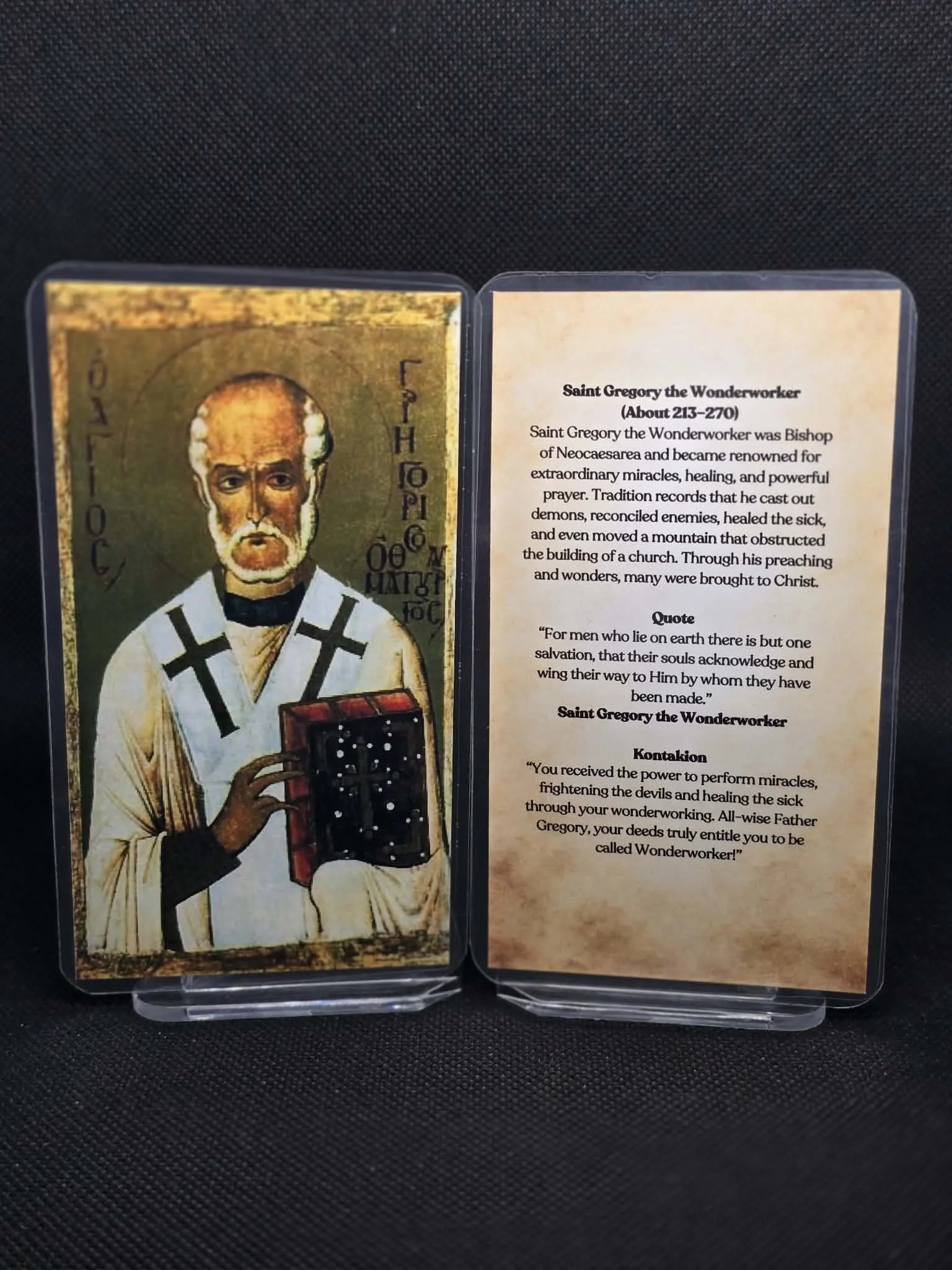
Saint Gregory the Wonderworker Prayer Card | For Miracles, Healing & Impossible Situations
Saint Gregory the Wonderworker, also known as Saint Gregory Thaumaturgus or Gregory of Neocaesarea, was a third-century bishop, theologian, missionary, healer, and one of the most celebrated miracle-workers of the early Church. Born around 213 AD into a prominent pagan family in Neocaesarea in Pontus, in present-day Turkey, he encountered Christianity while studying under the brilliant early Christian teacher Origen and eventually devoted his life completely to Christ. His miracles became so numerous that Christians came to call him Thaumaturgus, meaning “Wonderworker.” His feast is celebrated on November 17 in both the Byzantine East and the Catholic Church.
Saint Gregory is especially meaningful for healing, impossible situations, desperate problems, protection during natural disasters, floods, serious illness, spiritual oppression, conversion of family members and communities, missionaries, bishops, priests, teachers, and anyone praying for God to intervene where ordinary human ability has reached its limit. These associations arise naturally from his ancient Life: Gregory healed the sick, expelled demons, moved a hill that obstructed the building of a church, caused a disputed lake to disappear, protected Christians during persecution, and transformed a city that had contained only seventeen Christians when he became bishop.
The title Wonderworker is therefore not decorative. Gregory belongs to that relatively small group of saints whose miracles became so central to their historical reputation that the Church permanently attached wonderworking to their names. Vatican News likewise remembers him as a bishop so renowned for preaching and miracles that people simply began calling him the Thaumaturgus.
His story is particularly powerful for someone facing an immovable obstacle. According to the Orthodox tradition preserved in his Life, Gregory once needed land for the construction of a church, but a hill stood in the way. After prayer, the hill moved and made room for the foundation. In another incident, two brothers were preparing for violence over ownership of a lake, so Gregory prayed through the night and by morning the troublesome lake had disappeared, leaving a stream whose course settled the boundary dispute.
Saint Gregory is also deeply connected with healing and deliverance from evil. His first recorded wonder in the Orthodox Life occurred while he was still a young student, when a woman falsely accused him of sexual wrongdoing and then collapsed in a demonic fit after accepting money from his friend. Gregory prayed over her, the demon departed, and the deception was exposed. Later, as bishop, healing the sick and casting out demons became recurring features of his ministry.
Another extraordinary part of Gregory's tradition is his connection with the Mother of God and Saint John the Theologian. According to the account preserved by Saint Gregory of Nyssa, the Theotokos appeared to Gregory together with Saint John while Gregory was praying for clarity concerning the mystery of the Holy Trinity. At the Virgin's direction, John instructed him in the faith, and Gregory wrote down the Trinitarian confession associated with the vision. This ancient account is often regarded as one of the earliest surviving Christian traditions describing an apparition of the Virgin Mary.
This prayer card is especially fitting for someone facing a frightening illness, an impossible problem, a family member far from the faith, a serious natural disaster, spiritual oppression, a difficult ministry, or a situation that seems to require a miracle. It can also make a meaningful gift for priests, bishops, missionaries, catechists, theology students, converts, people preparing for baptism or chrismation, and anyone drawn to the great Wonderworkers of the early Church.
Each 2.5" x 4.25" prayer card is handmade in Austin, Texas and prepared prayerfully with each order. It is printed on museum-quality photo paper rather than cardstock, double laminated for durability, and made while the recipient and their intentions are lifted before Christ in prayer, with Saint Gregory the Wonderworker asked to intercede for them.
THE LIFE & STORY
Saint Gregory was born in Neocaesarea in Pontus, probably between 210 and 215 AD, and his original name was Theodore. His family was pagan and socially prominent, and his original educational plans centered upon the kind of classical learning that could prepare an ambitious young man for law and public life.
His father died while Gregory was still young, and Gregory eventually traveled with his brother Athenodorus toward Palestine. Their intention was to continue to the famous law school at Beirut, but a meeting in Caesarea with Origen, one of the most formidable Christian intellectuals of the ancient world, completely altered Gregory's plans.
THE PAGAN STUDENT WHO FOUND CHRIST
Gregory and his brother began listening to Origen, initially as educated young men interested in philosophy and intellectual inquiry. Instead of continuing immediately toward a legal career, Gregory remained with Origen for years, studying Scripture, philosophy, and theology, and eventually embraced Christianity and received baptism.
Gregory later wrote with profound gratitude about Origen as a teacher capable of opening the Word of God to his students. His relationship with Origen became one of the most important examples of Christian intellectual mentorship in the third century, while Gregory himself eventually became a major theological figure in his own right.
A SAINT FOR CONVERTS
Gregory is especially meaningful for converts because Christianity was not simply the religion into which he was born. He entered the faith after serious intellectual searching and after discovering that the philosophical education available to him could not finally answer the deepest questions he was asking.
His conversion also changed the direction of his ambitions. The young man once preparing for law and public distinction eventually became a bishop whose life was consumed by evangelization, prayer, persecution, healing, and the care of a relatively small Christian community.
HIS FIRST MIRACLE
The Orthodox Life preserves Gregory's first miracle from his student years. Pagan contemporaries who resented his purity arranged for a prostitute to accuse him publicly of having sinned with her and demand payment in front of the philosophers with whom he was speaking.
Rather than becoming enraged, Gregory had a friend give the woman what she demanded. As soon as she received the money, the account says she fell into a demonic fit, and Gregory prayed until she was delivered. The false accusation was exposed, and an attempt to destroy his reputation became the first event remembered in his tradition as miraculous.
THE DESERT & THE LIFE HE ACTUALLY WANTED
After returning to Neocaesarea, Gregory did not immediately seek ecclesiastical prominence. The Orthodox tradition says he withdrew into the wilderness, pursuing fasting, prayer, solitude, and freedom from worldly ambition.
He would apparently have preferred to remain there. His eventual episcopacy therefore did not begin because Gregory wanted authority, because another bishop had to pursue the reluctant ascetic whom he believed God had chosen for Neocaesarea.
THE BISHOP WHO TRIED TO HIDE
Bishop Phaidemos of Amaseia learned of Gregory's holiness and determined that he should become Bishop of Neocaesarea. Gregory, perceiving what was intended, hid from the messengers sent to bring him for ordination.
The traditional account says that Phaidemos proceeded in an extraordinary fashion, eventually bringing Gregory into the episcopal ministry despite his attempts to avoid it. Saint Gregory of Nyssa later preserved this episode when writing about the Wonderworker's life.
This reluctance is important because Gregory's later miraculous reputation could easily make him appear like a man seeking spiritual authority. His story instead begins with someone who preferred hidden prayer and had to be drawn into public responsibility.
THE APPARITION OF THE THEOTOKOS & SAINT JOHN
Before undertaking his episcopal work, Gregory prayed for certainty concerning the true confession of the Holy Trinity. His tradition says that the room was filled with light and that the Most Holy Theotokos appeared with Saint John the Theologian, who was clothed as a hierarch.
At the Virgin Mary's direction, John explained the mystery of the Trinity to Gregory. Gregory then wrote the teaching down, producing the confession generally known as his Declaration or Exposition of Faith.
Because Saint Gregory of Nyssa recorded this tradition in the fourth century, it belongs among the earliest surviving Christian accounts of an apparition of the Mother of God. A modern Catholic diocesan source in Calabria, where Gregory's relics are still venerated, likewise describes the apparition as exceptionally early in Marian tradition.
AN EARLY CONFESSION OF THE HOLY TRINITY
Gregory's surviving Declaration of Faith is remarkable because it predates the Council of Nicaea in 325 AD. It confesses one God the Father, the divine Son, the Holy Spirit, and a perfect Trinity without dividing the Godhead into separate gods.
The text became important in later Christian theology, and Saint Basil the Great appealed to Gregory's authority when discussing the Holy Spirit. The Orthodox tradition therefore remembers Gregory as more than a miracle-worker because his theological legacy contributed to the development of the Church's language concerning the Trinity.
THE WONDERWORKER ENTERS NEOCAESAREA
Gregory eventually returned to Neocaesarea as bishop. The city was overwhelmingly pagan, and the ancient tradition says that only seventeen Christians were present when his episcopal ministry began.
He therefore inherited almost the opposite situation faced by a bishop in an established Christian society. Gregory was essentially a missionary bishop charged with building a Church inside a population that did not yet share his faith.
THE PAGAN TEMPLE & THE DEMONS
On his journey toward Neocaesarea, Gregory spent time near a pagan temple. The Orthodox Life says that through his prayer the demons inhabiting the temple were driven away, alarming the pagan priest responsible for the sanctuary.
That priest ultimately converted to Christianity after witnessing Gregory's spiritual authority. He then became a witness to another miracle when Gregory commanded a massive stone to move and the stone obeyed.
The episode captures Gregory's missionary approach as remembered by the Church. His miracles were not entertainment because they repeatedly opened the way for conversion and Christian faith.
THE MOUNTAIN THAT MOVED
One of Gregory's most famous miracles occurred when the Christians needed space to construct a church. According to the OCA Life, a hill obstructed the proposed site, so Gregory commanded it to move and make room for the foundation.
This miracle became one reason Gregory was remembered as possessing the kind of faith Christ describes in the Gospel, faith through which even a mountain can move. It also gives him an especially strong devotional connection with problems that appear immovable or physically impossible.
A SAINT FOR IMPOSSIBLE SITUATIONS
Saint Gregory is therefore particularly meaningful when someone has reached the point where ordinary solutions seem exhausted. His traditional miracles repeatedly involve situations that human strength could not simply fix: physical illness, demonic affliction, natural obstacles, violent disputes, persecution, and the conversion of an overwhelmingly pagan city.
Seeking his intercession does not mean assuming God must produce the particular miracle we request. Gregory's life instead encourages persistent trust that an obstacle being beyond our strength does not make it beyond God's power.
THE DISPUTED LAKE
Two brothers once quarreled bitterly over their inheritance, particularly a large lake each wanted to possess. Their disagreement became serious enough that both began assembling supporters and appeared ready to settle the dispute through violence.
Gregory persuaded them to wait until the following day and spent the night praying beside the lake. When morning came, the lake had disappeared or sunk underground, leaving only a stream whose course established a clear boundary between the properties.
The miracle makes Gregory meaningful not only for natural problems but for family conflicts, inheritance disputes, litigation, and situations where material possessions threaten to destroy relationships. His intervention removed the object over which the brothers were prepared to fight.
THE RIVER & PROTECTION FROM FLOODING
Other traditions surrounding Gregory remember him restraining dangerous waters, which contributed to later Christian devotion to him during floods and destructive weather. His broader miracle tradition repeatedly connects his prayer with water, mountains, and threats arising from the natural world.
For this reason, Saint Gregory can be especially meaningful during floods, storms, earthquakes, landslides, or other natural disasters. It is better to describe this as a longstanding devotional association rather than reduce his immense cult to one narrow modern patronage title.
HEALING THE SICK
Healing was one of the ordinary forms of Gregory's wonderworking ministry. The OCA Life summarizes his episcopacy by noting that he healed the sick, helped people in need, expelled demons, and resolved disputes while preaching Christ throughout Neocaesarea.
The traditional Kontakion for his feast likewise remembers him specifically for receiving power to perform miracles, frightening demons, and healing the sick. Healing therefore belongs directly to the Church's liturgical memory of Gregory rather than being a later association added only because he carries the title Wonderworker.
A SAINT FOR SERIOUS ILLNESS
Christians facing serious or unexplained illness can therefore naturally seek Saint Gregory's intercession. His tradition presents healing not as his personal possession but as one of the gifts through which Christ's mercy became visible in his episcopal ministry.
A Saint Gregory prayer card can be especially meaningful during hospitalization, surgery, prolonged treatment, chronic illness, or a medical situation in which someone feels that every human option has become uncertain.
DELIVERANCE FROM DEMONIC OPPRESSION
Gregory's Life contains multiple encounters with demonic powers, beginning with the woman delivered during his student years and continuing with the pagan temple whose spirits fled before his prayer.
His official Kontakion explicitly praises him for frightening the devils through the wonderworking grace he had received. That makes him especially meaningful within prayers for spiritual protection and deliverance, while always understanding such prayer within the sacramental and pastoral life of the Church rather than as a substitute for it.
THE DECIAN PERSECUTION
Gregory's ministry unfolded before Christianity possessed legal security in the Roman Empire. When the violent persecution under Emperor Decius began around 249 AD, Gregory led members of his flock into the mountains rather than unnecessarily exposing them to arrest and death.
A pagan informant revealed their hiding place, and soldiers surrounded the mountain. Gregory stood with his deacon in an open location, raised his hands toward heaven in prayer, and entrusted the Christians to God's protection.
THE TWO MEN WHO LOOKED LIKE TREES
The soldiers repeatedly passed directly by Gregory and his deacon without recognizing them. When they eventually returned, they reported that nobody was present on the mountain and that they had seen only two trees standing together.
The informer who had betrayed the Christians was so astonished by what happened that he repented and became a Christian himself. Even an act of betrayal therefore became another occasion for conversion within Gregory's tradition.
A SAINT FOR PEOPLE IN DANGER
This story makes Gregory especially meaningful for people facing persecution, danger, hostile authorities, or situations in which physical protection is urgently needed. The miracle does not suggest that Christians should behave recklessly because Gregory actually led his people away from the danger first and prayed when their prudent attempt at escape seemed to have failed.
His example therefore joins prudence and faith. Christians should act responsibly with the means available while recognizing that ultimate protection remains in God.
THE MARTYRS & THE RETURN TO NEOCAESAREA
After the persecution subsided, Gregory returned to the city with his surviving flock. He established commemorations honoring the Christians who had died as martyrs, helping form the memory and liturgical identity of the growing local Church.
His episcopacy therefore included both spectacular miracles and the ordinary work of constructing Christian communal life after trauma. He preached, settled disputes, cared for the needy, commemorated the martyrs, and continued bringing new people into the Church.
FROM SEVENTEEN CHRISTIANS TO SEVENTEEN PAGANS
Perhaps the most extraordinary statistic preserved about Gregory's episcopacy concerns the transformation of Neocaesarea itself. When Gregory became bishop, according to both Orthodox and Catholic accounts, the city contained only about seventeen Christians.
After roughly three decades of his ministry, the traditional account says that at his death only seventeen pagans remained. The numerical reversal became an unforgettable summary of his evangelistic impact.
This may ultimately have been a greater wonder than moving a hill. Gregory did not merely perform miracles before crowds because an overwhelmingly pagan city became overwhelmingly Christian under the preaching, charity, holiness, and pastoral leadership of one bishop.
A SAINT FOR EVANGELIZATION
Saint Gregory is therefore one of the strongest early saints for missionaries, evangelists, converts, priests working in difficult territory, and Christians praying for the conversion of a family or community. The transformation of Neocaesarea gives his missionary association an unusually direct historical foundation.
His example also shows that evangelization involves more than argument. Gregory taught doctrine clearly, but his holiness, compassion, willingness to help people, ability to reconcile enemies, endurance in persecution, and remarkable works of mercy made the Gospel visible as well as audible.
A SAINT FOR PRIESTS & BISHOPS
Gregory's episcopacy offers a striking model of what pastoral leadership can accomplish without worldly power. He became bishop of a tiny minority community during an era when government persecution remained a real possibility, yet the Church entrusted to him became one of the great Christian communities of Pontus.
For clergy, his life joins theology, prayer, missionary courage, protection of the flock, care for the sick, reconciliation, and personal asceticism. The Wonderworker was not remembered merely because astonishing events happened around him, but because the miracles emerged within a life of serious pastoral responsibility.
HIS WRITINGS
Several works associated with Gregory survive, although ancient attribution questions surround some texts transmitted under his name. His most important securely associated works include his Declaration of Faith, his thanksgiving or panegyric to Origen, and canonical material reflecting the pastoral problems facing Christians in Pontus.
The Declaration of Faith remains especially important because of its early Trinitarian language. Gregory's theological significance therefore reaches far beyond the miracle stories that made his name famous.
SAINT GREGORY & THE EARLY CHURCH FATHERS
Gregory lived before the legalization of Christianity under Constantine and before the First Ecumenical Council of Nicaea. This places him firmly within the Ante-Nicene Church, making his Trinitarian confession particularly significant for understanding Christian belief before 325.
Later Fathers respected him deeply. Saint Basil the Great appealed to Gregory's authority, while Saint Gregory of Nyssa wrote the major ancient Life through which many of his miracle traditions were preserved.
EASTERN ORTHODOX, BYZANTINE CATHOLIC & ROMAN CATHOLIC VENERATION
Saint Gregory belongs to the shared inheritance of Christianity before the later separation between Catholic and Orthodox Churches. The Orthodox Church commemorates him on November 17, Vatican News lists him on the same date, and the Ruthenian Byzantine Catholic Metropolitan Cantor Institute includes “Our Holy Father Gregory the Wonder-worker, Bishop of Neocaesarea” in its November Menaion.
The Melkite Greek Catholic Church also keeps his November 17 commemoration and devotes catechetical material to his life. He is therefore authentically at home in Eastern Orthodox, Byzantine Catholic, and Roman Catholic devotion, rather than belonging exclusively to one later communion.
HIS FEAST DAY
Saint Gregory the Wonderworker is commemorated on November 17. The date is confirmed by the Orthodox Church in America, Vatican News, the Ruthenian Byzantine Catholic Menaion, and Melkite Catholic sources.
For someone carrying his prayer card because of illness, an impossible situation, or a need for conversion, November 17 provides a natural annual day for Divine Liturgy, Mass, prayer, charitable works, and renewed invocation of his intercession.
WHERE ARE SAINT GREGORY'S RELICS?
Gregory's relic history became widely dispersed, so it is safer to speak of important relics rather than one universally undisputed complete shrine. The Catholic Archdiocese of Catanzaro-Squillace confirmed in 2025 that relics of Saint Gregory are preserved and venerated at Stalettì in Calabria, Italy, where devotion to him has deep Byzantine roots.
A further important relic tradition exists at the Museu de São Roque in Lisbon, which preserves a historic reliquary associated with Saint Gregory. The documented relic collection entered São Roque through royal and aristocratic donations during the sixteenth century.
For a product page, the safest wording is therefore that significant relics attributed to Saint Gregory are venerated particularly in Stalettì, Calabria, with additional relic traditions elsewhere in Catholic Europe.
SAINT GREGORY IN CALABRIA
The devotion at Stalettì is especially interesting because Gregory became the local patron and protector. The contemporary Catholic archdiocese continues recognizing the presence of his relics there and the community's ancient devotion to the third-century Eastern bishop.
This provides a fascinating example of an early Greek-speaking saint whose veneration crossed geographic and later ecclesial boundaries. Gregory of Pontus became deeply loved in southern Italy, an area whose Christian culture itself preserved substantial Byzantine influence.
ICONOGRAPHY
Traditional icons depict Gregory as an elderly bishop, usually holding the Gospel book and blessing with his right hand. The episcopal vestments identify his pastoral office, while inscriptions commonly call him either Gregory of Neocaesarea or Gregory Thaumaturgus, the Wonderworker.
Some iconographic traditions also connect him visually with the Theotokos and Saint John because of the apparition associated with his Trinitarian confession. That scene can be particularly meaningful for Christians interested in the earliest Marian traditions of the Church.
PRAYERS
Saint Gregory possesses established Byzantine liturgical hymns, so there is no reason to invent a prayer for him. The Orthodox Church in America publishes both his Troparion and Kontakion, while Byzantine Catholic liturgical books likewise commemorate him on November 17.
His Troparion emphasizes his vigilance in prayer and continual works of mercy and asks him to intercede that Christians may be spiritually awakened rather than sleeping in sin. His Kontakion specifically celebrates his power to perform miracles, cast down demons, and heal the sick, explaining why the title Wonderworker belongs so naturally to him.
A simple traditional invocation suitable for daily use is “Holy Father Gregory the Wonderworker, pray to God for us.” Someone facing illness can seek his prayers for healing, while someone confronted by an impossible situation can ask for trust in God's power and wisdom concerning whatever outcome God wills.
A family praying for someone who has abandoned Christianity can also seek Gregory's intercession for conversion. Few saints have a more dramatic missionary story than the bishop who began with seventeen Christians and left a city in which the old pagan religion had almost entirely disappeared.
FAQ
Who was Saint Gregory the Wonderworker? Saint Gregory was a third-century Bishop of Neocaesarea in Pontus who became famous for evangelization, theology, healing, exorcisms, and extraordinary miracles. His reputation became so strong that the Church permanently remembered him as Gregory Thaumaturgus, meaning the Wonderworker.
Is Gregory Thaumaturgus the same person as Gregory the Wonderworker? Yes, they are the same saint. “Thaumaturgus” is the Greek-derived title meaning wonderworker or worker of miracles.
When did Saint Gregory live? Gregory was born around 213 AD, with Orthodox sources giving a range between approximately 210 and 215. He died around 270 AD, after roughly thirty years as Bishop of Neocaesarea.
When is Saint Gregory the Wonderworker's feast day? His feast is November 17 in Eastern Orthodox, Byzantine Catholic, and Catholic calendars. The same date is preserved by the OCA, Vatican News, the Ruthenian Byzantine Catholic Menaion, and Melkite Catholic sources.
Where was Saint Gregory from? He was born in Neocaesarea in Pontus, a city in northern Asia Minor corresponding to the region of modern Turkey. He later became bishop of the same city and transformed its religious life through his ministry.
Was Saint Gregory born Christian? No, he came from a prominent pagan family and was originally named Theodore. His encounter with Christianity came during his education, particularly through his years studying under Origen.
Who converted Saint Gregory? Origen played the decisive role in Gregory's Christian formation. Gregory spent years studying Scripture and theology with him before returning to Pontus as a Christian.
Was Saint Gregory a disciple of Origen? Yes, and Gregory later wrote an important address praising his teacher. His relationship with Origen is one of the best-known teacher-disciple relationships from third-century Christianity.
Why is Saint Gregory called the Wonderworker? Miracles became extraordinarily frequent in the tradition surrounding his ministry. The Church remembers healings, exorcisms, supernatural protection, the moving of a hill, the disappearance of a disputed lake, and many other wonders.
Is Saint Gregory good for impossible situations? Yes, this is one of the strongest devotional associations arising from his Life. Several of his miracles concern obstacles or situations that appeared completely beyond ordinary human ability.
Did Saint Gregory really move a mountain? Orthodox tradition says that while a church was being constructed, Gregory commanded a hill obstructing the foundation to move and it did so. The story became one of the miracles closely associated with his title as Wonderworker.
Did Saint Gregory make a lake disappear? According to his Orthodox Life, two brothers were preparing to fight over ownership of a lake, so Gregory prayed through the night. By morning the lake had disappeared or gone underground, leaving a stream that marked the boundary between their properties.
Is Saint Gregory associated with floods? Yes, longstanding devotion connects him with protection from dangerous waters and flooding. This association fits naturally with the water miracles preserved in traditions surrounding him.
Is Saint Gregory good for healing? Yes, healing is explicitly part of his ancient Life and Byzantine liturgical tradition. His Kontakion praises the wonderworking grace through which the sick were healed.
Is Saint Gregory good for spiritual protection? Yes, his Life repeatedly associates him with deliverance from demonic forces. His Kontakion specifically remembers his power over demons as part of the reason he was known as Wonderworker.
Did the Virgin Mary appear to Saint Gregory? According to the ancient tradition preserved by Saint Gregory of Nyssa, yes. The Theotokos appeared with Saint John the Theologian, who instructed Gregory concerning the Holy Trinity at her request.
Was Saint Gregory's vision the first Marian apparition? It is often described as one of the earliest recorded Christian traditions of a Marian apparition, and some Catholic sources describe it as the first recognized example. Because the surviving narrative comes from Saint Gregory of Nyssa roughly a century later, “one of the earliest recorded” is the most careful historical wording.
Did Saint John the Apostle appear with Mary? That is the traditional account. Saint John instructed Gregory concerning the Trinity while the Mother of God directed the encounter.
Did Saint Gregory write a creed? Yes, his Declaration of Faith survives and contains a remarkable pre-Nicene confession of the Father, Son, Holy Spirit, and perfect Trinity. The text remains an important witness to third-century Trinitarian theology.
Did Saint Gregory live before the Council of Nicaea? Yes, he died decades before the First Council of Nicaea in 325. This makes his explicit Trinitarian confession especially important for understanding Christian theology before the council.
Was Saint Gregory persecuted by Rome? His episcopacy included the Decian persecution, one of the great empire-wide persecutions of Christians. Gregory protected his flock by withdrawing into the mountains and returned to Neocaesarea after the persecution ended.
Did soldiers miraculously fail to see Saint Gregory? According to his Life, soldiers searched the place where Gregory and his deacon stood praying but perceived only two trees. The informer who betrayed them was so affected by what happened that he later became Christian.
How many Christians were in Neocaesarea when Gregory became bishop? Tradition says there were only seventeen Christians when he arrived. At the end of his ministry, the same tradition says only seventeen pagans remained.
Is Saint Gregory good for praying for someone's conversion? Yes, his episcopacy produced one of the most dramatic conversion stories attached to any early bishop. He entered an overwhelmingly pagan city and left behind an overwhelmingly Christian one.
Is Saint Gregory Catholic or Orthodox? He is both in the historical sense that he belongs to the common pre-schism Christian inheritance and continues to be venerated by both communions. He is also explicitly commemorated by Byzantine Catholics, including Ruthenian and Melkite Catholics.
Where are Saint Gregory's relics? Important relics attributed to Saint Gregory are preserved at Stalettì in Calabria, Italy, according to the local Catholic archdiocese. Other historic relics are preserved elsewhere, including the São Roque collection in Lisbon, so his relic tradition is geographically dispersed.
Does Saint Gregory have a traditional prayer? Yes, the Byzantine Church has established Troparion and Kontakion hymns for his feast. These texts specifically remember his prayer, works of mercy, healing, miracles, and power over demons.
Who would appreciate a Saint Gregory the Wonderworker prayer card? It is especially meaningful for someone facing illness, an impossible problem, natural disaster, spiritual warfare, a difficult conversion, or demanding missionary work. It is also an appropriate gift for priests, bishops, converts, theology students, catechists, and Christians devoted to early Church history.
What does Saint Gregory teach about miracles? His Life repeatedly presents miracles as signs directing people toward Christ rather than demonstrations meant to make Gregory famous. Healings, exorcisms, protection, and even dramatic changes in nature repeatedly resulted in reconciliation, conversion, or strengthening of the Church.
What is the main message of Saint Gregory the Wonderworker's life? Saint Gregory's life teaches that God can transform what appears immovable, whether the obstacle is a mountain, an illness, a violent conflict, demonic oppression, persecution, or an entire city resistant to the Gospel. The pagan student who once planned a career in law encountered Christ through Origen, withdrew into prayer, reluctantly became bishop of a city with only seventeen Christians, healed the sick, cast out demons, moved natural obstacles through prayer, protected his people during persecution, received an extraordinary Trinitarian tradition connected with the Theotokos and Saint John, and spent roughly thirty years preaching until the old religious balance of Neocaesarea had been almost completely reversed. His title Thaumaturgus, the Wonderworker, therefore describes not merely spectacular miracles, but a life through which people, families, enemies, and an entire city were changed.
Saint Gregory the Wonderworker, also known as Saint Gregory Thaumaturgus or Gregory of Neocaesarea, was a third-century bishop, theologian, missionary, healer, and one of the most celebrated miracle-workers of the early Church. Born around 213 AD into a prominent pagan family in Neocaesarea in Pontus, in present-day Turkey, he encountered Christianity while studying under the brilliant early Christian teacher Origen and eventually devoted his life completely to Christ. His miracles became so numerous that Christians came to call him Thaumaturgus, meaning “Wonderworker.” His feast is celebrated on November 17 in both the Byzantine East and the Catholic Church.
Saint Gregory is especially meaningful for healing, impossible situations, desperate problems, protection during natural disasters, floods, serious illness, spiritual oppression, conversion of family members and communities, missionaries, bishops, priests, teachers, and anyone praying for God to intervene where ordinary human ability has reached its limit. These associations arise naturally from his ancient Life: Gregory healed the sick, expelled demons, moved a hill that obstructed the building of a church, caused a disputed lake to disappear, protected Christians during persecution, and transformed a city that had contained only seventeen Christians when he became bishop.
The title Wonderworker is therefore not decorative. Gregory belongs to that relatively small group of saints whose miracles became so central to their historical reputation that the Church permanently attached wonderworking to their names. Vatican News likewise remembers him as a bishop so renowned for preaching and miracles that people simply began calling him the Thaumaturgus.
His story is particularly powerful for someone facing an immovable obstacle. According to the Orthodox tradition preserved in his Life, Gregory once needed land for the construction of a church, but a hill stood in the way. After prayer, the hill moved and made room for the foundation. In another incident, two brothers were preparing for violence over ownership of a lake, so Gregory prayed through the night and by morning the troublesome lake had disappeared, leaving a stream whose course settled the boundary dispute.
Saint Gregory is also deeply connected with healing and deliverance from evil. His first recorded wonder in the Orthodox Life occurred while he was still a young student, when a woman falsely accused him of sexual wrongdoing and then collapsed in a demonic fit after accepting money from his friend. Gregory prayed over her, the demon departed, and the deception was exposed. Later, as bishop, healing the sick and casting out demons became recurring features of his ministry.
Another extraordinary part of Gregory's tradition is his connection with the Mother of God and Saint John the Theologian. According to the account preserved by Saint Gregory of Nyssa, the Theotokos appeared to Gregory together with Saint John while Gregory was praying for clarity concerning the mystery of the Holy Trinity. At the Virgin's direction, John instructed him in the faith, and Gregory wrote down the Trinitarian confession associated with the vision. This ancient account is often regarded as one of the earliest surviving Christian traditions describing an apparition of the Virgin Mary.
This prayer card is especially fitting for someone facing a frightening illness, an impossible problem, a family member far from the faith, a serious natural disaster, spiritual oppression, a difficult ministry, or a situation that seems to require a miracle. It can also make a meaningful gift for priests, bishops, missionaries, catechists, theology students, converts, people preparing for baptism or chrismation, and anyone drawn to the great Wonderworkers of the early Church.
Each 2.5" x 4.25" prayer card is handmade in Austin, Texas and prepared prayerfully with each order. It is printed on museum-quality photo paper rather than cardstock, double laminated for durability, and made while the recipient and their intentions are lifted before Christ in prayer, with Saint Gregory the Wonderworker asked to intercede for them.
THE LIFE & STORY
Saint Gregory was born in Neocaesarea in Pontus, probably between 210 and 215 AD, and his original name was Theodore. His family was pagan and socially prominent, and his original educational plans centered upon the kind of classical learning that could prepare an ambitious young man for law and public life.
His father died while Gregory was still young, and Gregory eventually traveled with his brother Athenodorus toward Palestine. Their intention was to continue to the famous law school at Beirut, but a meeting in Caesarea with Origen, one of the most formidable Christian intellectuals of the ancient world, completely altered Gregory's plans.
THE PAGAN STUDENT WHO FOUND CHRIST
Gregory and his brother began listening to Origen, initially as educated young men interested in philosophy and intellectual inquiry. Instead of continuing immediately toward a legal career, Gregory remained with Origen for years, studying Scripture, philosophy, and theology, and eventually embraced Christianity and received baptism.
Gregory later wrote with profound gratitude about Origen as a teacher capable of opening the Word of God to his students. His relationship with Origen became one of the most important examples of Christian intellectual mentorship in the third century, while Gregory himself eventually became a major theological figure in his own right.
A SAINT FOR CONVERTS
Gregory is especially meaningful for converts because Christianity was not simply the religion into which he was born. He entered the faith after serious intellectual searching and after discovering that the philosophical education available to him could not finally answer the deepest questions he was asking.
His conversion also changed the direction of his ambitions. The young man once preparing for law and public distinction eventually became a bishop whose life was consumed by evangelization, prayer, persecution, healing, and the care of a relatively small Christian community.
HIS FIRST MIRACLE
The Orthodox Life preserves Gregory's first miracle from his student years. Pagan contemporaries who resented his purity arranged for a prostitute to accuse him publicly of having sinned with her and demand payment in front of the philosophers with whom he was speaking.
Rather than becoming enraged, Gregory had a friend give the woman what she demanded. As soon as she received the money, the account says she fell into a demonic fit, and Gregory prayed until she was delivered. The false accusation was exposed, and an attempt to destroy his reputation became the first event remembered in his tradition as miraculous.
THE DESERT & THE LIFE HE ACTUALLY WANTED
After returning to Neocaesarea, Gregory did not immediately seek ecclesiastical prominence. The Orthodox tradition says he withdrew into the wilderness, pursuing fasting, prayer, solitude, and freedom from worldly ambition.
He would apparently have preferred to remain there. His eventual episcopacy therefore did not begin because Gregory wanted authority, because another bishop had to pursue the reluctant ascetic whom he believed God had chosen for Neocaesarea.
THE BISHOP WHO TRIED TO HIDE
Bishop Phaidemos of Amaseia learned of Gregory's holiness and determined that he should become Bishop of Neocaesarea. Gregory, perceiving what was intended, hid from the messengers sent to bring him for ordination.
The traditional account says that Phaidemos proceeded in an extraordinary fashion, eventually bringing Gregory into the episcopal ministry despite his attempts to avoid it. Saint Gregory of Nyssa later preserved this episode when writing about the Wonderworker's life.
This reluctance is important because Gregory's later miraculous reputation could easily make him appear like a man seeking spiritual authority. His story instead begins with someone who preferred hidden prayer and had to be drawn into public responsibility.
THE APPARITION OF THE THEOTOKOS & SAINT JOHN
Before undertaking his episcopal work, Gregory prayed for certainty concerning the true confession of the Holy Trinity. His tradition says that the room was filled with light and that the Most Holy Theotokos appeared with Saint John the Theologian, who was clothed as a hierarch.
At the Virgin Mary's direction, John explained the mystery of the Trinity to Gregory. Gregory then wrote the teaching down, producing the confession generally known as his Declaration or Exposition of Faith.
Because Saint Gregory of Nyssa recorded this tradition in the fourth century, it belongs among the earliest surviving Christian accounts of an apparition of the Mother of God. A modern Catholic diocesan source in Calabria, where Gregory's relics are still venerated, likewise describes the apparition as exceptionally early in Marian tradition.
AN EARLY CONFESSION OF THE HOLY TRINITY
Gregory's surviving Declaration of Faith is remarkable because it predates the Council of Nicaea in 325 AD. It confesses one God the Father, the divine Son, the Holy Spirit, and a perfect Trinity without dividing the Godhead into separate gods.
The text became important in later Christian theology, and Saint Basil the Great appealed to Gregory's authority when discussing the Holy Spirit. The Orthodox tradition therefore remembers Gregory as more than a miracle-worker because his theological legacy contributed to the development of the Church's language concerning the Trinity.
THE WONDERWORKER ENTERS NEOCAESAREA
Gregory eventually returned to Neocaesarea as bishop. The city was overwhelmingly pagan, and the ancient tradition says that only seventeen Christians were present when his episcopal ministry began.
He therefore inherited almost the opposite situation faced by a bishop in an established Christian society. Gregory was essentially a missionary bishop charged with building a Church inside a population that did not yet share his faith.
THE PAGAN TEMPLE & THE DEMONS
On his journey toward Neocaesarea, Gregory spent time near a pagan temple. The Orthodox Life says that through his prayer the demons inhabiting the temple were driven away, alarming the pagan priest responsible for the sanctuary.
That priest ultimately converted to Christianity after witnessing Gregory's spiritual authority. He then became a witness to another miracle when Gregory commanded a massive stone to move and the stone obeyed.
The episode captures Gregory's missionary approach as remembered by the Church. His miracles were not entertainment because they repeatedly opened the way for conversion and Christian faith.
THE MOUNTAIN THAT MOVED
One of Gregory's most famous miracles occurred when the Christians needed space to construct a church. According to the OCA Life, a hill obstructed the proposed site, so Gregory commanded it to move and make room for the foundation.
This miracle became one reason Gregory was remembered as possessing the kind of faith Christ describes in the Gospel, faith through which even a mountain can move. It also gives him an especially strong devotional connection with problems that appear immovable or physically impossible.
A SAINT FOR IMPOSSIBLE SITUATIONS
Saint Gregory is therefore particularly meaningful when someone has reached the point where ordinary solutions seem exhausted. His traditional miracles repeatedly involve situations that human strength could not simply fix: physical illness, demonic affliction, natural obstacles, violent disputes, persecution, and the conversion of an overwhelmingly pagan city.
Seeking his intercession does not mean assuming God must produce the particular miracle we request. Gregory's life instead encourages persistent trust that an obstacle being beyond our strength does not make it beyond God's power.
THE DISPUTED LAKE
Two brothers once quarreled bitterly over their inheritance, particularly a large lake each wanted to possess. Their disagreement became serious enough that both began assembling supporters and appeared ready to settle the dispute through violence.
Gregory persuaded them to wait until the following day and spent the night praying beside the lake. When morning came, the lake had disappeared or sunk underground, leaving only a stream whose course established a clear boundary between the properties.
The miracle makes Gregory meaningful not only for natural problems but for family conflicts, inheritance disputes, litigation, and situations where material possessions threaten to destroy relationships. His intervention removed the object over which the brothers were prepared to fight.
THE RIVER & PROTECTION FROM FLOODING
Other traditions surrounding Gregory remember him restraining dangerous waters, which contributed to later Christian devotion to him during floods and destructive weather. His broader miracle tradition repeatedly connects his prayer with water, mountains, and threats arising from the natural world.
For this reason, Saint Gregory can be especially meaningful during floods, storms, earthquakes, landslides, or other natural disasters. It is better to describe this as a longstanding devotional association rather than reduce his immense cult to one narrow modern patronage title.
HEALING THE SICK
Healing was one of the ordinary forms of Gregory's wonderworking ministry. The OCA Life summarizes his episcopacy by noting that he healed the sick, helped people in need, expelled demons, and resolved disputes while preaching Christ throughout Neocaesarea.
The traditional Kontakion for his feast likewise remembers him specifically for receiving power to perform miracles, frightening demons, and healing the sick. Healing therefore belongs directly to the Church's liturgical memory of Gregory rather than being a later association added only because he carries the title Wonderworker.
A SAINT FOR SERIOUS ILLNESS
Christians facing serious or unexplained illness can therefore naturally seek Saint Gregory's intercession. His tradition presents healing not as his personal possession but as one of the gifts through which Christ's mercy became visible in his episcopal ministry.
A Saint Gregory prayer card can be especially meaningful during hospitalization, surgery, prolonged treatment, chronic illness, or a medical situation in which someone feels that every human option has become uncertain.
DELIVERANCE FROM DEMONIC OPPRESSION
Gregory's Life contains multiple encounters with demonic powers, beginning with the woman delivered during his student years and continuing with the pagan temple whose spirits fled before his prayer.
His official Kontakion explicitly praises him for frightening the devils through the wonderworking grace he had received. That makes him especially meaningful within prayers for spiritual protection and deliverance, while always understanding such prayer within the sacramental and pastoral life of the Church rather than as a substitute for it.
THE DECIAN PERSECUTION
Gregory's ministry unfolded before Christianity possessed legal security in the Roman Empire. When the violent persecution under Emperor Decius began around 249 AD, Gregory led members of his flock into the mountains rather than unnecessarily exposing them to arrest and death.
A pagan informant revealed their hiding place, and soldiers surrounded the mountain. Gregory stood with his deacon in an open location, raised his hands toward heaven in prayer, and entrusted the Christians to God's protection.
THE TWO MEN WHO LOOKED LIKE TREES
The soldiers repeatedly passed directly by Gregory and his deacon without recognizing them. When they eventually returned, they reported that nobody was present on the mountain and that they had seen only two trees standing together.
The informer who had betrayed the Christians was so astonished by what happened that he repented and became a Christian himself. Even an act of betrayal therefore became another occasion for conversion within Gregory's tradition.
A SAINT FOR PEOPLE IN DANGER
This story makes Gregory especially meaningful for people facing persecution, danger, hostile authorities, or situations in which physical protection is urgently needed. The miracle does not suggest that Christians should behave recklessly because Gregory actually led his people away from the danger first and prayed when their prudent attempt at escape seemed to have failed.
His example therefore joins prudence and faith. Christians should act responsibly with the means available while recognizing that ultimate protection remains in God.
THE MARTYRS & THE RETURN TO NEOCAESAREA
After the persecution subsided, Gregory returned to the city with his surviving flock. He established commemorations honoring the Christians who had died as martyrs, helping form the memory and liturgical identity of the growing local Church.
His episcopacy therefore included both spectacular miracles and the ordinary work of constructing Christian communal life after trauma. He preached, settled disputes, cared for the needy, commemorated the martyrs, and continued bringing new people into the Church.
FROM SEVENTEEN CHRISTIANS TO SEVENTEEN PAGANS
Perhaps the most extraordinary statistic preserved about Gregory's episcopacy concerns the transformation of Neocaesarea itself. When Gregory became bishop, according to both Orthodox and Catholic accounts, the city contained only about seventeen Christians.
After roughly three decades of his ministry, the traditional account says that at his death only seventeen pagans remained. The numerical reversal became an unforgettable summary of his evangelistic impact.
This may ultimately have been a greater wonder than moving a hill. Gregory did not merely perform miracles before crowds because an overwhelmingly pagan city became overwhelmingly Christian under the preaching, charity, holiness, and pastoral leadership of one bishop.
A SAINT FOR EVANGELIZATION
Saint Gregory is therefore one of the strongest early saints for missionaries, evangelists, converts, priests working in difficult territory, and Christians praying for the conversion of a family or community. The transformation of Neocaesarea gives his missionary association an unusually direct historical foundation.
His example also shows that evangelization involves more than argument. Gregory taught doctrine clearly, but his holiness, compassion, willingness to help people, ability to reconcile enemies, endurance in persecution, and remarkable works of mercy made the Gospel visible as well as audible.
A SAINT FOR PRIESTS & BISHOPS
Gregory's episcopacy offers a striking model of what pastoral leadership can accomplish without worldly power. He became bishop of a tiny minority community during an era when government persecution remained a real possibility, yet the Church entrusted to him became one of the great Christian communities of Pontus.
For clergy, his life joins theology, prayer, missionary courage, protection of the flock, care for the sick, reconciliation, and personal asceticism. The Wonderworker was not remembered merely because astonishing events happened around him, but because the miracles emerged within a life of serious pastoral responsibility.
HIS WRITINGS
Several works associated with Gregory survive, although ancient attribution questions surround some texts transmitted under his name. His most important securely associated works include his Declaration of Faith, his thanksgiving or panegyric to Origen, and canonical material reflecting the pastoral problems facing Christians in Pontus.
The Declaration of Faith remains especially important because of its early Trinitarian language. Gregory's theological significance therefore reaches far beyond the miracle stories that made his name famous.
SAINT GREGORY & THE EARLY CHURCH FATHERS
Gregory lived before the legalization of Christianity under Constantine and before the First Ecumenical Council of Nicaea. This places him firmly within the Ante-Nicene Church, making his Trinitarian confession particularly significant for understanding Christian belief before 325.
Later Fathers respected him deeply. Saint Basil the Great appealed to Gregory's authority, while Saint Gregory of Nyssa wrote the major ancient Life through which many of his miracle traditions were preserved.
EASTERN ORTHODOX, BYZANTINE CATHOLIC & ROMAN CATHOLIC VENERATION
Saint Gregory belongs to the shared inheritance of Christianity before the later separation between Catholic and Orthodox Churches. The Orthodox Church commemorates him on November 17, Vatican News lists him on the same date, and the Ruthenian Byzantine Catholic Metropolitan Cantor Institute includes “Our Holy Father Gregory the Wonder-worker, Bishop of Neocaesarea” in its November Menaion.
The Melkite Greek Catholic Church also keeps his November 17 commemoration and devotes catechetical material to his life. He is therefore authentically at home in Eastern Orthodox, Byzantine Catholic, and Roman Catholic devotion, rather than belonging exclusively to one later communion.
HIS FEAST DAY
Saint Gregory the Wonderworker is commemorated on November 17. The date is confirmed by the Orthodox Church in America, Vatican News, the Ruthenian Byzantine Catholic Menaion, and Melkite Catholic sources.
For someone carrying his prayer card because of illness, an impossible situation, or a need for conversion, November 17 provides a natural annual day for Divine Liturgy, Mass, prayer, charitable works, and renewed invocation of his intercession.
WHERE ARE SAINT GREGORY'S RELICS?
Gregory's relic history became widely dispersed, so it is safer to speak of important relics rather than one universally undisputed complete shrine. The Catholic Archdiocese of Catanzaro-Squillace confirmed in 2025 that relics of Saint Gregory are preserved and venerated at Stalettì in Calabria, Italy, where devotion to him has deep Byzantine roots.
A further important relic tradition exists at the Museu de São Roque in Lisbon, which preserves a historic reliquary associated with Saint Gregory. The documented relic collection entered São Roque through royal and aristocratic donations during the sixteenth century.
For a product page, the safest wording is therefore that significant relics attributed to Saint Gregory are venerated particularly in Stalettì, Calabria, with additional relic traditions elsewhere in Catholic Europe.
SAINT GREGORY IN CALABRIA
The devotion at Stalettì is especially interesting because Gregory became the local patron and protector. The contemporary Catholic archdiocese continues recognizing the presence of his relics there and the community's ancient devotion to the third-century Eastern bishop.
This provides a fascinating example of an early Greek-speaking saint whose veneration crossed geographic and later ecclesial boundaries. Gregory of Pontus became deeply loved in southern Italy, an area whose Christian culture itself preserved substantial Byzantine influence.
ICONOGRAPHY
Traditional icons depict Gregory as an elderly bishop, usually holding the Gospel book and blessing with his right hand. The episcopal vestments identify his pastoral office, while inscriptions commonly call him either Gregory of Neocaesarea or Gregory Thaumaturgus, the Wonderworker.
Some iconographic traditions also connect him visually with the Theotokos and Saint John because of the apparition associated with his Trinitarian confession. That scene can be particularly meaningful for Christians interested in the earliest Marian traditions of the Church.
PRAYERS
Saint Gregory possesses established Byzantine liturgical hymns, so there is no reason to invent a prayer for him. The Orthodox Church in America publishes both his Troparion and Kontakion, while Byzantine Catholic liturgical books likewise commemorate him on November 17.
His Troparion emphasizes his vigilance in prayer and continual works of mercy and asks him to intercede that Christians may be spiritually awakened rather than sleeping in sin. His Kontakion specifically celebrates his power to perform miracles, cast down demons, and heal the sick, explaining why the title Wonderworker belongs so naturally to him.
A simple traditional invocation suitable for daily use is “Holy Father Gregory the Wonderworker, pray to God for us.” Someone facing illness can seek his prayers for healing, while someone confronted by an impossible situation can ask for trust in God's power and wisdom concerning whatever outcome God wills.
A family praying for someone who has abandoned Christianity can also seek Gregory's intercession for conversion. Few saints have a more dramatic missionary story than the bishop who began with seventeen Christians and left a city in which the old pagan religion had almost entirely disappeared.
FAQ
Who was Saint Gregory the Wonderworker? Saint Gregory was a third-century Bishop of Neocaesarea in Pontus who became famous for evangelization, theology, healing, exorcisms, and extraordinary miracles. His reputation became so strong that the Church permanently remembered him as Gregory Thaumaturgus, meaning the Wonderworker.
Is Gregory Thaumaturgus the same person as Gregory the Wonderworker? Yes, they are the same saint. “Thaumaturgus” is the Greek-derived title meaning wonderworker or worker of miracles.
When did Saint Gregory live? Gregory was born around 213 AD, with Orthodox sources giving a range between approximately 210 and 215. He died around 270 AD, after roughly thirty years as Bishop of Neocaesarea.
When is Saint Gregory the Wonderworker's feast day? His feast is November 17 in Eastern Orthodox, Byzantine Catholic, and Catholic calendars. The same date is preserved by the OCA, Vatican News, the Ruthenian Byzantine Catholic Menaion, and Melkite Catholic sources.
Where was Saint Gregory from? He was born in Neocaesarea in Pontus, a city in northern Asia Minor corresponding to the region of modern Turkey. He later became bishop of the same city and transformed its religious life through his ministry.
Was Saint Gregory born Christian? No, he came from a prominent pagan family and was originally named Theodore. His encounter with Christianity came during his education, particularly through his years studying under Origen.
Who converted Saint Gregory? Origen played the decisive role in Gregory's Christian formation. Gregory spent years studying Scripture and theology with him before returning to Pontus as a Christian.
Was Saint Gregory a disciple of Origen? Yes, and Gregory later wrote an important address praising his teacher. His relationship with Origen is one of the best-known teacher-disciple relationships from third-century Christianity.
Why is Saint Gregory called the Wonderworker? Miracles became extraordinarily frequent in the tradition surrounding his ministry. The Church remembers healings, exorcisms, supernatural protection, the moving of a hill, the disappearance of a disputed lake, and many other wonders.
Is Saint Gregory good for impossible situations? Yes, this is one of the strongest devotional associations arising from his Life. Several of his miracles concern obstacles or situations that appeared completely beyond ordinary human ability.
Did Saint Gregory really move a mountain? Orthodox tradition says that while a church was being constructed, Gregory commanded a hill obstructing the foundation to move and it did so. The story became one of the miracles closely associated with his title as Wonderworker.
Did Saint Gregory make a lake disappear? According to his Orthodox Life, two brothers were preparing to fight over ownership of a lake, so Gregory prayed through the night. By morning the lake had disappeared or gone underground, leaving a stream that marked the boundary between their properties.
Is Saint Gregory associated with floods? Yes, longstanding devotion connects him with protection from dangerous waters and flooding. This association fits naturally with the water miracles preserved in traditions surrounding him.
Is Saint Gregory good for healing? Yes, healing is explicitly part of his ancient Life and Byzantine liturgical tradition. His Kontakion praises the wonderworking grace through which the sick were healed.
Is Saint Gregory good for spiritual protection? Yes, his Life repeatedly associates him with deliverance from demonic forces. His Kontakion specifically remembers his power over demons as part of the reason he was known as Wonderworker.
Did the Virgin Mary appear to Saint Gregory? According to the ancient tradition preserved by Saint Gregory of Nyssa, yes. The Theotokos appeared with Saint John the Theologian, who instructed Gregory concerning the Holy Trinity at her request.
Was Saint Gregory's vision the first Marian apparition? It is often described as one of the earliest recorded Christian traditions of a Marian apparition, and some Catholic sources describe it as the first recognized example. Because the surviving narrative comes from Saint Gregory of Nyssa roughly a century later, “one of the earliest recorded” is the most careful historical wording.
Did Saint John the Apostle appear with Mary? That is the traditional account. Saint John instructed Gregory concerning the Trinity while the Mother of God directed the encounter.
Did Saint Gregory write a creed? Yes, his Declaration of Faith survives and contains a remarkable pre-Nicene confession of the Father, Son, Holy Spirit, and perfect Trinity. The text remains an important witness to third-century Trinitarian theology.
Did Saint Gregory live before the Council of Nicaea? Yes, he died decades before the First Council of Nicaea in 325. This makes his explicit Trinitarian confession especially important for understanding Christian theology before the council.
Was Saint Gregory persecuted by Rome? His episcopacy included the Decian persecution, one of the great empire-wide persecutions of Christians. Gregory protected his flock by withdrawing into the mountains and returned to Neocaesarea after the persecution ended.
Did soldiers miraculously fail to see Saint Gregory? According to his Life, soldiers searched the place where Gregory and his deacon stood praying but perceived only two trees. The informer who betrayed them was so affected by what happened that he later became Christian.
How many Christians were in Neocaesarea when Gregory became bishop? Tradition says there were only seventeen Christians when he arrived. At the end of his ministry, the same tradition says only seventeen pagans remained.
Is Saint Gregory good for praying for someone's conversion? Yes, his episcopacy produced one of the most dramatic conversion stories attached to any early bishop. He entered an overwhelmingly pagan city and left behind an overwhelmingly Christian one.
Is Saint Gregory Catholic or Orthodox? He is both in the historical sense that he belongs to the common pre-schism Christian inheritance and continues to be venerated by both communions. He is also explicitly commemorated by Byzantine Catholics, including Ruthenian and Melkite Catholics.
Where are Saint Gregory's relics? Important relics attributed to Saint Gregory are preserved at Stalettì in Calabria, Italy, according to the local Catholic archdiocese. Other historic relics are preserved elsewhere, including the São Roque collection in Lisbon, so his relic tradition is geographically dispersed.
Does Saint Gregory have a traditional prayer? Yes, the Byzantine Church has established Troparion and Kontakion hymns for his feast. These texts specifically remember his prayer, works of mercy, healing, miracles, and power over demons.
Who would appreciate a Saint Gregory the Wonderworker prayer card? It is especially meaningful for someone facing illness, an impossible problem, natural disaster, spiritual warfare, a difficult conversion, or demanding missionary work. It is also an appropriate gift for priests, bishops, converts, theology students, catechists, and Christians devoted to early Church history.
What does Saint Gregory teach about miracles? His Life repeatedly presents miracles as signs directing people toward Christ rather than demonstrations meant to make Gregory famous. Healings, exorcisms, protection, and even dramatic changes in nature repeatedly resulted in reconciliation, conversion, or strengthening of the Church.
What is the main message of Saint Gregory the Wonderworker's life? Saint Gregory's life teaches that God can transform what appears immovable, whether the obstacle is a mountain, an illness, a violent conflict, demonic oppression, persecution, or an entire city resistant to the Gospel. The pagan student who once planned a career in law encountered Christ through Origen, withdrew into prayer, reluctantly became bishop of a city with only seventeen Christians, healed the sick, cast out demons, moved natural obstacles through prayer, protected his people during persecution, received an extraordinary Trinitarian tradition connected with the Theotokos and Saint John, and spent roughly thirty years preaching until the old religious balance of Neocaesarea had been almost completely reversed. His title Thaumaturgus, the Wonderworker, therefore describes not merely spectacular miracles, but a life through which people, families, enemies, and an entire city were changed.