 Image 1 of 1
Saint Gregory the Wonderworker Mountain Miracle Prayer Card | Faith That Moves Mountains
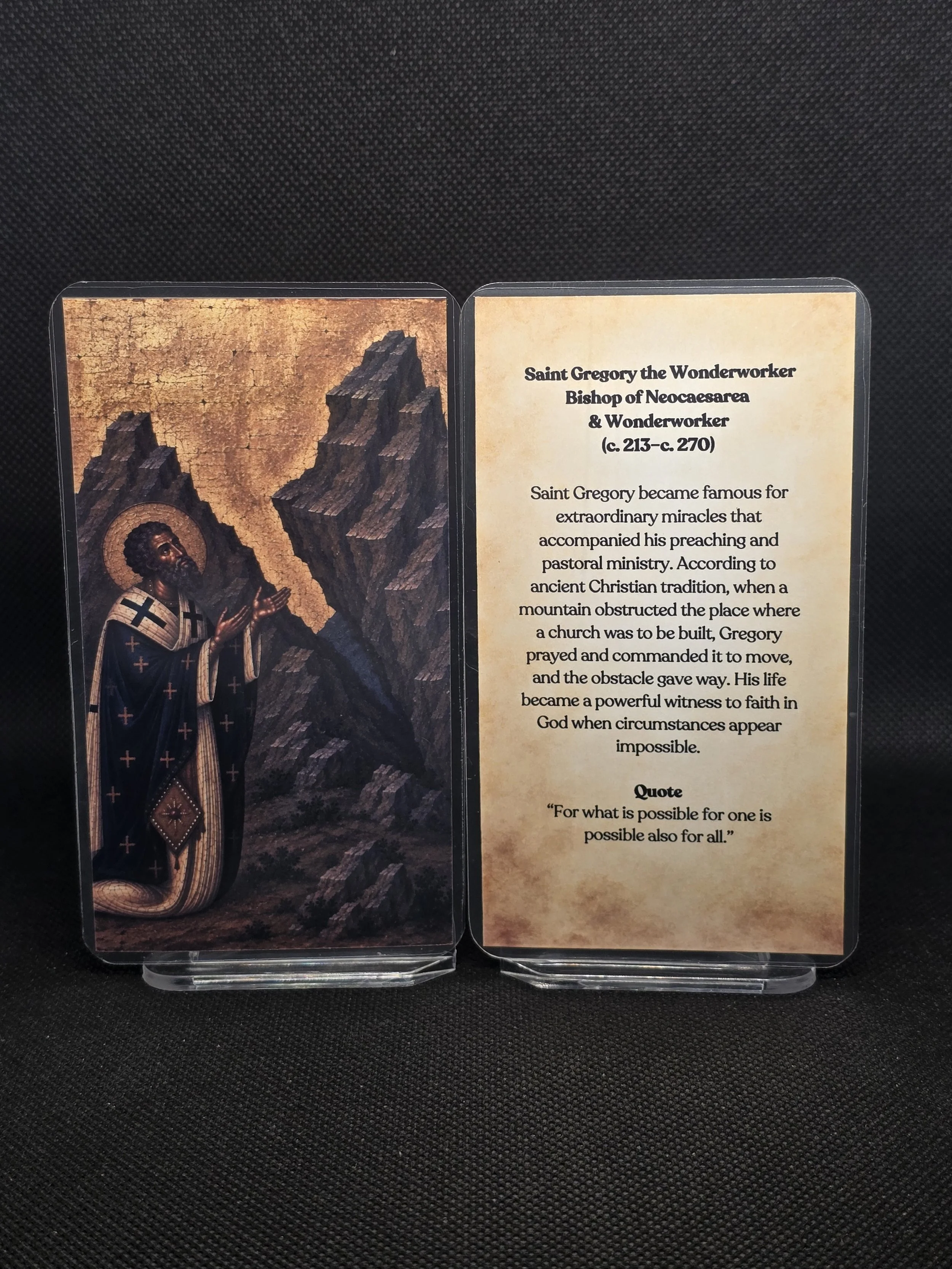
This prayer card depicts one of the most striking miracles associated with Saint Gregory the Wonderworker, also called Gregory Thaumaturgus of Neocaesarea, the third-century bishop whose extraordinary works of healing, deliverance, evangelization, and miracles earned him the permanent title “Wonderworker.” In the received Orthodox tradition, when Christians were constructing a new church and a hill obstructed the site, Gregory commanded the hill to move so that sufficient ground could be opened for the foundation. The Orthodox Church in America continues to preserve this miracle in his official Life, remembering that during the construction of a church, Gregory commanded the hill to move and make room for the foundation.
The scene naturally calls to mind Matthew 17:20, where Christ teaches that faith like a mustard seed can say to a mountain, “Move,” and it will move. The ancient sources do not record Gregory quoting Matthew 17:20 word for word at the moment of this particular miracle, so the most historically accurate way to present the card is to say that Gregory's mountain-moving miracle became a remarkable illustration of Christ's teaching about faith that moves mountains, rather than claiming that we know the exact words of his prayer.
Saint Gregory is especially meaningful for impossible situations, immovable obstacles, desperate problems, healing, serious illness, natural disasters, difficult conversions, spiritual protection, and moments when every ordinary human solution seems exhausted. His Life contains so many wonders that the title Thaumaturgus, “Wonderworker,” became inseparable from his name. He healed the sick, delivered people from demonic oppression, miraculously settled a dangerous dispute over a lake, survived persecution through divine protection, and presided over the extraordinary conversion of Neocaesarea from a city with only a tiny Christian community into one overwhelmingly Christian by the end of his ministry.
This particular prayer card focuses upon something visually simple but spiritually enormous: a mountain standing where the Church needed to be built, and faith refusing to accept that the obstacle was greater than God. For anyone looking at an illness, family crisis, financial hardship, addiction, broken relationship, difficult vocation, impossible decision, or seemingly closed door, Gregory's miracle gives physical form to the Gospel's challenge not to confuse what is impossible for us with what is impossible for God.
Each 2.5" x 4.25" prayer card is handmade in Austin, Texas and prepared prayerfully with each order. It is printed on museum-quality photo paper rather than cardstock, double laminated for durability, and made while the recipient and their intentions are lifted before Christ in prayer, with Saint Gregory the Wonderworker asked to intercede for them.
THE MIRACLE OF THE MOUNTAIN THAT MOVED
Saint Gregory served as Bishop of Neocaesarea in Pontus, in what is now northern Turkey, during the third century. When he began his episcopal ministry, Christians formed only a very small minority of the city, but his preaching and miracles quickly drew people toward the Gospel. The later fourth-century Life of Gregory the Wonderworker by Saint Gregory of Nyssa describes the Christian community growing rapidly enough that the faithful soon undertook the construction of a church together, contributing both their possessions and their physical labor.
The present Orthodox Synaxarion preserves the tradition that an obstacle arose during that construction: a hill occupied ground needed for the church foundation. Gregory commanded it to move, and the obstruction yielded, leaving room for the church to be built.
The miracle made Gregory one of the earliest saints in Christian tradition to become famous for an event that so directly resembles Christ's teaching about faith moving mountains. Gregory lived approximately seven centuries before the tenth-century Coptic tradition of Saint Simon the Tanner and the moving of Mokattam Mountain, making the Gregory tradition dramatically earlier in the history of Christian mountain-moving miracle accounts.
AN IMPORTANT DETAIL ABOUT THE EARLIEST SOURCE
There is an interesting historical distinction worth preserving because it makes the description more accurate rather than less impressive. Saint Gregory of Nyssa wrote his Life of Gregory the Wonderworker in the late 370s or 380s, roughly a century after Gregory the Wonderworker's death. Modern scholarship considers it the earliest of the major surviving Lives and likely dependent upon oral traditions circulating in Neocaesarea and within Gregory of Nyssa's own family.
In that earliest surviving Life, Gregory of Nyssa does not tell the church-site miracle in exactly the compressed form used by later Orthodox Synaxaria. Instead, he preserves two closely adjacent traditions. First, a pagan temple custodian asks Gregory to demonstrate the power of Christian faith by commanding an enormous rock, explicitly described as impossible for human strength to move, to relocate. Gregory commands it, and the rock moves to the exact place indicated, leading the pagan priest to believe in Christ. Shortly afterward, Gregory of Nyssa describes Gregory entering Neocaesarea and the rapidly growing Christian community constructing its church.
The modern Orthodox Life preserves the tradition in the familiar form that during the church's construction Gregory commanded a hill to move so the foundation could be dug. For this prayer card, that received Orthodox version is therefore completely appropriate, while the product description can remain unusually precise about how the surviving written tradition developed.
THE ROCK THAT OBEYED A WORD OF FAITH
The rock-moving episode in Gregory of Nyssa's ancient account deserves special attention because it explains why Gregory's later mountain-moving tradition fits his earliest hagiography so naturally. A pagan temple custodian wanted proof that Gregory's Christian preaching represented genuine divine power rather than philosophical argument alone. He pointed to an enormous rock that no human strength could move and challenged Gregory to make it change position through faith.
Gregory did not assemble machinery, workers, or animals. According to the account, he simply commanded the massive rock to move to the place the man had specified, and it obeyed. The temple custodian immediately abandoned his former pagan priesthood and became Gregory's disciple.
Saint Gregory of Nyssa then draws the theological lesson directly from the miracle. If a servant of God could command something considered immovable, he argues, how immeasurably greater must be the power of the Lord who created the world itself. The miracle therefore was never meant to glorify Gregory's personal power. It was evidence pointing through Gregory toward the power of God.
THE CHURCH THAT SURVIVED THE EARTHQUAKE
The church connected with Gregory's early episcopal ministry developed another remarkable tradition. Saint Gregory of Nyssa says that the building erected by Gregory and his new Christian community was still standing in his own lifetime, more than a century later.
Gregory of Nyssa then records that a devastating earthquake struck Neocaesarea in his own era and destroyed almost every public and private building in the city, yet Gregory the Wonderworker's church remained standing and unshaken. To Gregory of Nyssa, the church's survival provided another testimony to the divine help under which its foundation had originally been laid.
That detail adds another beautiful layer to this prayer card. The miracle was not simply about clearing ground so a building could exist. The resulting church itself became remembered as something that endured when the city around it was shaken.
MATTHEW 17:20 & THE FAITH THAT MOVES MOUNTAINS
The natural scriptural heart of this card is Matthew 17:20, where Jesus speaks about faith as small as a mustard seed and says that such faith can command a mountain to move. Gregory's tradition became an extraordinary physical image of precisely that Gospel teaching.
Christ's words should not be reduced to the idea that sufficiently intense belief forces God to perform any miracle we request. Christian faith is not mental power directed toward an object. It is trust in God, whose power is not limited by the boundary of what human beings can accomplish.
That distinction is especially important on a prayer card intended for impossible situations. The person carrying the card may be unable to move the mountain in front of them, and the mountain may not move in precisely the way they expect. Gregory's story nevertheless says that the Christian never has to worship the obstacle as though it possesses the final word.
ONE OF CHRISTIANITY'S EARLIEST GREAT MOUNTAIN-MOVING TRADITIONS
Saint Gregory lived in the third century, centuries before many of the better-known medieval miracle stories of Christianity. His early reputation as a Wonderworker was already firmly established by the fourth century, when Saint Gregory of Nyssa delivered his Life and panegyric recounting his wonders.
That chronology makes the miracle especially fascinating when placed beside the later Coptic story of Saint Simon the Tanner and Mokattam Mountain. Gregory the Wonderworker himself lived roughly seven centuries before Simon's tenth-century story, while Gregory of Nyssa's surviving fourth-century account of Gregory commanding an immovable rock already predates the Mokattam tradition by roughly six centuries.
The two traditions should not be treated as competing stories. Together they show how deeply Matthew 17:20 and the image of mountains yielding before faith entered Christian imagination and devotion across very different times, places, and Churches.
THE CHURCH BEGAN WITH ONLY A FEW CHRISTIANS
The mountain or hill was not the only seemingly immovable obstacle Gregory encountered. When he assumed responsibility for Neocaesarea, the Christian population was tiny. The Orthodox tradition famously remembers only seventeen Christians living there when his ministry began.
By the time Gregory approached death, the traditional account reverses the number: only seventeen pagans remained. Through preaching, healing, charity, spiritual authority, and extraordinary miracles, the bishop had watched almost an entire city turn toward Christianity.
In that sense, the physical mountain was only one of the mountains moved during Gregory's episcopacy. The transformation of an overwhelmingly pagan city may have been an even greater wonder.
WHY HE IS CALLED THAUMATURGUS
The Greek title Thaumaturgus means “Wonderworker,” a person through whom extraordinary wonders are worked. Gregory received the title because miracle accounts became inseparable from the memory of his ministry.
The Church's own Kontakion still praises him specifically for receiving the power to work miracles, terrifying demons, and healing the sick. His title therefore is not a modern nickname attached to him for dramatic effect but part of the Church's longstanding liturgical identity for the saint.
A PRAYER CARD FOR IMPOSSIBLE SITUATIONS
This scene makes an especially powerful prayer card for someone whose problem feels physically or emotionally immovable. The mountain can represent cancer, infertility, addiction, financial crisis, a marriage in trouble, a child far from God, a seemingly impossible legal problem, unemployment, grief, spiritual darkness, or a decision for which no good path seems visible.
The card does not promise a particular outcome. Instead, its message is that no Christian should look at an obstacle and conclude that because I cannot move it, therefore it cannot be moved.
Gregory's miracle shifts attention away from the size of our own strength and toward the immeasurable strength of God.
A PRAYER CARD FOR HEALING
Saint Gregory's wonderworking ministry was strongly associated with healing the sick. Saint Gregory of Nyssa describes crowds bringing people suffering from physical illnesses and spiritual afflictions to Gregory, while the Orthodox Kontakion explicitly celebrates the healing of the sick through his wonderworking gift.
For that reason, this card can be especially meaningful during surgery, cancer treatment, chronic illness, hospitalization, an unexplained medical condition, or any circumstance in which a family is asking God for healing.
A PRAYER CARD FOR CONVERSION
The rock-moving miracle itself ended in conversion. The pagan temple custodian who demanded evidence witnessed Gregory command the massive rock, believed in the God Gregory preached, abandoned his former religious position, and joined him.
Gregory's entire city then followed the same larger trajectory. The bishop who began with a tiny Christian flock eventually watched Neocaesarea become overwhelmingly Christian.
A Saint Gregory mountain miracle card is therefore especially fitting for parents praying for a child who has abandoned Christianity, spouses praying for one another, catechumens, converts, missionaries, and anyone praying for a person who appears completely closed to faith.
A PRAYER CARD FOR BUILDING SOMETHING FOR GOD
There is another meaning unique to this particular scene. The mountain stood where a church needed to be built.
For someone trying to establish a parish, monastery, ministry, school, mission, charitable project, business with a Christian purpose, or another work sincerely offered to God, the scene can become a reminder that obstacles encountered during good work do not necessarily mean the work should be abandoned.
Discernment is still necessary, because not every obstacle is meant to be miraculously removed. Gregory's story nevertheless encourages perseverance when a genuine calling encounters something that seems far larger than the people attempting it.
THE MIRACLE WAS ABOUT THE CHURCH, NOT GREGORY
The mountain-moving story becomes even more beautiful when understood within the growth of the Neocaesarean Church. The space was not being cleared so Gregory could construct a monument to himself. It was being cleared so a rapidly growing Christian community would have a place to worship.
The miracle therefore joins faith and mission. God removes the obstruction so the Church can continue its work.
That makes the scene particularly appropriate for church fundraisers, parish building campaigns, missions searching for permanent property, and Christians praying through seemingly impossible practical obstacles in ministry.
WHEN THE OBSTACLE IS BIGGER THAN YOU
A mountain makes a particularly powerful Christian image because there is no reasonable illusion that one person can move it by strength. It strips away the fantasy of self-sufficiency.
This is why Matthew 17:20 remains so memorable. Christ does not choose a small inconvenience as His image. He chooses something so large that the hearer immediately knows ordinary human power is insufficient.
Saint Gregory's miracle embodies the same lesson. The obstacle's size becomes the very reason the glory cannot finally belong to Gregory.
FAITH IS NOT SELF-CONFIDENCE
Gregory's story also helps distinguish faith from self-confidence. Self-confidence says, “I am strong enough.” Christian faith says, “God is God even when I am not strong enough.”
The difference matters especially when someone is sick, frightened, grieving, exhausted, or facing a problem that cannot simply be solved by trying harder. Gregory's mountain does not demand that the suffering person pretend to feel powerful. It directs the suffering person toward the One whose strength does not depend upon theirs.
GREGORY THE WONDERWORKER & NATURAL DISASTERS
Gregory's tradition contains repeated miracles involving the natural world, including the moving of an immovable rock, the church-site hill tradition, the drying of a disputed lake, and the miraculous survival of his church during a devastating earthquake.
This helps explain why later devotion has particularly associated him with earthquakes, floods, desperate causes, and seemingly uncontrollable natural dangers. His Life repeatedly presents creation itself as remaining subject to the Creator.
THE LAKE MIRACLE IS A DIFFERENT STORY
One detail is worth keeping separate because it is frequently blended into the mountain story in modern retellings. Gregory did spend an entire night alone in prayer, but Saint Gregory of Nyssa places that vigil at a different miracle involving two brothers who were preparing to fight over ownership of a marshy lake.
Gregory remained beside the lake through the night in prayer. At dawn, the water had disappeared and dry ground remained, eliminating the object over which the brothers were prepared to shed blood.
The all-night vigil is therefore completely authentic to his ancient Life, but attaching it specifically to the church-site mountain miracle would combine two separate wonders. Keeping them distinct makes the card's history stronger.
A MIRACLE PRESERVED BY SAINT GREGORY OF NYSSA
Saint Gregory of Nyssa is an unusually important witness because he did not write hundreds of years after everyone connected with Gregory the Wonderworker had disappeared from memory. His Life was composed in Asia Minor in the late fourth century, and modern scholarship notes that his family possessed connections with the traditions of Neocaesarea.
The modern scholarly introduction to the Fathers of the Church translation calls Gregory of Nyssa's work the closest of the surviving written accounts to the oral traditions of Neocaesarea, while still cautioning that a hagiographical Life cannot simply be treated as modern documentary biography.
For the product page, the strongest wording is therefore “according to the ancient and received Christian tradition preserved around Saint Gregory”, rather than presenting every miraculous detail as though it came from a contemporary government record.
SAINT GREGORY'S FEAST DAY
Saint Gregory the Wonderworker is commemorated on November 17. The Orthodox Church in America keeps his feast on that date and provides his traditional Troparion and Kontakion.
His November 17 feast provides a natural annual day for someone who carries this card to renew prayer for an impossible intention, healing, conversion, or another obstacle they have placed before God.
PRAYERS
Saint Gregory already has established Byzantine liturgical hymns, so there is no need to write a new saint-specific prayer. His Troparion remembers his vigilance in prayer and constant works of mercy and asks him to beseech Christ for spiritual enlightenment, while his Kontakion explicitly praises his miracles and healings.
A short traditional portion of his Troparion suitable for the back of a prayer card is:
“O Father Gregory, beseech Christ God to enlighten our minds.”
That established liturgical line pairs particularly well with the image of the mountain because it prevents the devotion from reducing Gregory to a saint for obtaining miracles. The Church first asks for the transformation of the person who prays.
A simple established form of invocation may also be used in personal devotion: “Holy Father Gregory the Wonderworker, pray to God for us.” Someone facing an impossible situation can then place the specific intention before Christ while asking Gregory to intercede.
FAQ
What miracle is shown on this Saint Gregory the Wonderworker prayer card? The card depicts the received Orthodox tradition that a hill obstructed the site where a new church was being built, and Saint Gregory commanded it to move so that room could be made for the foundation. The Orthodox Church in America continues preserving this event in its Life of Saint Gregory.
Did Saint Gregory the Wonderworker really move a mountain? The Orthodox hagiographic tradition says that Gregory commanded a hill obstructing church construction to move, and the miracle became one of the wonders associated with him. Saint Gregory of Nyssa's earlier fourth-century Life preserves a closely related miracle in which Gregory commands an enormous immovable rock to relocate through faith.
Is the mountain miracle in Saint Gregory of Nyssa's original Life? Not in exactly the later form commonly retold today. Gregory of Nyssa records the enormous rock moving at Gregory's command and then separately describes the construction of Gregory's church, while the modern Orthodox Synaxarion explicitly remembers a hill moving during church construction.
Did Gregory pray all night before the mountain moved? The earliest Life does record Gregory spending an entire night in prayer, but that belongs to his separate miracle involving the disputed lake. It is safer not to attach the all-night vigil specifically to the church-site hill miracle.
Is Matthew 17:20 connected with Saint Gregory's miracle? Matthew 17:20 is the natural Gospel text associated with the miracle because Christ speaks there about faith capable of commanding a mountain to move. The surviving ancient account does not record Gregory explicitly quoting that verse during this particular event, so it is best used as the scriptural lens through which the miracle is understood.
What does Thaumaturgus mean? Thaumaturgus means Wonderworker or miracle-worker. Gregory became so strongly associated with extraordinary miracles that the title became a permanent part of his name in Christian tradition.
When did Saint Gregory the Wonderworker live? Gregory lived during the third century and is generally dated to approximately 213 to 270 AD. He served as Bishop of Neocaesarea in Pontus, in northern Asia Minor.
When is Saint Gregory the Wonderworker's feast day? His feast is celebrated on November 17. Orthodox liturgical sources continue commemorating him on that date as Saint Gregory the Wonderworker of Neocaesarea.
Who wrote the ancient Life of Saint Gregory? Saint Gregory of Nyssa, one of the great Cappadocian Fathers, wrote the surviving Life and panegyric of Gregory the Wonderworker. Modern scholarship dates it to the late 370s or 380s, roughly a century after Gregory the Wonderworker's death.
How reliable is Saint Gregory of Nyssa's Life? It is a late antique hagiographical work rather than a modern documentary biography, so miraculous material should be identified as Church tradition. At the same time, scholarship regards it as the earliest of the principal surviving Lives and notes that Gregory of Nyssa's family was well positioned to know traditions preserved in Neocaesarea.
Was Saint Gregory's mountain miracle before Saint Simon the Tanner's miracle? Yes. Gregory the Wonderworker lived in the third century, roughly seven centuries before the tenth-century Coptic tradition surrounding Saint Simon the Tanner and Mokattam Mountain. Gregory of Nyssa's written fourth-century account of Gregory commanding an immovable rock is itself roughly six centuries earlier than the Mokattam tradition.
Are Saint Gregory and Saint Simon the Tanner connected? There is no evidence that one story historically caused the other, and they belong to different Christian traditions and periods. They are nevertheless striking parallels because both became associated with the Gospel image of faith confronting something as immovable as a mountain.
Why was the mountain moved? In the received Orthodox telling, the hill occupied space needed for the foundation of a new church. Gregory commanded it to move so that the Christian community could continue construction.
Did Saint Gregory build a church in Neocaesarea? Yes, Saint Gregory of Nyssa specifically records the rapidly growing Christian community joining together to construct a church under Gregory's leadership. He says that the building was still known in his own fourth-century lifetime.
Did Saint Gregory's church survive an earthquake? According to Gregory of Nyssa, yes. He says a severe earthquake devastated the city in his own era, destroying nearly every other building, while Gregory the Wonderworker's church remained standing.
Did Saint Gregory move anything else miraculously? The ancient Life records him commanding an enormous rock to move to a location specified by a pagan priest. That miracle immediately resulted in the man's conversion to Christianity.
Did Saint Gregory dry up a lake? According to Saint Gregory of Nyssa, two brothers were preparing for violence over ownership of a marshy lake, so Gregory spent the night there in prayer. At dawn the lake was dry, eliminating the cause of their conflict.
Is Saint Gregory good for impossible situations? His entire Wonderworker tradition makes this one of the strongest devotional associations with him. He is remembered in situations involving immovable physical objects, disease, demonic oppression, persecution, dangerous disputes, and seemingly impossible missionary work.
Can I pray to Saint Gregory for healing? Yes, healing is explicitly part of his liturgical and hagiographic tradition. His Kontakion remembers him healing the sick through the wonderworking grace given to him by God.
Can I pray to Saint Gregory for someone's conversion? Yes, his missionary life gives this devotion a very strong foundation. Tradition says he began his episcopacy with only seventeen Christians in Neocaesarea and died with only seventeen pagans remaining.
Can this card be given to someone facing cancer or serious illness? Yes, because Saint Gregory's tradition contains repeated healing miracles and his liturgy explicitly celebrates healing through his intercession. The mountain image also works powerfully for a diagnosis that feels like an enormous obstacle standing in front of a family.
Can this card be given to someone facing an impossible family problem? Yes, particularly because the mountain visually represents a problem that human strength cannot simply remove. Gregory's other miracles also include the peaceful resolution of a potentially violent conflict between two brothers.
Can this prayer card be used for a church building campaign? Yes, and that is one of the most distinctive uses of this particular image. The received tradition specifically connects the moving of the hill with making room for a church foundation.
Is Saint Gregory associated with earthquakes? His church was remembered by Gregory of Nyssa as surviving a devastating earthquake that destroyed most other buildings in Neocaesarea. That tradition contributed naturally to later devotion seeking his prayers in natural disasters.
Is there an established prayer to Saint Gregory the Wonderworker? Yes. The Byzantine Church possesses a traditional Troparion and Kontakion for his November 17 feast, so there is no need to invent a new saint-specific prayer.
What is the central message of this Saint Gregory mountain miracle prayer card? The card proclaims that an obstacle can be immovable to us without being immovable to God. Gregory's tradition remembers physical rock and earth yielding before faith, but the deeper Christian message reaches beyond geology: illness, fear, conversion, grief, family crisis, spiritual struggle, and every apparently closed path remain beneath the providence of the God whom Christ tells us to trust.
This prayer card depicts one of the most striking miracles associated with Saint Gregory the Wonderworker, also called Gregory Thaumaturgus of Neocaesarea, the third-century bishop whose extraordinary works of healing, deliverance, evangelization, and miracles earned him the permanent title “Wonderworker.” In the received Orthodox tradition, when Christians were constructing a new church and a hill obstructed the site, Gregory commanded the hill to move so that sufficient ground could be opened for the foundation. The Orthodox Church in America continues to preserve this miracle in his official Life, remembering that during the construction of a church, Gregory commanded the hill to move and make room for the foundation.
The scene naturally calls to mind Matthew 17:20, where Christ teaches that faith like a mustard seed can say to a mountain, “Move,” and it will move. The ancient sources do not record Gregory quoting Matthew 17:20 word for word at the moment of this particular miracle, so the most historically accurate way to present the card is to say that Gregory's mountain-moving miracle became a remarkable illustration of Christ's teaching about faith that moves mountains, rather than claiming that we know the exact words of his prayer.
Saint Gregory is especially meaningful for impossible situations, immovable obstacles, desperate problems, healing, serious illness, natural disasters, difficult conversions, spiritual protection, and moments when every ordinary human solution seems exhausted. His Life contains so many wonders that the title Thaumaturgus, “Wonderworker,” became inseparable from his name. He healed the sick, delivered people from demonic oppression, miraculously settled a dangerous dispute over a lake, survived persecution through divine protection, and presided over the extraordinary conversion of Neocaesarea from a city with only a tiny Christian community into one overwhelmingly Christian by the end of his ministry.
This particular prayer card focuses upon something visually simple but spiritually enormous: a mountain standing where the Church needed to be built, and faith refusing to accept that the obstacle was greater than God. For anyone looking at an illness, family crisis, financial hardship, addiction, broken relationship, difficult vocation, impossible decision, or seemingly closed door, Gregory's miracle gives physical form to the Gospel's challenge not to confuse what is impossible for us with what is impossible for God.
Each 2.5" x 4.25" prayer card is handmade in Austin, Texas and prepared prayerfully with each order. It is printed on museum-quality photo paper rather than cardstock, double laminated for durability, and made while the recipient and their intentions are lifted before Christ in prayer, with Saint Gregory the Wonderworker asked to intercede for them.
THE MIRACLE OF THE MOUNTAIN THAT MOVED
Saint Gregory served as Bishop of Neocaesarea in Pontus, in what is now northern Turkey, during the third century. When he began his episcopal ministry, Christians formed only a very small minority of the city, but his preaching and miracles quickly drew people toward the Gospel. The later fourth-century Life of Gregory the Wonderworker by Saint Gregory of Nyssa describes the Christian community growing rapidly enough that the faithful soon undertook the construction of a church together, contributing both their possessions and their physical labor.
The present Orthodox Synaxarion preserves the tradition that an obstacle arose during that construction: a hill occupied ground needed for the church foundation. Gregory commanded it to move, and the obstruction yielded, leaving room for the church to be built.
The miracle made Gregory one of the earliest saints in Christian tradition to become famous for an event that so directly resembles Christ's teaching about faith moving mountains. Gregory lived approximately seven centuries before the tenth-century Coptic tradition of Saint Simon the Tanner and the moving of Mokattam Mountain, making the Gregory tradition dramatically earlier in the history of Christian mountain-moving miracle accounts.
AN IMPORTANT DETAIL ABOUT THE EARLIEST SOURCE
There is an interesting historical distinction worth preserving because it makes the description more accurate rather than less impressive. Saint Gregory of Nyssa wrote his Life of Gregory the Wonderworker in the late 370s or 380s, roughly a century after Gregory the Wonderworker's death. Modern scholarship considers it the earliest of the major surviving Lives and likely dependent upon oral traditions circulating in Neocaesarea and within Gregory of Nyssa's own family.
In that earliest surviving Life, Gregory of Nyssa does not tell the church-site miracle in exactly the compressed form used by later Orthodox Synaxaria. Instead, he preserves two closely adjacent traditions. First, a pagan temple custodian asks Gregory to demonstrate the power of Christian faith by commanding an enormous rock, explicitly described as impossible for human strength to move, to relocate. Gregory commands it, and the rock moves to the exact place indicated, leading the pagan priest to believe in Christ. Shortly afterward, Gregory of Nyssa describes Gregory entering Neocaesarea and the rapidly growing Christian community constructing its church.
The modern Orthodox Life preserves the tradition in the familiar form that during the church's construction Gregory commanded a hill to move so the foundation could be dug. For this prayer card, that received Orthodox version is therefore completely appropriate, while the product description can remain unusually precise about how the surviving written tradition developed.
THE ROCK THAT OBEYED A WORD OF FAITH
The rock-moving episode in Gregory of Nyssa's ancient account deserves special attention because it explains why Gregory's later mountain-moving tradition fits his earliest hagiography so naturally. A pagan temple custodian wanted proof that Gregory's Christian preaching represented genuine divine power rather than philosophical argument alone. He pointed to an enormous rock that no human strength could move and challenged Gregory to make it change position through faith.
Gregory did not assemble machinery, workers, or animals. According to the account, he simply commanded the massive rock to move to the place the man had specified, and it obeyed. The temple custodian immediately abandoned his former pagan priesthood and became Gregory's disciple.
Saint Gregory of Nyssa then draws the theological lesson directly from the miracle. If a servant of God could command something considered immovable, he argues, how immeasurably greater must be the power of the Lord who created the world itself. The miracle therefore was never meant to glorify Gregory's personal power. It was evidence pointing through Gregory toward the power of God.
THE CHURCH THAT SURVIVED THE EARTHQUAKE
The church connected with Gregory's early episcopal ministry developed another remarkable tradition. Saint Gregory of Nyssa says that the building erected by Gregory and his new Christian community was still standing in his own lifetime, more than a century later.
Gregory of Nyssa then records that a devastating earthquake struck Neocaesarea in his own era and destroyed almost every public and private building in the city, yet Gregory the Wonderworker's church remained standing and unshaken. To Gregory of Nyssa, the church's survival provided another testimony to the divine help under which its foundation had originally been laid.
That detail adds another beautiful layer to this prayer card. The miracle was not simply about clearing ground so a building could exist. The resulting church itself became remembered as something that endured when the city around it was shaken.
MATTHEW 17:20 & THE FAITH THAT MOVES MOUNTAINS
The natural scriptural heart of this card is Matthew 17:20, where Jesus speaks about faith as small as a mustard seed and says that such faith can command a mountain to move. Gregory's tradition became an extraordinary physical image of precisely that Gospel teaching.
Christ's words should not be reduced to the idea that sufficiently intense belief forces God to perform any miracle we request. Christian faith is not mental power directed toward an object. It is trust in God, whose power is not limited by the boundary of what human beings can accomplish.
That distinction is especially important on a prayer card intended for impossible situations. The person carrying the card may be unable to move the mountain in front of them, and the mountain may not move in precisely the way they expect. Gregory's story nevertheless says that the Christian never has to worship the obstacle as though it possesses the final word.
ONE OF CHRISTIANITY'S EARLIEST GREAT MOUNTAIN-MOVING TRADITIONS
Saint Gregory lived in the third century, centuries before many of the better-known medieval miracle stories of Christianity. His early reputation as a Wonderworker was already firmly established by the fourth century, when Saint Gregory of Nyssa delivered his Life and panegyric recounting his wonders.
That chronology makes the miracle especially fascinating when placed beside the later Coptic story of Saint Simon the Tanner and Mokattam Mountain. Gregory the Wonderworker himself lived roughly seven centuries before Simon's tenth-century story, while Gregory of Nyssa's surviving fourth-century account of Gregory commanding an immovable rock already predates the Mokattam tradition by roughly six centuries.
The two traditions should not be treated as competing stories. Together they show how deeply Matthew 17:20 and the image of mountains yielding before faith entered Christian imagination and devotion across very different times, places, and Churches.
THE CHURCH BEGAN WITH ONLY A FEW CHRISTIANS
The mountain or hill was not the only seemingly immovable obstacle Gregory encountered. When he assumed responsibility for Neocaesarea, the Christian population was tiny. The Orthodox tradition famously remembers only seventeen Christians living there when his ministry began.
By the time Gregory approached death, the traditional account reverses the number: only seventeen pagans remained. Through preaching, healing, charity, spiritual authority, and extraordinary miracles, the bishop had watched almost an entire city turn toward Christianity.
In that sense, the physical mountain was only one of the mountains moved during Gregory's episcopacy. The transformation of an overwhelmingly pagan city may have been an even greater wonder.
WHY HE IS CALLED THAUMATURGUS
The Greek title Thaumaturgus means “Wonderworker,” a person through whom extraordinary wonders are worked. Gregory received the title because miracle accounts became inseparable from the memory of his ministry.
The Church's own Kontakion still praises him specifically for receiving the power to work miracles, terrifying demons, and healing the sick. His title therefore is not a modern nickname attached to him for dramatic effect but part of the Church's longstanding liturgical identity for the saint.
A PRAYER CARD FOR IMPOSSIBLE SITUATIONS
This scene makes an especially powerful prayer card for someone whose problem feels physically or emotionally immovable. The mountain can represent cancer, infertility, addiction, financial crisis, a marriage in trouble, a child far from God, a seemingly impossible legal problem, unemployment, grief, spiritual darkness, or a decision for which no good path seems visible.
The card does not promise a particular outcome. Instead, its message is that no Christian should look at an obstacle and conclude that because I cannot move it, therefore it cannot be moved.
Gregory's miracle shifts attention away from the size of our own strength and toward the immeasurable strength of God.
A PRAYER CARD FOR HEALING
Saint Gregory's wonderworking ministry was strongly associated with healing the sick. Saint Gregory of Nyssa describes crowds bringing people suffering from physical illnesses and spiritual afflictions to Gregory, while the Orthodox Kontakion explicitly celebrates the healing of the sick through his wonderworking gift.
For that reason, this card can be especially meaningful during surgery, cancer treatment, chronic illness, hospitalization, an unexplained medical condition, or any circumstance in which a family is asking God for healing.
A PRAYER CARD FOR CONVERSION
The rock-moving miracle itself ended in conversion. The pagan temple custodian who demanded evidence witnessed Gregory command the massive rock, believed in the God Gregory preached, abandoned his former religious position, and joined him.
Gregory's entire city then followed the same larger trajectory. The bishop who began with a tiny Christian flock eventually watched Neocaesarea become overwhelmingly Christian.
A Saint Gregory mountain miracle card is therefore especially fitting for parents praying for a child who has abandoned Christianity, spouses praying for one another, catechumens, converts, missionaries, and anyone praying for a person who appears completely closed to faith.
A PRAYER CARD FOR BUILDING SOMETHING FOR GOD
There is another meaning unique to this particular scene. The mountain stood where a church needed to be built.
For someone trying to establish a parish, monastery, ministry, school, mission, charitable project, business with a Christian purpose, or another work sincerely offered to God, the scene can become a reminder that obstacles encountered during good work do not necessarily mean the work should be abandoned.
Discernment is still necessary, because not every obstacle is meant to be miraculously removed. Gregory's story nevertheless encourages perseverance when a genuine calling encounters something that seems far larger than the people attempting it.
THE MIRACLE WAS ABOUT THE CHURCH, NOT GREGORY
The mountain-moving story becomes even more beautiful when understood within the growth of the Neocaesarean Church. The space was not being cleared so Gregory could construct a monument to himself. It was being cleared so a rapidly growing Christian community would have a place to worship.
The miracle therefore joins faith and mission. God removes the obstruction so the Church can continue its work.
That makes the scene particularly appropriate for church fundraisers, parish building campaigns, missions searching for permanent property, and Christians praying through seemingly impossible practical obstacles in ministry.
WHEN THE OBSTACLE IS BIGGER THAN YOU
A mountain makes a particularly powerful Christian image because there is no reasonable illusion that one person can move it by strength. It strips away the fantasy of self-sufficiency.
This is why Matthew 17:20 remains so memorable. Christ does not choose a small inconvenience as His image. He chooses something so large that the hearer immediately knows ordinary human power is insufficient.
Saint Gregory's miracle embodies the same lesson. The obstacle's size becomes the very reason the glory cannot finally belong to Gregory.
FAITH IS NOT SELF-CONFIDENCE
Gregory's story also helps distinguish faith from self-confidence. Self-confidence says, “I am strong enough.” Christian faith says, “God is God even when I am not strong enough.”
The difference matters especially when someone is sick, frightened, grieving, exhausted, or facing a problem that cannot simply be solved by trying harder. Gregory's mountain does not demand that the suffering person pretend to feel powerful. It directs the suffering person toward the One whose strength does not depend upon theirs.
GREGORY THE WONDERWORKER & NATURAL DISASTERS
Gregory's tradition contains repeated miracles involving the natural world, including the moving of an immovable rock, the church-site hill tradition, the drying of a disputed lake, and the miraculous survival of his church during a devastating earthquake.
This helps explain why later devotion has particularly associated him with earthquakes, floods, desperate causes, and seemingly uncontrollable natural dangers. His Life repeatedly presents creation itself as remaining subject to the Creator.
THE LAKE MIRACLE IS A DIFFERENT STORY
One detail is worth keeping separate because it is frequently blended into the mountain story in modern retellings. Gregory did spend an entire night alone in prayer, but Saint Gregory of Nyssa places that vigil at a different miracle involving two brothers who were preparing to fight over ownership of a marshy lake.
Gregory remained beside the lake through the night in prayer. At dawn, the water had disappeared and dry ground remained, eliminating the object over which the brothers were prepared to shed blood.
The all-night vigil is therefore completely authentic to his ancient Life, but attaching it specifically to the church-site mountain miracle would combine two separate wonders. Keeping them distinct makes the card's history stronger.
A MIRACLE PRESERVED BY SAINT GREGORY OF NYSSA
Saint Gregory of Nyssa is an unusually important witness because he did not write hundreds of years after everyone connected with Gregory the Wonderworker had disappeared from memory. His Life was composed in Asia Minor in the late fourth century, and modern scholarship notes that his family possessed connections with the traditions of Neocaesarea.
The modern scholarly introduction to the Fathers of the Church translation calls Gregory of Nyssa's work the closest of the surviving written accounts to the oral traditions of Neocaesarea, while still cautioning that a hagiographical Life cannot simply be treated as modern documentary biography.
For the product page, the strongest wording is therefore “according to the ancient and received Christian tradition preserved around Saint Gregory”, rather than presenting every miraculous detail as though it came from a contemporary government record.
SAINT GREGORY'S FEAST DAY
Saint Gregory the Wonderworker is commemorated on November 17. The Orthodox Church in America keeps his feast on that date and provides his traditional Troparion and Kontakion.
His November 17 feast provides a natural annual day for someone who carries this card to renew prayer for an impossible intention, healing, conversion, or another obstacle they have placed before God.
PRAYERS
Saint Gregory already has established Byzantine liturgical hymns, so there is no need to write a new saint-specific prayer. His Troparion remembers his vigilance in prayer and constant works of mercy and asks him to beseech Christ for spiritual enlightenment, while his Kontakion explicitly praises his miracles and healings.
A short traditional portion of his Troparion suitable for the back of a prayer card is:
“O Father Gregory, beseech Christ God to enlighten our minds.”
That established liturgical line pairs particularly well with the image of the mountain because it prevents the devotion from reducing Gregory to a saint for obtaining miracles. The Church first asks for the transformation of the person who prays.
A simple established form of invocation may also be used in personal devotion: “Holy Father Gregory the Wonderworker, pray to God for us.” Someone facing an impossible situation can then place the specific intention before Christ while asking Gregory to intercede.
FAQ
What miracle is shown on this Saint Gregory the Wonderworker prayer card? The card depicts the received Orthodox tradition that a hill obstructed the site where a new church was being built, and Saint Gregory commanded it to move so that room could be made for the foundation. The Orthodox Church in America continues preserving this event in its Life of Saint Gregory.
Did Saint Gregory the Wonderworker really move a mountain? The Orthodox hagiographic tradition says that Gregory commanded a hill obstructing church construction to move, and the miracle became one of the wonders associated with him. Saint Gregory of Nyssa's earlier fourth-century Life preserves a closely related miracle in which Gregory commands an enormous immovable rock to relocate through faith.
Is the mountain miracle in Saint Gregory of Nyssa's original Life? Not in exactly the later form commonly retold today. Gregory of Nyssa records the enormous rock moving at Gregory's command and then separately describes the construction of Gregory's church, while the modern Orthodox Synaxarion explicitly remembers a hill moving during church construction.
Did Gregory pray all night before the mountain moved? The earliest Life does record Gregory spending an entire night in prayer, but that belongs to his separate miracle involving the disputed lake. It is safer not to attach the all-night vigil specifically to the church-site hill miracle.
Is Matthew 17:20 connected with Saint Gregory's miracle? Matthew 17:20 is the natural Gospel text associated with the miracle because Christ speaks there about faith capable of commanding a mountain to move. The surviving ancient account does not record Gregory explicitly quoting that verse during this particular event, so it is best used as the scriptural lens through which the miracle is understood.
What does Thaumaturgus mean? Thaumaturgus means Wonderworker or miracle-worker. Gregory became so strongly associated with extraordinary miracles that the title became a permanent part of his name in Christian tradition.
When did Saint Gregory the Wonderworker live? Gregory lived during the third century and is generally dated to approximately 213 to 270 AD. He served as Bishop of Neocaesarea in Pontus, in northern Asia Minor.
When is Saint Gregory the Wonderworker's feast day? His feast is celebrated on November 17. Orthodox liturgical sources continue commemorating him on that date as Saint Gregory the Wonderworker of Neocaesarea.
Who wrote the ancient Life of Saint Gregory? Saint Gregory of Nyssa, one of the great Cappadocian Fathers, wrote the surviving Life and panegyric of Gregory the Wonderworker. Modern scholarship dates it to the late 370s or 380s, roughly a century after Gregory the Wonderworker's death.
How reliable is Saint Gregory of Nyssa's Life? It is a late antique hagiographical work rather than a modern documentary biography, so miraculous material should be identified as Church tradition. At the same time, scholarship regards it as the earliest of the principal surviving Lives and notes that Gregory of Nyssa's family was well positioned to know traditions preserved in Neocaesarea.
Was Saint Gregory's mountain miracle before Saint Simon the Tanner's miracle? Yes. Gregory the Wonderworker lived in the third century, roughly seven centuries before the tenth-century Coptic tradition surrounding Saint Simon the Tanner and Mokattam Mountain. Gregory of Nyssa's written fourth-century account of Gregory commanding an immovable rock is itself roughly six centuries earlier than the Mokattam tradition.
Are Saint Gregory and Saint Simon the Tanner connected? There is no evidence that one story historically caused the other, and they belong to different Christian traditions and periods. They are nevertheless striking parallels because both became associated with the Gospel image of faith confronting something as immovable as a mountain.
Why was the mountain moved? In the received Orthodox telling, the hill occupied space needed for the foundation of a new church. Gregory commanded it to move so that the Christian community could continue construction.
Did Saint Gregory build a church in Neocaesarea? Yes, Saint Gregory of Nyssa specifically records the rapidly growing Christian community joining together to construct a church under Gregory's leadership. He says that the building was still known in his own fourth-century lifetime.
Did Saint Gregory's church survive an earthquake? According to Gregory of Nyssa, yes. He says a severe earthquake devastated the city in his own era, destroying nearly every other building, while Gregory the Wonderworker's church remained standing.
Did Saint Gregory move anything else miraculously? The ancient Life records him commanding an enormous rock to move to a location specified by a pagan priest. That miracle immediately resulted in the man's conversion to Christianity.
Did Saint Gregory dry up a lake? According to Saint Gregory of Nyssa, two brothers were preparing for violence over ownership of a marshy lake, so Gregory spent the night there in prayer. At dawn the lake was dry, eliminating the cause of their conflict.
Is Saint Gregory good for impossible situations? His entire Wonderworker tradition makes this one of the strongest devotional associations with him. He is remembered in situations involving immovable physical objects, disease, demonic oppression, persecution, dangerous disputes, and seemingly impossible missionary work.
Can I pray to Saint Gregory for healing? Yes, healing is explicitly part of his liturgical and hagiographic tradition. His Kontakion remembers him healing the sick through the wonderworking grace given to him by God.
Can I pray to Saint Gregory for someone's conversion? Yes, his missionary life gives this devotion a very strong foundation. Tradition says he began his episcopacy with only seventeen Christians in Neocaesarea and died with only seventeen pagans remaining.
Can this card be given to someone facing cancer or serious illness? Yes, because Saint Gregory's tradition contains repeated healing miracles and his liturgy explicitly celebrates healing through his intercession. The mountain image also works powerfully for a diagnosis that feels like an enormous obstacle standing in front of a family.
Can this card be given to someone facing an impossible family problem? Yes, particularly because the mountain visually represents a problem that human strength cannot simply remove. Gregory's other miracles also include the peaceful resolution of a potentially violent conflict between two brothers.
Can this prayer card be used for a church building campaign? Yes, and that is one of the most distinctive uses of this particular image. The received tradition specifically connects the moving of the hill with making room for a church foundation.
Is Saint Gregory associated with earthquakes? His church was remembered by Gregory of Nyssa as surviving a devastating earthquake that destroyed most other buildings in Neocaesarea. That tradition contributed naturally to later devotion seeking his prayers in natural disasters.
Is there an established prayer to Saint Gregory the Wonderworker? Yes. The Byzantine Church possesses a traditional Troparion and Kontakion for his November 17 feast, so there is no need to invent a new saint-specific prayer.
What is the central message of this Saint Gregory mountain miracle prayer card? The card proclaims that an obstacle can be immovable to us without being immovable to God. Gregory's tradition remembers physical rock and earth yielding before faith, but the deeper Christian message reaches beyond geology: illness, fear, conversion, grief, family crisis, spiritual struggle, and every apparently closed path remain beneath the providence of the God whom Christ tells us to trust.