 Image 1 of 1
Saint Ignatius of Loyola Prayer Card | For Discernment, Spiritual Warfare & Finding God’s Will
Saint Ignatius of Loyola was a Spanish soldier turned priest, mystic, spiritual master, and founder of the Society of Jesus, the Jesuits. Born Íñigo López de Loyola in the Basque Country in 1491, he spent his youth pursuing military honor, courtly prestige, romance, and the ideals of knighthood. Everything changed in 1521, when a cannonball shattered his leg while he was defending Pamplona. Forced into a long recovery, the ambitious soldier began reading about Jesus Christ and the saints, and gradually discovered that the desires arising from thoughts of holiness left him with a lasting peace that his fantasies of worldly glory did not. That discovery became the beginning of his conversion and of what the Church now knows as Ignatian discernment of spirits.
Saint Ignatius is especially meaningful for discernment, major life decisions, conversion, spiritual warfare, retreats, vocation, recovery after injury, soldiers and veterans, spiritual directors, missionaries, students, and anyone trying to recognize God's will amid competing desires. His connection with discernment is not a modern devotional addition. The Society of Jesus identifies discernment as one of the central gifts Ignatius gave the Church through the Spiritual Exercises, teaching Christians to become attentive to the movements of consolation and desolation and to recognize where the Spirit of God is leading.
Ignatius is also the official heavenly patron of all Spiritual Exercises and of institutions associated with them. Pope Pius XI formally declared this patronage in 1922 and later described Ignatius as the Church's particular master of spiritual exercises, praising his method for helping Christians examine their lives, overcome disordered attachments, strengthen the will, and discern how to follow Christ.
For someone standing at a crossroads, Saint Ignatius is one of the strongest saints in Catholic tradition. His spirituality does not promise an immediate supernatural answer to every question. Instead, it teaches the Christian how to become free enough from fear, ego, vanity, attachment, and impulsive desire to ask a more demanding question: What choice actually leads me toward the purpose for which God created me?
This prayer card is especially fitting for someone discerning marriage, priesthood, religious life, the permanent diaconate, a career change, military service, relocation, conversion, education, a ministry, or another major decision. It can also be especially meaningful after a serious injury or unexpected event has completely changed someone's plans, because Ignatius' entire vocation began with what initially appeared to be a catastrophic interruption of the future he wanted.
Each 2.5" x 4.25" prayer card is handmade in Austin, Texas and prepared prayerfully with each order. It is printed on museum-quality photo paper rather than cardstock, double-laminated for durability, and made while the recipient and their intentions are lifted before Christ in prayer, with Saint Ignatius of Loyola asked to intercede for them.
THE LIFE & STORY
Saint Ignatius was born Íñigo López de Loyola in 1491 at Loyola Castle near Azpeitia, in the Basque region of northern Spain. He belonged to the lesser nobility and grew up admiring knights, military exploits, courtly life, and the pursuit of personal honor. Vatican News describes the young Íñigo as fascinated by sword fighting and military culture, ambitious for fame, and eager to imitate the heroic ideals celebrated in chivalric stories.
There was little in his early ambitions to suggest that he would become one of Catholicism's most influential spiritual teachers. He wanted earthly glory, and his imagination was filled with the kind of achievements that would make other people admire him. The transformation of those desires would eventually become one of the central themes of Ignatian spirituality: desire itself need not simply be destroyed, but purified and redirected toward the greater glory of God.
THE SOLDIER BEFORE THE SAINT
Ignatius served in the orbit of powerful Spanish nobles and developed the habits and ambitions of a courtier and soldier. Vatican sources remember him as courageous and intensely concerned with honor, reputation, appearance, and knightly ideals.
His military background remained spiritually significant even after his conversion. The Spiritual Exercises repeatedly use language of service, standards, kingship, struggle, discipline, and decision, but the battlefield is transformed. Instead of fighting for personal fame, the Christian is asked to place every gift, desire, possession, and ambition beneath the kingship of Christ.
THE CANNONBALL AT PAMPLONA
On May 20, 1521, Ignatius participated in the defense of Pamplona against French forces. During the fighting, a cannonball struck him and shattered one of his legs while seriously injuring the other. The wound ended the military future he had imagined and left him with a limp for the rest of his life.
The event is one of the most famous physical injuries in Christian history because the cannonball destroyed far more than bone. It shattered the life plan Ignatius had constructed around military prestige, worldly admiration, and personal glory.
HE HAD THE LEG BROKEN AGAIN
Ignatius' vanity did not disappear immediately after he was wounded. Vatican News preserves the striking detail that his injured leg healed badly, leaving a deformity that disturbed the appearance-conscious young nobleman so much that he agreed to have the bone broken and reset again without the benefit of modern anesthesia.
The episode shows how deeply attachment to appearance and status still controlled him. The man who would later teach Christians to free themselves from disordered attachments was beginning from personal experience rather than abstract theory.
THE BOOKS HE DID NOT WANT TO READ
During the long recovery at Loyola Castle, Ignatius asked for the chivalric romances he loved. None were available, so he was given religious books instead, including a Life of Christ and collections of the lives of the saints. At first these were substitutes for the entertainment he actually wanted, but eventually the stories of Christ, Saint Francis, Saint Dominic, and other saints began capturing his imagination.
Ignatius began asking himself what would happen if he attempted the kind of radical service to Christ that he admired in the saints. The same imagination that had once constructed fantasies of worldly greatness began constructing possibilities of sanctity.
THE DISCOVERY THAT CHANGED HIS LIFE
The decisive breakthrough came when Ignatius started paying attention not only to what he thought about, but to what remained in his soul afterward. Fantasies of worldly glory could excite him temporarily, but once the excitement passed he was left dissatisfied. Thoughts of following Christ and imitating the saints could also be demanding and difficult, yet afterward they left a deeper and more enduring peace.
Ignatius eventually recognized this as an important clue in distinguishing spiritual movements. Vatican News calls this his first introduction to what would become the discernment of spirits, while the Society of Jesus continues teaching discernment as attention to God's voice within the practical realities and movements of ordinary life.
A SAINT FOR DISCERNMENT
This makes Saint Ignatius particularly powerful for someone who cannot tell the difference between what they strongly want and what God may actually be calling them toward. Ignatian discernment does not treat every pleasant feeling as God's voice or every unpleasant feeling as a warning.
Instead, Ignatius learned to examine the direction and lasting fruit of interior movements. Some desires pull the Christian toward greater faith, hope, love, freedom, courage, and surrender to God, while others initially appear attractive but eventually produce confusion, isolation, pride, despair, or spiritual paralysis.
A SAINT FOR MAJOR LIFE DECISIONS
Saint Ignatius is especially meaningful when two or more legitimate possibilities are competing for attention. Choosing between good things can sometimes be harder than choosing between obvious good and evil, particularly when career, family, vocation, finances, relationships, and fear all exert pressure simultaneously.
Ignatian spirituality seeks enough interior freedom that the person can stop asking only, “Which option do I prefer?” and begin asking, “Which option most helps me become the person God created me to be?” The Society of Jesus summarizes the goal of discernment through Ignatius' own language of desiring and choosing what most conduces to the purpose for which we were created.
MONTSERRAT: THE SOLDIER LAYS DOWN HIS SWORD
After recovering enough to travel, Ignatius set out on pilgrimage and eventually arrived at the great Marian shrine of Montserrat. There, the former soldier exchanged his fine clothing for the clothing of a poor man and spent the night in vigil before the Virgin Mary. He then laid down his sword, symbolically leaving behind the kind of knight he had once wanted to become.
The scene is one of the most striking images in his Life. The sword itself was not the ultimate problem, because Ignatius' courage and discipline would later serve Christ powerfully. What had to change was the lord for whom the soldier was fighting.
A DIFFERENT KIND OF KNIGHT
Vatican News describes Montserrat as the moment when Ignatius began understanding himself as a different kind of knight, serving a different Lord. His imagination still contained the language of loyalty, sacrifice, service, courage, and great deeds, but Christ now occupied the center.
For soldiers and veterans, this is one reason Ignatius can be especially meaningful even without reducing him to a narrow military patronage. His conversion did not erase every virtue learned through martial life. It redirected courage, discipline, endurance, strategic thinking, and willingness to sacrifice toward the service of God.
MANRESA
Ignatius then spent roughly a year at Manresa, where his spiritual life deepened dramatically. He lived in poverty, prayed intensely, practiced severe penance, and passed through periods of profound consolation as well as terrible spiritual darkness.
Manresa became the great spiritual laboratory of Ignatius' life. He studied the movements of his own soul with extraordinary attention and gradually developed principles that could help other Christians understand temptation, consolation, desolation, freedom, and decision.
HIS STRUGGLE WITH SCRUPLES
Ignatius' early zeal was not always spiritually healthy. His intense examination of conscience sometimes became obsessive, and he suffered periods of scrupulosity and near despair, repeatedly returning to sins he had already confessed and struggling to trust God's mercy. Vatican News notes the severe desolation through which he had to work before gaining greater spiritual clarity.
That experience later helped him distinguish genuine repentance from forms of spiritual attack that use guilt to keep a person trapped in endless self-accusation. Ignatian spirituality is therefore not simply about detecting sin more intensely. It is about becoming spiritually free enough to receive mercy, resist deception, and move forward in serving God.
SPIRITUAL WARFARE
Few Western saints developed a more systematic practical understanding of spiritual warfare than Ignatius. His Spiritual Exercises examine how good and evil spirits work differently upon a person depending on the direction of the person's spiritual life, and they teach concrete rules for responding during consolation and desolation.
Ignatius understood that temptation is not always obvious. The enemy may sometimes work through discouragement, false reasoning, attractive but disordered desires, excessive fear, or even apparently religious thoughts that gradually lead someone away from peace, obedience, charity, or their actual vocation. The Jesuits continue presenting discernment as learning to identify these movements so that a Christian can respond more freely to God's Spirit.
A SAINT FOR SPIRITUAL WARFARE
A Saint Ignatius prayer card can therefore be especially meaningful during confusion, temptation, discouragement, spiritual dryness, repeated indecision, or a period in which prayer feels unusually difficult. His approach encourages the believer not to panic simply because feelings change.
Ignatius teaches that important decisions should not be recklessly reversed in periods of spiritual desolation. Instead, the Christian continues prayer, examines what is happening, uses reason, seeks wise counsel, and waits for greater freedom and clarity before making unnecessary changes.
THE SPIRITUAL EXERCISES
The insights Ignatius accumulated during and after Manresa eventually developed into the Spiritual Exercises, one of the most influential manuals of Christian spiritual formation ever written. The Society of Jesus describes the Exercises as a structured collection of meditations, prayers, contemplative practices, and methods designed to increase attentiveness, openness, and responsiveness to God.
The earliest surviving manuscripts remain in the archives of the Society of Jesus. The Jesuit Roman archive identifies an early Latin text prepared in 1541 and the earliest surviving Spanish text prepared between 1544 and 1548, with annotations in Ignatius' own hand.
WHAT ARE THE SPIRITUAL EXERCISES FOR?
The Exercises are not primarily a book meant to be read quickly from beginning to end. They form a guided process through which a retreatant examines sin and mercy, contemplates the life of Christ, learns greater spiritual freedom, discerns God's call, and eventually makes a more complete offering of life to God.
Pope Pius XI praised the method because it helps train the mind to weigh things carefully, strengthens the will, brings the passions beneath right order, and assists Christians in directing their lives more deliberately toward God.
OFFICIAL PATRON OF SPIRITUAL EXERCISES
Saint Ignatius has a formal patronage unusually well documented by the Holy See. In 1922, Pope Pius XI declared him the heavenly patron of all Spiritual Exercises and of institutions and organizations assisting people who make them.
This makes him especially appropriate for retreatants, retreat directors, spiritual directors, seminarians, religious, and lay Catholics entering an Ignatian retreat. A prayer card can be carried throughout the retreat as a reminder to ask for the same freedom and clarity Ignatius gradually learned through his own struggles.
THE EXAMEN
One of the best-known practices associated with Ignatian spirituality is the daily Examen, a structured prayerful review of the day. The Office of Ignatian Spirituality describes it as a reflective practice rather than one fixed set of mandatory words, helping Christians recognize God's presence, review their responses, notice patterns, and prepare to live the next day more freely.
The Examen differs from simply making a list of failures. It asks the believer to notice grace as well as sin, gratitude as well as repentance, and the movements through which God may already be directing future decisions.
FINDING GOD IN ALL THINGS
Ignatian spirituality became famous for the conviction that God can be encountered not only during formal prayer but throughout ordinary human experience. The contemporary Society of Jesus continues describing its spirituality in terms of discernment, attention to God's action, and finding God in all things.
This does not mean that everything that happens is automatically God's will. It means that there is no part of ordinary life, including work, relationships, suffering, decisions, service, study, and responsibility, that must remain spiritually meaningless.
THE HOLY LAND
Ignatius eventually fulfilled his desire to travel to the Holy Land, intending at first to remain there and devote himself to evangelization. Church authorities, however, did not permit him to stay permanently, and he returned to Europe.
That disappointment became another important lesson in discernment. Ignatius had sincerely wanted something holy, yet a sincere desire for a holy thing did not automatically mean it was God's final plan for him.
SOMETIMES GOD CLOSES THE GOOD DOOR
Ignatius' inability to remain in the Holy Land makes him especially meaningful when a person believes a good plan must succeed simply because the intention behind it is religious. His life shows that God can close a genuinely good door because another vocation is being prepared.
Had Ignatius remained in Jerusalem, the later Society of Jesus might never have developed in the same form. A disappointment that appeared to interrupt his mission became part of the path toward a much larger one.
THE OLDER STUDENT
Ignatius recognized that if he was going to teach and serve the Church effectively, spiritual enthusiasm alone was insufficient. He therefore returned to formal education, studying in Spain and eventually at the University of Paris, despite being considerably older than many ordinary students.
This makes him particularly meaningful for adults returning to school, seminarians beginning formation later in life, people changing careers, and anyone embarrassed to begin again. Ignatius' life had already changed dramatically, and he was willing to become a student because the mission ahead required preparation.
FRANCIS XAVIER & PETER FABER
At Paris, Ignatius formed friendships that would alter Christian history. Among his companions were Saint Francis Xavier, another Basque, and Saint Peter Faber, a gifted spiritual director from Savoy.
Their personalities and future missions were very different, yet Ignatius gradually gathered them around a common desire to serve Christ. The Society of Jesus emerged not from one man's solitary plan but from a group eventually known as friends in the Lord.
THE VOWS AT MONTMARTRE
On August 15, 1534, Ignatius and six companions made vows together at Montmartre in Paris. They hoped to serve Christ in the Holy Land, but if that proved impossible they would place themselves at the service of the Pope for whatever mission the Church required.
The group eventually became the nucleus of the Society of Jesus. The failed Holy Land plan had not ended Ignatius' mission because it had redirected the mission toward a form he could not have predicted during his recovery at Loyola.
THE SOCIETY OF JESUS
The Society of Jesus was formally established in 1540, when Pope Paul III approved the new religious order. The Jesuits became known for missionary work, education, preaching, spiritual direction, scholarship, and service to the Church around the world.
Ignatius became the Society's first Superior General and spent the remainder of his life largely in Rome, organizing missions, writing letters, directing Jesuits, and shaping the Constitutions of the order rather than personally traveling to all the distant places his companions reached.
THE FORMER SOLDIER BUILDS A SPIRITUAL ARMY
The name Society of Jesus expresses where Ignatius' military imagination ultimately arrived. He had once wanted to win glory through earthly warfare. He now gathered men willing to be sent anywhere for Christ and the service of the Church.
The analogy should not be pushed into glorifying violence. The Jesuit battlefields were universities, missions, confessionals, hospitals, courts, foreign cultures, intellectual controversies, and places where Christians needed disciplined service.
AD MAIOREM DEI GLORIAM
Ignatian spirituality became closely associated with the Latin phrase Ad Maiorem Dei Gloriam, commonly translated “For the Greater Glory of God.” The principle captures Ignatius' transformed ambition: the desire to do something great did not disappear, but greatness was no longer measured primarily by how much glory returned to Ignatius himself.
For someone ambitious in business, military service, athletics, academics, or ministry, this can be an especially important devotion. Christianity does not always require becoming less driven. Sometimes it requires asking whose glory the drive is serving.
A SAINT FOR SOLDIERS & VETERANS
Saint Ignatius' genuine military background makes him naturally meaningful for soldiers, veterans, wounded service members, and people struggling to understand who they are when an intended military future changes. Vatican News specifically remembers his courage as a soldier and the cannonball wound that ended that phase of his life.
His story can be particularly powerful after injury because Ignatius initially saw his damaged body as an obstacle to the life he wanted. In retrospect, the injury became the doorway into a vocation whose influence far exceeded the military glory he had imagined.
A SAINT FOR RECOVERY AFTER INJURY
The cannonball did not produce instant holiness. Recovery was painful, prolonged, and filled with frustration, vanity, boredom, and uncertainty. That makes Ignatius more useful devotionally than a story in which suffering immediately produces perfect serenity.
Someone recovering from a serious accident or surgery can ask his intercession not only for physical healing but for the grace to recognize what God may be doing during a period when ordinary plans have been interrupted.
A SAINT FOR CAREER CHANGES
Ignatius underwent one of the most radical career transformations imaginable, from aspiring soldier and courtier to pilgrim, adult student, priest, spiritual director, and founder of a worldwide religious order. His vocation developed in stages rather than arriving as a complete plan the day he was wounded.
For someone afraid that changing direction means previous years were wasted, his life offers another possibility. God can use skills formed during an earlier vocation while redirecting them toward an entirely different mission.
A SAINT FOR VOCATIONAL DISCERNMENT
Saint Ignatius is especially appropriate for someone asking whether God is calling them to marriage, priesthood, religious life, missionary work, diaconal service, or another demanding vocation. His Spiritual Exercises were specifically designed to increase freedom and responsiveness to divine will.
Ignatian discernment does not simply ask which vocation sounds most impressive. It examines desires, abilities, obligations, spiritual movements, circumstances, and the fruit each possibility is likely to produce in one's relationship with God and neighbor.
A SAINT FOR SPIRITUAL DIRECTORS
Ignatius did not merely discover spiritual principles for himself. He learned how to accompany other people without attempting to replace their conscience or dictate every answer.
The Spiritual Exercises are fundamentally designed for guided accompaniment, and the Society of Jesus describes them as especially intended for spiritual directors who help retreatants become more attentive and responsive to God's action.
A SAINT FOR STUDENTS & EDUCATORS
Although Ignatius is most famous for spirituality, the religious order he founded became one of the greatest educational forces in Catholic history. His own willingness to return to study as an adult also gives him a natural connection with students who are struggling academically or beginning education later than expected.
Jesuit education eventually developed across continents, joining intellectual rigor with formation of character and service. The founder who once needed to become a student himself helped create a religious community whose schools and universities would educate generations.
A SAINT FOR MISSIONARIES
Ignatius himself did not reach distant missions like his companion Saint Francis Xavier, but he became a missionary leader who sent Jesuits throughout the world. Vatican News emphasizes that as Superior General he directed his companions outward into mission while he remained in Rome coordinating the growing Society.
His life therefore shows that missionary vocation can involve both going and sending. Someone may serve God by crossing oceans, while another serves by forming, supporting, organizing, funding, and praying for those who go.
HIS MYSTICAL LIFE
Ignatius should not be reduced to a practical decision-making system. His discernment grew from an intense mystical life that included powerful experiences of the Trinity, deep prayer, tears, and a growing ability to perceive God's presence throughout ordinary reality.
The practical rules of the Spiritual Exercises emerged from contemplation. Ignatius learned to make decisions because he first learned to pay attention to God.
THE SUSCIPE
One of the greatest prayers associated securely with Saint Ignatius appears in paragraph 234 of the Spiritual Exercises, during the Contemplation to Attain Love. The official Church of the Gesù in Rome identifies the prayer explicitly as belonging to Ignatius' Spiritual Exercises.
Its opening provides an ideal prayer-card text:
“Take, Lord, and receive all my liberty, my memory, my understanding, and my entire will.”
The remainder offers everything one possesses back to God and asks in return only for divine love and grace. The prayer is therefore the mature answer to the young Ignatius who once wanted glory for himself: eventually he asks God to take everything.
A NOTE ABOUT THE ANIMA CHRISTI
The beautiful Anima Christi, beginning “Soul of Christ, sanctify me,” appears in editions of the Spiritual Exercises and became strongly associated with Ignatian prayer. It was not actually written by Saint Ignatius because the Church of the Gesù identifies it as a fourteenth-century prayer, predating him by more than a century.
This distinction matters for a historically accurate prayer card. The Suscipe is the better choice when an authentic prayer written by Ignatius himself is desired.
DEATH IN ROME
Ignatius suffered significant health problems during his later years. The Italian Jesuits record that he died in Rome on the morning of July 31, 1556, at the age of sixty-five, after spending his final years directing the Society of Jesus.
He had traveled an astonishing spiritual distance from the wounded soldier at Pamplona. The man once obsessed with visible honor died as the leader of a religious community deliberately named not for himself, but for Jesus.
CANONIZATION
Ignatius was beatified by Pope Paul V in 1609 and canonized on March 12, 1622 by Pope Gregory XV. The canonization was extraordinary because Saint Francis Xavier, Saint Teresa of Ávila, Saint Philip Neri, and Saint Isidore the Farmer were canonized in the same celebration.
His spiritual influence continued expanding afterward, especially through Jesuit missions, schools, retreat houses, parishes, seminaries, and the worldwide use of the Spiritual Exercises.
WHERE ARE SAINT IGNATIUS' RELICS?
Saint Ignatius' tomb is preserved in the Church of the Gesù in Rome, the mother church of the Society of Jesus. The church itself officially identifies the shrine as the tomb of the founder of the Jesuits, while the Italian Jesuits record that his body was transferred into the urn in the Chapel of Saint Ignatius in 1637.
The Gesù is therefore the principal pilgrimage destination for someone specifically seeking Saint Ignatius' tomb. The Jesuit historical archive in Rome also preserves a verified second-class relic consisting of a fragment from a garment that belonged to him.
ICONOGRAPHY
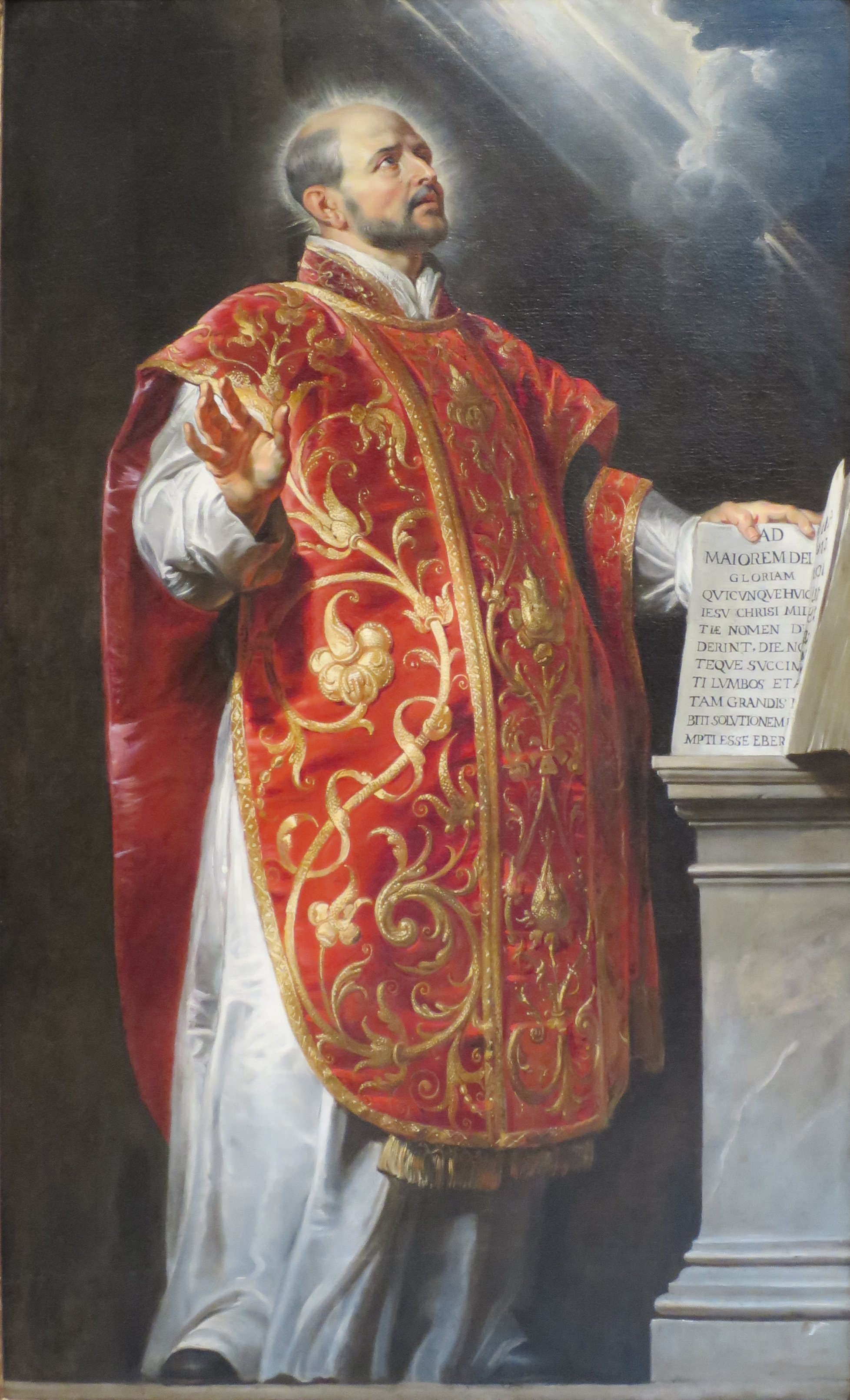
Saint Ignatius is normally depicted in black Jesuit clerical clothing, often holding the Spiritual Exercises, the Jesuit Constitutions, or a book inscribed with language referring to the greater glory of God. The IHS Christogram, closely associated with the Society of Jesus, frequently appears near him.
Some devotional art also depicts the cannonball at Pamplona, his surrender of the sword at Montserrat, or visions connected with his spiritual life. These scenes emphasize that Ignatius' identity cannot be understood without conversion: the soldier is never completely erased, but his entire understanding of victory is transformed.
FEAST DAY
The Catholic Church celebrates Saint Ignatius of Loyola on July 31, the anniversary of his death in Rome in 1556. Vatican News and the current Roman liturgical calendar both retain his memorial on that date.
His feast provides an especially fitting annual day to make an Examen, begin an Ignatian retreat, reconsider an important decision, pray the Suscipe, or ask for the grace to surrender some area of life that remains difficult to place completely in God's hands.
PRAYERS
The best prayer for a Saint Ignatius card is the Suscipe, because it comes directly from his own Spiritual Exercises. Unlike several popular prayers loosely attributed to him on the internet, its origin in Ignatius' text is secure.
A short card-sized excerpt can read:
“Take, Lord, and receive all my liberty, my memory, my understanding, and my entire will.”
Saint Ignatius of Loyola, Spiritual Exercises, 234
The larger prayer then returns everything received from God back to Him and asks only for God's love and grace. This makes it especially appropriate for discernment because the prayer seeks freedom from the demand that God's will conform to our preferred outcome.
FAQ
Who was Saint Ignatius of Loyola? Saint Ignatius was a sixteenth-century Spanish soldier who underwent a profound conversion after being badly wounded by a cannonball at Pamplona. He later became a Catholic priest, founded the Society of Jesus, developed the Spiritual Exercises, and became one of the Church's most influential teachers of discernment.
When did Saint Ignatius live? Ignatius was born in 1491 in the Basque Country and died in Rome on July 31, 1556. His life spanned the opening decades of the Protestant Reformation and the great expansion of Catholic missionary activity around the world.
When is Saint Ignatius of Loyola's feast day? His feast day is July 31. The Catholic Church celebrates his liturgical memorial on the anniversary of his death.
Was Saint Ignatius really a soldier? Yes. Before his conversion, Ignatius pursued the life and ideals of a soldier and courtier and participated in the defense of Pamplona. His military career effectively ended when a French cannonball shattered his leg in 1521.
What happened to Saint Ignatius at Pamplona? On May 20, 1521, a cannonball struck Ignatius during the defense of Pamplona, badly injuring his legs. The long recovery that followed became the setting in which his conversion began.
Why is the cannonball so important in Saint Ignatius' story? The wound destroyed the military future Ignatius had imagined and forced him into months of inactivity. During that interruption, reading about Christ and the saints redirected his ambitions toward a completely different kind of service.
Did Saint Ignatius have his leg broken again? Yes. Vatican News records that the first healing left his leg deformed, and the image-conscious Ignatius agreed to have it broken and reset because he was dissatisfied with its appearance.
What is Saint Ignatius the patron saint of? His clearest formal universal patronage is Spiritual Exercises and institutions devoted to them. Pope Pius XI officially declared him the heavenly patron of all Spiritual Exercises in 1922.
Is Saint Ignatius good for discernment? Yes, and discernment is one of the central contributions of Ignatian spirituality. The Society of Jesus explicitly identifies discernment as a key gift Ignatius gave through the Spiritual Exercises.
Can I pray to Saint Ignatius when making a major decision? Yes. His spirituality is particularly suited to decisions involving vocation, relationships, career, ministry, relocation, education, and other situations where several competing desires make God's direction difficult to recognize.
Is Saint Ignatius good for vocational discernment? Yes. The Spiritual Exercises are specifically designed to help a person become more attentive and responsive to God's will rather than remaining controlled by disordered attachments or fear.
Is Saint Ignatius associated with spiritual warfare? Yes. His rules for discernment examine how different spiritual movements influence the soul during consolation and desolation, helping Christians resist deception and remain faithful during temptation or confusion.
What is consolation in Ignatian spirituality? Consolation refers broadly to movements that increase faith, hope, love, orientation toward God, and genuine spiritual life. It is deeper than simply feeling happy because something difficult can still lead toward authentic consolation.
What is desolation in Ignatian spirituality? Desolation describes movements toward spiritual darkness, agitation, discouragement, isolation, loss of hope, or movement away from God. Ignatius teaches Christians to recognize desolation without allowing it automatically to dictate major decisions.
What are the Spiritual Exercises? They are a structured collection of meditations, contemplations, prayers, and methods developed by Saint Ignatius to help people grow in attentiveness and responsiveness to God. They are normally experienced with the guidance of a spiritual director rather than merely read as an ordinary book.
Did Saint Ignatius actually write the Spiritual Exercises? Yes. The Jesuit Roman archives preserve early Latin and Spanish texts, including manuscript material with annotations in Ignatius' own hand.
What is the Ignatian Examen? The Examen is a prayerful review of the day that helps a Christian notice God's presence, give thanks, recognize failures and graces, and become more attentive to patterns in spiritual life. The Office of Ignatian Spirituality notes that many versions exist because it is a method of prayer rather than one fixed formula.
What does “discernment of spirits” mean? It means learning to recognize the different movements acting upon the soul and judging them by their direction and fruit. Ignatius developed the practice from his own experience of noticing that some thoughts produced temporary excitement but lasting emptiness, while others led toward enduring peace and greater devotion to God.
Why did Saint Ignatius lay down his sword? At Montserrat, the former soldier kept a vigil before the Virgin Mary and laid down his sword as part of his break with his previous pursuit of worldly knighthood. The gesture symbolized his decision to place his courage and loyalty at the service of Christ.
Did Saint Ignatius go to the Holy Land? Yes. He traveled there hoping to remain and serve Christ, but ecclesiastical authorities required him to leave, so he returned to Europe.
Why did Saint Ignatius go back to school? Ignatius realized that serving the Church effectively required theological and academic preparation. He eventually studied at the University of Paris, where he formed the friendships that became the foundation of the Society of Jesus.
Who were Saint Ignatius' closest companions? Among the most important were Saint Francis Xavier and Saint Peter Faber. Together with several other companions, they made vows in Paris in 1534 and formed the nucleus of the future Jesuit order.
When were the Jesuits founded? The Society of Jesus was founded by Ignatius and his companions and received papal approval in 1540. Ignatius became its first Superior General.
What does Jesuit mean? Jesuit is the common name for a member of the Society of Jesus, the religious order founded by Ignatius and his companions. The order became especially known for missions, education, retreats, scholarship, spiritual direction, and service to the Church.
What does “Ad Maiorem Dei Gloriam” mean? The Latin phrase means “For the Greater Glory of God.” It became closely associated with Ignatian spirituality and summarizes the transformation of Ignatius' ambition from seeking his own glory toward seeking God's.
Is Saint Ignatius good for soldiers and veterans? Yes, as a historically grounded devotional association because Ignatius actually lived as a soldier before his conversion. His life can be particularly meaningful for wounded veterans or anyone whose military future has changed unexpectedly.
Is Saint Ignatius good for people recovering from an injury? Yes. His conversion began during a long and painful recovery from a devastating leg injury, making his story especially meaningful when illness or injury has interrupted a person's plans.
Is Saint Ignatius good for people changing careers? Yes. His own life moved from soldier and courtier to pilgrim, student, priest, spiritual director, and founder of a religious order, showing that a major change in vocation does not mean the experiences of an earlier life were wasted.
Is Saint Ignatius good for students? Yes, especially for students beginning again later in life or struggling to see the purpose of education. Ignatius himself undertook serious studies as an adult because the mission he had discerned required greater preparation.
Is Saint Ignatius good for retreats? Yes, and this is an official patronage rather than merely a loose association. Pope Pius XI declared him patron of Spiritual Exercises and institutions devoted to them.
What is the Suscipe prayer? The Suscipe is Ignatius' prayer of total self-offering found in paragraph 234 of the Spiritual Exercises. It gives liberty, memory, understanding, will, possessions, and the whole person back to God while asking for divine love and grace.
Did Saint Ignatius write the Anima Christi? No. Although the prayer appears in and became closely associated with the Spiritual Exercises, the official Church of the Gesù identifies the Anima Christi as a fourteenth-century prayer, meaning it predates Ignatius.
Where is Saint Ignatius buried? His tomb is in the Church of the Gesù in Rome, the mother church of the Society of Jesus. His body was placed in the urn at the Chapel of Saint Ignatius in 1637.
When was Saint Ignatius canonized? Pope Gregory XV canonized him on March 12, 1622. Saint Francis Xavier, Saint Teresa of Ávila, Saint Philip Neri, and Saint Isidore the Farmer were canonized in the same historic celebration.
What is the main message of Saint Ignatius of Loyola's life? His life teaches that God can use the collapse of the life we planned to reveal the life for which we were actually created. A cannonball destroyed Ignatius' military future, but in the silence of recovery he began noticing the difference between desires that temporarily excited him and those that drew him permanently toward Christ. The proud soldier eventually laid down his sword before the Mother of God, learned through struggle at Manresa how consolation and desolation operate in the soul, developed the Spiritual Exercises, gathered companions who became the Society of Jesus, and spent the rest of his life helping other people discern God's call. His great lesson is not simply that people should make better decisions. It is that we become capable of truly Christian decisions only when we become free enough to let God lead somewhere we did not originally intend to go.
Saint Ignatius of Loyola was a Spanish soldier turned priest, mystic, spiritual master, and founder of the Society of Jesus, the Jesuits. Born Íñigo López de Loyola in the Basque Country in 1491, he spent his youth pursuing military honor, courtly prestige, romance, and the ideals of knighthood. Everything changed in 1521, when a cannonball shattered his leg while he was defending Pamplona. Forced into a long recovery, the ambitious soldier began reading about Jesus Christ and the saints, and gradually discovered that the desires arising from thoughts of holiness left him with a lasting peace that his fantasies of worldly glory did not. That discovery became the beginning of his conversion and of what the Church now knows as Ignatian discernment of spirits.
Saint Ignatius is especially meaningful for discernment, major life decisions, conversion, spiritual warfare, retreats, vocation, recovery after injury, soldiers and veterans, spiritual directors, missionaries, students, and anyone trying to recognize God's will amid competing desires. His connection with discernment is not a modern devotional addition. The Society of Jesus identifies discernment as one of the central gifts Ignatius gave the Church through the Spiritual Exercises, teaching Christians to become attentive to the movements of consolation and desolation and to recognize where the Spirit of God is leading.
Ignatius is also the official heavenly patron of all Spiritual Exercises and of institutions associated with them. Pope Pius XI formally declared this patronage in 1922 and later described Ignatius as the Church's particular master of spiritual exercises, praising his method for helping Christians examine their lives, overcome disordered attachments, strengthen the will, and discern how to follow Christ.
For someone standing at a crossroads, Saint Ignatius is one of the strongest saints in Catholic tradition. His spirituality does not promise an immediate supernatural answer to every question. Instead, it teaches the Christian how to become free enough from fear, ego, vanity, attachment, and impulsive desire to ask a more demanding question: What choice actually leads me toward the purpose for which God created me?
This prayer card is especially fitting for someone discerning marriage, priesthood, religious life, the permanent diaconate, a career change, military service, relocation, conversion, education, a ministry, or another major decision. It can also be especially meaningful after a serious injury or unexpected event has completely changed someone's plans, because Ignatius' entire vocation began with what initially appeared to be a catastrophic interruption of the future he wanted.
Each 2.5" x 4.25" prayer card is handmade in Austin, Texas and prepared prayerfully with each order. It is printed on museum-quality photo paper rather than cardstock, double-laminated for durability, and made while the recipient and their intentions are lifted before Christ in prayer, with Saint Ignatius of Loyola asked to intercede for them.
THE LIFE & STORY
Saint Ignatius was born Íñigo López de Loyola in 1491 at Loyola Castle near Azpeitia, in the Basque region of northern Spain. He belonged to the lesser nobility and grew up admiring knights, military exploits, courtly life, and the pursuit of personal honor. Vatican News describes the young Íñigo as fascinated by sword fighting and military culture, ambitious for fame, and eager to imitate the heroic ideals celebrated in chivalric stories.
There was little in his early ambitions to suggest that he would become one of Catholicism's most influential spiritual teachers. He wanted earthly glory, and his imagination was filled with the kind of achievements that would make other people admire him. The transformation of those desires would eventually become one of the central themes of Ignatian spirituality: desire itself need not simply be destroyed, but purified and redirected toward the greater glory of God.
THE SOLDIER BEFORE THE SAINT
Ignatius served in the orbit of powerful Spanish nobles and developed the habits and ambitions of a courtier and soldier. Vatican sources remember him as courageous and intensely concerned with honor, reputation, appearance, and knightly ideals.
His military background remained spiritually significant even after his conversion. The Spiritual Exercises repeatedly use language of service, standards, kingship, struggle, discipline, and decision, but the battlefield is transformed. Instead of fighting for personal fame, the Christian is asked to place every gift, desire, possession, and ambition beneath the kingship of Christ.
THE CANNONBALL AT PAMPLONA
On May 20, 1521, Ignatius participated in the defense of Pamplona against French forces. During the fighting, a cannonball struck him and shattered one of his legs while seriously injuring the other. The wound ended the military future he had imagined and left him with a limp for the rest of his life.
The event is one of the most famous physical injuries in Christian history because the cannonball destroyed far more than bone. It shattered the life plan Ignatius had constructed around military prestige, worldly admiration, and personal glory.
HE HAD THE LEG BROKEN AGAIN
Ignatius' vanity did not disappear immediately after he was wounded. Vatican News preserves the striking detail that his injured leg healed badly, leaving a deformity that disturbed the appearance-conscious young nobleman so much that he agreed to have the bone broken and reset again without the benefit of modern anesthesia.
The episode shows how deeply attachment to appearance and status still controlled him. The man who would later teach Christians to free themselves from disordered attachments was beginning from personal experience rather than abstract theory.
THE BOOKS HE DID NOT WANT TO READ
During the long recovery at Loyola Castle, Ignatius asked for the chivalric romances he loved. None were available, so he was given religious books instead, including a Life of Christ and collections of the lives of the saints. At first these were substitutes for the entertainment he actually wanted, but eventually the stories of Christ, Saint Francis, Saint Dominic, and other saints began capturing his imagination.
Ignatius began asking himself what would happen if he attempted the kind of radical service to Christ that he admired in the saints. The same imagination that had once constructed fantasies of worldly greatness began constructing possibilities of sanctity.
THE DISCOVERY THAT CHANGED HIS LIFE
The decisive breakthrough came when Ignatius started paying attention not only to what he thought about, but to what remained in his soul afterward. Fantasies of worldly glory could excite him temporarily, but once the excitement passed he was left dissatisfied. Thoughts of following Christ and imitating the saints could also be demanding and difficult, yet afterward they left a deeper and more enduring peace.
Ignatius eventually recognized this as an important clue in distinguishing spiritual movements. Vatican News calls this his first introduction to what would become the discernment of spirits, while the Society of Jesus continues teaching discernment as attention to God's voice within the practical realities and movements of ordinary life.
A SAINT FOR DISCERNMENT
This makes Saint Ignatius particularly powerful for someone who cannot tell the difference between what they strongly want and what God may actually be calling them toward. Ignatian discernment does not treat every pleasant feeling as God's voice or every unpleasant feeling as a warning.
Instead, Ignatius learned to examine the direction and lasting fruit of interior movements. Some desires pull the Christian toward greater faith, hope, love, freedom, courage, and surrender to God, while others initially appear attractive but eventually produce confusion, isolation, pride, despair, or spiritual paralysis.
A SAINT FOR MAJOR LIFE DECISIONS
Saint Ignatius is especially meaningful when two or more legitimate possibilities are competing for attention. Choosing between good things can sometimes be harder than choosing between obvious good and evil, particularly when career, family, vocation, finances, relationships, and fear all exert pressure simultaneously.
Ignatian spirituality seeks enough interior freedom that the person can stop asking only, “Which option do I prefer?” and begin asking, “Which option most helps me become the person God created me to be?” The Society of Jesus summarizes the goal of discernment through Ignatius' own language of desiring and choosing what most conduces to the purpose for which we were created.
MONTSERRAT: THE SOLDIER LAYS DOWN HIS SWORD
After recovering enough to travel, Ignatius set out on pilgrimage and eventually arrived at the great Marian shrine of Montserrat. There, the former soldier exchanged his fine clothing for the clothing of a poor man and spent the night in vigil before the Virgin Mary. He then laid down his sword, symbolically leaving behind the kind of knight he had once wanted to become.
The scene is one of the most striking images in his Life. The sword itself was not the ultimate problem, because Ignatius' courage and discipline would later serve Christ powerfully. What had to change was the lord for whom the soldier was fighting.
A DIFFERENT KIND OF KNIGHT
Vatican News describes Montserrat as the moment when Ignatius began understanding himself as a different kind of knight, serving a different Lord. His imagination still contained the language of loyalty, sacrifice, service, courage, and great deeds, but Christ now occupied the center.
For soldiers and veterans, this is one reason Ignatius can be especially meaningful even without reducing him to a narrow military patronage. His conversion did not erase every virtue learned through martial life. It redirected courage, discipline, endurance, strategic thinking, and willingness to sacrifice toward the service of God.
MANRESA
Ignatius then spent roughly a year at Manresa, where his spiritual life deepened dramatically. He lived in poverty, prayed intensely, practiced severe penance, and passed through periods of profound consolation as well as terrible spiritual darkness.
Manresa became the great spiritual laboratory of Ignatius' life. He studied the movements of his own soul with extraordinary attention and gradually developed principles that could help other Christians understand temptation, consolation, desolation, freedom, and decision.
HIS STRUGGLE WITH SCRUPLES
Ignatius' early zeal was not always spiritually healthy. His intense examination of conscience sometimes became obsessive, and he suffered periods of scrupulosity and near despair, repeatedly returning to sins he had already confessed and struggling to trust God's mercy. Vatican News notes the severe desolation through which he had to work before gaining greater spiritual clarity.
That experience later helped him distinguish genuine repentance from forms of spiritual attack that use guilt to keep a person trapped in endless self-accusation. Ignatian spirituality is therefore not simply about detecting sin more intensely. It is about becoming spiritually free enough to receive mercy, resist deception, and move forward in serving God.
SPIRITUAL WARFARE
Few Western saints developed a more systematic practical understanding of spiritual warfare than Ignatius. His Spiritual Exercises examine how good and evil spirits work differently upon a person depending on the direction of the person's spiritual life, and they teach concrete rules for responding during consolation and desolation.
Ignatius understood that temptation is not always obvious. The enemy may sometimes work through discouragement, false reasoning, attractive but disordered desires, excessive fear, or even apparently religious thoughts that gradually lead someone away from peace, obedience, charity, or their actual vocation. The Jesuits continue presenting discernment as learning to identify these movements so that a Christian can respond more freely to God's Spirit.
A SAINT FOR SPIRITUAL WARFARE
A Saint Ignatius prayer card can therefore be especially meaningful during confusion, temptation, discouragement, spiritual dryness, repeated indecision, or a period in which prayer feels unusually difficult. His approach encourages the believer not to panic simply because feelings change.
Ignatius teaches that important decisions should not be recklessly reversed in periods of spiritual desolation. Instead, the Christian continues prayer, examines what is happening, uses reason, seeks wise counsel, and waits for greater freedom and clarity before making unnecessary changes.
THE SPIRITUAL EXERCISES
The insights Ignatius accumulated during and after Manresa eventually developed into the Spiritual Exercises, one of the most influential manuals of Christian spiritual formation ever written. The Society of Jesus describes the Exercises as a structured collection of meditations, prayers, contemplative practices, and methods designed to increase attentiveness, openness, and responsiveness to God.
The earliest surviving manuscripts remain in the archives of the Society of Jesus. The Jesuit Roman archive identifies an early Latin text prepared in 1541 and the earliest surviving Spanish text prepared between 1544 and 1548, with annotations in Ignatius' own hand.
WHAT ARE THE SPIRITUAL EXERCISES FOR?
The Exercises are not primarily a book meant to be read quickly from beginning to end. They form a guided process through which a retreatant examines sin and mercy, contemplates the life of Christ, learns greater spiritual freedom, discerns God's call, and eventually makes a more complete offering of life to God.
Pope Pius XI praised the method because it helps train the mind to weigh things carefully, strengthens the will, brings the passions beneath right order, and assists Christians in directing their lives more deliberately toward God.
OFFICIAL PATRON OF SPIRITUAL EXERCISES
Saint Ignatius has a formal patronage unusually well documented by the Holy See. In 1922, Pope Pius XI declared him the heavenly patron of all Spiritual Exercises and of institutions and organizations assisting people who make them.
This makes him especially appropriate for retreatants, retreat directors, spiritual directors, seminarians, religious, and lay Catholics entering an Ignatian retreat. A prayer card can be carried throughout the retreat as a reminder to ask for the same freedom and clarity Ignatius gradually learned through his own struggles.
THE EXAMEN
One of the best-known practices associated with Ignatian spirituality is the daily Examen, a structured prayerful review of the day. The Office of Ignatian Spirituality describes it as a reflective practice rather than one fixed set of mandatory words, helping Christians recognize God's presence, review their responses, notice patterns, and prepare to live the next day more freely.
The Examen differs from simply making a list of failures. It asks the believer to notice grace as well as sin, gratitude as well as repentance, and the movements through which God may already be directing future decisions.
FINDING GOD IN ALL THINGS
Ignatian spirituality became famous for the conviction that God can be encountered not only during formal prayer but throughout ordinary human experience. The contemporary Society of Jesus continues describing its spirituality in terms of discernment, attention to God's action, and finding God in all things.
This does not mean that everything that happens is automatically God's will. It means that there is no part of ordinary life, including work, relationships, suffering, decisions, service, study, and responsibility, that must remain spiritually meaningless.
THE HOLY LAND
Ignatius eventually fulfilled his desire to travel to the Holy Land, intending at first to remain there and devote himself to evangelization. Church authorities, however, did not permit him to stay permanently, and he returned to Europe.
That disappointment became another important lesson in discernment. Ignatius had sincerely wanted something holy, yet a sincere desire for a holy thing did not automatically mean it was God's final plan for him.
SOMETIMES GOD CLOSES THE GOOD DOOR
Ignatius' inability to remain in the Holy Land makes him especially meaningful when a person believes a good plan must succeed simply because the intention behind it is religious. His life shows that God can close a genuinely good door because another vocation is being prepared.
Had Ignatius remained in Jerusalem, the later Society of Jesus might never have developed in the same form. A disappointment that appeared to interrupt his mission became part of the path toward a much larger one.
THE OLDER STUDENT
Ignatius recognized that if he was going to teach and serve the Church effectively, spiritual enthusiasm alone was insufficient. He therefore returned to formal education, studying in Spain and eventually at the University of Paris, despite being considerably older than many ordinary students.
This makes him particularly meaningful for adults returning to school, seminarians beginning formation later in life, people changing careers, and anyone embarrassed to begin again. Ignatius' life had already changed dramatically, and he was willing to become a student because the mission ahead required preparation.
FRANCIS XAVIER & PETER FABER
At Paris, Ignatius formed friendships that would alter Christian history. Among his companions were Saint Francis Xavier, another Basque, and Saint Peter Faber, a gifted spiritual director from Savoy.
Their personalities and future missions were very different, yet Ignatius gradually gathered them around a common desire to serve Christ. The Society of Jesus emerged not from one man's solitary plan but from a group eventually known as friends in the Lord.
THE VOWS AT MONTMARTRE
On August 15, 1534, Ignatius and six companions made vows together at Montmartre in Paris. They hoped to serve Christ in the Holy Land, but if that proved impossible they would place themselves at the service of the Pope for whatever mission the Church required.
The group eventually became the nucleus of the Society of Jesus. The failed Holy Land plan had not ended Ignatius' mission because it had redirected the mission toward a form he could not have predicted during his recovery at Loyola.
THE SOCIETY OF JESUS
The Society of Jesus was formally established in 1540, when Pope Paul III approved the new religious order. The Jesuits became known for missionary work, education, preaching, spiritual direction, scholarship, and service to the Church around the world.
Ignatius became the Society's first Superior General and spent the remainder of his life largely in Rome, organizing missions, writing letters, directing Jesuits, and shaping the Constitutions of the order rather than personally traveling to all the distant places his companions reached.
THE FORMER SOLDIER BUILDS A SPIRITUAL ARMY
The name Society of Jesus expresses where Ignatius' military imagination ultimately arrived. He had once wanted to win glory through earthly warfare. He now gathered men willing to be sent anywhere for Christ and the service of the Church.
The analogy should not be pushed into glorifying violence. The Jesuit battlefields were universities, missions, confessionals, hospitals, courts, foreign cultures, intellectual controversies, and places where Christians needed disciplined service.
AD MAIOREM DEI GLORIAM
Ignatian spirituality became closely associated with the Latin phrase Ad Maiorem Dei Gloriam, commonly translated “For the Greater Glory of God.” The principle captures Ignatius' transformed ambition: the desire to do something great did not disappear, but greatness was no longer measured primarily by how much glory returned to Ignatius himself.
For someone ambitious in business, military service, athletics, academics, or ministry, this can be an especially important devotion. Christianity does not always require becoming less driven. Sometimes it requires asking whose glory the drive is serving.
A SAINT FOR SOLDIERS & VETERANS
Saint Ignatius' genuine military background makes him naturally meaningful for soldiers, veterans, wounded service members, and people struggling to understand who they are when an intended military future changes. Vatican News specifically remembers his courage as a soldier and the cannonball wound that ended that phase of his life.
His story can be particularly powerful after injury because Ignatius initially saw his damaged body as an obstacle to the life he wanted. In retrospect, the injury became the doorway into a vocation whose influence far exceeded the military glory he had imagined.
A SAINT FOR RECOVERY AFTER INJURY
The cannonball did not produce instant holiness. Recovery was painful, prolonged, and filled with frustration, vanity, boredom, and uncertainty. That makes Ignatius more useful devotionally than a story in which suffering immediately produces perfect serenity.
Someone recovering from a serious accident or surgery can ask his intercession not only for physical healing but for the grace to recognize what God may be doing during a period when ordinary plans have been interrupted.
A SAINT FOR CAREER CHANGES
Ignatius underwent one of the most radical career transformations imaginable, from aspiring soldier and courtier to pilgrim, adult student, priest, spiritual director, and founder of a worldwide religious order. His vocation developed in stages rather than arriving as a complete plan the day he was wounded.
For someone afraid that changing direction means previous years were wasted, his life offers another possibility. God can use skills formed during an earlier vocation while redirecting them toward an entirely different mission.
A SAINT FOR VOCATIONAL DISCERNMENT
Saint Ignatius is especially appropriate for someone asking whether God is calling them to marriage, priesthood, religious life, missionary work, diaconal service, or another demanding vocation. His Spiritual Exercises were specifically designed to increase freedom and responsiveness to divine will.
Ignatian discernment does not simply ask which vocation sounds most impressive. It examines desires, abilities, obligations, spiritual movements, circumstances, and the fruit each possibility is likely to produce in one's relationship with God and neighbor.
A SAINT FOR SPIRITUAL DIRECTORS
Ignatius did not merely discover spiritual principles for himself. He learned how to accompany other people without attempting to replace their conscience or dictate every answer.
The Spiritual Exercises are fundamentally designed for guided accompaniment, and the Society of Jesus describes them as especially intended for spiritual directors who help retreatants become more attentive and responsive to God's action.
A SAINT FOR STUDENTS & EDUCATORS
Although Ignatius is most famous for spirituality, the religious order he founded became one of the greatest educational forces in Catholic history. His own willingness to return to study as an adult also gives him a natural connection with students who are struggling academically or beginning education later than expected.
Jesuit education eventually developed across continents, joining intellectual rigor with formation of character and service. The founder who once needed to become a student himself helped create a religious community whose schools and universities would educate generations.
A SAINT FOR MISSIONARIES
Ignatius himself did not reach distant missions like his companion Saint Francis Xavier, but he became a missionary leader who sent Jesuits throughout the world. Vatican News emphasizes that as Superior General he directed his companions outward into mission while he remained in Rome coordinating the growing Society.
His life therefore shows that missionary vocation can involve both going and sending. Someone may serve God by crossing oceans, while another serves by forming, supporting, organizing, funding, and praying for those who go.
HIS MYSTICAL LIFE
Ignatius should not be reduced to a practical decision-making system. His discernment grew from an intense mystical life that included powerful experiences of the Trinity, deep prayer, tears, and a growing ability to perceive God's presence throughout ordinary reality.
The practical rules of the Spiritual Exercises emerged from contemplation. Ignatius learned to make decisions because he first learned to pay attention to God.
THE SUSCIPE
One of the greatest prayers associated securely with Saint Ignatius appears in paragraph 234 of the Spiritual Exercises, during the Contemplation to Attain Love. The official Church of the Gesù in Rome identifies the prayer explicitly as belonging to Ignatius' Spiritual Exercises.
Its opening provides an ideal prayer-card text:
“Take, Lord, and receive all my liberty, my memory, my understanding, and my entire will.”
The remainder offers everything one possesses back to God and asks in return only for divine love and grace. The prayer is therefore the mature answer to the young Ignatius who once wanted glory for himself: eventually he asks God to take everything.
A NOTE ABOUT THE ANIMA CHRISTI
The beautiful Anima Christi, beginning “Soul of Christ, sanctify me,” appears in editions of the Spiritual Exercises and became strongly associated with Ignatian prayer. It was not actually written by Saint Ignatius because the Church of the Gesù identifies it as a fourteenth-century prayer, predating him by more than a century.
This distinction matters for a historically accurate prayer card. The Suscipe is the better choice when an authentic prayer written by Ignatius himself is desired.
DEATH IN ROME
Ignatius suffered significant health problems during his later years. The Italian Jesuits record that he died in Rome on the morning of July 31, 1556, at the age of sixty-five, after spending his final years directing the Society of Jesus.
He had traveled an astonishing spiritual distance from the wounded soldier at Pamplona. The man once obsessed with visible honor died as the leader of a religious community deliberately named not for himself, but for Jesus.
CANONIZATION
Ignatius was beatified by Pope Paul V in 1609 and canonized on March 12, 1622 by Pope Gregory XV. The canonization was extraordinary because Saint Francis Xavier, Saint Teresa of Ávila, Saint Philip Neri, and Saint Isidore the Farmer were canonized in the same celebration.
His spiritual influence continued expanding afterward, especially through Jesuit missions, schools, retreat houses, parishes, seminaries, and the worldwide use of the Spiritual Exercises.
WHERE ARE SAINT IGNATIUS' RELICS?
Saint Ignatius' tomb is preserved in the Church of the Gesù in Rome, the mother church of the Society of Jesus. The church itself officially identifies the shrine as the tomb of the founder of the Jesuits, while the Italian Jesuits record that his body was transferred into the urn in the Chapel of Saint Ignatius in 1637.
The Gesù is therefore the principal pilgrimage destination for someone specifically seeking Saint Ignatius' tomb. The Jesuit historical archive in Rome also preserves a verified second-class relic consisting of a fragment from a garment that belonged to him.
ICONOGRAPHY
Saint Ignatius is normally depicted in black Jesuit clerical clothing, often holding the Spiritual Exercises, the Jesuit Constitutions, or a book inscribed with language referring to the greater glory of God. The IHS Christogram, closely associated with the Society of Jesus, frequently appears near him.
Some devotional art also depicts the cannonball at Pamplona, his surrender of the sword at Montserrat, or visions connected with his spiritual life. These scenes emphasize that Ignatius' identity cannot be understood without conversion: the soldier is never completely erased, but his entire understanding of victory is transformed.
FEAST DAY
The Catholic Church celebrates Saint Ignatius of Loyola on July 31, the anniversary of his death in Rome in 1556. Vatican News and the current Roman liturgical calendar both retain his memorial on that date.
His feast provides an especially fitting annual day to make an Examen, begin an Ignatian retreat, reconsider an important decision, pray the Suscipe, or ask for the grace to surrender some area of life that remains difficult to place completely in God's hands.
PRAYERS
The best prayer for a Saint Ignatius card is the Suscipe, because it comes directly from his own Spiritual Exercises. Unlike several popular prayers loosely attributed to him on the internet, its origin in Ignatius' text is secure.
A short card-sized excerpt can read:
“Take, Lord, and receive all my liberty, my memory, my understanding, and my entire will.”
Saint Ignatius of Loyola, Spiritual Exercises, 234
The larger prayer then returns everything received from God back to Him and asks only for God's love and grace. This makes it especially appropriate for discernment because the prayer seeks freedom from the demand that God's will conform to our preferred outcome.
FAQ
Who was Saint Ignatius of Loyola? Saint Ignatius was a sixteenth-century Spanish soldier who underwent a profound conversion after being badly wounded by a cannonball at Pamplona. He later became a Catholic priest, founded the Society of Jesus, developed the Spiritual Exercises, and became one of the Church's most influential teachers of discernment.
When did Saint Ignatius live? Ignatius was born in 1491 in the Basque Country and died in Rome on July 31, 1556. His life spanned the opening decades of the Protestant Reformation and the great expansion of Catholic missionary activity around the world.
When is Saint Ignatius of Loyola's feast day? His feast day is July 31. The Catholic Church celebrates his liturgical memorial on the anniversary of his death.
Was Saint Ignatius really a soldier? Yes. Before his conversion, Ignatius pursued the life and ideals of a soldier and courtier and participated in the defense of Pamplona. His military career effectively ended when a French cannonball shattered his leg in 1521.
What happened to Saint Ignatius at Pamplona? On May 20, 1521, a cannonball struck Ignatius during the defense of Pamplona, badly injuring his legs. The long recovery that followed became the setting in which his conversion began.
Why is the cannonball so important in Saint Ignatius' story? The wound destroyed the military future Ignatius had imagined and forced him into months of inactivity. During that interruption, reading about Christ and the saints redirected his ambitions toward a completely different kind of service.
Did Saint Ignatius have his leg broken again? Yes. Vatican News records that the first healing left his leg deformed, and the image-conscious Ignatius agreed to have it broken and reset because he was dissatisfied with its appearance.
What is Saint Ignatius the patron saint of? His clearest formal universal patronage is Spiritual Exercises and institutions devoted to them. Pope Pius XI officially declared him the heavenly patron of all Spiritual Exercises in 1922.
Is Saint Ignatius good for discernment? Yes, and discernment is one of the central contributions of Ignatian spirituality. The Society of Jesus explicitly identifies discernment as a key gift Ignatius gave through the Spiritual Exercises.
Can I pray to Saint Ignatius when making a major decision? Yes. His spirituality is particularly suited to decisions involving vocation, relationships, career, ministry, relocation, education, and other situations where several competing desires make God's direction difficult to recognize.
Is Saint Ignatius good for vocational discernment? Yes. The Spiritual Exercises are specifically designed to help a person become more attentive and responsive to God's will rather than remaining controlled by disordered attachments or fear.
Is Saint Ignatius associated with spiritual warfare? Yes. His rules for discernment examine how different spiritual movements influence the soul during consolation and desolation, helping Christians resist deception and remain faithful during temptation or confusion.
What is consolation in Ignatian spirituality? Consolation refers broadly to movements that increase faith, hope, love, orientation toward God, and genuine spiritual life. It is deeper than simply feeling happy because something difficult can still lead toward authentic consolation.
What is desolation in Ignatian spirituality? Desolation describes movements toward spiritual darkness, agitation, discouragement, isolation, loss of hope, or movement away from God. Ignatius teaches Christians to recognize desolation without allowing it automatically to dictate major decisions.
What are the Spiritual Exercises? They are a structured collection of meditations, contemplations, prayers, and methods developed by Saint Ignatius to help people grow in attentiveness and responsiveness to God. They are normally experienced with the guidance of a spiritual director rather than merely read as an ordinary book.
Did Saint Ignatius actually write the Spiritual Exercises? Yes. The Jesuit Roman archives preserve early Latin and Spanish texts, including manuscript material with annotations in Ignatius' own hand.
What is the Ignatian Examen? The Examen is a prayerful review of the day that helps a Christian notice God's presence, give thanks, recognize failures and graces, and become more attentive to patterns in spiritual life. The Office of Ignatian Spirituality notes that many versions exist because it is a method of prayer rather than one fixed formula.
What does “discernment of spirits” mean? It means learning to recognize the different movements acting upon the soul and judging them by their direction and fruit. Ignatius developed the practice from his own experience of noticing that some thoughts produced temporary excitement but lasting emptiness, while others led toward enduring peace and greater devotion to God.
Why did Saint Ignatius lay down his sword? At Montserrat, the former soldier kept a vigil before the Virgin Mary and laid down his sword as part of his break with his previous pursuit of worldly knighthood. The gesture symbolized his decision to place his courage and loyalty at the service of Christ.
Did Saint Ignatius go to the Holy Land? Yes. He traveled there hoping to remain and serve Christ, but ecclesiastical authorities required him to leave, so he returned to Europe.
Why did Saint Ignatius go back to school? Ignatius realized that serving the Church effectively required theological and academic preparation. He eventually studied at the University of Paris, where he formed the friendships that became the foundation of the Society of Jesus.
Who were Saint Ignatius' closest companions? Among the most important were Saint Francis Xavier and Saint Peter Faber. Together with several other companions, they made vows in Paris in 1534 and formed the nucleus of the future Jesuit order.
When were the Jesuits founded? The Society of Jesus was founded by Ignatius and his companions and received papal approval in 1540. Ignatius became its first Superior General.
What does Jesuit mean? Jesuit is the common name for a member of the Society of Jesus, the religious order founded by Ignatius and his companions. The order became especially known for missions, education, retreats, scholarship, spiritual direction, and service to the Church.
What does “Ad Maiorem Dei Gloriam” mean? The Latin phrase means “For the Greater Glory of God.” It became closely associated with Ignatian spirituality and summarizes the transformation of Ignatius' ambition from seeking his own glory toward seeking God's.
Is Saint Ignatius good for soldiers and veterans? Yes, as a historically grounded devotional association because Ignatius actually lived as a soldier before his conversion. His life can be particularly meaningful for wounded veterans or anyone whose military future has changed unexpectedly.
Is Saint Ignatius good for people recovering from an injury? Yes. His conversion began during a long and painful recovery from a devastating leg injury, making his story especially meaningful when illness or injury has interrupted a person's plans.
Is Saint Ignatius good for people changing careers? Yes. His own life moved from soldier and courtier to pilgrim, student, priest, spiritual director, and founder of a religious order, showing that a major change in vocation does not mean the experiences of an earlier life were wasted.
Is Saint Ignatius good for students? Yes, especially for students beginning again later in life or struggling to see the purpose of education. Ignatius himself undertook serious studies as an adult because the mission he had discerned required greater preparation.
Is Saint Ignatius good for retreats? Yes, and this is an official patronage rather than merely a loose association. Pope Pius XI declared him patron of Spiritual Exercises and institutions devoted to them.
What is the Suscipe prayer? The Suscipe is Ignatius' prayer of total self-offering found in paragraph 234 of the Spiritual Exercises. It gives liberty, memory, understanding, will, possessions, and the whole person back to God while asking for divine love and grace.
Did Saint Ignatius write the Anima Christi? No. Although the prayer appears in and became closely associated with the Spiritual Exercises, the official Church of the Gesù identifies the Anima Christi as a fourteenth-century prayer, meaning it predates Ignatius.
Where is Saint Ignatius buried? His tomb is in the Church of the Gesù in Rome, the mother church of the Society of Jesus. His body was placed in the urn at the Chapel of Saint Ignatius in 1637.
When was Saint Ignatius canonized? Pope Gregory XV canonized him on March 12, 1622. Saint Francis Xavier, Saint Teresa of Ávila, Saint Philip Neri, and Saint Isidore the Farmer were canonized in the same historic celebration.
What is the main message of Saint Ignatius of Loyola's life? His life teaches that God can use the collapse of the life we planned to reveal the life for which we were actually created. A cannonball destroyed Ignatius' military future, but in the silence of recovery he began noticing the difference between desires that temporarily excited him and those that drew him permanently toward Christ. The proud soldier eventually laid down his sword before the Mother of God, learned through struggle at Manresa how consolation and desolation operate in the soul, developed the Spiritual Exercises, gathered companions who became the Society of Jesus, and spent the rest of his life helping other people discern God's call. His great lesson is not simply that people should make better decisions. It is that we become capable of truly Christian decisions only when we become free enough to let God lead somewhere we did not originally intend to go.