 Image 1 of 1
Saint Innocent of Alaska Prayer Card - For Missionaries, Evangelization, Teachers & Translators
Saint Innocent of Alaska, Equal to the Apostles and Enlightener of North America, was one of the greatest Orthodox missionaries of the nineteenth century and one of the foundational saints of Christianity in Alaska. Born John Popov-Veniaminov in Siberia in 1797, he served first as a married parish priest and father, volunteered for an extraordinarily difficult mission to the Aleutian Islands, learned Indigenous languages, translated Scripture and worship into those languages, built churches and schools, traveled across dangerous northern seas to reach isolated communities, became a widower and monk, served as missionary bishop across Alaska and Siberia, and eventually became Metropolitan of Moscow. The Orthodox Church honors him as Equal to the Apostles because evangelization shaped virtually his entire adult life.
Saint Innocent is especially meaningful for missionaries, translators, teachers, priests, deacons, seminarians, parish founders, Christian writers, people learning a new language to serve others, families discerning a difficult move, and anyone afraid that God's call is larger than their abilities. His life also has particular significance for married clergy and their families because his first great missionary work in Alaska was undertaken not as a solitary monk but as a married priest accompanied by his wife, children, and relatives. Only after the death of his wife did he later receive monastic tonsure and enter the episcopate.
His approach to evangelization remains remarkably important today. Saint Innocent did not simply arrive among the Unangan people and demand that they first become culturally Russian in order to become Christian. He learned their language, worked with local collaborators, created written materials in the language people actually spoke, studied customs carefully, taught practical skills, established schools, and waited for people to desire Baptism rather than forcing conversion. The OCA's history of the Alaskan mission specifically identifies linguistic adaptability, cultural sensitivity, and educational outreach as defining characteristics of the missionary tradition represented by Saints Innocent and Jacob Netsvetov.
This makes Saint Innocent an especially meaningful intercessor for Christians trying to share the Gospel across cultural boundaries. His example teaches that evangelization is not accomplished merely by speaking more loudly because the missionary must first love people enough to listen, learn how they understand the world, communicate in language they can grasp, and present Christ without treating another people's cultural identity as an obstacle to salvation.
Saint Innocent is equally powerful for people facing distance, isolation, dangerous travel, exhausting work, or a vocation that seems logistically impossible. His Alaskan parish extended across islands separated by violent seas, and he routinely traveled in small boats through dangerous conditions in order to celebrate the sacraments and teach communities scattered across enormous distances. The official Akathist to Saint Innocent remembers him as a courageous voyager who endured storms and hardship for the Gospel, while his Kontakion specifically praises his perseverance through dangers and tribulations.
He is also an excellent saint for Christian education and translation. Saint Innocent developed a writing system using Cyrillic characters for the Unangan language used in the Fox Islands, collaborated with Indigenous Christians such as Ivan Pan'kov, translated the Gospel according to Matthew, prayers, hymns, and catechetical materials, composed educational texts, and later worked with other languages across Alaska and Siberia. His missionary vision was simple but profound: if people were going to receive Christianity deeply, they needed to hear and pray the faith in words they could actually understand.
Saint Innocent therefore belongs among the most important saints for Christians who believe that teaching itself can be missionary work. A translator, teacher, catechist, linguist, writer, homeschool parent, Bible teacher, parish educator, or missionary preparing materials for another culture can all recognize something of their vocation within his life.
This prayer card is created for missionaries, clergy, teachers, translators, writers, parish planters, people relocating for ministry, Christians serving Indigenous or multilingual communities, married clergy families, widows and widowers discerning what comes after loss, and anyone asking God for courage to follow a difficult vocation. It is also especially fitting for Orthodox Christians in Alaska and North America, where Saint Innocent is honored as one of the great fathers of the Church's missionary inheritance.
Each card is handmade in Austin, TX and created to order. We do not keep stock, because every prayer card is treated as a unique devotional offering. They are printed on museum-quality photo paper, not cardstock, and every card is made slowly during prayer with intentional reverence for the saint and for the person who will receive it. Names are lifted before Christ, intentions are held carefully, and each piece is handled multiple times in prayerful silence, asking God for mercy and asking Saint Innocent to intercede for the soul it is being made for. This is devotional craftsmanship shaped with patience, care, and spiritual responsibility because every soul and every prayer matters.
THE LIFE & STORY
Saint Innocent was born John Evseyevich Popov-Veniaminov on August 26, 1797, in the Siberian village of Anginskoye in the Irkutsk region. His father served the local church, and the young John was introduced to reading and church life at an early age. His father died when John was still a small child, and in 1807 the boy entered the theological seminary at Irkutsk, where his education prepared him for the remarkably varied work he would later perform as priest, teacher, linguist, craftsman, missionary, bishop, and administrator.
John did not begin his ministry as a monk. In 1817 he married, and that same year he was ordained to the diaconate at the Church of the Annunciation in Irkutsk. After completing his studies, he taught in a parish school and was ordained to the priesthood in 1821, beginning what might easily have become a stable and respected parish ministry close to home.
Then a call came from far beyond everything familiar.
In 1823 Bishop Michael of Irkutsk needed a priest willing to travel to Unalaska in the Aleutian Islands. The assignment was so difficult that the clergy who were approached initially showed little desire to volunteer, and John himself did not immediately embrace the idea. According to the OCA's official account, however, something changed within him, and he became filled with a desire to serve people who were eager to learn more about Christ.
Father John left Irkutsk on May 7, 1823 accompanied by his family. The OCA records his aging mother, his wife, his infant son Innocent, and his brother Stefan among those who set out with him, while its broader history of the Alaskan mission also remembers his wife and children making the journey into this remote missionary world. The trip required more than a year, and they finally reached Unalaska on July 29, 1824.
The difference between their former life and their new one was immediate. The family initially lived in extremely poor conditions, but Father John began building rather than complaining about what was missing. He trained local people in carpentry, metalworking, blacksmithing, masonry, and other trades and worked with them to construct a church dedicated to the Ascension of Christ, which was consecrated in 1826.
This practical dimension of his ministry is one reason Saint Innocent's story feels so different from a purely academic picture of missionary work. He could preach a sermon, translate Scripture, build a church, repair equipment, teach a trade, establish a school, and cross dangerous seas to celebrate the Divine Liturgy.
His hands and his mind belonged to the same vocation.
The parish entrusted to Father John covered not only Unalaska but surrounding islands and communities. Reaching his people meant traveling repeatedly through the northern Pacific in small boats and sea kayaks, sometimes through violent storms. The OCA records that the accumulated strain of this travel eventually caused him lasting pain and problems in his legs, but the enormous geography never persuaded him that isolated Christians should simply go without a priest.
One of his first priorities was language. Father John learned the local Unangan language and its dialects instead of expecting everyone to approach Christianity through Russian. He eventually mastered several local forms of speech, helped develop an alphabet using Cyrillic characters, and translated Scripture, prayers, hymns, and catechetical material so that the faith could be heard in the people's own language.
This work was not accomplished by Father John alone. The OCA's history specifically names Ivan Pan'kov, an Unangan leader, as a collaborator in translation of the Gospel according to Saint Matthew and a catechism. That detail is important because Orthodox Christianity in Alaska developed not simply through foreign missionaries doing everything for Indigenous people but through Indigenous Christians themselves becoming teachers, translators, clergy, and evangelists.
Father John and his collaborators also established a parish school in Unalaska in 1828. He wrote and translated educational materials, taught children, and connected Christian formation with broader education and practical skills.
His famous catechetical work The Indication of the Way into the Kingdom of Heaven grew from this same missionary world. Saint Innocent wrote it for ordinary believers rather than producing theology intended only for scholars, and the work became one of his enduring contributions to Orthodox missionary spirituality. The OCA records that he composed it in the Aleut language and later submitted it with his Scripture and catechetical translations for ecclesiastical approval.
The title itself summarizes Saint Innocent's approach to ministry. The missionary's task is not to make people admire the missionary.
It is to indicate the way toward the Kingdom.
Father John also traveled beyond the islands entrusted directly to him. In 1829 he journeyed to the mainland around Nushagak and preached among communities along the Bering Sea coast, baptizing those who freely embraced Christianity.
In 1834, he was transferred to Sitka, then known as New Archangel, where a new missionary challenge awaited him among the Tlingit people. Once again his first response was not simply to begin speaking through an interpreter about a culture he had not studied. He worked to learn the Tlingit language, customs, and worldview so that his preaching could be understood within the actual lives of the people he was serving.
The OCA's account emphasizes that Saint Innocent did not force Baptism upon people. He waited for individuals to express a genuine desire to become Christian and taught in a manner that respected freedom, while his educational and practical service gradually created trust. He established schooling, prepared texts, taught trades, and even shared medical knowledge during his years among the Tlingit.
This aspect of his missionary practice deserves particular attention because it provides a model of Christian evangelization that is both uncompromising about the Gospel and respectful of the human person. Saint Innocent wanted people to become Christians, but he did not believe the Gospel needed coercion in order to succeed.
MISSIONARY WORK WITHOUT ERASING CULTURE
Saint Innocent's missionary method is one of the strongest reasons he remains relevant for Christians today. He did not treat the languages of the people he encountered as obstacles that should disappear, but as languages capable of carrying Scripture, prayer, theology, and Divine Liturgy.
This meant learning before teaching.
He studied pronunciation, grammar, customs, social life, geography, and traditional patterns of thought. He then worked to communicate the Christian faith in terms understandable to the people before him rather than requiring them first to enter a Russian cultural world.
The distinction is extremely important.
Christian evangelization asks every culture to encounter Christ and therefore eventually challenges whatever within that culture is incompatible with the Gospel. Yet Christianity does not teach that salvation requires a person to abandon every legitimate feature of language, family life, artistic tradition, or cultural identity.
The OCA's historical assessment of the Alaskan mission specifically praises its linguistic adaptability, cultural sensitivity, and educational outreach, and it describes the resulting Orthodox Church in Alaska as developing with a strongly Indigenous character rather than simply functioning as a foreign Russian enclave.
Saint Innocent therefore makes a particularly meaningful intercessor for missionaries serving across ethnic and linguistic boundaries. His example encourages them to ask not merely, “How do I deliver my message?” but, “Do I understand these people well enough to communicate Christ faithfully to them?”
That question requires humility because the missionary has to become a student before becoming a teacher.
TRANSLATORS, LANGUAGES & THE WORD OF GOD
Saint Innocent is one of the strongest Orthodox saints for translators, linguists, interpreters, and people teaching Christianity across languages. Translation was not an incidental hobby in his life because he understood it as essential to successful evangelization.
He learned multiple Indigenous languages and dialects, helped develop written forms for languages that had not previously possessed the same written resources, and translated the Gospel according to Matthew, catechetical works, prayers, and liturgical materials. In later missionary work he continued encouraging translation and native-language worship across vast portions of Siberia.
His official Akathist praises him specifically as a scholar and teacher of Alaskan languages and remembers his work creating educational materials so people could read Christian texts in their own tongue.
This provides a powerful lesson about Pentecost.
The miracle of Pentecost did not consist of every nation suddenly being forced to speak one sacred human language. The Apostles proclaimed the mighty works of God and people heard in their own tongues.
Saint Innocent's missionary instinct followed that same direction.
A language becomes capable of carrying the Gospel when Christians take it seriously enough to learn it well.
For translators working on Scripture, liturgical books, websites, theological materials, prayer cards, or catechetical texts, Saint Innocent can therefore become a particularly fitting intercessor. Translation is not merely replacing one word with another because the translator carries meaning between worlds and must preserve truth while making it understandable.
TEACHERS & CHRISTIAN EDUCATION
Saint Innocent was a teacher before he became a missionary bishop, and education remained part of his ministry throughout his life. He taught in Irkutsk, established schools in Alaska, prepared textbooks and readers, trained Indigenous people in practical trades, and later developed educational structures capable of preparing local clergy and leaders.
The official Akathist calls him a patient instructor and celebrates his work educating Native children. It also remembers him as someone whose knowledge of the natural world, crafts, languages, and theology all became tools for serving other people.
This makes Saint Innocent especially meaningful for teachers who understand education as a vocation rather than simply employment.
A good teacher does more than distribute information.
A good teacher helps another person become capable.
Saint Innocent's schools and translations were designed to create Christians who could eventually read, teach, worship, lead, and continue the work without depending indefinitely upon a foreign missionary.
That is one of the clearest signs of healthy Christian mission.
The missionary succeeds when the community no longer needs the missionary to do everything.
MARRIED PRIEST, HUSBAND & FATHER
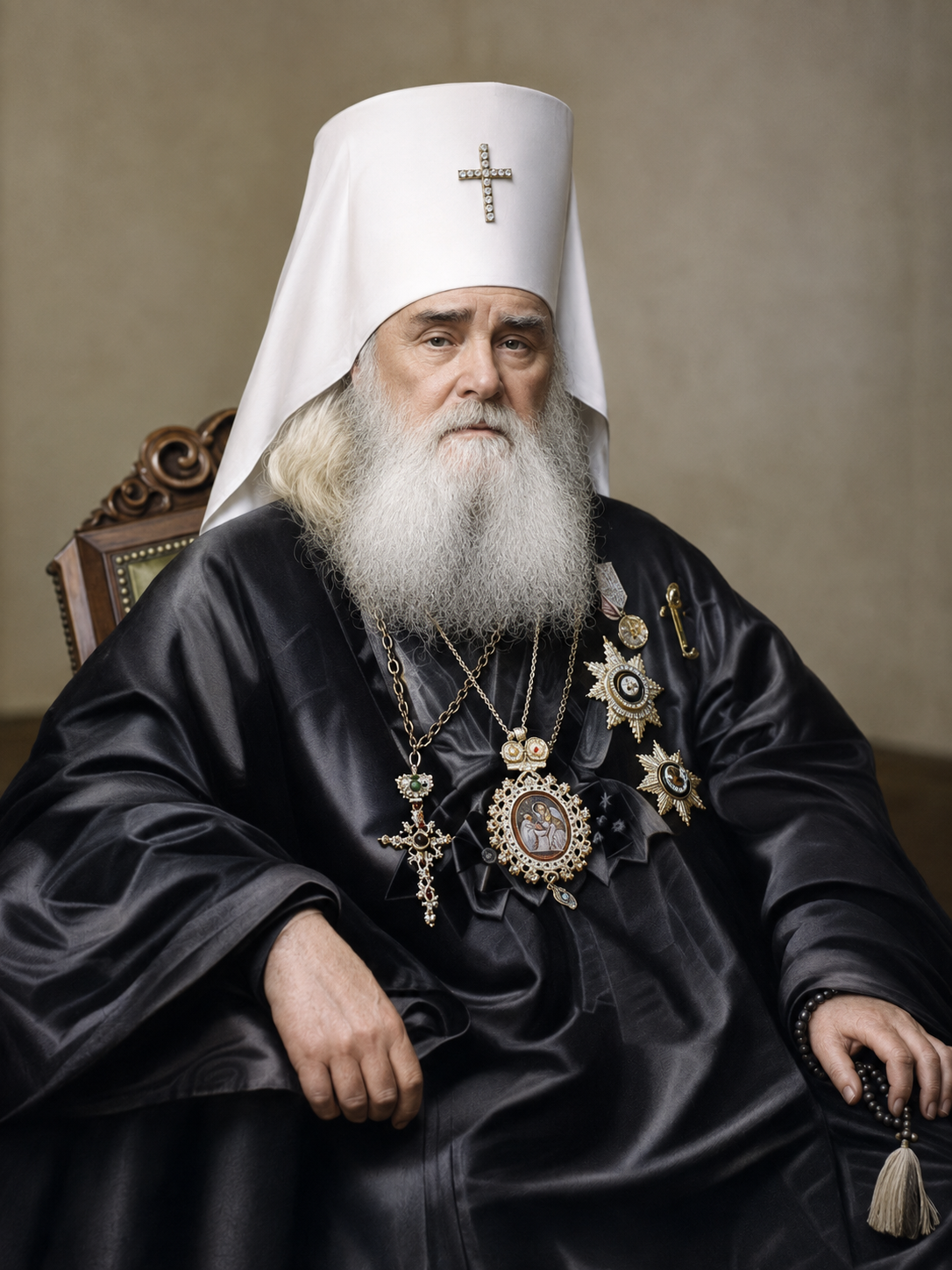
An especially important part of Saint Innocent's life is sometimes forgotten because icons usually depict him later as a bearded bishop in monastic clothing. Before he became Bishop Innocent, he was Father John Veniaminov, a married Orthodox priest and father. Metropolitan Tikhon of the OCA has specifically pointed to the breadth of his vocation, remembering that Saint Innocent had been husband, father, priest, monk, and bishop during different seasons of the same holy life.
His wife accompanied him into missionary life.
The official Akathist remembers Katherine traveling with the newly ordained priest into Russian America, while the historical sources describe the family enduring the exceptionally long journey to Unalaska together.
This makes Saint Innocent a particularly valuable saint for married clergy families within the Orthodox and Eastern Catholic traditions. Missionary priesthood does not affect only the ordained man because his wife and children also experience relocation, isolation, financial uncertainty, cultural adaptation, hospitality, parish demands, and the sacrifices created by pastoral responsibility.
Saint Innocent's early ministry belongs to his family story as well as his personal biography.
A priest's wife, deacon's wife, or family discerning a difficult assignment can therefore seek Saint Innocent's intercession with the confidence that his holiness developed inside family responsibilities before it later developed within episcopal monastic life.
His story also prevents an unnecessary opposition between family holiness and monastic holiness. Saint Innocent became holy through obedience to God in more than one state of life, and the OCA explicitly remembers that breadth as something remarkable about him.
GRIEF, WIDOWHOOD & A NEW VOCATION
Saint Innocent's life changed dramatically when his wife died. While Father John was away presenting his missionary work and translations to Church authorities, he received news that Katherine had died in Siberia on November 24, 1838.
The loss left him facing a future very different from the one he had expected.
Metropolitan Philaret of Moscow encouraged him to consider monastic life, but Father John did not immediately embrace the suggestion. He first undertook pilgrimage and discernment, eventually accepting monastic tonsure on November 29, 1840 and receiving the name Innocent, in honor of Saint Innocent of Irkutsk.
Only then did another extraordinary chapter of his vocation begin.
For widows and widowers, this part of Saint Innocent's life can be especially meaningful. Christianity does not require pretending that the death of a spouse simply opens an exciting new opportunity, because bereavement is a genuine rupture in the shape of earthly life.
Saint Innocent grieved.
He discerned.
He did not immediately know what the next chapter should be.
Yet the loss of one vocation's earthly form did not mean God had no further work for him.
The former husband and parish priest eventually became a monk, bishop, missionary archpastor, and Metropolitan of Moscow. His later ministry did not erase his marriage or make it unimportant because everything he had learned as husband, father, parish priest, teacher, and missionary traveled with him into the next stage.
Saint Innocent can therefore become an especially meaningful intercessor for someone asking, “What does God want from me now that the life I expected is gone?”
FROM FATHER JOHN TO BISHOP INNOCENT
After his monastic tonsure, Saint Innocent was rapidly called into episcopal responsibility. On December 15, 1840, he was consecrated Bishop of Kamchatka, the Kurile and Aleutian Islands, with his episcopal see located at Sitka. He returned there in 1841 and resumed the missionary work he already knew, now with responsibility for an enormous territory.
His elevation did not make him less practical.
As bishop, Innocent developed schools, trained clergy, strengthened missions, continued translation work, and encouraged Indigenous Christians to assume greater responsibility within the life of the Church. The OCA's official Akathist remembers him establishing a seminary in Sitka and directing missionary work throughout Alaska and Siberia.
In Sitka he also helped design and construct Saint Michael Cathedral, one of the most important historic Orthodox sites in Alaska. OCA historical material places the beginning of that construction in the 1840s and emphasizes Saint Innocent's direct role as both designer and bishop.
This combination of episcopal leadership and practical competence is characteristic of his entire life. Saint Innocent did not understand becoming a bishop as graduating from ordinary work.
Greater authority meant a larger field of responsibility.
SAINT INNOCENT & SAINT JACOB NETSVETOV
One of the greatest fruits of Saint Innocent's missionary vision appeared in Saint Jacob Netsvetov, the Alaska-born priest of Unangan and Russian ancestry who became another great evangelizer of Alaska. Father Jacob continued the translation and missionary work Saint Innocent had helped establish and eventually carried the Gospel into the Yukon and Kuskokwim regions.
This relationship demonstrates that Saint Innocent's mission was not intended to remain permanently dependent upon foreign clergy.
He wanted local Christians to become clergy, teachers, translators, and missionaries themselves.
That distinction matters enormously.
A missionary who creates permanent dependence may build an impressive personal ministry, but a missionary who forms others can create a Church capable of continuing for generations.
Saint Innocent's work helped create precisely that kind of continuity. Even after Russian political authority eventually disappeared from Alaska, Indigenous clergy and lay leaders continued preserving Orthodox Christianity in local communities.
His example therefore makes him especially appropriate for mentors, seminary professors, clergy trainers, and leaders trying to prepare successors.
The goal of Christian leadership is not to become irreplaceable.
It is to form faithful people who can continue the mission after we are gone.
FORT ROSS & ORTHODOXY IN CALIFORNIA
Saint Innocent's missionary travels reached much farther south than many people realize. In 1836, while still Father John Veniaminov, he traveled from Alaska to Fort Ross in present-day California, the southernmost Russian settlement in North America. OCA and Fort Ross historical sources record him celebrating services and sacraments there and ministering to the settlement's Orthodox population.
The OCA's history also records that he visited Spanish Franciscan missions in California, communicated with Catholic clergy in Latin, and even assisted by constructing small pipe organs for mission churches.
This journey gives Saint Innocent a special connection not only with Alaska but with the wider history of Christianity on the West Coast.
It also reveals another dimension of his remarkable abilities.
The same man who learned Indigenous languages, translated Scripture, built Orthodox churches, navigated northern seas, and taught theology could interact with Spanish-speaking Catholic missionaries and put practical craftsmanship at their service.
For Christians involved in missionary work across denominational boundaries or living in regions where Orthodox communities are small, this episode offers an example of maintaining a clear Orthodox identity while still treating other Christians with human respect and practical kindness.
DANGEROUS TRAVEL & TRUST IN PROVIDENCE
Saint Innocent spent an extraordinary portion of his life traveling. Oceans, rivers, frozen landscapes, remote islands, mountain routes, and enormous distances were not occasional interruptions to his ministry because traveling to the flock was the ministry.
The official Akathist repeatedly remembers these journeys, describing his movement through dangerous northern seas, his pastoral travel among scattered communities, and his willingness to accept hardship for the sake of the Gospel.
This makes him an especially meaningful intercessor for missionaries and clergy who travel extensively, but the spiritual lesson extends much further.
Many people know what God appears to be asking but cannot see how the logistics will work.
The money is uncertain.
The distance is enormous.
The family will have to move.
The language is unfamiliar.
There is no established infrastructure.
The work seems larger than available resources.
Saint Innocent's life does not answer every practical question by telling Christians to ignore prudence. He was highly practical and spent enormous energy planning schools, churches, translations, clergy formation, and missionary structures.
His example instead teaches that prudence and courage belong together.
One can plan carefully and still eventually have to step into the boat.
PREACHING FROM THE HEART
Saint Innocent was not only a translator and administrator but a preacher who thought seriously about how Christian teaching should be communicated. In his instructions to clergy, he emphasized clarity, simplicity, and speaking from genuine faith and love rather than merely displaying knowledge.
His missionary principles remain useful for priests, deacons, catechists, teachers, and Christian writers.
A sermon can be technically correct and still fail to reach anyone.
A theological explanation can contain sophisticated vocabulary and communicate almost nothing.
Saint Innocent wanted the essential Gospel proclaimed clearly enough that the hearer could actually respond.
The OCA's preserved summary of his teaching emphasizes repentance, faith in Christ, love of God, and love of humanity as central themes that should be communicated with the heart as well as the intellect.
This makes him a particularly meaningful saint for someone preparing a homily, catechetical lesson, book, website, or missionary presentation.
The question is not merely, “Did I say everything I know?”
The better question is, “Did I help this person see the way toward Christ?”
FROM ALASKA TO SIBERIA
Saint Innocent's missionary responsibility eventually expanded far beyond Alaska. After his episcopal work in Sitka, he was raised to the rank of archbishop and continued missionary work across enormous regions of eastern Siberia, including Yakutia and the Amur region. He again learned local languages and encouraged worship and Scripture in the languages spoken by the people.
The pattern therefore repeated itself.
New people.
New languages.
New geography.
New problems.
The same Gospel.
Saint Innocent did not assume that because his methods had worked in one region he could simply repeat them mechanically elsewhere. His ministry consistently involved studying the people actually before him.
He also became an important mentor to Saint Nicholas of Japan, with whom the OCA records meetings in 1860 and 1861. Saint Innocent's missionary experience helped strengthen a younger missionary who would eventually become Equal to the Apostles in another country.
This is another important measure of Saint Innocent's influence.
His missionary legacy did not end with the people he personally baptized.
It continued through missionaries he encouraged.
METROPOLITAN OF MOSCOW
Saint Innocent's final major assignment was one he never would have predicted when he left Siberia for Unalaska as a young married priest. Following the death of Metropolitan Philaret, the nearly blind missionary bishop was called in 1868 to become Metropolitan of Moscow, one of the most important positions in the Russian Orthodox Church.
The missionary frontier had formed the man who would now lead one of Orthodoxy's great historic sees.
His elevation did not end his concern for missions. In Moscow he helped establish the Russian Missionary Society, supported missionary work in Siberia and North America, and encouraged expansion of missions in Japan, China, and the Far East.
This part of Saint Innocent's life provides a striking lesson about authority.
He did not become Metropolitan because he had spent his career pursuing ecclesiastical prestige.
He had spent decades in remote regions where prestige offered very little practical assistance.
The man who eventually received one of the Church's highest offices had already learned to build churches with his hands, travel in small boats, teach children, learn unfamiliar languages, and live with people far outside centers of power.
Leadership came after service.
The order matters.
THE WAY INTO THE KINGDOM OF HEAVEN
Saint Innocent's best-known spiritual work is The Indication of the Way into the Kingdom of Heaven, a catechetical text originally connected with his missionary work among the people of Alaska. The OCA continues to identify it as one of his most important writings.
The work reflects the same quality seen throughout his ministry: complicated Christian truth must become understandable without becoming distorted.
Saint Innocent did not believe Christianity should remain accessible only to trained theologians. Ordinary people should be able to understand what it means to repent, believe in Christ, take up the Cross, receive grace, and walk toward the Kingdom of God.
This gives him a special importance for catechetical writing.
The ability to explain something simply is not evidence that the subject is shallow.
It can be evidence that the teacher understands it deeply enough to know what matters most.
Saint Innocent therefore offers an important model for anyone producing Christian educational material. The goal is neither to overwhelm beginners nor to dilute the faith until nothing remains.
The goal is to indicate the way.
HIS REPOSE & HOLY RELICS
By the final years of his life, Saint Innocent's eyesight had deteriorated significantly, but he continued serving as Metropolitan of Moscow. On Holy Tuesday in 1879 he received Holy Unction, on Holy Thursday he received Holy Communion, and on Holy Saturday, March 31, 1879, he peacefully reposed in the Lord.
He was buried at the Holy Trinity-Saint Sergius Lavra near Moscow. Saint Innocent was formally glorified by the Russian Orthodox Church on October 6, 1977, acting in response to a request from the Holy Synod of the Orthodox Church in America.
His relics were rediscovered during excavations at the Lavra in 1994 and continue to be venerated there. Official OCA delegations visiting Russia have repeatedly recorded venerating the relics of Saint Innocent alongside the great shrines of the Trinity-Saint Sergius Lavra.
Saint Innocent's principal feast commemorating his repose is March 31, while October 6 commemorates his glorification. He is also remembered on October 5 with the Synaxis of the Moscow Hierarchs and within broader commemorations of the saints of Alaska and North America.
For an American Orthodox Christian, the geographic distance of his relics carries an interesting spiritual symmetry. Saint Innocent spent much of his life carrying the Gospel from Russia toward America, while pilgrims from America now travel back toward Russia to venerate the missionary who helped plant their Church.
PRAYERS
A simple traditional invocation may be prayed regularly: Holy Father Innocent, Equal to the Apostles and Enlightener of Alaska, pray to God for us. This is especially fitting before missionary work, translation, teaching, preaching, travel, vocational discernment, or any difficult task undertaken for the sake of the Gospel.
The official OCA Akathist contains a specific Prayer to Saint Innocent asking his intercession for the Orthodox Church, patience under difficult circumstances, generosity, dedication to Christ, love for God and neighbor, and strength to continue the missionary work he began. It also repeatedly honors him as Equal to the Apostles and Enlightener of Alaska.
His festal Troparion remembers that Saint Innocent accepted dangers and tribulations in obedience to God's will and brought many peoples to knowledge of the truth. A second traditional Troparion emphasizes that he proclaimed the Gospel to the peoples of America and Asia in their own tongues, making language and translation part of the Church's own liturgical memory of his holiness.
Someone discerning missionary work may therefore invoke Saint Innocent while asking not simply for courage to leave home but for humility to learn the people being served. A translator or teacher may ask his intercession for clarity and accuracy, while a married clergy family can seek his prayers before a difficult parish assignment or relocation.
A widow or widower may also find particular consolation in his life because Saint Innocent experienced the death of his wife and then had to discern an entirely unexpected future. His story does not minimize grief, but it testifies that a vocation can change dramatically without a life ceasing to be fruitful.
This prayer card is especially fitting for a missionary bag, Bible, theological library, classroom, translation desk, parish office, clergy home, seminary room, Alaska prayer corner, or beside a map of the places where someone is discerning service. It can also make a meaningful ordination, seminary, mission commissioning, graduation, teaching, or relocation gift.
FAQ
Who is Saint Innocent of Alaska?
Saint Innocent of Alaska was a nineteenth-century Orthodox priest, missionary, linguist, translator, bishop, and eventually Metropolitan of Moscow. Born John Popov-Veniaminov in Siberia in 1797, he spent years evangelizing in Alaska and eastern Siberia and is honored as Equal to the Apostles and Enlightener of North America.
What was Saint Innocent's name before he became a monk?
His name was John Evseyevich Popov-Veniaminov, and he served for many years as Father John Veniaminov. He received the monastic name Innocent in 1840 in honor of Saint Innocent of Irkutsk after the death of his wife and his decision to embrace monastic life.
Was Saint Innocent of Alaska married?
Yes, and this is one of the most important facts about his life. He married in 1817 and served as a married deacon and priest for many years, including during his foundational missionary work in Alaska, before becoming a widower and later receiving monastic tonsure.
Did Saint Innocent have children?
Yes, Saint Innocent was a father as well as a husband and priest. The OCA's account specifically records his infant son Innocent accompanying the family on the journey toward Alaska, while Metropolitan Tikhon has emphasized Saint Innocent's experience as both husband and father before his later monastic and episcopal life.
Who was Saint Innocent's wife?
The OCA's official Akathist identifies his wife as Katherine, while other English sources may spell the name Catherine. She accompanied him into the Alaskan mission and died in Siberia in 1838 while Father John was away reporting on his missionary work.
Why did Saint Innocent become a monk if he had been married?
He received monastic tonsure only after the death of his wife. Metropolitan Philaret encouraged him to consider monasticism, and after a period of pilgrimage and discernment Father John accepted tonsure in 1840 and received the name Innocent.
Is Saint Innocent a good saint for married priests and their families?
Yes, especially because he personally lived the vocation of married priesthood before becoming a monk and bishop. His missionary years in Alaska involved real family sacrifice, making him an especially meaningful intercessor for Eastern Christian clergy families facing relocation, isolation, or demanding parish assignments.
What is Saint Innocent of Alaska known for?
He is particularly known for missionary evangelization, learning Indigenous languages, translating Scripture and worship, establishing schools and churches, traveling throughout Alaska, forming local Christian leaders, and later expanding missionary activity throughout eastern Siberia. He eventually became Metropolitan of Moscow and continued supporting missions from one of the highest offices in the Russian Church.
Why is Saint Innocent called Equal to the Apostles?
The title recognizes missionary work of extraordinary apostolic importance. Saint Innocent carried the Gospel across enormous territories, translated Christianity into local languages, formed churches and leaders, and helped establish an enduring Orthodox Christian life among peoples of Alaska and Siberia.
What is Saint Innocent the patron saint of?
Orthodox tradition does not require a single universal list of formal patronages, so the safest approach is to follow his life and hymnography. Saint Innocent is especially appropriate as an intercessor for missionaries, evangelists, translators, teachers, clergy, travelers, parish builders, and Christians discerning difficult vocational service.
Is Saint Innocent a patron saint of missionaries?
Missionary work is unquestionably one of his strongest devotional associations because the Church calls him Equal to the Apostles, Apostle to America, and Enlightener of Alaska. His official Akathist repeatedly celebrates his evangelization of the peoples of Alaska and Asia.
Can I pray to Saint Innocent before missionary work?
Yes, this is one of the most natural reasons to seek his intercession. His traditional prayers ask that Christians be strengthened to continue bringing the light of Christ into the places where they live and serve.
Is Saint Innocent a saint for translators?
Yes, his missionary life makes him especially appropriate for translators and linguists. He learned Indigenous languages, helped develop written materials, translated Scripture and prayers, and insisted that people hear the Christian faith in their own language.
What languages did Saint Innocent learn?
During his missionary work he learned multiple dialects among the peoples of the Aleutian Islands and studied Tlingit after moving to Sitka. His later ministry continued among other language communities in Siberia, where translation remained a major part of his missionary strategy.
Did Saint Innocent invent the Aleut language?
No, the language obviously existed long before his arrival. He helped create or adapt a writing system using Cyrillic characters for an Unangan dialect and collaborated with local speakers to produce written Christian materials, Scripture translations, and educational texts.
Did Native Alaskans help Saint Innocent translate?
Yes. The OCA specifically identifies the Unangan leader Ivan Pan'kov as collaborating with Father John Veniaminov on translation of the Gospel according to Matthew and a catechism. This is an important part of the Indigenous Christian character of the Alaskan mission.
Which Gospel did Saint Innocent translate?
He translated the Gospel according to Saint Matthew into the Unangan language used in his mission, along with prayers, hymns, and catechetical materials. His translations became a major part of his effort to make Christianity accessible in the language of the people.
What book did Saint Innocent write?
His best-known spiritual work is The Indication of the Way into the Kingdom of Heaven. It emerged from his missionary teaching and became an enduring Orthodox catechetical work explaining the Christian path toward salvation in clear language.
Is Saint Innocent a good saint for teachers?
Yes, education was central to his ministry. He taught before leaving Siberia, established schools in Alaska, produced textbooks and readers, instructed children personally, and developed institutions for training local leaders and clergy.
Can language teachers pray to Saint Innocent?
Yes, especially because language learning became one of his primary missionary tools. His life demonstrates how patiently learning another person's language can become an act of respect, service, and evangelization.
Did Saint Innocent respect Alaska Native cultures?
The OCA's historical assessment specifically identifies cultural sensitivity as a defining quality of the Alaskan Orthodox mission and records Saint Innocent studying Indigenous languages, customs, and ways of life before teaching. He remained committed to conversion to Christianity while refusing coercion and making extensive efforts to communicate the Gospel within local languages and communities.
Did Saint Innocent force people to become Orthodox?
The official account says the opposite. Father John waited until people demonstrated a desire for Baptism and taught within an atmosphere that respected freedom rather than attempting to impose Christian conversion by force.
What can modern missionaries learn from Saint Innocent?
His example teaches missionaries to learn before assuming they understand, respect legitimate cultural differences, communicate in language people can understand, form local leaders, and allow Christian conversion to be genuinely free. His missionary method joined strong commitment to Orthodox Christianity with patience and careful attention to the people he served.
Did Saint Innocent live in Unalaska?
Yes. Father John and his family arrived at Unalaska in July 1824, and the island became the first major center of his Alaskan missionary work. He built a church, learned local languages, established educational work, and traveled from there to surrounding island communities.
Did Saint Innocent live in Sitka?
Yes. He was transferred to Sitka in 1834 and later returned there as bishop after his episcopal consecration. His work in Sitka became deeply associated with the Tlingit mission, the development of church education, and Saint Michael Cathedral.
Did Saint Innocent build churches?
Yes, and he personally possessed substantial practical building skills. He helped construct the Ascension church at Unalaska and later designed and supervised work connected with Saint Michael Cathedral in Sitka.
Was Saint Innocent really a carpenter and craftsman?
Yes, his liturgical and historical tradition remembers him as an unusually skilled practical craftsman in addition to being a theologian and missionary. His official Akathist even praises him as a craftsman and clock-maker whose talents were placed in the service of Christ.
Did Saint Innocent travel in kayaks?
Yes, he traveled among island communities by sea kayak and other small boats, often under extremely dangerous conditions. OCA historical material records that years of this difficult travel contributed to lasting physical pain in his legs.
Can travelers pray to Saint Innocent for safety?
Yes, dangerous travel formed an enormous part of his missionary life, so this is a natural devotional application. His Akathist repeatedly remembers his preservation through storms, remote journeys, and the dangerous northern seas.
Did Saint Innocent ever visit California?
Yes. In 1836 Father John Veniaminov traveled to Fort Ross in California, where he celebrated Orthodox services and sacraments for the community there. Historical sources also record his contact with Franciscan missions while he was in California.
Did Saint Innocent interact with Catholic missionaries?
Yes. The OCA's history records him visiting Franciscan missions in California, communicating with Catholic missionaries in Latin, and even assisting with construction of small pipe organs for some mission churches. He remained an Orthodox missionary while treating the Catholic clergy he encountered with notable practical goodwill for the period.
Was Saint Innocent a bishop of Alaska?
Yes, although his formal episcopal title covered a much larger territory than modern Alaska alone. In 1840 he was consecrated Bishop of Kamchatka, the Kurile and Aleutian Islands, with his see at Sitka.
Did Saint Innocent train Native clergy?
Yes, preparing local clergy and leaders was an important part of his missionary vision. He established educational institutions in Sitka and supported men such as Saint Jacob Netsvetov, whose own missionary work became one of the great achievements of nineteenth-century Alaskan Orthodoxy.
What is Saint Innocent's connection with Saint Jacob Netsvetov?
Saint Jacob was an Alaska-born Orthodox priest who continued the work of translation and evangelization Saint Innocent had helped establish. As bishop, Innocent entrusted him with missionary work that eventually extended deeply into Alaska's interior and western regions.
What is Saint Innocent's connection with Saint Herman of Alaska?
Saint Herman belonged to the earlier generation of Orthodox missionaries who arrived in Alaska in 1794, while Saint Innocent's work began several decades later. Together they became two of the foundational saints of Orthodoxy in Alaska and are commemorated among the saints of North America.
What is Saint Innocent's connection with Saint Nicholas of Japan?
The OCA records that Saint Innocent met Saint Nicholas of Japan in 1860 and 1861 and shared missionary experience with him. The two saints are therefore connected as major Orthodox missionaries who worked to bring Christianity into new linguistic and cultural settings.
Did Saint Innocent become Metropolitan of Moscow?
Yes. In 1868, after decades of missionary service, the nearly blind Saint Innocent was called to become Metropolitan of Moscow following the death of Metropolitan Philaret. Even in Moscow he continued supporting missionary activity in Siberia, North America, Japan, China, and the Far East.
Did Saint Innocent establish a missionary society?
Yes. As Metropolitan of Moscow he helped establish the Russian Missionary Society in 1869 and continued strengthening missionary activity far beyond his former dioceses.
Did Saint Innocent suffer from poor eyesight?
Yes, his eyesight deteriorated significantly in his later years, and he had requested retirement before being called instead to become Metropolitan of Moscow. His physical limitations did not end his missionary concern or administrative service.
How did Saint Innocent die?
Saint Innocent peacefully reposed on Holy Saturday, March 31, 1879, after receiving Holy Unction and Holy Communion during Holy Week. He was buried at the Holy Trinity-Saint Sergius Lavra.
When is Saint Innocent of Alaska's feast day?
His repose is commemorated on March 31, and his glorification is commemorated on October 6. He is also included in broader commemorations of the Moscow hierarchs and the saints of Alaska and North America.
When was Saint Innocent canonized or glorified?
The Russian Orthodox Church formally glorified Saint Innocent on October 6, 1977, acting after a request from the Orthodox Church in America. His glorification recognized the holiness and apostolic significance of a missionary whose work had shaped both Russian and North American Orthodoxy.
Where are Saint Innocent's relics?
His relics are venerated at the Holy Trinity-Saint Sergius Lavra in Sergiev Posad, Russia. They were recovered during excavations in 1994, and official OCA delegations have continued to venerate them there.
Can I give this prayer card to a missionary?
Yes, this is one of the strongest possible uses for a Saint Innocent prayer card. His entire mature life became a missionary vocation spanning Alaska, Siberia, and eventually support for Orthodox missions throughout Asia.
Can I give this card to a teacher?
Yes, Saint Innocent spent much of his life teaching, establishing schools, writing educational material, and helping communities become capable of preserving and transmitting the faith themselves. His example is particularly appropriate for teachers who understand education as service rather than simply information transfer.
Can I give this card to a translator or interpreter?
Yes, his translation work is one of the defining characteristics of his missionary legacy. It is especially appropriate for people translating Scripture, theology, worship, catechetical resources, or Christian materials across languages.
Can I give this card to a priest or seminarian?
Yes, Saint Innocent offers an unusually complete model of ordained ministry because he served as parish priest, missionary, teacher, bishop, and metropolitan. His life teaches that priestly leadership involves preaching, education, practical service, cultural understanding, and willingness to go wherever pastoral need requires.
Can I give this card to someone who is moving far from home?
Yes, especially if the move involves vocation, ministry, military service, education, or family responsibility. Saint Innocent repeatedly left familiar surroundings for remote regions and had to build Christian life within circumstances that initially offered very little comfort or infrastructure.
Can a widow or widower pray to Saint Innocent?
Yes, because Saint Innocent himself became a widower and had to discern an entirely new form of life after his wife's death. His later vocation does not remove the grief from that story, but it shows that bereavement does not mean God has no remaining work for a person's life.
What does Saint Innocent teach about evangelization?
He teaches that missionary zeal and respect for the people being evangelized belong together. His work combined clear proclamation of Christianity with language learning, cultural study, education, patience, and refusal to force Baptism on people who had not freely chosen the faith.
What does Saint Innocent teach about teaching?
His life shows that education becomes missionary when it equips people to know Christ and eventually teach others themselves. Saint Innocent did not simply give answers because he built schools, produced books, trained leaders, and created the conditions for Christian communities to continue without him.
What does Saint Innocent teach about vocation?
His life teaches that God's call may develop through several very different seasons. Saint Innocent was successively husband, father, parish priest, missionary, widower, monk, bishop, archbishop, and metropolitan, yet the same fundamental vocation of serving Christ remained present throughout them all.
What does Saint Innocent teach about feeling unqualified?
His life demonstrates that willingness to learn can matter as much as what someone knows before beginning. He arrived in Alaska without mastery of the languages, without the infrastructure his mission needed, and without any guarantee that the work would succeed, yet he learned, built, translated, taught, and formed others over time.
What is the main message of Saint Innocent of Alaska's life?
Saint Innocent's life teaches that the Gospel should be carried to people with enough love to learn their language, understand their world, and remain with them through difficulty. A married Siberian priest crossed the world with his family, built churches with his hands, learned Indigenous languages, translated Scripture, traveled dangerous seas to reach isolated communities, formed Native Christian leaders, became a widower and monk, shepherded an enormous missionary diocese, and eventually served as Metropolitan of Moscow without abandoning his concern for missions. His life calls Christians to make themselves servants of the Gospel rather than masters of other people, to teach without coercion, to build what does not yet exist, and to trust that obedience in an obscure place can bear fruit far beyond anything the missionary will personally live to see.
Saint Innocent of Alaska, Equal to the Apostles and Enlightener of North America, was one of the greatest Orthodox missionaries of the nineteenth century and one of the foundational saints of Christianity in Alaska. Born John Popov-Veniaminov in Siberia in 1797, he served first as a married parish priest and father, volunteered for an extraordinarily difficult mission to the Aleutian Islands, learned Indigenous languages, translated Scripture and worship into those languages, built churches and schools, traveled across dangerous northern seas to reach isolated communities, became a widower and monk, served as missionary bishop across Alaska and Siberia, and eventually became Metropolitan of Moscow. The Orthodox Church honors him as Equal to the Apostles because evangelization shaped virtually his entire adult life.
Saint Innocent is especially meaningful for missionaries, translators, teachers, priests, deacons, seminarians, parish founders, Christian writers, people learning a new language to serve others, families discerning a difficult move, and anyone afraid that God's call is larger than their abilities. His life also has particular significance for married clergy and their families because his first great missionary work in Alaska was undertaken not as a solitary monk but as a married priest accompanied by his wife, children, and relatives. Only after the death of his wife did he later receive monastic tonsure and enter the episcopate.
His approach to evangelization remains remarkably important today. Saint Innocent did not simply arrive among the Unangan people and demand that they first become culturally Russian in order to become Christian. He learned their language, worked with local collaborators, created written materials in the language people actually spoke, studied customs carefully, taught practical skills, established schools, and waited for people to desire Baptism rather than forcing conversion. The OCA's history of the Alaskan mission specifically identifies linguistic adaptability, cultural sensitivity, and educational outreach as defining characteristics of the missionary tradition represented by Saints Innocent and Jacob Netsvetov.
This makes Saint Innocent an especially meaningful intercessor for Christians trying to share the Gospel across cultural boundaries. His example teaches that evangelization is not accomplished merely by speaking more loudly because the missionary must first love people enough to listen, learn how they understand the world, communicate in language they can grasp, and present Christ without treating another people's cultural identity as an obstacle to salvation.
Saint Innocent is equally powerful for people facing distance, isolation, dangerous travel, exhausting work, or a vocation that seems logistically impossible. His Alaskan parish extended across islands separated by violent seas, and he routinely traveled in small boats through dangerous conditions in order to celebrate the sacraments and teach communities scattered across enormous distances. The official Akathist to Saint Innocent remembers him as a courageous voyager who endured storms and hardship for the Gospel, while his Kontakion specifically praises his perseverance through dangers and tribulations.
He is also an excellent saint for Christian education and translation. Saint Innocent developed a writing system using Cyrillic characters for the Unangan language used in the Fox Islands, collaborated with Indigenous Christians such as Ivan Pan'kov, translated the Gospel according to Matthew, prayers, hymns, and catechetical materials, composed educational texts, and later worked with other languages across Alaska and Siberia. His missionary vision was simple but profound: if people were going to receive Christianity deeply, they needed to hear and pray the faith in words they could actually understand.
Saint Innocent therefore belongs among the most important saints for Christians who believe that teaching itself can be missionary work. A translator, teacher, catechist, linguist, writer, homeschool parent, Bible teacher, parish educator, or missionary preparing materials for another culture can all recognize something of their vocation within his life.
This prayer card is created for missionaries, clergy, teachers, translators, writers, parish planters, people relocating for ministry, Christians serving Indigenous or multilingual communities, married clergy families, widows and widowers discerning what comes after loss, and anyone asking God for courage to follow a difficult vocation. It is also especially fitting for Orthodox Christians in Alaska and North America, where Saint Innocent is honored as one of the great fathers of the Church's missionary inheritance.
Each card is handmade in Austin, TX and created to order. We do not keep stock, because every prayer card is treated as a unique devotional offering. They are printed on museum-quality photo paper, not cardstock, and every card is made slowly during prayer with intentional reverence for the saint and for the person who will receive it. Names are lifted before Christ, intentions are held carefully, and each piece is handled multiple times in prayerful silence, asking God for mercy and asking Saint Innocent to intercede for the soul it is being made for. This is devotional craftsmanship shaped with patience, care, and spiritual responsibility because every soul and every prayer matters.
THE LIFE & STORY
Saint Innocent was born John Evseyevich Popov-Veniaminov on August 26, 1797, in the Siberian village of Anginskoye in the Irkutsk region. His father served the local church, and the young John was introduced to reading and church life at an early age. His father died when John was still a small child, and in 1807 the boy entered the theological seminary at Irkutsk, where his education prepared him for the remarkably varied work he would later perform as priest, teacher, linguist, craftsman, missionary, bishop, and administrator.
John did not begin his ministry as a monk. In 1817 he married, and that same year he was ordained to the diaconate at the Church of the Annunciation in Irkutsk. After completing his studies, he taught in a parish school and was ordained to the priesthood in 1821, beginning what might easily have become a stable and respected parish ministry close to home.
Then a call came from far beyond everything familiar.
In 1823 Bishop Michael of Irkutsk needed a priest willing to travel to Unalaska in the Aleutian Islands. The assignment was so difficult that the clergy who were approached initially showed little desire to volunteer, and John himself did not immediately embrace the idea. According to the OCA's official account, however, something changed within him, and he became filled with a desire to serve people who were eager to learn more about Christ.
Father John left Irkutsk on May 7, 1823 accompanied by his family. The OCA records his aging mother, his wife, his infant son Innocent, and his brother Stefan among those who set out with him, while its broader history of the Alaskan mission also remembers his wife and children making the journey into this remote missionary world. The trip required more than a year, and they finally reached Unalaska on July 29, 1824.
The difference between their former life and their new one was immediate. The family initially lived in extremely poor conditions, but Father John began building rather than complaining about what was missing. He trained local people in carpentry, metalworking, blacksmithing, masonry, and other trades and worked with them to construct a church dedicated to the Ascension of Christ, which was consecrated in 1826.
This practical dimension of his ministry is one reason Saint Innocent's story feels so different from a purely academic picture of missionary work. He could preach a sermon, translate Scripture, build a church, repair equipment, teach a trade, establish a school, and cross dangerous seas to celebrate the Divine Liturgy.
His hands and his mind belonged to the same vocation.
The parish entrusted to Father John covered not only Unalaska but surrounding islands and communities. Reaching his people meant traveling repeatedly through the northern Pacific in small boats and sea kayaks, sometimes through violent storms. The OCA records that the accumulated strain of this travel eventually caused him lasting pain and problems in his legs, but the enormous geography never persuaded him that isolated Christians should simply go without a priest.
One of his first priorities was language. Father John learned the local Unangan language and its dialects instead of expecting everyone to approach Christianity through Russian. He eventually mastered several local forms of speech, helped develop an alphabet using Cyrillic characters, and translated Scripture, prayers, hymns, and catechetical material so that the faith could be heard in the people's own language.
This work was not accomplished by Father John alone. The OCA's history specifically names Ivan Pan'kov, an Unangan leader, as a collaborator in translation of the Gospel according to Saint Matthew and a catechism. That detail is important because Orthodox Christianity in Alaska developed not simply through foreign missionaries doing everything for Indigenous people but through Indigenous Christians themselves becoming teachers, translators, clergy, and evangelists.
Father John and his collaborators also established a parish school in Unalaska in 1828. He wrote and translated educational materials, taught children, and connected Christian formation with broader education and practical skills.
His famous catechetical work The Indication of the Way into the Kingdom of Heaven grew from this same missionary world. Saint Innocent wrote it for ordinary believers rather than producing theology intended only for scholars, and the work became one of his enduring contributions to Orthodox missionary spirituality. The OCA records that he composed it in the Aleut language and later submitted it with his Scripture and catechetical translations for ecclesiastical approval.
The title itself summarizes Saint Innocent's approach to ministry. The missionary's task is not to make people admire the missionary.
It is to indicate the way toward the Kingdom.
Father John also traveled beyond the islands entrusted directly to him. In 1829 he journeyed to the mainland around Nushagak and preached among communities along the Bering Sea coast, baptizing those who freely embraced Christianity.
In 1834, he was transferred to Sitka, then known as New Archangel, where a new missionary challenge awaited him among the Tlingit people. Once again his first response was not simply to begin speaking through an interpreter about a culture he had not studied. He worked to learn the Tlingit language, customs, and worldview so that his preaching could be understood within the actual lives of the people he was serving.
The OCA's account emphasizes that Saint Innocent did not force Baptism upon people. He waited for individuals to express a genuine desire to become Christian and taught in a manner that respected freedom, while his educational and practical service gradually created trust. He established schooling, prepared texts, taught trades, and even shared medical knowledge during his years among the Tlingit.
This aspect of his missionary practice deserves particular attention because it provides a model of Christian evangelization that is both uncompromising about the Gospel and respectful of the human person. Saint Innocent wanted people to become Christians, but he did not believe the Gospel needed coercion in order to succeed.
MISSIONARY WORK WITHOUT ERASING CULTURE
Saint Innocent's missionary method is one of the strongest reasons he remains relevant for Christians today. He did not treat the languages of the people he encountered as obstacles that should disappear, but as languages capable of carrying Scripture, prayer, theology, and Divine Liturgy.
This meant learning before teaching.
He studied pronunciation, grammar, customs, social life, geography, and traditional patterns of thought. He then worked to communicate the Christian faith in terms understandable to the people before him rather than requiring them first to enter a Russian cultural world.
The distinction is extremely important.
Christian evangelization asks every culture to encounter Christ and therefore eventually challenges whatever within that culture is incompatible with the Gospel. Yet Christianity does not teach that salvation requires a person to abandon every legitimate feature of language, family life, artistic tradition, or cultural identity.
The OCA's historical assessment of the Alaskan mission specifically praises its linguistic adaptability, cultural sensitivity, and educational outreach, and it describes the resulting Orthodox Church in Alaska as developing with a strongly Indigenous character rather than simply functioning as a foreign Russian enclave.
Saint Innocent therefore makes a particularly meaningful intercessor for missionaries serving across ethnic and linguistic boundaries. His example encourages them to ask not merely, “How do I deliver my message?” but, “Do I understand these people well enough to communicate Christ faithfully to them?”
That question requires humility because the missionary has to become a student before becoming a teacher.
TRANSLATORS, LANGUAGES & THE WORD OF GOD
Saint Innocent is one of the strongest Orthodox saints for translators, linguists, interpreters, and people teaching Christianity across languages. Translation was not an incidental hobby in his life because he understood it as essential to successful evangelization.
He learned multiple Indigenous languages and dialects, helped develop written forms for languages that had not previously possessed the same written resources, and translated the Gospel according to Matthew, catechetical works, prayers, and liturgical materials. In later missionary work he continued encouraging translation and native-language worship across vast portions of Siberia.
His official Akathist praises him specifically as a scholar and teacher of Alaskan languages and remembers his work creating educational materials so people could read Christian texts in their own tongue.
This provides a powerful lesson about Pentecost.
The miracle of Pentecost did not consist of every nation suddenly being forced to speak one sacred human language. The Apostles proclaimed the mighty works of God and people heard in their own tongues.
Saint Innocent's missionary instinct followed that same direction.
A language becomes capable of carrying the Gospel when Christians take it seriously enough to learn it well.
For translators working on Scripture, liturgical books, websites, theological materials, prayer cards, or catechetical texts, Saint Innocent can therefore become a particularly fitting intercessor. Translation is not merely replacing one word with another because the translator carries meaning between worlds and must preserve truth while making it understandable.
TEACHERS & CHRISTIAN EDUCATION
Saint Innocent was a teacher before he became a missionary bishop, and education remained part of his ministry throughout his life. He taught in Irkutsk, established schools in Alaska, prepared textbooks and readers, trained Indigenous people in practical trades, and later developed educational structures capable of preparing local clergy and leaders.
The official Akathist calls him a patient instructor and celebrates his work educating Native children. It also remembers him as someone whose knowledge of the natural world, crafts, languages, and theology all became tools for serving other people.
This makes Saint Innocent especially meaningful for teachers who understand education as a vocation rather than simply employment.
A good teacher does more than distribute information.
A good teacher helps another person become capable.
Saint Innocent's schools and translations were designed to create Christians who could eventually read, teach, worship, lead, and continue the work without depending indefinitely upon a foreign missionary.
That is one of the clearest signs of healthy Christian mission.
The missionary succeeds when the community no longer needs the missionary to do everything.
MARRIED PRIEST, HUSBAND & FATHER
An especially important part of Saint Innocent's life is sometimes forgotten because icons usually depict him later as a bearded bishop in monastic clothing. Before he became Bishop Innocent, he was Father John Veniaminov, a married Orthodox priest and father. Metropolitan Tikhon of the OCA has specifically pointed to the breadth of his vocation, remembering that Saint Innocent had been husband, father, priest, monk, and bishop during different seasons of the same holy life.
His wife accompanied him into missionary life.
The official Akathist remembers Katherine traveling with the newly ordained priest into Russian America, while the historical sources describe the family enduring the exceptionally long journey to Unalaska together.
This makes Saint Innocent a particularly valuable saint for married clergy families within the Orthodox and Eastern Catholic traditions. Missionary priesthood does not affect only the ordained man because his wife and children also experience relocation, isolation, financial uncertainty, cultural adaptation, hospitality, parish demands, and the sacrifices created by pastoral responsibility.
Saint Innocent's early ministry belongs to his family story as well as his personal biography.
A priest's wife, deacon's wife, or family discerning a difficult assignment can therefore seek Saint Innocent's intercession with the confidence that his holiness developed inside family responsibilities before it later developed within episcopal monastic life.
His story also prevents an unnecessary opposition between family holiness and monastic holiness. Saint Innocent became holy through obedience to God in more than one state of life, and the OCA explicitly remembers that breadth as something remarkable about him.
GRIEF, WIDOWHOOD & A NEW VOCATION
Saint Innocent's life changed dramatically when his wife died. While Father John was away presenting his missionary work and translations to Church authorities, he received news that Katherine had died in Siberia on November 24, 1838.
The loss left him facing a future very different from the one he had expected.
Metropolitan Philaret of Moscow encouraged him to consider monastic life, but Father John did not immediately embrace the suggestion. He first undertook pilgrimage and discernment, eventually accepting monastic tonsure on November 29, 1840 and receiving the name Innocent, in honor of Saint Innocent of Irkutsk.
Only then did another extraordinary chapter of his vocation begin.
For widows and widowers, this part of Saint Innocent's life can be especially meaningful. Christianity does not require pretending that the death of a spouse simply opens an exciting new opportunity, because bereavement is a genuine rupture in the shape of earthly life.
Saint Innocent grieved.
He discerned.
He did not immediately know what the next chapter should be.
Yet the loss of one vocation's earthly form did not mean God had no further work for him.
The former husband and parish priest eventually became a monk, bishop, missionary archpastor, and Metropolitan of Moscow. His later ministry did not erase his marriage or make it unimportant because everything he had learned as husband, father, parish priest, teacher, and missionary traveled with him into the next stage.
Saint Innocent can therefore become an especially meaningful intercessor for someone asking, “What does God want from me now that the life I expected is gone?”
FROM FATHER JOHN TO BISHOP INNOCENT
After his monastic tonsure, Saint Innocent was rapidly called into episcopal responsibility. On December 15, 1840, he was consecrated Bishop of Kamchatka, the Kurile and Aleutian Islands, with his episcopal see located at Sitka. He returned there in 1841 and resumed the missionary work he already knew, now with responsibility for an enormous territory.
His elevation did not make him less practical.
As bishop, Innocent developed schools, trained clergy, strengthened missions, continued translation work, and encouraged Indigenous Christians to assume greater responsibility within the life of the Church. The OCA's official Akathist remembers him establishing a seminary in Sitka and directing missionary work throughout Alaska and Siberia.
In Sitka he also helped design and construct Saint Michael Cathedral, one of the most important historic Orthodox sites in Alaska. OCA historical material places the beginning of that construction in the 1840s and emphasizes Saint Innocent's direct role as both designer and bishop.
This combination of episcopal leadership and practical competence is characteristic of his entire life. Saint Innocent did not understand becoming a bishop as graduating from ordinary work.
Greater authority meant a larger field of responsibility.
SAINT INNOCENT & SAINT JACOB NETSVETOV
One of the greatest fruits of Saint Innocent's missionary vision appeared in Saint Jacob Netsvetov, the Alaska-born priest of Unangan and Russian ancestry who became another great evangelizer of Alaska. Father Jacob continued the translation and missionary work Saint Innocent had helped establish and eventually carried the Gospel into the Yukon and Kuskokwim regions.
This relationship demonstrates that Saint Innocent's mission was not intended to remain permanently dependent upon foreign clergy.
He wanted local Christians to become clergy, teachers, translators, and missionaries themselves.
That distinction matters enormously.
A missionary who creates permanent dependence may build an impressive personal ministry, but a missionary who forms others can create a Church capable of continuing for generations.
Saint Innocent's work helped create precisely that kind of continuity. Even after Russian political authority eventually disappeared from Alaska, Indigenous clergy and lay leaders continued preserving Orthodox Christianity in local communities.
His example therefore makes him especially appropriate for mentors, seminary professors, clergy trainers, and leaders trying to prepare successors.
The goal of Christian leadership is not to become irreplaceable.
It is to form faithful people who can continue the mission after we are gone.
FORT ROSS & ORTHODOXY IN CALIFORNIA
Saint Innocent's missionary travels reached much farther south than many people realize. In 1836, while still Father John Veniaminov, he traveled from Alaska to Fort Ross in present-day California, the southernmost Russian settlement in North America. OCA and Fort Ross historical sources record him celebrating services and sacraments there and ministering to the settlement's Orthodox population.
The OCA's history also records that he visited Spanish Franciscan missions in California, communicated with Catholic clergy in Latin, and even assisted by constructing small pipe organs for mission churches.
This journey gives Saint Innocent a special connection not only with Alaska but with the wider history of Christianity on the West Coast.
It also reveals another dimension of his remarkable abilities.
The same man who learned Indigenous languages, translated Scripture, built Orthodox churches, navigated northern seas, and taught theology could interact with Spanish-speaking Catholic missionaries and put practical craftsmanship at their service.
For Christians involved in missionary work across denominational boundaries or living in regions where Orthodox communities are small, this episode offers an example of maintaining a clear Orthodox identity while still treating other Christians with human respect and practical kindness.
DANGEROUS TRAVEL & TRUST IN PROVIDENCE
Saint Innocent spent an extraordinary portion of his life traveling. Oceans, rivers, frozen landscapes, remote islands, mountain routes, and enormous distances were not occasional interruptions to his ministry because traveling to the flock was the ministry.
The official Akathist repeatedly remembers these journeys, describing his movement through dangerous northern seas, his pastoral travel among scattered communities, and his willingness to accept hardship for the sake of the Gospel.
This makes him an especially meaningful intercessor for missionaries and clergy who travel extensively, but the spiritual lesson extends much further.
Many people know what God appears to be asking but cannot see how the logistics will work.
The money is uncertain.
The distance is enormous.
The family will have to move.
The language is unfamiliar.
There is no established infrastructure.
The work seems larger than available resources.
Saint Innocent's life does not answer every practical question by telling Christians to ignore prudence. He was highly practical and spent enormous energy planning schools, churches, translations, clergy formation, and missionary structures.
His example instead teaches that prudence and courage belong together.
One can plan carefully and still eventually have to step into the boat.
PREACHING FROM THE HEART
Saint Innocent was not only a translator and administrator but a preacher who thought seriously about how Christian teaching should be communicated. In his instructions to clergy, he emphasized clarity, simplicity, and speaking from genuine faith and love rather than merely displaying knowledge.
His missionary principles remain useful for priests, deacons, catechists, teachers, and Christian writers.
A sermon can be technically correct and still fail to reach anyone.
A theological explanation can contain sophisticated vocabulary and communicate almost nothing.
Saint Innocent wanted the essential Gospel proclaimed clearly enough that the hearer could actually respond.
The OCA's preserved summary of his teaching emphasizes repentance, faith in Christ, love of God, and love of humanity as central themes that should be communicated with the heart as well as the intellect.
This makes him a particularly meaningful saint for someone preparing a homily, catechetical lesson, book, website, or missionary presentation.
The question is not merely, “Did I say everything I know?”
The better question is, “Did I help this person see the way toward Christ?”
FROM ALASKA TO SIBERIA
Saint Innocent's missionary responsibility eventually expanded far beyond Alaska. After his episcopal work in Sitka, he was raised to the rank of archbishop and continued missionary work across enormous regions of eastern Siberia, including Yakutia and the Amur region. He again learned local languages and encouraged worship and Scripture in the languages spoken by the people.
The pattern therefore repeated itself.
New people.
New languages.
New geography.
New problems.
The same Gospel.
Saint Innocent did not assume that because his methods had worked in one region he could simply repeat them mechanically elsewhere. His ministry consistently involved studying the people actually before him.
He also became an important mentor to Saint Nicholas of Japan, with whom the OCA records meetings in 1860 and 1861. Saint Innocent's missionary experience helped strengthen a younger missionary who would eventually become Equal to the Apostles in another country.
This is another important measure of Saint Innocent's influence.
His missionary legacy did not end with the people he personally baptized.
It continued through missionaries he encouraged.
METROPOLITAN OF MOSCOW
Saint Innocent's final major assignment was one he never would have predicted when he left Siberia for Unalaska as a young married priest. Following the death of Metropolitan Philaret, the nearly blind missionary bishop was called in 1868 to become Metropolitan of Moscow, one of the most important positions in the Russian Orthodox Church.
The missionary frontier had formed the man who would now lead one of Orthodoxy's great historic sees.
His elevation did not end his concern for missions. In Moscow he helped establish the Russian Missionary Society, supported missionary work in Siberia and North America, and encouraged expansion of missions in Japan, China, and the Far East.
This part of Saint Innocent's life provides a striking lesson about authority.
He did not become Metropolitan because he had spent his career pursuing ecclesiastical prestige.
He had spent decades in remote regions where prestige offered very little practical assistance.
The man who eventually received one of the Church's highest offices had already learned to build churches with his hands, travel in small boats, teach children, learn unfamiliar languages, and live with people far outside centers of power.
Leadership came after service.
The order matters.
THE WAY INTO THE KINGDOM OF HEAVEN
Saint Innocent's best-known spiritual work is The Indication of the Way into the Kingdom of Heaven, a catechetical text originally connected with his missionary work among the people of Alaska. The OCA continues to identify it as one of his most important writings.
The work reflects the same quality seen throughout his ministry: complicated Christian truth must become understandable without becoming distorted.
Saint Innocent did not believe Christianity should remain accessible only to trained theologians. Ordinary people should be able to understand what it means to repent, believe in Christ, take up the Cross, receive grace, and walk toward the Kingdom of God.
This gives him a special importance for catechetical writing.
The ability to explain something simply is not evidence that the subject is shallow.
It can be evidence that the teacher understands it deeply enough to know what matters most.
Saint Innocent therefore offers an important model for anyone producing Christian educational material. The goal is neither to overwhelm beginners nor to dilute the faith until nothing remains.
The goal is to indicate the way.
HIS REPOSE & HOLY RELICS
By the final years of his life, Saint Innocent's eyesight had deteriorated significantly, but he continued serving as Metropolitan of Moscow. On Holy Tuesday in 1879 he received Holy Unction, on Holy Thursday he received Holy Communion, and on Holy Saturday, March 31, 1879, he peacefully reposed in the Lord.
He was buried at the Holy Trinity-Saint Sergius Lavra near Moscow. Saint Innocent was formally glorified by the Russian Orthodox Church on October 6, 1977, acting in response to a request from the Holy Synod of the Orthodox Church in America.
His relics were rediscovered during excavations at the Lavra in 1994 and continue to be venerated there. Official OCA delegations visiting Russia have repeatedly recorded venerating the relics of Saint Innocent alongside the great shrines of the Trinity-Saint Sergius Lavra.
Saint Innocent's principal feast commemorating his repose is March 31, while October 6 commemorates his glorification. He is also remembered on October 5 with the Synaxis of the Moscow Hierarchs and within broader commemorations of the saints of Alaska and North America.
For an American Orthodox Christian, the geographic distance of his relics carries an interesting spiritual symmetry. Saint Innocent spent much of his life carrying the Gospel from Russia toward America, while pilgrims from America now travel back toward Russia to venerate the missionary who helped plant their Church.
PRAYERS
A simple traditional invocation may be prayed regularly: Holy Father Innocent, Equal to the Apostles and Enlightener of Alaska, pray to God for us. This is especially fitting before missionary work, translation, teaching, preaching, travel, vocational discernment, or any difficult task undertaken for the sake of the Gospel.
The official OCA Akathist contains a specific Prayer to Saint Innocent asking his intercession for the Orthodox Church, patience under difficult circumstances, generosity, dedication to Christ, love for God and neighbor, and strength to continue the missionary work he began. It also repeatedly honors him as Equal to the Apostles and Enlightener of Alaska.
His festal Troparion remembers that Saint Innocent accepted dangers and tribulations in obedience to God's will and brought many peoples to knowledge of the truth. A second traditional Troparion emphasizes that he proclaimed the Gospel to the peoples of America and Asia in their own tongues, making language and translation part of the Church's own liturgical memory of his holiness.
Someone discerning missionary work may therefore invoke Saint Innocent while asking not simply for courage to leave home but for humility to learn the people being served. A translator or teacher may ask his intercession for clarity and accuracy, while a married clergy family can seek his prayers before a difficult parish assignment or relocation.
A widow or widower may also find particular consolation in his life because Saint Innocent experienced the death of his wife and then had to discern an entirely unexpected future. His story does not minimize grief, but it testifies that a vocation can change dramatically without a life ceasing to be fruitful.
This prayer card is especially fitting for a missionary bag, Bible, theological library, classroom, translation desk, parish office, clergy home, seminary room, Alaska prayer corner, or beside a map of the places where someone is discerning service. It can also make a meaningful ordination, seminary, mission commissioning, graduation, teaching, or relocation gift.
FAQ
Who is Saint Innocent of Alaska?
Saint Innocent of Alaska was a nineteenth-century Orthodox priest, missionary, linguist, translator, bishop, and eventually Metropolitan of Moscow. Born John Popov-Veniaminov in Siberia in 1797, he spent years evangelizing in Alaska and eastern Siberia and is honored as Equal to the Apostles and Enlightener of North America.
What was Saint Innocent's name before he became a monk?
His name was John Evseyevich Popov-Veniaminov, and he served for many years as Father John Veniaminov. He received the monastic name Innocent in 1840 in honor of Saint Innocent of Irkutsk after the death of his wife and his decision to embrace monastic life.
Was Saint Innocent of Alaska married?
Yes, and this is one of the most important facts about his life. He married in 1817 and served as a married deacon and priest for many years, including during his foundational missionary work in Alaska, before becoming a widower and later receiving monastic tonsure.
Did Saint Innocent have children?
Yes, Saint Innocent was a father as well as a husband and priest. The OCA's account specifically records his infant son Innocent accompanying the family on the journey toward Alaska, while Metropolitan Tikhon has emphasized Saint Innocent's experience as both husband and father before his later monastic and episcopal life.
Who was Saint Innocent's wife?
The OCA's official Akathist identifies his wife as Katherine, while other English sources may spell the name Catherine. She accompanied him into the Alaskan mission and died in Siberia in 1838 while Father John was away reporting on his missionary work.
Why did Saint Innocent become a monk if he had been married?
He received monastic tonsure only after the death of his wife. Metropolitan Philaret encouraged him to consider monasticism, and after a period of pilgrimage and discernment Father John accepted tonsure in 1840 and received the name Innocent.
Is Saint Innocent a good saint for married priests and their families?
Yes, especially because he personally lived the vocation of married priesthood before becoming a monk and bishop. His missionary years in Alaska involved real family sacrifice, making him an especially meaningful intercessor for Eastern Christian clergy families facing relocation, isolation, or demanding parish assignments.
What is Saint Innocent of Alaska known for?
He is particularly known for missionary evangelization, learning Indigenous languages, translating Scripture and worship, establishing schools and churches, traveling throughout Alaska, forming local Christian leaders, and later expanding missionary activity throughout eastern Siberia. He eventually became Metropolitan of Moscow and continued supporting missions from one of the highest offices in the Russian Church.
Why is Saint Innocent called Equal to the Apostles?
The title recognizes missionary work of extraordinary apostolic importance. Saint Innocent carried the Gospel across enormous territories, translated Christianity into local languages, formed churches and leaders, and helped establish an enduring Orthodox Christian life among peoples of Alaska and Siberia.
What is Saint Innocent the patron saint of?
Orthodox tradition does not require a single universal list of formal patronages, so the safest approach is to follow his life and hymnography. Saint Innocent is especially appropriate as an intercessor for missionaries, evangelists, translators, teachers, clergy, travelers, parish builders, and Christians discerning difficult vocational service.
Is Saint Innocent a patron saint of missionaries?
Missionary work is unquestionably one of his strongest devotional associations because the Church calls him Equal to the Apostles, Apostle to America, and Enlightener of Alaska. His official Akathist repeatedly celebrates his evangelization of the peoples of Alaska and Asia.
Can I pray to Saint Innocent before missionary work?
Yes, this is one of the most natural reasons to seek his intercession. His traditional prayers ask that Christians be strengthened to continue bringing the light of Christ into the places where they live and serve.
Is Saint Innocent a saint for translators?
Yes, his missionary life makes him especially appropriate for translators and linguists. He learned Indigenous languages, helped develop written materials, translated Scripture and prayers, and insisted that people hear the Christian faith in their own language.
What languages did Saint Innocent learn?
During his missionary work he learned multiple dialects among the peoples of the Aleutian Islands and studied Tlingit after moving to Sitka. His later ministry continued among other language communities in Siberia, where translation remained a major part of his missionary strategy.
Did Saint Innocent invent the Aleut language?
No, the language obviously existed long before his arrival. He helped create or adapt a writing system using Cyrillic characters for an Unangan dialect and collaborated with local speakers to produce written Christian materials, Scripture translations, and educational texts.
Did Native Alaskans help Saint Innocent translate?
Yes. The OCA specifically identifies the Unangan leader Ivan Pan'kov as collaborating with Father John Veniaminov on translation of the Gospel according to Matthew and a catechism. This is an important part of the Indigenous Christian character of the Alaskan mission.
Which Gospel did Saint Innocent translate?
He translated the Gospel according to Saint Matthew into the Unangan language used in his mission, along with prayers, hymns, and catechetical materials. His translations became a major part of his effort to make Christianity accessible in the language of the people.
What book did Saint Innocent write?
His best-known spiritual work is The Indication of the Way into the Kingdom of Heaven. It emerged from his missionary teaching and became an enduring Orthodox catechetical work explaining the Christian path toward salvation in clear language.
Is Saint Innocent a good saint for teachers?
Yes, education was central to his ministry. He taught before leaving Siberia, established schools in Alaska, produced textbooks and readers, instructed children personally, and developed institutions for training local leaders and clergy.
Can language teachers pray to Saint Innocent?
Yes, especially because language learning became one of his primary missionary tools. His life demonstrates how patiently learning another person's language can become an act of respect, service, and evangelization.
Did Saint Innocent respect Alaska Native cultures?
The OCA's historical assessment specifically identifies cultural sensitivity as a defining quality of the Alaskan Orthodox mission and records Saint Innocent studying Indigenous languages, customs, and ways of life before teaching. He remained committed to conversion to Christianity while refusing coercion and making extensive efforts to communicate the Gospel within local languages and communities.
Did Saint Innocent force people to become Orthodox?
The official account says the opposite. Father John waited until people demonstrated a desire for Baptism and taught within an atmosphere that respected freedom rather than attempting to impose Christian conversion by force.
What can modern missionaries learn from Saint Innocent?
His example teaches missionaries to learn before assuming they understand, respect legitimate cultural differences, communicate in language people can understand, form local leaders, and allow Christian conversion to be genuinely free. His missionary method joined strong commitment to Orthodox Christianity with patience and careful attention to the people he served.
Did Saint Innocent live in Unalaska?
Yes. Father John and his family arrived at Unalaska in July 1824, and the island became the first major center of his Alaskan missionary work. He built a church, learned local languages, established educational work, and traveled from there to surrounding island communities.
Did Saint Innocent live in Sitka?
Yes. He was transferred to Sitka in 1834 and later returned there as bishop after his episcopal consecration. His work in Sitka became deeply associated with the Tlingit mission, the development of church education, and Saint Michael Cathedral.
Did Saint Innocent build churches?
Yes, and he personally possessed substantial practical building skills. He helped construct the Ascension church at Unalaska and later designed and supervised work connected with Saint Michael Cathedral in Sitka.
Was Saint Innocent really a carpenter and craftsman?
Yes, his liturgical and historical tradition remembers him as an unusually skilled practical craftsman in addition to being a theologian and missionary. His official Akathist even praises him as a craftsman and clock-maker whose talents were placed in the service of Christ.
Did Saint Innocent travel in kayaks?
Yes, he traveled among island communities by sea kayak and other small boats, often under extremely dangerous conditions. OCA historical material records that years of this difficult travel contributed to lasting physical pain in his legs.
Can travelers pray to Saint Innocent for safety?
Yes, dangerous travel formed an enormous part of his missionary life, so this is a natural devotional application. His Akathist repeatedly remembers his preservation through storms, remote journeys, and the dangerous northern seas.
Did Saint Innocent ever visit California?
Yes. In 1836 Father John Veniaminov traveled to Fort Ross in California, where he celebrated Orthodox services and sacraments for the community there. Historical sources also record his contact with Franciscan missions while he was in California.
Did Saint Innocent interact with Catholic missionaries?
Yes. The OCA's history records him visiting Franciscan missions in California, communicating with Catholic missionaries in Latin, and even assisting with construction of small pipe organs for some mission churches. He remained an Orthodox missionary while treating the Catholic clergy he encountered with notable practical goodwill for the period.
Was Saint Innocent a bishop of Alaska?
Yes, although his formal episcopal title covered a much larger territory than modern Alaska alone. In 1840 he was consecrated Bishop of Kamchatka, the Kurile and Aleutian Islands, with his see at Sitka.
Did Saint Innocent train Native clergy?
Yes, preparing local clergy and leaders was an important part of his missionary vision. He established educational institutions in Sitka and supported men such as Saint Jacob Netsvetov, whose own missionary work became one of the great achievements of nineteenth-century Alaskan Orthodoxy.
What is Saint Innocent's connection with Saint Jacob Netsvetov?
Saint Jacob was an Alaska-born Orthodox priest who continued the work of translation and evangelization Saint Innocent had helped establish. As bishop, Innocent entrusted him with missionary work that eventually extended deeply into Alaska's interior and western regions.
What is Saint Innocent's connection with Saint Herman of Alaska?
Saint Herman belonged to the earlier generation of Orthodox missionaries who arrived in Alaska in 1794, while Saint Innocent's work began several decades later. Together they became two of the foundational saints of Orthodoxy in Alaska and are commemorated among the saints of North America.
What is Saint Innocent's connection with Saint Nicholas of Japan?
The OCA records that Saint Innocent met Saint Nicholas of Japan in 1860 and 1861 and shared missionary experience with him. The two saints are therefore connected as major Orthodox missionaries who worked to bring Christianity into new linguistic and cultural settings.
Did Saint Innocent become Metropolitan of Moscow?
Yes. In 1868, after decades of missionary service, the nearly blind Saint Innocent was called to become Metropolitan of Moscow following the death of Metropolitan Philaret. Even in Moscow he continued supporting missionary activity in Siberia, North America, Japan, China, and the Far East.
Did Saint Innocent establish a missionary society?
Yes. As Metropolitan of Moscow he helped establish the Russian Missionary Society in 1869 and continued strengthening missionary activity far beyond his former dioceses.
Did Saint Innocent suffer from poor eyesight?
Yes, his eyesight deteriorated significantly in his later years, and he had requested retirement before being called instead to become Metropolitan of Moscow. His physical limitations did not end his missionary concern or administrative service.
How did Saint Innocent die?
Saint Innocent peacefully reposed on Holy Saturday, March 31, 1879, after receiving Holy Unction and Holy Communion during Holy Week. He was buried at the Holy Trinity-Saint Sergius Lavra.
When is Saint Innocent of Alaska's feast day?
His repose is commemorated on March 31, and his glorification is commemorated on October 6. He is also included in broader commemorations of the Moscow hierarchs and the saints of Alaska and North America.
When was Saint Innocent canonized or glorified?
The Russian Orthodox Church formally glorified Saint Innocent on October 6, 1977, acting after a request from the Orthodox Church in America. His glorification recognized the holiness and apostolic significance of a missionary whose work had shaped both Russian and North American Orthodoxy.
Where are Saint Innocent's relics?
His relics are venerated at the Holy Trinity-Saint Sergius Lavra in Sergiev Posad, Russia. They were recovered during excavations in 1994, and official OCA delegations have continued to venerate them there.
Can I give this prayer card to a missionary?
Yes, this is one of the strongest possible uses for a Saint Innocent prayer card. His entire mature life became a missionary vocation spanning Alaska, Siberia, and eventually support for Orthodox missions throughout Asia.
Can I give this card to a teacher?
Yes, Saint Innocent spent much of his life teaching, establishing schools, writing educational material, and helping communities become capable of preserving and transmitting the faith themselves. His example is particularly appropriate for teachers who understand education as service rather than simply information transfer.
Can I give this card to a translator or interpreter?
Yes, his translation work is one of the defining characteristics of his missionary legacy. It is especially appropriate for people translating Scripture, theology, worship, catechetical resources, or Christian materials across languages.
Can I give this card to a priest or seminarian?
Yes, Saint Innocent offers an unusually complete model of ordained ministry because he served as parish priest, missionary, teacher, bishop, and metropolitan. His life teaches that priestly leadership involves preaching, education, practical service, cultural understanding, and willingness to go wherever pastoral need requires.
Can I give this card to someone who is moving far from home?
Yes, especially if the move involves vocation, ministry, military service, education, or family responsibility. Saint Innocent repeatedly left familiar surroundings for remote regions and had to build Christian life within circumstances that initially offered very little comfort or infrastructure.
Can a widow or widower pray to Saint Innocent?
Yes, because Saint Innocent himself became a widower and had to discern an entirely new form of life after his wife's death. His later vocation does not remove the grief from that story, but it shows that bereavement does not mean God has no remaining work for a person's life.
What does Saint Innocent teach about evangelization?
He teaches that missionary zeal and respect for the people being evangelized belong together. His work combined clear proclamation of Christianity with language learning, cultural study, education, patience, and refusal to force Baptism on people who had not freely chosen the faith.
What does Saint Innocent teach about teaching?
His life shows that education becomes missionary when it equips people to know Christ and eventually teach others themselves. Saint Innocent did not simply give answers because he built schools, produced books, trained leaders, and created the conditions for Christian communities to continue without him.
What does Saint Innocent teach about vocation?
His life teaches that God's call may develop through several very different seasons. Saint Innocent was successively husband, father, parish priest, missionary, widower, monk, bishop, archbishop, and metropolitan, yet the same fundamental vocation of serving Christ remained present throughout them all.
What does Saint Innocent teach about feeling unqualified?
His life demonstrates that willingness to learn can matter as much as what someone knows before beginning. He arrived in Alaska without mastery of the languages, without the infrastructure his mission needed, and without any guarantee that the work would succeed, yet he learned, built, translated, taught, and formed others over time.
What is the main message of Saint Innocent of Alaska's life?
Saint Innocent's life teaches that the Gospel should be carried to people with enough love to learn their language, understand their world, and remain with them through difficulty. A married Siberian priest crossed the world with his family, built churches with his hands, learned Indigenous languages, translated Scripture, traveled dangerous seas to reach isolated communities, formed Native Christian leaders, became a widower and monk, shepherded an enormous missionary diocese, and eventually served as Metropolitan of Moscow without abandoning his concern for missions. His life calls Christians to make themselves servants of the Gospel rather than masters of other people, to teach without coercion, to build what does not yet exist, and to trust that obedience in an obscure place can bear fruit far beyond anything the missionary will personally live to see.