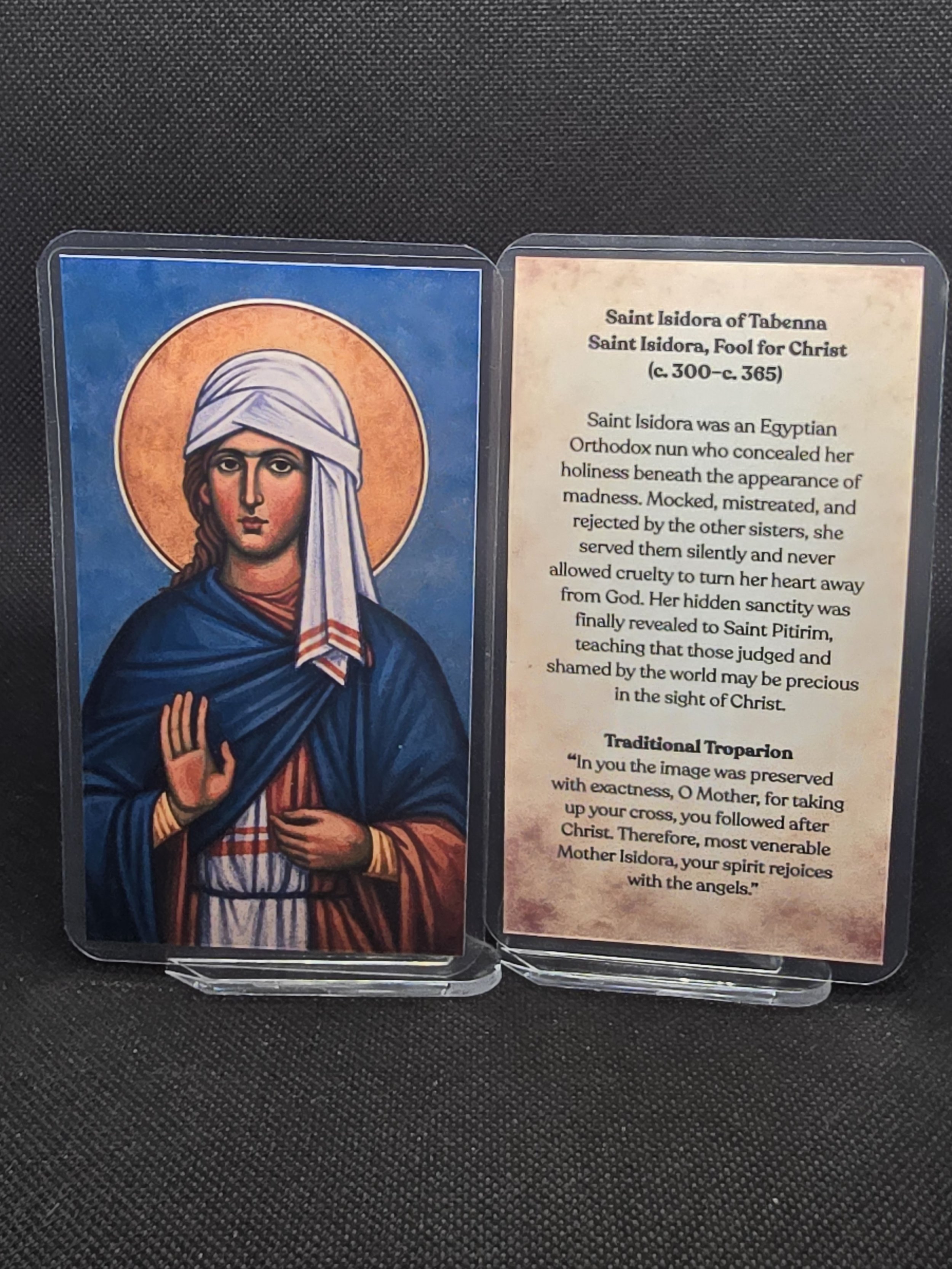
Saint Isidora of Tabenna Prayer Card – Patron for Mental Health Stigma, Crushing Shame & Radical Humility

$3.00

Holy Fool for Christ | Desert Ascetic | Hidden Saint of Humility

Saint Isidora of Tabenna was a Coptic Christian nun of fourth-century Egypt whose holiness was concealed beneath mockery, misunderstanding, and deliberate humiliation.

She lived inside a women’s monastery at Tabenna, founded under the rule of Saint Pachomius the Great, within the early Coptic Orthodox tradition that shaped Egyptian desert monasticism. While the other sisters followed structured ascetic discipline, Isidora chose a far more hidden path. She intentionally presented herself as mentally unstable and spiritually useless, allowing herself to be treated as a servant, a fool, and an outcast within her own community.

She cleaned floors.
She washed dishes.
She accepted scraps of food.

The other nuns mocked her openly. Some struck her. Others cursed her. She was excluded from communal meals and prayers, treated as a burden rather than a sister. Isidora never defended herself. She never explained. She never asked to be understood.

She absorbed humiliation as prayer.

Her entire spiritual life was built on radical humility, self-emptying, and silent endurance. While the world around her interpreted her behavior as madness, Isidora was quietly offering every insult and rejection to God, stripping herself of ego so completely that nothing remained but obedience and love.

Her sanctity remained hidden until Saint Pitirim of Scetis was divinely instructed to visit the monastery. Upon seeing Isidora, he immediately recognized her as a great saint and bowed before her. When the other sisters protested, he rebuked them sharply, revealing that the woman they had despised was far spiritually superior to them all.

Only then did they understand.

Overwhelmed with repentance, the sisters begged Isidora for forgiveness. She quietly left the monastery soon afterward, desiring once again to remain unknown.

Her feast is commemorated on May 10 (May 23 on the Old Calendar).

Today, Saint Isidora is sought by those suffering under mental health stigma, those crushed by shame or rejection, and those struggling with spiritual pride or invisibility. She is especially prayed to by people who feel misunderstood, judged, or discarded, and by those carrying emotional wounds from being treated as “less than.”

This prayer card honors her hidden sanctity and her courage to disappear so Christ could be revealed.

Each card is handmade in Austin and created to order. We do not keep stock, because every prayer card is treated as a unique devotional offering. They are printed on museum-quality photo paper, not cardstock, and each one is made during prayer. The saints are venerated throughout the entire process, and prayers are intentionally offered for the person who will receive the card. These are not mass-produced items. They are created slowly, reverently, and with spiritual intention, because every soul and every prayer matters.

Holy Fool for Christ | Desert Ascetic | Hidden Saint of Humility

Saint Isidora of Tabenna was a Coptic Christian nun of fourth-century Egypt whose holiness was concealed beneath mockery, misunderstanding, and deliberate humiliation.

She lived inside a women’s monastery at Tabenna, founded under the rule of Saint Pachomius the Great, within the early Coptic Orthodox tradition that shaped Egyptian desert monasticism. While the other sisters followed structured ascetic discipline, Isidora chose a far more hidden path. She intentionally presented herself as mentally unstable and spiritually useless, allowing herself to be treated as a servant, a fool, and an outcast within her own community.

She cleaned floors.
She washed dishes.
She accepted scraps of food.

The other nuns mocked her openly. Some struck her. Others cursed her. She was excluded from communal meals and prayers, treated as a burden rather than a sister. Isidora never defended herself. She never explained. She never asked to be understood.

She absorbed humiliation as prayer.

Her entire spiritual life was built on radical humility, self-emptying, and silent endurance. While the world around her interpreted her behavior as madness, Isidora was quietly offering every insult and rejection to God, stripping herself of ego so completely that nothing remained but obedience and love.

Her sanctity remained hidden until Saint Pitirim of Scetis was divinely instructed to visit the monastery. Upon seeing Isidora, he immediately recognized her as a great saint and bowed before her. When the other sisters protested, he rebuked them sharply, revealing that the woman they had despised was far spiritually superior to them all.

Only then did they understand.

Overwhelmed with repentance, the sisters begged Isidora for forgiveness. She quietly left the monastery soon afterward, desiring once again to remain unknown.

Her feast is commemorated on May 10 (May 23 on the Old Calendar).

Today, Saint Isidora is sought by those suffering under mental health stigma, those crushed by shame or rejection, and those struggling with spiritual pride or invisibility. She is especially prayed to by people who feel misunderstood, judged, or discarded, and by those carrying emotional wounds from being treated as “less than.”

This prayer card honors her hidden sanctity and her courage to disappear so Christ could be revealed.

Each card is handmade in Austin and created to order. We do not keep stock, because every prayer card is treated as a unique devotional offering. They are printed on museum-quality photo paper, not cardstock, and each one is made during prayer. The saints are venerated throughout the entire process, and prayers are intentionally offered for the person who will receive the card. These are not mass-produced items. They are created slowly, reverently, and with spiritual intention, because every soul and every prayer matters.

  • Saint Isidora lived during the fourth century in Egypt, within one of the earliest organized monastic communities. While most nuns practiced visible asceticism through fasting and structured prayer, Isidora chose a path almost impossible to comprehend.

    She adopted the role of a “fool for Christ.”

    Rather than seeking recognition for holiness, she deliberately concealed it. She behaved in ways that invited ridicule. She accepted abuse without protest. She served constantly while being treated as spiritually inferior.

    Her community believed she was mentally unwell.

    She allowed them to believe it.

    Isidora’s entire spiritual life was built around voluntary humiliation. She saw insults as offerings. She accepted exclusion as purification. She allowed her reputation to be destroyed so that pride would have no place to hide.

    Her sanctity remained completely unknown until Saint Pitirim arrived, having been shown her in a vision. When he bowed before her, the sisters were stunned. His revelation exposed not only Isidora’s holiness but their own blindness.

    After being recognized, Isidora quietly departed, choosing obscurity over honor. Nothing more is recorded of her earthly life.

    She vanished as she had lived.

    Hidden.

  • Saint Isidora is sought by those carrying invisible suffering and social rejection.

    Patron Saint Of:

    Mental health stigma
    Crushing shame
    Being misunderstood or judged
    Radical humility
    Spiritual pride
    Emotional invisibility
    Hidden suffering
    Those treated as expendable

    Miracles and Ongoing Intercession

    While her earthly miracles were concealed, devotion to Saint Isidora grew after her death, particularly among Coptic Christians and later Eastern Orthodox monastic communities.

    Those who pray through her intercession often testify to emotional healing after prolonged rejection, peace replacing internalized shame, softening of hardened relationships, and freedom from obsessive self-judgment.

    Many who struggle with being misunderstood or labeled report unexpected relief and renewed dignity after entrusting their pain to Saint Isidora. Others speak of spiritual pride breaking and humility returning, allowing deeper prayer and compassion.

    Her miracles are quiet.

    They happen in wounded hearts.

  • Traditional Prayer

    Holy Mother Isidora, hidden servant of Christ, pray for us. Intercede for the rejected, heal those crushed by shame, and teach our hearts the way of humility. Amen.

    Personal Prayer

    Holy Saint Isidora, silent bearer of suffering, pray for me.

    You know what it means to be misunderstood. You understand rejection, mockery, and invisibility. You carried humiliation without bitterness and turned every wound into prayer.

    I bring you my shame.
    I bring you my loneliness.
    I bring you the places where I feel unseen.

    Intercede for my healing.

    If I am judged unfairly, help me forgive.
    If I feel discarded, remind me of my worth.
    If pride has hardened my heart, soften it.

    Teach me how to carry suffering quietly.
    Teach me how to love without recognition.
    Teach me how to disappear so Christ can grow within me.

    Holy Mother, you accepted being called foolish for the sake of holiness.

    Help me surrender my need for approval.
    Help me release resentment.
    Help me find peace in humility.

    Stand beside me when shame rises.
    Stand beside me when rejection hurts.
    Stand beside me while I learn to rest in God alone.

    By your intercession, may Christ heal my wounded heart, restore my dignity, and teach me the freedom of holy humility.

    Amen.

  • Q: What is Saint Isidora of Tabenna known for?
    She is known as a Fool for Christ who intentionally accepted humiliation and rejection in order to destroy pride and live in radical humility.

    Q: When is Saint Isidora’s feast day?
    She is commemorated on May 10, with Old Calendar observance on May 23.

    Q: Which Christian traditions venerate Saint Isidora?
    She is venerated in the Coptic Orthodox Church and honored in Eastern Orthodox and Eastern Catholic traditions through the Desert Fathers and Mothers.

    Q: Why do people pray to Saint Isidora for shame or mental health stigma?
    Because she lived under misunderstanding and rejection while transforming suffering into prayer. Many seek her intercession when facing shame, emotional invisibility, or judgment, trusting her to bring peace and restoration.