 Image 1 of 1
Saint John Henry Newman Prayer Card – For Conversion, Conscience, Intellectual Doubt & Courage to Follow Truth
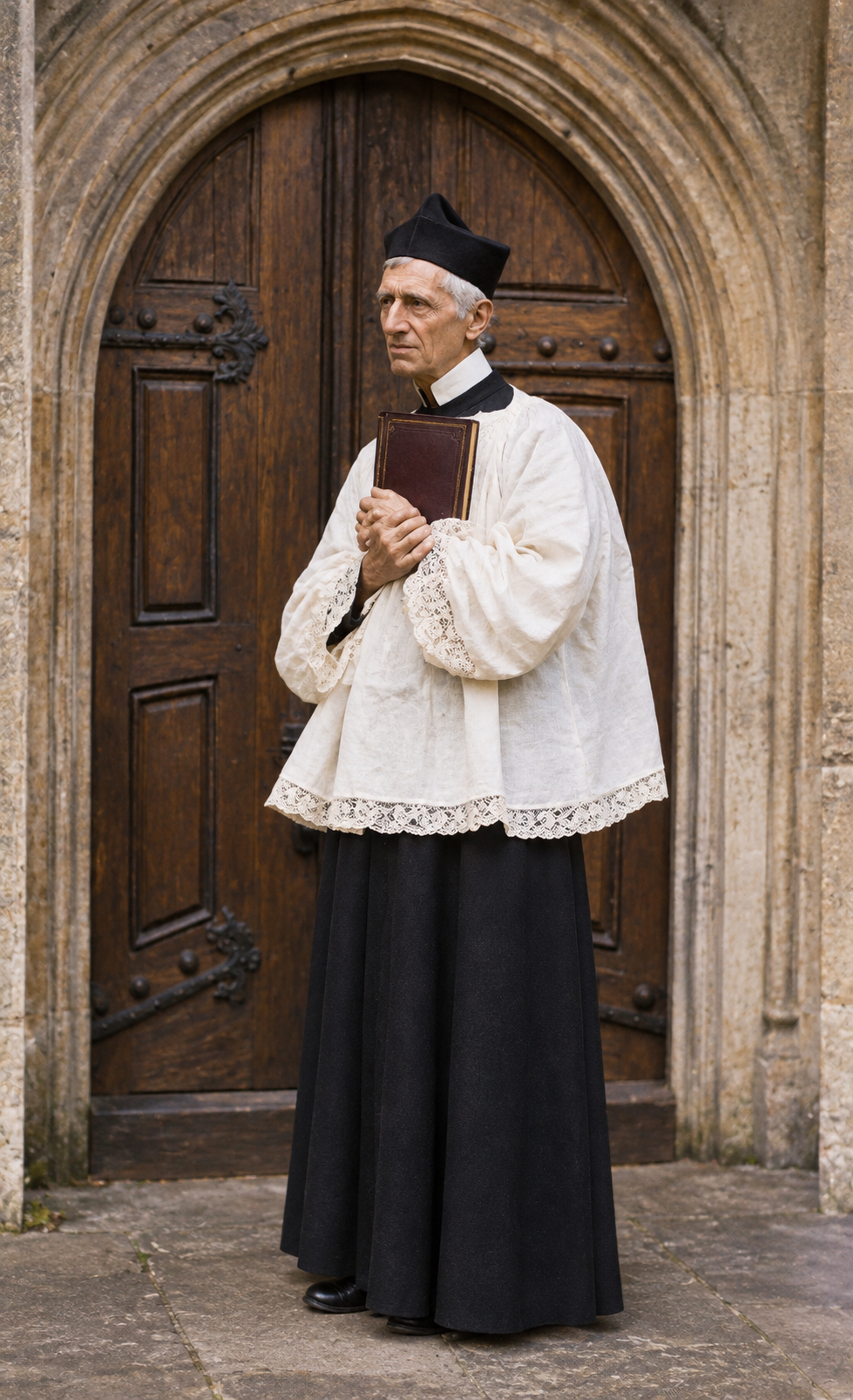
Saint John Henry Newman was an English priest, theologian, scholar, writer, convert, cardinal, and Doctor of the Church whose lifelong search for truth led him from the Church of England into the Catholic Church. Few modern saints speak as directly to people wrestling with religious doubt, questions of conscience, intellectual uncertainty, conversion, education, and the difficult cost of following truth when doing so may change the entire direction of a life.
Newman did not become Catholic through emotional impulse or dissatisfaction with Christianity. He spent years studying Scripture, the early Church Fathers, apostolic succession, Christian history, doctrine, and the development of belief. When his conclusions eventually placed him at odds with the religious world in which he had built his career, he accepted the consequences and entered the Catholic Church in 1845.
His life is especially meaningful for converts, people considering Catholicism, Christians struggling with intellectual doubt, students and educators, those discerning difficult decisions, and anyone trying to form a conscience that genuinely seeks truth rather than simply confirming what is comfortable. In 2025, Pope Leo XIV proclaimed Saint John Henry Newman a Doctor of the Church and named him, together with Saint Thomas Aquinas, co-Patron of the Church’s educational mission.
Each prayer card measures 2.5" x 4.25", is handmade in Austin, Texas, printed on museum-quality photo paper rather than ordinary cardstock, and double laminated for durability. Every card is made to order and prepared prayerfully, with the recipient and their intentions brought before Christ while asking Saint John Henry Newman to intercede for their needs.
THE LIFE & STORY OF SAINT JOHN HENRY NEWMAN
John Henry Newman was born in London in 1801 into an Anglican family. He grew up reading the Bible and developed an unusually serious religious imagination while still young.
At fifteen, Newman experienced what he later described as a profound inward conversion. Christianity became something more than inherited religious culture, and he developed a powerful awareness of the relationship between the individual soul and God.
That early conversion did not give Newman every answer he would later seek. Instead, it began a spiritual and intellectual journey that continued for the remainder of his life.
OXFORD
Newman entered Trinity College at the University of Oxford while still a teenager and was later elected a Fellow of Oriel College, then one of Oxford’s most intellectually influential communities.
He possessed a formidable mind and became deeply involved in university life, theology, teaching, and pastoral ministry. Oxford was not merely the location of his education. It became the setting in which many of the questions that eventually led him toward Catholicism first developed.
Newman was ordained an Anglican deacon in 1824 and an Anglican priest in 1825. He served as vicar of the University Church of Saint Mary the Virgin, where his preaching attracted significant attention.
THE ANGLICAN PRIEST
As an Anglican priest, Newman took pastoral responsibility extremely seriously. He visited parishioners, cared for the sick and poor, preached, studied theology, and believed that clergy carried responsibility for the souls entrusted to them.
His sermons gradually established him as one of the most important religious voices in Oxford. Students and scholars encountered a preacher who combined intellectual seriousness with a profound concern for personal holiness.
Newman was not yet moving deliberately toward Rome. He was attempting to strengthen Anglican Christianity by recovering what he believed belonged to the ancient and apostolic Church.
THE CHURCH FATHERS
Study of the early Church Fathers became one of the decisive forces in Newman’s life. He immersed himself in the writings of early Christian bishops and theologians and increasingly asked how the Christianity of antiquity related to the divisions of nineteenth-century Christianity.
These studies pushed him beyond theoretical theology. Questions about apostolic authority, doctrine, councils, heresy, ecclesial continuity, and the historical Church became increasingly personal.
Newman wanted to know not simply which religious position seemed most attractive but which Church could legitimately claim continuity with the ancient Christian community.
This search would eventually cost him enormously.
THE OXFORD MOVEMENT
Newman became one of the principal leaders of the Oxford Movement, also known as the Tractarian Movement. Beginning in the 1830s, its leaders sought to recover the Catholic and apostolic dimensions of Anglicanism.
They emphasized the early Church, apostolic succession, sacramental theology, ancient liturgy, ecclesial authority, and the idea that Christianity consisted of more than private interpretation or national religious identity.
Newman contributed extensively through the influential Tracts for the Times. His writing helped provoke major debate within Anglicanism because he was raising fundamental questions about what the Church was and where its authority came from.
TRACT 90
The controversy surrounding Newman intensified after the publication of Tract 90 in 1841. Newman argued that the Thirty-Nine Articles of Anglicanism could be interpreted in a way that was less hostile to Catholic doctrine than commonly assumed.
The reaction was severe. Oxford authorities condemned the tract, and Newman found himself increasingly isolated.
The controversy did not instantly make him Catholic. Instead, it exposed how difficult his attempt to reconcile Anglicanism with the ancient Catholic tradition had become.
His intellectual project was reaching its limit.
LITTLEMORE
Newman gradually withdrew from public life in Oxford and moved to Littlemore, a village outside the university city. There he lived with a small group of companions in a quiet, disciplined community devoted to prayer, fasting, study, and discernment.
Littlemore became the place where Newman allowed his theological questions to reach their conclusion without forcing an answer prematurely.
He resigned from his Anglican parish and eventually ceased functioning as an Anglican clergyman. For a man whose identity, friendships, professional life, and reputation had been tied to Oxford and the Church of England, the cost was enormous.
Newman was not simply changing denominations. He was preparing to lose much of the world he knew.
THE DEVELOPMENT OF CHRISTIAN DOCTRINE
During this period, Newman worked intensely on An Essay on the Development of Christian Doctrine. He was trying to answer one of the central objections to Catholicism: if Catholic teaching was truly apostolic, why did some doctrines appear to become clearer or more developed later in Christian history?
Newman argued that authentic doctrine can develop organically while remaining faithful to the original revelation. A doctrine may become more precise as the Church encounters new questions, controversies, and historical circumstances without becoming a different faith.
The argument became enormously influential in Catholic theology.
More importantly for Newman personally, his research helped convince him that the Catholic Church possessed the continuity with ancient Christianity he had been seeking.
RECEIVED INTO THE CATHOLIC CHURCH
In October 1845, Newman was received into the Catholic Church by the Passionist priest Dominic Barberi, who would later be beatified.
The decision sent shock waves through England.
Newman had been one of the most prominent Anglican theologians of his generation. His conversion therefore carried intellectual, religious, cultural, and personal significance far beyond one individual changing churches.
He surrendered security, reputation, friendships, and a respected position at Oxford because he had become convinced that truth required him to do so.
FOR CONVERTS
Saint John Henry Newman is one of the great saints for people entering the Catholic Church because he understood how complicated conversion can become.
Conversion can involve joy and conviction while simultaneously producing grief, family tension, social misunderstanding, disrupted friendships, and the painful realization that following conscience may carry real consequences.
Newman knew that experience personally.
His life offers encouragement to someone who has discovered that religious truth may demand more than intellectual agreement. Sometimes truth requires a decision.
CATHOLIC PRIESTHOOD
After becoming Catholic, Newman traveled to Rome and was ordained a Catholic priest in 1847. During his time there, he encountered the spirituality of Saint Philip Neri, the sixteenth-century founder of the Oratory.
Newman recognized in the Oratorian model something suited to his own vocation. Oratorians are priests living in community without taking traditional religious vows, combining prayer, pastoral ministry, study, friendship, and intellectual life.
He returned to England and established the Oratory of Saint Philip Neri, first at Birmingham and later also influencing the establishment of the London Oratory.
Birmingham became his permanent spiritual home.
THE BIRMINGHAM ORATORY
Newman spent much of his Catholic life at the Birmingham Oratory. Although internationally famous as a theologian and writer, he remained deeply involved in ordinary priestly ministry.
He preached, heard Confessions, instructed converts, visited people in need, corresponded with those seeking advice, and lived within the daily rhythm of his Oratorian community.
This pastoral dimension is essential to understanding him. Newman was not simply an intellectual who happened to become a saint.
His theology emerged from a life of prayer, pastoral responsibility, friendship, suffering, and concern for individual souls.
CATHOLIC EDUCATION
Education occupied a central place in Newman’s thought. He believed genuine education should develop the whole human person rather than merely produce technical competence.
His work in Ireland led to the lectures later published as The Idea of a University, one of the most famous works in the history of modern educational philosophy.
Newman defended the value of intellectual formation, broad knowledge, careful reasoning, and the relationship between theology and other fields of study.
He resisted the idea that education should be reduced entirely to immediate economic usefulness.
In 2025, this dimension of his legacy received extraordinary recognition when Pope Leo XIV named Saint John Henry Newman, together with Saint Thomas Aquinas, co-Patron of the Church’s educational mission.
FOR STUDENTS AND EDUCATORS
Saint John Henry Newman is especially meaningful for students, professors, teachers, writers, researchers, seminarians, and anyone trying to unite serious intellectual work with Christian faith.
He did not believe faith required fear of honest inquiry.
His own journey demonstrates the opposite. Newman followed historical and theological questions so seriously that they eventually forced him to reconsider his own religious identity.
For students afraid that difficult questions somehow make them unfaithful, Newman offers a different model. A question pursued honestly can become part of the journey toward deeper faith.
CONSCIENCE
Few topics are more closely associated with Newman than conscience.
For him, conscience was not simply the feeling that whatever a person sincerely wants must therefore be right. Conscience places the individual under a moral authority greater than personal preference.
The conscience must be formed, educated, and oriented toward truth.
This is why Newman can be misunderstood when his writings on conscience are separated from his belief in objective moral truth. He defended conscience precisely because he believed the human person is capable of hearing a moral summons that does not originate merely in the self.
FOR DIFFICULT MORAL DECISIONS
Saint John Henry Newman can be especially meaningful for someone facing a decision in which convenience and conscience appear to be pulling in different directions.
Newman’s own conversion placed him in precisely that position. Remaining where he was would have preserved much of his career and social world, but he no longer believed he could do so honestly.
His example does not teach impulsiveness. Newman spent years studying, praying, reconsidering, and testing his conclusions.
Yet discernment eventually reaches a point when a person must act upon what they believe to be true.
INTELLECTUAL DOUBT
Newman is also a powerful saint for Christians experiencing intellectual doubt. His writings demonstrate that deep faith and serious questioning are not opposites.
He wrestled with history, authority, doctrine, probability, certainty, religious experience, and the way human beings come to real conviction.
His later philosophical work An Essay in Aid of a Grammar of Assent explored how people actually reach certainty about matters that cannot always be reduced to mathematical demonstration.
For someone troubled by the idea that faith must mean possessing absolute intellectual simplicity about every question, Newman offers a more sophisticated vision.
Faith can involve reasoning, experience, conscience, accumulated evidence, trust, and the gradual movement of the whole person toward truth.
LEAD, KINDLY LIGHT
During a difficult period of illness and spiritual uncertainty while traveling in the Mediterranean, Newman composed the poem that became the famous hymn Lead, Kindly Light.
The hymn expresses the spirituality of someone who cannot see the entire road ahead but asks God for enough light to take the next step.
That image fits Newman’s entire life remarkably well.
He did not receive his complete Catholic future in a single moment. His path unfolded gradually through study, prayer, mistakes, correction, suffering, and increasing clarity.
For people overwhelmed because they cannot see how an uncertain situation will end, Newman’s life offers a powerful principle: God does not always reveal the whole road before asking us to walk.
“TO LIVE IS TO CHANGE”
One of Newman’s most famous statements comes from his work on doctrinal development:
“To live is to change, and to be perfect is to have changed often.”
The line does not mean that truth itself constantly changes. Newman was explaining that living things develop.
A mature faith is not necessarily identical in expression to the faith of childhood. Experience, study, suffering, correction, and deeper understanding can transform how a person understands truths they have long believed.
Newman himself became the living example of this process.
APOLOGIA PRO VITA SUA
In 1864, a public attack upon Newman’s honesty prompted him to write the work that became Apologia Pro Vita Sua, his spiritual autobiography and one of the great works of nineteenth-century religious literature.
Newman used the book to explain the development of his religious convictions from his youth through his conversion to Catholicism.
The work transformed his public reputation.
Readers who had regarded his conversion as dishonest or opportunistic encountered the record of a man who had spent decades painfully following a religious argument wherever he believed truth required him to go.
The Apologia remains essential reading for anyone trying to understand Newman.
HEART SPEAKS TO HEART
When Pope Leo XIII elevated Newman to the College of Cardinals in 1879, Newman chose the motto Cor ad cor loquitur, commonly translated as “Heart speaks to heart.”
The phrase beautifully summarizes his approach to faith and pastoral life.
Christian truth was never merely an intellectual system for Newman. Truth must reach the person.
His influence came partly from his ability to combine formidable intellectual reasoning with language that addressed fear, conscience, longing, friendship, loss, and the spiritual life of the individual.
MADE A CARDINAL
Newman’s elevation to the cardinalate was an extraordinary public vindication late in his life. Decades earlier, his conversion had generated suspicion among Anglicans while some Catholics also viewed aspects of his thinking cautiously.
By 1879, Pope Leo XIII recognized his extraordinary service to the Church by naming him a cardinal.
Newman did not become a bishop. He received special permission to continue living at the Birmingham Oratory, the community that had become his home.
His elevation was widely celebrated even beyond Catholic circles in England.
HIS FRIENDSHIPS
Newman placed tremendous value on friendship. His enormous correspondence reveals a man capable of deep emotional bonds and extraordinary loyalty to individuals across long periods of time.
This aspect of his personality is easy to overlook when focusing on doctrinal controversies.
His famous motto about heart speaking to heart emerged from a spirituality in which human relationship mattered profoundly.
Newman believed truth is communicated not only through arguments but through persons.
FOR PEOPLE WHO FEEL BETWEEN TWO WORLDS
Converts often experience a peculiar loneliness. They may no longer feel entirely at home in the religious world they left while still learning how to belong fully within the community they entered.
Newman understood that experience.
He never stopped loving people from his Anglican past simply because he had become Catholic, and his conversion did not erase the intellectual and spiritual formation he had received before entering the Church.
His life can therefore be especially comforting for converts who feel they have gained something precious while also mourning what they left behind.
NEWMAN AND THE EARLY CHURCH
One of the strongest reasons people continue discovering Newman today is his intense engagement with the early Church.
His reading of the Fathers helped convince him that Christianity must be historical, apostolic, sacramental, and ecclesial rather than reconstructed independently by each generation.
For Christians exploring Catholicism or Orthodoxy because of the Church Fathers, Newman’s story can feel remarkably familiar.
He asked questions that many modern converts continue asking: What did the earliest Christians believe? How did they understand authority? How were disputes settled? What does apostolic continuity actually mean?
Those questions changed his life.
NEWMAN CENTERS
Newman’s name has become particularly familiar to university students through Newman Centers, Catholic ministries located on or near secular college and university campuses.
The first such organizations developed after Newman’s lifetime and took inspiration from his commitment to Catholic intellectual life and university education.
Today, students throughout the United States and other countries may encounter his name before they know anything about the man himself.
For Catholic college students, Newman therefore has a particularly strong connection to the challenge of maintaining and deepening faith within academic environments.
HIS FINAL YEARS
Newman lived into old age at the Birmingham Oratory, continuing to write letters, offer spiritual counsel, pray, and remain connected with the community he had founded.
He died in 1890 at the age of eighty-nine.
His long life had crossed enormous boundaries: Anglican and Catholic, Oxford academic and Oratorian priest, controversial convert and celebrated cardinal, private seeker and public theologian.
His desired epitaph summarized the journey beautifully: “Out of shadows and images into the truth.”
BEATIFICATION AND CANONIZATION
Pope Benedict XVI beatified John Henry Newman in Birmingham in 2010 during his apostolic visit to the United Kingdom.
Pope Francis canonized him in Saint Peter’s Square in 2019.
His canonization recognized the holiness of a man whose influence already extended far beyond the Catholic Church. Newman had become a major figure in theology, education, philosophy, ecclesiology, religious history, and the study of conscience.
The Church’s recognition of his importance would go even further several years later.
DOCTOR OF THE CHURCH
On November 1, 2025, Pope Leo XIV proclaimed Saint John Henry Newman a Doctor of the Church.
The title is reserved for saints whose teaching possesses exceptional importance for the life of the universal Church.
At the same celebration, Pope Leo named Newman and Saint Thomas Aquinas co-Patrons of the Church’s educational mission, highlighting Newman’s enormous contribution to the relationship between faith, reason, formation, and education.
This places Newman among a relatively small group of saints whose theological teaching has received one of the Church’s highest forms of recognition.
THE MIRACLE FOR HIS CANONIZATION
The miracle recognized for Newman’s canonization involved Melissa Villalobos, an American mother who experienced a dangerous pregnancy complication.
Villalobos had developed a devotion to Newman and prayed for his intercession during a medical emergency. Her unexpected recovery was subsequently investigated through the Church’s canonical process.
The approved miracle opened the way for Newman’s canonization in 2019.
His modern canonization story adds another dimension to a saint known primarily for intellectual achievement. Newman can be approached not only as a theologian to study but as a saint whose intercession Christians actively seek.
FOR CONVERSION
A Saint John Henry Newman prayer card can be especially meaningful for someone becoming Catholic, considering conversion, entering OCIA, or praying for a family member exploring the Church.
Newman understands both the intellectual and emotional sides of conversion.
He demonstrates that seeking truth sometimes requires patience rather than a rushed decision, while also showing that discernment cannot continue forever merely to avoid the consequences of commitment.
His life encourages the seeker to pray, study carefully, remain honest, and follow truth when it becomes clear.
FOR INTELLECTUAL DOUBT
Newman is particularly valuable for someone who fears difficult questions.
He did not respond to intellectual uncertainty by demanding that people stop thinking. His entire life demonstrates confidence that Christianity can survive serious historical and philosophical investigation.
At the same time, he recognized that human beings are more than detached reasoning machines. Pride, fear, social pressure, desire, conscience, personal relationships, and moral choices all affect how we approach truth.
His writings therefore remain remarkably modern.
FOR STUDENTS
Students can ask Saint John Henry Newman to intercede for wisdom, intellectual honesty, discipline, discernment, courage, and the ability to pursue knowledge without losing sight of God.
His educational thought rejects both anti-intellectual religion and education stripped of any higher understanding of the human person.
For a student entering university, graduate school, seminary, or another demanding intellectual environment, Newman offers an extraordinary companion.
He demonstrates that learning can become part of a vocation rather than an obstacle to faith.
FOR TEACHERS AND PROFESSORS
Newman believed education involves the formation of the person, not merely the transfer of information.
Teachers carry responsibility for minds, but they also influence the habits, imagination, character, and understanding of the students entrusted to them.
His elevation as co-Patron of the Church’s educational mission makes his intercession especially fitting for teachers, professors, school leaders, theologians, catechists, campus ministers, and anyone involved in intellectual formation.
THE QUOTE
One of Saint John Henry Newman’s most memorable lines summarizes both his theology of development and his personal journey:
“To live is to change, and to be perfect is to have changed often.”
Newman was not celebrating change merely for the sake of novelty. He was describing the development characteristic of living things.
His own life changed repeatedly because he refused to stop seeking truth once the search became uncomfortable.
For someone afraid that changing a long-held belief automatically means failure, Newman offers another possibility. Sometimes growth requires having the humility to admit that deeper understanding has changed us.
A PRAYER WITH SAINT JOHN HENRY NEWMAN
One of Newman’s best-known spiritual meditations expresses his trust that every person has been created for a purpose within God’s Providence. He believed that even when someone cannot understand the entire shape of their vocation, their life still forms part of a work larger than themselves.
Christians seeking his intercession can therefore pray for the courage to follow truth, fidelity to conscience, wisdom during uncertainty, and confidence that God can lead them even when only the next step is visible.
Saint John Henry Newman, pray that we may seek truth without fear, form our consciences according to God’s will, and follow Christ wherever He leads us. Help students and teachers to unite knowledge with wisdom, guide those considering conversion, and intercede for everyone struggling to recognize the next faithful step. Amen.
WHO SHOULD RECEIVE A SAINT JOHN HENRY NEWMAN PRAYER CARD?
A Saint John Henry Newman prayer card can make a meaningful gift for converts, OCIA candidates, students, professors, theologians, writers, teachers, seminarians, campus ministers, and people discerning whether to become Catholic.
It can also be especially meaningful for someone experiencing religious doubt, intellectual uncertainty, a crisis of conscience, or a major life decision in which following the truth may carry personal cost.
Newman’s life reminds Christians that uncertainty does not necessarily mean God is absent. Sometimes the long process of questioning is itself part of the road by which God leads a person more deeply into truth.
FAQ
Who was Saint John Henry Newman? Saint John Henry Newman was a nineteenth-century English theologian, priest, writer, convert to Catholicism, Oratorian, cardinal, and Doctor of the Church. He lived from 1801 to 1890 and became one of the most influential Christian thinkers of the modern era.
Was John Henry Newman originally Anglican? Yes. Newman was ordained an Anglican priest and became one of Oxford’s most prominent Anglican theologians before entering the Catholic Church in 1845.
Why did John Henry Newman become Catholic? Years of studying Scripture, Christian history, doctrinal development, apostolic authority, and particularly the early Church Fathers gradually convinced Newman that the Catholic Church possessed the continuity with ancient Christianity he had been seeking.
What was the Oxford Movement? The Oxford Movement was a nineteenth-century movement within Anglicanism that emphasized the Church’s apostolic, sacramental, and Catholic heritage. Newman became one of its most important leaders.
What was Tract 90? Tract 90 was Newman’s controversial attempt to interpret the Anglican Thirty-Nine Articles in a way that demonstrated greater compatibility with Catholic doctrine. The reaction to it intensified the crisis that eventually contributed to his departure from Anglican ministry.
Who received Newman into the Catholic Church? The Passionist priest Dominic Barberi received Newman into the Catholic Church in 1845. Barberi was later beatified by the Catholic Church.
Was John Henry Newman a Catholic priest? Yes. After his conversion he was ordained a Catholic priest in Rome in 1847 and later established the Oratory of Saint Philip Neri in England.
Was John Henry Newman a bishop? No. Newman was never a bishop. Pope Leo XIII made him a cardinal in 1879, and Newman received permission to continue residing at the Birmingham Oratory.
What is John Henry Newman famous for? He is famous for his conversion to Catholicism, leadership in the Oxford Movement, writings on conscience and doctrinal development, educational philosophy, Apologia Pro Vita Sua, The Idea of a University, Grammar of Assent, and extensive sermons and correspondence.
What did Newman teach about conscience? Newman regarded conscience as a genuine moral authority within the human person, but not as permission to invent morality individually. Conscience must seek and submit to truth rather than simply justify personal preference.
What is the meaning of Newman’s motto “Heart speaks to heart”? The Latin motto Cor ad cor loquitur reflects Newman’s conviction that truth and faith involve personal encounter rather than intellectual argument alone. It became the motto associated with him after his elevation to the cardinalate.
What is Lead, Kindly Light? Lead, Kindly Light is a poem written by Newman during a difficult journey in the Mediterranean. It later became a widely beloved Christian hymn centered on trusting God for guidance when the entire path ahead cannot yet be seen.
What did Newman mean by “To live is to change”? Newman used the phrase while discussing doctrinal development. He argued that genuine living realities can grow and develop while preserving continuity with what they truly are.
What is Apologia Pro Vita Sua? Apologia Pro Vita Sua is Newman’s spiritual autobiography, written in 1864 to explain the development of his religious convictions and defend his honesty after a public attack upon his character.
What is The Idea of a University? The Idea of a University is a collection of Newman’s influential lectures on education. The work explores the purpose of higher education, intellectual formation, liberal knowledge, theology, and the development of the whole person.
Why are Catholic campus ministries called Newman Centers? Many Catholic ministries serving students at secular universities adopted Newman’s name because of his enormous contribution to Catholic thought about education, intellectual life, and university formation.
When was John Henry Newman canonized? Pope Francis canonized Saint John Henry Newman in 2019 after the Catholic Church formally investigated his heroic virtue and miracles attributed to his intercession.
Is Saint John Henry Newman a Doctor of the Church? Yes. Pope Leo XIV proclaimed him a Doctor of the Church on November 1, 2025, recognizing the exceptional importance of his teaching for the universal Church.
Is John Henry Newman a patron saint of education? In 2025 Pope Leo XIV named Saint John Henry Newman, together with Saint Thomas Aquinas, co-Patron of the Church’s educational mission. This makes him particularly meaningful for students, teachers, professors, schools, universities, and others involved in education.
Who would this Saint John Henry Newman prayer card make a meaningful gift for? It is especially appropriate for converts, OCIA candidates, students, educators, professors, theologians, writers, seminarians, campus ministers, people struggling with doubt, and anyone discerning a difficult decision involving faith or conscience.
THE MAIN MESSAGE OF SAINT JOHN HENRY NEWMAN’S LIFE
Saint John Henry Newman spent much of his life following questions whose answers eventually became personally inconvenient. He did not seek Catholicism because it made his life easier. His conversion cost him status, relationships, security, and the religious world in which he had expected to spend his life.
Yet Newman believed truth mattered enough to follow even when the destination was unexpected.
His story therefore speaks powerfully to an age in which people are often encouraged either to accept inherited beliefs without examination or to treat truth as whatever feels personally authentic. Newman offers another path: study seriously, pray honestly, form the conscience carefully, remain willing to be corrected, and follow truth rather than forcing truth to follow you.
His designation as a Doctor of the Church confirms what generations of readers had already discovered in his writings. Newman was not simply one of the great converts of the nineteenth century. He became one of Christianity’s great teachers of conscience, development, education, faith, reason, and the difficult but beautiful journey from shadows into truth.