 Image 1 of 1
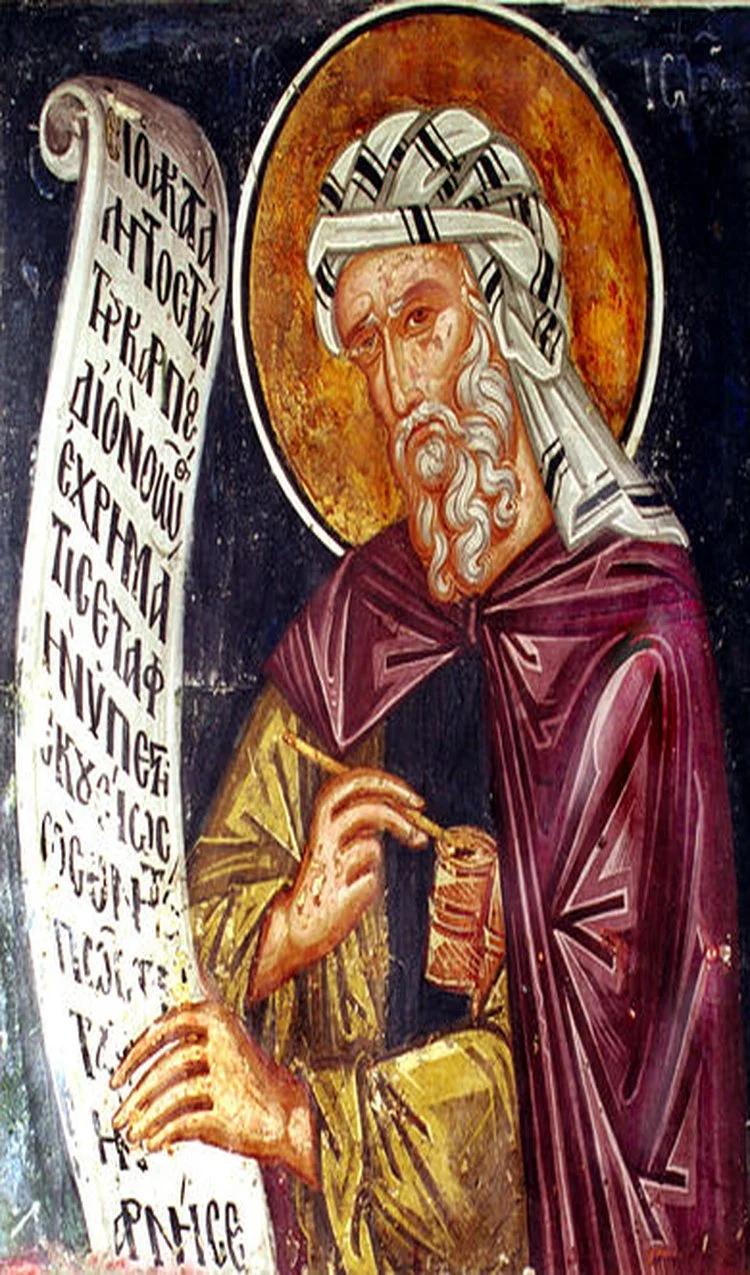
Saint John of Damascus Prayer Card - For Holy Icons, Theology, Church Singing & Defending the Faith
Saint John of Damascus, also known as Saint John Damascene, is one of the great theologians, hymnographers, and defenders of the Christian faith of the eighth century. Born into a Christian family in Damascus under Muslim rule, he left a position connected with the caliphal administration for monastic life at the Lavra of Saint Sabbas near Jerusalem, where he devoted himself to prayer, asceticism, theology, preaching, and sacred hymnography. He became especially famous for defending the veneration of holy icons during the first period of Byzantine Iconoclasm, and his writings helped provide the theological foundation later affirmed by the Seventh Ecumenical Council at Nicaea in 787.
Saint John is especially meaningful for iconographers, church singers, theologians, seminarians, catechists, teachers, writers, converts studying Christian doctrine, and anyone who needs courage to defend the faith intelligently without allowing controversy to destroy humility. His life joined rigorous intellectual work with monastic obedience, showing that theological knowledge reaches its proper purpose when it leads a person toward worship, repentance, and deeper love for Jesus Christ.
His defense of icons remains particularly important because Saint John did not argue that Christians may worship paintings, wood, or material objects. He carefully distinguished the worship due to God alone from the relative veneration offered to an image because of the person represented, and he rooted this distinction in the mystery of the Incarnation. Once the eternal Son of God truly became flesh and entered the visible material world, depicting Christ was no longer an attempt to picture an invisible deity but a confession that the Word truly became man and could genuinely be seen.
This makes Saint John especially meaningful for Christians who love sacred icons but want to understand why the Church venerates them. His theology gives a much deeper answer than saying that icons are simply beautiful religious artwork because, for John, the defense of the icon was ultimately a defense of Jesus Christ having truly taken flesh. To attack every sacred image in principle risked weakening the Christian confession that the invisible God had truly entered visible human history in the person of Christ.
Saint John is also one of the great saints of Byzantine hymnography and church singing. Orthodox tradition attributes important liturgical compositions to him, including the Paschal Canon and funeral hymns, while the Orthodox Church in America specifically notes that Christians seek his intercession for help in the study of church singing because of his work as a hymnographer.
His life therefore brings together truths that modern Christians sometimes separate. Theology and prayer belong together, doctrine and beauty belong together, intellectual defense of the faith and humility belong together, while icons, hymns, Scripture, liturgy, and the Incarnation all participate in one Christian confession centered upon Jesus Christ.
This prayer card is created for iconographers, Byzantine chanters, choir members, seminarians, priests, deacons, theologians, students, teachers, catechists, writers, apologists, Christians defending the use of holy icons, and anyone seeking wisdom to explain the faith clearly. It is also especially fitting for people who have been accused of idolatry because of Christian devotion to icons, converts trying to understand Eastern Christian worship, or anyone who wants intellectual knowledge of Christianity to become inseparable from prayer.
Saint John of Damascus belongs to the common Christian inheritance of Eastern Orthodox and Catholic Christianity. The Orthodox Church venerates him as Saint John of Damascus and commemorates him on December 4, while the Catholic Church also celebrates him as a priest and Doctor of the Church, a title formally extended to him by Pope Leo XIII in 1890.
Each card is handmade in Austin, TX and created to order. We do not keep stock, because every prayer card is treated as a unique devotional offering. They are printed on museum-quality photo paper, not cardstock, and every card is made slowly during prayer with intentional reverence for the saint and for the person who will receive it. Names are lifted before Christ, intentions are held carefully, and each piece is handled multiple times in prayerful silence, asking God for mercy and asking Saint John to intercede for the soul it is being made for. This is devotional craftsmanship shaped with patience, care, and spiritual responsibility because every soul and every prayer matters.
THE LIFE & STORY
Saint John was born in Damascus around the end of the seventh century, with Orthodox sources commonly placing his birth around 680 and Greek Orthodox tradition giving a similar date in the later seventh century. He was born into a prominent Christian family living under the Umayyad Caliphate, which placed him at an extraordinary meeting point between the ancient Greek and Syriac Christian world and the expanding Islamic civilization of the Middle East.
His father is remembered as Sergius Mansur, a Christian who held an important financial position within the administration of the Caliph. According to the traditional Orthodox Life, Sergius also adopted an orphan named Cosmas, who would grow up alongside John and later become known as Saint Cosmas the Hymnographer, or Cosmas of Maiuma.
The traditional Life says that John's father wanted both young men to receive an exceptional education. He therefore arranged for a learned monk named Cosmas, who had been taken captive and brought to Damascus, to teach them both secular and sacred subjects. John consequently received an intellectual formation that prepared him to engage philosophy, theology, language, and the broader learning of his age.
This education would become important later because John did not defend Christianity merely through emotion or inherited custom. He became one of the great synthesizers of patristic theology, drawing together teachings inherited from earlier Fathers and presenting them in an ordered form that would influence Eastern Christian theology for centuries.
After his father's death, John entered public service and held an important position within the government at Damascus. Catholic sources likewise remember him as assuming a role connected with the treasury of the Caliphate before eventually abandoning court life for monasticism.
The significance of this decision should not be overlooked. John possessed education, social standing, financial security, and a path toward continued public importance, yet he ultimately chose the monastery. His later authority did not come from accumulating greater worldly power but from surrendering that power and placing his gifts in the service of God.
John entered the Lavra of Saint Sabbas the Sanctified, commonly known as Mar Saba, in the Judean wilderness near Jerusalem. Pope Benedict XVI's account places this transition around the year 700 and emphasizes that John devoted himself there to asceticism, literary work, theological writing, and pastoral activity.
The traditional Orthodox Life emphasizes that John's enormous education created an unusual challenge when he entered monastic life. The monks recognized his learning and former social status, so finding an elder willing to take responsibility for forming him in obedience and humility was not easy. Eventually, an experienced spiritual father accepted John and deliberately placed him under disciplines intended to prevent intellectual ability from becoming spiritual pride.
This aspect of his life is particularly important for theologians and educated Christians. John did not need to become less intelligent in order to become holy, but his intelligence had to be purified from the temptation to believe that knowing more automatically meant being spiritually greater.
According to his traditional Life, his elder sometimes gave him deliberately humbling obediences. One famous story describes John being sent back toward Damascus dressed poorly and ordered to sell simple baskets for an unreasonable price, placing the former government official in a situation where he could no longer rely upon his former prestige.
The lesson is not that humiliation is valuable for its own sake. The deeper spiritual point is that John's knowledge had to become something offered to God rather than something protecting his self-image, and only then could his extraordinary intellectual gifts become tools of service rather than forms of vanity.
SAINT JOHN & THE DEFENSE OF HOLY ICONS
Saint John lived during the first great period of Byzantine Iconoclasm, when Emperor Leo III and others opposed the veneration of sacred images. Because John lived under Muslim political authority rather than within the Byzantine Empire itself, he possessed an unusual degree of freedom to criticize imperial religious policy.
John responded by composing three major discourses defending the holy icons. These writings became among the most important theological defenses of Christian sacred images and were later influential in the Church's rejection of Iconoclasm.
His argument began with Christ.
Before the Incarnation, attempting to depict the invisible and incomprehensible God presented an obvious theological problem. God is not a material object contained by shape, color, size, or physical boundaries, so the Old Testament prohibition against creating images of God guarded the people of Israel against reducing the divine mystery to an idol.
The Incarnation changed the situation because the eternal Word truly became flesh.
Jesus Christ possessed a real human face.
He could be seen.
He could be touched.
He occupied visible space.
His Mother saw Him.
The Apostles saw Him.
Crowds saw Him.
Pontius Pilate saw Him.
Those who crucified Him saw Him.
Those who encountered Him after the Resurrection saw the risen Lord.
For Saint John, the Christian icon therefore begins with the astonishing fact that God chose to become visible in the flesh. His defense of sacred images was not primarily an artistic argument but a Christological one, and Pope Benedict XVI specifically highlighted the way John's defense of images rested upon the mystery of the Incarnation.
John also carefully distinguished worship from veneration. Worship in the absolute sense belongs to God alone, while honor given to an image passes toward the person represented by that image rather than terminating in wood, paint, stone, or metal.
This distinction remains extremely important for Catholics and Orthodox Christians who are sometimes told that bowing before an icon, kissing it, lighting a candle before it, or carrying it in procession constitutes idolatry. Saint John's theology explains that Christians are not confusing matter with God because the honor shown toward the icon is directed toward its prototype.
A person who kisses a photograph of a deceased parent does not believe paper is his mother or father. The material image carries the relationship toward the person depicted, although Christian icon theology goes considerably deeper because sacred images belong within the worshipping life of the Church and confess the sanctifying consequences of the Incarnation.
Saint John also defended the Christian use of material things more broadly. The Incarnation means that matter is not the enemy of salvation because Christ assumed a real body, water is used in Baptism, bread and wine become central to the Eucharistic mystery, oil is used sacramentally, wood formed the Cross, ink carries the written Gospel, and the bodies of the saints themselves become temples of the Holy Spirit. Benedict XVI emphasized this positive theology of matter when explaining John's continuing importance.
This gives Saint John enormous importance for understanding Eastern Christianity as a whole. Incense, candles, icons, relics, holy water, chrism, vestments, sacred architecture, liturgical gestures, and sacramental worship all proclaim in different ways that Christianity is not a religion seeking escape from creation but the redemption and sanctification of creation through the Word who became flesh.
THE SEVENTH ECUMENICAL COUNCIL & SAINT JOHN'S LEGACY
Saint John did not live to see the final restoration of icons. His writings were condemned by the iconoclastic Council of Hieria in 754, but the Fathers of the Seventh Ecumenical Council at Nicaea in 787 later vindicated the theological position he had defended.
Nicaea II affirmed the lawful veneration of sacred images and became the definitive ecumenical rejection of Iconoclasm. Catholic and Orthodox sources alike recognize Saint John of Damascus as one of the most important theological voices whose work prepared the way for that defense of icons.
This gives his life a remarkable quality because a Christian can defend something faithfully and still die before seeing vindication. John wrote during controversy, endured condemnation from his opponents, and continued his monastic life without knowing how completely later generations would recognize the importance of his work.
For Christians facing misunderstanding or theological controversy, this can become an important spiritual lesson. Being vindicated immediately is not the measure of faithfulness, because sometimes a person's responsibility is simply to speak truthfully, remain humble, and leave the final judgment of history to God.
THE MIRACLE OF THE SEVERED HAND
One of the most beloved episodes in the traditional Life of Saint John concerns the miraculous healing of his right hand. This story belongs to the Church's hagiographic tradition and should be presented as such rather than confused with independently documented political history.
According to the Orthodox account, Emperor Leo III became enraged by John's writings in defense of the icons but could not directly arrest him because John was outside Byzantine jurisdiction. The traditional Life says that a forged letter was therefore produced in John's name and sent to the Caliph, making it appear that John was secretly conspiring against Damascus.
The Caliph believed the accusation and ordered John's right hand cut off. According to the tradition, John later received the severed hand, placed it against his arm, and prayed fervently before an icon of the Mother of God, asking for healing so that he could continue writing in defense of Christ and the holy images.
The story says that John fell asleep during prayer and awoke to discover that his hand had been restored, leaving only a mark as testimony to what had occurred. In gratitude, he placed a silver representation of a hand upon the icon of the Theotokos.
This tradition became associated with the famous icon known as the Theotokos of the Three Hands, or Tricherousa. Orthodox tradition holds that the icon later passed from Saint Sabbas Monastery and ultimately came to Hilandar Monastery on Mount Athos, where it became one of the monastery's treasured icons.
The image is sometimes misunderstood because the Mother of God is not being depicted as literally possessing three hands. The third hand represents the silver votive offering traditionally associated with Saint John's miraculous healing, and the devotional history of the icon preserves the memory of his prayer and defense of holy images.
This makes Saint John especially meaningful for writers, artists, iconographers, musicians, and people whose hands are central to their vocation. It would go beyond the traditional sources to assign him a formal universal patronage over hand injuries, but the story naturally makes his intercession meaningful to Christians whose work depends upon their hands or who are recovering from an injury affecting them.
MONASTIC HUMILITY & OBEDIENCE
The traditional Life of Saint John repeatedly emphasizes that his intellectual brilliance did not exempt him from ordinary monastic obedience. One of the strongest themes of his story is therefore the transformation of a highly educated public official into a monk willing to be corrected, humbled, and given tasks that had nothing to do with his previous status.
This becomes particularly visible in the tradition surrounding John's hymnography. According to the OCA's Life, a grieving monk once asked John to compose something for the funeral of his brother, but John's elder had forbidden him to write. John initially resisted the request because of obedience, yet compassion for the grieving monk eventually moved him to compose funeral hymns.
His elder treated this as disobedience and imposed a severe penance. The same hagiographic tradition says that the Mother of God later appeared in a vision to the elder and instructed him to allow John to write, after which John's theological and hymnographic gifts were again placed openly in service to the Church.
Whatever modern readers make of the severity of ancient monastic discipline, the spiritual lesson is clear. John possessed extraordinary gifts, but even genuine gifts had to exist within humility, obedience, and the larger life of the Christian community rather than becoming a justification for doing whatever he personally desired.
This is an important lesson for writers, musicians, theologians, artists, and other creative people. Possessing a gift does not automatically mean every impulse to use it comes from God, while genuine vocation requires learning when to speak, when to remain silent, when to work, and when to submit one's gifts to something larger than personal expression.
SAINT JOHN THE HYMNOGRAPHER
Saint John of Damascus became one of the great names of Byzantine liturgical hymnography. Greek Orthodox sources attribute to him major works including the Canon of Pascha, funeral hymns, and numerous hymns honoring Christ, the Theotokos, and the saints.
The Orthodox Church in America likewise identifies him explicitly as a hymnographer and even notes that Christians pray to Saint John for help with the study of church singing. This provides a particularly strong devotional connection for Byzantine chanters, choir directors, church musicians, cantors, and people learning sacred music.
His hymnography shows that theology was not merely something John placed into books. Theology could be sung, allowing doctrine to enter the memory through worship and become part of the prayer of ordinary Christians who might never read a theological treatise.
This is one of the great strengths of Eastern Christian liturgy. A believer learns Christology by singing it, learns the theology of the Resurrection by celebrating Pascha, learns Marian theology through feast-day hymns, and learns the lives of the saints through troparia, kontakia, canons, and other liturgical texts.
Saint John's work therefore stands at the meeting point of theology and beauty. The same man who could carefully distinguish worship from veneration could also place Christian doctrine into poetry that generations of believers would sing in church.
His connection with the Paschal Canon is particularly fitting because the Resurrection represents the fulfillment toward which the entire Christian life moves. Greek Orthodox sources continue to attribute the Paschal Canon to Saint John, and Catholic liturgical reflection has likewise cited the Easter Canon associated with him.
For church musicians, Saint John therefore offers a deeper understanding of sacred music. The goal is not performance for its own sake but the proclamation of Christian truth through beauty, so the singer becomes a servant of the prayer of the Church rather than the center of attention.
THE FOUNT OF KNOWLEDGE & ORTHODOX THEOLOGY
Saint John's most famous theological work is commonly known as the Fount of Knowledge. The OCA identifies it as his most important book and describes its third section, often known in English as An Exact Exposition of the Orthodox Faith, as a systematic summary of Orthodox Christian doctrine and a response to heresy.
This work helped organize the theological inheritance of earlier Christian centuries into a form that later generations could study more systematically. John was not trying to invent a new Christianity because much of his greatness came precisely from his ability to gather, clarify, organize, and faithfully transmit what the Fathers before him had taught.
This makes him a particularly meaningful saint for theology students and catechists. Some people are called to discover something entirely new, while others perform an equally important service by preserving what has already been received, arranging it clearly, and making it accessible to future generations.
Saint John's writings address a remarkably broad range of subjects, including the Trinity, creation, Christology, anthropology, providence, the sacraments, the saints, relics, sacred images, and the Christian understanding of salvation. Catholic teaching continues to cite him because his theology belongs not only to a narrow regional tradition but to the broader patristic inheritance shared by Eastern and Western Christianity.
His work is therefore especially meaningful for Christians who want to study doctrine without treating theology as a collection of disconnected arguments. John presents Christianity as a coherent vision centered upon the Triune God, the Incarnation, creation, redemption, sanctification, and humanity's ultimate communion with God.
SAINT JOHN & THE INCARNATION
The theological center of Saint John's defense of icons was the Incarnation, but the Incarnation also shaped his broader understanding of salvation. Catholic sources continue to cite his Christology because he insisted upon the fullness of Christ's divine and human natures and the significance of the Son assuming the whole reality of human nature in order to heal it.
Christianity does not teach that God merely appeared to be human. Jesus possessed a real body, a real human soul, real human emotions, and a real human history while remaining truly divine, and the salvation of human nature depends upon the reality of that union.
This becomes profoundly practical because human weakness is not something Christ observed from an untouchable distance. He entered human life completely, experienced hunger, exhaustion, sorrow, physical suffering, rejection, and death, and through His Resurrection opened human nature toward a new destiny.
Saint John's theology therefore helps Christians understand why the Church takes the human body seriously. Baptism uses water, the Eucharist involves bread and wine, the sick are anointed with oil, relics are honored, icons depict sanctified bodies, and the Resurrection promises not an eternal escape from embodiment but the resurrection of the body.
For someone whose spiritual instincts have become overly abstract, Saint John offers a strong correction. Christianity is embodied because Jesus Christ became embodied, and the material world can become a means through which divine grace is encountered precisely because creation belongs to God.
SAINT JOHN & THE MOTHER OF GOD
Saint John of Damascus also left an important legacy of devotion and theology concerning the Mother of God. Catholic documents continue to cite his homilies on the Dormition and his teaching concerning Mary's place in the mystery of Christ, demonstrating the enduring importance of his Marian writings in both Eastern and Western Christianity.
His Marian devotion should be understood through Christology rather than separated from it. Mary is honored because the child she bore is truly the eternal Son of God, and the title Theotokos, meaning God-bearer or Mother of God, protects the Christian confession concerning the identity of Jesus Christ.
The traditional story of John's healed hand also places the Theotokos prominently within his personal hagiography. His prayer before her icon and the later association with the Three-Handed icon made his life deeply connected with Marian devotion as well as with the defense of sacred images.
This makes Saint John meaningful for Christians trying to understand why Eastern Christianity gives such extraordinary honor to Mary. His theology does not place her in competition with Christ but understands her precisely through the mystery of the Incarnate Lord whom she bore.
DEFENDING THE FAITH WITHOUT LOSING HUMILITY
Saint John is a natural intercessor for Christian apologetics, although it would be more accurate to describe this as a devotional application of his life than as a formally defined universal patronage. His writings demonstrate that Christians sometimes have to answer serious theological attacks with careful reasoning rather than simply repeating that something has always been done.
Yet his monastic life also prevents apologetics from becoming a celebration of argumentative ability. The man who wrote powerful theological defenses was also formed through obedience, manual work, fasting, correction, and humility.
This balance is badly needed in an age where religious debate can easily become entertainment. Christians may begin wanting to defend Christ and gradually become more interested in humiliating opponents, collecting victories, or proving themselves intellectually superior.
Saint John offers another model. The purpose of defending doctrine is to safeguard truth so that people may encounter Christ more faithfully, while intellectual skill remains a servant rather than the object of admiration.
This makes his card especially appropriate for catechists, apologists, writers, podcasters, theology students, parish educators, and Christians who frequently discuss religion online. His example invites them to ask not only whether an argument is correct but whether the person making it is becoming more humble, charitable, truthful, and prayerful.
SAINT JOHN & CHRISTIANS LIVING UNDER ISLAMIC RULE
Saint John lived most of his life in lands governed by Muslims, making him an important historical example of an Eastern Christian whose theological identity developed within the early Islamic Middle East. Benedict XVI specifically described him as a witness to the transition from the older Greek and Syrian Christian world into the new Islamic cultural environment created by Arab conquest.
This historical setting makes him especially significant for Christians of the Middle East. Christianity in Syria, Palestine, Lebanon, and surrounding regions did not suddenly disappear after the Arab conquests, and figures such as Saint John demonstrate the continuity and intellectual vitality of Christian communities under new political circumstances.
His life therefore belongs not only to Byzantine history but also to the history of Arab and Middle Eastern Christianity. He was a Christian of Damascus whose theology became foundational for the entire Orthodox world and profoundly respected within Catholic Christianity as well.
This is especially meaningful for Eastern Christians whose communities have lived as religious minorities for centuries. Saint John shows that cultural or political marginality does not prevent a Christian community from producing theology of universal significance.
PRAYERS
A simple traditional invocation may be prayed throughout the day: Holy Father John of Damascus, pray to God for us. This prayer is especially fitting before theological study, icon painting, church singing, catechesis, writing, or a difficult conversation in which someone needs wisdom to explain Christian teaching clearly and peacefully.
The traditional Orthodox Troparion honors Saint John as a defender and teacher of the faith and asks for his continuing intercession. One short portion calls him a “Champion of Orthodoxy, teacher of purity and of true worship,” language that reflects both his doctrinal defense of sacred images and his broader role as a theologian of the Church.
The traditional Kontakion also remembers him specifically as a composer of hymns and defender of Christian doctrine. Rather than inventing a new prayer for a modern concern, Christians can use the Church's established invocation while placing their specific need before Christ and asking Saint John to intercede.
An iconographer may invoke him before beginning work because his theology helped defend the very place of sacred images within Christian worship. A church singer may ask his prayers before rehearsal or Divine Liturgy because Orthodox tradition remembers him as one of the great hymnographers and specifically associates him with church singing.
A theology student may keep the card near books or a study Bible as a reminder that learning about God should eventually become prayer. A Christian being challenged about the use of icons may likewise keep it nearby while studying the Seventh Ecumenical Council and the theology of the Incarnation, asking for wisdom to explain the faith without anger or pride.
This prayer card is especially fitting for a prayer corner, icon studio, seminary room, church choir area, cantor stand, theology library, parish classroom, Bible, writing desk, or alongside books on Eastern Christian theology. It can also make a meaningful gift for someone beginning Byzantine chant, entering seminary, receiving an iconography commission, becoming a catechist, or deepening their study of the ancient Church.
FAQ
Who is Saint John of Damascus? Saint John of Damascus was an eighth-century Christian monk, priest, theologian, hymnographer, and defender of holy icons who was born in Damascus and later lived at the Monastery of Saint Sabbas near Jerusalem. He became one of the most important theologians of Eastern Christianity and is honored in both the Orthodox and Catholic Churches.
Is Saint John of Damascus the same person as John Damascene? Yes, John Damascene is another English form of the same name. He may also be called Saint John of Damascus, Venerable John of Damascus, or Saint John Damascene depending upon the Christian tradition and source.
Is Saint John of Damascus an Orthodox saint? Yes, Saint John is one of the great theologians and hymnographers of the Eastern Orthodox Church. The Orthodox Church commemorates him on December 4 and honors him especially for his defense of icons and his theological writings.
Is Saint John of Damascus a Catholic saint? Yes, Saint John belongs to the shared Christian tradition and is formally honored by the Catholic Church as a priest and Doctor of the Church. Pope Leo XIII proclaimed him a Doctor of the Universal Church in 1890.
Was Saint John of Damascus an Eastern Christian? Yes, he was born in Damascus within the Syriac and Greek Christian world of the early Islamic Middle East and later became a monk near Jerusalem. His theology became foundational within Byzantine Christianity while remaining part of the wider Catholic patristic inheritance.
When did Saint John of Damascus live? He lived during the late seventh and eighth centuries, with Orthodox sources commonly placing his birth around 680. Exact dates for his death vary among ecclesiastical and historical traditions, so it is safest to identify him broadly as an eighth-century Father rather than force a single disputed chronology.
Where was Saint John of Damascus born? He was born in Damascus, Syria, into a prominent Christian family. His family's position allowed him to receive an unusually strong education before he later abandoned public life for monasticism.
Did Saint John of Damascus work for a Muslim caliph? Yes, ecclesiastical sources remember John as holding an important administrative or financial position under the Caliphate before becoming a monk. His father had also held an important position in the government.
Where did Saint John become a monk? Saint John entered the Lavra of Saint Sabbas the Sanctified, or Mar Saba, near Jerusalem. He devoted the remainder of his life primarily to asceticism, prayer, theology, hymnography, and pastoral work.
What is Saint John of Damascus most famous for? He is especially famous for defending the veneration of holy icons during the Iconoclast controversy. His theological writings also include the Fount of Knowledge, and he became one of the great hymnographers of Byzantine Christian worship.
What is Saint John of Damascus the patron saint of? It is more accurate to speak of his strong devotional associations than to assign him a universal modern patronage list. He is especially fitting for theologians, iconographers, church singers, catechists, writers, seminarians, and Christians defending the traditional veneration of holy icons.
Is Saint John of Damascus a patron saint of iconographers? His defense of holy icons makes him one of the most natural saints for iconographers to invoke, although it is safer to describe him as a powerful intercessor for iconographers rather than claim an exclusive formal patronage recognized identically everywhere. His theology helped provide the intellectual defense of the sacred images iconographers continue to paint.
Is Saint John of Damascus a patron saint of church singers? The OCA specifically says Christians pray to Saint John for help in the study of church singing because he was a great hymnographer. This gives a particularly firm devotional basis for Byzantine chanters, cantors, choir members, and sacred musicians to seek his intercession.
Can I pray to Saint John before singing in church? Yes, especially because sacred hymnography became one of the defining elements of his life and legacy. A singer can use the traditional invocation, “Holy Father John of Damascus, pray to God for us,” while asking for humility, attention, and the grace to help the congregation pray rather than merely perform.
Can I pray to Saint John before studying theology? Yes, his life makes this especially appropriate because he was one of the great systematic theologians of the Christian East. His monastic formation also reminds students that theological learning should deepen prayer rather than become a source of intellectual pride.
Can I give this prayer card to a seminarian? Yes, Saint John is particularly appropriate for seminarians because his life unites theology, liturgy, Scripture, sacred tradition, hymnography, priesthood, and monastic spirituality. The card can serve as a reminder that theological education is ordered toward worship and service.
Can I give this card to an iconographer? Yes, this is one of the strongest devotional uses for a Saint John of Damascus prayer card. His writings defending holy images became foundational to the Church's theological response to Iconoclasm.
Why did Saint John defend icons? He believed the Incarnation changed the theological question surrounding sacred images because the invisible Son of God had truly become visible in human flesh. Christians could therefore depict Christ according to His humanity without claiming to contain the incomprehensible divine nature within an image.
Did Saint John teach that Christians worship icons? No, he distinguished the worship due to God alone from the relative honor or veneration shown to an image because of the person represented. This distinction became crucial to the later theological defense of icons.
Why isn't kissing an icon idolatry? Christian veneration is directed toward the person depicted rather than toward wood and paint considered as a god. Saint John's theology helped clarify that honor shown to an image passes toward its prototype, while divine worship belongs to God alone.
What does the Incarnation have to do with icons? The Incarnation means that the Son of God truly took a visible human nature and entered material creation. Saint John argued that depicting Christ therefore confesses rather than denies the reality that the Word became flesh.
Did Saint John of Damascus influence the Seventh Ecumenical Council? Yes, his writings became among the important theological foundations for the defense of icons later affirmed by the Fathers of the Seventh Ecumenical Council at Nicaea in 787. Catholic and Orthodox sources both recognize his major importance in this development.
What was the Seventh Ecumenical Council? The Second Council of Nicaea in 787 was the Seventh Ecumenical Council and formally defended the veneration of holy icons against Iconoclasm. It distinguished proper Christian veneration of images from the worship that belongs to God alone.
What is Iconoclasm? Iconoclasm was a movement opposing the use and veneration of sacred images, particularly within the Byzantine Empire during the eighth and ninth centuries. Saint John became one of its most important theological opponents.
What did Saint John write about icons? He wrote three major discourses commonly known as the Discourses Against Those Who Calumniate the Holy Images or similar English titles. These works explain the Christian theology of images through the Incarnation, the distinction between worship and veneration, and the sanctification of matter.
What is the Fount of Knowledge? The Fount of Knowledge is Saint John's major theological work and one of the foundational systematic presentations of Eastern Christian theology. Its section commonly called On the Orthodox Faith summarizes Christian doctrine and responds to various heresies.
Did Saint John write hymns? Yes, he became one of the great hymnographers of the Byzantine tradition. Orthodox sources attribute to him the Paschal Canon, funeral hymns, and many other liturgical compositions associated with Christ, the Theotokos, and the saints.
Did Saint John of Damascus write the Paschal Canon? Greek Orthodox sources traditionally attribute the Canon of Pascha to Saint John of Damascus. It became one of the great liturgical expressions of the joy of Christ's Resurrection within Byzantine worship.
Did Saint John write Orthodox funeral hymns? Orthodox tradition associates him with important funeral hymns, and his traditional Life preserves a story connecting the composition of funeral texts with his monastic obedience. These hymns became part of his enduring contribution to the prayer of the Church.
What is the Three-Handed icon? The Theotokos of the Three Hands, or Tricherousa, is a famous icon connected by Orthodox tradition with Saint John of Damascus. The third hand represents a votive silver hand traditionally offered after the miraculous restoration of John's severed right hand.
Did Saint John of Damascus really lose his hand? The severing and miraculous restoration of his hand belongs to his traditional Orthodox hagiography. It should therefore be presented as a revered Church tradition rather than as an event independently established through contemporary political records.
Why was Saint John's hand supposedly cut off? According to the traditional Life, he was falsely accused of treason through a forged letter attributed to him after his writings angered the iconoclast Emperor Leo III. The Caliph then ordered his right hand cut off before the saint's innocence was eventually recognized.
Why is Saint John connected with the Virgin Mary? His traditional Life says he prayed before an icon of the Theotokos after losing his hand and was miraculously healed. He also wrote important theological homilies concerning the Mother of God, including texts associated with her Dormition.
Can I pray to Saint John for a hand injury? The miracle tradition surrounding his hand makes this a natural devotional application, although it is not necessary to claim that he possesses a formal universal patronage over hand injuries. A Christian may certainly ask his intercession while also seeking appropriate medical treatment.
Can writers ask Saint John of Damascus for prayers? Yes, his enormous literary output and the traditional miracle involving restoration of the hand with which he wrote make him especially meaningful for writers. His example also reminds Christian writers that talent should remain subordinate to truth, humility, and service.
Can artists pray to Saint John of Damascus? Yes, especially artists creating sacred Christian work. His defense of the theological dignity of sacred images provides a particularly strong connection with iconographers and other artists serving the liturgical life of the Church.
Was Saint John a priest? Yes, ecclesiastical tradition remembers him as being ordained to the priesthood after entering monastic life. The Catholic Church commemorates him specifically as Saint John Damascene, priest and Doctor of the Church.
Was Saint John a bishop? No, Saint John of Damascus was not an archbishop or bishop. He was a monk, priest, theologian, preacher, and hymnographer, so product descriptions and icon captions should not mistakenly give him episcopal titles.
Was Saint John of Damascus an Arab Christian? He lived in Damascus within the early Arab Islamic Caliphate and belonged to an established Christian family of the region. Describing him simply through a modern ethnic category can oversimplify the complex Syriac, Greek, Arab, and Byzantine cultural world in which he lived, so “Damascene” or “Middle Eastern Christian Father” is often more historically careful.
Why is Saint John important to Middle Eastern Christians? He demonstrates the extraordinary theological vitality of Christianity in Damascus and Palestine after the Arab conquests. A Christian living under Muslim political rule produced theology that eventually shaped Orthodox Christianity throughout the world and remains honored by Catholicism as well.
Is Saint John a Doctor of the Church? Yes, the Catholic Church formally recognizes Saint John Damascene as a Doctor of the Church. Pope Leo XIII granted him that title in 1890, recognizing his exceptional theological importance.
When is Saint John of Damascus's feast day? His feast is celebrated on December 4. Both the Orthodox Church in America and the Catholic Church commemorate him on that date.
What does Saint John teach about sacred matter? He teaches that matter should not be despised because God created it and the Son of God entered material creation through the Incarnation. His theology helps explain why Christianity uses water, oil, bread, wine, icons, relics, books, crosses, and other material realities within worship.
What does Saint John teach about theology? His life teaches that theology should preserve and clarify the faith received from the Fathers while leading people toward worship and communion with God. Intellectual brilliance becomes spiritually fruitful when it is joined with humility, obedience, prayer, and fidelity to the Church.
What does Saint John teach about sacred art? His theology teaches that authentic sacred art is not merely decoration but can proclaim the reality of the Incarnation and direct the believer toward the person represented. This theological inheritance became foundational to the Christian understanding of iconography affirmed at Nicaea II.
What does Saint John teach about defending the faith? His life shows that Christian apologetics requires both courage and humility. He defended icons vigorously and intelligently, yet monastic tradition remembers him simultaneously submitting his learning to obedience, repentance, and ascetic discipline.
What is the main message of Saint John of Damascus's life? Saint John's life teaches that truth, beauty, theology, and worship belong together because Jesus Christ truly became flesh. A highly educated official left worldly status for the monastery, a monk became one of Christianity's great theologians, a hymnographer gave the Church words it would sing for centuries, and a defender of icons helped preserve the Christian confession that matter itself can become a witness to God's saving work. His life calls Christians to defend the faith without pride, study theology without losing prayer, create beauty without making the artist the center, and honor sacred images because every authentic icon finally points beyond itself toward Christ.
Saint John of Damascus, also known as Saint John Damascene, is one of the great theologians, hymnographers, and defenders of the Christian faith of the eighth century. Born into a Christian family in Damascus under Muslim rule, he left a position connected with the caliphal administration for monastic life at the Lavra of Saint Sabbas near Jerusalem, where he devoted himself to prayer, asceticism, theology, preaching, and sacred hymnography. He became especially famous for defending the veneration of holy icons during the first period of Byzantine Iconoclasm, and his writings helped provide the theological foundation later affirmed by the Seventh Ecumenical Council at Nicaea in 787.
Saint John is especially meaningful for iconographers, church singers, theologians, seminarians, catechists, teachers, writers, converts studying Christian doctrine, and anyone who needs courage to defend the faith intelligently without allowing controversy to destroy humility. His life joined rigorous intellectual work with monastic obedience, showing that theological knowledge reaches its proper purpose when it leads a person toward worship, repentance, and deeper love for Jesus Christ.
His defense of icons remains particularly important because Saint John did not argue that Christians may worship paintings, wood, or material objects. He carefully distinguished the worship due to God alone from the relative veneration offered to an image because of the person represented, and he rooted this distinction in the mystery of the Incarnation. Once the eternal Son of God truly became flesh and entered the visible material world, depicting Christ was no longer an attempt to picture an invisible deity but a confession that the Word truly became man and could genuinely be seen.
This makes Saint John especially meaningful for Christians who love sacred icons but want to understand why the Church venerates them. His theology gives a much deeper answer than saying that icons are simply beautiful religious artwork because, for John, the defense of the icon was ultimately a defense of Jesus Christ having truly taken flesh. To attack every sacred image in principle risked weakening the Christian confession that the invisible God had truly entered visible human history in the person of Christ.
Saint John is also one of the great saints of Byzantine hymnography and church singing. Orthodox tradition attributes important liturgical compositions to him, including the Paschal Canon and funeral hymns, while the Orthodox Church in America specifically notes that Christians seek his intercession for help in the study of church singing because of his work as a hymnographer.
His life therefore brings together truths that modern Christians sometimes separate. Theology and prayer belong together, doctrine and beauty belong together, intellectual defense of the faith and humility belong together, while icons, hymns, Scripture, liturgy, and the Incarnation all participate in one Christian confession centered upon Jesus Christ.
This prayer card is created for iconographers, Byzantine chanters, choir members, seminarians, priests, deacons, theologians, students, teachers, catechists, writers, apologists, Christians defending the use of holy icons, and anyone seeking wisdom to explain the faith clearly. It is also especially fitting for people who have been accused of idolatry because of Christian devotion to icons, converts trying to understand Eastern Christian worship, or anyone who wants intellectual knowledge of Christianity to become inseparable from prayer.
Saint John of Damascus belongs to the common Christian inheritance of Eastern Orthodox and Catholic Christianity. The Orthodox Church venerates him as Saint John of Damascus and commemorates him on December 4, while the Catholic Church also celebrates him as a priest and Doctor of the Church, a title formally extended to him by Pope Leo XIII in 1890.
Each card is handmade in Austin, TX and created to order. We do not keep stock, because every prayer card is treated as a unique devotional offering. They are printed on museum-quality photo paper, not cardstock, and every card is made slowly during prayer with intentional reverence for the saint and for the person who will receive it. Names are lifted before Christ, intentions are held carefully, and each piece is handled multiple times in prayerful silence, asking God for mercy and asking Saint John to intercede for the soul it is being made for. This is devotional craftsmanship shaped with patience, care, and spiritual responsibility because every soul and every prayer matters.
THE LIFE & STORY
Saint John was born in Damascus around the end of the seventh century, with Orthodox sources commonly placing his birth around 680 and Greek Orthodox tradition giving a similar date in the later seventh century. He was born into a prominent Christian family living under the Umayyad Caliphate, which placed him at an extraordinary meeting point between the ancient Greek and Syriac Christian world and the expanding Islamic civilization of the Middle East.
His father is remembered as Sergius Mansur, a Christian who held an important financial position within the administration of the Caliph. According to the traditional Orthodox Life, Sergius also adopted an orphan named Cosmas, who would grow up alongside John and later become known as Saint Cosmas the Hymnographer, or Cosmas of Maiuma.
The traditional Life says that John's father wanted both young men to receive an exceptional education. He therefore arranged for a learned monk named Cosmas, who had been taken captive and brought to Damascus, to teach them both secular and sacred subjects. John consequently received an intellectual formation that prepared him to engage philosophy, theology, language, and the broader learning of his age.
This education would become important later because John did not defend Christianity merely through emotion or inherited custom. He became one of the great synthesizers of patristic theology, drawing together teachings inherited from earlier Fathers and presenting them in an ordered form that would influence Eastern Christian theology for centuries.
After his father's death, John entered public service and held an important position within the government at Damascus. Catholic sources likewise remember him as assuming a role connected with the treasury of the Caliphate before eventually abandoning court life for monasticism.
The significance of this decision should not be overlooked. John possessed education, social standing, financial security, and a path toward continued public importance, yet he ultimately chose the monastery. His later authority did not come from accumulating greater worldly power but from surrendering that power and placing his gifts in the service of God.
John entered the Lavra of Saint Sabbas the Sanctified, commonly known as Mar Saba, in the Judean wilderness near Jerusalem. Pope Benedict XVI's account places this transition around the year 700 and emphasizes that John devoted himself there to asceticism, literary work, theological writing, and pastoral activity.
The traditional Orthodox Life emphasizes that John's enormous education created an unusual challenge when he entered monastic life. The monks recognized his learning and former social status, so finding an elder willing to take responsibility for forming him in obedience and humility was not easy. Eventually, an experienced spiritual father accepted John and deliberately placed him under disciplines intended to prevent intellectual ability from becoming spiritual pride.
This aspect of his life is particularly important for theologians and educated Christians. John did not need to become less intelligent in order to become holy, but his intelligence had to be purified from the temptation to believe that knowing more automatically meant being spiritually greater.
According to his traditional Life, his elder sometimes gave him deliberately humbling obediences. One famous story describes John being sent back toward Damascus dressed poorly and ordered to sell simple baskets for an unreasonable price, placing the former government official in a situation where he could no longer rely upon his former prestige.
The lesson is not that humiliation is valuable for its own sake. The deeper spiritual point is that John's knowledge had to become something offered to God rather than something protecting his self-image, and only then could his extraordinary intellectual gifts become tools of service rather than forms of vanity.
SAINT JOHN & THE DEFENSE OF HOLY ICONS
Saint John lived during the first great period of Byzantine Iconoclasm, when Emperor Leo III and others opposed the veneration of sacred images. Because John lived under Muslim political authority rather than within the Byzantine Empire itself, he possessed an unusual degree of freedom to criticize imperial religious policy.
John responded by composing three major discourses defending the holy icons. These writings became among the most important theological defenses of Christian sacred images and were later influential in the Church's rejection of Iconoclasm.
His argument began with Christ.
Before the Incarnation, attempting to depict the invisible and incomprehensible God presented an obvious theological problem. God is not a material object contained by shape, color, size, or physical boundaries, so the Old Testament prohibition against creating images of God guarded the people of Israel against reducing the divine mystery to an idol.
The Incarnation changed the situation because the eternal Word truly became flesh.
Jesus Christ possessed a real human face.
He could be seen.
He could be touched.
He occupied visible space.
His Mother saw Him.
The Apostles saw Him.
Crowds saw Him.
Pontius Pilate saw Him.
Those who crucified Him saw Him.
Those who encountered Him after the Resurrection saw the risen Lord.
For Saint John, the Christian icon therefore begins with the astonishing fact that God chose to become visible in the flesh. His defense of sacred images was not primarily an artistic argument but a Christological one, and Pope Benedict XVI specifically highlighted the way John's defense of images rested upon the mystery of the Incarnation.
John also carefully distinguished worship from veneration. Worship in the absolute sense belongs to God alone, while honor given to an image passes toward the person represented by that image rather than terminating in wood, paint, stone, or metal.
This distinction remains extremely important for Catholics and Orthodox Christians who are sometimes told that bowing before an icon, kissing it, lighting a candle before it, or carrying it in procession constitutes idolatry. Saint John's theology explains that Christians are not confusing matter with God because the honor shown toward the icon is directed toward its prototype.
A person who kisses a photograph of a deceased parent does not believe paper is his mother or father. The material image carries the relationship toward the person depicted, although Christian icon theology goes considerably deeper because sacred images belong within the worshipping life of the Church and confess the sanctifying consequences of the Incarnation.
Saint John also defended the Christian use of material things more broadly. The Incarnation means that matter is not the enemy of salvation because Christ assumed a real body, water is used in Baptism, bread and wine become central to the Eucharistic mystery, oil is used sacramentally, wood formed the Cross, ink carries the written Gospel, and the bodies of the saints themselves become temples of the Holy Spirit. Benedict XVI emphasized this positive theology of matter when explaining John's continuing importance.
This gives Saint John enormous importance for understanding Eastern Christianity as a whole. Incense, candles, icons, relics, holy water, chrism, vestments, sacred architecture, liturgical gestures, and sacramental worship all proclaim in different ways that Christianity is not a religion seeking escape from creation but the redemption and sanctification of creation through the Word who became flesh.
THE SEVENTH ECUMENICAL COUNCIL & SAINT JOHN'S LEGACY
Saint John did not live to see the final restoration of icons. His writings were condemned by the iconoclastic Council of Hieria in 754, but the Fathers of the Seventh Ecumenical Council at Nicaea in 787 later vindicated the theological position he had defended.
Nicaea II affirmed the lawful veneration of sacred images and became the definitive ecumenical rejection of Iconoclasm. Catholic and Orthodox sources alike recognize Saint John of Damascus as one of the most important theological voices whose work prepared the way for that defense of icons.
This gives his life a remarkable quality because a Christian can defend something faithfully and still die before seeing vindication. John wrote during controversy, endured condemnation from his opponents, and continued his monastic life without knowing how completely later generations would recognize the importance of his work.
For Christians facing misunderstanding or theological controversy, this can become an important spiritual lesson. Being vindicated immediately is not the measure of faithfulness, because sometimes a person's responsibility is simply to speak truthfully, remain humble, and leave the final judgment of history to God.
THE MIRACLE OF THE SEVERED HAND
One of the most beloved episodes in the traditional Life of Saint John concerns the miraculous healing of his right hand. This story belongs to the Church's hagiographic tradition and should be presented as such rather than confused with independently documented political history.
According to the Orthodox account, Emperor Leo III became enraged by John's writings in defense of the icons but could not directly arrest him because John was outside Byzantine jurisdiction. The traditional Life says that a forged letter was therefore produced in John's name and sent to the Caliph, making it appear that John was secretly conspiring against Damascus.
The Caliph believed the accusation and ordered John's right hand cut off. According to the tradition, John later received the severed hand, placed it against his arm, and prayed fervently before an icon of the Mother of God, asking for healing so that he could continue writing in defense of Christ and the holy images.
The story says that John fell asleep during prayer and awoke to discover that his hand had been restored, leaving only a mark as testimony to what had occurred. In gratitude, he placed a silver representation of a hand upon the icon of the Theotokos.
This tradition became associated with the famous icon known as the Theotokos of the Three Hands, or Tricherousa. Orthodox tradition holds that the icon later passed from Saint Sabbas Monastery and ultimately came to Hilandar Monastery on Mount Athos, where it became one of the monastery's treasured icons.
The image is sometimes misunderstood because the Mother of God is not being depicted as literally possessing three hands. The third hand represents the silver votive offering traditionally associated with Saint John's miraculous healing, and the devotional history of the icon preserves the memory of his prayer and defense of holy images.
This makes Saint John especially meaningful for writers, artists, iconographers, musicians, and people whose hands are central to their vocation. It would go beyond the traditional sources to assign him a formal universal patronage over hand injuries, but the story naturally makes his intercession meaningful to Christians whose work depends upon their hands or who are recovering from an injury affecting them.
MONASTIC HUMILITY & OBEDIENCE
The traditional Life of Saint John repeatedly emphasizes that his intellectual brilliance did not exempt him from ordinary monastic obedience. One of the strongest themes of his story is therefore the transformation of a highly educated public official into a monk willing to be corrected, humbled, and given tasks that had nothing to do with his previous status.
This becomes particularly visible in the tradition surrounding John's hymnography. According to the OCA's Life, a grieving monk once asked John to compose something for the funeral of his brother, but John's elder had forbidden him to write. John initially resisted the request because of obedience, yet compassion for the grieving monk eventually moved him to compose funeral hymns.
His elder treated this as disobedience and imposed a severe penance. The same hagiographic tradition says that the Mother of God later appeared in a vision to the elder and instructed him to allow John to write, after which John's theological and hymnographic gifts were again placed openly in service to the Church.
Whatever modern readers make of the severity of ancient monastic discipline, the spiritual lesson is clear. John possessed extraordinary gifts, but even genuine gifts had to exist within humility, obedience, and the larger life of the Christian community rather than becoming a justification for doing whatever he personally desired.
This is an important lesson for writers, musicians, theologians, artists, and other creative people. Possessing a gift does not automatically mean every impulse to use it comes from God, while genuine vocation requires learning when to speak, when to remain silent, when to work, and when to submit one's gifts to something larger than personal expression.
SAINT JOHN THE HYMNOGRAPHER
Saint John of Damascus became one of the great names of Byzantine liturgical hymnography. Greek Orthodox sources attribute to him major works including the Canon of Pascha, funeral hymns, and numerous hymns honoring Christ, the Theotokos, and the saints.
The Orthodox Church in America likewise identifies him explicitly as a hymnographer and even notes that Christians pray to Saint John for help with the study of church singing. This provides a particularly strong devotional connection for Byzantine chanters, choir directors, church musicians, cantors, and people learning sacred music.
His hymnography shows that theology was not merely something John placed into books. Theology could be sung, allowing doctrine to enter the memory through worship and become part of the prayer of ordinary Christians who might never read a theological treatise.
This is one of the great strengths of Eastern Christian liturgy. A believer learns Christology by singing it, learns the theology of the Resurrection by celebrating Pascha, learns Marian theology through feast-day hymns, and learns the lives of the saints through troparia, kontakia, canons, and other liturgical texts.
Saint John's work therefore stands at the meeting point of theology and beauty. The same man who could carefully distinguish worship from veneration could also place Christian doctrine into poetry that generations of believers would sing in church.
His connection with the Paschal Canon is particularly fitting because the Resurrection represents the fulfillment toward which the entire Christian life moves. Greek Orthodox sources continue to attribute the Paschal Canon to Saint John, and Catholic liturgical reflection has likewise cited the Easter Canon associated with him.
For church musicians, Saint John therefore offers a deeper understanding of sacred music. The goal is not performance for its own sake but the proclamation of Christian truth through beauty, so the singer becomes a servant of the prayer of the Church rather than the center of attention.
THE FOUNT OF KNOWLEDGE & ORTHODOX THEOLOGY
Saint John's most famous theological work is commonly known as the Fount of Knowledge. The OCA identifies it as his most important book and describes its third section, often known in English as An Exact Exposition of the Orthodox Faith, as a systematic summary of Orthodox Christian doctrine and a response to heresy.
This work helped organize the theological inheritance of earlier Christian centuries into a form that later generations could study more systematically. John was not trying to invent a new Christianity because much of his greatness came precisely from his ability to gather, clarify, organize, and faithfully transmit what the Fathers before him had taught.
This makes him a particularly meaningful saint for theology students and catechists. Some people are called to discover something entirely new, while others perform an equally important service by preserving what has already been received, arranging it clearly, and making it accessible to future generations.
Saint John's writings address a remarkably broad range of subjects, including the Trinity, creation, Christology, anthropology, providence, the sacraments, the saints, relics, sacred images, and the Christian understanding of salvation. Catholic teaching continues to cite him because his theology belongs not only to a narrow regional tradition but to the broader patristic inheritance shared by Eastern and Western Christianity.
His work is therefore especially meaningful for Christians who want to study doctrine without treating theology as a collection of disconnected arguments. John presents Christianity as a coherent vision centered upon the Triune God, the Incarnation, creation, redemption, sanctification, and humanity's ultimate communion with God.
SAINT JOHN & THE INCARNATION
The theological center of Saint John's defense of icons was the Incarnation, but the Incarnation also shaped his broader understanding of salvation. Catholic sources continue to cite his Christology because he insisted upon the fullness of Christ's divine and human natures and the significance of the Son assuming the whole reality of human nature in order to heal it.
Christianity does not teach that God merely appeared to be human. Jesus possessed a real body, a real human soul, real human emotions, and a real human history while remaining truly divine, and the salvation of human nature depends upon the reality of that union.
This becomes profoundly practical because human weakness is not something Christ observed from an untouchable distance. He entered human life completely, experienced hunger, exhaustion, sorrow, physical suffering, rejection, and death, and through His Resurrection opened human nature toward a new destiny.
Saint John's theology therefore helps Christians understand why the Church takes the human body seriously. Baptism uses water, the Eucharist involves bread and wine, the sick are anointed with oil, relics are honored, icons depict sanctified bodies, and the Resurrection promises not an eternal escape from embodiment but the resurrection of the body.
For someone whose spiritual instincts have become overly abstract, Saint John offers a strong correction. Christianity is embodied because Jesus Christ became embodied, and the material world can become a means through which divine grace is encountered precisely because creation belongs to God.
SAINT JOHN & THE MOTHER OF GOD
Saint John of Damascus also left an important legacy of devotion and theology concerning the Mother of God. Catholic documents continue to cite his homilies on the Dormition and his teaching concerning Mary's place in the mystery of Christ, demonstrating the enduring importance of his Marian writings in both Eastern and Western Christianity.
His Marian devotion should be understood through Christology rather than separated from it. Mary is honored because the child she bore is truly the eternal Son of God, and the title Theotokos, meaning God-bearer or Mother of God, protects the Christian confession concerning the identity of Jesus Christ.
The traditional story of John's healed hand also places the Theotokos prominently within his personal hagiography. His prayer before her icon and the later association with the Three-Handed icon made his life deeply connected with Marian devotion as well as with the defense of sacred images.
This makes Saint John meaningful for Christians trying to understand why Eastern Christianity gives such extraordinary honor to Mary. His theology does not place her in competition with Christ but understands her precisely through the mystery of the Incarnate Lord whom she bore.
DEFENDING THE FAITH WITHOUT LOSING HUMILITY
Saint John is a natural intercessor for Christian apologetics, although it would be more accurate to describe this as a devotional application of his life than as a formally defined universal patronage. His writings demonstrate that Christians sometimes have to answer serious theological attacks with careful reasoning rather than simply repeating that something has always been done.
Yet his monastic life also prevents apologetics from becoming a celebration of argumentative ability. The man who wrote powerful theological defenses was also formed through obedience, manual work, fasting, correction, and humility.
This balance is badly needed in an age where religious debate can easily become entertainment. Christians may begin wanting to defend Christ and gradually become more interested in humiliating opponents, collecting victories, or proving themselves intellectually superior.
Saint John offers another model. The purpose of defending doctrine is to safeguard truth so that people may encounter Christ more faithfully, while intellectual skill remains a servant rather than the object of admiration.
This makes his card especially appropriate for catechists, apologists, writers, podcasters, theology students, parish educators, and Christians who frequently discuss religion online. His example invites them to ask not only whether an argument is correct but whether the person making it is becoming more humble, charitable, truthful, and prayerful.
SAINT JOHN & CHRISTIANS LIVING UNDER ISLAMIC RULE
Saint John lived most of his life in lands governed by Muslims, making him an important historical example of an Eastern Christian whose theological identity developed within the early Islamic Middle East. Benedict XVI specifically described him as a witness to the transition from the older Greek and Syrian Christian world into the new Islamic cultural environment created by Arab conquest.
This historical setting makes him especially significant for Christians of the Middle East. Christianity in Syria, Palestine, Lebanon, and surrounding regions did not suddenly disappear after the Arab conquests, and figures such as Saint John demonstrate the continuity and intellectual vitality of Christian communities under new political circumstances.
His life therefore belongs not only to Byzantine history but also to the history of Arab and Middle Eastern Christianity. He was a Christian of Damascus whose theology became foundational for the entire Orthodox world and profoundly respected within Catholic Christianity as well.
This is especially meaningful for Eastern Christians whose communities have lived as religious minorities for centuries. Saint John shows that cultural or political marginality does not prevent a Christian community from producing theology of universal significance.
PRAYERS
A simple traditional invocation may be prayed throughout the day: Holy Father John of Damascus, pray to God for us. This prayer is especially fitting before theological study, icon painting, church singing, catechesis, writing, or a difficult conversation in which someone needs wisdom to explain Christian teaching clearly and peacefully.
The traditional Orthodox Troparion honors Saint John as a defender and teacher of the faith and asks for his continuing intercession. One short portion calls him a “Champion of Orthodoxy, teacher of purity and of true worship,” language that reflects both his doctrinal defense of sacred images and his broader role as a theologian of the Church.
The traditional Kontakion also remembers him specifically as a composer of hymns and defender of Christian doctrine. Rather than inventing a new prayer for a modern concern, Christians can use the Church's established invocation while placing their specific need before Christ and asking Saint John to intercede.
An iconographer may invoke him before beginning work because his theology helped defend the very place of sacred images within Christian worship. A church singer may ask his prayers before rehearsal or Divine Liturgy because Orthodox tradition remembers him as one of the great hymnographers and specifically associates him with church singing.
A theology student may keep the card near books or a study Bible as a reminder that learning about God should eventually become prayer. A Christian being challenged about the use of icons may likewise keep it nearby while studying the Seventh Ecumenical Council and the theology of the Incarnation, asking for wisdom to explain the faith without anger or pride.
This prayer card is especially fitting for a prayer corner, icon studio, seminary room, church choir area, cantor stand, theology library, parish classroom, Bible, writing desk, or alongside books on Eastern Christian theology. It can also make a meaningful gift for someone beginning Byzantine chant, entering seminary, receiving an iconography commission, becoming a catechist, or deepening their study of the ancient Church.
FAQ
Who is Saint John of Damascus? Saint John of Damascus was an eighth-century Christian monk, priest, theologian, hymnographer, and defender of holy icons who was born in Damascus and later lived at the Monastery of Saint Sabbas near Jerusalem. He became one of the most important theologians of Eastern Christianity and is honored in both the Orthodox and Catholic Churches.
Is Saint John of Damascus the same person as John Damascene? Yes, John Damascene is another English form of the same name. He may also be called Saint John of Damascus, Venerable John of Damascus, or Saint John Damascene depending upon the Christian tradition and source.
Is Saint John of Damascus an Orthodox saint? Yes, Saint John is one of the great theologians and hymnographers of the Eastern Orthodox Church. The Orthodox Church commemorates him on December 4 and honors him especially for his defense of icons and his theological writings.
Is Saint John of Damascus a Catholic saint? Yes, Saint John belongs to the shared Christian tradition and is formally honored by the Catholic Church as a priest and Doctor of the Church. Pope Leo XIII proclaimed him a Doctor of the Universal Church in 1890.
Was Saint John of Damascus an Eastern Christian? Yes, he was born in Damascus within the Syriac and Greek Christian world of the early Islamic Middle East and later became a monk near Jerusalem. His theology became foundational within Byzantine Christianity while remaining part of the wider Catholic patristic inheritance.
When did Saint John of Damascus live? He lived during the late seventh and eighth centuries, with Orthodox sources commonly placing his birth around 680. Exact dates for his death vary among ecclesiastical and historical traditions, so it is safest to identify him broadly as an eighth-century Father rather than force a single disputed chronology.
Where was Saint John of Damascus born? He was born in Damascus, Syria, into a prominent Christian family. His family's position allowed him to receive an unusually strong education before he later abandoned public life for monasticism.
Did Saint John of Damascus work for a Muslim caliph? Yes, ecclesiastical sources remember John as holding an important administrative or financial position under the Caliphate before becoming a monk. His father had also held an important position in the government.
Where did Saint John become a monk? Saint John entered the Lavra of Saint Sabbas the Sanctified, or Mar Saba, near Jerusalem. He devoted the remainder of his life primarily to asceticism, prayer, theology, hymnography, and pastoral work.
What is Saint John of Damascus most famous for? He is especially famous for defending the veneration of holy icons during the Iconoclast controversy. His theological writings also include the Fount of Knowledge, and he became one of the great hymnographers of Byzantine Christian worship.
What is Saint John of Damascus the patron saint of? It is more accurate to speak of his strong devotional associations than to assign him a universal modern patronage list. He is especially fitting for theologians, iconographers, church singers, catechists, writers, seminarians, and Christians defending the traditional veneration of holy icons.
Is Saint John of Damascus a patron saint of iconographers? His defense of holy icons makes him one of the most natural saints for iconographers to invoke, although it is safer to describe him as a powerful intercessor for iconographers rather than claim an exclusive formal patronage recognized identically everywhere. His theology helped provide the intellectual defense of the sacred images iconographers continue to paint.
Is Saint John of Damascus a patron saint of church singers? The OCA specifically says Christians pray to Saint John for help in the study of church singing because he was a great hymnographer. This gives a particularly firm devotional basis for Byzantine chanters, cantors, choir members, and sacred musicians to seek his intercession.
Can I pray to Saint John before singing in church? Yes, especially because sacred hymnography became one of the defining elements of his life and legacy. A singer can use the traditional invocation, “Holy Father John of Damascus, pray to God for us,” while asking for humility, attention, and the grace to help the congregation pray rather than merely perform.
Can I pray to Saint John before studying theology? Yes, his life makes this especially appropriate because he was one of the great systematic theologians of the Christian East. His monastic formation also reminds students that theological learning should deepen prayer rather than become a source of intellectual pride.
Can I give this prayer card to a seminarian? Yes, Saint John is particularly appropriate for seminarians because his life unites theology, liturgy, Scripture, sacred tradition, hymnography, priesthood, and monastic spirituality. The card can serve as a reminder that theological education is ordered toward worship and service.
Can I give this card to an iconographer? Yes, this is one of the strongest devotional uses for a Saint John of Damascus prayer card. His writings defending holy images became foundational to the Church's theological response to Iconoclasm.
Why did Saint John defend icons? He believed the Incarnation changed the theological question surrounding sacred images because the invisible Son of God had truly become visible in human flesh. Christians could therefore depict Christ according to His humanity without claiming to contain the incomprehensible divine nature within an image.
Did Saint John teach that Christians worship icons? No, he distinguished the worship due to God alone from the relative honor or veneration shown to an image because of the person represented. This distinction became crucial to the later theological defense of icons.
Why isn't kissing an icon idolatry? Christian veneration is directed toward the person depicted rather than toward wood and paint considered as a god. Saint John's theology helped clarify that honor shown to an image passes toward its prototype, while divine worship belongs to God alone.
What does the Incarnation have to do with icons? The Incarnation means that the Son of God truly took a visible human nature and entered material creation. Saint John argued that depicting Christ therefore confesses rather than denies the reality that the Word became flesh.
Did Saint John of Damascus influence the Seventh Ecumenical Council? Yes, his writings became among the important theological foundations for the defense of icons later affirmed by the Fathers of the Seventh Ecumenical Council at Nicaea in 787. Catholic and Orthodox sources both recognize his major importance in this development.
What was the Seventh Ecumenical Council? The Second Council of Nicaea in 787 was the Seventh Ecumenical Council and formally defended the veneration of holy icons against Iconoclasm. It distinguished proper Christian veneration of images from the worship that belongs to God alone.
What is Iconoclasm? Iconoclasm was a movement opposing the use and veneration of sacred images, particularly within the Byzantine Empire during the eighth and ninth centuries. Saint John became one of its most important theological opponents.
What did Saint John write about icons? He wrote three major discourses commonly known as the Discourses Against Those Who Calumniate the Holy Images or similar English titles. These works explain the Christian theology of images through the Incarnation, the distinction between worship and veneration, and the sanctification of matter.
What is the Fount of Knowledge? The Fount of Knowledge is Saint John's major theological work and one of the foundational systematic presentations of Eastern Christian theology. Its section commonly called On the Orthodox Faith summarizes Christian doctrine and responds to various heresies.
Did Saint John write hymns? Yes, he became one of the great hymnographers of the Byzantine tradition. Orthodox sources attribute to him the Paschal Canon, funeral hymns, and many other liturgical compositions associated with Christ, the Theotokos, and the saints.
Did Saint John of Damascus write the Paschal Canon? Greek Orthodox sources traditionally attribute the Canon of Pascha to Saint John of Damascus. It became one of the great liturgical expressions of the joy of Christ's Resurrection within Byzantine worship.
Did Saint John write Orthodox funeral hymns? Orthodox tradition associates him with important funeral hymns, and his traditional Life preserves a story connecting the composition of funeral texts with his monastic obedience. These hymns became part of his enduring contribution to the prayer of the Church.
What is the Three-Handed icon? The Theotokos of the Three Hands, or Tricherousa, is a famous icon connected by Orthodox tradition with Saint John of Damascus. The third hand represents a votive silver hand traditionally offered after the miraculous restoration of John's severed right hand.
Did Saint John of Damascus really lose his hand? The severing and miraculous restoration of his hand belongs to his traditional Orthodox hagiography. It should therefore be presented as a revered Church tradition rather than as an event independently established through contemporary political records.
Why was Saint John's hand supposedly cut off? According to the traditional Life, he was falsely accused of treason through a forged letter attributed to him after his writings angered the iconoclast Emperor Leo III. The Caliph then ordered his right hand cut off before the saint's innocence was eventually recognized.
Why is Saint John connected with the Virgin Mary? His traditional Life says he prayed before an icon of the Theotokos after losing his hand and was miraculously healed. He also wrote important theological homilies concerning the Mother of God, including texts associated with her Dormition.
Can I pray to Saint John for a hand injury? The miracle tradition surrounding his hand makes this a natural devotional application, although it is not necessary to claim that he possesses a formal universal patronage over hand injuries. A Christian may certainly ask his intercession while also seeking appropriate medical treatment.
Can writers ask Saint John of Damascus for prayers? Yes, his enormous literary output and the traditional miracle involving restoration of the hand with which he wrote make him especially meaningful for writers. His example also reminds Christian writers that talent should remain subordinate to truth, humility, and service.
Can artists pray to Saint John of Damascus? Yes, especially artists creating sacred Christian work. His defense of the theological dignity of sacred images provides a particularly strong connection with iconographers and other artists serving the liturgical life of the Church.
Was Saint John a priest? Yes, ecclesiastical tradition remembers him as being ordained to the priesthood after entering monastic life. The Catholic Church commemorates him specifically as Saint John Damascene, priest and Doctor of the Church.
Was Saint John a bishop? No, Saint John of Damascus was not an archbishop or bishop. He was a monk, priest, theologian, preacher, and hymnographer, so product descriptions and icon captions should not mistakenly give him episcopal titles.
Was Saint John of Damascus an Arab Christian? He lived in Damascus within the early Arab Islamic Caliphate and belonged to an established Christian family of the region. Describing him simply through a modern ethnic category can oversimplify the complex Syriac, Greek, Arab, and Byzantine cultural world in which he lived, so “Damascene” or “Middle Eastern Christian Father” is often more historically careful.
Why is Saint John important to Middle Eastern Christians? He demonstrates the extraordinary theological vitality of Christianity in Damascus and Palestine after the Arab conquests. A Christian living under Muslim political rule produced theology that eventually shaped Orthodox Christianity throughout the world and remains honored by Catholicism as well.
Is Saint John a Doctor of the Church? Yes, the Catholic Church formally recognizes Saint John Damascene as a Doctor of the Church. Pope Leo XIII granted him that title in 1890, recognizing his exceptional theological importance.
When is Saint John of Damascus's feast day? His feast is celebrated on December 4. Both the Orthodox Church in America and the Catholic Church commemorate him on that date.
What does Saint John teach about sacred matter? He teaches that matter should not be despised because God created it and the Son of God entered material creation through the Incarnation. His theology helps explain why Christianity uses water, oil, bread, wine, icons, relics, books, crosses, and other material realities within worship.
What does Saint John teach about theology? His life teaches that theology should preserve and clarify the faith received from the Fathers while leading people toward worship and communion with God. Intellectual brilliance becomes spiritually fruitful when it is joined with humility, obedience, prayer, and fidelity to the Church.
What does Saint John teach about sacred art? His theology teaches that authentic sacred art is not merely decoration but can proclaim the reality of the Incarnation and direct the believer toward the person represented. This theological inheritance became foundational to the Christian understanding of iconography affirmed at Nicaea II.
What does Saint John teach about defending the faith? His life shows that Christian apologetics requires both courage and humility. He defended icons vigorously and intelligently, yet monastic tradition remembers him simultaneously submitting his learning to obedience, repentance, and ascetic discipline.
What is the main message of Saint John of Damascus's life? Saint John's life teaches that truth, beauty, theology, and worship belong together because Jesus Christ truly became flesh. A highly educated official left worldly status for the monastery, a monk became one of Christianity's great theologians, a hymnographer gave the Church words it would sing for centuries, and a defender of icons helped preserve the Christian confession that matter itself can become a witness to God's saving work. His life calls Christians to defend the faith without pride, study theology without losing prayer, create beauty without making the artist the center, and honor sacred images because every authentic icon finally points beyond itself toward Christ.