 Image 1 of 1
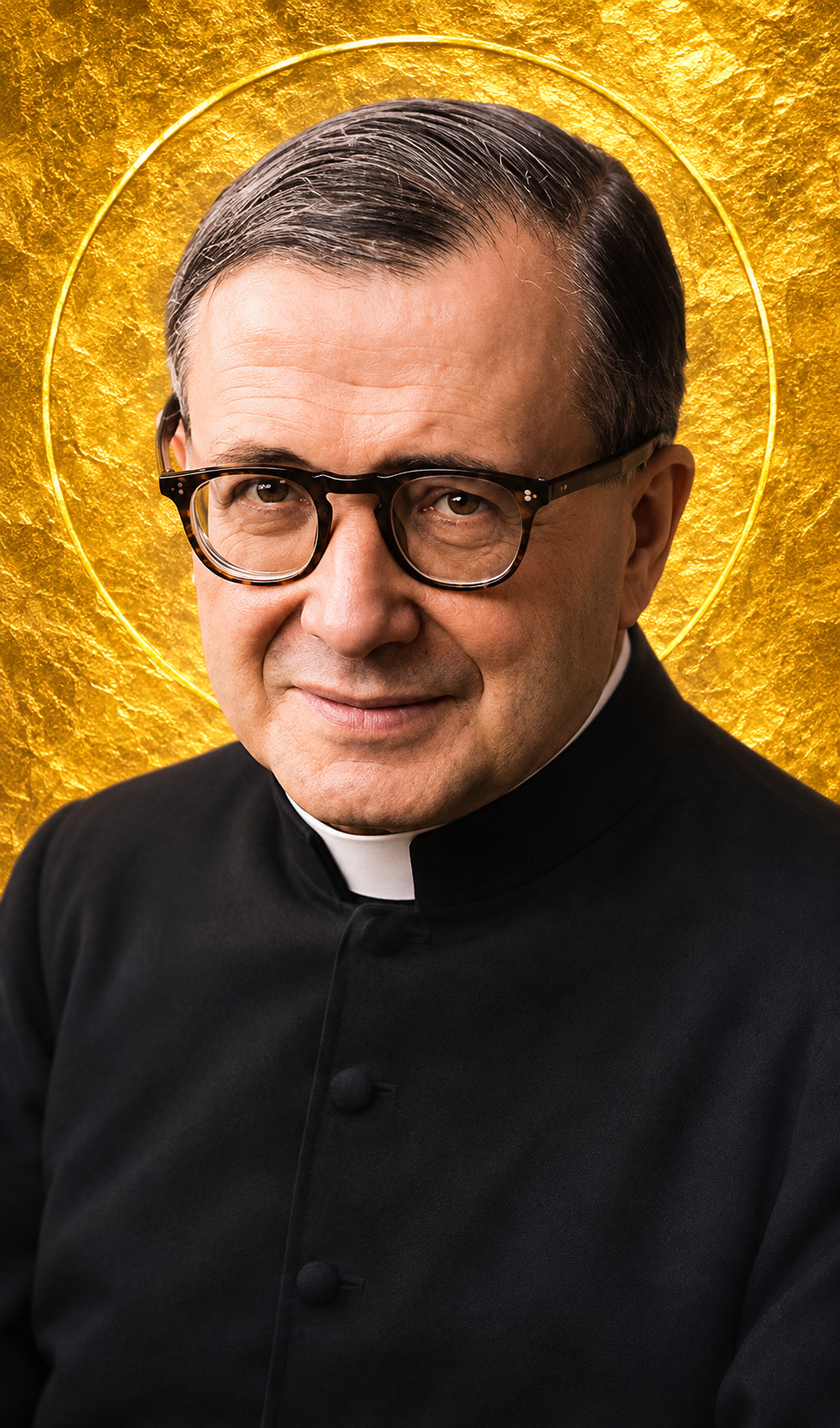
Saint Josemaría Escrivá Prayer Card – For Work, Career Discernment, Daily Holiness & Finding God in Ordinary Life
Saint Josemaría Escrivá was a Spanish Catholic priest, spiritual writer, and founder of Opus Dei whose central message was remarkably simple: holiness is not reserved for priests, monks, or people able to withdraw from ordinary life. The office, classroom, kitchen, workshop, hospital, construction site, family home, and countless ordinary responsibilities of daily life can become places where a Christian encounters God.
He taught that professional work can become prayer when it is done well, offered to God, and carried out in service to others. Rather than separating spiritual life from employment, family responsibilities, study, friendships, and ordinary duties, Josemaría encouraged Christians to bring Christ directly into those circumstances and discover the divine possibilities hidden within seemingly ordinary days.
Saint Josemaría is especially meaningful for people seeking direction in their careers, struggling to find meaning in repetitive work, starting a new job, facing unemployment, balancing faith and professional responsibilities, discerning a vocation, or simply wondering how an ordinary life can become genuinely holy. His spirituality offers a powerful answer: the path to God may already be present in the work and responsibilities directly in front of us.
Each prayer card measures 2.5" x 4.25", is handmade in Austin, Texas, printed on museum-quality photo paper rather than ordinary cardstock, and double laminated for durability. Every card is made to order and prepared prayerfully, with the recipient and their intentions brought before Christ while asking Saint Josemaría Escrivá to intercede for their needs.
THE LIFE & STORY OF SAINT JOSEMARÍA ESCRIVÁ
Josemaría Escrivá was born in Barbastro, Spain, in 1902 into a Catholic family that taught him prayer, frequent reception of the sacraments, devotion to the Blessed Virgin Mary, and concern for people in need. His childhood contained both happiness and profound hardship, including the deaths of several siblings and serious financial difficulties that changed his family's circumstances.
These experiences exposed Josemaría early to uncertainty, loss, and the reality that outward security can disappear unexpectedly. Rather than leading him toward a spirituality detached from ordinary problems, those experiences helped prepare him for a message centered precisely upon finding God within the circumstances of real human life.
FOOTPRINTS IN THE SNOW
As a teenager, Josemaría saw footprints in the snow left by a barefoot Carmelite friar. The sight affected him deeply because he began asking what sacrifices he himself might be willing to make if other people could give so much to God.
He gradually became convinced that God wanted something particular from his life, although he did not yet understand exactly what that calling would be. Believing the priesthood would make him more available for whatever God eventually revealed, he entered seminary formation.
BECOMING A PRIEST
Josemaría studied for the priesthood in Logroño and Zaragoza while also pursuing legal studies. He was ordained a priest in 1925 and began his ministry in rural Spain before eventually moving to Madrid.
Madrid exposed him to an enormous range of people and circumstances. He encountered university students, professionals, workers, children, families, academics, sick people, and residents of impoverished neighborhoods while simultaneously continuing his own studies and helping support members of his family.
This environment became crucial because the mission he eventually understood would not be centered primarily inside monasteries. It would be directed toward Christians living directly within ordinary society.
OCTOBER 2, 1928
During a spiritual retreat in Madrid in 1928, Josemaría experienced the decisive moment of his vocation. He understood that God was asking him to begin what became Opus Dei, Latin for “Work of God.”
Its central message was that ordinary Christians can seek complete holiness without abandoning their professional, family, or social responsibilities. Daily work itself could become a means of sanctification when united with Christ.
This was not a teaching that work somehow replaced prayer, the sacraments, or Christian moral life. Josemaría insisted that ordinary duties must be rooted in a deep interior life if they are truly to become pathways toward God.
THE UNIVERSAL CALL TO HOLINESS
Josemaría continually preached that sanctity is not the private territory of a spiritual elite. Baptism itself calls every Christian toward holiness.
The businessman, homemaker, physician, construction worker, attorney, teacher, farmer, mechanic, artist, student, scientist, and office worker do not need to abandon their legitimate occupations before they can become saints. Their circumstances can become precisely the material through which love of God and neighbor grows.
Decades later, the Second Vatican Council would strongly emphasize this universal call to holiness throughout the Church. Pope Saint John Paul II later described Josemaría as someone who had powerfully proclaimed holiness within ordinary life.
SANCTIFYING WORK
Perhaps no teaching is more closely associated with Saint Josemaría than the sanctification of work. He taught that professional work can be offered to God and transformed into a genuine encounter with Christ.
That begins with doing the work well. Josemaría strongly rejected the idea that religious intention could somehow make careless, lazy, dishonest, or poorly executed work acceptable.
Christian love should improve the way a person works. Attention to detail, competence, honesty, punctuality, responsibility, professional development, respect for colleagues, and service to customers or clients can all become part of the offering made to God.
“ADD A SUPERNATURAL MOTIVE”
In The Way, Saint Josemaría gave one of his shortest explanations of sanctified work when he wrote, “Add a supernatural motive to your ordinary work and you will have sanctified it.” His point was that the same ordinary task can acquire a completely different spiritual meaning when performed consciously for love of God.
The spreadsheet still has to be completed, the classroom still has to be taught, the floor still needs cleaning, and the patient still needs care. What changes is the intention and the love with which the work is undertaken.
This spirituality transforms ordinary responsibilities without requiring them to become outwardly dramatic.
WORK DONE WELL
Saint Josemaría repeatedly insisted that Christians should strive for professional excellence. God should not be offered work that is careless simply because the person performing it considers themselves religious.
He taught that human perfection and supernatural intention belong together. A carpenter should strive to become a better carpenter, a physician a better physician, a teacher a better teacher, and a student a more diligent student.
This gives his spirituality particular relevance to people who want to integrate professional ambition with Christian discipleship. Excellence does not need to become vanity when it is pursued as service and offered to God.
FOR PEOPLE WHO HATE THEIR JOB
Josemaría's teaching can be especially challenging for someone whose work feels repetitive, frustrating, or disconnected from anything obviously spiritual. He insisted that holiness is often hidden precisely inside the ordinary details people are tempted to dismiss.
He wrote that something divine is concealed within the most ordinary situations and that Christians must learn to discover it. This does not mean every job is ideal or that someone should remain forever in harmful working conditions, but it does mean that an imperfect work situation can still contain opportunities for patience, competence, charity, sacrifice, and prayer.
The search for better work and the sanctification of present work are not necessarily opposites.
FOR CAREER DISCERNMENT
A Saint Josemaría prayer card can be especially meaningful for someone deciding what kind of work to pursue. His spirituality takes professional vocation seriously without treating career achievement as the ultimate purpose of human life.
The important question is not simply which occupation provides the most prestige or income. A Christian can also ask where personal talents, responsibilities, opportunities, and the needs of others may allow work to become genuine service.
Josemaría taught that professional work belongs within the larger Christian vocation. Career decisions can therefore become matters of prayer rather than merely strategy.
FOR SOMEONE STARTING A NEW JOB
Beginning a new job can bring excitement together with anxiety, uncertainty, and the desire to prove oneself quickly. Saint Josemaría offers a spirituality particularly suited to this transition because he emphasizes both competent work and interior freedom.
The Christian should work hard, learn, improve, cooperate with others, and take responsibility seriously without allowing professional success to become the entire measure of personal worth. Work is important, but it remains ordered toward love of God and service to other people.
His intercession can therefore be sought for wisdom, professional growth, good relationships with coworkers, integrity, perseverance, and the ability to keep work in its proper place.
FOR UNEMPLOYMENT AND JOB SEARCHING
Devotion to Saint Josemaría has become particularly common among people seeking employment. Opus Dei publishes a Novena for Work inspired by his teachings, with intentions both for finding suitable employment and for learning to perform one's present work more faithfully.
Unemployment can attack more than finances because work is often connected with identity, usefulness, routine, family security, and confidence about the future. Josemaría's teaching restores a Christian perspective in which a person's dignity does not disappear when employment does.
Prayer for a job can therefore include both the practical need for employment and the deeper request for guidance toward work that can become service.
ORDINARY LIFE AS A PATH TO GOD
Pope Saint John Paul II described Saint Josemaría as “the saint of ordinary life.” The phrase captures the revolutionary simplicity of his message.
The Christian does not always need extraordinary circumstances in order to encounter God. Meals, conversations, commuting, study, deadlines, family duties, physical work, professional meetings, errands, and moments of rest can all become part of a unified Christian life.
Josemaría wanted people to stop imagining that God could be found only during specifically religious activities. Prayer and the sacraments should instead transform the rest of the day.
CONTEMPLATIVES IN THE MIDDLE OF THE WORLD
Saint Josemaría frequently spoke about becoming contemplative without leaving ordinary society. He wanted Christians to develop an ongoing conversation with God while working, traveling, studying, caring for children, or performing other daily responsibilities.
He taught that work itself can gradually become prayer when the person performing it lives consciously in God's presence. The distinction between spiritual life and ordinary life begins to disappear because the same person belongs to God throughout the entire day.
This spirituality can be especially helpful for people who cannot spend hours in formal prayer but sincerely desire deeper union with God.
THE MASS AT THE CENTER
The sanctification of ordinary life never meant that Josemaría minimized formal worship. The Mass stood at the center of his spiritual life, and he repeatedly taught that the Eucharistic sacrifice should become the root from which daily Christian activity grows.
Ordinary work is sanctified most deeply when it becomes united with Christ's own offering. The Christian brings the work, fatigue, relationships, successes, failures, and sacrifices of daily life toward the altar.
This Eucharistic foundation prevents the spirituality of work from becoming merely a religious version of productivity culture.
PRAYER BEFORE ACTION
Josemaría was an intensely active priest, founder, writer, teacher, and organizer, yet he placed prayer before outward action. One of his most famous teachings from The Way insists upon prayer first, sacrifice second, and action only afterward.
His point was not that Christians should avoid action. His own life was extraordinarily active.
He believed apostolic activity becomes spiritually fruitful when it grows from union with God rather than constant human agitation. Activity without prayer can eventually become self-reliance disguised as service.
THE SPANISH CIVIL WAR
The Spanish Civil War created a period of severe danger for Josemaría and many other priests and Catholics. Religious persecution in parts of Spain forced him into hiding and made ordinary priestly ministry extremely dangerous.
He continued celebrating the sacraments and caring for people under difficult circumstances while moving between hiding places. Eventually he escaped through the Pyrenees and reached territory where he could minister more openly.
The experience tested the message he had already been preaching. Finding God in ordinary circumstances now had to include war, fear, uncertainty, separation, and real personal danger.
FOR COURAGE DURING DIFFICULT TIMES
Saint Josemaría's spirituality is sometimes associated primarily with offices and professional work, but his own life contained political upheaval, persecution, misunderstanding, family financial hardship, war, and serious institutional difficulties.
His confidence in ordinary holiness was therefore not formed only in comfortable circumstances. He believed God remained present when circumstances became painfully abnormal.
For someone facing instability at work, family uncertainty, professional opposition, or another prolonged difficulty, his life offers encouragement to remain faithful without allowing hardship to become the sole focus of the soul.
OPUS DEI
Opus Dei developed from the mission Josemaría understood in 1928 and eventually spread internationally. Its spirituality emphasizes holiness within ordinary professional, family, and social life rather than separation from the world.
Lay men and women form the overwhelming majority of its faithful, while priests provide sacramental and pastoral ministry. Its spirituality stresses prayer, the sacraments, work, personal freedom, friendship, apostolate, and fidelity to the responsibilities of one's state in life.
Josemaría wanted Christians to bring Christ into society primarily through the ordinary relationships and professional responsibilities already belonging to them.
WORK AS SERVICE
Josemaría insisted that professional work must become service rather than self-absorption. Competence matters precisely because another human being is usually affected by the quality of what we do.
A physician's preparation affects patients, a teacher's diligence affects students, a contractor's workmanship affects families, and a business owner's integrity affects employees and customers. Work therefore becomes a place where love of neighbor takes practical form.
This gives his teaching a social dimension sometimes missed when sanctification of work is understood only as personal spirituality.
“IF YOU WANT TO BE USEFUL, SERVE”
One of Josemaría's teachings on professional excellence begins with a memorable principle: “If you want to be useful, serve.” He connected service with the responsibility to become genuinely competent at one's work.
Good intentions alone do not automatically produce good service. Christians should learn their craft, develop professional skills, correct mistakes, and strive to perform the work entrusted to them as well as possible.
This makes Saint Josemaría particularly meaningful for entrepreneurs, business owners, tradespeople, professionals, students, managers, and anyone trying to understand how ambition can be purified into service.
FOR ENTREPRENEURS AND BUSINESS OWNERS
Josemaría's teaching can be especially valuable for people whose professional decisions affect employees, customers, vendors, and families. Business activity provides countless opportunities for honesty, justice, creativity, generosity, and responsible stewardship.
He did not teach that wealth or professional success automatically proves God's favor. Instead, material realities must be ordered toward the good of persons and remain subject to Christian moral responsibility.
For business owners, his spirituality offers a demanding challenge: make the enterprise genuinely professional while remembering that people are never merely resources.
FOR STUDENTS
Study was another form of work within Josemaría's spirituality. Students can sanctify study through concentration, intellectual honesty, discipline, proper use of time, respect for teachers, and the desire to use future knowledge in service to others.
This perspective can change the meaning of education. Studying is not only about grades, credentials, or future income but can become part of a Christian vocation.
Saint Josemaría's prayer card can therefore be meaningful for college students, seminarians, graduate students, apprentices, or anyone completing demanding professional training.
FOR PARENTS AND FAMILY LIFE
Josemaría repeatedly emphasized that married people and parents are called to holiness in the circumstances of family life. Ordinary family responsibilities can become just as much a path toward God as explicitly religious work.
Preparing meals, earning income, raising children, keeping a home, caring for aging relatives, maintaining a marriage, and enduring the interruptions of family life all provide opportunities for sacrificial love.
His spirituality therefore speaks not only to professionals in formal workplaces but to anyone whose primary daily work occurs within the home.
FRIENDSHIP AND APOSTOLATE
Josemaría believed Christian evangelization should grow naturally from genuine friendship. Rather than treating people as projects, Christians should sincerely care about coworkers, neighbors, classmates, relatives, and friends.
Apostolate then arises naturally when friendship creates opportunities to speak about Christ, answer questions, invite someone to prayer, or simply provide a Christian example.
This approach makes his spirituality particularly relevant for laypeople whose primary missionary field is not a pulpit but the ordinary network of relationships surrounding their lives.
FREEDOM AND RESPONSIBILITY
Josemaría strongly emphasized personal freedom in professional, social, political, and cultural matters where the Church allows legitimate diversity. Catholics can reach different prudential conclusions while sharing the same faith.
This principle was especially important to his understanding of lay vocation. Ordinary Christians should not expect clergy to make every temporal decision for them.
Instead, they must form their consciences, develop professional competence, accept responsibility, and act freely while remaining faithful to Christian moral teaching.
JOY
Joy appears repeatedly in Josemaría's writings. He did not present Christian holiness as a life of permanent gloom or visible seriousness.
Christian joy does not mean refusing to acknowledge suffering, disappointment, exhaustion, or failure. His own life included all of them.
The deeper source of joy was divine filiation, the conviction that Christians truly are children of God and therefore never abandoned within the ordinary circumstances of life.
BEGINNING AGAIN
Josemaría had a strong spirituality of beginning again after failure. Near the end of his life, after fifty years of priesthood, he still described his interior life in terms of constantly beginning again.
This attitude protects the spiritual life from perfectionism. Failure does not mean that the entire attempt at holiness was fraudulent.
A person repents, learns, returns to Christ, and starts again. That principle is particularly powerful for people frustrated by repeated weaknesses or by the feeling that they should be spiritually further along than they are.
HIS BOOKS
Saint Josemaría's best-known book is The Way, a collection of short spiritual reflections that has been translated into numerous languages and distributed in millions of copies.
Other important works include Furrow, The Forge, Christ Is Passing By, Friends of God, Holy Rosary, The Way of the Cross, and collections of conversations and writings dealing with Christian life in the world.
Their short, practical style reflects much of his pastoral approach. Josemaría frequently used memorable phrases to push readers toward prayer, examination of conscience, courage, work, and deeper friendship with God.
HIS FINAL YEARS
During the later decades of his life, Josemaría lived primarily in Rome while Opus Dei expanded throughout Europe, the Americas, and other regions of the world. He also made extensive pastoral journeys in which large groups gathered to ask questions about marriage, work, prayer, vocation, parenting, faith, and ordinary Christian life.
His answers were often conversational and direct. The themes remained remarkably consistent with the mission he had understood decades earlier: seek Christ within everyday life and bring Him into every legitimate human activity.
Josemaría died suddenly in Rome in 1975 after suffering cardiac arrest in his workroom.
CANONIZATION
Pope Saint John Paul II beatified Josemaría Escrivá in 1992 and canonized him in Saint Peter's Square in 2002.
During the canonization, John Paul II emphasized the sanctification of work and ordinary activity as a central element of Josemaría's teaching. The Pope presented daily work not merely as a practical necessity but as something that, with God's grace, can become a means of sanctification.
The canonization confirmed the message that Josemaría had spent his life preaching: ordinary circumstances can become an extraordinary encounter with God.
THE QUOTE
One of Saint Josemaría's most characteristic teachings says, “It is in the simplicity of your ordinary work, in the monotonous details of each day, that you have to find the secret, which is hidden from so many, of something great and new: Love.” The line captures the reason his spirituality resonates with people who do not expect their lives to appear dramatic or historically significant.
The Christian does not need to wait for a more impressive vocation before beginning to love God. The ordinary detail immediately in front of us can already become an offering.
OFFICIAL PRAYER TO SAINT JOSEMARÍA
The official prayer card distributed through Opus Dei asks God for Saint Josemaría's intercession and directly reflects his spirituality of ordinary holiness. It asks that Christians learn to transform every circumstance of life into an opportunity for love and service.
“O God, through the mediation of Mary our Mother, you granted your priest St. Josemaría countless graces, choosing him as a most faithful instrument to found Opus Dei, a way of sanctification in daily work and in the fulfillment of the Christian's ordinary duties. Grant that I too may learn to turn all the circumstances and events of my life into occasions of loving You and serving the Church, the Pope and all souls with joy and simplicity, lighting up the pathways of this earth with faith and love. Deign to grant me, through the intercession of St. Josemaría, the favor of ... Amen.”
The prayer is particularly fitting for employment needs, professional decisions, family responsibilities, difficult work situations, vocational discernment, and the desire to find God more deeply within ordinary life.
WHO SHOULD RECEIVE A SAINT JOSEMARÍA ESCRIVÁ PRAYER CARD?
A Saint Josemaría Escrivá prayer card can make a meaningful gift for someone beginning a new job, seeking employment, discerning a career, launching a business, entering college, completing professional training, balancing family and work, or struggling to find spiritual meaning within repetitive responsibilities.
It is equally appropriate for professionals, tradespeople, homemakers, entrepreneurs, students, teachers, healthcare workers, parents, attorneys, engineers, laborers, and anyone whose Christian vocation is lived primarily within ordinary society. His message reaches precisely the person who wonders whether an apparently normal life can really become a path toward holiness.
FAQ
Who was Saint Josemaría Escrivá? Saint Josemaría Escrivá was a Spanish Catholic priest and spiritual writer who lived from 1902 to 1975. He founded Opus Dei and became especially known for teaching that ordinary professional work and everyday responsibilities can become paths toward Christian holiness.
What did Saint Josemaría Escrivá found? He founded Opus Dei in Madrid in 1928 after understanding during a retreat that God was calling him to spread the message of holiness within ordinary professional and social life.
What does Opus Dei mean? The Latin phrase Opus Dei means “Work of God.” The organization emphasizes the universal call to holiness and the sanctification of professional work and ordinary Christian duties.
What is Saint Josemaría known for? He is particularly associated with the sanctification of ordinary work, the universal call to holiness, prayer in daily life, professional excellence, Christian freedom, friendship, apostolate, and finding God in ordinary circumstances.
What does it mean to sanctify work? In Josemaría's teaching, sanctifying work means performing morally good work as well as possible, offering it to God, and allowing it to become an expression of love and service. Work can then help sanctify both the person performing it and the people who benefit from it.
Is Saint Josemaría a good saint for finding a job? Many people seek his intercession when looking for employment because of his spirituality of work. A Novena for Work based upon his teachings is widely used both by people seeking jobs and by people who want to sanctify their present employment.
Can I pray to Saint Josemaría about my career? Christians may ask Saint Josemaría to intercede for career discernment, employment, workplace problems, professional integrity, business decisions, study, and any other legitimate concern connected with work.
What did Saint Josemaría teach about ordinary life? He taught that ordinary life is not spiritually insignificant. Work, family responsibilities, friendships, study, rest, and daily duties can all become opportunities for encountering God when lived with faith and love.
Did Saint Josemaría believe only members of Opus Dei could sanctify their work? No. His teaching emphasized the universal Christian call to holiness. Pope Saint John Paul II likewise highlighted his message that ordinary activity can become a path toward sanctification for believers.
What is The Way by Saint Josemaría? The Way is his best-known spiritual book, consisting of short points for prayer and reflection. It addresses prayer, work, character, apostolate, struggle, perseverance, and friendship with God.
What other books did Saint Josemaría write? His works include Furrow, The Forge, Friends of God, Christ Is Passing By, Holy Rosary, and The Way of the Cross, along with other writings and collections.
Why is Saint Josemaría associated with students? He worked closely with university students and educators from the early years of Opus Dei and repeatedly taught that study can be sanctified in the same way as professional work. His spirituality therefore has particular relevance for students and people preparing for professional vocations.
Is Saint Josemaría associated with entrepreneurs? His teaching on professional work, competence, service, freedom, responsibility, and ethical action has strong relevance to entrepreneurs and business owners. He emphasized that work should serve other people rather than become merely a means of personal ambition.
What did Saint Josemaría teach about doing work well? He insisted that work offered to God should also be performed well on the human level. Good intentions do not excuse careless workmanship, and Christian love should encourage professional competence and attention to detail.
What did Saint Josemaría teach about failure? He repeatedly encouraged Christians to begin again after falling or failing. Spiritual growth does not depend upon never making mistakes but upon returning to God with humility, repentance, and renewed effort.
When was Saint Josemaría canonized? Pope Saint John Paul II canonized Josemaría Escrivá in Rome in 2002 after the Church completed the canonical examination of his life, virtues, and the miracle attributed to his intercession.
Who would this Saint Josemaría Escrivá prayer card make a meaningful gift for? It is especially fitting for someone searching for work, starting a new job, discerning a career, entering college, launching a business, struggling with workplace stress, balancing work and family responsibilities, or simply trying to discover greater spiritual meaning in ordinary daily life.
THE MAIN MESSAGE OF SAINT JOSEMARÍA ESCRIVÁ'S LIFE
Saint Josemaría Escrivá spent his life challenging the idea that holiness belongs primarily somewhere else. It does not require waiting until work becomes easier, the children become older, the schedule becomes less crowded, the perfect career appears, or enough free time finally exists for a more obviously spiritual life.
God can already be found within the present circumstances.
The ordinary workbench, classroom, office, hospital room, kitchen, construction site, commute, family conversation, and unfinished task can become places where love of God takes concrete form. The work should be done well, offered to God, and transformed into service for the people affected by it.
This makes Josemaría's message particularly powerful for modern Christians whose lives often seem too ordinary or too busy to become holy. His answer is that the ordinary life itself is not the obstacle. It may be precisely where God is waiting to be found.