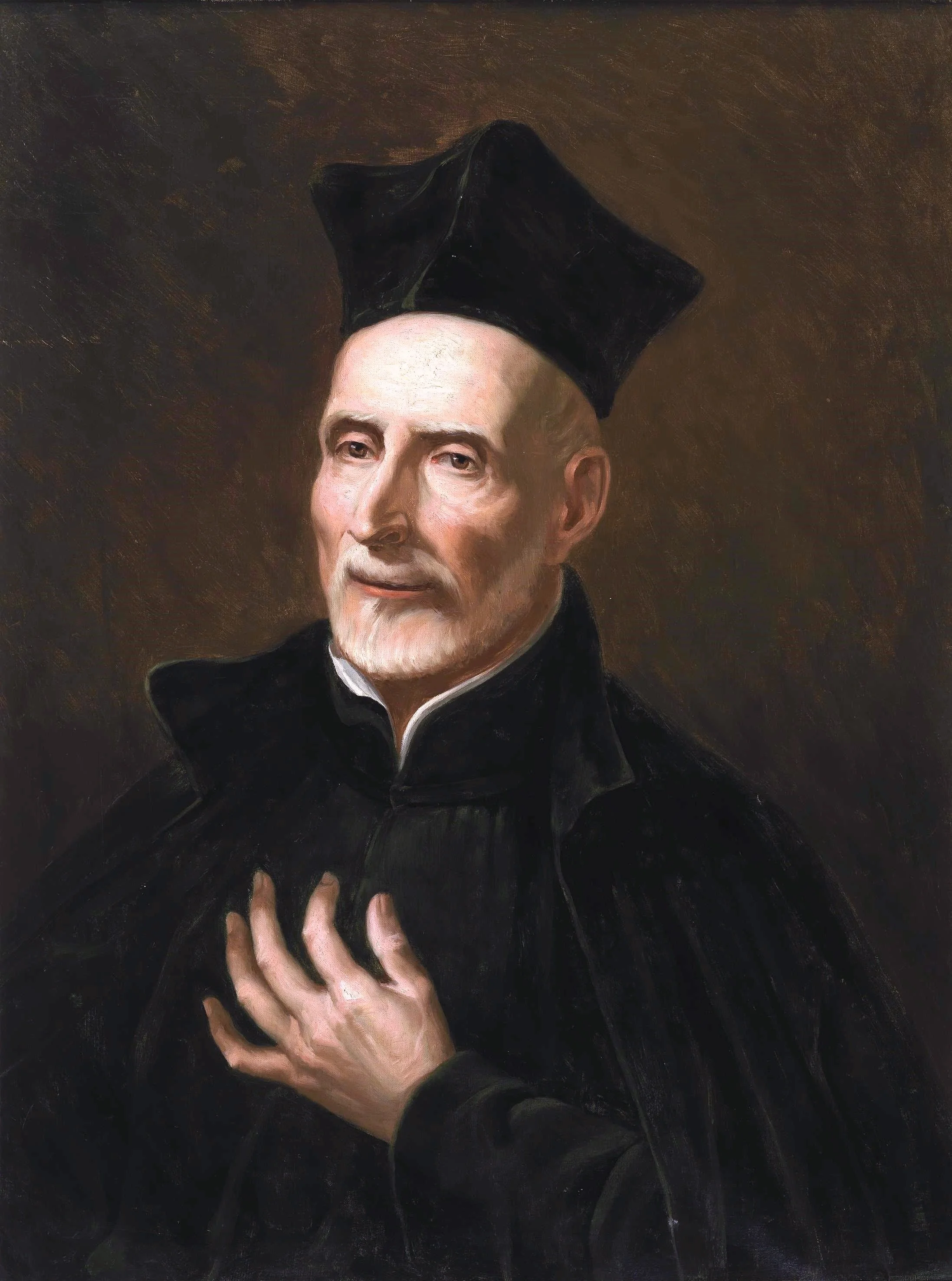
 Image 1 of 1
Saint Joseph Calasanz Prayer Card – For Teachers, Students, Catholic Education & Perseverance
Saint Joseph Calasanz was a Spanish Catholic priest, educator, founder of the Piarists, and one of the great pioneers of free education for poor children. After encountering children in Rome who had little realistic opportunity to receive even a basic education, he abandoned the comfortable ecclesiastical future that had once seemed open to him and devoted the remainder of his life to giving poor children an education that united Christian faith with serious academic learning.
In 1597, Calasanz helped establish in Rome what the Church and the Piarist Order describe as the first free popular public school in Europe. His educational vision was summarized by the expression “Piety and Letters,” joining faith and culture rather than forcing children to choose between them. Pope Saint John Paul II later described him as the true founder of the modern Catholic school, while Pope Pius XII formally proclaimed him the universal patron of Christian popular schools.
Saint Joseph Calasanz is especially meaningful for teachers, students, Catholic school families, principals, homeschooling parents, children struggling academically, educators serving poor communities, and anyone trying to persevere when good work encounters opposition or apparent failure. His own educational mission eventually passed through an extraordinary institutional crisis that appeared capable of destroying everything he had built, yet he died trusting that the work belonged ultimately to God rather than to himself.
Each prayer card measures 2.5" x 4.25", is handmade in Austin, Texas, printed on museum-quality photo paper rather than ordinary cardstock, and double laminated for durability. Every card is made to order and prepared prayerfully, with the recipient and their intentions brought before Christ while asking Saint Joseph Calasanz to intercede for their needs.
THE LIFE & STORY OF SAINT JOSEPH CALASANZ
Joseph Calasanz was born in Peralta de la Sal in the Kingdom of Aragon, Spain, in the sixteenth century. He grew up within a devout Catholic family that provided him with a strong education, eventually studying philosophy, law, and theology before being ordained to the priesthood in 1583.
His abilities opened opportunities for responsible positions within the Church, and for a time his life appeared likely to follow the path of an educated and capable diocesan priest. He served in pastoral and administrative roles and could reasonably have continued advancing within ecclesiastical life.
That future changed after he moved to Rome.
ARRIVING IN ROME
Calasanz arrived in Rome in 1592. While participating in charitable and pastoral activities, he became increasingly aware of the enormous number of poor children whose families could not afford schooling.
Education in the period remained inaccessible to many children, especially those from families living in poverty. Without literacy, numeracy, religious formation, or practical intellectual skills, those children faced adulthood with very limited possibilities for escaping the same conditions into which they had been born.
Calasanz gradually became convinced that educating poor children was not merely an act of generosity. It was a question of human dignity, Christian responsibility, and the future of society.
THE CHILDREN OF TRASTEVERE
The decisive moment came in the Roman neighborhood of Trastevere. In 1597, Calasanz encountered the small school connected with the parish of Santa Dorotea and recognized that this work could become the answer to the need he had been seeing throughout the city.
He gave himself increasingly to teaching poor children and organizing a school capable of receiving those who could not afford education. What began on a modest scale expanded rapidly because the need was enormous.
The children were not being educated simply so they could read prayers. Calasanz wanted them to receive serious intellectual formation capable of preparing them for productive adult lives.
EUROPE’S FIRST FREE POPULAR PUBLIC SCHOOL
The school established in Rome in 1597 is described by the Vatican and the Piarist Order as Europe's first free popular public school. Its importance lay not simply in the existence of another school but in whom the school was intended to serve.
Calasanz believed poverty should not prevent a child from learning.
That conviction may sound ordinary today because universal education is widely regarded as a basic social expectation. In Calasanz's world, however, providing organized, free education to poor children was genuinely innovative.
Pope Leo XIV recently highlighted precisely this aspect of his legacy, describing literacy and numeracy in Calasanz's vision as matters of human dignity rather than merely useful skills.
PIETY AND LETTERS
Calasanz summarized his educational ideal in the expression Pietas et Litterae, usually translated as “Piety and Letters” or, in modern language, faith and culture.
He rejected the idea that Christian education should consist only of religious instruction while neglecting serious academic learning. He also rejected an education that developed the intellect while ignoring the child's relationship with God and moral formation.
The goal was an integrated person.
Students should learn mathematics, language, writing, practical subjects, Christian doctrine, prayer, virtue, responsibility, and the habits necessary for a good life. Intellectual formation and spiritual formation belonged together.
“A HAPPY COURSE OF THEIR WHOLE LIFE”
One of Saint Joseph Calasanz's most important teachings about education states:
“If children, from their earliest years, are instructed diligently in piety and letters, it must undoubtedly be expected that their whole life will be a happy one.”
The statement reveals how seriously he viewed childhood education. A good school did more than prepare someone to pass an examination.
The habits, knowledge, faith, discipline, and character developed in childhood could shape the direction of an entire life. Calasanz therefore saw education as one of the most powerful forms of preventative charity available to the Church.
EDUCATION AS A WAY OUT OF POVERTY
Calasanz understood that poverty can reproduce itself when children lack access to education. Without basic academic knowledge or useful skills, children born into poor families could easily reach adulthood with few opportunities beyond the same conditions experienced by their parents.
His schools attempted to interrupt that cycle.
Students learned subjects that could help them obtain honest work and participate more fully in society. The Piarist educational tradition therefore included practical subjects such as arithmetic, geometry, drawing, and other areas useful for future employment.
Calasanz wanted education to help a child both spiritually and materially.
FOR CHILDREN WHO STRUGGLE IN SCHOOL
Saint Joseph Calasanz can be an especially meaningful intercessor for children who struggle academically or families worried about a student's education. His life's mission grew from looking at children others could easily overlook and refusing to believe that poverty or circumstances should determine the limits of their intellectual future.
His example encourages patience with children who learn differently, require additional attention, or have not yet discovered confidence in their own abilities. Education is not simply about sorting children according to performance but helping each child develop the gifts God has given them.
THE TEACHER AS A GUARDIAN ANGEL
Calasanz placed extraordinary responsibility upon teachers. He sometimes described the educator's mission through the image of a guardian angel, someone entrusted with accompanying a young person toward intellectual, moral, and spiritual maturity.
For him, teaching was not low-status work to be performed reluctantly. It was an important Christian vocation.
Pope Francis later highlighted this aspect of Calasanz's spirituality, remembering his understanding of the teacher as a guardian angel to the young, particularly children who were poor or otherwise vulnerable.
“THE CREDIT OF SCHOOLS”
Another saying preserved by the Piarist Order is remarkably direct:
“The credit of schools is in having good teachers.”
Buildings, curricula, resources, and institutions matter, but ultimately a school depends upon the quality of the people standing in front of its students.
A gifted teacher can awaken curiosity, build confidence, recognize potential, correct harmful habits, communicate difficult ideas, and sometimes change the direction of a child's life.
This makes Saint Joseph Calasanz particularly appropriate for teachers beginning a new school year, educators experiencing burnout, student teachers preparing for the classroom, or school leaders responsible for forming effective faculty.
THE PIARISTS
As the schools expanded, Calasanz needed collaborators willing to dedicate their lives to the mission. A community gradually formed around him and eventually became the Order of Poor Clerics Regular of the Mother of God of the Pious Schools, commonly known as the Piarists.
The order received formal ecclesiastical recognition during the early seventeenth century. Piarists professed the traditional religious vows together with a special dedication to the education of young people.
The religious community gave permanent institutional form to Calasanz's conviction that educating children, particularly poor children, was worthy of an entire consecrated vocation.
THE FIRST RELIGIOUS ORDER DEVOTED ESPECIALLY TO EDUCATION
The Piarist project was historically significant because education itself became the central apostolic identity of the community. Teaching poor children was not something members performed alongside what they considered more important religious work.
It was the religious work.
Calasanz challenged cultural assumptions that could regard elementary education, particularly education of impoverished children, as unworthy of highly educated priests and religious.
He believed precisely the opposite. The child sitting in the classroom was worthy of some of the Church's best intellectual and spiritual resources.
MATHEMATICS AND SCIENCE
Saint Joseph Calasanz was unusually interested in mathematics and scientific education for his period. He wanted students to learn subjects that could help them understand the world and prepare for useful work rather than receiving only a narrow literary curriculum.
This commitment eventually connected the Piarists with one of the most famous scientists in history: Galileo Galilei.
Several Piarists studied mathematics under Galileo or assisted him personally. When Galileo became blind, Calasanz permitted a Piarist, Clemente Settimi, to help him as a secretary.
This relationship reveals an important dimension of Calasanz's educational philosophy. Christian education did not require fear of serious scientific study.
CALASANZ AND GALILEO
The relationship between Calasanz's Piarists and Galileo is one of the most fascinating episodes in his life. Piarist teachers studied with Galileo, and Calasanz encouraged strong mathematical education within the schools.
After Galileo lost his sight, Calasanz explicitly permitted Piarist assistance to him. This occurred during a period when association with the famous scientist could carry significant controversy.
Calasanz's commitment was ultimately educational. He wanted his teachers to possess serious knowledge and wanted young people to benefit from advances in mathematics and science.
For teachers working in science, mathematics, technology, engineering, or other academic fields, this makes him an especially interesting patron.
FAITH AND SCIENCE
Calasanz's educational philosophy provides a useful corrective to the assumption that Christian education must choose between religious formation and scientific seriousness. He wanted both.
A child's mind should be formed to understand creation while the child's heart was formed to know the Creator.
The Piarist tradition therefore developed educational institutions in which mathematics and science could stand alongside theology, prayer, humanities, and moral formation.
His concept of “Piety and Letters” was broad enough to include serious intellectual investigation rather than reducing education to devotional instruction.
FOR CATHOLIC SCHOOLS
Saint Joseph Calasanz occupies a unique place within the history of Catholic education. Pope Saint John Paul II described him as the true founder of the modern Catholic school, emphasizing his vision of an educational environment open to all and concerned with the integral formation of the person.
Pope Pius XII formally proclaimed him the universal patron of Christian popular schools in 1948.
His prayer card can therefore be especially fitting in classrooms, faculty offices, principals' offices, school chapels, homeschooling spaces, or as a gift to Catholic educators.
FOR TEACHERS
Teachers frequently carry responsibilities invisible to people outside education. They prepare lessons, manage classrooms, respond to parents, adapt instruction, document progress, address behavioral problems, recognize emotional struggles, and still attempt to ensure that dozens of individual students actually learn.
Calasanz understood that education requires patience because children do not develop according to a perfectly controlled schedule.
His own work grew amid overcrowding, financial limitations, institutional conflict, and the constant need for qualified teachers. The difficulties surrounding education did not convince him that the mission was unimportant. They demonstrated how demanding the mission actually was.
FOR STUDENTS
Students may ask Saint Joseph Calasanz for intercession for discipline, understanding, concentration, perseverance, good teachers, success in legitimate studies, and the wisdom to use education responsibly.
His spirituality reminds students that education is a gift rather than simply an obligation.
For centuries, countless children would have desired the access to books, teachers, mathematics, science, languages, and information that modern students can easily take for granted.
Calasanz believed learning should ultimately help a person serve God, neighbor, and society more effectively.
FOR HOMESCHOOLING FAMILIES
Although Calasanz is most closely associated with schools, his emphasis upon integrated Christian education also resonates strongly with families who educate children at home.
He wanted intellectual formation and faith formation to reinforce rather than compete with one another.
Parents carrying primary responsibility for education can seek his intercession for patience, good judgment, suitable curriculum, perseverance, and the ability to recognize the individual needs and gifts of each child.
His emphasis upon the dignity of teaching also reminds families that education performed quietly within a home can still be a profound vocation.
FOR POOR AND UNDERSERVED CHILDREN
The poor remained at the center of Calasanz's educational vocation. He did not establish free education merely because he happened to discover an unexplored market for schools.
He believed children without economic resources possessed the same intellectual and spiritual dignity as children from wealthy families.
That conviction made education a work of justice as well as charity.
Modern educators serving low-income communities, children in unstable homes, refugee students, foster children, or young people facing systemic disadvantages may therefore find in Saint Joseph Calasanz a powerful spiritual companion.
EDUCATION CAN CHANGE SOCIETY
Calasanz understood that educating poor children could eventually alter society itself. Children who learned to read, calculate, think, work skillfully, and understand their faith would enter adulthood with possibilities previously unavailable to them.
This broader social consequence made his project both innovative and unsettling to some observers.
Education gives people tools.
Calasanz believed those tools should not remain the privilege of a small class but should be made available to children whose poverty otherwise excluded them.
More than four centuries later, his educational insight remains remarkably contemporary.
EXPANSION OF THE PIOUS SCHOOLS
The demand for Piarist schools grew rapidly. Communities wanted Calasanz and his religious to establish schools in additional cities, and the new order expanded across Italy and eventually into other parts of Europe.
Rapid growth brought opportunity but also severe strain.
More schools required more teachers, more religious formation, more money, stronger administration, and careful preservation of the original mission. Calasanz became increasingly aware that expansion without proper formation could endanger the very work everyone wanted to spread.
His later life demonstrated just how serious those dangers could become.
AN INSTITUTIONAL CRISIS
During Calasanz's old age, the Piarist Order entered a devastating internal crisis involving disputes, poor governance, accusations, and intervention by Church authorities.
Calasanz, who had been appointed Superior General for life, was removed from leadership. In 1646, Pope Innocent X reduced the Piarist Order to a much weaker form, prohibited the reception of novices, and placed its communities under local ecclesiastical authority.
For the elderly founder, the decision must have appeared catastrophic.
He had spent decades building a religious order dedicated to children, and now he lived long enough to watch the institution nearly dismantled before his eyes.
WHEN YOUR LIFE'S WORK SEEMS TO FAIL
This final period gives Saint Joseph Calasanz a spiritual relevance extending far beyond education.
He knew what it meant to spend decades building something good and then see circumstances emerge that appeared capable of destroying it.
Parents can experience something similar when years of sacrifice do not produce the outcome they expected in a child. Founders can watch organizations enter crises. Priests can see ministries decline. Teachers can invest themselves in students who appear not to respond.
Calasanz teaches perseverance when faithfulness does not immediately produce visible success.
TRUSTING GOD WITH THE WORK
Despite the institutional humiliation of his final years, Calasanz did not renounce the mission. He continued believing that educating children remained the work God had given him even when the institution designed to carry that mission appeared to be collapsing.
He died in Rome in 1648 without seeing the complete restoration of his order.
The restoration came afterward.
The Piarists were reestablished as a religious congregation in 1656 and fully restored as an order with solemn vows in 1669.
Calasanz's confidence was vindicated, but not within his own lifetime.
FOR PERSEVERANCE AFTER FAILURE
Saint Joseph Calasanz is therefore an unusually powerful saint for someone facing apparent failure.
His story does not offer the shallow reassurance that everything will always work out quickly if a person simply tries hard enough. Calasanz died before witnessing the institutional restoration of his life's work.
His witness is deeper.
A faithful person may do everything possible, suffer a genuine defeat, and still entrust the final outcome to God.
Sometimes the fruit appears only after the person who planted the seed is gone.
HIS CANONIZATION
The holiness of Joseph Calasanz eventually received formal recognition from the Church. He was beatified in the eighteenth century and canonized by Pope Clement XIII in 1767.
The educational mission that had once seemed close to destruction continued expanding through the Piarists and through later religious communities influenced by similar convictions about universal Christian education.
His legacy became so deeply associated with schooling that Pope Pius XII formally declared him patron of Christian popular schools throughout the world.
The founder who once taught poor children in a small Roman parish had become one of the Church's great patron saints of education.
THE PIARISTS TODAY
The Piarists continue the mission of Saint Joseph Calasanz more than four centuries after the opening of the first Pious School.
Their work now extends across multiple continents through schools, parishes, educational ministries, social programs, youth formation, and service to children and families.
The central mission remains recognizably Calasanctian: evangelize through education, unite faith and culture, and give particular attention to children and young people who are poor or otherwise disadvantaged.
The survival of that mission is especially striking considering how close the order came to disappearing during its founder's lifetime.
THE QUOTE
One of the strongest authentic sayings of Saint Joseph Calasanz for a prayer card comes directly from his educational teaching:
“If children, from their earliest years, are instructed diligently in piety and letters, it must undoubtedly be expected that their whole life will be a happy one.”
The statement summarizes his conviction that childhood education has consequences extending far beyond the classroom.
The teacher is not simply preparing a student for tomorrow's examination. Good education can shape the habits, faith, opportunities, moral decisions, and direction of an entire life.
ANOTHER POWERFUL QUOTE
Calasanz also wrote about the humility required to educate children, particularly those others had abandoned. He taught that one of the surest ways toward knowledge of ourselves and of God's mercy is to humble ourselves enough to bring light to children.
That insight turns teaching upside down.
The educator is not merely the knowledgeable adult giving something to an inferior student. Teaching can also become a path by which the teacher is humbled, purified, and brought closer to God.
The child receiving education becomes part of the educator's own sanctification.
OFFICIAL CHURCH PRAYER
The Church's liturgical prayer for Saint Joseph Calasanz asks God for the same charity and patience that allowed him to labor tirelessly in the education of children:
“O God, who adorned the Priest Saint Joseph Calasanz with such charity and patience that he labored tirelessly to educate children and endow them with every virtue, grant, we pray, that we, who venerate him as a teacher of wisdom, may constantly imitate him, for he was a co-worker of your truth. Through our Lord Jesus Christ, your Son, who lives and reigns with you in the unity of the Holy Spirit, God, for ever and ever. Amen.”
The prayer is especially appropriate for teachers, students, parents, school leaders, catechists, and anyone responsible for the intellectual or spiritual formation of children.
WHO SHOULD RECEIVE A SAINT JOSEPH CALASANZ PRAYER CARD?
A Saint Joseph Calasanz prayer card makes an especially meaningful gift for teachers, professors, school principals, Catholic educators, homeschooling parents, students, tutors, catechists, school counselors, special-education teachers, and people working with disadvantaged children.
It can also be particularly meaningful for someone whose work with children feels discouraging or whose educational mission is experiencing serious difficulties. Calasanz understood both the joy of seeing education transform children and the pain of watching an institution he loved appear to collapse.
His life offers educators a powerful combination of practical wisdom and spiritual hope. Teach well, love the child, unite faith with knowledge, persevere through difficulty, and remember that the ultimate fruit of education may appear long after the teacher has finished the lesson.
FAQ
Who was Saint Joseph Calasanz? Saint Joseph Calasanz was a Spanish Catholic priest, educator, and founder of the Piarist Order who lived from the sixteenth into the seventeenth century. He devoted his life particularly to providing free Christian education for poor children.
What is Saint Joseph Calasanz famous for? He is especially famous for establishing what the Vatican and Piarist tradition describe as the first free popular public school in Europe and for founding the Order of the Pious Schools, commonly called the Piarists.
Did Saint Joseph Calasanz create the first free school? In 1597, Calasanz helped establish in Rome what is described as Europe's first free popular public school. The school was intended especially to ensure that poverty did not prevent children from receiving education.
Where was the first Piarist school? The beginnings of the Pious Schools were connected with the parish of Santa Dorotea in the Trastevere neighborhood of Rome.
What does “Piety and Letters” mean? Pietas et Litterae, or Piety and Letters, summarizes the Calasanctian vision of education. Christian faith and serious intellectual learning should be integrated so that the whole person is formed.
Who are the Piarists? The Piarists are members of the Order of Poor Clerics Regular of the Mother of God of the Pious Schools, the religious order founded by Saint Joseph Calasanz. Their mission centers particularly upon the Christian education of children and young people.
Why is Saint Joseph Calasanz important to Catholic education? His schools made serious education available free of charge to poor children at a time when educational access was far more limited. Pope Saint John Paul II described him as the true founder of the modern Catholic school.
Is Saint Joseph Calasanz a patron saint of schools? Yes. Pope Pius XII formally proclaimed Saint Joseph Calasanz the universal patron of Christian popular schools in 1948.
Is Saint Joseph Calasanz a good saint for teachers? Yes. His entire mature vocation centered upon education, teacher formation, school development, and the intellectual and spiritual growth of children. His writings repeatedly emphasize the importance of good teachers.
Is Saint Joseph Calasanz a good saint for students? His life's work was devoted to students, particularly children who lacked educational opportunities. Students may ask his intercession for perseverance, understanding, good teachers, discipline, and the grace to use education wisely.
What did Saint Joseph Calasanz teach about teachers? He taught that the reputation and effectiveness of schools depend upon good teachers. He also viewed the educator as something like a guardian angel entrusted with accompanying young people.
Did Saint Joseph Calasanz know Galileo? Calasanz and the Piarist educational network had significant connections with Galileo Galilei. Piarist teachers studied with Galileo, and Calasanz permitted a member of his order to assist the aging and blind scientist as a secretary.
Did the Piarists teach science? Yes. Calasanz placed unusual emphasis on mathematics and scientific subjects alongside humanities and religious education. He wanted students to receive intellectual formation capable of preparing them for useful work and responsible adult life.
What happened to the Piarist Order during Calasanz's lifetime? Severe internal and administrative problems led to ecclesiastical intervention. In 1646, the order was reduced to a much weaker status, and Calasanz died two years later without seeing its complete restoration.
Was the Piarist Order restored? Yes. The community was restored after Calasanz's death, first as a congregation and later again as a full religious order. The Piarists continue their educational mission internationally today.
Why is Saint Joseph Calasanz a good saint for perseverance? He spent decades building an educational mission and then watched the institution suffer an enormous crisis near the end of his life. He continued trusting God even though he died before seeing the order fully restored.
What is a good Saint Joseph Calasanz quote? One of his best-known educational sayings teaches that when children are carefully formed in piety and learning from an early age, there is strong reason to expect a good course for the remainder of their lives.
Who would this Saint Joseph Calasanz prayer card make a meaningful gift for? It is especially fitting for teachers, students, Catholic school principals, homeschooling parents, catechists, tutors, education majors, school administrators, and people serving poor or underserved children. It can also be meaningful for someone persevering through discouragement in a ministry or educational vocation.
THE MAIN MESSAGE OF SAINT JOSEPH CALASANZ'S LIFE
Saint Joseph Calasanz looked at children whom society had given little opportunity and saw something worth investing an entire life in. He believed poverty should never determine whether a child was permitted to develop the mind God had given them.
His answer was not merely to complain about inequality or occasionally give children charitable assistance. He built schools, developed teachers, organized a religious order, promoted mathematics and science, integrated faith and academic learning, and defended the conviction that poor children deserved serious education.
Then, near the end of his life, he watched much of what he had built appear to collapse.
That final chapter makes his witness even more powerful. Calasanz teaches that the value of a good work is not measured only by whether we personally live long enough to see it succeed. Teachers plant seeds in students whose eventual fruit they may never witness, parents form children whose adult lives remain unknown, and founders can create institutions that pass through crises beyond their control.
Saint Joseph Calasanz remained faithful to the child, to education, and to God. More than four centuries later, children around the world are still being taught by the religious family that grew from his seemingly defeated work.