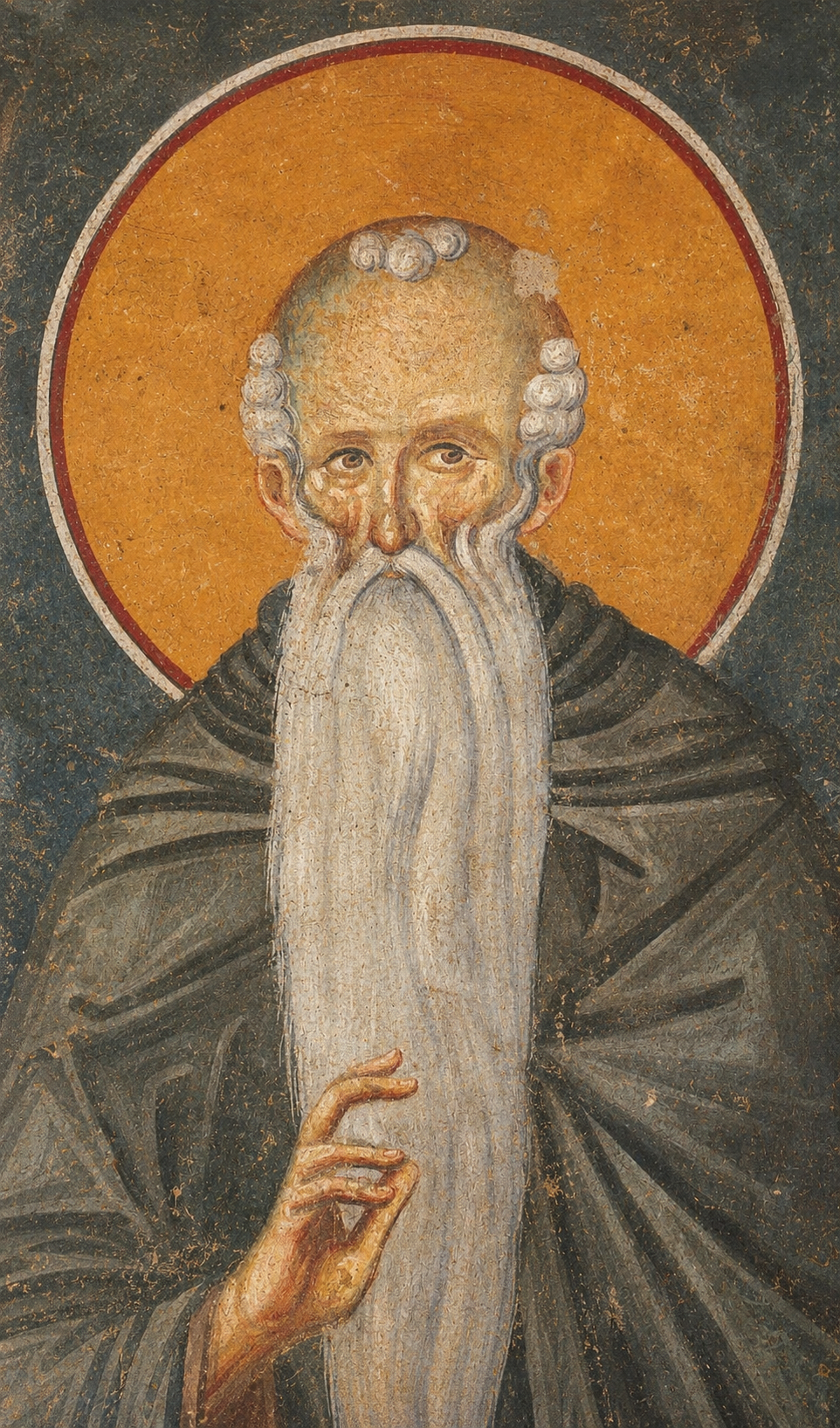
 Image 1 of 1
Saint Justin Popović Prayer Card - For Orthodox Faith, Theology, Repentance & Courage to Stand for Truth
Saint Justin Popović, also known as Saint Justin of Ćelije, Abba Justin, or Justin Popovich, was one of the most influential Serbian Orthodox theologians and spiritual fathers of the twentieth century. Born Blagoje Popović in Vranje in 1894, he became a monk during the First World War, studied theology in Russia, England, and Greece, taught Scripture, Patristics, and Dogmatic Theology, wrote extensively on the saints and the God-Man Jesus Christ, and spent the final thirty-one years of his life as spiritual father of the Ćelije Monastery near Valjevo. The Serbian Orthodox Church formally enrolled him among the saints in 2010 and established his liturgical commemoration on June 1 according to the Julian calendar, corresponding to June 14 on the Gregorian calendar.
Saint Justin is especially meaningful for theologians, seminarians, priests, teachers, Christian writers, students of the Church Fathers, people defending their faith under social or ideological pressure, Christians seeking deeper repentance, and anyone trying to keep Jesus Christ at the center of theology rather than reducing Christianity to philosophy, politics, culture, or abstract religious ideas. These associations arise directly from his life as a professor, scholar, monk, confessor of the faith under communist rule, prolific writer, and spiritual father whose theology consistently returned to Christ as the God-Man and to holiness as the living proof of Christian truth.
He is particularly meaningful for Christians who are intellectually serious about the faith but fear that study can become separated from prayer and holiness. Saint Justin possessed formidable academic training and eventually earned a doctorate in theology, yet he never treated theology as a purely intellectual discipline. His great collection of the Lives of the Saints expressed his conviction that Christian doctrine becomes visible in actual human lives transformed by Christ, and the OCA preserves his memorable description of the lives of the saints as a continuation of the Acts of the Apostles.
Saint Justin is also especially meaningful for people trying to remain faithful under atheistic, secular, or politically hostile conditions. After the Second World War, the new communist authorities removed him from his professorship at the University of Belgrade and greatly restricted his public activity. He eventually settled permanently at Ćelije Monastery in 1948, where political surveillance and restrictions could limit his public movement but could not prevent him from praying, writing, teaching those who came to him, and producing some of the theological works for which he became best known.
His story therefore offers something more substantial than an image of a combative theologian defending doctrines in argument. Saint Justin's resistance to atheism and theological compromise was rooted in a positive conviction that Jesus Christ is the center of human existence, the Church is His Body, the Eucharist communicates His divine-human life, and the saints reveal what human beings become when that life is actually received. His Orthodox theology of the God-Man, often expressed through the language of the Theanthropos, joined Christology, ecclesiology, salvation, sacramental life, and sanctity into one vision.
Saint Justin can also be especially meaningful for writers, translators, editors, and people producing Christian educational material. He translated patristic and hagiographical texts, wrote biblical commentaries, produced major works of dogmatic theology, studied Dostoevsky, and eventually completed a twelve-volume Serbian collection of the Lives of the Saints. His work illustrates how writing can become a genuine ministry when scholarship is directed toward helping people know Christ, understand the Fathers, and encounter the saints as living members of the Church rather than distant historical figures.
His life also has an unusually strong connection with Saint Macarius the Great of Egypt. Justin's doctoral work at the University of Athens examined the problem of personality and knowledge in Saint Macarius, showing that his later theological interest in the transformation of the human person had deep roots in the Egyptian Desert Father tradition. His theological formation therefore connects modern Serbian Orthodoxy directly with the ancient spirituality of Egypt, the Fathers, ascetic prayer, and the transformation of the human person by divine grace.
This prayer card is especially fitting for seminarians, Orthodox theologians, clergy, teachers, writers, students of Patristics, people studying the lives of the saints, Christians living under ideological pressure, and anyone struggling to remain faithful without allowing conviction to become pride or hostility. It can also make a meaningful gift for someone studying Saint Nikolai Velimirović, Saint Macarius the Great, Dostoevsky, Orthodox dogmatic theology, the Eucharist, ecclesiology, or twentieth-century Serbian Christianity.
Each card is handmade in Austin, TX and created to order. We do not keep stock, because every prayer card is treated as a unique devotional offering. They are printed on museum-quality photo paper, not cardstock, and every card is made slowly during prayer with intentional reverence for the saint and for the person who will receive it. Names are lifted before Christ, intentions are held carefully, and each piece is handled multiple times in prayerful silence, asking God for mercy and asking Saint Justin to intercede for the soul it is being made for. This is devotional craftsmanship shaped with patience, care, and spiritual responsibility because every soul and every prayer matters.
THE LIFE & STORY
Saint Justin was born Blagoje Popović in Vranje in southern Serbia in 1894, into a deeply religious family with a long history of priestly service. His name Blagoje was connected with the Annunciation, and the Serbian Church's biographical tradition emphasizes how strongly the Feast of the Annunciation marked both the beginning and end of his earthly life. He would later become so closely associated with Ćelije Monastery that Orthodox Christians often know him simply as Saint Justin of Ćelije.
From 1905 until 1914 he studied at the Saint Sava Seminary in Belgrade, where one of the most consequential influences upon him was the future Saint Nikolai Velimirović. The relationship between Saint Nikolai and the young Blagoje helped introduce him to a form of Orthodox theology that was intellectually serious but inseparable from repentance, prayer, the Fathers, and the spiritual needs of the Serbian people.
His theological formation was interrupted by the catastrophe of the First World War. Justin shared in the suffering of the Serbian people during the war and served with the Serbian medical corps, an experience that placed sickness, death, national suffering, and human fragility before him long before these subjects appeared in his theological writing. During this period he also contracted typhus and lived through the disastrous retreat of the Serbian army toward the Adriatic.
On January 1, 1916, while still a young man shaped by the suffering of war, Blagoje received monastic tonsure and was given the name Justin, in honor of the ancient Christian philosopher and martyr Saint Justin. The choice was remarkably appropriate for the life that followed, because the modern Justin would spend decades confronting philosophical systems, modern humanism, atheism, and religious relativism while insisting that the fullest truth about both God and humanity is revealed in Jesus Christ.
Soon after his tonsure, he was sent for theological study in Petrograd, Russia, where he encountered more deeply the Russian ascetic and theological tradition. The spiritual world of Saints Sergius of Radonezh, Seraphim of Sarov, Anthony and Theodosius of the Kiev Caves, and John of Kronstadt became part of the wider Orthodox inheritance through which Justin understood theology.
He then traveled to England and studied at Oxford from 1916 to 1919. His work there included a study of Fyodor Dostoevsky, whose exploration of freedom, suffering, unbelief, human dignity, and Christ would remain important to Justin's intellectual life. Justin's later writings on Dostoevsky were not literary criticism alone but part of his larger confrontation with the spiritual direction of modern European civilization.
After his years in England, Saint Justin continued his theological work in Athens, eventually completing doctoral research on Saint Macarius of Egypt. The dissertation examined questions concerning personality and knowledge according to Saint Macarius, connecting Justin's later theological concern with the human person to the ancient experience of the Egyptian monastic Fathers.
By the early 1920s, Justin had begun teaching New Testament, Dogmatic Theology, Patristics, and related theological subjects. He was ordained a hieromonk in 1922, combining priestly ministry with scholarship and teaching rather than allowing academic theology to develop separately from liturgical and sacramental life.
During these years he also began translating and compiling the Lives of the Saints from Greek, Slavonic, Syriac, and other ecclesiastical sources. What could easily have become a secondary scholarly interest instead became central to his theological vision, because Justin regarded the saints as living demonstrations of the Gospel and the dogmas of the Church.
In 1930, Justin served in connection with Bishop Joseph of Bitola and undertook missionary work involving Orthodox Christians in the Carpathian region. The Serbian Church considered him sufficiently respected that episcopal responsibility was contemplated for him, but he did not pursue a bishop's office and continued instead as priest, theologian, teacher, and monk.
By 1934, he had become a professor of Dogmatic Theology at the University of Belgrade. His position placed him among the important intellectual figures of Serbian theological education, yet the subjects that fascinated him remained the same ones that would later occupy his monastic years: Christ, the Church, the saints, divine grace, human personality, Dostoevsky, the Fathers, and the spiritual crisis of modern humanity.
The Second World War and the subsequent communist takeover of Yugoslavia completely changed the circumstances of his life. When the communist government consolidated power after the war, Saint Justin was removed from his university teaching position in 1945, and his uncompromising Christian convictions made him deeply suspect to an officially atheistic political system.
The years that followed included arrest, interrogation, restrictions, and constant awareness that the authorities regarded his religious influence as dangerous. He nevertheless refused to transform political opposition into hatred, and his most enduring response to the communist system was not political organization but prayer, theological writing, monastic life, and the formation of Christians who refused to accept atheism as the final interpretation of human existence.
In May 1948, Justin became the spiritual father of the women's monastery of Ćelije near Valjevo, the place with which the remainder of his earthly life would become inseparably connected. He lived there for thirty-one years, under restrictive political conditions but surrounded increasingly by people who came seeking confession, theological instruction, prayer, and spiritual guidance.
The apparent narrowing of his life to one small Serbian monastery actually became the setting for his widest influence. The former university professor who could no longer teach freely in Belgrade produced major theological works from Ćelije, corresponded with people outside the monastery, instructed younger theologians, wrote biblical commentary, and worked relentlessly on his monumental collection of the Lives of the Saints.
Saint Justin reposed at Ćelije Monastery in 1979, on the Feast of the Annunciation according to the Serbian Church calendar. His earthly life had therefore been framed symbolically by the feast associated with the Gospel announcement that the eternal Son of God would become man, an especially fitting correspondence for a theologian whose entire mature vision centered upon the mystery of the God-Man Jesus Christ.
THE GOD-MAN JESUS CHRIST AT THE CENTER OF EVERYTHING
One of the most characteristic concepts in Saint Justin's theology is the God-Man, or Theanthropos. For Justin, Christianity cannot finally be reduced to a moral system, philosophical worldview, cultural inheritance, humanitarian program, or set of abstract propositions because Christianity begins with the astonishing reality that the eternal Son of God truly became man in Jesus Christ.
This Christ-centered approach shaped everything else in his theology. The Church is understood in relation to Christ, salvation means participation in Christ, the sacraments communicate the life of Christ, the saints become holy through Christ, and human beings discover their true destiny not through self-created definitions of humanity but through union with the God-Man.
Saint Justin therefore makes an especially meaningful intercessor for theologians who feel overwhelmed by competing systems and technical vocabulary. His work continually asks a simpler and much more demanding question about whether Christ Himself remains at the center of what Christians are teaching.
This also gives his theology a pastoral importance beyond seminaries. A Christian can possess tremendous knowledge about councils, canons, saints, liturgical customs, and theological controversies while slowly allowing Christianity to become a collection of subjects rather than communion with Jesus Christ, and Saint Justin's entire theological vision pushes back against that separation.
THE LIVES OF THE SAINTS AS LIVING THEOLOGY
Saint Justin's massive work on the Lives of the Saints reveals perhaps more clearly than anything else how he understood theology. The OCA preserves his description of the saints' lives as a “continuation of the Acts of the Apostles,” meaning that the same Christ who acted through the Apostles continues His work in those transformed by grace throughout the history of the Church.
This means hagiography was not an optional devotional supplement to serious doctrine for Saint Justin. The saints reveal what doctrines such as the Incarnation, Resurrection, grace, sanctification, prayer, repentance, and eternal life actually look like when those truths enter a human life.
His twelve-volume Serbian collection of saints' lives therefore became one of his most significant accomplishments. It joined historical and liturgical memory with theological interpretation and helped generations of Serbian readers encounter saints from across the Christian centuries as living witnesses rather than names preserved only in calendars.
Saint Justin is consequently an especially fitting intercessor for anyone writing or teaching about saints. His example challenges Christian writers to move beyond trivia and dates toward the deeper question of how the saint's life reveals Christ and what the saint's holiness teaches about the Gospel.
THEOLOGY THAT MUST BECOME LIFE
Saint Justin resisted the idea that theology could be genuinely Orthodox merely because its vocabulary was technically correct. Theology reaches its purpose when what is confessed doctrinally becomes actual life in Christ, which is why he connected dogmatics so closely with asceticism, sacramental life, the Fathers, and the saints.
This approach makes him particularly important for seminarians and people who study the faith extensively. Knowledge can become a great gift to the Church, but knowledge can also quietly become a source of pride if the person becomes increasingly skilled at explaining holiness while becoming less patient, less prayerful, or less merciful.
Saint Justin's life offers a different standard. The theologian should eventually become more Christ-centered because of theology, and study should deepen worship rather than replace it.
SAINT JUSTIN & SAINT MACARIUS THE GREAT
The relationship between Saint Justin's theology and Saint Macarius the Great of Egypt began academically but went far deeper than academic interest. Justin's doctoral dissertation at Athens studied personality and knowledge according to Saint Macarius, placing one of the foundational Egyptian Desert Fathers near the beginning of his mature theological career.
Macarius's spirituality emphasizes inner transformation, purification of the heart, grace, prayer, and experiential knowledge of God. These themes correspond closely with Justin's later refusal to treat theology as abstract intellectual knowledge alone, because true knowledge of God ultimately involves the transformation of the human person.
The connection is also historically beautiful. A Serbian theologian living in the upheavals of twentieth-century Europe went back to a fourth-century Egyptian monk in order to ask what it means for the human person truly to know God, showing the remarkable continuity of the Eastern Christian spiritual tradition.
SAINT NIKOLAI VELIMIROVIĆ & SAINT JUSTIN
Saint Justin's relationship with Saint Nikolai Velimirović began when Nikolai was among his teachers and continued within the broader Serbian Orthodox renewal of the twentieth century. Both saints eventually became known for presenting Christianity as a living response to the spiritual crises of modern civilization rather than as a cultural relic inherited passively from earlier generations.
Their personalities and writings were not identical, but they shared a deep concern for the Serbian people, the Fathers, the saints, monastic spirituality, Christ-centered theology, and resistance to ideologies that attempted to replace God with political or philosophical systems. The OCA remembers Justin as Saint Nikolai's friend and disciple, underscoring the spiritual relationship between two of the most influential modern Serbian saints.
For a Christian studying modern Serbian Orthodoxy, Saints Nikolai and Justin therefore belong naturally together. Their lives also show how spiritual teaching can pass through generations, with one teacher helping form a student who later becomes a major teacher in his own right.
DOSTOEVSKY & THE SPIRITUAL CRISIS OF MODERN MAN
Saint Justin devoted significant attention to Fyodor Dostoevsky, beginning during his studies in the West and continuing through later publications. He regarded Dostoevsky's writings as a profound examination of freedom, unbelief, suffering, human rebellion, moral responsibility, and the consequences of trying to construct humanity without Christ.
This made Justin unusual among theologians because literature became part of his theological engagement with modernity. He did not read novels simply to find illustrations for doctrines but recognized that great literature can expose the spiritual assumptions beneath an entire civilization.
Saint Justin is therefore a meaningful saint for Christian writers, literature students, philosophers, and people attempting to engage modern culture without allowing Christianity to become indistinguishable from it. His example encourages serious understanding of the world being criticized rather than criticism formed from ignorance.
ORTHODOXY UNDER COMMUNISM
The communist takeover after the Second World War removed Saint Justin from the academic platform he had spent decades preparing to occupy. His expulsion from the University of Belgrade in 1945 was part of a much larger attempt to marginalize religious life within the newly established socialist state, and Justin subsequently lived under sustained political suspicion.
His response is significant because he did not need state approval in order to remain a theologian. When the lecture hall was taken away, the monastery became his classroom, books became his lectures, correspondence became pastoral ministry, and generations of visitors came quietly to Ćelije to receive the spiritual formation the government had attempted to remove from public education.
This makes Saint Justin especially meaningful for Christians working in places where open religious conviction carries professional or social costs. His life shows that losing institutional influence does not mean losing the ability to bear witness.
COURAGE WITHOUT MAKING POLITICS THE CENTER
Saint Justin strongly rejected communist atheism, but Christianity itself remained larger than opposition to communism. His central theological categories were not political parties or national programs but Christ, the Church, the Eucharist, the saints, repentance, eternity, and the transformation of the human person.
This distinction is useful whenever Christians live within ideological conflict. Defending the faith can become spiritually distorted if opposition to an ideology receives more emotional energy than love for Christ, while Justin's enormous theological output demonstrates that what he was for was ultimately much greater than what he opposed.
A prayer card dedicated to Saint Justin can therefore be especially meaningful for someone seeking courage under ideological pressure while also asking for protection from anger, political obsession, pride, or hatred. Christian resistance remains Christian only when its deepest loyalty is to Christ.
HIS CRITIQUE OF SECULAR HUMANISM
Saint Justin frequently criticized forms of humanism that attempted to define humanity without God. His objection was not that human beings possess no dignity, but almost the opposite: he believed modern secular accounts of humanity were too small because they separated the human person from the divine destiny revealed in the Incarnation.
For Justin, Jesus Christ reveals the full measure of what humanity is called to become. Human dignity therefore reaches beyond political rights, intellectual development, comfort, or material progress toward communion with God and eternal life.
This makes his theology especially relevant for contemporary questions about human identity. Saint Justin repeatedly redirects the question away from merely asking what human beings want to become and toward what God created human beings to become in Christ.
SAINT JUSTIN & THE EUCHARIST
Saint Justin's Christ-centered theology reaches a particularly concentrated expression in his understanding of the Eucharist. The OCA cites his teaching that the Blood of Christ sanctifies, purifies, and transfigures the believer, drawing the Christian into the divine-human life of the Church rather than leaving Communion as a merely symbolic religious action.
The Eucharist therefore belongs directly within his understanding of salvation. Christianity is not simply agreement with Christ's teachings but participation in Christ Himself, and sacramental life is part of how the human person is incorporated into the Body of Christ and transformed by grace.
This makes Saint Justin meaningful not only for academic theologians but for anyone trying to recover a deeper Eucharistic life. His theology continually moves from doctrines about Christ toward actual participation in Christ.
THE CHURCH AS THE BODY OF THE GOD-MAN
Saint Justin's ecclesiology is inseparable from his Christology. Because Christ is truly God and truly man, Justin speaks of the Church as possessing a divine-human character, the Body in which human beings become united with Christ and with one another.
This means the Church cannot be reduced simply to an organization, ethnic institution, collection of clergy, or human association. Its visible human life remains real, including weakness and historical limitation, but the Church's deepest identity comes from Christ Himself.
Saint Justin's emphasis provides an important correction when scandals, politics, bureaucracy, or interpersonal conflict make the Church appear to be nothing more than another human institution. He does not deny the human weaknesses Christians can see, but he insists that those weaknesses do not exhaust the mystery of what the Church is.
SAINT JUSTIN & ECUMENISM
Saint Justin is well known for severe criticism of ecumenism when he believed it relativized Orthodox dogmatic truth or treated fundamentally different theological claims as though their differences did not matter. His polemical writings became among the most controversial parts of his legacy, and his language can be unusually sharp when removed from the broader theological vision in which Christ and the truth of the Church stand at the center.
His criticism should therefore be represented accurately rather than softened into something he did not believe, but it should also not be detached from his life inside the Serbian Orthodox Church. Saint Justin did not make theological disagreement an excuse to place himself outside the Church that he was criticizing or to invent an independent ecclesiastical authority around himself.
For modern readers, his writings are best approached within his larger theology of the God-Man, the saints, the Church, repentance, and holiness. If only the polemical passages are extracted, the result can become a version of Justin whose theological life is dominated by opponents rather than by Christ.
ORTHODOX TRUTH & HUMILITY
Saint Justin's firmness presents Christians with a difficult spiritual challenge because doctrinal conviction and humility must exist together. A person can be correct about a theological question while still becoming proud, cruel, or spiritually self-satisfied, and correctness alone does not turn those passions into virtues.
Justin's own monastic identity is therefore essential to understanding him. He was not simply a professor who defended propositions but a monk whose days were structured around worship, repentance, confession, prayer, saints, Scripture, and the sacramental life.
His prayer card can consequently be used not merely to ask for courage to defend Orthodoxy but to ask for the much harder grace of defending truth without allowing pride to corrupt the defense.
A TEACHER OF SCRIPTURE
Saint Justin spent years teaching and writing about the New Testament, and biblical interpretation remained an important part of his mature theological work. His published legacy includes commentaries on the Gospels and several apostolic epistles, reflecting his conviction that Orthodox theology must remain rooted in the biblical revelation received and lived within the Church.
His scriptural work is important because he did not place Scripture and Tradition in competition. The same Church that reads the Apostle Paul also produces saints, worships through the liturgy, receives the Fathers, and confesses the dogmas through which Scripture is understood.
Saint Justin can therefore be especially meaningful for someone studying Scripture within the Eastern Christian tradition. His life points toward reading the Bible not simply as an isolated text but within the worship, doctrine, saints, and spiritual experience of the Church.
A SPIRITUAL FATHER AT ĆELIJE
Once Saint Justin settled at Ćelije Monastery, he increasingly became known not only for what he wrote but for the people he formed. Students, clergy, monastics, intellectuals, and ordinary believers sought him out despite the political restrictions surrounding him, and his monastery became an unofficial center of Orthodox spiritual and theological renewal.
Spiritual fatherhood changed the scale of his influence because a book can communicate ideas while a spiritual father helps another person apply truth to an actual life. Justin's theological convictions were therefore tested continuously by confession, suffering, personal relationships, and the concrete struggles of people who came asking him how to live.
This makes him a particularly meaningful intercessor for priests, confessors, seminary professors, and anyone responsible for forming others in the faith. Christian teaching becomes much more demanding when the person in front of the teacher is not a theoretical example but a soul entrusted to their care.
HIS TWELVE-VOLUME LIVES OF THE SAINTS
During his years at Ćelije, Saint Justin completed one of his most beloved works, a twelve-volume collection of Lives of the Saints arranged through the liturgical year. The work appeared during the 1970s and represented decades of translation, compilation, theological reflection, and devotion to the saints.
The scale of the project reveals something important about Justin's priorities. Even while he was producing major dogmatic theology, he believed the Christian people also needed detailed stories of men and women who had actually lived the faith across different centuries, nations, and vocations.
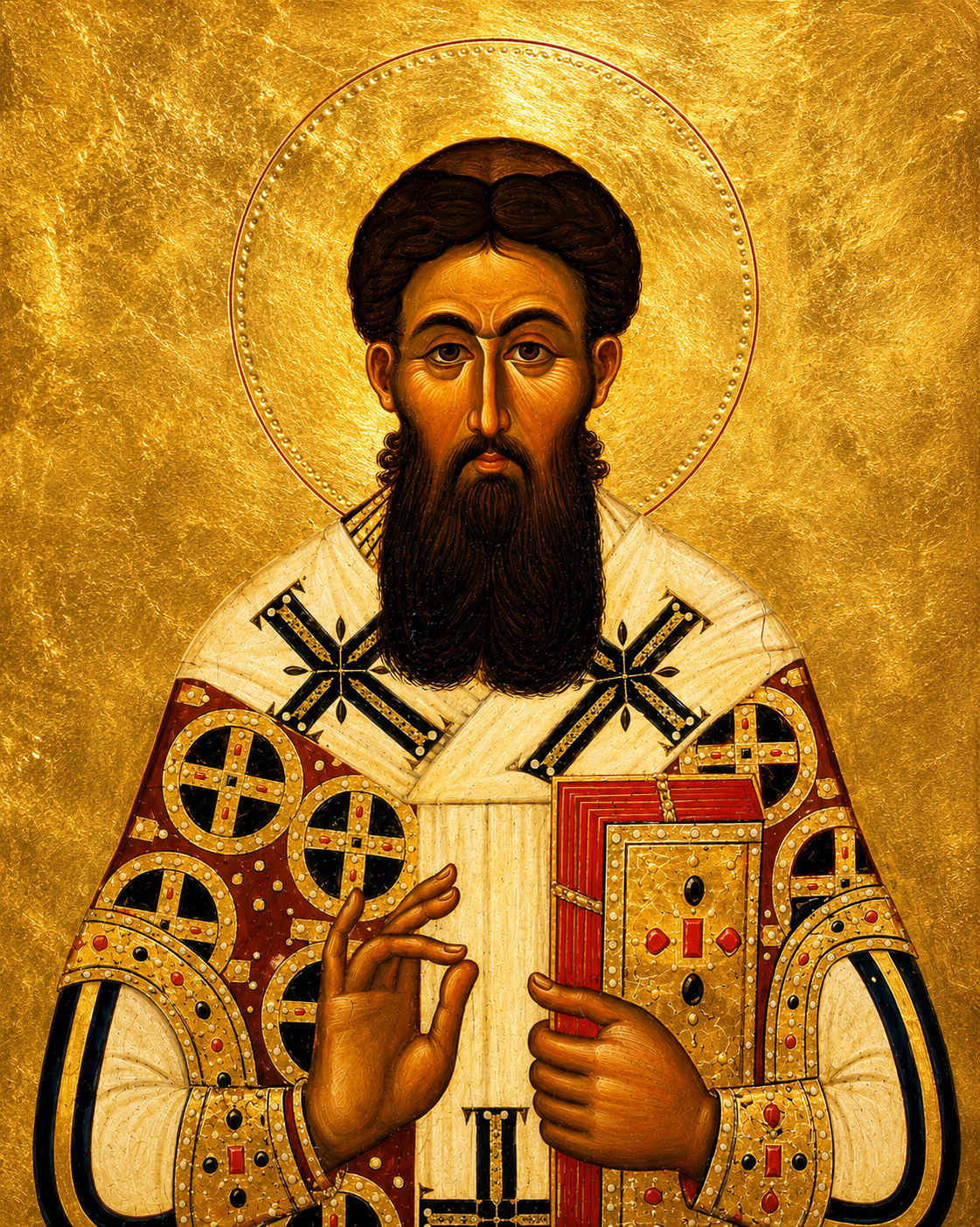
His iconography often depicts him holding a book of saints' lives for precisely this reason. The book is not merely an attribute identifying him as a writer but a sign of the conviction that the saints themselves constitute an ongoing school of Christian theology.
A SAINT FOR CHRISTIAN WRITERS
Saint Justin's enormous literary output makes him an especially natural intercessor for Christian writers and publishers. He wrote dogmatics, biblical commentary, studies of Dostoevsky, reflections on European culture, sermons, ecclesiological works, ascetic theology, and thousands of pages devoted to the saints.
His example also places a spiritual burden upon religious writing. Producing more words about Christianity is not automatically the same as serving Christ, because Christian writing should help people encounter truth rather than simply display the author's knowledge.
A writer seeking Saint Justin's intercession can therefore ask for accuracy, courage, discernment, humility, perseverance, and the willingness to correct personal ideas when they do not conform to the faith of the Church.
A SAINT FOR THEOLOGY STUDENTS & SEMINARIANS
Saint Justin's combination of serious academic formation and intense monastic spirituality makes him particularly valuable for seminarians and theology students. He studied across several countries, earned a theological doctorate, taught at university level, and became a major scholar without concluding that academic credentials were sufficient for knowledge of God.
His life also demonstrates that theological education may eventually lead somewhere very different from the career a student originally imagined. Justin moved from university professor to politically restricted monastery elder, yet the apparent professional loss became the setting for the work that ultimately reached far beyond the classroom he had lost.
A seminarian can therefore ask Saint Justin's prayers not simply for successful examinations or an academic career but for theology to become service to Christ and the Church whatever form that service eventually takes.
A SAINT FOR PEOPLE WHO LOSE A CAREER BECAUSE OF CONVICTION
Saint Justin's removal from the University of Belgrade gives his story unusual meaning for people whose religious convictions create professional consequences. Losing the position for which someone trained can produce grief, financial uncertainty, humiliation, and the fear that years of preparation have been wasted.
Justin's life provides no easy promise that every career will be restored. His university chair was not simply returned to him, but the theological vocation itself survived and eventually became larger than the institution that had excluded him.
Someone facing professional loss can therefore seek his intercession for courage, wisdom, freedom from bitterness, and openness to discovering that vocation may continue through a form that was never originally planned.
HIS REPOSE ON THE ANNUNCIATION
Saint Justin reposed in 1979 at Ćelije Monastery, on the Feast of the Annunciation according to the Church calendar followed in Serbia. This correspondence carried particular significance because his birth had also been closely associated with the same feast.
The Annunciation celebrates the mystery at the heart of Justin's theology: the eternal Son of God becoming truly man through the obedience of the Mother of God. The theologian whose mature writings continually returned to the God-Man therefore left earthly life on the feast that announces the Incarnation.
The connection should not be treated superstitiously, but it is difficult to imagine a liturgical setting more appropriate to his theological legacy.
HIS GLORIFICATION AS A SAINT
The Holy Assembly of Bishops of the Serbian Orthodox Church formally enrolled Archimandrite Justin Popović among the saints in 2010 together with Venerable Simeon of Dajbabe. The Serbian Church described him as the elder of Ćelije Monastery and established his liturgical memory for June 1 on the Julian calendar, corresponding to June 14 on the Gregorian calendar.
The Orthodox Church in America likewise records that the Serbian Church glorified Father Justin in 2010. His veneration has subsequently spread beyond Serbia, particularly among Orthodox Christians interested in theology, the saints, patristics, ecclesiology, twentieth-century Orthodoxy, and the spiritual renewal associated with modern Serbian saints.
Saint Justin is therefore specifically a modern Eastern Orthodox saint, formally glorified by the Serbian Orthodox Church. He should not be marketed as a saint canonized by the Catholic Church, although Catholics studying modern Eastern Christian theology may certainly encounter and read his works.
HIS FEAST DAY
The Serbian Orthodox Church established Saint Justin's feast on June 1 according to the Julian calendar, corresponding to June 14 on the Gregorian civil calendar. This is why English-language calendars and prayer-card listings commonly give June 14 as the date of his annual commemoration.
His repose occurred on the Annunciation in 1979, so the June feast should not be confused with the anniversary of his death. The Serbian Church deliberately established a separate liturgical commemoration for the newly glorified saint.
THE HOLY RELICS OF SAINT JUSTIN
Saint Justin was buried at Ćelije Monastery, where his grave quickly became a place of prayer and pilgrimage. In June 2014, four years after his glorification, his relics were uncovered and solemnly transferred during celebrations attended by hierarchs, clergy, monastics, and pilgrims from several Orthodox countries.
The official account records that the relics were carried into the monastery church for veneration and connected the event with the continued development of the monastery according to Saint Justin's own final wishes. Ćelije therefore remains the principal pilgrimage location associated with his relics, his grave, his decades of spiritual fatherhood, and the community in which his mature theological work was produced.
For someone traveling specifically to venerate Saint Justin, Ćelije Monastery near Valjevo, Serbia, is the central destination. The monastery is not merely a later shrine erected in his honor but the actual place where he lived, prayed, wrote, received spiritual children, reposed, and was buried.
THE TRANSLATION OF HIS RELICS IN 2014
On June 12, 2014, Saint Justin's relics were uncovered, and major liturgical celebrations followed on his June 14 feast. The official ROCOR report records thousands of faithful arriving from Serbia and other countries and notes the participation of Serbian hierarchs, bishops from other Orthodox Churches, Athonite monks, and Saint Justin's own former students.
The event demonstrated how far his influence had spread in only a few decades. A monk whose movements had once been deliberately restricted by an atheistic government was now being publicly honored by pilgrims arriving from around the Orthodox world.
That historical reversal is particularly striking. Political power succeeded in restricting his body for a time, but it did not succeed in restricting the theological and spiritual influence that followed from his life.
PRAYERS
A simple traditional invocation may be prayed throughout the day: Venerable Father Justin of Ćelije, pray to God for us. This is especially fitting before theological study, while writing or teaching about the faith, during ideological pressure, when struggling to remain faithful without becoming proud, or when asking Christ for greater love of Scripture, the Fathers, and the saints.
Saint Justin's own teaching on the saints also provides a fitting spiritual focus for prayer because he understood their lives as the continuing manifestation of Christ's work within the Church. A person seeking his intercession can therefore ask not merely to know more facts about Christianity but to become increasingly capable of living what the Church confesses.
Before studying theology, a seminarian or student may ask Saint Justin to pray for intellectual clarity joined to repentance and humility. His life demonstrates that academic knowledge can serve the Church powerfully when it remains subordinate to Christ, prayer, sacramental life, and holiness.
A Christian living in an environment hostile to faith can likewise ask Saint Justin for courage and endurance. His decades under communist restriction show that Christian witness can continue even when public influence, professional status, and institutional freedom have been dramatically reduced.
This prayer card is especially fitting beside a Bible, theological textbook, collection of the Church Fathers, book of saints' lives, seminary desk, priest's study, writer's workspace, or home prayer corner. It can also make a meaningful gift for someone entering theological school, beginning serious study of Orthodoxy, teaching Christian doctrine, writing about the saints, or trying to remain faithful within a strongly secular environment.
FAQ
Who is Saint Justin Popović? Saint Justin Popović was a twentieth-century Serbian Orthodox monk, priest, theologian, professor, writer, and spiritual father who lived from 1894 to 1979. He spent the final decades of his life at Ćelije Monastery and was formally glorified by the Serbian Orthodox Church in 2010.
Is Saint Justin Popović the same as Saint Justin of Ćelije? Yes, both names refer to the same saint. Popović is his family name, while “of Ćelije” reflects the Serbian monastery where he spent the final thirty-one years of his life and where his relics are venerated.
Is Justin Popovich another spelling of Justin Popović? Yes, Popovich is a common English transliteration of the Serbian surname Popović. Searches for Saint Justin Popovic, Justin Popović, Justin Popovich, Abba Justin, and Justin of Celije or Ćelije generally refer to the same Serbian Orthodox saint.
What was Saint Justin's birth name? His baptismal name was Blagoje Popović, a name connected with the Annunciation or Good News. When he received monastic tonsure in 1916, he took the name Justin in honor of Saint Justin the Philosopher and Martyr.
When was Saint Justin Popović born? He was born in 1894 in Vranje in southern Serbia. His birth was closely associated with the Feast of the Annunciation according to the Church calendar in use within Serbian Orthodox tradition.
Did Saint Justin come from a priestly family? Yes, Serbian Orthodox sources remember him as coming from a family with generations of priests. That environment placed church life, liturgy, and priestly service around him from childhood even though he ultimately chose monastic rather than married clerical life.
Was Saint Justin a student of Saint Nikolai Velimirović? Yes, Saint Nikolai was among the important teachers who influenced Justin during his seminary formation. Their relationship later became part of the remarkable twentieth-century Serbian Orthodox renewal associated with both saints.
Did Saint Justin serve during World War I? Yes, he served with the Serbian medical corps and shared in the tremendous suffering experienced by Serbia during the war. The experience of sickness, death, displacement, and national catastrophe formed part of the spiritual world from which his later theology developed.
When did Saint Justin become a monk? He received monastic tonsure on January 1, 1916 and was given the name Justin. His monastic life began while the First World War was still devastating Serbia and much of Europe.
Why did he choose the name Justin? He received the name in honor of the ancient Christian Saint Justin the Philosopher and Martyr. The name became particularly appropriate because the modern Justin also devoted much of his life to defending Christian revelation in conversation and conflict with philosophical systems.
Where did Saint Justin study theology? His theological formation included Serbia, Russia, England, and Greece. He studied in Petrograd, spent several years at Oxford, and later completed doctoral work at the University of Athens.
Did Saint Justin study at Oxford? Yes, he studied in England from 1916 until 1919 and worked extensively on Dostoevsky and the spiritual problems of modern European culture. His years in the West later informed his theological criticism because he was engaging a world he had personally encountered rather than one known only from a distance.
Did Saint Justin earn a doctorate? Yes, he completed doctoral theological work through the University of Athens. His dissertation focused upon questions of personality and knowledge in Saint Macarius of Egypt.
What is Saint Justin's connection to Saint Macarius the Great? Saint Justin devoted his doctoral research to Saint Macarius of Egypt and drew deeply from the ancient ascetic tradition represented by the Desert Fathers. The connection helps explain Justin's later insistence that theology must become experiential knowledge and transformation rather than remain abstract speculation.
Was Saint Justin a professor? Yes, he taught Scripture, Patristics, and Dogmatic Theology and eventually became a professor of Dogmatic Theology at the University of Belgrade. His academic career was interrupted permanently by the establishment of communist rule after the Second World War.
Was Saint Justin a priest? Yes, he was ordained a hieromonk in 1922. His life therefore joined monasticism, priesthood, scholarship, teaching, confession, and spiritual fatherhood.
Was Saint Justin ever offered the episcopacy? His biography records that episcopal service was considered for him during his work in the Carpathian region, but he did not accept the role. He remained a hieromonk and later archimandrite rather than becoming a bishop.
What is Saint Justin Popović known for? He is especially known for Orthodox dogmatic theology, Christ-centered ecclesiology, his theology of the God-Man, biblical commentary, Dostoevsky studies, his twelve-volume Lives of the Saints, criticism of atheistic and secular ideologies, and decades of spiritual fatherhood at Ćelije Monastery.
What is Saint Justin Popović the patron saint of? Orthodox tradition does not appear to give him one rigid universal patronage. His life makes him an especially meaningful intercessor for theologians, seminarians, teachers, Christian writers, clergy, students of the Fathers, people defending the Orthodox faith, and Christians remaining faithful under ideological pressure.
Is Saint Justin a saint for theologians? Yes, this is one of the strongest natural devotional associations with him because he was a major professor and writer of Orthodox dogmatic theology. His example is especially valuable because he insisted that theology must remain connected with prayer, the saints, Scripture, sacramental life, and personal holiness.
Can seminarians pray to Saint Justin? Yes, his combination of formal theological education and monastic spirituality makes him especially fitting for seminarians. His intercession can be sought for intellectual understanding, humility, perseverance, fidelity to Orthodox doctrine, and the transformation of theological study into service to Christ.
Can Christian writers pray to Saint Justin? Yes, because writing formed a major part of his ministry. He produced theological works, biblical commentaries, sermons, hagiography, translations, and studies of Dostoevsky, making him a particularly natural intercessor for people trying to communicate Orthodox Christianity faithfully.
Can teachers pray to Saint Justin? Yes, because much of his life was devoted to theological education and the formation of students. His experience also reminds teachers that influence can continue outside formal institutions when political or professional circumstances change.
Was Saint Justin anti-communist? He firmly rejected communist atheism and suffered professional and political consequences after the communist takeover of Yugoslavia. His Christian opposition was rooted principally in his conviction that human beings cannot be understood correctly apart from God and the eternal destiny revealed in Christ.
Was Saint Justin imprisoned by the communist authorities? Accounts of his postwar life record arrest, interrogation, political pressure, and the serious danger he faced under the new regime. His public activity was subsequently restricted, and Ćelije Monastery became the principal setting of his later ministry.
Why was Saint Justin removed from the University of Belgrade? The new communist government removed him from his theological teaching position after the Second World War within a broader state environment hostile to openly religious intellectual influence. The loss of his university position eventually led to a dramatically different form of theological ministry centered upon monastic life and writing.
Can someone who has lost a job because of religious conviction pray to Saint Justin? Yes, his own biography makes this a particularly meaningful modern application. He lost his university career yet continued his theological vocation through writing, prayer, spiritual guidance, and monastic life.
What does Saint Justin mean by the God-Man? The term refers to Jesus Christ as truly God and truly man, the central reality around which Justin organized much of his theology. For him, Christ reveals both who God is and what humanity is ultimately called to become through communion with Him.
Why are the saints so important in Saint Justin's theology? He regarded the saints as living demonstrations of the Gospel and Christian dogma. His famous description of their lives as a continuation of the Acts of the Apostles expresses his conviction that Christ continues acting within His Church through people transformed by grace.
Did Saint Justin write the Lives of the Saints? He compiled and translated an enormous twelve-volume Serbian collection of the Lives of the Saints, drawing upon older ecclesiastical sources and his own theological understanding. The project became one of the defining works of his later life.
Why is Saint Justin often shown holding a book in icons? The book commonly represents his writings and especially his monumental Lives of the Saints. His identity as theologian, teacher, and hagiographer became so central to his memory that books naturally became one of his most recognizable iconographic attributes.
Did Saint Justin write biblical commentaries? Yes, his literary legacy includes commentaries on Gospel and apostolic texts. His biblical work reflects his conviction that Scripture belongs within the living theological, liturgical, and patristic tradition of the Church.
Was Saint Justin an expert on Dostoevsky? Dostoevsky was one of the important literary figures Saint Justin studied extensively. His work used Dostoevsky to explore spiritual questions concerning freedom, unbelief, suffering, humanism, Christ, and the direction of modern European civilization.
Can literature students pray to Saint Justin? Yes, especially students interested in Dostoevsky, Christian philosophy, and the relationship between theology and literature. His life demonstrates that serious engagement with literature can become part of a Christian intellectual vocation.
What did Saint Justin teach about the Eucharist? He understood Holy Communion as genuine participation in the divine-human life of Christ rather than merely a symbolic remembrance. The OCA cites his teaching that Christ's Blood sanctifies, purifies, and transfigures the believer within the life of the Church.
What did Saint Justin teach about the Church? His ecclesiology centers upon the Church as the Body of the God-Man Christ. The Church therefore cannot be reduced simply to a human organization because its deepest identity and life come from Christ Himself.
Was Saint Justin against ecumenism? He was a severe critic of forms of ecumenism that he believed compromised or relativized Orthodox dogmatic truth. His writings need to be read within his larger theology of Christ and the Church rather than only through isolated polemical phrases.
Did Saint Justin leave the Serbian Orthodox Church because of disagreements? No, his criticisms did not result in his establishing a separate church around himself. He remained an Orthodox monk and priest within the Serbian Church while offering strong criticism where he believed theological faithfulness required it.
Can Saint Justin help someone defend the faith without becoming hateful? His monastic and theological life makes this an especially worthwhile intention to place before him. A Christian can ask his prayers for courage and doctrinal clarity while also asking for humility, repentance, and protection from the pride that can distort even a correct defense of truth.
Where did Saint Justin spend the final years of his life? He lived at Ćelije Monastery near Valjevo in Serbia from 1948 until his death in 1979. The monastery became the center of his writing, spiritual fatherhood, prayer, and later veneration.
Where is Ćelije Monastery? It is a Serbian Orthodox monastery near Valjevo, Serbia. The monastery is especially associated today with Saint Justin because of the decades he spent there and because his relics are venerated there.
Where are Saint Justin Popović's relics? His relics are venerated at Ćelije Monastery in Serbia, where he lived and was originally buried. They were solemnly uncovered and transferred for veneration in June 2014.
When were Saint Justin's relics uncovered? His relics were uncovered in June 2014, four years after his glorification. Major liturgical celebrations followed on his feast, drawing bishops, clergy, monks, and pilgrims from throughout the Orthodox world.
Can pilgrims visit Saint Justin's relics? Ćelije Monastery remains the principal pilgrimage destination associated with Saint Justin. Because monastery schedules and visitor arrangements can change, pilgrims should verify current access before traveling.
When did Saint Justin die? He reposed in 1979 at Ćelije Monastery. His death occurred on the Feast of the Annunciation according to the Serbian Orthodox liturgical calendar, creating a striking connection with the feast associated with his birth and his theology of the Incarnation.
When was Saint Justin Popović canonized? The Serbian Orthodox Church formally enrolled him among the saints in 2010. The Holy Assembly of Bishops announced his glorification together with Venerable Simeon of Dajbabe.
When is Saint Justin Popović's feast day? His liturgical commemoration is June 1 on the Julian calendar, corresponding to June 14 on the Gregorian calendar. June 14 is therefore the date most commonly encountered in contemporary civil-calendar references to his feast.
Why is his feast June 14 if he died in April? His June feast was established by the Serbian Orthodox Church when his liturgical veneration was formally instituted. It is therefore a separate feast rather than simply the civil-calendar anniversary of his repose.
Is Saint Justin Popović an Eastern Orthodox saint? Yes, he was formally glorified by the Serbian Orthodox Church and is venerated within Eastern Orthodoxy. His life and writings have subsequently become influential far beyond Serbia.
Is Saint Justin Popović a Catholic saint? No, he is a modern saint formally canonized by the Serbian Orthodox Church rather than by the Catholic Church. Catholics interested in Eastern theology may read him, but a devotional product should identify him specifically as a Serbian Orthodox saint.
Can Serbian Orthodox Christians give Saint Justin prayer cards as gifts? Yes, his importance to modern Serbian Orthodoxy makes the card particularly appropriate for Serbian Orthodox families, clergy, theology students, and people named Justin. His feast and relics are firmly established within the devotional life of the Serbian Church.
Can I give this prayer card to a seminarian? Yes, this is one of the strongest uses for a Saint Justin card because he devoted much of his life to theological education. His example also reminds the student that genuine theology should lead toward holiness, prayer, and service rather than merely academic achievement.
Can I give this card to an Orthodox priest? Yes, Saint Justin was himself a hieromonk and spiritual father responsible for teaching and guiding others. His card can be especially meaningful for priests who preach, hear confessions, teach doctrine, or struggle to hold pastoral charity and theological clarity together.
Can I give this card to a theology professor or teacher? Yes, because Saint Justin spent years as a professor and continued teaching even after formal academic life was taken away from him. His story makes the card particularly meaningful for teachers who want their intellectual work to remain rooted in Christ.
Can I give this card to a Christian writer? Yes, his tremendous written output makes him especially relevant to people producing theological, devotional, or educational material. His life can serve as a reminder that Christian writing carries responsibility for truth, accuracy, spiritual usefulness, and humility.
Can I give this card to someone struggling with doubts caused by secular culture? Yes, because Saint Justin spent much of his intellectual life confronting philosophical and cultural systems that attempted to explain humanity without Christ. His answer was not fear of intellectual questions but an increasingly deep conviction that the God-Man provides the fullest answer to the mystery of human existence.
Can I give this card to someone facing hostility because they are Christian? Yes, particularly when the person needs courage to remain faithful without allowing hostility to produce hatred. Saint Justin lost professional freedom and lived for decades under political restrictions while continuing his theological and spiritual vocation.
What does Saint Justin teach about holiness? His work teaches that holiness is not a secondary decoration added to Christianity but the lived manifestation of the Gospel. The saints show what happens when Christ's life becomes active within actual human persons.
What does Saint Justin teach about theology? His life and writings show that theology must remain centered upon Christ and confirmed in prayer, sacramental life, and holiness. Intellectual precision matters, but theological knowledge reaches its purpose only when it contributes to transformation in Christ.
What does Saint Justin teach about modern humanity? He believed humanity cannot fully understand itself when God is removed from the picture. The Incarnate Christ reveals both the true dignity of humanity and the eternal destiny toward which human life is directed.
What does Saint Justin teach about the saints? He teaches that the saints continue the apostolic witness because Christ continues to live and act within His Church. Their lives are therefore a form of lived theology in which Christian doctrine becomes visible through holiness.
What does Saint Justin teach about courage? His biography demonstrates courage through fidelity rather than theatrical confrontation. When public teaching, academic position, and freedom of movement were restricted, he continued praying, writing, and forming Christians within the opportunities still available to him.
What does Saint Justin teach about intellectual life? He demonstrates that serious scholarship and deep spiritual life do not have to oppose one another. His own education stretched across several countries, but the measure of knowledge remained whether it served truth, Christ, and the salvation of human beings.
What is the main message of Saint Justin Popović's life? Saint Justin's life teaches that Christian truth is ultimately not an idea but the living God-Man Jesus Christ, and theology becomes authentic when it leads the human person into His life. A Serbian seminarian who passed through war became a monk, studied in Russia, England, and Greece, wrote about Dostoevsky and Saint Macarius, became a university professor, lost his academic position under communist rule, withdrew to a small monastery, and spent the remainder of his life producing theology, Scripture commentary, and twelve volumes of saints' lives. The government that restricted his public influence disappeared, while the monk it tried to silence became a canonized saint whose writings continue to be read throughout the Orthodox world. His life therefore offers theologians, writers, clergy, students, and ordinary Christians a demanding vision in which courage must remain joined to repentance, doctrine to holiness, intellectual life to prayer, and every part of Christianity ultimately to Jesus Christ.
Saint Justin Popović, also known as Saint Justin of Ćelije, Abba Justin, or Justin Popovich, was one of the most influential Serbian Orthodox theologians and spiritual fathers of the twentieth century. Born Blagoje Popović in Vranje in 1894, he became a monk during the First World War, studied theology in Russia, England, and Greece, taught Scripture, Patristics, and Dogmatic Theology, wrote extensively on the saints and the God-Man Jesus Christ, and spent the final thirty-one years of his life as spiritual father of the Ćelije Monastery near Valjevo. The Serbian Orthodox Church formally enrolled him among the saints in 2010 and established his liturgical commemoration on June 1 according to the Julian calendar, corresponding to June 14 on the Gregorian calendar.
Saint Justin is especially meaningful for theologians, seminarians, priests, teachers, Christian writers, students of the Church Fathers, people defending their faith under social or ideological pressure, Christians seeking deeper repentance, and anyone trying to keep Jesus Christ at the center of theology rather than reducing Christianity to philosophy, politics, culture, or abstract religious ideas. These associations arise directly from his life as a professor, scholar, monk, confessor of the faith under communist rule, prolific writer, and spiritual father whose theology consistently returned to Christ as the God-Man and to holiness as the living proof of Christian truth.
He is particularly meaningful for Christians who are intellectually serious about the faith but fear that study can become separated from prayer and holiness. Saint Justin possessed formidable academic training and eventually earned a doctorate in theology, yet he never treated theology as a purely intellectual discipline. His great collection of the Lives of the Saints expressed his conviction that Christian doctrine becomes visible in actual human lives transformed by Christ, and the OCA preserves his memorable description of the lives of the saints as a continuation of the Acts of the Apostles.
Saint Justin is also especially meaningful for people trying to remain faithful under atheistic, secular, or politically hostile conditions. After the Second World War, the new communist authorities removed him from his professorship at the University of Belgrade and greatly restricted his public activity. He eventually settled permanently at Ćelije Monastery in 1948, where political surveillance and restrictions could limit his public movement but could not prevent him from praying, writing, teaching those who came to him, and producing some of the theological works for which he became best known.
His story therefore offers something more substantial than an image of a combative theologian defending doctrines in argument. Saint Justin's resistance to atheism and theological compromise was rooted in a positive conviction that Jesus Christ is the center of human existence, the Church is His Body, the Eucharist communicates His divine-human life, and the saints reveal what human beings become when that life is actually received. His Orthodox theology of the God-Man, often expressed through the language of the Theanthropos, joined Christology, ecclesiology, salvation, sacramental life, and sanctity into one vision.
Saint Justin can also be especially meaningful for writers, translators, editors, and people producing Christian educational material. He translated patristic and hagiographical texts, wrote biblical commentaries, produced major works of dogmatic theology, studied Dostoevsky, and eventually completed a twelve-volume Serbian collection of the Lives of the Saints. His work illustrates how writing can become a genuine ministry when scholarship is directed toward helping people know Christ, understand the Fathers, and encounter the saints as living members of the Church rather than distant historical figures.
His life also has an unusually strong connection with Saint Macarius the Great of Egypt. Justin's doctoral work at the University of Athens examined the problem of personality and knowledge in Saint Macarius, showing that his later theological interest in the transformation of the human person had deep roots in the Egyptian Desert Father tradition. His theological formation therefore connects modern Serbian Orthodoxy directly with the ancient spirituality of Egypt, the Fathers, ascetic prayer, and the transformation of the human person by divine grace.
This prayer card is especially fitting for seminarians, Orthodox theologians, clergy, teachers, writers, students of Patristics, people studying the lives of the saints, Christians living under ideological pressure, and anyone struggling to remain faithful without allowing conviction to become pride or hostility. It can also make a meaningful gift for someone studying Saint Nikolai Velimirović, Saint Macarius the Great, Dostoevsky, Orthodox dogmatic theology, the Eucharist, ecclesiology, or twentieth-century Serbian Christianity.
Each card is handmade in Austin, TX and created to order. We do not keep stock, because every prayer card is treated as a unique devotional offering. They are printed on museum-quality photo paper, not cardstock, and every card is made slowly during prayer with intentional reverence for the saint and for the person who will receive it. Names are lifted before Christ, intentions are held carefully, and each piece is handled multiple times in prayerful silence, asking God for mercy and asking Saint Justin to intercede for the soul it is being made for. This is devotional craftsmanship shaped with patience, care, and spiritual responsibility because every soul and every prayer matters.
THE LIFE & STORY
Saint Justin was born Blagoje Popović in Vranje in southern Serbia in 1894, into a deeply religious family with a long history of priestly service. His name Blagoje was connected with the Annunciation, and the Serbian Church's biographical tradition emphasizes how strongly the Feast of the Annunciation marked both the beginning and end of his earthly life. He would later become so closely associated with Ćelije Monastery that Orthodox Christians often know him simply as Saint Justin of Ćelije.
From 1905 until 1914 he studied at the Saint Sava Seminary in Belgrade, where one of the most consequential influences upon him was the future Saint Nikolai Velimirović. The relationship between Saint Nikolai and the young Blagoje helped introduce him to a form of Orthodox theology that was intellectually serious but inseparable from repentance, prayer, the Fathers, and the spiritual needs of the Serbian people.
His theological formation was interrupted by the catastrophe of the First World War. Justin shared in the suffering of the Serbian people during the war and served with the Serbian medical corps, an experience that placed sickness, death, national suffering, and human fragility before him long before these subjects appeared in his theological writing. During this period he also contracted typhus and lived through the disastrous retreat of the Serbian army toward the Adriatic.
On January 1, 1916, while still a young man shaped by the suffering of war, Blagoje received monastic tonsure and was given the name Justin, in honor of the ancient Christian philosopher and martyr Saint Justin. The choice was remarkably appropriate for the life that followed, because the modern Justin would spend decades confronting philosophical systems, modern humanism, atheism, and religious relativism while insisting that the fullest truth about both God and humanity is revealed in Jesus Christ.
Soon after his tonsure, he was sent for theological study in Petrograd, Russia, where he encountered more deeply the Russian ascetic and theological tradition. The spiritual world of Saints Sergius of Radonezh, Seraphim of Sarov, Anthony and Theodosius of the Kiev Caves, and John of Kronstadt became part of the wider Orthodox inheritance through which Justin understood theology.
He then traveled to England and studied at Oxford from 1916 to 1919. His work there included a study of Fyodor Dostoevsky, whose exploration of freedom, suffering, unbelief, human dignity, and Christ would remain important to Justin's intellectual life. Justin's later writings on Dostoevsky were not literary criticism alone but part of his larger confrontation with the spiritual direction of modern European civilization.
After his years in England, Saint Justin continued his theological work in Athens, eventually completing doctoral research on Saint Macarius of Egypt. The dissertation examined questions concerning personality and knowledge according to Saint Macarius, connecting Justin's later theological concern with the human person to the ancient experience of the Egyptian monastic Fathers.
By the early 1920s, Justin had begun teaching New Testament, Dogmatic Theology, Patristics, and related theological subjects. He was ordained a hieromonk in 1922, combining priestly ministry with scholarship and teaching rather than allowing academic theology to develop separately from liturgical and sacramental life.
During these years he also began translating and compiling the Lives of the Saints from Greek, Slavonic, Syriac, and other ecclesiastical sources. What could easily have become a secondary scholarly interest instead became central to his theological vision, because Justin regarded the saints as living demonstrations of the Gospel and the dogmas of the Church.
In 1930, Justin served in connection with Bishop Joseph of Bitola and undertook missionary work involving Orthodox Christians in the Carpathian region. The Serbian Church considered him sufficiently respected that episcopal responsibility was contemplated for him, but he did not pursue a bishop's office and continued instead as priest, theologian, teacher, and monk.
By 1934, he had become a professor of Dogmatic Theology at the University of Belgrade. His position placed him among the important intellectual figures of Serbian theological education, yet the subjects that fascinated him remained the same ones that would later occupy his monastic years: Christ, the Church, the saints, divine grace, human personality, Dostoevsky, the Fathers, and the spiritual crisis of modern humanity.
The Second World War and the subsequent communist takeover of Yugoslavia completely changed the circumstances of his life. When the communist government consolidated power after the war, Saint Justin was removed from his university teaching position in 1945, and his uncompromising Christian convictions made him deeply suspect to an officially atheistic political system.
The years that followed included arrest, interrogation, restrictions, and constant awareness that the authorities regarded his religious influence as dangerous. He nevertheless refused to transform political opposition into hatred, and his most enduring response to the communist system was not political organization but prayer, theological writing, monastic life, and the formation of Christians who refused to accept atheism as the final interpretation of human existence.
In May 1948, Justin became the spiritual father of the women's monastery of Ćelije near Valjevo, the place with which the remainder of his earthly life would become inseparably connected. He lived there for thirty-one years, under restrictive political conditions but surrounded increasingly by people who came seeking confession, theological instruction, prayer, and spiritual guidance.
The apparent narrowing of his life to one small Serbian monastery actually became the setting for his widest influence. The former university professor who could no longer teach freely in Belgrade produced major theological works from Ćelije, corresponded with people outside the monastery, instructed younger theologians, wrote biblical commentary, and worked relentlessly on his monumental collection of the Lives of the Saints.
Saint Justin reposed at Ćelije Monastery in 1979, on the Feast of the Annunciation according to the Serbian Church calendar. His earthly life had therefore been framed symbolically by the feast associated with the Gospel announcement that the eternal Son of God would become man, an especially fitting correspondence for a theologian whose entire mature vision centered upon the mystery of the God-Man Jesus Christ.
THE GOD-MAN JESUS CHRIST AT THE CENTER OF EVERYTHING
One of the most characteristic concepts in Saint Justin's theology is the God-Man, or Theanthropos. For Justin, Christianity cannot finally be reduced to a moral system, philosophical worldview, cultural inheritance, humanitarian program, or set of abstract propositions because Christianity begins with the astonishing reality that the eternal Son of God truly became man in Jesus Christ.
This Christ-centered approach shaped everything else in his theology. The Church is understood in relation to Christ, salvation means participation in Christ, the sacraments communicate the life of Christ, the saints become holy through Christ, and human beings discover their true destiny not through self-created definitions of humanity but through union with the God-Man.
Saint Justin therefore makes an especially meaningful intercessor for theologians who feel overwhelmed by competing systems and technical vocabulary. His work continually asks a simpler and much more demanding question about whether Christ Himself remains at the center of what Christians are teaching.
This also gives his theology a pastoral importance beyond seminaries. A Christian can possess tremendous knowledge about councils, canons, saints, liturgical customs, and theological controversies while slowly allowing Christianity to become a collection of subjects rather than communion with Jesus Christ, and Saint Justin's entire theological vision pushes back against that separation.
THE LIVES OF THE SAINTS AS LIVING THEOLOGY
Saint Justin's massive work on the Lives of the Saints reveals perhaps more clearly than anything else how he understood theology. The OCA preserves his description of the saints' lives as a “continuation of the Acts of the Apostles,” meaning that the same Christ who acted through the Apostles continues His work in those transformed by grace throughout the history of the Church.
This means hagiography was not an optional devotional supplement to serious doctrine for Saint Justin. The saints reveal what doctrines such as the Incarnation, Resurrection, grace, sanctification, prayer, repentance, and eternal life actually look like when those truths enter a human life.
His twelve-volume Serbian collection of saints' lives therefore became one of his most significant accomplishments. It joined historical and liturgical memory with theological interpretation and helped generations of Serbian readers encounter saints from across the Christian centuries as living witnesses rather than names preserved only in calendars.
Saint Justin is consequently an especially fitting intercessor for anyone writing or teaching about saints. His example challenges Christian writers to move beyond trivia and dates toward the deeper question of how the saint's life reveals Christ and what the saint's holiness teaches about the Gospel.
THEOLOGY THAT MUST BECOME LIFE
Saint Justin resisted the idea that theology could be genuinely Orthodox merely because its vocabulary was technically correct. Theology reaches its purpose when what is confessed doctrinally becomes actual life in Christ, which is why he connected dogmatics so closely with asceticism, sacramental life, the Fathers, and the saints.
This approach makes him particularly important for seminarians and people who study the faith extensively. Knowledge can become a great gift to the Church, but knowledge can also quietly become a source of pride if the person becomes increasingly skilled at explaining holiness while becoming less patient, less prayerful, or less merciful.
Saint Justin's life offers a different standard. The theologian should eventually become more Christ-centered because of theology, and study should deepen worship rather than replace it.
SAINT JUSTIN & SAINT MACARIUS THE GREAT
The relationship between Saint Justin's theology and Saint Macarius the Great of Egypt began academically but went far deeper than academic interest. Justin's doctoral dissertation at Athens studied personality and knowledge according to Saint Macarius, placing one of the foundational Egyptian Desert Fathers near the beginning of his mature theological career.
Macarius's spirituality emphasizes inner transformation, purification of the heart, grace, prayer, and experiential knowledge of God. These themes correspond closely with Justin's later refusal to treat theology as abstract intellectual knowledge alone, because true knowledge of God ultimately involves the transformation of the human person.
The connection is also historically beautiful. A Serbian theologian living in the upheavals of twentieth-century Europe went back to a fourth-century Egyptian monk in order to ask what it means for the human person truly to know God, showing the remarkable continuity of the Eastern Christian spiritual tradition.
SAINT NIKOLAI VELIMIROVIĆ & SAINT JUSTIN
Saint Justin's relationship with Saint Nikolai Velimirović began when Nikolai was among his teachers and continued within the broader Serbian Orthodox renewal of the twentieth century. Both saints eventually became known for presenting Christianity as a living response to the spiritual crises of modern civilization rather than as a cultural relic inherited passively from earlier generations.
Their personalities and writings were not identical, but they shared a deep concern for the Serbian people, the Fathers, the saints, monastic spirituality, Christ-centered theology, and resistance to ideologies that attempted to replace God with political or philosophical systems. The OCA remembers Justin as Saint Nikolai's friend and disciple, underscoring the spiritual relationship between two of the most influential modern Serbian saints.
For a Christian studying modern Serbian Orthodoxy, Saints Nikolai and Justin therefore belong naturally together. Their lives also show how spiritual teaching can pass through generations, with one teacher helping form a student who later becomes a major teacher in his own right.
DOSTOEVSKY & THE SPIRITUAL CRISIS OF MODERN MAN
Saint Justin devoted significant attention to Fyodor Dostoevsky, beginning during his studies in the West and continuing through later publications. He regarded Dostoevsky's writings as a profound examination of freedom, unbelief, suffering, human rebellion, moral responsibility, and the consequences of trying to construct humanity without Christ.
This made Justin unusual among theologians because literature became part of his theological engagement with modernity. He did not read novels simply to find illustrations for doctrines but recognized that great literature can expose the spiritual assumptions beneath an entire civilization.
Saint Justin is therefore a meaningful saint for Christian writers, literature students, philosophers, and people attempting to engage modern culture without allowing Christianity to become indistinguishable from it. His example encourages serious understanding of the world being criticized rather than criticism formed from ignorance.
ORTHODOXY UNDER COMMUNISM
The communist takeover after the Second World War removed Saint Justin from the academic platform he had spent decades preparing to occupy. His expulsion from the University of Belgrade in 1945 was part of a much larger attempt to marginalize religious life within the newly established socialist state, and Justin subsequently lived under sustained political suspicion.
His response is significant because he did not need state approval in order to remain a theologian. When the lecture hall was taken away, the monastery became his classroom, books became his lectures, correspondence became pastoral ministry, and generations of visitors came quietly to Ćelije to receive the spiritual formation the government had attempted to remove from public education.
This makes Saint Justin especially meaningful for Christians working in places where open religious conviction carries professional or social costs. His life shows that losing institutional influence does not mean losing the ability to bear witness.
COURAGE WITHOUT MAKING POLITICS THE CENTER
Saint Justin strongly rejected communist atheism, but Christianity itself remained larger than opposition to communism. His central theological categories were not political parties or national programs but Christ, the Church, the Eucharist, the saints, repentance, eternity, and the transformation of the human person.
This distinction is useful whenever Christians live within ideological conflict. Defending the faith can become spiritually distorted if opposition to an ideology receives more emotional energy than love for Christ, while Justin's enormous theological output demonstrates that what he was for was ultimately much greater than what he opposed.
A prayer card dedicated to Saint Justin can therefore be especially meaningful for someone seeking courage under ideological pressure while also asking for protection from anger, political obsession, pride, or hatred. Christian resistance remains Christian only when its deepest loyalty is to Christ.
HIS CRITIQUE OF SECULAR HUMANISM
Saint Justin frequently criticized forms of humanism that attempted to define humanity without God. His objection was not that human beings possess no dignity, but almost the opposite: he believed modern secular accounts of humanity were too small because they separated the human person from the divine destiny revealed in the Incarnation.
For Justin, Jesus Christ reveals the full measure of what humanity is called to become. Human dignity therefore reaches beyond political rights, intellectual development, comfort, or material progress toward communion with God and eternal life.
This makes his theology especially relevant for contemporary questions about human identity. Saint Justin repeatedly redirects the question away from merely asking what human beings want to become and toward what God created human beings to become in Christ.
SAINT JUSTIN & THE EUCHARIST
Saint Justin's Christ-centered theology reaches a particularly concentrated expression in his understanding of the Eucharist. The OCA cites his teaching that the Blood of Christ sanctifies, purifies, and transfigures the believer, drawing the Christian into the divine-human life of the Church rather than leaving Communion as a merely symbolic religious action.
The Eucharist therefore belongs directly within his understanding of salvation. Christianity is not simply agreement with Christ's teachings but participation in Christ Himself, and sacramental life is part of how the human person is incorporated into the Body of Christ and transformed by grace.
This makes Saint Justin meaningful not only for academic theologians but for anyone trying to recover a deeper Eucharistic life. His theology continually moves from doctrines about Christ toward actual participation in Christ.
THE CHURCH AS THE BODY OF THE GOD-MAN
Saint Justin's ecclesiology is inseparable from his Christology. Because Christ is truly God and truly man, Justin speaks of the Church as possessing a divine-human character, the Body in which human beings become united with Christ and with one another.
This means the Church cannot be reduced simply to an organization, ethnic institution, collection of clergy, or human association. Its visible human life remains real, including weakness and historical limitation, but the Church's deepest identity comes from Christ Himself.
Saint Justin's emphasis provides an important correction when scandals, politics, bureaucracy, or interpersonal conflict make the Church appear to be nothing more than another human institution. He does not deny the human weaknesses Christians can see, but he insists that those weaknesses do not exhaust the mystery of what the Church is.
SAINT JUSTIN & ECUMENISM
Saint Justin is well known for severe criticism of ecumenism when he believed it relativized Orthodox dogmatic truth or treated fundamentally different theological claims as though their differences did not matter. His polemical writings became among the most controversial parts of his legacy, and his language can be unusually sharp when removed from the broader theological vision in which Christ and the truth of the Church stand at the center.
His criticism should therefore be represented accurately rather than softened into something he did not believe, but it should also not be detached from his life inside the Serbian Orthodox Church. Saint Justin did not make theological disagreement an excuse to place himself outside the Church that he was criticizing or to invent an independent ecclesiastical authority around himself.
For modern readers, his writings are best approached within his larger theology of the God-Man, the saints, the Church, repentance, and holiness. If only the polemical passages are extracted, the result can become a version of Justin whose theological life is dominated by opponents rather than by Christ.
ORTHODOX TRUTH & HUMILITY
Saint Justin's firmness presents Christians with a difficult spiritual challenge because doctrinal conviction and humility must exist together. A person can be correct about a theological question while still becoming proud, cruel, or spiritually self-satisfied, and correctness alone does not turn those passions into virtues.
Justin's own monastic identity is therefore essential to understanding him. He was not simply a professor who defended propositions but a monk whose days were structured around worship, repentance, confession, prayer, saints, Scripture, and the sacramental life.
His prayer card can consequently be used not merely to ask for courage to defend Orthodoxy but to ask for the much harder grace of defending truth without allowing pride to corrupt the defense.
A TEACHER OF SCRIPTURE
Saint Justin spent years teaching and writing about the New Testament, and biblical interpretation remained an important part of his mature theological work. His published legacy includes commentaries on the Gospels and several apostolic epistles, reflecting his conviction that Orthodox theology must remain rooted in the biblical revelation received and lived within the Church.
His scriptural work is important because he did not place Scripture and Tradition in competition. The same Church that reads the Apostle Paul also produces saints, worships through the liturgy, receives the Fathers, and confesses the dogmas through which Scripture is understood.
Saint Justin can therefore be especially meaningful for someone studying Scripture within the Eastern Christian tradition. His life points toward reading the Bible not simply as an isolated text but within the worship, doctrine, saints, and spiritual experience of the Church.
A SPIRITUAL FATHER AT ĆELIJE
Once Saint Justin settled at Ćelije Monastery, he increasingly became known not only for what he wrote but for the people he formed. Students, clergy, monastics, intellectuals, and ordinary believers sought him out despite the political restrictions surrounding him, and his monastery became an unofficial center of Orthodox spiritual and theological renewal.
Spiritual fatherhood changed the scale of his influence because a book can communicate ideas while a spiritual father helps another person apply truth to an actual life. Justin's theological convictions were therefore tested continuously by confession, suffering, personal relationships, and the concrete struggles of people who came asking him how to live.
This makes him a particularly meaningful intercessor for priests, confessors, seminary professors, and anyone responsible for forming others in the faith. Christian teaching becomes much more demanding when the person in front of the teacher is not a theoretical example but a soul entrusted to their care.
HIS TWELVE-VOLUME LIVES OF THE SAINTS
During his years at Ćelije, Saint Justin completed one of his most beloved works, a twelve-volume collection of Lives of the Saints arranged through the liturgical year. The work appeared during the 1970s and represented decades of translation, compilation, theological reflection, and devotion to the saints.
The scale of the project reveals something important about Justin's priorities. Even while he was producing major dogmatic theology, he believed the Christian people also needed detailed stories of men and women who had actually lived the faith across different centuries, nations, and vocations.
His iconography often depicts him holding a book of saints' lives for precisely this reason. The book is not merely an attribute identifying him as a writer but a sign of the conviction that the saints themselves constitute an ongoing school of Christian theology.
A SAINT FOR CHRISTIAN WRITERS
Saint Justin's enormous literary output makes him an especially natural intercessor for Christian writers and publishers. He wrote dogmatics, biblical commentary, studies of Dostoevsky, reflections on European culture, sermons, ecclesiological works, ascetic theology, and thousands of pages devoted to the saints.
His example also places a spiritual burden upon religious writing. Producing more words about Christianity is not automatically the same as serving Christ, because Christian writing should help people encounter truth rather than simply display the author's knowledge.
A writer seeking Saint Justin's intercession can therefore ask for accuracy, courage, discernment, humility, perseverance, and the willingness to correct personal ideas when they do not conform to the faith of the Church.
A SAINT FOR THEOLOGY STUDENTS & SEMINARIANS
Saint Justin's combination of serious academic formation and intense monastic spirituality makes him particularly valuable for seminarians and theology students. He studied across several countries, earned a theological doctorate, taught at university level, and became a major scholar without concluding that academic credentials were sufficient for knowledge of God.
His life also demonstrates that theological education may eventually lead somewhere very different from the career a student originally imagined. Justin moved from university professor to politically restricted monastery elder, yet the apparent professional loss became the setting for the work that ultimately reached far beyond the classroom he had lost.
A seminarian can therefore ask Saint Justin's prayers not simply for successful examinations or an academic career but for theology to become service to Christ and the Church whatever form that service eventually takes.
A SAINT FOR PEOPLE WHO LOSE A CAREER BECAUSE OF CONVICTION
Saint Justin's removal from the University of Belgrade gives his story unusual meaning for people whose religious convictions create professional consequences. Losing the position for which someone trained can produce grief, financial uncertainty, humiliation, and the fear that years of preparation have been wasted.
Justin's life provides no easy promise that every career will be restored. His university chair was not simply returned to him, but the theological vocation itself survived and eventually became larger than the institution that had excluded him.
Someone facing professional loss can therefore seek his intercession for courage, wisdom, freedom from bitterness, and openness to discovering that vocation may continue through a form that was never originally planned.
HIS REPOSE ON THE ANNUNCIATION
Saint Justin reposed in 1979 at Ćelije Monastery, on the Feast of the Annunciation according to the Church calendar followed in Serbia. This correspondence carried particular significance because his birth had also been closely associated with the same feast.
The Annunciation celebrates the mystery at the heart of Justin's theology: the eternal Son of God becoming truly man through the obedience of the Mother of God. The theologian whose mature writings continually returned to the God-Man therefore left earthly life on the feast that announces the Incarnation.
The connection should not be treated superstitiously, but it is difficult to imagine a liturgical setting more appropriate to his theological legacy.
HIS GLORIFICATION AS A SAINT
The Holy Assembly of Bishops of the Serbian Orthodox Church formally enrolled Archimandrite Justin Popović among the saints in 2010 together with Venerable Simeon of Dajbabe. The Serbian Church described him as the elder of Ćelije Monastery and established his liturgical memory for June 1 on the Julian calendar, corresponding to June 14 on the Gregorian calendar.
The Orthodox Church in America likewise records that the Serbian Church glorified Father Justin in 2010. His veneration has subsequently spread beyond Serbia, particularly among Orthodox Christians interested in theology, the saints, patristics, ecclesiology, twentieth-century Orthodoxy, and the spiritual renewal associated with modern Serbian saints.
Saint Justin is therefore specifically a modern Eastern Orthodox saint, formally glorified by the Serbian Orthodox Church. He should not be marketed as a saint canonized by the Catholic Church, although Catholics studying modern Eastern Christian theology may certainly encounter and read his works.
HIS FEAST DAY
The Serbian Orthodox Church established Saint Justin's feast on June 1 according to the Julian calendar, corresponding to June 14 on the Gregorian civil calendar. This is why English-language calendars and prayer-card listings commonly give June 14 as the date of his annual commemoration.
His repose occurred on the Annunciation in 1979, so the June feast should not be confused with the anniversary of his death. The Serbian Church deliberately established a separate liturgical commemoration for the newly glorified saint.
THE HOLY RELICS OF SAINT JUSTIN
Saint Justin was buried at Ćelije Monastery, where his grave quickly became a place of prayer and pilgrimage. In June 2014, four years after his glorification, his relics were uncovered and solemnly transferred during celebrations attended by hierarchs, clergy, monastics, and pilgrims from several Orthodox countries.
The official account records that the relics were carried into the monastery church for veneration and connected the event with the continued development of the monastery according to Saint Justin's own final wishes. Ćelije therefore remains the principal pilgrimage location associated with his relics, his grave, his decades of spiritual fatherhood, and the community in which his mature theological work was produced.
For someone traveling specifically to venerate Saint Justin, Ćelije Monastery near Valjevo, Serbia, is the central destination. The monastery is not merely a later shrine erected in his honor but the actual place where he lived, prayed, wrote, received spiritual children, reposed, and was buried.
THE TRANSLATION OF HIS RELICS IN 2014
On June 12, 2014, Saint Justin's relics were uncovered, and major liturgical celebrations followed on his June 14 feast. The official ROCOR report records thousands of faithful arriving from Serbia and other countries and notes the participation of Serbian hierarchs, bishops from other Orthodox Churches, Athonite monks, and Saint Justin's own former students.
The event demonstrated how far his influence had spread in only a few decades. A monk whose movements had once been deliberately restricted by an atheistic government was now being publicly honored by pilgrims arriving from around the Orthodox world.
That historical reversal is particularly striking. Political power succeeded in restricting his body for a time, but it did not succeed in restricting the theological and spiritual influence that followed from his life.
PRAYERS
A simple traditional invocation may be prayed throughout the day: Venerable Father Justin of Ćelije, pray to God for us. This is especially fitting before theological study, while writing or teaching about the faith, during ideological pressure, when struggling to remain faithful without becoming proud, or when asking Christ for greater love of Scripture, the Fathers, and the saints.
Saint Justin's own teaching on the saints also provides a fitting spiritual focus for prayer because he understood their lives as the continuing manifestation of Christ's work within the Church. A person seeking his intercession can therefore ask not merely to know more facts about Christianity but to become increasingly capable of living what the Church confesses.
Before studying theology, a seminarian or student may ask Saint Justin to pray for intellectual clarity joined to repentance and humility. His life demonstrates that academic knowledge can serve the Church powerfully when it remains subordinate to Christ, prayer, sacramental life, and holiness.
A Christian living in an environment hostile to faith can likewise ask Saint Justin for courage and endurance. His decades under communist restriction show that Christian witness can continue even when public influence, professional status, and institutional freedom have been dramatically reduced.
This prayer card is especially fitting beside a Bible, theological textbook, collection of the Church Fathers, book of saints' lives, seminary desk, priest's study, writer's workspace, or home prayer corner. It can also make a meaningful gift for someone entering theological school, beginning serious study of Orthodoxy, teaching Christian doctrine, writing about the saints, or trying to remain faithful within a strongly secular environment.
FAQ
Who is Saint Justin Popović? Saint Justin Popović was a twentieth-century Serbian Orthodox monk, priest, theologian, professor, writer, and spiritual father who lived from 1894 to 1979. He spent the final decades of his life at Ćelije Monastery and was formally glorified by the Serbian Orthodox Church in 2010.
Is Saint Justin Popović the same as Saint Justin of Ćelije? Yes, both names refer to the same saint. Popović is his family name, while “of Ćelije” reflects the Serbian monastery where he spent the final thirty-one years of his life and where his relics are venerated.
Is Justin Popovich another spelling of Justin Popović? Yes, Popovich is a common English transliteration of the Serbian surname Popović. Searches for Saint Justin Popovic, Justin Popović, Justin Popovich, Abba Justin, and Justin of Celije or Ćelije generally refer to the same Serbian Orthodox saint.
What was Saint Justin's birth name? His baptismal name was Blagoje Popović, a name connected with the Annunciation or Good News. When he received monastic tonsure in 1916, he took the name Justin in honor of Saint Justin the Philosopher and Martyr.
When was Saint Justin Popović born? He was born in 1894 in Vranje in southern Serbia. His birth was closely associated with the Feast of the Annunciation according to the Church calendar in use within Serbian Orthodox tradition.
Did Saint Justin come from a priestly family? Yes, Serbian Orthodox sources remember him as coming from a family with generations of priests. That environment placed church life, liturgy, and priestly service around him from childhood even though he ultimately chose monastic rather than married clerical life.
Was Saint Justin a student of Saint Nikolai Velimirović? Yes, Saint Nikolai was among the important teachers who influenced Justin during his seminary formation. Their relationship later became part of the remarkable twentieth-century Serbian Orthodox renewal associated with both saints.
Did Saint Justin serve during World War I? Yes, he served with the Serbian medical corps and shared in the tremendous suffering experienced by Serbia during the war. The experience of sickness, death, displacement, and national catastrophe formed part of the spiritual world from which his later theology developed.
When did Saint Justin become a monk? He received monastic tonsure on January 1, 1916 and was given the name Justin. His monastic life began while the First World War was still devastating Serbia and much of Europe.
Why did he choose the name Justin? He received the name in honor of the ancient Christian Saint Justin the Philosopher and Martyr. The name became particularly appropriate because the modern Justin also devoted much of his life to defending Christian revelation in conversation and conflict with philosophical systems.
Where did Saint Justin study theology? His theological formation included Serbia, Russia, England, and Greece. He studied in Petrograd, spent several years at Oxford, and later completed doctoral work at the University of Athens.
Did Saint Justin study at Oxford? Yes, he studied in England from 1916 until 1919 and worked extensively on Dostoevsky and the spiritual problems of modern European culture. His years in the West later informed his theological criticism because he was engaging a world he had personally encountered rather than one known only from a distance.
Did Saint Justin earn a doctorate? Yes, he completed doctoral theological work through the University of Athens. His dissertation focused upon questions of personality and knowledge in Saint Macarius of Egypt.
What is Saint Justin's connection to Saint Macarius the Great? Saint Justin devoted his doctoral research to Saint Macarius of Egypt and drew deeply from the ancient ascetic tradition represented by the Desert Fathers. The connection helps explain Justin's later insistence that theology must become experiential knowledge and transformation rather than remain abstract speculation.
Was Saint Justin a professor? Yes, he taught Scripture, Patristics, and Dogmatic Theology and eventually became a professor of Dogmatic Theology at the University of Belgrade. His academic career was interrupted permanently by the establishment of communist rule after the Second World War.
Was Saint Justin a priest? Yes, he was ordained a hieromonk in 1922. His life therefore joined monasticism, priesthood, scholarship, teaching, confession, and spiritual fatherhood.
Was Saint Justin ever offered the episcopacy? His biography records that episcopal service was considered for him during his work in the Carpathian region, but he did not accept the role. He remained a hieromonk and later archimandrite rather than becoming a bishop.
What is Saint Justin Popović known for? He is especially known for Orthodox dogmatic theology, Christ-centered ecclesiology, his theology of the God-Man, biblical commentary, Dostoevsky studies, his twelve-volume Lives of the Saints, criticism of atheistic and secular ideologies, and decades of spiritual fatherhood at Ćelije Monastery.
What is Saint Justin Popović the patron saint of? Orthodox tradition does not appear to give him one rigid universal patronage. His life makes him an especially meaningful intercessor for theologians, seminarians, teachers, Christian writers, clergy, students of the Fathers, people defending the Orthodox faith, and Christians remaining faithful under ideological pressure.
Is Saint Justin a saint for theologians? Yes, this is one of the strongest natural devotional associations with him because he was a major professor and writer of Orthodox dogmatic theology. His example is especially valuable because he insisted that theology must remain connected with prayer, the saints, Scripture, sacramental life, and personal holiness.
Can seminarians pray to Saint Justin? Yes, his combination of formal theological education and monastic spirituality makes him especially fitting for seminarians. His intercession can be sought for intellectual understanding, humility, perseverance, fidelity to Orthodox doctrine, and the transformation of theological study into service to Christ.
Can Christian writers pray to Saint Justin? Yes, because writing formed a major part of his ministry. He produced theological works, biblical commentaries, sermons, hagiography, translations, and studies of Dostoevsky, making him a particularly natural intercessor for people trying to communicate Orthodox Christianity faithfully.
Can teachers pray to Saint Justin? Yes, because much of his life was devoted to theological education and the formation of students. His experience also reminds teachers that influence can continue outside formal institutions when political or professional circumstances change.
Was Saint Justin anti-communist? He firmly rejected communist atheism and suffered professional and political consequences after the communist takeover of Yugoslavia. His Christian opposition was rooted principally in his conviction that human beings cannot be understood correctly apart from God and the eternal destiny revealed in Christ.
Was Saint Justin imprisoned by the communist authorities? Accounts of his postwar life record arrest, interrogation, political pressure, and the serious danger he faced under the new regime. His public activity was subsequently restricted, and Ćelije Monastery became the principal setting of his later ministry.
Why was Saint Justin removed from the University of Belgrade? The new communist government removed him from his theological teaching position after the Second World War within a broader state environment hostile to openly religious intellectual influence. The loss of his university position eventually led to a dramatically different form of theological ministry centered upon monastic life and writing.
Can someone who has lost a job because of religious conviction pray to Saint Justin? Yes, his own biography makes this a particularly meaningful modern application. He lost his university career yet continued his theological vocation through writing, prayer, spiritual guidance, and monastic life.
What does Saint Justin mean by the God-Man? The term refers to Jesus Christ as truly God and truly man, the central reality around which Justin organized much of his theology. For him, Christ reveals both who God is and what humanity is ultimately called to become through communion with Him.
Why are the saints so important in Saint Justin's theology? He regarded the saints as living demonstrations of the Gospel and Christian dogma. His famous description of their lives as a continuation of the Acts of the Apostles expresses his conviction that Christ continues acting within His Church through people transformed by grace.
Did Saint Justin write the Lives of the Saints? He compiled and translated an enormous twelve-volume Serbian collection of the Lives of the Saints, drawing upon older ecclesiastical sources and his own theological understanding. The project became one of the defining works of his later life.
Why is Saint Justin often shown holding a book in icons? The book commonly represents his writings and especially his monumental Lives of the Saints. His identity as theologian, teacher, and hagiographer became so central to his memory that books naturally became one of his most recognizable iconographic attributes.
Did Saint Justin write biblical commentaries? Yes, his literary legacy includes commentaries on Gospel and apostolic texts. His biblical work reflects his conviction that Scripture belongs within the living theological, liturgical, and patristic tradition of the Church.
Was Saint Justin an expert on Dostoevsky? Dostoevsky was one of the important literary figures Saint Justin studied extensively. His work used Dostoevsky to explore spiritual questions concerning freedom, unbelief, suffering, humanism, Christ, and the direction of modern European civilization.
Can literature students pray to Saint Justin? Yes, especially students interested in Dostoevsky, Christian philosophy, and the relationship between theology and literature. His life demonstrates that serious engagement with literature can become part of a Christian intellectual vocation.
What did Saint Justin teach about the Eucharist? He understood Holy Communion as genuine participation in the divine-human life of Christ rather than merely a symbolic remembrance. The OCA cites his teaching that Christ's Blood sanctifies, purifies, and transfigures the believer within the life of the Church.
What did Saint Justin teach about the Church? His ecclesiology centers upon the Church as the Body of the God-Man Christ. The Church therefore cannot be reduced simply to a human organization because its deepest identity and life come from Christ Himself.
Was Saint Justin against ecumenism? He was a severe critic of forms of ecumenism that he believed compromised or relativized Orthodox dogmatic truth. His writings need to be read within his larger theology of Christ and the Church rather than only through isolated polemical phrases.
Did Saint Justin leave the Serbian Orthodox Church because of disagreements? No, his criticisms did not result in his establishing a separate church around himself. He remained an Orthodox monk and priest within the Serbian Church while offering strong criticism where he believed theological faithfulness required it.
Can Saint Justin help someone defend the faith without becoming hateful? His monastic and theological life makes this an especially worthwhile intention to place before him. A Christian can ask his prayers for courage and doctrinal clarity while also asking for humility, repentance, and protection from the pride that can distort even a correct defense of truth.
Where did Saint Justin spend the final years of his life? He lived at Ćelije Monastery near Valjevo in Serbia from 1948 until his death in 1979. The monastery became the center of his writing, spiritual fatherhood, prayer, and later veneration.
Where is Ćelije Monastery? It is a Serbian Orthodox monastery near Valjevo, Serbia. The monastery is especially associated today with Saint Justin because of the decades he spent there and because his relics are venerated there.
Where are Saint Justin Popović's relics? His relics are venerated at Ćelije Monastery in Serbia, where he lived and was originally buried. They were solemnly uncovered and transferred for veneration in June 2014.
When were Saint Justin's relics uncovered? His relics were uncovered in June 2014, four years after his glorification. Major liturgical celebrations followed on his feast, drawing bishops, clergy, monks, and pilgrims from throughout the Orthodox world.
Can pilgrims visit Saint Justin's relics? Ćelije Monastery remains the principal pilgrimage destination associated with Saint Justin. Because monastery schedules and visitor arrangements can change, pilgrims should verify current access before traveling.
When did Saint Justin die? He reposed in 1979 at Ćelije Monastery. His death occurred on the Feast of the Annunciation according to the Serbian Orthodox liturgical calendar, creating a striking connection with the feast associated with his birth and his theology of the Incarnation.
When was Saint Justin Popović canonized? The Serbian Orthodox Church formally enrolled him among the saints in 2010. The Holy Assembly of Bishops announced his glorification together with Venerable Simeon of Dajbabe.
When is Saint Justin Popović's feast day? His liturgical commemoration is June 1 on the Julian calendar, corresponding to June 14 on the Gregorian calendar. June 14 is therefore the date most commonly encountered in contemporary civil-calendar references to his feast.
Why is his feast June 14 if he died in April? His June feast was established by the Serbian Orthodox Church when his liturgical veneration was formally instituted. It is therefore a separate feast rather than simply the civil-calendar anniversary of his repose.
Is Saint Justin Popović an Eastern Orthodox saint? Yes, he was formally glorified by the Serbian Orthodox Church and is venerated within Eastern Orthodoxy. His life and writings have subsequently become influential far beyond Serbia.
Is Saint Justin Popović a Catholic saint? No, he is a modern saint formally canonized by the Serbian Orthodox Church rather than by the Catholic Church. Catholics interested in Eastern theology may read him, but a devotional product should identify him specifically as a Serbian Orthodox saint.
Can Serbian Orthodox Christians give Saint Justin prayer cards as gifts? Yes, his importance to modern Serbian Orthodoxy makes the card particularly appropriate for Serbian Orthodox families, clergy, theology students, and people named Justin. His feast and relics are firmly established within the devotional life of the Serbian Church.
Can I give this prayer card to a seminarian? Yes, this is one of the strongest uses for a Saint Justin card because he devoted much of his life to theological education. His example also reminds the student that genuine theology should lead toward holiness, prayer, and service rather than merely academic achievement.
Can I give this card to an Orthodox priest? Yes, Saint Justin was himself a hieromonk and spiritual father responsible for teaching and guiding others. His card can be especially meaningful for priests who preach, hear confessions, teach doctrine, or struggle to hold pastoral charity and theological clarity together.
Can I give this card to a theology professor or teacher? Yes, because Saint Justin spent years as a professor and continued teaching even after formal academic life was taken away from him. His story makes the card particularly meaningful for teachers who want their intellectual work to remain rooted in Christ.
Can I give this card to a Christian writer? Yes, his tremendous written output makes him especially relevant to people producing theological, devotional, or educational material. His life can serve as a reminder that Christian writing carries responsibility for truth, accuracy, spiritual usefulness, and humility.
Can I give this card to someone struggling with doubts caused by secular culture? Yes, because Saint Justin spent much of his intellectual life confronting philosophical and cultural systems that attempted to explain humanity without Christ. His answer was not fear of intellectual questions but an increasingly deep conviction that the God-Man provides the fullest answer to the mystery of human existence.
Can I give this card to someone facing hostility because they are Christian? Yes, particularly when the person needs courage to remain faithful without allowing hostility to produce hatred. Saint Justin lost professional freedom and lived for decades under political restrictions while continuing his theological and spiritual vocation.
What does Saint Justin teach about holiness? His work teaches that holiness is not a secondary decoration added to Christianity but the lived manifestation of the Gospel. The saints show what happens when Christ's life becomes active within actual human persons.
What does Saint Justin teach about theology? His life and writings show that theology must remain centered upon Christ and confirmed in prayer, sacramental life, and holiness. Intellectual precision matters, but theological knowledge reaches its purpose only when it contributes to transformation in Christ.
What does Saint Justin teach about modern humanity? He believed humanity cannot fully understand itself when God is removed from the picture. The Incarnate Christ reveals both the true dignity of humanity and the eternal destiny toward which human life is directed.
What does Saint Justin teach about the saints? He teaches that the saints continue the apostolic witness because Christ continues to live and act within His Church. Their lives are therefore a form of lived theology in which Christian doctrine becomes visible through holiness.
What does Saint Justin teach about courage? His biography demonstrates courage through fidelity rather than theatrical confrontation. When public teaching, academic position, and freedom of movement were restricted, he continued praying, writing, and forming Christians within the opportunities still available to him.
What does Saint Justin teach about intellectual life? He demonstrates that serious scholarship and deep spiritual life do not have to oppose one another. His own education stretched across several countries, but the measure of knowledge remained whether it served truth, Christ, and the salvation of human beings.
What is the main message of Saint Justin Popović's life? Saint Justin's life teaches that Christian truth is ultimately not an idea but the living God-Man Jesus Christ, and theology becomes authentic when it leads the human person into His life. A Serbian seminarian who passed through war became a monk, studied in Russia, England, and Greece, wrote about Dostoevsky and Saint Macarius, became a university professor, lost his academic position under communist rule, withdrew to a small monastery, and spent the remainder of his life producing theology, Scripture commentary, and twelve volumes of saints' lives. The government that restricted his public influence disappeared, while the monk it tried to silence became a canonized saint whose writings continue to be read throughout the Orthodox world. His life therefore offers theologians, writers, clergy, students, and ordinary Christians a demanding vision in which courage must remain joined to repentance, doctrine to holiness, intellectual life to prayer, and every part of Christianity ultimately to Jesus Christ.