 Image 1 of 1
Saint Longinus the Centurion Prayer Card | For Soldiers, Conversion, Courage & Eyesight
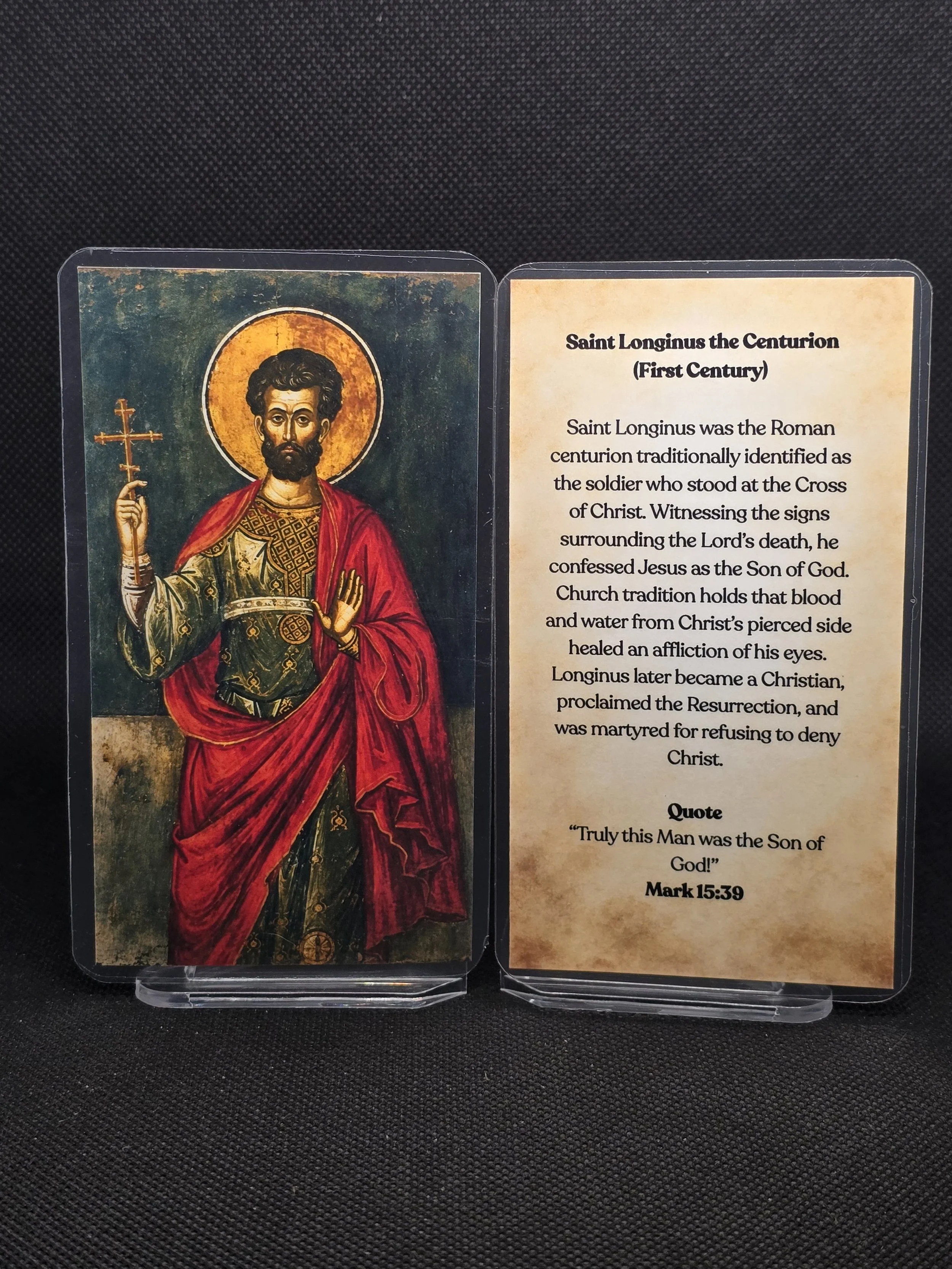
Saint Longinus the Centurion is traditionally identified as the Roman officer who stood beneath the Cross of Jesus Christ and, after witnessing His death and the signs surrounding it, confessed: “Truly this was the Son of God.” He is also identified in received Christian tradition with the unnamed soldier in John 19:34 who pierced Christ's side with a lance, causing blood and water to flow. From a man participating in a Roman execution, Longinus became in Christian memory a convert, preacher, martyr, and one of the most striking examples of a life transformed by encountering the Crucified Christ.
Saint Longinus is especially meaningful for soldiers, military personnel, veterans, converts, people returning to Christianity, those seeking courage to confess their faith, and people praying for healing of the eyes or restoration of sight. His military connection is obvious from the Gospel setting and later tradition, while devotion concerning eyesight comes from the tradition that an affliction of his eyes was healed when blood and water from Christ's pierced side touched him. The Cathedral of Milan identifies Longinus traditionally as a patron of soldiers and the blind, while the Orthodox Church preserves both his military identity and his connection with miraculous healing.
What makes Longinus especially powerful as a devotional figure is that his story begins at the Cross itself. He did not encounter Christ first through a sermon, theological book, or peaceful miracle. He watched Jesus beaten, crucified, and dying, yet what he witnessed there convinced him that the condemned Man before him was unlike any other prisoner he had ever guarded. The Roman officer standing beneath an instrument of execution became one of the first Gentile voices in the Passion narrative to recognize who Christ truly was.
His prayer card can therefore be especially meaningful for someone whose faith begins, returns, or deepens through suffering. Longinus reminds us that a person can arrive at the Cross as an outsider, skeptic, sinner, soldier simply doing his duty, or even someone participating in terrible events, and still leave transformed by grace.
Each 2.5" x 4.25" prayer card is handmade in Austin, Texas and prepared prayerfully with each order. It is printed on museum-quality photo paper rather than cardstock, double-laminated for durability, and made while the recipient and their intentions are lifted before Christ in prayer, with Saint Longinus the Centurion asked to intercede for them.
THE LIFE & STORY
The canonical Gospels give us several pieces of the story that later Christian tradition joined together in Saint Longinus. Matthew 27:54 describes the centurion and the soldiers guarding Jesus seeing the earthquake and the events surrounding His death and confessing that He was the Son of God. Mark 15:39 focuses specifically upon the centurion standing opposite Jesus, while Luke 23:47 records the centurion glorifying God and declaring Jesus righteous or innocent.
Then John 19:34 records a different detail. An unnamed Roman soldier pierced the side of the already-dead Jesus with a spear, and immediately blood and water came forth. Scripture itself does not give that soldier a name, nor does it explicitly state that the soldier with the lance and the confessing centurion were the same man.
Christian tradition eventually identified both figures with Saint Longinus. That identification became deeply embedded in Eastern and Western Christianity, sacred art, liturgical commemoration, and devotion to the Passion of Christ.
WHAT THE GOSPELS ACTUALLY SAY
This distinction is important because Longinus presents an unusual case where the biblical event is certain but the personal identification comes from later tradition. There certainly was a centurion at the Crucifixion who responded dramatically to Christ's death, and there certainly was a Roman soldier who pierced Christ's side, but neither is named Longinus in Matthew, Mark, Luke, or John.
The name appears later in Christian literature. Oxford's Cult of Saints research project notes that the Acts of Pilate, incorporated into the tradition of the Gospel of Nicodemus, is the earliest surviving text to give the name Longinus to the lance-bearing soldier. A form of that text dating to about 425 AD names the soldier Longinus, while later forms identify him with the confessing centurion.
That means the safest product wording is not “the Bible says his name was Longinus.” It is “Christian tradition identifies the centurion and lance-bearing soldier as Saint Longinus.”
THE TRADITION MAY BE OLDER THAN THE NAME
Interestingly, parts of the Longinus tradition existed before surviving writers actually used his name. Oxford's research notes that Saint John Chrysostom already knew a tradition that the centurion at the Cross later became a martyr, while Saint Gregory of Nyssa knew a tradition connecting the converted centurion with missionary activity in Cappadocia. Neither Father calls him Longinus in the surviving passages.
This is historically significant. It suggests that the Christian memory of the centurion's conversion and later witness was circulating before the surviving written tradition firmly attached the name Longinus to him.
“TRULY THIS WAS THE SON OF GOD”
The defining moment of Saint Longinus' story is his confession beneath the Cross. Matthew records that the centurion and those guarding Jesus were terrified by the earthquake and surrounding events and declared, “Truly this was the Son of God.”
Mark places the centurion directly opposite Jesus and makes his confession an immediate response to the way Christ died. Luke gives another perspective, saying the centurion glorified God and proclaimed Jesus righteous. Together, the Gospel accounts present a Roman military officer recognizing something extraordinary at the very moment many others believed Christ's claims had been finally defeated.
This makes Longinus one of the great saints of conversion at the Cross. The suffering and death of Christ did not destroy his faith because, paradoxically, those very events appear to have awakened it.
A GENTILE SOLDIER RECOGNIZES CHRIST
There is a powerful biblical reversal in the scene. Jesus has been rejected by many of His own people, condemned by religious and political authorities, abandoned by frightened followers, and handed over to Roman execution.
Yet beneath the Cross stands a Gentile Roman officer, and it is from him that the Gospel records one of the Passion's clearest confessions concerning Christ.
The man responsible for overseeing death recognizes Life. The representative of imperial power looks upon the apparently powerless Christ and recognizes divine authority.
THE SPEAR THAT PIERCED THE SIDE OF CHRIST
John tells us that soldiers came to break the legs of the crucified men to hasten death. Finding Jesus already dead, they did not break His legs, but one soldier pierced His side with a spear and blood and water flowed out.
Christian theology has meditated upon this scene for centuries. The blood and water became connected with the Eucharist and Baptism, the sacramental life of the Church, and the opening of Christ's side as a sign of the Church being born from the wounded Savior.
Later Christian tradition identified the soldier holding that spear as Longinus. The spear consequently became known as the Lance of Longinus or Holy Lance.
THE BLOOD & WATER
The blood and water are not an invention from Longinus' later Life because they come directly from John 19:34. The association between them and the soldier's personal healing, however, belongs to later devotional tradition.
The Orthodox Church preserves the tradition that Longinus suffered from an eye ailment and that some of the blood and water from Christ's side reached his eyes, bringing healing. His physical sight was restored at the same moment his spiritual sight was opening to the identity of Jesus.
That symbolism is one reason he became especially meaningful to Christians praying for eyesight and spiritual illumination.
A SAINT FOR EYESIGHT
Saint Longinus has a longstanding devotional connection with the blind and people suffering from disorders of sight. The Cathedral of Milan explicitly identifies him as a patron of the blind, while the Orthodox Life preserves multiple traditions involving miraculous restoration of eyesight.
The spiritual symbolism is unusually fitting. Longinus is remembered as a man who learned to see at the Cross, both physically in the later healing tradition and spiritually when he recognized the Son of God.
A Saint Longinus prayer card can therefore be especially meaningful before eye surgery, during treatment for declining vision, or for someone praying for greater spiritual clarity.
DID LONGINUS REALLY HAVE BAD EYES?
The eye-healing story should be described as Church tradition, not as a detail recorded in Scripture. Modern historical research indicates that the blindness or poor-eyesight motif developed considerably later than the earliest traditions about the centurion.
That does not mean the tradition has no devotional importance. It means the product description should carefully say, “According to later Christian tradition, Longinus suffered from an eye condition and was healed by the blood and water from Christ's side.”
THE GUARD AT THE TOMB
Eastern Orthodox tradition goes beyond Golgotha and identifies Longinus as one of the officers involved in guarding Christ's tomb after the burial. According to this tradition, Longinus and the soldiers witnessed the events surrounding the Resurrection.
Matthew's Gospel itself records that guards were stationed at the tomb and that after the Resurrection money was given to soldiers so they would report that Jesus' disciples had stolen His body. The Gospel does not name Longinus as one of those guards, but later Eastern tradition places him among them.
HE REFUSED THE BRIBE
The Orthodox Life says Longinus and two fellow soldiers refused money offered in exchange for supporting the false explanation of Christ's missing body. Instead of remaining silent, they testified to what they believed had occurred.
This part of his tradition gives Longinus an especially strong connection with integrity, truthfulness, and refusing corruption. The Roman officer who once followed orders now had to decide whether money and political pressure could persuade him to deny what he had seen.
FROM WITNESS TO CONVERT
According to the Orthodox tradition, Longinus and two fellow soldiers received Baptism from the apostles and left military service. Longinus then returned to his native Cappadocia, where he began preaching Christ.
The transformation is remarkable. The soldier who had once stood guard over the Crucifixion becomes a missionary proclaiming the Crucified and Risen Lord.
The imagery gives Longinus particular meaning for converts. Christianity did not merely add another belief to his life because accepting Christ changed his loyalties, profession, future, and eventually the reason for which he was willing to die.
A SAINT FOR CONVERTS
Saint Longinus is especially meaningful for people entering Christianity from outside the faith. His traditional Life begins with an outsider looking at Jesus from the perspective of the Roman world and ends with that same man openly preaching Christ.
He can also be meaningful for someone returning to faith after years away. Longinus reminds the believer that what matters is not how close or far away someone appeared yesterday, but what that person does once Christ becomes recognizable.
THE CENTURION BECOMES A MISSIONARY
The tradition connecting Longinus with Cappadocia appears surprisingly early. Oxford's study of his cult notes that Saint Gregory of Nyssa already knew of a tradition concerning the centurion as an apostolic evangelizer of Cappadocia, even though Gregory did not use the name Longinus.
This makes the missionary element more than a very late medieval embellishment. The exact details of his preaching cannot be reconstructed historically, but the idea that the converted centurion carried Christianity into Cappadocia was already known in the patristic era.
PILATE SENDS SOLDIERS AFTER HIM
The received Orthodox Life says that reports of Longinus' preaching eventually reached Jerusalem. Pilate was persuaded to send soldiers to Cappadocia with orders to kill Longinus and his companions.
The story then takes an extraordinary turn. The soldiers arrived without recognizing the man they sought, and Longinus himself welcomed them into his home and fed them.
Only after offering hospitality did he discover why they had come.
HE FED THE MEN SENT TO KILL HIM
According to the tradition, Longinus did not immediately reveal his identity. He treated the soldiers as guests and served them before they explained that they had been sent to find and kill a man named Longinus.
He then told them who he was.
The scene is one of the strongest parts of his later Life because the former Roman officer understood exactly what the soldiers were experiencing. They were men under orders, sent into an unfamiliar place to complete a grim assignment, and the person they were hunting had just welcomed them as guests.
THE SOLDIERS WANTED HIM TO ESCAPE
The soldiers were horrified when they discovered the truth. According to the Orthodox account, they urged Longinus and his companions to escape rather than force them to execute men who had treated them kindly.
Longinus refused to flee. His traditional Life presents him as accepting martyrdom deliberately, not because he despised life, but because he would not deny the Christ whom he had recognized beneath the Cross.
MARTYRDOM BY BEHEADING
Saint Longinus and his two companions were ultimately beheaded, according to the Eastern Christian tradition. His body was buried in Cappadocia, while his head was sent back as proof that the order had been carried out.
The Oxford Cult of Saints project dates the surviving developed Greek Martyrdom of Longinus probably to the sixth or seventh century, while noting that elements of the centurion's martyr tradition are already known centuries earlier. This distinction allows the story to be told devotionally without pretending the full later Passion is an eyewitness court record.
THE BLIND WIDOW & THE HEAD OF SAINT LONGINUS
Eastern tradition preserves another remarkable eyesight miracle after Longinus' death. A blind widow from Cappadocia traveled to Jerusalem hoping to receive healing, but her son became ill and died during the journey, leaving her both blind and overcome with grief.
Longinus appeared to her in a dream and directed her toward the place where his discarded head could be found. When she reached the place and touched the martyr's head, the tradition says her sight was restored.
The story strengthened Longinus' association with vision and healing. It also connects physical sight with consolation in grief, because the widow's journey ends not only with restored eyes but with reassurance concerning her son.
A SAINT FOR GRIEF AS WELL AS HEALING
The widow's story means Saint Longinus can also be meaningful to someone grieving the death of a child or loved one. Her prayer began as a request for one kind of healing, yet according to the traditional Life she received consolation concerning something even more devastating.
The Church does not promise visions or miraculous cures to everyone who invokes a saint. The story instead points toward the Christian conviction that physical death does not have the final word over those who belong to Christ.
LONGINUS IN THE EARLIEST CHRISTIAN ART
The name Longinus appears very early in Christian Crucifixion art. The famous Rabbula Gospels, an illuminated Syriac Gospel manuscript completed in 586 AD, contains a Crucifixion scene in which the lance-bearing figure beside Christ is labeled with a form of the name Longinus. The Smithsonian's National Museum of Asian Art confirms the manuscript's date and Syrian origin, while scholarly analysis identifies the labeled spear-bearing figure as Longinus.
This is important because it demonstrates that by the sixth century the name had already become visually attached to the Crucifixion scene. Longinus was no longer only a character in apocryphal literature but part of established Christian sacred imagery.
THE HOLY LANCE
The spear associated with Longinus became one of Christianity's most famous Passion relics. Saint Peter's Basilica in Rome currently preserves a relic traditionally identified with the Lance that pierced Christ's side, and the Basilica continues to expose it solemnly for veneration during Lent.
The Basilica itself carefully uses the language of tradition. Its official 2026 announcement calls it the Lance of Saint Longinus and explains that, according to tradition, it is identified with the weapon used by the Roman soldier in John 19:34.
This is the right level of certainty for product copy as well. The relic is genuinely and officially venerated, while its identification with the exact first-century weapon remains a matter of sacred tradition rather than something archaeology can independently prove.
THE LANCE IS STILL DISPLAYED AT SAINT PETER'S
This is not merely an obsolete medieval custom. In 2025 and again in 2026, Saint Peter's Basilica publicly announced the solemn Lenten display of the Lance of Longinus during the ancient Roman Statio observance.
That gives Saint Longinus a living connection with one of Christianity's most important churches. Pilgrims entering Saint Peter's are encountering not merely old legends in books, but a devotional tradition that remains part of the Basilica's prayer today.
BERNINI'S SAINT LONGINUS
One of the most spectacular artistic representations of Longinus stands inside Saint Peter's Basilica. Gian Lorenzo Bernini created the monumental statue of Saint Longinus placed beneath the great dome, near the area associated with the Passion relics. The Basilica's official Bernini tour specifically lists the statue of Saint Longinus among Bernini's masterpieces in Saint Peter's.
The sculpture shows the former centurion dramatically opening his arms toward heaven, no longer merely holding the weapon connected with Christ's death but transformed by the revelation of the Cross.
LONGINUS & THE PRECIOUS BLOOD IN MANTUA
A separate Western tradition became particularly strong in Mantua, Italy. The Diocese of Mantua preserves a tradition that Longinus brought earth soaked with Christ's Precious Blood to the city, where the relic became associated with the Basilica of Sant'Andrea.
This tradition differs from the Eastern account that places Longinus' later life and martyrdom in Cappadocia. It is therefore better not to force the Eastern and Western Lives into one seamless biography.
What can be said securely is that both East and West developed major devotion to Longinus, but sometimes preserved different accounts concerning what happened after the Crucifixion.
EASTERN & WESTERN LONGINUS TRADITIONS
Modern scholarship has specifically examined this difference. The Eastern tradition tended to emphasize Longinus the centurion, his confession, conversion, missionary activity, and martyrdom in Cappadocia, while Western devotion particularly developed the identity of Longinus the lance-bearing soldier, connecting him with the Precious Blood and Holy Lance.
Over time, the identities largely merged in popular Christian devotion. This is why modern icons, statues, prayer cards, and Lives normally treat the confessing centurion and the soldier with the lance as the same Saint Longinus.
A SAINT FOR SOLDIERS
Saint Longinus is particularly meaningful for soldiers and military personnel because his entire conversion unfolds inside military duty. He knew chain of command, Roman discipline, execution orders, guard duty, political pressure, and the expectation that a soldier would obey.
Yet his story eventually asks what happens when a soldier encounters a truth greater than the authority issuing the orders.
Western Catholic tradition explicitly identifies Longinus as a patron of soldiers, and Eastern devotion remembers him first and foremost as Longinus the Centurion.
A SAINT FOR VETERANS
Longinus can be especially meaningful for veterans because his traditional Life includes leaving military service and discovering an entirely new mission. The skills and experiences of his previous life were not erased, but his identity could no longer be reduced to his uniform.
For a veteran facing the question of what comes next, Longinus offers a powerful Christian image of the soldier becoming witness, missionary, and eventually martyr.
A SAINT FOR PEOPLE WHO CARRY REGRET
Few saintly conversions begin at a scene as morally heavy as the Crucifixion. Christian tradition identifies Longinus with men directly involved in guarding and carrying out the execution of Christ, yet it does not allow his worst moment to become the final definition of his life.
That makes Longinus especially meaningful for someone burdened by regret over serious past decisions. Christianity does not teach that the past is unreal, but it does teach that grace can transform what happens afterward.
The spear does not disappear from Longinus' iconography. Instead, the instrument connected with his former act becomes the very object by which Christians recognize the transformed saint.
THE SPEAR AS A SYMBOL OF CONVERSION
This gives the lance a profound spiritual meaning. Longinus is not usually depicted hiding the spear from his past because Christian iconography can place it directly in his hand after his conversion.
The object therefore stops functioning only as evidence against him. It becomes testimony to the moment when Christ's wounded side opened and the centurion's life changed.
For Christians struggling with shame, this is powerful imagery. God can transform even the memory of sin into a place from which repentance and testimony begin.
A SAINT FOR COURAGE TO SPEAK THE TRUTH
The centurion's first recorded Christian act is fundamentally speech. Surrounded by soldiers, authorities, terrified spectators, and the aftermath of a public execution, he says what he has come to believe about Jesus.
Longinus is therefore especially meaningful for someone who knows what is true but is frightened to say it publicly. His story joins military courage with courage of confession.
A SAINT FOR INTEGRITY
The later tomb-guard tradition adds another dimension. Longinus is presented as someone who cannot be paid to deny what he has witnessed, even when powerful people want a convenient story repeated.
That makes his prayer card meaningful for soldiers, law-enforcement personnel, witnesses, investigators, public officials, employees confronting corruption, or anyone whose integrity is being tested by money or pressure.
A SAINT FOR PEOPLE RETURNING TO CHRIST
Longinus did not spend decades gradually approaching Jesus before his conversion. His traditional identity is formed through a sudden confrontation with the Cross.
For someone who has lived far from Christianity, his story offers a simple message: the distance between a person and Christ can change very quickly when grace opens the eyes.
A prayer card of Saint Longinus can therefore make a meaningful gift for someone coming back to the Church, preparing for Baptism or Chrismation, or struggling to believe that a past life disqualifies them from holiness.
A SAINT FOR SPIRITUAL SIGHT
Physical eyesight is only one layer of the Longinus tradition. His deeper story is about recognizing reality when almost everyone around him sees only defeat.
He looks at a crucified prisoner and sees the Son of God.
For someone praying for discernment, conversion, or freedom from spiritual blindness, that makes Longinus a powerful intercessor even apart from the later traditions of physical eye healing.
HOW HISTORICAL IS SAINT LONGINUS?
The best answer requires separating three levels. First, the canonical Gospels securely record an unnamed centurion confessing Christ at the Crucifixion and an unnamed soldier piercing Jesus' side. Second, patristic sources already knew traditions that the centurion converted, preached, and became a martyr. Third, later apocryphal and hagiographic traditions supply the name Longinus and the detailed narrative now found in his Life.
That means Longinus should not be described either as a completely invented medieval legend or as though every detail of his later Life appears in Scripture. The reality is more interesting: his cult developed around genuine unnamed Gospel figures, received an early Christian identity, and accumulated a rich sacred tradition across centuries.
FEAST DAY
In the Byzantine Orthodox tradition, Saint Longinus the Centurion is commemorated on October 16. The Orthodox Church in America and the Greek Orthodox Patriarchate of Antioch both preserve that date and provide liturgical hymns for his feast.
The Coptic Orthodox tradition also venerates Longinus. Coptic sources commemorate his martyrdom on 23 Abib, while 5 Hator commemorates the finding of his head. Pope Shenouda III specifically referred to both commemorations when discussing the centurion of the Crucifixion.
Western Catholic tradition also preserves devotion to Longinus, historically particularly around March 15, while the saint remains closely associated with the Passion observances at Saint Peter's Basilica. Because this product emphasizes the ancient Eastern saintly tradition, October 16 is the clearest principal feast date to display.
ICONOGRAPHY
Saint Longinus is usually depicted as a Roman centurion or soldier, wearing military clothing or armor and carrying a spear or lance. The lance immediately identifies him with the piercing of Christ's side and with the blood and water of John 19.
Some icons emphasize Longinus at the Cross, while individual saint icons show him after conversion holding the martyr's cross as well as military attributes. The combination tells the story visually: Roman soldier, witness of Golgotha, convert, and martyr.
Early Christian art already associates the name with the spear-bearer. The 586 Rabbula Gospels famously labels the soldier at Christ's side with a form of the name Longinus, demonstrating the antiquity of the visual tradition.
THE “SPEAR OF DESTINY”
The weapon associated with Longinus is properly called the Holy Lance or Lance of Longinus in Christian tradition. “Spear of Destiny” is a much later popular term heavily associated with legends, novels, occult speculation, and modern entertainment rather than the Church's ordinary devotional vocabulary.
For a Christian product page, Holy Lance is therefore the better wording. Saint Peter's Basilica itself uses “Lance of Saint Longinus” when announcing the relic's solemn exposition.
PRAYERS
Saint Longinus has established Byzantine liturgical hymns, so there is no reason to invent a new prayer for him. His Orthodox Troparion remembers him looking upon the crucified King of Glory, becoming enlightened, receiving the martyr's crown, and continuing as an instrument of healing.
The Greek Orthodox Patriarchate of Antioch publishes an established Apolytikion ending with the invocation:
“O Christ God, by his prayers, save our souls, since Thou art merciful.”
This is an excellent traditional prayer for the back of a Longinus card because it keeps Christ clearly at the center. Longinus is asked to intercede, while salvation and mercy come from Christ.
FAQ
Who was Saint Longinus the Centurion? Saint Longinus is the name Christian tradition gives to the Roman centurion associated with Christ's Crucifixion and confession beneath the Cross. Later tradition also identifies him with the soldier who pierced Jesus' side with a lance.
Is Saint Longinus actually in the Bible? The centurion and the lance-bearing soldier are in the canonical Gospels, but the name Longinus is not. The name enters surviving Christian literature later through the Acts of Pilate and the developing Longinus tradition.
What did the centurion say when Jesus died? Matthew records the centurion and those with him declaring, “Truly this was the Son of God.” Mark similarly places that confession upon the lips of the centurion standing opposite Christ.
Is Longinus the soldier who pierced Jesus with the spear? Christian tradition identifies him that way, but John 19:34 does not name the soldier. The identification became firmly established in later Christian devotion and iconography.
Were the centurion and the spear-bearing soldier definitely the same person? Scripture does not explicitly say so. Eastern and Western traditions gradually combined the confessing centurion and the lance-bearing soldier into the single figure now venerated as Saint Longinus.
Where did the name Longinus come from? The earliest surviving text known to use the name for the Crucifixion soldier is the apocryphal Acts of Pilate. By the sixth century, a form of the name also appears above the spear-bearing figure in the famous Rabbula Gospels Crucifixion image.
How old is devotion to Saint Longinus? Elements of his tradition were already known to major fourth-century Fathers, and his named image appears in sixth-century Christian art. His veneration therefore has genuinely ancient roots even though the complete later Life developed over time.
Did Saint Longinus become Christian at the Cross? Christian tradition interprets the centurion's confession at Christ's death as the beginning of his conversion. The Orthodox Life then describes him receiving Baptism and becoming a missionary.
Did Saint Longinus witness the Resurrection? Eastern tradition places Longinus among the guards associated with Christ's tomb and says he witnessed the Resurrection. The canonical Gospel account mentions guards but does not identify Longinus by name.
Did Longinus refuse money to deny the Resurrection? According to Orthodox tradition, Longinus and two companions refused the money offered to support the claim that Christ's disciples had stolen His body. This episode belongs to his received Church Life rather than an explicit naming in Matthew's Gospel.
Did Saint Longinus leave the Roman army? The Orthodox Life says that after becoming Christian he received Baptism, left military service, and returned to Cappadocia. There he preached the Gospel with two companions.
Was Saint Longinus from Cappadocia? Eastern tradition identifies Cappadocia as his homeland and the place of his later missionary work. A connection between the converted centurion and evangelization of Cappadocia was already known to Saint Gregory of Nyssa.
How did Saint Longinus die? The Eastern Christian tradition says Longinus and two fellow converts were executed by beheading. The developed martyrdom account places their deaths in Cappadocia.
Why is Saint Longinus associated with eyesight? Later Christian tradition says he suffered from an eye problem that was healed when blood and water from Christ's pierced side touched him. Orthodox tradition also preserves a miracle in which a blind widow recovered her sight after finding his head.
Is Saint Longinus a patron of the blind? Western Catholic devotion identifies Saint Longinus as a patron of the blind and soldiers. His Orthodox Life likewise contains prominent traditions involving restoration of sight.
Can I pray to Saint Longinus before eye surgery? Yes, his long devotional association with eyesight makes this a fitting use of his intercession. The prayer should accompany responsible medical care while entrusting healing and the outcome to God.
Is Saint Longinus a patron of soldiers? Yes, Western Catholic tradition explicitly identifies him with soldiers, and Eastern Christianity venerates him specifically as Longinus the Centurion. His own military identity gives the association a direct foundation.
Can veterans pray to Saint Longinus? Yes, especially because his later Life involves leaving military service and discovering a completely new Christian mission. His story can speak powerfully to someone whose identity after military life is changing.
Is Saint Longinus good for converts? Yes, because conversion is at the center of his entire story. The Roman officer who arrived at Golgotha as part of the execution force became, in Christian tradition, a preacher and martyr of the very Christ he had watched die.
Is Saint Longinus good for someone returning to Christianity? Yes, especially for someone who believes past actions place holiness permanently beyond reach. His story is built around the Christian conviction that encountering Christ can redirect even a life burdened by serious regret.
Is Saint Longinus associated with healing? Yes. His Byzantine Troparion explicitly remembers healing in connection with his intercession, while his Life includes traditions of restored sight.
What is the Holy Lance? The Holy Lance is the weapon traditionally identified with the spear used to pierce Christ's side in John 19:34. Christian tradition connects it with Saint Longinus, giving rise to the name Lance of Longinus.
Is the Holy Lance still preserved? Saint Peter's Basilica preserves and publicly venerates a relic traditionally identified as the Lance of Longinus. The Basilica solemnly displayed it during Lenten observances in both 2025 and 2026.
Can historians prove the lance at Saint Peter's is the actual spear? No modern historical or scientific method can establish an unbroken first-century chain of identity beyond dispute. The Basilica itself appropriately presents the identification as a sacred tradition.
Is the “Spear of Destiny” the same thing as the Holy Lance? The expression normally refers to the same traditional Passion weapon, but “Spear of Destiny” is a later popular and sometimes occult term. Christian sources such as Saint Peter's Basilica use Holy Lance or Lance of Longinus instead.
Is there a statue of Saint Longinus in Saint Peter's Basilica? Yes. Bernini's monumental Saint Longinus stands inside Saint Peter's and is included by the Basilica among the master's major works there.
What is Saint Longinus' connection with the Precious Blood? Western tradition links Longinus closely with the Blood that flowed from Christ's side and with a relic of the Precious Blood preserved at Mantua. The Diocese of Mantua continues to preserve this tradition today.
When is Saint Longinus' feast day? The principal Byzantine Orthodox feast of Saint Longinus is October 16. The Coptic Church commemorates his martyrdom on 23 Abib and separately remembers the discovery of his head on 5 Hator.
Does the Coptic Orthodox Church venerate Saint Longinus? Yes. Coptic sources identify the centurion with Saint Longinus and preserve specific Synaxarium commemorations for his martyrdom and the finding of his head.
Do Catholics venerate Saint Longinus? Yes. His devotion is deeply embedded in Catholic tradition, especially at Saint Peter's Basilica and in Mantua, and the Cathedral of Milan likewise recognizes him as a saint and patron of soldiers and the blind.
Do Orthodox Christians venerate Saint Longinus? Yes. The Orthodox Church commemorates him on October 16 as the Martyr Longinus the Centurion who stood at the Cross of the Lord and preserves a full Life, Troparion, and Kontakion for him.
Is there a traditional prayer to Saint Longinus? Yes. Byzantine Christianity has established hymns for his feast, and the Greek Orthodox Patriarchate of Antioch publishes an Apolytikion asking Christ to save the faithful through Longinus' prayers.
What does Saint Longinus teach about conversion? His story teaches that conversion can begin at the very place where a person's past appears most condemning. The soldier associated with Christ's execution becomes a saint because the Cross does not merely expose sin, it also opens the possibility of repentance and transformation.
What does Saint Longinus teach soldiers? His Life teaches that discipline and obedience are real virtues, but no military identity is greater than truth once Christ has been recognized. The centurion eventually becomes willing to lose his profession and life rather than deny what he believes he has witnessed.
What does Saint Longinus teach about regret? His iconography gives an unusually powerful answer because he is still shown carrying the spear associated with Christ's wounded side. The past is not erased, but grace changes what the past means and what the person does with the rest of his life.
What is the main message of Saint Longinus the Centurion's life? Saint Longinus represents the man who came to the Cross as part of the machinery of execution and left it seeing Christ differently. Scripture records an unnamed centurion confessing the Son of God and an unnamed soldier opening Christ's side with a lance; ancient Christian tradition gradually identified both with Longinus, remembered his conversion, connected him with the Resurrection, sent him preaching into Cappadocia, and finally honored him as a martyr. His story became so deeply rooted that sixth-century Christian art already placed his name beside the spear at the Cross, Byzantine Christians gave him an annual feast and hymns, Coptic Christians preserved their own commemorations, and Saint Peter's Basilica still solemnly displays the Lance associated with him. For soldiers, converts, people carrying deep regret, those seeking healing of sight, and Christians afraid to confess what they know to be true, Longinus gives one enduring message: what matters most is not only where you were standing when you first encountered Christ, but what you do once you recognize who He is.
Saint Longinus the Centurion is traditionally identified as the Roman officer who stood beneath the Cross of Jesus Christ and, after witnessing His death and the signs surrounding it, confessed: “Truly this was the Son of God.” He is also identified in received Christian tradition with the unnamed soldier in John 19:34 who pierced Christ's side with a lance, causing blood and water to flow. From a man participating in a Roman execution, Longinus became in Christian memory a convert, preacher, martyr, and one of the most striking examples of a life transformed by encountering the Crucified Christ.
Saint Longinus is especially meaningful for soldiers, military personnel, veterans, converts, people returning to Christianity, those seeking courage to confess their faith, and people praying for healing of the eyes or restoration of sight. His military connection is obvious from the Gospel setting and later tradition, while devotion concerning eyesight comes from the tradition that an affliction of his eyes was healed when blood and water from Christ's pierced side touched him. The Cathedral of Milan identifies Longinus traditionally as a patron of soldiers and the blind, while the Orthodox Church preserves both his military identity and his connection with miraculous healing.
What makes Longinus especially powerful as a devotional figure is that his story begins at the Cross itself. He did not encounter Christ first through a sermon, theological book, or peaceful miracle. He watched Jesus beaten, crucified, and dying, yet what he witnessed there convinced him that the condemned Man before him was unlike any other prisoner he had ever guarded. The Roman officer standing beneath an instrument of execution became one of the first Gentile voices in the Passion narrative to recognize who Christ truly was.
His prayer card can therefore be especially meaningful for someone whose faith begins, returns, or deepens through suffering. Longinus reminds us that a person can arrive at the Cross as an outsider, skeptic, sinner, soldier simply doing his duty, or even someone participating in terrible events, and still leave transformed by grace.
Each 2.5" x 4.25" prayer card is handmade in Austin, Texas and prepared prayerfully with each order. It is printed on museum-quality photo paper rather than cardstock, double-laminated for durability, and made while the recipient and their intentions are lifted before Christ in prayer, with Saint Longinus the Centurion asked to intercede for them.
THE LIFE & STORY
The canonical Gospels give us several pieces of the story that later Christian tradition joined together in Saint Longinus. Matthew 27:54 describes the centurion and the soldiers guarding Jesus seeing the earthquake and the events surrounding His death and confessing that He was the Son of God. Mark 15:39 focuses specifically upon the centurion standing opposite Jesus, while Luke 23:47 records the centurion glorifying God and declaring Jesus righteous or innocent.
Then John 19:34 records a different detail. An unnamed Roman soldier pierced the side of the already-dead Jesus with a spear, and immediately blood and water came forth. Scripture itself does not give that soldier a name, nor does it explicitly state that the soldier with the lance and the confessing centurion were the same man.
Christian tradition eventually identified both figures with Saint Longinus. That identification became deeply embedded in Eastern and Western Christianity, sacred art, liturgical commemoration, and devotion to the Passion of Christ.
WHAT THE GOSPELS ACTUALLY SAY
This distinction is important because Longinus presents an unusual case where the biblical event is certain but the personal identification comes from later tradition. There certainly was a centurion at the Crucifixion who responded dramatically to Christ's death, and there certainly was a Roman soldier who pierced Christ's side, but neither is named Longinus in Matthew, Mark, Luke, or John.
The name appears later in Christian literature. Oxford's Cult of Saints research project notes that the Acts of Pilate, incorporated into the tradition of the Gospel of Nicodemus, is the earliest surviving text to give the name Longinus to the lance-bearing soldier. A form of that text dating to about 425 AD names the soldier Longinus, while later forms identify him with the confessing centurion.
That means the safest product wording is not “the Bible says his name was Longinus.” It is “Christian tradition identifies the centurion and lance-bearing soldier as Saint Longinus.”
THE TRADITION MAY BE OLDER THAN THE NAME
Interestingly, parts of the Longinus tradition existed before surviving writers actually used his name. Oxford's research notes that Saint John Chrysostom already knew a tradition that the centurion at the Cross later became a martyr, while Saint Gregory of Nyssa knew a tradition connecting the converted centurion with missionary activity in Cappadocia. Neither Father calls him Longinus in the surviving passages.
This is historically significant. It suggests that the Christian memory of the centurion's conversion and later witness was circulating before the surviving written tradition firmly attached the name Longinus to him.
“TRULY THIS WAS THE SON OF GOD”
The defining moment of Saint Longinus' story is his confession beneath the Cross. Matthew records that the centurion and those guarding Jesus were terrified by the earthquake and surrounding events and declared, “Truly this was the Son of God.”
Mark places the centurion directly opposite Jesus and makes his confession an immediate response to the way Christ died. Luke gives another perspective, saying the centurion glorified God and proclaimed Jesus righteous. Together, the Gospel accounts present a Roman military officer recognizing something extraordinary at the very moment many others believed Christ's claims had been finally defeated.
This makes Longinus one of the great saints of conversion at the Cross. The suffering and death of Christ did not destroy his faith because, paradoxically, those very events appear to have awakened it.
A GENTILE SOLDIER RECOGNIZES CHRIST
There is a powerful biblical reversal in the scene. Jesus has been rejected by many of His own people, condemned by religious and political authorities, abandoned by frightened followers, and handed over to Roman execution.
Yet beneath the Cross stands a Gentile Roman officer, and it is from him that the Gospel records one of the Passion's clearest confessions concerning Christ.
The man responsible for overseeing death recognizes Life. The representative of imperial power looks upon the apparently powerless Christ and recognizes divine authority.
THE SPEAR THAT PIERCED THE SIDE OF CHRIST
John tells us that soldiers came to break the legs of the crucified men to hasten death. Finding Jesus already dead, they did not break His legs, but one soldier pierced His side with a spear and blood and water flowed out.
Christian theology has meditated upon this scene for centuries. The blood and water became connected with the Eucharist and Baptism, the sacramental life of the Church, and the opening of Christ's side as a sign of the Church being born from the wounded Savior.
Later Christian tradition identified the soldier holding that spear as Longinus. The spear consequently became known as the Lance of Longinus or Holy Lance.
THE BLOOD & WATER
The blood and water are not an invention from Longinus' later Life because they come directly from John 19:34. The association between them and the soldier's personal healing, however, belongs to later devotional tradition.
The Orthodox Church preserves the tradition that Longinus suffered from an eye ailment and that some of the blood and water from Christ's side reached his eyes, bringing healing. His physical sight was restored at the same moment his spiritual sight was opening to the identity of Jesus.
That symbolism is one reason he became especially meaningful to Christians praying for eyesight and spiritual illumination.
A SAINT FOR EYESIGHT
Saint Longinus has a longstanding devotional connection with the blind and people suffering from disorders of sight. The Cathedral of Milan explicitly identifies him as a patron of the blind, while the Orthodox Life preserves multiple traditions involving miraculous restoration of eyesight.
The spiritual symbolism is unusually fitting. Longinus is remembered as a man who learned to see at the Cross, both physically in the later healing tradition and spiritually when he recognized the Son of God.
A Saint Longinus prayer card can therefore be especially meaningful before eye surgery, during treatment for declining vision, or for someone praying for greater spiritual clarity.
DID LONGINUS REALLY HAVE BAD EYES?
The eye-healing story should be described as Church tradition, not as a detail recorded in Scripture. Modern historical research indicates that the blindness or poor-eyesight motif developed considerably later than the earliest traditions about the centurion.
That does not mean the tradition has no devotional importance. It means the product description should carefully say, “According to later Christian tradition, Longinus suffered from an eye condition and was healed by the blood and water from Christ's side.”
THE GUARD AT THE TOMB
Eastern Orthodox tradition goes beyond Golgotha and identifies Longinus as one of the officers involved in guarding Christ's tomb after the burial. According to this tradition, Longinus and the soldiers witnessed the events surrounding the Resurrection.
Matthew's Gospel itself records that guards were stationed at the tomb and that after the Resurrection money was given to soldiers so they would report that Jesus' disciples had stolen His body. The Gospel does not name Longinus as one of those guards, but later Eastern tradition places him among them.
HE REFUSED THE BRIBE
The Orthodox Life says Longinus and two fellow soldiers refused money offered in exchange for supporting the false explanation of Christ's missing body. Instead of remaining silent, they testified to what they believed had occurred.
This part of his tradition gives Longinus an especially strong connection with integrity, truthfulness, and refusing corruption. The Roman officer who once followed orders now had to decide whether money and political pressure could persuade him to deny what he had seen.
FROM WITNESS TO CONVERT
According to the Orthodox tradition, Longinus and two fellow soldiers received Baptism from the apostles and left military service. Longinus then returned to his native Cappadocia, where he began preaching Christ.
The transformation is remarkable. The soldier who had once stood guard over the Crucifixion becomes a missionary proclaiming the Crucified and Risen Lord.
The imagery gives Longinus particular meaning for converts. Christianity did not merely add another belief to his life because accepting Christ changed his loyalties, profession, future, and eventually the reason for which he was willing to die.
A SAINT FOR CONVERTS
Saint Longinus is especially meaningful for people entering Christianity from outside the faith. His traditional Life begins with an outsider looking at Jesus from the perspective of the Roman world and ends with that same man openly preaching Christ.
He can also be meaningful for someone returning to faith after years away. Longinus reminds the believer that what matters is not how close or far away someone appeared yesterday, but what that person does once Christ becomes recognizable.
THE CENTURION BECOMES A MISSIONARY
The tradition connecting Longinus with Cappadocia appears surprisingly early. Oxford's study of his cult notes that Saint Gregory of Nyssa already knew of a tradition concerning the centurion as an apostolic evangelizer of Cappadocia, even though Gregory did not use the name Longinus.
This makes the missionary element more than a very late medieval embellishment. The exact details of his preaching cannot be reconstructed historically, but the idea that the converted centurion carried Christianity into Cappadocia was already known in the patristic era.
PILATE SENDS SOLDIERS AFTER HIM
The received Orthodox Life says that reports of Longinus' preaching eventually reached Jerusalem. Pilate was persuaded to send soldiers to Cappadocia with orders to kill Longinus and his companions.
The story then takes an extraordinary turn. The soldiers arrived without recognizing the man they sought, and Longinus himself welcomed them into his home and fed them.
Only after offering hospitality did he discover why they had come.
HE FED THE MEN SENT TO KILL HIM
According to the tradition, Longinus did not immediately reveal his identity. He treated the soldiers as guests and served them before they explained that they had been sent to find and kill a man named Longinus.
He then told them who he was.
The scene is one of the strongest parts of his later Life because the former Roman officer understood exactly what the soldiers were experiencing. They were men under orders, sent into an unfamiliar place to complete a grim assignment, and the person they were hunting had just welcomed them as guests.
THE SOLDIERS WANTED HIM TO ESCAPE
The soldiers were horrified when they discovered the truth. According to the Orthodox account, they urged Longinus and his companions to escape rather than force them to execute men who had treated them kindly.
Longinus refused to flee. His traditional Life presents him as accepting martyrdom deliberately, not because he despised life, but because he would not deny the Christ whom he had recognized beneath the Cross.
MARTYRDOM BY BEHEADING
Saint Longinus and his two companions were ultimately beheaded, according to the Eastern Christian tradition. His body was buried in Cappadocia, while his head was sent back as proof that the order had been carried out.
The Oxford Cult of Saints project dates the surviving developed Greek Martyrdom of Longinus probably to the sixth or seventh century, while noting that elements of the centurion's martyr tradition are already known centuries earlier. This distinction allows the story to be told devotionally without pretending the full later Passion is an eyewitness court record.
THE BLIND WIDOW & THE HEAD OF SAINT LONGINUS
Eastern tradition preserves another remarkable eyesight miracle after Longinus' death. A blind widow from Cappadocia traveled to Jerusalem hoping to receive healing, but her son became ill and died during the journey, leaving her both blind and overcome with grief.
Longinus appeared to her in a dream and directed her toward the place where his discarded head could be found. When she reached the place and touched the martyr's head, the tradition says her sight was restored.
The story strengthened Longinus' association with vision and healing. It also connects physical sight with consolation in grief, because the widow's journey ends not only with restored eyes but with reassurance concerning her son.
A SAINT FOR GRIEF AS WELL AS HEALING
The widow's story means Saint Longinus can also be meaningful to someone grieving the death of a child or loved one. Her prayer began as a request for one kind of healing, yet according to the traditional Life she received consolation concerning something even more devastating.
The Church does not promise visions or miraculous cures to everyone who invokes a saint. The story instead points toward the Christian conviction that physical death does not have the final word over those who belong to Christ.
LONGINUS IN THE EARLIEST CHRISTIAN ART
The name Longinus appears very early in Christian Crucifixion art. The famous Rabbula Gospels, an illuminated Syriac Gospel manuscript completed in 586 AD, contains a Crucifixion scene in which the lance-bearing figure beside Christ is labeled with a form of the name Longinus. The Smithsonian's National Museum of Asian Art confirms the manuscript's date and Syrian origin, while scholarly analysis identifies the labeled spear-bearing figure as Longinus.
This is important because it demonstrates that by the sixth century the name had already become visually attached to the Crucifixion scene. Longinus was no longer only a character in apocryphal literature but part of established Christian sacred imagery.
THE HOLY LANCE
The spear associated with Longinus became one of Christianity's most famous Passion relics. Saint Peter's Basilica in Rome currently preserves a relic traditionally identified with the Lance that pierced Christ's side, and the Basilica continues to expose it solemnly for veneration during Lent.
The Basilica itself carefully uses the language of tradition. Its official 2026 announcement calls it the Lance of Saint Longinus and explains that, according to tradition, it is identified with the weapon used by the Roman soldier in John 19:34.
This is the right level of certainty for product copy as well. The relic is genuinely and officially venerated, while its identification with the exact first-century weapon remains a matter of sacred tradition rather than something archaeology can independently prove.
THE LANCE IS STILL DISPLAYED AT SAINT PETER'S
This is not merely an obsolete medieval custom. In 2025 and again in 2026, Saint Peter's Basilica publicly announced the solemn Lenten display of the Lance of Longinus during the ancient Roman Statio observance.
That gives Saint Longinus a living connection with one of Christianity's most important churches. Pilgrims entering Saint Peter's are encountering not merely old legends in books, but a devotional tradition that remains part of the Basilica's prayer today.
BERNINI'S SAINT LONGINUS
One of the most spectacular artistic representations of Longinus stands inside Saint Peter's Basilica. Gian Lorenzo Bernini created the monumental statue of Saint Longinus placed beneath the great dome, near the area associated with the Passion relics. The Basilica's official Bernini tour specifically lists the statue of Saint Longinus among Bernini's masterpieces in Saint Peter's.
The sculpture shows the former centurion dramatically opening his arms toward heaven, no longer merely holding the weapon connected with Christ's death but transformed by the revelation of the Cross.
LONGINUS & THE PRECIOUS BLOOD IN MANTUA
A separate Western tradition became particularly strong in Mantua, Italy. The Diocese of Mantua preserves a tradition that Longinus brought earth soaked with Christ's Precious Blood to the city, where the relic became associated with the Basilica of Sant'Andrea.
This tradition differs from the Eastern account that places Longinus' later life and martyrdom in Cappadocia. It is therefore better not to force the Eastern and Western Lives into one seamless biography.
What can be said securely is that both East and West developed major devotion to Longinus, but sometimes preserved different accounts concerning what happened after the Crucifixion.
EASTERN & WESTERN LONGINUS TRADITIONS
Modern scholarship has specifically examined this difference. The Eastern tradition tended to emphasize Longinus the centurion, his confession, conversion, missionary activity, and martyrdom in Cappadocia, while Western devotion particularly developed the identity of Longinus the lance-bearing soldier, connecting him with the Precious Blood and Holy Lance.
Over time, the identities largely merged in popular Christian devotion. This is why modern icons, statues, prayer cards, and Lives normally treat the confessing centurion and the soldier with the lance as the same Saint Longinus.
A SAINT FOR SOLDIERS
Saint Longinus is particularly meaningful for soldiers and military personnel because his entire conversion unfolds inside military duty. He knew chain of command, Roman discipline, execution orders, guard duty, political pressure, and the expectation that a soldier would obey.
Yet his story eventually asks what happens when a soldier encounters a truth greater than the authority issuing the orders.
Western Catholic tradition explicitly identifies Longinus as a patron of soldiers, and Eastern devotion remembers him first and foremost as Longinus the Centurion.
A SAINT FOR VETERANS
Longinus can be especially meaningful for veterans because his traditional Life includes leaving military service and discovering an entirely new mission. The skills and experiences of his previous life were not erased, but his identity could no longer be reduced to his uniform.
For a veteran facing the question of what comes next, Longinus offers a powerful Christian image of the soldier becoming witness, missionary, and eventually martyr.
A SAINT FOR PEOPLE WHO CARRY REGRET
Few saintly conversions begin at a scene as morally heavy as the Crucifixion. Christian tradition identifies Longinus with men directly involved in guarding and carrying out the execution of Christ, yet it does not allow his worst moment to become the final definition of his life.
That makes Longinus especially meaningful for someone burdened by regret over serious past decisions. Christianity does not teach that the past is unreal, but it does teach that grace can transform what happens afterward.
The spear does not disappear from Longinus' iconography. Instead, the instrument connected with his former act becomes the very object by which Christians recognize the transformed saint.
THE SPEAR AS A SYMBOL OF CONVERSION
This gives the lance a profound spiritual meaning. Longinus is not usually depicted hiding the spear from his past because Christian iconography can place it directly in his hand after his conversion.
The object therefore stops functioning only as evidence against him. It becomes testimony to the moment when Christ's wounded side opened and the centurion's life changed.
For Christians struggling with shame, this is powerful imagery. God can transform even the memory of sin into a place from which repentance and testimony begin.
A SAINT FOR COURAGE TO SPEAK THE TRUTH
The centurion's first recorded Christian act is fundamentally speech. Surrounded by soldiers, authorities, terrified spectators, and the aftermath of a public execution, he says what he has come to believe about Jesus.
Longinus is therefore especially meaningful for someone who knows what is true but is frightened to say it publicly. His story joins military courage with courage of confession.
A SAINT FOR INTEGRITY
The later tomb-guard tradition adds another dimension. Longinus is presented as someone who cannot be paid to deny what he has witnessed, even when powerful people want a convenient story repeated.
That makes his prayer card meaningful for soldiers, law-enforcement personnel, witnesses, investigators, public officials, employees confronting corruption, or anyone whose integrity is being tested by money or pressure.
A SAINT FOR PEOPLE RETURNING TO CHRIST
Longinus did not spend decades gradually approaching Jesus before his conversion. His traditional identity is formed through a sudden confrontation with the Cross.
For someone who has lived far from Christianity, his story offers a simple message: the distance between a person and Christ can change very quickly when grace opens the eyes.
A prayer card of Saint Longinus can therefore make a meaningful gift for someone coming back to the Church, preparing for Baptism or Chrismation, or struggling to believe that a past life disqualifies them from holiness.
A SAINT FOR SPIRITUAL SIGHT
Physical eyesight is only one layer of the Longinus tradition. His deeper story is about recognizing reality when almost everyone around him sees only defeat.
He looks at a crucified prisoner and sees the Son of God.
For someone praying for discernment, conversion, or freedom from spiritual blindness, that makes Longinus a powerful intercessor even apart from the later traditions of physical eye healing.
HOW HISTORICAL IS SAINT LONGINUS?
The best answer requires separating three levels. First, the canonical Gospels securely record an unnamed centurion confessing Christ at the Crucifixion and an unnamed soldier piercing Jesus' side. Second, patristic sources already knew traditions that the centurion converted, preached, and became a martyr. Third, later apocryphal and hagiographic traditions supply the name Longinus and the detailed narrative now found in his Life.
That means Longinus should not be described either as a completely invented medieval legend or as though every detail of his later Life appears in Scripture. The reality is more interesting: his cult developed around genuine unnamed Gospel figures, received an early Christian identity, and accumulated a rich sacred tradition across centuries.
FEAST DAY
In the Byzantine Orthodox tradition, Saint Longinus the Centurion is commemorated on October 16. The Orthodox Church in America and the Greek Orthodox Patriarchate of Antioch both preserve that date and provide liturgical hymns for his feast.
The Coptic Orthodox tradition also venerates Longinus. Coptic sources commemorate his martyrdom on 23 Abib, while 5 Hator commemorates the finding of his head. Pope Shenouda III specifically referred to both commemorations when discussing the centurion of the Crucifixion.
Western Catholic tradition also preserves devotion to Longinus, historically particularly around March 15, while the saint remains closely associated with the Passion observances at Saint Peter's Basilica. Because this product emphasizes the ancient Eastern saintly tradition, October 16 is the clearest principal feast date to display.
ICONOGRAPHY
Saint Longinus is usually depicted as a Roman centurion or soldier, wearing military clothing or armor and carrying a spear or lance. The lance immediately identifies him with the piercing of Christ's side and with the blood and water of John 19.
Some icons emphasize Longinus at the Cross, while individual saint icons show him after conversion holding the martyr's cross as well as military attributes. The combination tells the story visually: Roman soldier, witness of Golgotha, convert, and martyr.
Early Christian art already associates the name with the spear-bearer. The 586 Rabbula Gospels famously labels the soldier at Christ's side with a form of the name Longinus, demonstrating the antiquity of the visual tradition.
THE “SPEAR OF DESTINY”
The weapon associated with Longinus is properly called the Holy Lance or Lance of Longinus in Christian tradition. “Spear of Destiny” is a much later popular term heavily associated with legends, novels, occult speculation, and modern entertainment rather than the Church's ordinary devotional vocabulary.
For a Christian product page, Holy Lance is therefore the better wording. Saint Peter's Basilica itself uses “Lance of Saint Longinus” when announcing the relic's solemn exposition.
PRAYERS
Saint Longinus has established Byzantine liturgical hymns, so there is no reason to invent a new prayer for him. His Orthodox Troparion remembers him looking upon the crucified King of Glory, becoming enlightened, receiving the martyr's crown, and continuing as an instrument of healing.
The Greek Orthodox Patriarchate of Antioch publishes an established Apolytikion ending with the invocation:
“O Christ God, by his prayers, save our souls, since Thou art merciful.”
This is an excellent traditional prayer for the back of a Longinus card because it keeps Christ clearly at the center. Longinus is asked to intercede, while salvation and mercy come from Christ.
FAQ
Who was Saint Longinus the Centurion? Saint Longinus is the name Christian tradition gives to the Roman centurion associated with Christ's Crucifixion and confession beneath the Cross. Later tradition also identifies him with the soldier who pierced Jesus' side with a lance.
Is Saint Longinus actually in the Bible? The centurion and the lance-bearing soldier are in the canonical Gospels, but the name Longinus is not. The name enters surviving Christian literature later through the Acts of Pilate and the developing Longinus tradition.
What did the centurion say when Jesus died? Matthew records the centurion and those with him declaring, “Truly this was the Son of God.” Mark similarly places that confession upon the lips of the centurion standing opposite Christ.
Is Longinus the soldier who pierced Jesus with the spear? Christian tradition identifies him that way, but John 19:34 does not name the soldier. The identification became firmly established in later Christian devotion and iconography.
Were the centurion and the spear-bearing soldier definitely the same person? Scripture does not explicitly say so. Eastern and Western traditions gradually combined the confessing centurion and the lance-bearing soldier into the single figure now venerated as Saint Longinus.
Where did the name Longinus come from? The earliest surviving text known to use the name for the Crucifixion soldier is the apocryphal Acts of Pilate. By the sixth century, a form of the name also appears above the spear-bearing figure in the famous Rabbula Gospels Crucifixion image.
How old is devotion to Saint Longinus? Elements of his tradition were already known to major fourth-century Fathers, and his named image appears in sixth-century Christian art. His veneration therefore has genuinely ancient roots even though the complete later Life developed over time.
Did Saint Longinus become Christian at the Cross? Christian tradition interprets the centurion's confession at Christ's death as the beginning of his conversion. The Orthodox Life then describes him receiving Baptism and becoming a missionary.
Did Saint Longinus witness the Resurrection? Eastern tradition places Longinus among the guards associated with Christ's tomb and says he witnessed the Resurrection. The canonical Gospel account mentions guards but does not identify Longinus by name.
Did Longinus refuse money to deny the Resurrection? According to Orthodox tradition, Longinus and two companions refused the money offered to support the claim that Christ's disciples had stolen His body. This episode belongs to his received Church Life rather than an explicit naming in Matthew's Gospel.
Did Saint Longinus leave the Roman army? The Orthodox Life says that after becoming Christian he received Baptism, left military service, and returned to Cappadocia. There he preached the Gospel with two companions.
Was Saint Longinus from Cappadocia? Eastern tradition identifies Cappadocia as his homeland and the place of his later missionary work. A connection between the converted centurion and evangelization of Cappadocia was already known to Saint Gregory of Nyssa.
How did Saint Longinus die? The Eastern Christian tradition says Longinus and two fellow converts were executed by beheading. The developed martyrdom account places their deaths in Cappadocia.
Why is Saint Longinus associated with eyesight? Later Christian tradition says he suffered from an eye problem that was healed when blood and water from Christ's pierced side touched him. Orthodox tradition also preserves a miracle in which a blind widow recovered her sight after finding his head.
Is Saint Longinus a patron of the blind? Western Catholic devotion identifies Saint Longinus as a patron of the blind and soldiers. His Orthodox Life likewise contains prominent traditions involving restoration of sight.
Can I pray to Saint Longinus before eye surgery? Yes, his long devotional association with eyesight makes this a fitting use of his intercession. The prayer should accompany responsible medical care while entrusting healing and the outcome to God.
Is Saint Longinus a patron of soldiers? Yes, Western Catholic tradition explicitly identifies him with soldiers, and Eastern Christianity venerates him specifically as Longinus the Centurion. His own military identity gives the association a direct foundation.
Can veterans pray to Saint Longinus? Yes, especially because his later Life involves leaving military service and discovering a completely new Christian mission. His story can speak powerfully to someone whose identity after military life is changing.
Is Saint Longinus good for converts? Yes, because conversion is at the center of his entire story. The Roman officer who arrived at Golgotha as part of the execution force became, in Christian tradition, a preacher and martyr of the very Christ he had watched die.
Is Saint Longinus good for someone returning to Christianity? Yes, especially for someone who believes past actions place holiness permanently beyond reach. His story is built around the Christian conviction that encountering Christ can redirect even a life burdened by serious regret.
Is Saint Longinus associated with healing? Yes. His Byzantine Troparion explicitly remembers healing in connection with his intercession, while his Life includes traditions of restored sight.
What is the Holy Lance? The Holy Lance is the weapon traditionally identified with the spear used to pierce Christ's side in John 19:34. Christian tradition connects it with Saint Longinus, giving rise to the name Lance of Longinus.
Is the Holy Lance still preserved? Saint Peter's Basilica preserves and publicly venerates a relic traditionally identified as the Lance of Longinus. The Basilica solemnly displayed it during Lenten observances in both 2025 and 2026.
Can historians prove the lance at Saint Peter's is the actual spear? No modern historical or scientific method can establish an unbroken first-century chain of identity beyond dispute. The Basilica itself appropriately presents the identification as a sacred tradition.
Is the “Spear of Destiny” the same thing as the Holy Lance? The expression normally refers to the same traditional Passion weapon, but “Spear of Destiny” is a later popular and sometimes occult term. Christian sources such as Saint Peter's Basilica use Holy Lance or Lance of Longinus instead.
Is there a statue of Saint Longinus in Saint Peter's Basilica? Yes. Bernini's monumental Saint Longinus stands inside Saint Peter's and is included by the Basilica among the master's major works there.
What is Saint Longinus' connection with the Precious Blood? Western tradition links Longinus closely with the Blood that flowed from Christ's side and with a relic of the Precious Blood preserved at Mantua. The Diocese of Mantua continues to preserve this tradition today.
When is Saint Longinus' feast day? The principal Byzantine Orthodox feast of Saint Longinus is October 16. The Coptic Church commemorates his martyrdom on 23 Abib and separately remembers the discovery of his head on 5 Hator.
Does the Coptic Orthodox Church venerate Saint Longinus? Yes. Coptic sources identify the centurion with Saint Longinus and preserve specific Synaxarium commemorations for his martyrdom and the finding of his head.
Do Catholics venerate Saint Longinus? Yes. His devotion is deeply embedded in Catholic tradition, especially at Saint Peter's Basilica and in Mantua, and the Cathedral of Milan likewise recognizes him as a saint and patron of soldiers and the blind.
Do Orthodox Christians venerate Saint Longinus? Yes. The Orthodox Church commemorates him on October 16 as the Martyr Longinus the Centurion who stood at the Cross of the Lord and preserves a full Life, Troparion, and Kontakion for him.
Is there a traditional prayer to Saint Longinus? Yes. Byzantine Christianity has established hymns for his feast, and the Greek Orthodox Patriarchate of Antioch publishes an Apolytikion asking Christ to save the faithful through Longinus' prayers.
What does Saint Longinus teach about conversion? His story teaches that conversion can begin at the very place where a person's past appears most condemning. The soldier associated with Christ's execution becomes a saint because the Cross does not merely expose sin, it also opens the possibility of repentance and transformation.
What does Saint Longinus teach soldiers? His Life teaches that discipline and obedience are real virtues, but no military identity is greater than truth once Christ has been recognized. The centurion eventually becomes willing to lose his profession and life rather than deny what he believes he has witnessed.
What does Saint Longinus teach about regret? His iconography gives an unusually powerful answer because he is still shown carrying the spear associated with Christ's wounded side. The past is not erased, but grace changes what the past means and what the person does with the rest of his life.
What is the main message of Saint Longinus the Centurion's life? Saint Longinus represents the man who came to the Cross as part of the machinery of execution and left it seeing Christ differently. Scripture records an unnamed centurion confessing the Son of God and an unnamed soldier opening Christ's side with a lance; ancient Christian tradition gradually identified both with Longinus, remembered his conversion, connected him with the Resurrection, sent him preaching into Cappadocia, and finally honored him as a martyr. His story became so deeply rooted that sixth-century Christian art already placed his name beside the spear at the Cross, Byzantine Christians gave him an annual feast and hymns, Coptic Christians preserved their own commemorations, and Saint Peter's Basilica still solemnly displays the Lance associated with him. For soldiers, converts, people carrying deep regret, those seeking healing of sight, and Christians afraid to confess what they know to be true, Longinus gives one enduring message: what matters most is not only where you were standing when you first encountered Christ, but what you do once you recognize who He is.