 Image 1 of 1
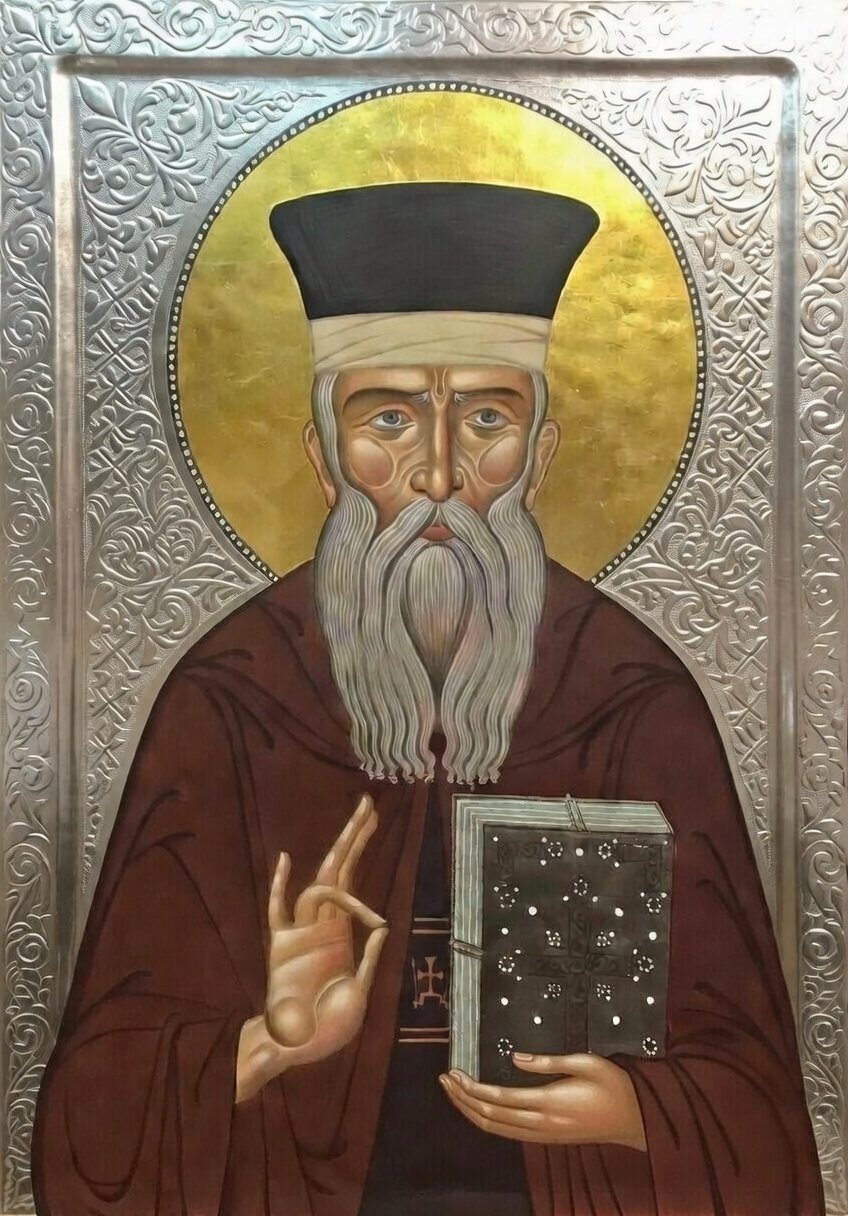
Saint Macarius of Optina Prayer Card – For Spiritual Guidance, Discernment, Humility & Faith in Daily Life
Saint Macarius of Optina was one of the great spiritual elders of nineteenth-century Russian Orthodoxy, remembered for his profound humility, remarkable gift of spiritual discernment, extensive correspondence, and lifelong devotion to the wisdom of the Church Fathers. From his cell at Optina Monastery, he guided monks, nuns, families, and ordinary Christians who sought help with temptation, prayer, relationships, suffering, difficult decisions, and the struggle to follow Christ faithfully.
Unlike spiritual teachers who presented one rigid rule for everyone, Saint Macarius understood that spiritual guidance had to consider the actual person receiving it. His surviving letters reveal a pastor deeply rooted in Scripture and the Fathers who carefully considered each person's responsibilities, weaknesses, family circumstances, and stage of spiritual life before giving advice.
His life is especially meaningful for people seeking spiritual guidance, discernment during difficult decisions, greater humility, freedom from pride, patience during temptation, and a deeper understanding of Orthodox Christian spirituality. Saint Macarius also offers a powerful witness for Christians living ordinary lives in the world, teaching that holiness does not depend upon becoming a monk but upon keeping God's commandments, loving others, and learning true humility wherever God has placed us.
Each prayer card measures 2.5" x 4.25", is handmade in Austin, Texas, printed on museum-quality photo paper rather than ordinary cardstock, and double laminated for durability. Every card is made to order and prepared prayerfully, with the recipient and their intentions brought before Christ while asking Saint Macarius of Optina to intercede for their needs.
THE LIFE & STORY OF SAINT MACARIUS OF OPTINA
Saint Macarius was born Mikhail Nikolayevich Ivanov in 1788 into a Russian noble family. His childhood was marked by the loss of his mother when he was only nine years old, after which he lived with relatives and continued his education.
As a young man, Mikhail worked in government financial administration and proved highly capable. By his teenage years he had already risen to significant responsibility in the provincial treasury, yet worldly advancement did not ultimately satisfy him.
In 1810, at twenty-two years old, he visited the Ploschansk Hermitage of the Mother of God. Whether he originally intended only a visit or had already decided upon monastic life is uncertain, but he soon informed his family that he would remain there and surrendered his share of the family estate to his brothers.
ENTERING THE MONASTIC LIFE
Ploschansk was not a wealthy or prestigious monastery. Its poverty and simplicity appear to have suited the young man who was leaving behind a comfortable social position in order to seek God more completely.
He first received the name Melchizedek as a rassophore monk and was later tonsured into full monastic life in 1815 with the name Macarius. Soon afterward he was ordained a hierodeacon, and in 1817 he was ordained to the priesthood.
The young monk possessed a deep desire for genuine spiritual guidance. He understood that books alone were not enough and longed to learn from experienced elders who had personally lived the ascetical tradition of the Church.
DISCIPLE OF THE SPIRITUAL TRADITION OF SAINT PAISIUS VELICHKOVSKY
One of the most important influences on Macarius was Schemamonk Athanasius, a disciple of Saint Paisius Velichkovsky. Paisius had played an enormous role in restoring the study of the Greek ascetical Fathers and the tradition of interior prayer among Slavic Orthodox Christians.
Macarius cared personally for the elderly and physically disabled Athanasius and became his devoted spiritual disciple. Through him, Macarius gained access to manuscript translations of the great ascetical Fathers associated with the spiritual revival inspired by Saint Paisius.
He read, copied, studied, and absorbed these works. Decades later, this early exposure would bear extraordinary fruit when Macarius helped make many previously inaccessible patristic writings available to the wider Russian Church.
LEARNING THE JESUS PRAYER AND INNER LIFE
Macarius continually sought experienced spiritual fathers rather than relying upon his own judgment. During pilgrimages he met monks formed in the tradition of interior prayer, including men who could speak from personal experience about the prayer of the heart.
This humility became fundamental to his later ministry. Before becoming a famous elder himself, Macarius spent decades learning how to be a disciple.
His life demonstrates an important principle of Orthodox spirituality: genuine spiritual authority grows from obedience and experience rather than merely from education or intelligence.
SAINT LEONID OF OPTINA
Another decisive moment came when Macarius met the future Saint Leonid of Optina, also known as Elder Leo. Macarius recognized in him the experienced spiritual father for whom he had been praying and repeatedly asked to become his disciple.
Even though Macarius was already a priest and experienced monk, he willingly submitted himself to Leonid's guidance. Their relationship became one of the great examples of spiritual friendship within the history of Optina.
When Leonid eventually moved to Optina Monastery, Macarius continued corresponding with him. Macarius later transferred to Optina himself in 1834 and once again placed himself under Leonid's direction.
ARRIVING AT OPTINA
Saint Macarius arrived permanently at Optina at the age of forty-six after spending more than two decades at Ploschansk. Optina was developing into one of the great spiritual centers of nineteenth-century Russia.
Macarius assisted Elder Leonid with his enormous correspondence and the spiritual care of people who came seeking counsel. His responsibilities gradually increased, and he eventually became confessor of the monastery and superior of the Optina Skete.
Yet his administrative position did not change his relationship with Leonid. Macarius continued asking his elder's advice and attributed his successes to Leonid's blessing and prayers.
BECOMING AN OPTINA ELDER
When Saint Leonid died in 1841, he directed his spiritual children toward Macarius. The elder who had spent so many years refusing to trust solely in his own judgment now became responsible for guiding others.
People increasingly came to him from throughout Russia. Monks, nuns, laypeople, families, intellectuals, and people carrying serious personal struggles sought his counsel.
Macarius received visitors throughout the day while maintaining an enormous correspondence with people who could not come to Optina personally. The surviving letters offer an extraordinary window into nineteenth-century Orthodox spiritual direction.
SPIRITUAL ADVICE FOR THE INDIVIDUAL PERSON
One of the most valuable principles in Saint Macarius's letters is his refusal to treat spiritual guidance as a collection of universal formulas. He explicitly warned one correspondent not to pass along personal advice as though it were a general rule for everyone.
Macarius explained that his counsel had been shaped according to that person's particular inner and outer circumstances. Advice appropriate for one Christian might not be appropriate for another.
This makes his writings remarkably relevant today. Spiritual advice found in a book, video, or online discussion may be true in general while still requiring wisdom before being applied to a particular person's life.
HUMILITY
Humility stands at the center of Saint Macarius's spiritual teaching. He believed pride makes people spiritually vulnerable because it causes them to place excessive confidence in their own judgment and strength.
Temptations and failures could sometimes become occasions for humility when they revealed how dependent a person truly was upon God. Macarius therefore warned against responding to spiritual failure with despair, because despair itself can contain a hidden form of pride that cannot accept human weakness.
The answer was not indifference toward sin. It was repentance joined with humility, confidence in God's mercy, and the willingness to begin again.
SPIRITUAL WARFARE
Saint Macarius took spiritual warfare seriously, but he did not encourage Christians to become fascinated with demons or afraid of them. His counsel consistently returned to humility as one of the strongest protections against spiritual deception.
He taught that pride, resentment, self-reliance, judgment of others, and the desire to exalt oneself provide fertile ground for temptation. By contrast, humility deprives the enemy of many of the tools through which confusion develops.
This makes Saint Macarius particularly meaningful for Christians seeking a sober approach to spiritual warfare. His emphasis was not fear of evil but deeper repentance, humility, prayer, forgiveness, and dependence upon Christ.
FOR PEOPLE LIVING IN THE WORLD
One of Saint Macarius's most beautiful teachings concerns Christians who wonder whether genuine holiness is possible outside a monastery. He explicitly reassured one spiritual child that a life lived in the world could be just as pleasing to God as monastic life.
He wrote that what ultimately matters is keeping God's commandments, loving others, and acquiring genuine humility wherever a person has been placed.
This makes his spirituality especially valuable for married Christians, parents, workers, caregivers, and people who sometimes imagine that serious spiritual life belongs primarily to monks and clergy. Macarius taught that the circumstances of ordinary life can themselves become the field in which holiness is acquired.
THE GREAT PATRISTIC PUBLISHING WORK OF OPTINA
Saint Macarius made one of his greatest contributions to Russian Christianity through the publication of patristic spiritual texts. The manuscripts associated with Saint Paisius Velichkovsky contained translations and corrected texts of major ascetical writers, but many remained inaccessible to ordinary readers.
Macarius recognized the enormous spiritual value of bringing these works into print. Working with educated lay collaborators, especially Ivan and Natalia Kireyevsky, he helped launch an ambitious publishing project at Optina.
Beginning in the 1840s, the monastery produced a remarkable series of patristic works under his supervision. These books helped restore direct contact between nineteenth-century Russian Christians and the ancient ascetical tradition of the Church.
SAINT ISAAC THE SYRIAN, SAINT SYMEON AND THE DESERT TRADITION
The authors published through the Optina project included some of Christianity's greatest spiritual teachers. Works connected with Saint Isaac the Syrian, Saint Symeon the New Theologian, Saint Nilus of Sora, Saints Barsanuphius and John, and other ascetical Fathers became available to a much wider audience.
Macarius therefore did more than counsel individual visitors. He helped place the wisdom of the Fathers into the hands of generations of readers he would never personally meet.
This publishing ministry helped create the spiritual environment in which the later Optina Elders, including Saint Ambrose of Optina, would exercise their own enormous influence.
SAINT MACARIUS AND SAINT AMBROSE OF OPTINA
Saint Ambrose of Optina, who later became perhaps the most famous of all the Optina Elders, was formed spiritually under Macarius. Ambrose assisted him with correspondence and with the preparation of patristic texts for publication.
Macarius recognized the younger monk's spiritual gifts and helped prepare him for the ministry he would later inherit. Together with Saint Hilarion of Optina, Ambrose became one of Macarius's principal successors in spiritual eldership.
The connection between Macarius and Ambrose reveals how spiritual traditions survive. A true elder does not seek to make himself indispensable but forms others capable of carrying the same wisdom forward.
A LIFE OF SPIRITUAL CORRESPONDENCE
Macarius's letters are among the most valuable surviving records of his ministry. They address humility, temptation, family relationships, suffering, forgiveness, prayer, pride, spiritual direction, life in the world, monasticism, and the struggle against discouragement.
The letters also reveal how carefully he adapted his counsel to each recipient. He did not simply distribute identical spiritual answers.
His writings remain valuable precisely because they combine the ancient wisdom of the Fathers with the complications of actual human lives.
FOR DIFFICULT DECISIONS
A Saint Macarius of Optina prayer card can be especially meaningful for someone seeking discernment during a difficult decision. Macarius spent decades helping people distinguish between their own desires, fear, pride, spiritual impulses, and what might genuinely lead them closer to God.
His example encourages Christians not to make important decisions solely from emotion or panic. Prayer, humility, Scripture, wise counsel, and patience often reveal more than endless mental analysis.
Macarius also reminds us that genuine spiritual direction respects the particular circumstances of the person involved rather than forcing everyone into one predetermined pattern.
FOR PRIDE AND SELF-RELIANCE
Many of Macarius's teachings return repeatedly to the danger of trusting excessively in one's own spiritual judgment. Intelligence, education, experience, and even religious knowledge can become sources of pride if a person begins believing they no longer need correction.
Macarius's own life provides the opposite example. Even after decades of monastic life and priesthood, he continued submitting himself to the guidance of Saint Leonid.
His humility did not make him weak or indecisive. It prepared him to become one of the most trusted spiritual fathers of his generation.
FOR DISCOURAGEMENT AFTER SIN
Saint Macarius distinguished genuine repentance from despair. Christians should take sin seriously, but becoming paralyzed by one's failures does not produce holiness.
His teaching emphasizes returning to God with humility rather than becoming shocked that we were capable of falling. Recognizing our weakness can become the beginning of deeper dependence upon grace.
This makes his spirituality especially helpful for someone who repeatedly struggles with the same temptation and is beginning to believe that continued repentance is pointless.
FOR CONFLICT AND FORGIVENESS
Macarius warned strongly against allowing resentment and hostility to remain in the heart. Discord that is ignored can continue growing until even small disagreements become spiritually destructive.
His counsel consistently returned to humility, forgiveness, and refusing to nourish accusations against others. This did not mean pretending that wrongdoing had never occurred, but it meant refusing to allow bitterness to become master of the soul.
Saint Macarius can therefore be approached in prayer when family conflict, church conflict, friendship breakdown, or long-standing resentment has become difficult to overcome.
HIS FINAL YEARS
Macarius eventually resigned as superior of the Optina Skete but continued his ministry as an elder. Visitors and letters continued arriving, and his influence extended far beyond the monastery.
During his final illness in 1860, the spiritual habits of his entire life remained visible. He received the Holy Mysteries, asked that writings of the Fathers be read to him, and remained peaceful while those around him prayed.
He died at Optina in 1860 surrounded by the spiritual tradition he had spent decades preserving and transmitting.
HIS RELICS AND THE OPTINA ELDERS
The spiritual legacy of Macarius continued through Saints Ambrose, Hilarion, and the later Optina Elders. The monastery itself would eventually suffer greatly during the Soviet period, but its spiritual heritage survived in books, letters, memories, and communities formed by its teachings.
The relics of Saint Macarius and several other Optina Elders were later uncovered and placed for veneration in the restored monastery. The Optina Elders were ultimately glorified for universal veneration by the Russian Orthodox Church.
Today, Saint Macarius remains one of the central figures for anyone seeking to understand Optina, Russian eldership, the revival of patristic spirituality, and the practical application of the Church Fathers to everyday Christian life.
THE QUOTE
One of Saint Macarius's most powerful teachings directly addresses the question of whether a person must leave ordinary life in order to become holy:
“A life lived in the world can be as good, in the eyes of God, as one spent in a monastery. It is indeed only the keeping of God's commandments, love of all, and a true sense of humility that matter, wherever we are.”
This teaching captures something essential about the Optina tradition. Monasticism possesses its own particular vocation, but salvation is not restricted to monasteries.
Wherever a person lives, the Christian path remains rooted in love, obedience to Christ, repentance, and humility.
OFFICIAL ORTHODOX PRAYER
The Orthodox Church honors Saint Macarius with a troparion that remembers his ascetic life and asks directly for his intercession:
“By a flood of tears you made the desert fertile, and your longing for God brought forth fruits in abundance. By the radiance of miracles you illumined the whole universe. O our holy father Macarius, pray to Christ our God to save our souls.”
This prayer can be used when asking Saint Macarius to intercede for spiritual guidance, humility, discernment, perseverance in temptation, and greater love for the wisdom of the Church.
WHO SHOULD RECEIVE A SAINT MACARIUS OF OPTINA PRAYER CARD?
A Saint Macarius of Optina prayer card can make a particularly meaningful gift for someone seeking spiritual guidance, discerning a major decision, struggling with pride, experiencing recurring temptation, trying to forgive someone, or desiring a deeper understanding of Orthodox spirituality.
It is also especially appropriate for readers of the Desert Fathers, the Philokalia, Saint Isaac the Syrian, Saint Paisius Velichkovsky, or the Optina Elders. His life connects these older ascetical traditions directly with the spiritual revival of nineteenth-century Russia.
For lay Christians, his teaching that holiness is possible within ordinary life can be particularly encouraging. Saint Macarius reminds parents, spouses, workers, students, and caregivers that God does not require everyone to escape the world before they can begin seriously seeking Him.
FAQ
Who was Saint Macarius of Optina? Saint Macarius of Optina was a nineteenth-century Russian Orthodox monk, priest, spiritual elder, and publisher of patristic writings. He lived from 1788 to 1860 and became one of the most important spiritual fathers associated with Optina Monastery.
What was Saint Macarius's birth name? He was born Mikhail Nikolayevich Ivanov. He eventually received the monastic name Macarius after entering monastic life.
Why is Saint Macarius associated with Optina? He moved permanently to Optina in 1834 and became one of the monastery's great spiritual elders. He served as confessor, superior of the skete, spiritual father to monks and laypeople, and an important leader in Optina's patristic publishing work.
Was Saint Macarius a spiritual father to Saint Ambrose of Optina? Yes. Saint Ambrose was formed under Macarius and assisted him with correspondence and publishing work. Macarius recognized Ambrose's gifts and helped prepare him to continue the tradition of eldership at Optina.
Who was Saint Leonid of Optina? Saint Leonid, also called Elder Leo, was Macarius's own spiritual father. Even after Macarius had become an experienced priest and monastic leader, he continued submitting himself humbly to Leonid's guidance.
What did Saint Macarius publish? Under his supervision, Optina helped publish numerous patristic and ascetical texts, including works associated with Saint Isaac the Syrian, Saint Symeon the New Theologian, Saint Nilus of Sora, and Saints Barsanuphius and John.
Was Saint Macarius connected with Saint Paisius Velichkovsky? Yes. One of Macarius's early spiritual teachers had been a disciple of Saint Paisius, and Macarius studied manuscript translations connected with Paisius's revival of patristic spirituality. He later helped publish many of these spiritual treasures.
What did Saint Macarius teach about humility? Humility was fundamental to his spirituality. He taught Christians not to depend entirely upon their own judgment or become discouraged when failures exposed their weakness, but instead to repent and depend more deeply upon God's grace.
What did Saint Macarius teach about living in the world? He explicitly taught that a Christian living in the world could be just as pleasing to God as someone living in a monastery. What matters is keeping God's commandments, loving others, and acquiring genuine humility.
Is Saint Macarius good for someone seeking spiritual guidance? His entire mature ministry centered upon spiritual direction, making him particularly meaningful for people seeking wisdom about prayer, temptation, difficult decisions, relationships, humility, or the Christian life.
Can Saint Macarius be asked to pray for discernment? Yes. Christians may ask any saint for intercession, and Macarius's particular ministry of spiritual direction makes him especially meaningful for discernment and difficult decisions.
What are the Optina Elders? The Optina Elders were a succession of Russian Orthodox spiritual fathers associated with Optina Monastery. They became famous for combining deep patristic spirituality with practical guidance for monks and ordinary lay Christians.
Where are Saint Macarius's relics? His relics are venerated at the restored Optina Monastery together with those of other holy Optina Elders.
Who would this Saint Macarius of Optina prayer card make a meaningful gift for? It is especially fitting for someone seeking spiritual direction, struggling with pride or temptation, studying Orthodox spirituality, reading the Church Fathers, discerning a vocation or major decision, or trying to live a serious Christian life while remaining in the world.
THE MAIN MESSAGE OF SAINT MACARIUS OF OPTINA
Saint Macarius's life demonstrates that spiritual wisdom is not the same thing as possessing quick answers. He spent decades learning obedience, studying the Fathers, receiving correction, and submitting his own judgment before becoming an elder trusted by thousands.
When people finally came to him for guidance, he did not treat them as identical spiritual problems. He listened carefully enough to understand that the same advice could help one person and harm another when their circumstances were different.
His work also ensured that spiritual wisdom would survive beyond personal conversations. By helping publish the great ascetical Fathers, Macarius connected nineteenth-century Christians with centuries of Orthodox experience and helped prepare the spiritual revival that would make Optina famous.
For Christians today, his message remains deeply practical. Seek wise guidance, distrust pride, forgive quickly, repent without despair, learn from the Fathers, and remember that holiness does not depend upon escaping ordinary life. God can be loved wherever He has placed you.