 Image 1 of 1
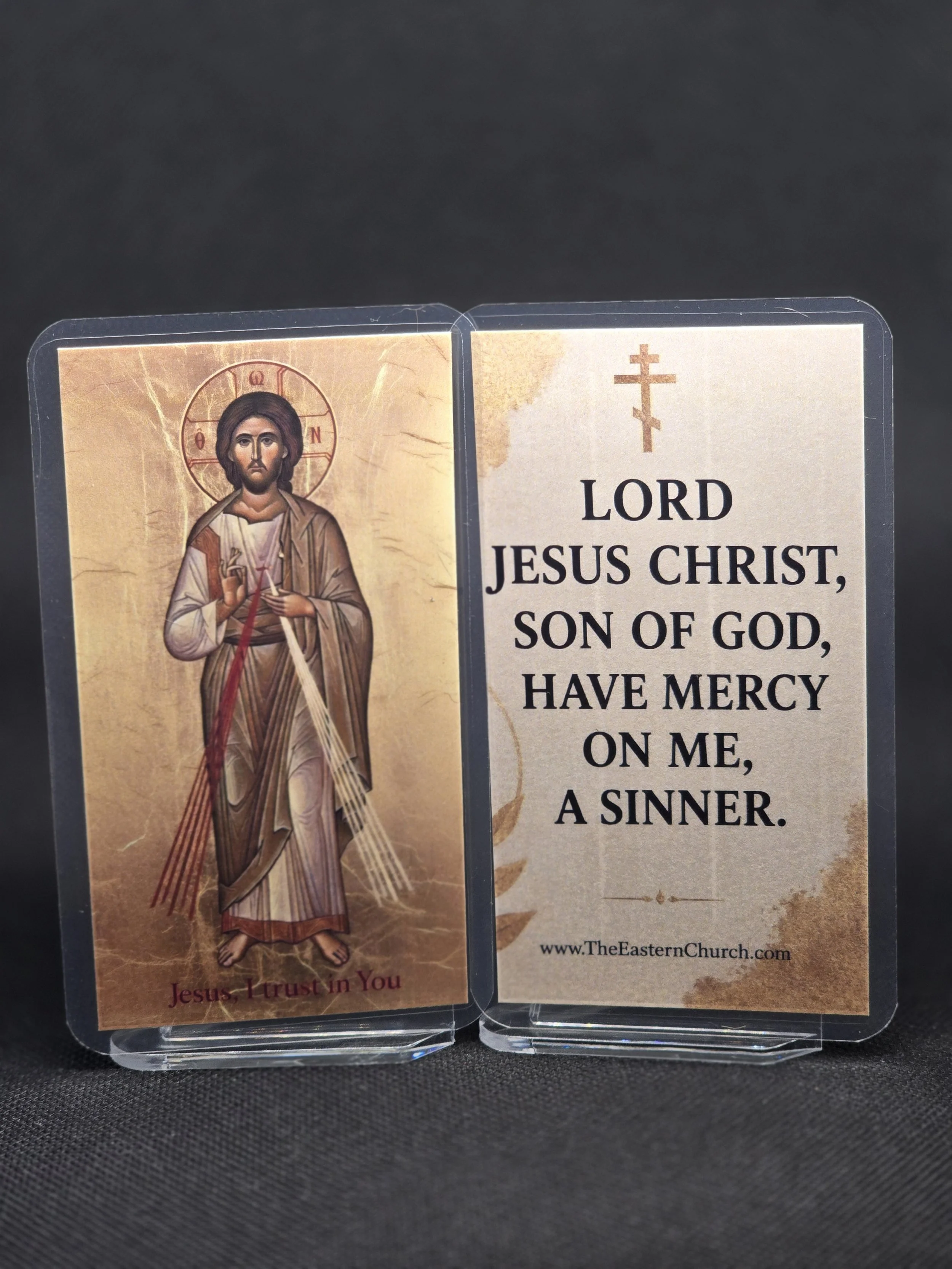
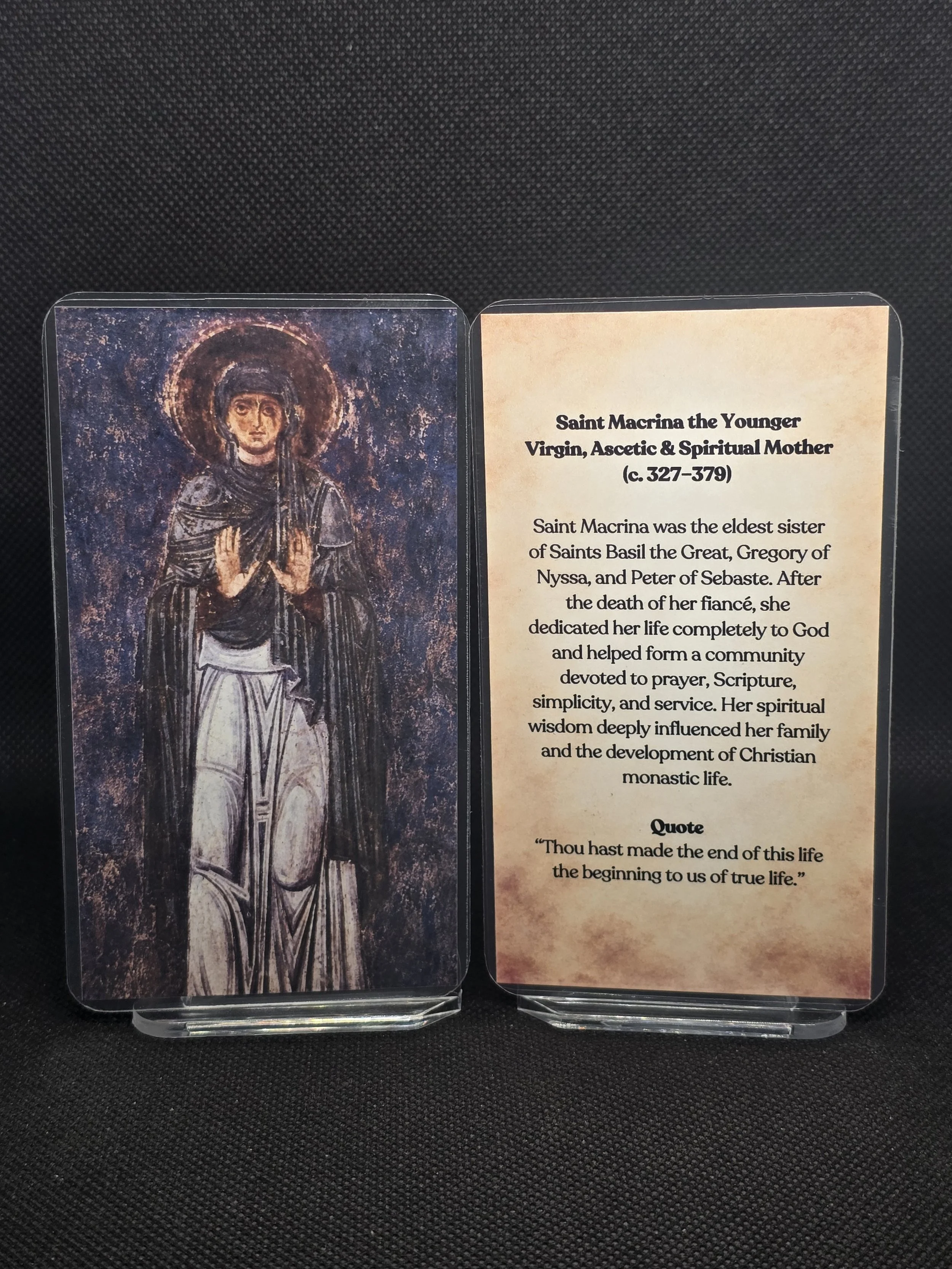
Saint Macrina the Younger Prayer Card - For Spiritual Growth, Prayer, Family & Religious Life
Saint Macrina the Younger was one of the most remarkable Christian women of the fourth century, the older sister and spiritual teacher of Saint Basil the Great and Saint Gregory of Nyssa, the daughter of Saint Emmelia, and a formative influence upon one of the most extraordinary families of saints in Christian history. She chose consecrated virginity after the death of the man to whom she had been betrothed, helped care for and spiritually form her younger siblings, transformed her family's household into an ascetic Christian community, and became so respected for her wisdom that Saint Gregory of Nyssa preserved her life and theological teaching for later generations.
Saint Macrina is especially meaningful for women discerning religious life, consecrated virgins, nuns and monastics, older sisters, Christian teachers, people caring for their families, women studying theology, those seeking a deeper prayer life, Christians practicing simplicity and detachment, people grieving someone they love, and anyone trying to lead others toward Christ quietly through the example of their own life. These associations arise directly from her biography rather than from invented modern patronage because Macrina educated and guided her siblings, cared for her widowed mother, renounced marriage after her fiancé's death, established an ascetic community, studied Scripture deeply, practiced radical simplicity, and became a spiritual teacher even to brothers who would become among the greatest theologians of the ancient Church.
Her connection with spiritual influence within a family is particularly powerful. Macrina never became a bishop, famous public preacher, or imperial adviser, yet both Basil and Gregory emerged from a family in which her example had enormous spiritual force, showing that some of the most important work in the Church takes place through one person quietly helping another person become holy.
She is also an especially meaningful saint for people whose path through life changed because of loss or an unexpected ending. Macrina had been betrothed to a young man, but when he died before their marriage she declined later proposals and chose instead to dedicate herself to Christ, transforming a painful interruption of the life originally planned for her into the beginning of an entirely different vocation.
This prayer card is especially fitting for women discerning consecrated life, nuns, sisters, theology students, teachers, mothers and daughters, older sisters, caregivers, women leading Bible studies, people grieving a fiancé or spouse, Christians simplifying their lives, and anyone seeking greater discipline in prayer. It can also make a meaningful religious profession, monastery entrance, retreat, graduation, confirmation, baptism, name-day, spiritual-direction, or family gift.
Each card is handmade in Austin, TX and created to order. We do not keep stock, because every prayer card is treated as a unique devotional offering. They are printed on museum-quality photo paper, not cardstock, and every card is made slowly during prayer with intentional reverence for the saint and for the person who will receive it. Names are lifted before Christ, intentions are held carefully, and each piece is handled multiple times in prayerful silence, asking God for mercy and asking Saint Macrina the Younger to intercede for the soul it is being made for. This is devotional craftsmanship shaped with patience, care, and spiritual responsibility because every soul and every prayer matters.
THE LIFE & STORY
Saint Macrina the Younger was born into a wealthy and deeply Christian family in Cappadocia during the first half of the fourth century. Sources differ slightly on the exact chronology, but she was born around the late 320s or beginning of the 330s and grew up during a period in which Christianity was emerging from persecution while simultaneously entering some of the greatest theological controversies in Church history.
Her parents were Basil the Elder and Saint Emmelia, and her family included ten children according to the tradition preserved by the Orthodox Church in America. Among her siblings were Saint Basil the Great, Saint Gregory of Nyssa, Saint Peter of Sebaste, and Naucratius, while the wider family also included her grandmother Saint Macrina the Elder.
The extraordinary number of saints within this family can make Macrina seem at first like simply another member of a famous Christian household. The surviving evidence suggests something much more important, because Macrina was one of the people actively responsible for shaping that household into the spiritual environment from which several of those saints emerged.
NAMED FOR SAINT THECLA
The Orthodox tradition preserves an unusual story surrounding Macrina's birth. According to the OCA Life, her mother Saint Emmelia saw an angel in a dream who called the unborn child Thecla, after Saint Thecla the Protomartyr, although the child was later known publicly as Macrina in honor of her grandmother, Saint Macrina the Elder.
The connection with Saint Thecla is particularly fitting because Thecla represented the ancient Christian ideal of a woman who placed discipleship to Christ above the social expectations surrounding her. Macrina would eventually make a similar radical commitment through consecrated virginity, asceticism, prayer, and a life directed increasingly toward God.
EDUCATED THROUGH SCRIPTURE
Saint Emmelia personally supervised much of Macrina's education and deliberately formed her through the Sacred Scriptures and the Psalms. The OCA tradition says that her mother taught her reading and writing through biblical texts that emphasized virtuous and God-pleasing living, while also teaching her prayer, worship, domestic responsibility, and practical work.
This is important because Macrina did not simply acquire religious information. Scripture was presented as a pattern according to which a life could actually be formed, connecting intellectual learning with prayer, discipline, work, and moral transformation.
Her life therefore provides a particularly strong example for Christian parents, homeschool families, catechists, religious educators, and people teaching children Scripture. The goal of Christian formation is not merely producing someone who knows biblical facts, but helping the words of Scripture gradually become part of how a person thinks, prays, chooses, suffers, works, and loves.
HER BETROTHAL & THE DEATH OF HER FIANCÉ
When Macrina reached marriageable age, her parents arranged her betrothal to a young Christian man. Before the marriage could take place, however, he died, leaving Macrina with a future radically different from the one that had been expected for her.
Other men later sought to marry her, but Macrina refused them and chose a life of virginity devoted to Christ. The OCA tradition describes her as regarding herself as still bound to the man who had died, while other Christian accounts emphasize her decision to dedicate herself wholly to Christ.
Her response to loss is one of the most moving aspects of her story. She did not choose the death that disrupted her original plans, but she did choose what she would become afterward, allowing grief to redirect rather than destroy her vocation.
This gives Macrina a meaningful devotional connection with people whose marriages, engagements, relationships, careers, or expected futures have ended unexpectedly. Her life does not suggest that grief is insignificant, but that God can still create a genuine vocation after the future someone expected has disappeared.
A WOMAN WHO HELD HER FAMILY TOGETHER
After the death of her father, Macrina assumed substantial responsibility within her family and became what the OCA describes as its chief support. She helped manage the household, assisted her mother, and participated in the upbringing and education of her younger brothers and sisters.
This part of Macrina's life is easy to overlook because later Christian history remembers the famous bishops and theologians among her brothers. Before those brothers became historical figures, however, they were younger members of a household in which their older sister was helping care for them and shape their spiritual formation.
Her story therefore speaks powerfully to people whose work is largely invisible. Raising children, caring for siblings, supporting an aging parent, managing a household, teaching someone to pray, correcting a younger family member, or quietly keeping a family functioning may never produce public recognition, yet those actions can alter generations.
THE SISTER OF SAINT BASIL THE GREAT
Saint Basil the Great became one of the greatest bishops, theologians, monastic legislators, and defenders of Nicene Christianity in the ancient Church. Orthodox tradition nevertheless remembers Macrina as someone who exercised a strong influence upon his life and character.
This is especially significant because Basil received one of the finest educations available in the Roman world and studied in major intellectual centers. The person who helped redirect that tremendous ability toward a more completely Christian and ascetic life was not another celebrated philosopher, but his sister.
Macrina's influence upon Basil demonstrates that spiritual authority and institutional authority are not always the same thing. She did not possess her brother's episcopal office, yet her personal holiness allowed her to influence the man who would eventually influence enormous portions of Eastern Christian theology and monasticism.
THE SISTER & TEACHER OF SAINT GREGORY OF NYSSA
Saint Gregory of Nyssa's relationship with Macrina provides perhaps the clearest evidence of her extraordinary spiritual stature. Pope Benedict XVI specifically noted that Gregory's Christian education was shaped not only by his brother Basil but also by his sister Macrina, placing her alongside one of Christianity's greatest Fathers as a genuine influence upon Gregory's theological and spiritual formation.
Gregory's admiration for Macrina became even more evident near the end of her life. His writings preserve not merely affection for his sister but a portrait of a woman capable of discussing profound questions about the soul, death, resurrection, virtue, and eternal life with remarkable theological depth.
This makes Saint Macrina especially meaningful for women studying theology or Scripture. Her life provides ancient evidence that serious intellectual engagement with Christian doctrine and deep ascetic spirituality were never exclusively male vocations.
THE SPIRITUAL FORMATION OF SAINT PETER OF SEBASTE
Macrina also helped educate her younger brother Saint Peter, who later became Bishop of Sebaste. Notre Dame's account specifically notes her role in Peter's education, while the broader Orthodox tradition places him among the saints formed within this remarkable household.
Macrina's influence therefore extended across multiple siblings who would eventually occupy very different places within the Church. Her life demonstrates how one spiritually mature person within a family can affect several other vocations at once without ever being able to predict what those people will eventually become.
This makes her an especially fitting intercessor for older siblings who worry about younger brothers or sisters. Christian influence does not require controlling another person's future because faithful example, prayer, teaching, correction, and love may continue bearing fruit long after the older sibling can see the results.
FROM FAMILY ESTATE TO ASCETIC COMMUNITY
As the family's children matured and left home, Macrina persuaded her mother Saint Emmelia to embrace a simpler ascetic way of life. According to the OCA, they freed their slaves and established a women's monastic community in which former servants and members of the household lived together, prayed together, worked together, shared possessions, and were no longer separated according to their earlier social status.
The transformation is remarkable because Macrina did not simply leave wealth behind for private solitude. She helped transform an entire household structure into a Christian community where distinctions of social rank were deliberately diminished by common prayer and common life.
This gives Macrina particular significance within the history of Christian monasticism and women's religious communities. Her community represents an early form of organized female ascetic life shaped around prayer, work, shared possessions, equality, Scripture, and mutual spiritual support.
SETTING FORMER SLAVES FREE
One of the most striking details preserved in the Orthodox account is the decision to free the household's slaves before forming the ascetic community. Some of those former servants then voluntarily remained with Macrina and Emmelia, but now within a community in which they lived as members of one family rather than as property and masters.
That transformation reflected something profound about Christian identity. Baptism, prayer, ascetic discipline, and common life created relationships that could not simply reproduce every hierarchy inherited from Roman society.
Macrina's community therefore gives her a meaningful connection with Christians concerned about human dignity, equality before God, simplicity of life, and the danger of allowing wealth or social position to determine a person's worth. Her response was not primarily political theory, but the creation of a community in which former distinctions of privilege were deliberately surrendered.
THE DEATH OF HER BROTHER NAUCRATIUS
Macrina's life included repeated experiences of grief, including the sudden death of her brother Naucratius while still a young man. The loss devastated the family, particularly their mother, and Macrina became an important source of strength during the mourning that followed.
Her response to bereavement was not emotional coldness or denial. The spirituality later preserved by Gregory presents death as genuinely painful while insisting that Christian hope changes what death ultimately means.
Macrina's biography can therefore be particularly meaningful for siblings grieving siblings and adults trying to remain strong for a parent after a family death. She knew what it meant simultaneously to grieve personally and to help someone else survive the same loss.
THE DEATH OF SAINT EMMELIA
Saint Emmelia eventually died after sharing the ascetic life with her daughter. After her mother's death, Macrina assumed leadership of the women's community and continued the common life of prayer, labor, poverty, and spiritual discipline they had begun together.
The transition reveals another dimension of Macrina's vocation because she was no longer simply a daughter assisting her mother. She became the spiritual leader responsible for maintaining a community of women who trusted her judgment and example.
This gives her an especially natural place among saints for women in spiritual leadership, abbesses, religious superiors, retreat leaders, mentors, and women responsible for forming others in Christian life. Her authority arose from years of proven faithfulness rather than from a desire for position.
RADICAL SIMPLICITY
The OCA remembers Macrina as extraordinarily strict with herself, possessing virtually nothing and even sleeping on boards. Her ascetic life emphasized temperance, simplicity, freedom from unnecessary possessions, prayer, work, and the deliberate weakening of attachments that could distract the heart from God.
Her practices should not be copied mechanically without discernment because Christian asceticism has always required wisdom about a person's health, vocation, responsibilities, and spiritual condition. The principle beneath Macrina's discipline, however, remains relevant because possessions and comfort can gradually become masters when a person is no longer capable of saying no to them.
Her card can therefore be meaningful for Christians attempting to simplify their lives, reduce attachment to possessions, practice fasting responsibly, regain self-discipline, or create more room for prayer. Macrina's example asks a difficult question about how little a person truly needs in order to belong completely to God.
PRAYER, WORK & COMMON LIFE
Life within Macrina's community was not an escape from responsibility. The women prayed together, worked together, shared what they possessed, and lived according to an understanding that ordinary labor could belong to spiritual life rather than standing outside it.
This union of prayer and work became one of the characteristic patterns of Christian monasticism. The person seeking God does not necessarily abandon practical responsibility because work itself can become ordered, peaceful, charitable, and integrated with prayer.
Saint Macrina can therefore be especially meaningful for someone trying to establish a daily spiritual rule. Her life suggests that prayer is strengthened when it becomes part of an ordered life containing work, restraint, community, Scripture, and service rather than an isolated activity squeezed into whatever time happens to remain.
A WOMAN OF THE SCRIPTURES
Macrina's biblical formation began in childhood and remained part of her spiritual identity throughout life. Her mother had deliberately taught her through Scripture and the Psalms, and later accounts present Macrina as a woman whose theological reasoning and prayer were saturated with biblical language.
This makes her particularly fitting for women leading Bible studies, Scripture students, catechists, young women beginning serious biblical study, and anyone trying to learn the Psalms as prayer rather than merely as literature. Macrina shows how Scripture can become a lifelong language for interpreting suffering, vocation, death, holiness, and hope.
Her example also challenges the idea that deep theological formation requires separation from ordinary responsibilities. Macrina studied Scripture while simultaneously carrying responsibilities involving family, household management, grief, community leadership, manual work, and care for others.
MACRINA AS A CHRISTIAN TEACHER
Macrina never held an academic chair or wrote theological books under her own name that survive today. Nevertheless, one of Christianity's greatest theologians remembered her as someone from whom he learned, and Gregory's surviving works make her intellectual and spiritual influence impossible to dismiss.
This makes her an especially important saint for teachers whose greatest achievements may be visible in their students rather than in their own public accomplishments. A teacher may never know how far a lesson, correction, conversation, or example will eventually travel through another person's life.
Macrina's influence upon Basil, Gregory, Peter, and her community illustrates a form of Christian teaching that does not depend upon fame. Her life became the curriculum, and the people who lived beside her became the evidence that her teaching mattered.
MACRINA & THEOLOGY
The theological importance of Saint Macrina becomes particularly visible through her brother Gregory's writings surrounding her final illness and death. The intellectual exchange associated with this period treats questions concerning the soul, bodily death, resurrection, eternal life, and Christian hope, presenting Macrina as a serious participant in one of the most profound theological conversations preserved from the early Church.
This makes it reasonable to speak of Macrina as a Christian theological teacher, provided the claim is framed carefully. Much of what we know about her teaching reaches us through Gregory's literary presentation, so it would be too simplistic to pretend that every philosophical sentence in his dialogue can automatically be treated as a verbatim transcript of Macrina's speech.
The larger picture, however, is unmistakable. Gregory considered his sister spiritually and intellectually significant enough to present her as a teacher while he himself listens, questions, grieves, and learns.
ON THE SOUL & THE RESURRECTION
Gregory of Nyssa's On the Soul and the Resurrection is closely connected with the final period of Macrina's life. The dialogue explores what happens in death, the relationship between soul and body, Christian resurrection, purification, hope, and the destiny for which humanity was created.
The setting makes the work especially powerful because these are not abstract questions being discussed in comfort. Macrina is approaching death while Gregory is carrying grief over the recent death of their brother Basil, meaning that theology is being tested precisely where Christian claims about resurrection matter most.
Saint Macrina therefore has a particularly strong devotional connection with people afraid of death, people grieving someone they love, hospice workers, caregivers, and Christians trying to understand bodily resurrection. Her final days present Christian hope not as refusal to acknowledge mortality but as faith brought directly into its presence.
THE DEATH OF SAINT BASIL THE GREAT
Saint Basil the Great died in 379, a devastating loss both for his family and for the Church. Gregory of Nyssa was deeply affected by his brother's death, and when he later came to Macrina he encountered someone who helped him place personal grief within the larger Christian hope of resurrection.
This makes the relationship between Gregory and Macrina particularly beautiful. The famous theologian and bishop came to his sister carrying grief, and the dying woman became the one who strengthened him.
Her story therefore provides a genuine basis for invoking Macrina in times of bereavement and fear of death. Her spiritual strength was not theoretical because it had survived the deaths of her fiancé, father, brother Naucratius, mother Emmelia, and brother Basil before she herself faced death.
HER FINAL ILLNESS
When Gregory visited Macrina near the end of her life, she was seriously ill and physically weak. Yet the account he preserved emphasizes that her spiritual attention remained directed toward God even as her strength failed.
Her final illness became almost a summary of her entire life. Scripture, prayer, theological reflection, detachment from possessions, love for family, Christian hope, and preparation for eternity converged within the final hours.
For Christians facing serious illness, Macrina's example does not require pretending that sickness is pleasant. It instead demonstrates the possibility that physical weakness and spiritual strength can coexist, and that a person's final period of dependence can still become meaningful prayer.
THE FINAL PRAYER OF SAINT MACRINA
One of the most precious surviving elements connected with Saint Macrina is the prayer Gregory says she offered as she approached death. Pope Benedict XVI specifically cited this prayer while teaching about Gregory of Nyssa, preserving Macrina's request for forgiveness, purification, and the reception of her spirit into God's hands.
Because the prayer appears within an ancient patristic source and was later specifically highlighted by Pope Benedict XVI, it provides exceptionally strong devotional material for Saint Macrina. It allows Christians to encounter her not through a prayer newly invented centuries later, but through words associated directly with her final preparation for death.
Her final prayer is especially suitable for someone preparing for surgery, living with serious illness, approaching the end of life, accompanying a dying family member, or trying to surrender fear of death to Christ. Macrina's attention at the end was directed toward mercy, forgiveness, purification, and placing herself completely into God's hands.
MIRACLES ASSOCIATED WITH SAINT MACRINA
The Orthodox Life of Saint Macrina preserves accounts of miracles connected with her. The sisters of her community told Gregory that Macrina had healed a girl's eye affliction, and the tradition also remembers her prayers being associated with the monastery continuing to have wheat during a famine.
These accounts mean that healing and God's provision belong genuinely to her hagiographic tradition. It would still be too strong to convert that into an invented modern claim that she is universally recognized as the official patron saint of eye disease, famine, or food shortages.
A more historically responsible devotional use is to recognize that Christians may certainly ask Saint Macrina's intercession for healing, material provision, food during hardship, and the needs of a religious community. These prayers correspond to episodes already associated with her life rather than imposing a modern category upon her.
A SAINT FOR WOMEN DISCERNING RELIGIOUS LIFE
Saint Macrina is an especially natural saint for women discerning monasticism, consecrated virginity, or another form of dedicated Christian life. She did not choose virginity because marriage was inherently inferior, but because her own vocation eventually became a complete dedication to Christ expressed through prayer, asceticism, community, Scripture, and service.
Her discernment also developed over time rather than appearing in one dramatic moment detached from ordinary life. Loss, family responsibility, spiritual formation, care for her mother, management of a household, and growing detachment all contributed to the life she ultimately embraced.
A young woman discerning religious life can therefore ask Macrina's prayers not merely for a sign telling her what to do, but for clarity, patience, freedom from fear, willingness to surrender one future if God is opening another, and courage to follow a vocation even when others may not understand it.
A SAINT FOR OLDER SISTERS
Few saints offer older sisters such a concrete example of spiritual influence within a family. Macrina helped raise younger siblings and became a spiritual guide to brothers whose later fame would greatly exceed her own.
An older sibling often occupies an unusual position because she is neither parent nor simply peer. Macrina's life demonstrates how that position can become a genuine vocation involving encouragement, correction, protection, example, teaching, and prayer.
Her card can therefore make a particularly meaningful gift from one sister to another. It can also serve as a reminder that the most powerful way to influence younger siblings is often not to control them, but to become someone whose own life makes holiness believable.
A SAINT FOR CAREGIVERS
Macrina spent significant portions of her life carrying responsibilities for other people, especially within her family and later within her religious community. She supported her widowed mother, helped with younger siblings, managed practical responsibilities, led an ascetic household, and remained part of a community whose life depended upon mutual work and service.
That makes her a meaningful saint for family caregivers, women caring for aging parents, people carrying household responsibilities after a death, and those whose own plans have repeatedly been interrupted by the needs of others. Her life demonstrates that caregiving does not necessarily stand outside a spiritual vocation because love expressed through practical responsibility can itself become part of holiness.
At the same time, Macrina's eventual movement into deeper ascetic life shows that service to others and attention to one's own relationship with God should not be treated as enemies. The Christian challenge is to allow both to become expressions of the same love.
A SAINT FOR GRIEF
Death appears repeatedly throughout Macrina's biography. She lost the man she expected to marry, her father, her brother Naucratius, her mother Emmelia, her brother Basil, and eventually faced her own death while still relatively young.
Yet grief did not make Macrina detached from human love. Her response was instead to place loss within the Christian conviction that bodily death does not possess the final word over a person who belongs to Christ.
This makes her one of the most compelling early Christian saints for someone trying to understand grief through the Resurrection. She offers neither shallow optimism nor despair because her life contains both genuine loss and determined Christian hope.
A SAINT FOR SIMPLICITY
Macrina progressively surrendered wealth, status, comfort, and social distinction in favor of common life and prayer. She moved from a privileged household toward a community in which possessions were shared and former social hierarchies were deliberately dissolved.
This makes her especially relevant to Christians overwhelmed by possessions, consumption, schedules, and the constant pressure to acquire more. Her example asks whether everything a person is capable of possessing is actually worth keeping.
A Saint Macrina prayer card can therefore serve as a devotional reminder during decluttering, fasting, financial simplification, or a deliberate effort to reduce distractions. Christian simplicity is ultimately not about owning the fewest objects but about becoming increasingly free to belong to God.
HER REPOSE
Sources differ slightly concerning the exact year of Saint Macrina's death. Gregory's chronology is commonly understood as placing her repose in 379, while the Orthodox Church in America's Life gives the year 380, so the historically careful presentation is to place her death around 379 to 380 rather than forcing an artificial precision.
Her feast, however, is securely celebrated on July 19. The Orthodox Church in America and the Greek Orthodox Archdiocese both commemorate Macrina on that date.
According to the OCA tradition, Macrina was buried in the same grave as her parents. Her earthly story therefore ended within the family that she had spent so much of her life serving and spiritually forming.
HER LEGACY
Macrina left no episcopal see, no political office, and no large surviving collection of writings under her own name. Her legacy instead survived through the people she formed, the monastic life she helped establish, and the writings of Gregory of Nyssa, who considered her life sufficiently important to preserve for the Church.
This makes her one of Christianity's clearest examples of hidden influence becoming historical influence. Basil and Gregory appear in every serious history of fourth-century Christianity, yet behind part of their formation stands a sister whose name is far less familiar to ordinary Christians.
Her story challenges modern assumptions about significance. The person who changes the world may sometimes be the person who forms the person who changes the world.
SAINT MACRINA IN THE CATHOLIC & ORTHODOX TRADITIONS
Saint Macrina lived in the fourth century, centuries before the later division between the Catholic and Eastern Orthodox Churches. She therefore belongs to the shared patristic and spiritual inheritance of both traditions and is honored within Eastern Orthodox and Catholic Christianity.
Her life also has particular significance for Eastern Catholics following the Byzantine tradition, where the Cappadocian Fathers and their family occupy an important place within the same spiritual world from which Byzantine monasticism and theology developed. The Byzantine Catholic Sisters of Saint Basil in Pennsylvania even established their motherhouse at Mount Saint Macrina, a place whose name preserves the connection between the Basilian tradition and Saint Basil's extraordinary sister.
For The Eastern Church, the most accurate description is therefore Saint Macrina the Younger, Venerable Ascetic and Sister of Saint Basil the Great, while recognizing that devotion to her belongs naturally within both Orthodox and Eastern Catholic spiritual life.
FEAST DAY
Saint Macrina the Younger is commemorated on July 19 in the Byzantine liturgical tradition. Both the Orthodox Church in America and the Greek Orthodox Archdiocese list her commemoration on that date.
Her feast places her among the great ascetic women of early Christianity rather than merely remembering her because of her famous brothers. The Church's liturgical memory honors her own holiness, prayer, virginity, ascetic discipline, spiritual leadership, and care for the soul.
PRAYERS
A simple traditional invocation may be prayed throughout the day: Venerable Mother Macrina, pray to God for us. It is especially fitting during religious discernment, Scripture study, grief, family difficulty, care for aging parents, attempts to establish greater simplicity, or periods in which someone is trying to deepen a daily rule of prayer.
The Orthodox Troparion for Saint Macrina praises the image of God preserved within her and remembers her taking up the Cross, following Christ, disregarding what passes away, and caring for the immortal soul. It concludes by celebrating her spirit rejoicing with the angels, giving the Church an established liturgical prayer rooted specifically in her ascetic life.
Her final prayer, preserved by Saint Gregory of Nyssa and later quoted by Pope Benedict XVI, may also inspire prayer at the end of life because Macrina asked God for forgiveness, purification, and the reception of her spirit into His hands. The text provides an especially ancient and intimate window into the faith with which she approached death.
Someone grieving a death can seek Saint Macrina's prayers for faith in the Resurrection without pretending that separation does not hurt. Someone carrying responsibility for a family can ask for her patience and strength, while a woman discerning religious life can ask for the freedom to recognize God's vocation even when it differs radically from the future she once expected.
This prayer card is especially fitting beside a Bible, Psalter, prayer rope, monastic prayer book, theology textbook, bedside table, family prayer corner, religious vocation materials, grief journal, or icon of the Cappadocian saints. It can also make a meaningful gift for sisters, daughters, nuns, religious sisters, theology students, caregivers, Scripture teachers, widows, women beginning retreats, and Christians seeking greater simplicity and dedication to God.
FAQ
Who was Saint Macrina the Younger? Saint Macrina the Younger was a fourth-century Christian ascetic, teacher, spiritual leader, and member of one of the most famous families of saints in Church history. She was the sister of Saint Basil the Great and Saint Gregory of Nyssa and helped shape the spiritual formation of several members of her family.
Why is she called Macrina the Younger? She is called the Younger to distinguish her from her grandmother, Saint Macrina the Elder, who also played an important role in the family's Christian heritage. Both women are honored as saints, but they belong to different generations.
When was Saint Macrina born? Her exact birth date is uncertain, but she was born during the first part of the fourth century, commonly placed around the late 320s or approximately 330. She grew up in Cappadocia within a wealthy and deeply Christian family.
When did Saint Macrina die? Sources vary slightly, with many placing her death in 379 and the OCA Life giving 380. The safest historical presentation is therefore that she reposed around 379 to 380.
When is Saint Macrina the Younger's feast day? Her feast is celebrated on July 19 in the Byzantine tradition. Both OCA and Greek Orthodox liturgical sources commemorate her on that date.
Was Saint Macrina the sister of Saint Basil the Great? Yes, and Orthodox tradition specifically remembers her as an important influence upon Basil's life and character. Their relationship makes Macrina especially significant within the spiritual history surrounding the Cappadocian Fathers.
Was Saint Macrina the sister of Saint Gregory of Nyssa? Yes, and Gregory deeply admired his sister's holiness and wisdom. Pope Benedict XVI specifically identified Macrina as one of the important influences upon Gregory's Christian formation.
Was Saint Peter of Sebaste also her brother? Yes, Saint Peter of Sebaste belonged to the same extraordinary Christian family. Macrina helped with his formation when he was young, giving her a direct connection with yet another future bishop and saint.
Was Saint Macrina ever married? No, although she was betrothed when she was young. Her fiancé died before their marriage, and she later refused other proposals and chose a life of consecrated virginity.
Is Saint Macrina a good saint for someone grieving a fiancé? Yes, this association arises directly from her life because the man she expected to marry died before their wedding. Her response to that loss eventually became part of the completely different vocation she embraced in Christ.
Is Saint Macrina a patron saint of grief? There is not a strong ancient tradition formally identifying her as the exclusive patron saint of grief. Her repeated experiences of bereavement, however, give Christians a well-grounded reason to seek her intercession while mourning.
What is Saint Macrina the patron saint of? Ancient sources do not give her one rigid patronage category in the modern sense. Her strongest grounded devotional associations include women religious, consecrated virginity, monastic life, older sisters, family spiritual formation, Scripture study, prayer, simplicity, grief, caregivers, and women studying theology.
Is Saint Macrina a good saint for religious vocations? Yes, especially for women discerning monasticism or consecrated life. Her own vocation developed through prayer, loss, family responsibilities, detachment, and an increasing dedication of her entire life to Christ.
Is Saint Macrina a good saint for nuns? Yes, she became the leader of an early women's ascetic community and devoted herself to common prayer, work, simplicity, and spiritual formation. She is therefore one of the natural early Christian saints for women living the monastic vocation.
Did Saint Macrina found a monastery? She and her mother transformed their family household and estate into an ascetic Christian community that functioned as an early women's monastic community. Macrina later became its spiritual leader after her mother's death.
Did Saint Macrina free slaves? The Orthodox Life says that Macrina persuaded her mother to leave their former way of life and free the household's slaves before establishing their common ascetic community. Some of the former servants voluntarily remained, but the community then lived and worked together without the previous social distinction between mistress and servant.
Did Saint Macrina study Scripture? Yes, her mother deliberately educated her through Scripture and the Psalms from childhood. Biblical prayer and Christian teaching remained central to the spiritual formation for which Macrina later became known.
Is Saint Macrina a good saint for Bible study? Yes, because Scripture formed the foundation of her education and spiritual life. Her card can be especially meaningful for women beginning a Bible study, teaching Scripture, or seeking to make the Psalms part of daily prayer.
Was Saint Macrina a theologian? It is reasonable to describe her as a theological teacher, especially because Gregory of Nyssa presents her discussing profound questions concerning death, resurrection, and the soul. Care should still be taken not to assume that every literary sentence Gregory places in the dialogue is necessarily a verbatim transcript of her historical words.
Did Saint Macrina influence Gregory of Nyssa's theology? Gregory himself portrayed Macrina as a spiritual and intellectual teacher, and Benedict XVI explicitly identified her as an important influence in his Christian formation. Her impact upon him therefore goes far beyond merely being his older sister.
What is On the Soul and the Resurrection**?** It is a theological dialogue by Saint Gregory of Nyssa connected with his conversations with Macrina near the end of her life. It considers death, the soul, resurrection, and Christian hope, presenting Macrina as the wise teacher within the dialogue.
Why is Saint Macrina important for women studying theology? She provides one of the strongest early Christian examples of a woman remembered for serious spiritual and theological wisdom. One of the greatest male theologians of antiquity openly portrayed his sister as someone capable of teaching him about the deepest mysteries of Christian life.
Was Saint Macrina a deaconess? Claims surrounding specific ecclesiastical titles applied to fourth-century female ascetics require careful historical interpretation and should not be exaggerated. Her secure historical importance rests upon her ascetic leadership, theological influence, Scriptural formation, and leadership of a women's community rather than upon assigning her a disputed modern understanding of ordained ministry.
Did Saint Macrina perform miracles? Orthodox tradition preserves accounts of a girl being healed from an eye affliction and of Macrina's community receiving sufficient wheat during famine through her prayers. These belong to her established hagiographic tradition.
Can I pray to Saint Macrina for healing? Yes, Christians may ask any saint to intercede before God, and Macrina's hagiography specifically includes a healing associated with her. It is more accurate to say that healing belongs to her tradition than to invent a formal title such as universal patron saint of eye disease.
Can I pray to Saint Macrina for food or financial hardship? Yes, her Life includes a tradition that her monastery did not run short of wheat during a famine through her prayers. This provides a genuine devotional connection with prayer for necessities and God's provision during hardship.
Is Saint Macrina a good saint for older sisters? Yes, this is one of the most natural associations arising from her biography. She helped care for and spiritually form younger siblings who later became important saints and leaders of the Church.
Can I give this prayer card to my sister? Yes, especially when the recipient is an older sister, spiritual mentor, caregiver, teacher, or woman whose faith has influenced the family. Macrina's story makes the card particularly meaningful as recognition of quiet spiritual influence that may never receive public attention.
Is Saint Macrina a good saint for caregivers? Yes, because substantial portions of her life were devoted to supporting family members and later leading a religious community. Her story gives a genuine Christian example of practical responsibility becoming part of spiritual vocation.
Is Saint Macrina a good saint for someone caring for an aging mother? Yes, she remained closely connected with Saint Emmelia and eventually shared the ascetic life with her mother. Their relationship gives Macrina a particularly meaningful connection with adult daughters caring for and praying with their mothers.
What did Saint Macrina teach about death? The tradition preserved through Gregory presents death within the Christian hope of resurrection rather than as the annihilation of the person. Her own final illness became a lived expression of that conviction as she prepared herself prayerfully to entrust her spirit to God.
Did Saint Macrina leave a prayer before her death? Saint Gregory preserved a prayer associated with her final hours, and Pope Benedict XVI later quoted part of it in his teaching on Gregory of Nyssa. The prayer asks for forgiveness, purification, and the reception of her spirit into God's hands.
Is there a traditional Orthodox hymn for Saint Macrina? Yes, the OCA publishes her Troparion for July 19. It praises her for preserving the image of God, taking up the Cross, following Christ, and caring for the immortal soul rather than what passes away.
Is Saint Macrina Orthodox or Catholic? She lived centuries before the later division between Eastern Orthodoxy and Catholicism and belongs to the common ancient inheritance of both. She is especially prominent within the Byzantine Christian tradition because of her connection with Saint Basil, Saint Gregory of Nyssa, and early Eastern monasticism.
Do Eastern Catholics venerate Saint Macrina? Yes, Saint Macrina belongs naturally within Byzantine Catholic tradition as a pre-schism saint associated with the Cappadocian Fathers and early Eastern monasticism. Mount Saint Macrina in Uniontown, Pennsylvania, home of the Byzantine Catholic Sisters of Saint Basil, provides a particularly visible American connection with her name and legacy.
What is Mount Saint Macrina? Mount Saint Macrina in Uniontown, Pennsylvania, is associated with the Byzantine Catholic Sisters of Saint Basil the Great and has long served as the site of an important Byzantine Catholic pilgrimage. Its name reflects the Basilian spiritual heritage connected with Saint Macrina and her brother Saint Basil.
Where was Saint Macrina buried? The Orthodox Life states that Macrina was buried in the same grave as her parents. This detail fittingly connects her final resting place with the family she had spent much of her life serving and spiritually forming.
Where are Saint Macrina's relics today? Portions of relics attributed to Saint Macrina are reported in several Orthodox locations, but publicly available documentation of their complete provenance is uneven. Because of that uncertainty, it is safer not to name one location as possessing her complete relics without stronger ecclesiastical documentation.
Can someone struggling with possessions pray to Saint Macrina? Yes, radical simplicity and freedom from possessions were important characteristics of her ascetic life. Her example can be especially helpful for Christians trying to distinguish what they actually need from things that have gradually become attachments.
Can Saint Macrina help someone establish a prayer rule? Her life provides an excellent model because prayer was integrated with Scripture, work, fasting, community, and ordinary responsibility. Asking her intercession can accompany the practical work of establishing consistent morning and evening prayer rather than depending only upon moments of spiritual enthusiasm.
Can I give this card to a woman entering a monastery? Yes, Saint Macrina is one of the most fitting ancient Christian saints for such a gift. Her life of consecrated virginity, community, spiritual leadership, simplicity, prayer, and Scripture directly relates to the monastic vocation.
Can I give this card to a theology student? Yes, particularly to a woman studying theology, patristics, Scripture, monasticism, or the Cappadocian Fathers. Macrina's influence upon Gregory of Nyssa and the theological portrait he preserved of her make the card especially meaningful in an academic setting.
Can I give this card to someone who has lost a sibling? Yes, Macrina knew the grief of losing siblings, including Naucratius and Saint Basil. Her life can accompany prayer for the grace to mourn deeply while continuing to believe in resurrection and eternal life.
Can I give this card to someone whose future plans have fallen apart? Yes, because Macrina's expected marriage ended with her fiancé's death and her life subsequently took a completely different direction. Her story can be especially meaningful when someone needs courage to believe that the loss of one future does not mean the loss of every vocation.
What does Saint Macrina teach about family? Her life teaches that holiness can spread through a family when members pray for one another, teach one another, accept responsibility for one another, and take one another's spiritual lives seriously. Her enormous influence is especially striking because much of it occurred inside a household before her brothers became famous saints.
What does Saint Macrina teach about women in the Church? Her life demonstrates that women exercised profound spiritual, intellectual, ascetic, educational, and communal leadership within ancient Christianity. Her authority did not depend upon becoming a bishop because bishops themselves, including her brother Gregory, recognized her wisdom and spiritual influence.
What does Saint Macrina teach about grief? She demonstrates that Christian hope does not require denying sorrow. Repeated losses became part of a life increasingly centered upon resurrection, prayer, detachment, and confidence that death cannot finally separate those who belong to Christ.
What does Saint Macrina teach about simplicity? Her movement away from privilege and private possessions toward common life demonstrates that spiritual freedom can require voluntarily surrendering things society regards as signs of success. Simplicity becomes valuable when it creates greater freedom for prayer, love, community, and attention to God.
What does Saint Macrina teach about hidden influence? Her life demonstrates that a person does not need public fame to exert enormous influence upon the Church. The sister who helped form Basil and Gregory influenced Christian history partly through the saints she helped other people become.
What is the main message of Saint Macrina the Younger's life? Saint Macrina's life teaches that quiet holiness can shape generations. She transformed the death of an expected future into consecration to Christ, helped hold her family together, formed younger siblings who became saints, led women in prayer and ascetic life, surrendered privilege for Christian community, studied Scripture deeply, strengthened others through grief, and approached her own death with confidence in God's mercy and the Resurrection. Her story reminds Christians that some of the Church's most consequential work happens far from public attention, wherever one faithful person helps another person become closer to Christ.
Saint Macrina the Younger was one of the most remarkable Christian women of the fourth century, the older sister and spiritual teacher of Saint Basil the Great and Saint Gregory of Nyssa, the daughter of Saint Emmelia, and a formative influence upon one of the most extraordinary families of saints in Christian history. She chose consecrated virginity after the death of the man to whom she had been betrothed, helped care for and spiritually form her younger siblings, transformed her family's household into an ascetic Christian community, and became so respected for her wisdom that Saint Gregory of Nyssa preserved her life and theological teaching for later generations.
Saint Macrina is especially meaningful for women discerning religious life, consecrated virgins, nuns and monastics, older sisters, Christian teachers, people caring for their families, women studying theology, those seeking a deeper prayer life, Christians practicing simplicity and detachment, people grieving someone they love, and anyone trying to lead others toward Christ quietly through the example of their own life. These associations arise directly from her biography rather than from invented modern patronage because Macrina educated and guided her siblings, cared for her widowed mother, renounced marriage after her fiancé's death, established an ascetic community, studied Scripture deeply, practiced radical simplicity, and became a spiritual teacher even to brothers who would become among the greatest theologians of the ancient Church.
Her connection with spiritual influence within a family is particularly powerful. Macrina never became a bishop, famous public preacher, or imperial adviser, yet both Basil and Gregory emerged from a family in which her example had enormous spiritual force, showing that some of the most important work in the Church takes place through one person quietly helping another person become holy.
She is also an especially meaningful saint for people whose path through life changed because of loss or an unexpected ending. Macrina had been betrothed to a young man, but when he died before their marriage she declined later proposals and chose instead to dedicate herself to Christ, transforming a painful interruption of the life originally planned for her into the beginning of an entirely different vocation.
This prayer card is especially fitting for women discerning consecrated life, nuns, sisters, theology students, teachers, mothers and daughters, older sisters, caregivers, women leading Bible studies, people grieving a fiancé or spouse, Christians simplifying their lives, and anyone seeking greater discipline in prayer. It can also make a meaningful religious profession, monastery entrance, retreat, graduation, confirmation, baptism, name-day, spiritual-direction, or family gift.
Each card is handmade in Austin, TX and created to order. We do not keep stock, because every prayer card is treated as a unique devotional offering. They are printed on museum-quality photo paper, not cardstock, and every card is made slowly during prayer with intentional reverence for the saint and for the person who will receive it. Names are lifted before Christ, intentions are held carefully, and each piece is handled multiple times in prayerful silence, asking God for mercy and asking Saint Macrina the Younger to intercede for the soul it is being made for. This is devotional craftsmanship shaped with patience, care, and spiritual responsibility because every soul and every prayer matters.
THE LIFE & STORY
Saint Macrina the Younger was born into a wealthy and deeply Christian family in Cappadocia during the first half of the fourth century. Sources differ slightly on the exact chronology, but she was born around the late 320s or beginning of the 330s and grew up during a period in which Christianity was emerging from persecution while simultaneously entering some of the greatest theological controversies in Church history.
Her parents were Basil the Elder and Saint Emmelia, and her family included ten children according to the tradition preserved by the Orthodox Church in America. Among her siblings were Saint Basil the Great, Saint Gregory of Nyssa, Saint Peter of Sebaste, and Naucratius, while the wider family also included her grandmother Saint Macrina the Elder.
The extraordinary number of saints within this family can make Macrina seem at first like simply another member of a famous Christian household. The surviving evidence suggests something much more important, because Macrina was one of the people actively responsible for shaping that household into the spiritual environment from which several of those saints emerged.
NAMED FOR SAINT THECLA
The Orthodox tradition preserves an unusual story surrounding Macrina's birth. According to the OCA Life, her mother Saint Emmelia saw an angel in a dream who called the unborn child Thecla, after Saint Thecla the Protomartyr, although the child was later known publicly as Macrina in honor of her grandmother, Saint Macrina the Elder.
The connection with Saint Thecla is particularly fitting because Thecla represented the ancient Christian ideal of a woman who placed discipleship to Christ above the social expectations surrounding her. Macrina would eventually make a similar radical commitment through consecrated virginity, asceticism, prayer, and a life directed increasingly toward God.
EDUCATED THROUGH SCRIPTURE
Saint Emmelia personally supervised much of Macrina's education and deliberately formed her through the Sacred Scriptures and the Psalms. The OCA tradition says that her mother taught her reading and writing through biblical texts that emphasized virtuous and God-pleasing living, while also teaching her prayer, worship, domestic responsibility, and practical work.
This is important because Macrina did not simply acquire religious information. Scripture was presented as a pattern according to which a life could actually be formed, connecting intellectual learning with prayer, discipline, work, and moral transformation.
Her life therefore provides a particularly strong example for Christian parents, homeschool families, catechists, religious educators, and people teaching children Scripture. The goal of Christian formation is not merely producing someone who knows biblical facts, but helping the words of Scripture gradually become part of how a person thinks, prays, chooses, suffers, works, and loves.
HER BETROTHAL & THE DEATH OF HER FIANCÉ
When Macrina reached marriageable age, her parents arranged her betrothal to a young Christian man. Before the marriage could take place, however, he died, leaving Macrina with a future radically different from the one that had been expected for her.
Other men later sought to marry her, but Macrina refused them and chose a life of virginity devoted to Christ. The OCA tradition describes her as regarding herself as still bound to the man who had died, while other Christian accounts emphasize her decision to dedicate herself wholly to Christ.
Her response to loss is one of the most moving aspects of her story. She did not choose the death that disrupted her original plans, but she did choose what she would become afterward, allowing grief to redirect rather than destroy her vocation.
This gives Macrina a meaningful devotional connection with people whose marriages, engagements, relationships, careers, or expected futures have ended unexpectedly. Her life does not suggest that grief is insignificant, but that God can still create a genuine vocation after the future someone expected has disappeared.
A WOMAN WHO HELD HER FAMILY TOGETHER
After the death of her father, Macrina assumed substantial responsibility within her family and became what the OCA describes as its chief support. She helped manage the household, assisted her mother, and participated in the upbringing and education of her younger brothers and sisters.
This part of Macrina's life is easy to overlook because later Christian history remembers the famous bishops and theologians among her brothers. Before those brothers became historical figures, however, they were younger members of a household in which their older sister was helping care for them and shape their spiritual formation.
Her story therefore speaks powerfully to people whose work is largely invisible. Raising children, caring for siblings, supporting an aging parent, managing a household, teaching someone to pray, correcting a younger family member, or quietly keeping a family functioning may never produce public recognition, yet those actions can alter generations.
THE SISTER OF SAINT BASIL THE GREAT
Saint Basil the Great became one of the greatest bishops, theologians, monastic legislators, and defenders of Nicene Christianity in the ancient Church. Orthodox tradition nevertheless remembers Macrina as someone who exercised a strong influence upon his life and character.
This is especially significant because Basil received one of the finest educations available in the Roman world and studied in major intellectual centers. The person who helped redirect that tremendous ability toward a more completely Christian and ascetic life was not another celebrated philosopher, but his sister.
Macrina's influence upon Basil demonstrates that spiritual authority and institutional authority are not always the same thing. She did not possess her brother's episcopal office, yet her personal holiness allowed her to influence the man who would eventually influence enormous portions of Eastern Christian theology and monasticism.
THE SISTER & TEACHER OF SAINT GREGORY OF NYSSA
Saint Gregory of Nyssa's relationship with Macrina provides perhaps the clearest evidence of her extraordinary spiritual stature. Pope Benedict XVI specifically noted that Gregory's Christian education was shaped not only by his brother Basil but also by his sister Macrina, placing her alongside one of Christianity's greatest Fathers as a genuine influence upon Gregory's theological and spiritual formation.
Gregory's admiration for Macrina became even more evident near the end of her life. His writings preserve not merely affection for his sister but a portrait of a woman capable of discussing profound questions about the soul, death, resurrection, virtue, and eternal life with remarkable theological depth.
This makes Saint Macrina especially meaningful for women studying theology or Scripture. Her life provides ancient evidence that serious intellectual engagement with Christian doctrine and deep ascetic spirituality were never exclusively male vocations.
THE SPIRITUAL FORMATION OF SAINT PETER OF SEBASTE
Macrina also helped educate her younger brother Saint Peter, who later became Bishop of Sebaste. Notre Dame's account specifically notes her role in Peter's education, while the broader Orthodox tradition places him among the saints formed within this remarkable household.
Macrina's influence therefore extended across multiple siblings who would eventually occupy very different places within the Church. Her life demonstrates how one spiritually mature person within a family can affect several other vocations at once without ever being able to predict what those people will eventually become.
This makes her an especially fitting intercessor for older siblings who worry about younger brothers or sisters. Christian influence does not require controlling another person's future because faithful example, prayer, teaching, correction, and love may continue bearing fruit long after the older sibling can see the results.
FROM FAMILY ESTATE TO ASCETIC COMMUNITY
As the family's children matured and left home, Macrina persuaded her mother Saint Emmelia to embrace a simpler ascetic way of life. According to the OCA, they freed their slaves and established a women's monastic community in which former servants and members of the household lived together, prayed together, worked together, shared possessions, and were no longer separated according to their earlier social status.
The transformation is remarkable because Macrina did not simply leave wealth behind for private solitude. She helped transform an entire household structure into a Christian community where distinctions of social rank were deliberately diminished by common prayer and common life.
This gives Macrina particular significance within the history of Christian monasticism and women's religious communities. Her community represents an early form of organized female ascetic life shaped around prayer, work, shared possessions, equality, Scripture, and mutual spiritual support.
SETTING FORMER SLAVES FREE
One of the most striking details preserved in the Orthodox account is the decision to free the household's slaves before forming the ascetic community. Some of those former servants then voluntarily remained with Macrina and Emmelia, but now within a community in which they lived as members of one family rather than as property and masters.
That transformation reflected something profound about Christian identity. Baptism, prayer, ascetic discipline, and common life created relationships that could not simply reproduce every hierarchy inherited from Roman society.
Macrina's community therefore gives her a meaningful connection with Christians concerned about human dignity, equality before God, simplicity of life, and the danger of allowing wealth or social position to determine a person's worth. Her response was not primarily political theory, but the creation of a community in which former distinctions of privilege were deliberately surrendered.
THE DEATH OF HER BROTHER NAUCRATIUS
Macrina's life included repeated experiences of grief, including the sudden death of her brother Naucratius while still a young man. The loss devastated the family, particularly their mother, and Macrina became an important source of strength during the mourning that followed.
Her response to bereavement was not emotional coldness or denial. The spirituality later preserved by Gregory presents death as genuinely painful while insisting that Christian hope changes what death ultimately means.
Macrina's biography can therefore be particularly meaningful for siblings grieving siblings and adults trying to remain strong for a parent after a family death. She knew what it meant simultaneously to grieve personally and to help someone else survive the same loss.
THE DEATH OF SAINT EMMELIA
Saint Emmelia eventually died after sharing the ascetic life with her daughter. After her mother's death, Macrina assumed leadership of the women's community and continued the common life of prayer, labor, poverty, and spiritual discipline they had begun together.
The transition reveals another dimension of Macrina's vocation because she was no longer simply a daughter assisting her mother. She became the spiritual leader responsible for maintaining a community of women who trusted her judgment and example.
This gives her an especially natural place among saints for women in spiritual leadership, abbesses, religious superiors, retreat leaders, mentors, and women responsible for forming others in Christian life. Her authority arose from years of proven faithfulness rather than from a desire for position.
RADICAL SIMPLICITY
The OCA remembers Macrina as extraordinarily strict with herself, possessing virtually nothing and even sleeping on boards. Her ascetic life emphasized temperance, simplicity, freedom from unnecessary possessions, prayer, work, and the deliberate weakening of attachments that could distract the heart from God.
Her practices should not be copied mechanically without discernment because Christian asceticism has always required wisdom about a person's health, vocation, responsibilities, and spiritual condition. The principle beneath Macrina's discipline, however, remains relevant because possessions and comfort can gradually become masters when a person is no longer capable of saying no to them.
Her card can therefore be meaningful for Christians attempting to simplify their lives, reduce attachment to possessions, practice fasting responsibly, regain self-discipline, or create more room for prayer. Macrina's example asks a difficult question about how little a person truly needs in order to belong completely to God.
PRAYER, WORK & COMMON LIFE
Life within Macrina's community was not an escape from responsibility. The women prayed together, worked together, shared what they possessed, and lived according to an understanding that ordinary labor could belong to spiritual life rather than standing outside it.
This union of prayer and work became one of the characteristic patterns of Christian monasticism. The person seeking God does not necessarily abandon practical responsibility because work itself can become ordered, peaceful, charitable, and integrated with prayer.
Saint Macrina can therefore be especially meaningful for someone trying to establish a daily spiritual rule. Her life suggests that prayer is strengthened when it becomes part of an ordered life containing work, restraint, community, Scripture, and service rather than an isolated activity squeezed into whatever time happens to remain.
A WOMAN OF THE SCRIPTURES
Macrina's biblical formation began in childhood and remained part of her spiritual identity throughout life. Her mother had deliberately taught her through Scripture and the Psalms, and later accounts present Macrina as a woman whose theological reasoning and prayer were saturated with biblical language.
This makes her particularly fitting for women leading Bible studies, Scripture students, catechists, young women beginning serious biblical study, and anyone trying to learn the Psalms as prayer rather than merely as literature. Macrina shows how Scripture can become a lifelong language for interpreting suffering, vocation, death, holiness, and hope.
Her example also challenges the idea that deep theological formation requires separation from ordinary responsibilities. Macrina studied Scripture while simultaneously carrying responsibilities involving family, household management, grief, community leadership, manual work, and care for others.
MACRINA AS A CHRISTIAN TEACHER
Macrina never held an academic chair or wrote theological books under her own name that survive today. Nevertheless, one of Christianity's greatest theologians remembered her as someone from whom he learned, and Gregory's surviving works make her intellectual and spiritual influence impossible to dismiss.
This makes her an especially important saint for teachers whose greatest achievements may be visible in their students rather than in their own public accomplishments. A teacher may never know how far a lesson, correction, conversation, or example will eventually travel through another person's life.
Macrina's influence upon Basil, Gregory, Peter, and her community illustrates a form of Christian teaching that does not depend upon fame. Her life became the curriculum, and the people who lived beside her became the evidence that her teaching mattered.
MACRINA & THEOLOGY
The theological importance of Saint Macrina becomes particularly visible through her brother Gregory's writings surrounding her final illness and death. The intellectual exchange associated with this period treats questions concerning the soul, bodily death, resurrection, eternal life, and Christian hope, presenting Macrina as a serious participant in one of the most profound theological conversations preserved from the early Church.
This makes it reasonable to speak of Macrina as a Christian theological teacher, provided the claim is framed carefully. Much of what we know about her teaching reaches us through Gregory's literary presentation, so it would be too simplistic to pretend that every philosophical sentence in his dialogue can automatically be treated as a verbatim transcript of Macrina's speech.
The larger picture, however, is unmistakable. Gregory considered his sister spiritually and intellectually significant enough to present her as a teacher while he himself listens, questions, grieves, and learns.
ON THE SOUL & THE RESURRECTION
Gregory of Nyssa's On the Soul and the Resurrection is closely connected with the final period of Macrina's life. The dialogue explores what happens in death, the relationship between soul and body, Christian resurrection, purification, hope, and the destiny for which humanity was created.
The setting makes the work especially powerful because these are not abstract questions being discussed in comfort. Macrina is approaching death while Gregory is carrying grief over the recent death of their brother Basil, meaning that theology is being tested precisely where Christian claims about resurrection matter most.
Saint Macrina therefore has a particularly strong devotional connection with people afraid of death, people grieving someone they love, hospice workers, caregivers, and Christians trying to understand bodily resurrection. Her final days present Christian hope not as refusal to acknowledge mortality but as faith brought directly into its presence.
THE DEATH OF SAINT BASIL THE GREAT
Saint Basil the Great died in 379, a devastating loss both for his family and for the Church. Gregory of Nyssa was deeply affected by his brother's death, and when he later came to Macrina he encountered someone who helped him place personal grief within the larger Christian hope of resurrection.
This makes the relationship between Gregory and Macrina particularly beautiful. The famous theologian and bishop came to his sister carrying grief, and the dying woman became the one who strengthened him.
Her story therefore provides a genuine basis for invoking Macrina in times of bereavement and fear of death. Her spiritual strength was not theoretical because it had survived the deaths of her fiancé, father, brother Naucratius, mother Emmelia, and brother Basil before she herself faced death.
HER FINAL ILLNESS
When Gregory visited Macrina near the end of her life, she was seriously ill and physically weak. Yet the account he preserved emphasizes that her spiritual attention remained directed toward God even as her strength failed.
Her final illness became almost a summary of her entire life. Scripture, prayer, theological reflection, detachment from possessions, love for family, Christian hope, and preparation for eternity converged within the final hours.
For Christians facing serious illness, Macrina's example does not require pretending that sickness is pleasant. It instead demonstrates the possibility that physical weakness and spiritual strength can coexist, and that a person's final period of dependence can still become meaningful prayer.
THE FINAL PRAYER OF SAINT MACRINA
One of the most precious surviving elements connected with Saint Macrina is the prayer Gregory says she offered as she approached death. Pope Benedict XVI specifically cited this prayer while teaching about Gregory of Nyssa, preserving Macrina's request for forgiveness, purification, and the reception of her spirit into God's hands.
Because the prayer appears within an ancient patristic source and was later specifically highlighted by Pope Benedict XVI, it provides exceptionally strong devotional material for Saint Macrina. It allows Christians to encounter her not through a prayer newly invented centuries later, but through words associated directly with her final preparation for death.
Her final prayer is especially suitable for someone preparing for surgery, living with serious illness, approaching the end of life, accompanying a dying family member, or trying to surrender fear of death to Christ. Macrina's attention at the end was directed toward mercy, forgiveness, purification, and placing herself completely into God's hands.
MIRACLES ASSOCIATED WITH SAINT MACRINA
The Orthodox Life of Saint Macrina preserves accounts of miracles connected with her. The sisters of her community told Gregory that Macrina had healed a girl's eye affliction, and the tradition also remembers her prayers being associated with the monastery continuing to have wheat during a famine.
These accounts mean that healing and God's provision belong genuinely to her hagiographic tradition. It would still be too strong to convert that into an invented modern claim that she is universally recognized as the official patron saint of eye disease, famine, or food shortages.
A more historically responsible devotional use is to recognize that Christians may certainly ask Saint Macrina's intercession for healing, material provision, food during hardship, and the needs of a religious community. These prayers correspond to episodes already associated with her life rather than imposing a modern category upon her.
A SAINT FOR WOMEN DISCERNING RELIGIOUS LIFE
Saint Macrina is an especially natural saint for women discerning monasticism, consecrated virginity, or another form of dedicated Christian life. She did not choose virginity because marriage was inherently inferior, but because her own vocation eventually became a complete dedication to Christ expressed through prayer, asceticism, community, Scripture, and service.
Her discernment also developed over time rather than appearing in one dramatic moment detached from ordinary life. Loss, family responsibility, spiritual formation, care for her mother, management of a household, and growing detachment all contributed to the life she ultimately embraced.
A young woman discerning religious life can therefore ask Macrina's prayers not merely for a sign telling her what to do, but for clarity, patience, freedom from fear, willingness to surrender one future if God is opening another, and courage to follow a vocation even when others may not understand it.
A SAINT FOR OLDER SISTERS
Few saints offer older sisters such a concrete example of spiritual influence within a family. Macrina helped raise younger siblings and became a spiritual guide to brothers whose later fame would greatly exceed her own.
An older sibling often occupies an unusual position because she is neither parent nor simply peer. Macrina's life demonstrates how that position can become a genuine vocation involving encouragement, correction, protection, example, teaching, and prayer.
Her card can therefore make a particularly meaningful gift from one sister to another. It can also serve as a reminder that the most powerful way to influence younger siblings is often not to control them, but to become someone whose own life makes holiness believable.
A SAINT FOR CAREGIVERS
Macrina spent significant portions of her life carrying responsibilities for other people, especially within her family and later within her religious community. She supported her widowed mother, helped with younger siblings, managed practical responsibilities, led an ascetic household, and remained part of a community whose life depended upon mutual work and service.
That makes her a meaningful saint for family caregivers, women caring for aging parents, people carrying household responsibilities after a death, and those whose own plans have repeatedly been interrupted by the needs of others. Her life demonstrates that caregiving does not necessarily stand outside a spiritual vocation because love expressed through practical responsibility can itself become part of holiness.
At the same time, Macrina's eventual movement into deeper ascetic life shows that service to others and attention to one's own relationship with God should not be treated as enemies. The Christian challenge is to allow both to become expressions of the same love.
A SAINT FOR GRIEF
Death appears repeatedly throughout Macrina's biography. She lost the man she expected to marry, her father, her brother Naucratius, her mother Emmelia, her brother Basil, and eventually faced her own death while still relatively young.
Yet grief did not make Macrina detached from human love. Her response was instead to place loss within the Christian conviction that bodily death does not possess the final word over a person who belongs to Christ.
This makes her one of the most compelling early Christian saints for someone trying to understand grief through the Resurrection. She offers neither shallow optimism nor despair because her life contains both genuine loss and determined Christian hope.
A SAINT FOR SIMPLICITY
Macrina progressively surrendered wealth, status, comfort, and social distinction in favor of common life and prayer. She moved from a privileged household toward a community in which possessions were shared and former social hierarchies were deliberately dissolved.
This makes her especially relevant to Christians overwhelmed by possessions, consumption, schedules, and the constant pressure to acquire more. Her example asks whether everything a person is capable of possessing is actually worth keeping.
A Saint Macrina prayer card can therefore serve as a devotional reminder during decluttering, fasting, financial simplification, or a deliberate effort to reduce distractions. Christian simplicity is ultimately not about owning the fewest objects but about becoming increasingly free to belong to God.
HER REPOSE
Sources differ slightly concerning the exact year of Saint Macrina's death. Gregory's chronology is commonly understood as placing her repose in 379, while the Orthodox Church in America's Life gives the year 380, so the historically careful presentation is to place her death around 379 to 380 rather than forcing an artificial precision.
Her feast, however, is securely celebrated on July 19. The Orthodox Church in America and the Greek Orthodox Archdiocese both commemorate Macrina on that date.
According to the OCA tradition, Macrina was buried in the same grave as her parents. Her earthly story therefore ended within the family that she had spent so much of her life serving and spiritually forming.
HER LEGACY
Macrina left no episcopal see, no political office, and no large surviving collection of writings under her own name. Her legacy instead survived through the people she formed, the monastic life she helped establish, and the writings of Gregory of Nyssa, who considered her life sufficiently important to preserve for the Church.
This makes her one of Christianity's clearest examples of hidden influence becoming historical influence. Basil and Gregory appear in every serious history of fourth-century Christianity, yet behind part of their formation stands a sister whose name is far less familiar to ordinary Christians.
Her story challenges modern assumptions about significance. The person who changes the world may sometimes be the person who forms the person who changes the world.
SAINT MACRINA IN THE CATHOLIC & ORTHODOX TRADITIONS
Saint Macrina lived in the fourth century, centuries before the later division between the Catholic and Eastern Orthodox Churches. She therefore belongs to the shared patristic and spiritual inheritance of both traditions and is honored within Eastern Orthodox and Catholic Christianity.
Her life also has particular significance for Eastern Catholics following the Byzantine tradition, where the Cappadocian Fathers and their family occupy an important place within the same spiritual world from which Byzantine monasticism and theology developed. The Byzantine Catholic Sisters of Saint Basil in Pennsylvania even established their motherhouse at Mount Saint Macrina, a place whose name preserves the connection between the Basilian tradition and Saint Basil's extraordinary sister.
For The Eastern Church, the most accurate description is therefore Saint Macrina the Younger, Venerable Ascetic and Sister of Saint Basil the Great, while recognizing that devotion to her belongs naturally within both Orthodox and Eastern Catholic spiritual life.
FEAST DAY
Saint Macrina the Younger is commemorated on July 19 in the Byzantine liturgical tradition. Both the Orthodox Church in America and the Greek Orthodox Archdiocese list her commemoration on that date.
Her feast places her among the great ascetic women of early Christianity rather than merely remembering her because of her famous brothers. The Church's liturgical memory honors her own holiness, prayer, virginity, ascetic discipline, spiritual leadership, and care for the soul.
PRAYERS
A simple traditional invocation may be prayed throughout the day: Venerable Mother Macrina, pray to God for us. It is especially fitting during religious discernment, Scripture study, grief, family difficulty, care for aging parents, attempts to establish greater simplicity, or periods in which someone is trying to deepen a daily rule of prayer.
The Orthodox Troparion for Saint Macrina praises the image of God preserved within her and remembers her taking up the Cross, following Christ, disregarding what passes away, and caring for the immortal soul. It concludes by celebrating her spirit rejoicing with the angels, giving the Church an established liturgical prayer rooted specifically in her ascetic life.
Her final prayer, preserved by Saint Gregory of Nyssa and later quoted by Pope Benedict XVI, may also inspire prayer at the end of life because Macrina asked God for forgiveness, purification, and the reception of her spirit into His hands. The text provides an especially ancient and intimate window into the faith with which she approached death.
Someone grieving a death can seek Saint Macrina's prayers for faith in the Resurrection without pretending that separation does not hurt. Someone carrying responsibility for a family can ask for her patience and strength, while a woman discerning religious life can ask for the freedom to recognize God's vocation even when it differs radically from the future she once expected.
This prayer card is especially fitting beside a Bible, Psalter, prayer rope, monastic prayer book, theology textbook, bedside table, family prayer corner, religious vocation materials, grief journal, or icon of the Cappadocian saints. It can also make a meaningful gift for sisters, daughters, nuns, religious sisters, theology students, caregivers, Scripture teachers, widows, women beginning retreats, and Christians seeking greater simplicity and dedication to God.
FAQ
Who was Saint Macrina the Younger? Saint Macrina the Younger was a fourth-century Christian ascetic, teacher, spiritual leader, and member of one of the most famous families of saints in Church history. She was the sister of Saint Basil the Great and Saint Gregory of Nyssa and helped shape the spiritual formation of several members of her family.
Why is she called Macrina the Younger? She is called the Younger to distinguish her from her grandmother, Saint Macrina the Elder, who also played an important role in the family's Christian heritage. Both women are honored as saints, but they belong to different generations.
When was Saint Macrina born? Her exact birth date is uncertain, but she was born during the first part of the fourth century, commonly placed around the late 320s or approximately 330. She grew up in Cappadocia within a wealthy and deeply Christian family.
When did Saint Macrina die? Sources vary slightly, with many placing her death in 379 and the OCA Life giving 380. The safest historical presentation is therefore that she reposed around 379 to 380.
When is Saint Macrina the Younger's feast day? Her feast is celebrated on July 19 in the Byzantine tradition. Both OCA and Greek Orthodox liturgical sources commemorate her on that date.
Was Saint Macrina the sister of Saint Basil the Great? Yes, and Orthodox tradition specifically remembers her as an important influence upon Basil's life and character. Their relationship makes Macrina especially significant within the spiritual history surrounding the Cappadocian Fathers.
Was Saint Macrina the sister of Saint Gregory of Nyssa? Yes, and Gregory deeply admired his sister's holiness and wisdom. Pope Benedict XVI specifically identified Macrina as one of the important influences upon Gregory's Christian formation.
Was Saint Peter of Sebaste also her brother? Yes, Saint Peter of Sebaste belonged to the same extraordinary Christian family. Macrina helped with his formation when he was young, giving her a direct connection with yet another future bishop and saint.
Was Saint Macrina ever married? No, although she was betrothed when she was young. Her fiancé died before their marriage, and she later refused other proposals and chose a life of consecrated virginity.
Is Saint Macrina a good saint for someone grieving a fiancé? Yes, this association arises directly from her life because the man she expected to marry died before their wedding. Her response to that loss eventually became part of the completely different vocation she embraced in Christ.
Is Saint Macrina a patron saint of grief? There is not a strong ancient tradition formally identifying her as the exclusive patron saint of grief. Her repeated experiences of bereavement, however, give Christians a well-grounded reason to seek her intercession while mourning.
What is Saint Macrina the patron saint of? Ancient sources do not give her one rigid patronage category in the modern sense. Her strongest grounded devotional associations include women religious, consecrated virginity, monastic life, older sisters, family spiritual formation, Scripture study, prayer, simplicity, grief, caregivers, and women studying theology.
Is Saint Macrina a good saint for religious vocations? Yes, especially for women discerning monasticism or consecrated life. Her own vocation developed through prayer, loss, family responsibilities, detachment, and an increasing dedication of her entire life to Christ.
Is Saint Macrina a good saint for nuns? Yes, she became the leader of an early women's ascetic community and devoted herself to common prayer, work, simplicity, and spiritual formation. She is therefore one of the natural early Christian saints for women living the monastic vocation.
Did Saint Macrina found a monastery? She and her mother transformed their family household and estate into an ascetic Christian community that functioned as an early women's monastic community. Macrina later became its spiritual leader after her mother's death.
Did Saint Macrina free slaves? The Orthodox Life says that Macrina persuaded her mother to leave their former way of life and free the household's slaves before establishing their common ascetic community. Some of the former servants voluntarily remained, but the community then lived and worked together without the previous social distinction between mistress and servant.
Did Saint Macrina study Scripture? Yes, her mother deliberately educated her through Scripture and the Psalms from childhood. Biblical prayer and Christian teaching remained central to the spiritual formation for which Macrina later became known.
Is Saint Macrina a good saint for Bible study? Yes, because Scripture formed the foundation of her education and spiritual life. Her card can be especially meaningful for women beginning a Bible study, teaching Scripture, or seeking to make the Psalms part of daily prayer.
Was Saint Macrina a theologian? It is reasonable to describe her as a theological teacher, especially because Gregory of Nyssa presents her discussing profound questions concerning death, resurrection, and the soul. Care should still be taken not to assume that every literary sentence Gregory places in the dialogue is necessarily a verbatim transcript of her historical words.
Did Saint Macrina influence Gregory of Nyssa's theology? Gregory himself portrayed Macrina as a spiritual and intellectual teacher, and Benedict XVI explicitly identified her as an important influence in his Christian formation. Her impact upon him therefore goes far beyond merely being his older sister.
What is On the Soul and the Resurrection**?** It is a theological dialogue by Saint Gregory of Nyssa connected with his conversations with Macrina near the end of her life. It considers death, the soul, resurrection, and Christian hope, presenting Macrina as the wise teacher within the dialogue.
Why is Saint Macrina important for women studying theology? She provides one of the strongest early Christian examples of a woman remembered for serious spiritual and theological wisdom. One of the greatest male theologians of antiquity openly portrayed his sister as someone capable of teaching him about the deepest mysteries of Christian life.
Was Saint Macrina a deaconess? Claims surrounding specific ecclesiastical titles applied to fourth-century female ascetics require careful historical interpretation and should not be exaggerated. Her secure historical importance rests upon her ascetic leadership, theological influence, Scriptural formation, and leadership of a women's community rather than upon assigning her a disputed modern understanding of ordained ministry.
Did Saint Macrina perform miracles? Orthodox tradition preserves accounts of a girl being healed from an eye affliction and of Macrina's community receiving sufficient wheat during famine through her prayers. These belong to her established hagiographic tradition.
Can I pray to Saint Macrina for healing? Yes, Christians may ask any saint to intercede before God, and Macrina's hagiography specifically includes a healing associated with her. It is more accurate to say that healing belongs to her tradition than to invent a formal title such as universal patron saint of eye disease.
Can I pray to Saint Macrina for food or financial hardship? Yes, her Life includes a tradition that her monastery did not run short of wheat during a famine through her prayers. This provides a genuine devotional connection with prayer for necessities and God's provision during hardship.
Is Saint Macrina a good saint for older sisters? Yes, this is one of the most natural associations arising from her biography. She helped care for and spiritually form younger siblings who later became important saints and leaders of the Church.
Can I give this prayer card to my sister? Yes, especially when the recipient is an older sister, spiritual mentor, caregiver, teacher, or woman whose faith has influenced the family. Macrina's story makes the card particularly meaningful as recognition of quiet spiritual influence that may never receive public attention.
Is Saint Macrina a good saint for caregivers? Yes, because substantial portions of her life were devoted to supporting family members and later leading a religious community. Her story gives a genuine Christian example of practical responsibility becoming part of spiritual vocation.
Is Saint Macrina a good saint for someone caring for an aging mother? Yes, she remained closely connected with Saint Emmelia and eventually shared the ascetic life with her mother. Their relationship gives Macrina a particularly meaningful connection with adult daughters caring for and praying with their mothers.
What did Saint Macrina teach about death? The tradition preserved through Gregory presents death within the Christian hope of resurrection rather than as the annihilation of the person. Her own final illness became a lived expression of that conviction as she prepared herself prayerfully to entrust her spirit to God.
Did Saint Macrina leave a prayer before her death? Saint Gregory preserved a prayer associated with her final hours, and Pope Benedict XVI later quoted part of it in his teaching on Gregory of Nyssa. The prayer asks for forgiveness, purification, and the reception of her spirit into God's hands.
Is there a traditional Orthodox hymn for Saint Macrina? Yes, the OCA publishes her Troparion for July 19. It praises her for preserving the image of God, taking up the Cross, following Christ, and caring for the immortal soul rather than what passes away.
Is Saint Macrina Orthodox or Catholic? She lived centuries before the later division between Eastern Orthodoxy and Catholicism and belongs to the common ancient inheritance of both. She is especially prominent within the Byzantine Christian tradition because of her connection with Saint Basil, Saint Gregory of Nyssa, and early Eastern monasticism.
Do Eastern Catholics venerate Saint Macrina? Yes, Saint Macrina belongs naturally within Byzantine Catholic tradition as a pre-schism saint associated with the Cappadocian Fathers and early Eastern monasticism. Mount Saint Macrina in Uniontown, Pennsylvania, home of the Byzantine Catholic Sisters of Saint Basil, provides a particularly visible American connection with her name and legacy.
What is Mount Saint Macrina? Mount Saint Macrina in Uniontown, Pennsylvania, is associated with the Byzantine Catholic Sisters of Saint Basil the Great and has long served as the site of an important Byzantine Catholic pilgrimage. Its name reflects the Basilian spiritual heritage connected with Saint Macrina and her brother Saint Basil.
Where was Saint Macrina buried? The Orthodox Life states that Macrina was buried in the same grave as her parents. This detail fittingly connects her final resting place with the family she had spent much of her life serving and spiritually forming.
Where are Saint Macrina's relics today? Portions of relics attributed to Saint Macrina are reported in several Orthodox locations, but publicly available documentation of their complete provenance is uneven. Because of that uncertainty, it is safer not to name one location as possessing her complete relics without stronger ecclesiastical documentation.
Can someone struggling with possessions pray to Saint Macrina? Yes, radical simplicity and freedom from possessions were important characteristics of her ascetic life. Her example can be especially helpful for Christians trying to distinguish what they actually need from things that have gradually become attachments.
Can Saint Macrina help someone establish a prayer rule? Her life provides an excellent model because prayer was integrated with Scripture, work, fasting, community, and ordinary responsibility. Asking her intercession can accompany the practical work of establishing consistent morning and evening prayer rather than depending only upon moments of spiritual enthusiasm.
Can I give this card to a woman entering a monastery? Yes, Saint Macrina is one of the most fitting ancient Christian saints for such a gift. Her life of consecrated virginity, community, spiritual leadership, simplicity, prayer, and Scripture directly relates to the monastic vocation.
Can I give this card to a theology student? Yes, particularly to a woman studying theology, patristics, Scripture, monasticism, or the Cappadocian Fathers. Macrina's influence upon Gregory of Nyssa and the theological portrait he preserved of her make the card especially meaningful in an academic setting.
Can I give this card to someone who has lost a sibling? Yes, Macrina knew the grief of losing siblings, including Naucratius and Saint Basil. Her life can accompany prayer for the grace to mourn deeply while continuing to believe in resurrection and eternal life.
Can I give this card to someone whose future plans have fallen apart? Yes, because Macrina's expected marriage ended with her fiancé's death and her life subsequently took a completely different direction. Her story can be especially meaningful when someone needs courage to believe that the loss of one future does not mean the loss of every vocation.
What does Saint Macrina teach about family? Her life teaches that holiness can spread through a family when members pray for one another, teach one another, accept responsibility for one another, and take one another's spiritual lives seriously. Her enormous influence is especially striking because much of it occurred inside a household before her brothers became famous saints.
What does Saint Macrina teach about women in the Church? Her life demonstrates that women exercised profound spiritual, intellectual, ascetic, educational, and communal leadership within ancient Christianity. Her authority did not depend upon becoming a bishop because bishops themselves, including her brother Gregory, recognized her wisdom and spiritual influence.
What does Saint Macrina teach about grief? She demonstrates that Christian hope does not require denying sorrow. Repeated losses became part of a life increasingly centered upon resurrection, prayer, detachment, and confidence that death cannot finally separate those who belong to Christ.
What does Saint Macrina teach about simplicity? Her movement away from privilege and private possessions toward common life demonstrates that spiritual freedom can require voluntarily surrendering things society regards as signs of success. Simplicity becomes valuable when it creates greater freedom for prayer, love, community, and attention to God.
What does Saint Macrina teach about hidden influence? Her life demonstrates that a person does not need public fame to exert enormous influence upon the Church. The sister who helped form Basil and Gregory influenced Christian history partly through the saints she helped other people become.
What is the main message of Saint Macrina the Younger's life? Saint Macrina's life teaches that quiet holiness can shape generations. She transformed the death of an expected future into consecration to Christ, helped hold her family together, formed younger siblings who became saints, led women in prayer and ascetic life, surrendered privilege for Christian community, studied Scripture deeply, strengthened others through grief, and approached her own death with confidence in God's mercy and the Resurrection. Her story reminds Christians that some of the Church's most consequential work happens far from public attention, wherever one faithful person helps another person become closer to Christ.