 Image 1 of 1
Saint Marianne Cope Prayer Card – For Nurses, Caregivers, Chronic Illness & Courageous Service
Saint Marianne Cope was a Franciscan sister, nurse, hospital administrator, missionary, and extraordinary servant of people suffering from Hansen’s disease, historically known as leprosy. When religious communities across the United States were asked to send sisters to care for patients in Hawaii, many understandably feared the disease. Mother Marianne responded differently, declaring that she was not afraid and considered it a privilege to serve people who had been abandoned and isolated because of their illness.
Her life became a remarkable witness to Christian courage joined with practical medical care. Long before traveling to Hawaii, Marianne had helped establish hospitals in New York and became known as a talented healthcare administrator who insisted that poor people, immigrants, alcoholics, and other patients whom society might reject deserved competent and compassionate treatment.
In Hawaii, she supervised hospitals, cared for women and children affected by Hansen’s disease, offered hospitality to Saint Damien of Molokai after his own diagnosis made others afraid to receive him, and eventually moved permanently to the isolated settlement at Kalaupapa. She remained there for the rest of her life, transforming an environment of fear and exile into a place where patients could experience cleanliness, beauty, education, dignity, companionship, and Christian love.
A Saint Marianne Cope prayer card can be especially meaningful for nurses, physicians, caregivers, hospital workers, people living with chronic or stigmatized illness, families caring for a sick loved one, and anyone whose vocation requires courage in the presence of suffering. Her life reminds us that compassionate care involves far more than treating disease. It means recognizing the dignity of the person who is suffering.
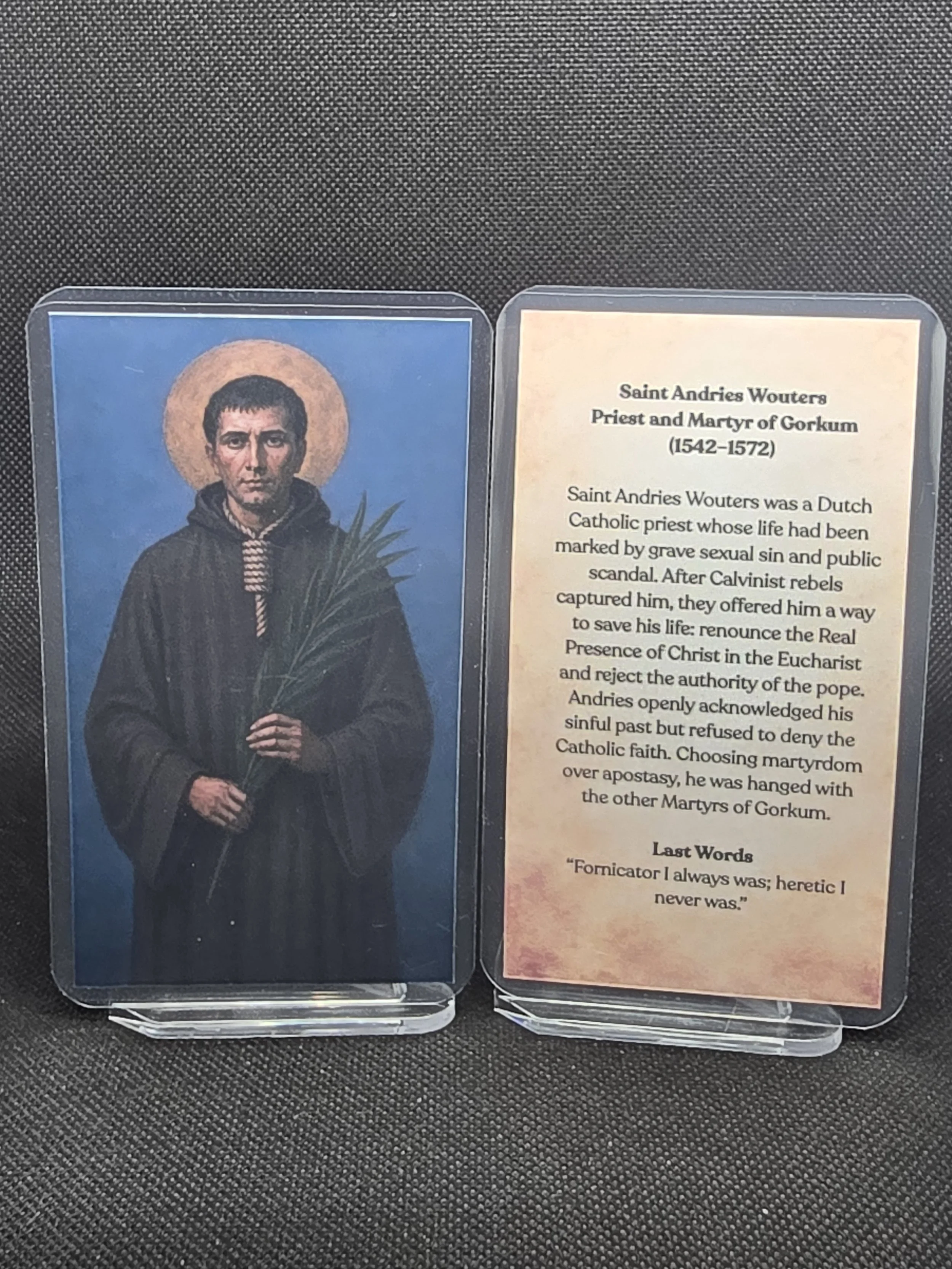
Each prayer card measures 2.5" x 4.25", is handmade in Austin, Texas, printed on museum-quality photo paper rather than ordinary cardstock, and double laminated for durability. Every card is made to order and prepared prayerfully, with the recipient and their intentions brought before Christ while asking Saint Marianne Cope to intercede for their needs.
THE LIFE & STORY OF SAINT MARIANNE COPE
Saint Marianne Cope was born Barbara Koob in Heppenheim, Germany, in 1838. When she was still an infant, her family immigrated to the United States and settled in Utica, New York, where she grew up within a Catholic immigrant family.
Barbara felt drawn toward religious life while still young, but circumstances prevented her from entering a convent immediately. When her father became ill and could no longer provide for the family, Barbara went to work in a factory after completing only an eighth-grade education.
For approximately nine years, her own religious vocation had to wait while she helped support those who depended upon her. This experience makes Marianne particularly meaningful for people whose vocation or personal dreams have been delayed by family responsibility.
Her path to holiness did not begin by escaping ordinary obligations. It began by fulfilling them.
ENTERING THE SISTERS OF SAINT FRANCIS
After her younger siblings became old enough to support themselves, Barbara was finally free to pursue religious life. In 1862, at the age of twenty-four, she entered the Sisters of Saint Francis in Syracuse, New York.
She received the religious name Sister Marianne and initially expected that teaching would become her principal work. She served as a teacher and school principal, but her intelligence, organizational ability, leadership, and practical judgment soon brought her into increasingly demanding responsibilities.
The woman who had once worked in a factory to support her family eventually became one of the major leaders of her religious community.
A PIONEER OF CATHOLIC HEALTHCARE
Mother Marianne became deeply involved in establishing some of the earliest hospitals in central New York. She participated in the development of Saint Elizabeth Hospital in Utica and Saint Joseph’s Hospital in Syracuse.
In Syracuse, the sisters purchased a former saloon and transformed it into a hospital that served the growing immigrant population. Marianne eventually became administrator of Saint Joseph’s and helped develop standards of patient care that were advanced for the period.
Her concern extended to people whom respectable society frequently preferred to ignore. She became known for admitting patients others hesitated to treat, including people suffering from alcoholism.
Marianne’s approach was already clear decades before Molokai. Illness did not erase human dignity, and a person’s social reputation did not determine whether that person deserved compassionate care.
A WOMAN AHEAD OF HER TIME IN HEALTHCARE
Mother Marianne combined religious compassion with highly practical administration. She understood that Christian love for the sick required clean facilities, trained staff, careful organization, proper treatment, and respect for each patient.
Her leadership came during a period when modern nursing and hospital administration were still developing rapidly in the United States. Catholic sisters became enormously important in building hospitals capable of serving poor and immigrant populations who otherwise had limited access to care.
Marianne became an exceptional example of this tradition. She was not simply comforting patients at their bedside but helping create entire systems capable of caring for them.
This makes her especially significant for modern nurses, physicians, healthcare administrators, chaplains, aides, hospice workers, and others whose vocation combines compassion with enormous practical responsibility.
THE LETTER FROM HAWAII
In 1883, Mother Marianne was serving as Provincial Mother of her congregation when a request arrived from Hawaii. Church authorities were desperately seeking religious sisters willing to help care for people suffering from Hansen’s disease.
The disease was deeply feared, poorly understood, and heavily stigmatized. Patients could be forcibly separated from their families and sent into isolation.
Requests had been sent to numerous religious communities, but the danger involved made the mission extremely difficult to fill.
When the request reached Marianne, she responded with extraordinary enthusiasm.
“I AM NOT AFRAID OF ANY DISEASE”
Mother Marianne’s response became one of the most famous statements associated with her life. She wrote that she was “not afraid of any disease” and that it would be her delight to minister to the abandoned people suffering from leprosy.
These were not easy words spoken from a safe distance. Marianne was preparing to place herself directly among people suffering from a disease widely regarded as terrifying and incurable.
She understood that accepting the mission could mean never returning home.
Yet she did not view the patients primarily as sources of infection. She saw people who had been abandoned and needed someone willing to cross the barrier created by fear.
LEAVING NEW YORK FOR HAWAII
Mother Marianne selected six sisters to accompany her and traveled to Hawaii in 1883. She originally expected to help establish the sisters in their mission and then return to Syracuse.
Instead, she never returned.
The suffering she encountered changed the direction of the rest of her life. What began as a temporary administrative mission became thirty-five years of service in Hawaii.
The sisters first took responsibility for the Kaka‘ako Branch Hospital on Oahu, where people diagnosed with Hansen’s disease were gathered before many were eventually transported to the isolated settlement on Molokai.
CLEANLINESS, ORDER AND DIGNITY
Mother Marianne immediately began improving conditions at the hospital. She understood that people diagnosed with a frightening disease still deserved surroundings that communicated dignity rather than abandonment.
The sisters cleaned the facilities, improved patient care, introduced greater order, and worked to make daily life more humane.
Marianne’s approach to healthcare extended beyond keeping people physically alive. She believed beauty, cleanliness, clothing, recreation, education, and a peaceful environment mattered because patients were whole human beings rather than collections of symptoms.
This philosophy later became especially visible at Kalaupapa.
CHILDREN OF PATIENTS WITH HANSEN’S DISEASE
The stigma attached to Hansen’s disease affected not only patients but also their children. Healthy children could face rejection simply because one or both parents had been diagnosed with the disease.
Mother Marianne helped establish the Kapiolani Home for healthy daughters of patients with Hansen’s disease. The decision was remarkable because fear of contagion made many people unwilling even to care for children associated with affected families.
Marianne refused to allow fear to determine the value of a child.
Her work therefore expanded beyond nursing into protection, education, housing, and advocacy for children whose families had been devastated by disease and forced separation.
SAINT MARIANNE COPE AND SAINT DAMIEN OF MOLOKAI
Saint Marianne’s story became closely connected with another famous servant of people with Hansen’s disease: Saint Damien of Molokai.
Father Damien had voluntarily lived among people isolated at the Kalaupapa settlement on Molokai. Over time he became internationally known for his heroic service there.
Mother Marianne first met Damien while he was still apparently healthy. Several years later, he contracted Hansen’s disease himself.
His diagnosis changed the way people treated him.
WHEN OTHERS WERE AFRAID OF FATHER DAMIEN
After Damien’s illness became known, fear of infection caused some people who had once welcomed him to distance themselves from him.
Mother Marianne did the opposite.
When Damien traveled to Honolulu, she offered him hospitality when others were reluctant to receive him. Her response was completely consistent with the principle that had guided her entire mission: disease should never make someone less deserving of human affection.
The priest who had spent years serving people isolated because of Hansen’s disease had now become isolated himself. Marianne refused to participate in that rejection.
MOVING TO MOLOKAI
Changes in Hawaiian government policy eventually threatened the institutions Mother Marianne and her sisters had been operating on Oahu. The policy of isolating people with Hansen’s disease at the Kalaupapa Peninsula on Molokai was again reinforced.
The question became unavoidable: who would care for the women and girls being sent there?
Mother Marianne answered once more.
In 1888, she moved to Kalaupapa with Sisters Leopoldina Burns and Vincentia McCormick. The decision effectively meant accepting permanent exile from the ordinary world she had known.
She remained at Kalaupapa for the rest of her life.
KALAUPAPA
The Kalaupapa Peninsula was geographically isolated by dramatic sea cliffs and the ocean, making it an effective location for forced medical segregation. People diagnosed with Hansen’s disease were removed from their families and transported there, often with little expectation of returning.
Mother Marianne entered this world voluntarily.
Her work centered especially upon the Bishop Home for women and girls. She and the sisters provided nursing care, education, clothing, food, spiritual support, and a stable community for people who had experienced profound rejection.
Marianne wanted their home to be more than a place where sick people waited to die.
MAKING LIFE BEAUTIFUL
One of the most distinctive features of Saint Marianne’s ministry was her insistence that beauty mattered.
Patients deserved clean clothing, attractive surroundings, music, gardens, recreation, and opportunities for meaningful work. Girls were taught sewing and other practical skills, while the sisters worked to make their environment feel like a genuine home.
This attention to beauty was theological as much as practical.
Marianne understood that a person could be medically sick while remaining entirely worthy of dignity, joy, friendship, creativity, and beauty.
The disease affecting a person’s body did not define the whole person.
NURSING SAINT DAMIEN
By the time Mother Marianne arrived permanently at Kalaupapa, Father Damien’s health had deteriorated severely.
She helped care for him during his final illness and assured him that the work he had begun would continue after his death.
Damien died in 1889.
Mother Marianne and her sisters then assumed responsibility for additional aspects of the work among the residents of Kalaupapa, ensuring that Damien’s death did not leave the people he loved without support.
The ministries of these two saints therefore became deeply connected. Damien helped establish the heroic Christian presence at Molokai, while Marianne helped ensure that it endured.
COURAGE WITHOUT RECKLESSNESS
Saint Marianne’s statement that she was not afraid of disease did not mean she ignored sensible healthcare practices. She was an experienced hospital administrator who understood cleanliness, organization, and disciplined nursing.
Her courage was therefore not recklessness.
She refused to allow fear to become an excuse for abandoning patients while simultaneously using the best practical means available to protect both patients and caregivers.
This combination makes her particularly relevant for healthcare workers who must balance compassion with professional boundaries, infection control, safety procedures, and difficult medical realities.
NONE OF HER SISTERS CONTRACTED THE DISEASE
One of the remarkable details preserved in official accounts of Mother Marianne’s mission is that the sisters who served under her did not contract Hansen’s disease despite decades of close work among patients.
Marianne herself expressed confidence that God would protect the sisters who had accepted this mission.
She did not interpret that confidence as permission for careless practices. Her disciplined approach to hygiene and healthcare remained an important part of the sisters’ ministry.
The extraordinary record of their service became closely associated with Marianne’s reputation for confidence in God, calm leadership, and careful nursing.
“I DO NOT THINK OF REWARD”
Saint Marianne’s surviving words reveal a spirituality that regarded service itself as a gift rather than a transaction with God.
One of the statements preserved by her religious community reads:
“I do not think of reward. I am working for God and do so cheerfully.”
That sentence captures much of her personality.
She spent decades far from New York, living among people who had been forcibly isolated because of disease. Yet accounts repeatedly emphasize her cheerfulness, serenity, practicality, and refusal to treat her vocation as though she were performing a miserable sacrifice deserving constant praise.
She believed serving Christ in suffering people was itself a privilege.
FOR NURSES
Saint Marianne Cope is an especially powerful saint for nurses because she understood nursing as both professional work and an expression of Christian charity.
She knew that compassionate intentions alone were not enough. Sick people needed competent administration, clean facilities, reliable routines, trained caregivers, sensible policies, and people willing to perform physically demanding work day after day.
Nurses today face many of the same spiritual pressures that surrounded Marianne’s life: exhaustion, fear of disease, emotionally difficult patients, understaffing, long hours, grief, administrative responsibilities, and the constant presence of human vulnerability.
Her example demonstrates that holiness can grow directly within these realities.
FOR CAREGIVERS
Family caregivers often perform work that few other people see. They manage medications, appointments, meals, hygiene, transportation, financial concerns, sleepless nights, and the emotional burden of watching someone they love suffer.
Mother Marianne’s life recognizes this hidden form of sacrifice.
She spent decades doing work that had to be repeated every day. Patients still needed to be fed tomorrow. Clothing still needed washing. Wounds still needed care. Frightened people still needed reassurance.
Her spirituality teaches caregivers that repetitive acts of mercy are not spiritually insignificant simply because they are ordinary.
FOR PEOPLE WITH CHRONIC ILLNESS
Saint Marianne can also be especially meaningful for someone living with a chronic illness that has changed the way others see or treat them.
The people she served were often defined almost entirely by their diagnosis. Their disease could determine where they lived, whether they remained with their families, and whether others were willing even to approach them.
Marianne consistently resisted this reduction of the person to the illness.
Her ministry proclaimed through action that someone can be sick without ceasing to be fully human, lovable, valuable, creative, and worthy of respect.
FOR STIGMATIZED ILLNESS
Some diseases carry social stigma in addition to physical suffering. Patients may experience shame, isolation, misunderstanding, or the fear that others now see them differently.
Saint Marianne lived among people for whom this stigma had become legally and socially devastating.
Her prayer card can therefore be meaningful for people carrying illnesses that make them feel isolated or judged, as well as for those working to create communities in which patients are treated first as human beings rather than diagnoses.
Her example calls Christians to confront the instinct to withdraw from people whose suffering makes us uncomfortable.
FOR HEALTHCARE WORKERS FACING FEAR
Healthcare professionals regularly encounter circumstances in which fear is understandable. Infectious disease, emergency medicine, psychiatric crises, terminal illness, dangerous working conditions, and exposure to suffering can test even experienced caregivers.
Mother Marianne never taught that courageous people feel no concern.
Her courage consisted in refusing to allow fear to determine whether a suffering person would receive care.
Her famous declaration, “I am not afraid of any disease,” is therefore best understood within an entire life of disciplined service. She knew the risks and went anyway because the people waiting for care mattered more to her than personal comfort.
FOR PEOPLE WHO FEEL LIKE OUTCASTS
The official museum dedicated to Saint Marianne remembers her especially as a mother to people who had become social outcasts.
That title captures something larger than her work with one disease.
Marianne consistently moved toward people others had moved away from. Alcoholics in New York hospitals, immigrant families, children associated with Hansen’s disease, isolated patients, and the dying all encountered in her a refusal to measure human worth according to social respectability.
For someone who feels unwanted, rejected, ashamed, or forgotten, Saint Marianne’s life communicates a profoundly Christian message: another person's fear or rejection does not determine your dignity before God.
FRANCISCAN SPIRITUALITY
Mother Marianne belonged to the Franciscan tradition, and her spirituality reflected the simplicity and practical charity associated with Saint Francis of Assisi.
She did not separate prayer from work or love of God from service to vulnerable people.
The suffering person was not an interruption to spiritual life. Caring for that person became part of spiritual life itself.
Her Franciscan vocation also helped give her the freedom to live simply, surrender personal comfort, and remain permanently among people who could offer her little worldly advantage in return.
PRAYER AND THE EUCHARIST
Official accounts of Saint Marianne’s life emphasize that her strength came from prayer, the Eucharist, devotion to the Blessed Virgin Mary, and confidence in God.
Her enormous workload cannot be understood merely as humanitarian activism.
Marianne served people because she saw her work as belonging to Christ. The patience required for decades of difficult healthcare ministry was nourished by a spiritual life in which prayer continually renewed the meaning of the work.
For Christian healthcare workers today, this union of contemplation and service remains one of the strongest elements of her example.
HER FINAL YEARS
Mother Marianne never returned permanently to New York after accepting the Hawaiian mission. The assignment that was originally expected to be temporary became the remainder of her earthly life.
She spent approximately thirty-five years serving in Hawaii and roughly three decades connected with the isolated community at Kalaupapa.
Her responsibilities continued into old age as she guided the sisters, cared for the community, and ensured that the work would survive beyond her.
Saint Marianne died at Kalaupapa in 1918 of natural causes.
BEATIFICATION AND CANONIZATION
The Church formally investigated Mother Marianne’s life, virtues, and the miracles attributed to her intercession. She was beatified in 2005 and canonized by Pope Benedict XVI in 2012.
At her canonization, Benedict XVI highlighted the extraordinary courage with which she responded to the call to serve people suffering from Hansen’s disease after others had declined the dangerous mission.
The Pope praised her as an outstanding example of the Catholic nursing tradition and Franciscan spirituality, emphasizing her courage, enthusiasm, and extraordinary love for those she served.
Her canonization brought worldwide attention to a woman who had spent most of her mature life among people society had deliberately placed out of sight.
SAINT MARIANNE COPE AND MODERN HEALTHCARE
Saint Marianne’s story remains remarkably contemporary because modern medicine continues confronting questions she understood well. How should healthcare workers treat people whose conditions are frightening, socially stigmatized, expensive to manage, or medically difficult?
Marianne’s answer was grounded in human dignity.
Good healthcare must treat the disease seriously while never allowing the disease to erase the person.
Her legacy therefore extends beyond specifically Catholic healthcare. It speaks to anyone who believes medicine should remain compassionate even when the patient is difficult, vulnerable, frightened, poor, socially marginalized, or unlikely to recover.
THE QUOTE
One of Saint Marianne Cope’s most powerful statements came when she was considering the dangerous Hawaiian mission:
“I am not afraid of any disease, hence it would be my greatest delight even to minister to the abandoned ‘lepers.’”
The older terminology reflects the language of her era, but the heart of the statement remains unmistakable.
She was willing to go precisely where fear had caused others to withdraw.
For a nurse, caregiver, healthcare worker, missionary, or anyone facing a frightening responsibility, Saint Marianne offers a model of courage that remains grounded in competent service, prayer, and love.
OFFICIAL PRAYER TO SAINT MARIANNE COPE
The Saint Marianne Cope Shrine and Museum, maintained by her own Franciscan community, publishes a prayer asking for her intercession. It recalls her love for people suffering from Hansen’s disease and asks that Christians imitate her charity toward those most in need.
“Lord Jesus, you who gave us your commandment of love of God and neighbor, and identified yourself in a special way with the most needy of your people, hear our prayer. Faithful to your teaching, St. Marianne Cope loved and served her neighbor, especially the most desolate outcast, giving herself generously and heroically for those afflicted by leprosy. Through her merits and intercession, grant us the favor which we confidently ask of you, so that the people of God, following the inspiration of her life and apostolate, may practice charity towards all according to your word and example. Amen.”
This prayer is particularly fitting for intentions involving illness, healthcare, caregiving, social rejection, medical uncertainty, and the need for courage when caring for someone who is suffering.
WHO SHOULD RECEIVE A SAINT MARIANNE COPE PRAYER CARD?
A Saint Marianne Cope prayer card makes an especially meaningful gift for nurses, nursing students, physicians, hospital workers, hospice caregivers, home-health aides, healthcare administrators, chaplains, and anyone working professionally with sick or vulnerable people.
It can also be given to someone facing chronic illness, a difficult diagnosis, long-term treatment, isolation because of illness, or the emotional effects of feeling defined by a medical condition.
For families caring for someone seriously ill, Marianne’s life offers both intercession and an example of compassionate endurance. She reminds caregivers that preserving dignity, creating beauty, offering companionship, and simply remaining present can be genuine works of Christian mercy.
FAQ
Who was Saint Marianne Cope? Saint Marianne Cope was a Franciscan sister, nurse, hospital administrator, missionary, and Catholic saint who lived from 1838 to 1918. She became famous for caring for people with Hansen’s disease in Hawaii and eventually spent the rest of her life serving at Kalaupapa on Molokai.
What was Saint Marianne Cope’s birth name? She was born Barbara Koob in Germany. Her family later used the anglicized surname Cope after immigrating to the United States, and she received the religious name Marianne when she entered the Sisters of Saint Francis.
Was Saint Marianne Cope an American saint? Her family immigrated to the United States when she was an infant, and she grew up in Utica, New York. She spent her early religious life and healthcare ministry in central New York before traveling to Hawaii.
Was Saint Marianne Cope a nurse? Yes. She became deeply involved in Catholic healthcare and served as a hospital administrator in New York before leading the mission to care for people with Hansen’s disease in Hawaii.
Why did Saint Marianne Cope go to Hawaii? Church authorities requested sisters willing to manage hospitals and care for people suffering from Hansen’s disease. Mother Marianne accepted the mission after other communities had declined because of the danger involved.
What did Saint Marianne say about disease? One of her most famous statements was, “I am not afraid of any disease.” She wrote this while expressing her willingness to care for people who had been abandoned because of Hansen’s disease.
What is Hansen’s disease? Hansen’s disease is the modern medical name for the condition historically known as leprosy. Today it is understood to be a bacterial disease that can be treated effectively with antibiotics.
Did Saint Marianne Cope work with Saint Damien of Molokai? Yes. Marianne knew Father Damien, welcomed him after he contracted Hansen’s disease, helped care for him during his final illness, and continued important parts of his work among the people of Kalaupapa after his death.
Did Saint Marianne live on Molokai? Yes. She moved permanently to Kalaupapa on Molokai in 1888 and remained there until her death in 1918.
Did Saint Marianne ever return to New York? No. After traveling to Hawaii in 1883, she devoted the remainder of her life to the Hawaiian mission and never permanently returned to Syracuse.
Why is Saint Marianne associated with nurses? Nursing and healthcare administration formed a major part of her vocation both in New York and Hawaii. Her combination of professional competence, courage, cleanliness, organization, and compassionate patient care makes her an important spiritual model for nurses and other healthcare workers.
Is Saint Marianne meaningful for people with chronic illness? Yes. Her entire Hawaiian mission centered upon people living with a serious chronic disease that carried enormous social stigma. She worked to preserve their dignity and make their lives as comfortable, beautiful, and meaningful as possible.
Is Saint Marianne Cope associated with healing? Many people ask for her intercession in situations involving illness and healing, and miracles investigated by the Catholic Church were connected with her beatification and canonization. Her own ministry, however, emphasized both prayer for healing and compassionate care when illness remained.
Why is Saint Marianne called a mother to outcasts? She repeatedly cared for people whom others feared or rejected, including patients suffering from Hansen’s disease and others marginalized by illness or social circumstances. Her ministry treated them as people possessing full human dignity rather than as problems to be removed from society.
When was Saint Marianne Cope canonized? Pope Benedict XVI canonized Saint Marianne Cope in 2012 after the Church completed the formal process examining her heroic virtue and miracles attributed to her intercession.
Who would this Saint Marianne Cope prayer card make a meaningful gift for? It is especially fitting for nurses, healthcare workers, caregivers, nursing students, people with chronic illness, hospital patients, families caring for the sick, missionaries, and anyone seeking courage to serve people who are suffering or socially rejected.
THE MAIN MESSAGE OF SAINT MARIANNE COPE’S LIFE
Saint Marianne Cope encountered a world in which fear of disease could become stronger than compassion for the person who was sick. Instead of condemning that fear from a distance, she crossed the distance herself and remained among the people others were afraid to approach.
Her response was not sentimental. She cleaned hospitals, organized systems of care, managed staff, protected children, trained sisters, improved living conditions, welcomed Saint Damien when others feared him, and ultimately accepted permanent life at an isolated settlement.
What makes her extraordinary is the combination of courage and tenderness. She confronted serious disease realistically while refusing to allow medical reality to destroy human dignity.
For anyone caring for another person through illness, Saint Marianne offers a powerful model. Good care treats the body seriously, but it also remembers the person who inhabits that body. Clean surroundings, good medicine, kindness, dignity, beauty, companionship, prayer, and simple human presence can all become part of the work of healing.