 Image 1 of 1
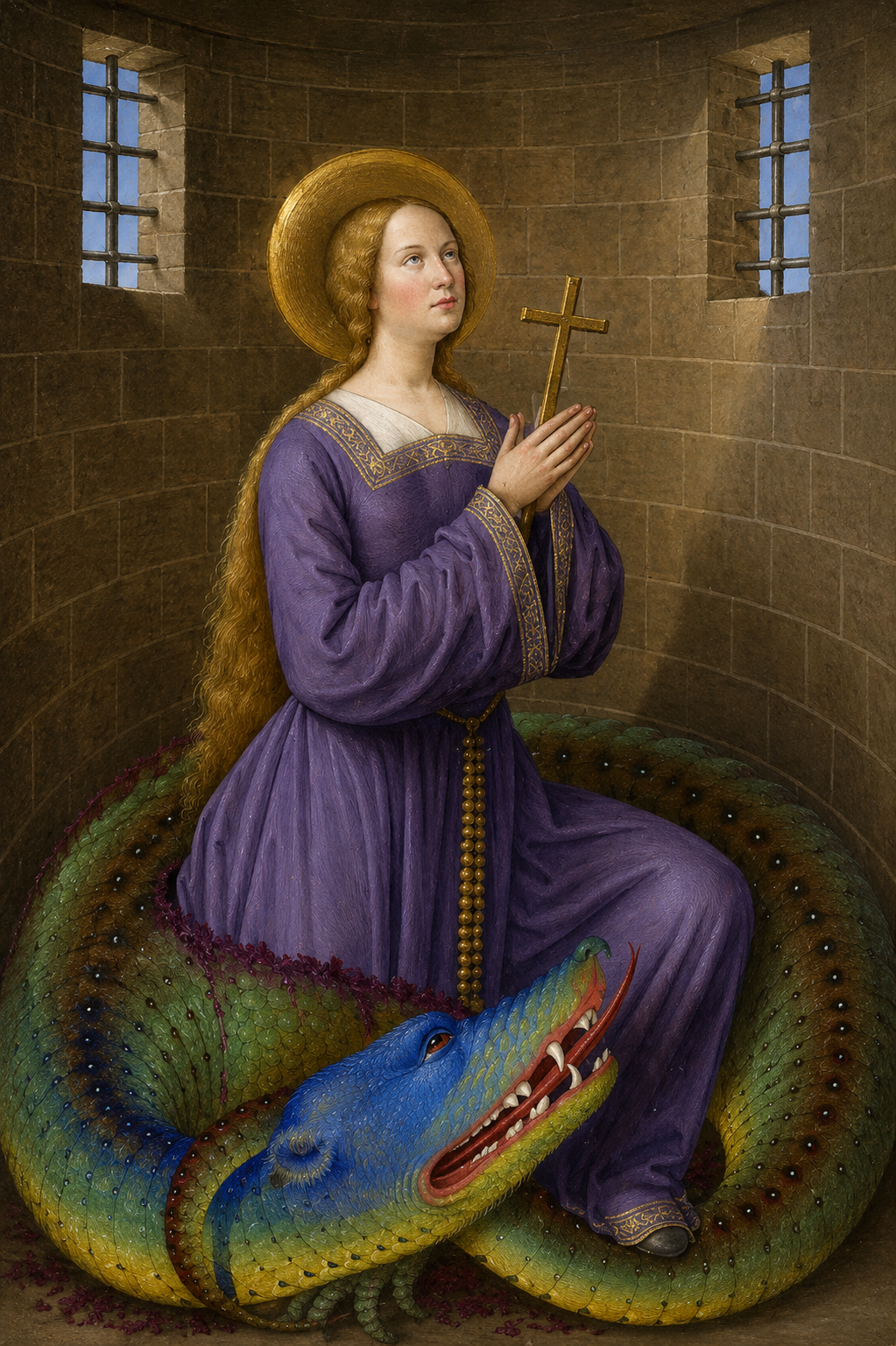
Saint Marina the Great Martyr / Saint Margaret of Antioch Prayer Card - For Spiritual Warfare, Protection, Courage & Healing
Saint Marina the Great Martyr, also known in Western Christian tradition as Saint Margaret of Antioch, is one of the most striking young martyrs of the ancient Church. According to the Orthodox tradition, she was born in Antioch of Pisidia in Asia Minor, the daughter of a pagan priest, and became a Christian while still a girl. When she refused to renounce Christ and rejected the marriage proposal of the Roman governor Olymbrios, she endured severe torture and ultimately martyrdom rather than abandon the faith she had freely chosen. The Orthodox Church commemorates her on July 17 and honors her with the title Great Martyr because of the extraordinary suffering she endured for Christ.
Saint Marina is especially meaningful for Christians seeking help in spiritual warfare, protection from evil, courage during persecution, perseverance through temptation, healing, and strength when fear feels overwhelming. These associations are unusually well grounded in her Orthodox tradition. The OCA's Life explicitly remembers her as a saint invoked against the assaults of the Enemy and for those suffering spiritual affliction, while her Troparion celebrates her victory over the invisible enemy and calls her a source of healing grace.
Her iconography makes this spiritual warfare theme immediately visible. Saint Marina is frequently shown standing over a dragon or demon, sometimes grasping it while holding a hammer, because her traditional Life describes a direct confrontation with Satan while she was imprisoned. The imagery is dramatic, but its theological meaning is not that Marina possessed power independently of Christ. Her victory came through prayer, the Sign of the Cross, and complete reliance upon God, making her especially meaningful for Christians who feel spiritually attacked, tempted, afraid, or overwhelmed.
Saint Marina is also a powerful saint for young women, teenagers, people facing pressure to compromise their faith, and anyone being asked to exchange Christian conviction for acceptance, status, security, or relationships. According to the Antiochian and OCA traditions, she was only about fifteen when she faced arrest, torture, and death. The governor attempted to persuade her through promises of marriage and worldly advantage before turning to violence, yet Marina refused both temptation and intimidation.
Her story therefore speaks to much more than dramatic accounts of ancient martyrdom. Saint Marina confronts the ordinary question every Christian eventually faces: What will I refuse to surrender, even when surrender would make life easier? Her answer was Christ, and the Church has remembered that answer for more than seventeen centuries.
Healing is another major part of Saint Marina's devotion. Her Orthodox Troparion calls her a source of healing grace, her Kontakion associates her with miracles of healing, and the OCA records a longstanding tradition of people seeking her intercession in sickness and affliction. The Holy Great Monastery of Vatopedi, which preserves her right hand, also maintains an old tradition connecting that relic with healing and deliverance from demonic affliction.
This prayer card is especially fitting for those facing spiritual warfare, frightening temptation, nightmares or fear, serious illness, emotional or spiritual affliction, persecution because of the Christian faith, pressure to compromise moral convictions, and difficult circumstances requiring courage. It is also particularly meaningful for young women, those named Marina or Margaret, Orthodox families with a devotion to the Great Martyr, and anyone who finds strength in the image of a young Christian refusing to allow fear or the devil to determine her faithfulness.
Each card is handmade in Austin, TX and created to order. We do not keep stock, because every prayer card is treated as a unique devotional offering. They are printed on museum-quality photo paper, not cardstock, and every card is made slowly during prayer with intentional reverence for the saint and for the person who will receive it. Names are lifted before Christ, intentions are held carefully, and each piece is handled multiple times in prayerful silence, asking God for mercy and asking Saint Marina to intercede for the soul it is being made for. This is devotional craftsmanship shaped with patience, care, and spiritual responsibility because every soul and every prayer matters.
THE LIFE & STORY
Saint Marina was born in Antioch of Pisidia, an ancient city in Asia Minor, rather than the better-known Syrian city of Antioch on the Orontes. This distinction is important because English references often shorten her title to “Marina of Antioch,” which can easily create the impression that she came from the great Syrian patriarchal city. The official Greek Orthodox Patriarchate of Antioch identifies her birthplace specifically as Antioch of Pisidia in southern Asia Minor.
Her father was a pagan priest, and Marina's mother died while she was still an infant. She was placed in the care of a nurse, and Orthodox tradition remembers this woman, or another Christian connected with Marina's upbringing, as the person through whom the young girl first encountered Christianity. By approximately twelve years of age, Marina knew the basic Christian proclamation concerning Jesus Christ and the Virgin Mary, and her faith continued to deepen.
Her conversion carried an immediate cost because her father reacted angrily when he learned that his daughter had become a Christian. The Antiochian account states that he disowned her, meaning the young Marina's first serious persecution did not come from an emperor or Roman governor but from within her own family.
That detail makes her especially meaningful for converts and Christians whose faith creates tension with parents, relatives, or people they love. Religious persecution is sometimes imagined only as something governments do, yet the pain of rejection inside a family can be every bit as personally devastating because the Christian is forced to choose faithfulness without ceasing to love the people who reject that faith.
Marina also chose virginity and decided not to marry, dedicating herself instead to Christ. The OCA's traditional Life describes her as consciously renouncing marriage and worldly temptation and as being willing to give her life for the Lord.
During the persecution of Christians associated with the reign of Emperor Diocletian, the governor Olymbrios encountered Marina and became attracted to her. The traditional account says that he wanted to marry her and attempted to persuade her to abandon Christianity, offering the possibility of worldly status and security if she would deny Christ.
Marina refused.
Her refusal was not simply rejection of a marriage proposal because the proposal was inseparable from apostasy. She was effectively being offered an exchange: give up Christ and gain protection, status, and a future that appeared far easier than persecution.
When persuasion failed, the promises turned into threats and torture. Orthodox accounts remember Marina being beaten, torn with instruments, pierced, burned, and imprisoned, yet the young martyr refused to deny Christ. The official Antiochian Life emphasizes that even the governor eventually covered his face because he could not bear the violence being inflicted upon her.
This contrast is one of the most striking elements of her story. The person commanding the torture could not bear to watch it, while the teenage girl enduring it would not surrender her faith.
Saint Marina's courage should not be misunderstood as absence of physical suffering. Christian martyrdom is not a claim that saints somehow stop experiencing pain because their faith is strong enough. The glory of the martyr lies precisely in remaining faithful while pain, fear, weakness, and the instinct for self-preservation remain real.
Her imprisonment became the setting for the most famous and visually dramatic episode in her traditional Life. According to Orthodox hagiography, Marina prayed that God would allow her to confront the spiritual enemy who was attacking her, after which Satan appeared in frightening forms.
The first appearance is traditionally described as a great serpent or dragon. The hagiographic account says that the dragon swallowed Marina, yet she continued praying and made the Sign of the Cross, causing the creature to burst apart and leaving the martyr unharmed.
Later in the same traditional account, the devil appeared more directly and physically attacked her. Marina saw a hammer in the prison, seized it, and struck the enemy while continuing to pray, producing the remarkable iconographic image for which she has become especially known.
The Church does not preserve this story in order to encourage Christians to imagine spiritual warfare as physical combat against creatures they can strike with household tools. The spiritual meaning is deeper because Marina's real weapons were faith in Christ, prayer, the Cross, and refusal to cooperate with temptation.
This is why icons showing Marina standing upon or striking the devil are so powerful. The figure may look physically small and vulnerable, but the defeated enemy beneath her represents the truth that evil does not possess unlimited authority over someone who belongs to Christ.
The same Life describes another attack in which the devil attempted deception rather than brute force. Marina again resisted through the Sign of the Cross and prayer, showing that spiritual warfare may involve not only fear but also lies, temptation, confusion, and attempts to manipulate the mind.
After the night of spiritual struggle, Marina was again brought before the authorities. Her body was subjected to additional torture, including burning and immersion in water, yet the tradition remembers the water becoming connected with a miraculous sign of Baptism.
According to the Antiochian account, Marina prayed that the water into which she was being plunged might become for her a holy Baptism. A light appeared, a white dove descended with a crown, her bonds were broken, and she emerged healed while glorifying the Father, Son, and Holy Spirit.
The crowd witnessing the event began confessing Christ, and the governor responded with further executions. Both the Antiochian and OCA traditions preserve the extraordinary claim that thousands of people were killed in connection with the event before Saint Marina herself was finally beheaded.
The OCA places her martyrdom in 304, during the great persecution associated with Diocletian, while the Orthodox Church celebrates her memory every year on July 17.
Whatever historical difficulties surround the exact numerical details preserved in later martyr traditions, the Church's central memory remains clear. Marina was a very young Christian woman who refused apostasy, endured torture, confessed Christ publicly, and died rather than exchange her faith for survival.
SAINT MARINA & SPIRITUAL WARFARE
Among all the themes connected with Saint Marina, spiritual warfare is perhaps the most distinctive. The OCA's Life does not merely mention the devil symbolically but devotes a substantial part of her story to her confrontation with Satan, while the saint's liturgical hymnography celebrates her triumph over the invisible enemy.
This makes her particularly meaningful for Christians struggling with temptation, fear, despair, obsessive spiritual anxiety, or a sense that evil has become overpowering. The devotional focus should remain carefully Christian because Saint Marina is not invoked as though she possesses an independent magical power over demons. She intercedes before Christ, while every victory over evil belongs ultimately to God.
Her Troparion summarizes this theology beautifully by remembering her victory over the invisible enemy and immediately connecting her with healing grace. The hymn therefore presents spiritual warfare not as fascination with demons but as one part of Christ's healing work within the human person.
The Sign of the Cross occupies a particularly important place in her traditional story. When confronted by the dragon, Marina's victory came through prayer and the Cross, while subsequent demonic attacks were again overcome through the same confession of Christ.
For ordinary Christian life, this is far more useful than attempting to imitate the dramatic surface details of the legend. Spiritual warfare ordinarily means resisting thoughts and actions that draw us away from God, refusing despair, rejecting temptation, guarding the senses, confessing sin, receiving the sacraments, praying, fasting according to one's tradition, reading Scripture, forgiving enemies, and continually returning to Christ.
Saint Marina's example therefore calls the Christian toward sobriety rather than fear. An obsession with the devil can itself become spiritually unhealthy because Christian life is centered on Jesus Christ, not on studying darkness.
Her icon is powerful precisely because Marina does not appear fascinated with the defeated enemy beneath her. She stands as a martyr of Christ.
That is the proper order of spiritual warfare.
THE DRAGON & THE HAMMER IN SAINT MARINA'S ICONS
People encountering Saint Marina's icon for the first time often notice something unusual immediately: a young female martyr may be shown standing over a dragon or horned demon, sometimes holding a hammer raised above it. The imagery comes directly from the traditional hagiographic account of her imprisonment.
The dragon represents the devil, drawing upon an ancient Christian biblical vocabulary in which Satan is associated with the serpent and dragon. Saint Marina's victory therefore visually recalls the broader Christian promise that evil will ultimately be defeated through Christ.
The hammer comes from the traditional episode in which Marina physically resisted Satan in the prison. The OCA's Life specifically describes her taking a copper hammer and striking him while holding him down, and Orthodox icons developed this scene into one of the saint's most recognizable images.
The hammer should therefore not be interpreted as a generic symbol of violence. In the iconographic tradition it symbolizes the humiliation and defeat of the spiritual enemy before the power of Christ working in a seemingly powerless young martyr.
This reversal is part of what makes Saint Marina's image so compelling. The Roman government appears powerful, the torturers appear powerful, and the devil appears frightening, while Marina appears to possess almost nothing.
Yet the story ends with Marina crowned.
Christian martyrdom repeatedly overturns ordinary measures of strength. The person who appears defeated may actually be the victor because faithfulness cannot be measured solely by physical survival.
PROTECTION FROM EVIL & DEMONIC AFFLICTION
The longstanding Orthodox tradition surrounding Saint Marina goes beyond symbolic language about temptation. The OCA explicitly records that she has historically been invoked against the attacks of the enemy and for people suffering severe spiritual or mental affliction.
The same source notes an older Athonite tradition describing her relics as bringing healing to the sick and consolation to those who mourn. It also records devotion to Saint Marina in connection with people believed to be suffering demonic oppression.
This gives a firm historical basis for describing Saint Marina as an important intercessor for spiritual protection, while still requiring theological caution. Christians should not casually diagnose every mental illness, nightmare, intrusive thought, or frightening experience as demonic because medical and psychological conditions are real and deserve competent care.
The Church's spiritual resources and appropriate healthcare do not have to be enemies. Someone experiencing serious psychological symptoms can pray, speak with a priest, participate in sacramental life, and also seek qualified medical or mental health assistance.
Saint Marina's intercession can accompany all of those things.
The goal of Christian spiritual warfare is freedom in Christ, not fear of evil.
SAINT MARINA & HEALING
Healing is firmly established within Saint Marina's liturgical tradition. Her Orthodox Troparion calls her a wellspring of healing grace, while the Kontakion remembers her as illumined through miracles of healing.
The historical devotion surrounding her relics reinforces this theme. The OCA records old traditions of healing connected with Saint Marina, while Vatopedi Monastery preserves her right hand among its sacred relics and maintains historical accounts connecting it with healing.
This makes Saint Marina an appropriate intercessor for people facing serious disease, chronic illness, surgery, physical pain, psychological suffering, and situations where illness creates fear for an uncertain future.
She should not, however, be turned artificially into the exclusive patron of every individual illness. Her authentic tradition is broader and more beautiful because the Church remembers her as a martyr associated generally with healing grace, spiritual victory, and consolation in affliction.
A family praying for someone who is ill may therefore seek her intercession while also praying for doctors, nurses, caregivers, treatment decisions, and the strength necessary to endure what cannot immediately be changed.
Healing in Christian prayer can mean physical recovery, but it can also include reconciliation, peace of mind, repentance, endurance, freedom from despair, or preparation to meet Christ.
COURAGE UNDER PRESSURE
Saint Marina was not confronted only with torture. Before violence began, she faced a subtler temptation: the possibility of obtaining an easier life if she would compromise what she believed.
Olymbrios wanted to marry her and offered the young Christian a place of status and security. Marina could potentially have avoided suffering simply by concealing or renouncing Christianity.
This makes her story remarkably relevant because most Christians will never face execution for refusing apostasy, but almost everyone eventually faces some smaller version of the same choice.
A student may discover that openly practicing Christianity makes social life more difficult. A professional may realize that advancement would be easier if certain convictions remained hidden. A young person may feel pressure to enter a relationship that requires compromising chastity or faith, while another Christian may fear being thought irrational, intolerant, or old-fashioned.
Saint Marina's response does not teach Christians to seek conflict or behave provocatively. It teaches that acceptance is too expensive when the price is betrayal of Christ.
Her courage was not stubbornness for its own sake. Marina knew what she belonged to, and because that identity had become settled, the governor could not bargain it away from her.
SAINT MARINA & YOUNG WOMEN
Saint Marina is particularly important as an example for young Christian women because her martyrdom occurred while she was still extraordinarily young. Orthodox sources place her age at approximately fifteen.
Her story therefore refuses the assumption that serious spiritual courage belongs only to people who have accumulated decades of maturity. Marina had almost none of the authority ancient society normally granted to powerful people because she was young, female, Christian, disowned by her father, unmarried, imprisoned, and legally vulnerable.
Yet the Church remembers her as Great Martyr.
That title reverses every worldly calculation about importance.
For teenage girls and young women, Saint Marina can therefore become a particularly strong example of identity rooted in Christ rather than beauty, romantic approval, popularity, or the expectations of other people.
The governor's attraction to Marina also gives this story an important dimension concerning consent and personal dignity. She refused the relationship he wanted, and when persuasion failed he attempted to use power and violence to break that refusal.
Marina's holiness did not require her to accommodate a powerful man's desires.
Her Christian virginity was not a rejection of the goodness of marriage but the expression of a particular vocation in which she had already chosen complete dedication to Christ.
For girls growing up within a culture that places enormous pressure upon appearance, relationships, sexuality, and approval, Saint Marina offers a dramatically different measure of worth.
VIRGINITY, CHASTITY & BELONGING TO CHRIST
The traditional hymns for Saint Marina emphasize her virginity and chastity as important dimensions of her martyrdom. Her Kontakion remembers her as adorned with chastity and crowned through martyrdom, while the OCA's Life describes her conscious desire to belong to Christ rather than marry.
Christian chastity is sometimes reduced to a list of prohibited behaviors, but the ancient understanding is more positive. Chastity concerns the integration of the whole person so that sexuality, desire, relationships, and the body are ordered toward love and holiness rather than domination or use.
For Marina, this took the form of consecrated virginity.
For a married Christian, chastity takes a different form through faithful marital love.
For an unmarried Christian, it involves living sexuality in accordance with the person's current state of life and refusing to treat others or oneself as objects.
Saint Marina's life therefore makes her a meaningful intercessor for people trying to remain faithful to Christian sexual ethics when doing so feels culturally isolating.
Her witness does not present chastity as fear of the body. The martyr offers her body itself to Christ rather than allowing another person or the state to determine what her body means.
MARINA OR MARGARET?
Saint Marina is often confusing to English-speaking Christians because Western sources commonly know her as Saint Margaret of Antioch, while Greek, Antiochian, Coptic, and many other Eastern traditions use the name Marina. The OCA therefore lists her as “Great Martyr Marina (Margaret) of Antioch.”
The OCA explains that the Western name Margaret developed in Latin hagiographic tradition, while Eastern and southern Christian regions preserved the form Marina. The two names therefore generally refer to the same ancient martyr tradition rather than to two completely unrelated saints.
For an Eastern Christian prayer card, Saint Marina the Great Martyr is the clearest primary title. Including “also known as Saint Margaret of Antioch” in the description or FAQ is useful because people searching Western sources may recognize only Margaret.
The word “Antioch” also requires clarification because Marina's Antioch was Antioch of Pisidia in Asia Minor, not the Syrian Antioch associated with Saints Peter and Ignatius. The official Greek Orthodox Patriarchate of Antioch specifically makes this geographic identification.
HER RELICS & MOUNT ATHOS
The history of Saint Marina's relics is complicated, and ecclesiastical sources preserve more than one tradition concerning their movement over the centuries. The official Greek Orthodox Patriarchate of Antioch notes traditions connecting her relics first with Constantinople or Antioch and later with Greece.
One location can be stated with much greater confidence: the Holy Great Monastery of Vatopedi on Mount Athos preserves the right hand of Saint Marina. Vatopedi's own official collection of sacred relics identifies the right hand of the Great Martyr among the treasures of the monastery.
The relic has its own history of devotion. An eighteenth-century description preserved by Vatopedi records the hand among the monastery's treasured relics and describes a longstanding reputation for healing and deliverance from demonic affliction.
The official Antiochian Life likewise states that Saint Marina's hand was transferred to Vatopedi on Mount Athos.
For pilgrims devoted to Saint Marina, Vatopedi therefore represents one of the most important securely identified locations connected with her relics today.
Her relics also reinforce the bodily theology of martyrdom. Christianity does not remember Marina only as a courageous idea or inspiring story because the Church honors the body through which she prayed, suffered, confessed Christ, and received martyrdom.
SAINT MARINA & THE SIGN OF THE CROSS
The Sign of the Cross occupies a central place in Saint Marina's traditional victory over the devil. When the dragon attacked her, the hagiographic account says that she made the Cross and overcame it, while subsequent attacks were likewise defeated through prayer and the same confession of Christ.
For Eastern Christians, making the Sign of the Cross is therefore much more than a habitual gesture placed at the beginning and end of prayer. It is a bodily confession of the Trinity and of salvation through Christ's Cross.
Saint Marina's story gives the gesture a particularly vivid meaning.
The Cross tells fear that Christ has already entered death and defeated it. It tells temptation that the Christian belongs to Someone else, and it tells the devil that the apparent defeat of Calvary became the instrument of his own overthrow.
This makes Saint Marina an especially appropriate saint for teaching children and converts not to treat the Sign of the Cross casually. A gesture performed hundreds of times can still contain the entire proclamation of the Gospel when it is made with attention and faith.
MARTYRDOM & THE MEANING OF VICTORY
From the perspective of the Roman authorities, Saint Marina lost. She was arrested, tortured, publicly humiliated, and killed.
From the perspective of the Church, Marina won.
That reversal is the essence of Christian martyrdom.
The martyr does not win because the persecutor becomes harmless. The martyr wins because the persecutor fails to obtain the one thing he ultimately wants: apostasy.
The governor could injure Marina's body but could not compel her worship.
He could take her future marriage, freedom, family security, physical health, and finally her earthly life, but he could not make her call falsehood truth.
This is why the Church uses the language of crowns and victory when speaking about martyrs. Saint Marina's Kontakion describes the crown she received through martyrdom, while another liturgical text celebrates her victory over the enemy.
For Christians living through circumstances they cannot control, that distinction is deeply important. Victory does not always mean obtaining the outcome we wanted.
Sometimes victory means remaining faithful when the outcome cannot be changed.
PRAYERS
A simple traditional Orthodox invocation may be prayed throughout the day: Holy Great Martyr Marina, pray to God for us. This is especially fitting during temptation, spiritual fear, serious illness, persecution, or any situation in which a Christian needs courage to remain faithful.
The Church's traditional Troparion remembers Saint Marina as the virgin who renounced worldly temptation, defeated the invisible enemy, and became associated with healing grace. The traditional Kontakion likewise remembers her chastity, martyrdom, and miracles, providing a firm liturgical foundation for devotion to her in matters of spiritual warfare and healing.
Someone experiencing frightening temptation can pray the simple invocation while making the Sign of the Cross and turning attention toward Jesus Christ. The purpose is not to become fascinated with whatever evil may be feared but to reaffirm that Christ is Lord and that Marina's entire victory came through Him.
Someone facing illness may likewise ask Saint Marina to intercede while praying for healing, wise medical care, relief from suffering, patience, and protection from despair. Her liturgical association with healing makes this a particularly appropriate use of the prayer card.
Parents may also keep the card in a family prayer corner and teach children about Marina's courage, especially as they grow old enough to encounter social pressure concerning faith and morality. Her story gives young Christians an example of someone who discovered very early that belonging to Christ could require saying no to people more powerful than herself.
This card is especially fitting beside a prayer rope, Bible, cross, bedside table, hospital bed, or within a prayer corner devoted to saints associated with spiritual protection. It can also make a meaningful gift for a girl or woman named Marina, someone entering a difficult period of spiritual struggle, or a Christian seeking courage to remain faithful under pressure.
FAQ
Who is Saint Marina the Great Martyr? Saint Marina was an early fourth-century Christian virgin and martyr traditionally associated with Antioch of Pisidia in Asia Minor. Orthodox tradition remembers her conversion as a young girl, refusal to renounce Christ, extraordinary suffering under the governor Olymbrios, spiritual struggle against the devil, and eventual martyrdom by beheading.
Is Saint Marina the same person as Saint Margaret of Antioch? Yes, Eastern Christian traditions generally know her as Marina, while Western Christian tradition commonly developed the name Margaret. The OCA identifies her explicitly as Marina (Margaret) of Antioch, reflecting these parallel names for the same martyr tradition.
Was Saint Marina from Antioch in Syria? No, the official Antiochian Orthodox account places her in Antioch of Pisidia, in Asia Minor. This was a different ancient city from Syrian Antioch on the Orontes, even though English sources frequently shorten both locations simply to “Antioch.”
When did Saint Marina live? Orthodox tradition places her martyrdom during the persecution associated with Emperor Diocletian, with the OCA giving the year 304. She therefore belongs to the great period of early fourth-century Christian martyrdom.
How old was Saint Marina when she was martyred? The traditional Orthodox accounts describe her as approximately fifteen years old during her arrest and martyrdom. Her extreme youth is part of what makes her witness so remarkable within the history of the martyrs.
Was Saint Marina's father a Christian? No, her father was a pagan priest. According to the Orthodox tradition, he rejected or disowned Marina after learning that she had embraced Christianity.
Who taught Saint Marina about Christianity? Her mother died while Marina was an infant, and she was raised by a nurse. Orthodox sources associate that Christian formation with her nurse or another Christian connected with her childhood, through whom Marina learned the faith while still young.
Why was Saint Marina arrested? Marina openly confessed that she was a Christian during a period of Roman persecution. The governor Olymbrios was attracted to her and attempted to persuade her to renounce Christianity and marry him, but she refused.
Why is Saint Marina called a Great Martyr? The title Great Martyr is used within Eastern Christianity for certain martyrs whose extraordinary suffering and witness became especially prominent in the Church's memory. Saint Marina's prolonged torture, unwavering confession of Christ, and eventual execution account for this title.
What is Saint Marina the patron saint of? Orthodox Christianity does not always define saintly patronage through universal modern lists, so the strongest description comes directly from Saint Marina's liturgical and hagiographic tradition. She is especially associated with spiritual warfare, deliverance from evil, protection during spiritual attack, healing, courage, chastity, and perseverance under persecution.
Is Saint Marina a saint for spiritual warfare? Yes, this is one of the strongest and most explicit associations in her Orthodox tradition. Her Life describes repeated confrontations with Satan, and her Troparion praises her victory over the invisible enemy.
Can I pray to Saint Marina for protection from evil? Yes. Orthodox tradition specifically associates her with victory over demonic assault and with intercession for those experiencing spiritual affliction, so protection from evil is a historically grounded devotional reason to seek her prayers.
Is Saint Marina associated with exorcism? Her Orthodox tradition strongly connects her with deliverance from demonic affliction, and historical Athonite accounts associate her relics with driving away demons. It is nevertheless more accurate to speak of her intercession in spiritual warfare and demonic affliction rather than treating the saint herself as a substitute for the Church's formal ministry of exorcism.
Can I pray to Saint Marina if I am having nightmares or frightening spiritual experiences? Yes, her connection with spiritual courage and victory over fear makes this a natural devotional application. Persistent nightmares or disturbing experiences can also have psychological, medical, or sleep-related causes, so seeking her prayers does not require assuming that every frightening experience is demonic.
Why does Saint Marina fight a dragon? According to her traditional Life, the devil appeared in prison in the form of a serpent or dragon and attacked her. Marina prayed and made the Sign of the Cross, defeating the creature, which is why Orthodox icons often place a dragon beneath her.
Did a dragon really swallow Saint Marina? The story belongs to the hagiographic tradition preserved in her Orthodox Life, which describes Satan appearing in the form of a dragon and swallowing her before she escaped through prayer and the Sign of the Cross. It is best presented clearly as part of the Church's traditional account rather than as a detail independently documented in surviving Roman civil records.
Why does Saint Marina have a hammer in icons? Her traditional Life describes Marina finding a copper hammer in the prison and striking Satan with it during the spiritual battle. This episode became one of her most distinctive iconographic attributes.
Does the hammer mean Christians should physically fight evil spirits? No. The hagiographic scene communicates Marina's victory over the Enemy, but Christian spiritual warfare ordinarily takes place through prayer, the Cross, repentance, sacramental life, fasting, Scripture, watchfulness, and resisting temptation.
Is Saint Marina a healing saint? Yes. Her Troparion calls her a source of healing grace, her Kontakion remembers miracles of healing, and Orthodox sources preserve a longstanding tradition of healing associated with her relics.
Can I pray to Saint Marina for serious illness? Yes, because healing is directly present in her Orthodox liturgical tradition. A Christian can ask Saint Marina's intercession while also using appropriate medical treatment and praying for physicians, caregivers, and whatever form God's mercy may take.
Can I pray to Saint Marina for mental illness? The OCA's account preserves historical devotion to Saint Marina among people suffering mental and spiritual affliction. Modern Christians should avoid automatically identifying mental illness with demonic activity, and prayer to Saint Marina can accompany professional mental healthcare rather than replace it.
Is Saint Marina a good saint for young women? Yes. Marina was herself a young woman who endured enormous pressure concerning faith, marriage, bodily autonomy, and social power, yet she refused to abandon Christ. Her witness makes her particularly meaningful for girls and women seeking courage, chastity, and a strong Christian identity.
Can teenage girls pray to Saint Marina? Yes, and her young age gives her story unusual relevance for teenagers. She demonstrates that Christian conviction does not have to wait until adulthood and that a young person can possess extraordinary spiritual courage.
Is Saint Marina a saint for chastity? Chastity and virginity are explicit themes in her Orthodox hymnography and Life. Her Kontakion praises her chastity, while the Life remembers her choice not to marry and her dedication to Christ.
Can someone pray to Saint Marina when pressured into a relationship? Yes, this is a natural devotional application of her story because Olymbrios tried to use his political authority and attraction to pressure her into marriage and apostasy. Saint Marina's refusal gives a powerful example of fidelity to conscience under unequal power.
Is Saint Marina good to pray to when I am afraid to stand up for my faith? Yes, courage under pressure is central to her martyrdom. She remained openly Christian when denial could have spared her suffering, making her a particularly fitting intercessor for Christians struggling with fear of rejection or persecution.
Was Saint Marina baptized? Her traditional Life contains an unusual account in which the water used during her torture became connected with a miraculous Baptism. The Antiochian tradition remembers her praying that the immersion would become holy Baptism before heavenly signs accompanied the event.
How did Saint Marina die? After repeated attempts to make her renounce Christ failed, the authorities sentenced her to death by beheading. The OCA dates her martyrdom to 304.
When is Saint Marina's feast day? Her feast is celebrated on July 17 in the Orthodox liturgical calendar. Both the Greek Orthodox Patriarchate of Antioch and the Orthodox Church in America commemorate her on that date.
Is Saint Marina celebrated on a different civil date by Old Calendar Orthodox churches? Yes. Orthodox communities using the Julian calendar celebrate liturgical July 17 when that date currently falls on July 30 according to the Gregorian civil calendar, while Revised Julian or Gregorian-calendar communities observe her civilly on July 17.
Is Saint Marina an Eastern Orthodox saint? Yes, she is widely venerated throughout Eastern Orthodoxy as the Holy Great Martyr Marina. Her feast appears in Greek, Antiochian, OCA, Slavic, Coptic, and other Eastern Christian traditions.
Is Saint Margaret of Antioch a Catholic saint? Western Christian tradition knows the same martyr primarily as Saint Margaret of Antioch. Eastern traditions normally preserve the name Marina, which is why Christians encountering the saint through Catholic and Orthodox sources may initially believe they are reading about two different people.
Why do Orthodox Christians call her Marina instead of Margaret? Marina represents the name preserved in Eastern and southern Christian traditions, while Margarita or Margaret became common in Western Latin hagiography. The OCA itself discusses this difference in the history of her veneration.
Where are Saint Marina's relics? The history of her relics contains several different ecclesiastical traditions, so it is safest not to claim that the entire body rests in one universally agreed location. The official Antiochian source connects relics with Greece and specifically states that her hand went to Vatopedi Monastery on Mount Athos.
Is Saint Marina's hand really on Mount Athos? Yes. The Holy Great Monastery of Vatopedi officially lists the right hand of Saint Marina among its sacred relics.
Are miracles associated with Saint Marina's hand? Vatopedi preserves a longstanding historical tradition associating the relic with healing and deliverance from demonic affliction. The monastery's published account includes an eighteenth-century eyewitness description of this reputation.
Can I give this card to someone named Marina? Yes, it is especially appropriate as a name-day, baptism, chrismation, birthday, or patron-saint gift for someone named Marina. The card gives the recipient the actual story and spiritual meaning of the Great Martyr whose name they bear.
Can I give this card to someone experiencing spiritual warfare? Yes, this is one of the strongest devotional uses for a Saint Marina prayer card because victory over the invisible enemy is explicitly part of both her traditional Life and Orthodox hymnography.
Can I give this card to someone who is sick? Yes, her liturgical texts explicitly associate Saint Marina with healing grace and miracles. The card is especially fitting beside a hospital bed, in a prayer corner, or as a gift to someone enduring a long period of treatment.
Can I give Saint Marina's card to someone being persecuted or bullied for their faith? Yes, because Marina's own story centers on pressure to abandon Christianity and the courage to remain faithful. Her example is especially meaningful for someone facing ridicule, rejection, discrimination, or coercion because of Christian conviction.
What does Saint Marina teach about spiritual warfare? Her life teaches that evil is resisted through allegiance to Christ rather than fear. The repeated use of prayer and the Sign of the Cross in her traditional confrontation with Satan expresses the Christian conviction that spiritual victory belongs to God.
What does Saint Marina teach about fear? She teaches that courage does not require circumstances to stop being frightening. Marina remained faithful while facing rejection, torture, imprisonment, demonic assault, and death, which means Christian courage consists primarily in refusing to allow fear to decide whom we will worship.
What does Saint Marina teach young Christians? Her youth demonstrates that holiness is not something postponed until later adulthood. A teenager can already develop deep faith, moral conviction, courage, prayer, and a sense of belonging to Christ stronger than the desire for acceptance.
What does Saint Marina teach about temptation? Her story presents temptation in several forms, including promises of status and marriage, physical fear, spiritual attack, and deception. Her response remains consistent throughout because she returns repeatedly to Christ rather than negotiating with whatever asks her to compromise.
What is the main message of Saint Marina the Great Martyr's life? Saint Marina's life teaches that the Christian who belongs to Christ does not have to surrender the heart to fear, temptation, persecution, or the power of evil. A young girl rejected by her pagan father became a courageous Christian, refused a powerful governor's attempt to make her exchange faith for security, endured torture, confronted the spiritual enemy through prayer and the Cross, became associated with healing and deliverance, and ultimately received martyrdom rather than deny Jesus Christ. Her life calls Christians toward courage without pride, vigilance without obsession, chastity without fear of the body, and spiritual warfare centered completely upon the victory of Christ.
Saint Marina the Great Martyr, also known in Western Christian tradition as Saint Margaret of Antioch, is one of the most striking young martyrs of the ancient Church. According to the Orthodox tradition, she was born in Antioch of Pisidia in Asia Minor, the daughter of a pagan priest, and became a Christian while still a girl. When she refused to renounce Christ and rejected the marriage proposal of the Roman governor Olymbrios, she endured severe torture and ultimately martyrdom rather than abandon the faith she had freely chosen. The Orthodox Church commemorates her on July 17 and honors her with the title Great Martyr because of the extraordinary suffering she endured for Christ.
Saint Marina is especially meaningful for Christians seeking help in spiritual warfare, protection from evil, courage during persecution, perseverance through temptation, healing, and strength when fear feels overwhelming. These associations are unusually well grounded in her Orthodox tradition. The OCA's Life explicitly remembers her as a saint invoked against the assaults of the Enemy and for those suffering spiritual affliction, while her Troparion celebrates her victory over the invisible enemy and calls her a source of healing grace.
Her iconography makes this spiritual warfare theme immediately visible. Saint Marina is frequently shown standing over a dragon or demon, sometimes grasping it while holding a hammer, because her traditional Life describes a direct confrontation with Satan while she was imprisoned. The imagery is dramatic, but its theological meaning is not that Marina possessed power independently of Christ. Her victory came through prayer, the Sign of the Cross, and complete reliance upon God, making her especially meaningful for Christians who feel spiritually attacked, tempted, afraid, or overwhelmed.
Saint Marina is also a powerful saint for young women, teenagers, people facing pressure to compromise their faith, and anyone being asked to exchange Christian conviction for acceptance, status, security, or relationships. According to the Antiochian and OCA traditions, she was only about fifteen when she faced arrest, torture, and death. The governor attempted to persuade her through promises of marriage and worldly advantage before turning to violence, yet Marina refused both temptation and intimidation.
Her story therefore speaks to much more than dramatic accounts of ancient martyrdom. Saint Marina confronts the ordinary question every Christian eventually faces: What will I refuse to surrender, even when surrender would make life easier? Her answer was Christ, and the Church has remembered that answer for more than seventeen centuries.
Healing is another major part of Saint Marina's devotion. Her Orthodox Troparion calls her a source of healing grace, her Kontakion associates her with miracles of healing, and the OCA records a longstanding tradition of people seeking her intercession in sickness and affliction. The Holy Great Monastery of Vatopedi, which preserves her right hand, also maintains an old tradition connecting that relic with healing and deliverance from demonic affliction.
This prayer card is especially fitting for those facing spiritual warfare, frightening temptation, nightmares or fear, serious illness, emotional or spiritual affliction, persecution because of the Christian faith, pressure to compromise moral convictions, and difficult circumstances requiring courage. It is also particularly meaningful for young women, those named Marina or Margaret, Orthodox families with a devotion to the Great Martyr, and anyone who finds strength in the image of a young Christian refusing to allow fear or the devil to determine her faithfulness.
Each card is handmade in Austin, TX and created to order. We do not keep stock, because every prayer card is treated as a unique devotional offering. They are printed on museum-quality photo paper, not cardstock, and every card is made slowly during prayer with intentional reverence for the saint and for the person who will receive it. Names are lifted before Christ, intentions are held carefully, and each piece is handled multiple times in prayerful silence, asking God for mercy and asking Saint Marina to intercede for the soul it is being made for. This is devotional craftsmanship shaped with patience, care, and spiritual responsibility because every soul and every prayer matters.
THE LIFE & STORY
Saint Marina was born in Antioch of Pisidia, an ancient city in Asia Minor, rather than the better-known Syrian city of Antioch on the Orontes. This distinction is important because English references often shorten her title to “Marina of Antioch,” which can easily create the impression that she came from the great Syrian patriarchal city. The official Greek Orthodox Patriarchate of Antioch identifies her birthplace specifically as Antioch of Pisidia in southern Asia Minor.
Her father was a pagan priest, and Marina's mother died while she was still an infant. She was placed in the care of a nurse, and Orthodox tradition remembers this woman, or another Christian connected with Marina's upbringing, as the person through whom the young girl first encountered Christianity. By approximately twelve years of age, Marina knew the basic Christian proclamation concerning Jesus Christ and the Virgin Mary, and her faith continued to deepen.
Her conversion carried an immediate cost because her father reacted angrily when he learned that his daughter had become a Christian. The Antiochian account states that he disowned her, meaning the young Marina's first serious persecution did not come from an emperor or Roman governor but from within her own family.
That detail makes her especially meaningful for converts and Christians whose faith creates tension with parents, relatives, or people they love. Religious persecution is sometimes imagined only as something governments do, yet the pain of rejection inside a family can be every bit as personally devastating because the Christian is forced to choose faithfulness without ceasing to love the people who reject that faith.
Marina also chose virginity and decided not to marry, dedicating herself instead to Christ. The OCA's traditional Life describes her as consciously renouncing marriage and worldly temptation and as being willing to give her life for the Lord.
During the persecution of Christians associated with the reign of Emperor Diocletian, the governor Olymbrios encountered Marina and became attracted to her. The traditional account says that he wanted to marry her and attempted to persuade her to abandon Christianity, offering the possibility of worldly status and security if she would deny Christ.
Marina refused.
Her refusal was not simply rejection of a marriage proposal because the proposal was inseparable from apostasy. She was effectively being offered an exchange: give up Christ and gain protection, status, and a future that appeared far easier than persecution.
When persuasion failed, the promises turned into threats and torture. Orthodox accounts remember Marina being beaten, torn with instruments, pierced, burned, and imprisoned, yet the young martyr refused to deny Christ. The official Antiochian Life emphasizes that even the governor eventually covered his face because he could not bear the violence being inflicted upon her.
This contrast is one of the most striking elements of her story. The person commanding the torture could not bear to watch it, while the teenage girl enduring it would not surrender her faith.
Saint Marina's courage should not be misunderstood as absence of physical suffering. Christian martyrdom is not a claim that saints somehow stop experiencing pain because their faith is strong enough. The glory of the martyr lies precisely in remaining faithful while pain, fear, weakness, and the instinct for self-preservation remain real.
Her imprisonment became the setting for the most famous and visually dramatic episode in her traditional Life. According to Orthodox hagiography, Marina prayed that God would allow her to confront the spiritual enemy who was attacking her, after which Satan appeared in frightening forms.
The first appearance is traditionally described as a great serpent or dragon. The hagiographic account says that the dragon swallowed Marina, yet she continued praying and made the Sign of the Cross, causing the creature to burst apart and leaving the martyr unharmed.
Later in the same traditional account, the devil appeared more directly and physically attacked her. Marina saw a hammer in the prison, seized it, and struck the enemy while continuing to pray, producing the remarkable iconographic image for which she has become especially known.
The Church does not preserve this story in order to encourage Christians to imagine spiritual warfare as physical combat against creatures they can strike with household tools. The spiritual meaning is deeper because Marina's real weapons were faith in Christ, prayer, the Cross, and refusal to cooperate with temptation.
This is why icons showing Marina standing upon or striking the devil are so powerful. The figure may look physically small and vulnerable, but the defeated enemy beneath her represents the truth that evil does not possess unlimited authority over someone who belongs to Christ.
The same Life describes another attack in which the devil attempted deception rather than brute force. Marina again resisted through the Sign of the Cross and prayer, showing that spiritual warfare may involve not only fear but also lies, temptation, confusion, and attempts to manipulate the mind.
After the night of spiritual struggle, Marina was again brought before the authorities. Her body was subjected to additional torture, including burning and immersion in water, yet the tradition remembers the water becoming connected with a miraculous sign of Baptism.
According to the Antiochian account, Marina prayed that the water into which she was being plunged might become for her a holy Baptism. A light appeared, a white dove descended with a crown, her bonds were broken, and she emerged healed while glorifying the Father, Son, and Holy Spirit.
The crowd witnessing the event began confessing Christ, and the governor responded with further executions. Both the Antiochian and OCA traditions preserve the extraordinary claim that thousands of people were killed in connection with the event before Saint Marina herself was finally beheaded.
The OCA places her martyrdom in 304, during the great persecution associated with Diocletian, while the Orthodox Church celebrates her memory every year on July 17.
Whatever historical difficulties surround the exact numerical details preserved in later martyr traditions, the Church's central memory remains clear. Marina was a very young Christian woman who refused apostasy, endured torture, confessed Christ publicly, and died rather than exchange her faith for survival.
SAINT MARINA & SPIRITUAL WARFARE
Among all the themes connected with Saint Marina, spiritual warfare is perhaps the most distinctive. The OCA's Life does not merely mention the devil symbolically but devotes a substantial part of her story to her confrontation with Satan, while the saint's liturgical hymnography celebrates her triumph over the invisible enemy.
This makes her particularly meaningful for Christians struggling with temptation, fear, despair, obsessive spiritual anxiety, or a sense that evil has become overpowering. The devotional focus should remain carefully Christian because Saint Marina is not invoked as though she possesses an independent magical power over demons. She intercedes before Christ, while every victory over evil belongs ultimately to God.
Her Troparion summarizes this theology beautifully by remembering her victory over the invisible enemy and immediately connecting her with healing grace. The hymn therefore presents spiritual warfare not as fascination with demons but as one part of Christ's healing work within the human person.
The Sign of the Cross occupies a particularly important place in her traditional story. When confronted by the dragon, Marina's victory came through prayer and the Cross, while subsequent demonic attacks were again overcome through the same confession of Christ.
For ordinary Christian life, this is far more useful than attempting to imitate the dramatic surface details of the legend. Spiritual warfare ordinarily means resisting thoughts and actions that draw us away from God, refusing despair, rejecting temptation, guarding the senses, confessing sin, receiving the sacraments, praying, fasting according to one's tradition, reading Scripture, forgiving enemies, and continually returning to Christ.
Saint Marina's example therefore calls the Christian toward sobriety rather than fear. An obsession with the devil can itself become spiritually unhealthy because Christian life is centered on Jesus Christ, not on studying darkness.
Her icon is powerful precisely because Marina does not appear fascinated with the defeated enemy beneath her. She stands as a martyr of Christ.
That is the proper order of spiritual warfare.
THE DRAGON & THE HAMMER IN SAINT MARINA'S ICONS
People encountering Saint Marina's icon for the first time often notice something unusual immediately: a young female martyr may be shown standing over a dragon or horned demon, sometimes holding a hammer raised above it. The imagery comes directly from the traditional hagiographic account of her imprisonment.
The dragon represents the devil, drawing upon an ancient Christian biblical vocabulary in which Satan is associated with the serpent and dragon. Saint Marina's victory therefore visually recalls the broader Christian promise that evil will ultimately be defeated through Christ.
The hammer comes from the traditional episode in which Marina physically resisted Satan in the prison. The OCA's Life specifically describes her taking a copper hammer and striking him while holding him down, and Orthodox icons developed this scene into one of the saint's most recognizable images.
The hammer should therefore not be interpreted as a generic symbol of violence. In the iconographic tradition it symbolizes the humiliation and defeat of the spiritual enemy before the power of Christ working in a seemingly powerless young martyr.
This reversal is part of what makes Saint Marina's image so compelling. The Roman government appears powerful, the torturers appear powerful, and the devil appears frightening, while Marina appears to possess almost nothing.
Yet the story ends with Marina crowned.
Christian martyrdom repeatedly overturns ordinary measures of strength. The person who appears defeated may actually be the victor because faithfulness cannot be measured solely by physical survival.
PROTECTION FROM EVIL & DEMONIC AFFLICTION
The longstanding Orthodox tradition surrounding Saint Marina goes beyond symbolic language about temptation. The OCA explicitly records that she has historically been invoked against the attacks of the enemy and for people suffering severe spiritual or mental affliction.
The same source notes an older Athonite tradition describing her relics as bringing healing to the sick and consolation to those who mourn. It also records devotion to Saint Marina in connection with people believed to be suffering demonic oppression.
This gives a firm historical basis for describing Saint Marina as an important intercessor for spiritual protection, while still requiring theological caution. Christians should not casually diagnose every mental illness, nightmare, intrusive thought, or frightening experience as demonic because medical and psychological conditions are real and deserve competent care.
The Church's spiritual resources and appropriate healthcare do not have to be enemies. Someone experiencing serious psychological symptoms can pray, speak with a priest, participate in sacramental life, and also seek qualified medical or mental health assistance.
Saint Marina's intercession can accompany all of those things.
The goal of Christian spiritual warfare is freedom in Christ, not fear of evil.
SAINT MARINA & HEALING
Healing is firmly established within Saint Marina's liturgical tradition. Her Orthodox Troparion calls her a wellspring of healing grace, while the Kontakion remembers her as illumined through miracles of healing.
The historical devotion surrounding her relics reinforces this theme. The OCA records old traditions of healing connected with Saint Marina, while Vatopedi Monastery preserves her right hand among its sacred relics and maintains historical accounts connecting it with healing.
This makes Saint Marina an appropriate intercessor for people facing serious disease, chronic illness, surgery, physical pain, psychological suffering, and situations where illness creates fear for an uncertain future.
She should not, however, be turned artificially into the exclusive patron of every individual illness. Her authentic tradition is broader and more beautiful because the Church remembers her as a martyr associated generally with healing grace, spiritual victory, and consolation in affliction.
A family praying for someone who is ill may therefore seek her intercession while also praying for doctors, nurses, caregivers, treatment decisions, and the strength necessary to endure what cannot immediately be changed.
Healing in Christian prayer can mean physical recovery, but it can also include reconciliation, peace of mind, repentance, endurance, freedom from despair, or preparation to meet Christ.
COURAGE UNDER PRESSURE
Saint Marina was not confronted only with torture. Before violence began, she faced a subtler temptation: the possibility of obtaining an easier life if she would compromise what she believed.
Olymbrios wanted to marry her and offered the young Christian a place of status and security. Marina could potentially have avoided suffering simply by concealing or renouncing Christianity.
This makes her story remarkably relevant because most Christians will never face execution for refusing apostasy, but almost everyone eventually faces some smaller version of the same choice.
A student may discover that openly practicing Christianity makes social life more difficult. A professional may realize that advancement would be easier if certain convictions remained hidden. A young person may feel pressure to enter a relationship that requires compromising chastity or faith, while another Christian may fear being thought irrational, intolerant, or old-fashioned.
Saint Marina's response does not teach Christians to seek conflict or behave provocatively. It teaches that acceptance is too expensive when the price is betrayal of Christ.
Her courage was not stubbornness for its own sake. Marina knew what she belonged to, and because that identity had become settled, the governor could not bargain it away from her.
SAINT MARINA & YOUNG WOMEN
Saint Marina is particularly important as an example for young Christian women because her martyrdom occurred while she was still extraordinarily young. Orthodox sources place her age at approximately fifteen.
Her story therefore refuses the assumption that serious spiritual courage belongs only to people who have accumulated decades of maturity. Marina had almost none of the authority ancient society normally granted to powerful people because she was young, female, Christian, disowned by her father, unmarried, imprisoned, and legally vulnerable.
Yet the Church remembers her as Great Martyr.
That title reverses every worldly calculation about importance.
For teenage girls and young women, Saint Marina can therefore become a particularly strong example of identity rooted in Christ rather than beauty, romantic approval, popularity, or the expectations of other people.
The governor's attraction to Marina also gives this story an important dimension concerning consent and personal dignity. She refused the relationship he wanted, and when persuasion failed he attempted to use power and violence to break that refusal.
Marina's holiness did not require her to accommodate a powerful man's desires.
Her Christian virginity was not a rejection of the goodness of marriage but the expression of a particular vocation in which she had already chosen complete dedication to Christ.
For girls growing up within a culture that places enormous pressure upon appearance, relationships, sexuality, and approval, Saint Marina offers a dramatically different measure of worth.
VIRGINITY, CHASTITY & BELONGING TO CHRIST
The traditional hymns for Saint Marina emphasize her virginity and chastity as important dimensions of her martyrdom. Her Kontakion remembers her as adorned with chastity and crowned through martyrdom, while the OCA's Life describes her conscious desire to belong to Christ rather than marry.
Christian chastity is sometimes reduced to a list of prohibited behaviors, but the ancient understanding is more positive. Chastity concerns the integration of the whole person so that sexuality, desire, relationships, and the body are ordered toward love and holiness rather than domination or use.
For Marina, this took the form of consecrated virginity.
For a married Christian, chastity takes a different form through faithful marital love.
For an unmarried Christian, it involves living sexuality in accordance with the person's current state of life and refusing to treat others or oneself as objects.
Saint Marina's life therefore makes her a meaningful intercessor for people trying to remain faithful to Christian sexual ethics when doing so feels culturally isolating.
Her witness does not present chastity as fear of the body. The martyr offers her body itself to Christ rather than allowing another person or the state to determine what her body means.
MARINA OR MARGARET?
Saint Marina is often confusing to English-speaking Christians because Western sources commonly know her as Saint Margaret of Antioch, while Greek, Antiochian, Coptic, and many other Eastern traditions use the name Marina. The OCA therefore lists her as “Great Martyr Marina (Margaret) of Antioch.”
The OCA explains that the Western name Margaret developed in Latin hagiographic tradition, while Eastern and southern Christian regions preserved the form Marina. The two names therefore generally refer to the same ancient martyr tradition rather than to two completely unrelated saints.
For an Eastern Christian prayer card, Saint Marina the Great Martyr is the clearest primary title. Including “also known as Saint Margaret of Antioch” in the description or FAQ is useful because people searching Western sources may recognize only Margaret.
The word “Antioch” also requires clarification because Marina's Antioch was Antioch of Pisidia in Asia Minor, not the Syrian Antioch associated with Saints Peter and Ignatius. The official Greek Orthodox Patriarchate of Antioch specifically makes this geographic identification.
HER RELICS & MOUNT ATHOS
The history of Saint Marina's relics is complicated, and ecclesiastical sources preserve more than one tradition concerning their movement over the centuries. The official Greek Orthodox Patriarchate of Antioch notes traditions connecting her relics first with Constantinople or Antioch and later with Greece.
One location can be stated with much greater confidence: the Holy Great Monastery of Vatopedi on Mount Athos preserves the right hand of Saint Marina. Vatopedi's own official collection of sacred relics identifies the right hand of the Great Martyr among the treasures of the monastery.
The relic has its own history of devotion. An eighteenth-century description preserved by Vatopedi records the hand among the monastery's treasured relics and describes a longstanding reputation for healing and deliverance from demonic affliction.
The official Antiochian Life likewise states that Saint Marina's hand was transferred to Vatopedi on Mount Athos.
For pilgrims devoted to Saint Marina, Vatopedi therefore represents one of the most important securely identified locations connected with her relics today.
Her relics also reinforce the bodily theology of martyrdom. Christianity does not remember Marina only as a courageous idea or inspiring story because the Church honors the body through which she prayed, suffered, confessed Christ, and received martyrdom.
SAINT MARINA & THE SIGN OF THE CROSS
The Sign of the Cross occupies a central place in Saint Marina's traditional victory over the devil. When the dragon attacked her, the hagiographic account says that she made the Cross and overcame it, while subsequent attacks were likewise defeated through prayer and the same confession of Christ.
For Eastern Christians, making the Sign of the Cross is therefore much more than a habitual gesture placed at the beginning and end of prayer. It is a bodily confession of the Trinity and of salvation through Christ's Cross.
Saint Marina's story gives the gesture a particularly vivid meaning.
The Cross tells fear that Christ has already entered death and defeated it. It tells temptation that the Christian belongs to Someone else, and it tells the devil that the apparent defeat of Calvary became the instrument of his own overthrow.
This makes Saint Marina an especially appropriate saint for teaching children and converts not to treat the Sign of the Cross casually. A gesture performed hundreds of times can still contain the entire proclamation of the Gospel when it is made with attention and faith.
MARTYRDOM & THE MEANING OF VICTORY
From the perspective of the Roman authorities, Saint Marina lost. She was arrested, tortured, publicly humiliated, and killed.
From the perspective of the Church, Marina won.
That reversal is the essence of Christian martyrdom.
The martyr does not win because the persecutor becomes harmless. The martyr wins because the persecutor fails to obtain the one thing he ultimately wants: apostasy.
The governor could injure Marina's body but could not compel her worship.
He could take her future marriage, freedom, family security, physical health, and finally her earthly life, but he could not make her call falsehood truth.
This is why the Church uses the language of crowns and victory when speaking about martyrs. Saint Marina's Kontakion describes the crown she received through martyrdom, while another liturgical text celebrates her victory over the enemy.
For Christians living through circumstances they cannot control, that distinction is deeply important. Victory does not always mean obtaining the outcome we wanted.
Sometimes victory means remaining faithful when the outcome cannot be changed.
PRAYERS
A simple traditional Orthodox invocation may be prayed throughout the day: Holy Great Martyr Marina, pray to God for us. This is especially fitting during temptation, spiritual fear, serious illness, persecution, or any situation in which a Christian needs courage to remain faithful.
The Church's traditional Troparion remembers Saint Marina as the virgin who renounced worldly temptation, defeated the invisible enemy, and became associated with healing grace. The traditional Kontakion likewise remembers her chastity, martyrdom, and miracles, providing a firm liturgical foundation for devotion to her in matters of spiritual warfare and healing.
Someone experiencing frightening temptation can pray the simple invocation while making the Sign of the Cross and turning attention toward Jesus Christ. The purpose is not to become fascinated with whatever evil may be feared but to reaffirm that Christ is Lord and that Marina's entire victory came through Him.
Someone facing illness may likewise ask Saint Marina to intercede while praying for healing, wise medical care, relief from suffering, patience, and protection from despair. Her liturgical association with healing makes this a particularly appropriate use of the prayer card.
Parents may also keep the card in a family prayer corner and teach children about Marina's courage, especially as they grow old enough to encounter social pressure concerning faith and morality. Her story gives young Christians an example of someone who discovered very early that belonging to Christ could require saying no to people more powerful than herself.
This card is especially fitting beside a prayer rope, Bible, cross, bedside table, hospital bed, or within a prayer corner devoted to saints associated with spiritual protection. It can also make a meaningful gift for a girl or woman named Marina, someone entering a difficult period of spiritual struggle, or a Christian seeking courage to remain faithful under pressure.
FAQ
Who is Saint Marina the Great Martyr? Saint Marina was an early fourth-century Christian virgin and martyr traditionally associated with Antioch of Pisidia in Asia Minor. Orthodox tradition remembers her conversion as a young girl, refusal to renounce Christ, extraordinary suffering under the governor Olymbrios, spiritual struggle against the devil, and eventual martyrdom by beheading.
Is Saint Marina the same person as Saint Margaret of Antioch? Yes, Eastern Christian traditions generally know her as Marina, while Western Christian tradition commonly developed the name Margaret. The OCA identifies her explicitly as Marina (Margaret) of Antioch, reflecting these parallel names for the same martyr tradition.
Was Saint Marina from Antioch in Syria? No, the official Antiochian Orthodox account places her in Antioch of Pisidia, in Asia Minor. This was a different ancient city from Syrian Antioch on the Orontes, even though English sources frequently shorten both locations simply to “Antioch.”
When did Saint Marina live? Orthodox tradition places her martyrdom during the persecution associated with Emperor Diocletian, with the OCA giving the year 304. She therefore belongs to the great period of early fourth-century Christian martyrdom.
How old was Saint Marina when she was martyred? The traditional Orthodox accounts describe her as approximately fifteen years old during her arrest and martyrdom. Her extreme youth is part of what makes her witness so remarkable within the history of the martyrs.
Was Saint Marina's father a Christian? No, her father was a pagan priest. According to the Orthodox tradition, he rejected or disowned Marina after learning that she had embraced Christianity.
Who taught Saint Marina about Christianity? Her mother died while Marina was an infant, and she was raised by a nurse. Orthodox sources associate that Christian formation with her nurse or another Christian connected with her childhood, through whom Marina learned the faith while still young.
Why was Saint Marina arrested? Marina openly confessed that she was a Christian during a period of Roman persecution. The governor Olymbrios was attracted to her and attempted to persuade her to renounce Christianity and marry him, but she refused.
Why is Saint Marina called a Great Martyr? The title Great Martyr is used within Eastern Christianity for certain martyrs whose extraordinary suffering and witness became especially prominent in the Church's memory. Saint Marina's prolonged torture, unwavering confession of Christ, and eventual execution account for this title.
What is Saint Marina the patron saint of? Orthodox Christianity does not always define saintly patronage through universal modern lists, so the strongest description comes directly from Saint Marina's liturgical and hagiographic tradition. She is especially associated with spiritual warfare, deliverance from evil, protection during spiritual attack, healing, courage, chastity, and perseverance under persecution.
Is Saint Marina a saint for spiritual warfare? Yes, this is one of the strongest and most explicit associations in her Orthodox tradition. Her Life describes repeated confrontations with Satan, and her Troparion praises her victory over the invisible enemy.
Can I pray to Saint Marina for protection from evil? Yes. Orthodox tradition specifically associates her with victory over demonic assault and with intercession for those experiencing spiritual affliction, so protection from evil is a historically grounded devotional reason to seek her prayers.
Is Saint Marina associated with exorcism? Her Orthodox tradition strongly connects her with deliverance from demonic affliction, and historical Athonite accounts associate her relics with driving away demons. It is nevertheless more accurate to speak of her intercession in spiritual warfare and demonic affliction rather than treating the saint herself as a substitute for the Church's formal ministry of exorcism.
Can I pray to Saint Marina if I am having nightmares or frightening spiritual experiences? Yes, her connection with spiritual courage and victory over fear makes this a natural devotional application. Persistent nightmares or disturbing experiences can also have psychological, medical, or sleep-related causes, so seeking her prayers does not require assuming that every frightening experience is demonic.
Why does Saint Marina fight a dragon? According to her traditional Life, the devil appeared in prison in the form of a serpent or dragon and attacked her. Marina prayed and made the Sign of the Cross, defeating the creature, which is why Orthodox icons often place a dragon beneath her.
Did a dragon really swallow Saint Marina? The story belongs to the hagiographic tradition preserved in her Orthodox Life, which describes Satan appearing in the form of a dragon and swallowing her before she escaped through prayer and the Sign of the Cross. It is best presented clearly as part of the Church's traditional account rather than as a detail independently documented in surviving Roman civil records.
Why does Saint Marina have a hammer in icons? Her traditional Life describes Marina finding a copper hammer in the prison and striking Satan with it during the spiritual battle. This episode became one of her most distinctive iconographic attributes.
Does the hammer mean Christians should physically fight evil spirits? No. The hagiographic scene communicates Marina's victory over the Enemy, but Christian spiritual warfare ordinarily takes place through prayer, the Cross, repentance, sacramental life, fasting, Scripture, watchfulness, and resisting temptation.
Is Saint Marina a healing saint? Yes. Her Troparion calls her a source of healing grace, her Kontakion remembers miracles of healing, and Orthodox sources preserve a longstanding tradition of healing associated with her relics.
Can I pray to Saint Marina for serious illness? Yes, because healing is directly present in her Orthodox liturgical tradition. A Christian can ask Saint Marina's intercession while also using appropriate medical treatment and praying for physicians, caregivers, and whatever form God's mercy may take.
Can I pray to Saint Marina for mental illness? The OCA's account preserves historical devotion to Saint Marina among people suffering mental and spiritual affliction. Modern Christians should avoid automatically identifying mental illness with demonic activity, and prayer to Saint Marina can accompany professional mental healthcare rather than replace it.
Is Saint Marina a good saint for young women? Yes. Marina was herself a young woman who endured enormous pressure concerning faith, marriage, bodily autonomy, and social power, yet she refused to abandon Christ. Her witness makes her particularly meaningful for girls and women seeking courage, chastity, and a strong Christian identity.
Can teenage girls pray to Saint Marina? Yes, and her young age gives her story unusual relevance for teenagers. She demonstrates that Christian conviction does not have to wait until adulthood and that a young person can possess extraordinary spiritual courage.
Is Saint Marina a saint for chastity? Chastity and virginity are explicit themes in her Orthodox hymnography and Life. Her Kontakion praises her chastity, while the Life remembers her choice not to marry and her dedication to Christ.
Can someone pray to Saint Marina when pressured into a relationship? Yes, this is a natural devotional application of her story because Olymbrios tried to use his political authority and attraction to pressure her into marriage and apostasy. Saint Marina's refusal gives a powerful example of fidelity to conscience under unequal power.
Is Saint Marina good to pray to when I am afraid to stand up for my faith? Yes, courage under pressure is central to her martyrdom. She remained openly Christian when denial could have spared her suffering, making her a particularly fitting intercessor for Christians struggling with fear of rejection or persecution.
Was Saint Marina baptized? Her traditional Life contains an unusual account in which the water used during her torture became connected with a miraculous Baptism. The Antiochian tradition remembers her praying that the immersion would become holy Baptism before heavenly signs accompanied the event.
How did Saint Marina die? After repeated attempts to make her renounce Christ failed, the authorities sentenced her to death by beheading. The OCA dates her martyrdom to 304.
When is Saint Marina's feast day? Her feast is celebrated on July 17 in the Orthodox liturgical calendar. Both the Greek Orthodox Patriarchate of Antioch and the Orthodox Church in America commemorate her on that date.
Is Saint Marina celebrated on a different civil date by Old Calendar Orthodox churches? Yes. Orthodox communities using the Julian calendar celebrate liturgical July 17 when that date currently falls on July 30 according to the Gregorian civil calendar, while Revised Julian or Gregorian-calendar communities observe her civilly on July 17.
Is Saint Marina an Eastern Orthodox saint? Yes, she is widely venerated throughout Eastern Orthodoxy as the Holy Great Martyr Marina. Her feast appears in Greek, Antiochian, OCA, Slavic, Coptic, and other Eastern Christian traditions.
Is Saint Margaret of Antioch a Catholic saint? Western Christian tradition knows the same martyr primarily as Saint Margaret of Antioch. Eastern traditions normally preserve the name Marina, which is why Christians encountering the saint through Catholic and Orthodox sources may initially believe they are reading about two different people.
Why do Orthodox Christians call her Marina instead of Margaret? Marina represents the name preserved in Eastern and southern Christian traditions, while Margarita or Margaret became common in Western Latin hagiography. The OCA itself discusses this difference in the history of her veneration.
Where are Saint Marina's relics? The history of her relics contains several different ecclesiastical traditions, so it is safest not to claim that the entire body rests in one universally agreed location. The official Antiochian source connects relics with Greece and specifically states that her hand went to Vatopedi Monastery on Mount Athos.
Is Saint Marina's hand really on Mount Athos? Yes. The Holy Great Monastery of Vatopedi officially lists the right hand of Saint Marina among its sacred relics.
Are miracles associated with Saint Marina's hand? Vatopedi preserves a longstanding historical tradition associating the relic with healing and deliverance from demonic affliction. The monastery's published account includes an eighteenth-century eyewitness description of this reputation.
Can I give this card to someone named Marina? Yes, it is especially appropriate as a name-day, baptism, chrismation, birthday, or patron-saint gift for someone named Marina. The card gives the recipient the actual story and spiritual meaning of the Great Martyr whose name they bear.
Can I give this card to someone experiencing spiritual warfare? Yes, this is one of the strongest devotional uses for a Saint Marina prayer card because victory over the invisible enemy is explicitly part of both her traditional Life and Orthodox hymnography.
Can I give this card to someone who is sick? Yes, her liturgical texts explicitly associate Saint Marina with healing grace and miracles. The card is especially fitting beside a hospital bed, in a prayer corner, or as a gift to someone enduring a long period of treatment.
Can I give Saint Marina's card to someone being persecuted or bullied for their faith? Yes, because Marina's own story centers on pressure to abandon Christianity and the courage to remain faithful. Her example is especially meaningful for someone facing ridicule, rejection, discrimination, or coercion because of Christian conviction.
What does Saint Marina teach about spiritual warfare? Her life teaches that evil is resisted through allegiance to Christ rather than fear. The repeated use of prayer and the Sign of the Cross in her traditional confrontation with Satan expresses the Christian conviction that spiritual victory belongs to God.
What does Saint Marina teach about fear? She teaches that courage does not require circumstances to stop being frightening. Marina remained faithful while facing rejection, torture, imprisonment, demonic assault, and death, which means Christian courage consists primarily in refusing to allow fear to decide whom we will worship.
What does Saint Marina teach young Christians? Her youth demonstrates that holiness is not something postponed until later adulthood. A teenager can already develop deep faith, moral conviction, courage, prayer, and a sense of belonging to Christ stronger than the desire for acceptance.
What does Saint Marina teach about temptation? Her story presents temptation in several forms, including promises of status and marriage, physical fear, spiritual attack, and deception. Her response remains consistent throughout because she returns repeatedly to Christ rather than negotiating with whatever asks her to compromise.
What is the main message of Saint Marina the Great Martyr's life? Saint Marina's life teaches that the Christian who belongs to Christ does not have to surrender the heart to fear, temptation, persecution, or the power of evil. A young girl rejected by her pagan father became a courageous Christian, refused a powerful governor's attempt to make her exchange faith for security, endured torture, confronted the spiritual enemy through prayer and the Cross, became associated with healing and deliverance, and ultimately received martyrdom rather than deny Jesus Christ. Her life calls Christians toward courage without pride, vigilance without obsession, chastity without fear of the body, and spiritual warfare centered completely upon the victory of Christ.