 Image 1 of 1
Saint Mark the Evangelist Prayer Card - For Evangelization, Missionaries, Writers & Courage to Proclaim Christ
Saint Mark the Evangelist, also called Saint Mark the Apostle and Evangelist and traditionally identified with John Mark of the Acts of the Apostles, was one of the great missionary figures of the first Christian generation and the inspired author of the Gospel according to Mark. Scripture places him among the companions of Saints Peter, Paul, and Barnabas, while ancient Church tradition remembers him especially as the interpreter of Saint Peter's preaching and the apostle who carried Christianity to Alexandria, where the Coptic Church reveres him as its founder and first bishop.
Saint Mark is especially meaningful for missionaries, evangelists, priests, deacons, catechists, Christian writers, Bible teachers, preachers, converts learning how to share their faith, and anyone who is afraid to speak openly about Jesus Christ. His life shows that evangelization is not simply the work of unusually confident personalities because Mark's own biblical story includes a moment when he withdrew from a missionary journey, followed later by reconciliation and renewed usefulness in apostolic ministry. By the end of Saint Paul's life, the Apostle specifically asked for Mark to be brought to him because he was useful for ministry, making Mark an extraordinary saint for anyone who has failed in a vocation and needs courage to begin again.
His Gospel also gives Saint Mark a special place for Christians who want to encounter Jesus more deeply through Scripture. The Gospel according to Mark moves rapidly through Christ's ministry and gives vivid attention to His actions, healings, confrontations, suffering, Crucifixion, and Resurrection. Orthodox teaching notes the Gospel's direct language and vivid narrative details, while the Church's liturgical tradition praises Mark for enlightening the world through the Gospel entrusted to him.
Saint Mark is particularly important to Coptic Orthodox Christianity, where he is not merely one Evangelist among many but the apostolic founder of the Church of Alexandria. The Coptic Orthodox Church officially traces its foundation to Saint Mark's preaching in Egypt and honors him as its first Pope of Alexandria, while the wider Eastern Orthodox tradition likewise remembers his mission to Alexandria and his martyrdom there.
His life therefore unites several powerful Christian themes: Scripture, missionary work, discipleship, perseverance after failure, friendship among the Apostles, courage under persecution, and the responsibility to carry Christ into places where He is not yet known. Saint Mark reminds Christians that the Gospel is not something received only for private consolation because the good news of Jesus Christ is meant to be carried, spoken, written, taught, and lived.
This prayer card is created for missionaries, evangelists, writers, preachers, priests, deacons, seminarians, catechists, Bible teachers, Christian educators, Coptic Orthodox families, people discerning missionary or ministry work, and Christians trying to become less afraid of discussing their faith. It is also especially fitting for someone named Mark, a convert preparing to share the faith with family, a person beginning theological or biblical study, or anyone who has stepped away from a vocation and wonders whether God can still call them back into meaningful service.
Saint Mark's strongest established associations include evangelization, missionary preaching, the Gospel, Alexandria, the Coptic Church, and apostolic ministry. Writers and teachers may also naturally seek his intercession because he is one of the four Evangelists, although it is more accurate to ground that devotion in his authorship of the Gospel than to invent an exclusive universal patronage title not used consistently across the ancient Churches.
Each card is handmade in Austin, TX and created to order. We do not keep stock, because every prayer card is treated as a unique devotional offering. They are printed on museum-quality photo paper, not cardstock, and every card is made slowly during prayer with intentional reverence for the saint and for the person who will receive it. Names are lifted before Christ, intentions are held carefully, and each piece is handled multiple times in prayerful silence, asking God for mercy and asking Saint Mark to intercede for the soul it is being made for. This is devotional craftsmanship shaped with patience, care, and spiritual responsibility because every soul and every prayer matters.
THE LIFE & STORY
The New Testament introduces a Christian named John whose surname was Mark, usually called John Mark. In Acts 12, after Saint Peter was miraculously released from prison, he went to the house of Mary, the mother of John Mark, where many Christians were gathered together in prayer. This places Mark's family within the earliest Christian community of Jerusalem and shows that his mother's home served as a gathering place for believers during a dangerous period of persecution.
The house itself became important in later Christian tradition, and the Orthodox Life of Saint Mark remembers him as having been born in Jerusalem and belonging to the circle surrounding the earliest disciples. Later traditions also connect Mark personally with events during Christ's earthly ministry, although those details should be distinguished from what the New Testament explicitly states.
Mark's family was also connected with Saint Barnabas. Colossians 4:10 identifies Mark as a relative of Barnabas, and the Acts of the Apostles shows the two men traveling together. This family relationship would become particularly important after one of the most difficult episodes of Mark's early missionary life.
Barnabas and Saul, later known as Saint Paul, brought John Mark with them when they returned from Jerusalem. When Paul and Barnabas were sent out on their first major missionary journey, Mark accompanied them as a helper. Acts 13 places him with the missionaries as they carried the Gospel through Cyprus and toward Asia Minor.
Then Mark left.
Acts 13:13 states simply that John departed from them at Perga and returned to Jerusalem. Scripture does not tell us exactly why, so explanations involving fear, homesickness, illness, disagreement, or inability to endure the hardships of missionary travel remain speculation rather than biblical fact.
Whatever the reason, Saint Paul regarded Mark's departure as serious enough that it later produced a sharp disagreement with Barnabas. When Paul proposed visiting the churches they had previously evangelized, Barnabas wanted to take Mark with them again, but Paul did not believe it wise to bring the man who had withdrawn from the earlier work.
Acts 15 says that the disagreement became so strong that Paul and Barnabas separated. Barnabas took Mark and sailed to Cyprus, while Paul chose Silas and continued his missionary work along another route.
This is one of the most important parts of Saint Mark's story because the future Evangelist once occupied the center of an apostolic dispute caused by his own earlier withdrawal from ministry. The man whose Gospel would eventually be proclaimed throughout the world had experienced a moment in which one of Christianity's greatest Apostles did not trust him to return to the missionary field.
Yet Barnabas did.
Barnabas gave Mark another opportunity, and that second chance mattered. Scripture never tells us that Mark's earlier failure ceased to matter, but later New Testament references reveal clearly that it did not define the remainder of his life.
Years later, Mark appears among Saint Paul's fellow workers. Paul names him in Philemon 24, and Colossians 4:10 refers to him positively while instructing the Christian community to receive him if he comes to them.
The reconciliation becomes clearest near the end of Paul's life. In 2 Timothy 4:11, the imprisoned Apostle asks Timothy to bring Mark with him because Mark is useful to him for ministry. The man Paul once refused to take on another missionary journey had eventually become someone Paul specifically wanted beside him during the final period of his apostolic work.
This makes Saint Mark one of Christianity's most powerful saints for second chances in vocation. A mistake can have real consequences without becoming a prophecy concerning the rest of a person's life, and a period of weakness can become part of the formation through which a person later learns faithfulness.
Saint Mark also became closely associated with Saint Peter. First Peter 5:13 refers affectionately to “Mark my son,” showing a close spiritual relationship between them, and early Christian tradition came to regard Mark's Gospel as deeply connected with Peter's eyewitness preaching.
The Orthodox liturgical tradition explicitly remembers this relationship. Saint Mark's Troparion praises him for following Peter zealously and serving Paul as a fellow laborer, while Greek Orthodox hymnography remembers him as Peter's interpreter.
This connection became central to the Church's understanding of the Gospel according to Mark. Ancient Christian tradition regards Mark as preserving the apostolic preaching associated particularly with Peter, meaning that the Gospel is not the literary work of someone detached from the eyewitness generation but belongs to the living apostolic proclamation of Jesus Christ.
Saint Mark's own Gospel is strikingly direct. It begins not with an infancy narrative or genealogy but with the beginning of the Gospel of Jesus Christ and the appearance of Saint John the Baptist, then moves rapidly into Christ's public ministry. Orthodox biblical teaching notes Mark's relatively direct Greek and his tendency to preserve vivid narrative details.
The Gospel repeatedly shows Jesus acting. He calls disciples, teaches with authority, casts out demons, heals the sick, forgives sins, feeds crowds, calms the sea, confronts religious hypocrisy, raises the dead, journeys toward Jerusalem, accepts the Cross, and rises from the tomb.
This strong emphasis on action makes Mark especially powerful for Christians who need to rediscover that Jesus is not merely the subject of theological discussion. Mark introduces readers to a living Lord who enters human suffering and acts with authority.
The Gospel also contains a particularly intense emphasis upon the Cross. The disciples repeatedly struggle to understand Jesus correctly, and Peter's recognition that Jesus is the Christ is followed almost immediately by Christ's teaching that the Son of Man must suffer, be rejected, be killed, and rise again.
Mark therefore refuses to separate Christian faith from discipleship under the Cross. Following Jesus is not simply admiring His miracles or enjoying religious consolation because Christ calls the disciple toward self-denial, faithfulness, suffering, and eventually Resurrection.
SAINT MARK & THE CHURCH OF ALEXANDRIA
Church tradition remembers Saint Mark's greatest missionary work as taking place in Egypt, where he preached the Gospel in Alexandria and established the Christian community that became the ancient Church of Alexandria. The Coptic Orthodox Church officially identifies itself as having been founded by Saint Mark and traces the succession of the Alexandrian patriarchate back to him.
This gives Saint Mark an extraordinary place in Christian history because Alexandria became one of the great apostolic centers of the ancient Church. The city would later be associated with figures such as Saint Athanasius the Great, Saint Cyril of Alexandria, Saint Anthony's wider Egyptian monastic world, and generations of theologians, monks, martyrs, bishops, and teachers.
Coptic tradition preserves a famous account of Mark's arrival in Alexandria. According to the official Coptic account, Mark needed his sandal repaired and encountered a shoemaker named Anianus. While working, Anianus injured his hand and cried out instinctively about the one God, giving Mark an opportunity to begin speaking with him about the Christian faith.
Anianus and his household accepted Christianity, and Mark eventually ordained him as the first bishop serving the Alexandrian Christian community after himself. The story belongs to the ecclesiastical tradition of Alexandria and remains an important part of Coptic memory concerning the beginnings of Christianity in Egypt.
The story beautifully captures the nature of evangelization because Mark's opportunity did not begin from a stage, political platform, or large organized event. It began through an ordinary encounter between two human beings.
This makes Saint Mark especially meaningful for Christians who imagine evangelization requires becoming professional missionaries or public speakers. Sometimes a conversation begins because another person asks a question, experiences suffering, notices a cross around someone's neck, or simply discovers that the Christian standing beside them takes faith seriously.
Saint Mark's mission reminds believers to remain spiritually awake enough to recognize those moments. Evangelization does not require forcing religion into every conversation, but it does require being willing to speak when the door genuinely opens.
The Alexandrian Church that grew from Mark's mission survived enormous persecution and became one of the central apostolic Churches of ancient Christianity. The Coptic Orthodox Church continues to regard Saint Mark not simply as a historical founder but as the apostolic father of its entire ecclesial life.
For Coptic Christians, a Saint Mark prayer card therefore carries a particularly deep significance. He stands at the beginning of the succession of Alexandrian bishops and patriarchs and represents the missionary seed from which centuries of Egyptian Christianity grew.
SAINT MARK & MISSIONARY COURAGE
Saint Mark's life is one of movement. Jerusalem, Antioch, Cyprus, Asia Minor, Rome, and Alexandria all appear within the biblical and ecclesiastical traditions surrounding him, making his Christianity fundamentally missionary rather than geographically comfortable.
The Gospel had to travel because the command of Christ could not remain confined to the original circle of disciples in Jerusalem. Saint Mark belonged to the generation responsible for crossing linguistic, political, religious, and cultural boundaries so that people who had never walked the roads of Galilee could nevertheless hear that Jesus Christ had risen.
Missionary work is often romanticized after the danger has passed. Ancient Christian missionaries faced exhausting travel, disease, persecution, unfamiliar cultures, rejection, poverty, political instability, and the real possibility of imprisonment or death.
Mark's early withdrawal from Paul's first missionary journey therefore becomes even more understandable without becoming insignificant. Christian courage often develops gradually, and the saint who later endured martyrdom may once have struggled to remain on the road.
This makes Saint Mark especially meaningful for Christians who are afraid that fear itself disqualifies them from courageous service. His story suggests that the question is not whether someone has ever been afraid, overwhelmed, or unprepared, but whether that person will allow Christ to continue forming them afterward.
The Mark who withdrew at Perga eventually became the Mark whom Paul called useful, the Mark associated with Peter, the Mark whose Gospel became Scripture, and the Mark remembered as bringing Christianity to Alexandria.
The distance between those two moments is called perseverance.
SECOND CHANCES AFTER FAILURE
Saint Mark's biblical story provides one of the clearest New Testament examples of a person whose early ministry included a significant setback but whose later service became extraordinarily fruitful. This makes him a particularly meaningful intercessor for people who have failed in ministry, abandoned a vocation, disappointed someone who trusted them, or made a decision they wish they could reverse.
Christianity does not teach that every consequence disappears after repentance. Paul did not immediately trust Mark again, and Scripture does not pretend the disagreement never happened.
Yet restoration occurred.
Mark's usefulness later became so clear that Paul himself testified to it. The Apostle who once refused to bring Mark along eventually requested Mark's presence during his own imprisonment.
This is an important spiritual distinction because forgiveness and restored trust are related but not identical. Forgiveness can be offered while trust may have to be rebuilt through demonstrated faithfulness over time.
Saint Mark appears to have done exactly that.
For someone recovering from failure, this can be more encouraging than a story in which nothing ever went wrong. The saint does not say, “A faithful Christian never falls short.” His life says that failure does not necessarily possess the authority to decide what God may still do with a person.
This makes the prayer card especially fitting for someone returning to ministry after burnout, entering formation again after a previous attempt ended, returning to church after years away, or trying to rebuild a relationship after disappointing people.
Saint Mark's life does not promise that every lost opportunity will return in its original form. It offers something deeper: God can still make the next chapter fruitful.
THE GOSPEL ACCORDING TO MARK
Saint Mark is one of the Four Evangelists, together with Saints Matthew, Luke, and John. The four Gospels proclaim one Jesus Christ through four distinct inspired witnesses, each preserving particular emphases, details, arrangements, and theological perspectives.
Mark's Gospel is the shortest of the four canonical Gospels, but its brevity should not be mistaken for simplicity. It moves with remarkable urgency and repeatedly draws the reader toward the mystery of who Jesus truly is.
Christ's authority appears from the beginning. He teaches differently from the scribes, commands unclean spirits, heals disease, forgives sins, and claims authority over the Sabbath.
Yet the identity of Jesus is progressively revealed.
Demons recognize Him while human beings often remain confused. Crowds marvel but do not fully understand, religious leaders increasingly oppose Him, and even the disciples repeatedly misunderstand what His Messiahship means.
Peter eventually confesses Jesus as the Christ, but Mark immediately moves toward the Cross. The Gospel thereby insists that Jesus cannot be understood correctly without His Passion.
This makes Saint Mark especially meaningful for Christians attracted to the power of Christ but struggling with the Cross. The Jesus who heals is also the Jesus who suffers, and the disciple who wants Resurrection must follow the Lord through self-denial rather than around it.
Mark's Gospel also gives extraordinary attention to human reactions. People are amazed, afraid, astonished, angry, grieving, desperate, confused, and overwhelmed, making the Gospel feel intensely human.
A father begs Christ for his child.
A woman reaches through a crowd because she has suffered for years.
Friends tear open a roof to bring a paralyzed man to Jesus.
A blind man cries out despite people telling him to be quiet.
A frightened father admits both faith and unbelief.
Mark repeatedly places desperate human need directly before Christ.
This is one reason the Gospel remains so spiritually immediate. Saint Mark does not present discipleship as a world inhabited only by spiritually composed people because his Gospel is full of human beings who need mercy.
SAINT MARK, WRITERS & CHRISTIAN TEACHERS
Because Saint Mark is one of the inspired Evangelists, he is naturally meaningful for Christian writers, authors, journalists, editors, Bible teachers, catechists, and anyone attempting to communicate the faith through words. This is best understood as a devotional association flowing directly from his evangelical vocation rather than as a narrowly defined universal patronage title.
Writing about Christianity carries a particular responsibility because words can clarify truth or distort it. A Christian writer is not simply trying to produce attractive sentences but to communicate something about God, Scripture, the saints, history, or the spiritual life accurately enough that another person's faith is not damaged by carelessness.
Saint Mark's Gospel offers a model of remarkable economy. He does not need unnecessary ornamentation to make Jesus compelling because Christ Himself is the center of the story.
This is a valuable lesson for Christian writers because religious writing can become overly concerned with the personality of the author. Saint Mark reminds the writer that Christian communication is at its best when readers finish knowing Christ better rather than simply admiring the person who wrote about Him.
The Evangelist is also meaningful for anyone afraid that their writing style is not sophisticated enough. Orthodox biblical teaching observes that Mark uses relatively direct Greek closer to ordinary speech while preserving vivid narrative details, yet the result became one of the four canonical Gospels of the Church.
Clarity can be holy.
A catechist explaining Christianity to children, a parent teaching the Gospel at home, a priest writing a homily, or an author working on a Christian book can all seek Saint Mark's intercession that their words point toward Christ rather than obscuring Him.
SAINT MARK & SAINT PETER
The relationship between Saints Mark and Peter holds an especially important place in Christian tradition. First Peter refers affectionately to Mark as Peter's son, language traditionally understood spiritually rather than biologically, and ancient Church memory associates Mark closely with Peter's apostolic preaching.
Orthodox hymnography preserves this tradition by praising Mark for following Peter and by describing him as Peter's interpreter.
This relationship helps explain why the Church has traditionally understood Mark's Gospel as closely connected with the testimony of Saint Peter. Mark becomes an example of how apostolic witness can be handed from one Christian to another without losing its center.
Peter saw Christ.
Mark received and preserved apostolic preaching.
Future generations received the Gospel.
The same pattern continues throughout the Church. Most Christians do not encounter Jesus through a dramatic private vision because they receive the faith from someone else: a parent, priest, teacher, friend, missionary, book, homily, or Christian community.
Saint Mark therefore teaches something fundamental about tradition. Receiving the Gospel from another person does not make faith less authentic because Christianity itself has always been handed from witness to witness.
The responsibility is to receive faithfully and then hand on faithfully.
SAINT MARK & SAINT PAUL
Saint Mark's relationship with Paul is equally important because it includes both conflict and reconciliation. Acts records Paul's refusal to take Mark on a second mission after Mark's earlier departure, while later New Testament letters show Mark restored to Paul's circle of trusted coworkers.
Their story offers a powerful Christian example because apostolic life was not free from disagreement. Saints were not people who never experienced conflict, disappointment, or broken trust.
Paul believed Mark had failed.
Barnabas believed Mark deserved another opportunity.
Later events showed that Mark became genuinely useful to Paul.
The Church preserved the whole story rather than erasing the embarrassing middle.
This is particularly meaningful for Christian communities because conflict does not necessarily mean communion has become impossible. Relationships can change, trust can be rebuilt, and people can mature.
Saint Mark's life also honors the importance of someone like Barnabas, who saw possibility where another person saw unreliability. Many people who later become extraordinarily useful to the Church may owe part of that future to one person willing to accompany them through an immature period.
THE LION OF SAINT MARK
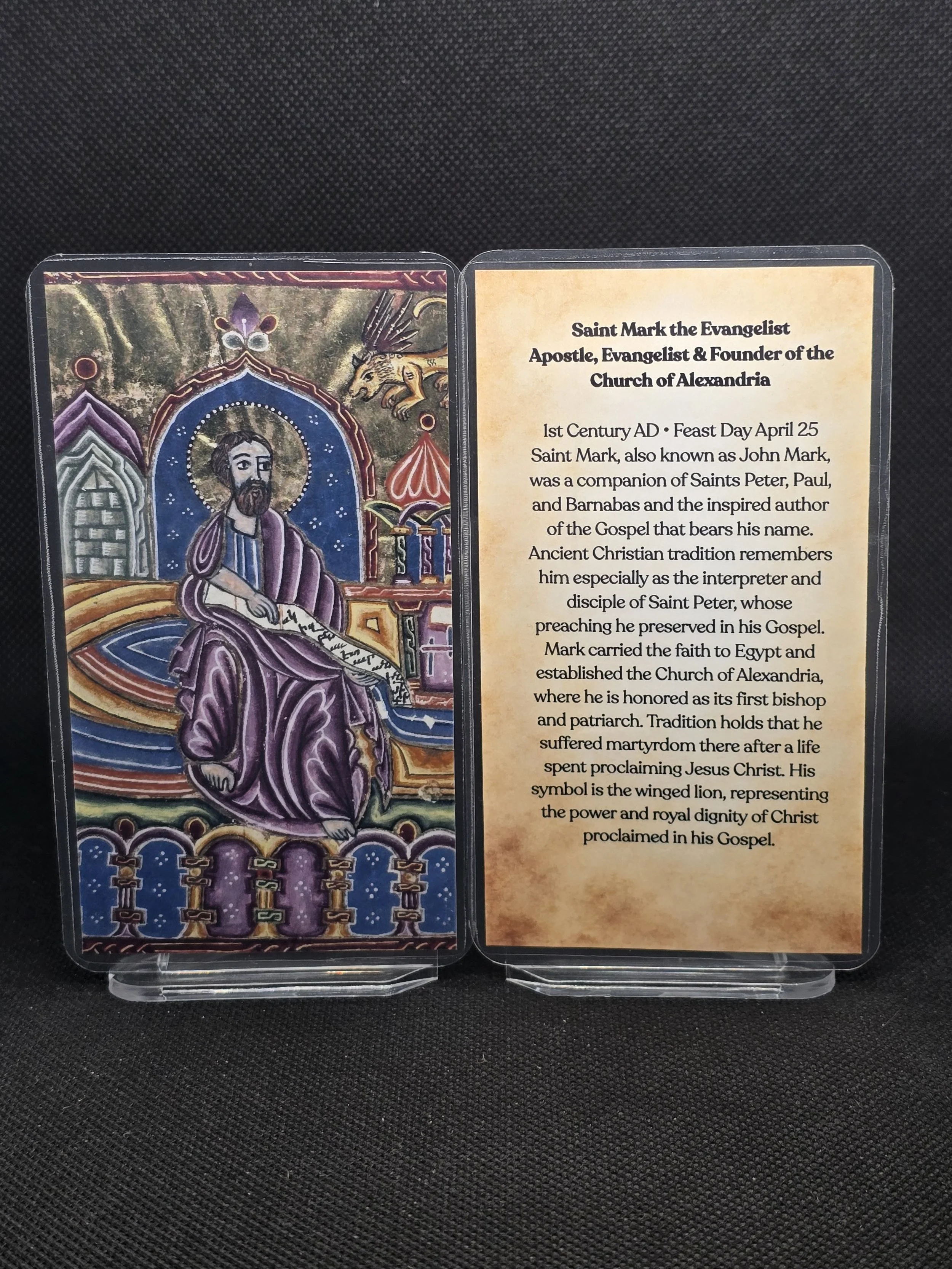
Saint Mark is traditionally represented by a winged lion, one of the four symbolic creatures associated with the Evangelists. Christian iconography connected the four Evangelists with the four living creatures described in Ezekiel and Revelation, producing the familiar symbols of the man or angel for Matthew, lion for Mark, ox for Luke, and eagle for John.
The lion became so strongly associated with Mark that it appears throughout Christian art and is particularly famous as the emblem of Venice. It can also appear beside Saint Mark in icons, manuscripts, church mosaics, statues, and Evangelist portraits.
Different spiritual explanations have been offered for the lion. One common interpretation connects it with Mark's opening in the wilderness and the voice crying there, while another sees the lion's strength as fitting the Gospel's vigorous presentation of Christ.
The symbol should not be mistaken for something essential to Mark's historical biography. It belongs to the iconographic and theological tradition through which Christians learned to identify the four Evangelists visually.
For a prayer card, the winged lion is therefore an especially appropriate secondary symbol. It immediately identifies Saint Mark while connecting the card with centuries of Christian Gospel imagery.
THE MARTYRDOM OF SAINT MARK
The ancient Churches of Alexandria remember Saint Mark not only as founder and Evangelist but as a martyr. The Coptic Orthodox Church officially commemorates his martyrdom and identifies him as the first Pope of Alexandria, while the Orthodox Church in America likewise preserves the tradition of his suffering and death in Alexandria.
According to the traditional account, hostility toward the growing Christian community eventually led pagans in Alexandria to seize Saint Mark while he was serving the Liturgy. He was beaten and dragged through the streets before being imprisoned.
Orthodox tradition says that Christ appeared to Mark in prison and strengthened him before the final suffering. The following day, he was again dragged through the streets and died from the injuries he endured, surrendering his spirit to God.
The Coptic Orthodox Church dates his martyrdom to the year 68 AD in its ecclesiastical tradition.
The exact chronological reconstruction of every detail belongs to ancient ecclesiastical tradition rather than surviving contemporary Roman documentation, so responsible historical writing should distinguish the Church's traditional martyrdom account from what can independently be demonstrated from first-century civil records.
Yet the central meaning of the tradition is unmistakable. Saint Mark did not merely write about Christ's Cross because his own missionary life ultimately became a participation in the same pattern of witness through suffering.
The Greek word martyr means witness.
Saint Mark's martyrdom therefore completes the vocation already expressed through his Gospel. He proclaimed Christ in words and eventually proclaimed Him with his life.
SAINT MARK & THE COPTS
No product page on Saint Mark is complete without recognizing his extraordinary place within Coptic Orthodox Christianity. The Coptic Church officially describes itself as one of the world's ancient apostolic Churches and traces its foundation directly to Saint Mark's arrival in Egypt.
For Coptic Christians, the Patriarch of Alexandria occupies the See of Saint Mark, and the succession of Coptic popes begins with Mark himself. Saint Mark is therefore woven into the ecclesiastical identity of Egyptian Christianity in a way comparable to the special relationships other apostolic Churches have with their founding Apostles.
This makes his prayer card especially meaningful for Coptic Orthodox homes, catechism classes, churches, deacons, servants, seminarians, and anyone with a devotion to the ancient Church of Alexandria.
In 2026, Pope Tawadros II again described Saint Mark as the founder of the Coptic Church and held him up as a model of successful Christian service whose preaching spread through Egypt.
The Coptic connection also makes Saint Mark profoundly important within the history of African Christianity. Christianity in Africa is not a modern import because one of the ancient apostolic patriarchates took root in Egypt during the first Christian generations.
Alexandria would become a source of theology, monasticism, martyrdom, biblical study, and missionary influence whose importance extended across the Christian world.
THE RELICS OF SAINT MARK
The history of Saint Mark's relics is shared between Alexandria, Cairo, and Venice. The Coptic Orthodox Church records that after his martyrdom his relics were kept at the Alexandrian site traditionally associated with his church at Bokalia.
Centuries later, a major portion of Saint Mark's relics became associated with Venice, where Saint Mark became the city's great patron and where his relics continue to be venerated in Saint Mark's Basilica. The Vatican's official record of Pope Francis's 2024 visit to Venice specifically notes his private veneration of Saint Mark's relics within the basilica.
An important reconciliation with the Alexandrian Church occurred in 1968, when a portion of Saint Mark's relics was returned to Egypt during the papacy of Saint Pope Cyril VI. The Coptic Orthodox Church records that these relics were placed beneath the sanctuary of the new Saint Mark Cathedral in Cairo.
This means that devotion to Saint Mark's relics today is connected particularly with both Venice and Cairo, while Alexandria remains the city of his apostolic mission and martyrdom.
The geographic history of his relics is fitting for an Evangelist whose entire vocation was movement. Jerusalem, the missionary roads of the Apostles, Alexandria, Rome through his connection with Peter, Venice, and Cairo all became linked with the memory of a man whose Gospel eventually traveled far beyond anything he could have seen during his earthly life.
COURAGE TO SPEAK ABOUT CHRIST
Many Christians sincerely believe but find it difficult to talk about Jesus with other people. They may fear sounding strange, being judged as unintelligent, damaging a friendship, provoking conflict, or discovering that they do not know how to answer a question.
Saint Mark is particularly meaningful for this fear because evangelization became the defining direction of his mature life.
The goal is not to become aggressive.
Christian evangelization does not require turning every encounter into an argument or treating every non-Christian as a target rather than a human person.
Saint Mark's traditional encounter with Anianus illustrates something more natural. A human situation opened a conversation, and Mark was prepared to speak about the God he knew.
That preparation matters.
Christians who want to share their faith should learn Scripture, understand what the Church teaches, know how to explain basic doctrines simply, and be willing to admit when they do not know an answer.
Saint Mark therefore becomes a natural intercessor for catechists, parish teachers, apologists, missionaries, parents, and ordinary Christians who want greater courage without becoming combative.
The best Christian witness does not merely make people aware that we possess religious opinions. It helps them encounter Jesus Christ.
PRAYERS
A simple traditional invocation may be prayed throughout the day: Holy Apostle and Evangelist Mark, pray to God for us. This is especially fitting before missionary work, preaching, teaching Scripture, writing about the Christian faith, or entering a conversation in which someone may ask questions about Christ.
The traditional Orthodox Troparion praises Saint Mark's lifelong service to Christ, remembers his connection with Saints Peter and Paul, and celebrates the Gospel through which he continues to enlighten the world.
Someone preparing to preach or teach can use the traditional invocation while asking that Christ, rather than personal ego, remain the center of whatever is said. A writer can likewise ask Saint Mark's intercession for accuracy, clarity, humility, and the wisdom to remove words that draw unnecessary attention away from the Gospel.
Missionaries may invoke him as one of the great evangelizing Apostles whose tradition extends from Jerusalem into Egypt. Coptic Christians may especially call upon him as the apostolic father of Alexandria and ask his prayers for the continuing faithfulness of the Church founded through his mission.
Those who have failed in ministry can also seek Saint Mark's prayers while remembering his reconciliation with Saint Paul. The point is not to pretend that past decisions never happened but to ask God for the humility, perseverance, and renewed faithfulness necessary for a person to become useful again.
This prayer card is especially fitting for a Bible, missionary bag, parish office, seminary room, writing desk, catechism classroom, Coptic Orthodox prayer corner, church library, or beside a copy of the Gospel according to Mark. It can also make a meaningful gift for someone beginning ministry, becoming a catechist, entering seminary, preparing for missionary work, or choosing Saint Mark as a patron.
FAQ
Who is Saint Mark the Evangelist? Saint Mark was an early Christian missionary, companion of Saints Peter, Paul, and Barnabas, and the traditional author of the Gospel according to Mark. Church tradition also remembers him as the founder of the Church of Alexandria and a martyr for Christ.
Is Saint Mark the Evangelist the same person as John Mark? Christian tradition identifies the Evangelist with John Mark mentioned repeatedly in the Acts of the Apostles and the New Testament letters. The Orthodox Church likewise uses this identification in its traditional Life of the Evangelist.
Was Saint Mark one of the Twelve Apostles? No, Saint Mark was not one of the original Twelve Apostles named in the Gospels. Eastern Christian tradition instead numbers him among the wider apostolic company commonly called the Seventy Apostles.
Was Saint Mark personally connected with Saint Peter? Yes, First Peter 5:13 affectionately refers to Mark as Peter's son, and ancient Church tradition remembers Mark as closely associated with Peter's preaching. Orthodox hymnography likewise calls attention to his relationship with Peter.
Was Saint Mark connected with Saint Paul? Yes, Acts records Mark accompanying Paul and Barnabas before withdrawing from their first missionary journey. Later letters show that reconciliation occurred, and near the end of Paul's life he specifically described Mark as useful for ministry.
Why did Saint Paul refuse to take Mark on his second missionary journey? Acts 15 says Paul objected because Mark had departed from them during the previous mission and had not continued in the work. Scripture does not tell us exactly why Mark originally left, so claims that identify a specific motive should be treated as speculation.
Did Saint Paul and Saint Mark reconcile? Yes, later New Testament references clearly show Mark again among Paul's trusted coworkers. In 2 Timothy 4:11, Paul specifically asks Timothy to bring Mark because he is useful for ministry.
Is Saint Mark a good saint for someone who has failed in ministry? Yes, his biblical story makes this a particularly meaningful devotional association. Mark's earlier withdrawal had real consequences, yet he later became a trusted coworker of Paul and one of Christianity's four Evangelists.
Who wrote the Gospel of Mark? Ancient Christian tradition attributes the Gospel to Saint Mark the Evangelist. The Church also associates his Gospel closely with the apostolic preaching and eyewitness testimony of Saint Peter.
Is Mark the first Gospel? Many modern biblical scholars regard Mark as the earliest of the four canonical Gospels, although the exact dating and literary relationships among the Synoptic Gospels remain scholarly questions. For devotional purposes, the essential Christian claim is that Mark belongs to the four canonical inspired Gospels received by the Church.
What is the Gospel according to Mark known for? Mark's Gospel is known for its direct narrative style, rapid movement, vivid details, emphasis on Christ's actions and miracles, and powerful movement toward the Passion and Resurrection. Orthodox teaching notes that Mark's Greek is relatively close to ordinary speech and that he frequently preserves vivid narrative details.
Why is Saint Mark called an Evangelist? The title Evangelist refers especially to the four saints whose inspired writings form the canonical Gospels: Matthew, Mark, Luke, and John. Mark proclaimed the Gospel both through missionary preaching and through the Gospel that bears his name.
What is Saint Mark the patron saint of? Saint Mark is strongly associated with evangelization, missionary preaching, the Gospel, Alexandria, and the Church of Egypt. He is also historically the great patron saint of Venice, while writers, preachers, catechists, and Bible teachers may naturally seek his intercession because of his vocation as an Evangelist.
Is Saint Mark a patron saint of writers? He is a natural intercessor for Christian writers because he is one of the four Evangelists and the author traditionally associated with one of the canonical Gospels. It is more accurate to ground this devotion in his evangelical authorship than to claim an exclusive universal patronage over every form of writing.
Can writers pray to Saint Mark? Yes, especially writers communicating Christianity, Scripture, theology, or the lives of the saints. His intercession can be sought for clarity, accuracy, courage, humility, and faithfulness to Christ.
Is Saint Mark a good saint for missionaries? Yes, missionary work is one of the strongest themes of his biblical and ecclesiastical life. He traveled with early Christian missionaries and is traditionally remembered as carrying the Gospel to Alexandria and founding its Church.
Can I pray to Saint Mark before evangelizing someone? Yes, his life makes this especially appropriate. A traditional invocation such as “Holy Apostle and Evangelist Mark, pray to God for us” can be prayed while asking Christ for wisdom, courage, charity, and the right words.
Is Saint Mark a good saint for catechists and Bible teachers? Yes, because the Evangelist's vocation was fundamentally about transmitting the Gospel faithfully. Catechists and teachers can seek his prayers that what they teach leads others toward Christ rather than merely toward information about Christianity.
Did Saint Mark found the Coptic Orthodox Church? The Coptic Orthodox Church officially traces its apostolic foundation to Saint Mark's preaching in Egypt and regards him as its first Pope of Alexandria. He therefore holds a uniquely important place within Coptic Christianity.
Is Saint Mark the first Pope of Alexandria? Yes, this is the official tradition of the Coptic Orthodox Church. The Alexandrian succession of patriarchs is understood to begin with Saint Mark.
Did Saint Mark really preach in Alexandria? The ancient ecclesiastical tradition of Alexandria firmly associates Mark with the evangelization of the city and foundation of its Church. The Coptic Orthodox Church continues to identify him as the Apostle who brought Christianity to Egypt.
Who was Anianus? According to Coptic tradition, Anianus was a shoemaker whom Saint Mark encountered in Alexandria and led to Christianity after an ordinary conversation opened into discussion about the one God. Mark later ordained him as the first bishop serving the Alexandrian Church after him.
Is Saint Mark especially important to Coptic Christians? Yes, he is the apostolic founder of their Church and occupies a foundational place within Coptic identity, liturgy, history, and episcopal succession. The Coptic Patriarchate is traditionally called the See of Saint Mark.
Is Saint Mark an Eastern Orthodox saint? Yes, Saint Mark is one of the universally honored Apostles and Evangelists of the Eastern Orthodox Church. The Orthodox Church in America commemorates him on April 25.
Is Saint Mark a Catholic saint? Yes, Saint Mark lived in the apostolic age long before later divisions among the ancient Churches and is universally honored in Catholic Christianity. His feast is also celebrated on April 25 in the Roman Catholic tradition.
Is Saint Mark honored by Coptic Catholics? Saint Mark belongs to the common Alexandrian apostolic heritage and is honored throughout Egyptian Christianity, although the Coptic Orthodox Church has the particularly direct historical identity of tracing its patriarchal succession to his foundation of the See of Alexandria.
When is Saint Mark the Evangelist's feast day? Byzantine Orthodox and Roman Catholic calendars celebrate Saint Mark on April 25. The Coptic Orthodox Church commemorates his martyrdom according to its own Coptic liturgical calendar, traditionally on 30 Baramouda.
Why is Saint Mark shown with a lion? The winged lion is the traditional symbol of Saint Mark among the four Evangelists. The imagery comes from Christian interpretations of the four living creatures in Ezekiel and Revelation and became one of the most recognizable symbols associated with Mark.
Why does Saint Mark's lion have wings? The wings belong to the symbolism of the four heavenly living creatures used in Christian iconography to represent the Evangelists. The winged lion became Mark's distinctive emblem and appears widely in both Eastern and Western Christian art.
Is the Lion of Venice the symbol of Saint Mark? Yes, Venice adopted the winged Lion of Saint Mark as one of its defining religious and civic symbols because Saint Mark became the city's principal patron. His relics continue to be venerated at Saint Mark's Basilica.
Where did Saint Mark die? Church tradition places Saint Mark's martyrdom in Alexandria, Egypt, where he had established the Christian community. Both Eastern Orthodox and Coptic traditions preserve accounts of his suffering there.
How did Saint Mark die? According to ancient ecclesiastical tradition, pagans seized him during worship, beat him, and dragged him through the streets of Alexandria. Orthodox tradition remembers him dying from the injuries after a second period of abuse.
Was Saint Mark a martyr? Yes, the Churches of Alexandria and the wider Orthodox tradition honor him as a martyr as well as an Apostle and Evangelist. The Coptic Orthodox Church traditionally dates his martyrdom to 68 AD.
Where are Saint Mark's relics? Major relics of Saint Mark are venerated at Saint Mark's Basilica in Venice, while a portion of his relics was solemnly returned to the Coptic Orthodox Church in Egypt in 1968 and placed at Saint Mark's Cathedral in Cairo.
Were Saint Mark's relics returned to Egypt? A portion of the relics was returned in 1968 during the papacy of Saint Pope Cyril VI. The Coptic Church records that they were placed in a shrine beneath the sanctuary of the new Saint Mark Cathedral in Cairo.
Are Saint Mark's relics still in Venice? Yes, Saint Mark's Basilica continues to venerate relics of the Evangelist. Pope Francis specifically venerated them during his visit to Venice on April 28, 2024.
Why are Saint Mark's relics in both Venice and Egypt? The relics have a complicated history extending through many centuries, and only a portion was returned to Egypt in 1968. As a result, both Venice and the Coptic Church in Cairo retain important relics connected with the Evangelist.
Can I give this prayer card to someone named Mark? Yes, it is an especially appropriate name-day, baptism, confirmation, chrismation, birthday, or patron-saint gift for someone named Mark. The card can help connect the person's name with the Apostle's actual biblical and ecclesiastical story.
Can I give this prayer card to a missionary? Yes, Saint Mark's connection with early apostolic travel and the evangelization of Egypt makes this one of the strongest uses for his prayer card. It can be especially meaningful when someone is departing for missionary service or beginning local evangelization.
Can I give this card to a priest or deacon? Yes, especially to clergy whose ministry includes preaching and teaching the Gospel. Saint Mark's apostolic witness and written Gospel provide a strong model for anyone entrusted with proclaiming Christ publicly.
Can I give this card to a seminarian? Yes, Saint Mark is particularly appropriate for seminarians because his life combines Scripture, apostolic tradition, missionary work, preaching, perseverance, and martyrdom. His card can be kept beside a Bible or theological books as a reminder that study must eventually become proclamation and service.
Can I give this card to a writer or author? Yes, especially someone writing Christian material. Saint Mark's example reminds writers that simplicity and clarity can communicate profound truth when Christ remains the center.
Can I give this prayer card to a Coptic Orthodox Christian? Yes, Saint Mark is one of the most significant possible saints for a Coptic Orthodox Christian because the Coptic Church recognizes him as its apostolic founder and first Pope of Alexandria.
Can I pray to Saint Mark when I am afraid to talk about my faith? Yes, evangelization and courageous Christian witness are natural devotional themes arising from his life. His intercession can be sought for courage that remains humble, respectful, and centered upon helping another person encounter Christ.
Can I pray to Saint Mark after failing at something important? Yes, his reconciliation with Saint Paul makes him particularly meaningful in that situation. His story demonstrates that a serious setback can be followed by maturity, restored trust, and enormously fruitful service.
What does Saint Mark teach about failure? His life teaches that weakness at one point in a vocation does not necessarily determine the final outcome of that vocation. The man Paul once refused to bring on a missionary journey eventually became someone Paul called useful for ministry.
What does Saint Mark teach about evangelization? He teaches that the Gospel must move outward from those who have received it toward people who have not yet heard it. His Alexandrian mission also demonstrates that evangelization often begins through ordinary human encounters rather than spectacular public events.
What does Saint Mark teach about Scripture? Through his Gospel, Saint Mark teaches Christians to encounter Jesus as the living Lord whose identity becomes clearest through His ministry, Cross, and Resurrection. His example also shows the responsibility of receiving apostolic testimony faithfully and transmitting it to the next generation.
What does Saint Mark teach Christian writers? He teaches that the purpose of Christian writing is not to make the writer impressive but to make Christ known. His Gospel's directness and vividness show that powerful religious writing does not depend upon unnecessary complexity.
What does Saint Mark teach about second chances? His biblical relationship with Paul shows that trust can be damaged and later rebuilt through demonstrated faithfulness. Mark's future usefulness became greater than his earlier failure, making his life a powerful Christian witness against despair.
What is the main message of Saint Mark the Evangelist's life? Saint Mark's life teaches that the Gospel received must become the Gospel proclaimed. A young Christian associated with the earliest Jerusalem community joined the missionary work, withdrew when the road became difficult, received another opportunity through Barnabas, regained Paul's trust, became closely associated with Peter, wrote one of the four Gospels, carried Christianity into Egypt, founded the Church of Alexandria according to ancient tradition, and ultimately gave his life for Christ. His story calls Christians to know Jesus through Scripture, rise again after failure, speak about Him with courage, and carry the Gospel farther than their own comfort would naturally allow.
Saint Mark the Evangelist, also called Saint Mark the Apostle and Evangelist and traditionally identified with John Mark of the Acts of the Apostles, was one of the great missionary figures of the first Christian generation and the inspired author of the Gospel according to Mark. Scripture places him among the companions of Saints Peter, Paul, and Barnabas, while ancient Church tradition remembers him especially as the interpreter of Saint Peter's preaching and the apostle who carried Christianity to Alexandria, where the Coptic Church reveres him as its founder and first bishop.
Saint Mark is especially meaningful for missionaries, evangelists, priests, deacons, catechists, Christian writers, Bible teachers, preachers, converts learning how to share their faith, and anyone who is afraid to speak openly about Jesus Christ. His life shows that evangelization is not simply the work of unusually confident personalities because Mark's own biblical story includes a moment when he withdrew from a missionary journey, followed later by reconciliation and renewed usefulness in apostolic ministry. By the end of Saint Paul's life, the Apostle specifically asked for Mark to be brought to him because he was useful for ministry, making Mark an extraordinary saint for anyone who has failed in a vocation and needs courage to begin again.
His Gospel also gives Saint Mark a special place for Christians who want to encounter Jesus more deeply through Scripture. The Gospel according to Mark moves rapidly through Christ's ministry and gives vivid attention to His actions, healings, confrontations, suffering, Crucifixion, and Resurrection. Orthodox teaching notes the Gospel's direct language and vivid narrative details, while the Church's liturgical tradition praises Mark for enlightening the world through the Gospel entrusted to him.
Saint Mark is particularly important to Coptic Orthodox Christianity, where he is not merely one Evangelist among many but the apostolic founder of the Church of Alexandria. The Coptic Orthodox Church officially traces its foundation to Saint Mark's preaching in Egypt and honors him as its first Pope of Alexandria, while the wider Eastern Orthodox tradition likewise remembers his mission to Alexandria and his martyrdom there.
His life therefore unites several powerful Christian themes: Scripture, missionary work, discipleship, perseverance after failure, friendship among the Apostles, courage under persecution, and the responsibility to carry Christ into places where He is not yet known. Saint Mark reminds Christians that the Gospel is not something received only for private consolation because the good news of Jesus Christ is meant to be carried, spoken, written, taught, and lived.
This prayer card is created for missionaries, evangelists, writers, preachers, priests, deacons, seminarians, catechists, Bible teachers, Christian educators, Coptic Orthodox families, people discerning missionary or ministry work, and Christians trying to become less afraid of discussing their faith. It is also especially fitting for someone named Mark, a convert preparing to share the faith with family, a person beginning theological or biblical study, or anyone who has stepped away from a vocation and wonders whether God can still call them back into meaningful service.
Saint Mark's strongest established associations include evangelization, missionary preaching, the Gospel, Alexandria, the Coptic Church, and apostolic ministry. Writers and teachers may also naturally seek his intercession because he is one of the four Evangelists, although it is more accurate to ground that devotion in his authorship of the Gospel than to invent an exclusive universal patronage title not used consistently across the ancient Churches.
Each card is handmade in Austin, TX and created to order. We do not keep stock, because every prayer card is treated as a unique devotional offering. They are printed on museum-quality photo paper, not cardstock, and every card is made slowly during prayer with intentional reverence for the saint and for the person who will receive it. Names are lifted before Christ, intentions are held carefully, and each piece is handled multiple times in prayerful silence, asking God for mercy and asking Saint Mark to intercede for the soul it is being made for. This is devotional craftsmanship shaped with patience, care, and spiritual responsibility because every soul and every prayer matters.
THE LIFE & STORY
The New Testament introduces a Christian named John whose surname was Mark, usually called John Mark. In Acts 12, after Saint Peter was miraculously released from prison, he went to the house of Mary, the mother of John Mark, where many Christians were gathered together in prayer. This places Mark's family within the earliest Christian community of Jerusalem and shows that his mother's home served as a gathering place for believers during a dangerous period of persecution.
The house itself became important in later Christian tradition, and the Orthodox Life of Saint Mark remembers him as having been born in Jerusalem and belonging to the circle surrounding the earliest disciples. Later traditions also connect Mark personally with events during Christ's earthly ministry, although those details should be distinguished from what the New Testament explicitly states.
Mark's family was also connected with Saint Barnabas. Colossians 4:10 identifies Mark as a relative of Barnabas, and the Acts of the Apostles shows the two men traveling together. This family relationship would become particularly important after one of the most difficult episodes of Mark's early missionary life.
Barnabas and Saul, later known as Saint Paul, brought John Mark with them when they returned from Jerusalem. When Paul and Barnabas were sent out on their first major missionary journey, Mark accompanied them as a helper. Acts 13 places him with the missionaries as they carried the Gospel through Cyprus and toward Asia Minor.
Then Mark left.
Acts 13:13 states simply that John departed from them at Perga and returned to Jerusalem. Scripture does not tell us exactly why, so explanations involving fear, homesickness, illness, disagreement, or inability to endure the hardships of missionary travel remain speculation rather than biblical fact.
Whatever the reason, Saint Paul regarded Mark's departure as serious enough that it later produced a sharp disagreement with Barnabas. When Paul proposed visiting the churches they had previously evangelized, Barnabas wanted to take Mark with them again, but Paul did not believe it wise to bring the man who had withdrawn from the earlier work.
Acts 15 says that the disagreement became so strong that Paul and Barnabas separated. Barnabas took Mark and sailed to Cyprus, while Paul chose Silas and continued his missionary work along another route.
This is one of the most important parts of Saint Mark's story because the future Evangelist once occupied the center of an apostolic dispute caused by his own earlier withdrawal from ministry. The man whose Gospel would eventually be proclaimed throughout the world had experienced a moment in which one of Christianity's greatest Apostles did not trust him to return to the missionary field.
Yet Barnabas did.
Barnabas gave Mark another opportunity, and that second chance mattered. Scripture never tells us that Mark's earlier failure ceased to matter, but later New Testament references reveal clearly that it did not define the remainder of his life.
Years later, Mark appears among Saint Paul's fellow workers. Paul names him in Philemon 24, and Colossians 4:10 refers to him positively while instructing the Christian community to receive him if he comes to them.
The reconciliation becomes clearest near the end of Paul's life. In 2 Timothy 4:11, the imprisoned Apostle asks Timothy to bring Mark with him because Mark is useful to him for ministry. The man Paul once refused to take on another missionary journey had eventually become someone Paul specifically wanted beside him during the final period of his apostolic work.
This makes Saint Mark one of Christianity's most powerful saints for second chances in vocation. A mistake can have real consequences without becoming a prophecy concerning the rest of a person's life, and a period of weakness can become part of the formation through which a person later learns faithfulness.
Saint Mark also became closely associated with Saint Peter. First Peter 5:13 refers affectionately to “Mark my son,” showing a close spiritual relationship between them, and early Christian tradition came to regard Mark's Gospel as deeply connected with Peter's eyewitness preaching.
The Orthodox liturgical tradition explicitly remembers this relationship. Saint Mark's Troparion praises him for following Peter zealously and serving Paul as a fellow laborer, while Greek Orthodox hymnography remembers him as Peter's interpreter.
This connection became central to the Church's understanding of the Gospel according to Mark. Ancient Christian tradition regards Mark as preserving the apostolic preaching associated particularly with Peter, meaning that the Gospel is not the literary work of someone detached from the eyewitness generation but belongs to the living apostolic proclamation of Jesus Christ.
Saint Mark's own Gospel is strikingly direct. It begins not with an infancy narrative or genealogy but with the beginning of the Gospel of Jesus Christ and the appearance of Saint John the Baptist, then moves rapidly into Christ's public ministry. Orthodox biblical teaching notes Mark's relatively direct Greek and his tendency to preserve vivid narrative details.
The Gospel repeatedly shows Jesus acting. He calls disciples, teaches with authority, casts out demons, heals the sick, forgives sins, feeds crowds, calms the sea, confronts religious hypocrisy, raises the dead, journeys toward Jerusalem, accepts the Cross, and rises from the tomb.
This strong emphasis on action makes Mark especially powerful for Christians who need to rediscover that Jesus is not merely the subject of theological discussion. Mark introduces readers to a living Lord who enters human suffering and acts with authority.
The Gospel also contains a particularly intense emphasis upon the Cross. The disciples repeatedly struggle to understand Jesus correctly, and Peter's recognition that Jesus is the Christ is followed almost immediately by Christ's teaching that the Son of Man must suffer, be rejected, be killed, and rise again.
Mark therefore refuses to separate Christian faith from discipleship under the Cross. Following Jesus is not simply admiring His miracles or enjoying religious consolation because Christ calls the disciple toward self-denial, faithfulness, suffering, and eventually Resurrection.
SAINT MARK & THE CHURCH OF ALEXANDRIA
Church tradition remembers Saint Mark's greatest missionary work as taking place in Egypt, where he preached the Gospel in Alexandria and established the Christian community that became the ancient Church of Alexandria. The Coptic Orthodox Church officially identifies itself as having been founded by Saint Mark and traces the succession of the Alexandrian patriarchate back to him.
This gives Saint Mark an extraordinary place in Christian history because Alexandria became one of the great apostolic centers of the ancient Church. The city would later be associated with figures such as Saint Athanasius the Great, Saint Cyril of Alexandria, Saint Anthony's wider Egyptian monastic world, and generations of theologians, monks, martyrs, bishops, and teachers.
Coptic tradition preserves a famous account of Mark's arrival in Alexandria. According to the official Coptic account, Mark needed his sandal repaired and encountered a shoemaker named Anianus. While working, Anianus injured his hand and cried out instinctively about the one God, giving Mark an opportunity to begin speaking with him about the Christian faith.
Anianus and his household accepted Christianity, and Mark eventually ordained him as the first bishop serving the Alexandrian Christian community after himself. The story belongs to the ecclesiastical tradition of Alexandria and remains an important part of Coptic memory concerning the beginnings of Christianity in Egypt.
The story beautifully captures the nature of evangelization because Mark's opportunity did not begin from a stage, political platform, or large organized event. It began through an ordinary encounter between two human beings.
This makes Saint Mark especially meaningful for Christians who imagine evangelization requires becoming professional missionaries or public speakers. Sometimes a conversation begins because another person asks a question, experiences suffering, notices a cross around someone's neck, or simply discovers that the Christian standing beside them takes faith seriously.
Saint Mark's mission reminds believers to remain spiritually awake enough to recognize those moments. Evangelization does not require forcing religion into every conversation, but it does require being willing to speak when the door genuinely opens.
The Alexandrian Church that grew from Mark's mission survived enormous persecution and became one of the central apostolic Churches of ancient Christianity. The Coptic Orthodox Church continues to regard Saint Mark not simply as a historical founder but as the apostolic father of its entire ecclesial life.
For Coptic Christians, a Saint Mark prayer card therefore carries a particularly deep significance. He stands at the beginning of the succession of Alexandrian bishops and patriarchs and represents the missionary seed from which centuries of Egyptian Christianity grew.
SAINT MARK & MISSIONARY COURAGE
Saint Mark's life is one of movement. Jerusalem, Antioch, Cyprus, Asia Minor, Rome, and Alexandria all appear within the biblical and ecclesiastical traditions surrounding him, making his Christianity fundamentally missionary rather than geographically comfortable.
The Gospel had to travel because the command of Christ could not remain confined to the original circle of disciples in Jerusalem. Saint Mark belonged to the generation responsible for crossing linguistic, political, religious, and cultural boundaries so that people who had never walked the roads of Galilee could nevertheless hear that Jesus Christ had risen.
Missionary work is often romanticized after the danger has passed. Ancient Christian missionaries faced exhausting travel, disease, persecution, unfamiliar cultures, rejection, poverty, political instability, and the real possibility of imprisonment or death.
Mark's early withdrawal from Paul's first missionary journey therefore becomes even more understandable without becoming insignificant. Christian courage often develops gradually, and the saint who later endured martyrdom may once have struggled to remain on the road.
This makes Saint Mark especially meaningful for Christians who are afraid that fear itself disqualifies them from courageous service. His story suggests that the question is not whether someone has ever been afraid, overwhelmed, or unprepared, but whether that person will allow Christ to continue forming them afterward.
The Mark who withdrew at Perga eventually became the Mark whom Paul called useful, the Mark associated with Peter, the Mark whose Gospel became Scripture, and the Mark remembered as bringing Christianity to Alexandria.
The distance between those two moments is called perseverance.
SECOND CHANCES AFTER FAILURE
Saint Mark's biblical story provides one of the clearest New Testament examples of a person whose early ministry included a significant setback but whose later service became extraordinarily fruitful. This makes him a particularly meaningful intercessor for people who have failed in ministry, abandoned a vocation, disappointed someone who trusted them, or made a decision they wish they could reverse.
Christianity does not teach that every consequence disappears after repentance. Paul did not immediately trust Mark again, and Scripture does not pretend the disagreement never happened.
Yet restoration occurred.
Mark's usefulness later became so clear that Paul himself testified to it. The Apostle who once refused to bring Mark along eventually requested Mark's presence during his own imprisonment.
This is an important spiritual distinction because forgiveness and restored trust are related but not identical. Forgiveness can be offered while trust may have to be rebuilt through demonstrated faithfulness over time.
Saint Mark appears to have done exactly that.
For someone recovering from failure, this can be more encouraging than a story in which nothing ever went wrong. The saint does not say, “A faithful Christian never falls short.” His life says that failure does not necessarily possess the authority to decide what God may still do with a person.
This makes the prayer card especially fitting for someone returning to ministry after burnout, entering formation again after a previous attempt ended, returning to church after years away, or trying to rebuild a relationship after disappointing people.
Saint Mark's life does not promise that every lost opportunity will return in its original form. It offers something deeper: God can still make the next chapter fruitful.
THE GOSPEL ACCORDING TO MARK
Saint Mark is one of the Four Evangelists, together with Saints Matthew, Luke, and John. The four Gospels proclaim one Jesus Christ through four distinct inspired witnesses, each preserving particular emphases, details, arrangements, and theological perspectives.
Mark's Gospel is the shortest of the four canonical Gospels, but its brevity should not be mistaken for simplicity. It moves with remarkable urgency and repeatedly draws the reader toward the mystery of who Jesus truly is.
Christ's authority appears from the beginning. He teaches differently from the scribes, commands unclean spirits, heals disease, forgives sins, and claims authority over the Sabbath.
Yet the identity of Jesus is progressively revealed.
Demons recognize Him while human beings often remain confused. Crowds marvel but do not fully understand, religious leaders increasingly oppose Him, and even the disciples repeatedly misunderstand what His Messiahship means.
Peter eventually confesses Jesus as the Christ, but Mark immediately moves toward the Cross. The Gospel thereby insists that Jesus cannot be understood correctly without His Passion.
This makes Saint Mark especially meaningful for Christians attracted to the power of Christ but struggling with the Cross. The Jesus who heals is also the Jesus who suffers, and the disciple who wants Resurrection must follow the Lord through self-denial rather than around it.
Mark's Gospel also gives extraordinary attention to human reactions. People are amazed, afraid, astonished, angry, grieving, desperate, confused, and overwhelmed, making the Gospel feel intensely human.
A father begs Christ for his child.
A woman reaches through a crowd because she has suffered for years.
Friends tear open a roof to bring a paralyzed man to Jesus.
A blind man cries out despite people telling him to be quiet.
A frightened father admits both faith and unbelief.
Mark repeatedly places desperate human need directly before Christ.
This is one reason the Gospel remains so spiritually immediate. Saint Mark does not present discipleship as a world inhabited only by spiritually composed people because his Gospel is full of human beings who need mercy.
SAINT MARK, WRITERS & CHRISTIAN TEACHERS
Because Saint Mark is one of the inspired Evangelists, he is naturally meaningful for Christian writers, authors, journalists, editors, Bible teachers, catechists, and anyone attempting to communicate the faith through words. This is best understood as a devotional association flowing directly from his evangelical vocation rather than as a narrowly defined universal patronage title.
Writing about Christianity carries a particular responsibility because words can clarify truth or distort it. A Christian writer is not simply trying to produce attractive sentences but to communicate something about God, Scripture, the saints, history, or the spiritual life accurately enough that another person's faith is not damaged by carelessness.
Saint Mark's Gospel offers a model of remarkable economy. He does not need unnecessary ornamentation to make Jesus compelling because Christ Himself is the center of the story.
This is a valuable lesson for Christian writers because religious writing can become overly concerned with the personality of the author. Saint Mark reminds the writer that Christian communication is at its best when readers finish knowing Christ better rather than simply admiring the person who wrote about Him.
The Evangelist is also meaningful for anyone afraid that their writing style is not sophisticated enough. Orthodox biblical teaching observes that Mark uses relatively direct Greek closer to ordinary speech while preserving vivid narrative details, yet the result became one of the four canonical Gospels of the Church.
Clarity can be holy.
A catechist explaining Christianity to children, a parent teaching the Gospel at home, a priest writing a homily, or an author working on a Christian book can all seek Saint Mark's intercession that their words point toward Christ rather than obscuring Him.
SAINT MARK & SAINT PETER
The relationship between Saints Mark and Peter holds an especially important place in Christian tradition. First Peter refers affectionately to Mark as Peter's son, language traditionally understood spiritually rather than biologically, and ancient Church memory associates Mark closely with Peter's apostolic preaching.
Orthodox hymnography preserves this tradition by praising Mark for following Peter and by describing him as Peter's interpreter.
This relationship helps explain why the Church has traditionally understood Mark's Gospel as closely connected with the testimony of Saint Peter. Mark becomes an example of how apostolic witness can be handed from one Christian to another without losing its center.
Peter saw Christ.
Mark received and preserved apostolic preaching.
Future generations received the Gospel.
The same pattern continues throughout the Church. Most Christians do not encounter Jesus through a dramatic private vision because they receive the faith from someone else: a parent, priest, teacher, friend, missionary, book, homily, or Christian community.
Saint Mark therefore teaches something fundamental about tradition. Receiving the Gospel from another person does not make faith less authentic because Christianity itself has always been handed from witness to witness.
The responsibility is to receive faithfully and then hand on faithfully.
SAINT MARK & SAINT PAUL
Saint Mark's relationship with Paul is equally important because it includes both conflict and reconciliation. Acts records Paul's refusal to take Mark on a second mission after Mark's earlier departure, while later New Testament letters show Mark restored to Paul's circle of trusted coworkers.
Their story offers a powerful Christian example because apostolic life was not free from disagreement. Saints were not people who never experienced conflict, disappointment, or broken trust.
Paul believed Mark had failed.
Barnabas believed Mark deserved another opportunity.
Later events showed that Mark became genuinely useful to Paul.
The Church preserved the whole story rather than erasing the embarrassing middle.
This is particularly meaningful for Christian communities because conflict does not necessarily mean communion has become impossible. Relationships can change, trust can be rebuilt, and people can mature.
Saint Mark's life also honors the importance of someone like Barnabas, who saw possibility where another person saw unreliability. Many people who later become extraordinarily useful to the Church may owe part of that future to one person willing to accompany them through an immature period.
THE LION OF SAINT MARK
Saint Mark is traditionally represented by a winged lion, one of the four symbolic creatures associated with the Evangelists. Christian iconography connected the four Evangelists with the four living creatures described in Ezekiel and Revelation, producing the familiar symbols of the man or angel for Matthew, lion for Mark, ox for Luke, and eagle for John.
The lion became so strongly associated with Mark that it appears throughout Christian art and is particularly famous as the emblem of Venice. It can also appear beside Saint Mark in icons, manuscripts, church mosaics, statues, and Evangelist portraits.
Different spiritual explanations have been offered for the lion. One common interpretation connects it with Mark's opening in the wilderness and the voice crying there, while another sees the lion's strength as fitting the Gospel's vigorous presentation of Christ.
The symbol should not be mistaken for something essential to Mark's historical biography. It belongs to the iconographic and theological tradition through which Christians learned to identify the four Evangelists visually.
For a prayer card, the winged lion is therefore an especially appropriate secondary symbol. It immediately identifies Saint Mark while connecting the card with centuries of Christian Gospel imagery.
THE MARTYRDOM OF SAINT MARK
The ancient Churches of Alexandria remember Saint Mark not only as founder and Evangelist but as a martyr. The Coptic Orthodox Church officially commemorates his martyrdom and identifies him as the first Pope of Alexandria, while the Orthodox Church in America likewise preserves the tradition of his suffering and death in Alexandria.
According to the traditional account, hostility toward the growing Christian community eventually led pagans in Alexandria to seize Saint Mark while he was serving the Liturgy. He was beaten and dragged through the streets before being imprisoned.
Orthodox tradition says that Christ appeared to Mark in prison and strengthened him before the final suffering. The following day, he was again dragged through the streets and died from the injuries he endured, surrendering his spirit to God.
The Coptic Orthodox Church dates his martyrdom to the year 68 AD in its ecclesiastical tradition.
The exact chronological reconstruction of every detail belongs to ancient ecclesiastical tradition rather than surviving contemporary Roman documentation, so responsible historical writing should distinguish the Church's traditional martyrdom account from what can independently be demonstrated from first-century civil records.
Yet the central meaning of the tradition is unmistakable. Saint Mark did not merely write about Christ's Cross because his own missionary life ultimately became a participation in the same pattern of witness through suffering.
The Greek word martyr means witness.
Saint Mark's martyrdom therefore completes the vocation already expressed through his Gospel. He proclaimed Christ in words and eventually proclaimed Him with his life.
SAINT MARK & THE COPTS
No product page on Saint Mark is complete without recognizing his extraordinary place within Coptic Orthodox Christianity. The Coptic Church officially describes itself as one of the world's ancient apostolic Churches and traces its foundation directly to Saint Mark's arrival in Egypt.
For Coptic Christians, the Patriarch of Alexandria occupies the See of Saint Mark, and the succession of Coptic popes begins with Mark himself. Saint Mark is therefore woven into the ecclesiastical identity of Egyptian Christianity in a way comparable to the special relationships other apostolic Churches have with their founding Apostles.
This makes his prayer card especially meaningful for Coptic Orthodox homes, catechism classes, churches, deacons, servants, seminarians, and anyone with a devotion to the ancient Church of Alexandria.
In 2026, Pope Tawadros II again described Saint Mark as the founder of the Coptic Church and held him up as a model of successful Christian service whose preaching spread through Egypt.
The Coptic connection also makes Saint Mark profoundly important within the history of African Christianity. Christianity in Africa is not a modern import because one of the ancient apostolic patriarchates took root in Egypt during the first Christian generations.
Alexandria would become a source of theology, monasticism, martyrdom, biblical study, and missionary influence whose importance extended across the Christian world.
THE RELICS OF SAINT MARK
The history of Saint Mark's relics is shared between Alexandria, Cairo, and Venice. The Coptic Orthodox Church records that after his martyrdom his relics were kept at the Alexandrian site traditionally associated with his church at Bokalia.
Centuries later, a major portion of Saint Mark's relics became associated with Venice, where Saint Mark became the city's great patron and where his relics continue to be venerated in Saint Mark's Basilica. The Vatican's official record of Pope Francis's 2024 visit to Venice specifically notes his private veneration of Saint Mark's relics within the basilica.
An important reconciliation with the Alexandrian Church occurred in 1968, when a portion of Saint Mark's relics was returned to Egypt during the papacy of Saint Pope Cyril VI. The Coptic Orthodox Church records that these relics were placed beneath the sanctuary of the new Saint Mark Cathedral in Cairo.
This means that devotion to Saint Mark's relics today is connected particularly with both Venice and Cairo, while Alexandria remains the city of his apostolic mission and martyrdom.
The geographic history of his relics is fitting for an Evangelist whose entire vocation was movement. Jerusalem, the missionary roads of the Apostles, Alexandria, Rome through his connection with Peter, Venice, and Cairo all became linked with the memory of a man whose Gospel eventually traveled far beyond anything he could have seen during his earthly life.
COURAGE TO SPEAK ABOUT CHRIST
Many Christians sincerely believe but find it difficult to talk about Jesus with other people. They may fear sounding strange, being judged as unintelligent, damaging a friendship, provoking conflict, or discovering that they do not know how to answer a question.
Saint Mark is particularly meaningful for this fear because evangelization became the defining direction of his mature life.
The goal is not to become aggressive.
Christian evangelization does not require turning every encounter into an argument or treating every non-Christian as a target rather than a human person.
Saint Mark's traditional encounter with Anianus illustrates something more natural. A human situation opened a conversation, and Mark was prepared to speak about the God he knew.
That preparation matters.
Christians who want to share their faith should learn Scripture, understand what the Church teaches, know how to explain basic doctrines simply, and be willing to admit when they do not know an answer.
Saint Mark therefore becomes a natural intercessor for catechists, parish teachers, apologists, missionaries, parents, and ordinary Christians who want greater courage without becoming combative.
The best Christian witness does not merely make people aware that we possess religious opinions. It helps them encounter Jesus Christ.
PRAYERS
A simple traditional invocation may be prayed throughout the day: Holy Apostle and Evangelist Mark, pray to God for us. This is especially fitting before missionary work, preaching, teaching Scripture, writing about the Christian faith, or entering a conversation in which someone may ask questions about Christ.
The traditional Orthodox Troparion praises Saint Mark's lifelong service to Christ, remembers his connection with Saints Peter and Paul, and celebrates the Gospel through which he continues to enlighten the world.
Someone preparing to preach or teach can use the traditional invocation while asking that Christ, rather than personal ego, remain the center of whatever is said. A writer can likewise ask Saint Mark's intercession for accuracy, clarity, humility, and the wisdom to remove words that draw unnecessary attention away from the Gospel.
Missionaries may invoke him as one of the great evangelizing Apostles whose tradition extends from Jerusalem into Egypt. Coptic Christians may especially call upon him as the apostolic father of Alexandria and ask his prayers for the continuing faithfulness of the Church founded through his mission.
Those who have failed in ministry can also seek Saint Mark's prayers while remembering his reconciliation with Saint Paul. The point is not to pretend that past decisions never happened but to ask God for the humility, perseverance, and renewed faithfulness necessary for a person to become useful again.
This prayer card is especially fitting for a Bible, missionary bag, parish office, seminary room, writing desk, catechism classroom, Coptic Orthodox prayer corner, church library, or beside a copy of the Gospel according to Mark. It can also make a meaningful gift for someone beginning ministry, becoming a catechist, entering seminary, preparing for missionary work, or choosing Saint Mark as a patron.
FAQ
Who is Saint Mark the Evangelist? Saint Mark was an early Christian missionary, companion of Saints Peter, Paul, and Barnabas, and the traditional author of the Gospel according to Mark. Church tradition also remembers him as the founder of the Church of Alexandria and a martyr for Christ.
Is Saint Mark the Evangelist the same person as John Mark? Christian tradition identifies the Evangelist with John Mark mentioned repeatedly in the Acts of the Apostles and the New Testament letters. The Orthodox Church likewise uses this identification in its traditional Life of the Evangelist.
Was Saint Mark one of the Twelve Apostles? No, Saint Mark was not one of the original Twelve Apostles named in the Gospels. Eastern Christian tradition instead numbers him among the wider apostolic company commonly called the Seventy Apostles.
Was Saint Mark personally connected with Saint Peter? Yes, First Peter 5:13 affectionately refers to Mark as Peter's son, and ancient Church tradition remembers Mark as closely associated with Peter's preaching. Orthodox hymnography likewise calls attention to his relationship with Peter.
Was Saint Mark connected with Saint Paul? Yes, Acts records Mark accompanying Paul and Barnabas before withdrawing from their first missionary journey. Later letters show that reconciliation occurred, and near the end of Paul's life he specifically described Mark as useful for ministry.
Why did Saint Paul refuse to take Mark on his second missionary journey? Acts 15 says Paul objected because Mark had departed from them during the previous mission and had not continued in the work. Scripture does not tell us exactly why Mark originally left, so claims that identify a specific motive should be treated as speculation.
Did Saint Paul and Saint Mark reconcile? Yes, later New Testament references clearly show Mark again among Paul's trusted coworkers. In 2 Timothy 4:11, Paul specifically asks Timothy to bring Mark because he is useful for ministry.
Is Saint Mark a good saint for someone who has failed in ministry? Yes, his biblical story makes this a particularly meaningful devotional association. Mark's earlier withdrawal had real consequences, yet he later became a trusted coworker of Paul and one of Christianity's four Evangelists.
Who wrote the Gospel of Mark? Ancient Christian tradition attributes the Gospel to Saint Mark the Evangelist. The Church also associates his Gospel closely with the apostolic preaching and eyewitness testimony of Saint Peter.
Is Mark the first Gospel? Many modern biblical scholars regard Mark as the earliest of the four canonical Gospels, although the exact dating and literary relationships among the Synoptic Gospels remain scholarly questions. For devotional purposes, the essential Christian claim is that Mark belongs to the four canonical inspired Gospels received by the Church.
What is the Gospel according to Mark known for? Mark's Gospel is known for its direct narrative style, rapid movement, vivid details, emphasis on Christ's actions and miracles, and powerful movement toward the Passion and Resurrection. Orthodox teaching notes that Mark's Greek is relatively close to ordinary speech and that he frequently preserves vivid narrative details.
Why is Saint Mark called an Evangelist? The title Evangelist refers especially to the four saints whose inspired writings form the canonical Gospels: Matthew, Mark, Luke, and John. Mark proclaimed the Gospel both through missionary preaching and through the Gospel that bears his name.
What is Saint Mark the patron saint of? Saint Mark is strongly associated with evangelization, missionary preaching, the Gospel, Alexandria, and the Church of Egypt. He is also historically the great patron saint of Venice, while writers, preachers, catechists, and Bible teachers may naturally seek his intercession because of his vocation as an Evangelist.
Is Saint Mark a patron saint of writers? He is a natural intercessor for Christian writers because he is one of the four Evangelists and the author traditionally associated with one of the canonical Gospels. It is more accurate to ground this devotion in his evangelical authorship than to claim an exclusive universal patronage over every form of writing.
Can writers pray to Saint Mark? Yes, especially writers communicating Christianity, Scripture, theology, or the lives of the saints. His intercession can be sought for clarity, accuracy, courage, humility, and faithfulness to Christ.
Is Saint Mark a good saint for missionaries? Yes, missionary work is one of the strongest themes of his biblical and ecclesiastical life. He traveled with early Christian missionaries and is traditionally remembered as carrying the Gospel to Alexandria and founding its Church.
Can I pray to Saint Mark before evangelizing someone? Yes, his life makes this especially appropriate. A traditional invocation such as “Holy Apostle and Evangelist Mark, pray to God for us” can be prayed while asking Christ for wisdom, courage, charity, and the right words.
Is Saint Mark a good saint for catechists and Bible teachers? Yes, because the Evangelist's vocation was fundamentally about transmitting the Gospel faithfully. Catechists and teachers can seek his prayers that what they teach leads others toward Christ rather than merely toward information about Christianity.
Did Saint Mark found the Coptic Orthodox Church? The Coptic Orthodox Church officially traces its apostolic foundation to Saint Mark's preaching in Egypt and regards him as its first Pope of Alexandria. He therefore holds a uniquely important place within Coptic Christianity.
Is Saint Mark the first Pope of Alexandria? Yes, this is the official tradition of the Coptic Orthodox Church. The Alexandrian succession of patriarchs is understood to begin with Saint Mark.
Did Saint Mark really preach in Alexandria? The ancient ecclesiastical tradition of Alexandria firmly associates Mark with the evangelization of the city and foundation of its Church. The Coptic Orthodox Church continues to identify him as the Apostle who brought Christianity to Egypt.
Who was Anianus? According to Coptic tradition, Anianus was a shoemaker whom Saint Mark encountered in Alexandria and led to Christianity after an ordinary conversation opened into discussion about the one God. Mark later ordained him as the first bishop serving the Alexandrian Church after him.
Is Saint Mark especially important to Coptic Christians? Yes, he is the apostolic founder of their Church and occupies a foundational place within Coptic identity, liturgy, history, and episcopal succession. The Coptic Patriarchate is traditionally called the See of Saint Mark.
Is Saint Mark an Eastern Orthodox saint? Yes, Saint Mark is one of the universally honored Apostles and Evangelists of the Eastern Orthodox Church. The Orthodox Church in America commemorates him on April 25.
Is Saint Mark a Catholic saint? Yes, Saint Mark lived in the apostolic age long before later divisions among the ancient Churches and is universally honored in Catholic Christianity. His feast is also celebrated on April 25 in the Roman Catholic tradition.
Is Saint Mark honored by Coptic Catholics? Saint Mark belongs to the common Alexandrian apostolic heritage and is honored throughout Egyptian Christianity, although the Coptic Orthodox Church has the particularly direct historical identity of tracing its patriarchal succession to his foundation of the See of Alexandria.
When is Saint Mark the Evangelist's feast day? Byzantine Orthodox and Roman Catholic calendars celebrate Saint Mark on April 25. The Coptic Orthodox Church commemorates his martyrdom according to its own Coptic liturgical calendar, traditionally on 30 Baramouda.
Why is Saint Mark shown with a lion? The winged lion is the traditional symbol of Saint Mark among the four Evangelists. The imagery comes from Christian interpretations of the four living creatures in Ezekiel and Revelation and became one of the most recognizable symbols associated with Mark.
Why does Saint Mark's lion have wings? The wings belong to the symbolism of the four heavenly living creatures used in Christian iconography to represent the Evangelists. The winged lion became Mark's distinctive emblem and appears widely in both Eastern and Western Christian art.
Is the Lion of Venice the symbol of Saint Mark? Yes, Venice adopted the winged Lion of Saint Mark as one of its defining religious and civic symbols because Saint Mark became the city's principal patron. His relics continue to be venerated at Saint Mark's Basilica.
Where did Saint Mark die? Church tradition places Saint Mark's martyrdom in Alexandria, Egypt, where he had established the Christian community. Both Eastern Orthodox and Coptic traditions preserve accounts of his suffering there.
How did Saint Mark die? According to ancient ecclesiastical tradition, pagans seized him during worship, beat him, and dragged him through the streets of Alexandria. Orthodox tradition remembers him dying from the injuries after a second period of abuse.
Was Saint Mark a martyr? Yes, the Churches of Alexandria and the wider Orthodox tradition honor him as a martyr as well as an Apostle and Evangelist. The Coptic Orthodox Church traditionally dates his martyrdom to 68 AD.
Where are Saint Mark's relics? Major relics of Saint Mark are venerated at Saint Mark's Basilica in Venice, while a portion of his relics was solemnly returned to the Coptic Orthodox Church in Egypt in 1968 and placed at Saint Mark's Cathedral in Cairo.
Were Saint Mark's relics returned to Egypt? A portion of the relics was returned in 1968 during the papacy of Saint Pope Cyril VI. The Coptic Church records that they were placed in a shrine beneath the sanctuary of the new Saint Mark Cathedral in Cairo.
Are Saint Mark's relics still in Venice? Yes, Saint Mark's Basilica continues to venerate relics of the Evangelist. Pope Francis specifically venerated them during his visit to Venice on April 28, 2024.
Why are Saint Mark's relics in both Venice and Egypt? The relics have a complicated history extending through many centuries, and only a portion was returned to Egypt in 1968. As a result, both Venice and the Coptic Church in Cairo retain important relics connected with the Evangelist.
Can I give this prayer card to someone named Mark? Yes, it is an especially appropriate name-day, baptism, confirmation, chrismation, birthday, or patron-saint gift for someone named Mark. The card can help connect the person's name with the Apostle's actual biblical and ecclesiastical story.
Can I give this prayer card to a missionary? Yes, Saint Mark's connection with early apostolic travel and the evangelization of Egypt makes this one of the strongest uses for his prayer card. It can be especially meaningful when someone is departing for missionary service or beginning local evangelization.
Can I give this card to a priest or deacon? Yes, especially to clergy whose ministry includes preaching and teaching the Gospel. Saint Mark's apostolic witness and written Gospel provide a strong model for anyone entrusted with proclaiming Christ publicly.
Can I give this card to a seminarian? Yes, Saint Mark is particularly appropriate for seminarians because his life combines Scripture, apostolic tradition, missionary work, preaching, perseverance, and martyrdom. His card can be kept beside a Bible or theological books as a reminder that study must eventually become proclamation and service.
Can I give this card to a writer or author? Yes, especially someone writing Christian material. Saint Mark's example reminds writers that simplicity and clarity can communicate profound truth when Christ remains the center.
Can I give this prayer card to a Coptic Orthodox Christian? Yes, Saint Mark is one of the most significant possible saints for a Coptic Orthodox Christian because the Coptic Church recognizes him as its apostolic founder and first Pope of Alexandria.
Can I pray to Saint Mark when I am afraid to talk about my faith? Yes, evangelization and courageous Christian witness are natural devotional themes arising from his life. His intercession can be sought for courage that remains humble, respectful, and centered upon helping another person encounter Christ.
Can I pray to Saint Mark after failing at something important? Yes, his reconciliation with Saint Paul makes him particularly meaningful in that situation. His story demonstrates that a serious setback can be followed by maturity, restored trust, and enormously fruitful service.
What does Saint Mark teach about failure? His life teaches that weakness at one point in a vocation does not necessarily determine the final outcome of that vocation. The man Paul once refused to bring on a missionary journey eventually became someone Paul called useful for ministry.
What does Saint Mark teach about evangelization? He teaches that the Gospel must move outward from those who have received it toward people who have not yet heard it. His Alexandrian mission also demonstrates that evangelization often begins through ordinary human encounters rather than spectacular public events.
What does Saint Mark teach about Scripture? Through his Gospel, Saint Mark teaches Christians to encounter Jesus as the living Lord whose identity becomes clearest through His ministry, Cross, and Resurrection. His example also shows the responsibility of receiving apostolic testimony faithfully and transmitting it to the next generation.
What does Saint Mark teach Christian writers? He teaches that the purpose of Christian writing is not to make the writer impressive but to make Christ known. His Gospel's directness and vividness show that powerful religious writing does not depend upon unnecessary complexity.
What does Saint Mark teach about second chances? His biblical relationship with Paul shows that trust can be damaged and later rebuilt through demonstrated faithfulness. Mark's future usefulness became greater than his earlier failure, making his life a powerful Christian witness against despair.
What is the main message of Saint Mark the Evangelist's life? Saint Mark's life teaches that the Gospel received must become the Gospel proclaimed. A young Christian associated with the earliest Jerusalem community joined the missionary work, withdrew when the road became difficult, received another opportunity through Barnabas, regained Paul's trust, became closely associated with Peter, wrote one of the four Gospels, carried Christianity into Egypt, founded the Church of Alexandria according to ancient tradition, and ultimately gave his life for Christ. His story calls Christians to know Jesus through Scripture, rise again after failure, speak about Him with courage, and carry the Gospel farther than their own comfort would naturally allow.