 Image 1 of 1
Saint Menas of Egypt Prayer Card | For Lost Things, Healing, Soldiers & Protection
Saint Menas of Egypt, also known as Saint Mina, Mari-Mina, or Menas the Wonderworker, was an Egyptian soldier and martyr whose devotion became so widespread that his shrine at Abu Mena near Alexandria grew into one of the great pilgrimage centers of early Christianity. The Coptic Church remembers him especially as Mari-Mina the Wonderworker, while Byzantine tradition honors him as a Great Martyr who abandoned an earthly military career rather than participate in the persecution of Christians. His ancient devotion is strongly associated with miracles, healing, protection, military courage, deliverance in danger, and even finding things that have been lost.
Saint Menas is especially meaningful for soldiers, veterans, military families, people facing danger, Christians suffering persecution, the sick, people seeking healing, those experiencing spiritual oppression, travelers, and anyone searching for something important that has been lost. The Orthodox Church in America specifically preserves the practice of asking Saint Menas for help finding lost objects and also describes him as a protector in wartime who became famous for healing illnesses and delivering people from demonic affliction.
His association with miracles is equally strong within the Coptic tradition. The Coptic Synaxarium calls him “Mari-Mina the Wonder Worker” and preserves stories of miraculous healing, supernatural protection, the discovery of his relics, and the growth of an enormous pilgrimage center around his burial place. The fame of that shrine is not known only from later devotional literature because the archaeological remains of Abu Mena survive today as a UNESCO World Heritage Site, which UNESCO describes as a major early Christian pilgrimage center that developed around the tomb of Saint Menas and the miracles attributed to it.
One of the most recognizable features of Saint Menas' iconography is the presence of two camels. According to the ancient Christian tradition, his body was returned to Egypt after his martyrdom and eventually placed on a camel so that divine providence could indicate where he should be buried. When the animal reached the area southwest of Alexandria associated with Lake Mariout, it stopped and refused to continue. Attempts to move the saint's body farther failed, and the place became identified as the location God had chosen for his tomb.
That is why ancient images of Saint Menas so often show him standing between two kneeling camels with his arms raised in prayer. This is not merely a modern Coptic artistic convention. Hundreds of early Christian pilgrimage flasks, called ampullae, survive from roughly the fifth through seventh centuries showing exactly this image, and examples are preserved today in museums including the Metropolitan Museum of Art and the British Museum.
Saint Menas is therefore especially fitting for someone who needs a saint connected with courage and protection without glorifying violence. He had belonged to the military world, but when imperial service required participation in idolatry and persecution, he chose Christ over his rank. His story asks the Christian a difficult question: when earthly loyalty and faith come into direct conflict, which one has the final claim upon the conscience?
This prayer card can make a meaningful gift for a soldier leaving for deployment, a veteran, someone starting military service, a person undergoing serious medical treatment, someone facing an apparently dangerous situation, or a family member who repeatedly asks Saint Menas for help finding lost belongings. It is also particularly meaningful for Coptic Christians because Saint Menas became one of the most beloved Egyptian martyrs and gave his name to one of the ancient world's most important Christian pilgrimage centers.
Each 2.5" x 4.25" prayer card is handmade in Austin, Texas and prepared prayerfully with each order. It is printed on museum-quality photo paper rather than cardstock, double-laminated for durability, and made while the recipient and their intentions are lifted before Christ in prayer, with Saint Menas asked to intercede for them.
THE LIFE & STORY
The traditions surrounding Saint Menas preserve several variations concerning the details of his early life, but the major traditions agree that he was Egyptian, connected with military service, withdrew rather than participate in pagan worship, openly confessed Christ, and received martyrdom during the persecutions associated with Diocletian and Maximian. The Byzantine tradition places his martyrdom around 304 AD and describes him as an Egyptian military officer serving in the region of Kotyaeion in Phrygia.
The Coptic Synaxarium preserves a fuller Egyptian family tradition. It names his father Eudoxius, describes him as a governor, and says Menas' mother Euphemia had long prayed for a child. While praying before an icon of the Virgin Mary, she heard the word “Amen,” and when a son was eventually born he was named Mina in connection with that answer to prayer.
These traditions developed in different parts of the Christian world, so not every biographical detail can simply be harmonized into one modern chronological biography. What remained consistent was the Church's memory of an Egyptian Christian associated with military life, desert withdrawal, courageous public confession, martyrdom, and an extraordinary posthumous reputation as a miracle-worker.
THE SOLDIER WHO WALKED AWAY FROM HIS RANK
The Byzantine Life says that when the emperors ordered soldiers to participate in pagan worship and assist in the persecution of Christians, Menas threw down the belt that represented his military rank and withdrew into the mountains. He preferred deprivation in the wilderness to participating in actions that violated his Christian faith.
This decision is one reason he can be especially meaningful for modern soldiers and military personnel. Saint Menas does not represent contempt for military service because he had served honorably and was remembered for bravery, patience, and discipline. His witness instead establishes a boundary: military obedience cannot become absolute when an order requires betrayal of God.
A SAINT FOR SOLDIERS & VETERANS
Saint Menas' military history gives his devotion a natural connection with soldiers, veterans, and people working in dangerous professions. His traditional Life remembers him as courageous in battle before his withdrawal, while later Christian devotion increasingly regarded him as a protector in times of war.
That combination makes him especially meaningful for someone trying to unite courage with conscience. Physical bravery is important, but Menas' decisive act of courage was refusing to allow military rank to become more important than fidelity to Christ.
THE DESERT
After abandoning his military position, Menas withdrew into solitude and gave himself to fasting, prayer, and ascetic struggle. The OCA tradition describes him living for a considerable time in the wilderness, practicing prayer, fasting, and nightly vigils until he believed God was calling him toward martyrdom.
The Coptic tradition likewise remembers him leaving his position during the Diocletian persecution and going into the desert to worship God. His story therefore joins two identities that might initially appear opposed: soldier and ascetic.
The discipline previously required by military life acquired a different purpose. Menas no longer trained for an earthly campaign, but for the spiritual struggle of remaining faithful when death became a possibility.
THE VISION OF THE MARTYRS' CROWNS
The Coptic Synaxarium says that while Menas was in the desert, he received a vision of the heavens opened and martyrs receiving beautiful crowns. He understood the vision as a call to confess Christ openly rather than remain safely hidden.
The Byzantine tradition preserves a similar movement in his spiritual life. After a long period of ascetic preparation, divine grace strengthened him and he became convinced that his path would end in martyrdom.
Menas therefore returned voluntarily toward danger.
HE WALKED INTO A PAGAN FESTIVAL & CONFESSED CHRIST
According to the Byzantine Life, the city was celebrating a pagan festival when Menas entered the crowd and openly proclaimed Jesus Christ as the true God. People abandoned the games and celebrations to see who had dared interrupt the public rites so boldly.
He was arrested and brought before the authorities. When questioned, Menas openly identified himself as an Egyptian and a servant of Jesus Christ, explaining that he had preferred the wilderness to obeying commands requiring idolatry and persecution.
This public confession is central to his sainthood. He did not die accidentally during a political disturbance because he knowingly chose open Christian witness when silence could have preserved his life.
OFFERED HIS MILITARY RANK BACK
The authorities attempted to persuade Menas rather than immediately execute him. According to the OCA account, he was offered restoration to his former military position if he would sacrifice to the pagan gods.
The offer made the decision even clearer. Menas could recover honor, rank, security, and normal life by performing one act against his conscience.
He refused.
TORTURE & MARTYRDOM
Menas was then subjected to severe torture in an attempt to force him to renounce Christ. When these punishments failed to change his confession, the authorities ordered his execution by beheading.
The Byzantine tradition places his martyrdom in 304 AD. The Coptic Church commemorates his martyrdom on 15 Hator, which currently corresponds to November 24 on the Gregorian calendar, while Byzantine Orthodox Churches commemorate him on November 11.
This calendar difference is not a disagreement about which saint is being celebrated. It reflects different liturgical traditions preserving their own ancient calendars and feast arrangements.
HIS BODY RETURNS TO EGYPT
Before his execution, Menas asked Christian friends to take his body back to Egypt when circumstances allowed. Christian tradition then preserves a series of events through which his relics eventually returned to the Egyptian homeland with which his devotion became permanently connected.
The Coptic account includes dramatic miracles during the journey, including protection while the relics were being transported by sea. The larger theological point remained consistent: the martyr who had died far from Egypt would ultimately return home.
WHY ARE THERE CAMELS IN SAINT MENAS ICONS?
The camels in Saint Menas' icon are among the most historically recognizable symbols associated with any early Christian saint. According to the Coptic tradition, an angel instructed that Menas' body be placed on a camel and taken from Alexandria without anyone directing the animal. The camel eventually stopped at a place near Lake Mariout, indicating where the martyr was to be buried.
Later, when authorities attempted to move the body elsewhere, the camel carrying it again refused to proceed. Even placing the relics upon another camel produced the same result, reinforcing the conviction that the saint's burial place had been divinely chosen.
That story explains why Saint Menas appears between two kneeling camels on countless ancient pilgrimage objects.
THE TWO CAMELS ARE AN ANCIENT SYMBOL, NOT A MODERN ADDITION
Archaeology confirms how early and widespread this iconography became. Pilgrim flasks dating roughly from the fifth to seventh centuries repeatedly show Saint Menas standing with raised arms between two camels. The Metropolitan Museum of Art and British Museum preserve numerous surviving examples.
The image became so recognizable that a small flask showing a saint between camels could immediately identify Menas to Christians living more than a thousand years ago.
For modern prayer-card art, preserving the camels is therefore historically valuable. They are not decorative desert animals but an ancient visual shorthand for the saint's relics, burial, and pilgrimage tradition.
THE HEALING OF THE GIRL WITH LEPROSY
One of the healing miracles preserved in the Coptic Synaxarium concerns a governor's daughter suffering from leprosy. She came to the area associated with the saint's body, used earth from the place in faith, and received a dream in which Menas instructed her where to dig.
When she awoke, the tradition says she had been healed and then discovered the saint's relics at the place he had indicated. The healing helped establish public knowledge of the burial site and contributed to the development of the shrine.
This is one reason healing became inseparable from devotion to Saint Menas.
SAINT MENAS THE WONDERWORKER
The Coptic Church does not remember him merely as Saint Menas the Martyr. The Synaxarium explicitly calls him “Mari-Mina the Wonder Worker.”
Miracles associated with his relics became so numerous that people traveled great distances to his tomb seeking healing and intercession. Eventually an entire pilgrimage city developed in the desert around the shrine.
His title therefore functions much like those of other famous wonderworkers in Eastern Christianity. It tells us that miracles became one of the defining features of his continuing devotional reputation.
ABU MENA, ONE OF THE GREAT PILGRIMAGE CENTERS OF EARLY CHRISTIANITY
The burial place of Saint Menas developed into the enormous Christian complex now known as Abu Mena, southwest of Alexandria. UNESCO describes the site as an early Christian pilgrimage center that grew around the martyr's tomb and attracted pilgrims because the tomb was believed to work miracles.
Between approximately the fifth and seventh centuries, Abu Mena expanded into a remarkable religious settlement containing churches, baptisteries, monastic buildings, pilgrim facilities, workshops, and other structures. UNESCO considers the archaeological site sufficiently important to Christianity and world history that it has been designated a World Heritage Site.
The devotion to Saint Menas was therefore not small or geographically isolated. His shrine became internationally famous.
THE SAINT MENAS PILGRIM FLASKS
Pilgrims visiting Abu Mena commonly carried home small clay containers known as Menas flasks or ampullae. The vessels could contain holy water, oil, or other material associated with the shrine and normally displayed the saint standing between his two camels.
These small objects became some of the most recognizable Christian pilgrimage souvenirs of Late Antiquity. Surviving examples have been found far beyond Egypt, showing just how widely devotion to Menas traveled.
One British Museum example associated with the Menas type was reportedly found at Canterbury in England, an extraordinary distance from Egypt. Even allowing for later movement of objects, the survival and geographic spread of Menas ampullae demonstrate the international reach of his ancient cult.
WHY SAINT MENAS IS OFTEN SHOWN WITH HIS ARMS RAISED
Many traditional images show Menas with both arms raised in prayer, a posture known as the orans position. The ancient pilgrim flasks preserved by the British Museum repeatedly depict him this way.
The gesture shifts attention away from Menas as an independent source of supernatural power. The Wonderworker is shown praying, making clear that miracles and protection ultimately come from God.
That is especially important in devotional art. The saint intercedes, but Christ remains the source of grace.
A SAINT FOR HEALING
Healing is one of the strongest devotional associations with Saint Menas. The Coptic tradition preserves numerous miracles associated with his relics, while the Byzantine Life summarizes his continuing intercession as including healing from various illnesses.
A Saint Menas prayer card can therefore be especially meaningful during chronic illness, surgery, cancer treatment, unexplained medical problems, or a prolonged period of recovery.
His ancient shrine itself became famous in large part because sick pilgrims came seeking healing.
A SAINT FOR FINDING LOST THINGS
One of the most unusual aspects of devotion to Saint Menas is his connection with lost objects. The Orthodox Church in America explicitly concludes its Life of Menas by stating that Christians pray to him for assistance in finding things that have been lost.
This makes him a particularly useful saint to know because the devotion is both practical and anciently rooted in a broader reputation for miraculous help.
A Saint Menas card may therefore be kept near a desk, in a wallet, prayer book, vehicle, or home prayer corner as a reminder to seek his intercession when something important goes missing.
WHY IS SAINT MENAS INVOKED FOR LOST OBJECTS?
The precise historical origin of his lost-object association is less clearly documented than his military, healing, and Abu Mena traditions. For that reason, it is better not to invent a specific miracle and claim it started the devotion.
What can be said securely is that the practice itself exists in Orthodox tradition, and the OCA explicitly recommends asking Saint Menas for help finding lost objects.
The devotional association is therefore real even where its earliest origin is uncertain.
A SAINT FOR PROTECTION
Saint Menas became associated not only with individual healing but with protection from danger. The Coptic Synaxarium preserves a tradition in which his relics were carried with an army facing enemies from the Pentapolis region, and his intercession was credited with the successful defense that followed.
The Byzantine tradition likewise calls him a protector during wartime.
This makes Saint Menas especially meaningful for military families, travelers, people in dangerous occupations, or anyone asking for protection during a threatening period.
SAINT MENAS & EL ALAMEIN
A much later Orthodox tradition connects Saint Menas with the Second Battle of El Alamein in 1942, fought not far from the ancient region of his shrine. The OCA preserves an account in which Saint Menas was seen leading camels from his ancient church toward the enemy camp before Axis forces were thrown into confusion and eventually defeated.
This should be presented as a modern devotional tradition, not as something established through military archives in the same way as the battle's conventional historical record. Its importance lies in showing how strongly Egyptian and Orthodox Christians continued associating Saint Menas with protection in war even many centuries after his martyrdom.
A SAINT FOR SPIRITUAL PROTECTION
The Orthodox Life also identifies Menas with deliverance from demonic possession. His wonderworking reputation therefore extends beyond physical sickness into the older Christian understanding of spiritual affliction and protection.
For personal devotion, this association should remain within ordinary Church life rather than becoming superstition. Prayer, confession, the Eucharist, pastoral guidance, and the Church's established prayers remain central, while Saint Menas is asked to intercede before Christ.
POPE KYRILLOS VI & THE MODERN MONASTERY OF SAINT MENAS
The ancient city of Abu Mena eventually declined and was largely lost beneath the desert, but devotion to Menas never disappeared. In the twentieth century, Pope Kyrillos VI of Alexandria played a major role in renewing monastic life near the ancient site and establishing the modern Monastery of Saint Mina at Mariout.
The Coptic Synaxarium specifically remembers Pope Kyrillos' devotion to the saint and his investment in developing the monastery. The modern monastery continues drawing Coptic pilgrims, linking present-day Egyptian Christianity directly with one of the great pilgrimage traditions of Late Antiquity.
A SAINT DEEPLY CONNECTED WITH COPTIC CHRISTIANITY
Saint Menas is profoundly Egyptian and Coptic. The Coptic Church calls him Mari-Mina the Wonderworker, keeps his martyrdom feast on 15 Hator, preserves his miracle stories in the Synaxarium, maintains monasteries and churches under his patronage, and continues pilgrimage to the region associated with his relics.
At the same time, his ancient devotion spread far beyond Egypt. Byzantine Orthodox Christians honor him on November 11, and his ancient pilgrimage flasks traveled throughout the Mediterranean and beyond.
He is therefore both a particularly beloved Coptic saint and a saint whose veneration belongs to the broader ancient Christian East.
FEAST DAY
In the Coptic Orthodox Church, Saint Menas' martyrdom is commemorated on 15 Hator, ordinarily corresponding to November 24 on the modern Gregorian calendar. The Coptic Synaxarium lists the feast as “The Martyrdom of Saint Mari-Mina, the Wonder Worker.”
The Coptic tradition also preserves additional commemorations connected with his churches, including 15 Paona for the church at Mariout and 1 Abib for the consecration of an early church in his name.
In the Byzantine Orthodox calendar, Saint Menas of Egypt is commemorated on November 11.
ICONOGRAPHY
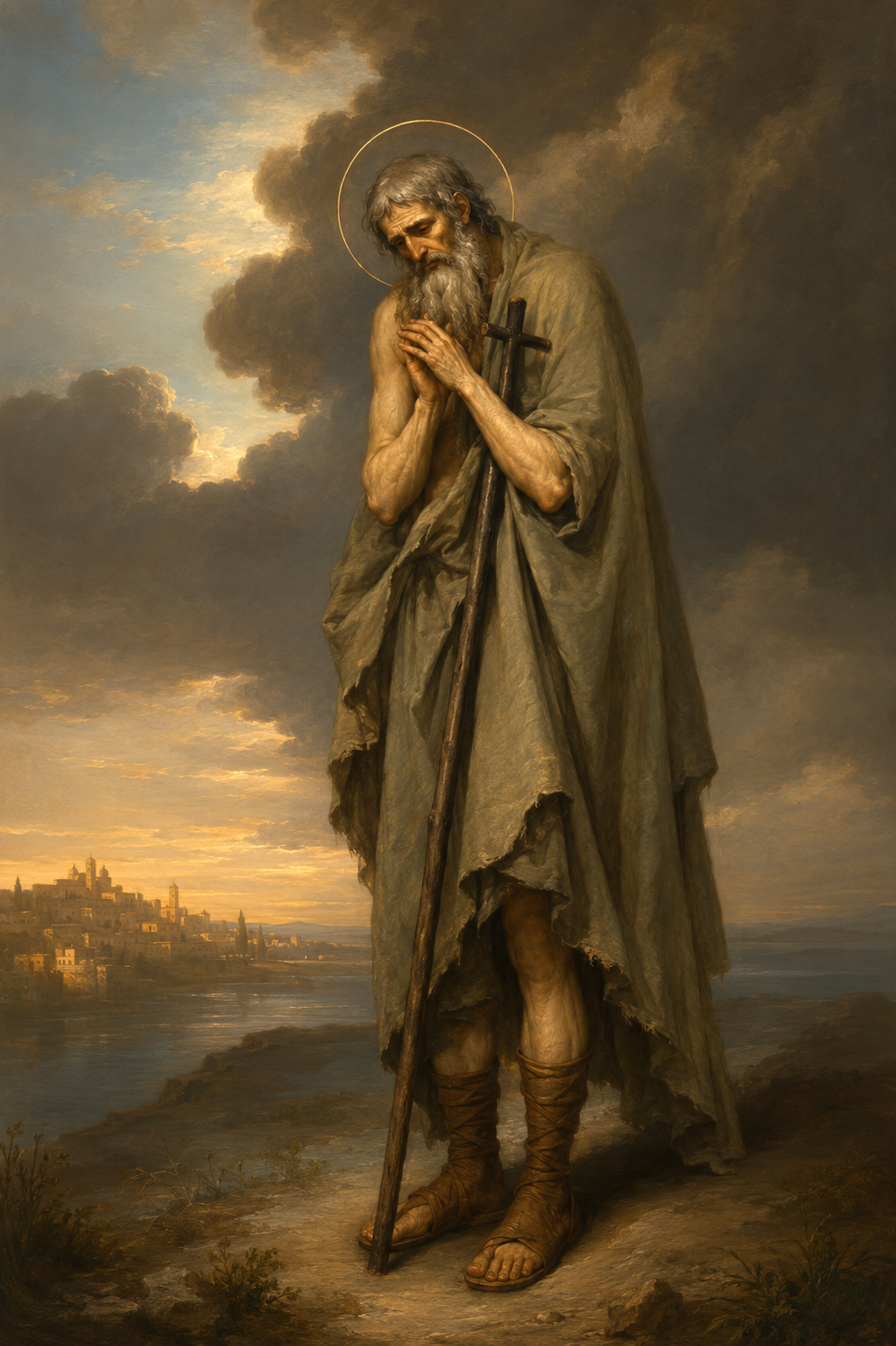
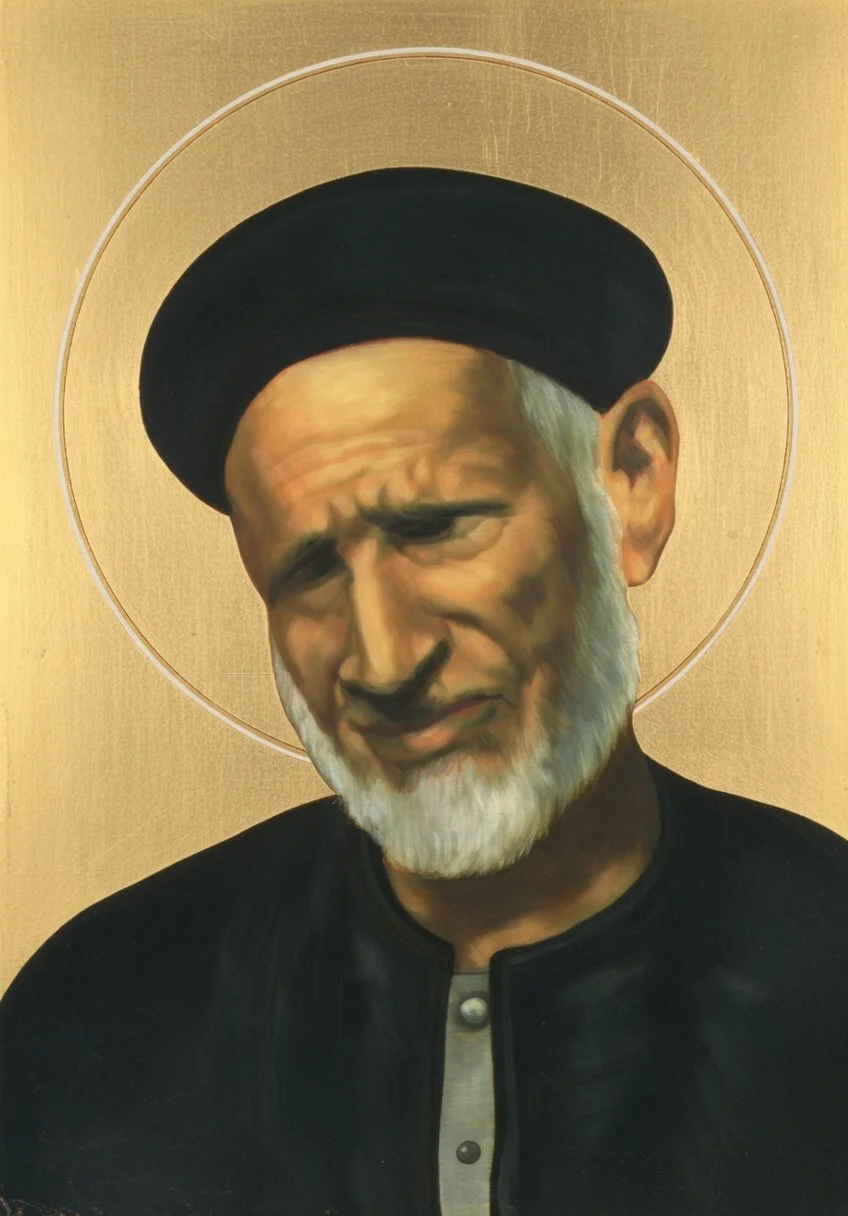
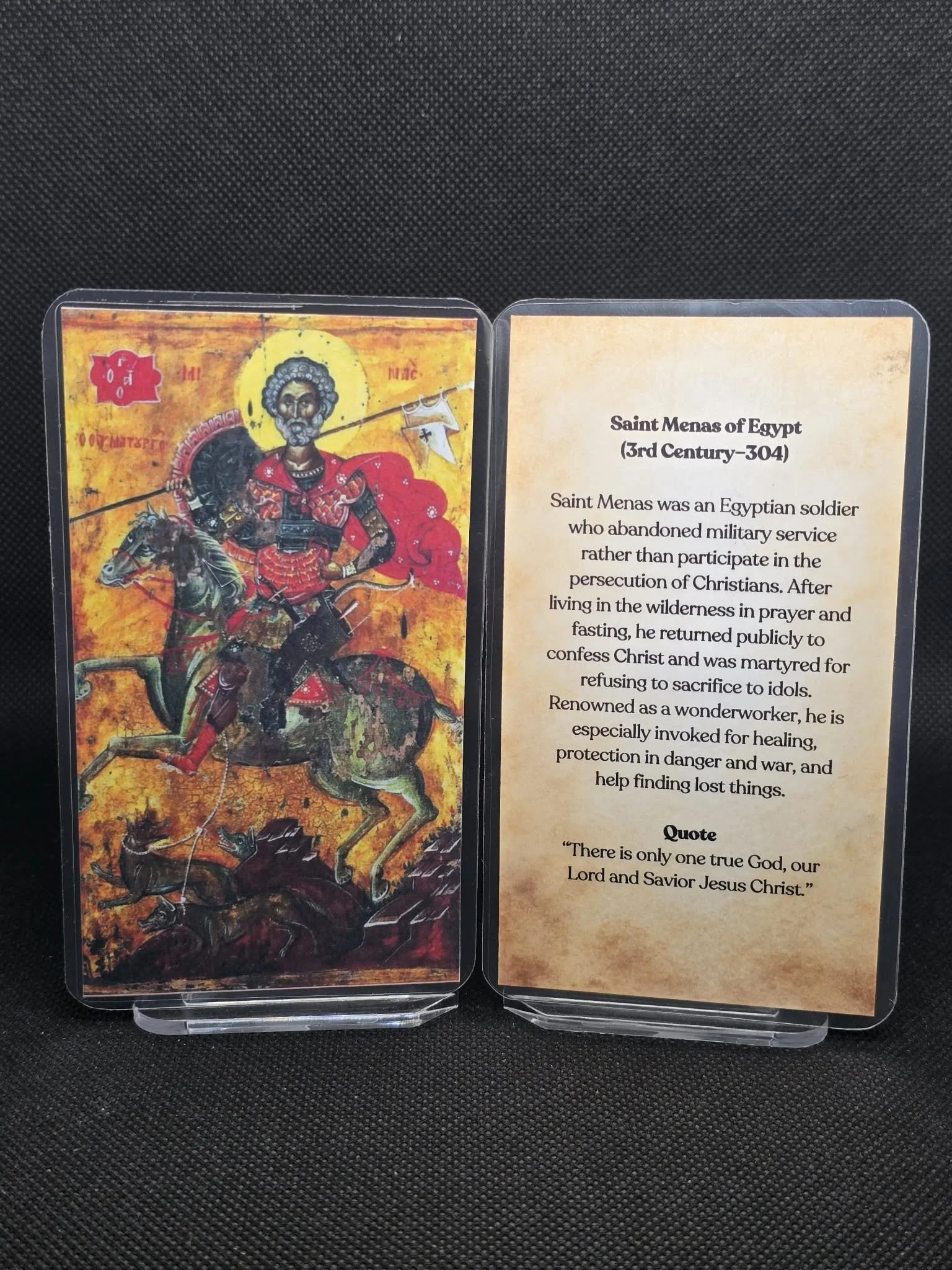
Saint Menas is commonly depicted as a young or middle-aged soldier, often wearing military clothing or armor with a red cloak. Coptic images frequently show his hands lifted in prayer and place two camels at his feet or beside him.
The camels are his most distinctive identifying feature because they refer to the tradition concerning the transportation and divinely chosen resting place of his relics. Ancient Menas flasks show this same composition, proving that the imagery reaches back to the early centuries of his pilgrimage cult.
Some icons also include representations of his church or monastery, connecting the martyr with Abu Mena and the living monastic devotion that continues in Egypt.
PRAYERS
Saint Menas already possesses established liturgical hymns, so there is no need to invent a new saint-specific prayer. The Byzantine Troparion celebrates him as the soldier who abandoned an earthly army, endured martyrdom, and received an unfading heavenly crown.
A particularly suitable established invocation from that hymn is:
“O Great Martyr Menas, intercede with Christ God to save our souls.”
The Coptic Synaxarium likewise concludes his Life with the invocation that the intercession of Mari-Mina be with us, demonstrating how naturally his intercession remains woven into Coptic devotion.
Someone who has lost an important object can ask Saint Menas to help recover it. Someone who is ill can ask for his intercession for healing and endurance, while a soldier or person facing danger can seek his prayers for protection, courage, and fidelity to Christ.
FAQ
Who was Saint Menas of Egypt? Saint Menas was an Egyptian Christian associated with Roman military service who received martyrdom during the persecutions of the early fourth century. He became one of Egypt's most famous miracle-working saints, and his burial place developed into the enormous pilgrimage center known as Abu Mena.
Is Saint Menas the same as Saint Mina? Yes. Menas, Mina, Mena, and the Coptic title Mari-Mina are different forms used for the same Egyptian Great Martyr.
Why is Saint Menas called the Wonderworker? The Coptic Synaxarium explicitly calls him Mari-Mina the Wonder Worker and preserves numerous miracles connected with his relics and shrine. His reputation for miraculous intercession became strong enough that pilgrims traveled internationally to Abu Mena seeking his help.
Was Saint Menas a soldier? Yes. The Byzantine Life identifies him as an Egyptian military officer who served in the Roman army before withdrawing when imperial orders required pagan worship and persecution of Christians.
Why did Saint Menas leave the army? Imperial orders required soldiers to participate in idolatry and persecute Christians. Menas chose to abandon his military rank rather than violate his faith.
Is Saint Menas a good saint for soldiers and veterans? Yes. His military background, courage, protection tradition, and refusal to violate conscience make him especially meaningful for soldiers and veterans. His Life shows that military discipline must remain subordinate to fidelity to God.
Is Saint Menas a patron of finding lost things? Orthodox tradition explicitly recommends asking Saint Menas for help when objects have been lost. The precise historical origin of the devotion is uncertain, but the practice itself is clearly preserved by the Orthodox Church.
Can I pray to Saint Menas when I lose something? Yes. The OCA specifically says Christians pray to Saint Menas for help finding lost objects, making this one of his distinctive devotional associations.
Is Saint Menas associated with healing? Yes. Healing is one of the strongest themes in both Coptic and Byzantine traditions surrounding him. His ancient shrine became a pilgrimage center particularly renowned for miracles associated with the martyr's tomb.
Can I pray to Saint Menas for serious illness? Yes. His tradition includes healing from diseases, and his shrine drew generations of Christians seeking healing through his intercession.
Is Saint Menas associated with protection? Yes. Both Coptic and Byzantine traditions remember him as a powerful protector, particularly in situations involving war and danger.
Is Saint Menas associated with spiritual protection? Yes. The Byzantine Life includes deliverance from demonic possession among the forms of help attributed to his intercession.
Why are there camels in Saint Menas icons? The camels refer to the tradition that his relics were carried into the Egyptian desert and that the animal transporting them stopped at the place God had chosen for his burial. The image of Menas between two camels appears on ancient pilgrimage flasks dating back to Late Antiquity.
Were the Saint Menas flasks real ancient objects? Yes. Numerous early Christian Menas ampullae survive today in museums around the world. They were used by pilgrims visiting his shrine to carry substances such as water or oil home from the holy site.
What did the ancient Saint Menas flasks look like? Many were small round terracotta vessels showing Saint Menas standing with his arms raised while two camels kneel beside him. This design became one of the most recognizable images in early Christian pilgrimage art.
What was Abu Mena? Abu Mena was the enormous early Christian pilgrimage settlement that developed around the tomb of Saint Menas southwest of Alexandria. UNESCO identifies it as a major pilgrimage and monastic center dating principally from the fifth through seventh centuries.
Is Abu Mena still there today? The ancient city's archaeological remains survive and are designated a UNESCO World Heritage Site. A modern Coptic monastery dedicated to Saint Menas also exists in the Mariout region near the ancient pilgrimage site.
Was Saint Menas Egyptian? Yes. Both Coptic and Byzantine traditions identify him as Egyptian, although they preserve differing details about his family and military service.
When did Saint Menas die? The Byzantine tradition places his martyrdom in 304 AD during the persecution associated with Diocletian and Maximian. The Coptic tradition likewise places him within the Diocletian persecution, even though its fuller biography differs in some details.
How was Saint Menas martyred? After refusing repeated demands to sacrifice to pagan gods, Menas was tortured and ultimately executed by beheading.
What is Saint Menas' Coptic feast day? The Coptic Orthodox Church celebrates his martyrdom on 15 Hator, ordinarily November 24 on the Gregorian calendar. The Coptic Synaxarium calls the feast “The Martyrdom of Saint Mari-Mina, the Wonder Worker.”
Why do some calendars list Saint Menas on November 11? Byzantine Orthodox Churches commemorate Saint Menas of Egypt on November 11. The difference reflects the distinct Coptic and Byzantine liturgical calendars rather than two different saints.
What is Saint Menas' connection to Pope Kyrillos VI? Pope Kyrillos VI had a deep devotion to Saint Menas and helped establish the modern Monastery of Saint Mina in the Mariout region near the ancient pilgrimage site. The Coptic Synaxarium specifically remembers his efforts to renew devotion there.
Is Saint Menas Coptic Orthodox? He is one of the most beloved saints of the Coptic Orthodox Church, where he is known as Mari-Mina the Wonderworker. His devotion also spread widely through Byzantine Christianity and beyond Egypt.
Do Eastern Orthodox Christians venerate Saint Menas? Yes. The Orthodox Church in America commemorates him on November 11 as the Great Martyr Menas of Egypt and provides established Troparion and Kontakion hymns for his feast.
Why is Saint Menas shown with his hands raised? The raised hands represent the ancient Christian posture of prayer known as orans. Ancient pilgrimage flasks already depict Menas in this position, emphasizing his identity as an intercessor before God.
Is there a traditional prayer to Saint Menas? Yes. His Byzantine Troparion invokes him specifically as the Great Martyr and asks him to intercede with Christ, while Coptic devotional tradition likewise repeatedly invokes the intercession of Mari-Mina.
Can Saint Menas be prayed to before military deployment? Yes. His own military history and longstanding association with protection during war make this a particularly natural devotional use of his prayer card.
Can this card be given to someone who constantly loses things? Yes. Saint Menas' recognized Orthodox association with finding lost objects makes it a particularly thoughtful and practical devotional gift.
Can this card be given to someone who is sick? Yes. Healing lies at the center of the ancient pilgrimage tradition surrounding Saint Menas, making the card appropriate during illness, surgery, treatment, or recovery.
What does Saint Menas teach about courage? His story teaches that courage is greater than physical bravery. A man remembered as a capable soldier ultimately demonstrated deeper courage when he surrendered military rank and accepted death rather than act against his Christian conscience.
What does Saint Menas teach about obedience? His Life shows that earthly obedience has limits. The Christian may owe genuine obedience to legitimate authority, but no human authority can rightfully require idolatry, persecution, or denial of Christ.
What does Saint Menas teach about protection? His miracles remind Christians that protection ultimately comes from God rather than military strength, wealth, or human control. Menas' role is that of an intercessor who continually points the faithful toward divine help.
What is the main message of Saint Menas of Egypt's life? Saint Menas' life teaches that a person can surrender earthly security without surrendering what matters most. The Egyptian soldier abandoned his rank rather than participate in persecution, trained himself in fasting and prayer, returned from the desert to confess Christ openly, endured torture without apostasy, and received martyrdom rather than sacrifice to idols. After his death, the place where his relics came to rest became one of the greatest pilgrimage centers of early Christianity, the sick sought healing there, travelers carried his image across the ancient world, soldiers sought his protection, and generations of Christians came to know the Egyptian martyr as Mari-Mina the Wonderworker.
Saint Menas of Egypt, also known as Saint Mina, Mari-Mina, or Menas the Wonderworker, was an Egyptian soldier and martyr whose devotion became so widespread that his shrine at Abu Mena near Alexandria grew into one of the great pilgrimage centers of early Christianity. The Coptic Church remembers him especially as Mari-Mina the Wonderworker, while Byzantine tradition honors him as a Great Martyr who abandoned an earthly military career rather than participate in the persecution of Christians. His ancient devotion is strongly associated with miracles, healing, protection, military courage, deliverance in danger, and even finding things that have been lost.
Saint Menas is especially meaningful for soldiers, veterans, military families, people facing danger, Christians suffering persecution, the sick, people seeking healing, those experiencing spiritual oppression, travelers, and anyone searching for something important that has been lost. The Orthodox Church in America specifically preserves the practice of asking Saint Menas for help finding lost objects and also describes him as a protector in wartime who became famous for healing illnesses and delivering people from demonic affliction.
His association with miracles is equally strong within the Coptic tradition. The Coptic Synaxarium calls him “Mari-Mina the Wonder Worker” and preserves stories of miraculous healing, supernatural protection, the discovery of his relics, and the growth of an enormous pilgrimage center around his burial place. The fame of that shrine is not known only from later devotional literature because the archaeological remains of Abu Mena survive today as a UNESCO World Heritage Site, which UNESCO describes as a major early Christian pilgrimage center that developed around the tomb of Saint Menas and the miracles attributed to it.
One of the most recognizable features of Saint Menas' iconography is the presence of two camels. According to the ancient Christian tradition, his body was returned to Egypt after his martyrdom and eventually placed on a camel so that divine providence could indicate where he should be buried. When the animal reached the area southwest of Alexandria associated with Lake Mariout, it stopped and refused to continue. Attempts to move the saint's body farther failed, and the place became identified as the location God had chosen for his tomb.
That is why ancient images of Saint Menas so often show him standing between two kneeling camels with his arms raised in prayer. This is not merely a modern Coptic artistic convention. Hundreds of early Christian pilgrimage flasks, called ampullae, survive from roughly the fifth through seventh centuries showing exactly this image, and examples are preserved today in museums including the Metropolitan Museum of Art and the British Museum.
Saint Menas is therefore especially fitting for someone who needs a saint connected with courage and protection without glorifying violence. He had belonged to the military world, but when imperial service required participation in idolatry and persecution, he chose Christ over his rank. His story asks the Christian a difficult question: when earthly loyalty and faith come into direct conflict, which one has the final claim upon the conscience?
This prayer card can make a meaningful gift for a soldier leaving for deployment, a veteran, someone starting military service, a person undergoing serious medical treatment, someone facing an apparently dangerous situation, or a family member who repeatedly asks Saint Menas for help finding lost belongings. It is also particularly meaningful for Coptic Christians because Saint Menas became one of the most beloved Egyptian martyrs and gave his name to one of the ancient world's most important Christian pilgrimage centers.
Each 2.5" x 4.25" prayer card is handmade in Austin, Texas and prepared prayerfully with each order. It is printed on museum-quality photo paper rather than cardstock, double-laminated for durability, and made while the recipient and their intentions are lifted before Christ in prayer, with Saint Menas asked to intercede for them.
THE LIFE & STORY
The traditions surrounding Saint Menas preserve several variations concerning the details of his early life, but the major traditions agree that he was Egyptian, connected with military service, withdrew rather than participate in pagan worship, openly confessed Christ, and received martyrdom during the persecutions associated with Diocletian and Maximian. The Byzantine tradition places his martyrdom around 304 AD and describes him as an Egyptian military officer serving in the region of Kotyaeion in Phrygia.
The Coptic Synaxarium preserves a fuller Egyptian family tradition. It names his father Eudoxius, describes him as a governor, and says Menas' mother Euphemia had long prayed for a child. While praying before an icon of the Virgin Mary, she heard the word “Amen,” and when a son was eventually born he was named Mina in connection with that answer to prayer.
These traditions developed in different parts of the Christian world, so not every biographical detail can simply be harmonized into one modern chronological biography. What remained consistent was the Church's memory of an Egyptian Christian associated with military life, desert withdrawal, courageous public confession, martyrdom, and an extraordinary posthumous reputation as a miracle-worker.
THE SOLDIER WHO WALKED AWAY FROM HIS RANK
The Byzantine Life says that when the emperors ordered soldiers to participate in pagan worship and assist in the persecution of Christians, Menas threw down the belt that represented his military rank and withdrew into the mountains. He preferred deprivation in the wilderness to participating in actions that violated his Christian faith.
This decision is one reason he can be especially meaningful for modern soldiers and military personnel. Saint Menas does not represent contempt for military service because he had served honorably and was remembered for bravery, patience, and discipline. His witness instead establishes a boundary: military obedience cannot become absolute when an order requires betrayal of God.
A SAINT FOR SOLDIERS & VETERANS
Saint Menas' military history gives his devotion a natural connection with soldiers, veterans, and people working in dangerous professions. His traditional Life remembers him as courageous in battle before his withdrawal, while later Christian devotion increasingly regarded him as a protector in times of war.
That combination makes him especially meaningful for someone trying to unite courage with conscience. Physical bravery is important, but Menas' decisive act of courage was refusing to allow military rank to become more important than fidelity to Christ.
THE DESERT
After abandoning his military position, Menas withdrew into solitude and gave himself to fasting, prayer, and ascetic struggle. The OCA tradition describes him living for a considerable time in the wilderness, practicing prayer, fasting, and nightly vigils until he believed God was calling him toward martyrdom.
The Coptic tradition likewise remembers him leaving his position during the Diocletian persecution and going into the desert to worship God. His story therefore joins two identities that might initially appear opposed: soldier and ascetic.
The discipline previously required by military life acquired a different purpose. Menas no longer trained for an earthly campaign, but for the spiritual struggle of remaining faithful when death became a possibility.
THE VISION OF THE MARTYRS' CROWNS
The Coptic Synaxarium says that while Menas was in the desert, he received a vision of the heavens opened and martyrs receiving beautiful crowns. He understood the vision as a call to confess Christ openly rather than remain safely hidden.
The Byzantine tradition preserves a similar movement in his spiritual life. After a long period of ascetic preparation, divine grace strengthened him and he became convinced that his path would end in martyrdom.
Menas therefore returned voluntarily toward danger.
HE WALKED INTO A PAGAN FESTIVAL & CONFESSED CHRIST
According to the Byzantine Life, the city was celebrating a pagan festival when Menas entered the crowd and openly proclaimed Jesus Christ as the true God. People abandoned the games and celebrations to see who had dared interrupt the public rites so boldly.
He was arrested and brought before the authorities. When questioned, Menas openly identified himself as an Egyptian and a servant of Jesus Christ, explaining that he had preferred the wilderness to obeying commands requiring idolatry and persecution.
This public confession is central to his sainthood. He did not die accidentally during a political disturbance because he knowingly chose open Christian witness when silence could have preserved his life.
OFFERED HIS MILITARY RANK BACK
The authorities attempted to persuade Menas rather than immediately execute him. According to the OCA account, he was offered restoration to his former military position if he would sacrifice to the pagan gods.
The offer made the decision even clearer. Menas could recover honor, rank, security, and normal life by performing one act against his conscience.
He refused.
TORTURE & MARTYRDOM
Menas was then subjected to severe torture in an attempt to force him to renounce Christ. When these punishments failed to change his confession, the authorities ordered his execution by beheading.
The Byzantine tradition places his martyrdom in 304 AD. The Coptic Church commemorates his martyrdom on 15 Hator, which currently corresponds to November 24 on the Gregorian calendar, while Byzantine Orthodox Churches commemorate him on November 11.
This calendar difference is not a disagreement about which saint is being celebrated. It reflects different liturgical traditions preserving their own ancient calendars and feast arrangements.
HIS BODY RETURNS TO EGYPT
Before his execution, Menas asked Christian friends to take his body back to Egypt when circumstances allowed. Christian tradition then preserves a series of events through which his relics eventually returned to the Egyptian homeland with which his devotion became permanently connected.
The Coptic account includes dramatic miracles during the journey, including protection while the relics were being transported by sea. The larger theological point remained consistent: the martyr who had died far from Egypt would ultimately return home.
WHY ARE THERE CAMELS IN SAINT MENAS ICONS?
The camels in Saint Menas' icon are among the most historically recognizable symbols associated with any early Christian saint. According to the Coptic tradition, an angel instructed that Menas' body be placed on a camel and taken from Alexandria without anyone directing the animal. The camel eventually stopped at a place near Lake Mariout, indicating where the martyr was to be buried.
Later, when authorities attempted to move the body elsewhere, the camel carrying it again refused to proceed. Even placing the relics upon another camel produced the same result, reinforcing the conviction that the saint's burial place had been divinely chosen.
That story explains why Saint Menas appears between two kneeling camels on countless ancient pilgrimage objects.
THE TWO CAMELS ARE AN ANCIENT SYMBOL, NOT A MODERN ADDITION
Archaeology confirms how early and widespread this iconography became. Pilgrim flasks dating roughly from the fifth to seventh centuries repeatedly show Saint Menas standing with raised arms between two camels. The Metropolitan Museum of Art and British Museum preserve numerous surviving examples.
The image became so recognizable that a small flask showing a saint between camels could immediately identify Menas to Christians living more than a thousand years ago.
For modern prayer-card art, preserving the camels is therefore historically valuable. They are not decorative desert animals but an ancient visual shorthand for the saint's relics, burial, and pilgrimage tradition.
THE HEALING OF THE GIRL WITH LEPROSY
One of the healing miracles preserved in the Coptic Synaxarium concerns a governor's daughter suffering from leprosy. She came to the area associated with the saint's body, used earth from the place in faith, and received a dream in which Menas instructed her where to dig.
When she awoke, the tradition says she had been healed and then discovered the saint's relics at the place he had indicated. The healing helped establish public knowledge of the burial site and contributed to the development of the shrine.
This is one reason healing became inseparable from devotion to Saint Menas.
SAINT MENAS THE WONDERWORKER
The Coptic Church does not remember him merely as Saint Menas the Martyr. The Synaxarium explicitly calls him “Mari-Mina the Wonder Worker.”
Miracles associated with his relics became so numerous that people traveled great distances to his tomb seeking healing and intercession. Eventually an entire pilgrimage city developed in the desert around the shrine.
His title therefore functions much like those of other famous wonderworkers in Eastern Christianity. It tells us that miracles became one of the defining features of his continuing devotional reputation.
ABU MENA, ONE OF THE GREAT PILGRIMAGE CENTERS OF EARLY CHRISTIANITY
The burial place of Saint Menas developed into the enormous Christian complex now known as Abu Mena, southwest of Alexandria. UNESCO describes the site as an early Christian pilgrimage center that grew around the martyr's tomb and attracted pilgrims because the tomb was believed to work miracles.
Between approximately the fifth and seventh centuries, Abu Mena expanded into a remarkable religious settlement containing churches, baptisteries, monastic buildings, pilgrim facilities, workshops, and other structures. UNESCO considers the archaeological site sufficiently important to Christianity and world history that it has been designated a World Heritage Site.
The devotion to Saint Menas was therefore not small or geographically isolated. His shrine became internationally famous.
THE SAINT MENAS PILGRIM FLASKS
Pilgrims visiting Abu Mena commonly carried home small clay containers known as Menas flasks or ampullae. The vessels could contain holy water, oil, or other material associated with the shrine and normally displayed the saint standing between his two camels.
These small objects became some of the most recognizable Christian pilgrimage souvenirs of Late Antiquity. Surviving examples have been found far beyond Egypt, showing just how widely devotion to Menas traveled.
One British Museum example associated with the Menas type was reportedly found at Canterbury in England, an extraordinary distance from Egypt. Even allowing for later movement of objects, the survival and geographic spread of Menas ampullae demonstrate the international reach of his ancient cult.
WHY SAINT MENAS IS OFTEN SHOWN WITH HIS ARMS RAISED
Many traditional images show Menas with both arms raised in prayer, a posture known as the orans position. The ancient pilgrim flasks preserved by the British Museum repeatedly depict him this way.
The gesture shifts attention away from Menas as an independent source of supernatural power. The Wonderworker is shown praying, making clear that miracles and protection ultimately come from God.
That is especially important in devotional art. The saint intercedes, but Christ remains the source of grace.
A SAINT FOR HEALING
Healing is one of the strongest devotional associations with Saint Menas. The Coptic tradition preserves numerous miracles associated with his relics, while the Byzantine Life summarizes his continuing intercession as including healing from various illnesses.
A Saint Menas prayer card can therefore be especially meaningful during chronic illness, surgery, cancer treatment, unexplained medical problems, or a prolonged period of recovery.
His ancient shrine itself became famous in large part because sick pilgrims came seeking healing.
A SAINT FOR FINDING LOST THINGS
One of the most unusual aspects of devotion to Saint Menas is his connection with lost objects. The Orthodox Church in America explicitly concludes its Life of Menas by stating that Christians pray to him for assistance in finding things that have been lost.
This makes him a particularly useful saint to know because the devotion is both practical and anciently rooted in a broader reputation for miraculous help.
A Saint Menas card may therefore be kept near a desk, in a wallet, prayer book, vehicle, or home prayer corner as a reminder to seek his intercession when something important goes missing.
WHY IS SAINT MENAS INVOKED FOR LOST OBJECTS?
The precise historical origin of his lost-object association is less clearly documented than his military, healing, and Abu Mena traditions. For that reason, it is better not to invent a specific miracle and claim it started the devotion.
What can be said securely is that the practice itself exists in Orthodox tradition, and the OCA explicitly recommends asking Saint Menas for help finding lost objects.
The devotional association is therefore real even where its earliest origin is uncertain.
A SAINT FOR PROTECTION
Saint Menas became associated not only with individual healing but with protection from danger. The Coptic Synaxarium preserves a tradition in which his relics were carried with an army facing enemies from the Pentapolis region, and his intercession was credited with the successful defense that followed.
The Byzantine tradition likewise calls him a protector during wartime.
This makes Saint Menas especially meaningful for military families, travelers, people in dangerous occupations, or anyone asking for protection during a threatening period.
SAINT MENAS & EL ALAMEIN
A much later Orthodox tradition connects Saint Menas with the Second Battle of El Alamein in 1942, fought not far from the ancient region of his shrine. The OCA preserves an account in which Saint Menas was seen leading camels from his ancient church toward the enemy camp before Axis forces were thrown into confusion and eventually defeated.
This should be presented as a modern devotional tradition, not as something established through military archives in the same way as the battle's conventional historical record. Its importance lies in showing how strongly Egyptian and Orthodox Christians continued associating Saint Menas with protection in war even many centuries after his martyrdom.
A SAINT FOR SPIRITUAL PROTECTION
The Orthodox Life also identifies Menas with deliverance from demonic possession. His wonderworking reputation therefore extends beyond physical sickness into the older Christian understanding of spiritual affliction and protection.
For personal devotion, this association should remain within ordinary Church life rather than becoming superstition. Prayer, confession, the Eucharist, pastoral guidance, and the Church's established prayers remain central, while Saint Menas is asked to intercede before Christ.
POPE KYRILLOS VI & THE MODERN MONASTERY OF SAINT MENAS
The ancient city of Abu Mena eventually declined and was largely lost beneath the desert, but devotion to Menas never disappeared. In the twentieth century, Pope Kyrillos VI of Alexandria played a major role in renewing monastic life near the ancient site and establishing the modern Monastery of Saint Mina at Mariout.
The Coptic Synaxarium specifically remembers Pope Kyrillos' devotion to the saint and his investment in developing the monastery. The modern monastery continues drawing Coptic pilgrims, linking present-day Egyptian Christianity directly with one of the great pilgrimage traditions of Late Antiquity.
A SAINT DEEPLY CONNECTED WITH COPTIC CHRISTIANITY
Saint Menas is profoundly Egyptian and Coptic. The Coptic Church calls him Mari-Mina the Wonderworker, keeps his martyrdom feast on 15 Hator, preserves his miracle stories in the Synaxarium, maintains monasteries and churches under his patronage, and continues pilgrimage to the region associated with his relics.
At the same time, his ancient devotion spread far beyond Egypt. Byzantine Orthodox Christians honor him on November 11, and his ancient pilgrimage flasks traveled throughout the Mediterranean and beyond.
He is therefore both a particularly beloved Coptic saint and a saint whose veneration belongs to the broader ancient Christian East.
FEAST DAY
In the Coptic Orthodox Church, Saint Menas' martyrdom is commemorated on 15 Hator, ordinarily corresponding to November 24 on the modern Gregorian calendar. The Coptic Synaxarium lists the feast as “The Martyrdom of Saint Mari-Mina, the Wonder Worker.”
The Coptic tradition also preserves additional commemorations connected with his churches, including 15 Paona for the church at Mariout and 1 Abib for the consecration of an early church in his name.
In the Byzantine Orthodox calendar, Saint Menas of Egypt is commemorated on November 11.
ICONOGRAPHY
Saint Menas is commonly depicted as a young or middle-aged soldier, often wearing military clothing or armor with a red cloak. Coptic images frequently show his hands lifted in prayer and place two camels at his feet or beside him.
The camels are his most distinctive identifying feature because they refer to the tradition concerning the transportation and divinely chosen resting place of his relics. Ancient Menas flasks show this same composition, proving that the imagery reaches back to the early centuries of his pilgrimage cult.
Some icons also include representations of his church or monastery, connecting the martyr with Abu Mena and the living monastic devotion that continues in Egypt.
PRAYERS
Saint Menas already possesses established liturgical hymns, so there is no need to invent a new saint-specific prayer. The Byzantine Troparion celebrates him as the soldier who abandoned an earthly army, endured martyrdom, and received an unfading heavenly crown.
A particularly suitable established invocation from that hymn is:
“O Great Martyr Menas, intercede with Christ God to save our souls.”
The Coptic Synaxarium likewise concludes his Life with the invocation that the intercession of Mari-Mina be with us, demonstrating how naturally his intercession remains woven into Coptic devotion.
Someone who has lost an important object can ask Saint Menas to help recover it. Someone who is ill can ask for his intercession for healing and endurance, while a soldier or person facing danger can seek his prayers for protection, courage, and fidelity to Christ.
FAQ
Who was Saint Menas of Egypt? Saint Menas was an Egyptian Christian associated with Roman military service who received martyrdom during the persecutions of the early fourth century. He became one of Egypt's most famous miracle-working saints, and his burial place developed into the enormous pilgrimage center known as Abu Mena.
Is Saint Menas the same as Saint Mina? Yes. Menas, Mina, Mena, and the Coptic title Mari-Mina are different forms used for the same Egyptian Great Martyr.
Why is Saint Menas called the Wonderworker? The Coptic Synaxarium explicitly calls him Mari-Mina the Wonder Worker and preserves numerous miracles connected with his relics and shrine. His reputation for miraculous intercession became strong enough that pilgrims traveled internationally to Abu Mena seeking his help.
Was Saint Menas a soldier? Yes. The Byzantine Life identifies him as an Egyptian military officer who served in the Roman army before withdrawing when imperial orders required pagan worship and persecution of Christians.
Why did Saint Menas leave the army? Imperial orders required soldiers to participate in idolatry and persecute Christians. Menas chose to abandon his military rank rather than violate his faith.
Is Saint Menas a good saint for soldiers and veterans? Yes. His military background, courage, protection tradition, and refusal to violate conscience make him especially meaningful for soldiers and veterans. His Life shows that military discipline must remain subordinate to fidelity to God.
Is Saint Menas a patron of finding lost things? Orthodox tradition explicitly recommends asking Saint Menas for help when objects have been lost. The precise historical origin of the devotion is uncertain, but the practice itself is clearly preserved by the Orthodox Church.
Can I pray to Saint Menas when I lose something? Yes. The OCA specifically says Christians pray to Saint Menas for help finding lost objects, making this one of his distinctive devotional associations.
Is Saint Menas associated with healing? Yes. Healing is one of the strongest themes in both Coptic and Byzantine traditions surrounding him. His ancient shrine became a pilgrimage center particularly renowned for miracles associated with the martyr's tomb.
Can I pray to Saint Menas for serious illness? Yes. His tradition includes healing from diseases, and his shrine drew generations of Christians seeking healing through his intercession.
Is Saint Menas associated with protection? Yes. Both Coptic and Byzantine traditions remember him as a powerful protector, particularly in situations involving war and danger.
Is Saint Menas associated with spiritual protection? Yes. The Byzantine Life includes deliverance from demonic possession among the forms of help attributed to his intercession.
Why are there camels in Saint Menas icons? The camels refer to the tradition that his relics were carried into the Egyptian desert and that the animal transporting them stopped at the place God had chosen for his burial. The image of Menas between two camels appears on ancient pilgrimage flasks dating back to Late Antiquity.
Were the Saint Menas flasks real ancient objects? Yes. Numerous early Christian Menas ampullae survive today in museums around the world. They were used by pilgrims visiting his shrine to carry substances such as water or oil home from the holy site.
What did the ancient Saint Menas flasks look like? Many were small round terracotta vessels showing Saint Menas standing with his arms raised while two camels kneel beside him. This design became one of the most recognizable images in early Christian pilgrimage art.
What was Abu Mena? Abu Mena was the enormous early Christian pilgrimage settlement that developed around the tomb of Saint Menas southwest of Alexandria. UNESCO identifies it as a major pilgrimage and monastic center dating principally from the fifth through seventh centuries.
Is Abu Mena still there today? The ancient city's archaeological remains survive and are designated a UNESCO World Heritage Site. A modern Coptic monastery dedicated to Saint Menas also exists in the Mariout region near the ancient pilgrimage site.
Was Saint Menas Egyptian? Yes. Both Coptic and Byzantine traditions identify him as Egyptian, although they preserve differing details about his family and military service.
When did Saint Menas die? The Byzantine tradition places his martyrdom in 304 AD during the persecution associated with Diocletian and Maximian. The Coptic tradition likewise places him within the Diocletian persecution, even though its fuller biography differs in some details.
How was Saint Menas martyred? After refusing repeated demands to sacrifice to pagan gods, Menas was tortured and ultimately executed by beheading.
What is Saint Menas' Coptic feast day? The Coptic Orthodox Church celebrates his martyrdom on 15 Hator, ordinarily November 24 on the Gregorian calendar. The Coptic Synaxarium calls the feast “The Martyrdom of Saint Mari-Mina, the Wonder Worker.”
Why do some calendars list Saint Menas on November 11? Byzantine Orthodox Churches commemorate Saint Menas of Egypt on November 11. The difference reflects the distinct Coptic and Byzantine liturgical calendars rather than two different saints.
What is Saint Menas' connection to Pope Kyrillos VI? Pope Kyrillos VI had a deep devotion to Saint Menas and helped establish the modern Monastery of Saint Mina in the Mariout region near the ancient pilgrimage site. The Coptic Synaxarium specifically remembers his efforts to renew devotion there.
Is Saint Menas Coptic Orthodox? He is one of the most beloved saints of the Coptic Orthodox Church, where he is known as Mari-Mina the Wonderworker. His devotion also spread widely through Byzantine Christianity and beyond Egypt.
Do Eastern Orthodox Christians venerate Saint Menas? Yes. The Orthodox Church in America commemorates him on November 11 as the Great Martyr Menas of Egypt and provides established Troparion and Kontakion hymns for his feast.
Why is Saint Menas shown with his hands raised? The raised hands represent the ancient Christian posture of prayer known as orans. Ancient pilgrimage flasks already depict Menas in this position, emphasizing his identity as an intercessor before God.
Is there a traditional prayer to Saint Menas? Yes. His Byzantine Troparion invokes him specifically as the Great Martyr and asks him to intercede with Christ, while Coptic devotional tradition likewise repeatedly invokes the intercession of Mari-Mina.
Can Saint Menas be prayed to before military deployment? Yes. His own military history and longstanding association with protection during war make this a particularly natural devotional use of his prayer card.
Can this card be given to someone who constantly loses things? Yes. Saint Menas' recognized Orthodox association with finding lost objects makes it a particularly thoughtful and practical devotional gift.
Can this card be given to someone who is sick? Yes. Healing lies at the center of the ancient pilgrimage tradition surrounding Saint Menas, making the card appropriate during illness, surgery, treatment, or recovery.
What does Saint Menas teach about courage? His story teaches that courage is greater than physical bravery. A man remembered as a capable soldier ultimately demonstrated deeper courage when he surrendered military rank and accepted death rather than act against his Christian conscience.
What does Saint Menas teach about obedience? His Life shows that earthly obedience has limits. The Christian may owe genuine obedience to legitimate authority, but no human authority can rightfully require idolatry, persecution, or denial of Christ.
What does Saint Menas teach about protection? His miracles remind Christians that protection ultimately comes from God rather than military strength, wealth, or human control. Menas' role is that of an intercessor who continually points the faithful toward divine help.
What is the main message of Saint Menas of Egypt's life? Saint Menas' life teaches that a person can surrender earthly security without surrendering what matters most. The Egyptian soldier abandoned his rank rather than participate in persecution, trained himself in fasting and prayer, returned from the desert to confess Christ openly, endured torture without apostasy, and received martyrdom rather than sacrifice to idols. After his death, the place where his relics came to rest became one of the greatest pilgrimage centers of early Christianity, the sick sought healing there, travelers carried his image across the ancient world, soldiers sought his protection, and generations of Christians came to know the Egyptian martyr as Mari-Mina the Wonderworker.