 Image 1 of 1
Saint Nestor of Thessalonica Prayer Card | Unofficial Patron of MMA Fighters, Wrestlers & Combat Athletes
Saint Nestor of Thessalonica was a young Christian martyr remembered for one of the most extraordinary combat stories in the early Church. During the persecution of Christians in Thessalonica, he entered a public arena against Lyaeus, a gigantic and feared wrestler who had repeatedly defeated and killed his opponents, but before stepping into the contest Nestor first went to the imprisoned Saint Demetrios and asked for his blessing. Strengthened by that blessing and invoking the God of Demetrios, the young Christian defeated the physically overwhelming champion before being executed for his faith. The Orthodox Church commemorates Saint Nestor on October 27, immediately following the October 26 feast of his teacher and spiritual father, Saint Demetrios the Great Martyr.
For obvious reasons, Saint Nestor has become an especially compelling saint for MMA fighters, wrestlers, grapplers, boxers, martial artists, strength athletes, combat-sports coaches, competitors, and young men trying to unite physical courage with Christian faith. Calling him the unofficial patron saint of MMA fighters is a modern expression, but the connection is unusually strong. His actual Church tradition remembers him entering a lethal public combat contest, facing an opponent famous for size and physical dominance, receiving his spiritual father's blessing before the fight, invoking God as he entered the stadium, defeating the champion, and then accepting martyrdom when victory enraged the emperor.
The MMA connection becomes even stronger when we look at the Church's own liturgical language. The Greek Orthodox Menaion calls Nestor a “Martyr Athlete,” describes him meeting Lyaeus “in the ring,” speaks of his physical victory in the language of wrestling, and praises him as a strong young man who bested Lyaeus through the power of God. The OCA Troparion similarly calls him an “invincible athlete of godliness” who contended bravely and defeated Lyaeus by divine help. This is not modern marketing language placed on top of an unrelated saint because combat, athletic struggle, courage, training, contest, victory, and spiritual warfare are already embedded in the Church's worship surrounding Nestor.
Saint Nestor is especially meaningful for a fighter preparing to step into the cage, ring, wrestling room, tournament, or difficult training camp. His story does not promise that faith guarantees athletic victory, because Nestor's greatest victory ultimately came through martyrdom rather than through preserving his earthly life. Instead, he gives Christian combat athletes a much deeper model: train seriously, enter competition courageously, refuse arrogance, seek God's help rather than worshiping your own strength, and remember that winning a fight is never more important than becoming the kind of man Christ can call faithful.
Saint Nestor also provides an excellent corrective to the ego that can grow around fighting. Lyaeus was remembered precisely for boasting in his enormous strength and humiliating opponents, while Nestor approached the contest by first kneeling before Saint Demetrios, asking for prayer, receiving the sign of the Cross, and entering the arena invoking God rather than proclaiming confidence in himself. Their confrontation therefore represents two very different understandings of strength: strength that glorifies the fighter and strength consciously placed under God.
This prayer card is especially fitting for MMA fighters, Brazilian Jiu-Jitsu practitioners, wrestlers, boxers, kickboxers, Muay Thai fighters, grapplers, martial artists, combat-sports coaches, strength athletes, young athletes, military members, law enforcement officers, and anyone preparing for difficult physical competition. It can make a meaningful first-fight gift, competition gift, tournament gift, fight-camp devotional, wrestling-season gift, martial arts promotion gift, confirmation or chrismation gift, or addition to a fighter's gym bag, locker, training space, vehicle, Bible, prayer book, or home icon corner.
Each card is handmade in Austin, Texas and created to order. It is printed on museum-quality photo paper and double laminated for durability, making it particularly suitable for someone who may keep the card in a gym bag, training journal, locker, or vehicle. Each card is handled prayerfully during production, with the recipient's intentions lifted before Christ and Saint Nestor asked to intercede for the person who will receive it.
THE LIFE & STORY
Saint Nestor lived in Thessalonica, modern Thessaloniki in Greece, during the great persecutions of Christians associated with Emperor Galerius Maximian around the beginning of the fourth century. The OCA places his martyrdom around 306, although older traditions contain some chronological variation concerning the exact year. What remains constant across the Orthodox sources is his youth, his relationship with Saint Demetrios, his contest against Lyaeus, and his execution after the victory.
The Orthodox Church remembers Nestor as a young Christian already known to Saint Demetrios the Great Martyr, who had instructed him in the faith. Demetrios was one of the major Christian figures of Thessalonica and had been imprisoned because of his open confession and teaching of Christianity. Nestor therefore entered the arena not merely as an isolated young believer but as a disciple whose courage had been formed under a spiritual father already preparing to die for Christ.
A YOUNG CHRISTIAN FIGHTER
Ancient and later Orthodox descriptions consistently emphasize Nestor's youth. The OCA calls him very young, while later Greek tradition describes him as approximately twenty years old or just reaching the age when a beard was beginning to grow. The Greek liturgical service praises him as a young man possessing bodily strength while also being adorned with wisdom and divine grace.
That combination matters for athletes because the Church does not portray physical ability itself as something shameful. Nestor is praised as physically strong, yet his strength becomes meaningful only because it operates within courage, faith, humility, and willingness to suffer for Christ. The body is not rejected, but neither is bodily power allowed to become the highest thing about the person.
THE STADIUM OF THESSALONICA
According to the Orthodox tradition, the emperor arranged public games in Thessalonica and created a raised fighting platform so that the contests could be watched by the crowd. A massive fighter named Lyaeus, Lyaios, or Lyeios became the central spectacle, and Orthodox sources describe him as a giant or exceptionally powerful wrestler whose size and strength made him feared throughout the stadium.
The arena described by the OCA was far removed from a regulated modern sporting event. Spears and other sharp weapons were positioned beneath the platform, and defeated opponents could be thrown from the platform to their deaths. The OCA tradition specifically remembers Christians among those forced into these contests and killed after being defeated by Lyaeus.
LYAΕUS, THE CHAMPION EVERYONE FEARED
Lyaeus was not remembered simply because he was large. The Greek Orthodox account describes him as a notable wrestler who boasted because of his height and physical strength and repeatedly challenged others to fight him. Opponent after opponent fell before him, turning his body and his victories into a spectacle of imperial power.
This is part of what makes the story resonate so naturally with combat athletes. Fighters understand the psychological presence created by an opponent with an intimidating record, unusual size, crushing strength, or reputation for destroying everyone placed in front of him. Nestor looked at precisely that kind of opponent and decided that fear would not determine what he did.
WHY NESTOR DECIDED TO FIGHT
Nestor saw the emperor delighting in the victories of Lyaeus and saw Christians humiliated and killed within the spectacle. The OCA says he was stirred by the arrogance surrounding the contests and took courage after witnessing the faith and miracles associated with Saint Demetrios.
His decision was therefore not presented as a young man searching for fame, prize money, or a chance to demonstrate that he was tougher than everyone else. He entered because the brutal champion had become an instrument through which Christians were being publicly degraded, and Nestor believed the fighter's pride needed to be confronted.
BEFORE THE FIGHT, HE WENT TO HIS SPIRITUAL FATHER
One of the strongest parts of Saint Nestor's story for modern fighters is what he did before entering the arena. He did not first gather a crowd, boast about what he planned to do, or proclaim confidence in his own conditioning because he went directly to the imprisoned Saint Demetrios and asked for his prayers and blessing.
Nestor fell before Demetrios and asked that through the saint's prayers God would help him defeat Lyaeus and end the disgrace being inflicted upon Christians. Demetrios responded by making the sign of the Cross over Nestor and telling him that he would indeed defeat Lyaeus, but that after the victory he would himself suffer for Christ.
A CHRISTIAN MODEL FOR THE PRE-FIGHT MOMENT
For a Christian MMA fighter, boxer, wrestler, or grappler, the image is unforgettable. Nestor had a fight ahead of him and went first for a blessing.
That does not mean a modern athlete should expect a priest to guarantee a win or imagine that God has chosen sides based simply on which competitor prays more. The more important lesson is that Nestor consciously placed the contest beneath his relationship with God before he entered it, recognizing that physical competition could never become the highest authority over his identity.
SAINT DEMETRIOS BLESSES THE FIGHTER
The relationship between Saint Nestor and Saint Demetrios is so central that the Church's hymns for both saints preserve it. The OCA Troparion for Demetrios says that he gave courage to Nestor in the stadium, while Nestor's own hymns remember him as friend and companion of Demetrios who received strength through his prayers.
This makes the two saints especially fitting together for a Christian fighter's icon corner. Demetrios represents the spiritual father who strengthens and blesses, while Nestor represents the young athlete who must actually walk into the arena and face what is waiting there.
NESTOR ENTERS THE ARENA
After receiving the blessing, Nestor entered the stadium without fear. The OCA remembers him invoking the God of Demetrios as he stepped onto the fighting platform, while Greek Orthodox tradition similarly records him making the sign of the Cross before engaging Lyaeus.
His confidence therefore was not presented as psychological self-hypnosis. Nestor knew his opponent was physically terrifying, but he understood that fear of Lyaeus was smaller than faithfulness to God.
For a modern fighter, that distinction can change the entire meaning of competition. Confidence does not have to mean pretending an opponent is harmless because courage means entering even when the challenge is real.
THE FIGHT BETWEEN NESTOR & LYAΕUS
The two men engaged in combat before the crowd. Orthodox sources vary somewhat in the exact physical detail, with the OCA emphasizing wrestling and the fatal fall from the platform, while Greek tradition also preserves imagery of a mortal strike during the engagement. What the tradition agrees upon is that the young Nestor defeated the enormous champion who had dominated everyone placed before him.
The victory reversed the entire spectacle. Lyaeus had been placed in the stadium as a symbol of overwhelming power, yet the champion who had terrified others suddenly lay defeated by a young Christian who had entered only after asking his spiritual father's blessing.
THE ORTHODOX LITURGY ACTUALLY DESCRIBES HIM WRESTLING
The modern connection between Nestor and combat sports becomes particularly striking in the official Greek Orthodox service for his feast. The Menaion describes Nestor putting on the armor of Christ, meeting Lyaeus in the ring, physically defeating him, and then spiritually overcoming the unseen enemy with imagery translated in terms of wrestling holds.
The same service calls him a “Martyr Athlete” and praises his bodily strength while making clear that the power of God remained the ultimate source of victory. This is why Saint Nestor makes such a natural saint for grapplers and fighters, because the Church itself has been using athletic and wrestling imagery to celebrate him for centuries.
THE “INVINCIBLE ATHLETE OF GODLINESS”
The OCA's traditional Troparion gives Nestor one of the strongest titles imaginable for a Christian combat athlete: “an invincible athlete of godliness.” The hymn remembers him contending bravely, defeating Lyaeus by divine help, and then becoming a holy sacrifice through martyrdom.
The phrase reveals how the Church ultimately interprets his athleticism. The true undefeated record is not merely that Nestor beat the champion because the greater contest was remaining faithful after the emperor ordered his death.
For an MMA fighter, that creates an entirely different standard of victory. A championship belt can be lost, a record can be broken, age can take away speed and strength, and eventually every athlete must stop competing, but the contest of faithfulness continues long after the final fight.
MMA & SAINT NESTOR
Saint Nestor obviously did not practice modern mixed martial arts, which developed many centuries later. What makes him such an appealing unofficial patron for MMA is that his historical and liturgical identity already centers on direct physical combat, wrestling, courage against a larger fighter, pre-fight spiritual preparation, competition before a crowd, and the difference between prideful strength and strength submitted to God.
Modern MMA combines striking, wrestling, submissions, conditioning, strategy, endurance, and the ability to remain composed under extreme pressure. Nestor's story cannot tell a fighter how to defend a takedown or escape a submission, but it speaks powerfully to the interior battle that accompanies every serious combat sport: fear, ego, anger, pride, discipline, courage, humility, and the temptation to let fighting become one's entire identity.
A SAINT FOR BRAZILIAN JIU-JITSU & GRAPPLING
Saint Nestor is especially fitting for Brazilian Jiu-Jitsu practitioners and grapplers because the traditional accounts identify his opponent as a wrestler and the Greek liturgical service explicitly uses wrestling language to describe Nestor's contest.
Grappling also provides a particularly useful spiritual analogy. Panic wastes energy, ego prevents learning, position matters, small errors compound, and a physically imposing opponent can sometimes be overcome through patience, timing, technique, and composure.
Saint Nestor's story adds the Christian dimension: however seriously one trains the body, the greater struggle is learning not to become dominated by the passions of the heart.
A SAINT FOR WRESTLERS
The wrestling connection is not merely metaphorical. Orthodox sources actually call Lyaeus a wrestler and describe the public contest in precisely those terms.
That makes Saint Nestor one of the most natural saints for a Christian wrestler. High-school wrestlers, collegiate wrestlers, freestyle and Greco-Roman competitors, wrestling coaches, and families whose lives revolve around the wrestling room can connect with a saint whose most famous earthly action occurred in a wrestling contest.
His story also speaks directly to the mentality wrestling requires. There is no place to hide when two competitors step onto the mat, and Nestor's courage before an overwhelmingly intimidating opponent gives Christian wrestlers a memorable image of entering competition without being ruled by fear.
A SAINT FOR BOXERS & STRIKERS
Although the historical contest is primarily described through wrestling and arena combat, Saint Nestor's broader association naturally extends to boxing, kickboxing, Muay Thai, karate, and other striking arts. The central spiritual issues remain nearly identical: courage, control under pressure, respect for an opponent, willingness to suffer, disciplined preparation, and mastery over anger.
The Christian fighter must also remember that the opponent is not an enemy in the ultimate spiritual sense. Modern sport competition is fundamentally different from Nestor's lethal arena, and defeating someone athletically never gives permission to hate or humiliate them.
NESTOR & THE FEAR OF A BIGGER OPPONENT
Anyone who has competed in combat sports understands what it feels like to look across the mat or cage and realize the other person appears bigger, stronger, more experienced, or more dangerous. Lyaeus represented that problem in its most extreme form because Orthodox sources emphasize his gigantic size and repeated dominance of everyone placed before him.
Nestor did not solve fear by pretending Lyaeus was weak. His courage came from knowing that the opponent's strength did not have absolute authority over him.
That principle extends far beyond fighting. An opponent can be a person, illness, addiction, temptation, career crisis, grief, persecution, or seemingly impossible responsibility, and Nestor's life teaches the Christian to ask for God's help before deciding that the challenge is unbeatable.
TRAINING & HUMILITY
Combat sports are ruthless teachers of humility. A person can feel extraordinarily confident until someone more skilled takes him down, passes his guard, submits him, drops him, outwrestles him, or exposes a weakness he did not know he had.
Saint Nestor's story fits naturally inside that world because his strength begins with kneeling. He does not enter the arena telling everyone what an extraordinary fighter he is because he begins by asking another saint to pray for him.
For Christian fighters, that may be one of his most useful lessons. The more capable the body becomes, the more deliberately the soul may need to practice humility.
LYAΕUS & THE DANGER OF FIGHTER EGO
Lyaeus represents the opposite side of combat culture. Greek Orthodox tradition describes him as boasting because of his height, physical power, and repeated victories, while the emperor delighted in the spectacle of his dominance.
The problem was therefore not strength itself because Nestor was also praised as strong. The problem was strength becoming an identity built upon pride, domination, humiliation, and the admiration of the crowd.
Combat athletes can understand this danger immediately. Winning feels good, applause feels good, physical dominance feels powerful, and social media can turn fighters into brands, but none of those things proves anything about holiness.
THE CHRISTIAN FIGHTER & THE CROWD
Nestor fought before a stadium crowd, but the crowd did not become his moral compass. The entire spectacle had been arranged by authorities who celebrated cruelty and treated human suffering as entertainment.
Modern competition is obviously different, yet crowds still possess psychological power. Fans can encourage arrogance, contempt, unnecessary hostility, trash talk, and the temptation to turn an opponent into something less than a human being because hatred generates attention.
Saint Nestor gives Christian athletes a different center. Fight hard, but do not let the crowd determine what kind of man you become.
THE SIGN OF THE CROSS BEFORE COMBAT
Saint Demetrios made the sign of the Cross over Nestor before the contest, and Nestor himself invoked God as he entered the arena.
For an Orthodox fighter, making the sign of the Cross before competition can therefore carry a particularly meaningful connection with Saint Nestor. The gesture should not be treated like a superstition guaranteeing victory because the Cross ultimately means self-sacrifice, obedience, and fidelity to Christ.
A fighter crossing himself before the cage door closes can remember that the competition is being placed beneath Christ, not that Christ has been recruited to guarantee the result.
PRAY BEFORE YOU FIGHT
Saint Nestor's story naturally suggests a simple habit for Christian combat athletes: pray before competing. Prayer can place fear, ambition, ego, adrenaline, anger, and desire for victory into proper order before the body is pushed into an intensely competitive environment.
A fighter can ask for safety for both competitors, courage, clarity, self-control, freedom from hatred, and the grace to accept either victory or defeat without losing humility.
Saint Nestor's intercession fits especially well within that prayer because his entire story begins with a fighter asking for prayer before entering the contest.
A SAINT FOR FIGHT CAMP
Fight camp tests much more than physical conditioning. Diet, fatigue, injuries, fear, repetitive training, sacrifice, irritability, pressure, expectations, and uncertainty can reveal parts of a fighter's character that remain hidden during ordinary life.
Saint Nestor can become a powerful devotional companion during those weeks. His card in a gym bag or training journal can remind the athlete that the camp is not only preparing a body for competition because difficult training can also become an opportunity to practice patience, gratitude, discipline, humility, and control over the passions.
A SAINT FOR CUTTING WEIGHT WITHOUT MAKING THE BODY AN IDOL
Combat athletes often have complicated relationships with weight, food, appearance, and performance. Saint Nestor's example keeps physical preparation within a Christian hierarchy because bodily strength is valuable but never absolute.
A fighter should therefore train responsibly and care for the body rather than treating it as either an idol or an enemy. Nestor's strength mattered, but the Church remembers his faith and martyrdom as infinitely more important than his physique.
A SAINT FOR THE FIRST FIGHT
The first competition can be terrifying because a fighter has trained but has never experienced exactly what happens when preparation becomes real. Saint Nestor entered an arena with consequences far beyond anything faced in modern sport, yet he did not allow fear to prevent him from acting.
A Saint Nestor card can therefore make a particularly meaningful first MMA fight, first boxing match, first BJJ tournament, or first wrestling competition gift. The message is not “you will win,” but something stronger: enter courageously, place yourself before God, and refuse to let either winning or losing determine your worth.
A SAINT FOR THE FIGHTER WHO LOST
Saint Nestor should not become a devotion used only when athletes expect victory. Christian competition has to include learning how to lose without becoming bitter, humiliated, or obsessed with revenge.
A loss can expose weaknesses that victory hides. The fighter who loses with humility, learns, returns to training, treats the opponent with respect, and refuses self-hatred may gain something spiritually greater than someone who wins and becomes arrogant.
Nestor's true crown was martyrdom, not an earthly championship. The Church's Kontakion says his faithful contest brought him immortal renown, placing the final meaning of victory far beyond the stadium.
A SAINT FOR CHAMPIONS
Winning creates different spiritual dangers. Success can gradually convince an athlete that talent, discipline, intelligence, or physical gifts make him superior as a person.
Saint Nestor provides a particularly useful patron for champions because his own great victory immediately became a test of whether he would remain faithful after public triumph. He defeated Lyaeus, but he did not leave the stadium believing that he had become untouchable.
For a fighter holding a belt, medal, trophy, or undefeated record, Nestor can be a reminder that every earthly title is temporary. The harder challenge may begin after people start calling you great.
WIN WITHOUT HUMILIATING THE OPPONENT
Lyaeus' story is characterized by pride and the public humiliation of weaker opponents. That is precisely the aspect of combat culture Christian fighters should refuse to imitate.
Modern MMA often rewards hostility because drama sells fights, but the Christian competitor can fight intensely without needing hatred. Respecting an opponent does not mean competing softly because it means remembering that victory over another person's body never makes the winner superior before God.
FIGHTING ANGER
Anger can create temporary intensity, and some fighters deliberately try to manufacture hatred before competition. Saint Nestor's story offers a better model because the source of his courage was not uncontrolled rage but prayer, blessing, conviction, and faith.
Anger can be psychologically energizing while still becoming spiritually dangerous. A fighter who needs hatred in order to compete may discover that the emotion follows him long after the bell.
Saint Nestor can be invoked for the ability to fight aggressively within the rules while keeping the soul free from hatred.
SPIRITUAL WARFARE & PHYSICAL COMBAT
The Greek Orthodox Menaion deliberately interprets Nestor's physical contest as a spiritual one. After describing him defeating Lyaeus physically, the hymn portrays him overcoming the unseen enemy through spiritual wrestling as well.
This is one of the deepest reasons his story fits martial artists. Physical fighting can become an image of the invisible struggle against pride, lust, anger, envy, cowardice, gluttony, despair, vanity, and every passion seeking control over the heart.
The opponent in the cage is not ultimately the enemy Christianity tells us to hate. The more dangerous opponent may be the passion inside us that the contest exposes.
THE TRUE OPPONENT
An MMA fighter spends enormous time studying opponents. Coaches analyze tendencies, movement, reactions, weaknesses, takedown defense, striking patterns, conditioning, and habits under pressure.
Christian asceticism asks for similar attention inwardly. What triggers anger? What makes pride appear? Where does fear take control? What happens after praise? What happens after humiliation?
Saint Nestor's story can therefore speak to a fighter at a level deeper than athletic inspiration. Training can become a school in which the person learns to identify the movements of his own passions.
A SAINT FOR DISCIPLINE
Successful combat athletes understand consistency better than most people. Skill is built through thousands of repetitions that rarely look impressive by themselves.
Christian spiritual discipline develops through a similar refusal to depend entirely upon motivation. Prayer, fasting, confession, Scripture, mercy, self-control, and repentance become strong through repeated faithfulness.
Nestor's courage in the arena therefore should not be imagined as appearing from nowhere. The OCA remembers Saint Demetrios as having already instructed him in Christian faith, suggesting a relationship of spiritual formation before the dramatic contest ever began.
A SAINT FOR COACHES
Saint Demetrios and Saint Nestor together provide an extraordinary image for coaches and athletes. Demetrios did not enter the stadium in Nestor's place because he blessed, strengthened, and prepared the young man who then had to face the contest himself.
Good coaching works similarly. A coach can teach, prepare, correct, encourage, and strategize, but eventually the athlete steps into competition and must act upon what has been formed through training.
A Saint Nestor card can therefore also make a meaningful gift from a coach to a fighter or from an athlete to a coach, particularly when paired with Saint Demetrios.
A SAINT FOR YOUNG MALE ATHLETES
Later Orthodox devotion has specifically connected Saint Nestor with youth and sports, and Greek dioceses have organized athletic events called “Nestoria” in his honor. This modern ecclesial association builds naturally upon his youth, strength, athletic contest, and faithful courage.
For young male athletes, Nestor provides something urgently needed: a model of masculinity in which courage and physical strength are real but remain subordinate to faith, humility, mentorship, and willingness to sacrifice.
He did not become strong so that everyone else would fear him. His strength became valuable because he was willing to risk it for something greater than himself.
NESTOR & CHRISTIAN MASCULINITY
Saint Nestor's story contains almost every quality young men are often taught to admire: courage, physical power, willingness to confront danger, loyalty to a mentor, competitiveness, and refusal to be intimidated.
Christianity does not remove those qualities, but it places them in order. Courage without humility becomes arrogance, strength without love becomes domination, competition without self-control becomes hatred, and independence without spiritual fatherhood can become pride.
Nestor kneels before Demetrios before standing before Lyaeus. That sequence may be the most important lesson in his entire story.
NESTOR & SAINT DEMETRIOS
The two saints are inseparable in Orthodox memory. Demetrios' feast is celebrated on October 26, while Nestor follows immediately on October 27, and the hymns for each repeatedly mention the other.
This pairing makes sense spiritually. Nestor's physical courage grew within discipleship, and Demetrios' spiritual fatherhood became visible through the courage of the young Christian he had formed.
For combat athletes, the pairing can symbolize the importance of mentorship. Nobody becomes a serious fighter entirely alone, and nobody becomes a serious Christian entirely through self-invention.
MAXIMIAN'S RAGE AFTER THE FIGHT
The emperor had celebrated Lyaeus as his champion, so Nestor's victory became more than an unexpected sporting result. It publicly humiliated the entire spectacle the emperor had constructed, and Maximian reacted with fury.
When he learned of Demetrios' role in blessing Nestor, he ordered both Christians killed. Demetrios was pierced with spears while imprisoned, and Nestor was sentenced to beheading.
The young fighter therefore moved almost immediately from athletic victory into martyrdom.
NESTOR'S REAL CHAMPIONSHIP
If Saint Nestor's story ended when Lyaeus fell, he would be remembered merely as an extraordinary athlete. The Church remembers him as a saint because of what came next.
Nestor did not deny Christ in order to preserve the life he had just defended so courageously. He accepted execution rather than purchase safety through apostasy.
That is why the Church calls him an athlete in a much deeper sense than modern sports culture. His final contest was faithfulness unto death.
BEHEADED WITH THE SWORD
Saint Nestor was executed by beheading after the emperor ordered his death. Greek tradition further preserves the striking detail that the sentence was carried out with the sword connected with the combat in which Lyaeus had been defeated.
The weapon of earthly victory therefore could not protect Nestor from martyrdom. The Church sees his execution not as the reversal of his victory but as its fulfillment because the crown he ultimately received was not given by an emperor or stadium crowd.
THE CROWN OF THE ATHLETE & THE CROWN OF THE MARTYR
Ancient Christian writers frequently used athletic imagery for martyrdom because both involved contest, endurance, discipline, and a crown awarded after the struggle. Saint Nestor's life brings the metaphor and the literal athletic contest unusually close together.
He first entered a physical contest and defeated Lyaeus, then entered the greater contest of martyrdom and refused to abandon Christ.
That is why the liturgy can call him both athlete and martyr without treating those identities as separate.
HIS FEAST DAY
Saint Nestor of Thessalonica is commemorated on October 27 in the Orthodox Church. His feast immediately follows Saint Demetrios on October 26, preserving the spiritual relationship between teacher and disciple within the Church calendar itself.
For MMA gyms, wrestling clubs, martial arts schools, or Christian athletic ministries devoted to Saint Nestor, October 27 provides a natural day for prayer, Divine Liturgy when available, charitable activity, training dedicated to his memory, or teaching on the Christian meaning of courage and competition.
SAINT NESTOR AS A PATRON OF SPORTS
Modern Orthodox devotion has extended beyond Nestor's ancient story into organized athletic life. Greek Orthodox communities in the Metropolises of Ierapetra and Siteia and of Didymoteicho, Orestiada and Soufli have held “Nestoria” athletic events honoring Saint Nestor as a patron of youth and sports.
That is important when describing him for athletes because the connection is not merely something invented by American MMA culture. Orthodox communities themselves have developed explicit contemporary devotion to Nestor around athletics and young people.
THE UNOFFICIAL PATRON SAINT OF MMA FIGHTERS
Within modern combat-sports devotion, Saint Nestor makes an almost uniquely suitable unofficial patron for MMA fighters. His connection rests not on a vague metaphor but on a saint whose defining earthly episode involved entering the ring against a feared champion, receiving a spiritual blessing immediately beforehand, invoking God during the contest, defeating the larger fighter, and then showing that Christian courage extends far beyond physical victory.
For your product page, that MMA connection deserves to be prominent rather than buried in an FAQ. Someone searching for a patron saint of MMA, saint for fighters, Orthodox saint for wrestlers, saint for BJJ, patron saint of combat sports, or prayer card for martial artists has a historically and liturgically grounded reason to encounter Saint Nestor.
RELICS OF SAINT NESTOR
Saint Nestor does not appear to have one universally recognized principal bodily shrine comparable to some saints whose complete relics remain in a single location. Greek Orthodox reporting identifies relics attributed to Saint Nestor at several important monasteries and churches, including the Zographou, Iveron, and Gregoriou monasteries on Mount Athos; Varlaam Monastery at Meteora; the Monastery of Saint Panteleimon at Chrysokastro; the Monastery of Emialon; and the Church of Saint Demetrios in Thessaloniki.
This wide distribution is particularly fitting for someone visiting Greece on pilgrimage. Thessaloniki remains the central geographical setting of Nestor's life, while Mount Athos and Meteora preserve relic traditions connected with the saint within some of the most important monastic centers of Orthodox Christianity.
SAINT NESTOR IN THESSALONIKI
Thessaloniki remains inseparable from Saint Nestor's memory because the city was the setting of his discipleship under Saint Demetrios, his combat with Lyaeus, and his martyrdom. Greek tradition also records an ancient church dedicated to Nestor south of the Basilica of Saint Demetrios, although the site underwent major changes during later centuries.
A modern church dedicated to Saint Nestor also stands near Thessaloniki's Kaftanzoglio Stadium, creating a particularly appropriate modern connection between the martyr and athletic life.
ICONOGRAPHY
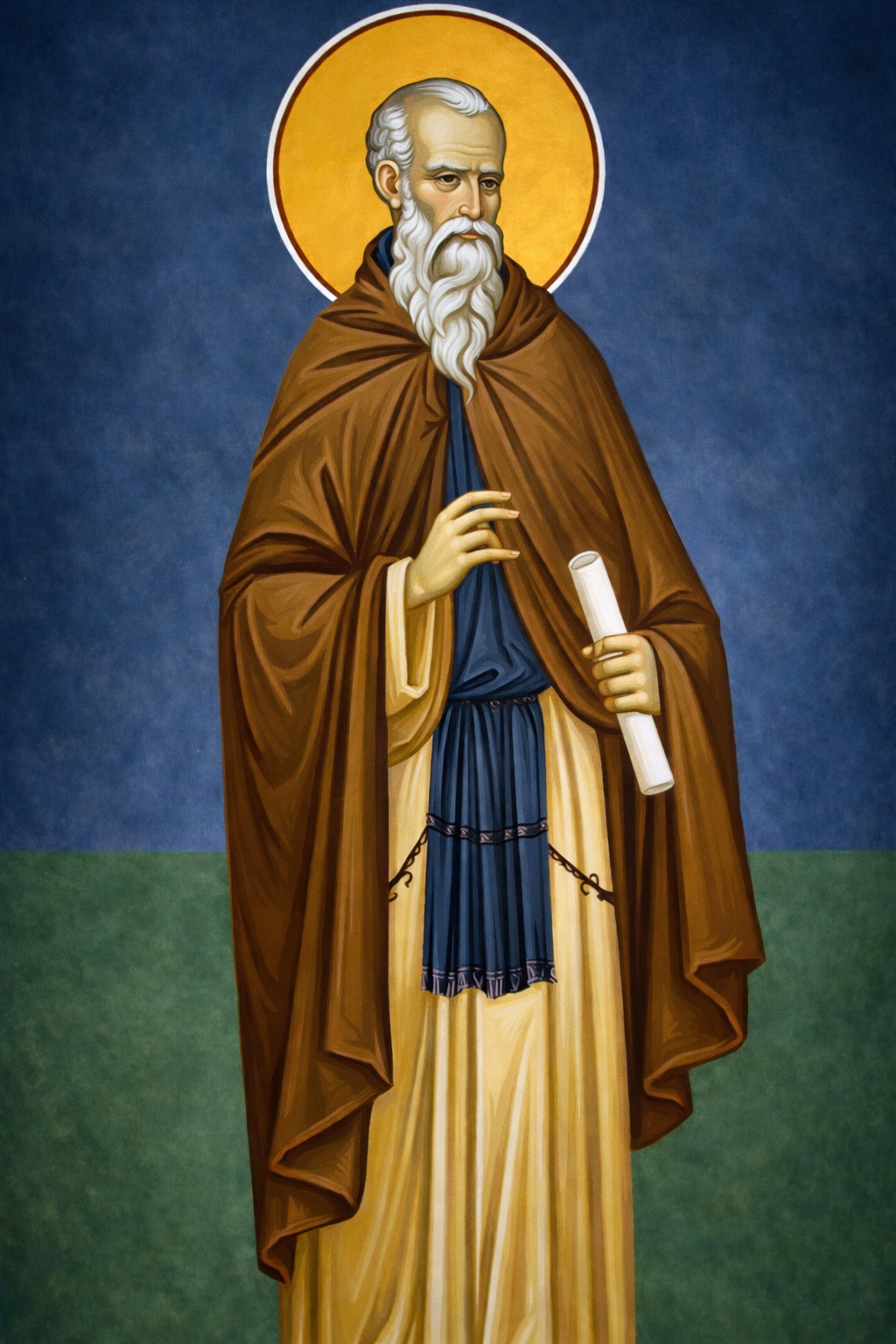
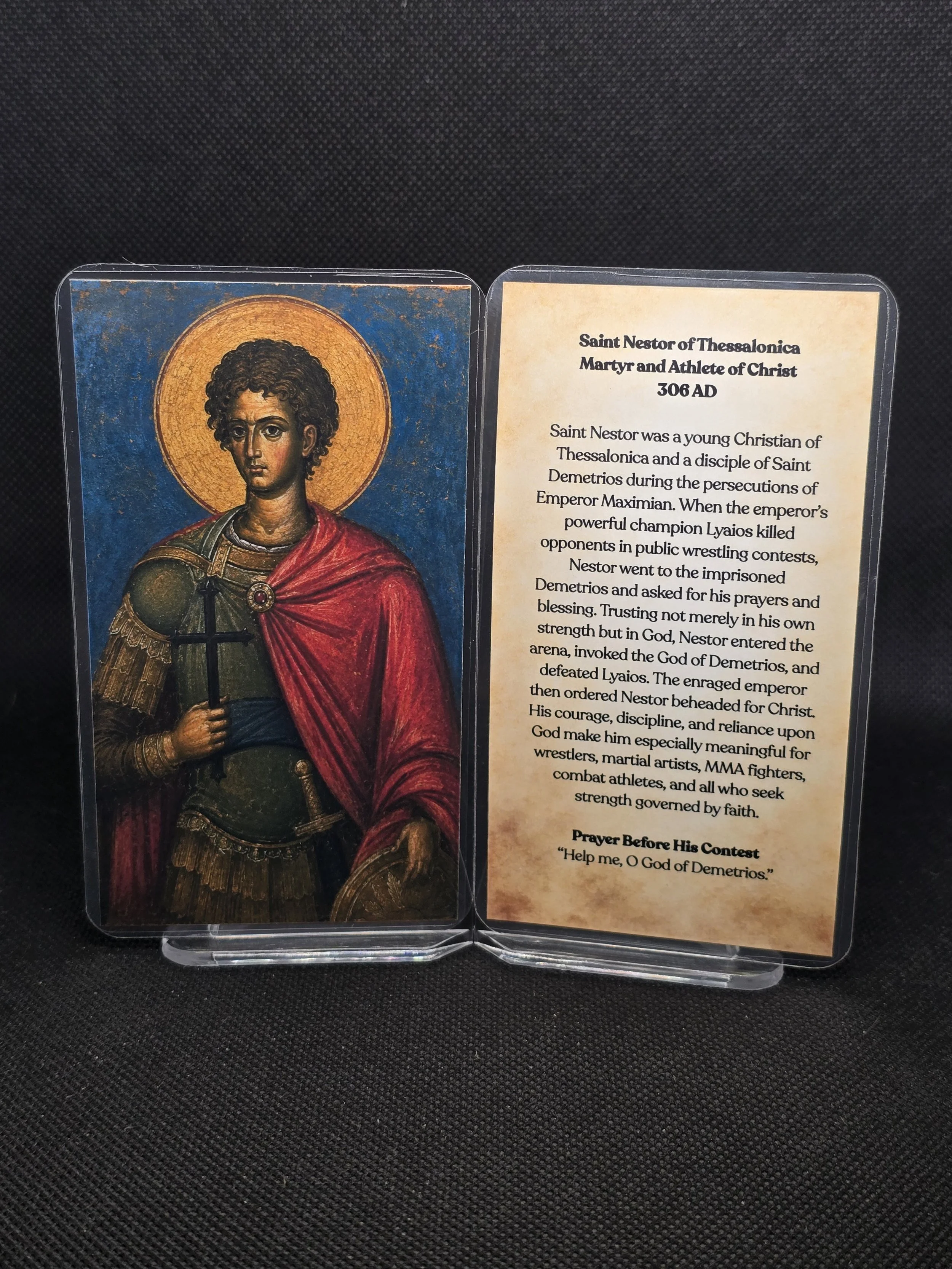
Saint Nestor is normally depicted as a young Christian martyr, often wearing military or warrior clothing and carrying a spear, sword, or cross. Greek tradition emphasizes his youth, and older iconography frequently places him beside Saint Demetrios because their stories are so closely connected.
For an MMA-focused prayer card, traditional iconography remains much stronger than trying to depict Nestor as a modern cage fighter. The connection becomes more powerful precisely because the ancient saint can stand beside the modern athlete without needing to be visually rewritten into modern sports clothing.
PRAYERS
A simple traditional invocation can be prayed before training or competition: Holy Martyr Nestor, pray to God for us. A fighter can ask for Saint Nestor's intercession for courage, humility, self-control, protection from hatred, clear judgment, perseverance in training, and the grace to accept both victory and defeat without losing sight of Christ.
The Orthodox Church already possesses established hymns for Saint Nestor, so there is no need to invent a new saint-specific prayer. His OCA Troparion praises him as an “invincible athlete of godliness” who contended bravely and defeated Lyaeus by divine help, while his Kontakion remembers him as one who contested well and became an excellent soldier of Christ.
A Christian MMA fighter can also pray before competition for both people entering the cage. Asking for courage and success does not prevent asking simultaneously that both competitors be protected from serious injury and that neither athlete allow anger or ego to govern the contest.
Saint Nestor's card is especially fitting beside a fight journal, training notebook, Bible, prayer book, prayer rope, wrestling gear, boxing equipment, BJJ bag, MMA gloves, gym locker, medal display, championship belt, or home icon corner. The image can become a reminder that physical competition is temporary, while the contest to become faithful to Christ reaches into eternity.
FAQ
Who was Saint Nestor of Thessalonica? Saint Nestor was a young Christian martyr of Thessalonica who was instructed in the faith by Saint Demetrios the Great Martyr. He became famous for defeating the gigantic wrestler Lyaeus in a public arena after receiving Saint Demetrios' blessing, and he was then executed for his Christian faith.
When did Saint Nestor live? He lived during the persecution of Christians around the beginning of the fourth century. The OCA calendar commonly places his martyrdom around 306 AD, although older sources contain some chronological variation.
When is Saint Nestor's feast day? Saint Nestor is commemorated on October 27. His feast immediately follows Saint Demetrios on October 26 because Demetrios was his teacher, spiritual father, and the saint whose blessing strengthened him before the arena contest.
Is Saint Nestor the patron saint of MMA fighters? He has become an especially fitting unofficial patron of MMA fighters and combat athletes, although MMA obviously did not exist in antiquity. The association is unusually strong because Orthodox tradition itself centers his story upon a lethal arena fight against a feared wrestler and liturgically calls him an athlete who defeated Lyaeus in the ring.
Is Saint Nestor a patron saint of wrestlers? Wrestling has a particularly strong connection because official Orthodox sources explicitly describe Lyaeus as a wrestler and Nestor's contest as wrestling or physical combat. The Greek Orthodox service even uses wrestling imagery when celebrating Nestor's physical and spiritual victory.
Is Saint Nestor a patron saint of athletes? Modern Orthodox devotion has explicitly honored him in connection with youth and sports, including Greek church events known as Nestoria. His ancient liturgy already uses athletic language extensively, so the modern association grows naturally from the older tradition.
Is Saint Nestor good for Brazilian Jiu-Jitsu practitioners? Yes, especially because his story and liturgical tradition involve wrestling and grappling imagery. BJJ did not exist during his lifetime, but the spiritual themes of composure, humility, disciplined struggle, and facing physically formidable opponents make the connection exceptionally natural.
Is Saint Nestor good for boxers? Yes, because the broader combat-sports themes of courage, training, self-control, respect, and mastery over fear apply directly to boxing. His story also provides an important reminder that physical power must remain subordinate to humility and faith.
Is Saint Nestor good for kickboxers or Muay Thai fighters? Yes, although his historical contest is described primarily as wrestling or arena combat. His devotional connection extends naturally to striking athletes because the deeper themes concern what kind of person enters combat and what ultimately governs that person's strength.
Can an MMA fighter pray to Saint Nestor before a fight? Yes. A fighter can ask Saint Nestor to intercede for courage, self-control, humility, safety, clear judgment, and fidelity to Christ regardless of the result.
Does praying to Saint Nestor guarantee a win? No, Christian prayer is not a supernatural method for guaranteeing sporting results. Nestor's own story ultimately leads from physical victory to martyrdom, showing that faithfulness to God is more important than any earthly win-loss record.
Did Saint Nestor ask for a blessing before fighting? Yes. He went directly to Saint Demetrios in prison, asked for his prayers, and received the sign of the Cross and the assurance that he would defeat Lyaeus and then suffer for Christ.
Who was Saint Demetrios to Saint Nestor? Saint Demetrios was Nestor's Christian teacher and spiritual father. The Orthodox Church's hymns repeatedly connect them, remembering Demetrios as the one who strengthened Nestor for the contest.
Who was Lyaeus? Lyaeus was an exceptionally large and powerful wrestler associated with the emperor's public games in Thessalonica. Orthodox sources describe him repeatedly defeating opponents and boasting in his physical strength before Nestor challenged him.
Was Lyaeus a gladiator? He is frequently described in modern retellings as a gladiator, while official Orthodox sources more specifically call him a wrestler or fighting man competing in the stadium. The safest description is therefore a feared arena wrestler or combat champion.
Was Lyaeus much bigger than Nestor? Orthodox tradition strongly emphasizes Lyaeus' gigantic size and extraordinary physical strength. Nestor, by contrast, is remembered as a very young man, making the difference between them an important element of the story.
How old was Saint Nestor? The earliest Church sources do not give a precise modern birth record, but Orthodox tradition consistently remembers him as very young. Later Greek sources describe him as approximately twenty years old or just reaching early manhood.
Did Saint Nestor actually fight Lyaeus? Yes, the contest is the central event in the Orthodox Church's received Life of Nestor and is also repeatedly referenced in the liturgical hymns of both Nestor and Saint Demetrios. The fight is therefore not a modern addition to his story.
Did Saint Nestor wrestle Lyaeus? The OCA and Greek Orthodox traditions specifically describe Lyaeus as wrestling in the stadium, and the Greek service uses wrestling language for Nestor's contest. The exact ancient combat format cannot simply be equated with a modern wrestling ruleset, but wrestling clearly belongs to the traditional story.
How did Saint Nestor defeat Lyaeus? Orthodox accounts agree that Nestor overcame the larger champion after invoking God and receiving Demetrios' blessing. Some traditions emphasize Nestor throwing Lyaeus from the raised platform, while others include a mortal strike during the engagement, so it is best not to force the different accounts into a single modern technical reconstruction.
What did Saint Nestor say before the fight? The OCA tradition remembers him entering the platform and invoking the God of Demetrios for help. The words emphasize that Nestor's confidence rested upon God rather than his own physical ability.
Why did Nestor fight Lyaeus? Nestor saw the brutal champion humiliating and killing opponents, including Christians, while the emperor celebrated the spectacle. He wanted to put an end to the boastful champion and defend Christians from the disgrace surrounding the games.
Did Saint Nestor kill Lyaeus? Yes, the traditional Orthodox accounts describe Lyaeus dying as a result of his defeat in the arena. This occurred within a lethal imperial spectacle in which defeated contestants themselves were being killed, making the historical setting fundamentally different from modern regulated combat sport.
Why was Saint Nestor executed? Emperor Maximian became enraged when his celebrated champion was defeated and learned that Saint Demetrios had strengthened Nestor. He ordered both Christians killed, with Demetrios pierced by spears and Nestor beheaded.
How did Saint Nestor die? Saint Nestor was beheaded after his victory over Lyaeus. His martyrdom is the reason the Church remembers his ultimate victory as much greater than the physical victory in the stadium.
Why is Saint Nestor called an athlete in Orthodox hymns? Early Christianity frequently used athletic contest as an image for martyrdom, but Nestor is unusual because he was also involved in an actual physical contest. His liturgical hymns therefore unite literal athletic struggle with the spiritual contest of remaining faithful to Christ.
Does the Orthodox Church call Saint Nestor a fighter? The Greek Orthodox service calls him a Martyr Athlete, describes him meeting Lyaeus in the ring, and praises his physical victory. The OCA also calls him an invincible athlete of godliness who contended bravely.
Is there a traditional prayer to Saint Nestor? Yes, Saint Nestor has established Orthodox liturgical hymns, including a Troparion and Kontakion. A simple traditional invocation for private devotion is, “Holy Martyr Nestor, pray to God for us.”
Can I keep a Saint Nestor card in my gym bag? Yes, particularly if it reminds you to pray before training or competition and to keep physical achievement beneath your Christian identity. A laminated card is also practical for a gym bag, locker, fight journal, or training space.
Can I give this card before someone's first MMA fight? Yes, it can make an especially meaningful first-fight gift because Nestor's story centers on courage before entering a frightening contest. The message is not that the athlete is guaranteed to win, but that he can enter courageously without letting fear or ego rule him.
Can I give this card to a wrestler? Yes, and wrestling is probably one of the strongest historical connections with Saint Nestor. His opponent is explicitly remembered as a feared wrestler, while Orthodox liturgy preserves wrestling imagery around their contest.
Can I give this card to a BJJ practitioner? Yes, particularly someone who understands grappling as both physical training and a discipline in humility. Saint Nestor's wrestling tradition gives the card a much more direct connection to grappling than a generic athlete saint would have.
Can I give this card to an MMA coach? Yes. The relationship between Demetrios and Nestor provides a beautiful Christian image of mentorship because Demetrios prepared and strengthened the younger man before Nestor entered the contest himself.
Can I give Saint Nestor and Saint Demetrios cards together? Yes, they make an especially meaningful pair. Their feast days are consecutive, their liturgical hymns mention one another, and Nestor's famous victory cannot be separated from Demetrios' blessing.
Is Saint Nestor good for young athletes? Yes, and modern Greek Orthodox devotion has explicitly honored him as a patron of youth and sports. His youth also makes him particularly accessible to teenagers and young adults developing athletic ability while learning how to govern strength with Christian character.
Is Saint Nestor good for someone afraid before competition? Yes, because Nestor faced an opponent known for overwhelming physical dominance and still entered the contest. His courage came after prayer and spiritual preparation rather than from pretending the threat was insignificant.
Can I pray to Saint Nestor after losing a fight? Yes, because his spiritual meaning is much larger than winning. A loss can become an opportunity for humility, learning, perseverance, and freedom from the belief that athletic performance determines personal worth.
Can champions pray to Saint Nestor? Yes, perhaps especially because victory can create pride. Nestor defeated the champion but immediately demonstrated that physical success did not make him the center of his own life.
Is Saint Nestor good for fighting ego? Yes, because his story directly contrasts Lyaeus' boastful reliance on physical strength with Nestor's humility before Saint Demetrios and dependence upon God. That contrast is one of the strongest spiritual lessons available to a Christian combat athlete.
Is Saint Nestor good for anger? He can be a fitting intercessor for self-control because Christian fighting should not require hatred of an opponent. His example directs courage toward faithfulness rather than uncontrolled rage.
Is Saint Nestor good for military members or law enforcement? Yes, particularly for people whose vocations require courage, physical preparedness, discipline, and responsible use of strength. His story reminds them that strength should remain accountable to God rather than becoming an identity based upon domination.
Where are Saint Nestor's relics? Relics attributed to Saint Nestor are reported at several major Orthodox sites, including monasteries on Mount Athos, Varlaam Monastery at Meteora, and the Church of Saint Demetrios in Thessaloniki. Greek Orthodox reporting also identifies additional monasteries possessing relic fragments.
Is there a church of Saint Nestor in Thessaloniki? Yes, a church dedicated to Saint Nestor is located near the Kaftanzoglio Stadium in Thessaloniki. The location is especially fitting given the saint's longstanding association with athletic contest.
What does Saint Nestor teach fighters about strength? He teaches that strength itself is not the problem because the Church praises his physical strength. The decisive question is whether strength becomes a source of arrogance like Lyaeus or is placed beneath faith and humility like Nestor.
What does Saint Nestor teach about fear? His life shows that courage does not require denying that an opponent is dangerous. Nestor knew the reputation of Lyaeus and entered anyway after placing himself before God.
What does Saint Nestor teach about competition? Competition can reveal courage, discipline, preparation, fear, ego, anger, and humility. Nestor's story reminds Christian athletes that the spiritual condition revealed through competition matters more than the applause earned through victory.
What does Saint Nestor teach about winning? Winning is not proof of holiness, and losing is not proof of failure before God. Nestor's earthly victory mattered, but the Church ultimately celebrates the martyr who remained faithful after the stadium had emptied.
What does Saint Nestor teach about masculinity? His life joins strength, courage, mentorship, humility, loyalty, and sacrifice rather than defining masculinity simply through dominance. He was physically brave enough to confront Lyaeus and spiritually humble enough to kneel before Demetrios first.
What does Saint Nestor teach about coaches and mentors? His relationship with Saint Demetrios shows how powerful formation can be before a difficult contest. Demetrios taught, blessed, and strengthened him, but Nestor still had to step into the arena and act upon what he had received.
What does Saint Nestor teach about spiritual warfare? The Greek Orthodox service deliberately joins his physical wrestling with spiritual struggle against the unseen enemy. His arena contest therefore became an icon of the deeper Christian struggle against sin and the passions.
What is the main message of Saint Nestor of Thessalonica's life? Saint Nestor's life teaches that the strongest fighter is not necessarily the man with the largest body, the loudest confidence, or the most victories, but the person whose strength has been placed under God. A young Christian watched the gigantic wrestler Lyaeus dominate the stadium, went first to his imprisoned spiritual father Saint Demetrios, knelt for prayer, received the sign of the Cross, entered the arena invoking God, defeated the champion everyone feared, and then demonstrated a courage greater than physical combat by accepting martyrdom rather than denying Christ. That is why his story speaks so powerfully to modern MMA fighters, wrestlers, grapplers, boxers, and martial artists: the cage may reveal whether you can defeat another person, but the Christian life reveals whether you have learned to master fear, pride, anger, ego, and the desire to make your own strength into a god.
Saint Nestor of Thessalonica was a young Christian martyr remembered for one of the most extraordinary combat stories in the early Church. During the persecution of Christians in Thessalonica, he entered a public arena against Lyaeus, a gigantic and feared wrestler who had repeatedly defeated and killed his opponents, but before stepping into the contest Nestor first went to the imprisoned Saint Demetrios and asked for his blessing. Strengthened by that blessing and invoking the God of Demetrios, the young Christian defeated the physically overwhelming champion before being executed for his faith. The Orthodox Church commemorates Saint Nestor on October 27, immediately following the October 26 feast of his teacher and spiritual father, Saint Demetrios the Great Martyr.
For obvious reasons, Saint Nestor has become an especially compelling saint for MMA fighters, wrestlers, grapplers, boxers, martial artists, strength athletes, combat-sports coaches, competitors, and young men trying to unite physical courage with Christian faith. Calling him the unofficial patron saint of MMA fighters is a modern expression, but the connection is unusually strong. His actual Church tradition remembers him entering a lethal public combat contest, facing an opponent famous for size and physical dominance, receiving his spiritual father's blessing before the fight, invoking God as he entered the stadium, defeating the champion, and then accepting martyrdom when victory enraged the emperor.
The MMA connection becomes even stronger when we look at the Church's own liturgical language. The Greek Orthodox Menaion calls Nestor a “Martyr Athlete,” describes him meeting Lyaeus “in the ring,” speaks of his physical victory in the language of wrestling, and praises him as a strong young man who bested Lyaeus through the power of God. The OCA Troparion similarly calls him an “invincible athlete of godliness” who contended bravely and defeated Lyaeus by divine help. This is not modern marketing language placed on top of an unrelated saint because combat, athletic struggle, courage, training, contest, victory, and spiritual warfare are already embedded in the Church's worship surrounding Nestor.
Saint Nestor is especially meaningful for a fighter preparing to step into the cage, ring, wrestling room, tournament, or difficult training camp. His story does not promise that faith guarantees athletic victory, because Nestor's greatest victory ultimately came through martyrdom rather than through preserving his earthly life. Instead, he gives Christian combat athletes a much deeper model: train seriously, enter competition courageously, refuse arrogance, seek God's help rather than worshiping your own strength, and remember that winning a fight is never more important than becoming the kind of man Christ can call faithful.
Saint Nestor also provides an excellent corrective to the ego that can grow around fighting. Lyaeus was remembered precisely for boasting in his enormous strength and humiliating opponents, while Nestor approached the contest by first kneeling before Saint Demetrios, asking for prayer, receiving the sign of the Cross, and entering the arena invoking God rather than proclaiming confidence in himself. Their confrontation therefore represents two very different understandings of strength: strength that glorifies the fighter and strength consciously placed under God.
This prayer card is especially fitting for MMA fighters, Brazilian Jiu-Jitsu practitioners, wrestlers, boxers, kickboxers, Muay Thai fighters, grapplers, martial artists, combat-sports coaches, strength athletes, young athletes, military members, law enforcement officers, and anyone preparing for difficult physical competition. It can make a meaningful first-fight gift, competition gift, tournament gift, fight-camp devotional, wrestling-season gift, martial arts promotion gift, confirmation or chrismation gift, or addition to a fighter's gym bag, locker, training space, vehicle, Bible, prayer book, or home icon corner.
Each card is handmade in Austin, Texas and created to order. It is printed on museum-quality photo paper and double laminated for durability, making it particularly suitable for someone who may keep the card in a gym bag, training journal, locker, or vehicle. Each card is handled prayerfully during production, with the recipient's intentions lifted before Christ and Saint Nestor asked to intercede for the person who will receive it.
THE LIFE & STORY
Saint Nestor lived in Thessalonica, modern Thessaloniki in Greece, during the great persecutions of Christians associated with Emperor Galerius Maximian around the beginning of the fourth century. The OCA places his martyrdom around 306, although older traditions contain some chronological variation concerning the exact year. What remains constant across the Orthodox sources is his youth, his relationship with Saint Demetrios, his contest against Lyaeus, and his execution after the victory.
The Orthodox Church remembers Nestor as a young Christian already known to Saint Demetrios the Great Martyr, who had instructed him in the faith. Demetrios was one of the major Christian figures of Thessalonica and had been imprisoned because of his open confession and teaching of Christianity. Nestor therefore entered the arena not merely as an isolated young believer but as a disciple whose courage had been formed under a spiritual father already preparing to die for Christ.
A YOUNG CHRISTIAN FIGHTER
Ancient and later Orthodox descriptions consistently emphasize Nestor's youth. The OCA calls him very young, while later Greek tradition describes him as approximately twenty years old or just reaching the age when a beard was beginning to grow. The Greek liturgical service praises him as a young man possessing bodily strength while also being adorned with wisdom and divine grace.
That combination matters for athletes because the Church does not portray physical ability itself as something shameful. Nestor is praised as physically strong, yet his strength becomes meaningful only because it operates within courage, faith, humility, and willingness to suffer for Christ. The body is not rejected, but neither is bodily power allowed to become the highest thing about the person.
THE STADIUM OF THESSALONICA
According to the Orthodox tradition, the emperor arranged public games in Thessalonica and created a raised fighting platform so that the contests could be watched by the crowd. A massive fighter named Lyaeus, Lyaios, or Lyeios became the central spectacle, and Orthodox sources describe him as a giant or exceptionally powerful wrestler whose size and strength made him feared throughout the stadium.
The arena described by the OCA was far removed from a regulated modern sporting event. Spears and other sharp weapons were positioned beneath the platform, and defeated opponents could be thrown from the platform to their deaths. The OCA tradition specifically remembers Christians among those forced into these contests and killed after being defeated by Lyaeus.
LYAΕUS, THE CHAMPION EVERYONE FEARED
Lyaeus was not remembered simply because he was large. The Greek Orthodox account describes him as a notable wrestler who boasted because of his height and physical strength and repeatedly challenged others to fight him. Opponent after opponent fell before him, turning his body and his victories into a spectacle of imperial power.
This is part of what makes the story resonate so naturally with combat athletes. Fighters understand the psychological presence created by an opponent with an intimidating record, unusual size, crushing strength, or reputation for destroying everyone placed in front of him. Nestor looked at precisely that kind of opponent and decided that fear would not determine what he did.
WHY NESTOR DECIDED TO FIGHT
Nestor saw the emperor delighting in the victories of Lyaeus and saw Christians humiliated and killed within the spectacle. The OCA says he was stirred by the arrogance surrounding the contests and took courage after witnessing the faith and miracles associated with Saint Demetrios.
His decision was therefore not presented as a young man searching for fame, prize money, or a chance to demonstrate that he was tougher than everyone else. He entered because the brutal champion had become an instrument through which Christians were being publicly degraded, and Nestor believed the fighter's pride needed to be confronted.
BEFORE THE FIGHT, HE WENT TO HIS SPIRITUAL FATHER
One of the strongest parts of Saint Nestor's story for modern fighters is what he did before entering the arena. He did not first gather a crowd, boast about what he planned to do, or proclaim confidence in his own conditioning because he went directly to the imprisoned Saint Demetrios and asked for his prayers and blessing.
Nestor fell before Demetrios and asked that through the saint's prayers God would help him defeat Lyaeus and end the disgrace being inflicted upon Christians. Demetrios responded by making the sign of the Cross over Nestor and telling him that he would indeed defeat Lyaeus, but that after the victory he would himself suffer for Christ.
A CHRISTIAN MODEL FOR THE PRE-FIGHT MOMENT
For a Christian MMA fighter, boxer, wrestler, or grappler, the image is unforgettable. Nestor had a fight ahead of him and went first for a blessing.
That does not mean a modern athlete should expect a priest to guarantee a win or imagine that God has chosen sides based simply on which competitor prays more. The more important lesson is that Nestor consciously placed the contest beneath his relationship with God before he entered it, recognizing that physical competition could never become the highest authority over his identity.
SAINT DEMETRIOS BLESSES THE FIGHTER
The relationship between Saint Nestor and Saint Demetrios is so central that the Church's hymns for both saints preserve it. The OCA Troparion for Demetrios says that he gave courage to Nestor in the stadium, while Nestor's own hymns remember him as friend and companion of Demetrios who received strength through his prayers.
This makes the two saints especially fitting together for a Christian fighter's icon corner. Demetrios represents the spiritual father who strengthens and blesses, while Nestor represents the young athlete who must actually walk into the arena and face what is waiting there.
NESTOR ENTERS THE ARENA
After receiving the blessing, Nestor entered the stadium without fear. The OCA remembers him invoking the God of Demetrios as he stepped onto the fighting platform, while Greek Orthodox tradition similarly records him making the sign of the Cross before engaging Lyaeus.
His confidence therefore was not presented as psychological self-hypnosis. Nestor knew his opponent was physically terrifying, but he understood that fear of Lyaeus was smaller than faithfulness to God.
For a modern fighter, that distinction can change the entire meaning of competition. Confidence does not have to mean pretending an opponent is harmless because courage means entering even when the challenge is real.
THE FIGHT BETWEEN NESTOR & LYAΕUS
The two men engaged in combat before the crowd. Orthodox sources vary somewhat in the exact physical detail, with the OCA emphasizing wrestling and the fatal fall from the platform, while Greek tradition also preserves imagery of a mortal strike during the engagement. What the tradition agrees upon is that the young Nestor defeated the enormous champion who had dominated everyone placed before him.
The victory reversed the entire spectacle. Lyaeus had been placed in the stadium as a symbol of overwhelming power, yet the champion who had terrified others suddenly lay defeated by a young Christian who had entered only after asking his spiritual father's blessing.
THE ORTHODOX LITURGY ACTUALLY DESCRIBES HIM WRESTLING
The modern connection between Nestor and combat sports becomes particularly striking in the official Greek Orthodox service for his feast. The Menaion describes Nestor putting on the armor of Christ, meeting Lyaeus in the ring, physically defeating him, and then spiritually overcoming the unseen enemy with imagery translated in terms of wrestling holds.
The same service calls him a “Martyr Athlete” and praises his bodily strength while making clear that the power of God remained the ultimate source of victory. This is why Saint Nestor makes such a natural saint for grapplers and fighters, because the Church itself has been using athletic and wrestling imagery to celebrate him for centuries.
THE “INVINCIBLE ATHLETE OF GODLINESS”
The OCA's traditional Troparion gives Nestor one of the strongest titles imaginable for a Christian combat athlete: “an invincible athlete of godliness.” The hymn remembers him contending bravely, defeating Lyaeus by divine help, and then becoming a holy sacrifice through martyrdom.
The phrase reveals how the Church ultimately interprets his athleticism. The true undefeated record is not merely that Nestor beat the champion because the greater contest was remaining faithful after the emperor ordered his death.
For an MMA fighter, that creates an entirely different standard of victory. A championship belt can be lost, a record can be broken, age can take away speed and strength, and eventually every athlete must stop competing, but the contest of faithfulness continues long after the final fight.
MMA & SAINT NESTOR
Saint Nestor obviously did not practice modern mixed martial arts, which developed many centuries later. What makes him such an appealing unofficial patron for MMA is that his historical and liturgical identity already centers on direct physical combat, wrestling, courage against a larger fighter, pre-fight spiritual preparation, competition before a crowd, and the difference between prideful strength and strength submitted to God.
Modern MMA combines striking, wrestling, submissions, conditioning, strategy, endurance, and the ability to remain composed under extreme pressure. Nestor's story cannot tell a fighter how to defend a takedown or escape a submission, but it speaks powerfully to the interior battle that accompanies every serious combat sport: fear, ego, anger, pride, discipline, courage, humility, and the temptation to let fighting become one's entire identity.
A SAINT FOR BRAZILIAN JIU-JITSU & GRAPPLING
Saint Nestor is especially fitting for Brazilian Jiu-Jitsu practitioners and grapplers because the traditional accounts identify his opponent as a wrestler and the Greek liturgical service explicitly uses wrestling language to describe Nestor's contest.
Grappling also provides a particularly useful spiritual analogy. Panic wastes energy, ego prevents learning, position matters, small errors compound, and a physically imposing opponent can sometimes be overcome through patience, timing, technique, and composure.
Saint Nestor's story adds the Christian dimension: however seriously one trains the body, the greater struggle is learning not to become dominated by the passions of the heart.
A SAINT FOR WRESTLERS
The wrestling connection is not merely metaphorical. Orthodox sources actually call Lyaeus a wrestler and describe the public contest in precisely those terms.
That makes Saint Nestor one of the most natural saints for a Christian wrestler. High-school wrestlers, collegiate wrestlers, freestyle and Greco-Roman competitors, wrestling coaches, and families whose lives revolve around the wrestling room can connect with a saint whose most famous earthly action occurred in a wrestling contest.
His story also speaks directly to the mentality wrestling requires. There is no place to hide when two competitors step onto the mat, and Nestor's courage before an overwhelmingly intimidating opponent gives Christian wrestlers a memorable image of entering competition without being ruled by fear.
A SAINT FOR BOXERS & STRIKERS
Although the historical contest is primarily described through wrestling and arena combat, Saint Nestor's broader association naturally extends to boxing, kickboxing, Muay Thai, karate, and other striking arts. The central spiritual issues remain nearly identical: courage, control under pressure, respect for an opponent, willingness to suffer, disciplined preparation, and mastery over anger.
The Christian fighter must also remember that the opponent is not an enemy in the ultimate spiritual sense. Modern sport competition is fundamentally different from Nestor's lethal arena, and defeating someone athletically never gives permission to hate or humiliate them.
NESTOR & THE FEAR OF A BIGGER OPPONENT
Anyone who has competed in combat sports understands what it feels like to look across the mat or cage and realize the other person appears bigger, stronger, more experienced, or more dangerous. Lyaeus represented that problem in its most extreme form because Orthodox sources emphasize his gigantic size and repeated dominance of everyone placed before him.
Nestor did not solve fear by pretending Lyaeus was weak. His courage came from knowing that the opponent's strength did not have absolute authority over him.
That principle extends far beyond fighting. An opponent can be a person, illness, addiction, temptation, career crisis, grief, persecution, or seemingly impossible responsibility, and Nestor's life teaches the Christian to ask for God's help before deciding that the challenge is unbeatable.
TRAINING & HUMILITY
Combat sports are ruthless teachers of humility. A person can feel extraordinarily confident until someone more skilled takes him down, passes his guard, submits him, drops him, outwrestles him, or exposes a weakness he did not know he had.
Saint Nestor's story fits naturally inside that world because his strength begins with kneeling. He does not enter the arena telling everyone what an extraordinary fighter he is because he begins by asking another saint to pray for him.
For Christian fighters, that may be one of his most useful lessons. The more capable the body becomes, the more deliberately the soul may need to practice humility.
LYAΕUS & THE DANGER OF FIGHTER EGO
Lyaeus represents the opposite side of combat culture. Greek Orthodox tradition describes him as boasting because of his height, physical power, and repeated victories, while the emperor delighted in the spectacle of his dominance.
The problem was therefore not strength itself because Nestor was also praised as strong. The problem was strength becoming an identity built upon pride, domination, humiliation, and the admiration of the crowd.
Combat athletes can understand this danger immediately. Winning feels good, applause feels good, physical dominance feels powerful, and social media can turn fighters into brands, but none of those things proves anything about holiness.
THE CHRISTIAN FIGHTER & THE CROWD
Nestor fought before a stadium crowd, but the crowd did not become his moral compass. The entire spectacle had been arranged by authorities who celebrated cruelty and treated human suffering as entertainment.
Modern competition is obviously different, yet crowds still possess psychological power. Fans can encourage arrogance, contempt, unnecessary hostility, trash talk, and the temptation to turn an opponent into something less than a human being because hatred generates attention.
Saint Nestor gives Christian athletes a different center. Fight hard, but do not let the crowd determine what kind of man you become.
THE SIGN OF THE CROSS BEFORE COMBAT
Saint Demetrios made the sign of the Cross over Nestor before the contest, and Nestor himself invoked God as he entered the arena.
For an Orthodox fighter, making the sign of the Cross before competition can therefore carry a particularly meaningful connection with Saint Nestor. The gesture should not be treated like a superstition guaranteeing victory because the Cross ultimately means self-sacrifice, obedience, and fidelity to Christ.
A fighter crossing himself before the cage door closes can remember that the competition is being placed beneath Christ, not that Christ has been recruited to guarantee the result.
PRAY BEFORE YOU FIGHT
Saint Nestor's story naturally suggests a simple habit for Christian combat athletes: pray before competing. Prayer can place fear, ambition, ego, adrenaline, anger, and desire for victory into proper order before the body is pushed into an intensely competitive environment.
A fighter can ask for safety for both competitors, courage, clarity, self-control, freedom from hatred, and the grace to accept either victory or defeat without losing humility.
Saint Nestor's intercession fits especially well within that prayer because his entire story begins with a fighter asking for prayer before entering the contest.
A SAINT FOR FIGHT CAMP
Fight camp tests much more than physical conditioning. Diet, fatigue, injuries, fear, repetitive training, sacrifice, irritability, pressure, expectations, and uncertainty can reveal parts of a fighter's character that remain hidden during ordinary life.
Saint Nestor can become a powerful devotional companion during those weeks. His card in a gym bag or training journal can remind the athlete that the camp is not only preparing a body for competition because difficult training can also become an opportunity to practice patience, gratitude, discipline, humility, and control over the passions.
A SAINT FOR CUTTING WEIGHT WITHOUT MAKING THE BODY AN IDOL
Combat athletes often have complicated relationships with weight, food, appearance, and performance. Saint Nestor's example keeps physical preparation within a Christian hierarchy because bodily strength is valuable but never absolute.
A fighter should therefore train responsibly and care for the body rather than treating it as either an idol or an enemy. Nestor's strength mattered, but the Church remembers his faith and martyrdom as infinitely more important than his physique.
A SAINT FOR THE FIRST FIGHT
The first competition can be terrifying because a fighter has trained but has never experienced exactly what happens when preparation becomes real. Saint Nestor entered an arena with consequences far beyond anything faced in modern sport, yet he did not allow fear to prevent him from acting.
A Saint Nestor card can therefore make a particularly meaningful first MMA fight, first boxing match, first BJJ tournament, or first wrestling competition gift. The message is not “you will win,” but something stronger: enter courageously, place yourself before God, and refuse to let either winning or losing determine your worth.
A SAINT FOR THE FIGHTER WHO LOST
Saint Nestor should not become a devotion used only when athletes expect victory. Christian competition has to include learning how to lose without becoming bitter, humiliated, or obsessed with revenge.
A loss can expose weaknesses that victory hides. The fighter who loses with humility, learns, returns to training, treats the opponent with respect, and refuses self-hatred may gain something spiritually greater than someone who wins and becomes arrogant.
Nestor's true crown was martyrdom, not an earthly championship. The Church's Kontakion says his faithful contest brought him immortal renown, placing the final meaning of victory far beyond the stadium.
A SAINT FOR CHAMPIONS
Winning creates different spiritual dangers. Success can gradually convince an athlete that talent, discipline, intelligence, or physical gifts make him superior as a person.
Saint Nestor provides a particularly useful patron for champions because his own great victory immediately became a test of whether he would remain faithful after public triumph. He defeated Lyaeus, but he did not leave the stadium believing that he had become untouchable.
For a fighter holding a belt, medal, trophy, or undefeated record, Nestor can be a reminder that every earthly title is temporary. The harder challenge may begin after people start calling you great.
WIN WITHOUT HUMILIATING THE OPPONENT
Lyaeus' story is characterized by pride and the public humiliation of weaker opponents. That is precisely the aspect of combat culture Christian fighters should refuse to imitate.
Modern MMA often rewards hostility because drama sells fights, but the Christian competitor can fight intensely without needing hatred. Respecting an opponent does not mean competing softly because it means remembering that victory over another person's body never makes the winner superior before God.
FIGHTING ANGER
Anger can create temporary intensity, and some fighters deliberately try to manufacture hatred before competition. Saint Nestor's story offers a better model because the source of his courage was not uncontrolled rage but prayer, blessing, conviction, and faith.
Anger can be psychologically energizing while still becoming spiritually dangerous. A fighter who needs hatred in order to compete may discover that the emotion follows him long after the bell.
Saint Nestor can be invoked for the ability to fight aggressively within the rules while keeping the soul free from hatred.
SPIRITUAL WARFARE & PHYSICAL COMBAT
The Greek Orthodox Menaion deliberately interprets Nestor's physical contest as a spiritual one. After describing him defeating Lyaeus physically, the hymn portrays him overcoming the unseen enemy through spiritual wrestling as well.
This is one of the deepest reasons his story fits martial artists. Physical fighting can become an image of the invisible struggle against pride, lust, anger, envy, cowardice, gluttony, despair, vanity, and every passion seeking control over the heart.
The opponent in the cage is not ultimately the enemy Christianity tells us to hate. The more dangerous opponent may be the passion inside us that the contest exposes.
THE TRUE OPPONENT
An MMA fighter spends enormous time studying opponents. Coaches analyze tendencies, movement, reactions, weaknesses, takedown defense, striking patterns, conditioning, and habits under pressure.
Christian asceticism asks for similar attention inwardly. What triggers anger? What makes pride appear? Where does fear take control? What happens after praise? What happens after humiliation?
Saint Nestor's story can therefore speak to a fighter at a level deeper than athletic inspiration. Training can become a school in which the person learns to identify the movements of his own passions.
A SAINT FOR DISCIPLINE
Successful combat athletes understand consistency better than most people. Skill is built through thousands of repetitions that rarely look impressive by themselves.
Christian spiritual discipline develops through a similar refusal to depend entirely upon motivation. Prayer, fasting, confession, Scripture, mercy, self-control, and repentance become strong through repeated faithfulness.
Nestor's courage in the arena therefore should not be imagined as appearing from nowhere. The OCA remembers Saint Demetrios as having already instructed him in Christian faith, suggesting a relationship of spiritual formation before the dramatic contest ever began.
A SAINT FOR COACHES
Saint Demetrios and Saint Nestor together provide an extraordinary image for coaches and athletes. Demetrios did not enter the stadium in Nestor's place because he blessed, strengthened, and prepared the young man who then had to face the contest himself.
Good coaching works similarly. A coach can teach, prepare, correct, encourage, and strategize, but eventually the athlete steps into competition and must act upon what has been formed through training.
A Saint Nestor card can therefore also make a meaningful gift from a coach to a fighter or from an athlete to a coach, particularly when paired with Saint Demetrios.
A SAINT FOR YOUNG MALE ATHLETES
Later Orthodox devotion has specifically connected Saint Nestor with youth and sports, and Greek dioceses have organized athletic events called “Nestoria” in his honor. This modern ecclesial association builds naturally upon his youth, strength, athletic contest, and faithful courage.
For young male athletes, Nestor provides something urgently needed: a model of masculinity in which courage and physical strength are real but remain subordinate to faith, humility, mentorship, and willingness to sacrifice.
He did not become strong so that everyone else would fear him. His strength became valuable because he was willing to risk it for something greater than himself.
NESTOR & CHRISTIAN MASCULINITY
Saint Nestor's story contains almost every quality young men are often taught to admire: courage, physical power, willingness to confront danger, loyalty to a mentor, competitiveness, and refusal to be intimidated.
Christianity does not remove those qualities, but it places them in order. Courage without humility becomes arrogance, strength without love becomes domination, competition without self-control becomes hatred, and independence without spiritual fatherhood can become pride.
Nestor kneels before Demetrios before standing before Lyaeus. That sequence may be the most important lesson in his entire story.
NESTOR & SAINT DEMETRIOS
The two saints are inseparable in Orthodox memory. Demetrios' feast is celebrated on October 26, while Nestor follows immediately on October 27, and the hymns for each repeatedly mention the other.
This pairing makes sense spiritually. Nestor's physical courage grew within discipleship, and Demetrios' spiritual fatherhood became visible through the courage of the young Christian he had formed.
For combat athletes, the pairing can symbolize the importance of mentorship. Nobody becomes a serious fighter entirely alone, and nobody becomes a serious Christian entirely through self-invention.
MAXIMIAN'S RAGE AFTER THE FIGHT
The emperor had celebrated Lyaeus as his champion, so Nestor's victory became more than an unexpected sporting result. It publicly humiliated the entire spectacle the emperor had constructed, and Maximian reacted with fury.
When he learned of Demetrios' role in blessing Nestor, he ordered both Christians killed. Demetrios was pierced with spears while imprisoned, and Nestor was sentenced to beheading.
The young fighter therefore moved almost immediately from athletic victory into martyrdom.
NESTOR'S REAL CHAMPIONSHIP
If Saint Nestor's story ended when Lyaeus fell, he would be remembered merely as an extraordinary athlete. The Church remembers him as a saint because of what came next.
Nestor did not deny Christ in order to preserve the life he had just defended so courageously. He accepted execution rather than purchase safety through apostasy.
That is why the Church calls him an athlete in a much deeper sense than modern sports culture. His final contest was faithfulness unto death.
BEHEADED WITH THE SWORD
Saint Nestor was executed by beheading after the emperor ordered his death. Greek tradition further preserves the striking detail that the sentence was carried out with the sword connected with the combat in which Lyaeus had been defeated.
The weapon of earthly victory therefore could not protect Nestor from martyrdom. The Church sees his execution not as the reversal of his victory but as its fulfillment because the crown he ultimately received was not given by an emperor or stadium crowd.
THE CROWN OF THE ATHLETE & THE CROWN OF THE MARTYR
Ancient Christian writers frequently used athletic imagery for martyrdom because both involved contest, endurance, discipline, and a crown awarded after the struggle. Saint Nestor's life brings the metaphor and the literal athletic contest unusually close together.
He first entered a physical contest and defeated Lyaeus, then entered the greater contest of martyrdom and refused to abandon Christ.
That is why the liturgy can call him both athlete and martyr without treating those identities as separate.
HIS FEAST DAY
Saint Nestor of Thessalonica is commemorated on October 27 in the Orthodox Church. His feast immediately follows Saint Demetrios on October 26, preserving the spiritual relationship between teacher and disciple within the Church calendar itself.
For MMA gyms, wrestling clubs, martial arts schools, or Christian athletic ministries devoted to Saint Nestor, October 27 provides a natural day for prayer, Divine Liturgy when available, charitable activity, training dedicated to his memory, or teaching on the Christian meaning of courage and competition.
SAINT NESTOR AS A PATRON OF SPORTS
Modern Orthodox devotion has extended beyond Nestor's ancient story into organized athletic life. Greek Orthodox communities in the Metropolises of Ierapetra and Siteia and of Didymoteicho, Orestiada and Soufli have held “Nestoria” athletic events honoring Saint Nestor as a patron of youth and sports.
That is important when describing him for athletes because the connection is not merely something invented by American MMA culture. Orthodox communities themselves have developed explicit contemporary devotion to Nestor around athletics and young people.
THE UNOFFICIAL PATRON SAINT OF MMA FIGHTERS
Within modern combat-sports devotion, Saint Nestor makes an almost uniquely suitable unofficial patron for MMA fighters. His connection rests not on a vague metaphor but on a saint whose defining earthly episode involved entering the ring against a feared champion, receiving a spiritual blessing immediately beforehand, invoking God during the contest, defeating the larger fighter, and then showing that Christian courage extends far beyond physical victory.
For your product page, that MMA connection deserves to be prominent rather than buried in an FAQ. Someone searching for a patron saint of MMA, saint for fighters, Orthodox saint for wrestlers, saint for BJJ, patron saint of combat sports, or prayer card for martial artists has a historically and liturgically grounded reason to encounter Saint Nestor.
RELICS OF SAINT NESTOR
Saint Nestor does not appear to have one universally recognized principal bodily shrine comparable to some saints whose complete relics remain in a single location. Greek Orthodox reporting identifies relics attributed to Saint Nestor at several important monasteries and churches, including the Zographou, Iveron, and Gregoriou monasteries on Mount Athos; Varlaam Monastery at Meteora; the Monastery of Saint Panteleimon at Chrysokastro; the Monastery of Emialon; and the Church of Saint Demetrios in Thessaloniki.
This wide distribution is particularly fitting for someone visiting Greece on pilgrimage. Thessaloniki remains the central geographical setting of Nestor's life, while Mount Athos and Meteora preserve relic traditions connected with the saint within some of the most important monastic centers of Orthodox Christianity.
SAINT NESTOR IN THESSALONIKI
Thessaloniki remains inseparable from Saint Nestor's memory because the city was the setting of his discipleship under Saint Demetrios, his combat with Lyaeus, and his martyrdom. Greek tradition also records an ancient church dedicated to Nestor south of the Basilica of Saint Demetrios, although the site underwent major changes during later centuries.
A modern church dedicated to Saint Nestor also stands near Thessaloniki's Kaftanzoglio Stadium, creating a particularly appropriate modern connection between the martyr and athletic life.
ICONOGRAPHY
Saint Nestor is normally depicted as a young Christian martyr, often wearing military or warrior clothing and carrying a spear, sword, or cross. Greek tradition emphasizes his youth, and older iconography frequently places him beside Saint Demetrios because their stories are so closely connected.
For an MMA-focused prayer card, traditional iconography remains much stronger than trying to depict Nestor as a modern cage fighter. The connection becomes more powerful precisely because the ancient saint can stand beside the modern athlete without needing to be visually rewritten into modern sports clothing.
PRAYERS
A simple traditional invocation can be prayed before training or competition: Holy Martyr Nestor, pray to God for us. A fighter can ask for Saint Nestor's intercession for courage, humility, self-control, protection from hatred, clear judgment, perseverance in training, and the grace to accept both victory and defeat without losing sight of Christ.
The Orthodox Church already possesses established hymns for Saint Nestor, so there is no need to invent a new saint-specific prayer. His OCA Troparion praises him as an “invincible athlete of godliness” who contended bravely and defeated Lyaeus by divine help, while his Kontakion remembers him as one who contested well and became an excellent soldier of Christ.
A Christian MMA fighter can also pray before competition for both people entering the cage. Asking for courage and success does not prevent asking simultaneously that both competitors be protected from serious injury and that neither athlete allow anger or ego to govern the contest.
Saint Nestor's card is especially fitting beside a fight journal, training notebook, Bible, prayer book, prayer rope, wrestling gear, boxing equipment, BJJ bag, MMA gloves, gym locker, medal display, championship belt, or home icon corner. The image can become a reminder that physical competition is temporary, while the contest to become faithful to Christ reaches into eternity.
FAQ
Who was Saint Nestor of Thessalonica? Saint Nestor was a young Christian martyr of Thessalonica who was instructed in the faith by Saint Demetrios the Great Martyr. He became famous for defeating the gigantic wrestler Lyaeus in a public arena after receiving Saint Demetrios' blessing, and he was then executed for his Christian faith.
When did Saint Nestor live? He lived during the persecution of Christians around the beginning of the fourth century. The OCA calendar commonly places his martyrdom around 306 AD, although older sources contain some chronological variation.
When is Saint Nestor's feast day? Saint Nestor is commemorated on October 27. His feast immediately follows Saint Demetrios on October 26 because Demetrios was his teacher, spiritual father, and the saint whose blessing strengthened him before the arena contest.
Is Saint Nestor the patron saint of MMA fighters? He has become an especially fitting unofficial patron of MMA fighters and combat athletes, although MMA obviously did not exist in antiquity. The association is unusually strong because Orthodox tradition itself centers his story upon a lethal arena fight against a feared wrestler and liturgically calls him an athlete who defeated Lyaeus in the ring.
Is Saint Nestor a patron saint of wrestlers? Wrestling has a particularly strong connection because official Orthodox sources explicitly describe Lyaeus as a wrestler and Nestor's contest as wrestling or physical combat. The Greek Orthodox service even uses wrestling imagery when celebrating Nestor's physical and spiritual victory.
Is Saint Nestor a patron saint of athletes? Modern Orthodox devotion has explicitly honored him in connection with youth and sports, including Greek church events known as Nestoria. His ancient liturgy already uses athletic language extensively, so the modern association grows naturally from the older tradition.
Is Saint Nestor good for Brazilian Jiu-Jitsu practitioners? Yes, especially because his story and liturgical tradition involve wrestling and grappling imagery. BJJ did not exist during his lifetime, but the spiritual themes of composure, humility, disciplined struggle, and facing physically formidable opponents make the connection exceptionally natural.
Is Saint Nestor good for boxers? Yes, because the broader combat-sports themes of courage, training, self-control, respect, and mastery over fear apply directly to boxing. His story also provides an important reminder that physical power must remain subordinate to humility and faith.
Is Saint Nestor good for kickboxers or Muay Thai fighters? Yes, although his historical contest is described primarily as wrestling or arena combat. His devotional connection extends naturally to striking athletes because the deeper themes concern what kind of person enters combat and what ultimately governs that person's strength.
Can an MMA fighter pray to Saint Nestor before a fight? Yes. A fighter can ask Saint Nestor to intercede for courage, self-control, humility, safety, clear judgment, and fidelity to Christ regardless of the result.
Does praying to Saint Nestor guarantee a win? No, Christian prayer is not a supernatural method for guaranteeing sporting results. Nestor's own story ultimately leads from physical victory to martyrdom, showing that faithfulness to God is more important than any earthly win-loss record.
Did Saint Nestor ask for a blessing before fighting? Yes. He went directly to Saint Demetrios in prison, asked for his prayers, and received the sign of the Cross and the assurance that he would defeat Lyaeus and then suffer for Christ.
Who was Saint Demetrios to Saint Nestor? Saint Demetrios was Nestor's Christian teacher and spiritual father. The Orthodox Church's hymns repeatedly connect them, remembering Demetrios as the one who strengthened Nestor for the contest.
Who was Lyaeus? Lyaeus was an exceptionally large and powerful wrestler associated with the emperor's public games in Thessalonica. Orthodox sources describe him repeatedly defeating opponents and boasting in his physical strength before Nestor challenged him.
Was Lyaeus a gladiator? He is frequently described in modern retellings as a gladiator, while official Orthodox sources more specifically call him a wrestler or fighting man competing in the stadium. The safest description is therefore a feared arena wrestler or combat champion.
Was Lyaeus much bigger than Nestor? Orthodox tradition strongly emphasizes Lyaeus' gigantic size and extraordinary physical strength. Nestor, by contrast, is remembered as a very young man, making the difference between them an important element of the story.
How old was Saint Nestor? The earliest Church sources do not give a precise modern birth record, but Orthodox tradition consistently remembers him as very young. Later Greek sources describe him as approximately twenty years old or just reaching early manhood.
Did Saint Nestor actually fight Lyaeus? Yes, the contest is the central event in the Orthodox Church's received Life of Nestor and is also repeatedly referenced in the liturgical hymns of both Nestor and Saint Demetrios. The fight is therefore not a modern addition to his story.
Did Saint Nestor wrestle Lyaeus? The OCA and Greek Orthodox traditions specifically describe Lyaeus as wrestling in the stadium, and the Greek service uses wrestling language for Nestor's contest. The exact ancient combat format cannot simply be equated with a modern wrestling ruleset, but wrestling clearly belongs to the traditional story.
How did Saint Nestor defeat Lyaeus? Orthodox accounts agree that Nestor overcame the larger champion after invoking God and receiving Demetrios' blessing. Some traditions emphasize Nestor throwing Lyaeus from the raised platform, while others include a mortal strike during the engagement, so it is best not to force the different accounts into a single modern technical reconstruction.
What did Saint Nestor say before the fight? The OCA tradition remembers him entering the platform and invoking the God of Demetrios for help. The words emphasize that Nestor's confidence rested upon God rather than his own physical ability.
Why did Nestor fight Lyaeus? Nestor saw the brutal champion humiliating and killing opponents, including Christians, while the emperor celebrated the spectacle. He wanted to put an end to the boastful champion and defend Christians from the disgrace surrounding the games.
Did Saint Nestor kill Lyaeus? Yes, the traditional Orthodox accounts describe Lyaeus dying as a result of his defeat in the arena. This occurred within a lethal imperial spectacle in which defeated contestants themselves were being killed, making the historical setting fundamentally different from modern regulated combat sport.
Why was Saint Nestor executed? Emperor Maximian became enraged when his celebrated champion was defeated and learned that Saint Demetrios had strengthened Nestor. He ordered both Christians killed, with Demetrios pierced by spears and Nestor beheaded.
How did Saint Nestor die? Saint Nestor was beheaded after his victory over Lyaeus. His martyrdom is the reason the Church remembers his ultimate victory as much greater than the physical victory in the stadium.
Why is Saint Nestor called an athlete in Orthodox hymns? Early Christianity frequently used athletic contest as an image for martyrdom, but Nestor is unusual because he was also involved in an actual physical contest. His liturgical hymns therefore unite literal athletic struggle with the spiritual contest of remaining faithful to Christ.
Does the Orthodox Church call Saint Nestor a fighter? The Greek Orthodox service calls him a Martyr Athlete, describes him meeting Lyaeus in the ring, and praises his physical victory. The OCA also calls him an invincible athlete of godliness who contended bravely.
Is there a traditional prayer to Saint Nestor? Yes, Saint Nestor has established Orthodox liturgical hymns, including a Troparion and Kontakion. A simple traditional invocation for private devotion is, “Holy Martyr Nestor, pray to God for us.”
Can I keep a Saint Nestor card in my gym bag? Yes, particularly if it reminds you to pray before training or competition and to keep physical achievement beneath your Christian identity. A laminated card is also practical for a gym bag, locker, fight journal, or training space.
Can I give this card before someone's first MMA fight? Yes, it can make an especially meaningful first-fight gift because Nestor's story centers on courage before entering a frightening contest. The message is not that the athlete is guaranteed to win, but that he can enter courageously without letting fear or ego rule him.
Can I give this card to a wrestler? Yes, and wrestling is probably one of the strongest historical connections with Saint Nestor. His opponent is explicitly remembered as a feared wrestler, while Orthodox liturgy preserves wrestling imagery around their contest.
Can I give this card to a BJJ practitioner? Yes, particularly someone who understands grappling as both physical training and a discipline in humility. Saint Nestor's wrestling tradition gives the card a much more direct connection to grappling than a generic athlete saint would have.
Can I give this card to an MMA coach? Yes. The relationship between Demetrios and Nestor provides a beautiful Christian image of mentorship because Demetrios prepared and strengthened the younger man before Nestor entered the contest himself.
Can I give Saint Nestor and Saint Demetrios cards together? Yes, they make an especially meaningful pair. Their feast days are consecutive, their liturgical hymns mention one another, and Nestor's famous victory cannot be separated from Demetrios' blessing.
Is Saint Nestor good for young athletes? Yes, and modern Greek Orthodox devotion has explicitly honored him as a patron of youth and sports. His youth also makes him particularly accessible to teenagers and young adults developing athletic ability while learning how to govern strength with Christian character.
Is Saint Nestor good for someone afraid before competition? Yes, because Nestor faced an opponent known for overwhelming physical dominance and still entered the contest. His courage came after prayer and spiritual preparation rather than from pretending the threat was insignificant.
Can I pray to Saint Nestor after losing a fight? Yes, because his spiritual meaning is much larger than winning. A loss can become an opportunity for humility, learning, perseverance, and freedom from the belief that athletic performance determines personal worth.
Can champions pray to Saint Nestor? Yes, perhaps especially because victory can create pride. Nestor defeated the champion but immediately demonstrated that physical success did not make him the center of his own life.
Is Saint Nestor good for fighting ego? Yes, because his story directly contrasts Lyaeus' boastful reliance on physical strength with Nestor's humility before Saint Demetrios and dependence upon God. That contrast is one of the strongest spiritual lessons available to a Christian combat athlete.
Is Saint Nestor good for anger? He can be a fitting intercessor for self-control because Christian fighting should not require hatred of an opponent. His example directs courage toward faithfulness rather than uncontrolled rage.
Is Saint Nestor good for military members or law enforcement? Yes, particularly for people whose vocations require courage, physical preparedness, discipline, and responsible use of strength. His story reminds them that strength should remain accountable to God rather than becoming an identity based upon domination.
Where are Saint Nestor's relics? Relics attributed to Saint Nestor are reported at several major Orthodox sites, including monasteries on Mount Athos, Varlaam Monastery at Meteora, and the Church of Saint Demetrios in Thessaloniki. Greek Orthodox reporting also identifies additional monasteries possessing relic fragments.
Is there a church of Saint Nestor in Thessaloniki? Yes, a church dedicated to Saint Nestor is located near the Kaftanzoglio Stadium in Thessaloniki. The location is especially fitting given the saint's longstanding association with athletic contest.
What does Saint Nestor teach fighters about strength? He teaches that strength itself is not the problem because the Church praises his physical strength. The decisive question is whether strength becomes a source of arrogance like Lyaeus or is placed beneath faith and humility like Nestor.
What does Saint Nestor teach about fear? His life shows that courage does not require denying that an opponent is dangerous. Nestor knew the reputation of Lyaeus and entered anyway after placing himself before God.
What does Saint Nestor teach about competition? Competition can reveal courage, discipline, preparation, fear, ego, anger, and humility. Nestor's story reminds Christian athletes that the spiritual condition revealed through competition matters more than the applause earned through victory.
What does Saint Nestor teach about winning? Winning is not proof of holiness, and losing is not proof of failure before God. Nestor's earthly victory mattered, but the Church ultimately celebrates the martyr who remained faithful after the stadium had emptied.
What does Saint Nestor teach about masculinity? His life joins strength, courage, mentorship, humility, loyalty, and sacrifice rather than defining masculinity simply through dominance. He was physically brave enough to confront Lyaeus and spiritually humble enough to kneel before Demetrios first.
What does Saint Nestor teach about coaches and mentors? His relationship with Saint Demetrios shows how powerful formation can be before a difficult contest. Demetrios taught, blessed, and strengthened him, but Nestor still had to step into the arena and act upon what he had received.
What does Saint Nestor teach about spiritual warfare? The Greek Orthodox service deliberately joins his physical wrestling with spiritual struggle against the unseen enemy. His arena contest therefore became an icon of the deeper Christian struggle against sin and the passions.
What is the main message of Saint Nestor of Thessalonica's life? Saint Nestor's life teaches that the strongest fighter is not necessarily the man with the largest body, the loudest confidence, or the most victories, but the person whose strength has been placed under God. A young Christian watched the gigantic wrestler Lyaeus dominate the stadium, went first to his imprisoned spiritual father Saint Demetrios, knelt for prayer, received the sign of the Cross, entered the arena invoking God, defeated the champion everyone feared, and then demonstrated a courage greater than physical combat by accepting martyrdom rather than denying Christ. That is why his story speaks so powerfully to modern MMA fighters, wrestlers, grapplers, boxers, and martial artists: the cage may reveal whether you can defeat another person, but the Christian life reveals whether you have learned to master fear, pride, anger, ego, and the desire to make your own strength into a god.