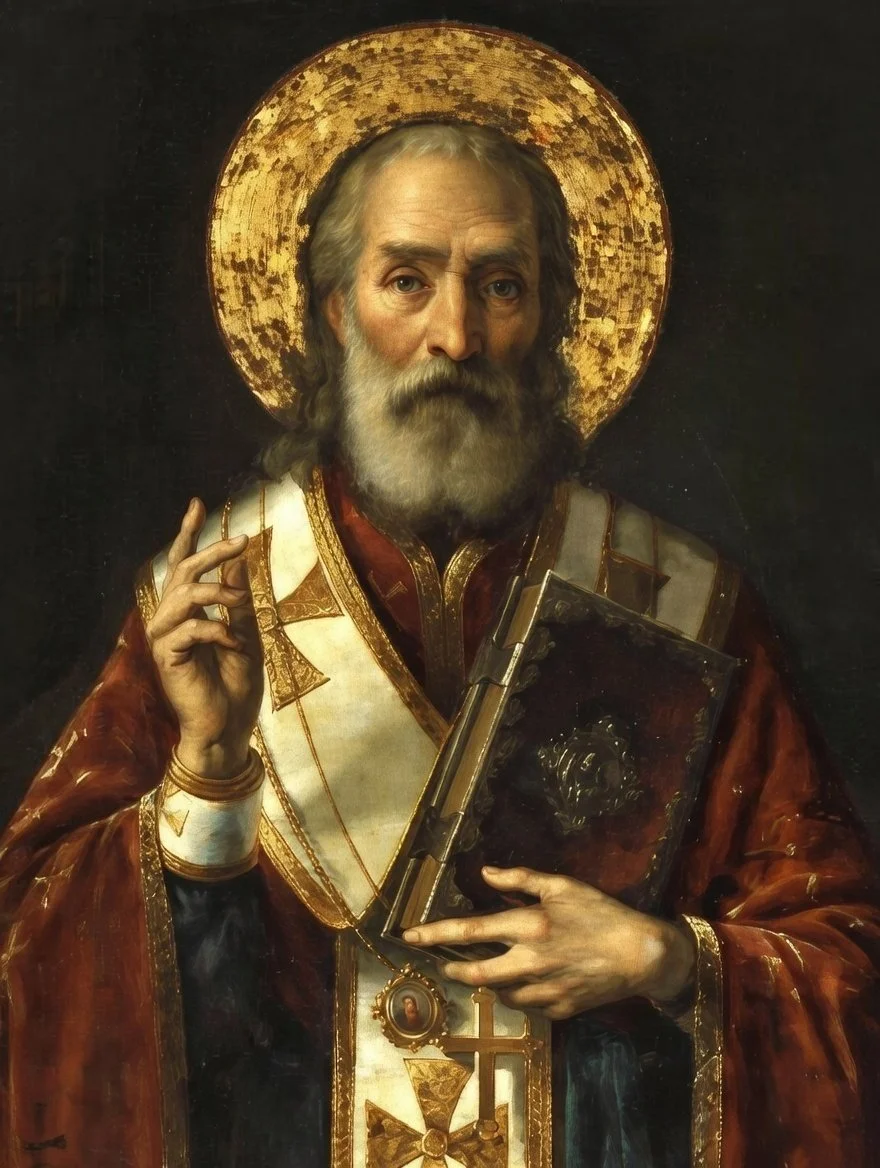
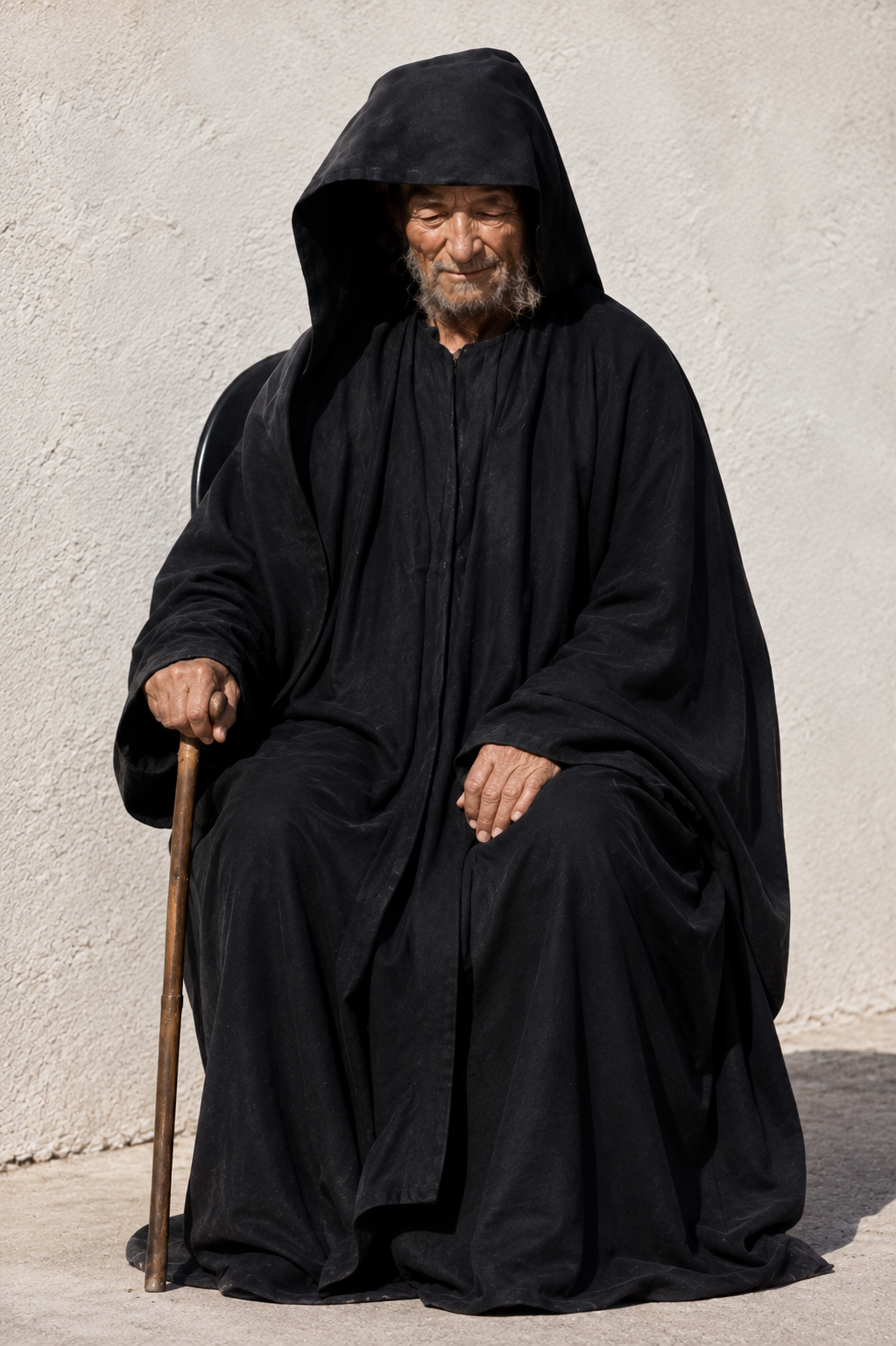
 Image 1 of 1
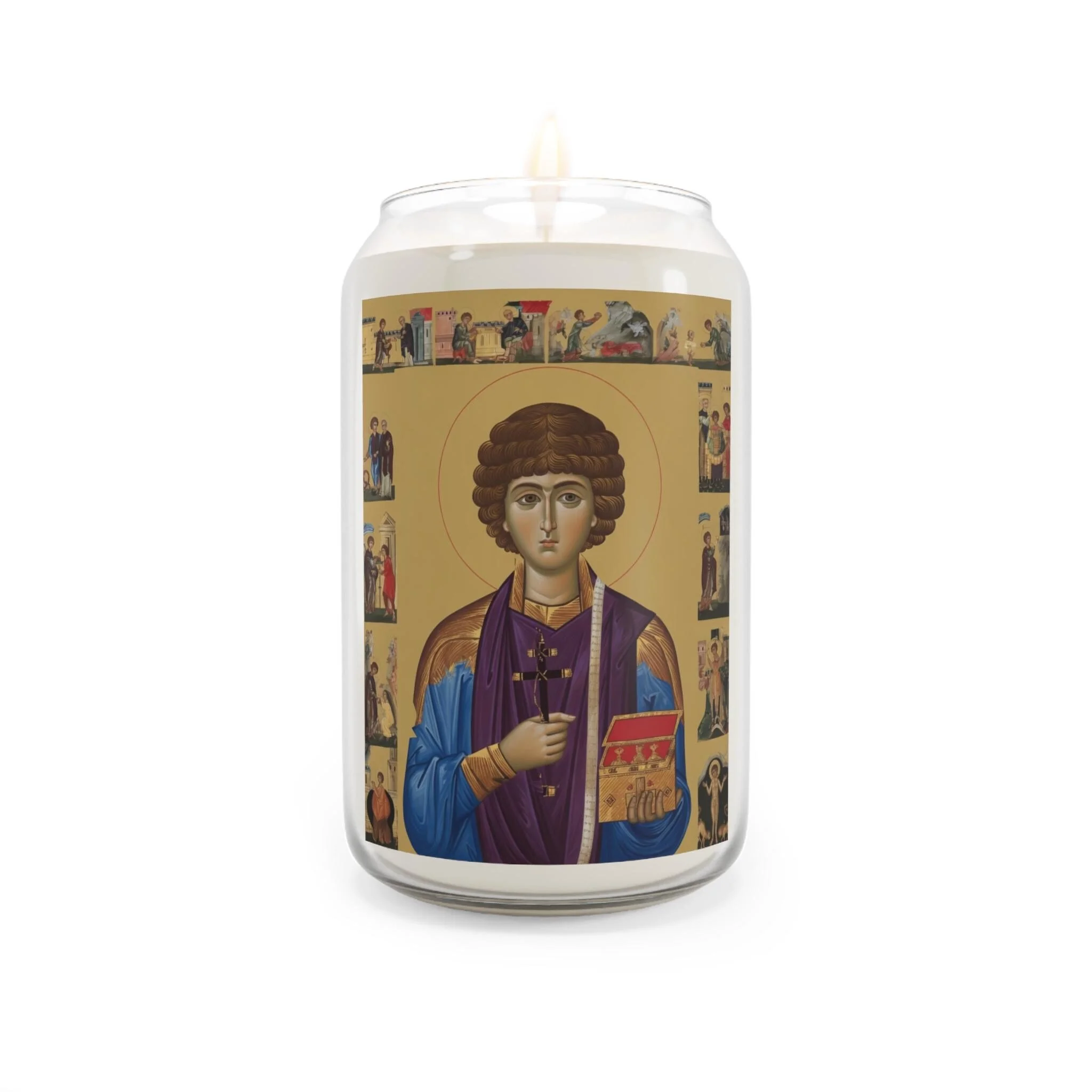
Saint Nikephoros (Nicephorus) the Leper Prayer Card - For Chronic Illness, Healing, Patience & Long Suffering
Saint Nikephoros the Leper, also written Saint Nicephorus, Nikiforos, or Nikēphóros the Leper, was a twentieth-century Greek Orthodox monk whose holiness developed almost entirely within the suffering of Hansen's disease, historically called leprosy. Born Nicholas Tzanakakis on Crete in 1890, orphaned while still young, and visibly affected by the disease as a teenager, he spent most of his adult life among other people with leprosy on Chios and later at the Saint Barbara hospital in Athens. Rather than allowing decades of pain, disfigurement, blindness, paralysis, and social isolation to turn him toward bitterness, he became known for prayer, gentleness, obedience, chanting, spiritual discernment, and an extraordinary ability to console people who came to him carrying their own suffering.
Saint Nikephoros is especially meaningful for chronic illness, incurable or long-term disease, visible disfigurement, disability, loss of physical independence, contagious disease, prolonged pain, medical isolation, and the emotional exhaustion that can come when a condition does not quickly improve. This association is firmly grounded in the Church's own liturgical language because his Troparion compares his patient suffering with that of Job, while his Kontakion praises his endurance and fortitude under sickness.
He is also a deeply appropriate intercessor for people who feel ashamed of what illness has done to their bodies. Hansen's disease progressively altered Saint Nikephoros's face, eyes, hands, and limbs, yet eyewitnesses remembered something strikingly different from ugliness when they encountered him: a gentle, luminous, peaceful man whose damaged body had not destroyed his capacity to love, pray, smile, or comfort others. The OCA preserves testimony that even when his body was covered with wounds and pain, he did not complain, and visitors experienced him as remarkably sweet, meek, and consoling.
Saint Nikephoros is particularly meaningful for chronic pain and conditions that require endurance rather than a quick cure. His disease began while he was still young and remained with him throughout almost his entire life, including decades before effective treatment was available. His holiness therefore does not offer a simplistic message that sufficient faith always causes physical suffering to disappear, because he became holy while continuing to suffer.
His story also speaks powerfully to people who are isolated because of sickness, whether through hospitalization, infection precautions, long-term care, disability, or simply the social withdrawal that can happen when illness makes ordinary life difficult. Nikephoros lived during an era when people with leprosy were feared and segregated from society, and his own decisions as a teenager were shaped by the possibility of compulsory isolation on Spinalonga. He knew what it meant for disease to alter not only the body but one's entire place within society.
Saint Nikephoros also became a spiritual father despite appearing, by ordinary worldly standards, to have almost nothing left to offer. By his later years his sight was badly damaged, his hands had become stiff, his lower limbs were paralyzed, and his body had been profoundly altered by disease, yet people deliberately sought out his small room to receive his blessing and consolation. His life therefore speaks to anyone who fears that illness, aging, or disability has made them useless to God or to other people.
His close relationship with Saint Anthimos of Chios adds another important dimension to his story. Nikephoros's holiness did not develop in complete spiritual independence, because he lived under Saint Anthimos's guidance, obeyed him as his spiritual father, and remained closely connected with him for decades. This makes Saint Nikephoros an especially meaningful saint for people learning how suffering can be carried within obedience, sacramental life, prayer, and spiritual guidance rather than through solitary endurance alone.
Saint Nikephoros is therefore especially fitting for someone living with cancer, autoimmune disease, neurological illness, severe skin disease, disability, chronic pain, a long hospital stay, physical disfigurement, degenerative disease, or another condition that has fundamentally changed ordinary life. His traditional devotion can also be meaningful for caregivers, nurses, physicians, families of the chronically ill, and people who need patience because the suffering they are carrying may not end quickly.
Each card is handmade in Austin, TX and created to order. We do not keep stock, because every prayer card is treated as a unique devotional offering. They are printed on museum-quality photo paper, not cardstock, and every card is made slowly during prayer with intentional reverence for the saint and for the person who will receive it. Names are lifted before Christ, intentions are held carefully, and each piece is handled multiple times in prayerful silence, asking God for mercy and asking Saint Nikephoros to intercede for the soul it is being made for. This is devotional craftsmanship shaped with patience, care, and spiritual responsibility because every soul and every prayer matters.
THE LIFE & STORY
Saint Nikephoros was born Nicholas Tzanakakis in 1890 in a mountainous village in the Chania region of Crete. His parents were simple, devout villagers, but both died while Nicholas was still young, leaving him orphaned. His grandfather took responsibility for raising him, and at approximately thirteen years old Nicholas left his village for Chania, where he began learning the trade of barbering.
It was during this period that the first symptoms of Hansen's disease, commonly called leprosy, began appearing. At the time, the disease carried enormous fear and stigma because effective treatment was unavailable and people believed to be infected were commonly separated from the wider population. In Crete, people with leprosy were sent to the colony on the island of Spinalonga, a prospect that terrified the young Nicholas.
By approximately sixteen years old, the symptoms had become much more visible, especially on his face and hands. Rather than allow himself to be sent to Spinalonga, Nicholas left Crete by boat and traveled to Alexandria, Egypt, where he again found work as a barber. He could temporarily escape the social consequences of the diagnosis, but he could not escape the progression of the disease itself, and the visible signs continued worsening.
Eventually a clergyman intervened and helped Nicholas travel to Chios, where a community for people with leprosy included the chapel of Saint Lazarus. The priest serving the leper community was Father Anthimos Vagianos, the future Saint Anthimos of Chios, who became one of the decisive figures in Nicholas's spiritual life. Nicholas arrived there in 1914 at approximately twenty-four years old.
The leprosarium at Chios was not simply a medical institution in the modern sense but a community in which those excluded by disease could live together. Within the grounds stood the chapel of Saint Lazarus and a revered icon of the Mother of God known as Panagia Ypakoe, whose title is associated with obedience. The setting became the place where Nicholas's suffering gradually developed into a distinctly monastic and spiritual vocation.
Saint Anthimos discerned unusual spiritual seriousness in the young man. Within approximately two years of Nicholas's arrival, Anthimos tonsured him into the monastic life and gave him the name Nikephoros, the name by which he would eventually become known throughout the Orthodox world.
The tonsure did not halt his illness. Hansen's disease continued progressing in an era before effective medication was available, leaving increasingly severe lesions and eventually affecting his sight, hands, and mobility. The fact that treatment capable of changing the course of the disease appeared only much later means that Nikephoros lived most of his adult life knowing that the physical deterioration would probably continue.
Yet this was also the period in which his spiritual life deepened. Saint Nikephoros lived in obedience to Saint Anthimos, fasted austerely, worked in the gardens as long as he was physically able, and spent long hours praying during the night. He also became the principal chanter of the chapel and preserved accounts of miracles he had personally witnessed through the ministry of Saint Anthimos.
His chanting is particularly remarkable because the disease gradually damaged his eyesight so severely that he could no longer depend upon reading the service books. Instead, he continued chanting troparia and apostolic readings from memory, showing how deeply the words of the Church's worship had become embedded within him.
The biographies also emphasize the gentleness of his relationships with other people. He was remembered as someone who did not quarrel or deliberately wound another person's heart, even though he himself lived in almost constant physical discomfort. This dimension of his holiness matters because suffering does not automatically make a person patient or compassionate, and chronic pain can make irritability entirely understandable. Saint Nikephoros's holiness consisted partly in what he allowed grace to do within that suffering.
He lived under Saint Anthimos's spiritual care for decades. The relationship between the two saints became one of the most beautiful examples of twentieth-century Orthodox spiritual fatherhood, with Anthimos guiding Nikephoros through years in which illness progressively took away many of the ordinary freedoms and physical capacities of life.
In 1957, the leprosarium on Chios closed. Nikephoros and the remaining residents were transferred to the Saint Barbara home for people with leprosy in Aigaleo, near Athens, and by this time he was approximately sixty-seven years old. His body had been severely altered by the disease, his eyesight was greatly diminished, his hands had become stiff, and his lower limbs were eventually paralyzed.
Yet his move to Athens began another extraordinary period of ministry.
People started coming to him.
They did not come because he could perform impressive physical tasks or because he occupied an important Church office. They came because the severely disabled monk lying in a room at a leprosy hospital had become a source of peace, prayer, discernment, and consolation.
Among those connected with him in Athens was Father Eumenios Saridakis, himself a former sufferer from Hansen's disease who remained at Saint Barbara's after receiving treatment so that he could care for other patients. Father Eumenios placed himself under Nikephoros's spiritual guidance and later became an important witness to the elder's holiness and to accounts of miracles connected with his intercession.
Saint Nikephoros finally reposed on January 4, 1964, at approximately seventy-four years old. Three years later his remains were exhumed and were reported to possess a remarkable fragrance, and testimonies of healings and other answers to prayer continued to spread through those who had known him and those who began seeking his intercession.
A SAINT FOR CHRONIC & LONG-TERM ILLNESS
Saint Nikephoros is one of the strongest modern Orthodox saints for chronic illness because the defining physical trial of his life lasted for decades rather than days or weeks. His leprosy began showing itself when he was still a teenager, and he lived with its progressive consequences until his death in his seventies.
This is spiritually different from a story in which a saint becomes sick, prays, receives an immediate cure, and continues life unchanged. Nikephoros prayed deeply, lived close to other holy people, received the sacraments, practiced asceticism, and became a saint, yet his disease continued progressing. The Church's own hymns therefore praise him not primarily because illness disappeared but because he glorified God through remarkable patience and long-suffering.
For someone living with a medical condition that may never completely resolve, this can be an important form of companionship. Christianity permits prayers for healing and the Church's tradition surrounding Nikephoros includes miracles, but his own life also demonstrates that holiness is not postponed until the body becomes healthy.
A person can pray from the hospital bed.
A person can pray from the wheelchair.
A person can pray while receiving chemotherapy, dialysis, infusions, wound care, or physical therapy, and Saint Nikephoros's life shows that the circumstances of sickness can become part of the place where a person encounters Christ rather than evidence that Christ has abandoned them.
PATIENCE WITHOUT PRETENDING PAIN IS EASY
The Orthodox hymns for Saint Nikephoros emphasize patience and long-suffering more strongly than almost any other theme. His Troparion compares him with Job, while the Kontakion calls him an athlete of endurance who was tested through affliction and sickness.
Christian patience should not be confused with pretending that pain does not hurt. Saint Nikephoros's body was severely damaged by a real disease, and the eyewitness accounts preserved by the OCA describe wounds, painful stiffness, severely impaired sight, and paralysis. The miracle of his patience therefore lies precisely in the reality of what had to be endured.
This makes him especially meaningful for people who are tired of being told simply to “stay positive.” Christian endurance is not denial of grief, fear, exhaustion, or pain, because those experiences belong to the truth of the situation. Patience means refusing to allow suffering to become the final authority over the soul.
Saint Nikephoros's witness therefore allows a sick person to pray honestly. Someone can ask God for healing and simultaneously admit that the disease is exhausting, frightening, painful, or unfair, while asking Saint Nikephoros for the grace to remain close to Christ through whatever comes next.
LEPROSY, HANSEN'S DISEASE & SOCIAL ISOLATION
The disease traditionally called leprosy is now more commonly known as Hansen's disease. During Saint Nikephoros's youth, however, people suffering from the condition were often subjected to severe social segregation, and the Greek system included compulsory isolation at places such as Spinalonga.
That historical setting matters because Nikephoros suffered from more than physical symptoms. Disease threatened his livelihood, his ability to remain within ordinary society, his physical appearance, and his relationships with people who feared contagion. His decision to leave Crete and later Alexandria reflects how profoundly the diagnosis changed the possibilities available to him.
This makes Saint Nikephoros especially meaningful for people who have experienced isolation because of illness or disability. Someone living in long-term care, spending months away from ordinary community, or feeling avoided because other people do not know how to respond to visible illness may recognize something of that loneliness in his story.
His later life also reverses the stigma dramatically. Society once treated Nikephoros as someone from whom others needed to keep their distance, yet eventually people deliberately entered his room because they desired his blessing and prayers.
The patient became the spiritual physician.
DISFIGUREMENT, BODY IMAGE & HUMAN DIGNITY
Hansen's disease severely affected Saint Nikephoros's face and body. The OCA describes his limbs and eyes as profoundly altered by the disease, while eyewitnesses remembered that his face bore unmistakable marks of illness.
Yet the same witnesses remembered light, warmth, sweetness, and beauty in his presence. One testimony preserved by the OCA describes a man whose face had been eaten by illness and whose wounds were obvious, yet whose countenance somehow seemed radiant to those who came near him.
This makes Saint Nikephoros particularly meaningful for people whose appearance has changed through illness, burns, surgery, scars, amputation, paralysis, cancer treatment, or another physical condition. His life offers an explicitly Christian answer to a culture that often measures human worth through youth, attractiveness, physical capability, and visible health.
The body matters deeply in Christianity, but its dignity does not depend upon appearing untouched by suffering. Saint Nikephoros's body became visibly wounded while his person became increasingly beautiful through holiness.
BLINDNESS & LOSS OF PHYSICAL ABILITY
As Hansen's disease progressed, Saint Nikephoros slowly lost much of his sight. His ability to use his hands and legs was also severely affected, and by his later years he lived with stiffness, paralysis, and substantial physical dependence.
His response to declining sight is especially moving because he continued participating in the liturgical life he loved. Unable to rely upon reading, he chanted hymns and apostolic readings from memory, allowing what he had learned during healthier years to remain available after physical ability was taken away.
This makes Saint Nikephoros a natural intercessor for people experiencing vision loss, progressive disability, neuropathy, paralysis, or degenerative illness. These are devotional applications of his actual life rather than claims that the Church has formally designated him the exclusive patron of each diagnosis.
His example can also be important for older people who are gradually losing abilities that once defined ordinary independence. Saint Nikephoros did not become less valuable as his body became less capable, because his deepest ministry actually became more visible during the years when he could physically do less.
SAINT NIKEPHOROS & SAINT ANTHIMOS OF CHIOS
The spiritual relationship between Saint Nikephoros and Saint Anthimos of Chios stands at the center of Nikephoros's formation. When the young Nicholas arrived at the Chios leper community in 1914, Father Anthimos was serving the people there, and within two years he judged Nicholas ready for monastic tonsure.
Nikephoros remained obedient to Anthimos and stayed close to him for decades. He witnessed Saint Anthimos's pastoral work and miracles personally and even recorded accounts of what he saw, while Anthimos guided Nikephoros through the slow progression of his disease and monastic life.
Their relationship demonstrates that suffering does not necessarily have to be carried alone. Saint Nikephoros had a spiritual father who knew his life, understood his weaknesses, and helped shape the ascetic and prayerful response through which illness became part of his sanctification.
This makes Saint Nikephoros especially meaningful for someone learning to ask for spiritual help instead of assuming that strength means complete self-sufficiency. The Christian ideal is not solitary heroism but communion with Christ within His Church.
PRAYER THROUGH PHYSICAL PAIN
Saint Nikephoros was remembered for spending hours in prayer during the night, often accompanied by many prostrations while his body still permitted them. As his physical condition deteriorated, his outward ability to perform those ascetic practices necessarily changed, but prayer remained the center of his life.
This gives his life an important lesson for anyone whose health has changed their prayer rule. A person who once stood through long services may eventually need to sit, someone who once made many prostrations may no longer be physically capable of doing them, and another person may have difficulty concentrating because pain or medication creates exhaustion.
Saint Nikephoros's story does not suggest that God measures prayer by the amount of physical discomfort someone can force themselves to endure. His later life demonstrates that prayer remains possible even when the body can no longer perform what it once could.
A short prayer spoken with attention from a hospital bed can be real prayer.
The Jesus Prayer whispered during pain can be real prayer.
Silently calling upon Christ when speech is difficult can be real prayer, because physical limitation does not remove a person from the presence of God.
CONSOLATION FOR THE SAD & SUFFERING
One of the most beautiful gifts attributed to Saint Nikephoros was his ability to console people who were sad. Eyewitness accounts preserved by the OCA specifically remember this gift, which is extraordinary considering that visitors often possessed far healthier bodies and much greater freedom than the monk whose room they were entering.
Nikephoros did not wait until his own suffering disappeared before becoming available to someone else's suffering. He became a source of comfort while still carrying his own wounds, blindness, pain, and paralysis.
This does not mean sick people have an obligation to care emotionally for everyone around them. Serious illness can consume enormous energy, and there are times when simply surviving the day is enough.
Saint Nikephoros instead shows what grace can sometimes produce when suffering no longer closes a person completely inward. Someone who has known pain deeply may eventually become unusually gentle with another person's pain because they no longer need an explanation before offering compassion.
SAINT NIKEPHOROS & CAREGIVERS
The saint's story also belongs to the people who cared for those with leprosy. Saint Anthimos devoted himself pastorally to the Chios community, while Father Eumenios later chose to remain among people with Hansen's disease even after receiving treatment himself, caring for other patients and becoming close to Nikephoros during his final years.
This makes Saint Nikephoros meaningful not only to patients but also to caregivers, nurses, family members, chaplains, and healthcare workers who remain beside people whose illness is prolonged or difficult. Caring for chronic disease has its own form of suffering because the caregiver may repeatedly confront pain they cannot remove.
Nikephoros's story reminds caregivers that presence itself has value. Saint Anthimos could not cure his disease, and those caring for Nikephoros in his final years could not restore the body he had lost, but their service mattered.
Christian care does not become meaningless when cure is impossible.
MIRACLES & HEALING
After Saint Nikephoros's death, reports of miracles through his intercession began spreading. The OCA records testimony from Father Eumenios and other believers concerning such events, while Nikephoros's liturgical Troparion explicitly says God distinguished him through miracles.
His devotion therefore has a legitimate connection with healing, but his own biography provides an important safeguard against treating prayer like a guarantee of a particular medical result. Saint Nikephoros himself was not delivered from Hansen's disease during his earthly life, even though he became deeply holy.
Christians may therefore ask boldly for physical healing while also asking for courage, peace, good medical care, endurance, and freedom from despair. Saint Nikephoros's intercession is especially appropriate when the sick person needs both kinds of healing: relief of the body and strength of the soul.
The Romanian Patriarchate's Basilica News Agency has also described him as an intercessor in illness and reported the distribution of relics in connection with prayer during the COVID-19 period. That modern devotion reflects the broader Orthodox understanding of him as a saint to whom Christians turn during serious and contagious disease.
HIS HOLY RELICS
Saint Nikephoros reposed on January 4, 1964, and his remains were exhumed approximately three years later. Orthodox accounts state that the relics were found to possess a notable fragrance, a detail also reflected directly in his liturgical Troparion, which praises the fragrance associated with his relics.
Relics of Saint Nikephoros have subsequently been distributed to Orthodox communities beyond Greece. For example, the Romanian Patriarchate reported in 2020 that Paltin-Petru Vodă Monastery received a fragment of his relics from Greece for veneration.
The connection between his wounded body and his relics carries a particularly powerful Christian meaning. The body once feared as contagious, avoided because of disease, and visibly damaged by suffering eventually became a body whose relics Christians approached with reverence.
The reversal is almost complete.
What society treated as untouchable became something the Church venerates.
HIS GLORIFICATION AS A SAINT
Saint Nikephoros's reputation for holiness continued growing for decades after his death. Testimonies from people who had known him, accounts of miracles, devotion to his relics, and the memory preserved through Father Eumenios and others gradually spread his veneration beyond the small world of the former leper communities.
The Holy Synod of the Ecumenical Patriarchate formally enrolled Saint Nikephoros among the saints in December 2012. The Ecumenical Patriarchate's pastoral health network specifically announced the synodal recognition and summarized his life of disease, prayer, silence, consolation, and miracle-working intercession.
Saint Nikephoros is therefore specifically a modern Eastern Orthodox saint. His formal glorification occurred within the Orthodox Church long after the medieval separation of East and West, so he should not be marketed as though he were a universally canonized Catholic saint, even though Catholics may certainly learn from his life or privately admire his Christian witness.
FEAST DAY
Saint Nikephoros the Leper is commemorated on January 4, the date of his repose in 1964. The Orthodox Church in America includes both his Life and his proper Troparion and Kontakion on that date, and the Greek Orthodox Archdiocese also recognizes his January 4 commemoration.
The date places his feast immediately before the great celebration of Theophany in the Byzantine calendar. For families devoted to Saint Nikephoros, January 4 can therefore become a meaningful day for praying particularly for those who are sick, disabled, isolated, or carrying a long physical trial.
PRAYERS
A simple traditional invocation may be prayed throughout the day: Holy Father Nikephoros the Leper, pray to God for us. This is especially fitting during chronic illness, hospitalization, medical isolation, physical disability, or any period in which a person needs patience more than quick answers.
The Church's Troparion compares Saint Nikephoros with Job because he patiently endured his suffering while continuing to glorify God, and it celebrates both miracles and the fragrance of his relics. The Kontakion similarly presents him as an example of extraordinary endurance and long-suffering under sickness.
Someone living with chronic illness can therefore seek Saint Nikephoros's intercession not only for physical healing but also for protection from despair, bitterness, isolation, shame, and the sense that illness has made life useless. His own biography provides a powerful answer to those fears because his greatest spiritual influence came after disease had taken much of his sight, mobility, and independence.
A caregiver can also ask his prayers for patience and gentleness, while someone waiting for test results or beginning long-term treatment can invoke him for courage. Prayer to Saint Nikephoros should accompany appropriate medical care rather than replace it, because Christian trust in God does not require refusing the ordinary means through which healing and relief may be given.
This prayer card is especially fitting for a hospital room, bedside table, medicine cabinet, Bible, prayer book, caregiver's bag, wheelchair pouch, nursing-home room, or family prayer corner. It can also make a meaningful gift for someone newly diagnosed with a chronic condition, someone whose physical appearance has been altered by illness, or a person who fears that disability has changed their value in the eyes of others.
FAQ
Who is Saint Nikephoros the Leper? Saint Nikephoros was a twentieth-century Greek Orthodox monk who lived most of his life with Hansen's disease, historically called leprosy. He became known for extraordinary patience, prayer, chanting, obedience, discernment, and consolation of others despite progressive blindness, disability, pain, and bodily disfigurement.
Is Saint Nikephoros also called Saint Nicephorus the Leper? Yes, Nikephoros, Nikiforos, Nicephorus, and Nikēphóros are different English transliterations of the same Greek name. Product listings can therefore include both Nikephoros and Nicephorus so people searching either spelling can find the saint.
What was Saint Nikephoros's name before becoming a monk? His secular name was Nicholas Tzanakakis. Saint Anthimos of Chios tonsured him as a monk approximately two years after his arrival at the Chios leper community and gave him the name Nikephoros.
When was Saint Nikephoros born? The OCA gives his birth year as 1890 in a mountainous village in the Chania region of Crete. His parents died while he was still young, leaving him under the care of his grandfather.
What disease did Saint Nikephoros have? Saint Nikephoros suffered from Hansen's disease, the condition historically known as leprosy. Symptoms began appearing while he was a teenager and progressively affected his face, eyes, hands, and mobility throughout his life.
Was Saint Nikephoros sent to Spinalonga? No, the OCA's Life states that as his symptoms became more obvious he left Crete in order to avoid being confined to the leper colony on Spinalonga. He traveled instead to Alexandria and later went to the leper community on Chios.
Did Saint Nikephoros live in Egypt? Yes, as a young man he traveled to Alexandria and continued working as a barber while trying to avoid forced isolation. When his illness became increasingly visible, a cleric helped arrange his move to Chios.
What is Saint Nikephoros known for? He is especially known for extraordinary patience during decades of severe illness, obedience to Saint Anthimos of Chios, prayer, liturgical chanting, discernment, consolation of the suffering, and miracles reported after his death. His liturgical hymns particularly emphasize endurance, sickness, miracles, and the fragrance of his relics.
What is Saint Nikephoros the patron saint of? Orthodox tradition is often less rigid about formal patronage lists, but Saint Nikephoros is especially associated with leprosy, chronic illness, contagious disease, long-term suffering, disability, healing, and patience during sickness. These associations arise directly from his biography and liturgical texts rather than from invented modern marketing titles.
Is Saint Nikephoros a saint for chronic illness? Yes, this is one of the strongest devotional applications of his life because his own illness lasted for decades and progressively worsened. His Kontakion explicitly praises his patience and long-suffering through affliction and sickness.
Can I pray to Saint Nikephoros for cancer? Yes, Christians may seek his intercession during cancer or another serious chronic illness because healing and endurance under sickness belong firmly to his tradition. He should not be falsely described as the exclusive formal patron of cancer, however, because his devotional association is broader.
Can I pray to Saint Nikephoros for autoimmune disease or chronic pain? Yes, his life makes him particularly meaningful for people carrying conditions that persist for years or permanently change ordinary life. His own holiness developed while living with continuing pain and disability rather than after those difficulties disappeared.
Is Saint Nikephoros a healing saint? Yes, miracles and healing belong to his Orthodox devotional tradition. The OCA records miracle reports after his death, while his Troparion says that God distinguished him through miracles.
Why is Saint Nikephoros compared to Job? His Troparion explicitly compares him with Job because he patiently endured severe physical suffering while continuing to glorify God. The comparison emphasizes perseverance rather than claiming that suffering itself is good.
Did Saint Nikephoros ever recover from leprosy? No, the disease continued progressing and severely damaged his body throughout his life. His holiness therefore gives particular hope to people whose prayers do not result in an immediate cure.
Did Saint Nikephoros become blind? His eyesight deteriorated drastically because of the disease, and the OCA says he eventually had very limited sight. He nevertheless continued chanting hymns and apostolic readings from memory.
Was Saint Nikephoros paralyzed? By his later years he had stiffness in his hands and paralysis affecting his lower limbs. Eyewitnesses nevertheless remembered him as peaceful, gentle, smiling, and capable of giving remarkable consolation to others.
Can someone with vision loss pray to Saint Nikephoros? Yes, this is a natural devotional connection because Nikephoros himself gradually lost much of his sight. His continued chanting from memory makes his life especially meaningful for someone adjusting to serious vision impairment.
Can someone with paralysis or disability pray to Saint Nikephoros? Yes, his later life was marked by severe physical limitation and loss of mobility. He is not necessarily the exclusive formal patron of paralysis, but his actual experience makes his intercession especially meaningful for disabled Christians.
Is Saint Nikephoros a good saint for someone whose appearance changed because of illness? Yes, because Hansen's disease visibly altered his face and body, yet those who knew him remembered remarkable peace and spiritual beauty in his presence. His story offers a powerful Christian witness that human dignity is not determined by physical appearance.
Can I pray to Saint Nikephoros when I feel ashamed of my body? Yes, especially when illness, scars, surgery, disability, or medical treatment have changed how someone looks. His life demonstrates that physical disfigurement cannot erase the image of God within a human person or prevent genuine holiness.
Was Saint Nikephoros a priest? The principal OCA Life identifies him as a monk and does not present him as an ordained priest. His title is therefore most safely given simply as Saint Nikephoros the Leper or Venerable Nikephoros the Leper rather than inventing a clerical title.
Who was Saint Anthimos of Chios? Saint Anthimos was the priest serving the Chios community for people with leprosy when Nicholas arrived there in 1914. He became Nikephoros's spiritual father, tonsured him into monasticism, and remained one of the most important influences in his spiritual life.
Was Saint Nikephoros a disciple of Saint Anthimos? Yes, very strongly. He lived in obedience to Saint Anthimos, remained close to him for decades, and even recorded miracles he personally witnessed through Saint Anthimos's ministry.
Was Saint Nikephoros a chanter? Yes, he became the principal chanter of the chapel at the Chios leper community. As his eyesight deteriorated, he continued chanting hymns and apostolic readings from memory.
Did Saint Nikephoros practice the Jesus Prayer? His Orthodox biography emphasizes his extensive prayer life, long nightly prayer, prostrations, silence, and repentance. While the sources used here do not require making him an exclusive patron of the Jesus Prayer, his life clearly belongs to the broader Orthodox tradition of continual prayer.
Was Saint Nikephoros known for spiritual discernment? Yes, the OCA says there were numerous testimonies that he had received the gift of discernment along with other spiritual gifts. People increasingly sought him out during his final years precisely because they experienced him as a holy and perceptive spiritual elder.
Was Saint Nikephoros known for comforting people? Yes, eyewitness testimony specifically remembers his gift for consoling people who were sad. This is remarkable because he himself was living with severe wounds, blindness, stiffness, paralysis, and pain.
Can I pray to Saint Nikephoros for depression or sadness? His historical gift of consoling the sorrowful makes this a natural devotional reason to seek his prayers, although he should not be marketed as a formal medical patron of depression. Prayer can accompany appropriate mental-health care just as it can accompany treatment for physical disease.
Can caregivers pray to Saint Nikephoros? Yes, because his life was surrounded by people who devoted themselves to caring for the sick, especially Saint Anthimos and later Father Eumenios. His story can provide a meaningful spiritual companion for caregivers who need patience, tenderness, endurance, and freedom from burnout.
Who was Father Eumenios in Saint Nikephoros's life? Father Eumenios Saridakis had himself suffered from Hansen's disease and later remained among other patients to care for them. He became close to Saint Nikephoros at Saint Barbara's in Athens, received his spiritual guidance, and became one of the witnesses who preserved memories of Nikephoros's holiness and miracles.
Did people visit Saint Nikephoros while he was still alive? Yes, crowds eventually came to the small room where he lived at Saint Barbara's because they wanted his blessing and prayers. This happened during the period when his physical body was already severely disabled by the disease.
When did Saint Nikephoros die? He reposed on January 4, 1964, at approximately seventy-four years old. His feast is therefore celebrated on January 4.
What happened when Saint Nikephoros's relics were exhumed? The Orthodox account states that his remains were uncovered approximately three years after his death and were found to possess a remarkable fragrance. His Troparion also explicitly refers to the delightful fragrance associated with his relics.
Are Saint Nikephoros's relics associated with miracles? Yes, accounts of miracles through his intercession spread after his death, and relics have been distributed for veneration. The Romanian Patriarchate reported receiving a fragment of his relics at Paltin-Petru Vodă Monastery in 2020.
When was Saint Nikephoros canonized? The Holy Synod of the Ecumenical Patriarchate formally enrolled Saint Nikephoros among the saints in December 2012. By that time devotion to him had already spread through eyewitness testimony, his relics, and reports of miracles.
Is Saint Nikephoros an Eastern Orthodox saint? Yes, he is a modern Eastern Orthodox saint formally glorified by the Ecumenical Patriarchate. His January 4 feast and proper liturgical hymns are now observed within Orthodox calendars.
Is Saint Nikephoros the Leper a Catholic saint? He was formally glorified within Eastern Orthodoxy in 2012 rather than by the Catholic Church, so he should not be marketed as a universally canonized Catholic saint. Catholics may still encounter or appreciate his life, but the exact ecclesial label for the card should be Eastern Orthodox.
When is Saint Nikephoros's feast day? His principal feast is January 4, the anniversary of his repose. The Orthodox Church in America commemorates him on that date with his Life, Troparion, and Kontakion.
Can I give this prayer card to someone in the hospital? Yes, Saint Nikephoros is particularly appropriate for hospitalization and prolonged medical treatment because his own life unfolded almost entirely within chronic disease and institutional care. His card can accompany prayer for healing, endurance, good medical care, peace, and protection from despair.
Can I give this card to someone with a lifelong condition? Yes, this may be one of the most meaningful uses for his prayer card because Saint Nikephoros himself never received an earthly cure from the disease that shaped most of his life. His holiness demonstrates that a long-term diagnosis does not place the spiritual life on hold.
Can I give this card to someone with visible scars or disfigurement? Yes, Saint Nikephoros's own face and body were visibly altered by disease, yet people encountered extraordinary spiritual beauty in him. His card can therefore communicate something deeper than a generic prayer for healing because it also speaks directly to dignity when the body has changed.
Can I give this card to someone who feels useless because of disability? Yes, because Saint Nikephoros became most sought after spiritually during the period when his physical abilities were greatly diminished. His life shows that a person's capacity to love, pray, bless, and become holy is not measured by physical productivity.
What does Saint Nikephoros teach about chronic illness? His life teaches that chronic illness can profoundly alter a person's circumstances without becoming the definition of that person's soul. He prayed for decades within sickness and became a source of consolation to others even while his own body continued deteriorating.
What does Saint Nikephoros teach about patience? His liturgical texts present patience as one of the defining virtues of his holiness. The Church compares him with Job because he endured prolonged sickness while continuing to glorify God rather than allowing suffering to destroy his relationship with Him.
What does Saint Nikephoros teach about physical beauty? His life demonstrates that Christian beauty cannot be reduced to an undamaged body or socially attractive appearance. Eyewitnesses saw holiness and peace in a face profoundly marked by disease, giving his story unusual power for anyone whose appearance has changed through suffering.
What does Saint Nikephoros teach about disability? His later ministry demonstrates that losing physical ability does not mean losing spiritual purpose. Even with very limited sight, stiff hands, paralysis, wounds, and pain, Nikephoros continued praying, consoling others, and becoming a spiritual father to those who sought him.
What does Saint Nikephoros teach about unanswered prayers for healing? His own life prevents Christians from equating holiness with guaranteed physical cure because he remained severely ill until death. His later miracle tradition allows Christians to pray boldly for healing while his biography simultaneously teaches that God's presence is not absent when physical healing does not occur.
What is the main message of Saint Nikephoros the Leper's life? Saint Nikephoros's life teaches that illness can wound the body without destroying the dignity, vocation, or capacity for holiness of the human person. An orphaned Cretan teenager developed a feared and disfiguring disease, fled social isolation, eventually entered a leper community under Saint Anthimos of Chios, became a monk, prayed through decades of worsening illness, lost much of his sight and mobility, and finally became a source of consolation sought by people whose bodies were healthier than his own. His life does not promise that every disease will disappear, but it offers something equally important to the chronically ill: suffering cannot make a person useless to Christ, and a life that appears diminished from the outside can still become radiant with prayer, love, patience, and grace.
Saint Nikephoros the Leper, also written Saint Nicephorus, Nikiforos, or Nikēphóros the Leper, was a twentieth-century Greek Orthodox monk whose holiness developed almost entirely within the suffering of Hansen's disease, historically called leprosy. Born Nicholas Tzanakakis on Crete in 1890, orphaned while still young, and visibly affected by the disease as a teenager, he spent most of his adult life among other people with leprosy on Chios and later at the Saint Barbara hospital in Athens. Rather than allowing decades of pain, disfigurement, blindness, paralysis, and social isolation to turn him toward bitterness, he became known for prayer, gentleness, obedience, chanting, spiritual discernment, and an extraordinary ability to console people who came to him carrying their own suffering.
Saint Nikephoros is especially meaningful for chronic illness, incurable or long-term disease, visible disfigurement, disability, loss of physical independence, contagious disease, prolonged pain, medical isolation, and the emotional exhaustion that can come when a condition does not quickly improve. This association is firmly grounded in the Church's own liturgical language because his Troparion compares his patient suffering with that of Job, while his Kontakion praises his endurance and fortitude under sickness.
He is also a deeply appropriate intercessor for people who feel ashamed of what illness has done to their bodies. Hansen's disease progressively altered Saint Nikephoros's face, eyes, hands, and limbs, yet eyewitnesses remembered something strikingly different from ugliness when they encountered him: a gentle, luminous, peaceful man whose damaged body had not destroyed his capacity to love, pray, smile, or comfort others. The OCA preserves testimony that even when his body was covered with wounds and pain, he did not complain, and visitors experienced him as remarkably sweet, meek, and consoling.
Saint Nikephoros is particularly meaningful for chronic pain and conditions that require endurance rather than a quick cure. His disease began while he was still young and remained with him throughout almost his entire life, including decades before effective treatment was available. His holiness therefore does not offer a simplistic message that sufficient faith always causes physical suffering to disappear, because he became holy while continuing to suffer.
His story also speaks powerfully to people who are isolated because of sickness, whether through hospitalization, infection precautions, long-term care, disability, or simply the social withdrawal that can happen when illness makes ordinary life difficult. Nikephoros lived during an era when people with leprosy were feared and segregated from society, and his own decisions as a teenager were shaped by the possibility of compulsory isolation on Spinalonga. He knew what it meant for disease to alter not only the body but one's entire place within society.
Saint Nikephoros also became a spiritual father despite appearing, by ordinary worldly standards, to have almost nothing left to offer. By his later years his sight was badly damaged, his hands had become stiff, his lower limbs were paralyzed, and his body had been profoundly altered by disease, yet people deliberately sought out his small room to receive his blessing and consolation. His life therefore speaks to anyone who fears that illness, aging, or disability has made them useless to God or to other people.
His close relationship with Saint Anthimos of Chios adds another important dimension to his story. Nikephoros's holiness did not develop in complete spiritual independence, because he lived under Saint Anthimos's guidance, obeyed him as his spiritual father, and remained closely connected with him for decades. This makes Saint Nikephoros an especially meaningful saint for people learning how suffering can be carried within obedience, sacramental life, prayer, and spiritual guidance rather than through solitary endurance alone.
Saint Nikephoros is therefore especially fitting for someone living with cancer, autoimmune disease, neurological illness, severe skin disease, disability, chronic pain, a long hospital stay, physical disfigurement, degenerative disease, or another condition that has fundamentally changed ordinary life. His traditional devotion can also be meaningful for caregivers, nurses, physicians, families of the chronically ill, and people who need patience because the suffering they are carrying may not end quickly.
Each card is handmade in Austin, TX and created to order. We do not keep stock, because every prayer card is treated as a unique devotional offering. They are printed on museum-quality photo paper, not cardstock, and every card is made slowly during prayer with intentional reverence for the saint and for the person who will receive it. Names are lifted before Christ, intentions are held carefully, and each piece is handled multiple times in prayerful silence, asking God for mercy and asking Saint Nikephoros to intercede for the soul it is being made for. This is devotional craftsmanship shaped with patience, care, and spiritual responsibility because every soul and every prayer matters.
THE LIFE & STORY
Saint Nikephoros was born Nicholas Tzanakakis in 1890 in a mountainous village in the Chania region of Crete. His parents were simple, devout villagers, but both died while Nicholas was still young, leaving him orphaned. His grandfather took responsibility for raising him, and at approximately thirteen years old Nicholas left his village for Chania, where he began learning the trade of barbering.
It was during this period that the first symptoms of Hansen's disease, commonly called leprosy, began appearing. At the time, the disease carried enormous fear and stigma because effective treatment was unavailable and people believed to be infected were commonly separated from the wider population. In Crete, people with leprosy were sent to the colony on the island of Spinalonga, a prospect that terrified the young Nicholas.
By approximately sixteen years old, the symptoms had become much more visible, especially on his face and hands. Rather than allow himself to be sent to Spinalonga, Nicholas left Crete by boat and traveled to Alexandria, Egypt, where he again found work as a barber. He could temporarily escape the social consequences of the diagnosis, but he could not escape the progression of the disease itself, and the visible signs continued worsening.
Eventually a clergyman intervened and helped Nicholas travel to Chios, where a community for people with leprosy included the chapel of Saint Lazarus. The priest serving the leper community was Father Anthimos Vagianos, the future Saint Anthimos of Chios, who became one of the decisive figures in Nicholas's spiritual life. Nicholas arrived there in 1914 at approximately twenty-four years old.
The leprosarium at Chios was not simply a medical institution in the modern sense but a community in which those excluded by disease could live together. Within the grounds stood the chapel of Saint Lazarus and a revered icon of the Mother of God known as Panagia Ypakoe, whose title is associated with obedience. The setting became the place where Nicholas's suffering gradually developed into a distinctly monastic and spiritual vocation.
Saint Anthimos discerned unusual spiritual seriousness in the young man. Within approximately two years of Nicholas's arrival, Anthimos tonsured him into the monastic life and gave him the name Nikephoros, the name by which he would eventually become known throughout the Orthodox world.
The tonsure did not halt his illness. Hansen's disease continued progressing in an era before effective medication was available, leaving increasingly severe lesions and eventually affecting his sight, hands, and mobility. The fact that treatment capable of changing the course of the disease appeared only much later means that Nikephoros lived most of his adult life knowing that the physical deterioration would probably continue.
Yet this was also the period in which his spiritual life deepened. Saint Nikephoros lived in obedience to Saint Anthimos, fasted austerely, worked in the gardens as long as he was physically able, and spent long hours praying during the night. He also became the principal chanter of the chapel and preserved accounts of miracles he had personally witnessed through the ministry of Saint Anthimos.
His chanting is particularly remarkable because the disease gradually damaged his eyesight so severely that he could no longer depend upon reading the service books. Instead, he continued chanting troparia and apostolic readings from memory, showing how deeply the words of the Church's worship had become embedded within him.
The biographies also emphasize the gentleness of his relationships with other people. He was remembered as someone who did not quarrel or deliberately wound another person's heart, even though he himself lived in almost constant physical discomfort. This dimension of his holiness matters because suffering does not automatically make a person patient or compassionate, and chronic pain can make irritability entirely understandable. Saint Nikephoros's holiness consisted partly in what he allowed grace to do within that suffering.
He lived under Saint Anthimos's spiritual care for decades. The relationship between the two saints became one of the most beautiful examples of twentieth-century Orthodox spiritual fatherhood, with Anthimos guiding Nikephoros through years in which illness progressively took away many of the ordinary freedoms and physical capacities of life.
In 1957, the leprosarium on Chios closed. Nikephoros and the remaining residents were transferred to the Saint Barbara home for people with leprosy in Aigaleo, near Athens, and by this time he was approximately sixty-seven years old. His body had been severely altered by the disease, his eyesight was greatly diminished, his hands had become stiff, and his lower limbs were eventually paralyzed.
Yet his move to Athens began another extraordinary period of ministry.
People started coming to him.
They did not come because he could perform impressive physical tasks or because he occupied an important Church office. They came because the severely disabled monk lying in a room at a leprosy hospital had become a source of peace, prayer, discernment, and consolation.
Among those connected with him in Athens was Father Eumenios Saridakis, himself a former sufferer from Hansen's disease who remained at Saint Barbara's after receiving treatment so that he could care for other patients. Father Eumenios placed himself under Nikephoros's spiritual guidance and later became an important witness to the elder's holiness and to accounts of miracles connected with his intercession.
Saint Nikephoros finally reposed on January 4, 1964, at approximately seventy-four years old. Three years later his remains were exhumed and were reported to possess a remarkable fragrance, and testimonies of healings and other answers to prayer continued to spread through those who had known him and those who began seeking his intercession.
A SAINT FOR CHRONIC & LONG-TERM ILLNESS
Saint Nikephoros is one of the strongest modern Orthodox saints for chronic illness because the defining physical trial of his life lasted for decades rather than days or weeks. His leprosy began showing itself when he was still a teenager, and he lived with its progressive consequences until his death in his seventies.
This is spiritually different from a story in which a saint becomes sick, prays, receives an immediate cure, and continues life unchanged. Nikephoros prayed deeply, lived close to other holy people, received the sacraments, practiced asceticism, and became a saint, yet his disease continued progressing. The Church's own hymns therefore praise him not primarily because illness disappeared but because he glorified God through remarkable patience and long-suffering.
For someone living with a medical condition that may never completely resolve, this can be an important form of companionship. Christianity permits prayers for healing and the Church's tradition surrounding Nikephoros includes miracles, but his own life also demonstrates that holiness is not postponed until the body becomes healthy.
A person can pray from the hospital bed.
A person can pray from the wheelchair.
A person can pray while receiving chemotherapy, dialysis, infusions, wound care, or physical therapy, and Saint Nikephoros's life shows that the circumstances of sickness can become part of the place where a person encounters Christ rather than evidence that Christ has abandoned them.
PATIENCE WITHOUT PRETENDING PAIN IS EASY
The Orthodox hymns for Saint Nikephoros emphasize patience and long-suffering more strongly than almost any other theme. His Troparion compares him with Job, while the Kontakion calls him an athlete of endurance who was tested through affliction and sickness.
Christian patience should not be confused with pretending that pain does not hurt. Saint Nikephoros's body was severely damaged by a real disease, and the eyewitness accounts preserved by the OCA describe wounds, painful stiffness, severely impaired sight, and paralysis. The miracle of his patience therefore lies precisely in the reality of what had to be endured.
This makes him especially meaningful for people who are tired of being told simply to “stay positive.” Christian endurance is not denial of grief, fear, exhaustion, or pain, because those experiences belong to the truth of the situation. Patience means refusing to allow suffering to become the final authority over the soul.
Saint Nikephoros's witness therefore allows a sick person to pray honestly. Someone can ask God for healing and simultaneously admit that the disease is exhausting, frightening, painful, or unfair, while asking Saint Nikephoros for the grace to remain close to Christ through whatever comes next.
LEPROSY, HANSEN'S DISEASE & SOCIAL ISOLATION
The disease traditionally called leprosy is now more commonly known as Hansen's disease. During Saint Nikephoros's youth, however, people suffering from the condition were often subjected to severe social segregation, and the Greek system included compulsory isolation at places such as Spinalonga.
That historical setting matters because Nikephoros suffered from more than physical symptoms. Disease threatened his livelihood, his ability to remain within ordinary society, his physical appearance, and his relationships with people who feared contagion. His decision to leave Crete and later Alexandria reflects how profoundly the diagnosis changed the possibilities available to him.
This makes Saint Nikephoros especially meaningful for people who have experienced isolation because of illness or disability. Someone living in long-term care, spending months away from ordinary community, or feeling avoided because other people do not know how to respond to visible illness may recognize something of that loneliness in his story.
His later life also reverses the stigma dramatically. Society once treated Nikephoros as someone from whom others needed to keep their distance, yet eventually people deliberately entered his room because they desired his blessing and prayers.
The patient became the spiritual physician.
DISFIGUREMENT, BODY IMAGE & HUMAN DIGNITY
Hansen's disease severely affected Saint Nikephoros's face and body. The OCA describes his limbs and eyes as profoundly altered by the disease, while eyewitnesses remembered that his face bore unmistakable marks of illness.
Yet the same witnesses remembered light, warmth, sweetness, and beauty in his presence. One testimony preserved by the OCA describes a man whose face had been eaten by illness and whose wounds were obvious, yet whose countenance somehow seemed radiant to those who came near him.
This makes Saint Nikephoros particularly meaningful for people whose appearance has changed through illness, burns, surgery, scars, amputation, paralysis, cancer treatment, or another physical condition. His life offers an explicitly Christian answer to a culture that often measures human worth through youth, attractiveness, physical capability, and visible health.
The body matters deeply in Christianity, but its dignity does not depend upon appearing untouched by suffering. Saint Nikephoros's body became visibly wounded while his person became increasingly beautiful through holiness.
BLINDNESS & LOSS OF PHYSICAL ABILITY
As Hansen's disease progressed, Saint Nikephoros slowly lost much of his sight. His ability to use his hands and legs was also severely affected, and by his later years he lived with stiffness, paralysis, and substantial physical dependence.
His response to declining sight is especially moving because he continued participating in the liturgical life he loved. Unable to rely upon reading, he chanted hymns and apostolic readings from memory, allowing what he had learned during healthier years to remain available after physical ability was taken away.
This makes Saint Nikephoros a natural intercessor for people experiencing vision loss, progressive disability, neuropathy, paralysis, or degenerative illness. These are devotional applications of his actual life rather than claims that the Church has formally designated him the exclusive patron of each diagnosis.
His example can also be important for older people who are gradually losing abilities that once defined ordinary independence. Saint Nikephoros did not become less valuable as his body became less capable, because his deepest ministry actually became more visible during the years when he could physically do less.
SAINT NIKEPHOROS & SAINT ANTHIMOS OF CHIOS
The spiritual relationship between Saint Nikephoros and Saint Anthimos of Chios stands at the center of Nikephoros's formation. When the young Nicholas arrived at the Chios leper community in 1914, Father Anthimos was serving the people there, and within two years he judged Nicholas ready for monastic tonsure.
Nikephoros remained obedient to Anthimos and stayed close to him for decades. He witnessed Saint Anthimos's pastoral work and miracles personally and even recorded accounts of what he saw, while Anthimos guided Nikephoros through the slow progression of his disease and monastic life.
Their relationship demonstrates that suffering does not necessarily have to be carried alone. Saint Nikephoros had a spiritual father who knew his life, understood his weaknesses, and helped shape the ascetic and prayerful response through which illness became part of his sanctification.
This makes Saint Nikephoros especially meaningful for someone learning to ask for spiritual help instead of assuming that strength means complete self-sufficiency. The Christian ideal is not solitary heroism but communion with Christ within His Church.
PRAYER THROUGH PHYSICAL PAIN
Saint Nikephoros was remembered for spending hours in prayer during the night, often accompanied by many prostrations while his body still permitted them. As his physical condition deteriorated, his outward ability to perform those ascetic practices necessarily changed, but prayer remained the center of his life.
This gives his life an important lesson for anyone whose health has changed their prayer rule. A person who once stood through long services may eventually need to sit, someone who once made many prostrations may no longer be physically capable of doing them, and another person may have difficulty concentrating because pain or medication creates exhaustion.
Saint Nikephoros's story does not suggest that God measures prayer by the amount of physical discomfort someone can force themselves to endure. His later life demonstrates that prayer remains possible even when the body can no longer perform what it once could.
A short prayer spoken with attention from a hospital bed can be real prayer.
The Jesus Prayer whispered during pain can be real prayer.
Silently calling upon Christ when speech is difficult can be real prayer, because physical limitation does not remove a person from the presence of God.
CONSOLATION FOR THE SAD & SUFFERING
One of the most beautiful gifts attributed to Saint Nikephoros was his ability to console people who were sad. Eyewitness accounts preserved by the OCA specifically remember this gift, which is extraordinary considering that visitors often possessed far healthier bodies and much greater freedom than the monk whose room they were entering.
Nikephoros did not wait until his own suffering disappeared before becoming available to someone else's suffering. He became a source of comfort while still carrying his own wounds, blindness, pain, and paralysis.
This does not mean sick people have an obligation to care emotionally for everyone around them. Serious illness can consume enormous energy, and there are times when simply surviving the day is enough.
Saint Nikephoros instead shows what grace can sometimes produce when suffering no longer closes a person completely inward. Someone who has known pain deeply may eventually become unusually gentle with another person's pain because they no longer need an explanation before offering compassion.
SAINT NIKEPHOROS & CAREGIVERS
The saint's story also belongs to the people who cared for those with leprosy. Saint Anthimos devoted himself pastorally to the Chios community, while Father Eumenios later chose to remain among people with Hansen's disease even after receiving treatment himself, caring for other patients and becoming close to Nikephoros during his final years.
This makes Saint Nikephoros meaningful not only to patients but also to caregivers, nurses, family members, chaplains, and healthcare workers who remain beside people whose illness is prolonged or difficult. Caring for chronic disease has its own form of suffering because the caregiver may repeatedly confront pain they cannot remove.
Nikephoros's story reminds caregivers that presence itself has value. Saint Anthimos could not cure his disease, and those caring for Nikephoros in his final years could not restore the body he had lost, but their service mattered.
Christian care does not become meaningless when cure is impossible.
MIRACLES & HEALING
After Saint Nikephoros's death, reports of miracles through his intercession began spreading. The OCA records testimony from Father Eumenios and other believers concerning such events, while Nikephoros's liturgical Troparion explicitly says God distinguished him through miracles.
His devotion therefore has a legitimate connection with healing, but his own biography provides an important safeguard against treating prayer like a guarantee of a particular medical result. Saint Nikephoros himself was not delivered from Hansen's disease during his earthly life, even though he became deeply holy.
Christians may therefore ask boldly for physical healing while also asking for courage, peace, good medical care, endurance, and freedom from despair. Saint Nikephoros's intercession is especially appropriate when the sick person needs both kinds of healing: relief of the body and strength of the soul.
The Romanian Patriarchate's Basilica News Agency has also described him as an intercessor in illness and reported the distribution of relics in connection with prayer during the COVID-19 period. That modern devotion reflects the broader Orthodox understanding of him as a saint to whom Christians turn during serious and contagious disease.
HIS HOLY RELICS
Saint Nikephoros reposed on January 4, 1964, and his remains were exhumed approximately three years later. Orthodox accounts state that the relics were found to possess a notable fragrance, a detail also reflected directly in his liturgical Troparion, which praises the fragrance associated with his relics.
Relics of Saint Nikephoros have subsequently been distributed to Orthodox communities beyond Greece. For example, the Romanian Patriarchate reported in 2020 that Paltin-Petru Vodă Monastery received a fragment of his relics from Greece for veneration.
The connection between his wounded body and his relics carries a particularly powerful Christian meaning. The body once feared as contagious, avoided because of disease, and visibly damaged by suffering eventually became a body whose relics Christians approached with reverence.
The reversal is almost complete.
What society treated as untouchable became something the Church venerates.
HIS GLORIFICATION AS A SAINT
Saint Nikephoros's reputation for holiness continued growing for decades after his death. Testimonies from people who had known him, accounts of miracles, devotion to his relics, and the memory preserved through Father Eumenios and others gradually spread his veneration beyond the small world of the former leper communities.
The Holy Synod of the Ecumenical Patriarchate formally enrolled Saint Nikephoros among the saints in December 2012. The Ecumenical Patriarchate's pastoral health network specifically announced the synodal recognition and summarized his life of disease, prayer, silence, consolation, and miracle-working intercession.
Saint Nikephoros is therefore specifically a modern Eastern Orthodox saint. His formal glorification occurred within the Orthodox Church long after the medieval separation of East and West, so he should not be marketed as though he were a universally canonized Catholic saint, even though Catholics may certainly learn from his life or privately admire his Christian witness.
FEAST DAY
Saint Nikephoros the Leper is commemorated on January 4, the date of his repose in 1964. The Orthodox Church in America includes both his Life and his proper Troparion and Kontakion on that date, and the Greek Orthodox Archdiocese also recognizes his January 4 commemoration.
The date places his feast immediately before the great celebration of Theophany in the Byzantine calendar. For families devoted to Saint Nikephoros, January 4 can therefore become a meaningful day for praying particularly for those who are sick, disabled, isolated, or carrying a long physical trial.
PRAYERS
A simple traditional invocation may be prayed throughout the day: Holy Father Nikephoros the Leper, pray to God for us. This is especially fitting during chronic illness, hospitalization, medical isolation, physical disability, or any period in which a person needs patience more than quick answers.
The Church's Troparion compares Saint Nikephoros with Job because he patiently endured his suffering while continuing to glorify God, and it celebrates both miracles and the fragrance of his relics. The Kontakion similarly presents him as an example of extraordinary endurance and long-suffering under sickness.
Someone living with chronic illness can therefore seek Saint Nikephoros's intercession not only for physical healing but also for protection from despair, bitterness, isolation, shame, and the sense that illness has made life useless. His own biography provides a powerful answer to those fears because his greatest spiritual influence came after disease had taken much of his sight, mobility, and independence.
A caregiver can also ask his prayers for patience and gentleness, while someone waiting for test results or beginning long-term treatment can invoke him for courage. Prayer to Saint Nikephoros should accompany appropriate medical care rather than replace it, because Christian trust in God does not require refusing the ordinary means through which healing and relief may be given.
This prayer card is especially fitting for a hospital room, bedside table, medicine cabinet, Bible, prayer book, caregiver's bag, wheelchair pouch, nursing-home room, or family prayer corner. It can also make a meaningful gift for someone newly diagnosed with a chronic condition, someone whose physical appearance has been altered by illness, or a person who fears that disability has changed their value in the eyes of others.
FAQ
Who is Saint Nikephoros the Leper? Saint Nikephoros was a twentieth-century Greek Orthodox monk who lived most of his life with Hansen's disease, historically called leprosy. He became known for extraordinary patience, prayer, chanting, obedience, discernment, and consolation of others despite progressive blindness, disability, pain, and bodily disfigurement.
Is Saint Nikephoros also called Saint Nicephorus the Leper? Yes, Nikephoros, Nikiforos, Nicephorus, and Nikēphóros are different English transliterations of the same Greek name. Product listings can therefore include both Nikephoros and Nicephorus so people searching either spelling can find the saint.
What was Saint Nikephoros's name before becoming a monk? His secular name was Nicholas Tzanakakis. Saint Anthimos of Chios tonsured him as a monk approximately two years after his arrival at the Chios leper community and gave him the name Nikephoros.
When was Saint Nikephoros born? The OCA gives his birth year as 1890 in a mountainous village in the Chania region of Crete. His parents died while he was still young, leaving him under the care of his grandfather.
What disease did Saint Nikephoros have? Saint Nikephoros suffered from Hansen's disease, the condition historically known as leprosy. Symptoms began appearing while he was a teenager and progressively affected his face, eyes, hands, and mobility throughout his life.
Was Saint Nikephoros sent to Spinalonga? No, the OCA's Life states that as his symptoms became more obvious he left Crete in order to avoid being confined to the leper colony on Spinalonga. He traveled instead to Alexandria and later went to the leper community on Chios.
Did Saint Nikephoros live in Egypt? Yes, as a young man he traveled to Alexandria and continued working as a barber while trying to avoid forced isolation. When his illness became increasingly visible, a cleric helped arrange his move to Chios.
What is Saint Nikephoros known for? He is especially known for extraordinary patience during decades of severe illness, obedience to Saint Anthimos of Chios, prayer, liturgical chanting, discernment, consolation of the suffering, and miracles reported after his death. His liturgical hymns particularly emphasize endurance, sickness, miracles, and the fragrance of his relics.
What is Saint Nikephoros the patron saint of? Orthodox tradition is often less rigid about formal patronage lists, but Saint Nikephoros is especially associated with leprosy, chronic illness, contagious disease, long-term suffering, disability, healing, and patience during sickness. These associations arise directly from his biography and liturgical texts rather than from invented modern marketing titles.
Is Saint Nikephoros a saint for chronic illness? Yes, this is one of the strongest devotional applications of his life because his own illness lasted for decades and progressively worsened. His Kontakion explicitly praises his patience and long-suffering through affliction and sickness.
Can I pray to Saint Nikephoros for cancer? Yes, Christians may seek his intercession during cancer or another serious chronic illness because healing and endurance under sickness belong firmly to his tradition. He should not be falsely described as the exclusive formal patron of cancer, however, because his devotional association is broader.
Can I pray to Saint Nikephoros for autoimmune disease or chronic pain? Yes, his life makes him particularly meaningful for people carrying conditions that persist for years or permanently change ordinary life. His own holiness developed while living with continuing pain and disability rather than after those difficulties disappeared.
Is Saint Nikephoros a healing saint? Yes, miracles and healing belong to his Orthodox devotional tradition. The OCA records miracle reports after his death, while his Troparion says that God distinguished him through miracles.
Why is Saint Nikephoros compared to Job? His Troparion explicitly compares him with Job because he patiently endured severe physical suffering while continuing to glorify God. The comparison emphasizes perseverance rather than claiming that suffering itself is good.
Did Saint Nikephoros ever recover from leprosy? No, the disease continued progressing and severely damaged his body throughout his life. His holiness therefore gives particular hope to people whose prayers do not result in an immediate cure.
Did Saint Nikephoros become blind? His eyesight deteriorated drastically because of the disease, and the OCA says he eventually had very limited sight. He nevertheless continued chanting hymns and apostolic readings from memory.
Was Saint Nikephoros paralyzed? By his later years he had stiffness in his hands and paralysis affecting his lower limbs. Eyewitnesses nevertheless remembered him as peaceful, gentle, smiling, and capable of giving remarkable consolation to others.
Can someone with vision loss pray to Saint Nikephoros? Yes, this is a natural devotional connection because Nikephoros himself gradually lost much of his sight. His continued chanting from memory makes his life especially meaningful for someone adjusting to serious vision impairment.
Can someone with paralysis or disability pray to Saint Nikephoros? Yes, his later life was marked by severe physical limitation and loss of mobility. He is not necessarily the exclusive formal patron of paralysis, but his actual experience makes his intercession especially meaningful for disabled Christians.
Is Saint Nikephoros a good saint for someone whose appearance changed because of illness? Yes, because Hansen's disease visibly altered his face and body, yet those who knew him remembered remarkable peace and spiritual beauty in his presence. His story offers a powerful Christian witness that human dignity is not determined by physical appearance.
Can I pray to Saint Nikephoros when I feel ashamed of my body? Yes, especially when illness, scars, surgery, disability, or medical treatment have changed how someone looks. His life demonstrates that physical disfigurement cannot erase the image of God within a human person or prevent genuine holiness.
Was Saint Nikephoros a priest? The principal OCA Life identifies him as a monk and does not present him as an ordained priest. His title is therefore most safely given simply as Saint Nikephoros the Leper or Venerable Nikephoros the Leper rather than inventing a clerical title.
Who was Saint Anthimos of Chios? Saint Anthimos was the priest serving the Chios community for people with leprosy when Nicholas arrived there in 1914. He became Nikephoros's spiritual father, tonsured him into monasticism, and remained one of the most important influences in his spiritual life.
Was Saint Nikephoros a disciple of Saint Anthimos? Yes, very strongly. He lived in obedience to Saint Anthimos, remained close to him for decades, and even recorded miracles he personally witnessed through Saint Anthimos's ministry.
Was Saint Nikephoros a chanter? Yes, he became the principal chanter of the chapel at the Chios leper community. As his eyesight deteriorated, he continued chanting hymns and apostolic readings from memory.
Did Saint Nikephoros practice the Jesus Prayer? His Orthodox biography emphasizes his extensive prayer life, long nightly prayer, prostrations, silence, and repentance. While the sources used here do not require making him an exclusive patron of the Jesus Prayer, his life clearly belongs to the broader Orthodox tradition of continual prayer.
Was Saint Nikephoros known for spiritual discernment? Yes, the OCA says there were numerous testimonies that he had received the gift of discernment along with other spiritual gifts. People increasingly sought him out during his final years precisely because they experienced him as a holy and perceptive spiritual elder.
Was Saint Nikephoros known for comforting people? Yes, eyewitness testimony specifically remembers his gift for consoling people who were sad. This is remarkable because he himself was living with severe wounds, blindness, stiffness, paralysis, and pain.
Can I pray to Saint Nikephoros for depression or sadness? His historical gift of consoling the sorrowful makes this a natural devotional reason to seek his prayers, although he should not be marketed as a formal medical patron of depression. Prayer can accompany appropriate mental-health care just as it can accompany treatment for physical disease.
Can caregivers pray to Saint Nikephoros? Yes, because his life was surrounded by people who devoted themselves to caring for the sick, especially Saint Anthimos and later Father Eumenios. His story can provide a meaningful spiritual companion for caregivers who need patience, tenderness, endurance, and freedom from burnout.
Who was Father Eumenios in Saint Nikephoros's life? Father Eumenios Saridakis had himself suffered from Hansen's disease and later remained among other patients to care for them. He became close to Saint Nikephoros at Saint Barbara's in Athens, received his spiritual guidance, and became one of the witnesses who preserved memories of Nikephoros's holiness and miracles.
Did people visit Saint Nikephoros while he was still alive? Yes, crowds eventually came to the small room where he lived at Saint Barbara's because they wanted his blessing and prayers. This happened during the period when his physical body was already severely disabled by the disease.
When did Saint Nikephoros die? He reposed on January 4, 1964, at approximately seventy-four years old. His feast is therefore celebrated on January 4.
What happened when Saint Nikephoros's relics were exhumed? The Orthodox account states that his remains were uncovered approximately three years after his death and were found to possess a remarkable fragrance. His Troparion also explicitly refers to the delightful fragrance associated with his relics.
Are Saint Nikephoros's relics associated with miracles? Yes, accounts of miracles through his intercession spread after his death, and relics have been distributed for veneration. The Romanian Patriarchate reported receiving a fragment of his relics at Paltin-Petru Vodă Monastery in 2020.
When was Saint Nikephoros canonized? The Holy Synod of the Ecumenical Patriarchate formally enrolled Saint Nikephoros among the saints in December 2012. By that time devotion to him had already spread through eyewitness testimony, his relics, and reports of miracles.
Is Saint Nikephoros an Eastern Orthodox saint? Yes, he is a modern Eastern Orthodox saint formally glorified by the Ecumenical Patriarchate. His January 4 feast and proper liturgical hymns are now observed within Orthodox calendars.
Is Saint Nikephoros the Leper a Catholic saint? He was formally glorified within Eastern Orthodoxy in 2012 rather than by the Catholic Church, so he should not be marketed as a universally canonized Catholic saint. Catholics may still encounter or appreciate his life, but the exact ecclesial label for the card should be Eastern Orthodox.
When is Saint Nikephoros's feast day? His principal feast is January 4, the anniversary of his repose. The Orthodox Church in America commemorates him on that date with his Life, Troparion, and Kontakion.
Can I give this prayer card to someone in the hospital? Yes, Saint Nikephoros is particularly appropriate for hospitalization and prolonged medical treatment because his own life unfolded almost entirely within chronic disease and institutional care. His card can accompany prayer for healing, endurance, good medical care, peace, and protection from despair.
Can I give this card to someone with a lifelong condition? Yes, this may be one of the most meaningful uses for his prayer card because Saint Nikephoros himself never received an earthly cure from the disease that shaped most of his life. His holiness demonstrates that a long-term diagnosis does not place the spiritual life on hold.
Can I give this card to someone with visible scars or disfigurement? Yes, Saint Nikephoros's own face and body were visibly altered by disease, yet people encountered extraordinary spiritual beauty in him. His card can therefore communicate something deeper than a generic prayer for healing because it also speaks directly to dignity when the body has changed.
Can I give this card to someone who feels useless because of disability? Yes, because Saint Nikephoros became most sought after spiritually during the period when his physical abilities were greatly diminished. His life shows that a person's capacity to love, pray, bless, and become holy is not measured by physical productivity.
What does Saint Nikephoros teach about chronic illness? His life teaches that chronic illness can profoundly alter a person's circumstances without becoming the definition of that person's soul. He prayed for decades within sickness and became a source of consolation to others even while his own body continued deteriorating.
What does Saint Nikephoros teach about patience? His liturgical texts present patience as one of the defining virtues of his holiness. The Church compares him with Job because he endured prolonged sickness while continuing to glorify God rather than allowing suffering to destroy his relationship with Him.
What does Saint Nikephoros teach about physical beauty? His life demonstrates that Christian beauty cannot be reduced to an undamaged body or socially attractive appearance. Eyewitnesses saw holiness and peace in a face profoundly marked by disease, giving his story unusual power for anyone whose appearance has changed through suffering.
What does Saint Nikephoros teach about disability? His later ministry demonstrates that losing physical ability does not mean losing spiritual purpose. Even with very limited sight, stiff hands, paralysis, wounds, and pain, Nikephoros continued praying, consoling others, and becoming a spiritual father to those who sought him.
What does Saint Nikephoros teach about unanswered prayers for healing? His own life prevents Christians from equating holiness with guaranteed physical cure because he remained severely ill until death. His later miracle tradition allows Christians to pray boldly for healing while his biography simultaneously teaches that God's presence is not absent when physical healing does not occur.
What is the main message of Saint Nikephoros the Leper's life? Saint Nikephoros's life teaches that illness can wound the body without destroying the dignity, vocation, or capacity for holiness of the human person. An orphaned Cretan teenager developed a feared and disfiguring disease, fled social isolation, eventually entered a leper community under Saint Anthimos of Chios, became a monk, prayed through decades of worsening illness, lost much of his sight and mobility, and finally became a source of consolation sought by people whose bodies were healthier than his own. His life does not promise that every disease will disappear, but it offers something equally important to the chronically ill: suffering cannot make a person useless to Christ, and a life that appears diminished from the outside can still become radiant with prayer, love, patience, and grace.